
Wednesday News Headlines
Posted: June 25, 2014 Filed under: Foreign Affairs, morning reads, U.S. Politics | Tags: Arkansas, Eli Wallach, GOP crazies, Hillary Clinton, IRAQ, Johnny Rhoda, Mississippi, Syria 29 Comments
Good Morning!!
This is going to be a brief open thread–just some headlines to get you started on the day. I apologize for not being able to write a full post. JJ is dealing with some urgent family problems, I’m at my mom’s house helping her get ready for several out-of-town guests, and Dakinikat is taking her pets to the vet. Dak and I will be around this afternoon.
So here’s what’s happening in the headlines this morning.
CNN: Syrian warplanes strike in Iraq, killing 57 civilians, official says.
BBC: Russian and Ukrainian media consider Putin step
An Arkansas GOP official said of Hillary Clinton: ‘She’d Probably Get Shot at the State Line’.
But the official, Johnny Rhoda, didn’t actually mean what he said as a threat.
And he claims his remarks were “taken way out of context,” because he was laughing when he said them.
Actor Eli Wallach has died: ‘Good, the Bad and the Ugly’ Star Eli Wallach Dies at 98 (Hollywood Reporter).
WaPo: Cochran beats McDaniel in nail-biter in Mississippi.
Mother Jones: A Mississippi Surprise: GOP Sen. Cochran Beats Back Tea Party Champion.
Dick Cheney just won’t go away. From the Hill, Cheney: Next attack ‘likely’ deadlier than 9/11.
CNN: FIFA starts disciplinary action against Luis Suarez after biting claims.
Reuters: New York Congressman Charles Rangel claims victory in Democratic primary.
Reuters: Seattle Archdiocese to pay $12 million to settle child sex abuse claims: lawyer.
What stories are you following today? Have a great “hump day,” Sky Dancers!
Monday Reads
Posted: June 23, 2014 Filed under: Barack Obama, Foreign Affairs, morning reads, U.S. Politics | Tags: corruption, Dick Cheney, Ed Klein, George W. Bush, Hillary Clinton, immigration, iran, IRAQ, John Kerry, mass graves, Nuri al-Maliki, Syria 38 Comments
Good Morning!!
Things are not going well in Iraq, to put it mildly. John Kerry arrived in Iraq this morning and is currently meeting with Iraqi leaders, according to CNN: John Kerry holds talks in Iraq as more cities fall to ISIS militants.
Baghdad, Iraq (CNN) — As radical Sunni militants snatch city after city in their march toward Baghdad, U.S. Secretary of State John Kerry arrived in Iraq on Monday during the country’s tensest time since the U.S. withdrawal of troops in 2011.
Kerry is meeting with Iraqi leaders. He met Monday with Prime Minister Nuri al-Maliki, the man who some observers say needs to step down.
With al-Maliki’s Shiite-led government losing more ground to militants from the Islamic State in Iraq and Syria, or ISIS, Kerry has implored the leader to rise above “sectarian motivations” to become more inclusive and make the government more representative of Iraq’s population.
“I’m here to convey to you President Obama’s and the American people’s commitment to help Iraq,” Kerry said when greeting Iraq’s speaker of parliament, Osama al-Nujayfi. “The principal concern is the integrity of the country, its borders, its sovereignty,” he said. ISIS “is a threat to all of us.”
Kerry will also meet with Iraq’s foreign minister as well as Shiite and Sunni leaders.
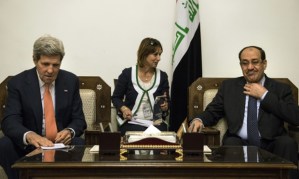
Iraqi Prime Minister Nuri al-Maliki and US Secretary of State John Kerry meet at the Prime Minister’s Office in Baghdad. Photograph: Brendan Smialowski/AFP/Getty Images
The discussions with the Maliki government are not likely to be particularly congenial. According to NPR:
U.S. Secretary of State John Kerry flew to Baghdad on Monday to personally urge the Shiite-led government to give more power to political opponents before a Sunni insurgency seizes more control across the country and sweeps away hopes for lasting peace.
The meeting scheduled between Kerry and Iraqi Prime Minister Nouri al-Maliki was not expected to be friendly, given that officials in Washington have floated suggestions that the Iraqi premier should resign as a necessary first step toward quelling the vicious uprising. Nor will it likely bring any immediate, tangible results, as al-Maliki has shown no sign of leaving and Iraqi officials have long listened to — but ultimately ignored — U.S. advice to avoid appearing controlled by the decade-old specter of an American occupation in Baghdad.
Still, having suffered together through more than eight years of war — which killed nearly 4,500 American troops and more than 100,000 Iraqis — the two wary allies are unwilling to turn away from the very real prospect of the Mideast nation falling into a fresh bout of sectarian strife.
“This is a critical moment where, together, we must urge Iraq’s leaders to rise above sectarian motivations and form a government that is united in its determination to meet the needs and speak to the demands of all of their people,” Kerry said a day earlier in Cairo. He was there in part to meet with Egyptian President Abdel-Fattah el-Sissi to and discuss a regional solution to end the bloodshed by the insurgent Islamic State of Iraq and the Levant, or ISIL.
Good luck with that. I wish Hillary were still in charge at State.
From Jay Solomon at The Wall Street Journal: U.S. Faces Opposing Regional Interests in Bid to Blunt Insurgency in Iraq.
AMMAN, Jordan—As the Obama administration’s top diplomat arrived in the Middle East to gather support to blunt a Sunni insurgency in Iraq, the U.S. was colliding with the region’s ethnic, tribal and sectarian divisions.
Deep gaps between U.S. and Arab views over the crisis have grown more obvious in recent days, say American and regional officials, hampering Washington’s response to the onslaught by the Islamic State of Iraq and al-Sham, or ISIS, which this month seized control of territories straddling Iraq and Syria.
The task gained new urgency on Sunday when ISIS swept through new Iraq towns and overran two border crossings with Jordan and Syria, blocking the Iraqi government’s access to its western frontier, security officials said.
President Barack Obama raised the stakes on Sunday, telling CBS News that ISIS threatens American interests if it turns to global terrorism, two days after he announced plans to send U.S. military advisers and supplies to Iraq and called for a new, more inclusive government in Baghdad.
The crisis in Iraq has exposed contradictions in traditional Mideast alliances, in some ways placing the U.S. alongside its sworn enemy, Shiite-ruled Iran, in a joint effort to halt ISIS, while in other ways putting Washington at odds with longtime Sunni allies in the Persian Gulf, who want to weaken Iran’s sway over Iraq.
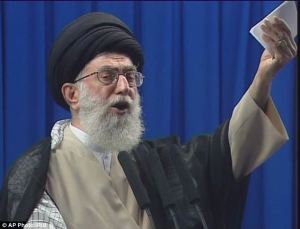
Iran’s supreme leader Ayatollah Khamenei in 2009
Meanwhile, yesterday, according to Reuters:
Iran’s supreme leader accused the United States on Sunday of trying to retake control of Iraq by exploiting sectarian rivalries, as Sunni insurgents drove towards Baghdad from new strongholds along the Syrian border.
Ayatollah Ali Khamenei’s condemnation of U.S. action came three days after President Barack Obama offered to send 300 military advisers to help the Iraqi government. Khamenei may want to block any U.S. choice of a new prime minister after grumbling in Washington about Shi’ite premier Nuri al-Maliki.
The supreme leader did not mention the Iranian president’s recent suggestion of cooperation with Shi’ite Tehran’s old U.S. adversary in defense of their mutual ally in Baghdad.
On Sunday, militants overran a second frontier post on the Syrian border, extending two weeks of swift territorial gains as the Islamic State of Iraq and the Levant (ISIL) pursues the goal of its own power base, a “caliphate” straddling both countries that has raised alarm across the Middle East and in the West.
“We are strongly opposed to U.S. and other intervention in Iraq,” IRNA news agency quoted Khamenei as saying. “We don’t approve of it as we believe the Iraqi government, nation and religious authorities are capable of ending the sedition.”
Will we ever be rid of these insane wars started by Dick Cheney and his puppet George W. Bush? At least Bush has the decency to keep quiet, but Cheney just won’t shut up even though he has no answers for the current crisis. From Raw Story: Dick Cheney doesn’t ‘intend any disrespect’ by suggesting Obama ‘guilty of treason’
Former Vice President Dick Cheney on Sunday insisted that he did not “intend any disrespect” when he suggested that President Barack Obama was guilty of treason by trying to undermine the United States before leaving office.
In a Wall Street Journal op-ed last week, Cheney — and his daughter Liz — said that the president was “determined to leave office ensuring he has taken America down a notch.”
He went on to suggest that Obama was a “fool” if he intended to work with Iran to prevent violence in Iraq.
“In this op-ed, you suggest the president is a fool,” ABC’s Jonathan Karl pointed out during a Sunday interview with Cheney. “That is the word you used, ‘only a fool would take the approach he’s taking in Iraq right now.’”
“It almost seems like you’re accusing the president of treason, that he’s intentionally bringing America ‘down a notch,’” Karl noted.
Cheney did not deny that he had accused the commander-in-chief of the United States of treason, but he insisted that he had not just called Obama a “fool” over the violence in Iraq.
“It referred to the fact that we’ve left a big vacuum in the Middle East by our withdrawal from Iraq with a no stay-behind agreement,” the former vice president said. “By the commitment that he made just a few weeks ago, that we are going to completely withdraw from Afghanistan with a no stay-behind agreement.”
See also, Dick Cheney’s amazing chutzpah on Iraq, by Paul Waldman (CNN)
Cheney needs to STFU and go on a hunting trip or something. Maybe he could take Tony Scalia with him.
In other news . . .

Right wing nut and birther Ed Klein has a new Hillary hate book out, and the New York Post has been publishing laughable excerpts. The trouble is, the wingnuts will believe the lies and the media won’t counter them. Be sure to read what Joseph Cannon has to say about the De-KLEIN of journalism.
Why does anyone still print or read right-wing pseudojournalist Edward Klein?
A while back, this fictioneer published a book alleging a lesbian relationship between Hillary Clinton and Huma Abedin — a work which one critic called “the sleaziest, most derivative, most despicable political biography ever.” Klein’s revelations always come from anonymous “informants” — one of whom, I’ve heard, is Slender Man.
Klein has a new book out and the NY Post is pushing it, even though the folks running the NY Post must know that they’re peddling garbage….
Anyone who takes this nonsense seriously must also believe that wrestling is real. Nevertheless, the right-wing propagandists are pretending to accept Klein’s work at face value. (See also here, especially the telling piece of “Hildebeest” research.)
This is a horrible story from the AP via Fox News: Researchers discover mass graves with bodies of immigrants in South Texas cemetery.
FALFURRIAS, Texas – Volunteer researchers have uncovered mass graves in a South Texas cemetery that they believe contain the bodies of immigrants who died crossing into the U.S. illegally, according to published reports Saturday.
The discovery at Sacred Heart Burial Park in Falfurrias came in the last two weeks, as Baylor University anthropologist Lori Baker and Krista Latham, a forensic anthropologist at the University of Indianapolis, and their students worked as part of a multi-year effort to identify immigrants who’ve died in the area near the U.S.-Mexico border.
Teams unearthed remains in trash bags, shopping bags, body bags or without a container at all, according to the Corpus Christi Caller Times (http://bit.ly/1qqH7CZ ). In one burial, bones of three bodies were inside one body bag. In another, at least five people in body bags and smaller plastic bags were piled on top of each other. Skulls also were found in biohazard bags placed between coffins.
They exhumed 110 unidentified people from the cemetery in 2013. This summer, researchers have performed 52 exhumations, but because some remains were stored together, further study will be needed to determine exactly how many bodies have been recovered, Baker said.
These people just suddenly dropped dead as they crossed the border? Apparently this is the work of a local funeral home, Funeraria del Angel Howard-Williams, which the state has been paying $450 each to deal with bodies of immigrants that have been discovered all over Texas. The funeral home has been paid for this service for at least 16 and as long as 22 years! Were there any autopsies? Did anyone determine whether any of these deaths were homicides?
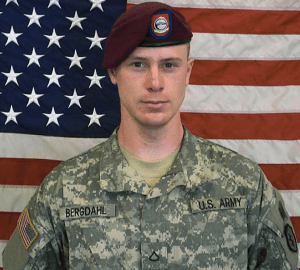
We haven’t heard much about Bowe Bergdhal lately. Via The Boston Globe, the AP reports this morning that he has been “Shifted to Outpatient Care.”
SAN ANTONIO (AP) — Sgt. Bowe Bergdahl, who had been a prisoner of war in Afghanistan for five years, has been shifted to outpatient care at a Texas military base, the U.S. Army said in a statement Sunday.
Bergdahl, 28, had been receiving inpatient treatment at Brooke Army Medical Center at Fort Sam Houston. He is now receiving outpatient care on the base in San Antonio, according to the statement. The Army said his ‘‘reintegration process’’ is proceeding with exposure to more people and a gradual increase in social interaction.
He arrived at the Texas medical center on June 13 after nearly two weeks recuperating at a U.S. military hospital in Germany. Army officials said then that Bergdahl was in stable condition and was working daily with health care providers to regain a sense of normalcy and move forward with his life.
The Army statement Sunday said Bergdahl is receiving counseling from ‘‘Survival, Evasion, Resistance and Escape’’ psychologists’’ to ‘‘continue to ensure he progresses to the point where he can return to duty.’’
The Army said specifics of Bergdahl’s location would not be made public.
That’s it for me for today, except that I’ve become a World cup fan and I might even watch some of the games the US team isn’t participating in. Ralph’s enthusiasm has sucked me in!
What stories are you following today? Please let us know in the comment thread.
Monday Reads
Posted: June 16, 2014 Filed under: Foreign Affairs, morning reads, Republican politics, U.S. Politics | Tags: Afghanistan, bionic pancreas, Chelsea Manning, David Brat, Diabetes, Eric Cantor, IRAQ, LeBron James, Scott Walker, war crimes 32 Comments
Good Morning!!
There’s not a lot of good news to report this morning except that the Miami Heat lost the NBA championship last night, cementing LeBron James’ reputation as a choker. He couldn’t win in Cleveland, and he can’t lead in Miami. He’s just all about LeBron.
The situation in Iraq is getting more dire. I’m sure you heard about the reported mass executions of Iraqi troops by ISIS militants yesterday. From The New York Times:
BAGHDAD — Wielding the threat of sectarian slaughter, Sunni Islamist militants claimed on Sunday that they had massacred hundreds of captive Shiite members of Iraq’s security forces, posting grisly pictures of a mass execution in Tikrit as evidence and warning of more killing to come.
The possible mass killing came as militants cemented control of the city of Tal Afar, west of Mosul, after two days of fierce clashes with Iraqi troops, residents and senior security officials said. The city came under mortar attack, sending residents fleeing toward Sinjar in the north, which is under control of Kurdish pesh merga troops. Residents said the militants freed dozens of prisoners.
BAGHDAD — Wielding the threat of sectarian slaughter, Sunni Islamist militants claimed on Sunday that they had massacred hundreds of captive Shiite members of Iraq’s security forces, posting grisly pictures of a mass execution in Tikrit as evidence and warning of more killing to come.
The possible mass killing came as militants cemented control of the city of Tal Afar, west of Mosul, after two days of fierce clashes with Iraqi troops, residents and senior security officials said. The city came under mortar attack, sending residents fleeing toward Sinjar in the north, which is under control of Kurdish pesh merga troops. Residents said the militants freed dozens of prisoners.
Lovely. “War Crimes” hardly seems strong enough to characterize such horrendous acts.
In an atmosphere where there were already fears that the militants’ sudden advance near the capital would prompt Shiite reprisal attacks against Sunni Arab civilians, the claims by ISIS were potentially explosive. And that is exactly the group’s stated intent: to stoke a return to all-out sectarian warfare that would bolster its attempts to carve out a Sunni Islamist caliphate that crosses borders through the region.
The sectarian element of the killings may put more pressure on the Obama administration to aid Iraq militarily. In fact, the militants seemed to be counting on it. A pronouncement on Sunday by the group’s leader, Abu Bakr al-Baghdadi, had a clear message for the United States: “Soon we will face you, and we are waiting for this day.”

CNN reports that some U.S. embassy staff in Iraq have been moved to another location.
The Iraqi air force struck back at the militant group ISIS, the Islamic State in Iraq and Syria, killing more than 200 militants, Iraqi state TV reported Monday morning. The air raids took place in Saqlawiyah, northwest of Fallujah, according to a graphic run by state TV.
ISIS has been ruthlessly fighting to take control of Iraq and has apparently posted chilling photos on jihadi Internet forums seeming to show the executions of Iraqi security forces.
ISIS, an al Qaeda splinter group, wants to establish a caliphate, or Islamic state, that would stretch from Iraq into northern Syria. The group has had substantial success in Syria battling Syrian President Bashar al-Assad’s security forces.
According to The Washington Post, the insurgents have captured American equipment and may be in possession of “advanced radios” that would make them much more effective.
Iraq’s security forces, propped up by American equipment and weapons, have been routed by a contingent of insurgents bent on extending their territory from strongholds in Syria deep into Iraq. As Mosul and other cities fell, the West saw a host of images of once-American Humvees and helicopters firmly in the hands of its enemies.
Outrage followed shock, as years of effort in Iraq by the U.S. military seemed to unravel in a coup-de-grace that played out over the Internet. Analysts speculated that the newly seized weapons and vehicles could turn fighters from the Islamic State of Iraq and Syria into an even stauncher foe.
Yet, among the towed Black Hawk helicopters, Howitzer cannons and Humvees plastered all over social media lies an unseen weapon that could make the ISIS fighters exponentially more lethal if employed properly: advanced radio equipment.
Read more at the link.

Iran is sending in troops to aid the insurgents, according to CNN.
What’s happening in Iraq now has all the makings of a civil war — and a full-blown foreign policy crisis. The United States is mulling direct talks with Iran while it boosts security at the U.S. Embassy in Baghdad with military personnel.
Why Iran? In recent days, Iran has sent hundreds of troops to fight alongside Iraqi government security forces in Diyala province, a senior security official in Baghdad told CNN.
The article summarizes the latest events on the ground as of early this morning. Finally, an editorial in The Independent UK states bluntly that
The outside world, starting with the United States, cannot hope to reverse the course of events in Iraq by intervening on the ground, and President Barack Obama was right to rule out US troops going back there.
However, that doesn’t mean taking up an observer’s seat as the region descends into ever greater chaos. Washington should encourage the tentative rapprochement between Sunni Saudi Arabia and Shia Iran, both of which are starting to see just how dangerous the Sunni-Shia power struggle is becoming to each of them. We should do our utmost to shore up the defences of vulnerable but still stable states in the region, such as Jordan.
Western countries could also afford to be more generous in helping to address the humanitarian aspect of the latest crisis. Britain has so far offered an extra £3m to help tens of thousands of refugees fleeing the advance of Isis, most of whom are now camping in Kurdish-controlled areas of northern Iraq. It goes without saying that they do not have access to things like the best survival backpack or basic nutrition, it hardly seems an adequate gesture.
With any luck, the Sunnis in Syria and Iraq will at some point turn against their self-styled deliverers in Isis. In that case, it is vital that the Shia-dominated regime in Baghdad comes under pressure to keep the door open to talks about some kind of federal option for the Sunnis, and for the Kurds. It is late in the day for Iraq even to try to play with the federalisation option, but just possibly some kind of gossamer-thin state can be salvaged from the current mess. Right now, none of the options looks good, but despair is not the answer.
In other news,

Chelsea Manning has broken her silence with an op-ed in the Sunday New York Times in which she harshly criticizes the methods used by the military to control press coverage of the Iraq and Afghanistan wars and–presumably–the U.S. media’s acquiescence to that control. For example,
If you were following the news during the March 2010 elections in Iraq, you might remember that the American press was flooded with stories declaring the elections a success, complete with upbeat anecdotes and photographs of Iraqi women proudly displaying their ink-stained fingers. The subtext was that United States military operations had succeeded in creating a stable and democratic Iraq.
Those of us stationed there were acutely aware of a more complicated reality.
Military and diplomatic reports coming across my desk detailed a brutal crackdown against political dissidents by the Iraqi Ministry of Interior and federal police, on behalf of Prime Minister Nuri Kamal al-Maliki. Detainees were often tortured, or even killed.
Read much more at the link.
Speaking of media co-option, the NYT has an interesting op-ed by long-time reporter David Carr about the media’s failure to anticipate Eric Cantor’s stunning defeat in Virginia’s primary last week.
It’s now clear why the primary defeat of the House majority leader,Eric Cantor, came so completely out of the blue last week: Beltway blindness that put a focus on fund-raising, power-brokering and partisan back-and-forth created a reality distortion field that obscured the will of the people.
But that affliction was not Mr. Cantor’s alone; it is shared by the political press. Reporters and commentators might want to pause and wipe the egg off their faces before they go on camera to cluck-cluck about how Mr. Cantor, Republican of Virginia, missed signs of the insurgency that took him out. There was a lot of that going around, and the big miss by much of the political news media demonstrates that news organizations are no less a prisoner of Washington’s tunnel vision than the people who run for office.
All politics is local, which may explain why The Richmond Times-Dispatch and The Chesterfield Observer both took David Brat’s Tea Party challenge to Mr. Cantor seriously, but few of the publications inside the District that follow the majority leader’s every wiggle and wobble sensed that he was leaving the home fires dangerously unattended….
The same forces that keep politicians penned up within a few blocks of Pennsylvania Avenue work on journalists as well. No one wants to stray from the white-hot center of power for fear of being stuck in some forsaken locale when something big happens in Washington — which is why it has become one of the most overcovered places on earth.
This problem is compounded by the “diminution” of regional newspapers. Read more at the link.

I haven’t had time to work through the whole thing yet, but Alec MacGillis has a long profile of Wisconsin Governor Scott Walker that seems worth a read: The Unelectable Whiteness of Scott Walker: A journey through the poisonous, racially divided world that produced a Republican star.
I’ll end with some exciting science news from The Boston Globe: Boston-Led Team Developing ‘Bionic Pancreas’ for Diabetics.
Scientists have made big progress on a ‘‘bionic pancreas’’ to free some people with diabetes from the daily ordeal of managing their disease. A wearable, experimental device passed a real-world test, constantly monitoring blood sugar and automatically giving insulin or a sugar-boosting drug as needed, doctors said Sunday.
The device improved blood-sugar control more than standard monitors and insulin pumps did when tested for five days on 20 adults and 32 teens. Unlike other artificial pancreases in development that just correct high blood sugar, this one also can fix too-low sugar, mimicking what a natural pancreas does.
The device was developed at Massachusetts General Hospital and Boston University. Results were featured Sunday at an American Diabetes Association conference in San Francisco and were published online by the New England Journal of Medicine.
More from NPR: Father Devises A ‘Bionic Pancreas’ To Help Son With Diabetes. Very interesting!
I have a few more links that I’ll post in comments.
So . . . what else is happening? Please post your thoughts and links on any topic in the comment thread.
Friday Reads: Some Things Just Never Change
Posted: June 13, 2014 Filed under: Hillary Clinton, Iraq, morning reads, right wing hate grouups 78 Comments Good Morning!
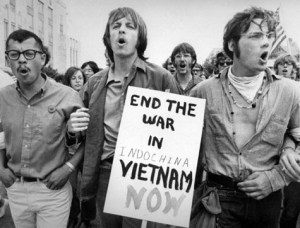
Do you remember the picture over there on the left? It’s our country getting out of Vietnam in 1975. That happened during my first year at university. My high school graduation was overshadowed by Watergate and the resignation of Nixon. My coming of age was basically full of these kinds of things that jade you. I won’t even go into the amazingly bad economy full of stagflation and unemployment. It’s amazing to me that my daughters now get to experience my Déjà vu with their fresh eyes. The photo down there on the right is the US leaving Iraq. The similarities are frightening. So look at these photos and then we will talk about Iraq which has been a singularly unpleasant topic for quite some time. It’s more unraveling of very bad U.S. Policy. Rachel Maddow covered it very thoroughly last night. Iraq is basically splitting into three distinct entities. It appears Baghdad will fall shortly.  Iraq is completely and fully experiencing a civil war.
Iraq was on the brink of falling apart Thursday as al-Qaeda renegades asserted their authority over Sunni areas in the north, Kurds seized control of the city of Kirkuk and the Shiite-led government appealed for volunteers to help defend its shrinking domain. The discredited Iraqi army scrambled to recover after the humiliating rout of the past three days, dispatching elite troops to confront the militants in the central town of Samarra and claiming that it had recaptured Tikrit, the home town of the late Iraqi strongman Saddam Hussein, whose regime was toppled by U.S. troops sweeping north from Kuwait in 2003. But there was no sign that the militant push was being reversed. With the al-Qaeda-inspired Islamic State of Iraq and Syria now sweeping south toward Baghdad, scattering U.S.-trained security forces in its wake, the achievements of America’s eight-year war in Iraq were rapidly being undone. Iraq now seems to be inexorably if unintentionally breaking apart, into Shiite, Sunni and Kurdish enclaves that amount to the de facto partition of the country. As the scale of the threat to the collapsing Iraqi state became clear, Obama administration officials met to discuss options for a response, including possible airstrikes. An Iraqi official in the office of Prime Minister Nouri al-Maliki said the United States had committed to carrying out airstrikes against the militants, but U.S. officials said no decision had been reached. President Obama indicated there would be some form of intervention, though he did not specify what. “It’s fair to say . . . there will be some short-term things that need to be done militarily,” he said.
 Iraqi Kurds have taken the oil-rich city of Kirkuk while radical Sunnis head for Baghdad. Shia radicals aligned with Iran and Syria have also moved into the embattled country.
In Mosul, Sunni militants of the Islamic State of Iraq and the Levant (ISIL) staged a parade of American Humvees seized from the collapsing Iraqi army in the two days since the fighters drove out of the desert and overran Iraq’s second biggest city. Two helicopters, also seized by the militants, flew overhead, witnesses said, apparently the first time the militant group has obtained aircraft in years of waging insurgency on both sides of the Iraqi-Syrian frontier. State television showed what it said was aerial footage of Iraqi aircraft firing missiles at insurgent targets in Mosul. The targets could be seen exploding in black clouds. Further south, the fighters extended their lightning advance to towns only about an hour’s drive from the capital Baghdad, where Shi’ite militia are mobilizing for a potential replay of the ethnic and sectarian bloodbath of 2006-2007. Trucks carrying Shi’ite volunteers in uniform rumbled towards the front lines to defend the capital. The stunning advance of ISIL, which aims to build a Caliphate ruled on medieval Sunni Islamic principles across Syria and Iraq, is the biggest threat to Iraq since U.S. troops withdrew in 2011. Hundreds of thousands of people have fled their homes in fear as the militants seized the main cities of the Tigris valley north of Baghdad in a matter of days. The security forces of Iraq’s autonomous Kurdish north, known as the peshmerga, or those who confront death, took over bases in Kirkuk vacated by the army, a spokesman said.
There were no jihadis in Iraq when Dubya et al lied us into war. There certainly are jihadis there now.
As the U.S. pullout began under the terms of a treaty signed in 2008 by then-President George W. Bush, Maliki, the leader of a Shiite political party, promised to run a more inclusive government—to bring more Sunnis into the ministries, to bring more Sunnis from the Sons of Iraq militia into the national army, to settle property disputes in Kirkuk, to negotiate a formula on sharing oil revenue with Sunni districts, and much more.
Maliki has since backpedaled on all of these commitments and has pursued policies designed to strengthen Shiites and marginalize Sunnis. That has led to the resurgence of sectarian violence in the past few years. The Sunnis, finding themselves excluded from the political process, have taken up arms as the route to power. In the process, they have formed alliances with Sunni jihadist groups—such as the Islamic State of Iraq and Syria, or ISIS, which has seized not just Mosul but much of northern Iraq—on the principle that the enemy of their enemy is their friend.Something like this has happened before. Between 2005 and 2006, jihadists who called themselves al-Qaida in Iraq, led by Abu Musab al-Zarqawi, took control of Anbar province, in the western part of the country, by playing on the population’s fear of the anti-Sunni ethnic-cleansing campaigns launched by Maliki’s army.* ISIS, an offshoot of Zarqawi’s organization, is following the same handbook, picking up support from one of northern Iraq’s leading Sunni militias, Jaysh Rijal al-Tariqah al-Naqshbandia, or JRTN. That is a risky move for a group like JRTN, which shares neither the millenarian goals nor the extremely violent tactics of ISIS (which, it’s worth noting, was expelled from al-Qaida because even current al-Qaida leader Ayman al-Zawahiri considered the group too violent). But JRTN’s leaders have accepted the risk for now to advance their own goal of overthrowing Maliki. (They boast that they have been fighting alongside ISIS, but disavow involvement in the killing of civilians.)The fall of Mosul is particularly poignant because that was the city where peace and prosperity seemed most likely in the early days of the American occupation. David Petraeus, then the three-star general who commanded the 101st Airborne Division, applied his theory of counterinsurgency to all of Nineveh province, of which Mosul was the capital. And, for a while anyway, it worked.
While most U.S. commanders in post-Hussein Iraq were ordering their soldiers to bust down doors and arrest or shoot all men who seemed to be insurgents, Petraeus and his team took steps to create a government. Using funds pilfered from Saddam Hussein’s coffers, they vetted candidates for a citywide election (selecting leaders from all factions and tribes), started up newspapers and TV stations, coordinated fuel shipments from Turkey, and reopened businesses, communication lines, and the university. This game plan was classic “nation-building,” a phrase anathema to most Army generals and the secretary of defense at the time, Donald Rumsfeld. The idea was not to make the people of Mosul love America, but rather to make them feel invested in the future of the new Iraq.
 So, it seems Dubya et all have not only brought on a civil war in Iraq, they planted the seeds for a civil war in the Republican Party. More than ever, it’s important to vote in the midterms this year. We cannot afford to have this battle fought on the floor of our Congress. The Tealiban are fed up with lip service. They want to make sure that women wear their versions of the head-to-toe burkhas, that gays are stoned, and that we have no federal government to stand in the way of a new NeoConfederacy.
The GOP’s leadership crisis extends beyond Congress. In recent cycles, Republican presidential primaries have been relatively orderly affairs where the party establishment rallies around a frontrunner—often the person who came in second the last time (Bob Dole, John McCain, Mitt Romney)—who holds off right-wing challengers on his way to the nomination. This year, however, that kind of elite control looks unlikely. Chris Christie, the first choice of many GOP leaders, is so wounded that even if he runs, he will not be the frontrunner. Some donors are rallying behind Jeb Bush. If he does not run, they may turn to Marco Rubio. But the road to the GOP nomination runs through Iowa and South Carolina, whose Republican activists resemble the anti-establishment, talk-radio-powered folks who knocked off Cantor. If those activists helped defeat Cantor merely for supporting citizenship for undocumented immigrant children, think how they’ll react to Bush or Rubio, who support a path to citizenship for their parents as well. In the Democratic Party, by contrast—which has enjoyed a reputation for organizational anarchy since the days of Will Rogers—party hierarchies are clear and largely unchallenged. A February Pew poll found that Democrats were more than 20 points more likely than Republicans to say their party’s leaders stand up for party principles. And the consequences are plain to see.
Even though a lot of us–including me–are not really Democrats or Republicans, it is important that the extremists in the Republican party go no further. We could spend the next two years with a right wing radicalism we’ve never seen before in this country.
American political parties always face a tension between their establishment and ideological wings. On the Republican side, going back more than a hundred years to the Teddy Roosevelt era, that was a struggle between moderate progressives and conservatives. Now it is different. There are no moderates or progressives in today’s GOP; the fight is between hard-line conservatives who believe in smaller government and radical nihilists who want to blow up the whole thing, who have as much disdain for Republican traditional conservatives as they do for liberals.
Meanwhile, the urban-rural, reactionary-progressive split seems more pronounced than ever. An extremely interesting Pew Poll was released  yesterday that shows exactly what it means to live in a divided America.
The overall share of Americans who express consistently conservative or consistently liberal opinions has doubled over the past two decades from 10% to 21%. And ideological thinking is now much more closely aligned with partisanship than in the past. As a result, ideological overlap between the two parties has diminished: Today, 92% of Republicans are to the right of the median Democrat, and 94% of Democrats are to the left of the median Republican. Today 92% of Republicans are to the right of the median Democrat, and 94% of Democrats are to the left of the median RepublicanPartisan animosity has increased substantially over the same period. In each party, the share with a highly negative view of the opposing party has more than doubled since 1994. Most of these intense partisans believe the opposing party’s policies “are so misguided that they threaten the nation’s well-being.”
I guess I do agree that today’s Republican party is a threat to this country. It’s definitely a threat to American women.
Here’s a Fresh Air interview with Hillary Clinton if you’re interested.
Hillary Clinton is on a national book tour for her new memoir, Hard Choices. The book outlines her four years as secretary of state during President Obama’s first term, when she met with leaders all over the world.
One of her priorities was to campaign for gay rights and women’s rights. She says she saw the “full gamut” on how women were treated, and in some cases it was “painful to observe.”
“It has become — and I think will continue to be — a very important issue for the United States to combat around the world and to stand up for the rights of all people,” she tells Fresh Air‘s Terry Gross.
The only thing that gives me hope is that the average Fox viewer and Republican are older than me. Let’s hope our daughters and sons, our granddaughters and grandsons see the insanity of repeating these same mistakes. The polls of our future citizens look a lot more hopeful than the polls based on the old guard.
What’s on your reading and blogging list today?
Monday Reads
Posted: June 9, 2014 Filed under: Foreign Affairs, morning reads, U.S. Politics | Tags: Afghanistan, Bowe Bergdahl, Cliven Bundy, Hillary Clinton, Karachi Airport attack, Las Vegas shootings, Pakistan, shooting sprees, Taliban, Tea Party, Turing Test breakthrough, White supremacists 23 Comments
Good Morning!
Another day, another shooting spree. The gun nuts don’t even take Sunday off. In Las Vegas, a married couple in their late 20s killed two police officers, Alyn Beck and Igor Soldo, and a civilian before killing themselves.
From the Las Vegas Review-Journal: Shooters in Metro ambush that left five dead spoke of white supremacy and a desire to kill police.
Two Las Vegas police officers were killed Sunday in what appears to be a politically motivated ambush in a pizza restaurant that spilled over to a nearby Wal-Mart, where the two shooters committed suicide after killing a woman in the store….
A law enforcement official who has been briefed on the incident said an officer — unconfirmed reports indicate it was Soldo — was refilling a soft drink when the female shooter approached him from behind and shot him in the head, killing him instantly.
The woman then shot the other officer several times as he drew his pistol. Gillespie said the officer was able to return fire but it was unclear if he hit anyone….
Witnesses told police one of the shooters yelled “This is the start of a revolution” before shooting the officers. Gillespie later said he could not confirm that.
The shooters then stripped the officers of their weapons and ammunition and badges, according to a law enforcement official with knowledge of the investigation. They then covered the officers with something that featured the Gadsden flag, a yellow banner with a coiled snake above the words, “Don’t tread on Me.”
Gee, you mean these terrorists weren’t muslims or Obama supporters? After shooting the two police officers the couple went across the street to a Walmart where they shot and killed a yet unidentified woman near the entrance. The woman then shot and wounded her partner and shot herself, and the man finished himself off. The two were carrying large duffle bags, and the bomb squad was called to the scene as well as to the couple’s apartment a few miles away. Now get this (emphasis added):
Several neighbors identified the man as Jared, while one called the woman Amanda.
Like many of the neighbors contacted, Krista Koch said she didn’t know the couple’s last names. She described them as “militant.” They talked about planning to kill police officers, “going underground” and not coming out until the time was right to kill.
Brandon Monroe, 22, has lived in the complex for about two weeks. He said the man who lived in the apartment that was being searched often rambled about conspiracy theories. He often wore camouflage or dressed as Peter Pan to work as a Fremont Street Experience street performer. A woman lived with him, Monroe said, but he didn’t see her as often.
They were weird people, Monroe said, adding that he thought the couple used methamphetamine.
“The man told Monroe he had been kicked off Cliven Bundy’s ranch 80 miles northeast of Las Vegas while people from throughout the U.S. gathered there in protest of a Bureau of Land Management roundup of Bundy’s cattle.” Jessica Anderson, 27, said. She lived next door.
There is still more detail at the article link.

Updates on the Bergdahl story:
From the Wall Street Journal, Official: Bowe Bergdahl has declined to speak to family.
While he spent five years in captivity after being captured by Afghan insurgents in 2009, Bergdahl doesn’t yet want to talk to his family on the phone, the official said.
Bergdahl has likely been shielded from most of the backlash his release has generated in the U.S. Some former platoon soldiers have accused him of deserting his post and lawmakers from both parties have questioned the decision to trade America’s lone prisoner of war in Afghanistan for five Talibanofficials held at Guantanamo Bay, Cuba.
Local authorities canceled a homecoming celebration in his Idaho hometown because of the backlash. The celebration was canceled specifically because of threats made against the family, officials said.
The Federal Bureau of Investigation confirmed that it was investigating threats made against Bergdahl’s parents.
From The New York Times: Bergdahl Was in Unit Known for Its Troubles.
The platoon was, an American military official would assert years later, “raggedy.”
On their tiny, remote base, in a restive sector of eastern Afghanistan at an increasingly violent time of the war, they were known to wear bandannas and cutoff T-shirts. Their crude observation post was inadequately secured, a military review later found. Their first platoon leader, and then their first platoon sergeant, were replaced relatively early in the deployment because of problems….
Indeed, an internal Army investigation into the episode concluded that the platoon suffered from lapses in discipline and security in the period before Sergeant Bergdahl — a private first class at the time who was promoted while in captivity — disappeared into Paktika Province, two officials briefed on the report said.
Bergdahl was not a peacenik.
Sergeant Bergdahl was viewed as standoffish or eccentric, smoking a pipe instead of spitting tobacco, as so many soldiers do, and reading voraciously when others napped or watched videos. But he was not isolated from his platoon mates, some said. And while he was, like other soldiers in the platoon, often disappointed or confused by their mission in Paktika, some of his peers also said that Sergeant Bergdahl seemed enthusiastic about fighting, particularly after the platoon was ambushed several weeks before his disappearance.
“He’d complain about not being able to go on the offensive, and being attacked and not being able to return fire,” said Gerald Sutton,who knew Sergeant Bergdahl from spending time together on their tiny outpost, Observation Post Mest Malak, near the village of Yahya Khel, about 50 miles west of the Pakistani border.
Read much more at the link.
From the LA Times: Most of 5 freed Taliban prisoners have less than hard-core pasts.
Obama critics have said the swap [of prisoners for Bergdahl] could endanger American lives, with Sen. John McCain (R-Ariz.) calling the five Taliban members “the hardest and toughest of all.”
A closer look at the former prisoners, however, indicates that not all were hard-core militants. Three held political positions in the Taliban government that ruled Afghanistan from 1996 to 2001 and were considered relative moderates. A fourth was a mid-level police official, experts say.
The fifth, however, has a darker past. Mohammed Fazl was chief of staff of the Taliban army and is accused of commanding forces that massacred hundreds of civilians in the final years of Taliban rule before the 2001 U.S.-led invasion. He was arrested in November 2001 after surrendering to U.S.-allied warlords in northern Afghanistan.
“Fazl is the only one of the five to face accusations of explicit war crimes and they are, indeed, extremely serious,” Kate Clark of the Afghanistan Analysts Network, a Kabul-based research group, wrote in a commentary published Wednesday.
The backgrounds of the prisoners, who are confined to the Persian Gulf nation of Qatar for one year under the terms of the exchange, indicate that they would have little utility on the battlefield after more than a decade in prison. They range in age from 43 to 47. In their absences, the Taliban movement they served has evolved into a complex and extremely violent insurgency that routinely kills civilians and has been decimated — although far from defeated — by years of U.S. counter-terrorism operations.
From the New York Times: Critics of P.O.W. Swap Question the Absence of a Wider Agreement.
When the heads of the two major intelligence committees criticized the Obama administration on Sunday for swapping Sgt. Bowe Bergdahl for five members of the Taliban, they homed in on one part of the deal that the White House has struggled for a week, unsuccessfully, to explain. The question is why the five were released without any commitments to a larger agreement, under which the Taliban would renounce international terrorism, and begin a process of reconciliation with the government of Afghanistan.

Other News:
According the The Independent UK, a computer has for the first time convinced humans that it was a real person: Turing Test breakthrough as super-computer becomes first to convince us it’s human.
A programme that convinced humans that it was a 13-year-old boy has become the first computer ever to pass the Turing Test. The test — which requires that computers are indistinguishable from humans — is considered a landmark in the development of artificial intelligence, but academics have warned that the technology could be used for cybercrime.
Computing pioneer Alan Turing said that a computer could be understood to be thinking if it passed the test, which requires that a computer dupes 30 per cent of human interrogators in five-minute text conversations.
Eugene Goostman, a computer programme made by a team based in Russia, succeeded in a test conducted at the Royal Society in London. It convinced 33 per cent of the judges that it was human, said academics at the University of Reading, which organised the test.
It is thought to be the first computer to pass the iconic test. Though other programmes have claimed successes, those included set topics or questions in advance.
The Wall Street Journal reports on an airport attack in Pakistan that killed at least 28 people: Karachi Airport Attack: Pakistani Taliban Claim Responsibility.
KARACHI, Pakistan—Militants stormed Karachi’s Jinnah International Airport late Sunday, exchanging fire with security forces and leaving at least 28 people dead, officials said.
Separately, gunmen and suicide bombers attacked pilgrims from the minority Shiite sect of Islam in the west of Pakistan, killing at least 25 pilgrims.
The Pakistani Taliban, a group closely linked to al Qaeda, claimed responsibility for the airport attack. The group, formally known as Tehreek-e-Taliban Pakistan, said the attack was revenge for recent Pakistani military airstrikes against them, which followed a breakdown in peace talks with the militants in the last few weeks….
At the airport, the assault began at around 10:20 p.m. local time Sunday and lasted at least six hours, with gunfire, explosions and a raging fire. All flights at the airport were suspended late Sunday. By midday Monday, local time, security officials said the airport was clear of militants. Flights were expected to resume by late afternoon.
“They attacked the airport security personnel and then entered,” Adnan, a witness who only gave his first name, said.
The assault focused on the airport’s relatively less heavily guarded Terminal One, which is used for cargo and VIP flights. Two cargo bays appeared to have been destroyed, witnesses said.

Hillary is about to begin her book tour, and the LA Times calls it a dry run for 2016.
e’s traveled the country mixing weighty policy pronouncements with joking references to her hair. She’s reflected on gender bias and offered career advice to young women, gushed about becoming a grandma and raked in a fortune in speaking fees on the lecture circuit.
After all that — and even having a shoe flung at her at a trash collectors’ convention in Las Vegas — Hillary Rodham Clinton takes her flirtation with the 2016 presidential race to a new level this week, beginning a minutely orchestrated book tour that will whisk her coast to coast for a mix of book signings and carefully calibrated television interviews.
Since stepping down as secretary of State 16 months ago, Clinton has managed to effectively freeze out any Democratic competition for the presidential nomination, no small feat in a party with a history of upstarts and upsets — especially for someone who has yet to say whether she even plans to run.
Throughout, she’s weathered a relentless degree of scrutiny, her daily travels exhaustively chronicled, her every utterance parsed for meaning. Even matters like her daughter Chelsea’s pregnancy are put to the will-or-won’t-she test.
The LA Times also reports that Hillary predicted the Bergdahl controversy, In new book, Clinton predicted furor over Taliban prisoner deal.
Former Secretary of State Hillary Rodham Clinton acknowledged in her new book that negotiations with the Taliban were bound to be hotly controversial with Americans, but wrote that bringing home captive Army Sgt. Bowe Bergdahl had to be a top priority.
Clinton writes in “Hard Choices” that “opening the door to negotiations with the Taliban would be hard to swallow for many Americans after so many years of war,” according to an account of excerpts published Thursday by CBS News. Yet in every contact with the Taliban, U.S. officials demanded the release of Bergdahl and made clear that “there would not be any agreement about prisoners without the sergeant coming home.”
Clinton’s book, due for release Tuesday, was written well before the swap of five top Taliban officials for Bergdahl last Saturday set off controversy in Washington. Her comments underscored, however, that the Obama administration was determined to complete the deal, despite its political risks.

 peej
peej Carissa
 bostonboomer
 dakinikat
 ecocatwoman
 jjlo
jjlo mablue2
 Mama Lopez
 peggysue22
 quixote
 skydancingguestblogger
 Mona (aka Wonk the Vote)



 Sky Dancing
Recent Comments