This post is focused on major developments in Trump’s war and his seeming lack of concern about them.
While the situation in the Middle East was spinning out of control, Trump was partying at the “midterm convention” in Dallas. Today, as the Saudis are forced to shut down a vital oil pipeline, Trump is in Ireland to watch a golf tournament at his own property in Doonbeg.
In order to justify spending millions in taxpayer money for a pleasure trip, Trump met briefly with Irish politicians and addressed a group of business leaders and embassy employees at the U.S. embassy. Of course, he managed to embarrass himself (and us). And guess who accompanied Trump to the Emerald Isle? No, not Melania. Natalie Harp.
But first, the war. Attacks by the Houthis have led to the shutdown of Saudi Arabia’s main pipeline for moving their oil.
The desperate pleas for air cover from Yemeni generals started coming mid-morning on Thursday. An advance by the Iran-backed Houthis toward Yemen’s strategic port city of Mocha was in full swing, and backup support from chief ally Saudi Arabia was nowhere in sight.
“The Houthis committed everything they had – waves upon waves of fighters … along with their available ballistic missiles and weapons,” a senior Yemeni source attached to their military forces told CNN. The source said he contacted the United States Central Command (CENTCOM) and was assured the US was “watching the situation closely and that Saudi air support was coming.”
“But the air support never came,” the source said. “And Mocha has now fallen.”
Hours later, on Friday, the Houthis captured another key coastal asset, Perim Island, at the mouth of the Red Sea. The island splits the Bab al-Mandeb Strait in two, giving Tehran de facto control over another key shipping route.
The Houthis’ rapid advance amounts to an extraordinary 36 hours in a conflict that had been largely on ice for years. But the kindling for renewed fighting had been laid for months amid the conflict between the United States and Iran, as Tehran seeks to use oil prices – and their impact on the global economy – as leverage.
Now, Yemen and the Red Sea have the potential to become a true second front in the Iran war.
A bit more detail:
Iran’s effective control of the Strait of Hormuz plus its tightening grip on the Bab al-Mandeb Strait threatens to push oil prices even higher, weeks before November’s midterm elections in the United States.
Young Woman with Cats, by Lovis Corinth (German artist)
While the Bab al-Mandeb Strait, the gateway to the Suez Canal shipping route, is less critical to global energy markets than Hormuz, it still carries essential goods worldwide, including millions of barrels of oil every day. The strait has become increasingly important since the start of the Iran war, as Saudi Arabia has re-routed some exports through the waterway to bypass Hormuz.
“(The Houthis) don’t need to use advanced weapons to close Bab al-Mandeb. They can just use a cannon on a car,” said Amr Al-Bidh, the top official of Yemen’s Southern Transitional Council (STC). The STC has fought both the Houthis and Saudi-backed forces in the past, and wants an independent state in the south.
“It’s a leverage that they have without using advanced weapons,” Al-Bidh told CNN in an interview. “And they will keep it.”
Saudi Crown Prince Mohammed bin Salman (MBS) called President Trump twice Thursday, urging him to launch strikes against the Houthis as the Iran-backed group closed in on a vital Red Sea chokepoint, two U.S. officials told Axios.
Trump declined, and U.S. officials stressed the administration has no plans to intervene directly against the Houthis for now.
Why it matters: Oil prices surged Thursday as the Houthis seized a strategic coastal city in Yemen, pushing them closer to the Bab al-Mandab Strait — a vital artery for global trade and Saudi oil exports.
With Iran already disrupting traffic through the Strait of Hormuz, Houthi control of Bab al-Mandab could give Tehran a powerful new point of leverage over the U.S. and its Gulf allies.
The latest: Reuters reported Friday morning that the Houthis had taken control of a key island in the strait.
They also reported that smoke was seen over the key east-west Saudi oil pipeline, though the source was not clear.
Driving the news: The U.S. is concerned about the rapidly escalating fight in Yemen and is stepping up support for Saudi Arabia while trying to avoid direct military involvement.
Adm. Brad Cooper, the commander of U.S. Central Command, traveled to Saudi Arabia on Thursday for urgent coordination meetings, two sources with knowledge of the matter said.
I’m not a military expert; but from what I’m reading, Trump’s war is rapidly getting bigger and more uncontrollable.
Nearly 50,000 people have fled a sudden advance by Houthi forces in western Yemen, with entire villages emptied and families trapped near frontline fighting with depleting food supplies, according to aid workers.
Nora Heysen (Australian, 1911-2003) – A Boy with his cat
Civilians in the Middle East’s poorest country have found themselves victims of a global struggle for control over one of the most important shipping routes in the world, which threatens to turn Yemen’s on-off conflict into a forever war.
In a lightning advance this week, the Iran-backed Houthi militants have seized a string of towns along the Red Sea coast from forces aligned with the US- and Saudi-backed Yemeni government. Hundreds of people are reported to have been killed. Many fear a return to the full-scale civil war that killed 150,000 and brought many others to the brink of famine….
The UN International Organization for Migration (IOM) said on Friday that 46,000 people had been displaced across the governates of Taiz and Hodeidah, where steep verdant mountain ridges give way to arid coastal plains. For many families, this was their second or even third time they had been forced out of their homes.
A significant number of people were observed to be leaving the city with their belongings. Fighting has cut key roads, while phone lines are down in some areas. “The scale of displacement is increasing rapidly,” said Joe Lowry, IOM’s Middle East and north Africa spokesperson in Cairo.
The Saudis have shut down a pipeline after an attack that originated in Iraq.
Saudi Arabia has closed a critical oil pipeline after it was struck by drones launched from Iraq, with the latest squeeze reverberating through the region Saturday as attacks by Iran-backed Houthi rebels threatened to deepen the world’s energy crisis.
The 745-mile pipeline had helped Saudi Arabia, the world’s largest crude oil exporter, bypass the blocked Strait of Hormuz, through which some 20% of the world’s oil used to pass before the U.S. and Israel waged war on Iran in late February.
The Saudi Energy Ministry confirmed the shutdown of the East-West pipeline on Friday, adding that drone attacks had resulted in a number of injuries and that its teams were “taking the necessary measures to secure the pipeline and assess its safety.”
By Zoya Scholis
Saudi Arabia said that, following a request from Iraq’s prime minister, it would not retaliate for now but reserves the right to take all necessary measures to protect its sovereignty, security and critical facilities, according to a Saudi Foreign Ministry statement.
An Iraqi military commander was dismissed early on Saturday after investigations confirmed the latest drone attacks targeting Saudi Arabia originated from Iraq, according to a statement by Iraq‘s prime minister’s office. An umbrella group of Iran-backed militias in Iraq denied its involvement.
Iraq also closed two key border crossings with Iran, Iraq’s state-run news agency reported Saturday.
Kuwait, a U.S. ally in the region, warned that the pipeline attack was a “dangerous escalation that undermines the security and stability of the region” while Bahrain stressed Saudi Arabia’s right to “take all necessary measures to protect its sovereignty.”
Meanwhile, In Ireland Trump seemed unconcerned:
U.S. President Donald Trump said on Saturday that everything would “work out just fine” when asked about the region on a visit to Ireland. He also said, without providing evidence, that Iran was “probably” behind the pipeline attack.
The pipeline strikes came as rebel Houthi forces in Yemen captured Perim, an island in the middle of the vital Bab el Mandeb Strait that serves as a gateway to the Red Sea trade route that links Europe and Asia.
Trump also said the Iran War would most likely end after the midterm elections.
The war in Iran will likely end soon after November’s mid-term elections, President Donald Trump said Saturday, and predicted that energy prices would fall sharply once that happens.
“I think very soon, I think it’ll be right after the mid-terms, actually,” Trump said on a trip to Ireland when asked by reporters when the Iran war is likely to end. “I would say shortly, and oil will come tumbling down when that happens,”
Hans Heyerdahl, Girl with a Cat (Norwegian artist)
Oil prices retreated on Friday, but notched sharp weekly gains after soaring above $100 a barrel for the first time in months.
Brent crude oil futures, the global benchmark, settled down 2.8% at $104.61 a barrel. U.S. West Texas Intermediate was down 2.4% to settle at $100.05 per barrel. On Thursday, Brent crude peaked at around $108 a barrel, while WTI hit more than $104.
The price decline came after Iranian state media said Tehran will meet with Gulf states in Oman to discuss the Strait of Hormuz, indicating some diplomacy is taking place despite a week of sharp escalation.
MS NOW quoted a senior government official and a Gulf diplomat as saying that Iranian and Gulf officials will meet in Oman’s capital, Muscat, on Monday to sign an agreement that will establish an Iran-Oman shipping route through the Strait of Hormuz.
But Iranian President Masoud Pezeshkian said his country will not surrender, adding that it has resisted aggression from the U.S. and Israel.
“Iran has successfully stood against Israel and the U.S.,” Pezeshkian said late Friday as he addressed a gathering of Indian religious leaders in New Delhi. “Since we are seeking truth and justice, we will not yield in front of bullying arrogance.”
The world’s most valuable energy corridors are pinching shut.
On Friday, Houthi militants backed by Iran expanded their control of the Red Sea, threatening a critical route for Persian Gulf crude. That left the region with few alternatives, since shipping traffic through the Strait of Hormuz — once the world’s primary oil transit point — remains significantly constrained and far below what it was before the war.
A Girl with a Black Cat by the Dutch artist Frida Holleman (1908–1999)
And oil exports from Saudi Arabia, long the most important producer in the Middle East, plunged last month to their lowest point in at least 13 years.
The U.S. Navy has been able to keep oil flowing out of the Strait of Hormuz on sea paths close to the coast of Oman, the opposite side from Iran. But that has required an extensive and dangerous operation.
For shipping companies, the once routine operation of navigating the strait has become a high-risk endeavor. At least 23 ships were hit in the waterway near Oman in July and August. Since the war began at the end of February, at least 22 sailors have been killed in the Middle East.
“These waters aren’t safe,” said Michelle Wiese Bockmann, an analyst at Windward, a maritime intelligence company.
As the war in Iran nears its seventh month, it appears to be spinning out of control, analysts said. With no diplomatic end in sight, the Middle East, the epicenter of energy production, is facing its most severe supply crisis in decades.
The Trump administration “has been using a variety of tools very effectively to keep the oil price and the gasoline price at bay,” said Amos Hochstein, who served as a foreign affairs and energy adviser in the Biden administration. But now, he said, fewer options are available to President Trump and his team. “They’re “stuck.”
You can use the gift link to read the rest if you’re interested.
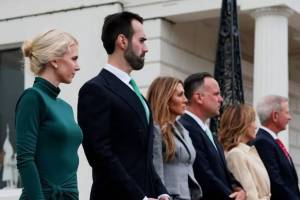
Trump was in Dublin this morning to justify spending taxpayer money on his golf trip. Natalie Harp was was there, lined up with the Trump family on the receiving line.
U.S. President Donald Trump held talks Saturday in Dublin with his Irish counterpart Catherine Connolly during a weekend visit that’s more about a major golf tournament hosted on a course he owns on the country’s Atlantic coast. He also met with Ireland’s Prime Minister Micheál Martin.
Trump will address the U.S. and Irish business leaders at the U.S. ambassador’s official residence in Dublin before traveling to his oceanfront golf club in Doonbeg, on the other side of the country, to watch the Irish Open.
Connolly is a left-wing politician who was among those who protested when Trump visited Ireland in 2019 during his first term in office. She is now Ireland’s elected, largely ceremonial head of state. A supporter of the Palestinian cause, she in the past has criticized U.S. policy in the Middle East and called Trump a “bully.”
Did you like this post? Please share it with your friends:
I haven’t been following the Antony Fauci story at all. I heard that his diaries were released, but I assumed it was just some wingnut thing. But today Fauci appeared in front of the Senate Homeland Security and Governmental Affairs Committee, headed by Covid conspiracy theorist Rand Paul. In a surprise move, Fauci invoked his Fifth Amendment right to refuse to answer questions.
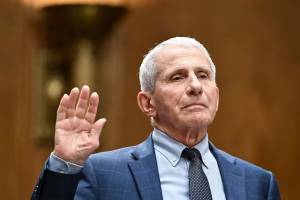
Dr. Anthony Fauci declined to answer senators’ questions at a hearing Wednesday on the origins of Covid and the government’s handling of the pandemic, saying he would invoke his Fifth Amendment right to avoid the possibility that Republicans could try to use his testimony to prosecute him for perjury.
The surprise decision shook up the hearing, which was expected to be contentious given Fauci’s previous public clashes with Chairman Rand Paul, R-Ky.
Antony Fauci is swarn in Wednesday.
In his opening statement to the Senate Homeland Security and Governmental Affairs Committee, Fauci pointed to Paul’s “obvious obsession with calling for my prosecution, his repeated slanderous comments about me” and his decision to publicly release the doctor’s personal journal.
“The only conclusion I can reach is that the sole reason he is calling me before this committee is to get me to say something — anything — that could vindicate his repeated public pledges that I end up, in his words — quote — ‘behind bars,’” Fauci said.
“Any reasonable person who has followed his unhinged obsession with me would readily come to the same conclusion,” he continued. “Therefore, although it pains me to do so because of the respect I have for the legislative branch of government and my decades-long record of cooperating with Congress, under the advice of my attorneys, I will invoke my right under the Fifth Amendment of the Constitution to refrain from answering your questions.”
Despite Fauci’s refusal to respond, Paul still used his time at the hearing to ask the doctor a series of questions.
Fauci answered each question with the same line: “On the advice of counsel, I respectfully decline to answer based upon my rights under the Fifth Amendment to the Constitution.”
At the end of his questioning, Paul told Fauci that he would face “repercussions” for not answering questions.
“The committee will have to consider after this hearing what appropriate action should be taken against you for the failure to testify after being directed to do so,” Paul said. “It’s against the law to obstruct an investigation of Congress. There will be repercussions to your refusal to testify today.”
I guess Rand Paul doesn’t understand the Fifth Amendment.
Republican Sen. Rand Paul of Kentucky has released more than a thousand pages of journal entries from Dr. Anthony Fauci, teeing up what is likely to be a contentious hearing with the nation’s former top infectious disease expert on Wednesday about the origins of the COVID-19 pandemic.
Paul, who heads the Senate Homeland Security Committee, subpoenaed Fauci to appear before the committee as part of the panel’s investigation into the origins of the coronavirus. Paul, who has pushed the theory that the virus emerged from a leak at the Wuhan Institute of Virology in China rather than spilling over from animals to humans naturally, has long accused Fauci and other government officials of misleading the public and Congress about the source of the outbreak.
The journal entries date from December 2019, in the days leading up to the U.S. declaring a public health emergency, until December 2022, when Fauci stepped down as the director of the National Institute of Allergy and Infectious Diseases, a position he held for nearly four decades….
Many scientists believe the evidence suggests that the virus emerged naturally from infected bats before it circulated to other species and spread to humans who were handling those animals at a market in Wuhan, where the first human cases appeared in late 2019. But the FBI has assessed the coronavirus “most likely” emerged in a “lab incident in Wuhan.” In January 2025, the CIA issued a new assessment that favored the “lab leak” hypothesis, though it said the finding was made with “low confidence.”
Some of Fauci’s diary entries reflect early uncertainty about the source of the pandemic. In January 2020, he wrote that “we know the market was not the source, it was the amplifier,” though he added that “somewhere the virus jumped from animals to humans.” About a week later, he referenced a conference call in which several top infectious disease experts thought the coronavirus might not have originated in nature.Paul on Monday accused Fauci of saying one thing to “Dear Diary” while telling the public “it’s implausible that it came from the lab, and we’re really convinced it came from these wild animals in the marketplace. But that level of dishonesty is really astounding.”
On Saturday afternoon, as part of this ongoing inquiry, Paul published a thread on X describing the release of a string of what he called diary entries made by Fauci from December 2019 through December 2022. Paul commented on X at the start of the posts, “What [Fauci] wrote privately and what he told the country are two different stories.” [….]
Felicia Goodrum, a virologist at Dartmouth College who spoke to NPR from the American Society for Virology meeting in Minneapolis, says that it’s possible that Fauci may have been less certain in private with his colleagues as they were racing to learn about the new virus than he was in public where he had to assure a population that was panicking over the rapidly emerging pandemic.
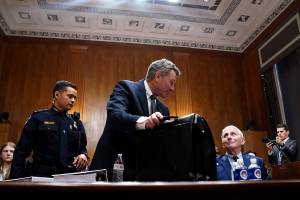
David Schertler, center, an attorney for infectious-disease expert Anthony S. Fauci, right, is removed by Capitol Police from a Senate hearing Wednesday. Maxine Wallace, The Washington Post
For years, Paul and Fauci have differed over the origins of SARS-CoV-2, the virus that causes COVID-19. Fauci has asserted that the scientific evidence points to a spillover — whereby the virus would have found its way from an animal into its first human host, and then spread at that point from human to human.
Proponents of this theory point to the wet market in Wuhan where potentially infected animals were waiting to be sold. “There’s very good evidence that there are two lineages [of SARS-CoV-2] that emerged,” according to Goodrum. “Both of those lineages were present at the market, and susceptible animals were present at the market.”
Goodrum says the market was cleared before it was possible to take any samples. However, she says the genetic data “maps all initial cases to that market” and “none to, for example, the Wuhan Institute of Virology, where they have accused the virus of having been created or released.”
Most scientists in the virology community share this view, according to a survey published in February 2024 by the Global Catastrophic Risk Institute, a nonpartisan U.S.-based think tank that studies potentially catastrophic events.
Paul has advocated for an alternative explanation. He says the possibility that the virus was engineered in a lab should not be discounted. Two years ago, during a full Senate committee hearing, Paul said, “Do we know for certain it came from the lab? No, but there’s a preponderance of evidence indicating that it may have come from the lab.”
So Rand Paul didn’t get what he wanted today. What’s next?
Anthony S. Fauci repeatedly invoked the Fifth Amendment during a Senate hearing Wednesday where Republicans pressed the retired government scientist on whether he was sufficiently truthful in past testimony about the coronavirus pandemic.
Sen. Rand Paul (R-Kentucky), a longtime adversary of Fauci, concluded the nearly three-hour hearing by saying the committee is planning a vote next week on whether to hold Fauci in contempt of Congress.
Paul acknowledged to GOP colleagues that there are legal questions about whether Fauci could be held in contempt — citing President Joe Biden’s preemptive pardon of Fauci last year — but contended that Fauci should have just answered questions on Wednesday, even if it meant admitting to a past lie or other wrongdoing.
After that surprise move, Paul and other Republican Senators asked Fauci numerous questions.
Sen. Josh Hawley (R-Missouri) peppered Fauci with basic questions, such as the day of the week and what color tie he was wearing. Fauci declined to answer those questions, too. At times, senators grew heated, with Hawley alternately using a mocking tone — repeatedly referring to Fauci as “doc” — and raising his voice to lace into him.
At one point, a Hawley staffer propped up an image of a magazine cover for which Fauci posed in September 2020. “You became a narcissist and a megalomaniac and a liar,” Hawley said.
Democrats, meanwhile, praised Fauci as a hero and thanked him for his work fighting infectious diseases.
Fauci’s lawyer alleged that Paul was fixated on Fauci after their clashes at the height of the pandemic — referring to a 2021 incident in which the two men traded accusations of lying — and that the senator’s sole purpose for the hearing was to punish Fauci and see him in prison.
“The accusations that Chairman Paul continues to propagate are false and disgraceful, and we will examine all options to hold him accountable,” David Schertler, Fauci’s attorney, said in a statement.
There’s more funny nonsense from the Republicans, if you’re interested. I made this a gift article just in case.
In other news, the Iran war continues, even though Trump tries to pretend otherwise.
Donald Trump has unleashed an expletive-ridden threat to “beat the f****** s***” out of Iran following its “surprise” missile attack against US bases in the Middle East.
“We’ll be hitting them hard. They’re going to get a beating,” the US president told Fox News as he responded furiously to the strikes.
The US military announced on Tuesday night that it intercepted Iran’s latest “surprise attack” by the Islamic Revolutionary Guard Corps after Trump’s meeting with Israeli prime minister Benjamin Netanyahu on Tuesday.
CENTCOM later said the Saudi Arabian Armed Forces aided the US military in a separate military effort Tuesday after “Iran-aligned” terrorists launched more than 30 drone attacks in the last 72 hours.
Saudi Arabia also joined US strikes on Iran-backed groups in Iraq on Wednesday, killing at least 20 soldiers as war spread throughout the Middle East.
The strikes on targets inside Iraq come as Oman proposed a new regional deal aimed at resolving the conflict over the critical Strait of Hormuz, through which about a fifth of global oil and liquefied natural gas flowed before the war.
Saudi Arabia and the US have carried out strikes against Iran-backed militias in Iraq, in a potential escalation of the Middle East conflict.
US Central Command (Centcom) said the strikes were against “Iran-aligned terrorists that the Islamic Revolutionary Guard Corps (IRGC) directed to attack US forces and Saudi energy infrastructure”.
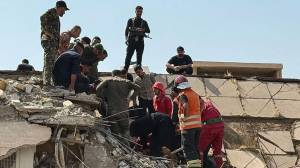
Iraqi security and emergency personnel work at the scene of a strike in Muqdadiyah, Diyala province on Wednesday
Iraq’s paramilitary Popular Mobilisation Forces (PMF), which is dominated by Iran-backed Shia militias, said at least 20 of its members had been killed in US-Saudi strikes on its bases.
It came hours after Centcom said Iran had launched missiles at US forces in the Middle East in an “attempted surprise attack”, ending a lull in hostilities.
The US said the Iranian attack occurred at 17:45 EDT (21:45 GMT) on Tuesday, with all missiles “successfully intercepted”.
The IRGC said it had targeted a US air base and a command centre in Jordan “in response to the acts of aggression of the American child-killing army”.
It also said that naval forces had struck three oil tankers in the Strait of Hormuz after they “ignored warnings” and sailed along what it described as an “unsafe and illegal route” through the vital Gulf waterway.
When asked by a Fox News correspondent on Wednesday about the Iranian attack on Jordan, US President Donald Trump said in an expletive-laden response that US forces would be “hitting them hard”, adding: “They’re going to get a beating.”
Remember the old days when we had dignified presidents?
American and Saudi fighter jets attacked Iranian-linked militias and their Iranian advisers in Iraq on Wednesday, and Iran fired missiles at military bases in Jordan . It ended a dayslong pause in direct fighting between the United States and Iran and further widening the scope of the war.
Since the collapse of a cease-fire between the United States and Iran this month, Iran-linked groups across the region have opened new fronts and reopened old ones, embroiling forces in Saudi Arabia, Iraq, Lebanon and Jordan in the war that until recently had been contained to countries along the Persian Gulf.
The United States accused the Iranian military on Wednesday of directing its allies in Iraq to attack “U.S. forces and Saudi energy infrastructure.” The Iranian foreign ministry condemned the U.S.-Saudi strikes as an attempt to broaden the conflict.
Ships transiting through the Gulf of Oman on Saturday.Credit…Agence France-Presse — Getty Images
On Wednesday, the Saudi foreign ministry said in a statement that the country was not seeking escalation but would respond to any aggression.
Mr. Trump said Iran’s latest strikes were a surprise in an interview on “Fox & Friends.” American forces had only a few minutes’ notice to shoot down the incoming Iranian missiles, he said. “We’ll be hitting them hard,” the president said.
Also on Wednesday, the Jordanian military said it had shot down five missiles that Iran’s Islamic Revolutionary Guards Corps claimed were fired in retaliation for American aggression.
The U.S. military said that the strikes in Iraq were in retaliation for more than 30 drone attacks by Iranian proxy groups in the past 72 hours. A U.S. official, who spoke on condition of anonymity to discuss operational matters, said the strikes killed about 20 Iranian military and technical advisers.
The next big Senate news will be the Judiciary Committee vote on Todd Blache’s confirmation as Attorney General.
GOP Sen. John Cornyn said Wednesday, less than 24 hours before a critical committee vote, that he is “not prepared” to support Todd Blanche’s confirmation as attorney general as the two continue to tangle over the fate of a controversial DOJ-brokered settlement agreement involving President Donald Trump.
Blanche did not appear for a planned morning meeting in Cornyn’s office, and the senator told reporters that time was running out for Blanche to meet his demand to formally modify the settlement Trump reached with the IRS earlier this year — a key ultimatum the Texas Republican set out after Blanche’s confirmation hearing earlier this month.
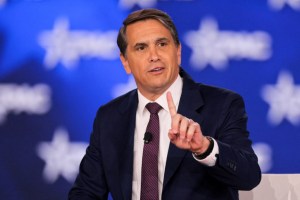
U.S. Deputy Attorney General Todd Blanche speaks during the 2026 Conservative Political Action Conference (CPAC) in Grapevine, Texas, U.S. March 26, 2026. REUTERS/Daniel Cole
“Hopefully they now recognize the seriousness of this,” said Cornyn, who recently lost his bid for renomination to a fifth term to a Trump-backed challenger. “Maybe they think I’m just going to give up or, you know, go along, but they’re mistaken.”
A DOJ official said the department shared a “written proposal” with Cornyn’s staff Tuesday. “We look forward to further discussion around any outstanding concerns,” said the person, who was not authorized to comment publicly on the matter.
Cornyn said Wednesday that he has yet to see “a single piece of writing that is responsive to what I’ve requested.”
His comments came ahead of a scheduled Thursday vote in the Senate Judiciary Committee, where he has been seen as the pivotal vote. Opposition from any one Republican could sink Blanche’s chances of confirmation, and another potential GOP swing vote, Sen. Thom Tillis of North Carolina, said this week he would follow Cornyn’s lead.
Cornyn said Judiciary Chair Chuck Grassley (R-Iowa) had told him he needed to know by 4 p.m. Wednesday if the vote could go forward, putting the Trump administration on a tight timeline if it wants Blanche confirmed before the Senate starts its summer recess next week.
One more important story. On Saturday, I posted an article about Trump ordering signs posted outside the Smithsonian’s National Museum of American History to inform visitors of the “inaccurate information presented in the Museum.” This is from Noel Sims and Rebecca Crosby at Popular Information: The fake historian advising Trump’s anti-Smithsonian crusade.
Last Friday, President Trump released an executive order directing officials to install signs outside the Smithsonian’s National Museum of American History (NMAH) informing visitors that the museum presents history inaccurately.
The order is the latest attack in a lengthy campaign by the Trump administration to discredit and control the Smithsonian Institution. The Trump administration has argued that the institution, which includes 21 museums and the National Zoo, has a liberal bias.
The Smithsonian National Museum of American History
he order cites a 162-page report released by the White House on July 4. The report, written by the White House Domestic Policy Council, argues that the “Smithsonian Institution, and the National Museum of American History in particular, under its current leadership and current interpretive ideology, cannot be trusted to tell America’s story honestly and in a way that is inspiring, unifying, and worthy of our great republic.” The report criticizes the NMAH for “extreme political activism,” “anti-White activism,” “transgender activism,” and supporting illegal immigration.
The executive order states that the temporary signs outside the museum should tell visitors that exhibits should be altered to reflect the report’s findings and “direct visitors to locations and resources for accurate information regarding America’s history.” It does not specify where visitors will be redirected.
Trump’s war against the Smithsonian began shortly after the start of his second term. In March 2025, Trump issued an executive order entitled “Restoring Truth and Sanity to American History” that stated that the Trump administration would “restore the Smithsonian Institution to its rightful place as a symbol of inspiration and American greatness.” The Trump administration has since threatened to withhold federal funding, ordered a comprehensive review of eight museums, and released a list of exhibits it did not agree with.
According to the article’s authors, important sources of Trump’s hostility to the Smithsonian are David and Tim Barton, a father an son who founded an organization called “WallBuilders.”
The father and son are founder and president, respectively, of WallBuilders, a Christian nationalist advocacy organization founded in 1988. WallBuilders aims to “teach US history and how our beginnings were overwhelmingly rooted in Christian ideology.”
Despite having no degree in history, David Barton calls himself a historian. He has amassed a large collection of documents related to America’s founding and published several books. For decades, he has pushed the view that the founding fathers never intended for there to be a separation between church and state. David Barton’s work has been rejectedrepeatedly by actual historians. Most notably, a book he published in 2012 about Thomas Jefferson was pulled from the shelves by its publisher after a group of historians from Christian universities accused him of including distortions and false information.
This has not prevented David Barton from gaining political influence. In Texas, David Barton has advised the Texas State Board of Education on public school curricula. According to Barton’s own social media posts and statements, he has attended several meetings at the White House during Trump’s second term and has been in communication with Trump officials about the “crazy stuff” in the Smithsonian museums.
Read the rest at Public Information.
Those are the stories that caught my attention today. I hope you found something of interest here. What other stories have you been following?
Did you like this post? Please share it with your friends:
So Trump was finally shamed into visiting some troops in Iraq, and naturally everything about his visit was completely inappropriate. He acted as if he was a a campaign rally, bragging about his mythical accomplishments and telling bald-faced lies as usual.
Previous presidents have used these trips to praise soldiers and let them know that they are appreciated as well as to meet with local officials. Trump did none of that; and, as JJ noted yesterday, he revealed the classified location of Seal team troops and posted their faced on-line. On top of everything else, he autographed MAGA hats for troops who are forbidden from engaging in political activities.
BAGHDAD (Reuters) – Iraqi political and militia leaders condemned U.S. President Donald Trump’s surprise visit to U.S. troops in Iraq on Wednesday as a violation of Iraq’s sovereignty, and lawmakers said a meeting between Trump and Iraqi Prime Minister Adel Abdul Mahdi was canceled due to a disagreement over venue.
The Book Keeper, by Nicole Gustafson
Sabah al Saadi, the leader of the Islah parliamentary bloc, called for an emergency session of parliament “to discuss this blatant violation of Iraq’s sovereignty and to stop these aggressive actions by Trump who should know his limits: The U.S. occupation of Iraq is over.”
The Bina bloc, Islah’s rival in parliament and led by Iran-backed militia leader Hadi al-Amiri, also objected to Trump’s trip to Iraq.
“Trump’s visit is a flagrant and clear violation of diplomatic norms and shows his disdain and hostility in his dealings with the Iraqi government,” said a statement from Bina.
Baghdad — Iraqi lawmakers Thursday demanded U.S. forces leave the country in the wake of a surprise visit by President Donald Trump that politicians denounced as arrogant and a violation of Iraqi sovereignty.
Politicians from both blocs of Iraq’s divided Parliament called for a vote to expel U.S. troops and promised to schedule an extraordinary session to debate the matter.
“Parliament must clearly and urgently express its view about the ongoing American violations of Iraqi sovereignty,” said Salam al-Shimiri, a lawmaker loyal to the populist cleric Moqtada al-Sadr.
Containing foreign influence has become a hot-button issue in a year that saw al-Sadr supporters win the largest share of votes in May elections. Al-Sadr has called for curbing U.S. and Iranian involvement in Iraqi affairs.
Video footage and the written report of Trump’s visit with service members in Iraq showed the President signing “Make America Great Again” hats and an embroidered patch that read “Trump 2020.”
But troops’ requests for the autographs could brush up against Department of Defense guidelines for political activities.
Those guidelines say that “active duty personnel may not engage in partisan political activities and all military personnel should avoid the inference that their political activities imply or appear to imply DoD sponsorship, approval, or endorsement of a political candidate, campaign, or cause.”
This should have been a victory lap for a president hailed by the military for letting them loose to attack ISIS, unconstrained by the reluctance and micromanagement of the Obama administration. But President Donald Trump has just announced the U.S. would be leaving the job to Turkey, deserting Kurdish and Western coalition allies, and abandoning the field of battle to Syrian dictator Bashar al-Assad, Russia, and Iran.
“We’re no longer the suckers, folks,” President Donald Trump told a group of about 100 troops, most of them special operators, in an unannounced holiday visit to al-Asad Airbase, in northern Iraq. He added that other countries can no longer expect the U.S. to do their fighting, unless they are willing to pay for it. “The United States cannot continue to be the policeman of the world,” he said….
“In Syria, Erdogan said he wants to knock out ISIS, whatever’s left, the remnants of ISIS,” Trump told reporters on the trip. “And Saudi Arabia just came out and said they are going to pay for some economic development, which is great; that means we don’t have to pay.”
But what of the French and British allies the U.S. has left behind in Syria to keep up the fight? Does that mean they are the suckers left holding the bag? Or the Kurdish militia groups that did most of the fighting, and dying, to drive out the so-called Islamic State, now left to the tender mercies of sworn enemy Turkey?
The president was unrepentant, explaining that he gave “the generals” multiple six-month “extensions” to get out of Syria. “They said again, recently, can we have more time? I said, ‘Nope.’ You can’t have any more time. You’ve had enough time. We’ve knocked them out. We’ve knocked them silly,” he said. “Others will do it too. Because we are in their region. They should be sharing the burden of costs and they’re not.”
But the decision hasn’t sat well with many in the special-operations community Trump was addressing, as they’ve known many of these Kurdish fighters for years, and risked life and limb on joint missions together well before the ISIS fight.
In other news, it’s looking more and more like the Trump Organization could end up being indicted in New York. Perhaps that will force Trump out even if the Republicans protect him from impeachment.
The Trump Foundation and the Trump Organization shared much more than President Donald Trump’s last name.
And that’s why, experts said, the New York state investigations into the charity could envelop the president’s namesake business.
Illustration by Nicole Gustafson
“Nothing but overlap here. It all was held so tightly by he and his family members,” NBC News/MSNBC legal analyst Glenn Kirschner, a former federal prosecutor, told NBC News.
“I don’t think there will be any investigative daylight between what the New York state authorities and investigators are looking into with respect to the foundation vs. the organization vs. anything else involving business dealings that have the name ‘Trump’ attached to them,” he said, predicting that the foundation investigation will “crash through (the Trump Organization) like a Mack Truck.”
Wouldn’t that be fun to watch? A bit more:
Daniel Goldman, a former federal prosecutor and NBC News/MSNBC legal analyst, said that because some of the same people alleged by the state attorney general of persistent illegal activity in running the charity are also involved with the president’s business, there is reasonable justification in broadening the investigation.
“It is likely that the investigation into the Trump Foundation has sufficiently overlapped with the Trump Organization that (state) investigators would be justified in extending their investigation into the Trump Organization,” he said.
The foundation itself had no employees, instead relying on Trump Organization staffers to cut its checks. Prior to taking office in 2017, Trump turned over day-to-day control of his business to his adult sons, Donald Trump Jr. and Eric Trump, and Allen Weisselberg, the Trump Organization’s chief financial officer. Both sons were among the charity’s board members, while Weisselberg was listed as its treasurer.
Meanwhile Trump is trying to use the government shutdown to post pone the emoluments case against him in Virginia.
Lawyers for President Donald Trump are invoking the government shutdown to seek a delay in a court case over claims that Trump is illegally profiting from business his Washington hotel does with foreign countries.
Illustration by Nicole Gustafson
Justice Department attorneys representing Trump asked a federal appeals court on Wednesday to postpone indefinitely all further filings in an appeal related to a suit that the governments of Maryland and Washington, D.C., filed over Trump’s alleged violation of the Constitution’s ban on foreign emoluments.
The government’s brief is not due until Jan. 22, but DOJ lawyers asked the 4th U.S. Circuit Court of Appeals, based in Richmond, Va., to put the appeal on ice until the shutdown ends.
“The Department does not know when funding will be restored by Congress,” Justice lawyers wrote. “Absent an appropriation, Department of Justice attorneys and employees are prohibited from working, even on a voluntary basis, except in very limited circumstances, including ‘emergencies involving the safety of human life or the protection of property’. … Undersigned counsel for the Department of Justice therefore requests a stay of briefing on the President’s mandamus petition until Congress has restored appropriations to the Department.”
I don’t understand why the DOJ is defending Trump for illegally profiting from his office.
If you have some extra time today here are two long reads on immigration to check out.
It’s only Tuesday, and this week feels as if it has already gone on forever. I wonder if the George Bush sainthood celebration will continue through the weekend? I sure hope not. I’d like to be able to resume watching cable news before next week. In case anyone else here is sick of hearing about Saint Poppy, here are some antidotes the the media coverage.
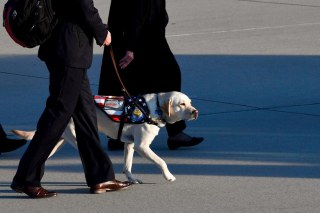
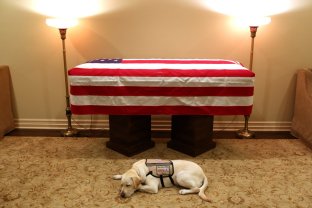
On Sunday night, George H.W. Bush spokesman Jim McGrath posted a photograph to Twitter depicting a golden Labrador named Sully resting in front of the former president’s casket. The caption read “Mission complete.”
Within hours, Sully the dog had become a bona fide celebrity. McGrath’s sentiment has been retweeted 61,000 times and counting, and “Sully” was trending on Twitter at various times on Monday. C-SPAN covered the dog’s arrival at Joint Base Andrews in Maryland on Monday afternoon. The picture of the dog lying in front of the casket was covered by outlets from Fox News to NPR as the internet exploded with tributes to the pair’s “forever friendship.” The photograph was submitted as evidence of Bush’s character, of Sully’s character, and as support for the idea that America should not elect a president who “does not love and is not loved by pets.” Heavy.com offered “5 Fast Facts You Need to Know” about the dog. People magazine gushed that Sully was “keeping the 41st commander in chief safe in death as he did in life,” and even produced a slideshow of their “special friendship.” Many suggested Sully was heartbroken, and/or that they themselves were crying over the photo; conservative writer Dan McGlaughlin compared the dog to a Marine.
There’s nothing wrong with applying sentimentality when it comes to family pets reacting to their owners’ deaths. There’s even some preliminary evidence from the small field of “comparative thanatology” that animals notice death, and that some may even experience an emotion we might compare to grief. But Sully is not a longtime Bush family pet, letting go of the only master he has known. He is an employee who served for less than six months….
It’s wonderful for Bush that he had a trained service animal like Sully available to him in his last months. It’s a good thing that the dog is moving on to another gig where he can be helpful to other people (rather than becoming another Bush family pet). But it’s a bit demented to project soul-wrenching grief onto a dog’s decision to lie down in front of a casket. Is Sully “heroic” for learning to obey the human beings who taught him to perform certain tasks? Does the photo say anything special about this dog’s particular loyalty or judgment, or is he just … there? Also, if dogs are subject to praise for obeying their masters, what do we do about the pets who eat their owners’ dead (or even just passed-out) bodies?
The photograph, in other words, is not proof that Sully is a particularly “good boy” or that “we don’t deserve dogs,” as countless swooning tweets put it on Monday. On its own, it says almost nothing other than the fact that Sully was, at one point in the same room as the casket of his former boss. This is simply a photograph of a dog doing something dogs love to do: Lie down. The frenzy around it captures something humans love to do, too: Project our own emotional needs onto animals.
Sexual harassment or assault can’t be bracketed off as part of a politician’s private life. It’s an important part of the story of their leadership, their use of power, and their policy. The same is true for Bush.
Relatively little has been made of the accusations against Bush since they emerged last year. A woman initially accused Bush of groping her and telling her a dirty joke as she stood beside him, seated in a wheelchair, for a photo op. The family responded, suggesting the aging former president might be slipping a bit. “President Bush has been confined to a wheelchair for roughly five years, so his arm falls on the lower waist of people with whom he takes pictures,” a spokesperson, Jim McGrath, said on Bush’s behalf.
But then the story changed. More women came forward describing incidents that took place before Bush was in a wheelchair and even while he was in office. One woman described a credible story dating back to 1992, when she says that Bush, then the president, put his hand on her rear end while taking a photograph at a reelection fundraiser. Another woman described an incident from 2003, when she was 16 years old — and Bush was still spry, zipping around Kennebunkport, Maine, on a Segway.
“All the focus has been on ‘He’s old.’ OK, but he wasn’t old when it happened to me,” the woman, now 55 told CNN. “I’ve been debating what to do about it.”
The women who spoke out feel differently. In each case, the accuser was excited to meet a political figure, someone who’s supposed to represent them; then, they said, he groped them. In that moment, they became second-class citizens. While their brothers or husbands or male friends might have gotten a handshake and a thumbs-up from this powerful man and walked away feeling good about themselves and their relationship with their government, these women were put in their place.
And let’s not forget that Bush appointed Clarence Thomas and stood by him when he was credibly accused of sexual harassment.
History will recall George Bush did nothing at all.
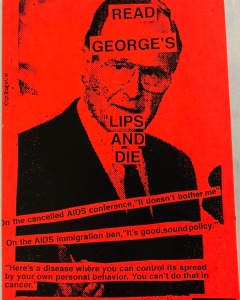
I must have chanted those words hundreds times while protesting the Bush administration’s inaction on the AIDS crisis with ACT UP (AIDS Coalition to Unleash Power) between 1989 and 1992. ACT UP was founded in 1987 in the epicenter of the HIV epidemic in America — New York City — to demand action to end the AIDS crisis. Today it is remembered as part of the Reagan ’80s, but the reality is that much of the group’s most intensive work took place during the administration of George Herbert Walker Bush. With ACT UP, I marched past the Bush White House down a Pennsylvania Avenue not yet closed to traffic. I rallied outside his Department of Health and Human Services, his Centers for Disease Control, his National Institutes of Health. And in 1991, I shook my finger chanting “Shame!” half a mile from his family’s summer compound in Kennebunkport, Maine. More than 1,500 AIDS activists descended on the resort town on September 1 that year, bearing signs that charged Bush with a murderous neglect of the AIDS crisis, along with a 50-foot banner with a 32-point plan to end it.
The transition from the Reagan presidency to the Bush one was more one of tone than substance when it came to AIDS, a kinder gentler indifference. Messaging that repeatedly pointed to “behavior change” as the solution, without backing prevention programs known to work. A lack of leadership from the top. No central strategy. “He was not doing enough as a leader,” Urvashi Vaid, the executive director of the National LGBTQ Task Force during the Bush years, told Pridesource after Bush’s death. “I think that those pressures and protests led by ACT UP all over the country … that pressure is what pushed both members of Congress and the administration to do whatever it did. I can’t say that enough.” Added ACT UP founder and playwright Larry Kramer, “I will not give [Bush] credit for anything. He hated us.”
Nearly a quarter century later when I had the opportunity as a political editor to participate in a several-day event at the Bush presidential library and museum, I thought about those years of protesting with ACT UP. For me reporting was always about other people’s stories, not my own, and it was rare for my activist past to come up except as history that informed my understanding of the dynamics of new social movements.
But with Bush, I felt I could not forget myself. Could not forget the suffering I’d witnessed in New York — where AIDS was, during his presidency, the leading cause of death for men ages 25–44, or the way his election extended the oppressive culture of the Reagan years that saw so many of my friends kicked out of their homes in their teens for being gay. I passed the Bush library opportunity on to a colleague.
Early in George H.W. Bush’s political career, when he was running for a U.S. Senate seat in Texas, he came out against the landmark Civil Rights Act of 1964, deriding his opponent as “radical” for supporting the bill that ended segregation in public places and banned employment discrimination.
“The new civil-rights act was passed to protect 14 percent of the people,” he said. “I’m also worried about the other 86 percent.”
The stand seemed at odds with his family’s long history of supporting civil rights (his father, Prescott Bush, a Connecticut senator had worked to desegregate schools and protect voting rights) and with his own work raising money for the United Negro College Fund.
But in Texas, where the Republican party was steadily becoming more conservative and embracing the Southern Strategy of appealing to white voters, Bush’s position made sense.
It “made sense” if you had no principles except getting elected. A bit more:
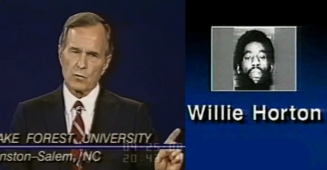
In his 1988 bid for the presidency, Bush would seem to again opt for expediency in a campaign that is often cited as one of the nastiest in political memory, with the blatant racism of the Willie Horton ad, which mined ugly stereotypes of African-Americans, and for Bush’s questioning of the patriotism of his opponent, Michael Dukakis, because of his Greek heritage.
The Horton ad, which focused on a convicted murderer who committed a violent rape while out of prison on a furlough program Dukakis had supported, was put out by a conservative PAC, not the Bush campaign. However, Bush repeatedly brought up Horton’s name in speeches, including one to the National Sheriffs’ Association.
“Horton applied for a furlough,” Bush said at the time. “He was given the furlough. He was released. And he fled — only to terrorize a family and repeatedly rape a woman.”
The Bush campaign also released an ad that showed footage of prisoners going through a revolving door — a strategy that played on white voters’ fears and prejudices, said Jason Johnson, a professor of politics and journalism at Morgan State University in Baltimore, Maryland.
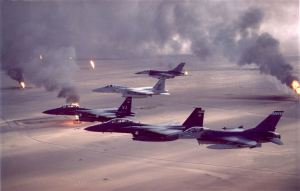
F-16A Fighting Falcon, F-15C Eagle and F-15E Strike Eagle fighter aircraft fly over burning oil field sites in Kuwait during Operation Desert Storm. (U.S. Air Force archive photo)
Most countries condemned Iraq’s 1990 invasion of Kuwait. But the truth — that it was the culmination of a series of tangled economic and historical conflicts between two Arab oil states — wasn’t likely to sell the US public on the idea of sending our troops halfway around the world to do something about it.
So we were given a variation of the “domino theory.” Saddam Hussein, we were told, had designs on the entire Middle East. If he wasn’t halted in Kuwait, his troops would just keep going into other countries.
As Scott Peterson reported for The Christian Science Monitor in 2002, a key part of the first Bush administration’s case “was that an Iraqi juggernaut was also threatening to roll into Saudi Arabia. Citing top-secret satellite images, Pentagon officials estimated in mid-September [of 1990] that up to 250,000 Iraqi troops and 1,500 tanks stood on the border, threatening the key US oil supplier.”
A quarter of a million troops with heavy armor amassed on the Saudi border certainly seemed like a clear sign of hostile intent. In announcing that he had deployed troops to the Gulf in August 1990, George HW Bush said, “I took this action to assist the Saudi Arabian Government in the defense of its homeland.” He asked the American people for their “support in a decision I’ve made to stand up for what’s right and condemn what’s wrong, all in the cause of peace.”
But one reporter — Jean Heller of the St. Petersburg Times — wasn’t satisfied taking the administration’s claims at face value. She obtained two commercial satellite images of the area taken at the exact same time that American intelligence supposedly had found Saddam’s huge and menacing army and found nothing there but empty desert.
She contacted the office of then-Secretary of Defense Dick Cheney “for evidence refuting the Times photos or analysis offering to hold the story if proven wrong.” But “the official response” was: “Trust us.”
Heller later told the Monitor’s Scott Peterson that the Iraqi buildup on the border between Kuwait and Saudi Arabia “was the whole justification for Bush sending troops in there, and it just didn’t exist.”
Read the rest at Bill Moyers.com.
I know there is lots of other news today, but I just had to get this off my chest. What stories are you following?
Did you like this post? Please share it with your friends:
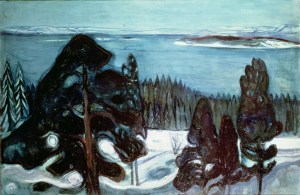
I’m still snowed in. I’ve been shoveling for two days, but 40+ inches of snow in a week was just too much for me to handle alone. My sister-in-law was going to come down from New Hampshire today to help me dig out, but it’s snowing again, so she may have to wait until tomorrow. My cold is still hanging on too, so this post may be a little disjointed. I’m going to focus on a “shocking” story about newscaster Brian Williams that broke over the past couple of days. The illustrations I’m are paintings of winter scenes by Edvard Munch.
Yesterday, NBC News anchor Brian Williams was caught telling a false story about being shot down in a helicopter in Iraq. From Politico:
On Friday night’s broadcast, Williams cited “a terrible moment a dozen years back during the invasion of Iraq when the helicopter we were traveling in was forced down after being hit by an RPG. Our traveling NBC News team was rescued, surrounded and kept alive by an armor mechanized platoon from the U.S. Army 3rd Infantry.”
One crew member responded to the story on Facebook the following day, writing to Williams, “Sorry dude, I don’t remember you being on my aircraft. I do remember you walking up about an hour after we had landed to ask me what had happened.”
This week, crew members of 159th Aviation Regiment’s Chinook helicopter also told Stars and Stripes that Williams had not been in the shot-down helicopter but had arrived an hour later.
On Wednesday, Williams conceded that he was not onboard the shot-down helicopter, but he told Stars and Stripes he did not intentionally make the mistake.
“I would not have chosen to make this mistake,” Williams said. “I don’t know what screwed up in my mind that caused me to conflate one aircraft with another.”
Williams made the claim about the incident while presenting NBC coverage of the tribute to the retired command sergeant major at the Rangers game Friday. Fans gave the soldier a standing ovation.
“The story actually started with a terrible moment a dozen years back during the invasion of Iraq when the helicopter we were traveling in was forced down after being hit by an RPG,” Williams said on the broadcast. “Our traveling NBC News team was rescued, surrounded and kept alive by an armor mechanized platoon from the U.S. Army 3rd Infantry.”
Williams and his camera crew were actually aboard a Chinook in a formation that was about an hour behind the three helicopters that came under fire, according to crew member interviews.
That Chinook took no fire and landed later beside the damaged helicopter due to an impending sandstorm from the Iraqi desert, according to Sgt. 1st Class Joseph Miller, who was the flight engineer on the aircraft that carried the journalists.
Unfortunately for Williams, this is not the first time he has made “this mistake” on network television. On the March, 26, 2013 episode of CBS’s Late Show With David Letterman, he told the host (at the 3-minute, 50-second mark): “Two of our four helicopters were hit by ground fire, including the one I was in.”
“No kidding!” Letterman exclaimed.
“RPG and AK-47,” Williams elaborated.
“What altitude were you hit at?” Letterman asked.
“We were only at 100 feet doing 100 forward knots…”
“What happens the minute everybody realizes you’ve been hit?” Letterman asked.
“We figure out how to land safely—and we did,” Williams answered. “We landed very quickly and hard…”
Stars and Stripes left open the possibility that Williams also misreported the incident initially on March 26, 2003, but it turns out that back then, at least, he never claimed to have been aboard the attacked chopper—during two different broadcasts on that date. Television news analyst Andrew Tyndall dipped into his videotape library and screened the Nightly News segment in which Williams said “he was in a convoy of helicopters, one of which got hit,” Tyndall told The Daily Beast.
NBC News, meanwhile, unearthed a March 26, 2003 Dateline segment in which Williams reported: “On the ground, we learn that the Chinook ahead of us was almost blown of the sky.”
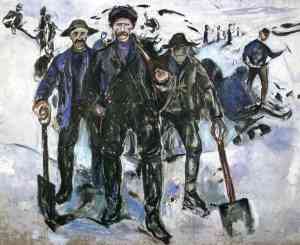
Edvard Munch, Workers in the Snow
Grove compared Williams’ conflation of events with a story Hillary Clinton told in 2008.
2008 presidential candidate Hillary Clinton’s false assertion that, as first lady in March 1996, she came under sniper fire during a trip to Tuzla, Bosnia. “I remember landing under sniper fire,” Clinton said during a speech. “There was supposed to be some kind of a greeting ceremony at the airport, but instead we just ran with our heads down to get into the vehicles to get to our base.” CBS News video of Clinton’s arrival showed no such thing; instead she alighted on the tarmac and greeted a welcoming child who offered her a poem.
I would compare Williams’ flub to tales that then presidential candidate Ronald Reagan told about events he recalled that never happened. A famous example from memory expert Daniel Schacter:
In the 1980 presidential campaign, Ronald Reagan repeatedly told a heartbreaking story of a World War II bomber pilot who ordered his crew to bail out after his plane had been seriously damaged by an enemy hit. His young belly gunner was wounded so seriously that he was unable to evacuate the bomber. Reagan could barely hold back his tears as he uttered the pilot’s heroic response: “Never mind. We’ll ride it down together.” …this story was an almost exact duplicate of a scene in the 1944 film “A Wing and a Prayer.” Reagan had apparently retained the facts but forgotten their source (Schacter 1996, 287).
In November 1983, he told Israeli Prime Minister Yitzhak Shamir during a White House visit that while serving in the U. S. Army film corps, his unit had shot footage of the Nazi concentration camps as they were liberated. He repeated the same tale to Nazi hunter Simon Wiesenthal and other witnesses. Reagan had indeed served in the Army and worked on morale-boosting movies for the War Department. But he had done so without ever leaving Hollywood for the entire duration of the war.
Edvard Munch, Winter Night
And then there was the story about 9/11 that George W. Bush was repeatedly criticized for–he claimed on that morning he had seen the first plane hit the World Trade Center twin towers before he went into a school for a photo op of him reading to children. But that was impossible, because film of the first tower being hit was not aired until the next day later that day. Here’s Bush’s story quoted in a piece at e-Skeptic by memory expert Daniel Greenberg
I was in Florida. And my chief of staff, Andy Card — actually I was in a classroom talking about a reading program that works. And I was sitting outside the classroom waiting to go in, and I saw an airplane hit the tower — the TV was obviously on, and I use[d] to fly myself, and I said, “There’s one terrible pilot.” And I said, “It must have been a horrible accident.” But I was whisked off there — I didn’t have much time to think about it, and I was sitting in the classroom, and Andy Card, my chief who was sitting over here walked in and said, “A second plane has hit the tower. America’s under attack.”
Two weeks later Bush’s story had evolved:
Bush remembers senior adviser Karl Rove bringing him the news, saying it appeared to be an accident involving a small, twin-engine plane. In fact it was American Airlines Flight 11, a Boeing 767 out of Boston’s Logan International Airport. Based on what he was told, Bush assumed it was an accident. “This is pilot error,” the president recalled saying. “It’s unbelievable that somebody would do this.” Conferring with Andrew H. Card Jr., his White House chief of staff, Bush said, “The guy must have had a heart attack”… At 9:05 a.m., United Airlines Flight 175, also a Boeing 767, smashed into the South Tower of the trade center. Bush was seated on a stool in the classroom when Card whispered the news: “A second plane hit the second tower. America is under attack.”
Edvard Munch, Yellow Log
The fact is that memory errors like these are quite common. Human memory is not perfect–we tend to get basic facts right, but when we retell a memory again and again or even go over it in our minds, specific details can change. There are a number of ways this can happen. We can forget the source of a memory, as Ronald Reagan did with the movie scene he believed to be real. It’s also comment to retroactively alter a memory, as Bush did with his 9/11 flashbulb memory. That is caused by “interference.” I doubt that Williams deliberately lied about his flashbulb memory from Iraq. Why would he put his reputation at risk in that way? Most likely, he conflated his memories with other things he learned later about the event that made a strong impression on him at the time.
You can read more about false flashbulb memories in this scholarly article by Greenberg (pdf): President Bush’s False ‘Flashbulb’ Memory of 9/11/01. A flashbulb memory is a very vivid recall of a dramatic event in which we have a sense “remembering” exactly where we were and who we were with when we experience or heard about the event.
Back to the Williams story.
At Slate, Ben Matthis Lilly provides a detailed timeline of the various stories Brian Williams has told about his 2003 experience over the years. The initial story Williams told in 2003 was also inaccurate, according to soldier witnesses, but Williams still claims his original report was true.
In the initial account (given on both the Nightly News and a Dateline episode on March 26, 2003), Williams clearly states that he was part of a group of helicopters that was fired upon while performing a mission:
We are one of four Chinook helicopters flying north this morning, third in line. As we head toward the drop point the Iraqi landscape looks quiet. We can see a convoy of American troop carriers and supply vehicles heading north.
This 2003 account, like Williams’ apology, implies the helicopters landed together after ground fire:
All four choppers dropped their load and landed immediately.
However, Stars and Stripes‘ piece says unequivocally that Williams’ helicopter was not part of the group that was fired upon—not third in line, and not part of the line at all.
…Crew members on the 159th Aviation Regiment’s Chinook that was hit by two rockets and small arms fire told Stars and Stripes that the NBC anchor wasnowhere near that aircraft or two other Chinooks flying in the formation that took fire. Williams arrived in the area about an hour later on another helicopter after the other three had made an emergency landing, the crew members said.
The soldiers quoted by Stars and Stripes say that they recall being upset at the time by the inaccuracies in this 2003 version of events.
Edvard Munch, New Snow on the Avenue
But do these soldiers really recall being upset in 2003? We can’t know for sure, because they didn’t tell their stories in public at the time.
I’m sure Brian Williams will continue to be attacked for his false memory. He might even lose his job over it, because lazy reporters would never consider consulting a psychologist who actually conducts research on human memory errors and their causes. Here’s Eric Wemple’s evaluation of Williams’ apology at the Washington Post:
That’s a very nice admission, though “conflating” the experience of taking incoming fire with the experience of not taking incoming fire seems verily impossible.
It might seem “verily impossible” to Wemple, but it isn’t impossible at all. It’s not even surprising to anyone who knows anything about how human memory works. I have no way of knowing for sure whether Williams lied or not; but if I had to guess, I think it’s more likely that he inadvertently created a false memory.
What stories are you following today? Please post your thoughts on the Brian Williams story and/or your recommended links in the comment thread.
Did you like this post? Please share it with your friends:
The Sky Dancing banner headline uses a snippet from a work by artist Tashi Mannox called 'Rainbow Study'. The work is described as a" study of typical Tibetan rainbow clouds, that feature in Thanka painting, temple decoration and silk brocades". dakinikat was immediately drawn to the image when trying to find stylized Tibetan Clouds to represent Sky Dancing. It is probably because Tashi's practice is similar to her own. His updated take on the clouds that fill the collection of traditional thankas is quite special.
You can find his work at his website by clicking on his logo below. He is also a calligraphy artist that uses important vajrayana syllables. We encourage you to visit his on line studio.




















 peej
peej Carissa
 bostonboomer
 dakinikat
 ecocatwoman
 jjlo
jjlo mablue2
 Mama Lopez
 peggysue22
 quixote
 skydancingguestblogger
 Mona (aka Wonk the Vote)



 Sky Dancing
Recent Comments