
Lazy Saturday Reads
Posted: June 7, 2014 Filed under: Foreign Affairs, morning reads, U.S. Politics | Tags: A Girl of the Limberlost, A Tree Grows in Brooklyn, Bode Bergdahl, Boston bombing, genre fiction, Hershey Candy Company, India, Khairullozhon Matanov, literary fiction, Mark Ames, Maureen Dowd, mental illness, Pierre Omidyar, reading for pleasure, Ruth Graham, Ukraine, YA, Young Adult novels 36 Comments
Good Morning!!
Yesterday, Slate published a piece by Ruth Graham that started a minor controversy on Twitter and various blogs. Graham argued that adults should be ashamed to be caught reading books written for the Young Adult (YA) audience. Graham writes:
The once-unseemly notion that it’s acceptable for not-young adults to read young-adult fiction is now conventional wisdom. Today, grown-ups brandish their copies of teen novels with pride. There are endless lists of YA novels that adults should read, an “I read YA” campaign for grown-up YA fans, and confessional posts by adult YA addicts. But reading YA doesn’t make for much of a confession these days: A 2012 survey by a market research firm found that 55 percent of these books are bought by people older than 18. (The definition of YA is increasingly fuzzy, but it generally refers to books written for 12- to 17-year-olds. Meanwhile, the cultural definition of “young adult” now stretches practically to age 30, which may have something to do with this whole phenomenon.)
The largest group of buyers in that survey—accounting for a whopping 28 percent of all YA sales—are between ages 30 and 44. That’s my demographic, which might be why I wasn’t surprised to hear this news. I’m surrounded by YA-loving adults, both in real life and online. Today’s YA, we are constantly reminded, is worldly and adult-worthy. That has kept me bashful about expressing my own fuddy-duddy opinion: Adults should feel embarrassed about reading literature written for children.
Graham has no problem with adolescents reading these books, but she thinks adults should focus on reading “literary fiction,” because “Life is so short, and the list of truly great books for adults is so long.”
I’m not one of the demographic that reads the new YA books, but I do love to escape into detective stories and I know many adults who enjoy reading science fiction and fantasy. In essence, what Graham’s is arguing against is so-called “genre fiction.” Her article made me want to rush out and buy a couple of Harry Potter books. The idea that anyone should be shamed for reading something that gives them pleasure really rubbed me the wrong way; and the notion that adults should avoid reading for pleasure–what Graham characterizes as “escapism, instant gratification, and nostalgia.” Her real problem with YA lit is that it is specifically designed to be give pleasure.
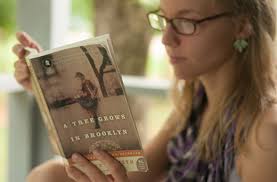
Of course I was not alone in my reaction to Graham’s essay. There were a number of excellent responses. Here’s Hillary Kelly from The New Republic: In Praise of Reading Whatever the Hell You Want: Don’t let Slate make you feel ashamed for reading books that you love.
One evening when I was 11 years old, lifelong friends of my parents came to our house for dinner. As the youngest child, I was the only one left at home to sulk on our living room floor and listen to adult chatter that I neither understood nor cared about. But the couple, Bob and Nancy, were thoughtful enough (and had witnessed my boredom enough) to bring me something to keep me occupied: a book, Betty Smith’s A Tree Grows in Brooklyn.
I won’t gush too long and too hard about how that novel affected me, how I felt Francie Nolan’s injustices, how romantic I found her fire escape reading perch, how I reveled in the fact that Francie was a reader like me. It’s enough to say that I loved—in fact, love—that novel. I reread it about once a year.
In the intervening years, I’ve only found about a half dozen “young adult” books that I’ve enjoyed and found fulfilling. I will reread the Harry Potter books over and over until the day I die. I haven’t come close to picking up The Fault in Our Stars. I found The Hunger Games books clumsy and absurd. Don’t get me going on The Perks of Being a Wallflower. I rarely, if ever, seek out YA lit. It just (usually) isn’t my thing. But that doesn’t mean that the Ruth Graham piece Slate published Thursday, titled “Against YA: Read whatever you want. But you should feel embarrassed when what you’re reading was written for children,” has any merit whatsoever. In fact, Graham fundamentally misunderstands and mislabels the entire genre, and sends a ridiculous message that any reader should rebel against: “Adults should feel embarrassed about reading literature written for children” (itals hers).
You should never be embarrassed by any book you enjoy. And you certainly shouldn’t let some woman you’ve never met make you feel inferior for reading beneath your grade level.

As a young girl, I also read and loved A Tree Grows in Brooklyn. I’ve never been tempted to go back and reread it, but I have reread other children’s books over the years–even books written for younger children. I’ve reread and cried over The Wind in the Willows, and I’ve often thought about rereading A Girl of the Limberlost and Laura Igalls Wilder’s “Little House” books, which I adored. I’ve reread Huckleberry Finn numerous times, each time getting more adult insights from it. Another book that I’ve reread several times with pleasure is The Hobbit.
There’s actually an even more practical argument against Graham’s premise that *real* reading should be a *very serious* endeavor. It’s very important for young children to develop a joy in reading–to learn to read for pleasure (pdf). Apparently this is something that is more recognized in the UK at the moment then here, where the focus is on testing and “Common Core standards.”
From the Guardian: How to encourage students to read for pleasure: teachers share their top tips.
The big challenge for teachers is not simply getting students to read – it’s getting them to enjoy it too. It’s one thing for students to trudge through set texts in a lesson, but will they open another book when they get home at the end of the day?
The National Literacy Trust has noted that becoming a lifetime reader is based on developing a deep love of reading.
“Research has repeatedly shown that motivation to read decreases with age, especially if pupils’ attitudes towards reading become less positive,” it said. “If children do not enjoy reading when they are young, then they are unlikely to do so when they get older.”
For younger readers in particular, their home environment is critically important.
“Home is a massive influence,” says Eleanor Webster, a primary school teacher in Nottinghamshire. “Supportive and understanding parents are key to developing their child’s reading.”
Here are a few more responses to the Graham piece if you’re interested:
Rachel Carter at The New Republic: I Write Young Adult Novels, and I Refuse to Apologize for It.
Alyssa Rosenberg at The Washington Post: No, you do not have to be ashamed of reading young adult fiction.
Kat Kinsman at CNN: Grownups: Don’t be ashamed of your YA habit.
Mark Shrayber at Jezebel: Hey, Everyone! Read Whatever the Fuck You Want.
Now a few newsy reads:

Have you heard about the edible pot controversy in Colorado? A few days ago Maureen Dowd wrote about the bad trip she took on a pot-infused candy bar, and the discussion went viral. Poor MoDo didn’t heed the warnings about not eating the whole thing at one sitting. From The Boston Globe: Maureen Dowd Eats Pot Candy in Denver, Breaks Internet.
As Dowd tells it, she legally purchased a caramel-chocolate flavored edible, ate it in her Denver hotel room, washed it down with some chardonnay, and then waited. About an hour later, the effects of THC set in, and the result was not good:
I strained to remember where I was or even what I was wearing, touching my green corduroy jeans and staring at the exposed-brick wall. As my paranoia deepened, I became convinced that I had died and no one was telling me.
The high lasted eight hours. EIGHT.
Dowd’s conclusion is that pot candy needs to be better labelled. Newbies to the drug should only eat about 1/16 of the kind of bar she ate, according to a medical consultant at an edibles plant she interviewed. Her candy wrapper had no mention of recommended servings, she wrote.
The tour guide who escorted Dowd around said she was warned. It’s not clear if she was told the recommended serving size.
According to The Cannabis, Matt Brown, co-founder of tourism company My 420 Tours, accompanied Dowd as she purchased the edibles at a Denver dispensary. He said she “got the warning” about how edibles affect everyone differently.
I have to admit, I’m a little concerned about pot-infused candy. What if kids get ahold of it? — and inevitably they will. There’s also the man who killed his wife after eating some of the candy and smoking a joint. The Hershey Candy Company is also perturbed and they’re suing: From Boston.com:
DENVER (AP) — The Hershey Co. has sued a Colorado marijuana edibles maker, claiming it makes four pot-infused candies that too closely resemble iconic products of the chocolate maker.
The trademark infringement lawsuit was filed in U.S. District Court in Denver this week against TinctureBelle LLC and TinctureBelle Marijuanka LLC.
It alleges TinctureBelle’s Ganja Joy, Hasheath, Hashees and Dabby Patty mimic Hershey’s Almond Joy, Heath, Reese’s peanut butter cups and York peppermint patty candies, respectively.

At Pando Daily, Mark Ames is continuing to follow the international adventures of Glenn Greenwald’s boss Pierre Omidyar. Two weeks ago, he revealed Omidyar’s role in supporting and profiting from the election of India’s new fascist government: REVEALED: The head of Omidyar Network in India had a secret second job… Helping elect Narendra Modi. He followed up last week with this: eBay Shrugged: Pierre Omidyar believes there should be no philanthropy without profit.
The role of Omidyar Network in so many major events of the past week — helping elect India’s ultranationalist leader Narendra Modi; co-funding Ukraine regime-change NGOswith USAID, resulting in a deadly civil war and Monday’s election of Ukrainian billionaireoligarch Petro Poroshenko; and now, this week’s first-ever sit-down TV interview with Edward Snowden, through an arrangement between NBC News and Pierre Omidyar’s First Look Media — shows how these contradictions are coming to the fore, and shaping our world.
Omidyar’s central role in the US national security state’s global agenda may still come as a shock to outsiders and fans of First Look media’s roster of once-independent journalists. But to White House foreign policy hawks, Pierre Omidyar represents the new face of an old imperial tradition.
And this week, Ames wrote: Just as we predicted, India’s new leader is about to make Pierre Omidyar a lot richer.
Well that was fast. Two weeks ago, we reported that eBay founder Pierre Omidyar’s top man in India had secretly helped elect controversial ultranationalist Narendra Modi, implicated by Human Rights Watch and others in the gruesome mass killings and cleansing of minority Muslims. As we also revealed, shortly after Omidyar’s man publicly joined the Modi campaign in February, Modi suddenly began warming up to the idea of letting global e-commerce companies into the world’s third largest economy. Omidyar’s eBay, which draws the majority of its revenues from overseas operations, has been champing at the bit to get into India.
Now, just weeks after Modi’s election, it seems their prayers have been answered.
Today, Reuters is reporting that Modi is planning to open India up to global e-commerce firms like eBay next month, and that Modi’s industry minister has been drawing up the new guidelines with input from top eBay officials, along with their e-commerce counterparts from Google, Amazon, Wal-Mart and others.
I wonder how all this ties in to Omidyar’s purchase of the Snowden data through Greenwald and Laura Poitras?
In a recent post, I mentioned that there has been a new arrest in the Boston bombing case. A friend of the Tsarnaev brothers, Khairullozhon Matanov, was arrested in Quincy, MA, last week and charged with obstruction of the bombing investigation. AP reported recently that Matanov had wired large amounts of money to people overseas. AP via The Daily Mail: Revealed: Boston bombing suspect’s friend wired $71,000 to people in six countries, as judge rules he should remain in jail.
A friend of Boston Marathon bomber Tamerlan Tsarnaev wired more than $71,000 to people in six countries and used fake names several times for the transactions – including while Tsarnaev was on a pilgrimage in Russia, according to prosecutors.
Khairullozhon Matanov, 23, is accused of deleting computer files and lying to agents investigating the 2013 bombings, which killed three and injured more than 260.
Prosecutors accuse the immigrant from Kyrgyzstan of a ‘pattern of deceit’ in dealing with authorities as they investigated the bomb attacks.
At a detention hearing, Matanov waived his right to seek release on bail. His lawyer said Matanov has no family here, lost his job as a cab driver after his indictment last week and has nowhere to go if he were released.
Curiouser and curiouser.
I’ll end with three links to interesting and helpful reads on the Bowe Bergdahl controversy.
Think Progress: Did Sergeant Bergdahl Desert The Army Or Did The Army Desert Him?
Reuters: Bergdahl reveals the impossible choices faced by hostages’ families.
NYT Editorial Board: The Rush to Demonize Sgt. Bergdahlgen
I hope you’ll find something worth reading in my suggestions. What are you reading and blogging about these days? Please post your links on any topic in the comment thread.
Monday Reads: Another Slow Summer News Day
Posted: June 2, 2014 Filed under: Foreign Affairs, morning reads | Tags: body language, Brian Williams, David Ignatious, deception, Edward Snowden, Fareed Zakaria, Glenn Greenwald, Greensnow cult, Jeff Darcy, King Juan Carlos, Mount Rainier, mountain climbing, risk-taking behavior, Spain 39 Comments
Good Morning!!
It’s another slow news day so far. Google’s top story is that the king of Spain Juan Carlos abdicating in favor of his son. Silly me, I didn’t even know Spain was a monarchy.
From USA Today, Game of thrones: Spain’s king Juan Carlos abdicates.
Carlos, who turned 76 in January, said that he was handing power to Felipe, 46, in order to “open a new era of hope combining his acquired experience and the drive of a new generation.”
Some Spaniards said they had been waiting for it.
“This is part of an expected chronology (of events),” said Alberto Garzon, a lawmaker in the Spanish parliament and author of the book The Third Republic — about a future Spain without a monarchy.
Carlos has enjoyed high popularity for decades but in the past few years his approval ratings fell sharply after a series of personal blunders. He took an expensive African safari during the height of the euro crisis. His daughter, Princess Cristina, has been indicted for embezzlement and her husband stands accused of tax evasion and money laundering.
BBC News summarizes the reasons in a video: Why is King Juan Carlos of Spain abdicating? In 45 secs.
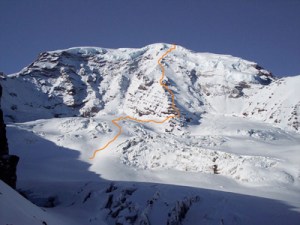
Liberty Ridge, Mount Rainier
This is a sad story, but perhaps not too surprising: Six Climbers Presumed Dead After Long Fall On Mount Rainier. From Northwest Public Radio:
Two experienced guides and four clients are presumed dead after what the National Park Service estimates was a 3,300 foot fall. The climbers were on their way down the mountain after an unsuccessful summit attempt via the difficult Liberty Ridge route on the northwestern side of Rainier.
An aerial and ground search happened Saturday after the group failed to return to their trailhead on schedule. From a helicopter, searchers spotted climbing gear at the base of a rock and ice fall and detected personal avalanche beacons. But the spotters saw no signs of life. A statement from Mount Rainier National Park says no attempt to recover bodies will be made until later in the season because of ongoing danger at the scene at the head of Carbon Glacier.
Interestingly, the guides involved worked for Alapine Ascents, the same Seattle company as some of the Sherpas who died on Mount Everest last month.
I’m not a risk-taker, and I will never understand why people want to get involved in such dangerous sports. But there are people who love to live on the edge and would rather die young doing something they love than live safely into old age.
It is a little-known fact that quite a few people actually die in National Parks every year. Oddly, I don’t like risky activities, but I do like to read books about them; and there are whole books about the different ways people have died in National and State Parks.
According to National Geographic, the dangerous ridge the climbers were using has been involved in numerous accidents in the past.
It’s called Liberty Ridge: a steep ramp of rock, snow and ice splitting a northern face of the 14,410-foot mountain in Washington State. Its stunning views and technical difficulty—hard but not too hard, experts say—have earned it a place in the book Fifty Classic Climbs of North America.
But its remoteness, steepness and exposure to the elements have also made Liberty Ridge the scene of epic rescues and more than its share of deaths….
“When you hear Liberty Ridge, it is a serious route… it’s not a casual route,” said Mike Gauthier, a climbing ranger at Mount Rainier National Park from 1990 to 2008 who was repeatedly called to the spot to rescue stranded climbers and search for missing people….
In his time on the mountain, Gauthier was repeatedly called to Liberty Ridge to rescue stranded climbers or search for missing people who didn’t survive. Often, the scene was on the ridge’s upper reaches, where the mountain is unremittingly steep, leaving few sheltered places to pitch a tent or to hide from avalanches or falling rocks.
“It’s just not an ideal location to hang out because you’re threatened there. You’re just exposed,” said Gauthier, who wrote the main guidebook for the mountain, Mount Rainier: A Climbing Guide.
Gauthier didn’t want to speculate about the group of missing climbers but said a camp at 2,800 feet would have been in a section where climbers have often run into trouble.
 At the LA Times, Maria L. LaGanga writes about the psychology of people who are drawn to mountain climbing: For some climbers, Mt. Rainier’s often deadly allure is irresistible.
“There is a draw, but I can’t explain it,” said Len Throop, owner of Eatonville Outdoor, who has climbed Rainier many times but never crested the summit. “From the first time I ever saw it, I felt a connection.
Even if you can’t see it, you know it’s there. And it’s dangerous. This week is one example, and it’s not even the worst.”
The worst accident came in June 1981, when 11 climbers died under giant chunks of ice….
Rainier has the largest system of glaciers in the United States outside of Alaska. The challenging terrain requires skill, stamina and equipment. Climbers must wear crampons, spiked implements that give their boots traction, and wield ice axes that help them arrest their slide down the mountain if they slip. They are often tied to their climbing mates for safety.
“It’s like being on a stair stepper at a steep angle for 10 hours, and that’s for just a normal route,” Grigg said. Liberty Ridge, the route the ill-fated climbers took last week, “is one of the most difficult on the mountain.”
Read the rest if you’re as interested in human behavior as I am. Apparently the climbing has to be done in the middle of the night with headlamps; so I guess the climbers don’t even see the view while they’re working their way up the mountain.
 Last night I watched most of Brian Williams’ interview with Edward Snowden. I still have to watch the final two segments, because I ran out of patience for being lectured to by a narcissistic 30-year-old. I’ll watch the rest today.
I’m not an expert at detecting deception, but I did notice that Snowden didn’t look a Williams during most of his responses to questions. He tended to look down and to the left as he spoke.
Michael B. Kelley of Business Insider asked a body language expert to review the video of Snowden and Williams.
Before Edward Snowden’s interview with NBC’s Brian Williams, body-language expert Dr. Nick Morgan considered Snowden a young guy who got a hold of a bunch of classified documents and was just telling his story about exposing intrusive American surveillance. “I came away [from the NBC interview] with a very different impression,” Morgan, a top U.S. communication theorist and best-selling author, told Business Insider. ”
As a body-language expert, I’d say this is a disingenuous performance, which surprised me.”
Morgan suggested that Snowden gave a studied performance, deliberately “subordinating himself” to Willams–as a way of sucking up and avoiding tough questions? Morgan also thought that Snowden had altered the pitch of his voice to make it lower than is natural for him.
A particularly telling moment came when Brian Williams asked Snowden, “What is your relationship with the host government?” Morgan, who didn’t previously know that Snowden’s Moscow lawyer is a Putin loyalist linked to the FSB, was struck by Snowden’s lack of eye contact and the slowing of his voice as he denied having any relationship with the Kremlin. “He was obviously lying,” Morgan said.
Frankly, anyone who believes that Snowden has no relationship with the Russian government (his lawyer works for the FSB!) is either incredibly ignorant or in deep denial.
RalphB called my attention to this interview with David Ignatious by Fareed Zakaria yesterday. Ignatious has a close relationship with the intelligence community, so I believe his assessment is worth looking at.
You mentioned there the damage to American values of the war on terror. How can America recover, and how hard is that going to be when Washington appears so divided? ….
Surveillance is an example. Because of the unexpected intervention of Edward Snowden, we are now in a period of experimentation with an alternative approach to surveillance.
I’m not someone who thinks Snowden is a hero. He promised to keep secrets, and he – despite his claim that he attempted to warn the NSA legally as a whistleblower – it’s clear that he took many of the nation’s most precious secrets with him and began distributing them to undermine what he thought were unconstitutional programs.
In our country, Congress and the courts have that responsibility for deciding what’s legal – not individual citizens. So it’s hard for me to see Snowden as a hero.
We don’t know the damage that comes from Snowden’s revelations. We may never really know that. But we do know one positive consequence, which is a searching national debate. As a result, we are now likely to experiment with a much less intrusive system of surveillance for our country.
Rather than the NSA holding our metadata for 5 years, the data will be held by communications companies for a year or two, and released by them only if there’s a court order.
Congress seems united in wanting this new approach, and we’ll see whether it works. Sometime in the future it will be urgent and essential to know who a terrorist in a safe haven in Syria was calling when in the U.S. Will we be able to know? Will the system we have put in place be sufficient to ensure the country’s security? I sure hope so. I’m sure it’s being designed with that in mind.
It would be terrible if we learn the results of the upheaval through another terrorist attack in a major U.S. city. After what we went through in Boston last year–and the aftermath continues–I certainly hope not.
Clearly, Snowden’s goal in giving an interview to Williams, who is not known for asking tough questions, was to improve his image in the U.S. and around the world. Predictably, he is now trying again to press his case for asylum in Latin America. From The Moscow Times:
“If Brazil offers me asylum, then I’ll gladly accept it. I would like to live in Brazil,” Agence France-Presse quoted Snowden as saying in an interview with Brazilian television channel Globo….
In a lengthy open letter published in the Brazilian press in December, he praised the Brazilian government for its stance against spying practices and volunteered to help the country in its investigation of NSA spying tactics if he were granted asylum.
I don’t think Ed should get his hopes up. I’d be shocked if Russia lets him go–to the U.S. or any other country.

I’ll end with this column and cartoon from Cleveland.com’s Jeff Darcy: Snowden follows Kerry’s advice.
Snowden likely did the interview to soften U.S. public opinion about him, but I doubt the answers he gave will alter the public’s view of him as either a traitor or whistle blowing hero. It’s possible to believe both that the NSA went to [sic] far and crossed the line and that Snowden was wrong in how he leaked that information.
In the interview Snowden claimed he was trained as a spy, given a false job title and false name. Brian Williams failed to ask the obvious follow up question: What was the fake name, James Bond, Austin Powers, Maxwell Smart or Benedict Arnold? The government’s answer is that Snowden was just an IT specialist contractor for the NSA. The truth is probably somewhere in between. What is certain, is that he should have never been hired and given security clearance.
When Snowden said that he was only in Russia because his passport was yanked, and he had planned to fly to Cuba, then on to Latin America, he failed to mention the Latin American countries on his destination list aren’t exactly known for their commitment to democratic freedoms and constitutional protections.
Snowden also gave weak answers to questions about national security damage caused by his leaks and why he didn’t share his concerns with Congress or other channels that would not have opened him up to treason charges….
Instead of talking to Brain Williams in Russia in 2014, Snowden should have been talking years earlier, to appropriate members of Congress about his concerns, or gone on “60 mins” or “Dateline” in disguise and blown his whistle.
Snowden defenders argue that if he were to come back to the U.S. he would never be seen again or at the very least, would never be able to have his case heard at a fair trial. I doubt that. Snowden has become too high profile and Kerry has now put the country on record in a very public way,that Snowden would be assured his day in court.
I totally agree. The Greensnow cult members who claim Snowden would disappear into a torture chamber if he came back here are full of it. In this country, public opinion–if it is loud and persistant enough–has an effect. The U.S. is not yet a “surveillance state”–even Snowden admitted that in the interview–and it’s not a dictatorship either, despite the Greensnow cult’s “chicken-little” attitude.
So . . . what are you reading and blogging about today? Please post your links in the comment thread.
Nigeria: Video of Kidnapped Girls Released
Posted: May 12, 2014 Filed under: Breaking News, Foreign Affairs | Tags: Boko Haram, Nigerian kidnappings 4 Comments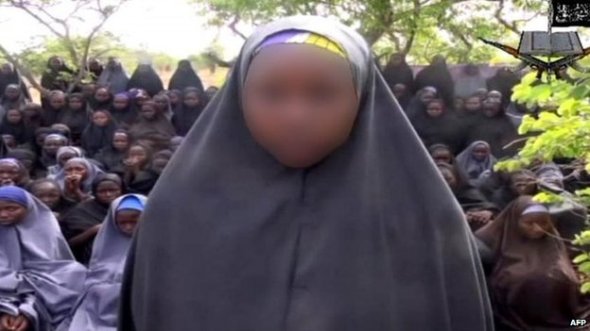
Blurred image of one of three girls seen speaking in the video and one says the group have not been harmed (BBC News)
This is a breaking news open thread.
From BBC News a few minutes ago:
Islamist militants Boko Haram have released a video apparently showing about 130 girls kidnapped from a school in northern Nigeria on 14 April.
Boko Haram leader Abubakar Shekau said the children would be held until all imprisoned militants had been freed.
Interior Minister Abba Moro rejected the deal, telling the BBC that it was “absurd” for a “terrorist group” to try to set conditions.
Boko Haram abducted more than 200 girls and threatened to sell them.
The BBC’s John Simpson in the northern city of Maiduguri says Boko Haram’s comments show signs that the group is willing to negotiate.
Three of the girls – wearing full-length cloaks – are shown speaking in the 27-minute video, obtained by French news agency AFP.
Two girls say they were Christian and have converted to Islam, while the other says she is Muslim.
“These girls, these girls you occupy yourselves with… we have indeed liberated them. These girls have become Muslims,” Abubakar Shekau says in the video.
Again, this is an open thread. I’ll post more information as I get it.
Lazy Saturday Reads: Victorian Photo Tricks, Homeschooling Horrors, and Hillary and Boko Haram
Posted: May 10, 2014 Filed under: Foreign Affairs, morning reads, Republican politics, U.S. Politics | Tags: Boko Haram, child abuse, education, hidden mother photos, Hillary Clinton, homeschooling, Josh Powell, memento mori, Nigerian kidnappings, Twelve Tribes, Victorian photography 32 Comments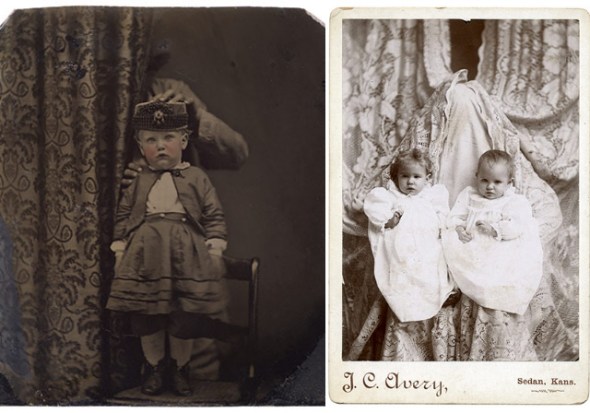
Happy Saturday!!
This might turn out to be a strange post; I’m not really sure yet. I’m writing it somewhat in response to Dakinkat’s Friday offering. I was really taken with the images she used of Victorian women and babies with bat wings, so I decided to share some Victorian baby pictures I came across recently.
In addition, following on what Dak wrote about home-schooling, I have some articles on people who survived homeschooling horrors. I think it’s an outrage that child abuse like this is permitted in supposedly civilized countries. The government should not be kowtowing to fundamentalist Christian sects that engage in uncivilized behaviors. I’m still trying not to think too much about politics, but I have some follow-up info on Boko Haram and it’s use in the latest Hillary-bashing episode.
The Hidden Mother
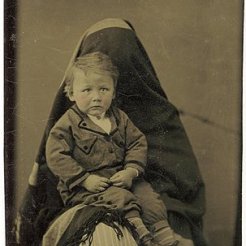
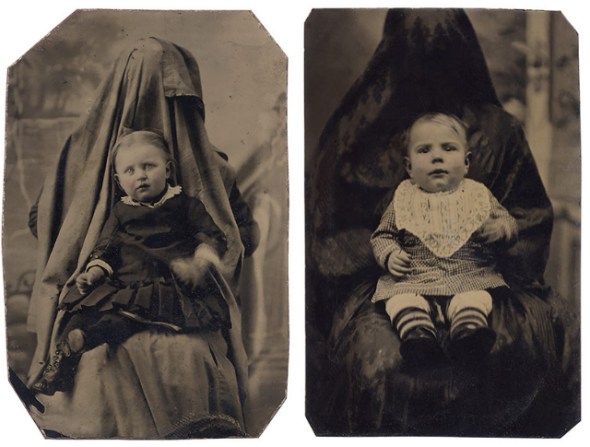
I originally saw these photos on Twitter (of course), but I found them so fascinating that I tried to find out a little more about them. You’ll notice in the photos at the top of this post that there are ghostly fabric things behind or beside the children. Those are the hidden mothers keeping their kids still for the slow-developing cameras of those days. Lots of the photos look really eerie, and they hardly ever show the children smiling. Here’s an article from the Guardian from December 2013 that provides an introduction to the strange Victorian practice of “hidden mother” photography: The lady vanishes: Victorian photography’s hidden mothers.
Babies may be insatiably photogenic, but somehow they don’t really suit the whole business of photography. The flash makes them startle. They wriggle. They cry. They blink. You prop them up with cushions – and seconds later, they’re upside down gnawing their own toes. They make Dr Evil hand-signals. They fall asleep. They drool.
And if it’s bad now, it was worse then. Now we have cameraphones to record every last gurgle, but for the Victorians it was much more complicated. A 19th-century parent would have to dress the baby in a starchy gown, transport it and perhaps its siblings to the nearest photographer’s (orambrotypist’s) studio as early in the morning as possible, climb several flights of stairs to the skylit attic, arrange the family group against the studio backdrop, get everyone to remain completely still for 30 seconds or so, part with a large chunk of money, and then wait several days for the copies to be finished, before sending them round to family and friends as calling cards, or pasting them into albums.
The main problem was the length of the exposure. However bright the photographer’s studio, it took up to half a minute for an image to register on wet collodion. Getting an adult to sit completely still for half a minute is a challenge, but getting a wakeful baby to do so is near-impossible. The photographer could position anyone old enough to sit on a chair by placing an electric chair-style head clamp behind them, but the only way of photographing a baby was for the mother to hold it (or dope it with enough laudanum to keep a grown man rigid for a week).
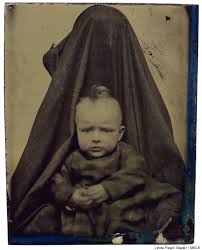
These photos recently came to light in a book called The Hidden Mother, by Linda Fregni Nagler
Though there are plenty of Victorian studio portraits of family groups, there are also many in which the mothers are concealed: they’re holding babies in place while impersonating chairs, couches or studio backdrops. They wanted a picture of just the baby, and this was the best way to achieve it. Sometimes, the figures are obvious, standing by the side of a chair and waiting to be cropped out later; sometimes, they really do appear as a pair of curtains or as disembodied hands. To a 21st-century viewer, the images look bizarre – all these unsmiling children strangled by smocking and framed by what appears to be a black-draped Grim Reaper, or by an endless succession of figures in carpets and chintz burqas.
The book also highlighted another weird Victorian practice–photographing the dead. Some of the children in the photos are dead.
Until the 1880s and the advent of mass-market photography, most people might only have a snapshot taken once in a lifetime. Since many children did die in infancy, the only memento the parents might have would be the single posthumous photograph of their baby propped up to look as if it was merely asleep.
It turns out that not just children were memorialized in photos after death. Below you can see a photographer taking a postmortem picture of a corpse propped up in a chair with eyes open.
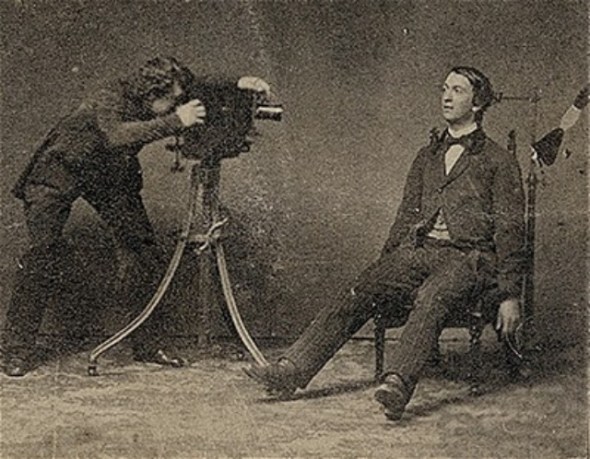
Weird, huh? Sometimes they even painted in eyes to make the person look more alive. Another “Victorian photo trick” was “headless photographs.” Here’s an example:
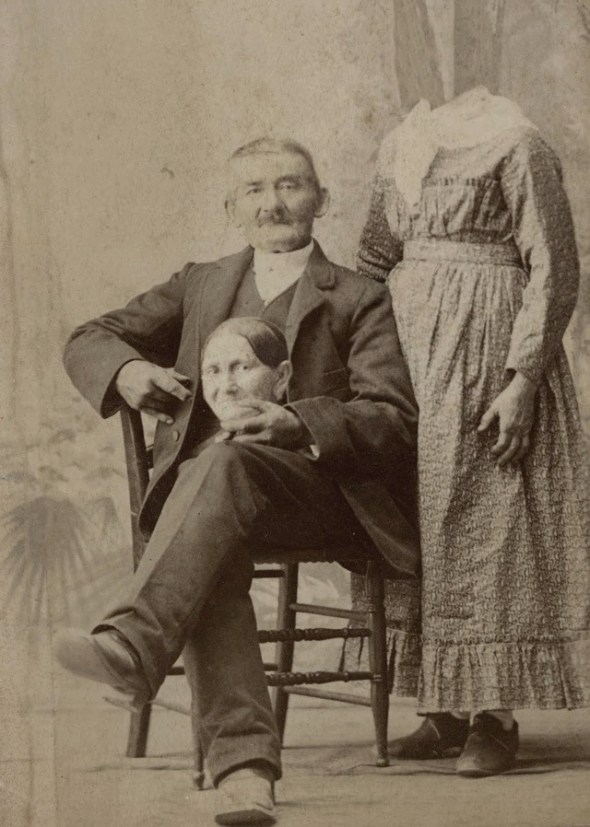
You can read more about these strange Victorian photographic practices and see more examples at the following links.
Hyperallergic art blog: Victorian Photo Tricks, From Hidden Mothers to Eyes on the Dead (1/2014)
Daily Life: Why did mothers once conceal themselves in photographs?
Pinterest: Mothers, Photographs, and Memento Mori.
Flickr page, Hidden Mother: Tintypes and Cabinets
Home Schooling Horrors
Again I came across this on Twitter. There’s apparently a Twitter group made up of home schooling survivors, and they were having some kind of home schooling awareness day awhile back to call attention to a law in Virginia that gives religious exemptions to parents who don’t want to send their kids to school. I started reading their descriptions of what they had experienced, and I was just horrified. I saved a few links at the time that I’ll share. From The Washington Post: Student’s home-schooling highlights debate over Va. religious exemption law.

Josh Powell wanted to go to school so badly that he pleaded with local officials to let him enroll. He didn’t know exactly what students were learning at Buckingham County High School, in rural central Virginia, but he had the sense that he was missing something fundamental.
By the time he was 16, he had never written an essay. He didn’t know South Africa was a country. He couldn’t solve basic algebra problems.
“There were all these things that are part of this common collective of knowledge that 99 percent of people have that I didn’t have,” Powell said.
Powell was taught at home, his parents using a religious exemption that allows families to entirely opt out of public education, a Virginia law that is unlike any other in the country. That means that not only are their children excused from attending school — as those educated under the state’s home-school statute are — but they also are exempt from all government oversight.
School officials don’t ever ask them for transcripts, test scores or proof of education of any kind: Parents have total control.
Powell’s family encapsulates the debate over the long-standing law, with his parents earnestly trying to provide an education that reflects their beliefs and their eldest son objecting that without any structure or official guidance, children are getting shortchanged. Their disagreement, at its core, is about what they think is most essential that children learn — and whether government, or families, should define that.
Josh’s story is heartbreaking and inspiring. The scariest thing about this law is that the children wishes are given no consideration at all. After years of struggle, Josh finally cobbled together an education managed to get accepted to Georgetown, but it was a long road and at the time of this article he still worried about his siblings who had not been able to escape the home schooling nightmare.
In 2008, Josh Powell wrote to Buckingham school officials, telling the board that he didn’t share his parents’ religious objections to public school and asking to enroll.
He said the administrator he spoke with was kindly but dismissive.
Crushed, he tried a home-school co-op for a while, then a class to study for a high-school equivalency test. “I figured if I can’t make any headway with my parents, can’t make any headway with the school board, what . . . am I going to do?” he said.
He Googled “financial aid” and applied to Piedmont Virginia Community College. A neighbor gave him a ride, an hour each way every day, until he had earned enough to afford an apartment nearby. It was terrifying, he said, as he was unsure how to behave in a classroom or whether he was going to embarrass himself answering questions. But he was thrilled.
“With the addition of lectures, the structure, the support, the tutoring — things just finally clicked. I remember my first semester sitting in my developmental math class. No one wanted to be there except for me. I was thinking, ‘Oh, my God, I have a chance to learn!’ ”
It’s a long article, but well worth reading in full. Here are a few more links for more info:
An interview with Josh Powell at NPR: Brother Wants Parents To Stop Siblings’ Homeschooling
Anthony B. Susan blog: It’s Time To Rethink Virginia’s Homeschool Laws.
A blog devoted to Homeschooling’s Invisible Children – “Shining a Light on Abuse and Neglect in Homeschooling Environments.”
It doesn’t just happen in the U.S. Some information on a homeschooling religious cult in Germany:
Der Spiegel: Life after the sect: “I have no roots and no strength to fly. The google translation is horrible, but you can read all about the Twelve Tribes cult here:
Yeshua Here I Am (Part 11, with links to parts 1-10).
Hillary Clinton and Boko Haram Follow-up
As I wrote on Thursday, the latest GOP attack on Hillary is over her supposed failure to deal with Nigeria’s Boko Haram when she was Secretary of State by adding them to the State Department’s list of terrorist groups. I’m not going to get deeply into this argument, because it just makes me tired; but here are a couple of in-depth treatments of the issues involved.
Tom Cohen at CNN: Clinton’s handling of Boko Haram questioned.
Howard LaFranchi at The Christian Science Monitor: Why Hillary Clinton’s State Dept. didn’t list Boko Haram as a terrorist group.
Chris McGreal at The Guardian UK: Nigeria kidnapping: why Boko Haram is a top security priority for the US
And from Mother Jones, a background article on Boko Haram: What is Boko Haram and Why Do Its Members Kidnap Schoolgirls?
So . . . What’s on your mind today? Please share your thoughts and links in the comment thread.
Thursday Reads: The Blame Hillary Game; Russia’s Internet Crackdown, and “Religious Experiences”
Posted: May 8, 2014 Filed under: Foreign Affairs, morning reads, U.S. Politics | Tags: Benghazi, chronic stress, counterterrorism, Edward Snowden, Hillary Clinton, hippocampus, John Kerry, Johnnie Carson, Josh Rogin, Nigerian kidnappings, psychological studies, religion and the brain, religious experiences, Russian internet crackdown, US State Department 44 Comments
Good Morning!!
Josh Rogin of the Daily Beast (formerly of The American Conservative and Foreign Policy) is at it again. Not long ago, he caused an uproar by sneaking into a supposedly off-the-record meeting of the Trilateral Commission and secretly taping John Kerry saying that Israel is in danger of becoming an “apartheid state.” Not that there’s anything wrong with taping the remarks, but Rogin failed to note this fact in his subsequent reports. Instead he sourced the remarks to “an attendee” and “recording obtained by The Daily Beast.”
This morning Rogin has Hillary Clinton in his crosshairs: Hillary’s State Department Refused to Brand Boko Haram as Terrorists. Rogin’s point seems to be that Clinton is a hypocrite because since Nigerian group kidnapped hundreds of schoolgirls, she has criticized them in no uncertain terms.
In the past week, Clinton, who made protecting women and girls a key pillar of her tenure at the State Department, has been a vocal advocate for the 200 Nigerian girls kidnapped by Boko Haram, the loosely organized group of militants terrorizing northern Nigeria. Her May 4 tweet about the girls, using the hashtag #BringOurGirlsBack, was cited across the media and widely credited for raising awareness of their plight.
On Wednesday, Clinton said that the abduction of the girls by Boko Haram was “abominable, it’s criminal, it’s an act of terrorism and it really merits the fullest response possible, first and foremost from the government of Nigeria.” Clinton said that as Secretary of State she had numerous meetings with Nigerian President Goodluck Jonathan and had urged the Nigerian government to do more on counterterrorism.
What Clinton didn’t mention was that her own State Department refused to place Boko Haram on the list of foreign terrorist organizations in 2011, after the group bombed the U.N. headquarters in Abuja. The refusal came despite the urging of the Justice Department, the FBI, the CIA, and over a dozen senators and congressmen.
“The one thing she could have done, the one tool she had at her disposal, she didn’t use. And nobody can say she wasn’t urged to do it. It’s gross hypocrisy,” said a former senior U.S. official who was involved in the debate. “The FBI, the CIA, and the Justice Department really wanted Boko Haram designated, they wanted the authorities that would provide to go after them, and they voiced that repeatedly to elected officials.”

Hillary Clinton condemns Nigerian kidnappings
Rogin goes on to quote numerous–some by name and some not–critics who essentially blame Clinton for the current situation. Rogin quotes these sources (largely Republicans) as saying that if Hillary had designated Boko Haram a terrorist group, the government would have been better able to cut them off from financial support and get other countries to do the same. Because of Hillary’s refusal to do this, according to Republican Patrick Meehan, chairman of the Subcommittee on Counterterrorism and Intelligence, “We lost two years of increased scrutiny. The kind of support that is taking place now would have been in place two years ago.” John Kerry did add Boko Haram to the terrorist list late last year.
Rogin admits that not everyone agrees that designating Boko Haram a terrorist group would have made that much difference. Sources told Rogin that other efforts were made to deal with the issue. Yesterday f0rmer Assistant Secretary of State for African Affairs Johnnie Carson defended the decision.
“There was a concern that putting Boko Haram on the foreign terrorist list would in fact raise its profile, give it greater publicity, give it greater credibility, help in its recruitment, and also probably drive more assistance in its direction,” he said.
The U.S. has plenty of ways to assist the Nigerian government with counterterrorism even without designating Boko Haram, Carson said. The problem has long been that the Nigerian government doesn’t always want or accept the help the U.S. has offered over the years.
“There always has been a reluctance to accept our analysis of what the drivers causing the problems in the North and there is sometimes a rejection of the assistance that is offered to them,” Carson said. “None of that has anything to do with putting Boko Haram on the foreign terrorist list.”
This sounds like a partisan issue to me, but I admit to having zero knowledge of Boko Haram and State Department policies in general. Frankly, I suspect Josh Rogin is trying to make a name for himself by undermining Hillary Clinton, John Kerry, and Obama administration foreign policy in general. But then, I’m also a partisan.
As for Hillary herself, she spoke to ABC News’ Robin Roberts yesterday: Hillary Clinton Calls Nigeria Kidnappings ‘An Act Of Terrorism.’ The occasion was a “philanthropy event” at the Ford Foundation in NYC. CNN provides more detail about Hillary’s remarks: Hillary Clinton faults Nigerian government’s handling of search for kidnapped girls.
The Nigerian government has been “somewhat derelict” in protecting their children, Hillary Clinton said Wednesday as international attention focused on schoolgirls kidnapped by a militant group.
“The seizure of these young women by this radical, extremist group, Boko Haram is abominable, it’s criminal, it’s an act of terrorism and it really merits the fullest response possible, first and foremost from the government of Nigeria,” Clinton said, later adding that “the government of Nigeria has been in my view somewhat derelict in its responsibility toward protecting boy and girls, men and women in northern Nigeria over the last years.”
During her remarks at a philanthropy event in New York City, Clinton went on to say “the Nigerian government must accept help – particularly intelligence, surveillance and recognizance help – their troops have to be the ones that (are) necessary but they could do a better job if they accept the offers that are being made.”
The U.S. government has offered to help in the search for the schoolgirls. Officials have told CNN the Obama administration is sharing intelligence with Nigerian authorities and could provide other assistance, but there is no plan to send U.S. troops. Legislators on Capitol Hill have also called for the United States to do more to help the Nigerian government.
A little more from the talk:
“The Nigerian government has failed to confront the threat or to address the underlying challenges,” Clinton said of the kidnappings. “Most of all, the government of Nigeria needs to get serious about protecting all of its citizens… and ensuring the every child has the right and opportunity to go to school.”
Standing in front of high profile financiers and donors at the opulent Waldorf Astoria, Clinton went on to urge Nigerian citizens to hold their leaders accountable and implored religious leaders, Nigeria’s neighbors, the African Union and the international community to continue to stay involved in finding the schoolgirls.
“Every asset and expertise should be brought to bear,” Clinton said. “Everyone needs to see this for what it is, it is a gross human rights abuse but it is also part of a continuing struggle within Nigeria and within North Africa.”
Follow me below the fold . . .

 peej
peej Carissa
 bostonboomer
 dakinikat
 ecocatwoman
 jjlo
jjlo mablue2
 Mama Lopez
 peggysue22
 quixote
 skydancingguestblogger
 Mona (aka Wonk the Vote)



 Sky Dancing
Recent Comments