


Just weeks before Blackwater guards fatally shot 17 civilians at Baghdad’s Nisour Square in 2007, the State Department began investigating the security contractor’s operations in Iraq. But the inquiry was abandoned after Blackwater’s top manager there issued a threat: “that he could kill” the government’s chief investigator and “no one could or would do anything about it as we were in Iraq,” according to department reports.
American Embassy officials in Baghdad sided with Blackwater rather than the State Department investigators as a dispute over the probe escalated in August 2007, the previously undisclosed documents show. The officials told the investigators that they had disrupted the embassy’s relationship with the security contractor and ordered them to leave the country, according to the reports.
After returning to Washington, the chief investigator wrote a scathing report to State Department officials documenting misconduct by Blackwater employees and warning that lax oversight of the company, which had a contract worth more than $1 billion to protect American diplomats, had created “an environment full of liability and negligence.”
Saturday Reads: A li’l bit of This and That
Posted: July 19, 2014 Filed under: Economy, free market ideology, morning reads, Russia, Ukraine 31 CommentsGood Morning!
I thought I’d just try to put up a bunch of interesting articles that I’ve read recently, so I’m pretty sure there’s no theme here. I guess we’ll see as I meander into each of them.
Economics started out as the study of Political Economy. Many of its early thinkers were definitely more essayists than researchers using data and  statistical methods to look for trends. The study of what we call frictions–or things in markets that cause them to stray from a perfect model—has been really important since we’ve learned to use data to empirically test theoretical models and constructs. It’s interesting to go back to many of these early philosophical writers and notice that their gut feelings–as expressed in their essays–are as germane now as they were then. Karl Polanyi critiqued early market Capitalism in the 20th century in “The Great Transformation.” Polanyi argued that the idea of an efficient market economy was basically as utopian as its Marxist counterpoint. Two sociologists have written a book that revisits the Polanyi critique. Is the Free Market an impossible Utopia? This is from an interview with the two researchers.
Polanyi’s core thesis is that there is no such thing as a free market; there never has been, nor can there ever be. Indeed he calls the very idea of an economy independent of government and political institutions a “stark utopia”—utopian because it is unrealizable, and the effort to bring it into being is doomed to fail and will inevitably produce dystopian consequences. While markets are necessary for any functioning economy, Polanyi argues that the attempt to create a market society is fundamentally threatening to human society and the common good. In the first instance the market is simply one of many different social institutions; the second represents the effort to subject not just real commodities (computers and widgets) to market principles but virtually all of what makes social life possible, including clean air and water, education, health care, personal, legal, and social security, and the right to earn a livelihood. When these public goods and social necessities (what Polanyi calls “fictitious commodities”) are treated as if they are commodities produced for sale on the market, rather than protected rights, our social world is endangered and major crises will ensue.
Free market doctrine aims to liberate the economy from government “interference”, but Polanyi challenges the very idea that markets and governments are separate and autonomous entities. Government action is not some kind of “interference” in the autonomous sphere of economic activity; there simply is no economy without government rules and institutions. It is not just that society depends on roads, schools, a justice system, and other public goods that only government can provide. It is thatall of the key inputs into the economy—land, labor, and money—are only created and sustained through continuous government action. The employment system, the arrangements for buying and selling real estate, and the supplies of money and credit are organized and maintained through the exercise of government’s rules, regulations, and powers.
By claiming it is free-market advocates who are the true utopians, Polanyi helps explain the free market’s otherwise puzzlingly tenacious appeal: It embodies a perfectionist ideal of a world without “coercive” constraints on economic activities while it fiercely represses the fact that power and coercion are the unacknowledged features of all market participation.
In “Judgments About Fact and Fiction by Children From Religious and Nonreligious Backgrounds,” Kathleen Corriveau, Eva Chen, and Paul Harris demonstrate that children typically have a “sensitivity to the implausible or magical elements in a narrative,” and can determine whether the characters in the narrative are real or fictional by references to fantastical elements within the narrative, such as “invisible sails” or “a sword that protects you from danger every time.”
However, children raised in households in which religious narratives are frequently encountered do not treat those narratives with the same skepticism. The authors believed that these children would “think of them as akin to fairy tales,” judging “the events described in them as implausible or magical and conclude that the protagonists in such narratives are only pretend.”
And yet, “this prediction is likely to be wrong,” because “with appropriate testimony from adults” in religious households, children “will conceive of the protagonist in such narratives as a real person — even if the narrative includes impossible events.”
The researchers took 66 children between the ages of five and six and asked them questions about stories — some of which were drawn from fairy tales, others from the Old Testament — in order to determine whether the children believed the characters in them were real or fictional.
“Children with exposure to religion — via church attendance, parochial schooling, or both — judged [characters in religious stories] to be real,” the authors wrote. “By contrast, children with no such exposure judged them to be pretend,” just as they had the characters in fairy tales. But children with exposure to religion judged many characters in fantastical, but not explicitly religious stories, to also be real — the equivalent of being incapable of differentiating between Mark Twain’s character Tom Sawyer and an account of George Washington’s life.
Archaeologists have found an 8000 year old skull containing residual brain matter. 
Archaeologists in Norway have found what could potentially be an 8,000-year-old human skull – which contains traces of brain matter.The finding at a site in Stokke, Vestfold, could shed light on life in the Stone Age, a period that lasted roughly 3.4 million years, and ended between 6000 BC and 2000 BC.It was among a number of discoveries unearthed during the excavation, The Local reported.
It is too early to tell whether the bone remains are those of a human or an animal, but early tests have dated the skull to around 5,900BC, placing it within the prehistoric Stone Age period.
Gaute Reitan, dig site leader, told NRK that the “one of a kind” skull contained a grey substance that appeared to be brain matter.
But he said it was not possible to confirm if it belongs to a human.
 The Guardian reports that the Russian-backed Ukrainian separatists are scurrying to cover up their guilt in the shoot down of the Malaysian commercial jet killing hundreds of people.
The OSCE was trying to gain access to one part of the large crash site but the commander of a rebel unit, known as Commander Glum, blocked them. After the warning shot, the OSCE convoy departed.
There is also confusion over the black boxes and other devices apparently salvaged from the plane. A rebel military commander initially said he was considering what to do with them, while another rebel leader, Aleksandr Borodai, contradicting his colleague, said the rebels had no black boxes or any other devices.
The Ukrainian interior ministry added to fears of a cover-up when it released video purportedly taken by police showing a truck carrying a Buk missile launcher with one of its four missiles apparently missing, rolling towards the Russian border at dawn. The video could not be independently verified.
Other material on rebel social media sites was being deleted, including pictures showing the alleged capture of Buk missile vehicles by rebels from a Ukrainian air base last month.
Rebels said the boast on the social media site on Thursday that a plane had been shot down was not put up by them but by a sympathiser who mistakenly assumed it was a Ukrainian military plane that had been shot down. But in a separate posting a rebel leader also claimed that a plane had been brought down. “We warned you – do not fly in our sky,” he said. That too was removed.
A Nato intelligence specialist quoted by the military analysts Janes said the recordings “show that the Russian ‘helpers’ realise that they now have an international incident on their hands – and they probably also gave the order for separatists to erase all evidence – including those internet postings. It will be interesting to see if we ever find this Buk battery again or if someone now tries to dump it into a river.”
Video footage allegedly taken on Thursday appeared to support the idea that pro-Russia separatists had been to blame. It showed a Buk battery seemingly being moved in the rebel-held area between Snizhne and Torez close to the crash site. A still picture allegedly shows a missile in vertical launch mode beside a supermarket in Torez. However, the location has still to be established.
Ukrainian intelligence has published a tape said to be a recording between rebels and Russian intelligence in which they realise there has been a catastrophic blunder. One recording is said to be between a rebel commander, Igor Bezler, and a Russian intelligence officer in which he says: “We have just shot down a plane.” A second recording from an unidentified source puts the blame on Cossack militiamen.
Defence analysts with Russian expertise shared Power’s scepticism that Russia-backed rebel groups would have had the expertise to fire the missile and suggested it was more likely to have been Russian ground troops who specialise in air defence, seconded to help the rebels.
At the Pentagon, officials said a motive for the operation had yet to be determined, as had the chain of command. One said it would be “surprising to us” if pro-Russia separatists were able to operate the Buk missile battery without Russian technical support. The Ukrainian military confirmed it has Buk batteries but said it had none in the area the missile was fired.
Nato had Awacs surveillance and command-and-control planes flying in the Baltics around the time of the crash, but Pentagon officials did not think the aircraft picked up indications of the disaster.
Bob Latiff, a former US weapons developer for the air force and the CIA and now a professor at Notre Dame University, said he leaned towards a belief that it was a case of mistaken identity on the part of those who pressed the button.
“A radar return from an airplane like this would look very similar to that from a cargo plane, as was initially claimed by the separatists. If radar was all they were using, that is a shame,” he said. “All airliners emit identification signals which identify the aircraft and provide other information like altitude and speed. They also operate on known communications frequencies. It doesn’t sound like the separatists were using any of this.
“My guess is the system’s radar saw a return from a big ‘cargo’ plane flying at 30,000 ft or so and either automatically fired, or some aggressive, itchy operator fired, not wanting to miss an opportunity.”
Latiff said that if they had only one radar, as Ukrainian officials suggest, it would have been pointed at the target. A second, rotating one would normally have been part of a battery to pick up other planes in the immediate vicinity, but he said even that would not have established whether it was a commercial plane and there would normally have been communications equipment to pick up signals showing the plane was non-military.
Igor Sutyagin, a Russian military specialist at the London-based Royal United Services Institute, said he regarded the tape recordings as genuine, as well as postings on social media pointing the finger at pro-Russia separatists or Russia itself.
But getting evidence would be very difficult. He said: “A decision has been made on the Russian side to hide their tracks. It will be hard to find the battery.” Satellites might have been able to catch something, but the trail from the missile would have been very short, Sutyagin said.
So, I still can’t discern much of a pattern here but I just found all these links very interesting. What’s on your reading and blogging list today?
Friday Reads: Israel Invades Gaza, Downing of Jet a Ukraine a “Game Changer,” and the Unrelenting War on Women
Posted: July 18, 2014 Filed under: Foreign Affairs, Israel, morning reads, Russia, U.S. Politics, Ukraine, Women's Rights | Tags: Benjamin Netanyahu, Gaza, Hamas, International AIDS conference, Malaysian Airlines, Reproductive Rights 47 Comments
Good Morning!!
Lately I’ve been remarking about how slow the news is in these dog days of summer. Suddenly there is lots going on–even on a Friday–and the news isn’t good. It’s difficult to say which is worse: the escalating battle between Israel and Hamas in Gaza or the downing of a Malaysia Airlines jet over Ukraine. And of course there is the ongoing war on women’s reproductive freedom. This post is going to be a link dump without a lot of commentary because, quite frankly, I’m at a loss for words.
Israel Invades Gaza
The LA Times reports: Israeli troops and tanks move into the Gaza Strip.
After 10 days of Israeli airstrikes and rocket attacks by Palestinian militants, Israeli Prime Minister Benjamin Netanyahu ordered ground troops into the Gaza Strip on Thursday night, escalating an exchange of fire that has claimed more than 240 lives, all but one of them Palestinian.
Under cover of darkness, tanks rolled across the northern border of the coastal enclave, backed by intense shelling from the land, air and sea all along the frontier, witnesses said.
The immediate objective was to strike at tunnels Hamas and its allies use to smuggle weapons and fighters into Israel, according to a statement issued by Netanyahu’s office….
Israeli officials said Netanyahu made the decision to send in ground forces after Hamas, the militant movement that has controlled the enclave since 2007, rejected a cease-fire brokered by Egypt this week and fired rockets at Israel during a five-hour truce Thursday that was requested by the United Nations. The truce was meant to allow Gaza’s battered residents to stock up on food, cash and other necessities.
There’s much more information at the link.

From the NYT: Israeli Military Invades Gaza, With Sights Set on Hamas Operations.
As rockets continued to rain down on Israeli cities, a military spokesman said the mission’s expansion was “not time bound” and was aimed to ensure Hamas operatives were “pursued, paralyzed and threatened” as it targeted “terrorist infrastructure” in the north, south and east of Gaza “in parallel.”
As midnight approached Thursday, residents of some sparsely populated farmland in northern Gaza were cowering in their homes, afraid to answer mobile phones or peek out windows. Some sent text messages reporting that they could hear tank shelling, heavy artillery, and F-16s dropping bombs. Moussa al-Ghoul, 63, who lives northwest of Beit Lahiya, said his neighborhood had turned into “a war zone” with tanks surrounding his home, having destroyed those of two of his sons. He said shells were landing “everywhere.”
Gaza news outlets reported that electricity had been cut to 80 percent of the coastal territory after cables bringing power from Israel were damaged….
“We will strike Hamas and we are determined to restore peace to the state of Israel,” the military spokesman, Lt. Col. Peter Lerner, told reporters in a conference call. “It will progress according to the situation assessment and according to our crafted and designed plan of action to enable us to carry out this mission.”
Israel began to call up 18,000 reservists, adding to 50,000 already mobilized in recent days; Colonel Lerner said the ground forces would include infantry and artillery units, armored and engineer corps, supported by Israel’s “vast intelligence capabilities,” air force and navy.
Again, many more details at the link.
From Reuters a short time ago this morning: Israel steps up Gaza ground offensive, civilian casualties grow.
Israel intensified its land offensive in Gaza with artillery, tanks and gunboats on Friday and warned it could “significantly widen” an operation Palestinian officials said was killing ever greater numbers of civilians.
Palestinian health officials said 27 Palestinians, including a baby, two children and a 70-year-old woman, had been killed since Israel sent ground forces into the densely-populated strip of 1.8 million Palestinians on Thursday.
The Israeli military said it killed 17 Palestinian gunmen while another 13 surrendered and were taken for questioning after the infantry and tank assault began in the Islamist Hamas-dominated territory.
One Israeli soldier was killed and several others were wounded in the operations, in which some 150 targets, including 21 concealed rocket launchers and four tunnels, have been attacked, according to the military.
Read more at the link.
I don’t even know what to say about this conflict other than I’ve pretty much lost any sympathy I once had for Israel. I can’t understand why the Israeli people keep electing far right warmongering leaders.
Downing of Malaysian Airlines Jet Over Ukraine
After the downing of a Malaysian Airlines plane with nearly 300 people on board, the conflict in Ukraine has become a full blown international crisis.

From the Kyiv Post this morning: SBU intercepts phone conversations of separatists admitting downing a civilian plane (FULL TRANSCRIPT; VIDEO).
Malaysia Airlines Boeing 777-200 flying from Amsterdam to Kuala Lumpur was allegedly shot down by a group of Russian-backed Cossack militants near the village of Chornukhine, Luhansk Oblast, some 80 kilometers north-west of Donetsk, according to recordings of intercepted phone calls between Russian military intelligence officers and members of terrorist groups, released by the country’s security agency (SBU).
One phone call apparently was made at 4:40 p.m. Kyiv time, or 20 minutes after the plane crash, by Igor Bezler, who the SBU says is a Russian military intelligence officer and leading commander of the self-proclaimed Donetsk People’s Republic. He reports to a person identified by Ukraine’s SBU as a colonel in the main intelligence department of the general headquarters of the armed forces of the Russian Federation Vasili Geranin regarding the shot down plane, which is about to be examined by the militants.
The second intercepted conversation released by the Security Service of Ukraine was apparently between militants nicknamed “Major” and “Greek” immediately upon inspection of the crash site.
“It’s 100 percent a passenger (civilian) aircraft,” Major is recorded as saying, as he admitted to seeing no weapons on site. “Absolutely nothing. Civilian items, medicinal stuff, towels, toilet paper.”
In the third part of conversation Cossack commander Nikolay Kozitsin talking to an unidentified militant cynically suggests that the Malaysia Airlines airplane could’ve been carrying spies, as, otherwise, it would have no business flying in that area.
Read the rest of the transcript at the link–lots of “Oh shit”-type quotes.

Julia Ioffe writes at The New Republic, The Crash of Malaysian Airlines flight 17 is a Game Changer: This Conflict is Now Officially Out of Control.
Over the last couple of months, pro-Russian separatists have beendowningUkrainian military planes with increasing regularity—and mounting casualties on the Ukrainian side. Just earlier Thursday, separatists had shot down another one. All of that seemed to undermine the narrative, propagated by the Kremlin, that the separatists were just a ragtag people’s militia who didn’t stand a chance against a proper, organized military. The constant downing of Ukrainian jets showed that these men were equipped with some pretty serious stuff: You can’t really shoot down a jet with a Kalashnikov.
And, in fact, Russian a state media report from late June indicates the rebels got a hold of a Buk missile system, a Russian/Soviet surface-to-air missile system. Rebels are now denying that they shot down the plane, but there are now screenshots floating around the Russian-language internet from what seems to be the Facebook page of Igor Strelkov, a rebel leader in eastern Ukraine, showing plumes of smoke and bragging about shooting down a Ukrainian military Antonov plane shortly before MH17 fell. “Don’t fly in our skies,” he reportedly wrote. If that’s true, it would seem rebels downed the jetliner, having mistaken it for a Ukrainian military jet….
Make no mistake: this is a really, really, really big deal. This is the first downing of a civilian jetliner in this conflict and, if it was the rebels who brought it down, all kinds of ugly things follow. For one thing, what seemed to be gelling into a frozen local conflict has now broken into a new phase, one that directly threatens European security. The plane, let’s recall, was flying from Amsterdam.
For another, U.S. officials have long been saying that there’s only one place that rebels can get this kind of heavy, sophisticated weaponry: Russia. This is why a fresh round of sanctions was announced yesterday. Now, the U.S. and a long-reluctant Europe may be forced to do more and implement less surgical and more painful sanctions.
This also seems to prove that Russia has lost control of the rebels, who have been complaining for some time of being abandoned by President Vladimir Putin. There is no way that, a day after criticizingthe recklessness of American foreign policy, his military shoots down a passenger plane. Rather, it seems that the rebels made a mistake that paints Putin into a corner. Putin hates corners, and when he’s backed into one, he tends to lash out.
Adding another level of shock to the story, Buzzfeed reports that at least 100 passengers on the Mayaysian jet were on their way to an international AIDS conference.
And a related story from from the WSJ, Ukraine Accuses Russia of Shooting Down Fighter Jet: Ministry of Defense Says Missiles Probably Fired By Aircraft Patrolling Border.
MOSCOW—Ukraine on Thursday accused Russia’s armed forces of shooting down one of its fighter jets over Ukrainian territory, marking Kiev’s most direct accusation yet of Moscow’s involvement in the separatist conflict in the country’s east.
The accusation came hours before a Malaysia Airlines3786.KU -11.11% plane carrying 295 passengers and crew crashed while flying over the east Ukraine region of Donetsk.
A Russian military plane fired on and downed a Ukrainian SU-25 fighter jet that was flying over the town of Amvrosiivka in Ukraine’s Donetsk region on Wednesday night, Ukrainian National Security and Defense Council Spokesman Andriy Lysenko said at a briefing.
The Ukrainian Ministry of Defense said the jet was shot in the tail section from the direction of the Russian border while it was turning around at approximately 7 p.m. on Wednesday night. (Follow the latest updates on the crisis in Ukraine.)
“In this way, Russia has executed another provocation,” the ministry said in a statement. “The bombardment probably came from air-to-air missiles fired by a pair of Russian Armed Forces aircraft patrolling the border in a certain area.”
Also well worth a read: at Pando, Mark Ames offers Five things to consider about the downing of Malaysian Airlines MH17 in Ukraine.
The Ongoing War on Women’s Reproductive Rights

Laura Bassett at HuffPo reports, White House: Employers Must Disclose Objections To Covering Birth Control.
The Department of Labor updated its website to indicate that closely held for-profit corporations must include in their insurance plans “a description of the extent to which preventive services (which includes contraceptive services) are covered under the plan.” If the company chooses to opt out of covering any of the 20 contraceptives required by the Affordable Care Act, it has 60 days to disclose the change to its employees.
A senior administration official said the move was in response to the Senate failing to pass a bill Wednesday that would have required all for-profit employers, regardless of their owners’ religious objections, to cover the full range of Food and Drug Administration-approved contraception in their health care plans. The bill would have overridden a recent Supreme Court decision that allowed Hobby Lobby, a craft supply company owned by evangelical Christians, to opt out of covering certain contraceptives to which the owners religiously object.
“Yesterday, a majority of the Senate voted for a bill to keep bosses from interfering in a woman’s health care,” the official said. “Now the House should act. In the meantime, we are making clear that if a corporation like Hobby Lobby drops coverage of contraceptive services from its health plan, it must do so in the light of day by letting its workers and their families know.”
The clarification is not a new rule. Current law already states that employers must disclose changes in their health benefits to employees. But the new guidance on the ACA makes clear that the disclosure requirement applies to those corporations opting out of birth control coverage after the Hobby Lobby decision.
Jezebel tells it like it is: Your Employers Must Tell You If They Think You’re a Babykilling Slut.
After the Supreme Court’s Hobby Lobby decision went down, many women wondered if they would suddenly find themselves at the mercy of their boss’s heretofore unknown beliefs that women who take birth control are abortion-happy harlots. Unfortunately, the answer is still yes. Fortunately, thanks to new rules set forth by the White House today, your boss has to inform you if and when this is happening….
Ideally, today’s directive will force companies with “religious beliefs” to be straightforward with their employees rather than sneaky about how badly they’re hosing everyone. And critics of this directive might wonder what the benefit is. If companies are run by zealots, then what good will telling the employees do?
Here’s what this “inform your employees of your conscientious objections” mandate will do: it will leave a paper trail that disgruntled employees could easily pass onto media outlets, which media outlets can then convey to the general public. The public can then avoid shopping at places run by people who think that birth control is murder.
And now’s as good a time as any to say this: if your boss informs you that your birth control is no longer covered because Jesus Loves Zygotes, let us know.
Those are my recommendations for today. What stories are you reading and blogging about?
Sunday Reads: Israel-Palestine Conflict and Presidential Break-Out
Posted: July 13, 2014 Filed under: Barack Obama, Foreign Affairs, morning reads, U.S. Politics | Tags: #TheBearIsLoose, Daniel Rugg Webb, David Harris-Gershon, Franklin Barbecue, immigration crisis, Israel-Palestine conflict, LGBT rights, Rick Perry 11 CommentsGood Morning!!
Is it just me, or is there less exciting news this summer than usual? Today, the top stories are the Israel-Palestine conflict and President Obama’s supposed sudden freedom to be himself. Oh, and the so-called “super moon” that reached its peak last night.
I have to be honest; I don’t understand why Israel is stepping up its attacks on the Palestine territory; Israel-Palestine discussions always seem to lead to bitter fighting on blogs, so I tend to avoid the issue entirely. But I’ll try to pick out some helpful stories on the conflict this morning.
From USA Today: Thousands flee Gaza as Israel ramps up offensive.
GAZA CITY — Thousands fled northern Gaza on Sunday as the Israeli military notified residents of an impending attack and its ground troops briefly crossed the border on a mission to destroy a launching site.
“Civilians are requested to evacuate their residences immediately for their own safety,” the leaflets dropped by air said, before listing specific areas that would “prove to be most dangerous.”
Israeli airstrikes hit more than 200 homes and buildings across Gaza on Sunday, bringing the death toll in the sixth day of the Israeli offensive Operation Protective Edge to 166 with more than 1,000 injured, the Palestinian Health Ministry said.
Despite calls from the United Nations and world leaders, there are no signs the two sides will agree to a cease-fire anytime soon.
“We don’t know when the operation will end,” Israeli Prime Minister Benjamin Netanyahu told a Cabinet meeting Sunday. “It might take a long time.”
From the UK Guardian: Israel calls on residents to leave northern Gaza as death toll continues to spiral.
The death toll passed 160 on Sunday on the Palestinian side, with no Israeli fatalities reported. The United Nations called on Israel and Hamas to end hostilities. Instead the violence escalated with more exchanges of rocket fire from Gaza and missiles from Israel….
The military said four Israeli navy commandos were lightly wounded in a shootout with Gaza-based Hamas fighters as they carried out a raid to destroy a rocket launching site on Sunday morning. It marks the first time the sides have directly clashed since Israel began a devastating bombardment in response to rocket fire. Hamas said its fighters had fired at the Israeli force offshore, preventing them from landing.
Both sides have dismissed calls for a truce and Israel has continued to build up troops along the Gaza border ahead of a possible ground invasion.
So is this all-out war?
There has been little sign that either side is interested in an immediate end to the hostilities, which appeared to be ramping up over Saturday night….
The Israeli prime minister, Binyamin Netanyahu, said on Friday that “no international pressure will prevent us from striking, with all force, against the terrorist organisation which calls for our destruction”.
Hamas’s Haniya sounded a similar tone, saying: “[Israel] is the one that started this aggression and it must stop, because we are [simply] defending ourselves.”
The latest conflict unfolded after last month’s kidnap and murder of three young Israelis in the occupied West Bank and the brutal revenge killing of a Palestinian teenager by Jewish extremists.
What are we to think about this seemingly endless, unresolvable conflict? I gained a bit of insight from two posts at Tikkun by David Harris-Gershon.
From July 5, As a Jew living in America, the past week has changed me forever
Gershon writes that he was brought up by parents who were very liberal; at the same time he was taught to be loyal to the state of Israel and to believe that the Palestinians were evil.
As an adult, I’ve moved away from such naiveté while holding on to both my Zionist and progressive leanings, despite the growing struggle for coexistence between the two. And it’s not as though I’m mildly informed about the region or mildly invested in Israel and my Jewishness. The opposite, in fact, is the case. I’m a Jewish studies teacher at a day school, yeshiva-educated with a master’s degree from Hebrew University in Jerusalem. I’ve authored a memoir about my experience with terror and reconciliation, and write extensively about the region, often critiquing Israel from a progressive perspective while maintaining my desire for a two-state solution to the conflict.
As an adult, I’ve learned about the cleansing of Arab villages which took place from 1947-1949 to make way for the Jewish state. I’ve learned about the ongoing settlement enterprise, the appropriation and bifurcation of Palestinian lands. I’ve learned the horrors of Israel’s decades-old occupation of the West Bank, about the suppression of basic human rights and the atrocities committed. I’ve studied Israel’s use of indefinite detentions, home demolitions, restrictions on goods and movement, and the violence visited upon those being occupied.
I’ve learned that – and this is just one example of many – a Palestinian child has tragically been killed every three days for the past 14 years. That bears repeating, since such deaths are rarely, if ever, given any attention in America: Palestinian parents have had to bury a child every three days for the past 14 years.
Knowing all this, I’ve still held fast to my ‘progressive Zionism,’ hoping Israel could become that beacon of liberalism I was presented as a child, a beacon which never truly existed in the first place, despite the country’s socialist roots. Why have I done so? For two reasons: 1) deep down, I still believe in the promise of Israel, and 2) I can’t shake the notion that a Jewish state is absolutely necessary for our security….
Gershon writes that he has worked with others to try to get Israel to change its warlike, even racist, policies, but with little success. he has come to the conclusion that the Israeli government has “little interest in peace.”
These realities have forced me to consider the incongruity between my American-borne progressivism and my Zionism. They have forced me to admit, like Peter Beinart, that in order to continue supporting Israel as a Jewish state, with everything it continues to do, I must compromise my progressivism.
However, the mind-numbingly horrific events of the past week have forced me, for the first time, to wonder whether such compromising can be sustained.
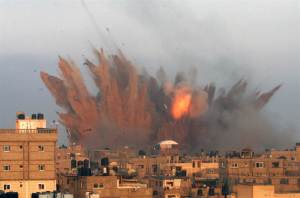
Smoke and fire rise above the skyline following an Israeli air strike on July 11 in Rafah in the southern Gaza Strip. Israeli warplanes kept up deadly raids on Gaza Friday but failed to stop Palestinian militants firing rockets across the border (NBC News).
And from July 12, My Head Is Spinning as Gaza Burns: The Most Timely Book Review I’ve Ever Written
I was sitting in Philadelphia’s airport recently, awaiting a flight back home, the book I had been reading turned face down in my lap. Intentionally. I didn’t want anyone to see the cover. Didn’t want anyone to associate its cover with my views – these people I didn’t know, people I would never know.
I had just opened to the book’s second chapter – “Does Israel Have a Right to Exist as a Jewish State?” – and had closed it quickly. Shocked by the question. Shocked by my imagined (and false) notions of what a chapter with such a title might contain, by the prospect of a stranger seeing me reading it.
So I shut the book – Ali Abunimah’s The Battle for Justice in Palestine, which argues that only a bi-national state can justly end the Israeli-Palestinian conflict – and quickly hid it from those milling about.
Gershon goes on to discuss his recent epiphany about the Israel-Palestine conflict.
…recent, unspeakable events of the past two weeks have begun to make me question whether a two-state solution is even remotely possible anymore, particularly as Israeli officials begin embracing various one-state solutions.
Such internal questioning reached a climax on Friday, when Netanyahu explicitly stated that he wanted Israel to control the West Bank indefinitely, marking his first-ever public rejection of the two-state solution and Palestinian statehood.
My jaw dropped.
There’s much more at the link. I hope you’ll check it out.

The famous reluctant handshake in Texas
Now for President Obama’s supposed break-out.
From The Washington Post: ‘The bear is loose’: Is Obama breaking free or running away?
Bears, beer and horse heads: What exactly is going on with the leader of the free world?
On a single day this week in Denver, President Obama scarfed down pizza and drinks with strangers, shot pool with Colorado’s governor and shook hands with a guy on the street wearing a horse mask. His top staffers are promoting these stops on Twitter with the hashtag#TheBearIsLoose — a term one of Obama’s aides coined in 2008 when the candidate would defy his schedule.
More than five years into his presidency, Obama is trying to free himself from the constraints of office, whether by strolling on the Mall or hopscotching the country as part of a campaign-style tour. White House senior adviser Dan Pfeiffer says the president “just wants to get out” and influence “our overall political conversation” by connecting with ordinary Americans.
But to some, breaking free can also look like running away.
Obama’s trip to Colorado and Texas this week took place against the backdrop of a burgeoning crisis on the Mexican border, where tens of thousands of children have been apprehended seeking entry into the United States. In Dallas, Obama dismissed the idea of heading farther south for a border visit as a “photo op” — not long after those photo ops showing him shooting pool and sipping beer in Denver.
Read more at the link. To me it looks like Obama is feeling freed up lately–mostly because he seems to be ignoring Republican nonsense and express his real opinions. I don’t know if that’s true or not, but it feels that way to me.

Obama’s latest photo-op came at an Austin, TX barbecue restaurant. From The Advocate: Texas Restaurant Worker Gets Gay-Supportive Fist Bump From Obama.
A gay employee at Franklin Barbecue in Austin had “a lucky day to be the register girl” Thursday, as he not only got to wait on President Obama but got a fist bump in support of LGBT rights.
Daniel Rugg Webb, a musician and comedian who works part-time at the restaurant, was on duty at the register as the president came up to pay for more than $300 worth of takeout, The Austin Chronicle reports. Webb slapped the counter and shouted, “Equal rights for gay people!” Obama asked, “Are you gay?” and Webb replied, “Only when I have sex.”
“That’s when he laughed and said, ‘Bump me,’” Webb told the Chronicle. Several onlookers photographed the fist bump and circulated the photo on Twitter. “It was just a lucky day to be the register girl,” Webb added.
From the Austin Chronicle via Buzzfeed:
Webb told the Chronicle:
“As a comedian, it was cool to have a moment where I was making a sitting president laugh — over something that might be considered inappropriate is a bonus,” Webb said of the experience.
He said he had been hoping to get in a joke about Texas Governor Rick Perry, who he described as “famously anti-gay.”
While Webb said he appreciates Obama’s social progressiveness, he expressed hope that the president will close the gap between his own relative forward-thinking on gay rights, and his general quietness on the anti-gay views of many state leaders before he leaves office.
“It would be interesting if he could call some people out for it. People can use a lot of things—religion, freedom of speech—to be anti-gay, but I need people to understand you can call people out for civil rights things,” Webb said.
“We are an anti-gay state. We are a state with a whole bunch of hungry children and sick old people, and [Rick Perry is] grandstanding on things that will get him a better election,” Webb said. “And it’s glaringly obvious. He’s kind of primitive in his social beliefs. I would like to see Rick Perry negatively influenced by any kind of attention. Even Obama laughing at something as, hopefully, acceptable as sexuality can show the difference.”
What do you think? Is Obama really changing?
What other stories are you following today? I have a few more news links, but I’ll post them in comments.
Friday Reads: Our Crisis of Child Refugees from Central America
Posted: July 11, 2014 Filed under: El Salvador, Foreign Affairs, Guatemala, Honduras, immigration, morning reads, Refugees, social justice 14 Comments Good Morning!
Recently, we’ve seen a lot in the news about the surge in women and children coming in from Central America. I was aware there had been ongoing civil wars in Honduras and problems in both Belize and El Salvador but really felt I needed more information to figure out what is going on. The huge numbers alone are disturbing. I know that we’ve needed immigration reform for some time. I also know that it’s impossible to get nearly anything done in this country anymore, because Republican members of Congress refuse to participate in governance. They seem to be boycotting democracy and everything else. So, I’ve done some reading and research. Today’s post will be on this one subject, but you can still consider it the usual Morning Reads post where you can post items of interest to you.
My first question was about the home countries of these refugee children. Where are they coming from and is this a big change from previous years? This NBC report has some of those facts and figures.
The U.S. Customs and Border Protection agency says that apprehensions of undocumented immigrants along the Southwestern U.S. border remain near historic lows, but agents have seen a sharp increase in the number of unaccompanied minors trying to enter the country illegally over the past five years. Over the first 8 1/2 months of fiscal year 2014, 52,193 unaccompanied minors have been taken into custody — a 99 percent increase over 2013.
In Texas’ Rio Grande Valley alone, where most border crossings now occur, apprehensions have increased 178 percent over last year, with 37,621unaccompanied minors apprehended so far this year.
Minors from Mexico or Canada who are apprehended at the border can be quickly returned to their home countries in expedited removal proceedings. But those from other countries – mostly teens but sometimes as young as toddlers – are transferred to the custody of the Office of Refugee Resettlement (ORR), part of the Department of Health and Human Services.
The ORR maintains custody of the minors only until they can be placed with family members in the U.S. or in foster care to await a decision on whether they can remain in the country. That occurs through a formal deportation proceeding, which can take months or years, during which they can petition an immigration judge to remain in the country.
The soaring number of migrant children has strained the system, forcing the federal government to scramble to open additional emergency facilities across the country and prompting President Barack Obama to request Tuesday for an emergency appropriation of $3.7 billion to fund the operation.
ORR also has seen its caseload jump sharply in recent years, rising from an average ofbetween 7,000 and 8,000 unaccompanied children from FY 2005 through 2011 to 24,668 last year, according to figures provided by HHS. This year, officials estimate, the office will receive at least 60,000 referrals.
The childrenWhere do they come from?: Four countries – El Salvador, Guatemala, Honduras and Mexico — account for almost all of the unaccompanied minor cases, according to a 2014 report by the Congressional Research Service. As recently as 2009, Mexico accounted for 82 percent of the apprehended children, but the three Central American countries have propelled the recent influx, comprising 73 percent of those apprehended last year, it said.
 So, you can see that there’s been a great change in the number of children and their home countries recently. This means there must be something going on in those three countries since around 2009 that has led to the change. What exactly has happened? I have assumed that a lot of it has to do with our own foreign policy because those three nations have experienced a lot of US intervention and have been considered client states. Has what we’ve done in the past come back to haunt us? Here’s a report in The Nation on that.
But the United States has a particular moral responsibility in the Central America refugee crisis that goes even deeper. Americans, especially young Americans, probably know more about the 1994 genocide in Rwanda than they do about how their own government funded murderous right-wing dictatorships in Central America back in the 1980s. The Reagan administration’s violent and immoral policy included $5 billion in aid to the military/landowner alliance in El Salvador, which prolonged an awful conflict in which some 75,000 people died—a toll proportionally equivalent to the casualty rate in the American Civil War. But once shaky peace agreements were signed in the 1990s, the United States walked away, leaving the shattered region to rebuild on its own.
In response to today’s exodus, President Obama is showing little concern for international law, and none at all for Washington’s own historic responsibility in Central America. Instead, the administration announced on June 28 that it is asking Congress to change the law so America can deport the refugee children more quickly.
The very name of one of the giant criminal gangs—18th Street, or Calle 18—reveals the origins of the current crisis. Eighteenth Street is not in San Pedro Sula, or in San Salvador, or in any of the other Central American cities torn apart by gang warfare. Eighteenth Street is actually in Los Angeles, where the gang and its rival, the Mara Salvatrucha, were born among young Salvadorans who had been displaced by the civil war in the 1980s. After the United States started deporting gang members, they arrived back in Central America, some barely speaking Spanish and knowing only how to do one thing: grab the weapons the region was already awash in and start killing. During the decade-long civil war, family and community life had weakened, so the newly arrived gangs partly filled a vacuum.
America’s responsibility in Honduras, Esperanza and Angelica Ramirez’s home nation, is even more recent. In 2009, the Honduran military overthrew the elected government, and the Obama administration accepted the coup over the protests of brave pro-democracy forces there. The respected International Crisis Group explains that the political turmoil weakened the central government, and in some places the criminal gangs became the de facto authority. What’s more, Washington’s war on drugs, in Honduras and elsewhere, has also raised the overall level of violence.
The Women’s Refugee Commission has been studying this issue for several years and predicted the current crisis. They have a study and a site that  explores many of the most important issues surrounding this crisis. This includes treatment of the children during their journey and the risks they face as well as the United States Policy and treatment of the children once they are found by the Border Patrol. They also have looked at the key issues surrounding the diaspora as well as have come up with policy suggestions.
There has been a great deal of research into the root causes of this surge of unaccompanied children fleeing the region. In 2012 we interviewed 161 children to find out why they were coming. In our interviews, the children reported to us that they were predominately being pushed from their homes due to rising violence and insecurity in their home countries. Moreover, almost every single child we spoke with reported having a good understanding of the dangers of trying to migrate through Mexico and into the United States without authorization. They knew of the risks of kidnapping, rape, and even death. The children we spoke with told us they felt like they would die if they stayed in their home country, and although they might die during the journey, they at least would have a chance.
In 2013, the U.S. Conference of Catholic Bishops traveled to Central America to interview children who had tried to migrate to the United States. Their report reaffirmed our findings that violence in the three countries of El Salvador, Guatemala and Honduras was the overriding factor leading to the migration of these children.[8] One mother they spoke with told them that she knew her son might die on his journey to the U.S. but she preferred that he die trying to find safety, then on her doorstep.
Most recently, in 2014, United Nations High Commissioner for Refugees (UNHCR) interviewed over 400 children who had left their homes countries. Most children – even those who had a parent or family member with whom they wished to reunite – cited domestic abuse within the home, gang and cartel violence, deprivation of basic survival necessities, and labor and sex trafficking as the reasons for their migration.[9] Most significantly, UNHCR found that the majority of the children made statements indicating that they may be in need of international protection.
There have been numerous reports and claims by government authorities that many of these children or the family members who may try to help them migrate are being encouraged to undertake the dangerous journey by false promises from smugglers or inaccurate media reporting on U.S. policies that do not exist or that cannot benefit them. But it is impossible for us to dispute the root causes that make these children desperate to leave their home countries and seek a safe haven. No child or parent would agree to pay a dangerous smuggler to take a young child on such a harrowing journey if they did not feel it was the only option. No promise of a tenuous and temporary status in the United States, such as administrative closure or Deferred Action for Children Arrivals (DACA), would encourage someone to risk their lives, or risk the lives of their child. It is the underlying severe conditions in Mexico and these Central American nations that is forcing this migration pattern, not the lure of intangible reform.
Furthermore, the facts do not support that rumors or U.S. policy with respect to these populations is what is encouraging the migration. Nicaragua is the poorest country in the region. At the same time Nicaragua, like El Salvador, Honduras and Guatemala, has a history of migration to the United States, resulting in many Nicaraguan children having family members in the United States. Yet, we have not seen any increase in the number of Nicaraguan children arriving at the Southern border. The difference is that Nicaragua, as one of the safest countries in the region, is not experiencing the violence that is driving children from its three neighbors.
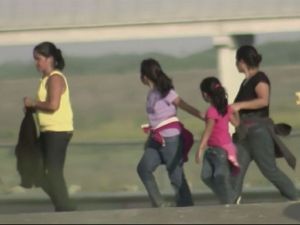 The UN is requesting the US treat the people from these three countries as refugees. They are basically no different that refugees fleeing Syria or Iraq to escape violence from countries torn by civil war. Bordering nations like Jordan routinely provide shelter to refugees fleeing the violence in areas filled with armed violence. We’re talking women and children in both cases. These aren’t able bodied men looking for work. They are victims of violence looking for safety.
Officials with the U.N. High Commissioner for Refugees say they hope to see movement toward a regional agreement on that status Thursday when migration and interior department representatives from the U.S., Mexico, and Central America meet in Nicaragua. The group will discuss updating a 30-year-old declaration regarding the obligations that nations have to aid refugees.
While such a resolution would lack any legal weight, the agency said it believes “the U.S. and Mexico should recognize that this is a refugee situation, which implies that they shouldn’t be automatically sent to their home countries but rather receive international protection.”
Most of the people widely considered to be refugees by the international community are fleeing more traditional political or ethnic conflicts like those in Syria or the Sudan. Central Americans would be among the first modern migrants considered refugees because they are fleeing violence and extortion at the hands of criminal gangs.
Central America’s Northern Triangle of Guatemala, El Salvador and Honduras has become one of the most violent regions on earth in recent years, with swathes of all three countries under the control of drug traffickers and street gangs who rob, rape and extort ordinary citizens with impunity.
Honduras, a primary transit point for U.S.-bound cocaine, has the world’s highest homicide rate for a nation that is not at war. Hondurans who are used to hiding indoors at night have been terrorized anew in recent months by a wave of attacks against churches, schools and buses.
During a recent visit to the U.S., Honduran President Juan Orlando Hernandez said migrants from his country were “displaced by war” and called on the United States to acknowledge that.
Honduran police routinely are accused of civil rights violations. The AP has reported at least five cases of alleged gang members missing or killed after being taken into police custody in what critics and human rights advocates call death squads engaged in a wave of social cleansing of criminals.
Violence by criminal organizations spread after members of California street gangs were deported to Honduras, Guatemala and El Salvador, where they overwhelmed weak and corrupt police forces.
In El Salvador, the end of a truce between street gangs has led to a steep rise in homicides this year.
Salvadorans heading north through Mexico who were interviewed by The Associated Press last month said there also was fear of the “Sombra Negra,” or “Black Shadow” – groups of masked men in civilian clothes who are believed responsible for extrajudicial killings of teens in gang-controlled neighborhoods. The Salvadoran government denies any involvement in death squads, but says it is investigating the reports.
In El Salvador, at least 135,000 people, or 2.1 percent of the population, have been forced to leave their homes, the vast majority due to gang extortion and violence, according to U.N. figures. That’s more than twice the percentage displaced by Colombia’s brutal civil war, the U.N. says.
Immigration experts in the U.S. and Central America say the flow of migrants from Honduras and El Salvador is likely to rise as the two countries experience more gang-related violence.
“They are leaving for some reason. Let’s not send them back in a mechanical way, but rather evaluate the reasons they left their country,” Fernando Protti, regional representative for the U.N. refugee agency, told The Associated Press.
Even though the agreement would not be legally binding on the countries that sign it, advocates say it would help create international consensus to help the migrants.
Those actions could include emergency aid and social services for internally displaced people inside Honduras, Guatemala and El Salvador.
So, this has gotten to be a very long post already. I’m going to run a second edition of this with more information. Meanwhile, this gives you some background.
What’s on your reading and blogging list today?
Monday Reads: In Search of the American Dream
Posted: June 30, 2014 Filed under: Barack Obama, Foreign Affairs, morning reads, U.S. Economy, U.S. Politics | Tags: American Dream, Baby boomers, Blackwater, golden age of capitalism, inequality, joseph stiglitz, plutocrats, polls, post-WWII boom, State Department, Thomas Picketty 78 Comments
Good Morning!!
Whatever happened to the American dream? Did it ever exist in reality?
We baby boomers can look back to the post-WWII years, when the economy was humming along and the GI Bill made it easier for our dads to get college degrees, find good jobs, buy houses for their families.
In those days, one salary was enough to support a couple and several kids. My dad did it on a college professor’s salary. It was a struggle early on, but those government programs for veterans gave us a push into the professional class.
Eisenhower was President then–a Republican who wouldn’t even recognize his fellow Republican today. Later on, after John Kennedy was murdered and Lyndon Johnson was brought down by the Vietnam War, Richard Nixon presided over the end of the good times. After about 1973, it was over; and since then, wages have essentially remained stagnant.
That was when we entered a new America, in which it took two salaries to support a family. Women went to work, not just because they wanted to, but to keep their families afloat. Children went to day care. So many thing changed. What happened to the American dream? Were those post-war years just an outlier, a brief period of prosperity that meant nothing in the greater scheme of things?
Yesterday, I read a piece by Joseph Stiglitz–in Politico of all places–that addressed some of these questions: The Myth of America’s Golden Age: What growing up in Gary, Indiana taught me about inequality. Stiglitz was born in 1943. Growing up in the industrial “company town” of Gary, he was able to observe the underside of the “golden age” of capitalism–“discrimination, poverty, and bouts of high unemployment.” The big steel companies deliberate brought in desperately poor African Americans from the south in order to keep wages low–to divide and control the work force. Stiglitz writes that he never bought into the notion of the free market as the answer to all ills.
Nearly half a century later, the problem of inequality has reached crisis proportions. John F. Kennedy, in the spirit of optimism that prevailed at the time I was a college student, once declared that a rising tide lifts all boats. It turns out today that almost all of us now are in the same boat—the one that holds the bottom 99 percent. It is a far different boat, one marked by more poverty at the bottom and a hollowing out of the middle class, than the one occupied by the top 1 percent.
Most disturbing is the realization that the American dream–the notion that we are living in the land of opportunity–is a myth. The life chance of a young American today are more dependent on the income and education of his parents than in many other advanced countries, including “old Europe.”

American Dream, by Skip Hunt
Stiglitz points to Thomas Picketty’s research as evidence. Picketty’s work shows that capitalism leads inevitably to inequality. The post-war era of my childhood and early adulthood was an “aberration.”
Today, inequality is growing dramatically again, and the past three decades or so have proved conclusively that one of the major culprits is trickle-down economics—the idea that the government can just step back and if the rich get richer and use their talents and resources to create jobs, everyone will benefit. It just doesn’t work; the historical data now prove that. [….]
Ironically enough, the final proof debunking this very Republican idea of trickle-down economics has come from a Democratic administration. President Barack Obama’s banks-first approach to saving the nation from another Great Depression held that by giving money to the banks (rather than to homeowners who had been preyed upon by the banks), the economy would be saved. The administration poured billions into the banks that had brought the country to the brink of ruin, without setting conditions in return. When the International Monetary Fund and the World Bank engage in a rescue, they virtually always impose requirements to ensure the money is used in the way intended. But here, the government merely expressed the hope that the banks would keep credit, the lifeblood of the economy, flowing. And so the banks shrank lending, and paid their executives megabonuses, even though they had almost destroyed their businesses. Even then, we knew that much of the banks’ profits had been earned not by increasing the efficiency of the economy but by exploitation—through predatory lending, abusive credit-card practices and monopolistic pricing. The full extent of their misdeeds—for instance, the illegal manipulation of key interest rates and foreign exchange, affecting derivatives and mortgages in the amount of hundreds of trillions of dollars—was only just beginning to be fathomed.

American Dream, by Gordon Wendling
I can’t quote any more, but I hope I’ve whetted your appetite enough that you’ll go read the whole thing. While you’re at that link, you might also take a look at this article by “zillionaire” Nick Hanauer, The Pitchforks are Coming for Us Plutocrats. Here’s just a small taste–it’s a long read.
The most ironic thing about rising inequality is how completely unnecessary and self-defeating it is. If we do something about it, if we adjust our policies in the way that, say, Franklin D. Roosevelt did during the Great Depression—so that we help the 99 percent and preempt the revolutionaries and crazies, the ones with the pitchforks—that will be the best thing possible for us rich folks, too. It’s not just that we’ll escape with our lives; it’s that we’ll most certainly get even richer.
The model for us rich guys here should be Henry Ford, who realized that all his autoworkers in Michigan weren’t only cheap labor to be exploited; they were consumers, too. Ford figured that if he raised their wages, to a then-exorbitant $5 a day, they’d be able to afford his Model Ts.
What a great idea. My suggestion to you is: Let’s do it all over again. We’ve got to try something. These idiotic trickle-down policies are destroying my customer base. And yours too.
It’s when I realized this that I decided I had to leave my insulated world of the super-rich and get involved in politics. Not directly, by running for office or becoming one of the big-money billionaires who back candidates in an election. Instead, I wanted to try to change the conversation with ideas—by advancing what my co-author, Eric Liu, and I call “middle-out” economics. It’s the long-overdue rebuttal to the trickle-down economics worldview that has become economic orthodoxy across party lines—and has so screwed the American middle class and our economy generally. Middle-out economics rejects the old misconception that an economy is a perfectly efficient, mechanistic system and embraces the much more accurate idea of an economy as a complex ecosystem made up of real people who are dependent on one another.
Which is why the fundamental law of capitalism must be: If workers have more money, businesses have more customers. Which makes middle-class consumers, not rich businesspeople like us, the true job creators.
Is it possible that because these articles appear in conservative Politico, even a few powerful people in Washington might read them and stop for a moment to think about what what is really happening to America?

American Dream by Matt Sesow
Also in the news today:
NBC NEWS: Yes, Perceptions of Washington Are Even Worse Than Last Year.
This is a six-month report card time, and it’s failing grades for all of Washington. President Obama’s approval rating stands at 41% in our recent NBC/WSJ poll, his fav/unfav is upside down (at 41%-45%), and a majority of Americans (54%) no longer think he’s able to lead the country and get the job done. Republicans and Congress are in even worse shape. The GOP’s fav/unfav in the NBC/WSJ poll is 29%-45% (versus the Democratic Party’s 38%-40% score). Just 7% of the country has confidence in Congress (compared with 29% for the presidency and 30% for the Supreme Court, per Gallup. And when it comes to congressional productivity, the 113th Congress (2013-2014) has passed just 121 bills into law — fewer than at this same point in the historically unproductive 112th Congress (140 bills into law). Maybe it doesn’t FEEL worse, because there hasn’t been an epic showdown or confrontation like the government shutdown. But the numbers tell a different story — it has gotten worse.
From James Risen at the NYT, scary revelations about the murder of 17 civilians by Blackwater thugs in Iraq in 2007: Before Shooting in Iraq, a Warning on Blackwater.
“The management structures in place to manage and monitor our contracts in Iraq have become subservient to the contractors themselves,” the investigator, Jean C. Richter, wrote in an Aug. 31, 2007, memo to State Department officials. “Blackwater contractors saw themselves as above the law,” he said, adding that the “hands off” management resulted in a situation in which “the contractors, instead of Department officials, are in command and in control.”
I have a few more links, but I’m going to put them in comments; because I’m having terrible issues with WordPress today. I hope you’ll also post your thoughts and links in the thread below.

 peej
peej Carissa
 bostonboomer
 dakinikat
 ecocatwoman
 jjlo
jjlo mablue2
 Mama Lopez
 peggysue22
 quixote
 skydancingguestblogger
 Mona (aka Wonk the Vote)



 Sky Dancing
Recent Comments