Posted: February 18, 2026 | Author: bostonboomer | Filed under: just because | Tags: Autism, Democratic Party history, extremist rhetoric in Trump administration, FDA, immigration, Jesse Jackson, Martin Luther King Jr. assassination, Racism, Robert F. Kennedy Jr., Trump violation of court orders in NJ, Vinay Prasad, voting rights |
Good Afternoon!!
It’s actually sort of a slow news day today. At least there isn’t a lot of stuff that I find interesting or exciting. I do want to address Jesse Jackson’s passing, so I’m going to spend some time on that. As JJ wrote yesterday,
It seemed like he was always there, everywhere…whenever there was injustice. And he spoke out! It wasn’t just a few words written in a tweet…and sent from wherever. Jesse Jackson went there…wherever the problem was and spoke out with the people in support. I just think that his on scene action of demonstration and protest, the act of showing up and being there…made a huge difference. And I feel that it is what is missing in the situation right now.
Yes, he did, and he made a difference. He fought for so many issues, including immigration. He was often mocked for turning up whenever something was happening, but he persisted and I admired that. I wish we had someone like him here today to call greater attention to these issues.
 When Jesse Jackson ran for president in 1984 and especially in 1988, I watched his speeches on C-Span and found them thrilling. His manner of speaking was so unique, and I loved his signature saying “keep hope alive.” He truly paved the way for Obama’s win in 2008. Here is the platform that Jackson ran on, from Wikipedia:
Declaring that he wanted to create a “Rainbow Coalition” of various minority groups, including African Americans, Hispanics, Middle Eastern Americans, Asian Americans, Native Americans, family farmers, the poor and working class, and LGBT people, as well as white progressives, Jackson ran on a platform that included:
With the exception of a resolution to implement sanctions against South Africa for its apartheid policies, none of these positions made it into the party’s platform in either 1984 or 1988.
A few interesting articles:
Karen Tumulty at The Washington Post (gift link): I covered Jesse Jackson’s 1988 campaign. The racism he faced was undisguised.
“Keep hope alive!” It was the signature line of Jesse Jackson’s second run for president. Euphoric crowds, numbering in the thousands, would chant it along with him.
I was a reporter for the Los Angeles Times, and that 1988 presidential campaign was the first I had ever covered. Those months revealed to me many things about America. Not all were as uplifting as the optimistic spirit that propelled the civil rights leader to a second-place finish against the ultimate Democratic nominee, Massachusetts Gov. Michael Dukakis.
One day in particular stands out in my memory for what I saw of undisguised racism, and for what I heard from Jackson himself about the less visible barriers he believed had been put in his way by some in his own party.

Jesse Jackson, then a Democratic presidential hopeful, with his wife, Jacqueline, at an Operation Push rally in Chicago on March 10, 1988. Fred Jewell AP
It was May 9. The campaign had begun before dawn, as many days did with Jackson’s operation. We were in poverty-stricken Arnett, West Virginia, and a few curious neighbors had gathered outside the home of an unemployed White coal miner, where Jackson had spent the night. When one of them was asked how he planned to cast his ballot in that week’s Democratic primary, he retorted: “I ain’t voting for no damn n—-r.”
The previous evening, the arrival of Jackson’s motorcade had been greeted with similar epithets, and someone in the crowd of about 200 appeared threatening enough that the Secret Service vetoed the candidate making his usual round of shaking hands.
Jackson, who died Tuesday at 84, was usually too much on the move to indulge in introspection and reflection. But later that day, in a conversation with a few bleary-eyed reporters aboard his campaign bus, he did.
In his view, Jackson told us, the most significant hurdles that a Black candidate had to overcome were not what we had seen in West Virginia. “Some people are very raw, very direct, [saying] ‘I would not vote for a n—-r.’ Other people are able to use sand to cover up their mess,” he said.
Jackson was a spellbinder on the stump, but well to the left of most of the country. And he had never shaken his reputation as a self-promoter — or, as then-Vice President George H.W. Bush once put it, a “hustler from Chicago.”
His candidacy had, from the outset, been “running against a headwind of culture and media and pundits,” Jackson said. “The party itself is using its strength to get the candidate it thinks can win.”
He faulted the news media and the polls for constantly raising the question of whether Americans would vote for a Black man: “If I’m asked, ‘Why run?,’ the people are asked, ‘Why vote?
Use the gift link to read more if you’re interested.
Neil Vigdor at The New York Times (gift link): Seven Pivotal Moments in Jesse Jackson’s Life.
Millions of Democrats cast primary votes for him, envisioning him as America’s first Black president.
Along the way, there would be convention keynote speeches and, at times, self-inflicted controversy for the Rev. Jesse Jackson, who died on Tuesday at 84. His life ran in parallel to the successes of the civil rights era, but it was at the movement’s lowest moment that he came to wider national attention: the 1968 assassination of the Rev. Dr. Martin Luther King Jr., which he witnessed at the Lorraine Motel in Memphis….
Martin Luther King Jr.’s assassination
On April 4, 1968, Mr. Jackson was in the motel parking lot, speaking with Dr. King, who was on the second-floor balcony above him, when Dr. King was shot by James Earl Ray.
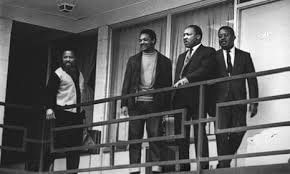
Jesse Jackson on the day of Martin Luther King’s assassination.
“We hoped it was his arm, but the bullet hit him in the neck,” Mr. Jackson told reporters while visiting the motel, now a civil rights landmark, before Tennessee’s Democratic presidential primary in 1984.
At the time of the assassination, Mr. Jackson was 26 years old and a protégé of Dr. King.
“This is the scene of the crucifixion,” he said, taking reporters on a tour of Room 306, where the civil rights leader had been staying.
1984 presidential campaign
With his entry into the 1984 Democratic primary race, Mr. Jackson became the first Black candidate to seek a major party’s nomination for president since Shirley Chisholm, the trailblazing Brooklyn congresswoman who ran unsuccessfully in 1972.
At a campaign kickoff rally, Ms. Chisholm
introduced Mr. Jackson, who was then 42 and had criticized Democrats for what he described as their lackluster opposition to President Ronald Reagan.
Mr. Jackson viewed his candidacy as inspirational to a rainbow coalition — Black, white and Hispanic citizens, women, American Indians and “the voiceless and downtrodden.”.
He finished third to the eventual nominee, Walter Mondale, the former vice president, who lost the general election in a landslide…..
1988 presidential campaign
Building on his name recognition and base of support in the South, Mr. Jackson returned to the campaign trail emboldened in 1988. The clergyman from Chicago and founder of the Rainbow PUSH Coalition made inroads with white voters, winning three times as many votes from them as he did four years earlier.
Nearly seven million people voted for Mr. Jackson in the primaries and caucuses that year, delivering him victories in 13 contests.
He finished a solid second to Michael Dukakis, the Massachusetts governor, who eventually lost the general election to George H.W. Bush, the vice president.
1988 D.N.C. keynote
In the spotlight of the Democratic National Convention, Mr. Jackson brought delegates to tears with his retelling of his upbringing in poverty and segregation in Greenville, S.C. He said he could identify with people watching his speech on television in poor neighborhoods.
“They don’t see the house I’m running from,” he said. “I have a story. I wasn’t always on television.”
He used his speech to press for social justice and action by Democrats in the general election, when he became a key surrogate for Mr. Dukakis, particularly with Black voters.
He closed his remarks with a sermon-like chant, one that would echo in future campaigns, including Barack Obama’s in 2008, when Americans elected him as the first Black president.
“Keep hope alive! Keep hope alive! Keep hope alive!”
Use the gift link to read the rest if you’re interested.

The Rev. Jesse Jackson delivered a speech at the Democratic National Convention after failing to secure the party’s nomination for president in 1984. Credit…Jim Wilson, The New York Times
Jackson’s most important speech was probably his keynote presentation at the 1984 Democratic Convention in San Francisco. Jonathan Wolfe at The New York Times (gift link): The Jesse Jackson Speech That Helped Redefine the Democratic Party’s Base.
In 1984 in San Francisco, Jesse Jackson delivered a speech at the Democratic National Convention that helped unify the fractured party and redefine the modern Democratic base. “The Rainbow Coalition” speech, as it is known, is regarded as one of the most significant addresses in the history of American politics and helped shape a progressive vision for the party.
Mr. Jackson was coming off an unsuccessful presidential primary run when he delivered the speech, coming in third behind Senator Gary Hart of Colorado and former Vice President Walter Mondale, the eventual nominee. In his address, he urged the party to embrace a diverse, multiracial and multi-class alliance, encouraging the inclusion of marginalized groups, including the poor, workers and minorities.
The speech, which was evangelical in tone and contained numerous biblical allusions, described the country as a patchwork quilt.
“Our flag is red, white and blue, but our nation is a rainbow — red, yellow, brown, black and white — and we’re all precious in God’s sight,” he said. “America is not like a blanket — one piece of unbroken cloth, the same color, the same texture, the same size. America is more like a quilt — many patches, many pieces, many colors, many sizes, all woven and held together by a common thread.”
He argued in the address that the party should expand its coalition and embrace his constituency: “The desperate, the damned, the disinherited, the disrespected, and the despised.” He also pushed for patience and understanding.
“We must be unusually committed and caring as we expand our family to include new members,” he said. “All of us must be tolerant and understanding as the fears and anxieties of the rejected and of the party leadership express themselves in so many different ways.”
Mr. Jackson used the speech to attack President Ronald Reagan’s “trickle down” economic theories and argued for a renewed focus on the poor and the marginalized. He recited a list of what he saw as Mr. Reagan’s offenses against his coalition, including attacks on health care, education and food stamps, and used the speech to put forward what he saw as the mission of the Democratic party.
“This is not a perfect party,” he said early in the address. “We are not a perfect people. Yet, we are called to a perfect mission: Our mission, to feed the hungry, to clothe the naked, to house the homeless, to teach the illiterate, to provide jobs for the jobless, and to choose the human race over the nuclear race.”
We could use a voice like that today.
One more on Jackson’s influence b Jennifer Rubin at The Contrarian: Jesse Jackson’s Passing Should Stir the Democracy Movement.
With Rev. Jesse Jackson Jr.’s passing, we lose one of the dwindling number of direct links to Martin Luther King, Jr. and to the mid-20th century Civil Rights generation. From the Lorraine Motel to stewardship of Rainbow/PUSH to his own presidential campaigns to his successful hostage negotiations to Barack Obama’s election to the Black Lives Matter movement, he was front and center in racial justice fights, a symbol of both the tremendous progress and the enduring, at times exhausting, presence of White supremacists who seek to erase history and undo decades of hard-won gains.
While the country lacks a singular figure to lead the racial justice movement, the number of organizations and plethora of elected figures (including the likely next House Speaker) are part of Jackson’s legacy, a permanent army of civil rights activists who stand in opposition to the Make America White Again ideology at the heart of Trumpism. The challenge that was at the heart of Jackson’s work — the creation of a true multi-racial democracy — has never been more acute in the modern era.
It is always worth recalling Jackson’s iconic lines from his speech to the 1984 Democratic Convention:
Our flag is red, white and blue, but our nation is a rainbow — red, yellow, brown, black and white — and we’re all precious in God’s sight.
America is not like a blanket — one piece of unbroken cloth, the same color, the same texture, the same size. America is more like a quilt — many patches, many pieces, many colors, many sizes, all woven and held together by a common thread. The white, the Hispanic, the black, the Arab, the Jew, the woman, the native American, the small farmer, the businessperson, the environmentalist, the peace activist, the young, the old, the lesbian, the gay and the disabled make up the American quilt. (Applause)
Even in our fractured state, all of us count and all of us fit somewhere. We have proven that we can survive without each other. But we have not proven that we can win and progress without each other. We must come together.
The Trump regime presents the greatest attack on that vision of pluralistic democracy and racial justice in the modern era. Should the MAGA partisan hacks on the Supreme Court succeed in eviscerating the Voting Rights Act in Louisiana v. Callais, the political map will resemble the political landscape in the Jim Crow era in which Black and Hispanic voting power was minimal to nonexistent, representatives at all levels of government were overwhelmingly White, and one party rule prevailed in the South.

Jesse Jackson as a young man.
Jackson would certainly recognize The SAVE Act, which would impose onerous proof of citizenship requirements to vote, as the latest MAGA disenfranchisement project, part of the never-ending assault to deprive communities of color access to the polls. The Leadership Conference on Civil and Human Rights and 130 organizations have decried the assault on voting rights as being driven by “unprecedented disinformation campaigns and intrusions on the ability of states to make sound decisions on how to run their elections.” The effort to now require a birth certificate or passport to establish qualification to vote would be the culmination of a voter suppression drive begun over decade ago:
Since the Supreme Court’s decision in Shelby County v. Holder (2013), 31 states have enacted 114 restrictive voting laws, which disproportionately burden voters of color. The harm has been palpable: Racial disparities in voter turnout have been increasing, particularly in areas formerly protected by the Voting Rights Act’s preclearance provision, which the Court dismantled.
The object of the new burdens on voting is obvious. “Approximately half of American adults do not have a passport, and two-thirds of Black Americans do not.…Nationwide, 69 million married women do not have a birth certificate matching their legal name.” Transferring sensitive voter information to a federal database would only “increase the likelihood that citizens will see their registrations wrongly purged or their personal information compromised.”
All of this smacks of the literacy and poll tests imposed in the Jim Crow South, a set of mechanisms designed to make the electorate unrepresentative of the general population in order to maintain white dominance.
Even voter ID requirements amount to a poll tax.
The rest of the news is not that inspiring, but here a few significant stories to check out.
Odette Yousef at NPR: Extremist rhetoric is often found in government messaging. Who’s the target?
A recent social media post from an account belonging to President Trump prompted enough outcry over its use of a familiar racist trope that the White House deleted it. The Truth Social post included an image of former President Barack Obama and former first lady Michelle Obama as apes. Despite removing the post, Trump has deflected blame to an aide….
For scholars and civil rights advocates steeped in the language and aesthetics of white nationalism, Trump’s post was remarkable only because of how overtly racist the trope is. But they say that it fits into a pattern of extremist rhetoric, visual material and other media that have overtaken public messaging from federal agencies over the past year. They say that much of that messaging may not have been detectable to most Americans who are not immersed in the study of extremism. But to those who are, the dog whistles and coded words have been unmistakable.
“If this were just one racist image or one bad post, it wouldn’t matter much,” said Eric Ward, executive vice president of Race Forward, a civil rights organization. “What matters is that over the last year, the Trump administration [is] abusing federal authority, and the federal government has increasingly learned to speak in the emotional language of white nationalism.”
While the latest controversy is over a post from a Trump social media account, Ward and others say the Department of Homeland Security has been behind the most, and the most notable, examples of extremist themes in federal messaging. In its effort to recruit large numbers of new immigration enforcement agents, the federal agency has generated a body of propaganda that has raised alarm over its echoes of extremist movements.
“A lot of this was very much wrapped up in this kind of Norman Rockwell-style imagery of white Americana and … this idea that we need to ‘defend the homeland’ from migrants arriving from the Global South,” said Caleb Kieffer, a senior research analyst with the Southern Poverty Law Center. “And I think that one thing it’s worth noting, and what we really were alarmed by, [is] that we’ve seen this rhetoric for decades be prevalent in white nationalist circles, in anti-immigrant circles, claiming that there’s this migrant invasion happening and that we need to stop it.”
Read the rest at the link.
Kyle Cheney at Politico: DOJ acknowledges violating dozens of recent court orders in New Jersey.
The Trump administration acknowledged violating court orders issued by New Jersey’s federal judges more than 50 times over the past 10 weeks in cases stemming from the Trump administration’s mass deportation push.
Associate Deputy Attorney General Jordan Fox, who was tapped in December to help lead the Justice Department’s New Jersey office after temporary pick Alina Habba was forced out, said those violations were spread across more than 547 immigration cases that have flooded the courts since early December, straining both prosecutors and judges.
The violations include a deportation to Peru that occurred in violation of a judge’s injunction, as well as three missed deadlines to release ICE detainees.

A general view of the Delaney Hall Detention Facility in Newark on June 16, 2025, in New Jersey. Stefan JeremiahAP
There were also six missed deadlines to respond to court orders, 12 missed deadlines to provide bond hearings to ICE detainees, 17 out-of-state transfers after judges had issued no-transfer orders, three instances of imposing release conditions in violation of court prohibitions and 10 instances of failing to produce evidence demanded by courts.
“We regret deeply all violations for which our Office is responsible. Those violations were unintentional and immediately rectified once we learned of them,” Fox wrote in a letter accompanying the report. “We believe that [the Department of Homeland Security’s] violations were also unintentional.”
Fox’s conciliatory approach stood in stark contrast with previous statements from the Justice Department and ICE that have blamed “rogue judges” for the administration’s noncompliance.
DOJ produced the catalog of violations in response to an order by U.S. District Judge Michael Farbiarz.
Derek Hunter at The Hill: Something is very wrong at the FDA.
It’s not very often an editorial from anywhere, let alone the Wall Street Journal, stops you in your tracks, but one titled “Vinay Prasad’s vaccine kill shot” did just that for me. Not normally known for bomb-throwing, the Journal’s editors went in very hard against someone you’ve probably never heard of — the chief medical and scientific officer and director of the Center for Biologics Evaluation and Research at the U.S. Food and Drug Administration.
The damning sub-headline reads, “Does the White House know the harm he’s doing to public health?” And no, this is not some random question based on spasmodic, Trump-deranged leftist opposition to everything going on in Washington. This is serious.
The Journal editors write of Prasad — previously forced out of the FDA and then hired back within two weeks — that “it’s hard to recall a regulator who has done as much damage to medical innovation in as little time … In his latest drive-by shooting, the leader of the Food and Drug Administration’s vaccine division rejected Moderna’s mRNA flu vaccine without even a cursory review. This is arbitrary government at its worst.”
But is it arbitrary? In 2022, Prasad tweeted that he was “a Bernie Sanders liberal” who has “been surprised by ad hominem claims I am right wing. I am pro-universal health care. Pro wealth tax. Pro choice. Etc. Read my books.”
The same day as the editorial, the Wall Steet Journal reported on the FDA’s rejection of a new flu shot from Moderna for unclear reasons. Career staff reportedly objected and “argued that refusing to even consider the vaccine was the wrong approach to address any concerns about the product.” They were overruled.
And other drugmakers reported multiple cases of surprising and seemingly arbitrary decisions by Prasad, many of them connected to treatments for rare diseases.
Read the rest at The Hill.
Megan O’Matz at ProPublica: Chlorine Dioxide, Raw Camel Milk: The FDA No Longer Warns Against These and Other Ineffective Autism Treatments.
The warning on the government website was stark. Some products and remedies claiming to treat or cure autism are being marketed deceptively and can be harmful. Among them: chelating agents, hyperbaric oxygen therapies, chlorine dioxide and raw camel milk.
Now that advisory is gone.
The Food and Drug Administration pulled the page down late last year. The federal Department of Health and Human Services told ProPublica in a statement that it retired the webpage “during a routine clean up of dated content at the end of 2025,” noting the page had not been updated since 2019. (An archived version of the page is still available online.)
 Some advocates for people with autism don’t understand that decision. “It may be an older page, but those warnings are still necessary,” said Zoe Gross, a director at the Autistic Self Advocacy Network, a nonprofit policy organization run by and for autistic people. “People are still being preyed on by these alternative treatments like chelation and chlorine dioxide. Those can both kill people.”
Chlorine dioxide is a chemical compound that has been used as an industrial disinfectant, a bleaching agent and an ingredient in mouthwash, though with the warning it shouldn’t be swallowed. A ProPublica story examined Sen. Ron Johnson’s endorsement of a new book by Dr. Pierre Kory, which describes the chemical as a “remarkable molecule” that, when diluted and ingested, “works to treat everything from cancer and malaria to autism and COVID.”
Johnson, a Wisconsin Republican who has amplified anti-scientific claims around COVID-19, supplied a blurb for the cover of the book, “The War on Chlorine Dioxide.” He called it “a gripping tale of corruption and courage that will open eyes and prompt serious questions.”
The lack of clear warning from the government on questionable autism treatments is in line with HHS Secretary Robert F. Kennedy Jr.’s rejection of conventional science on autism and vaccine safety. Last spring, Kennedy brought into the agency a vaccine critic who’d promoted treating autistic children with the puberty-blocking drug Lupron. And in January, Kennedy recast an advisory panel on autism, appointing people who have championed the use of pressurized chambers to deliver pure oxygen to children, as well as some who support infusions to draw out heavy metals, a process known as chelation.
Kennedy is almost as scary as Trump.
That’s all I have for you today. What stories are you following?
Did you like this post? Please share it with your friends:
Posted: November 26, 2025 | Author: bostonboomer | Filed under: just because | Tags: Any Lucia Lopez Belloza, Bruna Caroline Ferreira, Donald Trump, ICE, immigration, Jack Nichlaus, James McCreary, João Marciano do Carmo, Joint Base Andrews golf courses, Karoline Leavitt, Trump aging, Trump dozing off, Trump's ballroom |
Good Afternoon!!
I’m really struggling with watching/read the national news these days. I’m sure I’m not alone in that. I have been trying to follow local reports of federal immigration/deportation activities. Trump hasn’t sent troops to Massachusetts yet, but ICE has still been very busy here. A few recent stories:
Marcela Rodrigues and Scooty Nickerson of The Boston Globe write that the feds are acting quickly to get detainees out of New England (and away from friendly judges) to red states where it will be easier to keep them imprisoned: ‘Treated like an animal’: ICE is moving detained immigrants quickly to conservative states, raising due process concerns.
Last week, João Marciano do Carmo returned to his family in Milford, embraced his crying mother, and fell into the comfort of his living room couch. The 19-year-old had finally made the journey home from a jail in Mississippi, one of the detention facilities where he had been held since September on an immigration-related violation that, lawyers say, never warranted his detention in the first place.
He’s not alone, according to a Globe analysis of arrest and detention data and interviews with immigration attorneys and experts. Immigrants in New England targeted for deportation are being whisked away quicker and to farther locations than ever before. They are increasingly brought to remote areas of the country where they face more conservative judges who are less likely to grant them freedom, according to the interviews and the data analysis.

Kelly Lamphere, the mother-in-law of João Marciano do Carmo’s sister, embraced João as he arrived at his family’s home in Milford, Nov. 18. Erin Clark, Globe Staff
As agents carry out that agenda, advocates and legal analysts say, immigrants have lost essential due process rights. Detainees legally eligible for bond are moved quickly, and at times in violation of court orders. It can take days for them to be able to call their families. Often, not even their lawyers know where they are.
Legal experts warn the rapid rise in transfers to far-flung states is likely to accelerate as billions of dollars allocated by Congress in the One Big Beautiful Bill Act last summer begin to flow to detention centers.
“To be super clear, this is the beginning,” said Kathleen Bush-Joseph, an attorney and policy analyst at the Migration Policy Institute. “They are ramping up, but they have plans to go so much bigger.” [….]
ICE arrests in the Boston area more than tripled in the first seven months of this year compared to last, while the number of people sent to facilities outside New England spiked sixfold, according to the Globe analysis.
At the same time, the median period before someone was moved to an out-of-region facility was cut in half. Last year, it took around 20 days to move someone out of New England, while this year it took around 10 days.
What happened to João:
In Carmo’s case, the teenager, who moved to Milford from Brazil at age 11, was arrested on the way to work at a nearby farm with a friend from Milford High School. Immigration agents shattered his car window to apprehend them. The two teenagers, who have no criminal record, were put in a van with their hands and feet shackled.
For the first six days, they weren’t allowed to make a phone call. None of their family members or their lawyer could locate them. For days, their mothers in Milford wondered if they were alive.
In the seven weeks that followed, Carmo and Marcos Oliveira Martins were transferred from detention facility to detention facility, with stops in Massachusetts, New York, and Mississippi. They slept on concrete, the floor of a gymnasium, and in traditional jail cells.
“I was being really treated like an animal … I didn’t matter,” Carmo said at his home. His journey from New York to Mississippi lasted 16 hours between buses and a plane, and he was shackled the entire time.
Another heartbreaking story by Giulia McDonnell Nieto del Rio at The Boston Globe: A Babson College student wanted to surprise her family for Thanksgiving. She was deported instead.
Immigration authorities detained and swiftly deported a freshman at Babson College to Honduras last week while she was at Logan Airport on her way to surprise her family in Texas for Thanksgiving, according to attorneys and a family friend.
The young woman, Any Lucia Lopez Belloza, came to the United States from Honduras with her family when she was a young child and was at Logan Thursday to catch a flight to Texas, where her parents live, according to her attorney, Todd Pomerleau.
Lopez Belloza made it through security but was stopped as she was about to board the plane, Pomerleau said. “They wouldn’t tell her why she was being detained. She didn’t understand it at all,” Pomerleau said. She was then taken to the Burlington ICE field office, then flown to Texas, Pomerleau said.

abson college student, Any Lucia Lopez Belloza, at her high school graduation.Family Photo
After a frantic 48-hour search, her family received a call from her on Saturday from Honduras, a country she had not lived in since she was a child. The federal government had quickly deported her, the lawyers said, and Lopez Belloza had found her way to her grandparents’ house and called her father.
“It really didn’t feel like it was real life because nothing made sense,” said Ricky Soto, a close friend of the family who was desperately trying to contact attorneys to help the family. “I can only imagine how terrifying that was for her.”
Soto, 41, had bought Lopez Belloza plane tickets and helped organize the surprise for her family — he considers them family, too, and works with her father at a tailor shop in Texas.
The student’s parents and her two youngest siblings are also in Texas, and it would have been her first Thanksgiving break during college. “She was so excited, because she wasn’t expecting to come home,” Soto told the Globe.
Why did this happen?
Nayna Gupta, the policy director at the American Immigration Council, has also been assisting the family with the case, quickly scrambling to find local lawyers and contact representatives on Thursday evening after hearing of the case. Lopez Belloza apparently had a removal order from around 2017 that neither she nor her family was aware of, Gupta said.
“They didn’t know to show up somewhere, and she certainly had no idea of any of this,” Gupta said.
Before Trump, people in this category weren’t targeted; now that has changed. Now Lopez Belloza may not be able to continue her education.
Soto, the family friend, remembers Lopez Belloza‘s father learning of his daughter’s college acceptance last year, bursting into their shop with such enthusiasm to share the news.
“Based on what I know about her father and his family, and what they went through, and how he’s been able to grow and persevere, and have a family — and then his oldest daughter is achieving this,” Soto said, “everybody was just really proud.”
Pomerleau, Lopez Belloza‘s attorney based in Massachusetts, said that she is a business student who received a scholarship to attend Babson. Now, Lopez Belloza isn’t sure if she’ll be able to finish her finals, Pomerleau said. He was able to speak with Lopez Belloza for the first time on Monday.
“She was really sad,” Pomerleau said. “I told her, ‘We’re going to fight like hell until we bring you back.’”
There must be terrible stories like this all over the country. It makes me sick at heart.
One more Massachusetts immigration story by Tara Prindiville and Dennis Romero at NBC News: White House press secretary Karoline Leavitt’s relative detained by ICE.
Officials have detained the mother of White House press secretary Karoline Leavitt’s nephew amid the Trump administration’s ramped-up immigration enforcement efforts, a source familiar with the matter confirmed to NBC News.
Immigration and Customs Enforcement agents took the woman into custody in Revere, Massachusetts, this month, the source said.

Bruna Ferreira has an 11-year-old son with Michael Leavitt, who is the press secretary’s brother.
A Department of Homeland Security spokesperson said Bruna Caroline Ferreira is a “criminal illegal alien from Brazil” who overstayed her tourist visa, which expired in June 1999.
The woman has an arrest on suspicion of battery, the spokesperson said. It’s not clear how the case was resolved.
Ferreira, who the source familiar with the situation said has never lived with Leavitt’s nephew, is at the South Louisiana ICE Processing Center amid proceedings to have her removed, the DHS spokesperson said….
The source said Leavitt’s nephew has lived full time in New Hampshire with his father since he was born, has never resided with his mother and has not spoken with her in many years….
Ferreira’s family said in a GoFundMe campaign that she was brought to the United States as a child in 1998 and that she has done “everything in her power to build a stable, honest life here.”
It says she “maintained her legal status” in the United States by receiving protection under the Deferred Action for Childhood Arrivals (DACA) program, which seeks to allow immigrants brought to the United States as children, albeit illegally, to enjoy protection from removal.
The Associated Press reported Tuesday that DACA recipients have been among those detained in immigration sweeps.
The New York Times has finally noticed that Trump is really old.
Katie Rogers and Dylan Freedman at The New York Times (gift link): Shorter Days, Signs of Fatigue: Trump Faces Realities of Aging in Office.
With headline-grabbing posts on social media, combative interactions with reporters and speeches full of partisan red meat, Mr. Trump can project round-the-clock energy, virility and physical stamina. Now at the end of his eighth decade, Mr. Trump and the people around him still talk about him as if he is the Energizer Bunny of presidential politics.
The reality is more complicated: Mr. Trump, 79, is the oldest person to be elected to the presidency, and he is aging. To pre-empt any criticism about his age, he often compares himself to President Joseph R. Biden Jr., who at 82 was the oldest person to hold the office, and whose aides took measures to shield his growing frailty from the public, including by tightly managing his appearances….
Mr. Trump remains almost omnipresent in American life. He appears before the news media and takes questions far more often than Mr. Biden did. Foreign leaders, chief executives, donors and others have regular access to Mr. Trump and see him in action.
Still, nearly a year into his second term, Americans see Mr. Trump less than they used to, according to a New York Times analysis of his schedule. Mr. Trump has fewer public events on his schedule and is traveling domestically much less than he did by this point during his first year in office, in 2017, although he is taking more foreign trips.
He also keeps a shorter public schedule than he used to. Most of his public appearances fall between noon and 5 p.m., on average.
And when he is in public, occasionally, his battery shows signs of wear. During an Oval Office event that began around noon on Nov. 6, Mr. Trump sat behind his desk for about 20 minutes as executives standing around him talked about weight-loss drugs.
At one point, Mr. Trump’s eyelids drooped until his eyes were almost closed, and he appeared to doze on and off for several seconds. At another point, he opened his eyes and looked toward a line of journalists watching him. He stood up only after a guest who was standing near him fainted and collapsed.
A bit more:
Mr. Trump has prompted additional questions about his health by sharing news about medical procedures he has had, but not details about them. While in Asia, Mr. Trump revealed that he had undergone magnetic resonance imaging at Walter Reed National Military Medical Center in early October.
“I gave you the full results,” Mr. Trump told reporters, mischaracterizing the summary that was released by his physician, which did not say that Mr. Trump had an M.R.I. scan and contained few other details….

Trump dozing in an Oval Office meeting
Mr. Trump also applies makeup to a bruise on the back of his right hand, adding speculation about a medical condition that his physician and aides say is caused by taking aspirin and shaking so many hands. In September, the bruising on his hand, coupled with swollen ankles, caused observers on the internet to speculate wildly about his health….
According to a Times analysis of the official presidential schedules in a database maintained by Roll Call, Mr. Trump’s first official event starts later in the day. In 2017, the first year of his first term, Mr. Trump’s scheduled events started at 10:31 a.m. on average. By contrast, Mr. Trump in his second term has started scheduled events in the afternoon on average, at 12:08 p.m. His events end on average at around the same time as they did during the first year of his first term, shortly after 5 p.m.
The number of Mr. Trump’s total official appearances has decreased by 39 percent. In 2017, Mr. Trump held 1,688 official events between Jan. 20 and Nov. 25 of that year. For that same time period this year, Mr. Trump has appeared in 1,029 official events.
Mr. Trump still regularly comes down to the Oval Office after 11 a.m., according to a person familiar with his schedule. This routine is a holdover from his first term: After he complained about being overscheduled in the mornings, Mr. Trump kept so-called executive time hours in the White House residence before he headed downstairs for work.
It’s nothing we don’t know about, but at least the Times admits Trump is declining with age.
Predictably, Trump was unhappy with the story. Tom Boggiani at Raw Story: Trump flips out at New York Times ‘creeps’ in furious rant over ‘hit piece’ about his naps.
The New York Times appears to have touched a nerve with Donald Trump after reporting that observers are noting his lack of energy and increasing fatigue as his age catches up with him during his second year.
In the report, the Times noted, “… when he is in public, occasionally, his battery shows signs of wear. During an Oval Office event that began around noon on Nov. 6, Mr. Trump sat behind his desk for about 20 minutes as executives standing around him talked about weight-loss drugs,” before reporting that the 79-year-old president appeared to all observers to have dozed off as those around him spoke.
Clearly stung, Trump took to Truth Social on Wednesday morning to lash out, while also boasting about his last election win for some curious reason.
“The Creeps at the Failing New York Times are at it again. I won the 2024 Presidential Election in a Landslide, winning all Seven Swing States, the Popular Vote, and the Electoral College by a lot. I one our Nation’s Districts by 2750 to 550, a complete wipeout. I settled 8 Wars, have 48 New Stock Market Highs, our Economy is Great, and our Country is RESPECTED AGAIN all over the World, respected like never before. The last Administration had the Highest Inflation in history – I have already brought that down to normal, and prices, including groceries, are coming down,” he wrote.
He continued, “To do this requires a lot of Work and Energy, and I have never worked so hard in my life. Yet despite all of this the Radical Left Lunatics in the soon to fold New York Times did a hit piece on me that I am perhaps losing my Energy, despite facts that show the exact opposite.”
“They know this is wrong, as is almost every thing that they write about me, including election results, ALL PURPOSELY NEGATIVE. This cheap ‘RAG’ is truly an ‘ENEMY OF THE PEOPLE.’ The writer of the story, Katie Rogers, who is assigned to write only bad things about me, is a third rate reporter who is ugly, both inside and out,” he complained, once again insulting a female reporter’s physical appearance.
“Despite all of this, I have my highest Poll Numbers, ever, and with record setting investment being made in America, they should only go up,” he insisted before claiming, “There will be a day when I run low on Energy, it happens to everyone, but with a PERFECT PHYSICAL EXAM AND A COMPREHENSIVE COGNITIVE TEST (‘That was aced’) JUST RECENTLY TAKEN, it certainly is not now! GOD BLESS AMERICA & MAKE AMERICA GREAT AGAIN!!!”
He’s not just old; he’s certifiably insane.
Based on what is reported in the news, Trump spends much of his time on his redecorating obsessions.
Jonathan Edwards and Dan Diamond at The Washington Post (gift link): Trump wants a bigger White House ballroom. His architect disagrees.
President Donald Trump has argued with the architect he handpicked to design a White House ballroom over the size of the project, reflecting a conflict between architectural norms and Trump’s grandiose aesthetic, according to four people who spoke on the condition of anonymity to describe internal conversations.

Trump with ballroom architect James McCrery
Trump’s desire to go big with the project has put him at odds with architect James McCrery II, the people said, who has counseled restraint over concerns the planned 90,000-square-foot addition could dwarf the 55,000-square-foot mansion in violation of a general architectural rule: don’t build an addition that overshadows the main building.
A White House official acknowledged the two have disagreed but would not say why or elaborate on the tensions, characterizing Trump and McCrery’s conversations about the ballroom as “constructive dialogue.” [….]
Trump’s intense focus on the project and insistence on realizing his vision over the objections of his own hire, historic preservationists and others concerned by a lack of public input in the project reflect his singular belief in himself as a tastemaker and obsessive attention to details. In the first 10 months of his second term, Trump has waged a campaign to remake the White House in his gilded aesthetic and done so unilaterally — using a who’s-going-to-stop-me ethos he honed for decades as a developer.
Multiple administration officials have acknowledged that Trump has at times veered into micromanagement of the ballroom project, holding frequent meetings about its design and materials. A model of the ballroom has also become a regular fixture in the Oval Office.
The renovation represents one of the largest changes to the White House in its 233-year history, and has yet to undergo any formal public review. The administration has not publicly provided key details about the building, such as its planned height. The 90,000-square-foot structure also is expected to host a suite of offices previously located in the East Wing. The White House has also declined to specify its plans for an emergency bunker that was located below the East Wing, citing matters of national security.
You can read the rest using the gift link.
Trump also plans to redesign some golf courses. Sarah Fortinsky at The Hill: Trump says Jack Nicklaus will lead golf course overhaul at Joint Base Andrews.
President Trump said Jack Nicklaus, the retired professional golfer, will oversee an overhaul of the golf courses at Joint Base Andrews.
Trump told reporters he was tapping Nicklaus as the architect of the project on Saturday before boarding Marine One to head to Andrews, where he later took an aerial tour of the landscape.

85 year old Jack Nichlaus
“We’re doing some fix-up of the base, which it needs. We’re going to try and reinstitute the golf courses. I’m meeting with the greatest Jack Nicklaus,” Trump said.
“He’s involved in trying to bring their recreational facility back,” he added, calling it a “great place that has been destroyed over the years through lack of maintenance, so we’ll fix that up, and Jack will be the architect and he’ll design it.”
Trump said the project would address “two existing courses that are in very bad shape” and said, “We can, for very little money, fix it up.”
Trump has time for all this because he doesn’t really care about serious issues and leaves those to his staff, his pal Putin, and apparently Jared Kushner. I haven’t really gotten into politics and foreign policy in this post, but here are some headlines if you’re interested.
Jacqueline Cole, Mariana Lastovyria, and Tim Mak at The Counteroffensive: NEWSFLASH: Witkoff was secretly giving Russians advice.
Shaun Walker at The Guardian: Who leaked Witkoff’s call advising Kremlin on how to get Trump on side?
Betsy Klein at CNN: Trump brushes off concerns about Witkoff’s interactions with Russians as leaked transcript roils Washington.
Apoorva Mandavilli at The New York Times: Doctor Critical of Vaccines Quietly Appointed as C.D.C.’s Second in Command.
David Cole at The New York Times: Mark Kelly Is Being Investigated for Telling the Truth.
Politico: Trump opens the door to Obamacare subsidy extension.
The Independent: Trump denies he pushed two-year healthcare subsidies extension, calls Obamacare a ‘disaster.’
The Daily Beast: Why Trump Aide Is Thinking 25th Amendment: Wolff.
That’s it for me today. What’s on your mind?
Did you like this post? Please share it with your friends:
Posted: November 8, 2025 | Author: bostonboomer | Filed under: just because | Tags: ACA subsidies, Broadview ICE facility, Chicago, Donald Trump, government shutdown, ICE, immigration, Inside Trump's Head, Justice Ketanji Brown Jackson, Michael Wolff, SCOTUS, Senator Chuck Schumer, SNAP benefits, Steve Vladeck, Trump polls |
Good Afternoon!!

Raphael Balme, Three cats and wallpaper.
I’m feeling slightly more optimistic after Tuesday’s Democratic sweep of theoff-year elections on Tuesday. According to the polls, Trump is very unpopular, and I have to believe that his efforts to avoid giving food to starving Americans are not going to help him. Democracy is still in danger, but it is beginning look as if there’s still hope for saving it.
Julia Manchester at The Hill: Trump approval drops as Dems show more motivation for midterms: Poll.
President Trump’s approval rating is dropping as Democrats signal more motivation than the GOP ahead of next year’s midterm elections, according to a new Emerson College Polling survey released on Friday.
Forty-one percent of voters said they approved of the job Trump is doing as president, a four-point drop from Trump’s October approval rating of 45 percent. Forty-nine percent of voters said they disapproved of Trump’s job in office, up from 48 percent last month.
Meanwhile, the same poll found that 71 percent of Democratic voters said they were motivated to vote in next year’s midterm elections compared to 60 percent of Republicans. Forty-two percent of Independents said the same.
Fifty-seven percent of all voters said they were more motivated to vote than usual, while 12 percent said they were less motivated. Thirty-one percent said they were motivated as usual ahead of the midterms.
The polling comes after Republicans suffered losses to Democrats in Tuesday’s off-year elections, which were seen as a referendum on the first year of Trump’s second term in office….
The same poll found that 43 percent of voters said their vote in the midterms would be an expression of opposition to Trump, while 29 percent said their vote would be an expression of support.
The Emerson College national poll was conducted Nov. 3-4 among 1,000 active registered voters. The margin of error is plus or minus three percentage points.
Here’s the full report from Emerson College polling.
I’ve been listening to/watching regularly a Daily Beast podcast called Inside Trump’s Head.” The show consists of interviews with journalist Michael Wolff, who has written 3 books about Trump. You can watch it on YouTube. Wolff is not only an expert on Trump (and Jeffrey Epstein), but also has numerous current sources inside the Trump circle. In addition, he is often funny.
Robert Davis at Raw Story: ‘Measure of optimism’: Analyst predicts ‘end of Trump’ after Democratic election wins.
Controversial journalist Michael Wolff made a bold prediction about the future of the second Trump administration on Thursday during a new podcast interview.
Wolff joined The Daily Beast’s Joana Coles on a new episode of “Inside Trump’s Head” that aired on Thursday, where the two discussed what Tuesday’s election results mean for President Donald Trump. Democrats won a spate of key races, including two governor’s offices and a host of statewide offices.

By Timothy Matthews
Trump and Republicans like Speaker Mike Johnson (R-LA) have tried to brush off the Democratic victories. Wolff argued that they reveal a troubling trend for the Trump administration.
“Let’s look at that in the context of we are not today in an autocracy and [with] a measure of optimism, which is that we’ve just spent a year since last Election Day with Trump as this omnipotent figure in politics,” Wolff said. “And while I would not say that today spells in any way the end of Trump, I would say that the end of Trump could well happen.”
Leading up to Tuesday’s election, Trump shared multiple social media posts attempting to help his preferred candidates win. However, Trump-aligned and Trump-backed candidates did not fare well in the election.
“That’s what happens in American politics,” Wolff continued. “That’s one of the great things in American politics. Reversals, landslides. Things that you would not dream of happening, happen.”
“This has been a horrifying year of Trump, and without any sense that anyone could stand in his way,” he continued. “But in American politics, that’s what happens. You think these people are permanent, and it turns out that they are fleeting.”
Late last night, Justice Ketanji Brown Jackson allowed Trump to continue withholding full SNAP benefits to the states after an appeals court ordered the payments to begin immediately.
Jennifer Ludden at NPR: Supreme Court temporarily blocks full SNAP benefits even as they’d started to go out.
The U.S. Supreme Court temporarily granted the Trump administration’s request to block full SNAP food benefits during the government shutdown, even as residents in some states had already begun receiving them.
The Trump administration is appealing a court order to fully restart the country’s largest anti-hunger program. The high court decision late Friday gives a lower court time to consider a more lasting pause.
The move may add to confusion, though, since the government said it was sending states money on Friday to fully fund SNAP at the same time it appealed the order to pay for them.
Shortly after U.S. District Judge John McConnell Jr. issued that decision Thursday afternoon, states started to announce they’d be issuing full SNAP benefits. Some peoplewoke up Friday with the money already on the debit-like EBT cards they use to buy groceries. The number of states kept growing, and included California, Oregon, Wisconsin, Pennsylvania and Connecticut among others.
The Supreme Court’s decision means states must, for now, revert back to the partial payments the Trump administration had earlier instructed them to distribute. While the U.S. Court of Appeals for the First Circuit rejected the administration’s request for an administrative stay, the appeals court said it would consider the request for the stay and intends to issue a decision as quickly as possible.
SCOTUS whisperer Steve Vladeck quickly published an explainer at One First: SNAP WTF?.
Basically, Vladeck thinks that Jackson knew that if she didn’t issue the hold, the 5 right wing justices would go along with Trump’s wish for an administrative hold, and it might take a long time for them to get around to making a final decision on the SNAP payments.
I wanted to put out a very brief post to try to provide a bit of context for Justice Jackson’s single-justice order, handed down shortly after 9 p.m. EST on Friday night, that imposed an “administrative stay” of a district court order that would’ve required the Trump administration to use various contingency funds to pay out critical benefits under the Supplemental Nutrition Assistance Program (SNAP).

Willem den Ouden (NL 1928) Ferry with cat
It may surprise folks that Justice Jackson, who has been one of the most vocal critics of the Court’s behavior on emergency applications from the Trump administration, acquiesced in even a temporary pause of the district court’s ruling in this case. But as I read the order, which says a lot more than a typical “administrative stay” from the Court, Jackson was stuck between a rock and a hard place—given the incredibly compressed timing that was created by the circumstances of the case.
In a world in which Justice Jackson either knew or suspected that at least five of the justices would grant temporary relief to the Trump administration if she didn’t, the way she structured the stay means that she was able to try to control the timing of the Supreme Court’s (forthcoming) review—and to create pressure for it to happen faster than it otherwise might have. In other words, it’s a compromise—one with which not everyone will agree, but which strikes me as eminently defensible under these unique (and, let’s be clear, maddening and entirely f-ing avoidable) circumstances.
Everyone agrees that, among the many increasingly painful results of the government shutdown, the U.S. Department of Agriculture (USDA) can no longer spend the funds Congress appropriated to cover SNAP—a program that helps to fund food purchases for one in eight (42 million!) Americans. Everyone also agrees that there are other sources of appropriated money that the President has the statutory authority to rely upon to at least partially fund SNAP benefits for the month of November. The two questions that have provoked the most legal debate is whether (1) he has the authority to fully fund SNAP; and (2) either way, whether federal courts can order him to use whatever authorities he has.
The dispute in the case that reached the Supreme Court on Friday involves a lawsuit that asked a federal court in Rhode Island to order the USDA first to partially fund SNAP for November, and then, as circumstances unfolded, to fully fund it. Having already ordered the USDA to do the former, yesterday, Judge McConnell issued a TRO ordering it to do the latter (to fully fund SNAP for November)—and to do so by the end of the day today.
I won’t quote any more, but I hope you’ll go read the explanation. Vladeck thinks that Jackson did the right thing under the circumstances, because she wants to make sure that the full court debates the case and makes a decision quickly. Vladeck also notes that Trump could just approve payment of the SNAP benefits. There’s no need of a court order. Democrats should make sure people understand that Trump is willing to starve children and old people in order to get his way on the shutdown and the cruel cuts in his big ugly bill.
Meanwhile, Democrats have offered a new proposal to reopen the government. NBC News: Democrats make a new offer to end the shutdown, but Republicans aren’t buying it.
Senate Democrats made an offer Friday to reopen the government, proposing a one-year extension of expiring Affordable Care Act subsidies alongside a package of funding measures in order to secure their votes.

By Kichisaburou Hirota
The offer, rolled out on the floor by Senate Minority Leader Chuck Schumer, D-N.Y., includes a “clean” continuing resolution, which would reopen the government at current spending levels, and a package of three bipartisan appropriations bills to fund some departments for the full fiscal year.
“After so many failed votes, it’s clear we need to try something different,” Schumer said, calling it “a very simple compromise.”
The short-term health care funding extension would prevent a massive increase in insurance costs for millions of Americans on Obamacare next year. In addition, Democrats proposed creating a bipartisan committee to negotiate a longer-term solution.
“This is a reasonable offer that reopens the government, deals with health care affordability and begins a process of negotiating reforms to the ACA tax credits for the future,” Schumer added. “Now, the ball is in the Republicans’ court. We need Republicans to just say yes.”
Senate Majority Leader John Thune, R-S.D., called the Democratic offer a “nonstarter.”
“The Obamacare extension is the negotiation. That’s what we’re going to negotiate once the government opens up. … We need to vote to open the government — and there is a proposal out there to do that — and then we can have this whole conversation about health care,” he said.
Yeah, no. Republicans can’t be trusted to honor their promises.
Trump has started trying to get Republicans to get rid of the filibuster in order to reopen the government. Theodoric Meyer at The Washington Post: Trump wants to abolish the filibuster. GOP senators aren’t on board.
Senate Republicans have largely backed President Donald Trump’s agenda since he returned to office — but many refuse to support his campaign to scrap the filibuster.
Trump asked Republican senators at a meeting at the White House on Wednesday to end the government shutdown by getting rid of the filibuster and reiterated his demand Thursday at a news conference.

By Tatyana Rodionova
The filibuster, a long-standing Senate rule, allows a single senator to block most legislation unless 60 senators vote to cut off debate. Democrats have used the filibuster to block Republicans’ government funding bill for more than a month despite Republicans’ 53-seat Senate majority.
Some Senate Republicans returned from the White House saying they were open to ending the filibuster. But doing away with the rule would require the support of almost every Republican senator — and Senate Majority Leader John Thune (R-South Dakota) and many other Republicans say they are implacably opposed to it.
“There’s nothing that could move me on the filibuster,” Sen. Thom Tillis (R-North Carolina) told reporters Wednesday after the White House meeting.
Senate Republicans’ unwillingness to scrap the filibuster underscores the limits of Trump’s influence in his second term, during which lawmakers have been reluctant to defy him.
There is quite a bit of immigration news out there today.
NBC News: Judge permanently bars Trump from deploying National Guard troops to Portland in response to immigration protests.
A federal judge in Oregon on Friday issued a permanent injunction barring the Trump administration from deploying the National Guard on the streets of Portland in response to protests against the president’s immigration policies.
“This Court arrives at the necessary conclusion that there was neither ‘a rebellion or danger of a rebellion’ nor was the President ‘unable with the regular forces to execute the laws of the United States’ in Oregon when he ordered the federalization and deployment of the National Guard,” U.S. District Judge Karin J. Immergut, who was appointed by President Donald Trump in his first term, wrote in her ruling.
The Trump administration can appeal the ruling if it wants to.
Oregon Gov. Tina Kotek responded to the ruling Friday, calling Trump’s move to federalize the guard “a gross abuse of power.”
“Oregon National Guard members have been away from their jobs and families for 38 days. The California National Guard has been here for just over one month. Based on this ruling, I am renewing my call to the Trump Administration to send all troops home now,” Kotek said.
California Attorney General Rob Bonta, whose justice department argued in the case objecting over his state’s National Guard’s deployment, called the decision “a win for the rule of law, for the constitutional values that govern our democracy, and for the American people.”
There are a number of immigration stories coming out of the Broadville neighborhood in Chicago where there is a large ICE facility.
Adrian Carrasquillo at The Bulwark: ICE Has Created a ‘Ghost Town’ in the Heart of Chicago.
DHS’S IMMIGRATION ENFORCEMENT ACTIONS continue to land like hammer blows on communities across the United States. Families are being torn apart, protesters are catching pepperballs, businesses are at risk, and, increasingly, entire neighborhood economies in areas with large Latino populations are grinding to a halt.
The worst consequences occur when these different aspects of the Trump administration’s deportation regime overlap. Case in point: Chicago’s food scene, specifically the capital of the Mexican Midwest, Little Village, where I got both a firsthand look at the compounding harms of ICE’s actions and the best gorditas I’ve ever had in my life.

By Cindy Revell
The first sign of how different things are come well before you take a bite of the gordita. It’s when you look around and realize that there is now an eerie emptiness to a once-vibrant place.
As I pulled into Little Village for dinner with some local Chicagoans, we experienced no traffic and had our pick of parking spots. “Traffic used to be bumper to bumper for decades and start blocks away, I’ve never experienced it like this,” Chicago food writer Ximena N. Beltran Quan Kiu told me. In a TikTok about the neighborhood, she noted that Little Village is the second-largest shopping district in the city after Michigan Avenue, which is home of the “Magnificent Mile” of luxury stores.
Our destination that day last month was Carniceria Aguascalientes, which sits on the main thoroughfare of 26th Street. We passed through a glittering Mexican grocery store at the street side to get to the large diner-style restaurant lined with tables and booths. Only two or three of roughly thirty tables were in use when we sat down. As we enjoyed our food, the largely vacant dining room became less and less comprehensible.
When I told our friendly waitress, Michelle Macias, 24, what I do and why I was in town, she was eager to share what had happened to the restaurant. Aguascalientes, a staple of “La Villita,” has welcomed customers for half a century. But lately, its business has plummeted. Sales are down a staggering amount: more than 60 percent compared to last year.
Everything has been turned on its head, Macias explained. While in past years Fridays, Saturdays, and Sundays were bustling, lately Mondays have become the restaurant’s busiest day—perhaps a result of people trying to avoid the usual crowds of the weekend. The restaurant announced this year that it would be closing an hour earlier, a money-saving measure. And as I had noticed, there’s now parking readily available, a fact that shocks longtime patrons accustomed to the gridlock that formerly surrounded the popular eatery.
Everything has been turned on its head, Macias explained. While in past years Fridays, Saturdays, and Sundays were bustling, lately Mondays have become the restaurant’s busiest day—perhaps a result of people trying to avoid the usual crowds of the weekend. The restaurant announced this year that it would be closing an hour earlier, a money-saving measure. And as I had noticed, there’s now parking readily available, a fact that shocks longtime patrons accustomed to the gridlock that formerly surrounded the popular eatery.
The bleak reality facing Carniceria Aguascalientes weighs on its forty employees—especially Macias, whose parents own the restaurant.
As I took it in, I couldn’t help but think back to when Trump’s mass-deportation policy was just getting underway, and the many conversations I had then with Democratic lawmakers who wondered aloud about where we would be in three years. Forget three years: In the Latino enclaves of Little Village, and in Back of the Yards, in Pilsen, and on the North Side, they’re wondering how they will get through the next three weeks.
“Everyone is staying home, everyone is scared,” Macias told me. “There’s so much uncertainty. COVID was bad, but this is way worse.”
It sounds like what happened in Washington DC. Read the whole thing at the Bulwark link.
Charles Thrush at Block Club Chicago: Feds Tell Faith Leaders ‘No More Prayer’ Outside Broadview Facility.
BROADVIEW – Federal authorities told demonstrators Friday that there would be “no more prayer” in front of or inside the Broadview ICE facility, in a move that mystified local leaders and raised legal questions.
A federal representative delivered the news to a huddle of faith leaders and activists standing outside the Immigration and Customs Enforcement facility Friday, speaking after faith leaders were denied entry to the building for the third time Friday.

By Miroslaw Hajnos
Broadview Police Chief Thomas Mills, whose department helped facilitate the phone call, said that he was “trying to figure out” in discussions with Mayor Katrina Thompson and an attorney if a federal agency could legally ban religious gatherings on land owned by the village. Religious groups previously have been allowed to practice outside the facility, he said.
“I’m just a messenger,” an anonymous voice stuttered over the phone to a huddle of faith leaders and activists standing outside the Broadview immigration processing facility on Friday.
During the call, which took place with a Block Club reporter present, the anonymous representative told a group of faith leaders and activists that “There is no more prayer in front of building or inside the building because this is the state and it’s not [of a] religious background.”
“I’m dumbfounded,” the police chief told Block Club. “Every time I talk with [federal officials], it feels like their rules keep changing. We don’t really know what’s happening, I’m sorry I can’t say more. We just want to keep people safe and let them peacefully protest without getting hurt.”
That sounds like a violation of the First Amendment to me.
Chicago Sun-Times: 14 suburban moms arrested in sit-in protest outside Broadview ICE facility.
A group of moms from the western suburbs were arrested Friday morning during a protest against the separation of families outside of the U.S. Immigration and Customs Enforcement facility in Broadview.
Fourteen mothers jumped over the barricades and sat in a circle on Beach Street to “demand an end” to the immigration raids that have swept through the Chicago area since the Trump administration launched “Operation Midway Blitz” in September.
Less than a minute later, the women were arrested by Cook County sheriff’s deputies. The women were charged with obstruction, disorderly conduct and pedestrian walking on highways.
“We want to encourage other people who feel strongly about ICE’s actions to step off the sidelines and take our cities back,” said Teresa Shattuck, a mother from Oak Park. “We want to use our collective power and our white privilege in the way it should be used.”
Meghan Carter, another mother from Oak Park, said the women who were arrested understood the risks when they chose to take a stand, adding their experiences paled in comparison to what the detained immigrants inside the facility were enduring.
Carter said the suburban moms were a group of parents “fed up” with seeing immigration agents “terrorizing” their communities.
One more immigration/deportation story from NBC News: ‘Mega detention centers’: ICE considers buying large warehouses to hold immigrants.
The Trump administration is exploring buying warehouses that were designed for clients like Amazon and retrofitting them as detention facilities for immigrants before they are deported, a move that would vastly expand the government’s detention capacity, according to a Homeland Security Department official and a White House official.

By Timothy Matthews
The precise warehouses that Immigration and Customs Enforcement may buy have not yet been determined, but the agency is looking at locations in the southern U.S. near airports where immigrants are most often deported, the DHS official and the White House official said. Selecting such warehouses would “increase efficiency” in deportations, the DHS official said.
A deal to purchase the warehouses, which on average are more than twice the size of current ICE detention facilities, is past the early stages but not yet final, the DHS official and the White House official said. The DHS official described the warehouses as future “mega detention centers.”
Amazon would not be a part of any deal and would not profit from it as the warehouses were built by developers for Amazon but never used or leased by the company, the officials said.
An Amazon spokesperson said that the company is not involved in any discussions with DHS or ICE about warehouse space and that it leases and does not own the vast majority of its warehouse space.
It was not immediately clear who owns the warehouses that the government may buy and the DHS official and the White House official did not know how much the deals could be worth. The DHS official said some of the warehouses under consideration were built by developers with Amazon in mind but never used.
That’s it for me today. I hope everyone is having a relaxing weekend. I’m working on it.
Did you like this post? Please share it with your friends:
Posted: October 4, 2025 | Author: bostonboomer | Filed under: just because | Tags: 82nd Airborne, cat art, caturday, deportations, Donald Trump, drone strikes on boats, extrajudicial executions, Howard Lutnick, immigration, Jeffrey Epstein, Kilmar Abrego Garcia, literary cats, Mark Hertling, Miranda Devine, Pete Hegseth, Portland OR, Signal app leaks, Venezuela |
Good Afternoon!!

Haruki Murakami with Kafka
It’s the end of another week in which lots of bad things happened. Frankly, I can’t keep track of everything anymore. Here are some of the stories that interested me most.
I’m still recovering from Tuesday’s insane performances by Pete Hegseth and Donald Trump in front of 800 military leaders whom they forced to travel to Quantico Marine Corps base from all over the world. Former Lt. General Mark Hertling writes about it at The Bulwark: Questions After Quantico.
THE SPEECHES ON TUESDAY IN QUANTICO—by Chairman of the Joint Chiefs of Staff Gen. Dan Caine, Secretary of Defense (or War, as he would have it) Pete Hegseth, and President Donald Trump—were over in just two hours. But for the generals, admirals, and senior enlisted who left that auditorium and started their long flights home to the Pacific, Europe, and the Middle East, those speeches were just the beginning. Because when Washington speaks—especially when it speaks with bluster, ambiguity, or hostility—it is the commanders who must translate to their troops, steady their units, and respond to the challenges of new orders.
I’ve been that commander. I’ve flown back overnight from Washington to Germany, walked into my headquarters in Heidelberg, and faced staff officers and soldiers who were waiting—not for a policy memo, not for another directive from the Pentagon, but for their commander to tell them what it all meant and to give them implementing instructions. After Tuesday’s meeting, they will want to know what things they will have to change, if their country still believes in them, if the oath they swore still anchors their service, if the mission they’re preparing for or executing still has clarity and legitimacy….
…[T]he shockwaves of the Quantico gathering are only now beginning to reverberate through bases in Europe, the Pacific, the Middle East, and beyond. Because when those commanders and their enlisted advisors returned to their posts, bases, air wings, or carrier strike groups, the questions began.
As the speech was being publicly broadcast, female soldiers living on the Kasernes of Germany watching on the Armed Forces Network were asking one another: Does this mean our opportunities to serve in jobs we love are closing again? Will I still be allowed to compete fairly for assignments and promotions? Black soldiers, weary and wary of subtle slights and systemic hurdles, will wonder if the new emphasis on “appearance” and “discipline” means a return to the days when shaving profiles for painful and unsightly face “bumps” were treated as liabilities instead of as a need for legitimate accommodations. Sikh soldiers, who after long battles were only recently granted the right to wear turbans and keep beards as part of a commonsense accommodation for their faith, will now wonder if that right will again be questioned. For each of them, their unique individuality and love for service in uniform are inseparable.
And gay and transgender service members—many of whom finally felt able to serve openly over the last decade—felt the floor shift beneath them yet again. Do I need to start making plans to leave? one staff sergeant might quietly ask her first sergeant. Or do I just keep my head down and hope this storm passes? Keeping your head down is sometimes needed in combat when engaging with the enemy; it’s not something we want from our soldiers who are living their Army value of “personal courage.”
There will be broader, increasingly gnawing concerns for the staffs: Are we really being asked to prepare for missions inside our own cities? What happens if peaceful protesters are described as “enemies”? Where does that leave the oath we swore—to the Constitution, not to a man or a party?
These aren’t abstract policy questions. They will be whispered in barracks hallways, posed after hours in a motor pool, or texted late at night to a trusted squad leader. They are the lived reality of a military force watching politics intrude on their profession. And with each one, there is the question of degraded morale, an erosion of trust.
How will commanders handle these overwhelming questions? Read what Hertling has to say about it at The Bulwark.

Patricia HIghsmith with Ripley
I’m also still gloating about the latest exploit by Trump’s stupidest cabinet member (and that’s really saying something, considering that group of morons) Howard Lutnik. Lutnick gave an interview to a podcast hosted by Miranda Devine of the New York Post in which he told personal stories about Jeffrey Epstein, who was once Lutnick’s next door neighbor in New York City. Could there be anything more guaranteed to enrage Trump?
Josh Christenson at The New York Post: Howard Lutnick tells ‘Pod Force One’ ex-neighbor Jeffrey Epstein showed off massage room, made creepy comment during townhouse tour.
Commerce Secretary Howard Lutnick, in a notable break with the Department of Justice, claimed late pedophile Jeffrey Epstein was “the greatest blackmailer ever” — and may have traded the feds video of his rich and well-connected associates getting massages from young women in exchange for a controversial 2008 plea deal.
Lutnick made the shocking allegations to The Post’s Miranda Devine on the latest episode of “Pod Force One,” out now.
The 64-year-old cabinet secretary said Epstein himself showed off his notorious “massage room” while giving Lutnick and his wife a tour of the infamous East 71st Street townhouse after the couple moved in next door to the since-disgraced financier in 2005.
“I say to him, ‘Massage table in the middle of your house? How often do you have a massage?’” Lutnick recalled. “And he says, ‘Every day.’ And then he gets, like weirdly close to me, and he says, ‘And the right kind of massage.’”
Lutnick said he and his wife quickly excused themselves and left Epstein’s home, “and in the six to eight steps it takes to get from his house to my house, my wife and I decided that I will never be in the room with that disgusting person ever again.”
When asked by Devine whether Epstein’s rich and powerful associates — including the likes of Prince Andrew and Microsoft founder Bill Gates — “could hang around him and not see what you saw, or did they see it and ignore it,” Lutnick responded, “They participated.”
“They get a massage, that’s what his MO was. ‘Get a massage, get a massage,’ and what happened in that massage room, I assume, was on video,” the commerce secretary went on. “This guy was the greatest blackmailer ever, blackmailed people. That’s how he had money.” [….]
Lutnick added: “I assume way back when they traded those videos in exchange for him getting that 18-month sentence, which allowed him to have visits and be out of jail. I mean, he’s a serial sex offender. How could he get 18 months and be able to go to his office during the day and have visitors and stuff? There must have been a trade.
“So, my assumption, I have no knowledge, but my assumption is there was a trade for the videos, because there were people on those videos,” he also claimed.
Hahahaha!! Trump has tried so hard to distract from the Epstein files. He was pals for years with the guy who nauseated Howard Lutnick after one brief interaction. Now Democrats in the Congress want Lutnick to testify for their committees. You can watch the video of the Lutnick interview at the NY Post link.

Gore Vidal with Caligula
Swapna Venugopal Ramaswamy at USA Today: Trump’s commerce secretary calls Jeffrey Epstein the ‘greatest blackmailer.’
For months, President Donald Trump has pleaded with his supporters to move on from the Jeffrey Epstein controversy − calling it a “Democratic hoax” − even as he faces growing calls from Congress and many in his own MAGA base for more disclosure on the jet-setting sex offender.
But Trump’s fellow billionaire and Commerce secretary, Howard Lutnick, apparently didn’t get the memo.
Lutnick held forth on a recent podcast about how he found Epstein, who was a close friend of Trump’s for more than a decade, to be “gross” and believed he was a “blackmailer.”
“He was gross,” said Lutnick, in a Oct.1 podcast interview with New York Post’s Miranda Devine. Lutnick described Epstein as the “greatest blackmailer ever” and suggested he had used compromising videos of prominent men to get a 2008 sweetheart deal in Florida amid a child prostitution investigation.
Those comments sharply differ from a memo released by the Justice Department and FBI in July which said that there was no “credible evidence found that Epstein blackmailed prominent individuals” or that he kept an “incriminating client list.”
One more on Lutnick by Asawin Suebsaeng at Zeteo: ‘F***ing Dumbass’: Trump Officials Want Howard Lutnick Sidelined After Epstein Comments.
Top officials in Donald Trump’s administration are furious with Commerce Secretary Howard Lutnick, knowledgeable sources tell Zeteo, after he went on a tabloid podcast this week and blabbed about the one sex criminal who Team Trump wants to talk about least: Jeffrey Epstein. Not only that, but Lutnick went off script and undermined the government’s entire story about the late Epstein.
For months, President Trump and the highest levels of his administration have been trying to sell the public and his MAGA supporters on their conclusion that Epstein, the notorious sex offender and former Trump pal,did not run a secret sexual-blackmail operation targeting wealthy, powerful elites.

Sylvia Plath with “Daddy”
On Wednesday morning, the New York Post published parts of its podcast sit-down with Lutnick, who was once Epstein’s neighbor. The Trump Cabinet member told the Post about his tour of Epstein’s townhouse, where Epstein showed him his “massage room.” Lutnick said he was quickly “disgusted,” before asserting that Epstein’s rich and famous associates not only knew about his bad behavior but “participated.” He called Epstein a “blackmailer,” something the Trump administration strenuously denies.
Several senior Trump officials, some of whom were responsible for carefully curating the messaging regarding the administration’s decision to end its Epstein investigation, were apoplectic on Wednesday, bemoaning to one another about why Lutnick is still employed by the president and why the commerce secretary is allowed to do media appearances, four senior Trump administration appointees tell Zeteo.
“That fucking dumbass,” one of the senior Trump administration officials told Zeteo on Wednesday, after seeing a clip of Lutnick riffing on Epstein. “I’ve worked with him and can tell you he doesn’t think he did anything negative… That’s not how he thinks. He just talks and talks, and doesn’t care what unhelpful bullshit comes out.”
Well, Trump appointed that dumbass, along with a bunch of other idiots in his cabinet.
In more serious news, Trump is still murdering people in small boats off the coast of Venezuela.
Kathryn Armstrong at BBC News: Four killed in latest US strike on alleged drug vessel near Venezuela.
US forces have killed four people in an attack on a boat off the coast of Venezuela that was allegedly trafficking drugs, Defence Secretary Pete Hegseth says.
“The strike was conducted in international waters just off the coast of Venezuela while the vessel was transporting substantial amounts of narcotics – headed to America to poison our people,” Hegseth wrote in a post on X.
It is the latest in a number of recent deadly strikes that the US has carried out on boats in international waters it says are involved in “narco-trafficking”.
The strikes have attracted condemnation in countries including Venezuela and Colombia, with some international lawyers describing the strikes as a breach of international law.
Hegseth said the attack took place in the US Southern Command’s area of responsibility, which covers most of South America and the Caribbean.
“Our intelligence, without a doubt, confirmed that this vessel was trafficking narcotics, the people onboard were narco-terrorists, and they were operating on a known narco-trafficking transit route,” Hegseth said about Friday’s attack.
“These strikes will continue until the attacks on the American people are over!!!!”
US President Trump also confirmed the strike on his Truth Social platform, saying that the boat was carrying enough drugs “to kill 25 to 50 thousand people”.
However, the US has not provided evidence for its claims or any information about the identities of those on board.
An opinion piece from W.J. Hennigan at The New York Times (gift link): If We’re at War, Americans Deserve to Know More About It.
The Trump administration told Congress this week that the United States is engaged in an “armed conflict” with drug cartels.
The average American knows vanishingly little about what its government seeks to accomplish in this fight. Citizens aren’t in possession of the metrics by which to judge the administration’s pursuit of those goals.

George Bernard Shaw with Pygmalian
We haven’t been told which specific drugs they seek to stop. We haven’t been told much about which specific groups they seek to destroy. We haven’t been told much about what legal authorities they are acting on.
Withholding this information from the American public is the administration’s way to escape scrutiny. At the very least, the country deserves some evidence of whether the military operation is working.
If stopping the flow of drugs is the goal, the actions taken so far have been unpersuasive. American forces, at the direction of President Trump, executed a lethal airstrike on Friday on a boat off Venezuela, killing four people on board. Defense Secretary Pete Hegseth posted a video of the attack on X, saying, “The vessel was transporting substantial amounts of narcotics – headed to America to poison our people,” adding that it was “affiliated with Designated Terrorist Organizations.”
This is the sort of vague language the administration has used in its campaign over the past two months as it directs the military to sporadically launch airstrikes — now totaling four — against boats in the region that the government says are running drugs. No corresponding evidence has been provided to the public to support the actions. The operation amounts to extrajudicial executions, according to U.N. officials.
A bit more:
Without delving into the strikes’ questionable legality again, the bombing runs fall well short of decisive military actions. It would be hard to convince anyone that blowing up a few motorboats — and all the people aboard them — will prove conclusive in winning the half-century-old war on drugs.
For one thing, this isn’t how the Pentagon combats enemy networks. Say what you will about the many failures of America’s global war on terrorism, but it’s undeniable the U.S. military became frighteningly proficient at penetrating and taking apart organizations over the past quarter-century.
Instead of systematically killing low- and midlevel henchmen in pinprick airstrikes, U.S. forces learned that more information could be gleaned through capturing those suspects and gathering, bagging and tagging their personal electronics for intelligence analysis. A phone from a suspect’s pocket in Iraq, for instance, would often include enough information, such as phone numbers and text conversations, so that a follow-on raid on other operatives could be planned. This is how U.S. forces mapped out countless terrorist groups’ leadership ranks along with the fighters under their command.
The infrastructure for ship interdictions already exists in the Caribbean. The U.S. Coast Guard and Navy have long interdicted vessels that they suspected of drug running.
Why the administration has opted to blow apart potential leads and sources instead of exploiting them is anyone’s guess.
These are serious questions, but Trump and Hegseth aren’t serious people. All they are interested in is blowing people and boats up and posting videos of the action. It’s disgusting that they are getting away with doing this in our name. You can use the gift link to read the rest of this thoughtful article.
The Abrego Garcia case is still going on, and there was a notable ruling yesterday.
Alan Feuer at The New York Times (gift link): Judge Finds ‘Likelihood’ That Charges Against Abrego Garcia Are Vindictive.
A federal judge in Nashville ruled on Friday that there was a “realistic likelihood” that the indictment filed against Kilmar Armando Abrego Garcia, the immigrant who was wrongfully deported to El Salvador in March and then brought back to face criminal charges, amounted to a vindictive prosecution by the Justice Department.
The ruling was an astonishing rebuke of both the department and some of its top officials, including Todd Blanche, the deputy attorney general. Mr. Blanche was called out by name in the ruling for remarks he made about Mr. Abrego Garcia’s case on the same day in June he was returned to U.S. soil to face the charges in Federal District Court in Nashville.

Doris Lessing with Black Madonna
In a 16-page decision, Judge Waverly D. Crenshaw Jr. said there was evidence that Mr. Abrego Garcia’s prosecution “may stem from retaliation” by the Justice Department and the Department of Homeland Security. Judge Crenshaw found that Trump officials may have sought to punish Mr. Abrego Garcia for having filed a lawsuit successfully challenging his initial “unlawful deportation” to El Salvador.
Moreover, Judge Crenshaw indicated how he was serious about getting to the bottom of the issue of vindictiveness. He said he intended to permit Mr. Abrego Garcia’s lawyers to pry, at least in part, into the Trump administration’s process of deciding to bring an indictment in the first place and how the charges related to the deportation case.
Vindictive prosecution motions are exceedingly difficult to win because of the high threshold required to prove that prosecutors acted improperly by filing criminal charges. Under the law, cases can be considered vindictive only if defendants can show that prosecutors displayed animus toward them while they were seeking to vindicate their rights in court, and that the charges would not have been brought except for the existence of that animus.
While Judge Crenshaw has not yet made a final decision on the issue of vindictiveness, the fact that he is even considering doing so in Mr. Abrego Garcia’s case is a hugely embarrassing blow to the Trump administration. From the moment Trump officials acknowledged that they had mistakenly expelled Mr. Abrego Garcia to El Salvador, President Trump and his top aides began a relentless barrage of attacks against him, calling him a violent member of the street gang MS-13, a wife beater and even a terrorist, effectively blaming him for being the victim of their own administrative error.
The judge’s ruling highlighted the ways in which the habit many Trump officials have of speaking out of court about legal cases has — or could — come back to haunt them.
Use the gift link to read the rest if you’re intersted.
Trump has been talking about sending troops to cities governed by Democrats. Lately he’s been focusing on Portland, Oregon. This is just beyond belief. And we know about it because of another leak from Signal.
Catherine Bouris at The Daily Beast: Trump Goon Spills Bonkers Plan to Deploy 82nd Airborne to Blue City.
A senior White House official accidentally disclosed that the Trump administration was considering deploying an elite army strike force into Portland by using Signal in a public place.
The Minnesota Star Tribune reported Friday that Anthony Salisbury, one of Stephen Miller’s top deputies, was observed discussing the plans via Signal in view of members of the public while traveling in Minnesota. The newspaper was then contacted by one member of the public who was troubled to see sensitive military plans discussed so openly.

Aldous Huxley with Limbo
In the messages, senior White House officials discussed the potential deployment of the Army’s 82nd Airborne Division, an elite unit that specializes in parachuting into hostile territory. The division has been deployed in both world wars, including the Battle of the Bulge, as well as Vietnam and Afghanistan.
Across several conversations, the Star Tribune reports, Salisbury spoke about a range of matters with Pete Hegseth adviser Patrick Weaver as well as other officials.
In one of the messages, Weaver revealed that Hegseth wanted Trump to explicitly instruct him to send soldiers to Portland.
“Between you and I, I think Pete just wants the top cover from the boss if anything goes sideways with the troops there,” Weaver reportedly said.
Noting the potentially disastrous optics around sending an elite division into an American city, Weaver told Salisbury, “82nd is like our top tier [quick reaction force] for abroad. So it will cause a lot of headlines. Probably why he wants potus to tell him to do it.”
Ultimately, Trump opted to send 200 National Guard soldiers into Portland, following a similar playbook used in other Democrat-controlled cities like Los Angeles and Washington D.C. Both the state of Oregon and the city of Portland have sued to stop the deployment.
More interesting reads to check out:
Jonathan V. Last at The Bulwark: Here’s How Trump Loses the Shutdown. God help us but Gavin Newsom is the only Democrat who understands power.
Jens Stoltenberg at The Guardian: ‘I’m leaving,’ Trump said. ‘There’s no reason to be here any more’: inside the meeting that brought Nato to the brink (Former secretary general Jens Stoltenberg recalls the rollercoaster ride of dealing with Donald Trump – and how close the US president brought the alliance to the point of collapse.)
The Independent: ‘It’s not a good place right now’: CBS News staffers are ‘literally freaking out’ about Bari Weiss taking over newsroom.
The New York Times: Supreme Court Lets Trump Revoke Deportation Protections for Venezuelans.
The Guardian: Body slamming, teargas and pepper balls: viral videos show Ice using extreme force in Chicago.
CBS News: The FBI is weighing an arrest and perp walk for Comey — and suspended an agent for refusing to help, sources say.
Those are the stories that interested me today. What do you think? What’s on your mind?
Did you like this post? Please share it with your friends:










 peej
peej Carissa
 bostonboomer
 dakinikat
 ecocatwoman
 jjlo
jjlo mablue2
 Mama Lopez
 peggysue22
 quixote
 skydancingguestblogger
 Mona (aka Wonk the Vote)



 Sky Dancing
Recent Comments