
Thursday Reads: St. Patrick’s Day Edition
Posted: March 17, 2016 Filed under: morning reads, The Media SUCKS, U.S. Politics | Tags: "constructive criticism", Amadeo Modigliani, Britt Hume, Chris Matthews, Donald Trump, Glenn Thrush, helpful pundits, Hillary Clinton, Howard Kurtz, Joe Scarborough, Merrick Garland, PBS News, Samantha Bee, SCOTUS, Sexism, unsmiling women, white power tattoos, White supremacists 96 Comments
Good Afternoon!!
If you’re celebrating St. Patrick’s Day, have a good one!
I’m illustrating this post with portraits of unsmiling women by Amadeo Modigliani. Why, you may ask? It’s just a little symbolic protest of the constant barrage of “instructions” from the media on how Hillary Clinton should behave.
For months we’ve been hearing from various male commentators–and even from her very loud male opponent–that Hillary needs to stop “shouting.” As Lawrence O’Donnell condescendingly explained, with help from Chris Matthews, “the microphone works.” Hillary should speak more softly and modulate her “tone.” She’s not being “ladylike” enough for them.
Tsk tsk tsk
On Tuesday after Hillary swept five Democratic primaries, Howard Kurtz offered this:
Glenn Thrush agreed.
Britt Hume thought she looked angry.
And then there was Joe Scarborough:
Each of these men was resoundingly mocked on Twitter, but not one of them apologized. Instead they were defensive. They complained about being attacked for their helpful advice and provided examples of various negative things they had written about male candidates’ speeches. They refused to listen to women who tried to explain to them why such unsolicited advice is sexist. You can check out their timelines to read more.

Every woman has experienced this kind of “constructive criticism” again again. It’s not helpful, and refusing to listen to women explain why is also sexist. Some examples at Vogue.
Samantha Bee had a great response. She tweeted a photo of herself frowning into the camera and asked for responses. Lots of other women tweeted back unsmiling selfies. Click on the link to go to Mediaite and see some of the responses.
Connie Shultz at The National Memo: Hey, Hillary: Smile, Girl.
You know, the world would be a happier place if a girl would just smile more.
Just ask the guys on Twitter.
Now, by “girl,” I mean a former U.S. senator and secretary of state who is likely to be the first female president of these allegedly united states.As for “the world,” let’s narrow it down. We’re talking mean men who apparently spend much of their day breathing into paper bags because they’re not even allowed to ask a secretary to grab them a cuppa joe anymore without someone from HR signing them up for diversity training.
What? No more office wife? Evidence of hell in a handbasket right there. Just ask them.
So now we’ve got this Hillary woman going all presidential on us. She’s everywhere. Giving speeches. Declaring victories. Starring in one town hall after another. How much suffering must a good ol’ boy endure? ….
Some men hear what they want to hear, and too many men don’t want to hear from women at all. This is an unhappy century for them, and it’s only going to get worse. One grandmother barreling her way toward the presidency is bound to work up all kinds of other women who’ve had it up to here with the catcall mentality of men who measure our worth by our ability to make them feel better about their limited view of us.
Much more at the link.

Of course the advice about smiling and speaking in a softer tone are only the beginning of the unsolicited advice pundits have for Hillary.
Amanda Marcotte: Stop “helping” Hillary: Sorry, guys, but Clinton doesn’t need to smile, whisper, or have John Kasich as her running mate.
Tuesday night, those who were lucky enough to be watching their primary coverage on MSNBC were treated to what may be a record-setter in scorching hot takes, courtesy of, who else, Chris Matthews. “I do think if you could ever find a way to put a ticket together that would actually end some of this mishegoss, to use a Yiddish word,” Matthews spun out before coughing up, and you could feel this coming, that he’d like to see Hillary Clinton pick John Kasich as her running mate
“If Hillary Clinton were smart,” Matthews said, with a certainty that is unique to men discrediting the intelligence of women who are, in reality, much smarter than they are, “she’d make herself the alternative” for Republicans who don’t want to vote for Trump by putting Kasich on her ticket.“Of course, this doesn’t happen in American politics,” he added wistfully, “because American politics is so free of wonder anymore. It’s so predictable.”Yes, he said this during the administration of the first black president, during a campaign that pits the first major party female candidate against a reality TV star who is winning his party’s nomination against the party leaders’ wills and while running a fascism-reminiscient campaign. But what we really need to get out of the doldrums is for a liberal Democrat to pick a running mate that stands against everything she and her party stand for.
Read the rest at Salon.

Of course the big news is President Obama’s Supreme Court pick of Merrick Garland. JJ covered it thoroughly yesterday. Today the pundits are speculating about why Obama picked an “old white guy” instead of making a “truly progressive” choice. Of course Merrick is Jewish, so he would add to the diversity of a court that is packed with right win Catholics. Forward.com:
Merrick Garland grew up Jewish in Chicago suburbs of Skokie, worked his way to Harvard Law School and investigated the Oklahoma City bombing as a federal prosecutor.
The “mensch” of a jurist with a most un-Jewish sounding name and a sterling reputation for fairness won a coveted spot on the Washington D.C. court of appeals and rose to lead that prestigious court.
After twice being passed over for the Supreme Court, he is now aiming to become an unprecedented fourth Jew on the nine-member top court.
“He’s a total mensch,” said Jay Michaelson, a Forward columnist who once clerked for Garland. “He really wanted to get the law right.”
Garland’s first cousin, Marty Shukert, an urban designer in Omaha, Nebraska, said it was “almost dreamlike” to see Garland nominated by President Obama.
Garland called the nomination “the greatest honor of my life,” in a carefully scripted roll-out to the nation.
Recounting his Jewish family’s battle with persecution, Garland made an emotional pitch for the job he has coveted for decades.
“My grandparents left the Pale of Settlement…in the early 1900’s, fleeing anti-Semitism and hoping to make a better life for their children in America,” Garland told reporters in the Rose Garden, flanked by President Obama and Vice President Joe Biden.
As the headline of the story says, Garland seems like a real “mensch.”

Josh Lederman at the AP: Analysis: Obama Dares GOP to Let Clinton, Trump Pick Justice.
By nominating an uncontroversial 63-year-old judge, President Barack Obama handed Republicans an unwelcome election-year proposition: Give in or risk letting Hillary Clinton or Donald Trump pick a Supreme Court justice the GOP might like even less.
Obama’s selection of appellate judge Merrick Garland landed with a bang the morning after primaries in Florida, Ohio and other key states made clear that Clinton and Trump will be their parties’ presidential candidates, barring extraordinary circumstances. Obama described Garland as an evenhanded consensus-builder, all but daring Republicans to block him and face uncertain consequences from voters.
Republican leaders dug in on their insistence that the next president get to choose the replacement for the late Antonin Scalia, the influential conservative and high court’s most provocative member. Senate Majority Leader Mitch McConnell called it “an issue where we can’t agree.” ….
Republicans loathe Clinton, but they recognize that if she wins the presidency, she could nominate someone far more liberal than Garland, who’s regarded as a centrist. At the same time, the GOP establishment is extremely wary of the unpredictable Trump and desperate for an alternative.
A Democratic victory at the presidential level could be accompanied by a return of the Senate to Democratic control, further complicating Republicans’ ability to prevent Democrats from getting their way. Republicans are fighting their toughest Senate races this year in states like New Hampshire, Wisconsin and Illinois where Democrats are hoping independent-minded voters will be turned off by the GOP’s hardline position.
Brian Beutler calls Garland an “old white guy” and opines that Obama isn’t playing 11 dimensional chess. He just made a mistake in not choosing someone who would make all the progs happy.
Did you hear about the story that PBS News ran about the Tilly family, first-time voters working for Trump in North Carolina? Please go to the link and watch it. PBS did not notice that a woman they featured prominently while she phone-banked for Trump had white supremacist tattoos all over her arms and hands. Gawker did notice. Here’s a photo of Grace Tilly.
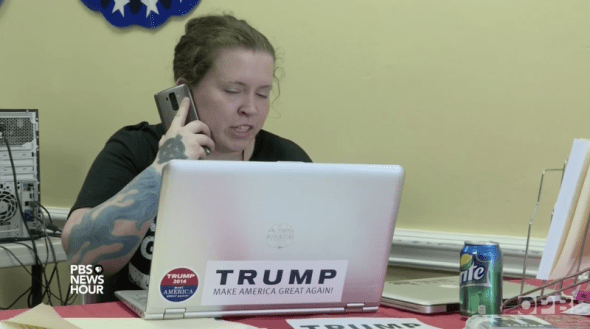
From the Gawker story:
Above, you see Grace phone banking for Donald Trump, with the Celtic Cross tattoo on her right hand. Despite the tattoo being in plain view of PBS’ cameras, the story never acknowledges that it is interviewing a walking white power billboard. The Anti-Defamation League explains that the Celtic Cross is one of the most “commonly used white supremacist symbols.” Mark Pitcavage, senior research fellow at the ADL, tells me:
The Celtic Cross is an ancient and revered Christian symbol typically not associated with extremism at all. However, one particular version of the Celtic Cross—a squarish cross with a thick circle intersecting with it (also known as Odin’s Cross), has become one of the most popular white supremacist symbols around. In the past 20 years, its popularity has done little but grow, thanks to its use as the logo by Stormfront, the largest white supremacist website in the world.
And on her hand, Grace has a large tattoo that reads “88,” which according to ADL is “code for Heil Hitler.” See that photo at Gawker. So far, PBS has reacted to the Gawker story.

On Tuesday night we learned that the Sanders Campaign plans to try to convince superdelegates to vote for him at the Democratic convention. Yesterday they announced plans to poach delegates that are pledged to vote for Clinton. It’s hard to remember now that only a couple of months ago, Sanders was supposedly running a clean, positive campaign. Time reports on a call with reporters hosted by camapaign manager Jeff Weaver, Sanders’ and strategist Tad Devine:
Although the Democratic pledged delegates are bound to a particular candidate based on state Democratic votes, Sanders senior strategist Tad Devine suggested there is some leeway there. Devine pointed to the Carter campaigns 1980 victory and their worry about holding onto pledged delegates. The Carter campaign was “deeply concerned about the defection of pledged delegates” to Ted Kennedy, Devine said.
“My point is that a frontrunner in a process like this needs to continue to win if you want to keep hold of delegates,” Devine continued. When pressed by a reporter, Devine said there was no plan “at the moment” to try to sway pledged delegates.
Weaver said that Sanders is doing Clinton a favor by staying in the race–because Bernie will protect poor fragile Hillary from Donald Trump.
“Were this contest to end, you know, by Secretary Clinton, or us getting out—certainly if the Secretary were still in the race, she could expect months and months and months of immediate, and vicious, and very personal attacks from the Trump people,” Weaver said. “So I don’t know if that’s necessarily healthy for her.”

WTF?! The people who said all along that the superdelegate process is undemocratic now want to win with their votes? And on top of that, they want to usurp the voters’ choices by stealing pledge delegates?
It’s just breathtaking. Here’s a great Greg Sargent interview with Hillary’s chief strategist Joel Benenson as an antidote: Hillary Clinton’s chief strategist: Sanders can’t win, and we’re ready to take down Trump. Read the whole thing at the WaPo.
What stories are you following today? Please post your thoughts and links in the comment thread and enjoy the rest of your Thursday.
Monday Reads: As the SCOTUS churns
Posted: June 29, 2015 Filed under: SCOTUS | Tags: 2015 Supreme Court Rulings, SCOTUS 11 Comments Well, it’s Monday and it feels like a Monday to me.
There are more Supreme Court decisions out today on all kinds of things.I’m going to give you a brief description of the major ones. It’s hard to top the Marriage Equality ruling and the saving of tax credits for “Obamacare”. However, a few of them are just as important in their own right.
One of the most stand-out decisions today had to do with voting and voter id.
The U.S. Supreme Court refused to consider letting states require evidence of citizenship when people register to vote for federal elections, rejecting an appeal from Arizona and Kansas.
The rebuff is a victory for the Obama administration and voting- and minority-rights groups that battled the two states in court. It leaves intact a decision by a U.S. agency that blocked the states from requiring proof of citizenship for voters in federal elections.
It’s the second high court defeat on the issue for Arizona. The state has a law that requires evidence of citizenship, but the Supreme Court ruled in 2013 that it couldn’t be enforced when people use a standard registration document known as the “federal form” to register to vote for Congress and the president.
That 7-2 ruling left open the possibility that Arizona could impose its requirements through a different avenue. The court said the state could submit a request to the agency that developed the form, the U.S. Election Assistance Commission, asking it to tell Arizona voters they needed to supply proof of citizenship.
SCOTUS also struck down three provision of the various Three Strikes laws that were designed to penalize “career” criminals. Scalia wrote the majority opinion in this case.
While the country was busy celebrating the Supreme Court’s long-awaited marriage equality ruling, the justices issued another ruling in the Johnson v. United States case that dealt a crucial blow to the prison industrial complex. The SCOTUS ruled that a key provision of the Armed Career Criminal Act, which lengthens the sentences of “career criminals,” is unconstitutionally vague. The ruling paves the way for thousands of prisoners to have their sentences reduced and will cause the private prison industry to lose millions of dollars in profits.
In 1984, Congress passed the Armed Career Criminal Act (ACCA), the law required judges to sentence people to 15 years to life if they have three prior convictions for “serious drug offense” or “violent felonies.” However, what exactly qualified as a “violent felony” was frustratingly vague and was used as a sentence enhancer in many non-violent cases. A “residual clause” in the ACCA allowed third time felons to be sent to prison for any crime that ” presents a serious potential risk of physical injury to another.” That potential risk could include drunk driving, fleeing police, failing to report to a parole officer and even attempted burglary. It seemed to be used as a catch-all sentence enhancer for the sole purpose of throwing people in prison for years longer than they deserved to be. This practice has become increasingly more common as more states allow for-profit prisons in their states.
In the Johnson case, the government used the ACCA to enhance Samuel Johnson’s prison sentence because of a prior conviction of possession of a sawed off shotgun. Johnson argued that he shouldn’t be subjected to a harsher sentence, because the definition of what was considered “violent” was unconstitutionally vague. The SCOTUS agreed with Johnson and issued a 7-1 ruling in his favor.
 Another finding allows independent panels to redistrict congressional and other political districts. This could be a key step to stopping the practice of gerrymandering. Arizona’s decision to let independent panels redistrict was declared constitutional.
By ruling that Arizona’s Independent Redistricting Commission is constitutional, the Supreme Court of the United States kicked plutocrat-loving Republicans in the gut. Justice Ruth Bader Ginsberg wrote the 5-4 majority opinion, joined by Justices Breyer, Kagan, Kennedy and Sotomayer.
The crux of the majority’s reasoning can be found in last paragraph of the ruling.
Our Declaration of Independence, drew from Locke in stating: “Governments are instituted among Men, deriving their just powers from the consent of the governed.” And our fundamental instrument of government derives its authority from “We the People.” U. S. Const., Preamble. As this Court stated, quoting Hamilton: “[T]he true principle of a republic is, that the people should choose whom they please to govern them.” Powell v. McCormack, 395 U. S. 486, 540-541 (1969) (quoting 2 Debates on the Federal Constitution 257 (J. Elliot ed. 1876)). In this light, it would be perverse to interpret the term “Legislature” in the Elections Clause so as to exclude lawmaking by the people, particularly where such lawmaking is intended to check legislators’ ability to choose the district lines they run in, thereby advancing the prospect that Members of Congress will in fact be “chosen . . . by the People of the several States,”
Even though this case got much less attention from the media compared to the health care and marriage equality cases it is in some ways as important as the aforementioned cases. The reason is it will shape the meaning of vote equality in the years to come. Had the court ruled the other way, frankly, it would have removed the last real hope of stopping the Koch controlled Republicans from rigging elections in their favor.
In one disappointing decision, SCOTUS removed EPA limits on Air Pollution.
The US supreme court struck down new rules for America’s biggest air polluters on Monday, dealing a blow to the Obama administration’s efforts to set limits on the amount of mercury, arsenic and other toxins coal-fired power plants can spew into the air, lakes and rivers.
The 5-4 decision was a major setback to the Environmental Protection Agency (EPA), and could leave the agency more vulnerable to legal challenges from industry and Republican-led states to its other new carbon pollution rules.
The justices embraced the arguments from the industry and 21 Republican-led states that the EPA rules were prohibitively expensive and amounted to government overreach.
But the EPA pointed out that most plants had already either complied or made plans to comply with the ruling.
“EPA is disappointed that the court did not uphold the rule, but this rule was issued more than three years ago, investments have been made and most plants are already well on their way to compliance,” the agency said in a statement obtained by Reuters.
The EPA “remains committed to ensuring that appropriate standards are in place to protect the public from the significant amount of toxic emissions from coal and oil-fired electric utilities and continue reducing the toxic pollution from these facilities,” the agency added.
Monday’s decision, written by Justice Antonin Scalia, ruled that the EPA did not reasonably consider the cost factor when drafting the toxic air-pollution regulations.
The Clean Air Act had directed the EPA to create rules to regulate power plants for mercury and other toxic pollutants that were “appropriate and necessary”.
 There’s some discussion in legal blogs about a possible softening of the Court in terms of it’s tendency to follow Scalia and Thomas to hard right conclusions. Are Kennedy and Roberts becoming more moderate or showing a bit more judicial restraint and temperament? Here’s some analysis by Tom Goldstein writing for SCOTUSBlog.
There is a lot of commentary about the unusually liberal results of this Term. I thought I would mention a few data points which back up that view of things.
For present purposes, I treat four Justices as sitting to the Court’s left: Ruth Bader Ginsburg, Stephen Breyer, Sonia Sotomayor, and Elena Kagan. I treat four Justices as sitting to the Court’s right: Chief Justice John Roberts and Justices Antonin Scalia, Clarence Thomas, and Samuel Alito. I treat Justice Anthony Kennedy as the Court’s “center.”
I count 26 cases this Term that were both close (5-4 or 6-3) and ideological (in the sense that they broke down principally on ideological lines, with ideology seemingly an important factor).
Of the 26 cases, the left prevailed in 19. Those included the first 9 of the Term. The right prevailed in 7.
In the 26, a Justice on the left voted with the right a total of 3 times. In 2 cases, those votes determined the outcome and produced a more conservative result, because Justice Kennedy or one of the conservatives voted for the more liberal result.
In the 26, a Justice on the right voted with the left 14 times. In 6 cases, those votes determined the outcome and produced a more liberal result, because Justice Kennedy voted for the more conservative result.
I also considered the 10 cases I consider most significant. Of those, the left prevailed in 8. Those included the first 7 of the Term. (I mention the early cases to give a sense of how the results must have appeared inside the Court as the Term went along.) The right prevailed in 2, both in the final sitting of the Term.
In the 10, no Justice on the left voted with the right; the four Justices on the left voted together in every one of those cases. A Justice on the right voted with the left 4 times. Those votes determined the outcome in 2 cases, because Justice Kennedy voted for the more conservative result.
Note that the analysis above is skewed against finding the Term particularly liberal by treating Justice Kennedy as the Court’s “center.” That is true ideologically, but he is certainly a conservative. If he were characterized that way for my analysis, the number of defections to the left would be much higher.
By that measure, a Justice on the right voted with the left 25 times (compared with 3 times the reverse happened). That occurred in all 10 of the 10 major cases (because no Justice on the left voted with the right in any of those cases), and determined the outcome in all of them.
Real Clear Politics also had a take on this. It’s obviously an interesting question to ask given the current hissy fits happening with in movement conservatives who are calling for the essential overthrow of the  current court since a few decisions did not go their way.
Conservatives were disheartened by the Court’s rulings Thursday in King v. Burwell and Texas Department of Housing and Community Affairs v. The Inclusive Project. They probably will be disheartened if the Court rules that gay marriage is a constitutional right, which seems likely. I suspect I got the authorship of the Arizona redistricting commission case wrong in my Supreme Court Bingoarticle: the opinion assignments make more sense if Justice Kennedy lost his majority in Din, which would suggest Justice Ginsburg is writing the redistricting commission opinion. That means conservatives may well be disappointed in the outcome of that opinion as well.
Unsurprisingly, conservatives are up in arms about the supposed “selling out” from Chief Justice John Roberts. Their reaction is something along the lines of Obi-Wan’s final words (from Obi-Wan’s point of view) to Anakin Skywalker: “You were the chosen one! It was said that you would destroy the Sith, not join them!”
…
plenty of today’s “liberal” decisions would have been considered downright reactionary in the 1960s (or 1970s). Consider the NFIB case, which upheld Obamacare in 2012, while finding that the individual mandate could not be supported by the commerce power. Until 1995, many scholars believed that the Commerce Clause had all but given Congress a general police power; the Lopez decision, which placed the first limits on congressional power in 60 years, was on the outer fringes of even conservative legal theory. NFIB actually reinforces, and to a certain extent expands that decision.
This says nothing of the Court’s holding that there are real limits to the spending clause, which garnered the votes of seven justices. I’m not sure there would have been more than one or two votes for this in the 1960s. By the standards of the 1970s, NFIB was a radically conservative decision, even when the substantive outcome is taken into account. By the standards of, say, the 1920s on the other hand, this was a radically liberal opinion, insofar as it accepts the basic New Deal framework (that there is at least one justice who is prepared to jettison that framework entirely shows just how far to the right the Court has gone).
Or consider the opinion validating Obamacare’s subsidies. While the plaintiffs’ theory of the case was perfectly plausible under current statutory interpretation principles (enough so that several Democratic-appointed lower court judges were cautious when ruling against plaintiffs), it also represented something of a reductio ad absurdum of textualism. If we were to have a debate over textualism in, say, the 1970s, one can imagine a purposivist asking, “So what if there is an obvious drafting error in a section that threatens an entire massive statute? What then?” The fact that conservatives expect the Court to go “full textualist” even in that circumstance – and that even liberal scholars like Abbe Gluck accept the basic textualist framework – again shows how far the debate has moved in the past 30 years.
What about the redistricting commission case? Assuming conservatives lose this one, it’s worth remembering that this position on the elections clause only had the support of three members of the Court in 2000 (when a similar argument was raised in Bush v. Gore); Justices Kennedy and O’Connor avoided the issue and may well have been against it. So even a 6-3 ruling against conservatives here would probably reveal no net shift in the positioning of the Court over the past 15 years. It is just that the expectations for conservatives have shifted.
The article is interesting because it compares some of the different courts over the last 50 years and you can see exactly how illiberal this court still is.
One more case is worth discussing. This one will be in the works. “The Supreme Court on Monday agreed to consider whether the University of Texas’s race-conscious admissions plan is constitutional.”
Two years ago, the court voted 7 to 1 to send the plan back for further judicial view and told the lower court to apply the kind of rigorous evaluation that must accompany any government action that considers race.
“Strict scrutiny imposes on the university the ultimate burden of demonstrating, before turning to racial classifications, that available, workable race-neutral alternatives do not suffice,” Justice Anthony M. Kennedy wrote.
This will be another interesting case to watch.
What’s on your reading and blogging list today?
Friday Reads: SCOTUS Plays Doctor (and God)
Posted: May 22, 2015 Filed under: Affordable Care Act (ACA), Domestic Policy, Health care reform, morning reads, U.S. Politics | Tags: Affordable Care Act, King v. Burwell, SCOTUS 33 CommentsGood Morning!
 I’ve got all kinds of personal reasons to hope that when the Supreme Court decides King v. Burwell next month that one just one Republican-appointed justice will consider the complaint trivial and it will be dismissed. That’s because I will be among the millions of people that will lose their health care. Jonathan Chait-writing for New York Magazine--wonders if that’s really what Republicans want in the year running up to a Presidential election.
Next month, the Supreme Court will rule on King v. Burwell. If all five Republican appointees support the plaintiffs (there’s no chance any of the Democrat-appointed justices will take the lawsuit seriously), some 7 million Americans will quickly lose their insurance. The prospect that this will occur has induced a wave of panic — not among the customers at risk of losing their insurance, who seem largely unaware, nor even among Obamacare’s Democratic supporters, but among Republicans. The chaos their lawsuit would unleash might blow back in a way few Republicans had considered until recently, and now, on the eve of a possible triumph, they find themselves scrambling to contain the damage. It is dawning on the Grand Old Party that snatching health insurance away from millions of helpless victims is not quite as rewarding as expected.
Unlike the Obamacare lawsuit that failed three years ago, the latest case is not based on a radical legal theory. Instead it is based on a novel reading of legislative history. The law allows states to set up their own exchanges to sell insurance to those who don’t have it through employer coverage, Medicare, or Medicaid. If states don’t establish an exchange, the federal government sets one up for them and, as it does with the state exchanges, offers customers tax credits. The trouble is that the law authorizing tax credits defines the exchange as “established by the state.” This ambiguity — does “by the state” not also mean the federal government? — was a technical omission. Many other parts of the law indicate its intent to make tax credits available to customers on the federal and the state exchanges alike.
The plaintiffs are led by a Vietnam veteran in Virginia named David King who makes $39,000 a year and objects to having to purchase insurance on a federal exchange. He would be exempt from this requirement were he not eligible for the tax credit — his $275 monthly payment would rise to a disqualifyingly unaffordable $648 — and this exemption, his lawyers argue, was exactly Congress’s intent. Without tax credits, the insurance would be unaffordable to most customers, triggering an actuarial death spiral that would destroy the individual insurance market in any state that attempted it. The plaintiffs insist Congress created the threat of self-destructing federal exchanges to coerce states into creating their own. (Disregard the copious evidence that the law’s drafters, and officials at the state level in both parties, believed federal exchanges would include tax credits.)
The lawsuit works more on the level of an elaborate prank than as a serious reading of the law. And yet it stands at least some chance of success — it only needs to persuade Republican-appointed judges. That prospect has grown suddenly unnerving because, unlike previous Republican efforts to strangle the law, the current one comes as Obamacare is functioning extremely well. Premiums on the exchanges have come in well under projected costs, customers report higher satisfaction with their coverage than those who have employer-sponsored insurance, and overall medical costs have grown far below the projected rate. It is one thing to take away a scheduled future subsidy, of which most intended beneficiaries are unaware. It is quite another to take away a benefit they’re already using.
Can you imagine the optics of people being taken off chemotherapy, dialysis, or insulin shots? So, Republicans are gearing up a way to blame it on Obama or trying to find a way to get the extreme right to compromise and provide a short term extensions of the credits should SCOTUS agree with the plaintiffs.
Senator Ben Sasse of Nebraska has likewise warned that a successful lawsuit would create problems. “Chemotherapy turned off for perhaps 12,000 people, dialysis going dark for 10,000. The horror stories will be real,” he wrote in a Wall Street Journal op-ed. For decades, medical deprivation of this sort used to be a uniquely American fact of life, at least among industrialized countries. Obamacare has turned it into something different: an actual political problem for opponents of universal health insurance.
Neither Johnson nor Sasse has a real plan designed to stop those horrors from taking place. Instead, their aim is to give Republicans a way to divert the blame onto Obama. The party is circulating contingency plans to temporarily restore the tax credits in exchange for crippling the law in other ways. Phil Gramm, the former Republican senator turned conservative-think-tank “visiting scholar” and financial-industry lobbyist, has proposed that Republicans pass a bill to temporarily extend the credits in return for eliminating the law’s regulations prohibiting insurance companies from rejecting old or sick customers. Competing proposals by Johnson and Sasse would likewise weaken Obamacare’s insurance regulations, ultimately destroying the law’s functionality. Gramm evenacknowledges that his plan “would put Obamacare on the path to extinction.” Obviously, Obama is not going to sign a bill that puts Obamacare on the path to extinction. The purpose is simply to give Republicans a talking point — they can say they passed a bill and blame Obama for vetoing it. But odds are that Republicans will fail to unify around a bill that can pass both houses of Congress with only Republican votes, because some will deem even a bill that causes Obamacare’s eventual demise unacceptably conciliatory.
At that point, it will fall to the states to either establish their own exchanges or watch their individual-insurance markets collapse. Neither option is terribly attractive for Republicans. The former means surrender. Doing nothing means sowing chaos, deprivation, and death. Will Republicans let this happen?
Legal Analyst and Lawyer Jeffrey Toobin has a lengthy article in The New Yorker examining the issues.
So that’s the theory: millions will suddenly be uninsured, and will blame Republicans. As Harry Reid, the Democratic leader in the Senate, put it recently, “I don’t think they will [win the case]. If they do, that’s a problem that the Republicans have.”
No, it’s not. If the Obama Administration loses in the Supreme Court, the political pain will fall almost exclusively on the President and his Party. To paraphrase Colin Powell and the Pottery Barn rule, President Obama will have broken health care, so he owns it. To the vast mass of Americans who follow politics casually or not at all, Obamacare and the American system of health care have become virtually synonymous. This may not be exactly right or fair, but it’s a reasonable perception on the part of most people. The scope of the Affordable Care Act is so vast, and its effects so pervasive, that there is scarcely a corner of health care, especially with regard to insurance, that is unaffected by it. So if millions lose insurance, they will hold it against Obamacare, and against Obama. Blaming the President in these circumstances may be unfair, but it’s the way American politics works.
Republicans, of course, will encourage this sentiment. The precise legal claim in King v. Burwell is an esoteric one. It is not based on a claim that Obamacare is unconstitutional. (The Supreme Court upheld the constitutionality of the law three years ago.) Rather, the central assertion by the plaintiffs is that the Obama Administration violated the law itself. In any event, the subtlety of the issue at the heart of the case will surely be lost in its aftermath. The headlines will read, correctly, “Court rules against Obamacare,” and this will be all that matters. The Republicans will argue that the Supreme Court showed that the law was flawed from the start, that the Obama Administration is lawless, that a full repeal of the law is the only appropriate response to the Court’s decision—and that the millions who lose their subsides should blame the sponsor of the law. Watch for references to a “failed Presidency.” There’ll be plenty of them.
Understandably, perhaps, the Administration has courted this kind of reaction. Better than anyone, Administration officials know the scale of the problems that would be created by a loss in the Supreme Court. Advertising this possibility makes sense as a litigation strategy; Obama officials don’t want to make it easy for the Supreme Court to rule against them. In testimony before Congress and elsewhere, Sylvia Burwell, the Secretary of Health and Human Services (and the defendant in the case), said that the Administration has no contingency plan for an adverse ruling in the Supreme Court. But playing chicken with the Justices only works if it works. If the Supreme Court strikes down the subsidies, the Administration will also have to answer for why it didn’t prepare for this possibility.
 “Conservatives” have tried to laugh off the concerns.
A few weeks ago, the Heritage Foundation’s Edmund Haislmaier published an “Issue Brief” entitled “King v. Burwell: A Loss of Subsidy Does Not Mean a Loss of Coverage.” That’s a provocative title, considering 87 percent of the 8.8 million enrollees from federal exchanges receive those tax credit subsidies, meaning they have low or moderate incomes.
Haislmaier recently was seen saying it’s “premature” to conclude the huge drop in the uninsured rate since Obamacare passed is the result of Obamacare passing. In this brief, he correctly points out the Affordable Care Act and previous federal and state laws would enable current Obamacare enrollees to switch to some other form of health insurance if the lawsuit he supports succeeds in making their current plans unaffordable. (The brief also chides low-income people for using their subsidies to buy “king-crab-legs-and-steak” insurance rather than take the cheapest possible “powdered-milk-and-frozen-peas” plans.)
“In sum, should the Supreme Court’s eventual ruling in King v. Burwell result in people losing insurance subsidies, the affected individuals will have options for maintaining their coverage or choosing replacement coverage,” Haislmaier wrote. There’s even a chart.
Is that good news for people at risk of losing their health insurance subsidies? Maybe not. “Of course, some might still not be able to afford the unsubsidized premium even if they switched to a less expensive plan,” Haislmaier adds as a disclaimer. Of course.
That seems like it could be a problem, since 83 percent of Obamacare enrollees on the federal exchanges have annual incomes of 250 percent of the federal poverty level or less, which works out to no more than $23,450 for a single person, according to Avalere Health, a consulting firm. In other words, these aren’t Americans with a lot of extra money. And the average value of the tax credits they stand to lose is $263 a month, a substantial amount for people at this income level.
There’s a lot of variation in the price of health insurance, but a look at national average premiums and cost-sharing requirements illustrates what the “Let them eat Bronze plans” line of thinking ignores.
A 40-year-old at the poverty line, which is $11,770 for a single person, would pay $20 a month for a mid-tier Silver plan with tax credits. That amounts to about 2 percent of her annual income. Take away the subsidies, and her premiums jump almost 14-fold to $276 — or about 28 percent of her income.
What about dropping down to a lesser Bronze policy with higher out-of-pocket costs like deductibles?
That would cost almost 11 times as much as the subsidized Silver plan, at $213 a month, or about 22 percent of her income. Another person making twice as much money as her would see his premiums for the same Silver policy rise by 80 percent, which would eat up 14 percent of his income. His premiums would rise by 39 percent if he switched to a Bronze plan, which would cost him 11 percent of his yearly earnings.
Even opting for a slimmer policy might not make sense for lower-income people, considering how much more Bronze policyholders have to spend before their coverage kicks in. For example, the average deductible for an individual Bronze plan is $5,181, compared to $2,927 for a Silver plan, according to Health Pocket.
And this doesn’t even factor in the effects of a second type of subsidy only available to people earning up to 250 percent of poverty, which reduces their out-of-pocket health care expenses, and which also would go away in the high court rules for the plaintiffs.
Some are seeing this as the classic American “State’s Right’s” argument that has been responsible for–among  many other things–the Civil War.
But what may eventually prove to be the key line of questioning may have been kicked off by Justice Sonia Sotomayor, who expressed concern about the consequences of a ruling for the challengers. If a state’s residents don’t receive subsidies, she told Carvin, it will lead to a “death spiral”: because a large group of people in those states will no longer be required to buy health insurance, but insurers will still be required to offer insurance to everyone, only sick people will buy health insurance. And that will cause everyone’s insurance costs to rise, leading more people to drop out of the insurance market. States will then feel like they have no choice other than to establish their own exchanges to ward off the “death spiral” – a scenario that is so coercive that it violates the Constitution.
Perhaps critically for the government, Justice Anthony Kennedy – who is often regarded as a strong supporter of states’ rights – also expressed concern about the possibly coercive effect of a ruling for Carvin’s clients. There is, he told Carvin, “something very powerful to the point” that if the challengers prevail, the states have to choose between the death spiral and creating an exchange. “There’s a serious constitutional problem,” he concluded. (Carvin tried to downplay this concern by telling Kennedy that the government had not raised this issue, but Kennedy quickly retorted that “we sometimes think of things the government doesn’t argue.”)
Like Carvin, Solicitor General Don Verrilli – the government’s top lawyer at the Supreme Court – also faced questions about the challengers’ right to sue. But between his acknowledgement that, as Carvin had asserted, a veteran who had only served a short time would not be eligible for free health care and the lack of certainty about the plaintiffs’ 2014 annual incomes (which would determine whether they would be required to buy health insurance at all), the issue didn’t seem to have much traction with the Justices.
On the merits of the challenge to the subsidies, Verrilli faced repeated questions from Justices Scalia and Alito, who were both obviously skeptical of the government’s arguments. Scalia pushed back against Verrilli’s argument that the challengers’ reading simply doesn’t work, while – by contrast – the government’s interpretation accounts for the ACA’s structure and design. The question, Scalia admonished Verrilli, is not what Congress intended; the question is what it actually wrote in the statute. But in any event, Scalia queried a few minutes later, if the Court were to rule for the challengers, did Verrilli and the government actually expect Congress to “really just sit there while disaster ensues?” (Based on Verrilli’s response – a dubious “This Congress?” – the answer appeared to be yes.)
Justices Alito and Scalia also contested Verrilli’s assertion that, had Congress actually intended to force states to choose between setting up their own exchanges and depriving their residents of subsidies, it would have done so more clearly. Scalia asked rhetorically why, because the ACA is “not the most elegantly drafted statute,” would it “be so surprising” if Congress didn’t make the states’ obligations obvious? Alito added that, if Congress didn’t want to limit the subsidies to the residents of states that had set up their own exchanges, it could have used more precise language to do so – as it did, for example, in making clear that the District of Columbia (which is not a state) nonetheless qualifies as a “state” for purposes of the ACA.
So, we’re down to brass tacks again. Will the ACA go down on a technicality which, essentially, is what the law is all about?
What’s on your reading and blogging list today?
Tuesday Reads: Netanyahu Speech, Hillary-Hate, and Nonsensical SCOTUS Case that could Hurt 8 Million Americans
Posted: March 3, 2015 Filed under: 2016 elections, Affordable Care Act (ACA), Barack Obama, Foreign Affairs, Hillary Clinton, morning reads, U.S. Politics | Tags: Affordable Care Act, Benjamin Netanyahu speech to Congress, iran, israel, King v. Burwell, New York Times, Obamacare, SCOTUS, State Department 19 Comments
Good Afternoon!!
I wanted to touch on a couple of issues this afternoon: the latest Hillary Clinton “scandal,” and the upcoming Supreme Court case that could doom Obamacare once and for all.
But before I get to those stories, I want to share this good article by James Fallows on the possible motivations behind Netanyahu’s speech to Congress this morning.
The Mystery of the Netanyahu Disaster, and a Possible Explanation.
Fallows enumerates the possible motivations for the Netanyahu slap in the face to President Obama:
“Was it simple tin ear on his side, and Ambassador Ron Dermer’s?” Fallows asks? That’s not likely according to Fallows, because Netanyahu is far too sophisticated and knowledgeable about U.S. politics. Fallows also discounts the theory that it was only about “election-year politicking” in Israel. Perhaps that’s part of it. Is it because Netanyahu has so often been right in his previous predictions?
Hardly. I can’t believe that he’s fooled even himself into thinking that his egging-on of war with Iraq looks good in retrospect. And for nearly two decades Netanyahu has been arguing that Iran was on the verge of developing nuclear weapons. When you’re proven right, you trumpet that fact—and when you’re proven wrong, you usually have the sense to change the topic. Usually.
Was it because Netanyahu “has a better plan?”
No. His alternative plan for Iran is like the Republican critics’ alternative to the Obama healthcare or immigration policies. That is: It’s not a plan, it’s dislike of what Obama is doing. And if the current negotiations break down, Iran could move more quickly toward nuclear capacity than it is doing now—barring the fantasy of a preemptive military strike by Israel or the U.S.
Fallows also doesn’t buy the argument that Netanyahu actually believes that Iran “faces an “existential threat” if Iran develops a nuclear weapon?
Let me explain. No person, nation, or community can define what some other person (etc) “should” consider threatening….But from the U.S. perspective I can say that the “existential” concept rests on two utterly unsupportable premises. One is that Iran is fundamentally like Nazi Germany, and the world situation of 2015 is fundamentally like that of 1938. Emotionally you can say “never forget!” Rationally these situations have nothing in common—apart from the anti-Semitic rhetoric. (To begin with: Nazi Germany had a world-beating military and unarmed Jewish minorities within its immediate control. Iran is far away and militarily no match for Israel.) The other premise is that Iran’s leaders are literally suicidal. That is, they care more about destroying Israel than they care about their country’s survival. Remember, Israel has bombs of its own with which to retaliate, so that any attack on Israel would ensure countless more Iranian deaths.

What then? Fallows refers to an article at The National Interest by Paul Pillar.
Pillar’s assessment is that the ramped-up “existential” rhetoric is a screen for the real issue, which is a flat contradiction between long-term U.S. and Israeli national interests as regards Iran. It is in American interests (as I have argued) to find some way to end Iran’s excluded status and re-integrate it with the world, as happened with China in the 1970s. And it is in Israel’s interests, at least as defined by Netanyahu for regional-power reasons, that this not occur. As Pillar writes:
The prime objective that Netanyahu is pursuing, and that is quite consistent with his lobbying and other behavior, is not the prevention of an Iranian nuclear weapon but instead the prevention of any agreement with Iran. It is not the specific terms of an agreement that are most important to him, but instead whether there is to be any agreement at all. Netanyahu’s defense minister recently made the nature of the objective explicit when he denounced in advance “every deal” that could be made between the West and Tehran. As accompaniments to an absence of any agreements between the West and Iran, the Israeli government’s objective includes permanent pariah status for Iran and in particular an absence of any business being done, on any subject, between Washington and Tehran.
That is, as long as Netanyahu keeps the attention on nukes and “existential” threats, he’s talking about an area where the U.S. and Israel might differ on tactics but agree on ultimate goals. Inflammatory as that topic is, it’s safer than talking about re-integrating Iran as a legitimate power, where U.S. and Israeli interests may ultimately differ.
I thought that was pretty good food for thought.
Before I get to the Clinton e-mails issue, here’s an interesting piece at the Washington Post on Hillary’s relationship with Netanyahu.
The phone call between Hillary Rodham Clinton and Israeli Prime Minister Benjamin Netanyahu lasted 45 minutes. For 43 of them, she talked and he listened.
The U.S. secretary of state lectured the Israeli leader, accusing him of trying to do an end run around American opposition to settlement-building and embarrassing Vice President Biden during a visit to Israel, according to interviews with people present during the 2010 call or who were briefed on it afterward. She read from a script for part of the lecture, so as not to miss any key points.
“The word ‘humiliation’ appeared very prominently,” recalled Michael Oren, then the Israeli ambassador in Washington. “As in ‘You have humiliated the United States of America.’ ”
There probably aren’t many times in Netanyahu’s professional life when he has listened to anyone for 43 minutes. Netanyahu prefers to do the lecturing….And there aren’t many people who could make Netanyahu sit still for a tongue-lashing. Clinton is one of them.

The story of the phone call comes from Clinton’s book on her time as Secretary of State, Hard Choices. Read more about it at the link. It would seem that experiences like this would stand Clinton and the U.S. in good stead if she ends up in the White House.
On the latest “scandal” about Hillary using a private e-mail as Secretary of State, I’m not sure what to think. It certainly does give ammunition to Republicans and to potential Democratic opponents like Martin O’Malley.
Here’s the NYT Story that started the fuss: Hillary Clinton Used Personal Email Account at State Dept., Possibly Breaking Rules. You’ll need to read it at the link, because the Times has fixed their website so that I, at least, can’t copy and paste any excerpts. Here are some reactions to the story. First, the debunkers:
From USA Today, Clinton aide: State Department e-mails preserved.
A spokesman for Hillary Rodham Clinton said Tuesday that while she used a personal e-mail account during her years as secretary of State, those records have been maintained pursuant to federal rules.
“Both the letter and spirit of the rules permitted State Department officials to use non-government email, as long as appropriate records were preserved,” said Clinton spokesman Nick Merrill. “As a result of State’s request for our help to make sure they in fact were, that is what happened here.”
Merrill responded to a New York Times story saying that Clinton, a prospective presidential candidate in 2016, used a personal e-mail account during her four years at the State Department and “may have violated federal requirements that officials’ correspondence be retained as part of the agency’s record.”
The Times reported that Clinton’s “expansive use of the private account was alarming to current and former National Archives and Records Administration officials and government watchdogs, who called it a serious breach.”
Yes, the president signed the new law two years after Clinton left the State Department. The NYT wants to punish her retroactively. Not surprising, considering the Times’ longstanding hatred for and sliming of the the Clintons. Please go read the whole Media Matters post. It won’t stop the Clinton haters from using this, but it’s the truth. Arm yourself.

Coffee, Leon Zernitzky
Bob Cesca at The Daily Banter: That Story About Hillary Clinton’s Private Email Account Isn’t as Awful as It Seems.
Again, please go read the whole thing, and prepare yourself for the coming onslaught. This is only the beginning.
A few more links to folks who either don’t know or don’t care about the time of the law and the fact that Clinton preseved all her emails.
A fairly Hillary-friendly post from Charles Pierce, Hillary Finds A Rake To Step On: The First Clinton Bombshell.
LA Times, Hillary Clinton used personal email while serving as secretary of state.
Mashable, Clinton email revelation: You did what, Hillary?
Incidentally, I was shocked to see this from Joseph Cannon:
Hillary’s secret email account. Let’s be honest: If a Republican did this, we’d be worried. Actually, Republicans have done exactly that.
The most important point here is sub-textual: If the NYT has turned against Hillary Clinton, then we should suspect that she has privately revealed to her closest aides that, if elected, she will do things that she cannot now state out loud. Of course, nothing is truly private these days.
“If the times as turned against Hillary Clinton”??!!! Joseph, why aren’t you aware that the NYT –brave champion of Dubya’s Iraq war–has always loathed the Clintons and has published innumerable attacks on them?
Finally a few links to prepare you for tomorrow’s SCOTUS hearing on King v. Burwell, during which the justices will consider whether to throw about 8 million Americans off their health care plans.
Charles Pierce, The Tell: What This Week’s Attack On Obamacare Is Really About.
…the Nine Wise Souls on Tuesday will hear King v. Burwell, the highly imaginative, if constitutionally laughable, attack on the grammar and punctuation in the Affordable Care Act, which the NWS should have laughed off months ago….
It is the Universal String Theory Of Wingnut Conjuring Words in full view, the complete text of one of the spells. A fake scandal being used to excuse the shabby underpinning of a fake lawsuit that will have real and devastating consequences to thousands of people.

That’s it in a nutshell. But here are more links to check out for more details.
Politico: No easy fix if Supreme Court halts Obamacare cash. (No sh$t Sherlock.)
Republicans are getting nervous about what will happen if they get their wish. From The Hill: GOP fears grow over ObamaCare challenge.
Ezra Klein at Vox: Republicans say they have a plan if the Supreme Court rules against Obamacare. They don’t.
Stephen Brill at Reuters: The Supreme Court hears an Obamacare fairytale.
US News (not known for liberal views): The Silliest Obamacare Challenge Yet. The King v. Burwell case could cause 8 million to lose health insurance.
SCOTUS should never have agreed to hear this case, but they did. Is John Roberts okay with going down in history as a buffoon? We’ll find out in June.
Please share your views along with the stories you’re following today in the comment thread.
Extra Lazy Saturday Afternoon Reads
Posted: October 25, 2014 Filed under: morning reads, U.S. Politics | Tags: Alison Lundergan Grimes, Campaign Ads, Charlie Baker, court decisions, DSCC, Jaylen Fryberg, John Roberts, Kentucky Senate race, Martha Coakley, Massachusetts governor's race, mental health services, Mitch McConnell, racial discrimination, SCOTUS, Suicide, Texas voter ID law, Washington state school shooting 58 Comments
Good Afternoon!!
It’s looking like Massachusetts may be on the verge of electing another Republican governor, and suddenly I’m feeling even sicker than I have been with this cold I can’t get rid of.
Breaking news this morning from The Boston Globe, Charlie Baker jumps 9 points in new Globe poll.
Republican Charlie Baker has opened up a 9-point lead over Democrat Martha Coakley, 45 percent to 36 percent, according to a new Globe poll that depicts a far more comfortable advantage than either candidate for governor has enjoyed in months.
The poll reflects an October surge in independent voters toward Baker’s column. It was independents who provided Governor Deval Patrick with his margins of victory in 2006 and 2010.
Baker’s standing has improved from last week’s poll, which showed the two candidates dead even. It can be attributed largely to the gains he has made in voters’ perceptions of who would improve the economy and manage state government, areas that already were tilting his way. At the same time, Baker has offset the deficits he faced on issues such as education and health care, where Coakley still holds an edge, but a diminished one.
“There is just positive movement in every single metric we can ask around Baker,” said pollster John Della Volpe, chief executive of SocialSphere Inc., which conducts the weekly poll for the Globe. “The more voters have gotten to know him, the stronger he performs.”
What is it with this supposedly liberal state? Since I moved here more than 40 years ago, we have had mostly Republican governors. I can’t understand why Massachusetts would elect another one, especially after our experience with Mitt Romney. We’ve also never had a woman elected governor. Republican Jane Swift was governor for two years, but that was because, as lieutenant governor, she took over for Paul Celluci, who resigned to become ambassador to Canada under George W. Bush.
As for getting to know Baker, what does that mean? Do voters really know his history? Or are they responding to political advertising?
Overall, Baker has moved from 38 percent support to 45 percent since late August. Coakley dropped 5 points this week, the poll found, after having held steady throughout much of the fall. Baker’s growth, said Della Volpe, has come almost entirely from voters who have made up their minds since the beginning of September. Eleven percent of voters remain undecided….
The poll depicts an electorate highly susceptible to the recent barrage of political advertising on television. Two weeks ago, Coakley, the state’s attorney general, led Baker by 5 points in the same poll. According to estimates from Kantar Media/CMAG, a firm that tracks political television commercials, $2.2 million in ads paid for by gubernatorial candidates and allied groups — more than 1,700 individual spots — aired on broadcast television from Oct. 12 through Oct. 19.

I didn’t know much about Baker until I read a very disturbing story in the Globe this week, Mental health record may be predictor for Charlie Baker. It turns out Baker was the architect of a damaging mental health privatization policy in Massachusetts that is still reverberates across the state today. (I’ve emphasized some points in the article with bold type.)
It was early 1991, Baker was Massachusetts’ new undersecretary for health, and the 34-year-old Harvard grad was having his first look at the state’s decrepit mental hospitals.
Soon after, a special state commission recommended closing nine of the state’s most antiquated institutions, including Danvers and two other hospitals for mentally ill patients, and moving much of that care to the community. It was Baker’s job to get it done. His strategy involved a first-in-the-nation use of a for-profit company with power to approve or deny treatments for low-income mental health patients.
Baker’s blueprint saved Massachusetts millions of dollars at a time when the state was staring at a nearly $2 billion deficit, but it left thousands of mental health patients often waiting weeks for treatments. The controversial approach became his template for rescuing financially ailing Harvard Pilgrim Health Care a decade later.
The aftershocks of both initiatives are still being felt as the now 57-year-old Republican runs for governor, and those experiences, say Baker supporters and critics, provide a window into how he might handle similarly fraught and costly issues if elected.
Baker’s claim to fame is that as CEO of Harvard Pilgrim Health Care, he kept the company from going bankrupt. Democratic ads have publicized the fact that he “raised premiums 150 percent and tripled his own salary to $1.7 million during his decade at Harvard Pilgrim.” One of the ways he saved money for Harvard Pilgrim was by laying of lots of workers and outsourcing their jobs to India. He even won an “Outsourcing Excellence Award” in 2008.
Back to the Globe article on Baker’s mental health record. There were vast financial profits for the state, and some low income mental health patients did benefit short-term. But overall,
…the separate move to privatize mental health care, with a for-profit company controlling treatment and costs, meant 800 state mental health workers were laid off and their work farmed out to private clinics that received less state money. Long waiting lists ensued for community services.
“It was a disaster,” said Dr. Matthew Dumont, former director of the Chelsea Community Counseling Center, where the number of psychiatrists and other caregivers, including Dumont, was cut from 23 to six. Dumont said the clinic was no longer able to provide a critical service he believes was a lifeline for mental health patients — home visits.
Over the next several years, suicide rates among mental health patients who had received state services soared. That prompted a blistering 1997 report from a legislative panel that criticized the Weld administration for lax monitoring of patients and failing to investigate their deaths in a timely way.
Two years later, a Brandeis University study gave the state high marks for innovative community-based mental health programs launched during the 1990s, but found too many patients waiting for services….
“It’s still a revolving door,” said Dumont, the former director of the Chelsea counseling center who lives with the legacy of privatizing mental health services when he evaluates patients for the state’s public defender agency. He said he has to scrounge to find places that will take indigent defendants who have been in and out of mental health facilities.
Read about Baker’s future plans for mental health care in Massachusetts at the link.

What’s happening in Kentucky?
Is Mitch McConnell getting nervous about holding onto his Senate seat? The Hill reports today that McConnell has just written a personal check to his campaign for $1.8 million dollars to counter the recent DSCC purchase of TV ads in support of challenger Alison Lundergan Grimes. From The Hill:
A week ago it appeared the Democratic Senatorial Campaign Committee was giving up on the race when it pulled the plug on television advertising after a $1.4 million buy.
But the Democratic Party committee plunged back into this fight this week by announcing it would spend another $650,000 on television ads to help Alison Lundergan Grimes against McConnell. The Senate Majority PAC, a Democratic super-PAC, followed up with a pledge to spend $850,000 in the state.
McConnell has a stable lead in polls, but doesn’t want to let the new Democratic ads go unmatched. He has long pledged to his Republican colleagues that he would not take any party funds to help win reelection.
Maybe it doesn’t mean anything; we’ll have to wait and see. Meanwhile a couple more articles on the Kentucky Senate race.
The Courier-Journal, Grimes pledges to fight for Kentuckians’ rights.
On the stump, she’s a Clinton Democrat. In GOP attacks, she’s a cheerleader for Barack Obama. Political allies — and opponents — know her as the daughter of Jerry Lundergan, former head of the Kentucky Democratic Party.
For her part, Democrat Alison Lundergan Grimes calls herself a “Kentucky filly,” charging toward victory in her bid to unseat Republican Sen. Mitch McConnell and become the state’s first female U.S. senator.
“This is a strong … independent Kentucky woman,” Grimes tells crowds on the campaign trail, while pledging to defend Medicare and Social Security benefits, fight for a higher minimum wage and support pay equality for women.
“She will fight for the people of Kentucky like we have never been fought for before,” she promises, speaking in the third person.
But 16 months after announcing her candidacy, political observers say Grimes still faces challenges in defining herself to Kentucky voters who overwhelmingly dislike Obama and have largely turned away from Democrats in most federal elections.
Apparently, it’s all about how much Kentuckians feel about Clinton and Obama. I hope Bill has plans to stump for Grimes again close to election day.

Brian Beutler at The New Republic reports on McConnell’s refusal to respond to questions about privatizing Social Security.
The reporters appear to be referencing this encounter McConnell had at the Louisville Rotary Club with reporter Joe Sonka. At the event, McConnell had expressed remorse that he couldn’t wrangle any Democrats into supporting George W. Bush’s 2005 effort to, as McConnell put it, “fix Social Security.”
Sonka asked him if he’d revisit that effort in 2015, and McConnell said, “I’m not announcing what the agenda would be in advance. We’re not in the majority yet. We’ll have more to say about that later.”
So McConnell dodged a pretty straightforward question about the Republican policy agenda, and, should he become majority leader, his own substantive goals.
A central theme of McConnell’s campaign is that Kentuckians shouldn’t replace a guy who stands to become an agenda setter in Washington with Grimes, who would be a freshman with comparably little power. Vis a vis less politically contentious issues, he’s more than happy to explain how he’d use that power.
One of the goals McConnell has been open about is “going after the EPA,” which he claims is hurting Kentucky’s economy.
So it’s inconsistent of him to hold his cards close to the vest when the issue is privatizing Social Security rather than gunning for the EPA. It would’ve been easy enough for him to say that private accounts are going to stay on the shelf, where they’ve been, for all intents and purposes, since 2005. Or that it wouldn’t be worth the hassle, since President Obama would surely veto such a bill. Instead he said the agenda isn’t up for public discussion until he’s granted the agenda-setting power.
I’m sure McConnell realizes that his constituents wouldn’t be too happy about attacks on Social Security . . .
The Texas Voter ID Law

From MSNBC, a depressing story about the Texas voter ID law, Texas woman threatened with jail after applying for voter ID.
An Austin, Texas woman told msnbc she was threatened with jail time for having an out-of-state driver’s license when she went to apply for a voter identification card so she could vote under the state’s controversial ID law. She said she was so intimidated she left without getting the ID she needed — and which she’d been trying to get for a year.
Lynne Messinger’s account highlights the obstacles that some Texans face as they try to obtain a voter ID — despite the state’s assurances that getting one doesn’t pose a burden.
Messinger, 62 and a musician, said she brought her birth certificate to aTexas’ Department of Public Safety (DPS) office in south Austin Thursday in an effort to get a voter ID. She needs one because Texas’s strict ID law doesn’t accept out-of-state driver’s licenses.
Messinger said she spoke to a clerk at the desk, and explained that she had a California driver’s license. She has houses in both California and Texas and goes back and forth between the two, but decided several years ago to switch her voting residency to Texas.
The clerk left for a few minutes, then told her to take a seat. At that point, Messinger said, a state trooper summoned her into his back office, saying he needed to speak to her. Once inside his office, Messinger said the trooper insisted on seeing all the documentation she had brought, and demanded to know where she lives and pays taxes. He even told her she could be jailed for driving with a California license.* It is illegal to drive in Texas on another state’s driver’s license 90 days after moving into the state.
“It was like a Nazi interrogation about how I cant be driving with a California ID,” Messinger said. “I was completely intimidated and freaked out.”

Here’s a very interesting read on Chief Justice Roberts and Voter ID laws from The Atlantic, On Race and Voter ID, John Roberts Wants It Both Ways. The author, Garrett Epps discusses Roberts’ views on race, and concludes that “[t]he idea that government must not discriminate by race seems to be important to the chief.” But . . .
Which brings us to Veasey v. Perry, the voting-rights case in which the Court issued its 5 a.m. order on Saturday. That order allowed Texas’ draconian voter-ID law, known as SB 14, to take effect for the midterm elections next month—the first general election to which it will be applied. It is customary to speak of SB 14 as a “tough” voter-ID law, but it might be better to speak of it as a discriminatory voter-ID law, inspired by the intent to disfranchise black and Latino voters.
That’s not my inference; it was the considered factual finding of federal district Judge Nelva Gonzales Ramos. (Ramos is an Obama appointee, but one endorsed for the bench by Republican Senators Kay Bailey Hutchinson and John Cornyn.) Ramos based her conclusion on a nine-day trial in which both the state and the plaintiffs presented evidence about SB 14’s history and effect. That effect is startling—Ramos found that the law might disfranchise as much as 4.5 percent of the state’s eligible voters. But more important is her conclusion about the law’s intent (emphasis added):
The record as a whole (including the relative scarcity of incidences of in-person voter impersonation fraud, the fact that SB 14 addresses no other type of voter fraud, the anti-immigration and anti-Hispanic sentiment permeating the 2011 legislative session, and the legislators’ knowledge that SB 14 would clearly impact minorities disproportionately and likely disenfranchise them) shows that SB 14 was racially motivated.
This is a devastating finding. The judge is not saying that the law has a disproportionate effect on minorities; she is saying that it was specifically written to prevent them from voting. Because it was intentional race discrimination, she found, it violated Section 2 of the Voting Rights Act, the Equal Protection Clause of the 14th Amendment, the prohibition of racial restrictions on the vote in the 15th Amendment—and also the prohibition of poll taxes in the 24th Amendment.
Read much more at the link. It’s an important article.

Washington School Shooting
More details are coming out about the school shooting in Washington state. From The Seattle Times, Teen shooter targets 3 girls, 2 male cousins.
A freshman homecoming prince, reportedly angry about a girl, pulled out a gun and opened fire in a crowded cafeteria at Marysville-Pilchuck High School Friday morning, killing one classmate and wounding four others before fatally shooting himself.
At 10:39 a.m., as hundreds of students gathered for lunch on the sprawling campus, Jaylen Fryberg walked up to a cafeteria table, pulled out a gun and shot three teen girls and two teenage male cousins, witnesses and authorities said….
Fryberg and a girl were confirmed dead. The girl’s name was not released.
Two boys and two girls were taken by ambulance to Providence Regional Medical Center in Everett. As of Friday night, the two girls were alive and in intensive care with gunshot wounds to the head, said Dr. Joanne Roberts, chief medical officer for Providence. It will be several days before a prognosis could be made, she said.
The wounded boys were identified by family members as Andrew Fryberg, 15, and Nate Hatch, 14 — both cousins to Jaylen Fryberg. Both also were shot in the head. They were initially taken to Providence and later transferred to Harborview Medical Center in Seattle, where Andrew was in serious condition and Nate was in critical condition.
“He shot people he cared about,” said friend and football teammate Dylen Boomer.
I guess we’ll learn more as time goes on. These school shootings make no sense to me.
So . . . what stories are you following today? Please share your links in the comment thread and enjoy your weekend!

 peej
peej Carissa
 bostonboomer
 dakinikat
 ecocatwoman
 jjlo
jjlo mablue2
 Mama Lopez
 peggysue22
 quixote
 skydancingguestblogger
 Mona (aka Wonk the Vote)



 Sky Dancing
Recent Comments