
RTT News: Dark Chocolate May Improve Walking Ability.
Friday Reads: Zombie Memes
Posted: October 10, 2014 Filed under: Barack Obama, Foreign Affairs, medicine, morning reads, Republican politics, science, Surreality, U.S. Politics | Tags: airport screening, Anthony Kennedy, Eagle Forum, ebola, Idaho, ISIL, Nevada, Phyllis Schlafly, same-sex marriage, SCOTUS, Tom Frieden, West Africa, zombies 11 Comments Good Morning!
The Ebola Virus and the epidemic in Africa is real. The right wing hysteria about the virus is rivaling the bad plots of the Zombie movies I’m watching during SyFy’s Countdown to Halloween. I thought I’d spend some time separating the facts from the conspiracy theories today. So let me start with one of the most outrageous Zombie Memes from one of the most vile women on the planet. Dementia or further evidence of the advanced stages of evil? It’s your choice.
In an interview with WorldNetDaily published today, Eagle Forum founder Phyllis Schlafly weighed in on the unfounded theory gaining traction in the right-wing media that Central American young people are to blame for an outbreak of a childhood respiratory illness in the U.S.
“There are all kinds of diseases in the rest of the world, and we don’t want them in this country,” Schlafly told WND, adding that “of all the things [Obama has] done, I think this thing of letting these diseased people into this country to infect our own people is just the most outrageous of all.”
She went on to imply that President Obama is intentionally allowing people infected with Ebola into the United States because he wants America to be “just like everybody else, and if Africa is suffering from Ebola, we ought to join the group and be suffering from it, too. That’s his attitude.”
Conservative icon Phyllis Schlafly – author of “Who Killed the American Family?” – said she agrees Obama is responsible for allowing diseases to enter the country.
“There are all kinds of diseases in the rest of the world, and we don’t want them in this country,” Schlafly said. “And it’s Obama’s job to keep them out.
“Out of all the things he’s done, I think this thing of letting these diseased people into this country to infect our own people is just the most outrageous of all.”
Schlafly said the government should screen immigrants for disease before they enter the country, as was done at Ellis Island a hundred years ago.
“That was the purpose of Ellis Island – to have a waiting place where it was decided whether people were healthy enough or responsible enough to come into our country,” she said. “The idea that anybody can just walk in and carry this disease with them is just an outrage, and it is Obama’s fault because he’s responsible for doing it.”
…
When asked why the current administration hasn’t done more to prevent diseased illegal aliens or Ebola carriers from Africa from entering the country, Schlafly said Obama wants to make the U.S. more like the rest of the world.
“Obama doesn’t want America to believe that we’re exceptional,” Schlafly said. “He wants us to be just like everybody else, and if Africa is suffering from Ebola, we ought to join the group and be suffering from it, too. That’s his attitude.”
Yup, it’s despicable She. Still foaming at the mouth after all these years too.
Okay, so as not to overwhelm you with teh crazy all at once. Let’s go to some science and medicine.
The director of the Centers for Disease Control and Prevention told a top-level forum in Washington, D.C., that the Ebola outbreak is unlike anything he’s seen since the AIDS epidemic.
“I would say that in the 30 years I’ve been working in public health, the only thing like this has been AIDS,” Frieden said before the heads of the United Nations, World Bank and International Monetary Fund, according to AFP.
Frieden added: “We have to work now so that it is not the world’s next AIDS.”
Frieden’s comments come as the first person diagnosed with Ebola in the U.S. died Wednesday despite intense but delayed treatment. The U.S. government also announced it was expanding airport examinations to guard against the spread of the deadly disease.
The checks will include taking the temperatures of hundreds of travelers arriving from West Africa at five major American airports.
The new screenings will begin Saturday at New York’s JFK International Airport and then expand to Washington Dulles and the international airports in Atlanta, Chicago and Newark. An estimated 150 people per day will be checked, using high-tech thermometers that don’t touch the skin.
The White House said the fever checks would reach more than 9 of 10 travelers to the U.S. from the three heaviest-hit countries — Liberia, Sierra Leone and Guinea.
President Barack Obama called the measures “really just belt and suspenders” to support protections already in place. Border Patrol agents now look for people who are obviously ill, as do flight crews, and in those cases the Centers for Disease Control and Prevention is notified.
It’s unlikely a fever check would have spotted Thomas Eric Duncan, the Liberian man who died of Ebola in a Dallas hospital Wednesday morning. Duncan wasn’t yet showing symptoms when he arrived in the U.S.
 So the disease is ravaging West Africa. That’s where the problem is and needs to be solved.
There are the facts about the state of the Ebola crisis. In West Africa, more than 8,000 people have contracted the disease and nearly half have died. In the U.S., there’s just one confirmed case—that of Thomas Duncan, the Liberian man who passed away in Dallas on Wednesday. Experts say that the caseload in West Africa is likely to get much, much bigger. As many as 1.4 million people could get the disease, with a large fraction of them dying from it. The same experts expect no similar outbreak here, even if a few more cases appear, because we have the personnel and the resources to limit exposure.
But all of the news on Wednesday was about developments here in the U.S.—in particular, new screening efforts at five major U.S. airports, Duncan’s death, and reports of possible new cases in the U.S., including one in Dallas. You could tell by the questions that Thomas Frieden, director of the U.S. Centers for Disease Control, fielded during a late afternoon press conference. He got more than a dozen of them. Only two were about the situation abroad. (And one of them, it so happens, came from me.)
The preoccupation with what’s happening here, as opposed to what’s happening over there, is perfectly understandable. On Tuesday, a Gallup poll revealed that Americans today are as worried about contracting Ebola as they were about contracting H1N1, the swine flu, during that outbreak two years ago. By that time, millions of people had gotten H1N1 and thousands had already died. But people die from flu all the time, usually because they are very young or very old or already otherwise infirmed. It’s a threat that people have factored into their daily lives, if at all. Ebola is quite literally a foreign menace, one to which almost nobody gave much thought until a few weeks ago. The virus kills about half the people who get it, with little regard for age or health status of the person infected.
That fear goes a long way to explaining why the U.S. is implementing the new screening process at the airports. Customs and Border Patrol agents were already on the lookout for people with visible signs of the disease. Now they will add another layer of scrutiny. They will use questionnaires to screen for people who have been in affected countries—and, then, subject these people to temperature tests and more questioning. People who have fever or show other Ebola symptoms will be evaluated by quarantine officers from the CDC, then referred to local health authorities who will decide how to handle the cases. The primary goal is to identify any passengers infected with Ebola before they leave the airport.
But yes, the right wing is hysterical and afraid and lying as the right wing is prone to do.
Of all the issues that you would think would be non-partisan, Ebola should be at the top of the list. The disease is just a mindless germ that doesn’t check your race, gender, social class, sexual orientation or party identification before it strikes, suggesting both liberals and conservatives
have a stake in treating people exposed to the disease with compassion and care. And yet, to flip on Fox News or turn on any conservative media at all, you’d think that ebola was some kind of plague designed by the Democratic party in order to wipe out Republicans.
Blowing the threat of ebola out of proportion and trying to link it to Obama has been a constant theme on the right in recent days. Elisabeth Hasselbeck of Fox News literally demanded that we put the country on lockdown, banning all travel in and out. In a bit of race-baiting, Andrea Tantaros of Fox suggested that people who travel to the country and show symptoms of ebola will “seek treatment from a witch doctor” instead of go to the hospital. Fox host Steve Doocy suggested the CDC is lying about ebola because they’re “part of the administration”. Fox also promoted a conspiracy theorist who is trying to claim the CDC is lying when they caution people not to panic.
Other right wing media joined in. Tammy Bruce blamed ebola on the “Obama legacy”. Laura Ingraham said Obama was prevented from doing more to stop the disease because of his “core ties to the African continent”. Rush Limbaugh even went as far as to accuse Obama of letting the disease spread because he supposes liberals believe “we kind of deserve a little bit of this”.
Okay, so here’s a zombie mistake and a big one. Justice Kennedy’s Typo Accidentally Stops Same-Sex Marriage in Nevada.
Yesterday, Supreme Court Justice Anthony Kennedy stunned America when he ordered a halt on Nevada’s same-sex marriages, less than a day after the Court voted to overturn a ban on gay marriages in that state. Turns out that it was a total accident. Yes, a big ol’ “oops, my bad” incident.
According to SCOTUSBlog, what happened was the following: The Ninth Circuit recently heard challenges to same-sex marriage bans in Idaho and Nevada, who, for the purposes of convenience, had combined both of their challenges into a single case. In two different rulings, the federal appellate court struck down both of these states’ bans, allowing same-sex marriage in Idaho and Nevada, and issued a mandate on the ruling to immediately enforce the new law. In other words, the moment that the Ninth Circuit struck down the ban, gay and lesbian couples could get married immediately.
This did not make Idaho happy, so they filed a request to Justice Kennedy asking him to put a stop on same-sex marriage in Idaho, so that state officials could review their case before the Ninth Circuit. Kennedy allowed it, but in a total brain fart moment, issued an order that put a stop on weddings in both Idaho and Nevada, even though nobody in Nevada had asked for a review, either.
Thankfully, same-sex marriages can still occur in Las Vegas for the time being, but unfortunately, nobody knows what the eff is happening anymore. As a result, the Ninth Circuit has recalled its order implementing same-sex marriage in Idaho and are asking for briefs as to whether they need to do the same in Nevada.
Good job, Kennedy. Look how much confusion your typo has caused.
Oh, another Zombie Meme replacing Benghazi these days. It’s not only Ebola that’s Obama’s fault but also ISIL. It’s all about killing white people!!! Here’s some great links and proof from Politicus.
We have shown that for the GOP, the threat of Ebola exists only as an excuse to attack President Obama, that it’s all Obama’s fault (of course) and that, Oh my God! Oh my God! It’s going to kill us all! Cue to Rand Paul diving under his bed.
We have also been closely following the rise of ISIL in Syria and Iraq, and have tried to show you the contrast between the Republican and the Democratic reactions.
We have shown that for the GOP, the threat of ISIL exists only as an excuse to attack President Obama, that it’s all Obama’s fault (of course) and that Oh my God! Oh my God! They’re going to kill us all! Cue to Lindsey Graham diving under his bed.
It is surely significant that yesterday Time Magazine should profile the Republican response to the ISIL “scandal”: GOP Ad Claims ISIS Plot to Attack U.S. Via ‘Arizona’s Backyard.’
As Time’s Zeke Miller and Alex Rogers describe the ad, which was posted to YouTube yesterday,
The National Republican Congressional Committee ad opens with grainy footage of black flags and fighters from the Islamic State of Iraq and Greater Syria (ISIS) holding rifles on military vehicles. “Evil forces around the world want to harm Americans every day,” an ominous voiceover states. “Their entry into our country? Through Arizona’s backyard.” The spot goes on to recount how Rep. Ann Kirkpatrick (D-AZ), locked in a close re-election fight with Arizona House Speaker Andy Tobin, has voted against border security legislation, suggesting that she “leaves Arizona vulnerable.”
Chris Wallace of Fox News has already planted the suggestion in viewers’ facile minds that Ebola could come across our Southern Border and that it could be used as a weapon. It doesn’t matter after those words are spoken than an expert debunks them. The damage has been done.
The brain damage was done to any one that actually believes these things years ago.
So what’s on your reading and blogging list today?
Lazy Saturday Reads
Posted: July 5, 2014 Filed under: morning reads, U.S. Politics, Women's Rights | Tags: "white oppression", Bill Clinton, Boston bombing, Bourbon St. shootings. New Orleans, C-Span callers, Civil Rights act, Eden Foods, Hillary Clinton, Hobby Lobby decision, Hurricane Arthur, Indianapolis shootings, Maya Angelou, Michael Potter, Racism, Richard Mellon Scaife, Samuel Alito, SCOTUS, vanilla ice cream 34 Comments
“Someone is Waiting,” by David Hettinger
Good Morning!!
I’m sure you won’t be surprised to learn that today is a very slow news day. Nevertheless, I’ve still managed to dig up a few interesting reads.
Long-time Clinton hater Richard Mellon Scaife has died at 82. The Associated Press reports via Politico:
Scaife died early Friday at his home, his newspaper, the Pittsburgh Tribune-Review, reported. Scaife’s death comes less than two months after he announced in a first-person, front-page story in his Pittsburgh Tribune-Review that he had an untreatable form of cancer.
“Some who dislike me may rejoice at the news,” wrote Scaife, who acknowledged making political and other enemies. “Naturally, I can’t share their enthusiasm.”
He was the grand-nephew of Andrew Mellon, a banker and secretary of the Treasury who was involved with some of the biggest industrial companies of the early 20th century. Forbes magazine estimated Scaife’s net worth in 2013 at $1.4 billion.
The intensely private Scaife became widely known in the 1990s when first lady Hillary Rodham Clinton said her husband was being attacked by a “vast right-wing conspiracy.” White House staffers and other supporters suggested Scaife was playing a central role in the attack.
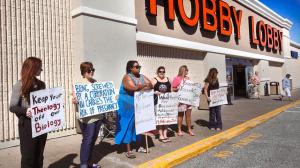
Hillary was mocked for those remarks; but today, in the aftermath of the Hobby Lobby decision, it should be obvious to all but the most oblivious and ignorant among us that the vast right wing conspiracy exists and its tentacles have reached even the U.S. Supreme Court.
From Forbes, Clare O’Connor reports more Hobby Lobby Fallout: Catholic Soy Milk Mogul Won’t Cover Drugs That ‘Prevent Procreation’. Eden Foods founder Michael Potter has stated his determination to prevent his female employees from getting access to birth control, and the Supreme Court is helping him.
In April 2013, devout Catholic (and sole Eden Foods shareholder) Potter sued the Department of Health and Human Services, calling the Affordable Care Act’s contraceptive mandate “unconstitutional government overreach.”
In a letter he wrote in response to a shopper complaint that month, Potter described contraceptives as “lifestyle drugs” akin to “Viagra, smoking cessation, weight-loss” tools and other medications. (He also compared birth control to “Jack Daniels” in a contemporaneous interview with Salon.)
In October, the U.S. Court of Appeals decided against Potter, ruling that Eden Foods, as a for-profit corporation, couldn’t exercise religion.
Now, in the wake of this week’s controversial Supreme Court ruling recognizing craft chain Hobby Lobby’s religious rights, the court has changed its tune.The day after the Justices decided evangelical Hobby Lobby billionaire David Green doesn’t have to cover certain contraceptives for his employees, the Supreme Court vacated the judgment against Eden Foods and sent the case back to the U.S. Court of Appeals for the Sixth Circuit for further consideration.
“The court of appeals is ordered by the Supreme Court to follow its decision in Hobby Lobby,” said Erin Mersino, the attorney handling Potter’s case at the Christian, conservative Thomas More Law Center.
And the beat goes on . . .
At The Nation, Katha Pollit asks: Where Will the Slippery Slope of ‘Hobby Lobby’ End?
Facts are stubborn things, as John Adams famously said. Unless, that is, you’re talking about religion. Then facts don’t seem to matter at all: right you are if you think you are. The Hobby Lobby case was billed as a test of religious freedom versus the power of the state: Did the Religious Freedom Restoration Act (RFRA) mean that David Green, the evangelical Christian CEO of a chain of crafts stores, could be exempt from providing coverage for the full range of contraceptives for his employees under the Affordable Care Act? Green balked at including Plan B, Ella (another form of emergency contraception) and two kinds of IUD, because, he claimed, they caused “abortion” by preventing the implantation of a fertilized egg.
The Court’s 5-to-4 decision—which featured all three women justices ruling for the workers, and all five Catholic men ruling for the corporation—was wrong in many ways. But the thing I really don’t understand is why it didn’t matter that preventing implantation is not “abortion,” according to the accepted medical definition of the term. And even if it was, Plan B, Ella and the IUDs don’t work that way, with the possible exception of one form of IUD when inserted as emergency contraception. As an amicus brief from a long list of prestigious medical organizations and researchers laid out at length, studies show that emergency contraception and the IUD preventfertilization, not implantation. They are not “abortifacients,” even under the anti-choicers’ peculiar definition of abortion. (Green is actually more moderate than some anti-choicers, who include hormonal contraception, aka “baby pesticide,” as abortion.) Why doesn’t it matter that there is no scientific evidence for Green’s position? When did Jesus become an Ob/Gyn?
Good question. Today even facts are irrelevant to Supreme Court decisions. The fact is that Democrats helped Thomas, Roberts, and Alito make it onto the Court, and now we’re stuck with these religious and ideological fanatics.
At Salon, Digby writes that Alito could have been stopped: Why Dems should have filibustered the radical. And from Peter Montgomery at HuffPo, Samuel Alito: A Movement Man Makes Good on Right-Wing Investments. Read them and weep.
Dakinikat posted this Guardian piece in the comments last night; I thought it should be included in this morning’s links: Black people were denied vanilla ice cream in the Jim Crow south – except on Independence Day.
By custom rather than by law, black folks were best off if they weren’t caught eating vanilla ice cream in public in the Jim Crow South, except – the narrative always stipulates – on the Fourth of July. I heard it from my father growing up myself, and the memory of that all-but-unspoken rule seems to be unique to the generation born between World War I and World War II.
But if Maya Angelou hadn’t said it in her classic autobiography I Know Why the Caged Bird Sings, I doubt anybody would believe it today.
People in Stamps used to say that the whites in our town were so prejudiced that a Negro couldn’t buy vanilla ice cream. Except on July Fourth. Other days he had to be satisfied with chocolate.
Vanilla ice cream – flavored with a Nahuatl spice indigenous to Mexico, the cultivation of which was improved by an enslaved black man named Edmund Albius on the colonized Réunion island in the Indian Ocean, now predominately grown on the largest island of the African continent, Madagascar, and served wrapped in the conical invention of a Middle Eastern immigrant – was the symbol of the American dream. That its pure, white sweetness was then routinely denied to the grandchildren of the enslaved was a dream deferred indeed.
What makes the vanilla ice cream story less folk memory and more truth is that the terror and shame of living in the purgatory between the Civil War and civil rights movement was often communicated in ways that reinforced to children what the rules of that life were, and what was in store for them if they broke them.
Please go read the whole thing if you haven’t already.

From Politico: Why the Civil Rights Act couldn’t pass today.
It was a painful tableau: The bipartisan leaders of Congress linking hands in the Capitol Rotunda and swaying to the strains of “We Shall Overcome” as they commemorated the 50th anniversary of the passage of the Civil Rights Act of 1964. Harry Reid and Nancy Pelosi sang along with the crowd, but Mitch McConnell and John Boehner’s lips were frozen in silent, self-conscious smiles.
The climate in today’s Washington is so different from the one that produced what many scholars view as the most important law of the 20th century that celebrating the law’s legacy is awkward for Republicans and Democrats alike. Neither party bears much resemblance to its past counterpart, and the bipartisanship that carried the day then is now all but dead….
The current congressional leaders gathered last week not to honor Johnson — or any of the legislative leaders who actually passed the landmark law — but to award a posthumous Congressional Gold Medal to The Rev. Dr. Martin Luther King Jr. and his wife, Coretta Scott King, whose crusade helped create the climate that made the bill possible. In his life, racial tensions helped make King such a polarizing figure that both Johnson and John F. Kennedy worried about seeming too close to him, but in martyrdom and myth, he is the only politically safe ground on which present day leaders could unite.
They are all so pathetic. And this is beyond pathetic: Callers Use C-SPAN Civil Rights Discussion To Complain About White Oppression (VIDEO).
“Washington Journal” host Steve Scully listened as an “independent” caller named Thomas from Maryland told him that he is “much less liberal today” than he was in 1964 when the landmark law was signed by Lyndon B. Johnson.
“And I think the blacks have brought on most of their present-day problems themselves. They insult white people,” he told Scully. “I heard it right on your own show, I heard some black call Karl Rove a ‘white boy.’ And I don’t think that’s right. They’re attacking white people in the big cities and we’re supposed to put up with that kind of stuff and like them and say, ‘Well, come into our neighborhood.’ And how about the discussion of the black crime that goes on in this country?”
The caller went on to complain that the discrimination endured by Irish, Mormons and Italians is widely ignored.
“You people will never, never discuss that. You only discuss the discrimination against the black people,” he said.
Is that sick or what?
A few more news links:
Information Week on private tech companies treatment of their customers, Facebook Mood Manipulation: 10 Bigger Problems.
Fox News: Suspect arrested in Bourbon St. shootings.
USA Today: Seven hurt in Indianapolis shootings.
WSJ: A Weakened Hurricane Arthur Heads Toward Nova Scotia
ABC News: Before Boston Attack, Alleged Bomber Posed With Black Flag of Jihad at Local Mosque.
So . . . what stories are you reading and blogging about? Please share your links in the comment thread, and enjoy the rest of the long weekend!
Fourth of July Reads
Posted: July 4, 2014 Filed under: morning reads, U.S. Politics, Women's Rights | Tags: corporate personhood, corporatizing religious liberty, Declaration of Independence, Fourth of July, Hobby Lobby, Independence Day, John Roberts, legal precedent, religion, Samuel Alito, SCOTUS, separation of church and state, Statue of Liberty, Wheaton College 14 Comments
Good Morning!!
Today we celebrate the Declaration of Independence. I’ve assembled a few informational readings about this day in history.
From The Cagle Post: Fourth of July Fast Facts.
“I’m confused. I thought July 4 was the day our country declared independence from King George III of Great Britain.”
“Actually, according to ConstitutionFacts.com, that’s not so. The Continental Congress declared independence from Great Britain on July 2, 1776.”
“Then why do we celebrate our independence on the Fourth every year? Is that when we started the American Revolution?”
“That is a common misunderstanding, as well. The American Revolution began in April 1775, more than a year earlier.”
“I’m stumped. Was the Fourth the day Thomas Jefferson wrote the first draft of the Declaration of Independence?”
“Nope. Thomas Jefferson wrote the first draft in June 1776. Also, Jefferson didn’t write the Declaration alone.”
“He didn’t? I always thought he was the sole author.”
“A common misconception. In fact, the Continental Congress appointed a five-person to write the Declaration. It included Jefferson, Benjamin Franklin, John Adams, Robert Livingston and Roger Sherman.” ….
“Though Jefferson wrote the first draft, it was changed 86 times by other members of the committee and other members of the Continental Congress.”
I did not know that.
David Armitage at The Wall Street Journal: The Declaration of Independence: The Words Heard Around the World.
The Declaration of Independence is the birth certificate of the American nation—the first public document ever to use the name “the United States of America”—and has been fundamental to American history longer than any other text. It enshrined what came to be seen as the most succinct and memorable statement of the ideals on which the U.S. was founded: the rights to life, liberty and the pursuit of happiness; the consent of the governed; and resistance to tyranny.
But the Declaration’s influence wasn’t limited to the American colonies of the late 18th century. No American document has had a greater impact on the wider world. As the first successful declaration of independence in history, it helped to inspire countless movements for independence, self-determination and revolution after 1776 and to this very day. As the 19th-century Hungarian nationalist, Lajos Kossuth, put it, the U.S. Declaration of Independence was nothing less than “the noblest, happiest page in mankind’s history.”
In telling this story of global influence, however, it is important to separate two distinct elements of the Declaration—elements that sometimes get conflated. The first of these is the assertion of popular sovereignty to create a new state: in the Declaration’s words, the right of “one People to dissolve the Political Bands which have connected them with another, and to assume among the Powers of the Earth, the separate and equal Station to which the Laws of Nature and of Nature’s God entitle them.” The second and more famous element of the Declaration is its ringing endorsement of the sanctity of the individual: “We hold these truths to be self-evident, that all men are created equal, that they are endowed by their Creator with certain unalienable Rights.”
Read much more at the link.
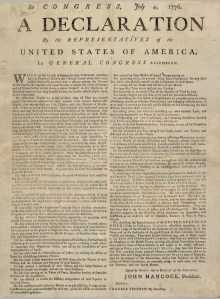
From the LA Times: The slow-spreading news of American independence.
In this era of instant communication, it’s interesting to note the slow distribution of the Declaration, and the spreading of the word to those on whose behalf independence had been declared. (Imagine the Twitter version: Dudes, we’re on our own. #independence #totallyrad #stickitkinggeorge).
The text was set in type by Philadelphia printer John Dunlap just hours after the Continental Congress approved the manifesto on July 4. He ran off about 200 copies, most of which were then distributed via horse and boat around the Colonies. He reprinted it in his own newspaper, Dunlap’s Pennsylvania Packet, or The General Advertiser (great newspaper names back then). Over the next few weeks, Jefferson’s stirring words were reprinted inlocal newspapers and pamphlets around the Colonies.
And, naturally, in Britain. It took more than a month for the first reports of the Declaration to reach Britain in letters ferried by the Mercury packet ship. Gen. William Howe, who was leading the crown’s forces in the Colonies, included a brief mention in his report to his overseers. So the first public airing of the news came in the London Gazette, the crown’s official paper. If you weren’t a close reader, you could have easily missed it.
In the four-page issue dated Aug. 6-Aug. 10, 1776, the Gazette’s lead story was Howe’s update of the war, reporting that “the Rebels, who are numerous, and are very advantageously posted with strong Entrenchments both upon Long Island and that of New York, with more than One Hundred pieces of Cannon for the Defence of the Town towards the Sea, and to obstruct the passage of the [British] Fleet up the North [Hudson] River, besides a considerable Field Train of artillery.”
Finally, Carina Kolodny at Huffington Post: This Is Not Your Independence Day.
The 4th of July might commemorate the independence of our country — but it also serves as a bitter reminder that in 1776, the country that I love had no place for me in it.
When our founding fathers penned, “All men are created equal,” they meant it. Not all people. Not all humans. Just all men — the only reason they didn’t feel obliged to specify “white” men is because, at the time, men of color were considered less than men, less than human.
The 4th is not my Independence Day — and if you’re a Caucasian woman, it isn’t yours either. Our “independence” didn’t come for another 143 years, with the passage of The Woman’s Suffrage Amendment in 1919. The 4th of July is also not Independence Day for people of color. It wasn’t until the 15th Amendment was ratified in 1870 that all men had the right to vote regardless of race — on paper, that is, not in practice. People of color were systematically, and all too successfully, disenfranchised for another century. July 4th of 1776 was certainly not a day of Independence or reverence for Native Americans. It wasn’t until 1924 that Native Americans could unilaterally become citizens of the United States and have the voting rights to go with it.
Now, before anyone argues that Independence is about more than voting rights, I’d like to point out that our Founding Fathers would fundamentally disagree with you. The Revolutionary War was fought, in large part, because of “taxation without representation” — the then English colonists believed they were not free because their voices were not represented. The right to vote, the right to have your say is the delineating characteristic of a democracy.
The Aftermath of the Hobby Lobby Decision
On that note, today many concerned citizens are looking back at the latest Supreme Court decisions that take women backwards in their pursuit of freedom and autonomy. The court-approved limits on access to birth control go beyond the Hobby Lobby decision. Lyle Denniston at SCOTUSblog: Broader right to object to birth control.
Expanding the rights of religious opponents of birth control, a divided Supreme Court on Thursday afternoon spared an Illinois college — and maybe hundreds of other non-profit institutions — from obeying government regulations that seek to assure access to pregnancy prevention services for female workers and students. In the same order, the majority essentially told the government to modify its own rules if it wants to keep those services available.
Three Justices wrote a sharply worded dissent, accusing the majority of creating on its own a “new administrative regime” that will seriously complicate the operation of the birth control mandate under the new federal health care law. The majority, the dissenters said, “has no reason to think that the administrative scheme it foists on the government today is workable or effective on a national scale.”
The ruling, which the majority insisted was temporary and had settled nothing finally about the legal issues at stake, came three days after the Court in Burwell v. Hobby Lobby had given for-profit businesses whose owners have religious objections to birth control a right to refuse to provide those services in their employee health plans.
The plea by Wheaton College, a religious institution in Illinois with about 3,000 students, moved the Court beyond for-profit firms to the world of non-profit religious colleges, hospitals, and other charities. The government had already moved to accommodate their beliefs, but that had not gone far enough for the college and for scores of other non-profits. With the Court’s new order, they gained additional separation from the birth-control mandate.
At Mother Jones, Kevin Drum writes: Supreme Court Now Playing Cute PR Games With Hobby Lobby Decision.
For the last few days, there’s been a broad argument about whether the Hobby Lobby ruling was a narrow one—as Alito himself insisted it was—or was merely an opening volley that opened the door to much broader rulings in the future. After Tuesday’s follow-up order—which expanded the original ruling to cover all contraceptives, not just those that the plaintiffs considered abortifacients—and today’s order—which rejected a compromise that the original ruling praised—it sure seems like this argument has been settled. This is just the opening volley. We can expect much more aggressive follow-ups from this court in the future.
POSTSCRIPT: It’s worth noting that quite aside from whether you agree with the Hobby Lobby decision, this is shameful behavior from the conservatives on the court. As near as I can tell, they’re now playing PR games worthy of a seasoned politico, deliberately releasing a seemingly narrow opinion in order to generate a certain kind of coverage, and then following it up later in the sure knowledge that its “revisions” won’t get nearly as much attention.
At Slate, Micah Schwartzman, Richard Schragger, and Nelson Tebbe explain that Hobby Lobby rewrites religious-freedom law in ways that ignore everything that came before.
Monday’s decision in Hobby Lobby was unprecedented. Much of the commentary has focused on the Supreme Court’s decision to extend rights of religious free exercise to for-profit corporations. Hobby Lobby is for religion what Citizens United was for free speech—the corporatization of our basic liberties. But Hobby Lobby is also unprecedented in another, equally important way. For the first time, the court has interpreted a federal statute, theReligious Freedom Restoration Act (or RFRA), as affording more protection for religion than has ever been provided under the First Amendment. While some have read Hobby Lobby as a narrow statutory ruling, it is much more than that. The court has eviscerated decades of case law and, having done that, invites a new generation of challenges to federal laws, including those designed to protect civil rights.
The authors explain how the right wing Roberts Court has moved beyond any concern for legal precedent in making its decisions.
Hobby Lobby is unprecedented because it corporatizes religious liberty. It extends to for-profit businesses the rights and privileges that have long been associated only with churches and religious nonprofits. But that change is the result of a more pervasive and deeper upending of the law of religious liberty in America. Ignoring congressional intent, the court reads RFRA as having shed its First Amendment skin. It is not entirely clear what American law will look like after that change. But if anything is clear, it is that the Roberts Court is now unconstrained by precedent. It has loosened itself from decades of First Amendment doctrine and has begun remaking the law of free exercise.
Please read the whole thing.
Ironically, the Hobby Lobby decision may have also created some serious problems for the human beings who own corporations (h/t Dakinikat). From Mother Jones: How Hobby Lobby Undermined The Very Idea of a Corporation. Basically, now that SCOTUS has said that some corporations are inseparable from the people who own them, those owners could lose their legal protection from debts and lawsuits that result from corporate actions. There’s some instant Karma for you!
A few more links for your holiday reading pleasure:
Miami Herald: FBI records: Chilling find in Bradenton dumpster (new clues to Saudi involvement in the 9/11 and the cover-up of that involvement by the Bush/Cheney administration).
Study links Oklahoma earthquake swarm with fracking operations
Boston Globe: People prefer electric shocks to time alone with thoughts.
LA Times: Tibetans get high-altitude edge from extinct Denisovans’ genes.
What stories are you following on this Independence Day?
Thursday Reads
Posted: August 22, 2013 Filed under: Barack Obama, Crime, Criminal Justice System, morning reads, U.S. Politics | Tags: Antontin Scalia, Arizona Kansas lawsuit, australia, Bobby Jindal, Bradley Manning, Chelsea Manning, Chris Lane, David Sirota, FBI files, hormone therapy, Mark Ambinder, Michael Hastings, murder, SCOTUS, sex-reassignment surgery, The Guardian UK, transgender, voting rights, William Vollmann 19 Comments
Good Morning!!
I’m getting slow start this morning after rereading some of yesterday’s morning thread and seeing Fannie’s and Beata’s comments. Life is such a mystery . . . it often seems sad and even meaningless. And yet life is wonderful and beautiful too.
I don’t even know how to express what I’m feeling right now. I just want to thank all of you for being here. When I get discouraged and disgusted with our politics and the behavior of some of my fellow humans, it helps me to share my feelings with you and to get your reactions.
Now let’s see what’s in the news this morning.
Bradley Manning was sentenced to 35 years in prison yesterday. But with good behavior he could be released in as little as 7 years. Charlie Savage and Emmarie Huetteman at The New York Times:
In a two-minute hearing on Wednesday morning, the judge, Col. Denise R. Lind of the Army, also said that Private Manning would be dishonorably discharged and reduced in rank from private first class to private, the lowest rank in the military. She said he would forfeit his pay, but she did not impose a fine.
Before the sentencing, Private Manning sat leaning forward with his hands folded, whispering to his lawyer, David Coombs. His aunt and two cousins sat quietly behind him. As Colonel Lind read the sentence, Private Manning stood, showing no expression. He did not make a statement.
The materials that Private Manning gave to WikiLeaks included a video taken during an American helicopter attack in Baghdad in 2007 in which civilians were killed, including two journalists. He also gave WikiLeaks some 250,000 diplomatic cables, dossiers of detainees being imprisoned without trial at Guantánamo Bay, Cuba, and hundreds of thousands of incident reports from the wars in Iraq and Afghanistan….
Mr. Coombs later told reporters that he would apply for a presidential pardon next week and read a statement from Private Manning that he said would be included in his request.
“I only wanted to help people,” Private Manning’s statement said, adding, “If you deny my request for a pardon, I will serve my time knowing that sometimes you have to pay a heavy price to live in a free society.”
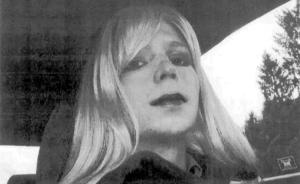
This undated photo provided by the U.S. Army shows Pfc. Bradley Manning posing in a wig and lipstick.
Manning has expressed the desire to live as a woman, and although he may not be able to get hormone therapy or sex-reassignment surgery while he is in military prison, he has announced that he is now Chelsea Manning. From Joe Coscarelli at New York Magazine: Bradley Manning’s Long, Painful Road to Coming Out As Transgender.
Less than a day after being sentenced to 35 years in prison for passing classified U.S. documents to WikiLeaks, Army private Bradley Manning has a huge, if not exactly surprisingly, announcement: “I am Chelsea Manning. I am female,” the 25-year-old wrote in a statement to Today. “Given the way that I feel, and have felt since childhood, I want to begin hormone therapy as soon as possible. I hope that you will support me in this transition. I also request that, starting today, you refer to me by my new name and use the feminine pronoun.”
But the transition has colored much of Manning’s life for many years and factors heavily into how she became one of the most notable leakers in American history. Even if much of the world is only now paying attention to Manning’s gender-questioning, it’s always been a part of her story.
Manning’s full letter is titled “The Next Stage of My Life” and has notes of relief, her trial and sentencing finally complete after three years. “As I transition into this next phase of my life,” Manning wrote, “I want everyone to know the real me.”
Manning was wrestling with her sexual orientation while serving in Iraq and when she got involved with WikiLeaks. As reported by Steve Fishman in a July 2011 issue of New York, “Among fellow soldiers, Manning had to conceal the basic facts of his sexual orientation. On the web, he was proudly out and joined a ‘Repeal Don’t Ask Don’t Tell’ group. He’d even begun to explore switching his gender, chatting with a counselor about the steps a person takes to transition from male to female.”
Manning will probably be in her early 30s when she is released from prison; so she’ll still have a long and probably interesting life ahead of her when that time comes.
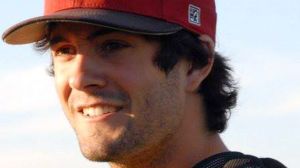
Chris Lane
Australians are calling for a boycott of U.S. travel after the senseless shooting of young Australian college student Chris Lane in Oklahoma. CNN:
The indiscriminate shooting of Christopher Lane, a 23-year-old Australian who was living his dream of studying in the United States on a baseball scholarship, has repulsed many in his home country and led to calls for Australian tourists to boycott the United States.
“It is another example of murder mayhem on Main Street,” former Australian deputy Prime Minister Tim Fischer told CNN’s Piers Morgan.
“People thinking of going to the USA for business or tourist trips should think carefully about it given the statistical fact you are 15 times more likely to be shot dead in the USA than in Australia per capita per million people.”
Police said Lane was on one of his regular runs through what has been described as the affluent town of Duncan on Friday about 3 p.m. when a car carrying three teenagers drove up behind him.
“They pulled up behind him and shot him in the back, then sped away,” said Capt. Jay Evans of the Duncan Police Department. “It could have been anybody — it was such a random act.”
Here’s a long article about the shooting from new.com.au: Chilling 911 call details final moments of Melbourne baseballer Chris Lane’s life.
What a heartbreaking story.
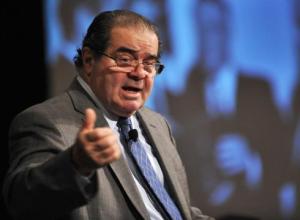
The states of Arizona and Kansas have followed a suggestion from Supreme Court Justice Antonin Scalia, according to TPM: Accepting Scalia’s Offer, Arizona Sues Obama Administration On Voting Rights.
The lawsuit, filed Wednesday, was announced by Arizona’s Attorney General Tom Horne and Secretary of State Ken Bennett, and joined by Kansas Secretary of State Kris Kobach, a high-profile architect of restrictionist laws, including Arizona’s Senate Bill 1070.
The issue involves the 1993 National Voter Registration Act, also known as the “motor voter” law, which requires states to let people register to vote simply by attesting they are citizens, when renewing their driver’s license or applying for social services. A 2004 law adopted by the voters in Arizona added the requirement that people registering to vote also provide proof of citizenship. The Supreme Court struck down that law earlier this year, concluding that it is trumped by the motor voter law. Arizona, the court ruled, could not add new requirements to the form prescribed by the federal law.
But during oral arguments in March, Scalia expressed his bafflement that Arizona did not launch a broader assault on the constitutionality of the NVRA form, written by the Election Assistance Commission. The state simply contended in that case that its proof of citizenship law did not violate the federal law. Even Scalia disagreed with that, voting against Arizona in the ruling, but also giving them a valuable tip in his 7-2 majority opinion.
“We hold that [the NVRA] precludes Arizona from requiring a Federal Form applicant to submit information beyond that required by the form itself,” Scalia wrote in the June decision. “Arizona may, however, request anew that the EAC include such a requirement among the Federal Form’s state-specific instructions, and may seek judicial review of the EAC’s decision under the Administrative Procedure Act.”
Sigh . . . read more at the link.
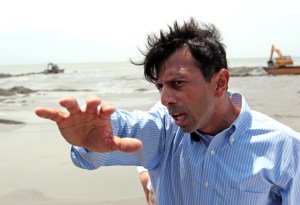
According to a new PPP poll, only 28 percent of Louisiana voters still think Governor Bobby Jindal is doing a good job.
Three years ago in August PPP declared Bobby Jindal to be the most popular Governor in the country. 58% of voters approved of him to only 34% who disapproved. Jindal’s fortunes have seen an amazing shift since that time though, and our newest poll finds him to be the most unpopular Republican Governor of any state- and the second most unpopular Governor in the country overall.
Just 28% of voters now approve of Jindal to 59% who disapprove. That’s an 11 point decline in his net approval just since February when he was already at a poor 37/57 standing. Even Republicans are pretty divided on Jindal (43/42) while independents (35/45) and Democrats (14/78) generally give him poor marks.
Jindal’s White House prospects are dismal if his home state voters have anything to say about it. Just 17% of Louisianans think he should run for President in 2016 to 72% who believe he should sit it out. He ties for 4th among Republican primary voters as their top choice for their 2016 candidate- Rand Paul leads with 18% to 17% for Jeb Bush, 11% for Paul Ryan, 10% for Jindal and Chris Christie, 8% for Marco Rubio and Ted Cruz, 5% for Rick Santorum, and less than 1% for Susana Martinez. (That’s also an embarrassingly poor showing for Santorum given that he easily won the state’s primary last year.)
Jindal wouldn’t be likely to get to a general election but the news for him there is bad too- he trails Hillary Clinton 47/40 in a hypothetical match up. Every other Republican we looked at is more competitive with Clinton in the state- Ryan leads her 46/44, Paul does 45/44, Bush ties her at 44 each, and she leads Christie just 42/41. It looks like Clinton would have a chance to make Louisiana unusually competitive in any instance, but particularly so against Jindal.
It’s difficult to believe that Jindal is polling that well against Hillary.
A few more short takes:
A new article in LA Weekly offers some startling revelations about Michael Hastings’ state of mind before he was killed in a one-car crash: Michael Hastings’ Dangerous Mind: Journalistic Star Was Loved, Feared and Haunted. Based on a friend’s descriptions of Hastings’ behavior, it sounds like he was so severely depressed that he was delusional.
From The A Register, speculations based on The Guardian’s bizarre claims that British intelligence agents forced them to destroy computers that contained U.S. secrets stolen by Edward Snowden: MYSTERY of Guardian mobos and graphics cards which ‘held Snowden files’
A funny Buzzfeed list (with gifs) contributed by Marc Ambinder: 12 Ways To Easily Identify An East Coast Transplant In LA.
A very weird story that demonstrates the institutional stupidity of the Federal Bureau of Investigation: FBI suspected William Vollmann was the Unabomber.
A fascinating story at Defense One: Area 51 Has Been Hiding U-2 Spy Planes, Not UFOs
Finally, our old friend David Sirota really outdid himself yesterday with this story at Salon: This cowardly silence is an act of war, in which he claims that President Obama’s failure to object to the UK detaining Glenn Greenwald’s partner David Miranda at Heathrow Airport is a crime against humanity . . . or something.
Now it’s your turn. What stories are you focusing on today? Please share your links in the comment thread.
Thursday Reads: Aftermath of SCOTUS Voting Rights Decision
Posted: June 27, 2013 Filed under: 2014 elections, Civil Rights, court rulings, Elections, morning reads, open thread, racism, Real Life Horror, Republican politics, U.S. Politics | Tags: Antonin Scalia, GOP Southern strategy, hypocrisy, Judicial Activism, SCOTUS, U.S. Supreme Court, Voter ID laws, Voting Rights Act 66 Comments
Good Morning!!
This is going to be a quickie post, because I’m feeling kind of sick this morning.
Although I’m thrilled with the DOMA decision yesterday, I still can’t get past my anger and sadness about the Supreme Court’s gutting of the Voting Rights Act. So I’m just going to post the (above) “official 2013 photo” of the U.S. Supreme Court and some accompanying links that demonstrate the damage the Court has done in its horrendous decision on the Voting Rights Act.
I’ll begin with this excellent post by Linda Greenhouse at The New York Times: Current Conditions, which neatly summarizes the Court’s “conservative” wing’s blatant “judicial activism,” to quote a frequent charge of conservatives against “liberal” judges.
These have been a remarkable three days, as the Supreme Court finished its term by delivering the only four decisions that most people were waiting for. The 5-to-4 decisions striking down the coverage formula of the Voting Rights Act and the Defense of Marriage Act will go far toward defining the Roberts court, which has concluded its eighth year. Monday’s place-holding ruling on affirmative action in higher education, although it decided very little, is also definitional, for reasons I’ll explain. There is a great deal to say about each decision, and about how each reflects on the court. My thoughts are preliminary, informed by that phrase in the chief justice’s voting rights opinion: current conditions.
By this phrase, the chief justice meant to suggest that there is a doctrinal basis for drawing a boundary around Congressional authority, for judicial insistence that a burden that Congress chooses to impose on the states has to be justified as a cure for a current problem. In the context of voting rights, an area over which the 15th Amendment gives Congress specific authority, this is a deeply problematic position that Justice Ruth Bader Ginsburg’s dissenting opinion demolishes.
Please go read the whole column–it’s difficult to get Greenhouse’s thesis into an excerpt. The blatant hypocrisy of the “conservative” justices–especially Scalia is mind-boggling, especially when the stunning effects of the Voting Rights decision on “current conditions” are already obvious and dramatic–just as were the disastrous effect of the Citizens United decision. A few examples.
The Guardian: Texas rushes ahead with voter ID law after supreme court decision
Officials in Texas said they would rush ahead with a controversial voter ID law that critics say will make it more difficult for ethnic minority citizens to vote, hours after the US supreme court released them from anti-discrimination constraints that have been in place for almost half a century.
The Texas attorney general, Greg Abbott, declared that in the light of the supreme court’s judgment striking down a key element of the 1965 Voting Rights Act he was implementing instantly the voter ID law that had previously blocked by the Obama administration. “With today’s decision, the state’s voter ID law will take effect immediately. Photo identification will now be required when voting in elections in Texas.”
Greensboro News and Record: NC senator: Voter ID bill moving ahead with ruling
Voter identification legislation in North Carolina will pick up steam again now that the U.S. Supreme Court has struck down part of the Voting Rights Act, a key General Assembly leader said Tuesday.
A bill requiring voters to present one of several forms of state-issued photo ID starting in 2016 cleared the House two months ago, but it’s been sitting since in the Senate Rules Committee to wait for a ruling by the justices in an Alabama case, according to Sen. Tom Apodaca, R-Henderson, the committee chairman. He said a bill will now be rolled out in the Senate next week.
The ruling essentially means a voter ID or other election legislation approved in this year’s session probably won’t have to receive advance approval by U.S. Justice Department attorneys or a federal court before such measures can be carried out.
Northwest Ohio.com: Voter ID and restricted early voting likely after SCOTUS ruling
ATLANTA (AP) — Across the South, Republicans are working to take advantage of a new political landscape after a divided U.S. Supreme Court freed all or part of 15 states, many of them in the old Confederacy, from having to ask Washington’s permission before changing election procedures in jurisdictions with histories of discrimination.
After the high court announced its momentous ruling Tuesday, officials in Texas and Mississippi pledged to immediately implement laws requiring voters to show photo identification before getting a ballot. North Carolina Republicans promised they would quickly try to adopt a similar law. Florida now appears free to set its early voting hours however Gov. Rick Scott and the GOP Legislature please. And Georgia’s most populous county likely will use county commission districts that Republican state legislators drew over the objections of local Democrats.
AL.com: Alabama photo voter ID law to be used in 2014, state officials say
MONTGOMERY, Alabama — Today’s U.S. Supreme Court decision clears the way for Alabama’s new photo voter ID law to be used in the 2014 elections without the need for federal preclearance, state officials said.
Alabama Attorney General Luther Strange and Secretary of State Beth Chapman said they believed the voting requirement, which is scheduled to take effect with the June 2014 primaries, can simply move forward.
“Photo voter ID will the first process that we have gone through under this new ruling,” Chapman said today.
Memphis Business Journal: Mississippi voter ID law could start next year
Voters in Mississippi may have to start showing a photo ID to vote by the middle of 2014, according to Secretary of State Delbert Hosemann.
According to the Associated Press, Hoseman spoke Tuesday after the U.S. Supreme Court ruled that certain state and local governments no longer need federal approval to change election laws. That ruling opens up the possibility that Mississippi will implement a voter identification requirement.
According to Think Progress, Arizona and South Dakota will likely be trying to pass Voter ID laws soon. I’m sue that won’t be the end of it.
Just a few more links:
Joan Walsh: The ugly SCOTUS voting rights flim-flam
Ari Berman: What the Supreme Court Doesn’t Understand About the Voting Rights Act
Stephen Hill: So the Voting Rights Act Is Gutted—What Can Protect Minority Voters Now?

 peej
peej Carissa
 bostonboomer
 dakinikat
 ecocatwoman
 jjlo
jjlo mablue2
 Mama Lopez
 peggysue22
 quixote
 skydancingguestblogger
 Mona (aka Wonk the Vote)



 Sky Dancing
Recent Comments