
Finally Friday Reads: Chaos Redux
Posted: May 1, 2026 Filed under: "Der Fuehrer's Face", #FARTUS, #MAGAnomics, #We are so Fucked, 2026 MidTerm elections, Affordable Care Act (ACA) | Tags: @johnbuss.bsky.social John Buss, Cadet Bonespur's Iran War, jim crow, Trump Poll numbers, voting rights 1 Comment
“The Kings. Imagine if we had a Big Beautiful Bawlroom. I’m thinking Charles is grateful to be outdoors, just sayin’.” John Buss, @repeat1968
Good Day, Sky Dancers!
This has been a bad week for our small d democracy. The Supreme Court attacked voting rights in a court case that basically decimated voting rights. Down here in Lousyana, our legislature and governor have raised the stakes. They’re delaying our election so they can gerrymander the state’s legislative districts. They’ve also passed a law giving jail time to anyone smoking pot around a university campus. Campus Potheads will likely wind up as state slaves out doing whatever local law enforcement needs doing, which has included some pretty shady things. It’s a lot like Jim Crow Redux. Is the South trying to rise again?
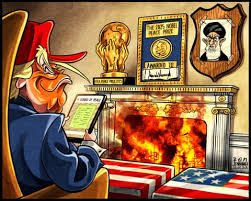
Then, there’s the Iran War. This has definitely reached Constitutional Crisis status. Tess Bridgeman and Oona A. Hathaway from Just Security have this analysis. “At the 60-Day Mark, the Iran War is Triply Illegal.” Of course, should it head to SCOTUS, the right-wing justices will just make something up.
Today, May 1st, marks 60 days since President Donald Trump notified Congress that he initiated a war against Iran. The notification of Operation Epic Fury, which began two days earlier on Feb. 28, triggered the 60-day termination clock of the War Powers Resolution, a landmark statute passed by supermajorities in both congressional chambers over President Richard Nixon’s veto in an effort to reclaim Congress’s constitutional authority over decisions to wage war. Under that statute, Trump must now terminate the hostilities he began two months ago. He seems set against doing so. If he refuses, he will take a war that is already doubly illegal and turn it into a triply-illegal war. He will also make it clear, if it was not already, that he regards the law as no constraint on his use of the U.S. military’s lethal power.
At the outset it should be made clear that President Trump’s war in Iran was illegal from the start. From the moment it began, Trump’s war with Iran violated the U.S. Constitution and the UN Charter.
First, the Constitution vests Congress, not the President, with the power to decide when the United States goes to war. The current conflict with Iran makes plain why placing this power in the peoples’ representatives, rather than the chief executive, was and remains so important. Democracy, it was thought then – and remains true now – is incompatible with the “one man decides” model in which a nation can be thrown into war on a single person’s whims. Requiring congressional authorization is not just a safeguard against potential incompetence, though that is plenty evident in the disastrous war of choice against Iran. It is also because the weighty decision to go to war should be made by the more deliberative branch of government, and the most politically accountable, that the authority to declare war resides in the list of Congress’ Article I powers, alongside a host of other powers on making, regulating, and funding war. (Of note, this war clearly crosses even the threshold the executive branch has set for itself on when it needs to turn to Congress to authorize force, though neither the Congress nor the courts have embraced the executive’s highly elastic test.)
Second, the war is a clear violation of Article 2(4) of the UN Charter, which prohibits the threat or use of force except in legitimate self-defense against an armed attack (or imminent threat of one) or with Security Council authorization. Neither exist here. It is, put simply, a war of aggression. Other countries know this even if they have been nervous to call it out, fearing Trump’s wrath. It’s why we have so little international support–and why longstanding allies have refused even basic cooperation.
The manifest violation of the UN Charter also violates the U.S. Constitution: the president has a constitutional duty to “take Care that the Laws be faithfully executed.” This duty applies to treaties that, under our Constitution, are the “supreme Law of the Land.” The UN Charter is clearly in this category, having earned Senate approval on an 89-2 vote.
While presidents have launched wars in violation of one or the other of these bodies of law in the past, the war in Iran stands out as a significant violation of both of these foundational laws at once. The President, in short, has claimed for himself the power to unleash the most powerful military the world has ever seen on the basis, as he famously put it, of his own morality.
 Read more at the link to find out why it’s a triple threat today. The outrage over the latest Supreme Court decision continues. This analysis comes from Liberal Currents and is provided by Alan Elrod. The Supreme Court Delivers Another Victory for the Jim Crow Southernization of America. We must not forget how poorly buried the racial tyranny of the South’s past is in America’s present.”
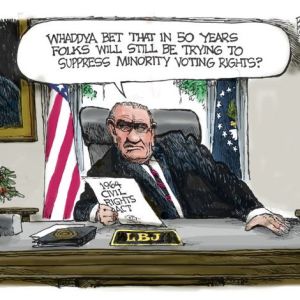
In this context, the painful proximity of the Civil Rights Era and the Jim Crow abuses its reforms worked to end should be clear. And so the Roberts Court decision to effectively neuter Section 2 of the VRA, arguing that Louisiana’s second majority-Black congressional district is racially discriminatory—a ruling rooted in a view-from-nowhere, colorblind vision of race—lands as both profoundly unjust and historically illiterate. That it comes at a time when the Trump administration and wider MAGA movement are launching a frontal assault on the multicultural democracy built on the back of the reforms of the 1960s and 1970s threatens to plunge the country into a Neo-Jim Crow period of rights abuses and anti-democratic discriminations.
As Amy Howe wrote Wednesday for SCOTUSblog:
In a 36-page opinion, Alito explained that “the Constitution almost never permits the Federal Government or a State to discriminate on the basis of race.” The question before the court, he said, is “whether compliance with the Voting Rights Act should be added to our very short list of compelling interests that can justify racial discrimination.”
As a general rule, Alito wrote, Section 2 of the VRA guarantees voters, including minority voters, an opportunity to cast a vote for their preferred candidate, but that candidate’s chances of success may be affected by the choices that the state is allowed to make when drawing a redistricting map – such as the desire to protect incumbents or increase the number of seats held by a particular political party. And under the Constitution, Alito continued, a violation of Section 2 only occurs when “the circumstances give rise to a strong inference that intentional discrimination occurred” – for example, when there are several possible maps that contain majority-minority districts, but the state “cannot provide a legitimate reason for rejecting all those maps.”
[…]
“In sum,” Alito concluded, “because the Voting Rights Act did not require Louisiana to create an additional majority-minority district, no compelling interest justified the State’s use of race in creating SB8. That map is an unconstitutional gerrymander, and its use would violate the plaintiffs’ constitutional rights.”
I argued last year at The Bulwark that the American South never truly took to liberal democracy, resisting the goals of both Reconstruction and the Civil Rights Era. Across the region, a culture of censorship, anti-LGBTQ policies, and draconian law enforcement and prison practices choke the dignity and pluralism that make free, diverse societies truly flourish. Under Trump and the contemporary GOP, a great national Southernization of politics appears underway. The Supreme Court’s decision this week threatens to help strengthen and accelerate this process. Consider what Justice Kagan wrote in her dissent:
The Voting Rights Act is — or, now more accurately, was— ‘one of the most consequential, efficacious, and amply justified exercises of federal legislative power in our Nation’s history.’ It was born of the literal blood of Union soldiers and civil rights marchers. It ushered in awe-inspiring change, bringing this Nation closer to fulfilling the ideals of democracy and racial equality.
Kagan is right. As a Southerner, I am acutely aware of the blood spilt in the fight for human rights and dignity for Black people in America—the blood of soldiers, of activists and protesters, and of everyday people who had the temerity to exist in a white man’s world. One of the bloodiest racial massacres in our nation’s history took place in the Arkansas Delta, around the town of Elaine. A white mob set upon Black sharecroppers, with some estimates of the death toll reaching into the hundreds.
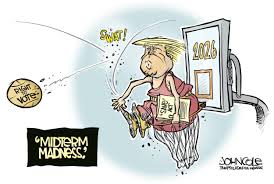 Read about “the context” at the link. Elrod writes about his own life experiences growing up in the deep South. He also discusses the events of the time. It’s a compelling read. Greg Sargent, writing for The New Republic, has a must-read analysis about how bereft Trump is about what the Supreme Court decision really means. “Trump Has No Clue What His Supreme Court Has Just Unleashed. The Supreme Court decision on gerrymandering points in one direction only: Come 2028, Democrats have to declare a take-no-prisoners redistricting war on the GOP.”
Now that the Supreme Court has gutted yet another piece of the Voting Rights Act, this one concerning redistricting, here’s one thing we know for sure: Democrats will have to enter into a new era of procedural total war. That might make many of them uncomfortable, but when it comes to the future of the liberal agenda, the stakes are enormous.
With Donald Trump’s active encouragement, Republicans are already seizing on the ruling—which essentially dismantled protections against racial gerrymandering—to threaten to redraw maps in the South to eliminate numerous congressional seats with Black representatives. While it’s largely too late to do so this cycle, Republicans will likely launch mid-decade redistricting in many Southern states heading into 2028, eliminating as many as 19 more Democratic seats in hopes of locking in a near-permanent GOP majority.
In substantive and legal terms, this outcome is awful—see this overview from TNR’s Matt Ford for a full rundown—but in a purely political sense, is this Armageddon for Democrats? Not necessarily. The reason? Democrats can move to redraw maps in time for the 2028 elections in states where they control the legislatures.Which points to one big takeaway from the court ruling: State legislative races—which already attract too little attention—just got a lot more important. Many races underway now will help determine the party’s long-term prospects in the scorched-earth conflict that’s about to unfold.
According to a new analysis by Fair Fight Action, a voting rights group, Democrats could redraw anywhere from 10 to 22 additional congressional seats for the party in time for the 2028 elections if they push hard with redistricting in seven blue and swing states. The analysis—which is circulating among Democratic leadership aides and outside groups and was obtained by TNR—concludes that being aggressive could theoretically offset Republican gains, even in a maximalist GOP redistricting scenario.
“Democrats have a clear path to neutralize this GOP power grab if they want to take it,” Max Flugrath, senior communications director of Fair Fight Action, told me. “This is the ‘break glass in case of emergency’ moment for American democracy.”
The range of potential Democratic gains is so broad because so much depends on which party controls key state legislatures after the fall elections. Strikingly, even if Democrats flip zero chambers, they can redraw up to 10 additional congressional districts for the party, the analysis finds, by maximizing gerrymanders in New York, Colorado, Oregon, and Maryland, where Democrats control governorships and state legislatures.
But even more strikingly, Democrats could redraw as many as 22 additional congressional districts for the party overall if they flip legislative chambers in other states and redraw aggressively in them, the analysis finds.
 All of this shouldn’t distract from other stories. The mainstream media has definitely dropped the conversation on the Epstein files. Other stories and questions still linger. David Lurie writes this for Public Notice. “Trump’s Reichstag fire presidency is immolating. The media personality in the White House has been exposed as a crisis actor.”
The day after an alleged gunman tried to barge into the White House Correspondents Dinner, Todd Blanche — the nation’s chief law enforcement official — appeared on national television to denounce that act of political violence.
But during the very same news conference, Blanche also signaled the president may vacate the convictions of terrorists found guilty of scheming to attack the government of the United States on behalf of Donald Trump on January 6, 2021.
“They were convicted, but President Trump, as is his right and duty under our Constitution, commuted or pardoned those individuals,” Blanche said.
BASH: Do you plan to vacate convictions of Proud Boys and Oath Keepers who were involved in the January 6 attack on the Capitol?
BLANCHE: That’s ongoing litigation. You’ll hear from us in the coming days. Their sentences were commuted by President Trump
BASH: You’re not ruling it out?
BLANCHE: No. We’re not ruling anything out
This perverse contradiction epitomizes the era of Late Trumpism, in which the rewriting of history and systemic abuses of power are ramping up while Trump’s political power is collapsing.
What follows is an amazing list of Trump performances likened to similar performances by Hitler. I used to shiver when anyone jumped the shark to compare someone to Hitler, but this is a truly amazing and long list of similarities. I also consider it a must-read today. Meanwhile, American Citizens are losing access to their most basic needs. This is from the New York Times. “Since Congress Let Obamacare Subsidies Expire, Millions Are Dropping Coverage. Americans can’t afford the higher health insurance premiums that resulted from Congress’s refusal to extend federal tax credits.” Reed Abelson and Margot Sanger-Katz have the lede.
Millions of Americans appear to be dropping Obamacare coverage in the months since Congress failed to extend the generous subsidies that had become a defining feature of the Affordable Care Act.
Initial sign-ups had already fallen by about 1.2 million people. But insurance companies, state officials and industry analysts are reporting that many more have lost Obamacare coverage now that people are facing long-term higher costs. The federal government has yet to report current enrollment data.
Many insurers and analysts are estimating overall declines of about 20 percent, dropping to around 19 million from the 24 million who were covered under the A.C.A. last year. Other indications suggest there could be even larger potential losses by the end of the year, a deep retrenchment for Obamacare coverage and a reversal of significant gains in the last several years.
The rising cost of health care has shown up as a top concern among Americans in several public opinion polls. Premiums are rising for Americans who get insurance through work, too, as health care costs have been increasing nationwide. Out-of-pocket costs are growing too, as plans with high deductibles have become popular.
Though health care has faded somewhat as a priority for the Republican-controlled Congress since lawmakers hit a stalemate over the subsidies at the end of 2025, it is likely to figure prominently in the midterm elections this year.
One analysis, by Wakely Consulting Group, a firm with access to detailed insurance industry data, estimates that coverage in the marketplaces will drop by as much as 26 percent this year compared with last year’s average enrollment.
In Georgia, where coverage had nearly tripled since Congress first authorized the extra financial help in 2021, state data show enrollment has fallen by more than a third, according to information obtained by the news organizations The Current GA and The Georgia Recorder.
The Georgia state insurance department did not respond to a request for comment.
Some Blue Cross plans lost 20 to 30 percent of customers this year. And many people are switching to plans with lower premiums but much higher out-of-pocket costs, said David Merritt, a spokesman for the Blue Cross Blue Shield Association. “We are waiting on official data like everyone else,” he said.
The insurers and state officials said early retirees with middle-class incomes, who faced the largest increases in premiums, appeared to be among the hardest hit. In some markets, the cost of insurance for this group rose by $1,000 a month or more.
 Meanwhile, the horrid state of Nebraska, where I had lived before escaping to New Orleans, literally wants poor people to work themselves to death, one way or another. Here’s a headline from The Hill. “Nebraska faces challenges as first state to impose Medicaid work requirements under GOP bill.”
Nebraska on Friday is set to become the first state to impose Medicaid work requirements under the GOP’s One Big Beautiful Bill Act, racing ahead of the national deadline by eight months.
Nebraska’s experience will be a key test for Republicans who have been championing work requirements, as it could be an indicator of what the rest of the country will face when the policy takes effect nationwide.
The only two states that have enacted similar rules — Arkansas and Georgia — found they did not increase employment, caused tens of thousands of people to lose coverage and cost the states millions of dollars.
In Nebraska, Medicaid advocates and health policy experts fear similar coverage losses as people get buried under a blizzard of red tape. The law’s implementation timeline was already compressed, and they said Nebraska’s decision to rush ahead will be disastrous.
For instance, the state just this week released hundreds of pages with key details about who will qualify for a “medically frail” exemption.
“Unfortunately, when we have a rush job, we usually see bad results, and this is shaping up to be the case,” said Sarah Maresh, the program director for health care access at the nonprofit Nebraska Appleseed.
Work requirements have been a priority for President Trump and congressional Republicans since his first term.
The GOP’s tax and spending megabill used work requirements to partially pay for its nearly $3 trillion price tag. The Congressional Budget Office estimated nearly 5 million people will lose their Medicaid over the next decade as a result, including many who are already working.
GOP officials argue work requirements are needed to root out waste, fraud and abuse in the Medicaid program, and they will only target the “able-bodied” people who should be working but choose not to.
Nebraska Gov. Jim Pillen (R) has said he wants to promote self-sufficiency.
“It’s a key piece of giving the discipline for our families to be successful. It’s a key piece of self-worth. It’s a key piece of mental health and stability,” Pillen said in December when he announced the state would implement the requirements early.
All of this must be offset at the polls, even with the shenanigans set off by SCOTUS and the Republicans in Congress. Heather Cox Richardson highlights polling numbers in her SubStack today.
Today G. Elliott Morris of Strength in Numbers noted that Trump has hit a new low in overall job performance and in his handling of the economy, at -22.2 and -40.3, respectively. Those numbers reflect the percentage of people who approve of his handling of an issue minus those who disapprove. Indeed, Morris noted that Trump’s approval rating on the economy is so low it “literally broke the scale of this graph on my data portal.”
On Tuesday, Morris explained in Strength in Numbers that while Republicans have lately been arguing that they simply need to get people to show up to win the midterms, turnout is not their problem. Their real problem is that voters don’t like what Trump is doing.
An obvious symbol of Trump’s presidency is his unilateral decision to tear down the East Wing of the White House and replace it with a giant ballroom. A new Washington Post–ABC News–Ipsos poll released today shows that Americans oppose the ballroom by a margin of about two to one. Fifty-six percent of Americans oppose it, while only 28% support it. Of those who oppose it, 47% oppose it strongly.
Dan Diamond and Scott Clement of the Washington Post note that people don’t like Trump’s proposed triumphal arch, either—52% opposed versus 21% in favor—or the idea of Trump’s signature on paper money. Sixty-eight percent of Americans oppose that plan, while only 12% support it. Even Republicans oppose it 40% to 28%.
And then there is Trump’s war on Iran. A recent Reuters/Ipsos poll shows that only 34% of Americans approve of the strikes on Iran, while 61% oppose them. Gas prices continue to rise, with Brent crude futures today briefly topping $114 a barrel—the highest price since June 2022, shortly after Russia launched its attack on Ukraine. Senator Angus King (I-ME) noted on CNN today that these higher prices are currently costing American consumers about $700 million a day.
On his Substack today, economist Paul Krugman noted that the acronym “TACO,” for “Trump Always Chickens Out,” has been replaced by “NACHO”: “Not A Chance Hormuz Opens.” Krugman explains that Iran is unlikely to reopen the Strait of Hormuz, through which about 20% of the world’s oil passed before Israel and the U.S. began airstrikes against Iran on February 28, 2026, until “the economic damage from its closure becomes much more severe.”
She has more good news, so we can end it here, and you may go read it all!
What’s on your Reading, Action, and Blogging list today?


 peej
peej Carissa
 bostonboomer
 ecocatwoman
 jjlo
jjlo mablue2
 Mama Lopez
 peggysue22
 quixote
 skydancingguestblogger
 Mona (aka Wonk the Vote)



 Sky Dancing
I hope you’re weekend goes well! We’ve had big thunder storms off and on this week and it looks like this afternoon might hit us too. Sorry this post is so late but when I walked Temple, whatever they were blasting off the walls at the base really hit my sinuses and lungs. Went back to sleep to try to get a break from the coughing. As usually, I’m better now. I don’t know what another year and half of this racket and dust is going to do to us. They have to move inside some time, I guess.
Any way, take care! Be safe! Keep Sky Dancing!