Posted: June 27, 2026 | Author: bostonboomer | Filed under: just because | Tags: 250th Anniversary of Declaration of Independence, cat art, caturday, Confederate flag, DEI, Donald Trump, Great American State Fair, immigration and U.S. economy, Massachusetts, Matt McCarthy, North Carolina, Ohio, surrealism |
Good Day!!

Surreal cat art by Matt McCarthy
Note: The surreal giant cats in today’s post are the work of Matt McCarthy.
As I was reading Dakinikat’s post yesterday, I realized how discouraged I have become lately. Everything is just awful. And it doesn’t help that my chronic sciatica has been acting up lately.
Rick Wilson was so right way back in Trump’s first term when he wrote his book, “Everything Trump Touches Dies.” We’re approaching the 250th anniversary of the Declaration of Independence. It should be a special time for the country, but Trump has taken over the anniversary and made it all about himself. We’ve had to watch him wreck the East Wing of the White House, pave over the rose garden, and hang ugly gold decorations all over the Oval Office. He destroyed the south lawn of the White House for a cage fight that was could only be seen with expensive tickets or on paid TV. On the Fourth of July Trump plans to mark the anniversary itself with a MAGA rally. I just want to cry.
Right now, Trump has something called the Great American State Fair going on. That link goes to a MAGA website. Trump wasn’t satisfied with a bipartisan celebration, so he set up his own organization, Freedom 250. Some commentary on the not-so-great fair:
Farrah Tomazin at The Daily Beast: Trump’s Empty ‘Great State Fair’ Exposed in Damning Photos.
The spectacle on the National Mall in Washington D.C. is ready to receive thousands of visitors. Instead, it is virtually deserted.
Not that there is much to see. Amid the sprawling stretches of open space, there is a 110-foot Freedom 250 ferris wheel and a tacky plywood “Triumph Arch” dominating the center of the grounds, a replica of the monument Trump wants to build near D.C.’s sacred Arlington Cemetery.
There are no corn dogs or funnel cakes. No roller coasters or merry go rounds. And by Friday morning, Pennsylvania became the latest of several Democratic states to declare it was not taking part.
The plan was to have representation from all 50 states. But some had opted out due to the high cost to taxpayers or not being able to secure any businesses to sponsor a booth. Others had chosen not to attend after the supposedly nonpartisan event suddenly seemed political, with Trump himself kicking off the fair with a MAGA rally earlier this week.
The Daily Beast was at the fair in the late afternoon and early evening, hoping to see a flood of people arrive after school and work.
As temperatures climbed, a clump of fairgoers waited under the hot DC sun for a ride on the Freedom 250 Ferris wheel—the festival’s marquee attraction —even as much of the surrounding fairgrounds remained conspicuously quiet.
Elsewhere, a jazz band played to an audience of about 10 people. (Don’t ask about the food: On its first full day, a power shortage hit the food pavilion, resulting in melted ice cream and concerns about spoiled goods.)
The most energetic vibe wasn’t at the Ferris wheel or the live rodeo; it was packed into an evangelical Christian tent, singing and dancing to a worship band, present despite some rather famous lines in the Constitution about church and state.
You can check out the photos at the link. I was going to put some in this post, but I decided to stick with cats, because at least they don’t make me feel sad and hopeless.
You can see more photos at The Atlantic in this piece (gift link) by Kelsey Ables, photos by Lawren Simmons: The Great American State Fair Isn’t Very Great.
The U.S. capital has been outfitted of late with visual trappings that many associate with authoritarianism, such as banners depicting Donald Trump’s face and featuring his slogans. So perhaps it was only a matter of time before the president erected his own Potemkin village: the Great American State Fair, where almost nothing is what it pretends to be.
Stretching across a large swath of the National Mall, the fair has dozens of pavilions for 56 states and territories and numerous executive-branch departments, in addition to a Ferris wheel, a rodeo, and other displays from companies and organizations, many of them Trump-aligned. It’s advertised by Freedom 250, the White House–created group behind many semiquincentennial events, as a “world-class exposition and modern-day World’s Fair.”

By Matt McCarthy
For a president enamored with the gilded and the grand, the exterior of this fair is surprisingly austere. Trompe l’oeil sheets cover slapdash structures lining both sides of the Mall with an illustration of architecture that is supposed to be beaux arts but is so stripped down that it makes the nearby brutalist buildings look practically baroque. A boxy model of Trump’s proposed triumphal arch in the center of the Mall appears as if it could have been designed in Minecraft and ordered from CVS for same-day pickup.
Perhaps because of this aesthetic of illusions, the earnest state pride evident in some of the pavilions turns out to feel especially delightful. Consider: the Science Museum Oklahoma’s president going on about how hers is “the most surprising state you’ll ever experience,” or the Ohioan dispensing with midwestern cheer state-shaped tattoos and tokens for free Frosties through the end of the year. Here and there, the big, proud personalities of the states shine through (see: Idaho’s potato-sack dress). Together, they nearly instill an appreciation for this eclectic batch of states that have united into a country. But like any sense of patriotism these days, it’s complicated just as quickly. Right as I was about to crack open a bag of potato chips from Michigan, with “Take Me Home, Country Roads” stuck in my head from a karaoke video game in the West Virginia booth, I wandered into the State Department pavilion, where I was offered a paper replica of the limited-edition Trump passport.
In a certain sense, the Great American State Fair bottles the central tension of federalism: a push and pull between irrepressible state personalities and the federal government. But it’s also not that academic. Put simply, the president is bringing down the mood.
Boy, you can say that again. “The president is bringing down the mood.” He ruins everything.
None of the New England States contributed to the exhibits, but a few individuals showed up. From The Boston Globe: We checked out Trump’s Great American State Fair. It is, and isn’t, what you’d think.
Down the lush green grass of the National Mall, past the 110-foot Ferris wheel and the scaled-down reproduction of President Trump’s proposed Triumphal Arch, the Massachusetts booth at the Great American State Fair was essentially a do-it-yourself project.
Its singular attraction? Maple syrup.
That was one of the oddities of the 16-day extravaganza, which began on Thursday, to mark the nation’s 250th birthday. Perhaps fittingly for America in 2026, it opened with a mix of the wholesome, the partisan, and the just plain bizarre.
The fair is a production of Freedom 250, the organization launched by Trump last year to give the type of MAGA-spin on the semiquincentennial festivities — think the White House UFC fight — that the bipartisan,congressionally created America 250 organization would not.
The event, Trump’s brainchild, assigns each of the 56 US states and territories a booth among more than 150 exhibits that “showcase the very best of America.” He kicked it off with a rally Wednesday night. And as people began visiting the Greco-Roman-style pavilions, the sprawling exposition reflected America’s Tilt-A-Whirl politics as it celebrates a milestone anniversary.
Despite the region’s pivotal role in the American Revolution, New England was largely a fair draft-dodger. Five of the six state governments declined to participate in what Democrats dismissed as a Trump-centric carnival. Nationwide, a few other states also skipped it.
After Massachusetts Governor Maura Healey balked at the price tag — she estimated hundreds of thousands of dollars to fund it — a 72-year-old Trump supporter from Greenfield, Mass., took matters into her own hands.
“I was upset about it,” the woman, who declined to give her name out of fear of political repercussions, told the Globe as she manned the Massachusetts booth Thursday morning. “Why have an empty spot when they come in? They see nobody, nothing.”
Instead, they saw maple syrup.
It might not be the first thing that comes to mind when people think of Massachusetts, but the state has more than 300 producers, so she reached out to some near her town. Winston’s Sugar House in Shelburne Falls answered the call, donating tiny bottles.
As fairgoers started trickling in Thursday morning, the bottles were arranged on two tables along with brochures about the state’s maple syrup industry and otherother Massachusetts pamphlets in front of the unique backdrop the fair organizers created for every state and territory.
Within minutes, the bottles started disappearing as fairgoers grabbed for the freebies.
But at least Massachusetts had a display — a fact many visitors noted. A few doors down, empty chairs, potted plants, and collage-style backdrops were all that greeted visitors eager to see the offerings of Rhode Island, Maine, Vermont, or Connecticut.
Kevin M. Levin writes at Substack: Of Course a Confederate Flag Showed Up at the Great American State Fair.
Nobody who has been paying attention to the Trump administration’s handling of America’s 250th anniversary should be surprised that a Confederate flag turned up at the Great American State Fair on the National Mall. It was discovered at the North Carolina booth and in its own small way tells you everything you need to know about this whole production.

By Matt McCarthy
The controversy erupted after footage circulated showing the North Carolina exhibit featuring altered versions of the state flag with the Confederate battle emblem superimposed over the design. Governor Josh Stein’s office condemned the display, calling it a misrepresentation of North Carolina and demanding that organizers remove it.
The flag was pulled. Problem solved, in the narrowest possible sense.
But the details here matter. North Carolina’s official state flag has never included the Confederate battle symbol in any version of its design. Not in 1861, not in 1885, not ever.
Whoever put together that video display didn’t just stumble into Lost Cause territory by accident. They had to go out of their way to attach a symbol that the state itself had never chosen to fly.
As historian Stephen Jackson noted, unlike former flags from Georgia and Mississippi, the official flag of North Carolina has never incorporated the Confederate battle flag in its design. The alteration wasn’t heritage. It was invention.
Corporate sponsor Mt. Olive Pickle Company withdrew from the exhibit after learning about the display, saying the company stands on values of human dignity, opportunity, and freedom.
They’d better watch out. Trump doesn’t like anything that smacks of “DEI.” Remember, it’s white people who discriminated against in Trump world. A bit more:
The episode is a concentrated version of the sloppiness that has defined this event from the start. At least ten states declined to send official delegations. Oregon Governor Tina Kotek’s office was explicit about why her state withdrew, citing the cost of participating and growing concerns that the event was shaping up to be a more partisan affair than originally presented.
When you’re trying to celebrate the birth of the nation and you can’t get half the nation’s states to show up, something has gone wrong at the planning stage.

By Matt McCarthy
The fair itself has drawn criticism for its cheap and shoddy appearance. The Washington Post’s Philip Kennicott offered this review:
America’s 250th might have been celebrated with a genuine festival of state fairs, or a 21st century version of the national and international expositions of art and science that were popular in the 19th century. The Trump administration could have let the Smithsonian stage a giant festival of American folkways, music, dance, art, craft and food. It could have defaulted to something like a theme park, which would at least have produced a seamless illusionism and a facsimile of the same folkways that are absent in the Trump show.
And it might have given the states the time, funding and freedom to create their own pavilions, representative of the magnificent diversity of this country’s architecture and design. Instead, everything is stuffed into a fake agora with Doric columns and arched niches painted onto cheap theatrical flats, which look like someone scaled up the photo murals found in a tatty Greek diner that sells gyros, moussaka and heart-bomb platters of pastitsio.
Growing up in Atlantic City in the 1980s, I watched Donald Trump build his casinos into monuments of gaudy spectacle, none more so than the Taj Mahal. The man has always had a gift for making expensive things look tacky and tacky things look expensive, sometimes simultaneously.
Read the rest at the link.
Dakinikat wrote yesterday about the horrible Supreme Court decision to allow Trump to end temporary protected status for Haitians and Syrians in the US. This is a disaster for these immigrants and for the economy. It will expose as many as a million asylum-seekers to arrest and deportation. Most of these people have established homes, jobs, and lives here; and if they are sent back home, they could even be killed.
NBC News on Wednesday: Supreme Court allows Trump to remove protections from thousands of Haitian and Syrian immigrants.
The Supreme Court cleared the way Thursday for the Trump administration to remove legal protections from thousands of Haitian and Syrian immigrants in the United States, meaning they could be subject to deportation.
The court, on a 6-3 vote on ideological lines, ruled in favor of the administration, which asked to continue with its plan to strip Temporary Protected Status from about 350,000 Haitians and 6,000 Syrians.
The ruling could also boost the administration’s efforts to remove similar protections from people from other countries as part of President Donald Trump’s hard-line immigration policy.
Writing for the majority, conservative Justice Samuel Alito said that judges overstepped their authority in second-guessing the administration’s decisions. The court also rejected a claim that the decision to remove protections for Haitians was discriminatory.

By Matt McCarthy
The law in question “expressly restricts” courts from reviewing determinations made by the Department of Homeland Security on whether to terminate or extend TPS protections, he added.
As for the claims of discrimination against Haitians, Alito said the statements cited by plaintiffs were not “overtly racial” and were “insufficient to show that the termination of Haiti’s TPS designation was based on the race of the Haitian people.”
In dissent, liberal Justice Elena Kagan accused the majority of soft-pedaling Trump’s comments about Haitians.
“The statements fairly shout, in their racial undertones and overtones alike, that race entered into the president’s resolve to remove Haitians from this country,” she wrote.
Kagan extensively quoted Trump himself, including his 2018 statement that Haiti is a “shithole country” and comments he made during the 2024 election baselessly claiming that Haitians in Springfield, Ohio, were eating people’s pets.
Without protected status, affected people are subject to deportation via the normal legal process. But they can seek other avenues to remain in the U.S. by, for example, claiming asylum.
This is going to cause serious problems here in Massachusetts, where many Haitian immigrants have settled and hold important jobs. And they are vitally important to the economy. A recent study found that Massachusetts needs 60,000 new immigrants every year to “sustain the work force.”
The Boston Globe: Supreme Court ruling could leave thousands in Massachusetts vulnerable to ICE arrests.
Thousands of immigrants in Massachusetts will likely be at risk of being detained by Immigration and Customs Enforcement following a Supreme Court ruling that paves the way for the Trump administration to revoke the legal status of approximately 330,000 Haitians and Syrians across the country.
“A lot of people are going to be in an extremely vulnerable position as a result of this,” said Kerry Doyle, a former legal adviser for ICE under the Biden administration who now practices immigration law in Massachusetts.
Massachusetts politicians and activists this week promised to fight to pass federal legislation extending the TPS program, and legal advocates said they would work to help those who lose their status find ways through the immigration court system to remain here legally.
“We will continue to use every tool, every legal tool to protect and defend the immigrant communities in Massachusetts and across the Greater Boston area,” said Iván Espinoza-Madrigal, the executive director of Lawyers for Civil Rights, at a demonstration outside the State House Thursday.
For those affected by the decision, however, the immediate situation looked grim. Geralde Gabeau, the executive director of the Mattapan-based Immigrant Family Services Institute, perhaps the most prominent group serving Haitians in Massachusetts, was somber when she spoke to advocates and reporters at the State House. She recounted a story from a local teacher whose student asked if she would take the child home in case their parents were deported.
“This is not acceptable,” Gabeau said. “We have seen a lot of bad, terrible news coming from the Supreme Court. This is going too far.”

By Matt McCarthy
Remember Springfield, Ohio, the town where JD Vance claimed immigrants were eating cats and dogs? The town had deliberately invited Haitian immigrant to come there to live and work. Ohio Governor Mike DeWine is not happy.
WBNS10: DeWine calls policy to remove Springfield’s Haitian immigrants a ‘mistake’ after SCOTUS ruling.
The governor said changing the immigration status of Haitian immigrants under TPS is not in the best interest of the United States or Ohio.
Gov. Mike DeWine, an outspoken supporter of Haitian immigrants in Springfield, called the policy to remove them a mistake after the Supreme Court allowed the Trump administration to end legal protection for migrants fleeing violence and natural disaster in Haiti and Syria.
The 6-3 decision overturns lower court orders and allows the Department of Homeland Security to swiftly end temporary protected status, a program that protects a total of 1.3 million people from 17 countries.
DeWine said Thursday’s ruling means that the over 10,000 Haitians legally living in Ohio, mostly in the Springfield area, will now be in the country illegally. They will be subjected to immediate deportation. He added that it will now be illegal to employ them.
“The situation in Haiti could hardly be much worse. The violent gangs run most of the country. The government barely functions. And, the economy is in shambles,” DeWine said.
In his statement, DeWine pointed to the federal government’s own advisory against traveling to Haiti.
“Our Federal Aviation Administration prohibits U.S. carriers from flying there because of the danger to planes of being shot at by the gangs,” DeWine said. “But, more importantly, changing the immigration status of these individuals is not in the best interest of the United States nor Ohio.”
Read more at the link. Trump and his handpicked justices are ruining our country.
One more disturbing story from NBC News: Pete Buttigieg targeted by ‘false report’ to authorities involving his 4-year-old twins.
Former Transportation Secretary Pete Buttigieg said Friday that he and his family in Michigan were targeted by a “false report” to state authorities claiming he was a danger to his 4-year-old twins.

By Matt McCarthy
Michigan State Police confirmed in a statement that they had received an anonymous report regarding Buttigieg. State police and Child Protective Services then responded and “determined the report was false,” the statement said.
Buttigieg, a Cabinet official in the Biden administration and a potential 2028 presidential candidate, wrote in a Substack post that a police officer and Child Protective Services worker appeared at his home “a few days ago” following an allegation that had been made against him involving his children.
He said his children were removed from the home he shares with his husband, Chasten, before the twins went through separate forensic interviews the next morning. Buttigieg said he was then interviewed as part of the investigation.
During that interview, Buttigieg said, an officer told him that an anonymous caller had reported him to CPS, with the caller saying “that he had spoken to a woman who claimed to have met me at a conference several years ago in Alabama, where she said I told her that I had committed unspeakable violent crimes, and the caller believed my children were still at risk.”
Buttigieg said he told the officer he had never been to the town in Alabama.
“Then the officer made clear that he believed this was politically motivated, and said it would not be referred to a prosecutor,” Buttigieg wrote. “Nothing in the forensic interview with the children, which was conducted by trained personnel, had led to concerns.”
Buttigieg said he was apart from his children for 24 hours.
That is horrible. I can’t believe those poor kids had to go through forensic interviews.
Sorry this post is so depressing, but that’s the state of our country today. If you have something positive to share, please do so in the comment thread. I’d be very grateful.
Did you like this post? Please share it with your friends:
Posted: May 28, 2025 | Author: bostonboomer | Filed under: Donald Trump, education, just because | Tags: academic freedom, Boston Mayor Michelle Wu, first amendment, Harvard President Alan Garber, Harvard University, higher education, international students, Massachusetts, Massachusetts Governor Maura Healey, scientific research |
Good Morning!!
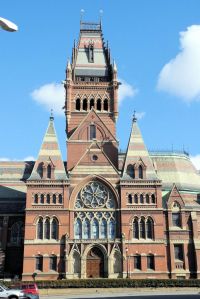
Memorial Hall, Harvard University
Today I’m going to focus on the Trump administration’s attacks on Harvard University. Obviously, Trump’s war on Harvard isn’t just about Harvard. It’s a war on higher education. If he succeeds in destroying Harvard, he will move on to other universities. Thank goodness Alan Garber, Harvard’s president is standing strong against the blatant attacks on academic research, international students, and freedom of speech.
Here’s the latest news in the Trump-Harvard battle:
The New York Times: Trump Intends to Cancel All Federal Funds Directed at Harvard.
The Trump administration is set to cancel the federal government’s remaining federal contracts with Harvard University — worth an estimated $100 million, according to a letter sent to federal agencies on Tuesday. The letter also instructs agencies to “find alternative vendors” for future services.
The additional planned cuts, outlined in a draft of the letter obtained by The New York Times, represented what an administration official called a complete severance of the government’s longstanding business relationship with Harvard.
The letter is the latest example of the Trump administration’s determination to bring Harvard — arguably the country’s most elite and culturally dominant university — to its knees, by undermining its financial health and global influence. Since last month, the administration has frozen about $3.2 billion in grants and contracts with Harvard. And it has tried to halt the university’s ability to enroll international students.
The latest letter, dated May 27 from the U.S. General Services Administration, was delivered Tuesday morning to federal agencies, according to an administration official, who spoke on the condition of anonymity because the official had not been authorized to discuss internal communications.
The letter instructs agencies to respond by June 6 with a list of contract cancellations. Any contracts for services deemed critical would not be immediately canceled but would be transitioned to other vendors, according to the letter, signed by Josh Gruenbaum, commissioner of the G.S.A.’s federal acquisition service, which is responsible for procuring government goods and services.
Contracts with about nine agencies would be affected, according to the administration official.
Examples of contracts that would be affected, according to a federal database, include a $49,858 National Institutes of Health contract to investigate the effects of coffee drinking and a $25,800 Homeland Security Department contract for senior executive training. Some of the Harvard contracts under review may have already been subject to “stop work” orders.
“Going forward, we also encourage your agency to seek alternative vendors for future services where you had previously considered Harvard,” the letter said.
It’s not just Harvard, of course.
Politico: Trump team pauses new student visa interviews as it weighs expanding social media vetting.
The Trump administration is weighing requiring all foreign students applying to study in the United States to undergo social media vetting — a significant expansion of previous such efforts, according to a cable obtained by POLITICO.
In preparation for such required vetting, the administration is ordering U.S. Embassies and consular sections to pause scheduling new interviews for such student visa applicants, according to the cable, dated Tuesday and signed by Secretary of State Marco Rubio.
If the administration carries out the plan, it could severely slow down student visa processing. It also could hurt many universities who rely heavily on foreign students to boost their financial coffers.
“Effective immediately, in preparation for an expansion of required social media screening and vetting, consular sections should not add any additional student or exchange visitor (F, M, and J) visa appointment capacity until further guidance is issued septel, which we anticipate in the coming days,” the cable states. (“Septel” is State Department shorthand for “separate telegram.”)
The administration had earlier imposed some social media screening requirements, but those were largely aimed at returning students who may have participated in protests against Israel’s actions in Gaza.
What does this policy mean?
The cable doesn’t directly spell out what the future social media vetting would screen for, but it alludes to executive orders that are aimed at keeping out terrorists and battling antisemitism.
Many State Department officials have complained privately for months that past guidance — for, say, vetting students who may have participated in campus protests — has been vague. It’s unclear, for example, whether posting photos of a Palestinian flag on an X account could force a student to undergo additional scrutiny.
The administration has used a variety of rules to target universities, especially elite ones such as Harvard, that it sees as too liberal and accuses of allowing antisemitism to flourish on their campuses. At the same time, it is carrying out immigration crackdowns that have swept up a number of students….
The news was met with frustration in much of the higher education community.
NAFSA: Association of International Educators, a group that advocates for foreign students, decried the decision. The group’s CEO, Fanta Aw, said it unfairly cast aspersions on hardworking students.
“The idea that the embassies have the time, the capacity and taxpayer dollars are being spent this way is very problematic,” Aw said. “International students are not a threat to this country. If anything, they’re an incredible asset to this country.”
What is Trump’s supposed rationale for his attack on Harvard and high education?
The Boston Globe: Trump administration says Harvard funding cuts are punishment for ‘race discrimination.’
After a weekend of threats and criticism from President Trump, the federal government on Tuesday severed the last of its remaining business ties to Harvard University.
Josh Gruenbaum, a top official at the US General Services Administration, instructed all federal agencies to terminate any contracts with Harvard or transfer them to other vendors. He also said in a letter sent to federal procurement officials Tuesday that government agencies should refrain from awarding any new contracts to Harvard in the future….
 Although the Trump administration’s original rationale for targeting Harvard was campus antisemitism, Gruenbaum’s letter Tuesday focused more on the government’s allegations that Harvard’s admissions and hiring practices violate antidiscrimination laws. For that reason, he said, Harvard should not be allowed to receive federal funding….
Gruenbaum’s letter laid out the government’s expanded justification for targeting Harvard. The university,the federal government alleges, systematically discriminates against white people, men, straight people, and, in some cases, Asian Americans.
“As fiduciaries to the taxpayer, the government has a duty to ensure that procurement dollars are directed to vendors and contractors who promote and champion principles of nondiscrimination and the national interest,” Gruenbaum wrote.
Harvard has denied the government’s allegations and sued the Trump administration. In two cases in federal court in Boston, Harvard’s lawyers argued the administration’s tactics violate federal laws and the Constitution and amount to illegal retaliation. Many lawyers, including some conservatives who share Trump’s critiques of universities, have agreed some of the Trump administration’s tactics appear to be illegal.
The administration’s letter on Tuesday accuses Harvard of discrimination in its admissions and hiring practices, as well as at the Harvard Law Review. Federal agencies have launched investigations on all of those subjects.
The Department of Justice is investigating whether Harvard’s admissions practices run afoul of a Supreme Court ban on affirmative action in college admissions. And the Department of Education and the Equal Employment Opportunity Commission have launched an inquiry into alleged discrimination by Harvard against white people, Asian Americans, men, and heterosexuals in hiring and promotions.
The Trump administration is even suggesting there could be criminal investigations of university officials.
Greg Sargent at The New Republic: Trump’s Fury at Harvard Gets More Deranged—and Exposes a Big MAGA Scam.
President Donald Trump has mostly justified his lawless attempt to restrict international students from attending Harvard University by pretending it’s designed to root out the antisemites, woke radicals, and dangerous terrorists supposedly nesting in their ranks. Now, however, Trump has a new rationale: It’s all about helping young, aspiring Americans, particularly those in the working class.
“We have Americans who want to go there and to other places,” Trump told reporters over the weekend, adding angrily that many of Harvard’s international students are “bad” and are taking Americans’ slots: “They can’t go there because you have 31 percent foreign.”
Trump then tweeted:
I am considering taking Three Billion Dollars of Grant Money away from a very antisemitic Harvard, and giving it to TRADE SCHOOLS all across our land. What a great investment that would be for the USA, and so badly needed!!!
Yeah, OK. If Trump really wants to facilitate the upward mobility of America’s working-class youth, here’s a better way to do it: Persuade his fellow Republicans in the House to drop their new budget’s changes to financial aid for higher education, which will restrict access to it for large numbers of working-class students, probably including many who want to attend—yup—trade schools.
With Trump’s fury at Harvard getting worse, this turn in the saga suggests another grotesque subtext to all of it: Telling working-class families that the real obstacle their kids face is zero-sum competition from foreign students makes it easier to take away resources previously appropriated to boost working-class kids to fund tax cuts for the rich.
What’s going on here?
Trump’s assault is a wildly unhinged abuse of power in every way. Last week, Trump revoked Harvard’s ability to host international students, due to Harvard’s alleged failure to share sufficient “information” about foreign students in response to an administration demand. That demand was itself absurdly intrusive, and seemed designed not to be met, creating a pretext for Trump to broaden his attack. The revocation appears wholly lawless, and after Harvard sued, a court blocked it within hours.
At this point, there’s no need to pretend there’s a genuine public-interest rationale at work here. Everyone knows it’s all about getting universities to surrender to flatter Trump, or about executing a broader hostile MAGA takeover of liberal institutions. For instance, in an article reporting that Trump is now nixing Harvard’s federal contracts on top of canceling billions in grants, The New York Times notes almost in passing that Trump wants to bring Harvard “to its knees,” as if this is unremarkable, when it should be depicted as the power-crazed ravings of a Mad King.
But there’s something particularly ghoulish about Trump’s suggestion that his blockade on international students is about helping American kids who are unfairly displaced by them.
That’s because the “big, beautiful bill” that House Republicans passed last week—which Trump has urged Senate Republicans to adopt—could make attending college harder for countless such kids. For a detailed summary of its changes, see this piece by The New Republic’s Monica Potts: They would make it harder for full-time students to qualify for Pell Grants, bump off large numbers of part-time students, and restrict access to the program and other financial assistance for higher education in numerous other ways.
Indeed, a coalition of education advocacy organizations estimates that the bill’s changes to Pell Grants alone could deprive as many as 700,000 people of eligibility entirely and hit many more with higher costs. As Potts summarizes, all this “takes an ax to one of the few reliable ladders for working-class people seeking higher education” as an “engine for social mobility.” These are mostly poorer and working-class students by definition, many with jobs or young kids of their own.
Trump’s attack on Harvard and higher education hurts Massachusetts, which is home to 114 colleges and universities.
Karen Miller at Boston Globe Magazine: Trump vs. Massachusetts: How one state represents everything the president despises.
In her State of the City address in March, Mayor Michelle Wu spoke about her then-2-month-old daughter. The world she entered was “not the world I expected or hoped for her,” Wu said. “I want her to grow up in the America that Paul Revere rode for, that Dr. King marched for, that my parents left home for.”
A few weeks later, as Paul Revere’s ride was reenacted and scores of redcoats lined up with muskets on the Lexington Battle Green, you didn’t have to look far to see signs that Massachusetts’ centuries-long revolutionary spirit was being threatened. Sprinkled through the crowd, posters read “No King! No Tyranny! Support the Rule of Law” and “In America, the Law is King.” [….]
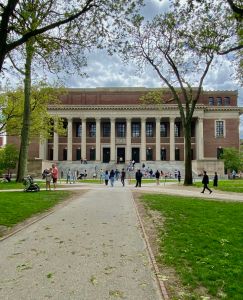
Widener Library, Harvard University
Massachusetts may be uniquely positioned to suffer in President Trump’s second term. And not just because the president has slashed disaster aid, school funding, and health support for the Commonwealth. Or because he plans to withdraw clean energy support and undercut states with robust environmental laws.
Our economy is deeply reliant on elite colleges, elite hospitals, and the elite minds who come here from around the world. In Massachusetts — like it or not — we have built an economy on expertise, excellence, and education.
In the early 2000s, after graduating from high school outside of Chicago, Wu was drawn — like so many others — to the educational opportunities here. Her parents “didn’t know too much about America” when they arrived in the 1980s from Taiwan. She says that they, “like so many, held such a reverence for the institutions that in some ways symbolized the American dream for them. Harvard was one of them.”
Now, the magnets that have attracted talent to Massachusetts have become liabilities. “ Boston is at the center of many of the most targeted industries and communities,” Wu says. “And so we’re feeling it very much — very urgently.”
The mayor notes that the city is “trying to plan for unpredictability. And so our city budget this year includes preparations for worst-case scenarios.” Although Boston’s financial foundation is “quite strong,” Wu says, “we need to be prepared for immediate, significant impacts to federal funding or larger macroeconomic impacts.”
We’re living, she says, under “a cloud of chaos.”
The Boston Globe: ‘This is about more than Harvard’: Healey tells alumni as university faces down Trump.
Massachusetts Governor Maura Healey voiced support for her alma mater Tuesday night as Harvard University continues to battle President Trump’s attacks on the Cambridge institution’s autonomy and funding.
“This is about more than Harvard,” she told a virtual webinar of thousands of Harvard alumni.
In recent weeks, Harvard has filed litigation charging that Trump unlawfully froze billions in federal funding to the school after it refused to give the government control over academic decisions. More recently, the school also legally challenged Trump’s attempt to revoke the school’s ability to enroll international students.
On Tuesday night, a group of Harvard alumni held a pair of virtual events to discuss the impact of the administration’s actions on academic freedom, research, students, and employees of the Ivy League university.
Crimson Courage, which describes itself as “a nonpartisan community of Harvard alumni,” encouraged alumni to sign onto an amicus brief in ongoing litigation spearheaded by Harvard against the Trump administration.
The brief “supports the academic freedom and integrity of Harvard and higher education institutions across America—all of which must be able to educate students consistent with their missions and values, free from political interference.”
The brief, according to organizers, will be filed in a legal case where Harvard argues the government’s use of research funding cuts as leverage to exert control over its affairs is an abuse of federal power.
Healey, in her comments to alumni, said Trump’s moves against the university is undercutting American competitiveness and damaging the local and national economy. Harvard, she said, is the fourth largest employer in Massachusetts, and its international students alone contribute $400 million to the local economy annually.
If Trump succeeds in damaging Massachusetts, will other blue states be next?
NPR: As Trump targets elite schools, Harvard’s president says they should ‘stand firm.’
With elite U.S. universities in President Trump’s crosshairs, the leader of Harvard University says institutions need to double down on their “commitment to the good of the nation” and be firm in what they stand for.
The Trump administration, acting on its claims that Harvard has failed to stamp out antisemitism on campus, froze more than $2 billion in research grants and contracts in April and attempted to revoke the school’s ability to enroll international students last week. The university is suing the federal government for both actions.
Harvard President Alan Garber told Morning Edition that he finds the measures taken by Trump to be “perplexing.” While he acknowledges there is work to be done on campus, he said he struggles to see a link between funding freezes and fighting antisemitism.
“Why cut off research funding? Sure, it hurts Harvard, but it hurts the country because after all, the research funding is not a gift,” Garber said, adding that these dollars are awarded to efforts deemed “high-priority work” by the federal government….
As evidence of how his university’s work directly benefits the U.S. public, Garber points to recent honors awarded to Harvard faculty by the Breakthrough Prize, known as “The Oscars of Science,” for their work on obesity and diabetes drugs and gene editing, used to correct disease-causing genetic variations.
The Trump administration’s multi-billion dollar funding freeze came after Harvard refused demands to change policies around hiring and admissions, eliminate DEI programs, or screen international students who are “supportive of terrorism or anti-Semitism,” as the administration put it.
Read the entire interview at the NPR link.
Commentary on Trump’s attacks on Harvard:
Daniel Drezner at Drezner’s World: The Trump Administration Is Trying to Kill American Higher Education.
Recent readers may recall that I was in a bit of a funk last week because among other things “The [Trump] administration further escalated its war on Harvard in myriad ways. This is part and parcel of a wider war on higher education that will destroy American soft power, one of the country’s leading export sectors, and American economic productivity.”
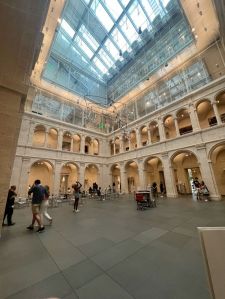
Harvard Art Museum
Impressively, the situation on this front has gotten even worse in the last 24 hours….
…consider the complete set of federal actions taken against Harvard that the New York Times’ Michael C. Bender has compiled. It’s an extraordinary list of punitive actions given that the Trump administration has been in office for just a little over a third of a year.
Now, as a professor at the Fletcher School, a direct competitor of Harvard’s Kennedy School of Government, readers might wonder if I think there might be some competitive advantage that might be gained from Harvard’s misfortune. And the answer to this is “not really, no,” for two reasons.
The first is raw politics: Harvard is the most prestigious university in the United States. It has the deepest pockets. If the Trump administration can force Harvard to acquiesce to its demands, that capitulation will make it that much harder for other universities to protect academic freedom.
The second is that while Harvard might be receiving the brunt of the administration’s malignant attention, Trump’s team is taking other actions that will harm most U.S. universities.
Examples: Threats to investigate foreign students’ social media and ordering embassies to stop vetting visas for international students applicants.
This administration seems bound and determined to force U.S. students to pay higher tuition, because it keeps stripping away alternative sources of revenue. Between slashing federal research funding to record-low levels, raising the transaction costs of accepting foreign grants, and this freezing the visa processing of foreign students, the Trump administration is disincentivizing scientific research and forcing universities to rely increasingly on the tuition payments of domestic college students.
The end result will be a poorer, less dynamic economy and a less vibrant society. I wish the Atlantic’s Adam Serwer was being hyperbolic in this paragraph – but he isn’t:
“These various initiatives and policy changes are often regarded as discrete problems, but they comprise a unified assault. The Trump administration has launched a comprehensive attack on knowledge itself, a war against culture, history, and science. If this assault is successful, it will undermine Americans’ ability to comprehend the world around us. Like the inquisitors of old, who persecuted Galileo for daring to notice that the sun did not, in fact, revolve around the Earth, they believe that truth-seeking imperils their hold on power.”
Why are they doing it? Serwer attributes it to politics: “by destroying knowledge, Trumpists seek to make the country more amenable to their political domination, and to prevent meaningful democratic checks on their behavior.” I could proffer a variety of other ideological or political responses. As of now, however, such rationales are besides the point. The only thing I know for sure is that it’s not for the reasons proffered by the administration.
Read the rest at the Substack link.
Paul Krugman on his Substack: America Turns Its Back on the World.
My wife and I are co-authors of a widely used textbook on the principles of economics, which is revised on a three-year cycle. When a new edition comes out, I normally visit a number of schools that might adopt it, usually giving a big public talk, a smaller technical seminar, and spending some time with students and faculty. I enjoy it, by the way; there are a lot of good, interesting people in U.S. education, and not just in the high-prestige schools.
So it was that at one point I found myself visiting Texas Tech in Lubbock. Yes, it seemed pretty remote to someone who has spent almost his whole life in the Northeast Corridor, but as usual the overall experience was very positive. And it was also surprisingly cosmopolitan: there were students from many nations. I just checked the numbers, and currently 30 percent of Texas Tech’s graduate students are international.
So it is all across America. Our nation’s ability to attract foreigners to study here is one of our great strengths. Or maybe I should say was one of our strengths.
According to Politico, a cable from Marco Rubio, the secretary of state, has directed U.S. embassies and consulates to halt all processing of visa applications from foreigners hoping to study in the United States. This is reportedly a temporary measure in preparation for a new system in which would-be students will be screened on the basis of their social media history. And you can be sure that the criteria for denying entry will go far beyond, you know, advocating terrorism. Probably asking “Why was Trump talking to West Point grads about trophy wives?” will be grounds for rejection.
This completely insane policy move is presumably a temper tantrum in response to a court’s rejection of the administration’s attempt to prevent Harvard from admitting foreign students, which was in turn a temper tantrum in response to Harvard’s rejection of demands from Trumpists that they be allowed to dictate the university’s hiring and curriculum.
The courts will probably reject this policy move, too, but I worry that Rubio and co. can put enough sand in the gears of the visa process to bring the entry of international students to a near halt. And even if they can’t, the clear message to students that they aren’t welcome (and may be arrested once here) will have an immensely chilling effect.
It’s hard to overstate the self-destructiveness of this move, and the war on higher education in general. This is madness even in purely economic terms.
Read the rest at the link.
One more by Liz Dye at Public Notice: Trump’s attack on Harvard hampered by his inability to STFU.
The Trump administration would be getting slapped down in court even if the president and his minions didn’t constantly announce their intent to violate the law. But their incessant chest thumping does make things go a lot faster.
Case in point: the temporary restraining order barring the government from canceling student visas at Harvard University. The order was issued just hours after Homeland Security Secretary Kristi Noem revoked Harvard’s visa “privilege” for foreign students. The administration teed up the ruling by declaring that it intended to flagrantly violate the First Amendment. But they telegraphed their punch so thoroughly that Harvard’s lawyers had a 72-page complaint with 28 exhibits ready to be filed the second Noem announced the plan.
Trump Hates Harvard
Just hours after being sworn in, Trump signed an executive order instructing federal agencies to “identify up to nine potential civil compliance investigations” of civic, corporate, and academic institutions, including “institutions of higher education with endowments over 1 billion dollars” for their supposed “illegal discrimination.”
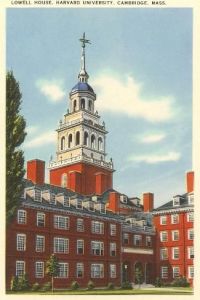
Lowell House, Harvard University
The EO was clearly an attack on the Ivy League, long targeted by conservatives as a bastion of “wokeness” that should be brought to heel. And Project 2025, with its “big idea” to seize control of the budget from Congress, provided Trump with a blueprint to wield federal tax dollars as a weapon against state governments and institutions.
Part of the plan was for Trump to unilaterally announce new “laws” via executive order, and, instead of asking courts to enforce them, leverage federal funds to punish anyone who resists.
And so the president simply declared DEI “illegal,” and used the widespread adoption of anti-discrimination policies by corporations and academia as a pretext to go after anyone he doesn’t like. But, as a federal judge noted last week when he blocked an attack on the law firm Jenner & Block, “the defendants point to no case holding such diversity initiatives illegal.” This is simply the executive branch inventing a new legal theory and demanding that everyone treat it as settled law.
Dye describes how Harvard fought back successfully in court.
On April 11, Harvard sued in federal court in Massachusetts, alleging that the funding cuts were an arbitrary and capricious agency action in violation the First Amendment, the Fifth Amendment’s due process clause, and the Constitution’s separation of powers. That case landed on Judge Allison Burroughs’s docket, and when the school sued again 10 days later over a further round of funding cuts, it designated the cases as “related,” ensuring that it, too, would be assigned to the Obama appointee.
Harvard docketed voluminous correspondence demonstrating that the Trump administration is using federal funds to both coerce the school into changing its speech, and retaliating against it for speech conservatives don’t like. For instance, a letter signed by representatives of the General Services Administration and the Departments of Education and Health and Human Services presented an “agreement in principle” demanding sweeping changes to all aspects of the university’s hiring, admissions, disciplinary, and curricular programs as a precondition of preserving the school’s federal funds.
“The university will not surrender its independence or relinquish its constitutional rights,” the university wrote in response. “Neither Harvard nor any other private university can allow itself to be taken over by the federal government.”
That response was signed by longtime Republican lawyer Bill Burck, of the law firm Quinn Emanuel, and Robert Hur, the former special counsel tapped by Attorney General Bill Barr to investigate Joe Biden. (Burck was immediately fired by the Trump Organization as an ethics advisor.)
But Trump kept on making public threats and posting nonsense on social media.
Trump’s constant public screeds serve as potent evidence that the funding cuts are retaliatory, and any supposed DEI “crimes” are mere pretext.
On April 15, he suggested that Harvard “should lose its Tax Exempt Status and be Taxed as a Political Entity if it keeps pushing political, ideological, and terrorist inspired/supporting ‘Sickness?’” [….]
That’s an explicit attack on Harvard’s academic freedom, which is protected by the First Amendment. And he followed it up the next day by screeching that “Harvard is a JOKE, teaches Hate and Stupidity, and should no longer receive Federal Funds.” [….]
Secretary of Education Linda McMahon admitted in an interview with CNBC on May 7 that the administration is 100 percent targeting Harvard for disfavored speech.
“Are they vetting students who are coming in from outside of the country to make sure they’re not activists? Are they vetting professors that they’re hiring to make sure that they’re not teaching ideologies?” she said. “They’ve taken a very hard line, so we took a hard line back.”
All these comments — and so many more! — featured in Harvard’s lawsuits.
Please read the rest at Public Notice. It’s an excellent summary of what Trump has been doing and why it’s unlawful.
That’s all I have for you today. What’s on your mind?
Did you like this post? Please share it with your friends:
Posted: July 2, 2020 | Author: bostonboomer | Filed under: morning reads, U.S. Politics | Tags: Afghanistan, coronavirus pandemic Covid-19, deaths from coronavirus, Donald Trump, Gov. Charlie Baker, Massachusetts, Rahmatullah Azizi, Russia |
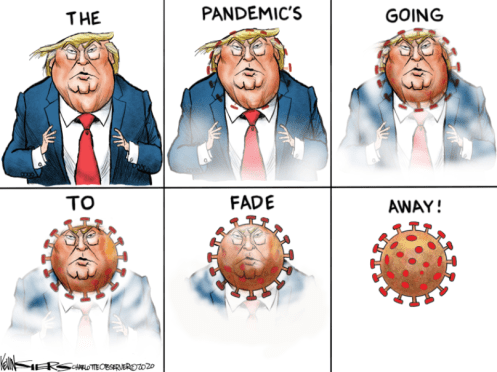
Good Morning!!
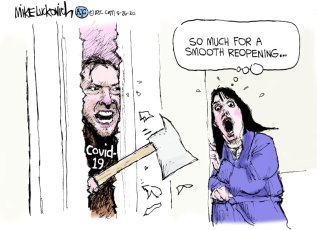
If feels as if the long weekend has already begun. The Fourth of July is traditionally a time when the Boston area empties out as people head to the Cape or New Hampshire. I just hope that people will be careful about crowding the beaches. Fortunately, bars won’t be opened here until phase 4, so that is one advantage we have. Yesterday, Gov. Charlie Baker warned Massachusetts residents: ‘No Victory Laps From COVID-19′: Gov. Baker Urges Social Distancing Over July 4 Weekend. NBC10:
Massachusetts Gov. Charlie Baker on Wednesday urged residents to practice social distancing over the Fourth of July weekend, saying people should continue to take the coronavirus pandemic seriously to prevent a resurgence of cases.
“We have a big weekend coming up, it’s the Fourth of July, and I really hope people continue to take things seriously,” Baker said during a press conference at the Greater Boston YMCA.
 “There are no victory laps from COVID… It’s not going to take the summer off,” he said, urging people to continue wearing masks and practicing social distancing and hygiene….
The governor said key metrics in the state’s efforts to contain the virus were continuing to trend downward. The state on Tuesday reported no new coronavirus deaths, the first time that’s happened in months.
“The continued fight against the virus depends almost completely and exclusively on all of us maintaining our vigilance and continuing to do the things that have made such a big difference in Massachusetts.”
Yesterday, the U.S. exceeded 50,000 new cases of Covid-19 for the first time. The Washington Post:
The United States reported 52,789 new coronavirus cases on Wednesday, the largest single-day total since the start of the pandemic. President Trump speculated in a Fox Business interview that the virus was “going to sort of just disappear” at some point.
Experts say that is unlikely, unless an overwhelming majority of people are infected and develop immunity, which could lead to millions of deaths, or through the successful development and deployment of a vaccine. There is a chance the coronavirus will never go away, some experts have warned.
Anthony Fauci, the country’s top infectious disease expert, attributed rising case numbers in the United States at least partially to the fact lockdown measures were more lenient than those in some European countries that have since managed to turn the tide on the virus.
More than 800,000 new coronavirus cases were detected in the United States in June. At least 125,602 deaths have been reported since the start of the pandemic.
 CNBC reports on an alarming study of coronavirus deaths from Yale researchers: Official U.S. coronavirus death toll is ‘a substantial undercount’ of actual tally, Yale study finds.
The number of confirmed U.S. deaths due to the coronavirus is substantially lower than the true tally, according to a study published Wednesday in JAMA Internal Medicine.
Using National Center for Health Statistics data, researchers at Yale University compared the number of excess U.S. deaths from any causes with the reported number of weekly U.S. Covid-19 deaths from March 1 through May 30. The numbers were then compared with deaths from the same period in previous years.
Researchers found that the excess number of deaths over normal levels also exceeded those attributed to Covid-19, leading them to conclude that many of those fatalities were likely caused by the coronavirus but not confirmed. State reporting discrepancies and a sharp increase in U.S. deaths amid a pandemic suggest the number of Covid-19 fatalities is undercounted, they said.
“Our analyses suggest that the official tally of deaths due to Covid-19 represent a substantial undercount of the true burden,” Dan Weinberger, an epidemiologist at Yale School of Public Health and a lead author of the study, told CNBC. Weinberger said other factors could contribute to the increase in deaths, such as people avoiding emergency treatment for things like heart attacks. However, he doesn’t think that is the main driver….
The 781,000 total deaths in the United States in the three months through May 30 were about 122,300, or nearly 19% higher, than what would normally be expected, according to the researchers. Of the 122,300 excess deaths, 95,235 were attributed to Covid-19, they said. Most of the rest of the excess deaths, researchers said, were likely related to or directly caused by the coronavirus.
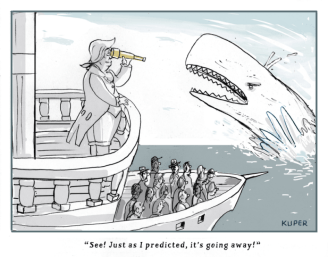 Meanwhile, Trump claimed yesterday that the virus will magically disappear. CNN: Trump’s aides debate a new virus approach as President claims it will ‘disappear.’
A divide has emerged inside President Donald Trump’s inner circle over whether he should turn his attention back to the coronavirus pandemic or continue to focus on reopening the economy, sources familiar with the matter tell CNN.
As cases surge in dozens of states, Trump has remained mostly silent on the matter, focusing instead on protecting statues and stoking racial and cultural divisions. While others in his administration — including Vice President Mike Pence — make appeals for Americans to continue socially distancing and wear masks, Trump again suggested Wednesday the virus would “disappear.”
That has led to concerns, even among some of his own aides, that Trump appears disengaged from a deadly crisis that continues to grip the nation.
Gee, no kidding.
Several of Trump’s top aides, including chief of staff Mark Meadows and son-in-law Jared Kushner, have begun to worry about the President’s chances to win reelection, advisers familiar with the matter said — fears borne out by a steady stream of public polls showing Trump trailing his election rival, Joe Biden, by double digits. Both Meadows and Kushner have urged a focus on the economy over the public health emergency.
Some of Trump’s political advisers believe he has suffered grave political damage due to the pandemic, which has caused widespread economic hurt and death. Even as Trump and others in the White House project optimism that the economy will surge closer to the election, Trump’s handling of the pandemic has drawn rebukes — particularly as cases begin to spike.
“There is a fair amount of concern,” one adviser said, describing the President as “frustrated” by recent polling indicating Biden could win the November election by a wide margin.
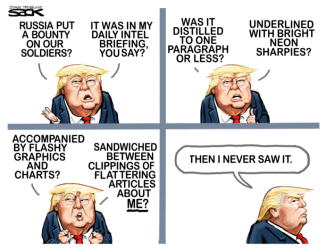 Trump couldn’t possibly care less about the pandemic, about Russia paying to kill American troops or about actually doing the job of POTUS. All he seems to care about is being cheered at rallies, protecting statues of racists, and playing golf. Windsor Mann at The Bulwark: Donald Trump Is All Done Caring. An excerpt:
Trump is not interested in the actual job of the presidency. He’s interested in the attention the presidency affords him.
After his election, he discovered that running for president was easier and more fun than being president. Which is why he continued to hold campaign rallies even after he was elected. He wasn’t campaigning for anything. He just liked hearing crowds screaming his name. Unlike most politicians, who campaign in order to govern, Trump campaigns as a way to avoid governing.
By the same token, his politics are an extension of his ego—which is why, at his rallies, he tells the crowds how big his crowds are and not what his policies are. Trump says he’ll hold rallies after he wins the 2020 election, too—even though he will be ineligible to run for the presidency again.
Instead of holding rallies for the purpose of getting elected, Trump wants to get elected so he can keep having rallies….
Twitter performs for Trump the same function as his rallies. Because he’s the president, he can tweet something mean, false, and/or nonsensical and, instead of cheers, get instantaneous likes and retweets—validation in milliseconds. After tweeting “CHINA!” in May, he got 236,000 retweets and 797,000 likes. Tweeting while you watch Fox & Friends, it turns out, is even more gratifying than shouting at the TV. When you tweet, the whole world listens to you, and some people even applaud….
The problem for Trump is that his presidency has no point. It is as devoid of purpose as his days are of work. He doesn’t want to make America great. He wants America to make him feel great.
 Still, the bad news keeps coming for Trump. Every time he claims that the Russian bounty story is a “hoax,” someone in the intel community leaks more details. Now we have the name of a guy who received payments. The latest from The New York Times: Afghan Contractor Handed Out Russian Cash to Kill Americans, Officials Say.
KABUL, Afghanistan — He was a lowly drug smuggler, neighbors and relatives say, then ventured into contracting, seeking a slice of the billions of dollars the U.S.-led coalition was funneling into construction projects in Afghanistan.
But he really began to show off his wealth in recent years, after establishing a base in Russia, though how he earned those riches remained mysterious. On his regular trips home to northern Afghanistan, he drove the latest model cars, protected by bodyguards, and his house was recently upgraded to a four-story villa.
Now Rahmatullah Azizi stands as a central piece of a puzzle rocking Washington, named in American intelligence reports and confirmed by Afghan officials as a key middleman who for years handed out money from a Russian military intelligence unit to reward Taliban-linked fighters for targeting American troops in Afghanistan, according to American and Afghan officials.
As security agencies connected the dots of the bounty scheme and narrowed in on him, they carried out sweeping raids to arrest dozens of his relatives and associates about six months ago, but discovered that Mr. Azizi had sneaked out of Afghanistan and was likely back in Russia. What they did find in one of his homes, in Kabul, was about half a million dollars in cash.
Click the link to read the rest.
 More bad news for Trump:
NBC New York: Jeffrey Epstein Confidante Ghislaine Maxwell Arrested, Sources Say.
The Washington Post: New York court sides with publisher of explosive book by President Trump’s niece.
The New York Times: Biden Outraises Trump for Second Straight Month, With $141 Million June Haul.
Stanley Greenberg at The Atlantic: Believe the Polls This Time. These aren’t Hillary Clinton’s numbers. Biden has a wide lead because the landscape has changed.
I hope all you Sky Dancers have a great Independence Day weekend. Please stay safe!
Did you like this post? Please share it with your friends:
Posted: April 4, 2020 | Author: bostonboomer | Filed under: Foreign Affairs, morning reads, U.S. Politics | Tags: 3M, Canada, coronavirus, Donald Trump, Gov. Charlie Baker, Illinois, Jared Kushner, Massachusetts, Russell Honore, Trump administration |

By Sara Barnes
Good Morning!!
Is Trump deliberately letting Americans die? It certainly appears that he is directing scarce medical supplies to red states like Florida while actively trying to prevent deliveries of such equipment to blue states.
On Thursday I posted about a massive shipment of N95 masks that was delivered to Massachusetts through the intervention of the Kraft family, owners of the New England Patriots. The Krafts arranged to have the Patriots plane fly to China and back to pick up more than a million masks. Another shipment will follow later. The Krafts also donated $2 million toward the cost of the masks. From The Boston Globe:
The news, which broke early Thursday, resembled a plot pulled straight out of a summer blockbuster: The Kraft family had deployed a New England Patriots team plane to China to deliver about one million desperately needed N95 respirator masks to health care workers in Massachusetts.

By Rudi Herzimeier
Yet the story is as alarming as it is heartwarming, underscoring a harsh reality as the coronavirus pandemic spreads ever faster around the United States. Governor Charlie Baker and his counterparts throughout the country are forced to go to extraordinary lengths to secure life-saving medical equipment in the absence of a coordinated federal response.
“This is not how it is supposed to work,” said Representative Katherine Clark of Melrose, a member of House Speaker Nancy Pelosi’s leadership team. She described herself as “very grateful” for the Kraft family’s generosity and help getting the critical gear, but said “what we need is a coordinated federal system.”
Why was such a dramatic effort necessary? Because Trump has been actively preventing Massachusetts from purchasing medical supplies.
The journey began, in the governor’s telling, roughly two weeks ago, when the federal government confiscated a shipment of more than 3 million N95 masks at the Port of New York and New Jersey that Massachusetts had arranged to buy….
Baker’s victory in the state’s intense hunt for masks and other protective gear, or PPE, follows weeks of increasingly public frustration from the normally even-keeled governor. His administration has hit numerous roadblocks thrown up by the federal government, which has repeatedly snatched supplies from the states’ hands and directed governors to find their own source.

Very Introvert Cat Sitting on a Red Chair, by Nastya Ozozo
Even now, Baker administration officials are still waiting on the federal government to deliver promised help. Earlier this week, Baker announced that the state had ordered 1,000 ventilators from the federal government and that he expected the delivery by the end of this week. On Thursday, Baker said Massachusetts still hasn’t gotten any of the equipment and he no longer expects them by the end of the week.
Normally calm and matter-of-fact, Baker choked back tears when he spoke at Logan Airport after meeting he Patriots plane.
The Chicago Sun-Times has a story about another crazy situation in Illinois: Illinois adjusts on the fly to meet medical supply needs in a coronavirus ‘Wild West.’
About two weeks ago, Illinois officials tracked down a supply of 1.5 million potentially life-saving N95 respirator masks in China through a middleman in the Chicago area and negotiated a deal to buy them.
One day before they were expecting to complete the purchase, they got a call in the morning from the supplier informing them he had to get a check to the bank by 2 p.m. that day, or the deal was off. Other bidders had surfaced.
Realizing there was no way the supplier could get to Springfield and back by the deadline, Illinois assistant comptroller Ellen Andres jumped in her car and raced north on I-55 with a check for $3,469,600.

By Shozo Ozaki.
From the other end, Jeffrey Polen, president of The Moving Concierge in Lemont, drove south. Polen isn’t in the medical supply business, but he “knows a guy,” an old friend who specializes in working with China’s factories.
As they drove, Andres and Polen arranged to meet in the parking lot of a McDonald’s restaurant just off the interstate in Dwight. They made the handoff there.
Polen made it back to his bank with 20 minutes to spare. Illinois already has received part of the mask shipment. There’s more on the way.
That’s just a taste of the “Wild West” world of emergency procurement taking place over the past several weeks as the state fights for equipment and supplies to protect frontline workers and patients in the battle against COVID-19.
Why is this chaos necessary? Because Trump refuses to allow the federal government to organize the pandemic response.
Now Trump is angering America’s foreign allies by commandeering medical supplies their governments are trying to buy.
Kaiser Health News: Trump Administration Uses Wartime Powers To Be First In Line On Medical Supplies.
The Trump administration quietly invoked the Defense Production Act to force medical suppliers in Texas and Colorado to sell to it first — ahead of states, hospitals or foreign countries.
It took this action more than a week before it announced Thursday that it would use the little-known aspect of the law to force 3M to fill its contract to the U.S. first. Firms face fines or jail time if they don’t comply.

Terry Runyan, Yellow Cat
The Cold War-era law gives federal officials the power to edge out the competition and force contractors to provide supplies to them before filling orders for other customers.
While it’s unclear how many times the power has been used during the coronavirus pandemic, federal contracting records examined by Kaiser Health News show that federal authorities staked first rights to $137 million in medical supplies. The orders in late March flew under the radar, even as dog-eat-dog bidding wars raged among states and nations for desperately needed medical protective gear.
“It’s like ‘Lord of the Flies’ out there for states and hospitals as they bid against each other for critical medical supplies and equipment,” Sen. Chris Murphy (D-Conn.) said in a statement to KHN. “Plus, there’s no transparency about what the federal government is doing with the equipment that they purchase when they outbid states and hospitals.”
Read more:
Reuters: Canada blasts U.S. block on 3M exports of masks as coronavirus cases set to soar.
CNBC: 3M warns Trump: Halting exports under Defense Production Act would reduce number of masks available to US.
At the Coronavirus Task Force briefing on Thursday, we learned that, instead of sending medical supplies controlled by the Pentagon (paid for by taxpayers) directly to states, the administration is handing the equipment over to private companies to resell to the highest bidder. Here’s what Lt. Katrina recovery hero Gen. Russell Honore had to say about that.
Yesterday, Dakinikat wrote about the insanity of putting failson-in-law Jared Kusher in charge of the federal pandemic response. We learned about that at the Thursday briefing too. From The Daily Beast:
President Donald Trump’s top adviser and son-in-law Jared Kushner insisted on Thursday that the government had not built up a national stockpile of medical equipment for states to use during threats like the coronavirus since those states have strategic reserves of their own.
The remark drew raised eyebrows from experts, considering presidents have dispersed supplies from the national strategic stockpiles for use by states dozens of times over the last twenty years.
In fact, the Trump administration itself has dipped into the federal reserves to help states in need…

Malarstwo Japońskie
“He doesn’t know what the hell he is talking about. He has no idea,” said Gen. Russel Honore, a retired military general who helped direct the response on the ground during Hurricane Katrina. “He must have remembered something from some slide or some speech. But that’s why people created the national strategic stockpile in the first place. It’s for those days when we can’t predict what we need. What I see is a total misunderstanding by the White House that they have a responsibility to help maintain the stockpile and help states.” [….]
While state governments do possess their own stockpiles of equipment and supplies, the national strategic stockpile was originally designed in 1999 to help states fill the gaps when facing things like natural or health disasters. The role of the stockpile has expanded dramatically in recent years amid more frequent natural disasters.
But the Trump White House’s approach to filling the supply chain gaps has been slapstick at best, officials say, in part because it was unprepared for taking the lead in responding to a global pandemic. For weeks, the administration struggled to understand which agency was responsible for studying the supply chain breakdown and which was in charge of fixing not only the dwindling medical supplies in hospitals, but also the shortages of products like toilet paper and paper towels in grocery stores.
“We missed dealing with this disaster because for weeks, the White House said it was a hoax,” Honore said. “So we missed at least four weeks of anticipation and preparation on the logistics side because of our leadership.” [….]
“It shouldn’t be this complicated,” said Juliette Kayyem, a former assistant secretary of the Department of Homeland Security. “It’s supposed to happen like a light switch you flip on. And this should have happened a month ago. This is not inventing a vaccine, this is just shipping stuff. In these situations you want a light White House touch and you want the subject matter experts to take the lead.”

By Saul Steinberg
More important stories to check out:
The New York Times: Coronavirus in N.Y.: Toll Soars to Nearly 3,000 as State Pleads for Aid.
The Washington Post: The U.S. was beset by denial and dysfunction as the coronavirus raged.
The Washington Post: Inside the coronavirus testing failure: Alarm and dismay among the scientists who sought to help.
Yahoo News: Coronavirus may cause some food shortages, warns government task force.
ProPublica: How Tea Party Budget Battles Left the National Emergency Medical Stockpile Unprepared for Coronavirus.
Raw Story: Trump administration quietly guts COVID-19 paid leave provision that already excluded 75 percent of workers.
Lucian Truscott IV at Salon (via Raw Story): Trump is preparing the ground for a totalitarian dictatorship.
Business Insider: The US Postal Service is on track to run out of money by June, and it could be a disaster for states trying to expand voting by mail.
Take care this weekend, Sky Dancers! Please let us know what’s happening where you are.
Did you like this post? Please share it with your friends:







 peej
peej Carissa
 bostonboomer
 dakinikat
 ecocatwoman
 jjlo
jjlo mablue2
 Mama Lopez
 peggysue22
 quixote
 skydancingguestblogger
 Mona (aka Wonk the Vote)



 Sky Dancing
Recent Comments