
Tuesday Reads: So Much Breaking News!
Posted: September 2, 2014 Filed under: Barack Obama, Foreign Affairs, morning reads, Real Life Horror, Russia, Somalia, U.S. Military, U.S. Politics, Ukraine, Violence against women | Tags: Ahmed Abdi Godane, AIAI, al-Shabab, Burlington MA, Council on Foreign Relations (CFR), Eric Cantor, Estonia, FBI, grooming child victims, hackers, IRAQ, ISIS, Kenya mall massacre, Market Basket, Pakistan, rape, Rear Adm. John Kirby, sex trafficking, unauthorized nude photos released, Wales NATO Summit, Westgate Mall, World War III 62 Comments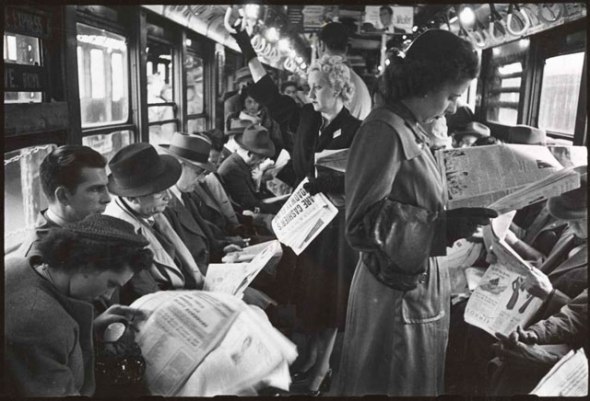
Photo by Stanley Kubrick for Life Magazine
Good Morning!!
I have some serious news reads for you this morning, but–just because it’s a feel-good story–I’m going to begin with one more Market Basket update. The Boston Globe published an article yesterday about the Market Basket store I shop at in, in Burlington, MA: A Market Basket store, returning to life. Recall that the shelves were mostly empty when the employees returned to work on Thursday morning.
The doors of the tractor-trailer open on a bounty of chicken, Swiss cheese, and sliced onions.
A swarm of grocery clerks in blue jackets and managers in red descends on the loading dock, using hand-operated electric jacks to spear pallets of food that the workers stack in the cavernous storage rooms in the back of the Market Basket supermarket….Bob McKeown fills a display case with fresh-from-the-fryer doughnuts, a few garnished with smiley faces made of jelly. Samantha Bond decorates a cake to honor the moment, etching the words “Market Basket Strong” in icing and an image of the yellow giraffe that served as the employees’ mascot of sorts during the protest — for “sticking their necks out.” ….
This Market Basket store in Burlington came back to life over the last few days, resuscitated by a cadre of employees eager to get to work after the six-week protest that forced the return of Arthur T. Demoulas as head of the family food empire. Like the others in the 71-store chain, the Burlington store was the scene of a rapid restocking, a huge task involving thousands of pounds of produce, meat, bread, canned goods, and other groceries….
The first morning back had been about congratulations and hugs and handshakes as customers came in more to talk to employees than to shop. Amid the celebrations, workers admitted to anxious moments during the stoppage. They worried their defiance would cost them their jobs — “I’ve been living on antacids for the last six weeks,” one said — and couldn’t wait to get back to the unglamorous but satisfying routine of running a supermarket.
That routine had returned in full by early Friday.
It’s a nice story, and I’m so happy for these workers. Isn’t it great that this happened over Labor Day weekend?
Now for the not-so-upbeat news . . .
NBC News reports, Terror Leader Linked to Kenya Mall Massacre Targeted by U.S. Strike.
The U.S. military launched an airstrike in Somalia on Monday targeting the leader of the al Qaeda-affiliated group behind the Kenya mall massacre. U.S. officials told NBC News that a military drone launched Hellfire missiles at at least two vehicles in a remote area of southern Somalia. Sources said Ahmed Abdi Godane, the top leader of al Shabab, was the attack’s target. Al Shabab claimed responsibility for last September’s Westgate Mall siege that left at least 67 dead and around 200 injured. One U.S. security source described Godane as “operationally savvy and ideologically driven, with aspirations off the charts.”
Rear Adm. John Kirby, the Pentagon’s press secretary, said in a statement late Monday that “we are assessing the results of the operation and will provide additional information as and when appropriate.” Godane has served as the group’s leader since a U.S. airstrike killed his predecessor Aden Hashi Ayro in 2008. In October, U.S. commandos launched raids in Somalia seeking to capture Godane, who is also known as Mukhtar Abu Zubeyr. Reuters reported that Godane’s close associate, Ahmed Mohamed Amey, was killed by a U.S. airstrike in January. In an online audio message following the Westgate Mall massacre, Godane said Kenya should be “prepared for an abundance of blood that will be spilt in your country.” Al Shabab, which means “The Youth” in Arabic, seized much of southern Somalia in 2006 before Somali forces and African peacekeeping troops ousted it five years later.

Photo of NY subway by Walker Evans
AP reports (via ABC News) that 6 militants were killed in the raid. There aren’t a lot of details as yet, but here’s a backgrounder on al-Shabab from The Council on Foreign Relations. Here’s the introduction and information on how the group began.
Al-Shabab, or “The Youth,” is an al-Qaeda-linked militant group and U.S.-designated Foreign Terrorist Organization fighting for the creation of a fundamentalist Islamic state in Somalia. The group, also known as Harakat al-Shabab al-Mujahideen, and its Islamist affiliates once held sway over Mogadishu and major portions of the Somali countryside, but a sustained African Union military campaign in recent years has weakened the group considerably. Still, security analysts warn that the group remains the principal threat in a politically volatile, war-torn state.
Al-Shabab’s terrorist activities have mainly focused on targets within Somalia, but it has also proven an ability to carry out deadly strikes in the region, including coordinated suicide bombings in Uganda’s capital in 2010 and a deadly raid on a Nairobi mall in 2013. Washington fears the group, which has successfully recruited members of the Somali-American diaspora, may orchestrate strikes on U.S. soil. In recent years, the United States has pursued a two-pronged policy in Somalia: providing funding, training, and logistical support to UN-backed African forces battling al-Shabab, while escalating counterterrorism operations including Special Forces and armed drones….
Somalia, one of the most impoverished countries in the world, has seen a number of radical Islamist groups come and go in its decades-long political tumult. The group analysts cite as al-Shabab’s precursor, and the incubator for many of its leaders, is Al-Ittihad Al-Islami (aka Unity of Islam), a militant Salafi extremist group that peaked in the 1990s after the fall of the Siad Barre military regime (1969-1991) and the outbreak of civil war.
AIAI, which sought to establish an Islamist emirate in Somalia, sprang from a band of Middle Eastern-educated Somali extremists and was partly funded and armed by al-Qaeda chief Osama bin Laden. Many of its fighters, including current al-Shabab commanders, fled the country and fought in Afghanistan in the late 1990s after being pushed out by the Ethiopian army and its Somali supporters. The group was designated a terrorist organization by the U.S. State Department in the days after the September 11, 2001 attacks.
In 2003, a rift developed between AIAI’s old guard, which had decided to create a new political front, and youth members who sought the establishment of a “Greater Somalia” under fundamental Islamic rule. The hardliners eventually joined forces with an alliance of sharia courts, known as the Islamic Courts Union, serving as its youth militia in the battle to conquer Mogadishu’s rivaling warlords. Al-Shabab and the ICU wrested control of the capital in June 2006, a victory that stoked fears of spillover jihadist violence in neighboring Ethiopia, a majority Christian nation.
Much more at the CFR link.

Yesterday, U.S. planes carried out an operation against ISIS militants in Iraq. Reuters: U.S. planes strike militants near Iraq’s Amreli, airdrop aid.
President Barack Obama authorized the new military action, broadening U.S. operations in Iraq amid an international outcry over the threat to Amerli’s mostly ethnic Turkmen population.
U.S. aircraft delivered over a hundred bundles of emergency supplies and more aid was dropped from British, French and Australian planes, officials said, signaling headway in Obama’s efforts to draw allies into the fight against Islamic State.
Iraqi army and Kurdish forces closed in on Islamic State fighters on Saturday in a push to break the Sunni militants’ siege of Amerli, which has been surrounded by the militants for more than two months.
Armed residents of Amerli have managed to fend off attacks by Islamic State fighters, who regard the town’s majority Shi’ite Turkmen population as apostates. More than 15,000 people remain trapped inside.
“At the request of the government of Iraq, the United States military today airdropped humanitarian aid to the town of Amerli, home to thousands of Shia Turkmen who have been cut off from receiving food, water, and medical supplies for two months by ISIL,” Rear Admiral John Kirby, the Pentagon press secretary, said, using an alternative name for Islamic State.
“In conjunction with this airdrop, U.S. aircraft conducted coordinated air strikes against nearby ISIL terrorists in order to support this humanitarian assistance operation,” he said, adding that a key objective was to prevent a militant attack on civilians in the town.
President Obama is headed to Estonia today and then to Wales for the NATO Summit. CBS News reports, Russia and ISIS take center stage on Obama’s Europe trip.
President Obama leaves for Europe Tuesday with stops in Estonia and a NATO summit in Wales amid escalating crises in Ukraine and in Iraq and Syria, crises that are having a direct impact on a number of European nations.
While the Russian threat in Ukraine will be the focus of the upcoming summit, the meeting also puts President Obama, Secretary of State John Kerry and Defense Secretary Chuck Hagel face to face with European countries who may be willing to join the U.S. in dealing with the other crisis in Iraq and Syria.
Officially, however, NATO says it doesn’t want to be involved in dealing with the Islamic militant group called the Islamic State of Iraq and Syria (ISIS) that has swept across Iraq and Syria and poses a growing threat to the U.S. and parts of Western Europe that might be targeted by foreign fighters.
Why is Obama stopping in Estonia?
“It is clearly not accidental that the president has decided to stop in Estonia on the way to the NATO Summit. The two stops are essentially part of the same effort to send a message to the Russians that their behavior is unacceptable,” said Charles Kupchan, the White House’s senior director for European Affairs.
Estonia, like Ukraine, has a large Russian population and is concerned about the potential of pro-Russian unrest there too. But Kupchan said Mr. Obama will send the message that the Article 5 commitment to common defense of other nations is ironclad.
“Russia, don’t even think about messing around in Estonia or in any of the Baltic areas in the same way you have been messing around in Ukraine,” Kupchan said the president would relay to allies there.
Mr. Obama will meet with the leaders of Estonia, Latvia and Lithuania and also speak to young people there.
Read more details about the NATO Summit at the link.
According to the New York Times, Russia is already making plans to respond to expected NATO actions.
MOSCOW — With NATO leaders expected to endorse a rapid-reaction force of 4,000 troops for Eastern Europe this week, a senior Russian military official said on Tuesday that Moscow would revise its military doctrine to account for “changing military dangers and military threats.”
In an interview with the Russian state news agency RIA Novosti, the official, Mikhail Popov, deputy secretary of Russia’s military Security Council, called the expansion of NATO “one of the leading military dangers for the Russian Federation.”
Mr. Popov said Russia expected that leaders of NATO would seek to strengthen the alliance’s long-term military presence in Eastern Europe by establishing new military bases in the region and by deploying tanks in Estonia, a member of NATO that borders Russia.
“We believe that the defining factor in our relationship with NATO remains the unacceptability for Russia of plans to move military infrastructures of the alliance to our borders, including by means of expanding the bloc,” Mr. Popov said.
And so, we move closer to the possibility of another world war. At least that’s what Ann Applebaum of Slate suggested recently: Putin has invaded Ukraine. Is it hysterical to prepare for total war with Russia? Or is it naive not to? It’s brief and to the point, so please give it a read.

The New York Times also has an important story about the sex-trafficking scandal in Great Britain. I read about it at the Guardian a few days ago, but we haven’t discussed it here. The Times reports, Years of Rape and ‘Utter Contempt’ in Britain. Here’s the introduction:
ROTHERHAM, England — It started on the bumper cars in the children’s arcade of the local shopping mall. Lucy was 12, and a group of teenage boys, handsome and flirtatious, treated her and her friends to free rides and ice cream after school.
Over time, older men were introduced to the girls, while the boys faded away. Soon they were getting rides in real cars, and were offered vodka and marijuana. One man in particular, a Pakistani twice her age and the leader of the group, flattered her and bought her drinks and even a mobile phone. Lucy liked him.
The rapes started gradually, once a week, then every day: by the war memorial in Clifton Park, in an alley near the bus station, in countless taxis and, once, in an apartment where she was locked naked in a room and had to service half a dozen men lined up outside.
She obliged. How could she not? They knew where she lived. “If you don’t come back, we will rape your mother and make you watch,” they would say.
At night, she would come home and hide her soiled clothes at the back of her closet. When she finally found the courage to tell her mother, just shy of her 14th birthday, two police officers came to collect the clothes as evidence, half a dozen bags of them.
But a few days later, they called to say the bags had been lost.
“All of them?” she remembers asking. A check was mailed, 140 pounds, or $232, for loss of property, and the family was discouraged from pressing charges. It was the girl’s word against that of the men. The case was closed.
God, what a horrible story! Here’s a related post at The Daily Beast, The Psychology of Sex Slave Rings, by Charlotte Lytton. Lytton asks a controversial question, “are grooming rings endemic within certain cultures?”

Back in the USA, CNN reports that the FBI is investigating a hacker who released nude photos of Jennifer Lawrence and several other female celebrities over the weekend. That’s good news. I hope they put catch the culprit and put him in prison for a very long time.
Here’s a little political news from Reuters, via Huffington Post: Eric Cantor To Join Investment Bank Moelis & Co. As Vice Chairman And Managing Director.
Former U.S. House Majority Leader Eric Cantor will join investment bank Moelis & Co as vice chairman and managing director, the company said, adding that Cantor will also be elected to its board….
“Eric has proven himself to be a pro-business advocate and one who will enhance our boardroom discussions with CEOs and senior management as we help them navigate their most important strategic decisions,” Moelis CEO Ken Moelis said in a statement.
And finally, Politico writes: WHY THERE (PROBABLY) WON’T BE A SHUTDOWN
The apparent (but not finalized) decision by the White House to push executive action on immigration reform past the November midterms means there is no forcing mechanism to create a shutdown fight when government funding runs out Sept. 30th. Qorvis’ Stan Collender, a top budget expert, emails: “I never thought a shutdown was likely this fall (next March is another issue), but in a rational world delaying action on immigration should kill any chance of one happening. Then again — Benghazi, Obamacare, etc”
So, those are this morning’s breaking news headlines. What else is happening? Please post your thoughts and links in the comment thread, and have a terrific Tuesday!
Saturday Reads: Remembering the Soundtrack to the ’60s, and Other News
Posted: June 21, 2014 Filed under: Barack Obama, morning reads, nature, Republican politics, science, U.S. Politics, Violence against women, War on Women | Tags: Carole King, Chris Christie, Eric Cantor, female coders, George Will, Gerry Goffin, Google, GOP scandals, honeybees, music, rape, rock 'n' roll, Scott Walker, sexual assault, the Shirelles, Will You Love Me Tomorrow? 35 Comments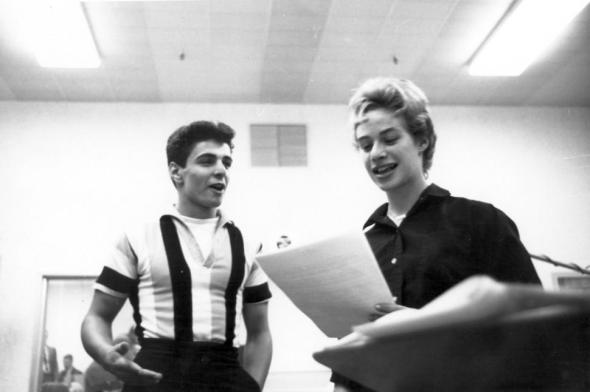
Husband and wife singer songwriting team Goffin and King rehearse during a recording session in a New York studio in 1959. (h/t NY Daily News)
Good Morning
On Thursday we lost another 1960s music great; Gerry Goffin, who wrote lyrics to Carole King’s music died at 75. The talented couple wrote the songs that accompanied my teenage years–so much great music associated with so many memories.
From the Guardian Gerry Goffin: the poet laureate of teenage pop:
Gerry Goffin, a trainee chemist who became the poet laureate of teenage pop, specialised in coming up with a great opening line to grab the audience’s attention. Plenty of people will remember the first time they heard “Tonight you’re mine completely/ You give your love so sweetly,” from Will You Love Me Tomorrow, or “Looking out on the morning rain/ I used to feel so uninspired,” from (You Make Me Feel Like) A Natural Woman. But he didn’t stop there.
Buried a little deeper in those wonderful songs are the lines that really touched his young listeners’ hearts. The words to the bridge, or middle section, of that first Shirelles hit from 1960 were almost like poetry: “Tonight with words unspoken/ You say that I’m the only one/ But will my heart be broken/ When the night meets the morning sun?” And when Goffin presented Aretha Franklin with the second verse of A Natural Woman – “When my soul was in the Lost and Found, you came along to claim it” – he gave countless ordinary lovers a way to express their deepest feelings.
Misleadingly, they are often called “Carole King songs”. She wrote the tunes, and later on she would sing them when, after Goffin and King divorced, she embarked on a hugely successful solo career. But whenever King sang her own, gentler versions of the Chiffons’ One Fine Day or the Drifters’ Up on the Roof, she was still singing Goffin’s words. They were written by the man she had met when she was 17 and he was 20, and with whom she had two daughters while they lived in an apartment in the Queens housing project LeFrak City – and with whom she travelled to work in Manhattan every day at their cubicle in the offices of Aldon Music at 1650 Broadway, where they pumped out hit after hit after hit.

From The New York Times: Gerry Goffin, Hitmaking Songwriter With Carole King, Dies at 75:
Mr. Goffin and Ms. King were students at Queens College when they met in 1958. Over the next decade they fell in love, married, had two children, divorced and moved their writing sessions into and out of 1650 Broadway, across the street from the Brill Building. (The Brill Building pop music of the late 1950s and ‘60s was mostly written in both buildings.)
Together they composed a catalog of pop standards so diverse and irresistible that they were recorded by performers as unalike as the Drifters, Steve Lawrence, Aretha Franklin and the Beatles. They were inducted together into the Songwriters Hall of Fame in 1987 and the Rock and Roll Hall of Fame in 1990. In 2004 the Recording Academy presented them jointly with a Trustees Award for lifetime achievement.
The couple’s writing duties were clearly delineated: Ms. King composed the music, Mr. Goffin wrote the lyrics — among them some of the most memorable words in the history of popular music.
“His words expressed what so many people were feeling but didn’t know how to say,” Ms. King said in a statement on Thursday.
A bit more about Goffin:
Gerald Goffin was born on Feb. 11, 1939, in Brooklyn and grew up in Jamaica, Queens. He began writing lyrics as a boy — “like some kind of game in my head,” he recalled once — but found he was unable to come up with satisfying music to accompany them.
He graduated from Brooklyn Technical High School before enrolling at Queens College. He was three years older than Ms. King, studying chemistry, when they met in the spring of her freshman year.
He asked her to help him write a musical. She was interested in rock ‘n’ roll. They hit it off anyway, and she was pregnant with their first child when they married on Aug. 30, 1959.
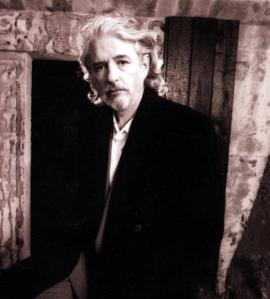
Gerry Goffin
After the couple divorced in 1968, King went on to become a singer and songwriter in her own right, although the two continued to collaborate and maintained a friendship. Goffin married again and and the couple had five children.
In addition to his wife, [Michelle] Mr. Goffin’s survivors include four daughters, Louise Goffin, Sherry Goffin Kondor, Dawn Reavis and Lauren Goffin; a son, Jesse Goffin; six grandchildren; and a brother, Al.
Goffin and King’s first hit was “Will You Love Me Tomorrow,” which they wrote in 1960 for the girl group the Shirelles. After the song hit #1 on the charts in 1961, Goffin quit his job as a chemist and began working full-time as a lyricist.
Goffin’s lyrics deftly touch on the doubt that lurks behind all new romances. As sung by Shirelles’ leader Shirley Owens in unflappable manner, the song doesn’t skimp on the wonder inherent in any fresh coupling. But it’s also unflinchingly realistic about the possibility that the fairy dust will dissolve at dawn.
“Can I believe the magic in your sighs?” Owens pointedly asks her paramour. In the bridge, Goffin’s words flow like champagne even as they fear the possible hangover: “Tonight with words unspoken/You’ll say that I’m the only one/But will my heart be broken/When the night meets the morning sun.” King’s melody plays a big role in the overall effect, arching high in the verses and middle eight while accompanied by strings that elegantly trip across the proceedings like moonlight dancers, before coming back down to Earth for the interrogative refrain.
In other news . . .
At Salon, Simon Malloy writes about the multiplying Republican scandals: GOP’s sudden scandal-mania: Why criminal probes and infighting are taking over the party.
It’s fashionable right now to talk about the premature end of Barack Obama’s presidency. He’s fast approaching the second half of his second term, which is historically the beginning of lame-duck season. His poll numbers aren’t what anyone would call ideal, and Republicans (in concert with some excitable members of the press) are rushing to proclaim the Obama presidency dead. “I saw a commentator today say that these polls, what they reflect, is that the Obama presidency is over,” Sen. Marco Rubio said, referring to NBC’s Chuck Todd. “And I agree with that. I think it is, in general.” Speaker John Boehner told reporters at his weekly press briefing yesterday: “You look at this presidency and you can’t help but get the sense that the wheels are coming off.” ….The funny thing is that as Republicans team up with pundits to chisel out Obama’s epitaph, the Republican Party itself is falling to pieces right before our eyes.
Yesterday’s news that Scott Walker and Chris Christie sinking deeper into their respective scandals is as good a sign as any of the GOP’s political disintegration. After Obama crushed Mitt Romney in 2012, Republicans began casting about for their 2016 redeemer, and Christie and Walker were high on the list. They won conservative hearts with their antagonism toward unions, but they had also found a way to win in reliably Democratic states. If the GOP hoped to take on candidate-in-waiting Hillary Clinton, they’d need someone who could peel away some Democratic voters. Walker had talked about the need to nominate an “outsider” like himself in 2016.
Now Christie and Walker are implicated in criminal investigations. Prosecutors in Wisconsin placed Walker at the center of a “criminal scheme” to coordinate campaign spending with outside groups. In New Jersey, the investigation stemming from the George Washington Bridge scandal is reportedly closing in on Christie himself. For both men, once considered potential saviors of the GOP, the political future looks considerably dimmer.
Read Malloy’s take on it at the link.
At FiveThirtyEightPolitics, David Wasserman has a long article on “What we can learn from Eric Cantor’s defeat.” You really need to read the whole thing, but here’s a small excerpt that deals with the contribution of public distrust of Congress:
Cantor was only the second House incumbent to lose a primary this year (the first was Texas Republican Ralph Hall), but the warning signs of discontent were abundant: Plenty of rank-and-file House incumbents had been receiving startlingly low primary vote shares against weak and under-funded opponents, including GOP Reps. Rodney Davis of Illinois, Lee Terry of Nebraska and David Joyce of Ohio. In fact, just a week before Cantor’s defeat and without much fanfare, socially moderate Rep. Leonard Lance of New Jersey received just 54 percent of the Republican primary vote against the same tea party-backed opponent he had taken 61 percent against in 2012.
Overall, 32 House incumbents have taken less than 75 percent of the vote in their primaries so far this year, up from 31 at this point in 2010 and just 12 at this point in 2006. What’s more, 27 of these 32 “underperforming” incumbents have been Republicans.1
In other words, while Congress’s unpopularity alone can’t sink any given member in a primary, it has established a higher baseline of distrust that challengers can build on when incumbents are otherwise vulnerable. And as the sitting House Majority Leader, Cantor was uniquely susceptible to voters’ frustration with Congress as an institution.
There’s much more interesting analysis at the link.
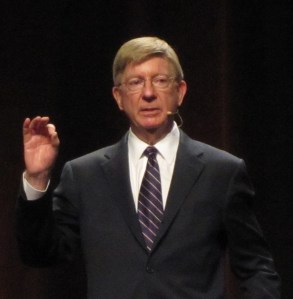
George Will’s recent column on campus rapes is still in the news. From Talking Points Memo, George Will’s Latest: College Rape Charges Fueled By ‘Sea Of Hormones And Alcohol’.
Will explained that he took issue with the practice of adjudicating campus sexual assault cases by a “preponderance” of evidence, rather than hitting the bar of evidence beyond a reasonable doubt. That flies in the face of due process, he argued, and ultimately harms young men’s future prospects.
“What’s going to result is a lot of young men and young women in this sea of hormones and alcohol, that gets into so much trouble on campuses, you’re going to have charges of sexual assault,” he said. “And you’re going to have young men disciplined, their lives often permanently and seriously blighted by this — don’t get into medical school, don’t get to law school, all the rest.”
Four Democratic senators reached out to Will after his column was published to torch the conservative columnist’s “ancient beliefs.” Will said he wrote a letter back to the senators and laid out his rebuttal in the C-SPAN interview.
“What I say is that: A) I take sexual assault more seriously than I think they do, because I agree that society has correctly said that rape is second only to murder as a serious felony,” Will said. “And therefore, when someone is accused of rape, it should be reported to the criminal justice system that knows how to deal with this, not jerry-built, improvised campus processes.”
“Second, I take, I think, sexual assault somewhat more seriously than the senators do because I think there’s a danger now of defining sexual assault so broadly, so capaciously, that it begins to trivialize the seriousness of it,” he added. “When remarks become sexual assault, improper touching — bad, shouldn’t be done, but it’s not sexual assault.”
Well, we can’t have young men’s lives “blighted” by rape charges. Much better for young women to just suck it up and deal with a years of post-traumatic stress on their own and keep their complaints to themselves.
Whatever you do, don’t miss this TBogg post at Raw Story: Gentleman George Will is getting damned tired of having to explain rape to you guttersnipes.
Victorian gas-pipe and Her Majesty’s Curator of Rape To The Colonies, George Will, has just about had it up to here with you people — YES, YOU PEOPLE.
And especially you. Don’t think by closing your laptop he can’t see you, because he can.
Oh yes, he most certainly can, you loathsome wastrel.
t seems that, after explaining the ins and out of rape to you ungrateful curs, he was shocked and dismayed to discover that you promiscuous info-trollops on the intertubes are unable to comprehend the pearls of wisdom that he dispenses to the riff-raff gratis, courtesy of Ye Olde Washminster Poste.
Hush now, let Gentleman George condescend to speak down to you and try, fruitlessly no doubt, to explain once again that rape is what George Will says rape is…
Now go read the rest at the link. You won’t be sorry.
This sounds like it could do some good: Google commits $50M to encouraging girls to code (CNet)
Google wants to see more women in technology, and it’s funding a $50 million initiative to encourage girls to learn how to code in an effort to close the gender gap.
Thursday night the company kicked off the Made with Code initiative here with celebrities former first daughter Chelsea Clinton and actress and comedienne Mindy Kaling.
Kaling, who emceed the event, said she has tons of ideas for apps but no idea to how make them work. She said she’d like to create a “What’s his deal?” app that takes a picture of guy and tells you whether he’s single, married, a weirdo, or what his car is like. Another idea is a Shazaam-like app for perfume.
“People my age have a million ideas for apps,” she said. “But we have no idea how to build them. Last week in the movies, I didn’t even know how to turn off the flashlight on my phone.”
Kaling isn’t alone. Women are woefully under-represented in the technology industry. Only about 20 percent of software developers in the US are women, according to the Labor Department. Last month, even Google admitted only 17 percent of its tech workers are women.
A bit more possible good news from the BBC: US sets up honey bee loss task force.
The Environmental Protection Agency (EPA) and the agriculture department will lead the effort, which includes $8m (£4.7m) for new honey bee habitats.
Bee populations saw a 23% decline last winter, a trend blamed on the loss of genetic diversity, exposure to certain pesticides and other factors.
A quarter of the food Americans eat, including apples, carrots and avocados, relies on pollination.
Honey bees add more than $15bn in value to US agricultural crops, according to the White House.
The decline in bee populations is also blamed on the loss of natural forage and inadequate diets, mite infestations and diseases.
There has also been an increase in a condition called colony collapse disorder (CCD) in which there is a rapid, unexpected and catastrophic loss of bees in a hive.
So . . . what stories are you following today? Please post your thoughts and links in the comment thread.
Lazy Saturday Reads
Posted: May 31, 2014 Filed under: Crime, FBI, Hillary Clinton, metadata, morning reads, NSA, National Security Agency, Rape Culture, Real Life Horror, U.S. Politics, Violence against women | Tags: Edward Snowden, George Packer, Glenn Greenwald, Jonathan Chait, Margaret Sullivan, Michael Kinsley 34 Comments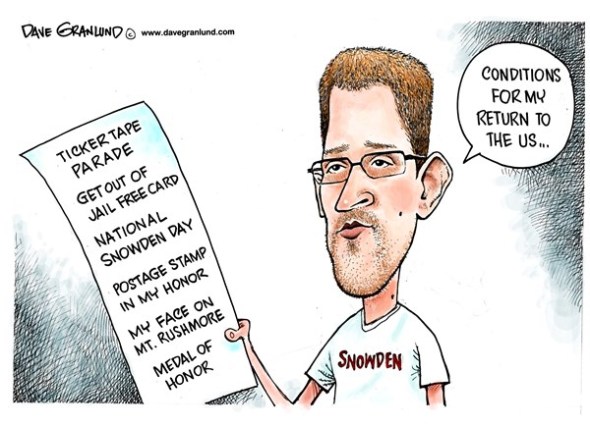
Good Morning!!
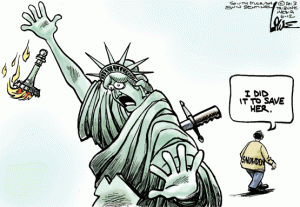
I stole the above Dave Granlund cartoon from JJ’s Friday night post, because it perfectly expresses my viewpoint on who and what Edward Snowden is. I’ll have the latest Snowden news for you in a minute, but first a personal update and some breaking Boston bombing news.
I’m in Indiana visiting my mom for a couple of weeks. The weather is gorgeous here, and I’m really enjoying it. It’s great to be out of the drizzly cold weather the Boston area has been having. I’m looking forward to doing quite a bit of yard work, helping my mom buy a new bed, celebrating her 89th birthday with her, and just generally enjoying her company.
As usual, I drove my car out here, and I made great time. The speed limits have been increased to 70 mph in Ohio and Indiana, and everyone in Massachusetts and New York routinely drives at least 10-15 miles over the 65 mph limit. So I probably averaged around 70-75 mph on the trip.
My mechanic told me that I need to start using premium gas in my car. I hated to do it, but to my surprise I got much better mileage with the expensive gas. I used 2-1/2 tanks of gas to go more than 900 miles. Usually it takes 3 full tanks and a little more to make the trip!
As I mentioned above, some Boston bombing news broke last night. From The Boston Globe: Man charged with obstructing bombing probe.
A cab driver from Quincy who was close to the two suspected Boston Marathon bombers was arrested Friday on charges of lying to investigators and destroying evidence, allegedly obstructing the ongoing investigation of the 2013 attack that shocked the city and the nation.
Khairullozhon Matanov, a 23-year-old Kyrgyzstan national, allegedly contacted Tamerlan Tsarnaev 42 minutes after the April 15, 2013, bombings, and he bought him and his younger brother, Dzhokhar Tsarnaev, dinner at a restaurant that night. Matanov visited Tamerlan, whom he knew from playing soccer and from places of worship, at the suspected bomber’s Cambridge home two days later.
Over several days after the bombings, he also called the brothers repeatedly.
Authorities alleged in a sweeping indictment unsealed Friday that Matanov realized the FBI would want to interview him about his relationship with the suspected bombers, but that he deleted files from his computer and tried to get rid of his cellphones. They also allege that he lied to investigators about his encounters with the brothers in the days after the bombings.
Matanov discussed his friendship with the Tsarnaev brothers with others in the days following the bombing, but he claims that they didn’t confess their involvement to him. Apparently, the FBI knew about all this a year ago; it’s not clear why they waited until now to charge Matanov. I’ll be keeping my eye on this story.
Now the latest on the Snowden Operation.

Edward Snowden has been dominating the news for the past few days because of the interview he gave to NBC’s Brian Williams and the recent release of Glenn Greenwald’s book on his collaboration with Snowden in releasing classified NSA files. I have to admit up front that I haven’t yet been able to force myself to watch the interview. Frankly, I doubt if Williams asked any of the questions that I think Snowden should be asked; but I promise I’ll watch the thing today to find out for sure. Meanwhile, I’ve gathered some reactions from people who have watched it.
Frankly, I admit up front that I think Edward Snowden is a defector as well as an arrogant, grandiose, narcissistic jerk. But I think you all knew that already. With that said, here are the latest Snowden (and Greenwald) stories from my very biased point of view.
Last week there were a couple of high-profile negative reviews of Glenn Greenwald’s book No Place to Hide, one by George Packer and the other by Michael Kinsley. As you know, Greenwald doesn’t take criticism well, and he and his fans were not happy with either review. Packer’s review was the most scathing and carefully argued, but Kinsley is taking most of the heat from the Greenwald fan base, probably because the review was quite snarky. For example:
Greenwald was the go-between for Edward Snowden and some of the
newspapers that reported on Snowden’s collection of classified documents
exposing huge eavesdropping by the National Security Agency, among
other scandals. His story is full of journalistic derring-do, mostly set in
exotic Hong Kong. It’s a great yarn, which might be more entertaining if
Greenwald himself didn’t come across as so unpleasant. Maybe he’s
charming and generous in real life. But in “No Place to Hide,” Greenwald
seems like a self-righteous sourpuss, convinced that every issue is
“straightforward,” and if you don’t agree with him, you’re part of
something he calls “the authorities,” who control everything for their own
nefarious but never explained purposes….Throughout “No Place to Hide,” Greenwald quotes any person or
publication taking his side in any argument. If an article or editorial in
The Washington Post or The New York Times (which he says “takes
direction from the U.S. government about what it should and shouldn’t
publish”) endorses his view on some issue, he is sure to cite it as evidence that he is right. If Margaret Sullivan, the public editor (ombudsman, or
reader representative) of The Times, agrees with him on some controversy,
he is in heaven. He cites at length the results of a poll showing that more
people are coming around to his notion that the government’s response to
terrorism after 9/11 is more dangerous than the threat it is designed to
meet.Greenwald doesn’t seem to realize that every piece of evidence he
musters demonstrating that people agree with him undermines his own
argument that “the authorities” brook no dissent. No one is stopping
people from criticizing the government or supporting Greenwald in any
way. Nobody is preventing the nation’s leading newspaper from publishing
a regular column in its own pages dissenting from company or government
orthodoxy. If a majority of citizens now agree with Greenwald that dissent
is being crushed in this country, and will say so openly to a stranger who
rings their doorbell or their phone and says she’s a pollster, how can
anyone say that dissent is being crushed? What kind of poor excuse for an
authoritarian society are we building in which a Glenn Greenwald, proud
enemy of conformity and government oppression, can freely promote this
book in all media and sell thousands of copies at airport bookstores
surrounded by Homeland Security officers?
And so on . . . After Kinsley’s piece was published the Snowden cult, of which NYT public editor Margaret Sullivan is a charter member, reacted as usual with an over-the-top firestorm of rage. I’ll let Sullivan speak for the cult. She questioned the choice of Kinsley as reviewer and accused the long-time book-reviewer of arguing the only the government should decide whether classified government materials should be published. She apparently also felt that Kinsley showed insufficient deference to her idol Glenn Greenwald. I’d like to quote from Sullivan’s piece, but for some reason I can’t copy and paste from it. But here’s a reaction to the kerfluffle from Jonathan Chait: Times vs. Sullivan vs. Kinsley vs. Greenwald. Chait agrees with me that the Packer review is “more devastating.” Chait thoroughly skewers Margaret Sullivan, and she can’t attack him because he didn’t do it at the NYT.
It’s certainly true that Kinsley is more effective [than Packer] at poking a hole in Greenwald’s argument than in making the case for his own (obviously problematic) alternative. That would seem to be fair enough given that he’s writing a review of Greenwald’s book. Not to Sullivan, who sprung into action, using her public editor’s column to scold Kinsley. His review “expressed a belief that many journalists find appalling,” she wrote, aghast. Also, “there’s a lot about this piece that is unworthy of the Book Review’s high standards, the sneering tone about Mr. Greenwald, for example.” No sneering in the book review!
Paul writes back to Sullivan — in a rebuttal posted at the bottom of Sullivan’s item — to say, more or less, “let me explain to you what what a book review is”:
It seems there is a lot of confusion on the Internet, especially among those who do not work in the media but even — disturbingly — within the media, about the differences between an editorial and a book review, between what “The New York Times” says and what a reviewer for The New York Times Book Review says. …
For a reviewer to address how a writer comes across, particularly in a memoir or first-hand account, is entirely fair game for a book review, and by no means an ad hominem attack.
The notion that it’s wrong for the book review to print abhorrent reviews, let alone to poke fun at no less a hero than Glenn Greenwald, is an artifact of the culture of smugness that Kinsley is writing about here. If there’s one thing objective journalists are allowed — indeed, expected — to hold extremely strong opinions about, other than the importance of reducing the budget deficit, it’s the importance of journalists themselves. How dare a newspaper publish a review expressing skepticism about special rights for journalists?
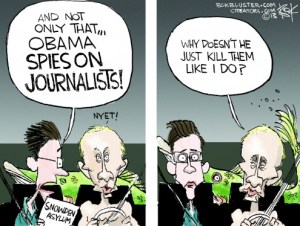
Just for balance, here is a fairly non-judgmental summary of the overall “controversy” at the Neiman Report.
Finally, Kinsley’s response to Margaret Sullivan
Since I haven’t yet watched the Snowden interview with Brian Williams, I’ll give you what I think is the best response I’ve seen so far from Kurt Eichenbaum at Newsweek: 16 Questions Edward Snowden Wasn’t Asked. This article is must-read–if only I could quote the whole thing! Here’s a small sample:
1. Most of the information that has been revealed from the documents you obtained dealt with the abilities, rather than the actions, of the NSA. Did you see or do you have any evidence that the agency was, in fact, spying on Americans who were not linked to terrorist organizations through what is known as the “three-hop” standard? (Under this rule, one of 22 NSA officials must give approval to an analyst who believes a “reasonable, articulable suspicion” exists that a number is directly linked to terrorists. Then the analyst is allowed to determine through searches of metadata which phone numbers were called by the first number. The NSA can then determine the numbers called by the second phone, and the numbers called by the third. The intent is to see if numbers called in the United States by phones directly connected to terrorists will reveal terrorist operatives inside the country.)
5. Did you see or do you have evidence of the NSA reading content of emails sent by Americans or listening to phone calls of Americans without meeting the standards required by the national security courts known as FISA courts?
10. Do you believe that surveillance in foreign nations is intrinsically wrong?
11. You say that you do not believe your actions damaged United States security and that the government has failed to reveal instances where it did. Two questions: What kind of analysis did you conduct to be sure that the information you were taking did not compromise security? And, secondly, given that journalists do not have security clearances, why did you think they were the best placed to Click here and determine what would compromise national security and what didn’t?
Please go read the rest. It sounds like Brian Williams pretty much avoided asking Snowden any hard questions at all.
A few more quick headlines:
NBC News (Irony alert!): Russia Web Journalism Award Named For Edward Snowden.
More horrendous gang rapes in India–from Reuters India: Home minister seeks report on grisly rape, hanging of teens in Uttar Pradesh.
Exclusive: The Daily Banter’s Investigation Helps Catch Sandy Hook Memorial Thief.
Hilarious must-read from Politico: NSA releases Snowden memo.
Oliver Willis: Republicans already handing the White House to Hillary Clinton.
Those are my offerings for today. What are you reading and blogging about? Please share your links on any topic in the comment thread.http
Memorial Day Reads
Posted: May 26, 2014 Filed under: Crime, Mental Health, misogyny, morning reads, racism, social justice, U.S. Politics, Violence against women, War on Women | Tags: Caroline Janney, Civil War, Confederate Memorial Day, David Blight, Decoration Day, elliot rodger, freed slaves, Isla Vista mass murder, Memorial Day history, Ta=Nehisi Coates, Veterans 40 Comments
Good Morning!!
A few days ago, I read an article about the “true meaning of Memorial Day.” I can’t find it now, but it was in the Chicago Tribune. The author wrote that Memorial Day began as “Decoration Day,” when Southern women decorated the graves of Confederate soldiers. I Googled some more and found other writers making the same claim. Here’s a piece by a Civil War historian from Purdue University Caroline Janney:
Many may not know the holiday weekend that marks the start of summer by paying respects to veterans and remembering loved ones began when white Southern women took a leadership role in honoring their Civil War veterans, says a Purdue University historian.
“After the Civil War, southern men would have appeared treasonous if they had organized memorials to honor their fallen, so women – perceived as apolitical – instead organized tributes and events that set the tone for how the country celebrates Memorial Day today,” says Caroline E. Janney, professor of historyand president-elect of the Society of Civil War Historians. “In 1866, the men were figuratively hiding behind the skirts of these women who worked together as part of Ladies’ Memorial Associations.”
The women organized dozens of memorials during the spring of 1866 and the following years, Janney says. Historically these memorials were scheduled throughout the spring as a sign of renewal and rebirth, and each community chose its own date to celebrate.
The date usually reflected a key date in the Civil War, such as the May 10 death of Gen. Thomas “Stonewall” Jackson, or a battle close to the association’s individual area. Memorial Day became more unified when larger associations, such as the United Confederate Veterans and United Daughters of the Confederacy, began organizing memorials in the 1890s. And memorial days also were observed in the North, but they were organized by Union veterans beginning in 1868, two years after the ex-Confederate women had established the practice.
I was surprised, because I had read years ago that the practice was begun by former slaves who wanted to honor Union soldiers. I found the above photo on Facebook–with the suggestion that it was taken on that first Decoration Day May 1, 1865; but I can’t be absolutely certain that’s accurate. Note that that dates is a year earlier than the one Janney writes about. It turns out that a number of places and people claim to have started the practice of decorating Union and Confederate Graves. Southerners designated “Confederate Memorial Days.” Kingston, Georgia claims to have held the first one.
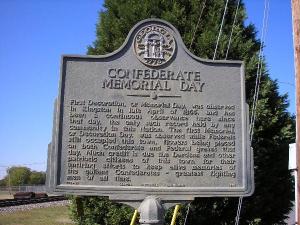
Yale historian David Blight wrote about the disputed origins of Memorial Day in the New York Times in 2011.
Officially, in the North, Memorial Day emerged in 1868 when the Grand Army of the Republic, the Union veterans’ organization, called on communities to conduct grave-decorating ceremonies. On May 30, funereal events attracted thousands of people at hundreds of cemeteries in countless towns, cities and mere crossroads. By the 1870s, one could not live in an American town, North or South, and be unaware of the spring ritual.
But the practice of decorating graves — which gave rise to an alternative name, Decoration Day — didn’t start with the 1868 events, nor was it an exclusively Northern practice. In 1866 the Ladies’ Memorial Association of Columbus, Ga., chose April 26, the anniversary of Gen. Joseph Johnston’s final surrender to Gen. William T. Sherman, to commemorate fallen Confederate soldiers. Later, both May 10, the anniversary of Gen. Stonewall Jackson’s death, and June 3, the birthday of Jefferson Davis, were designated Confederate Memorial Day in different states.
Soon the yearly practice became partisan:
In the South, Memorial Day was a means of confronting the Confederacy’s defeat but without repudiating its cause. Some Southern orators stressed Christian notions of noble sacrifice. Others, however, used the ritual for Confederate vindication and renewed assertions of white supremacy. Blacks had a place in this Confederate narrative, but only as time-warped loyal slaves who were supposed to remain frozen in the past.
The Lost Cause tradition thrived in Confederate Memorial Day rhetoric; the Southern dead were honored as the true “patriots,” defenders of their homeland, sovereign rights, a natural racial order and a “cause” that had been overwhelmed by “numbers and resources” but never defeated on battlefields.
Yankee Memorial Day orations often righteously claimed the high ground of blood sacrifice to save the Union and destroy slavery. It was not uncommon for a speaker to honor the fallen of both sides, but still lay the war guilt on the “rebel dead.”
But Blight discovered in a historical archive at Harvard University that the earliest celebration of “Decoration Day” was organized by freed slaves in Charleston, South Carolina in 1865.
During the final year of the war, the Confederates had converted the city’s Washington Race Course and Jockey Club into an outdoor prison. Union captives were kept in horrible conditions in the interior of the track; at least 257 died of disease and were hastily buried in a mass grave behind the grandstand.
After the Confederate evacuation of Charleston black workmen went to the site, reburied the Union dead properly, and built a high fence around the cemetery. They whitewashed the fence and built an archway over an entrance on which they inscribed the words, “Martyrs of the Race Course.” ….
The procession was led by 3,000 black schoolchildren carrying armloads of roses and singing the Union marching song “John Brown’s Body.” Several hundred black women followed with baskets of flowers, wreaths and crosses. Then came black men marching in cadence, followed by contingents of Union infantrymen. Within the cemetery enclosure a black children’s choir sang “We’ll Rally Around the Flag,” the “Star-Spangled Banner” and spirituals before a series of black ministers read from the Bible.
After the dedication the crowd dispersed into the infield and did what many of us do on Memorial Day: enjoyed picnics, listened to speeches and watched soldiers drill. Among the full brigade of Union infantrymen participating were the famous 54th Massachusetts and the 34th and 104th United States Colored Troops, who performed a special double-columned march around the gravesite.
Nearly 150 years later, it’s apparently very difficult for some Americans to credit African Americans with the first Memorial Day (or with much of anything else for that matter). As Ta-Nehisi Coates showed in The Atlantic recently, it’s apparently difficult for Americans to remember much of anything about African American history–before or after the Civil War. Why would anyone feel comfortable mourning the “lost cause” of a society built on the enslavement of other human beings? I can understand mourning the dead Confederate soldiers, but shouldn’t there be recognition that they died for something shameful? We can look around us today and still see the aftereffects of the slavery and the war that ended it. Will we ever get over it? One more quote from Blight’s article:
The war was over, and Memorial Day had been founded by African-Americans in a ritual of remembrance and consecration. The war, they had boldly announced, had been about the triumph of their emancipation over a slaveholders’ republic. They were themselves the true patriots.

On Memorial Day in 2014, we honor the dead of all wars, but we treat our living war veteran with disrespect. From CNN, ‘Thanks for your service’ not enough, by Sebastian Junger, Jim McDermott and Karl Marlantes.
According to current Veterans Administration estimates, 22 American veterans take their lives every single day.
High rates of unemployment, homelessness, alcoholism, substance abuse and post-traumatic stress are decimating our community of veterans. With the wars of the past 13 years in Iraq and Afghanistan coming to a close, we are seeing too many casualties among American soldiers in this transition to peace.
In light of this crisis, we need a new kind of Memorial Day.
Many veterans are desperate to talk about their experiences with fellow Americans who accept shared responsibility for what is done in war, particularly the killing. Yet these conversations rarely happen today. How can a veteran truly come home unless we acknowledge that our nation’s wars are something we all chose and paid for?
Returning Vietnam veterans were treated shamefully. That, thankfully, is behind America. We’ve moved from outright hostility to awkward, if well-meant, expressions of “thank you for your service” and the creation of a number of new veterans services organizations.
However, there remains an abiding sense of national indifference, or worse, a sense that somehow veterans are victims. This must change.
A great deal needs to change for the United States to be “one nation indivisible.”

In the News
Isla Vista Mass Murder:
The horrible murders in Santa Barbara are still at the top of the Google News page today. A few links:
NBC News: What Do We Know About Elliot Rodger’s Rampage?
Little Green Footballs: Echoes of Montreal – Isla Vista shows us 25 years doesn’t change much.
NY Daily News: Social media strikes back with #YesAllWomen after deadly Isla Vista rampage.
Slate: The Pick-Up Artist Community’s Predictable, Horrible Response to a Mass Murder
CBS Los Angeles: Rodger’s Family Friend says Killer’s Parents Tried to Get Son Mental Help.
Village Voice: Rightbloggers: Santa Barbara Killer Elliot Rodger’s Sexist Rants Have Nothing To Do With Sexism (Or Guns).
Fox News: Sheriffs never saw menacing videos before California rampage.
NY Daily News: Santa Barbara killer’s parents raced to stop him after receiving disturbing emails

Other News:
The Washington Post: White House mistakenly identifies CIA chief in Afghanistan.
The New York Times: Pro-European Businessman Claims Victory in Ukraine Presidential Vote.
Reuters: French far right in ‘earthquake’ win as Europe votes.
Raw Story: It’s all in your head: Scientist now believes his pioneering work on gluten allergy was wrong.
Raw Story: SC pastor accused of turning Bible college into forced labor camp for foreign students.
The Hollywood Reporter: Walt Disney Family Feud: Inside His Grandkids’ Weird, Sad Battle Over a $400 Million Fortune.
Politico: The ‘Wary of Hillary’ Democrats
What else is happening? Please post your links in the comment thread, and enjoy the holiday!
Tuesday Reads: Hacker Twitter Storm and Post-Prom Nightmares
Posted: May 20, 2014 Filed under: Crime, morning reads, Rape Culture, Real Life Horror, Violence against women | Tags: after-prom horrors, Calhoun High School Georgia, cypherpunks, Edward Snowden, Ellijay Georgia Calhoun High Prom Rape, gang rape, Gilmer County GA, Glenn Greenwald, hackers, Jacob Applebaum, John Cook, Laura Poitras, NSA leaks, redactions, The Intercept, twitter fight, twitter storm 104 Comments
Good Morning!!
In the comments on yesterday’s post, I mentioned that there has been quite a bit of tension building up between Glenn Greenwald and some of the more extreme members of the (for lack of a better name) cypherpunks crowd–Wikileaks, Cryptome.com, and the hacker community (including Jacob Applebaum, who is closely involved both with Wikileaks and Laura Poitras, Greenwald’s partner in crime. I guess I should have stayed up later last night, because this morning I woke up to the aftermath of a major storm in the Twitterverse, where most of these types of people choose to communicate with each other.

Glenn Greenwald
The fight stemmed from an article posted at The Intercept yesterday, in which the authors chose to redact the name of one of the five countries targeted by NSA data collection. However, it really goes back much further than that.
There has been a long running disagreement between Greenwald and the other groups I mentioned on how much of Edward Snowden’s trove of stolen NSA data to publish. The hacker/Wikileaks crowd thinks Greenwald should simply release everything and let the chips fall where they may, and Greenwald claims he is carefully vetting the material with Snowden’s help in order not to reveal anything that would harm anyone.
Greenwald has actually revealed only a small portion of the material so far, presumably holding back information that he wanted to include in his book. But now the book has been released, and it apparently contains much information that has already been published. For those who have been obsessively following the NSA leaks story, there doesn’t seem to be a need to buy the book. Why is Greenwald being so stingy?
Here’s some background from Michael Kelley at Business Insider: WikiLeaks Threatens To Reveal Information That Glenn Greenwald Says Could Lead To ‘Deaths’.
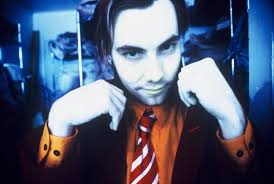
Jacob Applebaum
America’s National Security Agency (NSA) can “vacuum up and store the actual content of every conversation” in the Bahamas and an unnamed country, the new publication The Intercept reported Monday, based on documents leaked by Edward Snowden.
Intercept Editor Glenn Greenwald — who wrote about documents leaked by Snowden when he was a columnist for The Guardian — said the publication didn’t reveal the country because it was “very convinced” that doing so would lead to “deaths.”
After a heated discussion between WikiLeaks, Greenwald, Intercept Editor-In-Chief John Cook, and American WikiLeaks hacker-turned-Der Spiegal contributor Jacob Appelbaum, WikiLeaks tweeted that it will reveal the name of the second country being spied on by the NSA.
As Kelley points out, the implications is that Wikileaks knows the name of the country either by unmasking the redaction with software or because Wikileaks has access to the Snowden files.
The most plausible way for WikiLeaks to have access to a Snowden cache is if Appelbaum, who led the reporting on several Der Spiegel articles based on NSA documents (which may or may not be from Snowden), shared information with his friend and WikiLeaks Editor-In-Chief Julian Assange. Applebaum tweeted that The Intercept’s redaction was “a mistake.”
Appelbaum, a close friend of Laura Poitras, the other journalist whom Snowden gave a large set of documents, also gave a presentation detailing a classified document listing technology available to the NSA’s hacking unit, known as TAO. It is not known how he acquired those documents.

Laura Poitras
So which is it? The careless ways in which the Snowden documents have been passed around between The Guardian and The New York Times and other news organizations; with Greenwald’s husband David Miranda carrying them through London to Berlin and back; as well as the fact that Snowden is in Russia, suggest that the entire cache will eventually be released, and presumably all hell will break loose. It’s only a matter of time.
Charles Johnson posted the entire Wikileaks-Greenwald argument at Little Green Footballs: Slap Fight of the Day: Wikileaks vs Pernicious G
Today on Twitter this happened: Julian Assange, who most people believe is the one behind the @Wikileaks account, threw a huge tantrum because Glenn Greenwald redacted the name of a country from his latest disingenuous article. Greenwald says he was convinced publishing the country’s name would lead to deaths. Assange doesn’t give a shit about that, of course.
There are some inadvertently hilarious moments here; Wikileaks’s Jacob Appelbaum says redacting the country “makes Wikileaks look extreme.” I almost fell out on that one. And then there’s the tweet in which Assange basically calls everyone in Greenwald’s crew “a bunch of racists.” And it all ends with Assange issuing a super-villain threat to release the country’s name “in 72 hours.”
Scroll through the collection below to see what it looks like when extreme libertarians have a purity war.
Head over to Green Footballs if you want the details. Read more exchanges between Wikileaks, Jacob Applebaum, and John Cook, editor of The Intercept at Chirpstory. Read more at Buzzfeed, where Miriam Berger and Miriam Elder provide a timeline of the tweets along with their interpretation: Julian Assange Is Angry At Glenn Greenwald And He’s Not Going To Take It Anymore.

Finally, Bob Cesca’s take on the whole affair: The Wikileaks vs Greenwald Twitter Fight: Julian Assange Threatens To Reveal Deadly NSA Info.
It all began Monday morning when The Intercept posted a new Snowden revelation with cutesy headline: “Data Pirates of the Caribbean: The NSA Is Recording Every Cell Phone Call in the Bahamas.” Get it? Pirates! The article exhaustively describes an operation called MYSTIC and another called SOMALGET in which NSA gathers audio and metadata of cellphone calls in the Bahamas in order to spy on human traffickers and drug cartels. The Bahamas is notorious for both.
Naturally, the article featured all of the deceptive Greenwaldian bait-and-switch we’ve come to expect from his Snowden articles. For example, in paragraph seven, Greenwald and his co-authors Ryan Devereaux and Laura Poitras noted that Sen. Tom Harkin (D-IA), Bill Gates and Oprah Winfrey routinely vacation in the Bahamas:
By targeting the Bahamas’ entire mobile network, the NSA is intentionally collecting and retaining intelligence on millions of people who have not been accused of any crime or terrorist activity. Nearly five million Americans visit the country each year, and many prominent U.S. citizens keep homes there, including Sen. Tom Harkin (D-Iowa), Bill Gates, and Oprah Winfrey.
NSA is spying on Oprah! Stop the presses! But no, if you read all the way down to the 54th paragraph (!!) Greenwald tosses in a token mention of NSA’s rules about preventing data collection against U.S. Persons, whether or not they happen to be inside the U.S. There are very strict “minimization” procedures to eliminate the data that might’ve been inadvertently collected. Why? Because it’s illegal to spy on Americans without an individual warrant. And, by the way, Greenwald & Company noted that the SOMALGET program is, yes, legal.
It sure seems like there are enough hints in the story for anyone to guess the redacted country. Pirates? SOMALGET? Plus the fact the Assange accused Greenwald of “racism.” Read much more interpretation and more tweets at The Daily Banter.
I’ll be keeping a close eye on this story from now on and I’ll pass on any new information.
In other news . . .
On Sunday JJ wrote about an alleged gang rape that reportedly took place after the Calhoun High School senior prom in North Georgia on May 10. The reason I’m writing about it is that Sky Dancing has been getting a huge number of clicks from people looking for more information on this story. It seems people want to know what is happening, but the local papers have not published anything on the crime or the investigation since Sunday. Doesn’t that seem odd and troubling? Is a cover-up in the works. As JJ pointed out it brings back memories of Steubenville, Ohio. After the gang rape there, local officials tried to sweep it under the rug, but a blogger and an “Anonymous” group kept the story alive. Maybe someone with inside information from Calhoun needs to get something like that started? As in Steubenville, there are hints that coddled football players may be involved.

Jacqueline Gomez
Meanwhile, in another prom-related tragedy, a girl was found dead after a prom at MacArthur High School in Houston. According to her mother, the mother of Jacqueline Gomez’ boyfriend was supposed to bring her home that night, but instead the boy’s mother allowed the couple to stay in a hotel room against the Gomez’ mother’s wishes. To me the whole thing sounds really suspicious. From KHOU.com, Mother: Daughter was not supposed to stay at hotel after MacArthur HS prom.
There are new startling details from the mother of a teenagerfound dead on prom night. Her mother feels like she was mislead by her daughter’s prom date and his mother….
Gomez was off to her senior prom at the Hyatt North Houston Hotel. Her mother was too distraught to show her face on camera, but said she expected to see her daughter back at home later that night….
Barron said Gomez’s date’s mother picked the couple up from her home. She also picked them up from the hotel later that night. That’s when she last spoke to her daughter on the phone.
“I just spoke to them after prom, a couple words, told me she was going to get something to eat,” said Barron.
That’s when the boy’s mother got on the phone and asked if Gomez could spend the night at their house.
“I said no, bring her back home,” said Barron. “I gave them a couple hours, and I never heard back.”
The next call she got was from a homicide detective with the Houston Police Department. She said detectives told her the room was booked by the boyfriend’s mother.
What happened? Who gave Jacqueline the drugs and did the boy’s mother know about it? More information from The Houston Chronicle: Texts Hint Girl May Have Overdosed After Prom.
A series of text messages offered new details into the death of Jacqueline Gomez, the 17-year-old Aldine ISD senior found dead Saturday in a Houston motel room the morning after her prom. The texts, sent from an account identified as Gomez’s date, also indicate investigators believe the girl probably overdosed….
Yet nobody can be certain how the MacArthur High School student died until autopsy results are complete – which could take several weeks, the Harris County medical examiner said. And that has the date and Gomez’s family and friends anxiously waiting for the mystery to be solved.
Meanwhile, her friends and family refute any suggestion that Gomez was ever a “party girl,” saying she spent most of her time working at a Kroger grocery and preparing to graduate in June.
Was Jacqueline given a date-rape drug? We may never find out, because those drugs wash out of the system very quickly. Check this out:
“He was posting pictures of himself crying on Instagram. So I a sent him a text that day to ask what had happened to my girl,” said Justice Gonzalez, a close friend of Gomez who saw the couple leave the prom together Friday night to go to that room. Authorities report Gomez was found dead in her bed about 9:20 the next morning.
“They said she overdosed,” part of the text reads, likely referring to law enforcement officials.
He went on.
“I woke up. I tried waking her but she wouldn’t,” the date texted back, adding four frowning faces. “I was screaming and crying telling her to wake up. But she didn’t. She didn’t,” He ended his text with two frowning faces with tears.
He stated she had appeared “perfectly fine and happy” when they left the “Miami Night” prom. She also seemed “happy” when they both went to sleep, he said.
He had told authorities that they had some alcohol, but said in a text to the friend that Gomez had also taken the painkiller hydrocodone.
Why the f&ck didn’t didn’t he take her home, and WTF was his mother thinking?! Furthermore, why can’t something be done to prevent these kinds of after-prom horrors?
Now I’m really mad, and I’m running out of space and time. I’ll post links to other news in the comment thread, and I hope you’ll do the same.

 peej
peej Carissa
 bostonboomer
 dakinikat
 ecocatwoman
 mablue2
 Mama Lopez
 peggysue22
 quixote
 skydancingguestblogger
 Mona (aka Wonk the Vote)



 Sky Dancing
Recent Comments