
Monday Reads
Posted: January 16, 2012 Filed under: morning reads | Tags: Civil Rights, MLK Day, Religoius NUTcases, Rick Santorum, Tim Tebow 27 Comments Good Morning!
Wow. I almost feel human this morning! I spent the last few days with a terrible flu. First, I couldn’t get warm, then I couldn’t cool down. My joints and muscles hurt like crazy. I also had congestion and stuffiness everywhere possible. I gave up on trying to accomplish anything on Friday and just took to bed. Watching TV was too much effort even! Hope you can avoid whatever that was because it made me miserable.
There is one bit of new news. Huntsman is quitting the GOP race for President.
Jon M. Huntsman Jr. informed his advisers on Sunday that he intends to drop out of the Republican presidential race, ending his candidacy a week before he had hoped to revive his campaign in the South Carolina primary.
Mr. Huntsman, who had struggled to live up to the soaring expectations of his candidacy, made plans to make an announcement as early as Monday. He had been set to participate in an evening debate in Myrtle Beach.
It looks like I missed a lot of theatrical politics for the benefit of the American Taliban this weekend. I did enjoy hearing about the Broncos-Pats games. The Saints outcome was gut and heart wrenching. Tewbow’s endzone piety leads to a good question, imho. Can’t we have at least one area of our lives where we don’t have to be subjected to endless shows of self-righteousness? Do football players really have to wear hairshirts on the field? We certainly would take see many folks take issue with football players insisting on prayer rugs and bowing to Mecca down there on the field. Wouldn’t people fight the idea that we stop playing games on Friday night so Jewish football players don’t disrespect the Sabbath? This is getting worse than those nasty Mel Gibson movies.
Sports used to be a refuge from the division and hatred which permeates the media nowadays. Not anymore. This all began in 2010 when Tebow and his mother starred in a controversial pro-life commercial sponsored by FOTF during the Super Bowl aired by CBS. What made it so controversial is that CBS had already turned down ads from left-leaning organizations like PETA and MoveOn.org. There was no room for their message on Super Sunday, but just like last night CBS has no problem airing evangelical right wing messages.
Of course the reason the FOTF commercial was aired in the first place was because Tebow was playing in the game. The Tebowization of the NFL will continue in this year’s Super Bowl as Randall Terry (Who is running as a conservative Democrat challenging President Obama) plans to air a gruesome commercial featuring aborted fetuses. The Right has found their savior in Tebow and the NFL, which is obviously willing to turn Denver Bronco games into Christian recruiting lovefests.
Now don’t get me wrong. I’m sure that Tim Tebow is a nice guy. However when you make the decision to wear your religion on your sleeve, you are pushing your beliefs on people who do not want to hear or see them, especially during an NFL playoff game. I don’t begrudge anyone their own personal beliefs. When you push them and use your position as an NFL player as a platform to foist them on the public, that’s out of bounds. Tebow also energizes the evangelicals who see him as a vessel to push their political agenda. (Rick Perry and Michele Bachmann have already co-opted the Tebow mystique.)
Thanks to CBS and Tebow’s followers, we are headed down a slippery slope. Would it be too much to ask that sports be declared a no-religion zone?
You just can’t get away from the sanctimonious these days. Our local ABC affiliate has now picked up the slogan “God Bless Louisiana”. They’ve got it festooned on billboards and TV. Why this sudden urge to play Pharisee every where I look? I refuse to watch the entire line up now on that station. It’s like an assault. Sorry ABC. I don’t care what you run. I’m not watching until you tell your affiliate to put a sock in it.
I couldn’t even watch TV news this weekend with out enduring the Christian Taliban Hate Fest down there in Texas. We’re fricking infested with these pests! Somebody grab the Constitution and swat them please! At least, remove take tax exempt status away from these guys so they have less money to throw around!
Right now, there’s a somewhat frantic effort among some on the Christian right to corral their movement behind Santorum, who has already proved to be the favorite of evangelicals in Iowa. Many religious right figures are still haunted by their failure in 2008 to rally to Mike Huckabee, which they feel enabled the victory of John McCain, who they distrusted even more than they do Mitt Romney.
On Saturday, more than 150 leading religious conservatives gathered in Brenham, Texas, to see if they could agree, this time, to coalesce behind a single candidate. Perry was eliminated on the first ballot. By the third, when some attendees had already left, Santorum won the group’s imprimatur with 85 votes, compared to 29 for Gingrich. In a conference call about the results, Tony Perkins, head of The Family Research Council, said we could expect fundraising drives and other sorts of activism on Santorum’s behalf from the group’s participants.
Gloria Hein, one of my prayer breakfast tablemates, said the Texas group’s Santorum endorsement made her more likely to vote for him. “I’ve been rooting for Santorum, but I thought he didn’t stand a chance,” she said. “I think that’s a great encouragement that they’re behind him. I’m getting chills right now!”
Maybe she’s just got the flu that I had.
So, today is MLK day. It seems we have a long way to go on all fronts of civil rights. The current discussion over FLOTUS is just one example. Women get the bitch and anger labels whenever they have strong opinions. The usual suspects lined up to point fingers.
The political downsides for both of the Obamas are clear enough. In using the words she did, she risked reactivating an entire narrative that had surrounded her in 2008. This idea that she was in some nebulous way radical and less-than-fully American had been a corrosive one, buttressed most powerfully by her now-infamous campaign trail statement that “for the first time in my adult life I am proud of my country.”
That image was one that it took a great deal of time and work to undo — beginning, perhaps, with her ostentatiously patriotic address to the 2008 Democratic National Convention and continuing with her signature White House initiatives on the most uncontentious of issues: childhood obesity and the welfare of military families.
Last week’s remarks opened the door for ideological opponents of Obama to argue that she was up to her old antics. They needed no second invitation to march through it.
“She comes from a very angry, black nationalist background,” David Webb, a conservative radio talk show host and Tea Party activist who is himself African-American, told The Hill.
In Webb’s view, Obama had emerged from a family of modest means, had been afforded “enormous opportunities” and had gone on to the crowning heights of the White House. Given her official role, he said, she ought to realize that “you have to couch your views, because you’re representing the nation.”
Webb added that the danger in Obama’s remarks was their capacity to turn off even the ideologically uncommitted.
“It’s un-American,” he said, referring to her raising of racial issues. “The majority of Americans do not like that approach, this underhand way of doing things.”
So, here’s a great story from The Christian Science Monitor that highlights 8 peaceful protests that usheredin civil rights laws. One of the most effective was the Montgomery Bus Boycott that

Rosa Parks and Doctor Martin Luther King
lasted a year.
The protest began, on Dec. 1, 1955, after African-American Rosa Parkswas arrested for refusing to give up her seat on a bus to a white person. The next day, Dr. King proposed a citywide boycott of public transportation at a church meeting.
The boycott proved to be effective, causing the transit system to run a huge deficit. After all, Montgomery’s black residents not only were the principal boycotters, but also the bulk of the transit system’s paying customers. The situation became so tense that members of the White Citizens’ Council, a group that opposed racial integration, firebombed King’s house.
In June 1956, a federal court found that the laws in Alabama and Montgomery requiring segregated buses were unconstitutional. However, an appeal kept segregation intact until Dec. 20, 1956, when the US Supreme Court upheld the district court’s ruling. The boycott’s official end signaled one of the civil rights movement’s first victories and made King one of its central figures.
This made me think about the gender-segregated buses in Israel. I think the US should refuse to fund any country that allows this kind of thing. Here’s a link to the New Israel Fund that is committed to democracy, justice and equality for all Israles. It’s hard to believe a modern democracy could do this to women, isn’t it?
- Israel’s High Court of Justice has given Transport Minister Israel Katz (Likud) until December 27 (update: the deadline has been extended) to present his position on gender- segregated bus lines. The order followed a report by a special committee set up by the Ministry of Transport, which ruled that these bus lines are illegal because they humiliate and discriminate against women passengers.
- The Ministry of Transport committee was set up following a petition in 2007 by veteran New Israel Fund grantee Israel Religious Action Center (IRAC) for Progressive Judaism (Reform) and novelist Naomi Ragen against the gender-segregated bus lines. The court ordered the committee to consider, rule on and regulate the matter.
- More than ten years ago, the ultra-Orthodox (haredi) community asked Israel’s public bus company, Egged, to provide segregated busses in their neighborhoods. By early 2009 more than 55 such lines were operating around Israel. Typically, women are required to enter through the bus back doors and sit in the back of the bus, as well as “dress modestly.”
- Some buses operate in or through mixed neighborhoods and are the only buses running on particular routes. In Jerusalem, the segregated buses actually charge lower fares than ordinary Egged busses. Women who refuse to sit in the back of the bus are frequently threatened verbally and physically by haredi men who “enforce” the segregation system.
- In October, the special Ministry of Transport committee recommended a year-long trial in which men and women could choose to enter the buses by separate doors and sit separately, but stressed that all seating on public buses must be voluntarily and no coercion must be used. The committee further stressed that there is no separate, publicly-run bus system for haredi communities, and every member of the public has the right to use buses in accordance with basic human rights and the principle of equality.
- Many Israelis fear that the right-wing governing coalition, which includes all but one of the major religious parties, will pressure the Minister into rejecting the committee report and supporting the continuation of segregated and discriminatory public transportation.
It seems that a lot of countries are having problems with their fundamentalist religious sects who are demanding that discriminatory, hateful, and unreasonable practices be enacted. Our country must respect the right of each individuation to practice their beliefs, but our laws, civil rights, and culture should not be skewed to bow down to these narrow beliefs.
Happy MLK Day! I can hear the parade going down Claiborne as it goes through the Ninth Ward to Down Town. Let’s remember the dignity of no person should be limited due to the narrow views of any religion.
What’s on your reading and blogging list today?
Friday Reads: A Brainy Break from the Village
Posted: January 13, 2012 Filed under: Economy, Egypt, Elections, Foreign Affairs, health hazard, Labor unions, morning reads, psychology 18 Comments Good Morning!
I thought I would treat you to some academics this morning starting with two well known economists and their thoughts on 2012. I figured we needed a break from the primary season insanity. First up is Nobel Prize Winner Joseph Stiglitz on “The Perils of 2012”. The next two offerings are from Project Syndicate.
This year is set to be even worse. It is possible, of course, that the United States will solve its political problems and finally adopt the stimulus measures that it needs to bring down unemployment to 6% or 7% (the pre-crisis level of 4% or 5% is too much to hope for). But this is as unlikely as it is that Europe will figure out that austerity alone will not solve its problems. On the contrary, austerity will only exacerbate the economic slowdown. Without growth, the debt crisis – and the euro crisis – will only worsen. And the long crisis that began with the collapse of the housing bubble in 2007 and the subsequent recession will continue.
Moreover, the major emerging-market countries, which steered successfully through the storms of 2008 and 2009, may not cope as well with the problems looming on the horizon. Brazil’s growth has already stalled, fueling anxiety among its neighbors in Latin America.
Meanwhile, long-term problems – including climate change and other environmental threats, and increasing inequality in most countries around the world – have not gone away. Some have grown more severe. For example, high unemployment has depressed wages and increased poverty.
While that was what appeared to be Dr. Gloom, here is Doctor Doom. Dr. Nourielle Roubini writes that the global economy will be “Fragile and Unbalanced in 2012”.
Private- and public-sector deleveraging in the advanced economies has barely begun, with balance sheets of households, banks and financial institutions, and local and central governments still strained. Only the high-grade corporate sector has improved. But, with so many persistent tail risks and global uncertainties weighing on final demand, and with excess capacity remaining high, owing to past over-investment in real estate in many countries and China’s surge in manufacturing investment in recent years, these companies’ capital spending and hiring have remained muted.
Rising inequality – owing partly to job-slashing corporate restructuring – is reducing aggregate demand further, because households, poorer individuals, and labor-income earners have a higher marginal propensity to spend than corporations, richer households, and capital-income earners. Moreover, as inequality fuels popular protest around the world, social and political instability could pose an additional risk to economic performance.
Oops, I mentioned income inequality. I must hate capitalism and be a collectivist. Right? Absolutely not! After studying markets for as long as I have–and teaching others about them–I have a pretty good understanding about how they work and it’s not based on wishful thinking or trying to hide the woefully low amount of taxes I pay. Oh, and I betcha that my dad created more jobs in his life time than Willard ever did. I also know that income inequality is bad for every one and that includes the superrich. That’s why it’s good to ask “Why is Inequality Higher in America?”‘ Henry Farrell of GW–professor of political science–breaks down a study in a series of two articles. The study looks at the increasing use of veto power by Senators and finds that problems happen as you increase the number of players with the ability to block laws.
Linz and Stepan argue that high numbers of electoral veto players are highly correlated with inequality, and that studies of other systems (Australia, Switzerland) suggests that more veto players create greater lags in introducing welfare systems and block reform (interestingly though, these cases involve referendums as a block to legislation rather than the kinds of vetos seen at the federal level in the US). However, they also claim that veto points are not destiny – the experience of reform in Brazil argues that Barack Obama could have instituted Senate reform and hence reduced down the effective number of veto players from four to one.
The original essay can be found at Cambridge Journals but the authors have published books on the topic as well. The authors research is mostly in the area of countries transitioning to Democracies. The Atlantic published an essay of theirs called “How Egypt Can Make Democracy Work” last February.
Regardless of who leads it, there are some things an interim government should not do. Judging by the transitions that we have studied, a successful democratic outcome stands the best chance if the interim government does not succumb to the temptation to extend its mandate or write a new constitution itself. The interim government’s key political task should be to organize free and fair elections, making only those constitutional changes needed to conduct them. Writing a new constitution is best left to the incoming, popularly elected parliament.
Most activists and commentators are now asking who will or should become the next president. But why assume that a presidential political system, headed by a powerful unitary executive, will be instituted? Of the eight post-communist countries in the European Union, not one chose such a system. All of them established some form of parliamentary system, in which the government is directly accountable to the legislature and the president’s powers are limited — and often largely ceremonial.
That was a wise decision. A presidential election at a moment of great uncertainty, and in the absence of experienced democratic parties or broadly accepted leaders, is filled with danger.
Archeologists are examining an interesting time in American history for clues of America’s largest labor conflict between miners and coal mine owners. An unlikely coalition of people are trying to stop clear mining–and hence destruction–of the site. This article can be found in Archaeology Today.
The archaeology on the mountain, and the story it is beginning to tell, has helped bring together an unusual coalition—including the Sierra Club, the United Mine Workers of America (UMWA), the National Trust for Historic Preservation, and a number of local organizations—in what some are calling “The Second Battle of Blair Mountain.” It is certainly a fight over historic preservation, but for many involved, including local archaeologists and historians, the mountain is symbolic of much more—labor struggle, the social effects of resource extraction industries, and what they see as a century-long class conflict. The mountain’s loss to surface mining, they assert, would be personal, a major blow to Appalachian identity.
Coal mining has always been one of the most dangerous and difficult jobs, and the late nineteenth century in the southern coalfields saw it at its worst. There were few safety regulations for workers—undocumented European immigrants, African Americans, and poor Scots-Irish hill folk—and every aspect of their lives was controlled by their employers. They lived in company towns, bought their own equipment at company stores, and listened to company-approved sermons in company churches. As labor movements picked up elsewhere, even in coal regions to the north, they seemed to pass the southern coalfields by.
Nature reports on the attempts to tighten the use of antibiotics on farm animals. Just like humans, animals and their diseases are showing an increased resistance to the current medicines. A new rule will go into effect in April to try to slow down the trend towards increased resistance. The EU already has stricter rules in place.
In industrial farming, antimicrobials are commonly given to farm animals to treat infections, and prophylactically to prevent disease or spur growth. But there is growing concern that excessive use on farms is helping to breed antibiotic-resistant microbes, from Salmonella (see ‘Rising resistance’) to Escherichia coli, which are harder to treat when they infect people.
The US Food and Drug Administration (FDA) is now moving to protect key antibiotics known as cephalosporins, which are used in humans to treat a range of infections, including pneumonia. On 4 January, the agency said that it would prohibit certain uses of cephalosporins in farm animals including cattle, pigs, chickens and turkeys, because overuse of the drugs is “likely to contribute to cephalosporin-resistant strains of certain bacterial pathogens”. If cephalosporins become ineffective in treating human diseases, the FDA said, “doctors may have to use drugs that are not as effective, or that have greater side effects”.The new rules, to come into effect on 5 April, restrict veterinary surgeons to using the two cephalosporin drugs specifically approved for food-producing animals — ceftiofur and cephapirin — and ban prophylactic use. In animals not listed in the FDA order, such as ducks or rabbits, vets will have more discretion to use the drugs.
Most antibiotic classes are used both in animals and in humans, so the FDA is also considering tightening controls on all classes of antimicrobials used on farms. It is reviewing comments on rules that would prohibit the use of any antimicrobial drug to promote animal growth, a move that would be welcomed by many vets. “We would support greater veterinary oversight of antimicrobial drugs,” says Christine Hoang, assistant director of scientific activities at the American Veterinary Medical Association in Schaumburg, Illinois.
Psychology Today has some interesting information on Deadly Mind Traps. Dr. Boomer knows these as cognitive errors. Most of us call them self-defeating behaviors.
Intriguingly, research into this kind of self-defeating behavior shows that it is usually far from random. When we make mistakes, we tend to make them in ways that cluster under a few categories of screwup. There’s a method to our mindlessness. Most of the time, we’re on autopilot, relying on habit and time-saving rules of thumb known as heuristics.
For the most part, these rules work just fine, and when they don’t, the penalty is nothing worse than a scraped knee or a bruised ego. But when the stakes are higher, when a career is in jeopardy or a life is on the line, they can lead us into mental traps from which there is no escape. One slipup leads to another, and to another, in an ever-worsening spiral. The pressure ratchets up, and our ability to make sound decisions withers.
These cognitive errors are most dangerous in a potentially lethal environment like the wilderness or the cockpit of an aircraft, but versions of them can crop up in everyday life, too, such as when making decisions about what to eat, whom to date, or how to invest. The best defense? Just knowing they exist. When you recognize yourself starting to glide into one of these mind traps, stop, take a breath, and turn on your rational brain.
There’s a list of the classic errors and explanations in case you want to check it out. Turning on your rational brain sounds like something the Republican presidential wannabes should do right now. I think it would surprise every one, don’t you?
So, that’s your brainy break from the mainstream media. What’s on your reading and blogging list today?
Thursday Reads
Posted: January 12, 2012 Filed under: 2012 presidential campaign, 2012 primaries, Mitt Romney, morning reads, Psychopaths in charge, Republican presidential politics, U.S. Economy, U.S. Politics, We are so F'd | Tags: Bain Capital, Barack Obama, Charles Dickens, Christopher Hitchens, Elizabeth Warren, Eric Fehrnstrom, iran, israel, Mitt Romney, Newt Gingrich, Scott Brown 33 Comments
Good Morning!!
I’m still in shock from the realization that Willard “Mitt” Romney is most likely going to be the Republican nominee. I never thought the day would come when a candidate would appear who is more soulless, more shallow, more banal, and less prepared to be president than Barack Obama. But Romney is all those things. I don’t think he knows any more about politics or economics than Donald Trump, and he’s just as much of a blowhard. What could possess anyone to vote for him? The American experiment has truly failed when these two psychopaths are the choices to lead the nation.
I was looking forward to Newt Gingrich’s attacks on Romney’s corporate raider past, but as Minkoff Minx reported last night, someone got to Newt and told him to cool it.
Newt Gingrich on Wednesday suggested his attacks on rival Mitt Romney’s record at Bain Capital have not been rational – though a spokesman insisted Gingrich is not backing off the attacks.
Gingrich’s comment came after a voter in Spartanburg, South Carolina, told Gingrich that he believed the former House speaker has “missed the target on the way you’re addressing Romney’s weaknesses.”
“I want to beg you to redirect and go after his obvious disingenuosness about his conservatism and lay off the corporatist versus the free market,” said the voter.
Gingrich replied: “I agree – I agree with you.”
“I think it’s an impossible theme to talk about with Obama in the background,” Gingrich continued. “Obama just makes it impossible to talk rationally in that area because he is so deeply into class warfare that automatically you get an echo effect which, as a Reagan Republican it frankly never occurred to me until it happened. So I agree with you entirely.”
Gingrich, who has harshly criticized Romney for his record at Bain, seemed to be saying he cannot “talk rationally” about Romney’s record because of the way Mr. Obama frames the issue.
He sure doesn’t sound rational there. I can’t figure out what he’s even trying to say. But it sounds like he’s claiming that somehow Obama made him attack Romney. Sadly, I’m afraid we may never see that “When Romney Came to Town” video now. Rats!
According to an article in the NYT, Romney’s advisers have been “shaken by attacks” on the candidate’s record at Bain Capital.
Although the advisers had always expected that Democrats would malign Mr. Romney’s work of buying and selling companies, they were largely unprepared for an assault that came so early in the campaign and from within the ranks of their own party, those involved in the campaign discussions said.
Even as Mr. Romney coasted to victory in New Hampshire, they worry that the critique could prove more potent as the race shifts to South Carolina, where shuttered mills dot the landscape, unemployment is higher and suspicion of financial elites is not limited to left-leaning voters.
Both Iowa and New Hampshire have unemployment rates in the 5% range.
In his victory speech Tuesday night, Mr. Romney lamented that “desperate Republicans” were attacking the free enterprise system and the very notion of success.
“This is such a mistake for our party and for our nation,” he said. “The country already has a leader who divides us with the bitter politics of envy.”
That message was echoed by Mr. Romney’s surrogates and embraced by a number of influential conservatives on Tuesday, from Rush Limbaugh to Michelle Malkin and the Club for Growth.
Unfortunately, the attacks seem to have caused many conservative who were previously unenthusiastic about Romney to rise to his defense.
At conservative blog Patterico’s Pontifications, “Karl” points out that it’s a little strange that Romney’s advisers weren’t expecting this, since Republican rivals have brought the issue up in Romney’s previous campaigns. I’m curious to see how all this will play in South Carolina.
Charlie Pierce had a bit of interesting Massachusetts gossip yesterday afternoon. Apparently one of Romney’s close advisers, Eric Fehrnstrom, is also an adviser to Senator Scott Brown, who as we all know is involved in a tough reelection fight with Elizabeth Warren.
Anyway, the gossip around the Massachusetts GOP — which is a small enough group that gossip can circulate at speeds at which matter is spontaneously created — is that some people in McDreamy’s re-election campaign have begun to complain that Fehrnstrom is spending too much time with Willard and not enough with their man, who’s in a much tougher fight with Elizabeth Warren than Romney is with the assemblage of second-raters in the Republican primary. It’s hard to see how Fehrnstrom can keep both of those balls in the air at the same time and, if he can’t, my guess is that McDreamy is the loser. This will not be a good thing for that campaign.
And speaking of Liz Warren, she raised twice as much money as Brown in the last quarter.
She has just over $6 million on hand, her campaign reported this afternoon.
Warren’s overall fund-raising for those few final months of 2011 outpaced Republican Senator Scott Brown’s total for the same time period. On Monday, Brown’s campaign released figures showing that he collected $3.2 million in the final quarter of 2011 and raised a total of $8.5 million last year.
Still, Brown holds a strong advantage, having accumulated $12.8 million in his campaign account, a record amount for any Massachusetts candidate this early in the election cycle.
Michelle Obama denies that she ever had any disagreements with Rahm Emanuel, as was reported in the new book “The Obamas” by NYT writer Jodi Kantor.
Obama said in an interview that aired on CBS’s “This Morning” that she does not routinely interfere in West Wing business despite reports that she clashed with top West Wing aides and has expressed her concerns and displeasure about policy and politics through back channels.
“I don’t have conversations with my husband’s staff. I don’t go to the meetings,” she told King. “I guess it’s more interesting to imagine this conflicted situation here, a strong woman. But that’s been an image that people have tried to paint of me since the day that Barack announced — that I’m some angry black woman.”
Obama said that she and former chief of staff Rahm Emanuel “never had a cross word” — despite Kantor’s reporting that they clashed over strategy and policy during Emanuel’s tenure.
In foreign news, another Iranian nuclear scientist has been assassinated. From the Globe and Mail:
Amid escalating threats, the covert war to thwart Iran’s efforts to get nuclear weapons took an ugly – if gruesomely familiar – turn Wednesday with the murder of a young Iranian nuclear scientist on a Tehran street.
It was the fourth such reported targeted assassination in two years, adding a dangerous new element to the escalating conflict over Iran’s refusal to rein in its nuclear program or to open it to international inspection.
Wednesday’s killing in North Tehran was similar to previous attacks. Using powerful magnets, a motorcyclist attached a small delayed-action bomb to a car carrying Mostafa Ahmadi-Roshan, a nuclear scientist and university professor.
The explosion killed the 32-year-old chemistry professor, who worked at the sprawling Natanz nuclear facility, and another person in the car, reports said. The pinpoint attack focused the blast into the car during the morning rush hour.
Wonderful. Are we being pushed into another war after just beginning to extricate ourselves from Iraq? The NYT reports that the covert actions are believed by “experts” to be coming from Israel, the Iranians, probably with good reason, assume the U.S. is also involved.
Iranian officials immediately blamed both Israel and the United States for the latest death, which came less than two months after a suspicious explosion at an Iranian missile base that killed a top general and 16 other people. While American officials deny a role in lethal activities, the United States is believed to engage in other covert efforts against the Iranian nuclear program.
The assassination drew an unusually strong condemnation from the White House and the State Department, which disavowed any American complicity. The statements by the United States appeared to reflect serious concern about the growing number of lethal attacks, which some experts believe could backfire by undercutting future negotiations and prompting Iran to redouble what the West suspects is a quest for a nuclear capacity.
Both Obama and Hillary Clinton denied any U.S. involvement. Sure.
Finally, there’s a wonderful article by the late Christopher Hitchens in the new Vanity Fair: Charles Dickens’s Inner Child. I haven’t finished reading it yet, but so far I’m very much enjoying it. I love Dickens and reading the piece made me want to pick up on of his novels again soon–maybe I’ll reread my favorite one–“Our Mutual Friend.” What a great book it is!
That’s all I have for today. What are you reading and blogging about?
Tuesday Reads: Gordon Gekko for President?
Posted: January 10, 2012 Filed under: 2012 presidential campaign, Barack Obama, Hillary Clinton, Mitt Romney, morning reads, Newt Gingrich, Republican presidential politics, U.S. Economy, U.S. Politics, unemployment | Tags: Citizen's United, corporate raiders, leveraged buyout firms, Massachusetts Governor's race 2002, Mitt Romney, New Hampshire primary, Newt Gingrich, Robert Reich, Roberts Court, SCOTUS, Wall Street 27 Comments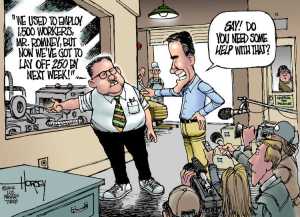
Good morning! Today is the New Hampshire primary. We’ll live blog the returns later tonight. As of last night, Gordon Gekko Mitt Romney had a big lead in the polls, with Ron Paul second and John Huntsman and Rick Santorum tied for third place.
Romney, the former governor of neighboring Massachusetts, holds a 24 percentage point lead over his closest rival, with 41 percent of likely Republican primary voters indicating they’d vote for him, the WMUR New Hampshire Primary Poll said.
U.S. Rep. Ron Paul from Texas was favored by 17 percent of likely primary voters, followed by former Utah Gov. Jon Huntsman and former U.S. Sen. Rick Santorum of Pennsylvania, each with 11 percent, and former House Speaker Newt Gingrich collecting 8 percent.
Several polls indicated Gingrich would finish in the top three.
“All of the candidates behind Romney have a good chance finishing anywhere between second and fifth place,” said Andrew Smith, director of the UNH Survey Center in Durham.
Yesterday Romney stepped in it again when he told an audience that he really likes firing people.
The final day of campaigning saw Romney under fire for a comment about health insurance that quickly became fodder for criticism.
Asked about the issue in Nashua, New Hampshire, Romney said he wanted a person to be able to own his or her own policy “and perhaps keep it the rest of their life.”
“That means the insurance company will have the incentive to keep you healthy. It also means if you don’t like what they do, you can fire them,” he said.
“I like being able to fire people who provide services to me,” Romney added. “If someone doesn’t give me the good service I need, I want to say I am going to get somebody else to provide that service to me.”
Romney complained that everyone was taking his remarks out of context, but when you’re a former corporate raider worth $250 million, it’s probably a good idea to watch what you say about putting people out of work.
Anyway, the latest meme about Romney is that he’s Gordon Gekko brought to life. I think it’s a pretty good comparison. I don’t know if you recall the quote from the recent Vanity Fair profile of Romney that I included in a recent post:
Romney described himself as driven by a core economic credo, that capitalism is a form of “creative destruction.” This theory, espoused in the 1940s by the economist Joseph Schumpeter and later touted by former Federal Reserve Board chairman Alan Greenspan, holds that business must exist in a state of ceaseless revolution. A thriving economy changes from within, Schumpeter wrote in his landmark book, Capitalism, Socialism and Democracy, “incessantly destroying the old one, incessantly creating a new one.” But as even the theory’s proponents acknowledged, such destruction could bankrupt companies, upending lives and communities, and raise questions about society’s role in softening some of the harsher consequences.
Romney, for his part, contrasted the capitalistic benefits of creative destruction with what happened in controlled economies, in which jobs might be protected but productivity and competitiveness falters. Far better, Romney wrote in his book No Apology, “for governments to stand aside and allow the creative destruction inherent in a free economy.” He acknowledged that it is “unquestionably stressful—on workers, managers, owners, bankers, suppliers, customers, and the communities that surround the affected businesses.” But it was necessary to rebuild a moribund company and economy.
That sure sounds Gekko-like, doesn’t it?
Yesterday, Rick Klein of ABC News addressed the Romney/Gekko issue.
Virtually all of Romney’s rivals are now sensing a powerful issue. Jon Huntsman said today that the firing comment shows that Romney is “completely out of touch” with the American economy.
Rick Perry, skipping ahead a state, is calling it the “ultimate insult for Mitt Romney to come to South Carolina and tell you he feels your pain, because he caused it.”
Gingrich is equating Romney’s business style with finding “clever legal ways to loot a company.” Rick Santorum’s stump speech includes a line about not needing a CEO as president, and he suggested at ABC’s Saturday night debate in New Hampshire that Romney’s background calls into question whether he “can inspire and paint a positive vision for this country.”
Romney hasn’t made matters easier for himself as he’s tried to connect with voters on the economy. The son of a millionaire business titan said over the weekend: “I know what it’s like to worry about whether or not you are going to get fired.”
Klein claims it’s too late for any of this to affect the New Hampshire primary results. I wouldn’t be so sure. New Hampshirites are famous for making up their minds at the last minute. Remember Hillary’s surprise win in 2008?
Romney has been expecting the Gordon Gekko comparisons, so you have to wonder why he hasn’t managed to curb some of these Gekko-like remarks. I guess he just can’t help himself.
Mitt Romney says he knows a photo in which he appears with other executives at Bain Capital LLC posing with cash in their hands, pockets and mouths will be used against him if he wins the Republican presidential nomination.
The 1980s image — called the “Gordon Gekko” photo by some Democrats, a reference to the Michael Douglas character in the movie “Wall Street” — offers an easy attack line at a time of high unemployment and sharp rhetoric against the nation’s top money managers, investors and bankers.
“We posed for a picture, just celebrating the fact that we had raised a lot of money and then we hoped to be able to return it with a good return,” Romney said on “Fox News Sunday.”
Here’s Romney’s defense of the photo on Fox News Sunday.
Andrew Leonard of Salon also discussed the comparison of Romney with Gekko.
Like Gekko, Romney made his fortune buying and selling companies; and like Gekko, he believes that his “greed is good” version of rough-and-tumble creative destruction is a positive force for America, weeding out the bad performers and nurturing lean-and-mean profit engines. If you are looking for the paradigmatic exemplar of the new style of capitalism mogul launched by the Reagan revolution, Romney is your man. Michael Douglas’ Gordon Gekko is merely ersatz.
But what Leonard finds so amazing is that this attack on Romney and his leverage buyouts is being led Newt Gingrich.
The shock is to see Newt Gingrich and his financial backers channeling the Oliver Stone critique so passionately and wholeheartedly. If you have not seen the three-minute advertisement “When Romney Came to Town,” the soon-to-be debuted documentary lambasting Romney as the enemy of the American worker, prepare to be flabbergasted.
“Their greed was only matched by their willingness to do anything to make millions in profits.”
“This film is about one such raider and his firm.”
“His mission: To reap massive rewards for himself and his investors.
“Romney took foreign seed money from Latin America, and began a pattern exploiting dozens of American businesses.”
And so on. Michael Moore doesn’t sting this hard, and MoveOn isn’t this angry. If Romney, as expected, ends up winning the Republican nomination, Obama’s campaign team can relax. Their work has already been done.
Here’s the trailer for the 27-minute documentary that Gingrich backers have purchased.
Politico calls it “the Bain Bomb.”
While conservatives look unlikely to unite around one alternative to Romney, the campaigns themselves are uniting around the theme that the former head of Bain Capital looted companies, tossed people out of jobs and is now exaggerating his success at the venture capital firm.
In the context of this moment in American politics, in which frustration with the privileged is boiling hot, the attack, from Republicans on one side and the Obama campaign on the other, will test Romney. If he ends up looking more like an opportunist who profited for the few than like a man who created jobs for the many, it’s hard to imagine his polls numbers won’t drop.
Conservative bloggers, who generally can’t stand Romney have begun defending him against his rivals attacks, and Dana Millback called Romney “the Scrooge McDuck of the 2012 presidential race. Bloomberg reports that buyout firms are getting nervous about damage to their reputations.
This could be fun to watch. I thought Newt’s attack on Romney yesterday was spot on.
Is Romney full of shit or what? He even makes Newt Gingrich look good. I hope Newt sticks around and continues letting it all hang out. Every single word he said about Romney was the truth.
I’m going to wrap this up with a more serious take on Romney from Robert Reich: Mitt: Son of “Citizen’s United.” I had forgotten that Reich ran for governor of Massachusetts in the the Democratic primary in 2002. Please go read the whole thing and try not to weep while you’re doing it.
As Reich says, Romney is the ultimate big money candidate. He was in 2002, and now with the help of the Roberts Court, he has more money than any candidate ever dreamed of before. If you thought Obama was the candidate of Wall Street–and he was in 2008–Romney is soooo much more so. He has money and connections that make Obama’s fundraising look pathetic. And none of this money even needs to be reported–it could be coming from overseas, even from foreign governments, and we’d never know.
Tonight we’ll find out of any of this barrage of Gordon Gekko/Mitt Romney comparisons will have any effect. I’m rooting for Romney to be taken down a peg. And then on to South Carolina!
Please share your links in the comments, and I hope to see you tonight for the live blog.
Monday Morning Reads
Posted: January 9, 2012 Filed under: John Birch Society in Charge, morning reads, Republican politics, Republican presidential politics | Tags: christofascists, libertarian fascists, Republicans 33 Comments Good Morning!
Yes, it’s that time of year when Republicans try to convince us that everything old, disproved, and thrown out is shiny, patriotic and new again. Angry sky gods, debunked scientific hypotheses, and myth trump rule of law, science, and reason. Here’s a few things on their most choice delusions.
We’re not only fighting the war for abortion access and rights, we’re fighting for legal access to birth control. There’s a group of religious radicals in our country that just won’t take a supreme court case at face value. I was appalled by Romney’s insistence in this weekend’s debate that this really wasn’t a problem and wouldn’t be one. Once again, some pharmacists think they are above the law and know more than doctors because some high priest of ignorance said make it so. Men trying to buy Plan B are having trouble doing so .
Defenders of Kathleen Sebelius’ decision to overrule the FDA’s decison to make Plan B emergency contraception available over-the-counter without age restrictions floated the specter of 11-year-old girls having sex to justify the decision. (Though, of course, the sex has already happened when the Plan B is purchased, so really, people who float this argument are just arguing that it’s better for the 11-year-old in question to be pregnant than not, which seems really cruel.) The reality is that fewer than 1 percent of 11-year-olds are sexually active, so the real people hurt by these restrictions are the 15- and 16-year-olds having sex with age-appropriate partners and those 17 and older who have a legal right to the pill but find that having to ask for a pharmacist to fetch it is too much of an obstacle, because either the pharmacy counter is closed or because the pharmacy staff won’t hand it over, either out of ignorance or malice.
For those who would scoff at the chance that these are serious concerns, I give you the story of a Jason Melbourne of Mesquite, Texas went to the Mesquite CVS to buy Plan B for his wife, who had to stay home to look after their two small children. The reward he got for being a good husband who goes to the drugstore to buy lady things for his wife was resistance from the pharmacy staff, who refused to sell him the drug because they claimed to believe that men don’t have a legal right to buy it. Well, the problem is there are no gender restrictions on access to Plan B, something that Melbourne demonstrated to the staff by use of Google on a smartphone. They continued to refuse to sell to him, making outrageous claims about men supplying the drug to rape victims, even though he got his wife on the phone to explain the situation. Melbourne is the second man who has reported being denied Plan B at a CVS to the ACLU. Considering how many people don’t contact the ACLU after having their rights violated—or who would believe the pharmacy staff’s claims—that suggests this could be a widespread problem.
The Economist is suggesting that Americans are entering an age where they should lock their doors lest the morality police get inside. There are folks like Rick Santorum that want to control our sex acts, our reproductive processes, and our basic civil rights based on personal bigotry and religious hysteria. They warn us that “Now is the time for consenting adults to lock their bedroom doors”. Who needs to be concerned about creeping sharia law when we’ve got this set actively pushing their equally creepy religious cult practices?
Last September the former senator was one of nine Republican hopefuls participating in a televised debate in Orlando, Florida. A question was posed over video by a soldier in Iraq who said he had hidden the fact that he was gay because he did not want to lose his job. Did any of the candidates intend to repeal the measure Barack Obama signed into law last year that had at last given gay soldiers the right to serve their country openly? Mr Santorum’s unblinking answer was Yes. Allowing gays to serve in the military was giving one group of people “a special privilege”; it was “social policy” that ought to have no place in the armed forces.
This became a notorious exchange, not least because some members of the ultra-conservative audience in Orlando booed the soldier. But the episode hardly does justice to the depth of the former senator’s feelings about the things gays get up to. The propinquity of the wicked plainly has an unsettling impact on the peace of mind of the virtuous Mr Santorum.
Gays should not only be disqualified from serving their country, says Mr Santorum. They should also be prohibited from marrying one another. Even if unmarried, they would be ill-advised to have sex. To Mr Santorum the Supreme Court’s ruling in 2003 that anti-sodomy laws were unconstitutional was a bad mistake: this was a slippery slope that would establish a right to bigamy, polygamy, incest, adultery—“anything”.
It is not quite clear what Mr Santorum thinks about heterosexuals who have sex for fun—or at least who have it only for fun. The special status of marriage, he told the New York Time, does not exist “because people like to hang out together and have fun”; it is there to provide “a stable environment for the raising of children”. As president, he said more recently, he would at last address “the dangers of contraception in this country”, because contraception is a “licence to do things in a sexual realm that are counter to how things are supposed to be”.
If Mr Santorum has doubts about contraception, he has none about abortion. It is wrong, even in cases of rape or incest, because life is sacred and begins at conception (he does, however, support the death penalty, as it is not the innocent who die). Any doctor who performs an abortion should face criminal charges.
The Economist must feel that we are so confused about the role of religion in the founding of our country, that they must to show us and the rest of the world that our founding fathers weren’t fundamentalist crusaders. They have a special Religion in America section up about how the founders were trying to avoid having Rick Santorum moments. Here’s an apt and correct description of the religious philosophy of then Presbyterian Thomas Jefferson.
But Jefferson, like most of the top figures in the American Revolution, was far more of a sceptic in religious matters. He was fascinated by metaphysics but he had no time for the mystical. In contrast with today’s vituperative exchanges, these differences did not stop the two gentlemen maintaining a warm correspondence. But Jefferson’s approach to redacting the Bible involved something more radical than translation. He literally snipped out everything supernatural: miracles, the Virgin birth, the resurrection. The result was his own, non-mystical account of the life of Jesus. He told his old comrade: “I too have made a wee little book from the same materials which I call the ‘Philosophy of Jesus.’ It is a paradigma [sic] of his doctrines, made by cutting the pages out of the book and arranging them on the pages of a blank book…A more beautiful or precious morsel…I have never seen. It is a document in proof that I am a real Christian, that is to say, a disciple of the doctrines of Jesus, very different from the Platonists who call me infidel and themselves Christians.”
If Jefferson was a Christian of any kind, he was an idiosyncratic one. He admired Jesus as a moral teacher but like many of America’s revolutionaries, he had a visceral loathing for priestcraft. Jefferson blamed Saint Paul, the early Church, and even the Gospel writers for distorting the mission of Jesus, which, as he saw it, had been to reverse the decadence of the Jewish religion. Starting from the (correct) proposition that mystical ideas originating from Plato were influential when Christian theology was being developed, he castigated followers of the Greek philosopher for corrupting what he saw as the original Christian message.
Did Jefferson believe in God? Certainly not the Christian idea of a God in three Persons; he saw that notion as incomprehensible and therefore impossible for a rational person to accept. One view is that like many of America’s founders, he was a Deist, believing in a Creator who set the universe and its laws in motion but did not intervene thereafter. (The Deist God has been described as rather like a rich aunt in Australia—benevolent, a long way off, and mostly leaving the world to its own devices.)
Modern fundamentalists are rewriting history in the same way they like rewriting science. They place dinosaurs and modern people in their garden of Eden panoramas. Some now argue that the founders didn’t like “Darwinism” which wasn’t even around at that time Of course, that doesn’t stop Texas putting that kind’ve nonsense in textbooks. This also explains Michelle Bachmann’s odd notion that the founding fathers fought against slavery.
Believers in the idea that America was established as a Christian state scored a hit last year when the Texas school board, a politicised body in which evangelicals control crucial votes, ordered up textbooks laying out this view. Given the size of the Texan market, school-book publishers across the country often follow its lead. The best-known advocate of the “Christian nation” theory is a Texan, an author and evangelist called David Barton, who has been writing on the subject since the 1980s.
Among his recent claims are that the founding fathers rejected Darwinism (although they pre-dated Charles Darwin), and that they broke away from Britain in order to abolish slavery. In fact the southern states only joined the Revolution on the understanding that slavery would not be questioned. Strange as his views may sound to most scholars, Mr Barton’s philosophy is taken seriously in Republican circles. When Rick Perry, the Texas governor and presidential candidate, held a day of prayer for the nation in August, Mr Barton was an acknowledged endorser. One of Mr Barton’s admirers is Newt Gingrich, the former House speaker who argues that American history has been distorted by secular historians to play down the role of faith. “I never listen to David Barton without learning a whole lot of new things,” Mr Gingrich has said.
Here’s another bit of founder philosophy. This time it’s George Washington.
Virtually absent from Washington’s pronouncements was any reference to Jesus. He did not take communion—for most Christians, the most important rite of their faith—and he did not summon a Christian minister to his death bed. Was Jefferson right, then, to claim that “[Washington] thinks it right to keep up appearances but is an unbeliever”? Washington was certainly a diplomat. Although he remained formally Anglican, as president he wrote friendly letters to many Christian and Jewish communities and attended their services. And when he needed a job done on the estate, he was firm, for his time, about the irrelevance of religion: “If they are good workmen,” he said, “they may be Mahometans, Jews or Christian of any sect, or they may be atheists.”
As every American youngster has been taught, one thing that Washington, Jefferson and all the founders did believe in was religious freedom. They were appalled by the fusion of religious and political power, epitomised by the divine right of kings.
Another example of reheated nonsense popping up in the current Republican primaries is Ron Paul’s obsession This is a completely debunked set of economic philosophies and musings roughly associated with Fredich Hayek who had a few good ideas about the pricing mechanisms of the market that were completely contorted by some fascists. If you ever hear any one say anything about Mises, cover your ears. It’s basically akin to learning astrophysics from a flat earther who denies the theory of gravity. No amount of historical data deters these people. This description is from Matt Yglesias.
But “Austrians” in Paul’s sense refers to something narrower, specifically the thought of Ludwig Von Mises and his student Murray Rothbard. It is a form of capitalism that is even more libertarian and anarchic than that espoused by many libertarians. Rothbard‘s followers, most prominently longtime Paul associate and founder of the Mises Institute Lew Rockwell, have been waging a decades-long war against the Koch brothers and the more mainstream form of libertarianism the Kochs represent.
“Austrian economics,” in this sense, goes beyond standard-issue free market thinking in a number of ways. Most notably, it seeks to build a strong ethical case for strict libertarianism without admitting that this would lead to any practical problems whatsoever. Therefore, along with rejecting the legitimacy of any intervention to protect the poor or regulate anything (a position much more extreme than even the Hayek of Road to Serfdom), Austrians reject the idea that there is anything at all the government can do to stabilize macroeconomic fluctuations. This, to be clear, is different from the mainstream Republican view that the stimulus bill enacted by Congress in 2009 and signed into law by President Obama was wasteful or ineffective. Austrians also believe that cutting taxes to boost economic activity doesn’t work either. And they disagree with Milton Friedman that appropriate monetary stimulus by the Federal Reserve could have prevented the Great Depression. Indeed, they disagree with even the least controversial of all stabilization measures, the ordinary tweaking of short-term interest rates that all modern central banks use to try to prevent either inflation or deflation. In the view of the Austrians, practically every economic policy pursued by the federal government and Federal Reserve is a mistake that distorts markets. Rather than curing recessions, claim Austrians, stimulative policies cause them by producing unsustainable bubbles.
Not only did the analysis of the Great Depression thoroughly debunk this school of thought’s ridiculous hypotheses, the only places in the later part of the century that tried to implement the weirdness were countries like Pinochet’s Chile. Most of the Austrian Schools founders admired Mussolini so this as really not as big a leap as one would think for these guys. I know I always associate liberty with fascist dictators and authoritarian regimes, don’t you? It worked so well that the entire financial system there collapsed in 1982. In fact, when Pinochet disappeared, one of his cabinet members showed up at the Cato Institute and even helped Dubya Bush with his efforts to privatize social security His name is José Piñera . I guess just crashing the economy and safety nets of the Chilean people just wasn’t enough.
You may wonder why I associate Ron Paul with the idea of a neoconfederacy. Believe me, I’m not stretching on this either.
When it comes to American history, libertarians tend retrospectively to side with the Confederacy against the Union. Yes, yes, the South had slavery — but it also had low tariffs, while Abraham Lincoln’s free labor North was protectionist. Surely the tariff was a greater evil than slavery.
The posthumous induction of Jefferson Davis into the libertarian hall of fame was too much for David Boaz, a vice president of Cato. In a 2010 essay in Reason magazine titled “Up From Slavery: There’s No Such Thing as a Golden Age of Lost Liberty,” Boaz observed that even whites in the antebellum North “did not actually live in a free society … Liberalism seeks not just to liberate this or that person, but to create a rule of law exemplifying equal freedom. By that standard, even the plantation owners did not live in a free society, nor even did people in the free states.”
Boaz asked his fellow libertarians, “If you had to choose, would you rather live in a country with a department of labor and even an income tax or a Dred Scott decision and a Fugitive Slave Act?” It says something that in 2009 this question stirred up a controversy on the libertarian right.
Libertarians and conservatives, to be sure, can point to many examples of naive liberals in the last century who embarrassed themselves by praising this or that squalid, tyrannical communist regime, from the Soviet Union and communist China to petty police states like North Korea, communist Vietnam and Castro’s Cuba. But the apologists for tyranny on the left were always opposed by anti-communist liberals and anti-communist democratic socialists. Where were the anti-authoritarian libertarians, denouncing libertarian fellow travelers of Pinochet like von Hayek and Milton Friedman?
For that matter, where was the libertarian right during the great struggles for individual liberty in America in the last half-century? The libertarian movement has been conspicuously absent from the campaigns for civil rights for nonwhites, women, gays and lesbians. Most, if not all, libertarians support sexual and reproductive freedom (though Rand Paul has expressed doubts about federal civil rights legislation). But civil libertarian activists are found overwhelmingly on the left. Their right-wing brethren have been concerned with issues more important than civil rights, voting rights, abuses by police and the military, and the subordination of politics to religion — issues like the campaign to expand human freedom by turning highways over to toll-extracting private corporations and the crusade to funnel money from Social Security to Wall Street brokerage firms.
So, I’ve obviously gone a bit over my usual acceptable word count, but believe me, in all my years of education, I would never believe that so much debunked tripe would form the central arguments of so many people running for president. They will not be happy until everything is returned to the days of Dixie or pyramid building. I’m having a hard time figuring out how far back in time they would throw us. It’s enough to make me run for the hills.
What’s on your reading and blogging list today?

 peej
peej Carissa
 bostonboomer
 dakinikat
 ecocatwoman
 mablue2
 Mama Lopez
 peggysue22
 quixote
 skydancingguestblogger
 Mona (aka Wonk the Vote)



 Sky Dancing
Recent Comments