
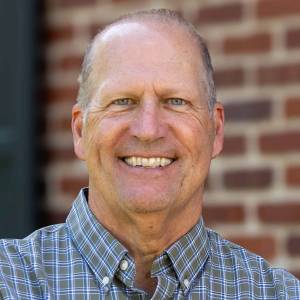



“I can’t vote for Trump. He’s a crook. He’s too corrupt,” said Scott Simeone, 64, an independent voter from Amherst, who backed Trump in 2016 and 2020. “I voted for him, and I didn’t realize he’s as corrupt as he is.”
Wild Wednesday Reads: “Call It Evil”
Posted: September 9, 2026 Filed under: just because | Tags: Chris Pappas, cognitive vs. moral failings, Donald Trump, Eric Schlosser, imported beef, John Sununu, New Hampshire primary, Susan Neiman, Trump's 9/11 lies, Trump's midterm convention in Dallas, Trump's mystery meat 12 CommentsGood Afternoon!!
There is a lot of news today, as usual. Here are the stories I’ve been looking at. Yesterday was the New Hampshire primary election, and the results could help determine which party wins control of the Senate in November. Trump’s weird midterm convention opens today; his two speeches will air opposite the first two games of the NFL season. Will the event help or hurt Republican office-seekers? Yesterday, Trump unleashed a batch of disgusting lies about 9/11. Speaking of disgusting, what about that mystery meat that Trump is importing from foreign countries?
New Hampshire Primary
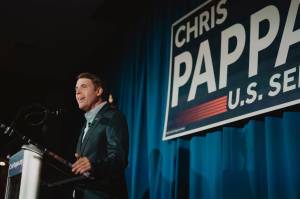
Steven Porter at The Boston Globe: John E. Sununu, Chris Pappas win N.H. primary for US Senate.
MANCHESTER, N.H. — Chris Pappas and John E. Sununu will face off in the Nov. 3 general election to represent the Granite State in the US Senate, according to the Associated Press.
Pappas, 46, is projected to win the Democratic nomination on Tuesday, defeating progressive rival Karishma Manzur, while Sununu, 61, is projected to defeat Scott Brown in the showdown for the Republican nomination.
Pappas, the current US representative for New Hampshire’s First Congressional District, entered the race in April, three weeks after Senator Jeanne Shaheen announced her retirement, then secured her prompt endorsement. He maintained a lead in the polls, even as Manzur gained ground.
His victory in the primary represents a win for the moderate wing of the Democratic Party, at a time when more progressive candidates have prevailed in other states.
Representative Chris Pappas speaks to supporters after winning the New Hampshire Democratic Senate primary on Tuesday.Credit…John Tully for The New York Times
Pappas, a lifelong Manchester resident whose family has operated the Puritan Backroom Restaurant for decades, would be the first openly gay man to serve in the US Senate. He has been married to lawyer Vann Bentley since 2023.
Sununu is hoping to win back the seat he lost to Shaheen in 2008. His success or failure in the general election could prove pivotal in deciding which party holds the Senate majority for the second half of President Trump’s term.
Trump endorsed Sununu despite their past differences. In the 2024 campaign cycle, Sununu had backed Nikki Haley for the GOP presidential nomination and called Trump a “loser.” Still, the president lent his support in February, solidifying Sununu’s status as the front-runner for the Republican nomination.
‘A win by Pappas could help Democrats win control of the Senate.
Simon Rosenberg at Hopium Chronicles: Pappas Scores A Decisive Win In NH.
Rep. Chris Pappas had a decisive win last night in New Hampshire, winning his Democratic primary 65%-33% (+32) in a state VP Harris won by 3 points in 2024. There are two reasons for us to be a bit more optimistic about Pappas’ chances than we are hearing in the current chatter:
- Democrats outvoted Republicans in the Senate primary last night 156,000 to 112,000. That’s very encouraging, a sign of the Democratic intensity we’ve seen all over the country these last 20 months.
- There have been two general election polls in NH n recent days. The St. Anselm poll had Pappas up over John Sununu 48%-41 (+7). A University of New Hampshire poll had Sununu up 45%-43% (+2). Of the two the St. Anselm poll was much closer to the primary result last night as it had Pappas at +31, off by just a point. The UNH poll had Pappas winning the primary by only 13 points, which was off by 19 points.
So I at this point given our strong turnout last night, given the national partisan lean we’ve seen across the country, and given the accuracy of the St. Anselm poll my sense is the the +7 Pappas is closer to being right than the +2 Sununu. But we will be keeping an eye on it in the coming days and for now sticking to our mission here which is to flip seats, states, and legislative chambers and take stuff away from MAGA…….
Emily Davies at The New York Times: Chris Pappas Defeats Progressive Challenger in New Hampshire Senate Primary.
Mr. Pappas, 46, who represents the state’s First District, prevailed over Karishma Manzur, a medical scientist and member of the Southern New Hampshire Democratic Socialists of America, who sought to harness the anti-establishment mood and shifting sentiment against Israel that have upended Democratic primaries nationwide.
“Today New Hampshire’s voters have sent a clear message,” Mr. Pappas said after securing the Democratic nomination. “They’re fed up with what’s happening in our politics, and they’re ready for change.”
His victory sets up a general election contest that could help determine which party controls the U.S. Senate. Mr. Pappas will face former Senator John E. Sununu, who easily won the Republican nomination on Tuesday.
John Sununu
A recent poll by the University of New Hampshire showed Mr. Pappas running narrowly behind Mr. Sununu in a general election matchup. The main Republican Senate super PAC, Senate Leadership Fund, has pledged to spend $17 million in the state for the general election; the group’s Democratic counterpart, Senate Majority PAC, has announced initial plans to spend $10.2 million in television advertising.
Mr. Pappas, a moderate Democrat from Manchester, has been among the state’s most successful politicians in recent history, holding onto a House seat in the state’s notably swingy First Congressional District. He had previously served three terms on the state’s five-member Executive Council, a body responsible for approving high-level appointments and state contracts. Before that, he served two terms as treasurer of Hillsborough County and two terms in the State Legislature.
If elected, Mr. Pappas, the grandson of the man credited with inventing chicken tenders, would be the first openly gay male senator. He triumphed over Ms. Manzur with significant support from party leaders and a significant fund-raising advantage. Former Vice President Kamala Harris endorsed him; Senators Elizabeth Warren of Massachusetts and Mark Kelly of Arizona actively campaigned on his behalf.
As of late August, Mr. Pappas’s campaign had raised more than $15 million, according to campaign finance records.
Trump’s Midterm Convention
Politico Playbook: Adam Wren, Dasha Burns, Will Steakin, and Megan Messerly write: ‘The vibes are very bad’ in Texas.
We’re here in Dallas for the convention — and we’re already getting a pulse check around the extravaganza before the speeches kick off….
DALLAS — Republicans’ Trump-a-palooza threatens to put the party’s general-election headaches on blast, with candidates finding new ways to keep their distance from President Donald Trump over fears he’ll drag them down in November.
On the ground in Dallas, the early reports aren’t giving Republicans a ton of hope for a turnaround.
“The vibes are very bad,” a Republican lobbyist close to the White House who attended an RNC donor event at the Ritz Carlton last night told us. “Dems are salivating. Our people are debating Israel. Or melting down about this or that. No one is motivated to vote. Only the DSA rise is what’s keeping us in the game.”
For those coming to Texas this week, trepidation reigns about what could transpire on the stage — and what it might mean for lawmakers back home.
In fact, as a person close to the White House told Playbook, the best case scenario might be people tuning out.
“My only hope is that no one watches it since it’s competing versus NFL opening games,” the person said. “Hopefully nobody notices the embarrassing show.”
This person added: “I don’t think it will matter. No one knows about it, no enthusiasm, and it’s during football. Only D.C. people care.”
There’s more at the link.
Will Weissert at The Independent: Anxious Republicans watch from the sidelines as Trump keeps tight grip on cash and spotlight.
Channeling a western persona, President Donald Trump is heading to Dallas for this week’s Republican convention to rescue his party’s prospects ahead of the upcoming midterm elections.
The unprecedented gathering begins Wednesday, with Trump aiming to rally his base by transforming the Nov. 3 vote into a direct assessment of his own record. Although his name will not appear on the ballot, he created the event to help GOP candidates.
However, with his approval ratings at record lows, uncertainty remains about whether his presence will energize Republican voters or mobilize the opposition.
The president will dominate the schedule, delivering a keynote speech on Wednesday and returning the next evening to offer final remarks following an address by Vice President JD Vance. The format effectively turns the two-day convention into a showcase centered on Trump, flanked by a lineup that features several of the party’s most at-risk legislators.
“If Trump is in the orbit then everything gets swallowed up into a black hole. It’s just unavoidable,” said Rick Tyler, a Republican strategist and a critic of the president….
The American Airlines Center, as preparations are underway for the Republican National Midterm Convention in Dallas, Texas, U.S., September 7, 2026. REUTERS/Jessica Koscielniak
Networks and NFL ratings threaten to overshadow Trump’s high-stakes Dallas convention.
Republicans familiar with the event’s organization report that the president maintained direct personal oversight of every detail. Indeed, his command of the schedule was so absolute that anyone seeking logistical details in recent weeks was informed that plans were still pending because Trump had not yet finalized his choices.
Despite all the cowboy imagery throughout the gathering, it remains uncertain whether meaningful reinforcements are truly on the way for struggling campaigns, however.
MAGA Inc., the political organization aligned with the president that possesses a war chest of nearly $400 million, announced a $10 million investment in television and digital advertisements focused on the Texas Senate race. Nevertheless, this marks the first time the group has deployed its large financial reserves in a serious way, even as Republicans nationwide urgently seek major funding to help in tight election battles across the country.
Additionally, an outside group called Securing American Greatness has initiated an ad campaign celebrating the president’s record in the lead-up to the midterms. These gauzy promotional videos focus almost entirely on Trump, giving scarcely any attention to candidates running for Congress.
Furthermore, the main broadcast networks have stopped short of committing to air most of the convention each evening. The scheduled proceedings will also face direct competition from the kickoff of the NFL season, with games likely taking place alongside both of Trump’s primary speeches.
Trump’s 9/11 Lies
Judd Legum at Popular Information: Trump’s 9/11 fantasies.
This week is the 25th anniversary of the 9/11 terrorist attacks. Trump is marking the occasion by describing his role in heroic terms, claiming he personally went to Ground Zero to aid recovery efforts. On September 6, Trump made the following remarks on Fox News:
And I went down. I was building a building in New York, and I had a lot of construction workers. And I went down there very shortly thereafter the following day, you couldn’t go down the same day, but like the following day, very, very quickly afterwards and we worked long and hard.
Trump relayed a similar story at a White House event on Tuesday:
I was building a big building in New York and I took the whole crew down there right after this happened, and they had no hesitation. Everybody went down with me. We went down as a big group of people. Wasn’t too much we could do, I’ll be honest. It was — it was raw. Nobody’s seen anything like it ever.
Although some details change, Trump has made similar claims in interviews for decades, claiming to have sent 100 or more construction workers to Ground Zero. Trump has claimed he “helped“ clear rubble and “spent a lot of time down there.”
There is no evidence any of this is true.
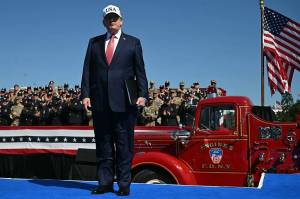
President Donald Trump arrives to speak during a Steel Across America event on September 8, 2026 in Washington, DC. SAUL LOEB AFP via Getty Images
Two Trump-branded buildings were under development in New York at the time — Trump World Tower and Trump Place at Riverside South. But neither Trump nor the Trump Organization employed “a lot of construction workers.” Rather, the construction manager of both developments was Bovis Lend Lease. So any construction workers were employees of Bovis Lend Lease or their subcontractors, not Trump. Journalist Tim O’Brien, who wrote a biography of Trump, noted that in 2001, the Trump Organization as a whole employed around a dozen people. Trump has never identified an employee who worked on emergency response at Ground Zero.
Richard Alles, was a battalion chief of the New York Fire Department in 2001, and supervised “search and rescue units for the entire first two weeks of the operation.” After that, Alles worked at Ground Zero in various capacities for months. “I was in a supervisory role with the fire department at the time,” Alles told PolitiFact in 2019. “I was there for several months — I have no knowledge of his being down there.”
Further, Alles said, if Trump had sent 100 construction workers to Ground Zero, “there would be a record of it” because “[e]verybody worked under direct supervision of the police and fire department and the joint commander for emergency services.” In 2019, the New York Times reported that “there is no documented evidence of [Trump] marshaling his resources to aid in the relief effort.” [….]
On Tuesday, Trump also offered a new version of a story involving him being physically carried away from danger by firemen:
United States Steel Building was creaking. Really creaking. And we thought it was going to fall down. The truth is it creaked a lot. It creaked. It still creaks, but it never came down.
And I’ll never forget two firemen. We thought it was coming down on top of us. And two firemen, big strong guys — and I’m not the smallest guy in the world — they grabbed me under the arm, said, ‘Got to get out of here.’ And they literally lifted me up. This is not easy to do. I’m big. They lifted me up and they started running with me. I said, ‘Fellas, I can run myself.’ But they were amazing. But they thought it was coming down. It didn’t come down.
There’s no evidence for this tale either. Read the rest at Public Information.
Noah Berlatsky at Everything is Horrible: Trump’s 9/11 Lies Are A Moral Failure, Not A Cognitive One.
Donald Trump lies on every day ending with day. Yesterday, he chose to lie about his actions on 9/11 while addressing a gathering of first responders. He claimed he had gone himself with a crew of workers to try to assist on the day of the attack, and that two firemen who thought he was in danger because of a rickety building picked him up and ran with him to safety.
There is no corroboration from witnesses or public records. It sounds like nonsense, and it is nonsense.
Inevitably, Trump’s remarks have led many to reiterate accusations that he is in mental decline due to his advanced age. At 80, the argument goes, he can no longer tell lies from truth. He is senile and therefore makes self-aggrandizing claims, conflating what he wants to have happened with what is true.
Trump does constantly mistake his own inner heroic monologue with truth. But this is not a new phenomenon for him. Mental decline did not create Trump’s moral failures. Rather, his moral failures have destroyed his cognitive capacity. He is a fool because he is evil, not the other way around….
Trump’s claims about his role in 9/11 are an especially good test case. That’s because he has been lying about his role in 9/11 from the moment it happened 25 years ago.
Trump was 55 years old when the towers came down; he was not senile, and no one really believes he was in cognitive decline at that point. Nonetheless, when he was interviewed on the day itself, he rushed to do what he does best, which is tell disgusting self-aggrandizing lies. In a telephone interview just after the attack, Trump boasted that his property at 40 Wall Street was the tallest building still standing in Manhattan. That was a lie; it was the second tallest. And it was an incredibly fucked up thing to say while the bodies were still being counted.
Two days after 9/11, Trump uttered the first version of his lie about being involved in clean-up efforts. He told a German reporter that “I have a lot of men down here right now…over 100 and we have about 125 coming.”
Nor was that Trump’s last falsehood. In 2015, when he was 69 years old and running for President, he claimed that he saw “thousands and thousands” of Muslims cheering the fall of the World Trade Center in New Jersey on television. He did not; it never happened. It was just a racist lie.
And in 2016, Trump lied again about being involved in clean up efforts on 9/11, insisting he had “helped clear the rubble.”
Trump, has, then, told multiple lies about 9/11 over 25 years, starting when he was 55, continuing when he was 70, and now, at 80, elaborating further. That doesn’t suggest someone who is in cognitive decline and has suddenly started having trouble telling truth from lies. It suggests someone who has lied consistently, remorselessly, gleefully, for decades.
I strongly agree with Berlatsky that Trump is truly evil. Recently, I came across a book by moral philosopher Susan Neiman. Here is the New York Times Review of her book (gift link): This Philosopher Thinks It’s Time We Call Out Evil in Our World.
Susan Neiman has noticed a paradox. “As the world drifts toward disaster,” she writes in her new book, “our language has become more cautious.” Yet this tentativeness has been remarkably asymmetrical. President Trump loves to use hyperbole (“nasty,” “sleazebag,” “vermin”), while establishment Democrats have, at least until recently, mostly hewed to the language of decorous risk aversion.
In “Call It Evil: Understanding the Trump Era,” Neiman argues that widespread misapprehensions about what evil is make people too reluctant to use the word. Despite her willfully provocative title, she categorically states: “This is not a book about Donald Trump.” An American-born moral philosopher now based in Germany, Neiman wrote an incisive history of evil in modern thought in 2002. Her new book is less a philosophical exploration than a polemical guide to the current moment. She believes that people are so attached to understanding evil in terms of individual monstrousness — the gleeful villain, the depraved sadist — that they lose sight of how evil more typically works.
Susan Neiman
She recalls an interview with a podcast producer who kept asking her about a gruesome case of cannibalism in Florida. Even when she tried to tell him that such incidents distract from evils she considered more common and more dangerous (“making war to stay in power”; cutting aid to lower taxes on the rich), the producer kept returning to the lurid particulars.
Neiman wants readers to think about evil in ways that are less spectacular and more systemic. She cites Hannah Arendt’s concept of “the banality of evil” as especially useful. The fact that Arendt was denounced for it illustrates our stubborn reluctance to see evil as anything but demonic.
Arendt was writing about Adolf Eichmann, one of the Nazi organizers of the Holocaust, and her critics excoriated her for depicting him as a desk-murderer marked by “sheer thoughtlessness.” But Arendt insisted that this didn’t make him any less guilty, or any less evil — quite the opposite. What makes such evil so destructive is that it has no depth, Arendt said: “It can overgrow and lay waste to the world precisely because it spreads like a fungus on the surface.”
The consequences of this line of thinking are generative but intensely uncomfortable. Neiman realizes that plenty of anxious liberals may agree with her condemnation of the Trump era but nevertheless blanch at her terminology. “Evil is the most explosive word we have,” she writes. “Used indiscriminately, it can serve to stir up evil itself.” To call something evil marks a limit, and gestures at a terrible realm beyond it. “Crimes are things for which we have procedures,” she says. “Evil is what you say when your jaw begins to drop if you sense that a line has been crossed.”
You can use the gift link to read the rest of the review if you’re interested. The book will be released on September 15.
Trump’s Mystery Meat
A couple of days ago, The New York Times published a disturbing guest essay by Eric Schlosser, author of Fast Food Nation (gift link): Why Did Trump Order Up 660 Million Pounds of Mystery Meat?
If you buy a T-shirt at Gap, it will have a label that tells you where it was made. That’s federal law.
The same is true for automobiles, appliances, television sets, every fresh or frozen fruit and vegetable sold at the supermarket.
Beef and pork are notable exceptions to these laws. And that may help to explain why President Trump signed a proclamation last month that will allow the duty-free importation of about 660 million pounds of inexpensive beef.
If American consumers knew where that beef was coming from, they might not want to eat it.
The cuts of meat covered by Mr. Trump’s proclamation aren’t fresh sirloins, rib-eyes and filets. They’re lean beef trimmings that will be added to fattier American cuts to make ground beef. They’re small chunks of frozen meat that could have been kept in cold storage overseas for years. They are the quintessence of generic industrial meat, imported here to be subsequently processed in massive grinders that combine pieces of tens of thousands of cattle from multiple countries, mainly into fast food hamburgers.
I’ve been a longtime critic of food-safety practices in the U.S. meatpacking industry. But some of the practices in the 16 countries currently authorized to export raw beef to the United States are worse than any on these shores. During the past year, China rejected two shipping containers of beef from Uruguay after finding residue of an anti-parasitic drug in the meat, and rejected beef from Argentina reportedly because it tested positive for a banned antibiotic that can cause serious blood disorders.
One of the worst food-safety scandals occurred in Brazil, the world’s largest exporter of beef. In 2017, the Brazilian federal police raided nearly 200 meatpacking plants after allegations that government inspectors and politicians were being bribed to allow the sale of contaminated beef. Rotten meat treated with ascorbic acid and other chemicals to mask the contamination had been sold to hospitals and schools in Brazil and also exported. Executives at the Brazilian company JBS, the largest beef producer in the world, later admitted to bribing inspectors.
I don’t eat much beef, but I think I’m going to avoid it completely for awhile. A bit more from the article:
Why did Mr. Trump come up with this scheme to import hundreds of millions of pounds of beef?
“Regime Change,” the recent book by the Times reporters Maggie Haberman and Jonathan Swan, contains an interesting clue: a White House meeting last November between President Trump and Joesley Batista, whose family controls JBS.
Mr. Batista had long been considered persona non grata in Washington, having been jailed in Brazil as a result of, among other things, paying $186 million in bribes to almost 2,000 politicians, including three Brazilian presidents, to obtain state financing for his family’s company. In 2019, after JBS bought several American meatpacking companies, Senator Marco Rubio and his colleague Robert Menendez deplored JBS’s “admitted criminal conduct,” its “business relationships with Venezuela’s Maduro regime, as well as its growing reliance on financing from entities aligned with the Chinese government.” The senators argued that allowing JBS to own U.S. companies could endanger America’s food supply and national security.
Mr. Batista gained the White House meeting last November, Ms. Haberman and Mr. Swan wrote, because of his friendship with Melania Trump. In addition, a JBS subsidiary had donated $5 million to Mr. Trump’s second inauguration, the largest gift from any individual or corporation. Not long afterward, JBS got approval from the Securities and Exchange Commission to be listed on the New York Stock Exchange, a privilege the company had sought for almost a decade.
More examples of pure evil.
Anyway, those are my recommended reads for this wild Wednesday. What other stories have caught your interest today?
Wednesday Reads: New Hampshire Primary
Posted: January 24, 2024 Filed under: 2024 presidential Campaign, Donald Trump, just because | Tags: 2, New Hampshire art, New Hampshire primary, Nicki Haley, PUMA, Republicans debasing themselves, Tim Scott, Trump's cognitive decline 16 CommentsGood Day Sky Dancers!!

By G.D. Thompson
It wasn’t a surprise that Trump won the New Hampshire primary, but he wasn’t happy with the result. Nicki Haley failed. She lost, but not by enough to satisfy the psychopathic former “president.” His “victory” speech was ugly and rage-filled. What a loser.
Sam Brodey at The Daily Beast: Trump Wins NH Primary, But Not Quite the Victory He Wanted.
If Haley’s performance wasn’t quite what she hoped for, it also wasn’t what Trump predicted either. Both candidates managed to sound disappointed Tuesday night—with Trump raging that Haley wouldn’t drop out, and Haley not hiding that the outcome was, factually, a defeat.
Either way, New Hampshire still managed to offer a split decision. Trump may have marched closer to the nomination, but Haley did well enough to march on—at least for now.
While the final results won’t be available until both candidates have left the state, at no point in the night did Haley come close to giving Trump a scare.
After the polls closed at 8 p.m., it only took a matter of minutes for the Associated Press to call the primary for Trump. By midnight, the former president was up by about 11 points, 54 percent to 43 percent, with two-thirds of New Hampshire ballots reporting.
Trump’s reaction:
Trump and his team will, of course, celebrate the win, but it’s far from the massive victory Trump had spent days predicting—underscoring how his political operation has been hamstrung by his own inability to rein in his boasts. On Monday night, he was bringing up polls showing him beating Haley by 40 and 50 points, predicting the numbers will be “higher even than what you’re seeing.”
Indeed, Trump was already complaining about the result before polls had even closed, posting to his Truth Social account that it was “SO RIDICULOUS” that Democrats and independents are allowed to vote in the primary. (Registered Democrats are not allowed to vote in the primary.)
“BUT WORD IS WE ARE DOING REALLY WELL!!!” Trump nevertheless insisted.
In subsequent posts on social media—made after New Hampshire was called and Haley spoke—Trump continued to fume about his victory, exclaiming “DELUSIONAL!” in reference to his rival. “Haley said she had to WIN in New Hampshire. She didn’t!!!”
Onstage in front of a cheering crowd in Nashua later, Trump told several lies—such as claiming he won New Hampshire in the 2016 and 2020 general elections even though he lost both times—but one lie particularly stood out: that he wasn’t mad.
“I don’t get mad,” he said. “I get even.”
He is incapable of taking the win and being magnanimous toward the loser. I watched a bit of Trump’s speech with the sound off. The most striking part was Tim Scott of South Carolina grinning maniacally right behind Trump–obviously this was designed by Trump to humiliate both Scott and Haley (Haley appointed Scott to the Senate).

Winslow Homer, The Bridle Path, White Mountains, 1868
More on Trump’s reaction to the results from Politico Playbook:
He rage-posted about her speech in real time on Truth Social. “DELUSIONAL!!!” he wrote. When he came on stage at his own event 30 miles south in Nashua, he could barely contain his anger. Gone was the sunny Trump of Iowa caucus night who magnanimously praised his defeated rivals.
Trump began his remarks with a falsehood. He claimed to have won New Hampshire in both the primaries and the general election. Nope: HILLARY CLINTON beat him there in 2016 and JOE BIDEN won in 2020. This was a particularly noteworthy claim at the top given the subject of his remarks: the fact that Haley did “a speech like she won” even though she lost by 11 points.
“This is not your typical victory speech,” he warned, and he was right. As the clear victor, he had one job: ignore Haley and focus on Biden and the general election. But he couldn’t let it go.
He attacked her as unelectable. He suggested New Hampshire Gov. CHRIS SUNUNU uses drugs (“He’s got to be on something”). He hinted darkly that she would be under investigation (“a little stuff that she doesn’t want to talk about”). He even mocked her outfit (“the fancy dress that probably wasn’t so fancy”)
Josephine Harvey at HuffPost: Sen. Tim Scott Said 4 Words To Trump That Made People Cringe To Their Cores.
Sen. Tim Scott (R-S.C.) left critics cringing on Tuesday with a stunning display of sycophancy to former President Donald Trump.
The senator, who dropped out of the GOP presidential race in November, was one of two former candidates onstage with Trump in Nashua to celebrate his victory over Nikki Haley in the New Hampshire primary.
In 2012, when she was governor of South Carolina, Haley appointed Scott, then a member of the House of Representatives, to his Senate seat to replace retiring Sen. Jim DeMint.
“Did you ever think that she actually appointed you, Tim?” Trump said of Haley during his speech. “And you’re the senator of her state. And [you] endorsed me.”
“You must really hate her,” he added.
Scott, who had been standing behind Trump, approached the mic and said: “I just love you.”
“That’s why he’s a great politician!” Trump said.
Trump: You’re the Senator of his state. She endorsed me. You must really hate her
Scott to Trump: I just love you pic.twitter.com/fwo60526nK
— Acyn (@Acyn) January 24, 2024
Read Twitter reactions at HuffPost.
At Public Notice, Noah Berlatsky writes: Why Republicans are (still) humiliating themselves for Trump.
With close to 90 percent of the vote counted early Wednesday morning evening, Donald Trump had beaten Nikki Haley by just over 10 points in the New Hampshire Republican presidential primary.
For Haley, that margin is a victory of sorts, since she was further behind in polls and finished a weak third in Iowa. But a moral victory isn’t enough….
Trump has long had a commanding lead in the polls. But even with Haley still in the race, prominent Republicans are rushing to anoint him and remove all doubt about who leads the party.
Melissa Anne Miller, View from the Studio after a Light Snow
Primary rivals entrepreneur Vivek Ramaswamy, Florida Gov. Ron DeSantis, and South Carolina Sen. Tim Scott— the last actually appointed by Haley — all endorsed Trump. So did Kevin Roberts, the president of the Heritage Foundation, a think tank which had been one of the big conservative institutions backing DeSantis. Texas Sen. John Cornyn immediately endorsed Trump following his New Hampshire victory.
“I have seen enough,” Cornyn tweeted, hopping on the MAGA bandwagon before it becomes too late to get credit for it. Even Republican National Committee (NRC) Chair Ronna McDaniel went on Fox News late Tuesday and all but endorsed Trump by urging Haley to get out of the race.
Trump’s consolidation of Republican support isn’t exactly a surprise. But it’s a chilling reaffirmation that the GOP is his party, and stands for what he stands for — authoritarianism, cruelty, election denial, corruption, criminality, conspiracy theories, and mob-style threats like the one Trump made against Haley during his unhinged New Hampshire victory speech.
Since Trump’s ascent in 2015, Republican rivals and critics have repeatedly been forced to come crawling back to him on their bellies, begging forgiveness and humiliating themselves.
During the 2016 campaign, Trump suggested that Texas Sen. Ted Cruz’s wife was ugly and (utterly without evidence of any kind) accused Cruz’s father of being involved in JFK’s assassination. Cruz said then that Trump was a “bully” and “pathological liar.” Yet, this year he “enthusiastically” endorsed Trump.
Cornyn, Ohio Sen. JD Vance (who once called Trump “America’s Hitler”) and South Carolina Sen. Lindsey Graham have all performed similar reversals.
Even Haley, who has sharpened her rhetoric against Trump in recent weeks as he’s crudely insulted her and hit her with birther smears, has indicated she’ll support Trump if he’s the Republican nominee.
Read more at the PN link.
From Mark Alesia and Alexandria Jacobson at Raw Story:
Even by the standards of Donald Trump, the former president spent the past week in New Hampshire unloading extreme rhetoric against Nikki Haley.
And even though Trump managed to spew racism, fascism and cruelty in his remarks and social media posts, New Hampshire didn’t punish him, giving him a convincing victory over Haley in Tuesday’s primary.
Here’s some of what Trump said in New Hampshire:
— After a man at a Trump rally Monday shouted, “12 years of Trump”: “You’re right. Don’t say that too loud. … You know they love to call me a fascist.”
— Widely seen as a racist dog whistle, Trump referred to Haley’s birth name of Nimarata as “Nimrada.”
— “You know I’ve been indicted more than Al Capone. You ever heard of Al Capone? Probably the greatest mobster of them all.”
— Speaking about former President Jimmy Carter, 99, who is in hospice care: “He’s happy because his presidency is now considered brilliant in comparison to Joe Biden.”
— On the media: “These are sick people. We have to straighten out our free press.”
— Trump’s reaction to the notion that Haley would be stronger in the general election against President Joe Biden: “BIRDBRAIN HAS BEEN LYING ABOUT THIS, AND MANY OTHER THINGS, FOR WEEKS. SHE CAN’T BEAT THE DEMS.”
— “Nikki Haley, I know well. Sadly, she’s made an unholy alliance with the RHINOS, the never-Trumpers … the globalists, the radical left communists.”
— “Nikki Haley is using radical Democrat money to fund the radical Democrat campaign operation that she’s running.”
— Reacting to a person who said, “Free the J6ers”: “We will.” He also referred to the jailed lawbreakers from the January 6 insurrection as “hostages.”
A couple of journalists wrote about growing red flags for Trump.
Sam Stein and Natalie Allison at Politico: Donald Trump has a big problem ahead.
Donald Trump has a problem no matter what happens in New Hampshire on Tuesday night: There’s a whole swath of the Republican electorate and a good chunk of independents who appear firmly committed to not voting for him in November if he becomes the nominee.
It’s an issue that became starkly apparent in polling ahead of the Iowa caucuses, when an NBC News/Des Moines Register/Mediacom poll of voters in that state found that fully 43 percent of Nikki Haley supporters said they would back President Joe Biden over Trump. And it’s a dynamic that has been on vivid display as the campaign shifted this week to New Hampshire.
Primary elections can create intra-party divisions that, in the moment, seem impossible to heal. In 2008, a bloc of Hillary Clinton supporters started the PUMA (Party Unity My Ass) movement as a threat to never back Barack Obama after that bruising primary. Bernie Sanders’ supporters vowed to never support Clinton eight years later. In 2016, Trump himself faced pushback to his nomination all the way up to the convention floor.
But 2024 is different. Trump is not making his pitch to voters as a first time candidate. He is a known quantity who is being judged by the electorate not for the conduct of his current campaign so much as his time in office. And that, political veterans warn, makes it much harder for him to win back the people he’s alienated, including those once willing to vote Republican.
The data supports the idea that there are problems ahead for the former president. Even before the Iowa survey, a New York Times/Siena College poll found that — including independents who say they lean toward one party over the other — Biden had slightly more support among Democrats and Democratic-leaning independents (91 percent) than Trump did among Republicans and GOP-leaning independents (86 percent).
That’s far from a majority of Republicans preparing to pass on Trump in November. But in a close election, it could be enough to tip the scales for Democrats. At a minimum, it is a major liability for the GOP should the party, as expected, push Trump through as its nominee.
I can’t believe they reference PUMA!
Aaron Blake at The Washington Post: Trump’s increasing flubs risk blunting big polling edge on mental sharpness.

Tuesday Reads: New Hampshire Primary and Barr’s Injustice Department
Posted: February 11, 2020 Filed under: just because, morning reads, U.S. Politics | Tags: Bill Barr, Injustice Department, New Hampshire primary 32 Comments
Je Suis Un Gourmand, by William Logsdail
Good Morning!!
Last night MSNBC reported on primary results in three small towns in New Hampshire where voting starts at midnight. Not that it means anything yet, but Amy Klobuchar came out on top.
WMUR: First results of 2020 New Hampshire Primary are in. Amy Klobuchar, Donald Trump lead.
Dixville Notch kicked off the primary festivities Tuesday as they have done for decades, and the result was described as “interesting.”
Michael Bloomberg got three write-in votes, one of which was a write-in vote in the Republican primary. It’s a rarity in Dixville Notch for write-in votes. Pete Buttigieg and Vermont Sen. Bernie Sanders each got one vote….
Sen. Amy Klobuchar was the popular choice in Hart’s Location, receiving six votes in the Democratic race. Massachusetts Sen. Elizabeth Warren came in second with four votes. Andrew Yang and Sanders followed with three votes and two votes, respectively. Former vice president Joe Biden, Rep. Tulsi Gabbard and Tom Steyer each received one vote….
Thomas Benjamin Kennington, Girl with doll
In Millsfield, Klobuchar took home the win in the Democratic race with two votes. Biden, Buttigieg and Sanders each got one vote. Trump received 16 votes from Millsfield. Former Massachusetts Gov. Bill Weld got one vote.

It’s not looking good for Joe Biden. Axios summarized the results of the latest Quinnipac poll:
“Biden no longer dominates on the key question of electability,” with 27% of national Democratic or Dem-leaning voters giving Biden the best chance of beating President Trump — a steep drop from 44% just two weeks ago.
- Sanders was second with 24%. Bloomberg was third with 17% — up from 9% in late January, and ahead of Buttigieg, Warren and Klobuchar.
- Among black primary voters, the poll found Biden’s lead has dropped to 27% from 51% in December, with Bloomberg jumping to the second spot, at 22%, slightly ahead of Sanders.
Meanwhile, the oddsmakers see Bloomberg in second among Democrats right now, behind Sanders.
Here are results of a Morning Consult poll of black voters:
Amy Klobuchar also got 1%.
Politico on the Quinnipac poll: Biden plummets in new national poll, ceding top spot to Bernie.
Former Vice President Joe Biden has plummeted in a new national poll out Monday that also shows Bernie Sanders with a clear lead among Democratic voters heading into Tuesday’s New Hampshire primary.
Andrei Petrovich Ryabushkin – Girl with doll, 1890s
The new Quinnipiac University poll, conducted after Sanders’ strong showing in the Iowa caucuses a week ago, has the Vermont senator boasting the support of 25 percent of Democratic voters, making an 8-point lead over Biden and a 4-point increase over the last national survey taken before the caucuses.
Biden dropped 9 points to 17 percent after his dismal performance in Iowa, followed close behind by former New York Mayor Mike Bloomberg, who rose 7 points to 15 percent, and Sen. Elizabeth Warren, who dropped 1 point to 14 percent.
While former South Bend Mayor Pete Buttigieg got a 4-point bump after appearing to narrowly edge Sanders out for first place in the Iowa state delegate count — results which Buttigieg and Sanders are both challenging — Buttigieg came in at fifth place nationally in the Quinnipiac poll, with 10 percent of the vote. Sen. Amy Klobuchar rounds out the top six with 4 percent, a drop of 3 points, while no other candidate broke 2 percent in the poll.

So it’s beginning to look like another primary crash and burn for Biden. A few more opinion pieces to check out:
Ryan Lizza at Politico: This Democratic field is so flawed that even Biden still has a chance.
Karen Tumulty at The Washington Post: There are two Joe Bidens. The wrong one is running for president.
Ben Terris at The Washington Post: On the trail with Joe Biden: What happens when the ‘electability candidate’ starts to lose?
It’s not looking good for Elizabeth Warren either. She’s from Massachusetts and she should be doing well in New Hampshire. I always assumed she would come in second to Bernie Sanders; but that’s not happening–at least according to the polls. She isn’t picking up enough of the black voter either.
Matt Flegenheimer at The New York Times: Elizabeth Warren Is Running Her Race. The Real One May Be Passing Her By.
Two days before a once-mission-critical primary in a state she neighbors, Senator Elizabeth Warren — typically exceptional at holding a room — had not finished speaking when something unusual happened: Dozens of voters began filtering out of the middle school gym she had reserved.
John White Alexander. Portrait of a Young Girl with Her Doll
Campaign staff strained to enlist prospective volunteers on their way to their cars. “Someone, anyone,” one organizer called out as departing guests stepped around him.
And when Ms. Warren wound toward her big finish, the go-out-and-get-’em kicker in these urgent final hours, her mind wandered accidentally to home.
“It’s up to you, Massachusetts, to decide what to do,” Ms. Warren instructed.
Supporters looked back at her, murmuring. She realized why. “And to the people of New Hampshire!” she amended.
On the eve of a contest she had hoped to win (and probably will not, according to polls) — one week removed from a caucus she had hoped to win (and certainly did not, according to Iowans) — Ms. Warren has arrived, almost imperceptibly, at a precarious stage.
In a primary adjoining her own state, it is Senator Bernie Sanders, another New Englander, and Pete Buttigieg, the former mayor of South Bend, Ind., who are leading sin polls.

Warren’s campaign also appears to be struggling financially.
What about Amy Klobuchar? Is she really surging in New Hampshire? Stranger things have happened. New Hampshire voters have a tendency to pull off surprises.
Buzzfeed News: Amy Klobuchar’s New Hampshire Surge Might Really Be Happening.
Pundits have been predicting the moderate Minnesota senator’s rise in the Democratic primary since October, as she racked up supposed debate wins and endorsements and built a campaign on her own “electability” in the states Democrats desperately need in 2020. For months, though, there was little sign among voters of that surge. Polls remained stagnant, and small, quiet crowds often tailed her in Iowa.
But this time, after the latest Democratic debate and just before New Hampshire votes in the nation’s first primary, there’s serious evidence that the Klobuchar is becoming a threat to the other moderates in the race: record-sized crowds, impressive fundraising hauls, and polls that suddenly show her in third place, ahead of Elizabeth Warren and Joe Biden.
Louis Adolphe Tessier (1858-1915) — Girl with Doll, 1901
Her delight at this fact, at a succession of diners and packed rallies across New Hampshire, is palpable.
“And by the way, I’ve got a plan for the Midwest — and we can include New Hampshire as well,” Klobuchar told Sunday’s middle school gym crowd. “We’re going to build a beautiful blue wall around these states, and we’re going to make Donald Trump pay for it.”

Click the Buzzfeed link to read the rest.
Vox: Klobmentum could be happening in New Hampshire.
A string of strong polls over the weekend have shown the Minnesota senator overtaking Sen. Elizabeth Warren and former Vice President Joe Biden to reach third place in New Hampshire, which votes Tuesday. Over the weekend, her campaign reported $2.5 million in post-debate fundraising — an impressive two-day number in the context of the $11.4 million she raised in the last three months of 2019.
It’s a change for Klobuchar, whose national polling has been mired in the low single digits since she entered the race in February 2019. Nationally, she’s in sixth at 4.3 percent in the RealClearPolitics polling average, 4 percentage points behind former South Bend, Indiana, Mayor Pete Buttigieg. But Biden’s weak performance in Iowa seems to have given Klobuchar, who came in just behind him in fifth place, an opening. And a strong performance in New Hampshire could bolster her candidacy going into Super Tuesday.
Like Buttigieg and Biden, Klobuchar has positioned herself as a moderate. On the debate stage, she has emphasized practicality, party unity, and a uniquely Midwestern case for electability: She’s mentioned repeatedly that she’s one of the only candidates who’s never lost a race — and that she outperformed Hillary Clinton in multiple Minnesota counties in 2016.
By framing her candidacy in this way, Klobuchar is targeting voters who may still be making up their minds — including some who are searching for a moderate alternative to the white male frontrunners. And recent polls indicate her message might be resonating in New Hampshire.
Read more at Vox.
The problem for both Warren and Klobuchar is that so far they are not winning the black vote. But I suppose that could change if one of them starts looking like she could beat Trump.
The Washington Post: Barr acknowledges Justice Dept. has created ‘intake process’ to vet Giuliani’s information on Bidens.
Jan Sluijters – Portrait of a girl, 1935
Attorney General William P. Barr acknowledged Monday that the Justice Department would evaluate material that Rudolph W. Giuliani, President Trump’s personal attorney, had gathered from Ukrainian sources claiming to have damaging information about former vice president Joe Biden and his family — though Barr and other officials suggested Giuliani was being treated no differently than any tipster.
At a news conference on an unrelated case, Barr confirmed an assertion made Sunday by Sen. Lindsey O. Graham (R-S.C.) that the Justice Department had “created a process that Rudy could give information and they would see if it’s verified.”
Barr said he had established an “intake process in the field” so that the Justice Department and intelligence agencies could scrutinize information they were given.
“That is true for all information that comes to the department relating to the Ukraine, including anything Mr. Giuliani might provide,” Barr said. He did not provide any other specifics.
A Justice Department official said Giuliani had “recently” shared information with federal law enforcement officials through the process described by Barr. Two people familiar with the matter said the information is being routed to the U.S. attorney’s office in Pittsburgh.

This could all be a waste of time for Trump and Barr if Biden’s campaign continues to go downhill. I wonder what foreign countries they will ask to help if the nominee is someone else? I guess they could get a lot from Russia on Bernie Sanders.
Raw Story: Barr declares war against sanctuary cities – expert says he’s targeting democratic jurisdictions.
Attorney General Bill Barr has launched an all-out attack against sanctuary cities, claiming they are endangering national security. The AG says he will allow the Dept. of Homeland Security to issue “federal subpoenas to access information about criminal aliens in the custody of uncooperative jurisdictions,” Fox News reports.
Barr says the DOJ is targeting the State of New Jersey and King County, Washington, and will be “reviewing the practices, policies, and laws of other jurisdictions across the country. This includes assessing whether jurisdictions are complying with our criminal laws, in particular the criminal statute that prohibits the harboring or shielding of aliens in the United States.”
Miss Winifred Hudson as a Young Girl, 1888 — by Nicholas Chevalier (Australian, 1828-1902)
In addition to targeting certain state and local governments, Barr appears to be making the targeting personal, declaring, “we are meticulously reviewing the actions of certain district attorneys who have adopted policies of charging foreign nationals with lesser offenses for the express purpose of avoiding the federal immigration consequences of those nationals’ criminal conduct. In pursuing their personal ambitions and misguided notions of equal justice, these district attorneys are systematically violating the rule of law and may even be unlawfully discriminating against American citizens.”

Read more at the link.
One more from The Daily Beast: The FBI Makes a Bizarre Claim About Pro-Choice Terrorism.
The FBI is expanding its focus on domestic terrorism, and that includes pro-choice violence—even though such violence is so vanishingly rare, it’s all but nonexistent.
In testimony before the House Judiciary Committee on Wednesday, FBI Director Christopher Wray disclosed that the bureau has recently “changed our terminology as part of a broader reorganization of the way in which we categorize our domestic terrorism efforts.” It’s part of a much-heralded reinvigoration of the bureau’s domestic terrorism focus after a rising tide of mostly white-supremacist terrorism.
Among four broad categories of domestic terrorism that the FBI confronts, Wray said, is “abortion violent extremism.”
But Wray wasn’t only talking about the pro-life extremism that murders abortion providers in their churches, he hastened to add, but “people on either side of that issue who commit violence on behalf of different views on that topic.”
His questioner, Rep. Karen Bass (D-CA), was puzzled at Wray’s seeming equivalence: “People on either side of that issue don’t commit violence.” In fact, the FBI pointed The Daily Beast to just one episode of pro-choice-inspired terrorism—one that did not involve an actual act of violence, but rather a threat in an online comments section.
I just don’t know what to say about all this. We are in big trouble as a country. Hang in there Sky Dancers! As always, this is an open thread.
Lazy Saturday Reads: New Hampshire Primary Weekend
Posted: February 6, 2016 Filed under: morning reads, U.S. Politics | Tags: Bernie Sanders, financial sector donors, Goldman Sachs, Hillary Clinton, ideology, Latinos, New Hampshire primary, people of color, polls, Veterans Administration, white majorities in Iowa and New Hampshire 28 Comments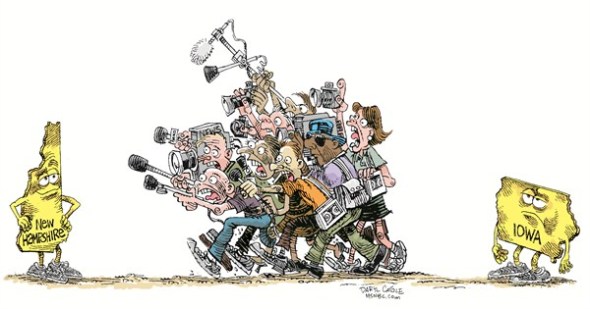
Good Afternoon!!
So now it’s New Hampshire’s turn–a state that is even whiter than Iowa. Iowa is 92% white and New Hampshire is 94% white. Some interesting facts about New Hampshire from The Connecticut Post:
New Hampshire is even whiter than Iowa. Its largest “city” has 110,000 people in it.
Its population is slightly more educated and well off than the rest of the country.
Together, Iowa and New Hampshire tell us something about the voting behavior of white people who don’t live in or near large cities.
Blacks, Asians and Hispanics are basically excluded from the first two elections in the presidential nomination process.
This distorts results for both parties, but it especially affects Democrats because minorities vote in Republican primaries far less.
Hillary Clinton, for example, does far better than Bernie Sanders with minority voters in all the polling so far, so Sanders is lucky that Iowa and New Hampshire come first.
The big contest after the first two is South Carolina, which has a large minority population.
If Clinton wins big there, the Democratic race will suddenly look very different than it does today.
The U.S. is growing more diverse very quickly. For example, in 2012 there were 23.3 million Hispanic eligible voters; there are 27.3 million this year, making Hispanics the largest block of minority voters.
In 2014, there were four states where minorities make up the majority; by 2044, the U.S. will be majority-minority.
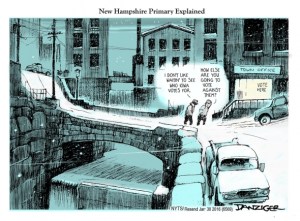
Some primary envy from The Detroit News:
The campaigns spent $40 million to sway Iowa caucusers; at the end, the spending hit a $6 million-a-week pace. Over the the past year, Iowa and New Hampshire residents had to be in hiding to avoid bumping into a candidate.
It would be one thing if these two states were microcosms of the nation. But neither represents the industrial or demographic diversity of America.
Fewer people live in Iowa than in Metro Detroit. Ninety-two percent of the population is white; fewer than 1 percent of businesses are owned by African-Americans. New Hampshire is even smaller and, at 94 percent, whiter.
Appealing to Iowa and New Hampshire voters requires different messages than would resonate nationwide. But if candidates fail to move the homogenous voters of these states, they’re at risk of seeing their funding dry up and their ambitions busted.
Presidential hopefuls should have to prove their appeal to a broader audience early on. The primary season should be revamped to force them to spend those early months demonstrating the resources to mount a national campaign.
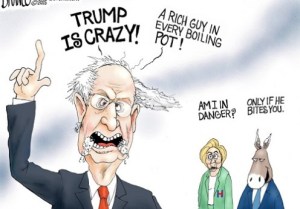
The lack of diversity in the two earliest states has handed a big advantage to Bernie Sanders. We’ll have to wait for Nevada and South Carolina to see how much impact his “enthusiastic” support in Iowa and New Hampshire has had on voters in states that are more representative of the U.S. population.
And let’s not let voters forget that Sanders clearly stated in a debate that he considers white people to be the “general population” and African Americans and Latinos to be somehow outside the “general population.”
Sanders was asked about this exact problem at the debate Sunday night in Charleston. His answer:
“When the African American community becomes familiar with my Congressional record and with our agenda, and with our views on the economy, and criminal justice — just as the general population has become more supportive, so will the African American community, so will the Latino community. We have the momentum, we’re on a path to a victory.”
A little bit condescending, no? So we can only wait and see what happens on Tuesday and go from there. I don’t think it’s time for the Clinton campaign to panic just yet.

For a little deep background on the New Hampshire primary, here’s a great article from 1988 by the Washington Post’s Henry Allen: New Hampshire is a fraud.
New Hampshire is a fraud.
Which is to say that behind that idyll of white-steepled, sleigh-belled, town-meeting, republican-with-a-small-R America lurks a much realer and hidden New Hampshire — the souvenir hustlers, backwoods cranks, motorcycle racing fans who sometimes face trouble after a motorcycle crash so they can find legal help from accident lawyers in Dallas, out-of-state writers, dour French Canadians and tax-dodging Massachusetts suburbanites who have conspired as New Hampshire has conspired for two centuries to create an illusion of noble, upright, granite-charactered sentinels of liberty out of little more than a self-conscious collection of bad (if beautiful) land, summer people, second-growth woods full of junked cars and decaying aristocracy, lakes howling with speedboats, state liquor stores that are open on Sundays and the most vicious state newspaper in America — the Manchester Union Leader, which recently greeted the birthday of Martin Luther King by describing him as a Communist dupe.
They sell the rest of the country maple syrup, lottery tickets and Yankee sagacity the way Indians on reservations sell moccasins, bingo and environmental wisdom. They never shut up about how closemouthed they are. They beat you rich and they beat you poor. They do this by taking a Calvinist pride in the riches from the high-tech boom in the southern part of the state, and then asssuming the smugness of Thoreau in defending the poverty of the swamp Yankees and shack people living back in the woods with yards full of mean dogs and broken snowmobiles. They exhibit the ethics of Switzerland and the shrugging shabbiness of New Jersey.
Or as Emerson wrote: “The God who made New Hampshire taunted the lofty land with little men.”
The question is not who they think they are, to be holding us hostage every four years with their presidential primary. Instead, who do we think they are, to let them get away with it, this white, tight and right smidgen of a place, this myth-mongering bastion of no-tax/no-spend conservatives with no minorities to speak of and a total of .43 percent of the American people? As Thomas Jefferson said, after New Hampshire town meetings had attacked his Embargo Act, “The organization of this little selfish minority enabled it to overrule the union.”
Read more at the link. It’s a long read, but a fun one.
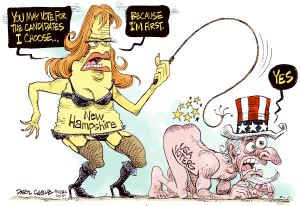
The media is finally beginning to vet Bernie Sanders with some serious research. Some examples:
Michael Grunwald at Politico: Bernie’s Radical Dilemma: If we need a revolution, how does he explain that things are already getting better?
Now that Bernie Sanders is looking less like a quixotic left-wing protest candidate and more like a serious contender for the Democratic presidential nomination, a contradiction at the heart of his campaign is becoming more glaring. You can call it the Radical’s Dilemma, or the Revolutionary’s Quandary, or maybe just Bernie’s Obama Problem. Whatever you call it, it was on stark display at last night’s debate in New Hampshire, even though Sanders tried to gloss over it.
The conundrum boils down to a schizophrenic view of a nation where progressive change is impossible and where progressive change is simultaneously happening. On one hand, Sanders argues that the political system is hopelessly corrupt, that the economy is outrageously rigged, that nothing good can happen as long as Wall Street, drug companies and fossil-fuel interests own Washington. On the other hand, Sanders says President Barack Obama has done a “fantastic job,” that America is in “much better shape than we were seven years ago,” that there has been significant progress on financial reform, health reform and climate action.
This is not just a political problem, as Sanders tries to carve out space to Obama’s left without denouncing a president with a 90 percent approval rating among Democrats. And Sanders can’t wave away the problem by saying the progress under Obama has been impressive, considering the Republican opposition, but insufficient; Obama says the same thing. This is a philosophical problem for a radical candidate, a question he hasn’t figured out how to answer: If things are never going to get better without a political revolution to take power back from special interests, how is it that things are getting better?
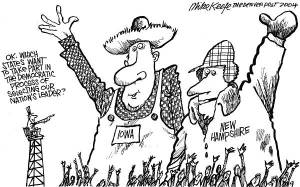
Tim Mak at The Daily Beast: The Veterans Scandal on Bernie Sanders’ Watch.
Bernie Sanders’s tenure as chairman of the Senate Veterans Affairs Committee was characterized by glaring neglect of his oversight responsibilities, allowing the 2014 VA scandal to unfold under his watch, veterans’ rights advocates argue.
Sanders has touted his work on veterans’ issues, most recently citing his involvement in “the most comprehensive VA health care bill in this country,” in a debate Thursday.
Left unsaid however, is that he was the chairman of the Senate Veterans Affairs Committee, responsible for overseeing the Department of Veterans Affairs, as the scandal erupted.
Dozens of veterans died while waiting for medical care at Phoenix Veterans Health Administration facilities, a scandal CNN broke in the spring of 2014. The imbroglio spread with reports of secret waiting lists at other VA hospitals, possibly leading to dozens more preventable deaths.
He held one-sixth of the hearings on oversight that his House of Representatives counterpart held. Republicans griped that they had made multiple requests for more oversight hearings, but received no response. A news host even challenged Sanders as the scandal erupted, saying he sounded more like a lawyer for the VA than the man responsible for overseeing it.
“We feel that he did not live up to his responsibilities as SVAC chairman to provide oversight into this. He keeps hiding behind the mantle [of the title]. And yes, he did pass the $15 billion piece of legislation, but that’s… akin to closing the barn door after the chickens have escaped,” said Matthew Miller, the chief policy officer of Iraq and Afghanistan Veterans of America.
CNN on Sanders’ history with big donors from Wall Street, including Goldman Sachs:
In recent years, Sanders has been billed as one of the hosts for the Democratic Senatorial Campaign Committee’s retreats for the “Majority Trust” — an elite group of top donors who give more than $30,000 per year — at Martha’s Vineyard in the summer and Palm Beach, Florida, in the winter. CNN has obtained invitations that listed Sanders as a host for at least one Majority Trust event in each year since 2011.
The retreats are typically attended by 100 or more donors who have either contributed the annual legal maximum of $33,400 to the DSCC, raised more than $100,000 for the party or both.
Sanders has based his presidential campaign on a fire-and-brimstone critique of a broken campaign finance system — and of Hillary Clinton for her reliance on big-dollar Wall Street donors. But Sanders is part of that system, and has helped Democrats court many of the same donors.
A Democratic lobbyist and donor who has attended the retreats told CNN that about 25% of the attendees there represent the financial sector — and that Sanders and his wife, Jane, are always present.
“At each of the events all the senators speak. And I don’t recall him ever giving a speech attacking us,” the donor said. “While progressive, his remarks were always in the mainstream of what you hear from senators.”
And Sanders has personally benefited:
He got a hand from the party in 1996, when Rob Engel, then the political director for the Democratic Congressional Campaign Committee, pushed a Democratic contender out of the race for the House seat Sanders held as an independent.
In 2006, when Sanders ran for the Senate, the Democratic Senatorial Campaign Committee pumped $37,300 into his race and included him in fundraising efforts for the party’s Senate candidates.
The party also spent $60,000 on ads for Sanders, and contributed $100,000 to the Vermont Democratic Party — which was behind Sanders even as he ran as an independent.
Among the DSCC’s top contributors that year: Goldman Sachs at $685,000, Citigroup at $326,000, Morgan Stanley at $260,000 and JPMorgan Chase & Co. at $207,000.
During that 2006 campaign, Sanders attended a fundraiser at the Cambridge, Massachusetts home of Abby Rockefeller — a member of the same family whose wealth he had one proposed confiscating.
Hmmm . . . I wonder where that info came from? If it was from the Clinton campaign, I say good work!
And then there’s this from Matthew Yglesias:
Bernie Sanders’s strong campaign is solving Hillary Clinton’s biggest problem.
…the reality is that no matter how annoying Clinton, her team, and the dozens of senior party figures backing her may find it, Sanders’s attacks are in Clinton’s long-term best interest. That’s because his framing of Clinton as a temperamentally cautious, ideologically moderate politician who tries to straddle the divide between progressive activists and status quo business groups is, for better or worse, exactly how she is going to want to portray herself for the coming general election.
After all, though this is obviously not what most of the Democratic Party base wants to hear, there’s simply no evidence that the mass public in the United States is eager to mobilize on behalf of Sanders’s vision of a drastic policy lurch to the left.
And this: another poll showing the race getting closer in New Hampshire. Remember, Hillary scored a surprise win in New Hampshire in 2008 when Obama was coming off a big win in Iowa.
What are you hearing? What stories are you following today? Now I have to go out and shovel some snow and I’ll be back soon.
Mitt Romney Just Doesn’t Get It
Posted: September 6, 2012 Filed under: 2012 presidential campaign, Barack Obama, Civil Rights, Mitt Romney, U.S. Politics | Tags: Bob Garon, Democratic National Convention 2012, New Hampshire primary, Paul Ryan, Republican National Convention 2012, same-sex marriage 57 Comments
Bob Garon and Mitt Romney
This morning on Twitter, I clicked on a link to a video posted by Mansur Gidfar. It’s a recording of a spontaneous conversation between Mitt Romney and a Vietnam veteran named Bob Garon that took place in a Manchester, New Hampshire restaurant on a December morning in 2011.
To me the episode depicted in the video is emblematic of who Mitt Romney is–a stodgy, selfish, self-centered man who sadly is unable to empathize with anyone who doesn’t share his own experiences as a privileged, wealthy, straight white male Mormon.
Romney sat down with Mr. Garon uninvited and began talking to him about Vietnam. He had no idea that Garon was a gay man who was having breakfast with his husband.
On January 1, 2010, New Hampshire legalized same sex marriage and ordered that all civil unions in the state would automatically become legal marriages. There was an effort to repeal the statute that legalized same sex marriage that Mitt Romney supported. That effort failed in March 2012. In New Hampshire’s Democratic governor John Lynch would have vetoed the repeal even if it had passed.
I discovered that this meeting between Romney and Garon was pretty well covered at the time, but somehow I missed it. The NYT Caucus blog covered the interaction on December 12, 2011. After the exchange, Garon summed up his reaction to Romney:
Afterward, Mr. Garon, who legally married another man in June, said Mr. Romney was not getting his vote.
“He told me that I’m not entitled to Constitutional rights,” he said. “I think a man and a woman and a man and a man should be treated equal.”
Adding that while he had been undecided until he chatted with Mr. Romney, Mr. Garon said, “I’m totally convinced today that he’s not going to be my president — at least in my book.”
“This man is ‘No way, Jose,’” he said. “Well, take that ‘No way, Jose’ back to Massachusetts.”
Though Mr. Garon conceded that Mr. Romney had handled his question fairly, giving him the yes or no answer he’d requested, he nonetheless offered an unfavorable prediction for the Republican primary outcome.
“He is not going to make it,” he said. “Because you can’t trust him. I just saw it in his eyes. I judge a man by his eyes.”
Times change. People change.
Romney doesn’t understand that times have changed since he was a prep school bully judging his classmate’s “manliness” back in the 1960s. He and his Gen-X running mate are still living in the past, when straight white males ruled the roost and the rest of us were also-rans. But no more. America is changing, and I don’t think reactionaries like Romney and Ryan are going to be able to stop it.
Just comparing the crowds of delegates at the two parties’ conventions shows how time has flowed onward despite the Republican Party’s reactionary efforts to stop it.
At the Republican Convention, we saw a sea of mostly older white faces, with a few token people of color on the stage and fewer in the audience. We heard mostly negative, messages that excluded those of us who don’t fit the Republican view of what a “real American” should be–including our President. Even though there was a parade of people on stage talking about Romney’s kindness and generosity, we never heard of his helping people who weren’t like him–those he helped were mostly fellow Mormons as far as I could tell. We never heard episodes in which he reached out to those outside his own circle.
At the Democratic Convention, we have been seeing a rainbow of faces–people wearing different kinds of clothing, belonging to many cultures, but united in wanting this to be a country in which people care about and for each other–because we’re all in this together. We’ve heard an inclusive, forward-looking message of hope for the future rather than a futile wishes to go back in time to a pristine America that never really existed.
I know which group I want to be part of, and I hope we send Romney and Ryan packing in November. Let them live in their fantasy world if they want to, but we must stop them from forcing their reactionary values on the rest of us.
This is an open thread. I’ll post a live blog later this evening for the third and last night of the Democratic National Convention.

 peej
peej Carissa
 bostonboomer
 dakinikat
 ecocatwoman
 jjlo
jjlo mablue2
 Mama Lopez
 peggysue22
 quixote
 skydancingguestblogger
 Mona (aka Wonk the Vote)



 Sky Dancing
Recent Comments