
Tuesday Reads
Posted: March 22, 2011 Filed under: Baby Boomers, Bahrain, Foreign Affairs, health hazard, Iraq, Japan, Libya, morning reads, psychology, Syria, U.S. Military, U.S. Politics, Water, Yemen | Tags: 1960s, Ali Abdullah Saleh, Bahrain, Fukushim nuclear plant, Hillary Clinton, id, iran, Japan, Libya, LSD, Muammar Gaddafi, Owsley Stanley, personality, Sigmund Freud, Syria, Wisconsin, Yemen 30 Comments
Good Morning!!
I’m teaching a Psychology of Personality course this semester, and yesterday I started lecturing about Freud and psychoanalytic theory. I was explaining Freud’s notion of the three parts of the personality–the id, the ego, and the superego. You’re probably familiar with those terms, but basically the id is there when we are born–it is completely self-centered, doesn’t know the difference between fantasy and reality, all it cares about is pleasure. It wants what it wants when it wants it. Sometime during infancy, we develop an ego that gets the id under some control, and around age 4-6 we develop a superego–basically like a conscience, that tells us which behaviors are right or wrong or socially acceptable.
Anyway, after class I was thinking about Muammar Gaddafi and his bizarre behavior–the way he has insisted for weeks that there is no opposition and that he isn’t attacking Libyan citizens. No, he would never do that. It occurred to me that Gaddafi is pretty much acting from his id all the time. Of course his ego keeps him somewhat connected to reality so he can function in the world, but mostly he just cares about his own needs.
I wonder if that is what happens to all leaders who gain absolute control. Does the quote “power corrupts and absolute power corrupts absolutely,” really mean that power causes people to regress to an earlier stage of development?
It sounds peculiar, but think about how powerful people get so many of their needs met by others. Obama doesn’t have to worry about paying for things, getting food or clothing, even getting information. It is all provided by other people. In many ways, it’s a kind of childlike, dependent state. So if the leader doesn’t have a strong character (ego), he can end up behaving in a narcissistic, childlike way.
OK, well that’s my not-very-deep thought for today.
So what’s happening in the news? As has often been the case in recent weeks, much of the big news is coming from outside the U.S.
On Libya, there has been more criticism of the UN resolution and how it is being carried out. I posted quite a few examples of the criticism in my post last night. Most of the objections are based on the fact that Libya is not at all important to the U.S. strategically.
Today I want to recommend a couple of articles that explain why the intervention in Libya, while troubling in many ways, was probably the right thing to do–even for U.S. interests. The first is by Mark Lynch at the Foreign Policy blog. Lynch uses the name “abuardvark” on twitter. His post is headlined Libya in its Arab Context Although Lynch has misgivings about the intervention and has written about them, he still thinks what the U.S. is doing is the right thing–both for the Arab world and for advancing our interests. Here’s his basic argument:
Libya matters to the United States not for its oil or intrinsic importance, but because it has been a key part of the rapidly evolving transformation of the Arab world. For Arab protestors and regimes alike, Gaddafi’s bloody response to the emerging Libyan protest movement had become a litmus test for the future of the Arab revolution. If Gaddafi succeeded in snuffing out the challenge by force without a meaningful response from the United States, Europe and the international community then that would have been interpreted as a green light for all other leaders to employ similar tactics. The strong international response, first with the tough targeted sanctions package brokered by the United States at the United Nations and now with the military intervention, has the potential to restrain those regimes from unleashing the hounds of war and to encourage the energized citizenry of the region to redouble their efforts to bring about change. This regional context may not be enough to justify the Libya intervention, but I believe it is essential for understanding the logic and stakes of the intervention by the U.S. and its allies.
Libya’s degeneration from protest movement into civil war has been at the center of the Arab public sphere for the last month. It is not an invention of the Obama administration, David Cameron or Nicholas Sarkozy. Al-Jazeera has been covering events in Libya extremely closely, even before it tragically lost one of its veteran cameramen to Qaddafi’s forces, and has placed it at the center of the evolving narrative of Arab uprisings. Over the last month I have heard personally or read comments from an enormous number of Arab activists and protest organizers and intellectuals from across the region that events in Libya would directly affect their own willingness to challenge their regimes. The centrality of Libya to the Arab transformation undermines arguments that Libya is not particularly important to the U.S. (it is, because it affects the entire region) or that Libya doesn’t matter more than, say, Cote D’Ivoire (which is also horrible but lacks the broader regional impact).
Lynch is still worried about what could go wrong:
I continue to have many, many reservations about the military intervention, especially about the risk that it will degenerate into an extended civil war which will require troops regardless of promises made today. But as I noted on Twitter over the weekend, for all those reservations I keep remembering how I felt at the world’s and America’s failure in Bosnia and Rwanda. And I can’t ignore the powerful place which Libya occupies in the emerging Arab transformations, and how the outcome there could shape the region’s future. Failure to act would have damned Obama in the eyes of the emerging empowered Arab public, would have emboldened brutality across the region, and would have left Qaddafi in place to wreak great harm. I would have preferred a non-military response — as, I am quite sure, the Obama administration would have preferred. But Qaddafi’s military advances and the failure of the sanctions to split his regime left Obama and his allies with few choices. The intervention did not come out of nowhere. It came out of an intense international focus on the Arab transformations and a conviction that what happens now could shape the region for decades.
At CNN, Peter Bergen tries to explain Why Libya 2011 is not Iraq 2003 I recommend checking it out.
Another article worth reading is by Robert Fisk at The Independent: Right across the Arab world, freedom is now a prospect
In the Middle East, Yemen may be close to ousting President Ali Abdullah Saleh. From the Guardian:
A military showdown is looming in Yemen after the defence minister announced that the army would defend the president against any “coup against democracy”. His statement came hours after 12 military commanders, including a senior general, defected from the regime and promised to protect anti-government protesters in the capital, Sana’a.
[….]
Yemen’s president, Ali Abdullah Saleh, suffered a significant blow when General Ali Mohsen al-Ahmar, his longtime confidant and head of the Yemeni army in the north-west, announced that he would support “the peaceful revolution” by sending soldiers under his command to protect the thousands gathered in the capital to demand that Saleh step down.
“According to what I’m feeling, and according to the feelings of my partner commanders and soldiers … I announce our support and our peaceful backing to the youth revolution,” Ali Mohsen said.
Minutes after his defection, tanks belonging to the republican guards, an elite force led by Ahmed Ali, the president’s son, rolled into the streets of Sana’a, setting the stage for a confrontation between defectors and loyalists.
At Bloomberg: U.S. Faces Loss of Key Ally Against Al-Qaeda in Yemen
…Yemeni President Ali Abdullah Saleh appears unlikely to weather a popular uprising and defections among his ruling elite, former U.S. officials said.
“It’s clear at this point that Saleh will have to step down,” Barbara Bodine, a former U.S. ambassador to Yemen, said in an interview yesterday. With the “mounting numbers of senior people in his administration resigning, we know it’s over. The terms of his departure, I think, are still being negotiated.”
The March 18 killing of at least 46 protesters allegedly by police and pro-regime gunmen — which drew condemnation from Obama and Secretary of State Hillary Clinton and prompted the defection of key military, tribal and government officials — may well be the tipping point.
Protests are continuing to escalate in Syria as well.
In Deraa, hundreds of black-uniformed security forces wielding AK-47 assault rifles lined the streets but did not confront thousands of mourners who marched at the funeral of 23-year-old Raed al-Kerad, a protester killed in Deraa.
“God, Syria, freedom. The people want the overthrow of corruption,” they chanted. The slogan is a play on the words “the people want the overthrow of the regime,” the rallying cry of revolutions that overthrew the veteran rulers of Tunisia and Egypt.
Security forces opened fire last Friday on civilians taking part in a peaceful protest in Deraa to demand the release of 15 children detained for writing protest graffiti.
Authorities released the children on Monday in a sign they were hoping to defuse tension in the border town, which witnessed more protests after Friday’s crackdown.
And there is a lot happening in Bahrain too. This article is worth a read: Libya burns but Bahrain can shake the world
While the world attention remains glued to the fires in Libya potential stakes in Bahrain are actually a hundred times higher. Safaniya Oil Field, the largest oil field in the world, is less than 200 miles from Manama. The Strait of Hormuz, through which passes 20 percent of world oil shipments and 40 percent of the world’s sea-borne oil shipments, is within a 400-mile radius.
More importantly, United States Fifth Fleet, with a forward deployed Carrier Strike Group, Combat Command force, Anti-Terrorism force, Sea Stallion helicopters, Amphibious Force and Patrol and Reconnaissance Force, is headquartered at Naval Support Activity Bahrain (or NSA Bahrain). In essence, Bahrain is home to America’s military might that reigns over the Persian Gulf, Red Sea and the Arabian Sea-all put together.
On March 14, around 2,000 soldiers of the Saudi-led, US-backed Peninsula Shield Force, in their armored carriers and tanks, invaded Bahrain. The stated purpose of the invasion is: to crush an unarmed civilian uprising.
On March 15, King Hamad ibn Isa Al Khalifa of Mamlakat al Bahrayn declared martial law under which the Bahrain Defence Force (BDF), numbering around 10,000 personnel, was “empowered to take whatever actions it deems appropriate in dealing with the predominately Shiite-driven unrest.”
I recommend clicking on the link and reading the rest to learn how Iran could get involved in the Bahrain conflict. Yikes!
In Japan workers are still trying to get the Fukushima nuclear plant under control. We keep hearing that things are improving, but it’s kind of hard for me to trust what I hear from governments and corporations these days. After Iraq, Katrina, the BP oil spill, and on and on, I honestly believe just about everyone in government and private business lies their asses off. The biggest fear at the moment is the radiation that is turning up in food and water. Of course the authorities claim that’s nothing to worry about, but why should we believe them?
Away from the plant, mounting evidence of radiation in vegetables, water and milk stirred concerns among Japanese and abroad despite assurances from Japanese officials that the levels were not dangerous.
TEPCO said radiation was found in the Pacific ocean nearby , not surprising given rain and the hosing of reactors with seawater. Some experts said it was unclear where the used seawater was ultimately being disposed.
Radioactive iodine in the sea samples was 126.7 times the allowed limit, while cesium was 24.8 times over, Kyodo said. That still posed no immediate danger, TEPCO said.
“It would have to be drunk for a whole year in order to accumulate to one millisievert,” a TEPCO official said, referring to the standard radiation measurement unit. People are generally exposed to about 1 to 10 millisieverts each year from background radiation caused by substances in the air and soil.
Whatever. I wouldn’t want to drink from the tap or swim in the radioactive ocean water.
Back in the USA, Wisconsin Asks Appeals Court to Block Order Halting Union Bargaining Law
Wisconsin’s attorney general asked an appeals court to block a state judge’s order that temporarily halted a law curbing government employee unions’ collective- bargaining power.
State Attorney General J.B. Van Hollen today also asked the Wisconsin Court of Appeals for permission to file an appeal seeking to overturn the ruling by Circuit Court Judge Maryann Sumi.
“Contrary to established case law, the trial court injected itself into the legislative process and enjoined a legislative act,” Van Hollen said in court papers filed today in Madison. “There is absolutely no authority for the broad, overreaching step taken.”
Sumi on March 18 granted a temporary restraining order blocking publication of the measure signed into law by Governor Scott Walker on March 11, after a hearing in Madison, the state’s capital city. Publication gives the law full force and effect.
I’ll end on a lighter note. If you’re as old as I am, you might remember a guy named Owsley “Bear” Stanley: “the Sixties hero who ‘turned on’ a generation.” Stanley died a few days ago in a car crash at the age of 76.
Stanley, who died in a car crash in Australia on Sunday, fuelled the “flower power” counter-culture that took root in California in the mid-1960s, supplying it with acid that he manufactured after stumbling across a recipe in a chemistry journal.
He also worked with the psychedelic rock band Grateful Dead, who wrote their song “Alice D Millionaire” about him after a newspaper described him as an “LSD millionaire”. One batch of his drugs reputedly inspired Jimi Hendrix’s song “Purple Haze”, and he provided LSD for the notorious “Acid Test” parties hosted by the American writer Ken Kesey, which featured in books by Tom Wolfe and Hunter S Thompson.
News of Stanley’s death – his car swerved off a road and slammed into a tree near his home in north Queensland – elicited tributes, but also surprise. Despite a youth so misspent that his name became slang for good acid, Stanley had made it to the age of 76. He was even a great-grandfather. In a statement yesterday, his family mourned him as “our beloved patriarch”.
Supposedly, a batch of Owsley’s acid inspired Jimi Hendrix’s first big hit, Purple Haze. Rest in peace, Owsley. I am one “casualty” of the ’60s who did learn something significant from my experiences with LSD. One thing I eventually learned is that I don’t need drugs to “get high.”
I guess that’s another not-so-deep thought, but hey, I’m OK with that. What are you reading and blogging about today?
Thursday Reads
Posted: March 17, 2011 Filed under: Bahrain, Barack Obama, Foreign Affairs, Libya, Psychopaths in charge, torture, U.S. Military, U.S. Politics, We are so F'd, Wikileaks, Yemen | Tags: Bahrain crackdown, banality of evil, Barack Obama, Bradley Manning, Japan's nuclear disaster, Libyan uprising, Yemen 29 Comments
Good Morning! Well, at least we are alive and not living next to a nuclear plant that is melting down–for now anyway–so I guess you could say it’s a good morning.
I’m pretty overwhelmed with trying to summarize the news. There is so much happening that I hardly know where to begin. I’m going to begin with a link or two about some of the big stories happening right now. You can supplement my links in the comments.
Japan nuclear disaster: US Officials Alarmed by Japanese Handling of Nuclear Crisis
“It would be hard to describe how alarming this is right now,” one U.S. official told ABC News….
“We are all-out urging the Japanese to get more people back in there to do emergency operation there, that the next 24 to 48 hours are critical,” the official said. “Urgent efforts are needed on the part of the Japanese to restore emergency operations to cool” down the reactors’ rods before they trigger a meltdown.
“They need to stop pulling out people—and step up with getting them back in the reactor to cool it. There is a recognition this is a suicide mission,” the official said….
The U.S. official says experts believe there is a rupture in two, maybe three of the six reactors at the Fukushima power plant, but as worrisome is the fact that spent fuel rods are now exposed to the air, which means that substances like cesium, which have a long half-life, could become airborne.
“That could be deadly for decades,” the official said….
“There is talk of an apocalypse and I think the word is particularly well chosen,” European Union’s energy commissioner Günther Oettinger said today, according to various reports. “Practically everything is out of control. I cannot exclude the worst in the hours and days to come.”
It doesn’t get much more serious that that. The US has also contradicted Japan on the evacuation zone, saying that if this happened in the US, the recommendation would be to evacuate everyone in a 50 square mile radius of the plant–not the 12 miles that Japan has recommended.
Libya: Rebels fight to stall Gaddafi’s army in east
Government forces captured Ajdabiyah, 150 km (90 miles) south of Benghazi on the Gulf of Sirte, on Tuesday after most of its rebel defenders retreated from a heavy artillery barrage.
One rebel officer said on Wednesday the town had been lost and the fighters who remained had handed over their weapons. But some apparently refused to surrender or flee.
By Wednesday evening, residents said the rebels held the centre of town while forces loyal to Gaddafi were mostly on its eastern outskirts.
It’s just about over for the opposition forces. I’m writing this late at night, by the time you read this, there could have been a real bloodbath. It’s so sad. I’ll update in the morning.
Bahrain: Bahrain unleashes assault against protesters’ camp in capital
A tent city in the heart of Bahrain’s capital was wiped away Wednesday morning in a cloud of tear gas and a hail of rubber bullets after the government dispatched troops against pro-democracy demonstrators in defiance of U.S. warnings.
Trails of acrid black smoke floated over Manama as dumpsters and tires were set alight across the city. By late afternoon, the military had announced a 12-hour curfew for most of the downtown area, including Pearl Square, which has been the hub of the demonstrations.
The early-morning sweep came despite U.S. insistence that dialogue, not violence, was the only way to end the crisis that has convulsed Bahrain for more than a month. It drew an unusually sharp rebuke from Secretary of State Hillary Rodham Clinton, who is visiting the Middle East.
“They are on the wrong track,” she told reporters in Cairo. “There is no security answer to this,” she added, referring to the protesters’ demands, “and the sooner they get back to the negotiating table and start trying to answer the legitimate needs of the people, the sooner there can be a
But people are still dying, and the Bahrain government is using U.S.-provided weapons and teargas. Last night I fell asleep listening to BBC World News on the radio. Once I awoke to hear a heart-rending call from a doctor at a Bahrain hospital. She was frantic, telling the horrified radio talkers that government troops (and Saudi forces) were shooting people on the streets and refusing to let the doctors treat the injured. Here’s the horrifying video.
Yemen: The Yemen government is also viciously attacking its own people–and with U.S. weapons and backing. I have to wonder if our own “leader’s” refusal to get involved in the Libyan situation has given other dictators carte blanche to follow Gaddafi’s lead and massacre protesters in order to stay in power.
The torture of Bradley Manning: Glenn Greenwald’s latest post is essential. Greenwald provides links to U.S. and international coverage of the Manning case and suggests that we may have finally hit a tipping point–the disgust at what the Obama administration is doing to this young man is palpable.
And please don’t miss this cartoon by Tom Tomorrow (via Greenwald).
Finally, also via Greenwald, please read this amazing rant. (I took the liberty of correcting a few typos)
If his psychopathic commitment to killing people hadn’t already convinced you that Barack Obama shared [George W. Bush’s] particular quality of being a vacant, blood-driven monster whose outward appearance as one of our own kind is no more than an act of ingenious fakery, then you may wish to consider his response to the torture of Bradley Manning, which he treats with the blithe indifference of a busy manager signing off on some subordinate’s expense report. Yeah, he assured me everything was copasetic. It’s all good.
Here is a fine opportunity to engage in a little free and painless magnanimity, to make vague noises about according decent treatment even to one’s enemies, to blather a bit about America’s commitment to the humane treatment of all God’s precious children, to give the poor kid some boxer shorts and a couple of books to read, and to throw that paltry bone to his supporters in the Democratic faction, who would immediately beatify him as better-than-Cheney, and he passed on it. He said, no, we’re going to go right on torturing this person, who has not been convicted of any crime, lest he commit suicide before we are able to consign him for the rest of his life to the tortures we are already visiting upon him….
What this episode reveals is that the most salient aspect of Barack Obama’s character is that he is an asshole of the worst order. He does not delight in cruelty like his predecessor, but is grossly indifferent to it. The Ts have all been crossed. Proper procedures followed? Yes. Fine. Let’s move on. I have been assured.
I cannot disagree. So….what are you reading and blogging about today? Lay it on me.
Presidents’ Day Reads
Posted: February 21, 2011 Filed under: Bahrain, Diplomacy Nightmares, Drone Warfare, Egypt, Foreign Affairs, income inequality, Libya, morning reads, Psychopaths in charge, U.S. Economy, U.S. Politics, Voter Ignorance, worker rights, Yemen | Tags: CIA, Ed Schultz, Egypt, foreign policy, Libya, Pakistan, Raymond Davis, Rush Limbaugh, Wisconsin protests, Yusuf al-Qaradawi 51 Comments
Good Morning! It’s “Presidents’ Day.” Talk about a generic holiday. We used to mark two presidents’ birthdays in February–Washington’s birthday on the 22nd and Lincoln’s birthday on the 12th–but now we just have a Monday in February when everything goes on sale, and pictures of Washington and Lincoln are used to sell cars and mattresses. At least some of us get the day off work.
There’s an awful lot of news happening, and I’m guessing there could be a even more happening Libya by the time you start reading this. The latest is that protesters are in Tripoli, and the family of Libyan dictator Muammar Gaddafi is vowing to fight the protesters “to the last man standing,” according to Gaddafi’s son Saif al-Islam in a really monotonous, rambling speech yesterday.
Anti-government protesters rallied in Tripoli’s streets, tribal leaders spoke out against Gaddafi, and army units defected to the opposition as oil exporter Libya endured one of the bloodiest revolts to convulse the Arab world.
Gaddafi’s son Saif al-Islam Gaddafi appeared on national television in an attempt to both threaten and calm people, saying the army would enforce security at any price.
“Our spirits are high and the leader Muammar Gaddafi is leading the battle in Tripoli, and we are behind him as is the Libyan army,” he said.
“We will keep fighting until the last man standing, even to the last woman standing…We will not leave Libya to the Italians or the Turks.”
He also warned of “rivers of blood.” But those may be famous last words. From the Guardian UK:
In fast-moving developments after midnight, demonstrators were reported to be in Tripoli’s Green Square and preparing to march on Gaddafi’s compound as rumours spread that the leader had fled to Venezuela. Other reports described protesters in the streets of Tripoli throwing stones at billboards of Muammar Gaddafi while police used teargas to try to disperse them.
“People are in the street chanting ‘Allahu Akbar’ (God is great) and throwing stones at photos of Gaddafi,”an expatriate worker told Reuters by telephone from Tripoli. “The police are firing teargas everywhere, it’s even getting into the houses.”
There was also plenty of protesting going on in other Middle Eastern countries:
Libya’s extraordinary day overshadowed drama elsewhere in the region. Tensions eased in Bahrain after troops withdrew from a square in Manama occupied by Shia protesters. Thousands of security personnel were also deployed in the Iranian capital, Tehran, to forestall an opposition rally. Elsewhere in the region unrest hit Yemen, Morocco, Oman, Kuwait and Algeria.
At Asia Times Online, Pepe Escobar wrote a couple of days ago that the protests in Bahrain could soon spread to Saudi Arabia. That is one fascinating article.
In Wisconsin, protesters say they aren’t going anywhere.
“We’ll be here Monday, Tuesday, Wednesday, Thursday — as long as it takes,” Gary Lonzo, a union organizer and former Wisconsin corrections officer, said Sunday as he watched protesters banging drums and waving signs here for a sixth day in a row. “We’re not going anywhere.”
As the protests went on through falling sleet and snow, some lawmakers suggested that a compromise might yet be possible over the cuts that Gov. Scott Walker, a Republican, has proposed. A spokesman for Dale Schultz, a moderate Republican senator, said that Mr. Schultz supported Mr. Walker, particularly in his assessment that the state budget situation was dire, but that Mr. Schultz also hoped to work to preserve collective bargaining rights.
Meanwhile, Wisconsin’s Democratic State Senators are staying in Illinois until further notice.
“This is not a stunt, it’s not a prank,” said Senator Jon Erpenbach, one of the Democrats who drove away from Madison early Thursday, hours before a planned vote, and would say only that he was in Chicago. “This is not an option I can ever see us doing again, but in this case, it’s absolutely the right thing to do. What they want to do is not the will of the people.”
Either I missed this story completely, or the US corporate media ignored it. An exiled religious leader, Muslim cleric Yusuf al-Qaradawi, has returned to Egypt after 50 years and may be trying to “stealing the revolution,” according to a retweet from Mona Eltahawy (h/t, Wonk the Vote). Quaradawi made a speech to more than a million people in Cairo’s Tahrir Square on Friday. During the rally,
Google executive Wael Ghonim, who emerged as a leading voice in Egypt’s uprising, was barred from the stage in Tahrir Square on Friday by security guards, an AFP photographer said. Ghonim tried to take the stage in Tahrir, the epicentre of anti-regime protests that toppled President Hosni Mubarak, but men who appeared to be guarding influential Muslim cleric Yusuf al-Qaradawi barred him from doing so.
Ghonim, who was angered by the episode, then left the square with his face hidden by an Egyptian flag.
Uh oh….
Remember Raymond Davis, who was arrested in Pakistan for shooting two Pakistani men on the street? He was more or less outed as a CIA agent during his trial. The U.S. has been trying to save him from murder charges by claiming he had diplomatic immunity. But the trial has gone on anyway, and now it’s definite that he’s CIA.
Raymond Davis has been the subject of widespread speculation since he opened fire with a semi-automatic Glock pistol on the two men who had pulled up in front of his car at a red light on 25 January.
Pakistani authorities charged him with murder, but the Obama administration has insisted he is an “administrative and technical official” attached to its Lahore consulate and has diplomatic immunity.
Based on interviews in the US and Pakistan, the Guardian can confirm that the 36-year-old former special forces soldier is employed by the CIA. “It’s beyond a shadow of a doubt,” said a senior Pakistani intelligence official. The revelation may complicate American efforts to free Davis, who insists he was acting in self-defence against a pair of suspected robbers, who were both carrying guns.
[….]
The Pakistani government is aware of Davis’s CIA status yet has kept quiet in the face of immense American pressure to free him under the Vienna convention. Last week President Barack Obama described Davis as “our diplomat” and dispatched his chief diplomatic troubleshooter, Senator John Kerry, to Islamabad. Kerry returned home empty-handed.
Many Pakistanis are outraged at the idea of an armed American rampaging through their second-largest city. Analysts have warned of Egyptian-style protests if Davis is released.
Oh dear, another diplomatic nightmare for our indecisive President to deal with. BTW, has he said anything about the bloody massacres in Libya yet?
The New York Post has a nasty takedown of Mitt Romney by Josh Kosman, author of a book on how private equity firms could cause the next economic crisis.
…the former private equity firm chief’s fortune — which has funded his political ambitions from the Massachusetts statehouse to his unsuccessful run for the White House in 2008 — was made on the backs of companies that ultimately collapsed, putting thousands of ordinary Americans out on the street. That truth if it becomes widely known could become costly to Romney, who, while making the media rounds recently, told CNN’s Piers Morgan that “People in America want to know who can get 15 million people back to work,” implying he was that person.
Romney’s private equity firm, Bain Capital, bought companies and often increased short-term earnings so those businesses could then borrow enormous amounts of money. That borrowed money was used to pay Bain dividends. Then those businesses needed to maintain that high level of earnings to pay their debts.
Romney in 2007 told the New York Times he had nothing to do with taking dividends from two companies that later went bankrupt, and that one should not take a distribution from a business that put the company at risk.
Yet Geoffrey Rehnert, who helped start Bain Capital and is now co-CEO of the private equity firm The Audax Group, told me for my Penguin book, “The Buyout of America: How Private Equity Is Destroying Jobs and Killing the American Economy,” that Romney owned a controlling stake in Bain Capital between approximately 1992 and 2001. The firm under his watch took such risks, time and time again.
I’m going to leave you with this video from The Ed Show live in Madison, Wisconsin.
What are you reading and blogging about today?
Will 2011 “Rock the World” Like 1968 Did?
Posted: February 19, 2011 Filed under: Algeria, Bahrain, Egypt, Foreign Affairs, Iraq, Middle East, Tunisia, U.S. Economy, U.S. Politics, worker rights, Yemen | Tags: May 1968, Paris, worldwide protests, year that rocked the world 27 Comments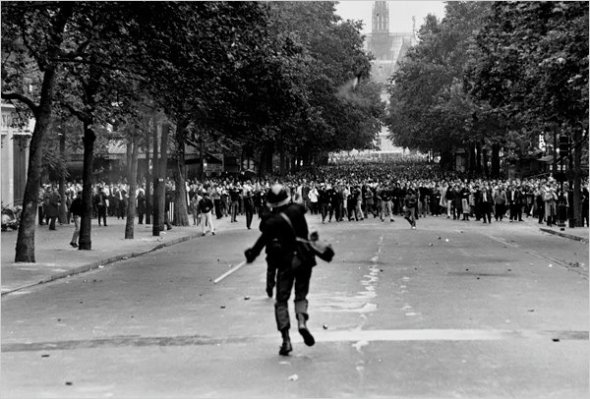
Paris, May 1968
For the past few weeks, as the protests in Tunisia spread to Egypt and then to several other countries, I’ve been reminded of the worldwide political uprisings that took place back in 1968, “the year that rocked the world.” Now that we are even seeing Americans protesting in the streets of Madison, Wisconsin and Columbus, Ohio, I wonder: could it happen again?
In case you weren’t around in 1968 or your memory is fuzzy, the Guardian published a summary of some of the events of that unbelievable year back in 2008. Sean O’Hagen describes how in May 1968, Paris
…was paralysed after weeks of student riots followed by a sudden general strike. France’s journey from ‘serenity’ to near revolution in the first few weeks of May is the defining event of ‘1968’, a year in which mass protest erupted across the globe, from Paris to Prague, Mexico City to Madrid, Chicago to London.
[….]
These rebellions were not planned in advance, nor did the rebels share an ideology or goal. The one cause many had in common was opposition to America’s war in Vietnam but they were driven above all by a youthful desire to rebel against all that was outmoded, rigid and authoritarian. At times, they gained a momentum that took even the protagonists by surprise. Such was the case in Paris, which is still regarded as the most mythic near-revolutionary moment of that tumultuous year, but also in Mexico City, Berlin and Rome.
In these cases, what began as a relatively small and contained protest against a university administration – a protest by the young and impatient against the old and unbending – burgeoned into a mass movement against the government. In other countries – like Spain, where the Fascist General Franco was still in power, and Brazil, where a military dictatorship was in place – the protests were directed from the start against the state. In Warsaw and Prague, the freedom movements rose up briefly against the monolithic communist ideology of the USSR. And in America, capitalism was the ultimate enemy, and Vietnam the prime catalyst.
Those protests, along with revolutions in music, art, fashion, and mores truly changed the world. Could it be happening again? Have we really reached a tipping point?
I thought I’d just put up some links to the important events that have taken place today in the many ongoing protests. You can add your own links in the comments (if anyone else is still awake).
More below the fold….
Tuesday Reads: Tim Geithner in Control of Obama’s Economic Policy, and Other News
Posted: February 15, 2011 Filed under: Bailout Blues, Barack Obama, Economic Develpment, Egypt, financial institutions, Foreign Affairs, Global Financial Crisis, Gulf Oil Spill, Iran, U.S. Economy, U.S. Politics, unemployment, Yemen | Tags: Barack Obama, Financial Markets, Larry Summers, Noam Scheiber, The New Republic, Timothy Geithner, Wall Street 22 Comments
Good Morning!! The snow is slowly melting outside my house, and I’ve come down with Spring fever! No more snowstorms please, Mother Nature. Anyway, at least for this week, we are getting temperatures in the 40s and 50s. It is going to be chilly again tomorrow, but after that–springlike! After the frigid winter we’ve lived through, these temperatures feel amazing. Maybe this will make the bad news from DC a little more bearable. I hope so.
This morning I want to focus on an important article that comes via David Dayen at FDL. It’s a piece at The New Republic about Timothy Geithner, written by Noam Scheiber. First a little aside.
Back in November, I wrote a post about the axing of Obama’s economic team and noted that Geither was the last man standing.
In that post, I quoted Andrew Cockburn of Counterpunch:
If Barack Obama needed any help in guiding the Democratic Party over the cliff he certainly got it from Treasury Secretary Timothy Geithner. Voters have told pollsters that the state of the economy, their own in particular, was their principle concern. Though impelled by the specter of unemployment and homelessness, the image of Geithner, toady to the bankers, can only have encouraged them in their fury. A sensible president would therefore already be running out the plank prior to giving this disastrous financial overseer an encouraging shove between the shoulders. But in this case, we may not be that lucky. CounterPunch can reveal the crucial role played in these matters by a group close to the President but unknown to the outside world.
A knowledgeable insider told Cockburn that despite Larry Summers’ reputation as a corporate tool,
“Larry has some idea that there is more to the economy than just the welfare of large banks,” this official suggests. “He did push for a larger stimulus and more jobs programs, for example. Tim just cares about banks.”
I then went on to indulge in a little conspiracy theorizing based on Cockburn’s information. But that’s beside the point right now. The point is that after writing that post, I came to the conclusion that Geithner was running economic policy in the Obama administration.
Getting back to the article at TNR, Scheiber purports to explain how Geithner survived the massacre of the economists. One interesting tidbit in the lengthy article is about Geithner’s relationship with Larry Summers, who acted as Geithner’s mentor and patron early on.
In 1993, Geithner caught the attention of [a] prominent patron—Larry Summers—whom Bill Clinton had appointed as his treasury undersecretary. Summers took a personal interest in Geithner’s career and promoted him each time he rose through the Treasury ranks.
And then during the Obama administration, Geithner apparently stabbed his patron in the back, becoming President Obama’s primary economic adviser–even though Geithner isn’t an economist. (Neither is anyone else on Obama current “economic team,” as Dakinikat frequently points out.)
Geithner actually sounds a lot like Obama–he’s really good at sucking up and convincing people he’s on their side–until he slides in the knife. Regarding Geithner’s time at the IMF, Scheiber writes:
According to former co-workers, Geithner was deft at bringing skeptical colleagues on board. One technique involved homing in on possible dissidents and absorbing their suggestions into his proposals.
Sound familiar? A bit more:
Perhaps most important, Geithner was scrupulously attuned to the temperament of the boss. Like Obama, he evinced a strong aversion to blather. During meetings with the president, he would say little, and usually not until the end, when his opinion was solicited. “I thought [Geithner] got the president really well,” says a former administration official who interacted with him on nonfinancial matters. “When he was in trouble, I said to someone, ‘He just needs to hold on. He’ll be fine with Obama. Once they get to know each other, they’re like the same person.’”
Scheiber describes an epic struggle between Geithner and Summers over how to deal with the banks that had crashed the U.S. economy. Summers argued for some form of nationalization, while Geithner claimed the banks just needed more capital and they could recover.
If Geithner was right, the capital shortfall was much more manageable than Summers feared. The banks might be able to fill it with minimal government help, simply by selling shares to investors. But, if he was wrong, the banks would stumble along in a kind of vampire state, sucking credit from the economy and exacerbating the recession. In the worst case, fears of insolvency could trigger a modern-day version of Depression-era bank runs.
Hey, wait a minute. That sounds like what is happening to our economy right now. But, never mind, Geithner won the battle that counted–the battle for Obama’s favor.
Part of what Geithner convinced Obama of was “that it was ultimately better politics to risk a backlash with unemployment at 10 percent than to feed the backlash and watch the economy shrink further.” So it’s Geithner we have to thank for the new normal of high unemployment, poverty, and suffering among the middle, working, and lower classes.
Finally, what horrified David Dayen was Geithner’s out-front claim that–in Dayen’s words, “what’s good for Wall Street is good for America.” Geithner:
“I don’t have any enthusiasm for … trying to shrink the relative importance of the financial system in our economy as a test of reform, because we have to think about the fact that we operate in the broader world,” he said. “It’s the same thing for Microsoft or anything else. We want U.S. firms to benefit from that.” He continued: “Now financial firms are different because of the risk, but you can contain that through regulation.” This was the purpose of the recent financial reform, he said. In effect, Geithner was arguing that we should be as comfortable linking the fate of our economy to Wall Street as to automakers or Silicon Valley.
In response, Dayen writes:
I don’t even know what to say about this. We’re just a few years removed from the financial oligarchs destroying the global economy through their own greed and negligence. And the man put in charge of regulating them, who had a front-row seat to all this destruction and who has been given expanded powers under Dodd-Frank to see to it that never happens again, thinks that there’s a great “financial deepening” about to take place where the demand for sophisticated financial innovations will jump. Therefore, the financial sector will need to grow and become the most reliable spur of the US economy. That’s his feeling. And regulation can reduce the risk, even though the new regulations barely put a dent into Wall Street’s core business, and are being systematically defunded besides.
Financialization of the economy has led to practically nothing but pain for the average worker and risk for the taxpayer. It has turned the allocation of capital into the placing of bets at a casino, and the stock market into a particularly sophisticated video poker game. This territory was all covered before in the run-up to the Great Depression as well, and we know the precise causes and remedies involved. Geithner prefers not to address the plutocracy he’s really advancing here – where elites provide “financial deepening” services abroad and amass ridiculous profits that they wall off.
This incredibly amoral conman is partnering with our conman chief executive to sell out our country, our lives, and those of our children and grandchildren. There’s lots more of interest in the article, particularly the information about Geithner’s upbringing.
I’ll wrap this up with a few other stories, and then throw the floor open to your links and opinions. Did you hear that Stephen Baldwin is suing Kevin Costner over Costner’s oil-eating invention?
It seems Baldwin sold his shares in Costner’s company right before BP shelled out $50 million for the machines.
Jane Hamsher offers a flow-chart of the principle players in the scandal over US Chamber of Commerce’s attempts to discredit Wikileaks, Glenn Greenwald, Brad Friedman, David House, and others who have supported wikileaks and Bradley Manning. Joseph Cannon has also been covering this story.
Brad Friedman’s post especially is a must read. Get this, the Chamber paid 2 million dollars a month for dirt on Friedman, and got completely inaccurate information. And that inaccurate information came from corporations who are paid billions by our government “to target terrorists.” But Obama wants to cancel heating assistance for poor people to save money.
Mitt Romney is ahead in the latest NH poll, at 40%, for whatever that’s worth. Romney was always going to win NH. They always vote for New Englanders up there. The real test for Romney will be Iowa.
The Patriot Act extension has been passed by the House on the second try. I think the Egyptians will probably get rid of their emergency law before we get rid of ours.
There are “massive” protests in Iran, inspired by the dramatic events in Egypt. There have also been more protests in Yemen and in Bahrain. When will it happen here?
What are you reading and blogging about today?

 peej
peej Carissa
 bostonboomer
 dakinikat
 ecocatwoman
 mablue2
 Mama Lopez
 peggysue22
 quixote
 skydancingguestblogger
 Mona (aka Wonk the Vote)



 Sky Dancing
Recent Comments