I’m getting a slow start today. I was exhausted after my trip home, and I slept most of yesterday afternoon. I feel as if I could do that again today, and I just might.
There is lots of news this morning, but first I want to share a small epiphany I experienced while driving through Ohio on Saturday. Traffic was light and the weather was nice, partly cloudy and warm–with just enough sun to be bright but not enough for me to need sunglasses.
I was listening to an interesting program on NPR–I think it was Radiolab–about a man who described himself as solitary–practically a hermit–because he experienced so many problems in interacting with people. He enjoyed being alone more than anything else. His marriage to his first wife had broken up and she had taken their two children, whom he loved. The only relationships he had had that weren’t problematic were with his son and daughter. At one point, he learned that his ex-wife’s boyfriend was abusing his children, and he sued for custody. He didn’t get it because when he went to a psychological evaluation, he mistook another little girl in the office for his daughter. The psychologist questioned how he could be a good parent if he didn’t even recognize his own child.
The man moved to California and found a job where he didn’t have to interact with other people except over the phone, and it worked very well for him. Eventually he met a woman who seemed to understand him, and they lived together for years and eventually married.
I really identified with the story, because I find most of my difficult experiences involve interactions with other people. I have always preferred being alone to spending time with people–especially in large groups. As a child, I loved to read and could lose myself in a book and shut out the entire world. As a teenager, I loved to listen to music alone in my room, and I still read constantly. I always felt different–as if I didn’t belong in this world. I think that is the reason I like to drive long distances–I can be alone with no one to bother me, unless I want them to.
Anyway, it turned out that the man in the NPR story had prosopagnosia, or face blindness, a visual processing disorder in which a person has difficulty perceiving faces. He discovered this while he and his wife were watching a 60 Minutes program on this unusual cognitive problem. Interestingly, famed neurologist Oliver Sacks suffers from prosopagnosia.
At the point where the man learned what his problem was after years of struggling in relationships, I suddenly had my epiphany. I became aware of a feeling and I thought to myself. This is how it feels to be happy. I’m happy right now. Of course once I had the thought, I was no longer in the present moment, but the good feeling continued for some time as I listened to other stories on NPR.
Now I don’t think I have prosopagnosia–at least I got 6 right on a video test for it–so I don’t know why the NPR program had such a profound effect on me–maybe because I think there’s something wrong with me but I don’t know what it is. It would be great to have an answer. Why am I happiest when I’m alone but still can be in touch with people over the internet or on the phone? Maybe I’ll never know, but I definitely did have one of those peak experiences that Abraham Maslow wrote about.
On Sunday, the second day of my trip, I was tired all day long and had trouble staying awake. I made good time across New York despite quite a bit of traffic; but the final leg of the trip on the Mass Pike was torturous. I sat in bumper-to-bumper traffic for more than an hour at one point and the the traffic was hellish the entire way. Oddly, I still felt that my experience of happiness the previous day made it all worthwhile.
I tried to find the NPR prosopagnosia story on-line, but I didn’t have any luck. I’d like to listen to it again.
Now that I’ve likely bored you to tears, I’ll get on with the news.
The United States and five other world powers have reached a deal with Iran that would place strict limits on Tehran’s nuclear program in return for ending sanctions on its economy, the culmination of years of delicate diplomacy pursued by President Barack Obama despite warnings the agreement could strengthen Iran’s Islamist regime and leave it dangerously close to a nuclear bomb.
The historic accord, reached by Secretary of State John Kerry and his international counterparts in Vienna on Tuesday after 18 days of intense negotiations, now faces review from a hostile Republican-led Congress, opposition from every GOP presidential candidate, from Israel’s government and from Sunni Arab monarchs. The deal’s long and complex implementation process also leaves it vulnerable to unraveling.
Speaking from the White House Tuesday morning, Obama called the deal a victory for diplomacy that would prevent a nuclear arms race in the Middle East and avert a possible conflict with Iran.
“No deal means a greater chance of more war in the Middle East,” Obama said. He reaffirmed America’s commitment to Israel’s security and Gulf Arab states like Saudi Arabia, while adding that the U.S. is “open to engagement on the basis of mutual interests and mutual respect.”
Obama also hinted at the possibility of a larger thaw in U.S.-Iranian relations. ”It is possible to change,” Obama told Iranians, urging them to take a “different path, one of tolerance, of peaceful resolution to conflict… This deal opens an opportunity to move in a new direction. We should seize it.”
“This is the good deal that we have sought,” Kerry said in a statement from Vienna.
After arduous talks that spanned 20 months, negotiators have reached a landmark deal aimed at reining in Iran’s nuclear program.
The agreement, a focal point of U.S. President Barack Obama’s foreign policy, appears set to reshape relations between Iran and the West, with its effects likely to ripple across the volatile Middle East.
Representatives of Iran, the United States and the other nations involved in the marathon talks were holding a final meeting in Vienna on Tuesday.
Obama praised the deal reached Tuesday morning, saying the agreement met the goals he had in place throughout negotiations.
“Today after two years of negotiation the United States together with the international community has achieved something that decades of animosity has not: a comprehensive long-term deal with Iran that will prevent it from obtaining a nuclear weapon,” Obama said from the White House, with Vice President Joe Biden at his side.
Iranian President Hassan Rouhani also praised the deal, speaking after Obama finished, as televisions in Iran broadcast the U.S. President’s statement live, translated into Farsi.
“Negotiators have reached a good agreement and I announce to our people that our prayers have come true,” Rouhani said in a live address to the nation following Obama.
The essential idea behind the deal is that in exchange for limits on its nuclear activities, Iran would get relief from sanctions while being allowed to continue its atomic program for peaceful purposes.
The possibility of up to a million new barrels of Iranian oil flooding global markets—the amount Iranian officials aim to deliver within months—comes at a critical time. China’s stock-market turmoil in recent weeks could slow an economy that was expected to account for a lot of energy-demand growth. U.S. production remains strong, and oil giants such as Iraq and Saudi Arabia are pumping record amounts.
With new Iranian supply, that has raised the specter of a fresh oil glut.
After recovering somewhat from a 60% drop earlier this year, global benchmark Brent crude has lost 15% since early Ma.. It fell further on Tuesday morning in London trading, to $57.30 a barrel on London’s ICE futures exchange. WTI crude futures, a benchmark largely for American oil, was down 1.7% on the New York Mercantile Exchange.
“Iran’s efforts to raise oil exports could not have come at a worse time, given the market’s lingering oversupply,” said Michael Cohen, an energy analyst at Barclays.
Advertisement
In 2012, the U.S. and European Union imposed strict sanctions on Iran’s energy and financial sectors, and the country’s oil exports have been cut nearly in half as a result, according to the U.S. Energy Department. Iranian exports averaged 1.4 million barrels a day in 2014, down from 2.6 million barrels a day at the end of 2011, federal data show.
The speed and quantity of new oil that Iran can export hinge upon many difficult-to-predict factors. They include when Iran might be able to satisfy various countries and the United Nations that it has met the requirements of the deal, triggering the start of sanctions relief. Western officials have said that likely won’t happen until the end of 2015.
As most of us understand, “Do I have a job?” is not the only question you might ask about your economic situation. That understanding is what Hillary Clinton is counting on as she delivers her first major economic address Monday, an attempt to articulate a vision that will not only provide a means of understanding the collection of policy changes she’ll be advocating in her 2016 campaign for president, but also contrast with the now 17 Republicans who want to face her next fall.
I’m writing this before the full text of Clinton’s speech is available, so what I have to go on is only the outline and selections that have been leaked to a couple of reporters (see here and here). But it’s clear that Clinton is attempting to expand the economic conversation beyond the two measures that usually dominate the discussion: job growth and GDP growth. “The measure of our economic success,” she’ll say, “should be how much incomes rise for middle-class households, not an arbitrary growth figure.”
So while Clinton is going to offer some proposals like an infrastructure bank meant to create jobs, most of her emphasis is going to be on increasing wages and improving working conditions with things like paid sick leave. To see why this is aimed at the Republican candidates, pay close attention to what they say when they’re asked about issues like wage stagnation and inequality. What you almost inevitably get is a brief acknowledgment that these things are indeed a problem, then a quick redirection to the policies they say will accelerate growth and create jobs. The last thing they want is to get into a detailed discussion about wages. If pressed, the best explanation they can come up with for why wages are stagnant, or why inequality has been increasing for many years, is that, like everything else that is not as we would like it to be, it’s the government’s fault.
That’s the nature of the problem they face where their ideological beliefs meet the requirements of a presidential campaign. They don’t believe that government can do much affirmatively to improve the economy, so their proposals tend toward “getting government out of the way”—in other words, not doing something new, but stopping something that’s already happening. But if you put a Democratic proposal like paid sick leave alongside a Republican proposal like loosening environmental regulations, it’s a lot easier to understand how the first is supposed to help workers than how the second would.
So as the discussion on economics shifts, Clinton can advocate for at least some policies that are new and meant to react to the changes that have taken place in the American economy. The Republicans, on the other hand, are unlikely to advocate much beyond what they always advocate. There may be some differences in the details, but its essence will be all too familiar: Cut taxes (particularly on the wealthy), cut regulations on corporations, accelerate the decline in collective bargaining, and wait for our glorious future of prosperity to begin.
I’ll add a few more news links in the comments. So . . . what stories are you following today? Please post your thoughts and links in the thread below.
Did you like this post? Please share it with your friends:
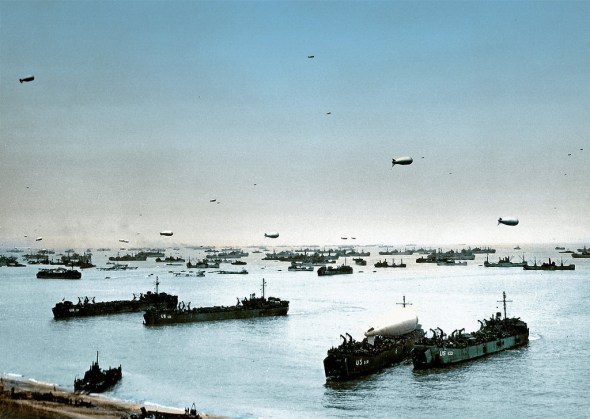
Allied ships, boats and barrage balloons off Omaha Beach after the successful D-Day invasion, near Colleville-sur-Mer, Normandy, France on June 9, 1944. (Photo by Galerie Bilderwelt/Getty Images)
Good Morning!!
Today is the 71st anniversary of the D-Day invasion of Normandy. I found some stunning original color photos at The Denver Post, and I thought I’d share a few of them here. Go to the link to see the entire collection. I’ve also gathered some interesting articles on the “longest day” along with remembrances from survivors.
With Saturday comes another anniversary of D-Day as the light continues to dim on the generation that fought it.
Seventy-one years have passed since Carolinians such as Andy Andrews of Black Mountain and Walter Dickens of Monroe got their first taste of combat when they rushed ashore at Normandy, France, on June 6, 1944, the pivotal day historians tag as the beginning of the end for Nazi Germany.
It was more of a beginning than an end. Long after D-Day’s first anniversary, the bullets would continue to fly in the Pacific theater and other parts of the world.
A year ago, I wrote a series of stories to honor the 70th anniversary of D-Day through the eyes – and distant memories – of Andrews, Dickens and others like paratroopers Harold Eatmon of Mint Hill and E.B. Wallace of Waxhaw. The fighting took another 11 months and horrific losses during battles in countries such as France, Holland, Belgium and ultimately Germany before the Germans surrendered.
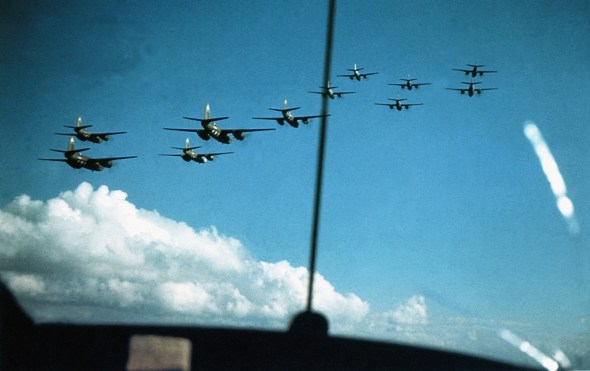
Planes from the 344th Bomb Group, which led the IX Bomber Command formations on D-Day on June 6, 2014. Operations started in March 1944 with attacks on targets in German-occupied France, Belgium, and the Netherlands. After the beginning of the Normandy invasion, the Group was active at Cotentin Peninsula, Caen, Saint-Lo and the Falaise Gap. (Photo by Galerie Bilderwelt/Getty Images)
Fighting continued in the Pacific, where my Dad was stationed, for a long time after June 6, 1944. He was on a ship traveling to Japan when the U.S. dropped the bombs on Hiroshima and Nagasaki. He said they celebrated–not knowing the horror the bombs would unleash–they were saved. My Dad might not have come home if those bombs hadn’t been dropped.
A year after D-Day, thousands of U.S. Marine and Army troops were still two weeks away from capturing Okinawa, the last in a hopscotch of islands that Allied forces needed for a plan to force Japan’s unconditional surrender. Offshore, U.S. Navy ships absorbed daily attacks by Japanese kamikaze (suicide) planes as their guns pounded hills above the landing beaches. Army Air Forces planes bombed targets inland to soften the Japanese defense.
As they fought to take control of Okinawa, hundreds of thousands of U.S. soldiers, Marines and sailors prepared to take part in what would have been history’s greatest battle – Operation Olympic, code-named Downfall, the invasion of the Japanese homeland.
They knew the fighting would be fierce.
Much more at the link. It’s a very good piece.
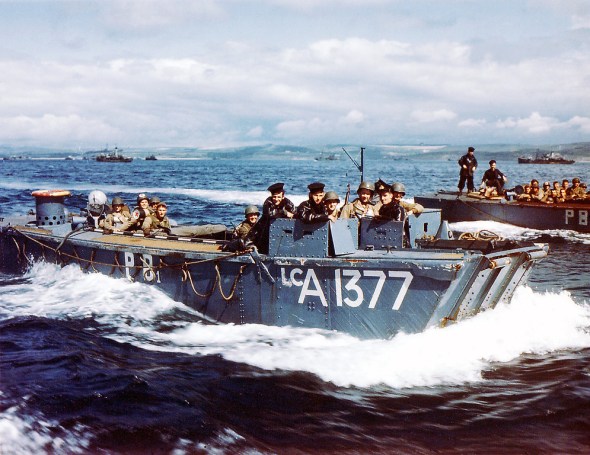
British Navy Landing Crafts (LCA-1377) carry United States Army Rangers to a ship near Weymouth in Southern England on June 1, 1944. British soldiers can be seen in the conning station. For safety measures, U.S. Rangers remained consigned on board English ships for five days prior to the invasion of Normandy, France. (Photo by Galerie Bilderwelt/Getty Images)
Cornelius Ryan was a 24-year-old war correspondent when he had a chance to see a defining moment in the defining event of the 20th century — the Allied landings on the coast of France to retake France and bring down Hitler.
Ryan at first witnessed the invasion from a bomber that flew over the beaches. Then, back in England, he scrambled to find the only thing he could that was going to Normandy. A torpedo boat that, he learned too late, had no radio. “And if there’s one thing that an editor is not interested in,” he said, “it’s having a reporter somewhere he can’t write a story.”
Recalling those five hours off the coast, watching the struggle on the beaches, he remembered “the magnitude of the thing, the vastness. I felt so inadequate to describe it.”
But today, as the 71st anniversary of D-Day approaches on June 6, Ryan is most likely to be remembered for being the one who did describe it, who told so many millions the real story of what happened that day, in his book which became the famous movie, “The Longest Day.”
Lauder was a young woman headed to journalism school at Northwestern when the invasion took place.
In September 1962, I interviewed Cornelius Ryan before the New York premiere of the film. Ryan had become the authority on the events of June 6, 1944, following publication of his book. And as he himself noted, in the 10 years it took him to research and write the book, he became “a veritable depository of D-Day memorabilia.”
He shared some of what he’d learned as we talked in the study of his home in Ridgefield, Connecticut, that Sunday afternoon.
Read her remembrances at the CNN link.
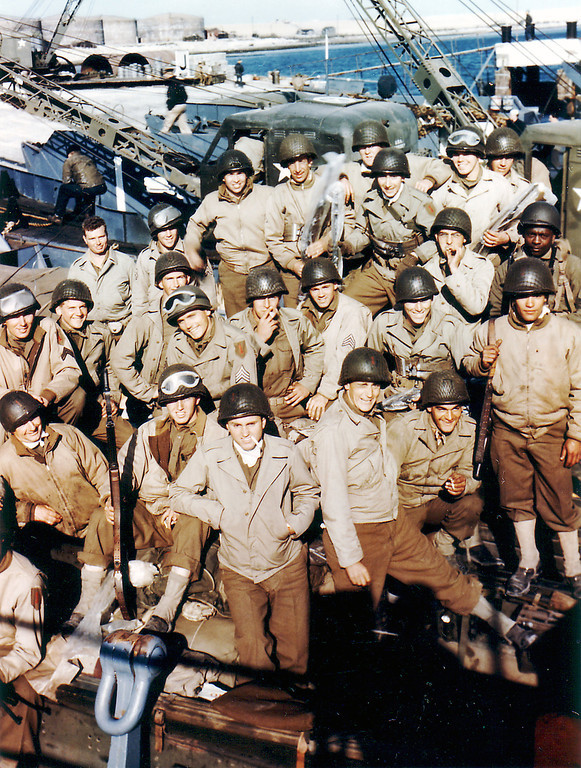
The 1st Infantry Division of the United States Army (The ‘Big Red One’) in Dorset, United Kingdom on June 5, 1944 before departing for Omaha Beach. (Photo by Galerie Bilderwelt/Getty Images)
Considering the pivotal nature of June 6, 1944, how did Hitler react to the attack? Did he rant, did he rail? Did he move with focused calm to try and repel the invaders? [….]
In the early days of June Germany’s Fuhrer was at The Berghof, his residence in the Bavarian Alps. Everyone there knew an invasion was likely in the near future, but the atmosphere was not nervous, according to contemporary accounts. To the contrary it was relaxed, and in the evening, almost festive. A group of guests and military aides would gather at the complex’s Tea House and Hitler would hold forth on favorite topics, such as the great men of history, or Europe’s future.
On the evening of June 5, Hitler and his entourage watched the latest newsreels, and then talked about films and theater. They stayed up until 2 a.m., trading reminiscences. It was almost like the “good old times,” remembered key Hitler associate Joseph Goebbels.
When Goebbels left for his own quarters, a thunderstorm broke, writes British historian Ian Kershaw. German military intelligence was already picking up indications of an oncoming Allied force, and perhaps landing troops, in the Normandy region. But Hitler wasn’t told. The Fuhrer retired around 3 a.m.
German headquarters confirmed that some sort of widespread attack was in progress shortly thereafter. At sunrise, around 6 a.m., the defenders knew: Allied ships and planes were massed off the French beaches in astounding strength, and men were beginning to come ashore. It was a sight many would never forget.
But the German reaction was slow and befuddled. Was this the real thing, the main invasion? Or was it a feint, with the real force to land elsewhere, probably Calais?
Read more at the link.
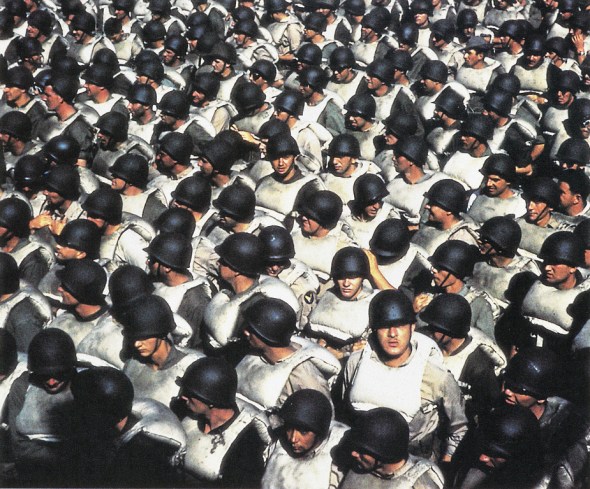
A U.S. Landing Craft Infantry (LCI) filled with invasion troops approaches the French coast from the sea in June of 1944. The GIs wear life vests in preparation for the landing. (Photo by Galerie Bilderwelt/Getty Images)
Before I get to the rest of the news, I want to highly recommend an HBO documentary I watched a few days ago called Tales of the Grim Sleeper. It’s the story of how serial killer Lonnie Franklin, Jr. murdered as many as 100 African-American women in South Central LA over more than 20 years while the LAPD ignored what was happening.
This isn’t the story of a serial killer–it’s about police attitudes toward the poor and people of color; and it fits right in with recent events in places like Ferguson, Cleveland, Staten Island, and Baltimore and with the Black Lives Matter movement.
This story could have happened in a poor neighborhood in any major American city. In fact, there was a similar case in Cleveland where Anthony Sowell murdered poor black women for years without getting caught because the crimes weren’t taken seriously.
If you have HBO or can get access to it, please watch this outstanding film.
How could I have slept until 10AM? I can’t believe it. I’ve been waking up really early ever since the time change, which was ages ago. This will be a quickie post, because I have to get ready to go somewhere this afternoon.
Before I get to the latest political news, I wanted to share this weird story I came across a few days ago in The Daily Mail. Please let me know if you think it’s for real or some kind of bizarre mass hypnosis.
A mysterious noise from the sky is continuing to baffle people all over the world – as well as giving those who hear it sleepless nights.
Sounding like a trumpet or a collective from a brass section of an orchestra, a selection of videos shot from the Canada to Ukraine, via the U.S., Germany and Belarus show strange goings on above us.
And the eerie sounds have been continuously heard at all different times and locations for almost a decade.
The first video posted on YouTube recording the unusual, unearthly sounds, was in 2008 when a user recorded the strange sounds in the sky from Homel, in Belarus.
That same year another anonymous user shared the ‘ear-deafening’ sounds that they insisted ‘were not a hoax,’ from a quiet neighbourhood believed to be in the U.S.
Kimberly Wookey from Terrace, British Columbia in Canada first captured the alien sound in June 2013, and since then she has managed to capture several recordings of the noise with her most recent being on May 7 this year.
There are several examples of recordings of the strange sounds at the Daily Mail link. I looked on YouTube, and dozens of these recordings have been posted. Of course the end-timers are going to think these are trumpets from heaven sounding the last days. Someone in New Jersey thinks it’s a UFO.
Is this going to be another crop-circles-type mystery/hoax? Anyway, I love strange stuff like this, so I thought I’d share and see what you think.
The State Department is sharing new details about the deadly fighting in Ramadi, Iraq, last Sunday, saying the city fell into ISIS hands after the militant group set off 30 suicide car bombs in the city center, 10 of which each were comparable in power to the Oklahoma City truck bomb of 1995.
The explosions took out “entire city blocks,” said a senior State Department official who spoke to reporters at the State Department Wednesday on condition that he not be named. The vehicle-borne improvised explosive devices, or VBIEDs, were able to gain access to the city center after an armored bulldozer plowed through T-wall barricades lining the city’s critical government buildings, the official said, adding that the same bulldozer was later used as a power VBIED, itself.
Soon after the bombs went off, the Iraqis deployed a reinforcing column into the city center, but they were forced to retreat after coming under heavy enemy fire, the official said. That retreat led to a larger exodus of Iraqi security forces and the civilian populations, leaving the streets looking “barren,” according to this official.
ABC also has video at the link. A little more:
The State Department and the Pentagon insist the fall of Ramadi does not closely resemble that of Mosul in 2014, when, after only a week of fighting, Islamic State forces were able to take over the entire city as ISF forces abandoned the posts, equipment and even their uniforms.
The State Department official argued that Ramadi has been fiercely contested for 18 months, as both sides controlled equal parts of the city. It wasn’t until the critical government center fell this weekend that ISIS was able to lay claim to the entire provincial capital.
But the official admitted that, in this case, the Iraqi forces did leave some U.S.-made weapons behind. The official suggested that if the enemy attempts to commandeer any of the bigger weapons, they would be killed in airstrikes.
The capture of Ramadi last weekend by Islamic State fighters is a significant setback for U.S. strategy in Iraq and shows that, nearly a year after the extremists overran Mosul, the United States still doesn’t have a viable plan for protecting the country’s Sunni areas.
The collapse of the Iraqi army in Ramadi, the capital of Anbar province, was in some ways a replay of the Mosul debacle in June 2014. The Shiite-dominated Iraqi military, though trained and retrained by the United States, appeared to lack the leadership or will to fight off a relatively small but ferocious onslaught of Sunni insurgents.
The Ramadi defeat exposed the sectarian tensions that underlie this war. Among the urgent questions: Are Shiite regular army troops ready to fight and die to protect Sunnis, or will their lines collapse in Sunni areas, as happened in Mosul and now Ramadi? If the tougher Iranian-backed Shiite militias are sent instead to do the job, will the Sunni population see them as a Shiite occupation army — setting the stage for a generation of sectarian revenge killing?
Gee, do you think maybe Bush and Cheney might have made a mistake when they attacked Iraq based on questionable intelligence?
Charles Pierce sees a replay of much tragic events in the more distant past:
It goes back to the “Bloody Shirt” campaigns in the decades after the Civil War. However, at least in those campaigns, the people waving the bloody shirt were doing so at people who actively had committed treason against the government of the United States and were attempting (with too much success) to win at the polls what they’d lost on the battlefield. More recent uses of the techniques sadly have been designed to cover the ass of bellicose mistakes, and worse, all over the world. Which means the “bloody shirt” begins to slide toward the Dolchstosslegendeof post-WWI Germany. And that never is a good thing.
In our current situation, we are seeing the beginnings of the kind of rhetoric that poisoned our politics for decades after the collapse of South Vietnam. In fact, there was a lot of that going around in 2006, when it became plain that the Iraq invasion had been sold on moonshine by a cabal of geopolitical fantasts and Dick Cheney….
The only way for the people who shook their moneymakers for the war in 2002 to justify their continued place in our politics is to use ISIL to replace the aluminum tubes and hope that enough people don’t notice what a grotesque fast shuffle this is. That will clear the way for the candidates on the Republican side — Rubio, Graham, Jeb (!), and, most recently, Chris Christie — who want to revive the old neocon hoo-rah while distancing themselves from its savage consequences. It looks very much like “Who lost Iraq?” may replace the disastrous decisions of the Avignon Presidency in this campaign, and that a good chunk of the Republican field will be perfectly happy to allow that to happen. For all the talk of the president’s fecklessness from the chickenhawk choir, what those candidates are about right now is the worst kind of cowardice.
Jesus. When will it ever end?
Talking Points Memo discusses a recent survey of voter attitudes.
Researchers from UC Berkeley and the University of Michigan dug up some surprising results after posing the question: How much do lawmakers really know about their voters’ political views?
“Pick an American state legislator at random, and chances are that he or she will have massive misperceptions about district views on big-ticket issues, typically missing the mark by 15 percentage points,” David Broockman and Christopher Skovron wrote in a study for the Scholarly Strategy Network originally published in 2013.
To investigate the question, the duo surveyed thousands of state legislators and compared their perceptions of voters to people’s actual views, derived from a large body of public opinion data.
Their conclusion: “legislators usually believe their constituents are more conservative than they actually are.”
On three issues — universal healthcare, same-sex marriage, and welfare — lawmakers’ assumptions about what their constituents believed were “15-20 percent more conservative, on average,” than the actual base of public support for such issues.
Most striking, both liberal and conservative lawmakers assume their voters are much further to the right than they actually are.
I’m not surprised, but it’s good to see intuition backed by empirical research.
Still reeling from last month’s devastating earthquake, Nepal was hammered again Tuesday by a magnitude 7.3 temblor that caused dozens more deaths, unleashed fresh landslides and brought down unsteady buildings.
By late afternoon, Nepal’s Home Affairs Ministry said at least 42 people were killed and more than 1,117 injured in the largest aftershock yet recorded from the 7.8 quake on April 25. Officials warned that the toll could rise.
The epicenter was about 47 miles northeast of the capital, Katmandu, near the Chinese border, according to the U.S. Geological Survey. The April 25 quake, which killed more than 8,150 people, was centered in the mountains west of Katmandu.
The tremor struck just before 1 p.m. local time, sending residents of the capital scurrying into the open air for safety, and was followed by a series of smaller tremors that rattled nerves even further.
Within hours, new makeshift tents had begun popping up in parts of Katmandu as families that had survived the earlier quake and returned to their homes in recent days decided again they were safer sleeping outdoors.
The Hindu is publishing live updates from Reuters. They report multiple aftershocks. What a terrible tragedy! Obviously this is a developing story, and we’ll hear more throughout the day and in coming days.
Records obtained by The Baltimore Sun show that city police often disregard or are oblivious to injuries and illnesses among people they apprehend — in fact, such cases occur by the thousands.
From June 2012 through April 2015, correctional officers at the Baltimore City Detention Center have refused to admit nearly 2,600 detainees who were in police custody, according to state records obtained through a Maryland Public Information Act request.
In those records, intake officers in Central Booking noted a wide variety of injuries, including fractured bones, facial trauma and hypertension. Of the detainees denied entry, 123 had visible head injuries, the third most common medical problem cited by jail officials, records show.
The jail records redacted the names of detainees, but a Sun investigation found similar problems among Baltimore residents and others who have made allegations of police brutality.e
Salahudeen Abdul-Aziz, who was awarded $170,000 by a jury in 2011, testified that he was arrested and transported to the Western District after being beaten by police and left with a broken nose, facial fracture and other injuries. Hours later, he went to Central Booking and then to Bon Secours Hospital, according to court records.
Abdul-Aziz said last week that jailers at Central Booking “wouldn’t let me in the door as soon as they saw my face. … I thought I was gonna die that day. Freddie Gray wasn’t so lucky.”
Read the rest at the Baltimore Sun link.
The Washington Post, which initially published leaks favorable to the Baltimore PD, published an editorial in response the the Sun article: Too much black and blue in Baltimore.
TWO OR three times a day on average, suspects in the custody of the Baltimore police are turned away by the city jail because they are deemed too battered, beaten, bruised or otherwise injured or sick to be processed and admitted. The police are forced to head instead for a hospital emergency room to seek treatment for suspects suffering from head injuries, broken bones, hypertension and an array of other afflictions.
The frequency of such occurrences was detailed over the weekend by the Baltimore Sun, which obtained records from the city’s detention center under the Maryland Public Information Act. According to those records, the jail has turned away nearly 2,600 ailing detainees since June 2012 — about 2 percent of all bookings.
That staggering figure suggests the Baltimore police are heedless, at best, of the physical welfare of suspects in their custody. It also may help explain how Freddie Gray could have pleaded for medical care at least five times after he was arrested last month before the officers who detained him bothered to summon a paramedic — by which time it was too late….
The police understand — and after 2,600 reaffirmations in three years, they should be acutely aware — that they are obliged to seek medical attention for suspects who are sick or injured before the jail will admit them. Yet somehow that obligation doesn’t seem institutionally ingrained in cops on the beat….
The Justice Department’s civil rights investigation of the city police, announced last week by Attorney General Loretta E. Lynch, should take account of these injured detainees, including the causes and circumstances of their injuries and whether police are adequately trained and instructed in assessing them. And it should examine whether African American suspects are more frequently hurt and denied prompt medical care than other detainees.
Journalists are still reacting to Seymour Hersh’s poorly sourced accusations that the Obama administration conspired with Pakistan to stage a fake raid on Osama bin Laden’s compound and then lied about it. Here are two I found this morning:
When a journalist writes a tell-all story about a classified operation, and he suspects the story will catalyze anti-American anger, provide fuel for terrorist groups, and cause severe friction with foreign governments, the act of publication is morally fraught. When the story is based on obscenely thin sourcing and careens into conspiracy theories, the decision to publish becomes indefensible.
Seymour Hersh has had a long and distinguished history as one of America’s finest investigative journalists. In recent years, he has gone a bit kooky. In 2011, for instance, he suggested that Stanley McChrystal, the former top commander in Afghanistan, and the leadership of the US Joint Special Operations Forces were “all members of, or at least supporters of, Knights of Malta.” His latest story, in which he claims that the entire story of Bin Laden’s killing is an elaborate cover-up for a joint Pakistani-American operation, may be his kookiest.
As many have already pointed out, Hersh’s version offers a combination of the inconsistent and the inexplicable. Why, for instance, would the Pakistanis help plan an elaborate raid, complete with a recall of Bin Laden’s Pakistani guards—rather than just hand Bin Laden over directly—if they always intended to claim he’d been killed in a drone strike hundreds of miles away? Worse, the key contentions rely on the exclusive word of one unnamed source who was a) retired, and b) on Hersh’s own account, only “knowledgeable about the initial intelligence about bin Laden’s presence in Abbottabad.”
To be sure, there are scraps of Hersh’s hodgepodge narrative that may turn out to be true. That a CIA “walk-in” may have contributed to the intel leading to Bin Laden’s whereabouts, for instance, matches a tidbit that NBC has confirmed recently. And Hersh’s insistence that someone highly placed in the Pakistani intelligence services knew of Bin Laden’s presence has been pretty widely believed for a while. But leaping from these plausible and relatively minor details to the rest of the fantastic tale Hersh spins simply boggles the mind.
It’s unsurprising then that The New Yorker passed on the story (as it, along with the The Washington Post, have reportedly done with the last few of Hersh’s flights of fantasy.)
The London Review of Books, on the other hand, lacked the same degree of restraint. This is hardly surprising given the editorial leadership’s apparent lack of interest in fact-checking. As LRB senior editor Christian Lorentzen wrote in a 2012 piece suitably titled Short Cuts,” “the facts are the burden of the reporter…nobody at the paper fact-checks full time; that’s an American thing… I miss New York sometimes, but I don’t miss its schizophrenic obsession with facts, or the puritan hysteria that attends the discovery that a memoir should have been called a novel.” The LRB, it seems, takes pride in its sloppiness. Perhaps they have an editorial opening for Stephen Glass?
As a former fact-checker, I find the LRB’s approach part puzzling and part offensive. As a citizen who would like to form judgements and opinions on the basis of actual information, I’m horrified.
Hersh leads the reader into a Wonderland of his own, thinly sourced retelling of the raid on Bin Laden’s complex in Abbottabad, Pakistan. According to Hersh, who cites American sources, “bin Laden had been a prisoner of the [Pakistani Inter-Services Intelligence agency] at the Abbottabad compound since 2006” and his ISI captors eased the way for the American SEAL team to skip into Pakistan on their helicopters, kill the al Qaeda leader, and then skip out.
It’s a messy omelet of a piece that offers little of substance for readers or journalists who may want to verify its many claims. The Hersh piece can’t be refuted because there’s not enough solid material to refute. Like the government officials who spun the original flawed Abbottabad stories, he simply wants the reader to trust him.
Hersh’s piece quarrels with almost every aspect of the official story, asserting that much of it is cover designed to protect the Pakistanis who sold bin Laden out to the United States for military aid….
Hersh may very well be onto something—what did the Pakistanis know, when did they know it, and how much did they help? And that debate appears to be starting in earnest already, with NBC News quickly building off Hersh’s article. But Hersh’s potentially valid question on that subject is almost lost in the broad sweep of rolling back so many other stories and quibbling with effectively every known detail of one of the most thoroughly leaked secret operations in history.
By re-exploring the bin Laden operation, Hersh has thrust himself into the phenomenological territories that Cold War spymaster James Jesus Angleton called a “wilderness of mirrors.” In this clandestine world, truths are constructed, obliterated and bent to serve their masters. Adversaries who would deceive abound in this place, and without a reliable map, a compass, a sense of direction and maybe even a pedometer, even the most intrepid voyager (or journalist) can find himself lost. I’ll volunteer to join a search party for Hersh—somebody I’ve long admired—if only somebody can tell me precisely where he is.
Another harsh indictment. I expect “progressive” conspiracy theorists like Glenn Greenwald and Marcy Wheeler will attempt to keep this story alive, but it doesn’t seem to be getting much traction in either the mainstream media or the sane alternative media.
Students study for finals on “BU Beach,” May 6, 2015
Good Morning!!
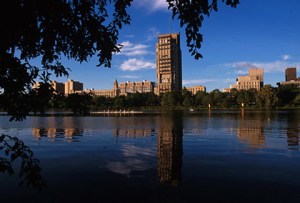
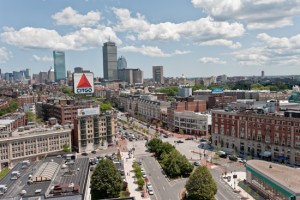
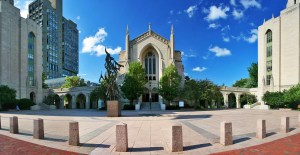
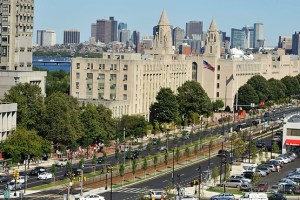
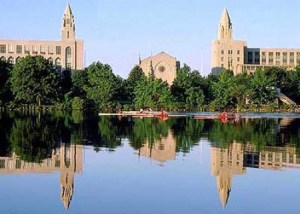
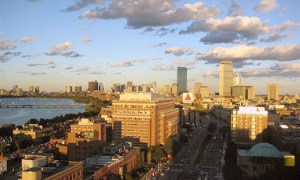
Well, well, well. Boston University and a newly hired assistant professor of sociology are being attacked by right wing nuts who can’t handle free speech or academic freedom. And so far BU is telling them they’re just going to have to deal with it. I hope they stick to their guns, so to speak. In honor of the school administration doing the right thing, I’m illustrating this post with views of the beautiful BU campus.
Fox News is shocked! Naturally, they begin with a version of “some people say….”
Critics say a newly-hired Boston University professor has crossed the line with recent tweets bashing whites, but the school says it’s simply free speech.
“White masculinity isn’t a problem for america’s colleges, white masculinity is THE problem for america’s colleges,” Saida Grundy, an incoming assistant professor of sociology and African-American studies at Boston University, tweeted in March.
In another tweet from January, she wrote: “Every MLK week I commit myself to not spending a dime in white-owned businesses. and every year i find it nearly impossible.”
In another, she called white males a “problem population.”
“Why is white America so reluctant to identify white college males as a problem population?” she asked.
View of BU’s Charles River Campus.
Horrors! A black female sociologist who studies traditional masculinity had a few things to say on Twitter about white males. No one has to agree with her or even read her tweets (she has now made her account private). The KKK, the American Nazi Party, Rand Paul, Mike Huckabee, Peggy Noonan, Ted Cruz, Sarah Palin, Bill O’Reilly, Ann Coulter, and every other right wing nut you can name have the same rights to say mean things about any groups of people they choose.
Here’s BU’s response to Fox’s request for comment:
“Professor Grundy is exercising her right to free speech and we respect her right to do so,” Boston University spokesman Colin Riley said.
Read more of Grundy’s “controversial” tweets at the Fox News link and at a Patriots fan site here. I don’t know why they’re all bent out of shape about this.
Grudy got her Ph.D. at the University of Michigan, and her other credentials look pretty good to me.
So far there hasn’t been a lot of reaction to this except from right wing sites like American Thinker and American Spectator. I’ll be keeping an eye on the story and whether BU continues to defend Grundy. If they don’t I’ll be very disappointed. It’s not about agreeing with everything she said; it’s about not giving in to the predictable right wing attacks on anyone who says something they disagree with–even if it’s only on Twitter.
BU College of Arts and Sciences
In other “diversity” news, a restaurant in Colorado is planning a “White Appreciation Day.” That should make the wingnuts happy. From MSNBC:
A Colorado barbecue joint has sparked national outrage with a racially-tinged promotion: “White Appreciation Day.”
“We have a whole month for Black History Month. We have a whole month for Hispanic heritage month,” Edgar Antillon told KUSA-TV. “So we figured all we could do – the least we can do – is offer one day to appreciate white Americans.”
Antillon told the NBC News affiliate that Rubbin’ Buttz, the restaurant he co-owns in Milliken, Colorado, would observe its “White Appreciation Day” on June 11. On this day, all white customers will receive a 10% discount.
It’s worth noting that Antillon is a first-generation American born to Mexican parents, and he acknowledged to KUSA-TV that he has personally experienced racism in his past.
“We’re all American, plain and simple,” he said to the NBC News affiliate.
Apparently the whole thing started as a joke, and then Antillon decided to actually do it. Who cares? It’s dumb and pointless, unless the goal is just to get national publicity. Why not just ignore it? According to The Root, non-white people could end up suing the restaurant for discrimination. The outrage industry in this country is completely out of control.
6/7/10 1:07:44 PM — Boston, Massachusetts Campus Scenics of Kemore Square, Boston Skyline, BU Banners and Commonwealth Ave Photo by Vernon Doucette for Boston University
The Illinois Supreme Court on Friday unanimously ruled unconstitutional a landmark state pension law that aimed to scale back government worker benefits to erase a massive $105 billion retirement system debt, sending lawmakers and the new governor back to the negotiating table to try to solve the pressing financial issue.
The ruling also reverberated at City Hall, imperiling a similar law Mayor Rahm Emanuel pushed through to shore up two of the four city worker retirement funds and making it more difficult for him to find fixes for police, fire and teacher pension funds that are short billions of dollars.
At issue was a December 2013 state law signed by then-Democratic Gov. Pat Quinn that stopped automatic, compounded yearly cost-of-living increases for retirees, extended retirement ages for current state workers and limited the amount of salary used to calculate pension benefits.
Employee unions sued, arguing that the state constitution holds that pension benefits amount to a contractual agreement and once they’re bestowed, they cannot be “diminished or impaired.” A circuit court judge in Springfield agreed with that assessment in November. State government appealed that decision to the Illinois Supreme Court, arguing that economic necessity forced curbing retirement benefits.
Marsh Chapel at center of Charles River campus
The court disagreed with the state, and really slapped down the Illinois legislature in their decision.
“Our economy is and has always been subject to fluctuations, sometimes very extreme fluctuations,” Republican Justice Lloyd Karmeier wrote on behalf of all seven justices. “The law was clear that the promised benefits would therefore have to be paid and that the responsibility for providing the state’s share of the necessary funding fell squarely on the legislature’s shoulders.
“The General Assembly may find itself in crisis, but it is a crisis which other public pension systems managed to avoid and … it is a crisis for which the General Assembly itself is largely responsible,” Karmeier wrote.
“It is our obligation, however, just as it is theirs, to ensure that the law is followed. That is true at all times. It is especially important in times of crisis when, as this case demonstrates, even clear principles and long-standing precedent are threatened. Crisis is not an excuse to abandon the rule of law. It is a summons to defend it,” he wrote.
The Chicago Teachers Union has filed an unfair labor practice complaint accusing the city’s school board of bad-faith bargaining and refusing to engage in mediation toward a new contract.
Union officials said little progress has been made over eight formal bargaining sessions and numerous informal meetings since November. The complaint filed Wednesday with the Illinois Educational Labor Relations Board follows the union’s rejection earlier this week of the board’s proposal that teachers take on a greater share of pension payments….
As she did in the months before the 2012 teachers strike, CTU President Karen Lewis sought to make Mayor Rahm Emanuel the focus of the union’s displeasure with talks to replace a contract that expires June 30. The union again accused the city of using the talks to get back at the CTU for its support of Jesus “Chuy” Garcia in the mayoral election.
“We feel this is reactionary and retaliatory,” Lewis said at a news conference Wednesday. “I guess the fuzzy sweater’s gone,” she said, referring to Emanuel’s wearing a sweater in campaign commercials to indicate a softer personality.
The district, which says it is wrestling with a $1.1 billion deficit weighted with pension payments, wants to save millions of dollars by having teachers pay more into their pension fund. The district wants to end a long-standing agreement that limits teacher paycheck deductions for pensions, the union said.
I have a solution for Chicago’s and for the state of Illinois’s budget problems. Tax the rich. Blaming teachers and government workers isn’t going to solve your money problems. It’s just going to make everything worse. Tax the people who can afford to give something back to the government that constantly favors them.
View of Marsh Chapel with Charles River in foreground
LONDON — Exit polls and partial results after a nationwide vote to pick Britain’s next Parliament showed the Conservative Party with a surprisingly commanding lead Friday, just short of a majority and in a strong position to return to power.
The projections defied virtually all pre-election polls, which forecast a virtual tie between the Tories and the opposition Labor Party in the popular vote. Both main parties had been expected to fall well short of the majority needed to claim power outright.
But as the counting continued into dawn Friday, all signs pointed to an emphatic margin in favor of the Conservatives and their leader, Prime Minister David Cameron, and to a major disappointment for Labor as well as the Liberal Democrats, who paid a steep price for having entered into a coalition with the Conservatives for the past five years.
At dawn Friday, Labor leader Ed Miliband delivered what amounted to a concession speech, saying it had been “a very disappointing and difficult night” for his party.
Newly empowered British Prime Minister David Cameron moved swiftly to establish the terms and priorities for his new government on Friday after a stunning national election that delivered his Conservative Party an unexpected majority, devastated three other parties and redrew the political map of Scotland.
Following predictions that the post-election maneuvering to form a government might take days if not weeks, the Conservative Party’s big victory produced a quick end to speculation about what or who would be in charge.
But if the election produced an unexpectedly clear outcome, it may only have heightened the degree to which the country faces a period of internal debate, inward-looking politics and potential instability, with questions about the durability of the United Kingdom and its place in both Europe and the world still to be answered.
Cameron will have to find a way to manage resurgent Scottish nationalists who are demanding more powers and possibly another referendum on independence. Further, his pledge to hold a referendum to determine Britain’s future in the European Union will continue to raise uncertainty about the country’s commitments and reliability there.
A day after the surprise result in the UK elections, world media outlets have been taking a look at the ramifications.
European papers are concerned about the effect on the EU in the light of Prime Minister David Cameron’s promise to hold a referendum on leaving. And there is speculation that the Scottish nationalists’ spectacular gains may herald the break-up of the United Kingdom.
A US daily fears the result may be the harbinger of the end of the US-UK “special relationship”, but one Spanish daily is enthralled by a photo of Mr Cameron using cutlery to eat a hot dog.
The Sky Dancing banner headline uses a snippet from a work by artist Tashi Mannox called 'Rainbow Study'. The work is described as a" study of typical Tibetan rainbow clouds, that feature in Thanka painting, temple decoration and silk brocades". dakinikat was immediately drawn to the image when trying to find stylized Tibetan Clouds to represent Sky Dancing. It is probably because Tashi's practice is similar to her own. His updated take on the clouds that fill the collection of traditional thankas is quite special.
You can find his work at his website by clicking on his logo below. He is also a calligraphy artist that uses important vajrayana syllables. We encourage you to visit his on line studio.



















 peej
peej Carissa
 bostonboomer
 dakinikat
 ecocatwoman
 jjlo
jjlo mablue2
 Mama Lopez
 peggysue22
 quixote
 skydancingguestblogger
 Mona (aka Wonk the Vote)



 Sky Dancing
Recent Comments