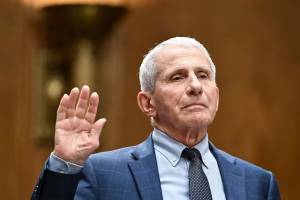
I haven’t been following the Antony Fauci story at all. I heard that his diaries were released, but I assumed it was just some wingnut thing. But today Fauci appeared in front of the Senate Homeland Security and Governmental Affairs Committee, headed by Covid conspiracy theorist Rand Paul. In a surprise move, Fauci invoked his Fifth Amendment right to refuse to answer questions.
Dr. Anthony Fauci declined to answer senators’ questions at a hearing Wednesday on the origins of Covid and the government’s handling of the pandemic, saying he would invoke his Fifth Amendment right to avoid the possibility that Republicans could try to use his testimony to prosecute him for perjury.
The surprise decision shook up the hearing, which was expected to be contentious given Fauci’s previous public clashes with Chairman Rand Paul, R-Ky.
Antony Fauci is swarn in Wednesday.
In his opening statement to the Senate Homeland Security and Governmental Affairs Committee, Fauci pointed to Paul’s “obvious obsession with calling for my prosecution, his repeated slanderous comments about me” and his decision to publicly release the doctor’s personal journal.
“The only conclusion I can reach is that the sole reason he is calling me before this committee is to get me to say something — anything — that could vindicate his repeated public pledges that I end up, in his words — quote — ‘behind bars,’” Fauci said.
“Any reasonable person who has followed his unhinged obsession with me would readily come to the same conclusion,” he continued. “Therefore, although it pains me to do so because of the respect I have for the legislative branch of government and my decades-long record of cooperating with Congress, under the advice of my attorneys, I will invoke my right under the Fifth Amendment of the Constitution to refrain from answering your questions.”
Despite Fauci’s refusal to respond, Paul still used his time at the hearing to ask the doctor a series of questions.
Fauci answered each question with the same line: “On the advice of counsel, I respectfully decline to answer based upon my rights under the Fifth Amendment to the Constitution.”
At the end of his questioning, Paul told Fauci that he would face “repercussions” for not answering questions.
“The committee will have to consider after this hearing what appropriate action should be taken against you for the failure to testify after being directed to do so,” Paul said. “It’s against the law to obstruct an investigation of Congress. There will be repercussions to your refusal to testify today.”
I guess Rand Paul doesn’t understand the Fifth Amendment.
Republican Sen. Rand Paul of Kentucky has released more than a thousand pages of journal entries from Dr. Anthony Fauci, teeing up what is likely to be a contentious hearing with the nation’s former top infectious disease expert on Wednesday about the origins of the COVID-19 pandemic.
Paul, who heads the Senate Homeland Security Committee, subpoenaed Fauci to appear before the committee as part of the panel’s investigation into the origins of the coronavirus. Paul, who has pushed the theory that the virus emerged from a leak at the Wuhan Institute of Virology in China rather than spilling over from animals to humans naturally, has long accused Fauci and other government officials of misleading the public and Congress about the source of the outbreak.
The journal entries date from December 2019, in the days leading up to the U.S. declaring a public health emergency, until December 2022, when Fauci stepped down as the director of the National Institute of Allergy and Infectious Diseases, a position he held for nearly four decades….
Many scientists believe the evidence suggests that the virus emerged naturally from infected bats before it circulated to other species and spread to humans who were handling those animals at a market in Wuhan, where the first human cases appeared in late 2019. But the FBI has assessed the coronavirus “most likely” emerged in a “lab incident in Wuhan.” In January 2025, the CIA issued a new assessment that favored the “lab leak” hypothesis, though it said the finding was made with “low confidence.”
Some of Fauci’s diary entries reflect early uncertainty about the source of the pandemic. In January 2020, he wrote that “we know the market was not the source, it was the amplifier,” though he added that “somewhere the virus jumped from animals to humans.” About a week later, he referenced a conference call in which several top infectious disease experts thought the coronavirus might not have originated in nature.Paul on Monday accused Fauci of saying one thing to “Dear Diary” while telling the public “it’s implausible that it came from the lab, and we’re really convinced it came from these wild animals in the marketplace. But that level of dishonesty is really astounding.”
On Saturday afternoon, as part of this ongoing inquiry, Paul published a thread on X describing the release of a string of what he called diary entries made by Fauci from December 2019 through December 2022. Paul commented on X at the start of the posts, “What [Fauci] wrote privately and what he told the country are two different stories.” [….]
Felicia Goodrum, a virologist at Dartmouth College who spoke to NPR from the American Society for Virology meeting in Minneapolis, says that it’s possible that Fauci may have been less certain in private with his colleagues as they were racing to learn about the new virus than he was in public where he had to assure a population that was panicking over the rapidly emerging pandemic.
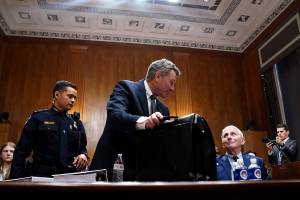
David Schertler, center, an attorney for infectious-disease expert Anthony S. Fauci, right, is removed by Capitol Police from a Senate hearing Wednesday. Maxine Wallace, The Washington Post
For years, Paul and Fauci have differed over the origins of SARS-CoV-2, the virus that causes COVID-19. Fauci has asserted that the scientific evidence points to a spillover — whereby the virus would have found its way from an animal into its first human host, and then spread at that point from human to human.
Proponents of this theory point to the wet market in Wuhan where potentially infected animals were waiting to be sold. “There’s very good evidence that there are two lineages [of SARS-CoV-2] that emerged,” according to Goodrum. “Both of those lineages were present at the market, and susceptible animals were present at the market.”
Goodrum says the market was cleared before it was possible to take any samples. However, she says the genetic data “maps all initial cases to that market” and “none to, for example, the Wuhan Institute of Virology, where they have accused the virus of having been created or released.”
Most scientists in the virology community share this view, according to a survey published in February 2024 by the Global Catastrophic Risk Institute, a nonpartisan U.S.-based think tank that studies potentially catastrophic events.
Paul has advocated for an alternative explanation. He says the possibility that the virus was engineered in a lab should not be discounted. Two years ago, during a full Senate committee hearing, Paul said, “Do we know for certain it came from the lab? No, but there’s a preponderance of evidence indicating that it may have come from the lab.”
So Rand Paul didn’t get what he wanted today. What’s next?
Anthony S. Fauci repeatedly invoked the Fifth Amendment during a Senate hearing Wednesday where Republicans pressed the retired government scientist on whether he was sufficiently truthful in past testimony about the coronavirus pandemic.
Sen. Rand Paul (R-Kentucky), a longtime adversary of Fauci, concluded the nearly three-hour hearing by saying the committee is planning a vote next week on whether to hold Fauci in contempt of Congress.
Paul acknowledged to GOP colleagues that there are legal questions about whether Fauci could be held in contempt — citing President Joe Biden’s preemptive pardon of Fauci last year — but contended that Fauci should have just answered questions on Wednesday, even if it meant admitting to a past lie or other wrongdoing.
After that surprise move, Paul and other Republican Senators asked Fauci numerous questions.
Sen. Josh Hawley (R-Missouri) peppered Fauci with basic questions, such as the day of the week and what color tie he was wearing. Fauci declined to answer those questions, too. At times, senators grew heated, with Hawley alternately using a mocking tone — repeatedly referring to Fauci as “doc” — and raising his voice to lace into him.
At one point, a Hawley staffer propped up an image of a magazine cover for which Fauci posed in September 2020. “You became a narcissist and a megalomaniac and a liar,” Hawley said.
Democrats, meanwhile, praised Fauci as a hero and thanked him for his work fighting infectious diseases.
Fauci’s lawyer alleged that Paul was fixated on Fauci after their clashes at the height of the pandemic — referring to a 2021 incident in which the two men traded accusations of lying — and that the senator’s sole purpose for the hearing was to punish Fauci and see him in prison.
“The accusations that Chairman Paul continues to propagate are false and disgraceful, and we will examine all options to hold him accountable,” David Schertler, Fauci’s attorney, said in a statement.
There’s more funny nonsense from the Republicans, if you’re interested. I made this a gift article just in case.
In other news, the Iran war continues, even though Trump tries to pretend otherwise.
Donald Trump has unleashed an expletive-ridden threat to “beat the f****** s***” out of Iran following its “surprise” missile attack against US bases in the Middle East.
“We’ll be hitting them hard. They’re going to get a beating,” the US president told Fox News as he responded furiously to the strikes.
The US military announced on Tuesday night that it intercepted Iran’s latest “surprise attack” by the Islamic Revolutionary Guard Corps after Trump’s meeting with Israeli prime minister Benjamin Netanyahu on Tuesday.
CENTCOM later said the Saudi Arabian Armed Forces aided the US military in a separate military effort Tuesday after “Iran-aligned” terrorists launched more than 30 drone attacks in the last 72 hours.
Saudi Arabia also joined US strikes on Iran-backed groups in Iraq on Wednesday, killing at least 20 soldiers as war spread throughout the Middle East.
The strikes on targets inside Iraq come as Oman proposed a new regional deal aimed at resolving the conflict over the critical Strait of Hormuz, through which about a fifth of global oil and liquefied natural gas flowed before the war.
Saudi Arabia and the US have carried out strikes against Iran-backed militias in Iraq, in a potential escalation of the Middle East conflict.
US Central Command (Centcom) said the strikes were against “Iran-aligned terrorists that the Islamic Revolutionary Guard Corps (IRGC) directed to attack US forces and Saudi energy infrastructure”.
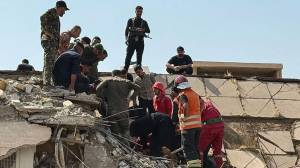
Iraqi security and emergency personnel work at the scene of a strike in Muqdadiyah, Diyala province on Wednesday
Iraq’s paramilitary Popular Mobilisation Forces (PMF), which is dominated by Iran-backed Shia militias, said at least 20 of its members had been killed in US-Saudi strikes on its bases.
It came hours after Centcom said Iran had launched missiles at US forces in the Middle East in an “attempted surprise attack”, ending a lull in hostilities.
The US said the Iranian attack occurred at 17:45 EDT (21:45 GMT) on Tuesday, with all missiles “successfully intercepted”.
The IRGC said it had targeted a US air base and a command centre in Jordan “in response to the acts of aggression of the American child-killing army”.
It also said that naval forces had struck three oil tankers in the Strait of Hormuz after they “ignored warnings” and sailed along what it described as an “unsafe and illegal route” through the vital Gulf waterway.
When asked by a Fox News correspondent on Wednesday about the Iranian attack on Jordan, US President Donald Trump said in an expletive-laden response that US forces would be “hitting them hard”, adding: “They’re going to get a beating.”
Remember the old days when we had dignified presidents?
American and Saudi fighter jets attacked Iranian-linked militias and their Iranian advisers in Iraq on Wednesday, and Iran fired missiles at military bases in Jordan . It ended a dayslong pause in direct fighting between the United States and Iran and further widening the scope of the war.
Since the collapse of a cease-fire between the United States and Iran this month, Iran-linked groups across the region have opened new fronts and reopened old ones, embroiling forces in Saudi Arabia, Iraq, Lebanon and Jordan in the war that until recently had been contained to countries along the Persian Gulf.
The United States accused the Iranian military on Wednesday of directing its allies in Iraq to attack “U.S. forces and Saudi energy infrastructure.” The Iranian foreign ministry condemned the U.S.-Saudi strikes as an attempt to broaden the conflict.
Ships transiting through the Gulf of Oman on Saturday.Credit…Agence France-Presse — Getty Images
On Wednesday, the Saudi foreign ministry said in a statement that the country was not seeking escalation but would respond to any aggression.
Mr. Trump said Iran’s latest strikes were a surprise in an interview on “Fox & Friends.” American forces had only a few minutes’ notice to shoot down the incoming Iranian missiles, he said. “We’ll be hitting them hard,” the president said.
Also on Wednesday, the Jordanian military said it had shot down five missiles that Iran’s Islamic Revolutionary Guards Corps claimed were fired in retaliation for American aggression.
The U.S. military said that the strikes in Iraq were in retaliation for more than 30 drone attacks by Iranian proxy groups in the past 72 hours. A U.S. official, who spoke on condition of anonymity to discuss operational matters, said the strikes killed about 20 Iranian military and technical advisers.
The next big Senate news will be the Judiciary Committee vote on Todd Blache’s confirmation as Attorney General.
GOP Sen. John Cornyn said Wednesday, less than 24 hours before a critical committee vote, that he is “not prepared” to support Todd Blanche’s confirmation as attorney general as the two continue to tangle over the fate of a controversial DOJ-brokered settlement agreement involving President Donald Trump.
Blanche did not appear for a planned morning meeting in Cornyn’s office, and the senator told reporters that time was running out for Blanche to meet his demand to formally modify the settlement Trump reached with the IRS earlier this year — a key ultimatum the Texas Republican set out after Blanche’s confirmation hearing earlier this month.
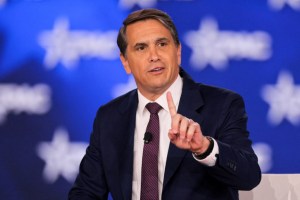
U.S. Deputy Attorney General Todd Blanche speaks during the 2026 Conservative Political Action Conference (CPAC) in Grapevine, Texas, U.S. March 26, 2026. REUTERS/Daniel Cole
“Hopefully they now recognize the seriousness of this,” said Cornyn, who recently lost his bid for renomination to a fifth term to a Trump-backed challenger. “Maybe they think I’m just going to give up or, you know, go along, but they’re mistaken.”
A DOJ official said the department shared a “written proposal” with Cornyn’s staff Tuesday. “We look forward to further discussion around any outstanding concerns,” said the person, who was not authorized to comment publicly on the matter.
Cornyn said Wednesday that he has yet to see “a single piece of writing that is responsive to what I’ve requested.”
His comments came ahead of a scheduled Thursday vote in the Senate Judiciary Committee, where he has been seen as the pivotal vote. Opposition from any one Republican could sink Blanche’s chances of confirmation, and another potential GOP swing vote, Sen. Thom Tillis of North Carolina, said this week he would follow Cornyn’s lead.
Cornyn said Judiciary Chair Chuck Grassley (R-Iowa) had told him he needed to know by 4 p.m. Wednesday if the vote could go forward, putting the Trump administration on a tight timeline if it wants Blanche confirmed before the Senate starts its summer recess next week.
One more important story. On Saturday, I posted an article about Trump ordering signs posted outside the Smithsonian’s National Museum of American History to inform visitors of the “inaccurate information presented in the Museum.” This is from Noel Sims and Rebecca Crosby at Popular Information: The fake historian advising Trump’s anti-Smithsonian crusade.
Last Friday, President Trump released an executive order directing officials to install signs outside the Smithsonian’s National Museum of American History (NMAH) informing visitors that the museum presents history inaccurately.
The order is the latest attack in a lengthy campaign by the Trump administration to discredit and control the Smithsonian Institution. The Trump administration has argued that the institution, which includes 21 museums and the National Zoo, has a liberal bias.
The Smithsonian National Museum of American History
he order cites a 162-page report released by the White House on July 4. The report, written by the White House Domestic Policy Council, argues that the “Smithsonian Institution, and the National Museum of American History in particular, under its current leadership and current interpretive ideology, cannot be trusted to tell America’s story honestly and in a way that is inspiring, unifying, and worthy of our great republic.” The report criticizes the NMAH for “extreme political activism,” “anti-White activism,” “transgender activism,” and supporting illegal immigration.
The executive order states that the temporary signs outside the museum should tell visitors that exhibits should be altered to reflect the report’s findings and “direct visitors to locations and resources for accurate information regarding America’s history.” It does not specify where visitors will be redirected.
Trump’s war against the Smithsonian began shortly after the start of his second term. In March 2025, Trump issued an executive order entitled “Restoring Truth and Sanity to American History” that stated that the Trump administration would “restore the Smithsonian Institution to its rightful place as a symbol of inspiration and American greatness.” The Trump administration has since threatened to withhold federal funding, ordered a comprehensive review of eight museums, and released a list of exhibits it did not agree with.
According to the article’s authors, important sources of Trump’s hostility to the Smithsonian are David and Tim Barton, a father an son who founded an organization called “WallBuilders.”
The father and son are founder and president, respectively, of WallBuilders, a Christian nationalist advocacy organization founded in 1988. WallBuilders aims to “teach US history and how our beginnings were overwhelmingly rooted in Christian ideology.”
Despite having no degree in history, David Barton calls himself a historian. He has amassed a large collection of documents related to America’s founding and published several books. For decades, he has pushed the view that the founding fathers never intended for there to be a separation between church and state. David Barton’s work has been rejectedrepeatedly by actual historians. Most notably, a book he published in 2012 about Thomas Jefferson was pulled from the shelves by its publisher after a group of historians from Christian universities accused him of including distortions and false information.
This has not prevented David Barton from gaining political influence. In Texas, David Barton has advised the Texas State Board of Education on public school curricula. According to Barton’s own social media posts and statements, he has attended several meetings at the White House during Trump’s second term and has been in communication with Trump officials about the “crazy stuff” in the Smithsonian museums.
Read the rest at Public Information.
Those are the stories that caught my attention today. I hope you found something of interest here. What other stories have you been following?
Did you like this post? Please share it with your friends:
Nothing is normal in the U.S. anymore. The government is run by incompetent and corrupt people. Most concerning of all is that the “president is not only ignorant and incompetent, but also physically and mentally unstable. In addition, he lacks any sense of morality or empathy for other people.
In the months since, the evidence has only grown that something serious is afflicting Trump.
And then last night happened.
Overnight, the President of the United States went on what can only be described as an unhinged social media fever dream. He posted on his social media site Truth Social hundreds of times in a short span — somewhere north of 150 times overnight, a wild mix of conspiracy theories, videos, and memes. It was extreme even for him.
During that end-of-August episode, the major questions were about the president’s physical health — his bruised hands and his swollen ankles — and in the months since, there have been more reasons and evidence that some part of the president is not well:
He is stumbling, physically, through more of his events. Since August, he appears to be regularly dragging the right side of his body and struggles to walk in a straight line. Just watch this recent video of Trump boarding Marine One, where he appears to be leaning heavily on Melania Trump to stand. And then there was Trump’s Asia trip, where he seemed so lost, wandering aimlessly through a Japanese press event, that the late night shows set it to music.
He appears to have fallen asleep in meetings on multiple recent occasions, including at an Oval Office meeting.
And then there’s the MRI. In October, he went to Walter Reed for his “annual medical exam,” even though it was barely six months after his last “annual medical exam” at Walter Reed, and had a wide range of tests done, including an MRI. In recent days, Trump has gotten into a high-profile tiff with Minnesota Gov. Tim Walz, who pressed him to release the results of that MRI. When asked, Trump couldn’t explain why he had the test. Finally, yesterday the White House released information saying it was a chest MRI for his cardiovascular and abdominal systems and that, as the White House always says he is, the tests showed everything was “perfectly normal” and in “excellent health.” (Gavin Newsom mocked Trump about the results.)
But that’s not the reason worth having a conversation about Trump’s health today.
Today, we should be having a conversation about Trump’s increasingly clear diminished mental capacity. This is a man, after all, with the sole launch authority for the nation’s nuclear weapons who, on a daily basis, seems increasingly more disconnected from reality, beholden to conspiracy thinking, and — most simply — absent-minded. It is not a recipe for global stability — and deserves more serious conversation than its getting.
Please go read Graff’s specific arguments in support of his claims. It’s not long.
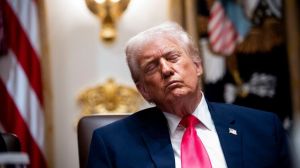
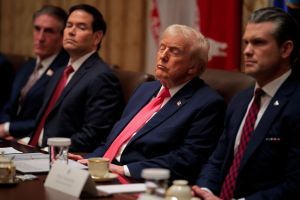
Yesterday Trump held a cabinet meeting on video. He could barely stay awake most of the time. Of course, he had been up most of the night posting insane garbage on Truth Social, but still…
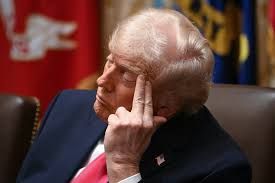
President Trump appeared to be fighting sleep on Tuesday during a cabinet meeting at the White House, closing his eyes and at times seeming to nod off, after he criticized media coverage about him facing the realities of aging in office.
Over the course of two hours and 18 minutes, the president, who is 79, sometimes appeared to struggle to keep his eyes open as cabinet officials went around the room describing their work and heaping praise on him….
Mr. Trump does appear frequently before the news media, and he takes questions far more often than his predecessor, President Joseph R. Biden Jr., did. He is a regular, outsize presence in public life.
But Mr. Trump also appeared to have had a late night. He shared or posted dozens of times on social media on Monday night until nearly midnight.
Early in the meeting, Mr. Trump had complained that he was getting unfair scrutiny compared to Mr. Biden, who dropped out of the presidential race last year amid concerns in his own party about his age, mental acuity and ability to beat Mr. Trump.
“I’ll let you know when there’s something wrong. There will be someday,” Mr. Trump said. “That’s going to happen to all of us. But right now I think I’m sharper than I was 25 years ago. But who the hell knows?”
A bit more:
Mr. Trump then claimed he got “all A’s” on his physical.
But as Tuesday’s meeting went on, Mr. Trump seemed to grow tired.
About 50 minutes in, as Brooke L. Rollins, the agriculture secretary, spoke, Mr. Trump struggled to keep his eyes open before he leaned back and forth in his chair. More than an hour and a half into the meeting, while Linda McMahon, the education secretary, spoke, he closed his eyes for five seconds before leaning back and looking at the ceiling. Roughly 20 minutes later, as Secretary of State Marco Rubio spoke, the president leaned forward and appeared to close his eyes again.
It was the second time in less than a month that Mr. Trump appeared to doze off in public. During an Oval Office event on Nov. 6, the president’s eyes grew heavy and closed for several seconds.
Trump recently announced that he had had an MRI scan at his latest physical exam, but claimed he had no idea what it was for. Experts have questioned that, and finally his doctor released some confusing details.
The White House released a letter from President Trump’s physician on Monday about the results of “advanced imaging tests.” The statement, by Dr. Sean P. Barbabella, said the tests on his cardiovascular system and abdominal region showed the president “remains in excellent overall health.”
Trump in yesterday’s cabinet meeting.
Some medical experts said it was unclear what tests doctors conducted, why they were done or what the results mean. And, they said, a person without symptoms would not have imaging tests as part of a routine medical exam under ordinary medical circumstances.
Mr. Trump, the oldest president ever sworn into his office, had M.R.I. scans in October as part of a semiannual physical exam. His annual physical was done in April.
On Sunday, during an appearance on “Meet the Press” on NBC News, Governor Tim Walz of Minnesota called on the president to release the results after Mr. Trump had impugned Mr. Walz’s intelligence. Asked by a reporter on Sunday what part of his body was scanned, Mr. Trump said aboard Air Force One, “I have no idea — it was just an M.R.I.” He then said it was not a scan of his brain.
But Dr. Barbabella’s memo did not specify that Mr. Trump had a M.R.I. scan, which uses a magnetic field to produce images of soft tissues that do not show up on X-rays. Instead, the memo describes “advanced imaging” that it said was carried out “because men in his age group benefit from a thorough evaluation of cardiovascular and abdominal health.”
The imaging was part of Mr. Trump’s “comprehensive executive physical,” Dr. Barbabella explained, referring to a detailed medical exam often offered to executives. Such exams can include tests that are not normally done when people have no symptoms of disease.
The memo said Mr. Trump’s cardiovascular imaging is “perfectly normal” with no signs that his arteries are narrowed. His “cardiovascular system shows excellent health,” the statement said.
It added that, “his abdominal imaging is also perfectly normal,” and said, “this level of detailed assessment is standard for an executive physical at President Trump’s age and confirms that he remains in excellent overall health.”
Medical experts are questioning the White House’s explanation for President Donald Trump’s MRI tests as “preventive.”
A Monday memo released by presidential physician Sean Barbabella described the results of “a thorough evaluation of cardiovascular and abdominal health” as normal. “This level of detailed assessment is standard for an executive physical at President Trump’s age,” Barbabella said.
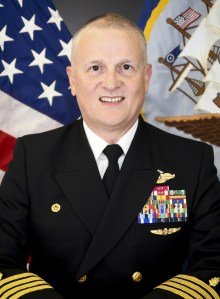
Dr. Sean P. Barbabella, Trump’s doctor
But imaging experts who spoke to Scientific American expressed doubts as to Barbabella’s assertion that magnetic resonance imaging (MRI) screening is typical preventive care. American Heart Association guidelines, for example, note that a cardiac MRI is usually requested because of existing heart conditions and often only after other tests.
“No, it is certainly not standard medical practice to perform screening MRIs of the heart and abdomen,” says radiologist and MRI expert Thomas Kwee of the University of Groningen in the Netherlands. Such imaging is typically only performed in the case of underlying disease, he says, or if there is suspicion of an underlying disease based on the patient’s medical history and physical examination. Barbabella’s memo said the imaging showed Trump was in “excellent health.”
Kwee’s comment echoed those of Medpage Today’s editor in chief, physician Jeremy Faust, who told CNN on Monday that “there’s really no such thing as routine prevention using an MRI.” Faust on Tuesday told Scientific American that the White House memo reference to “advanced imaging” left open questions as to exactly what tests Trump underwent. It could even possibly refer to a CT scan, for example, which is different than MRI. “If we knew exactly what imaging he received, it would give us a better idea of what conditions they are worried about,” Faust says.
More opinions:
“An assessment of a heart MRI and abdominal MRI is not ‘standard for an executive physical,’” says former White House physician Jeffrey Kuhlman, author of the book Transforming Presidential Healthcare. Though it’s not uncommon for physicians who have concierge-type practices to use total or partial body scans on their clients, “this is not evidence-based,” he adds….
Questions around Trump’s health have surfaced repeatedly in recent months. In July the White House reported that the president has chronic venous insufficiency, a blood vessel disease that affects circulation and can cause ankle swelling. And noticeable bruises on the back of Trump’s hands seen in February were attributed to “shaking hands all day” by Leavitt.
There is no solid evidence that executive MRI scans help people, Kwee says, either by diagnosing disease or extending their lifespan. “These scans can also lead to unexpected incidental findings and give false reassurance that there is no underlying disease.”
At least big media is beginning to talk about Trump’s obvious mental and physical health issues. We need them to start focusing on Trump’s age as much as they did Biden’s.
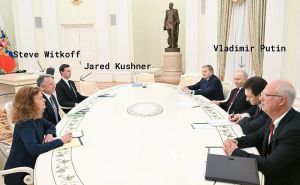
Jared Kushner, President Trump’s son-in-law, has been traveling the world to participate in high-stakes foreign policy negotiations on behalf of the president. On Tuesday, Kushner traveled to Moscow and sat across the table from Russian President Vladimir Putin to discuss a peace deal to end the war in Ukraine. The entire United States delegation consisted only of Kushner and Special Envoy Steve Witkoff. Kushner and Witkoff were joined at the table by an interpreter.
Kushner’s participation in the Moscow meeting — and the similar role he played in the Gaza negotiations — likely violates the law.
Representing the Trump administration in high-level foreign policy negotiations makes Kushner, at a minimum, a Special Government Employee (SGE). Under the law, an SGE is someone “who is retained, designated, appointed, or employed to perform, with or without compensation, for not to exceed one hundred and thirty days during any period of three hundred and sixty-five consecutive days, temporary duties either on a full-time or intermittent basis.”
Trump has not named Kushner an SGE. But a seminal 1977 opinion by the Department of Justice’s Office of Legal Counsel (OLC) found “an identifiable act of appointment may not be absolutely essential for an individual to be regarded as an officer or employee in a particular case where the parties omitted it for the purpose of avoiding the application of the conflict-of-interest laws.” In that opinion, the OLC considered the status of an individual who had not been named to any role by the president but “assumed considerable responsibility for coordinating the Administration’s activities in [a] particular area.” The OLC concluded that since the individual was “quite clearly engaging in a governmental function” and is “working under the direction or supervision of the President,” he should be considered an SGE.
Here, Kushner is engaged in activities that can only be conducted by government officials. The Logan Act bars private citizens from engaging in negotiations with foreign governments without authorization. Kushner is acting in an authorized capacity, under Trump’s direction, and that creates a host of legal issues.
A the same time, Kushner is receiving payments from foreign governments.
Since leaving the White House in 2021, Kushner has raised at least $4.8 billion for Affinity Partners, his private equity firm. Nearly 99% of Affinity Partners’ funding comes from foreign sources. The largest investment, $2 billion, came from the Public Investment Fund of Saudi Arabia (PIF).
The Saudi government pays Kushner 1.25% of its investment, or $25 million annually. Other investors, including the governments of Qatar and the United Arab Emirates (UAE), pay annual fees of up to 2%. As of September 2024, Affinity Partners had collected $157 million in fees, mainly from Middle Eastern governments.
Kushner is continuing to collect these fees as he serves in a top foreign policy role for the Trump administration. This is precisely the kind of behavior the Foreign Emoluments Clause was designed to prevent. Kushner was one of two Americans on Tuesday engaged in high-stakes negotiations with Putin. But as the private equity manager for billions of foreign capital, Kushner has a fiduciary duty to advance the financial interests of Saudi Arabia, Qatar, and other foreign governments.
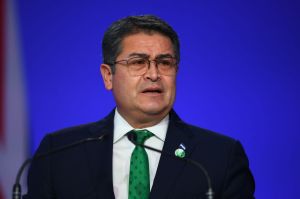
Former Honduran president Juan Orlando Hernández, convicted by a U.S. court last year on charges that he ran the Central American nation as a “narco-state” that helped send South American cocaine to the United States, has been released from federal prison after receiving a “full and unconditional” pardon from President Donald Trump.
Hernández, 57, was released Monday from U.S. Penitentiary Hazelton in West Virginia, according to the Federal Bureau of Prisons website and a BOP spokesperson.
Hernández, who was president of Honduras from 2014 to 2022, was serving 45 years in prison on importation and weapons charges. U.S. prosecutors said he built his political career on millions of dollars in bribes from traffickers in Honduras and Mexico, and as president helped to move at least 400 tons of cocaine to the United States while protecting traffickers from extradition and prosecution.
Juan Orlando Hernández
The Trump administration is waging what it says is a counternarcotics campaign off Venezuela. U.S. forces have destroyed at least 21 boats in the Caribbean Sea and Pacific Ocean, killing more than 80 people, that officials say were carrying drugs to the U.S., and U.S. troops and warships are massing in the region. Trump has accused Venezuelan President Nicolás Maduro of sending violent criminals and drugs to the U.S.
But on Friday, Trump said that Hernández had been “treated very harshly and unfairly” and that he would grant him a “Full and Complete Pardon.”
“CONGRATULATIONS TO JUAN ORLANDO HERNANDEZ ON YOUR UPCOMING PARDON,” Trump wrote on Truth Social. “MAKE HONDURAS GREAT AGAIN!”
Trump’s decision to pardon an official who, a federal court found, helped flood the United States with cocaine angered congressional Democrats.
“Hernandez’s conviction last year finally held him accountable for all the Honduran and American blood on his hands and sent an unequivocal message: No drug trafficker is above the law, not even former presidents,” said Sen. Jeanne Shaheen (New Hampshire), the top Democrat on the Senate Foreign Relations Committee. “That is precisely why all Americans should be outraged by President Trump’s pardoning of former president Hernandez.”
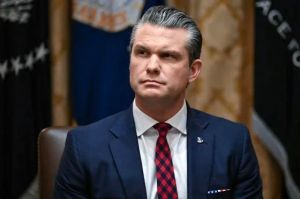
Defense Secretary Pete Hegseth on Tuesday was given a final copy of the completed Defense Department Inspector General report that examined his sharing sensitive military information on a Signal group chat back in March, according to two people familiar with the investigation.
The much-anticipated report is expected to become public as early as this week, these people said.
Pete Hegseth
The report outlines the findings of a more than eight-month investigation into Hegseth’s use of Signal, an encrypted but unclassified messaging app, to share details of planned U.S. military strikes in Yemen before they had begun.
Hegseth has maintained that he shared no classified information on the group chat….
The two people familiar with the inspector general investigation would not say what its conclusions are. The report was requested by the chairman of the Senate Armed Services Committee, Sen. Roger Wicker, R-Miss., and the committee’s ranking member, Sen. Jack Reed, D-R.I., on March 27.
The group chat, which included other top members of President Donald Trump’s national security team, became public after an editor for The Atlantic magazine was inadvertently added.
A family in Colombia filed a petition on Tuesday with the Washington DC-based Inter-American Commission on Human Rights, alleging that the Colombian citizen Alejandro Carranza Medina was illegally killed in a US airstrike on 15 September.
The petition marks the first formal complaint over the airstrikes by the Trump administration against suspected drug boats, attacks that the White House says are justified under a novel interpretation of law.
Alejandro Carranza Medina and his son. Photograph Courtesy of Carranza family
The IACHR, part of the Organization of American States, is designed to “promote and protect human rights in the Western Hemisphere”. The US is a member, and in March the Trump administration’s state department wrote: “The United States is pleased to be a strong supporter of the IACHR and is committed to continuing support for the Commission’s work and its independence. Preserving the IACHR’s autonomy is a pillar of our human rights policy in the region.”
The complaint was filed by Pittsburgh-based human rights lawyer Dan Kovalik. “On September 15, 2025, the United States military bombed the boat of Alejandro Andres Carranza Medina,” the filing says, “which Mr Carranza was sailing in the Caribbean off the coast of Colombia. Mr Carranza was killed in the process of this bombing.”
Kovalik identified Pete Hegseth, the US defense secretary, as the perpetrator, based on Hegseth’s own statements. “From numerous news reports, we know that Pete Hegseth, US Secretary of Defense, was responsible for ordering the bombing of boats like those of Alejandro Carranza Medina and the murder of all those on such boats. Secretary Hegseth has admitted that he gave such orders despite the fact that he did not know the identity of those being targeted for these bombings and extra-judicial killings,” the filing goes on.
The complaint adds: “US President Donald Trump has ratified the conduct of Secretary Hegseth described herein.”
The Trump administration on Tuesday halted immigration applications submitted by nationals from 19 countries that already faced restrictions on travel to the United States, according to a U.S. Citizenship and Immigration Services memo.
“USCIS has considered that this direction may result in delay to the adjudication of some pending applications and has weighed that consequence against the urgent need for the agency to ensure that applicants are vetted and screened to the maximum degree possible,” the agency said in a four-page policy memo.
“Ultimately, USCIS has determined that the burden of processing delays that will fall on some applicants is necessary and appropriate in this instance, when weighed against the agency’s obligation to protect and preserve national security,” it added.
The New York Times first reported the immigration pause, which applies to both green card and citizenship applicants.
Federal authorities are preparing a targeted immigration enforcement operation in Minnesota that would primarily focus on Somali immigrants living unlawfully in the U.S., according to a person familiar with the planning.
The move comes as President Donald Trump again on Tuesday escalated rhetoric about Minnesota’s sizable Somali community, saying he did not want immigrants from the east African country in the U.S. because “they contribute nothing.”
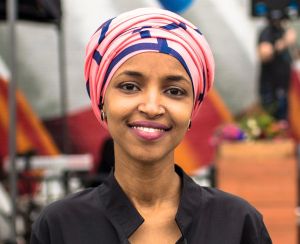
Minnesota Rep. Ilhan Omar
The enforcement operation could begin in the coming days and is expected to focus on the Minneapolis–St. Paul area and people with final orders of deportation, the person said. Teams of immigration agents would spread across the Twin Cities in what the person described as a directed, high-priority sweep, though the plans remain subject to change.
The prospect of a crackdown is likely to deepen tensions in Minnesota — home to the nation’s largest Somali community. They’ve been coming since the 1990s, fleeing their country’s long civil war and drawn by Minnesota’s generous social programs.
An estimated 260,000 people of Somalian descent were living in the U.S. in 2024, according to the Census Bureau’s annual American Community Survey. The largest population is in the Minneapolis area, home to about 84,000 residents, most of whom are American citizens. Ohio, Washington and California also have significant populations.
President Trump unleashed a xenophobic tirade against Somali immigrants on Tuesday, calling them “garbage” he does not want in the United States in an outburst that captured the raw nativism that has animated his approach to immigration.
Even for Mr. Trump — who has a long history of insulting Black people, particularly those from African countries — his outburst was shocking in its unapologetic bigotry. And it comes as he started a new ICE operation targeting Somalis in the Minneapolis-St. Paul region.
“These are people that do nothing but complain,” Mr. Trump said at the tail end of a cabinet meeting at the White House, during which he sometimes appeared to be fighting sleep. But when the subject turned to immigration, Mr. Trump made a point of lashing out.
“When they come from hell and they complain and do nothing but bitch, we don’t want them in our country. Let them go back to where they came from and fix it,” Mr. Trump added as Vice President JD Vance banged the table in encouragement.
He said Somalia “stinks and we don’t want them in our country.” He described Representative Ilhan Omar, Democrat of Minnesota, who came to the United States from Somalia as a refugee and became a citizen 25 years ago, as “garbage.”
“We could go one way or the other, and we’re going to go the wrong way if we keep taking in garbage into our country,” Mr. Trump said. “She’s garbage. Her friends are garbage. These aren’t people who work. These aren’t people who say, ‘Let’s go, come on, let’s make this place great.’”
Mr. Trump has used this kind of rhetoric throughout his rise in politics, including in his first term as president, when he demanded to know why the United States would accept immigrants from Haiti and African nations, which he described as “shithole countries,” rather than, say, Norway.
But he has long been especially fixated on Somalis in the United States, and on Ms. Omar in particular.
“His obsession with me is creepy,” Ms. Omar wrote in a post shortly after the cabinet meeting. “I hope he gets the help he desperately needs.”
Trump is garbage and he should be in prison.
Those are my recommended reads for you today. What’s on your mind?
Did you like this post? Please share it with your friends:
The latest Democratic debate airs on CNN tonight at 8PM. You can read about what to expect in this piece at Vox.
Sorry to be a wet blanket, but I have to admit that I’m far from enthused about watching it, although I’ll try to give it a chance. I’m sick of the irrelevant candidates like Andrew Yang, Tulsi Gabbard, and Tom Steyer; and as for the top three–Biden, Warren, and Sanders–I still believe they are too old for the job.
If we are going to have a septuagenarian president, I would rather have it be Hillary. I guess I have to face the fact that I’ll never be as excited about a candidate as I was about her.
After months of staying silent amid an avalanche of attacks by President Trump and his team, Hunter Biden, son of the former vice president, made his first public comments in an interview Tuesday morning just about 12 hours before his father takes the debate stage Tuesday night.
Wassily Kandinsky, Autumn in Murnau, 1908
For the majority of the Democrats running for president, and even one notable surrogate to Joe Biden himself, there is a sense of confusion as to why Hunter is choosing now to finally speak up about the extent of his business ties in Ukraine and China.
“I wouldn’t have put Hunter on the air,” former Pennsylvania Gov. Ed Rendell, a top surrogate for Biden, told The Daily Beast. “I think the more you respond, the more you’re playing into Donald Trump.” [….]
For Team Biden, Hunter’s Biden’s interview, which aired on ABC News’ Good Morning America, was an opportunity to clear the air and turn the attention back to the widespread corruption running rampant in the Trump White House. It also gave the younger Biden a chance to present facts in his own words to counter Trump’s misinformation campaign.
In the interview, he admitted that he had shown “poor judgment” in taking the job with a Ukrainian natural gas company but insisted that he had done nothing unethical.
Does anyone believe that the debate moderators will ignore all this and focus on Donald Trump and his children’s blatant self-dealing? I don’t.
Meanwhile, Trump is burning down the post-WWII world order. That should be the subject of tonight’s debate, not Hunter Biden.
President Trump didn’t make a “mistake” in pulling troops out of northeastern Syria last week, as many have charged. It’s what he has long wanted to do. The mistake was not understanding—and, more to the point, not caring about—the consequences.
Trump’s fateful phone call with Turkish President Recep Tayyip Erdogan on Oct. 6, giving him the green light to cross the Syrian border and crush the Kurds without U.S. resistance, did more than any single act has ever done to demolish the post-WWII global order and isolate America from the rest of the world. This, again, has been Trump’s goal since he entered the White House.
Until recently, one or more of his advisers—Jim Mattis, H.R.
McMaster, John Bolton, or Gen. Joseph Dunford—obstructed or dissuaded him from withdrawing. Now all of those advisers are gone, and their replacements lack either the clout or the gumption to push back.
Trump may believe that he’s doing the right thing, that abandoning the rest of the world’s problems will “make America great again.” He doesn’t realize that America’s might and wealth depend, in large measure, on the cooperation it receives from others—either offered or coerced—in pursuing its interests around the world.
He is also blind to the fact—or loath to admit—that he, in fact, is not getting out of the world. On Friday, days after abandoning the Kurdish allies to the Turks (and consequently, all of Syria to Bashar al-Assad and the Russians), Trump announced that he was sending 1,800 troops to Saudi Arabia. But to Trump’s mind, there was a big difference in this deployment.
“Saudi Arabia, at my request, has agreed to pay us for everything we are doing to help them,” he told reporters. “That’s a first. We appreciate that.”
Georgia O’Kefee, Autumn Leaves, 1924
To Trump, the U.S. military is nothing more than a mercenary force to be rented out to the highest bidder.
It was as if sending American troops abroad doesn’t count as a commitment if taxpayers don’t have to pay for it. It was as if Trump were telling the world that the U.S. military is now a mercenary force. It was a message to any country currently hosting American troops at least in part at our largesse—because, say, previous presidents have considered it in U.S.
interests to keep troops there—that they should start rethinking their options for how to stay secure
Trump has made a practice of abrogating treaties, filching on commitments, and alienating allies, but, more than any single act, the betrayal of the Kurds should tell everyone that—as long as Trump is president and, who knows, perhaps beyond—there is no reason to trust the United States on anything.
“Anyone who wants to assist Syria in protecting the Kurds is good with me, whether it is Russia, China, or Napoleon Bonaparte.” read one of the president’s tweets. “I hope they all do great, we are 7,000 miles away!”
Trump even tried to blame the Kurds for the release of Islamic State prisoners. From The Week:
It appears that President Trump was a bit off the mark Monday morning when he tweeted a theory that Kurdish forces were releasing prisoners with ties to the Islamic State in an attempt to get the U.S. to continue fighting alongside them. Trump’s suspicions were likely derived from the fact that the Kurds, longtime U.S. allies in the Middle East, were disappointed in Washington for removing U.S. troops from the region, providing Turkey — which considers Kurdish forces a national security threat — an opening to invade.
Gustav Klimt, Birch Forest I, 1902
U.S. officials have said that prisoners with ISIS ties are being deliberately released, but it’s actually Turkish proxy forces in the Free Syrian Army — a decentralized rebel group that has been linked to extremists groups and was once recruited by the CIA to aid the U.S. in its fight against ISIS — who are behind it, rather than the Kurds, Foreign Policy reports. The Free Syrian Army has also been accused of executing Kurdish prisoners and killing unarmed civilians.
As for the Kurds, one U.S. official said the Kurdish-led Syrian Democratic Forces have not abandoned or released any prisoners with ISIS ties and, in some cases, the SDF has reportedly moved detainees to other facilities further south.
Subsequently, Trump’s theory is not sitting well with U.S. and Kurdish forces. “That has enraged our forces in Syria,” another senior U.S. administration official said. “Kurds are still defending our bases. Incredibly reckless and dishonest thing to say.”
Yesterday, Trump’s former Russia and Ukraine adviser Fiona Hill testified at the Impeachment hearings. Here’s the latest on that.
Fiona Hill, the White House’s former top Russia adviser, told impeachment investigators on Monday that Rudolph W. Giuliani, the president’s personal lawyer, ran a shadow foreign policy in Ukraine that circumvented U.S. officials and career diplomats in order to personally benefit President Trump, according to people familiar with her testimony.
Hill, who served as the senior official for Russia and Europe on the National Security Council, was the latest witness in a fast-moving impeachment inquiry focused on whether the president abused his office by using the promise of military aid and diplomatic support to pressure Ukraine into investigating his political rivals.
Henri Rousseau, Eiffel Tower at Sunset, 1910
In a closed-door session that lasted roughly 10 hours, Hill told lawmakers that she confronted Gordon Sondland, the U.S. ambassador to the European Union, about Giuliani’s activities which, she testified, were not coordinated with the officials responsible for carrying out U.S. foreign policy, these people said, speaking on the condition of anonymity to disclose details of her deposition.
Sondland played a leading role in the Trump administration’s efforts to pressure Ukraine to open investigations of the president’s political rivals, text messages obtained and later released by House Democrats show. Three congressional committees are now probing how Trump pressured Ukraine to investigate former vice president Joe Biden and his son, Hunter Biden, who was on the board of a Ukrainian energy company, as well as a debunked theory that Ukraine interfered in the 2016 U.S. election in an attempt to damage Trump’s candidacy.
The effort to pressure Ukraine for political help provoked a heated confrontation inside the White House last summer that so alarmed John R. Bolton, then the national security adviser, that he told an aide to alert White House lawyers, House investigators were told on Monday.
Mr. Bolton got into a tense exchange on July 10 with Gordon D. Sondland, the Trump donor turned ambassador to the European Union, who was working with Rudolph W. Giuliani, the president’s personal lawyer, to press Ukraine to investigate Democrats, according to three people who heard the testimony.
Paul Gauguin, Landscape in Arles near the Alyscamps, 1888
The aide, Fiona Hill, testified that Mr. Bolton told her to notify the chief lawyer for the National Security Council about a rogue effort by Mr. Sondland, Mr. Giuliani and Mick Mulvaney, the acting White House chief of staff, according to the people familiar with the testimony.
“I am not part of whatever drug deal Sondland and Mulvaney are cooking up,” Mr. Bolton, a Yale-trained lawyer, told Ms. Hill to tell White House lawyers, according to two people at the deposition. (Another person in the room initially said Mr. Bolton referred to Mr. Giuliani and Mr. Mulvaney, but two others said he cited Mr. Sondland.)
In recent weeks, numerous leaks have appeared in the pages of The Washington Post, The New York Times, The Wall Street Journal, and other major papers and news outlets detailing the president’s attempts to enlist foreign leaders to help dig up dirt on former Vice President Joe Biden and also aid Trump’s quest to discredit Special Counsel Robert Mueller’s concluded investigation. And as is his MO, the media-obsessed president has been fixated on not just the identity of the whistleblower behind the internal complaint that brought this scandal to the fore, but also on who, exactly, has been namelessly feeding intel to the press.
In the course of casual conversations with advisers and friends, President Trump has privately raised suspicions that a spiteful John Bolton, his notoriously hawkish former national security adviser, could be one of the sources behind the flood of leaks against him, three people familiar with the comments said. At one point, one of those sources recalled, Trump guessed that Bolton was behind one of the anonymous accounts that listed the former national security adviser as one of the top officials most disturbed by the Ukraine-related efforts of Trump and Rudy Giuliani, the president’s personal attorney who remains at the center of activities that spurred the impeachment inquiry.
What else is happening? Please share your thoughts and links in the comment thread.
Did you like this post? Please share it with your friends:
I hope you’ll forgive a little childhood nostalgia from me this morning. Yesterday I came down with a cold and sought a little comfort by recalling the Beatrix Potter stories my parents read to me as a child. I googled Potter and came across this wonderful story about her life at The Guardian: The strange life of Beatrix Potter — how rabbits (and mushrooms) set her free, by Matthew Dennison. Dennison wrote a brief biography of Potter, Over the Hills and Far Away: The Life of Beatrix Potter. Here’s the Amazon blurb of the book:
Inspired by the twenty-three “tales,” Matthew Dennison takes a selection of quotations from Potter’s stories and uses them to explore her multi-faceted life and character: repressed Victorian daughter; thwarted lover; artistic genius; formidable countrywoman. They chart her transformation from a young girl with a love of animals and fairy tales into a bestselling author and canny businesswoman, so deeply unusual for the Victorian era in which she grew up. Embellished with photographs of Potter’s life and her own illustrations, this biography will delight anyone who has been touched by Beatrix Potter’s work.
At The Guardian, Dennison writes that at 25, Potter was:
Unmarried, cripplingly shy, plagued by poor health, she passed empty days in the nursery of her childhood home in South Kensington, at the beck and call of her irritable parents. She would remain there until her unexpected marriage at the age of 45.
In place of friends, she had a “noisy cheerful” pet rabbit called Benjamin H Bouncer. On good days, she noted, he was “amiably sentimental to the point of silliness”; on bad days, he ate the insides of her paintbox. Beatrix even dreamt about him: “Bunny came to my bedside in a white cotton nightcap and tickled me with his whiskers.” Inspired by Pepys, she wrote her diary in a complicated code of her own invention, sometimes framing her entries as letters to an imaginary friend called Esther. In these diaries, she vented frustration at her comfortable, pointless existence. As young as 10, she recorded an intention to “do something”.
It took quite awhile, but Potter eventually broke away from her restrictive parents by studying nature and painting. Of course she was best known for her illustrations of rabbits, but she also wrote illustrated stories about cats. I’ve used some of those illustrations in this post.
Now to the latest news.
We’re moving rapidly toward impeachment and maybe we’ll actually be able to rid ourselves of the monster in the White House. The revelations about Trump administration corruption are coming out at warp speed. You’ve probably been following every twist and turn, just as I have.
President Trump told two senior Russian officials in a 2017 Oval Office meeting that he was unconcerned about Moscow’s interference in the 2016 U.S. presidential election because the United States did the same in other countries, an assertion that prompted alarmed White House officials to limit access to the remarks to an unusually small number of people, according to three former officials with knowledge of the matter.
The comments, which have not been previously reported, were part of a now-infamous meeting with Russian Foreign Minister Sergei Lavrov and Russian Ambassador Sergey Kislyak, in which Trump revealed highly classified information that exposed a source of intelligence on the Islamic State. He also said during the meeting that firing FBI Director James B. Comey the previous day had relieved “great pressure” on him.
A memorandum summarizing the meeting was limited to a few officials with the highest security clearances in an attempt to keep the president’s comments from being disclosed publicly, according to the former officials, who spoke on the condition of anonymity to discuss sensitive matters.
A bit more:
White House officials were particularly distressed by Trump’s election remarks because it appeared the president was forgiving Russia for an attack that had been designed to help elect him, the three former officials said. Trump also seemed to invite Russia to interfere in other countries’ elections, they said.
The previous day, Trump had fired Comey amid the FBI’s investigation into whether the Trump campaign had coordinated with Russia. White House aides worried about the political ramifications if Trump’s comments to the Russian officials became public.
Trump had publicly ridiculed the Russia investigation as politically motivated and said he doubted Moscow had intervened in the election. By the time he met with Lavrov and Kislyak, Trump had been briefed by the most senior U.S. intelligence officials about the Russian operation, which was directed by Russian President Vladimir Putin and included the theft and publication of Democratic emails and the seeding of propaganda in social media, according to the findings of the U.S. intelligence community.
Apparently, no one told Robert Mueller about these remarks–unless they were redacted by Cover-Up General Bill Barr.
The White House concealed some reconstructed transcripts of delicate calls between President Trump and foreign officials, including President Vladimir V. Putin and the Saudi royal family, in a highly classified computer system after embarrassing leaks of his conversations, according to current and former officials.
The handling of Mr. Trump’s calls with world leaders has come under scrutiny after questions over whether a transcript of a July 25 call with the Ukrainian president, Volodymyr Zelensky, was improperly placed into this computer system.
The latest revelations show the focus that White House officials put o safeguarding not only classified information but also delicate calls with Mr. Trump, the details of which the administration did not want leaked.
In the case of the calls with the Saudi royal family, the restrictions were set beforehand, and the number of people allowed to listen was sharply restricted. The Saudi calls placed in the restricted system were with King Salman, Crown Prince Mohammed bin Salman and Prince Khalid bin Salman, who at the time was the Saudi ambassador to the United States….
The practice began after details of Mr. Trump’s Oval Office discussion with the Russian foreign minister, Sergey V. Lavrov, leaked to the news media, leading to questions of whether the president had released classified information, according to multiple current and former officials. The White House was particularly upset when the news media reported that Mr. Trump had called James B. Comey, the former F.B.I. director, a “nut job” during that same meeting, according to current and former officials.
The White House had begun restricting access to information after initial leaks of Mr. Trump’s calls with the leaders of Mexico and Australia. But the conversation with Mr. Lavrov and Sergey I. Kislyak, then the Russian ambassador to the United States, prompted tighter restrictions.
Three days after his now infamous phone conversation with Ukrainian president Volodymyr Zelenskiy, Donald Trump abruptly fired his director of national intelligence in favour of an inexperienced political loyalist.
According to a New York Times report, the White House learned within days that the unorthodox call on 25 July with Zelenskiy had raised red flags among intelligence professionals and was likely to trigger an official complaint.
That timeline has raised new questions over the timing of the Trump’s dismissal by tweet of the director of national intelligence (DNI), Dan Coats, on 28 July and his insistence that the deputy DNI, Sue Gordon, a career intelligence professional, did not step into the role, even in an acting capacity.
Instead, Trump tried to install a Republican congressman, John Ratcliffe, who had minimal national security credentials but had been a fierce defender of the president in Congress. Trump had to drop the nomination after it emerged that Ratcliffe had exaggerated his national security credentials in his biography, wrongly claiming he had conducted prosecutions in terrorist financing cases.
Despite the collapse of the Ratcliffe nomination, Gordon was forced out. She was reported to have been holding a meeting on election security on 8 August when Coats interrupted to convinceher that she would have to resign.
According to The New York Times, Trump knew about the whistleblower complaint “Soon After Trump’s Call” with Ukraine’s President Volodymyr Zelensky, so it appears that Trump fired Coats and Gordon to keep them from getting involved in the situation.
President Trump, who has alleged that Hunter Biden got the Chinese to put $1.5 billion into an investment fund, said during private remarks this week that he raised the matter with a U.S. executive who has served as his intermediary on trade talks with Beijing….
In remarks to the U.S. Mission to the United Nations on Thursday morning, Trump said he discussed Biden’s China work with Stephen Schwarzman, the chief executive of the investment company Blackstone.
“I was with the head of Blackstone . . . Steve Schwarzman,” Trump said, according to a video of the remarks obtained by The Washington Post. After alleging that Hunter Biden got $1.5 billion from the Chinese, Trump said he asked Schwarzman, “Steve, is that possible?” Trump said Schwarzman asked, “Who got that?” and Trump responded, “Biden’s son.”
Trump said he asked Schwarzman how that could happen, and the executive responded: “Maybe I shouldn’t get involved, you know it’s very political.”
I wonder how many other countries Trump has tried to solicit for help with the 2020 election?
I’ve never been a fan of Joe Biden, so maybe I’ve just ignored his stance on reproductive rights. I did not know Biden was wobbly on the issue. I had even forgotten that Biden is a Catholic.
When former Vice President Joe Biden was a freshman senator he said in a 1974 interview with Washingtonian that he believed the Supreme Court’s Roe v. Wade ruling clearing the way for legal first-trimester abortions “went too far,” and that he didn’t “think that a woman has the sole right to say what should happen to her body.”
In the interview, which took place just two years after Biden’s wife and two-year-old were killed in a car accident, Biden — then the youngest senator in U.S. history — said his anti-abortion views were part of his “socially conservative” outlook.
“My wife said I was the most socially conservative man she had ever known,” he said. “When it comes to issues like abortion, amnesty, and acid, I’m about as liberal as your grandmother.”
Biden claims his remarks were “taken out of context.”
But Biden didn’t limit his anti-abortion views to rhetoric. He also advanced legislation on the subject.
In 1981, for example, Biden proposed the Foreign Assistance Act, which barred U.S. aid from being used for any medical research on abortion. It’s still in effect to this day. He has also voted in support of the Hyde Amendment, which bars federal funding for abortion procedures.
Joe Biden interview with American Magazine, September 2015
“Those of us who are opposed to abortion should not be compelled to pay for them,” Biden wrote to a constituent in 1994.
He also supported former President Ronald Reagan’s “Global Gag Rule,” which prohibits the U.S. funding any nongovernmental organizations that offer or advise on reproductive health care if they also offer abortion. President Trump was quick to revive it in 2017.
Biden’s approval rating from the pro-choice activist group NARAL has fluctuated throughout his career. In the 1990s, his score wavered between 34 and 46 percent ― a pretty abysmal scorecard for a Democrat. In recent years, however, it’s shot up to 100 percent.
Biden has also consistently voted in support of banning so-called “partial-birth” abortions ― the medical term for which is “dilation and extraction.” These procedures are often politicized despite heart-wrenching stories from women whose lives were saved because of them.
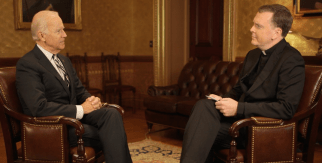
In an exclusive interview with America released at the beginning of this week, Vice President Joseph R. Biden, Jr. affirmed that pro-life people “absolutely, positively” are welcome in the Democratic party and that he believes, as a Catholic, that “abortion is always wrong.” His comments, very different from most contributions to the political conversation about abortion, are blurring some long-established lines in the culture wars and generating significant interest in the media and among commentators….
“It has been hard…I’m prepared to accept that at the moment of conception there’s human life and being, but I’m not prepared to say that to other God-fearing [and] non-God-fearing people that have a different view,” Biden said. He continued, “Abortion is always wrong…But I’m not prepared to impose doctrine that I’m prepared to accept on the rest of [the country].” (See the exchange, which begins at the 13:30 mark, in the full interview embedded at the bottom of this post.)
Fr. Malone also asked Mr. Biden if there was room for people who are pro-life in the Democratic party. The Vice President responded resolutely: “Absolutely. Absolutely, positively. And that’s been my position for as long as I’ve been engaged.”
No. Just no. Anyone who is “pro-life” in the sense of opposing women’s reproductive rights should not be welcome in the Democratic Party.
Biden has been an inconsistent supporter of reproductive rights, sometimes backing the legal right of women to choose how to handle a pregnancy, while often hewing to his Catholic faith and moralizing against all abortions. Even today, when he and Clinton would most likely agree on most of the policy substance of ensuring access to abortion clinics, Biden sticks to a pro-life view in his personal politics.
Biden the gaffe machine
During the early part of his career, abortion rights groups griped about Biden as an unreliable ally. “Joe Biden moans a lot and then usually votes against us,” a Planned Parenthood official said in 1986.
When he first entered national politics, Biden was willing to stand alongside politicians who wanted to make abortion illegal. In a Washingtonian profilepublished the year after the Supreme Court’s 1973 Roe v. Wade decision established a nationwide right to abortion, Biden unequivocally criticized the ruling. “I don’t like the Supreme Court decision on abortion,” he said. “I think it went too far. I don’t think that a woman has the sole right to say what should happen to her body.”
He put that view into practice in 1982, voting in the Judiciary Committee for a proposed constitutional amendment that would have overturned Roe v. Wade by declaring that the Constitution offered women no inherent right to abortion, and that the federal government and states would be free to regulate or ban abortion as they pleased. Under that amendment, state laws that restricted abortions would have superseded more permissive federal laws.
Read the rest at Mother Jones.
As Biden continues to agonize about getting into the 2020 presidential race, this is something that needs to be spread far and wide among Democrats. With Roe v. Wade likely to be overturned soon, Women cannot accept a candidate who doesn’t wholeheartedly support women’s right to control their own bodies.
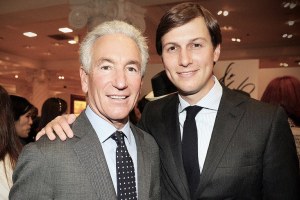
In late October 2017, Jared Kushner, President Trump’s son-in-law and Middle East adviser, dropped into Saudi Arabia for an unannounced visit to the desert retreat of Crown Prince Mohammed bin Salman, who was in the process of consolidating his power. The two men talked privately late into the night.
Just a day earlier, Mr. Kushner’s younger brother, Josh, then 32, was flying out of the kingdom.
Jared came to talk policy, but Josh was there on business.
The founder of an eight-year-old venture capital firm, Josh Kushner had spent the three days before his brother’s arrival at an investor conference, where Prince Mohammed had promised to spend billions of dollars on a high-tech future for Saudi Arabia.
As others sat through speeches in a gilded conference hall, several participants said, the younger Mr. Kushner frequently ducked out for more exclusive conversations with Saudi officials.
Some government ethics lawyers say those conversations — never hidden, but not previously reported — create the appearance of a potential conflict of interest. Although Jared Kushner severed his ties with his brother’s company and divested his interest in his brother’s funds around the time he entered the White House, he was nonetheless discussing American policy with the rulers of the kingdom at virtually the same time that his brother was talking business with their top aides.
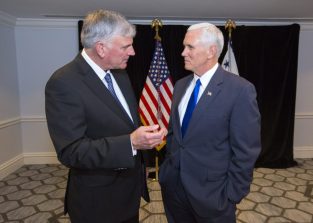
Franklin Graham, America’s most prominent evangelical leader, says Vice President Mike Pence signed off on his trip to Russia earlier this month. While there, Graham met with sanctioned Kremlin officials — even as U.S. investigations ramped up into Moscow’s election interference efforts. One official Russian governmental social media account touted the meeting as a way to “[intensify] contacts between the State Duma and the U.S. Congress.”
In an interview with RIA Novosti, a major Russian state-run outlet, Graham said he called Pence directly to tell him of the trip. “He was very happy to hear the news,” Graham said. “And he admitted that he fully supported my decision.”
Neither Pence’s office nor the Billy Graham Evangelistic Association responded to ThinkProgress’s requests for comment.
According to interviews in Russian media and photos on his own social media accounts, Graham, currently the chair of the Billy Graham Evangelistic Association, traveled to Moscow earlier this month to meet with a number of prominent Russian figures. Most notably, Graham had a sit-down meeting with Russian Duma Speaker Vyacheslav Volodin, who is close to President Vladimir Putin and who has been sanctioned by the U.S. since 2014 for his role in Russia’s invasion of Ukraine.
The Sky Dancing banner headline uses a snippet from a work by artist Tashi Mannox called 'Rainbow Study'. The work is described as a" study of typical Tibetan rainbow clouds, that feature in Thanka painting, temple decoration and silk brocades". dakinikat was immediately drawn to the image when trying to find stylized Tibetan Clouds to represent Sky Dancing. It is probably because Tashi's practice is similar to her own. His updated take on the clouds that fill the collection of traditional thankas is quite special.
You can find his work at his website by clicking on his logo below. He is also a calligraphy artist that uses important vajrayana syllables. We encourage you to visit his on line studio.


















 peej
peej Carissa
 bostonboomer
 dakinikat
 ecocatwoman
 jjlo
jjlo mablue2
 Mama Lopez
 peggysue22
 quixote
 skydancingguestblogger
 Mona (aka Wonk the Vote)



 Sky Dancing
Recent Comments