
Thursday Reads: Why Is Trump Choosing to Kill Americans?
Posted: April 9, 2020 Filed under: morning reads, U.S. Politics | Tags: coronavirus, coronavirus in rural areas, Covid-19, Donald Trump, Eric Boehlert, federal seizures of medical equipment shipments, FEMA, medical equipment shortages, red states vs blue states, small town hospitals 31 Comments
Five Puppies on the Carpet, by Edvard Munch
Good Morning!!
Yesterday Eric Boehlert asked an important question that the mainstream media never will: Memo to media: We still don’t know why Trump is doing this.
Why?
One month into our mounting crisis and we still don’t know why Trump won’t help key states secure desperately needed medical equipment to deal with the growing coronavirus pandemic. Or why Trump is touting a dubious miracle cure, fills marathon pandemic briefings with ceaseless contradictions and lies, and has silenced scientists. Why he purposefully ignored detailed intelligence warnings about Covid-19, placed his unqualified son-in-law in charge of a national emergency, and refused to invoke the Defense Production Act to compel private companies to manufacture needed medical supplies. Or why the government airlifted 18 tons of donated respirator masks, surgical masks, gowns and other medical supplies to China in February.
Woman with a dog, Fernando Botero, 1997
If Trump had done just one of these things, it would’ve been considered shortsighted and represented a shocking lack of leadership. Trump’s done them all. Yet that still doesn’t prompt most journalists to address the bigger picture and ask disturbing questions about a president who seems to be okay with watching America crumble and decay, in very real ways, on his watch.
As I stressed last week, the media’s preferred storyline that suggests Trump is simply incompetent doesn’t add up because Trump has made the wrong decision every single time in terms of how crises like this are supposed to be dealt with. (i.e. Be consistent, transparent, factual, and credible.) It’s increasingly not believable for the press to suggest Trump has been distracted or inept during this crisis, in part because of the level of White House uselessness has become so staggering.
Maybe Trump’s vengeful. Maybe he wants to wreck the economy to create investment opportunities? He’s under the thumb of a foreign entity? He wants to cause panic and cancel the November elections? He’s a fatalist? Who knows. And honestly, the specific “why” isn’t what matters now. What matters is asking the difficult questions and pondering what the Trump presidency is truly about, no matter what lurks in the shadows.

Read the rest at Press Run.
The evidence is piling up that Trump is helping red states and choosing to let people in blue states die because of equipment shortages.
Los Angeles Times: Hospitals say feds are seizing masks and other coronavirus supplies without a word.
Although President Trump has directed states and hospitals to secure what supplies they can, the federal government is quietly seizing orders, leaving medical providers across the country in the dark about where the material is going and how they can get what they need to deal with the coronavirus pandemic.

Pierre_Bonnard, Woman with Dog and Still Life, 1917
Hospital and clinic officials in seven states described the seizures in interviews over the past week. The Federal Emergency Management Agency is not publicly reporting the acquisitions, despite the outlay of millions of dollars of taxpayer money, nor has the administration detailed how it decides which supplies to seize and where to reroute them.
Officials who’ve had materials seized also say they’ve received no guidance from the government about how or if they will get access to the supplies they ordered. That has stoked concerns about how public funds are being spent and whether the Trump administration is fairly distributing scarce medical supplies.
“In order to have confidence in the distribution system, to know that it is being done in an equitable manner, you have to have transparency,” said Dr. John Hick, an emergency physician at Hennepin Healthcare in Minnesota who has helped develop national emergency preparedness standards through the National Academies of Sciences, Engineering and Medicine.
The medical leaders on the front lines of the fight to control the coronavirus and keep patients alive say they are grasping for explanations. “We can’t get any answers,” said a California hospital official who asked not to be identified for fear of retaliation from the White House.
In Florida, a large medical system saw an order for thermometers taken away. And officials at a system in Massachusetts were unable to determine where its order of masks went.
“Are they stockpiling this stuff? Are they distributing it? We don’t know,” one official said. “And are we going to ever get any of it back if we need supplies? It would be nice to know these things.”
Maybe it’s not just blue states if it happened in Florida. So why are they doing this? We need explanations.
Another example from CNN: Colorado Democrat believes Trump awarded ventilators as political favor to vulnerable GOP senator.
Still Life With Puppies, Paul Gaugin
Rep. Diana DeGette, a veteran Democrat, said that President Donald Trump’s announcement that he would send 100 ventilators to Colorado smacks of a political favor to vulnerable GOP Sen. Cory Gardner after the federal government had not fulfilled the delegation’s request for the devices.
“I think this thing that happened with Sen. Gardner and President Trump is very disturbing,” the Colorado Democrat told CNN Wednesday evening. “What is the process here?”
DeGette said that while she wants the state to get every ventilator it can — after initially requesting 10,000 — the process employed by the White House shows that the President appears to be doling out the ventilators to his allies at a time when the virus is affecting people of all political persuasions.
“It seems that way to me,” DeGette said when asked if it appeared to be a political favor to Gardner. “I was totally outraged.”
DeGette said that the decision to award 100 ventilators followed a tortured process after the state’s delegation and Democratic Gov. Jared Polis had been asking for 10,000 ventilators.
But while they were waiting for an answer from the Federal Emergency Management Agency, Polis reached a deal with a private company for 500 ventilators to be sent to the state. Once FEMA got word of the state deal, the federal agency stepped in to prevent that contract from going through so it could acquire the ventilators instead, Polis said on CNN last week.Gardner then called Trump on Tuesday night, and the President tweeted Wednesday that the state would get 100 ventilators from the federal stockpile at the Republican senator’s request. Gardner is one of the most vulnerable Republican senators up for reelection.

Trump seems to think that rural areas will not be overwhelmed by coronavirus infections, but the places where most Trump voters live will likely be the next hot spots, and they aren’t likely to be as prepared as the big cities.
Nancy LeTourneau at Washington Monthly: Some Coronavirus Hot Spots Are in Rural America.
Pablo Picasso, Woman with a dog
Most of the reporting on coronavirus has focused on its spread in major urban areas, especially New York City. But I was spurred into looking at what is happening in rural America by the fact that the “hot spot” in my home state of Minnesota is not the Twin Cities metro area. The disease has taken hold in the city of Fairmont, which is located in Martin County—an agricultural community in the southwestern part of the state.
While the number of cases and deaths related to coronavirus in Martin County is fairly low (34 cases and 4 deaths), it dwarfs those in the metro counties on a per capita basis. For example, per 100,000 people, Martin County’s numbers represent 170 cases and 20 deaths, compared to 17 cases and 0.7 deaths per 100,000 in Hennepin County, which includes Minneapolis.
No one knows why this virus has taken hold in Martin County, but that hasn’t stopped speculation. Here is what Tim Langer, public health sanitarian with Martin County Human Services, ventured.
“My personal opinion is there are some folks listening to some media outlets that were not taking this seriously. That can be a factor, too. It’s hard to prove that. I don’t want to get political. But there were outlets saying it’s a hoax, it’s no worse than a cold, and those are things people listen to.”
Martin County, Minnesota isn’t the only rural area that is facing a coronavirus outbreak. In hotspots like Blaine County, Idaho and Eagle County, Colorado, the explanation is clear: rich ski towns have some of the highest infection rates in the country. But what explains the fact that Greer County, Oklahoma is the hot spot of that state, with an infection rate of 520 and death rate of 50 per 100,000?

Click the link to read the rest.

Susan on a balcony holding a dog, Mary Cassatt
NPR: Small-Town Hospitals Are Closing Just As Coronavirus Arrives In Rural America.
By this time next week, Decatur County, Tenn., will have lost its only hospital, Decatur County General, which has been serving the rural community of about 12,000 people along the Tennessee River since 1963.
The hospital’s human resources director, Melinda Hays-Kirkwood, has already begun laying off people, and she says by next week only a skeleton staff will remain….
The closure will have a huge economic toll locally — with more than 100 on staff, the hospital was one of the county’s largest employers. But the ironic timing isn’t lost on its staff either. Because of the COVID-19 crisis, most nonessential businesses in the area were already closed.
“It’s a difficult time to be shutting down a hospital in the middle of the coronavirus,” Hays-Kirkwood says.
There are currently no known cases in Decatur County, but she says every county around it has reported infections.
Small-town hospitals were already closing at an alarming rate before the COVID-19 pandemic. But now the trend appears to be accelerating just as the disease arrives in rural America. When Decatur County General Hospital shuts down indefinitely by April 15, it will be the ninth small-town hospital to close in 2020 alone. According to a report released this month by the Chartis Center for Rural Health, nearly half of rural hospitals were already operating in the red before the COVID-19 crisis.
What will happen when it becomes clear that Trump is killing his own supporters? Lloyd Green at The Guardian, April 5: ‘Trump is killing his own supporters’ – even White House insiders know it.
On Sunday, initially at least, there was no White House briefing on the president’s public schedule. But the bad news kept coming. Coronavirus deaths continued to climb and reports of the heartland being unprepared for what may be on its horizon continued to ricochet around the media.
In the words of one administration insider, to the Guardian: “The Trump organism is simply collapsing. He’s killing his own supporters.”
By Edouard Vuillard
Members of the national guard, emergency workers, rank-and-file Americans: all are exposed. Yet Trump appears incapable of emoting anything that comes close to heart-felt concern. Or just providing straight answers.
Rather, he is acting like Jefferson Davis, the president of the Confederate States of America: repeatedly letting governors know the burden of shoring up their sick, their doctors and their people falls on their shoulders first. The national government? It’s the world’s greatest backstop.
Remember when the Republican party freaked out about Barack Obama and the US “leading from behind” abroad? Remember the howls that evoked from GOP leaders? Those days are gone. Welcome to what Martin O’Malley, a Democratic former governor of Maryland, calls the “Darwinian approach to federalism”.
Trump is telling NFL owners he wants the season to start on time. He is disregarding Centers for Disease Control and Prevention advice on wearing facemasks in public. And he is touting untested coronavirus cures live on national TV.
Think Trump University on steroids, only this time we all stand to be the victims.
When Dr Anthony Fauci says there is no evidence to back up Trump’s claims surrounding hydroxychloroquine, an anti-malaria drug, pay attention. The fact Jared Kushner is on the case is hardly reassuring. He’s the guy who thought firing James Comey was win-win politics and promised Middle East peace in our time.
While all this is going on, the Wisconsin Republican party is giving America a taste of the campaign to come in the fall. Right now, the Badger State GOP is fighting in the US supreme court efforts to extend mail-in voting for this Tuesday’s Democratic primary.
In other words, voters will be forced to choose between foregoing their rights and risking their lives. Democracy shouldn’t work that way.

Read the rest at The Guardian.
What’s happening where you live? And what stories are you following today?
Tuesday Reads: Follow the Money
Posted: April 7, 2020 Filed under: morning reads, Republican politics, U.S. Politics | Tags: Brett Kavanaugh, Chirag Patel, coronavirus, Donald Trump, hydroxychloroquine, Jared Kushner, Ken Fisher, narcissism, Plaquenil, propaganda, Roberto Mignone, Sanofi, SCOTUS, The Big Lie, Trump lies, Wilbur Ross, Wisconsin primary 2020 27 Comments
Marguerite Thompson Zoorach, 1887-1968, The Picnic, 1920s
Good Morning!!
Just as I suspected, Trump has financial motives for pushing an unproven drug with dangerous side effects during a global pandemic.
The New York Times reported yesterday:
If hydroxychloroquine becomes an accepted treatment, several pharmaceutical companies stand to profit, including shareholders and senior executives with connections to the president. Mr. Trump himself has a small personal financial interest in Sanofi, the French drugmaker that makes Plaquenil, the brand-name version of hydroxychloroquine….
Some associates of Mr. Trump’s have financial interests in the issue. Sanofi’s largest shareholders include Fisher Asset Management, the investment company run by Ken Fisher, a major donor to Republicans, including Mr. Trump. A spokesman for Mr. Fisher declined to comment.
Claude Monet. Luncheon on the Grass
Another investor in both Sanofi and Mylan, another pharmaceutical firm, is Invesco, the fund previously run by Wilbur Ross, the commerce secretary. Mr. Ross said in a statement Monday that he “was not aware that Invesco has any investments in companies producing” the drug, “nor do I have any involvement in the decision to explore this as a treatment.”
As of last year, Mr. Trump reported that his three family trusts each had investments in a Dodge & Cox mutual fund, whose largest holding was in Sanofi.
Ashleigh Koss, a Sanofi spokeswoman, said the company no longer sells or distributes Plaquenil in the United States, although it does sell it internationally.

And of course Jared is involved. I wonder if he stands to gain financial from this drug pushing?
Several generic drugmakers are gearing up to produce hydroxychloroquine pills, including Amneal Pharmaceuticals, whose co-founder Chirag Patel is a member of Trump National Golf Course Bedminster in New Jersey and has golfed with Mr. Trump at least twice since he became president, according to a person who saw them.
Mr. Patel, whose company is based in Bridgewater, N.J., did not respond to a request for comment. Amneal announced last month that it would increase production of the drug and donate millions of pills to New York and other states. Other generic drugmakers are ramping up production, including Mylan and Teva Pharmaceutical Industries.
Roberto Mignone, a Teva board member, reached out to the team of Jared Kushner, the president’s son-in-law and senior adviser, through Nitin Saigal, who used to work for Mr. Mignone and is a friend of Mr. Kushner’s, according to people informed about the discussions.
Luncheon on the Grass, Pablo Picasso
Mr. Kushner’s team referred him to the White House task force and Mr. Mignone asked for help getting India to ease export restrictions, which have since been relaxed, allowing Teva to bring more pills into the United States. Mr. Mignone, who is also a vice chairman of NYU Langone Health, which is running a clinical study of hydroxychloroquine, confirmed on Monday that he has spoken with the administration about getting more medicine into the country.

Yesterday we also learned that Peter Navarro, Trump’s wacky trade adviser was warning about a pandemic back in January. Axios: Navarro memos warning of mass coronavirus death circulated in January.
In late January, President Trump’s economic adviser Peter Navarro warned his White House colleagues the novel coronavirus could take more than half a million American lives and cost close to $6 trillion, according to memos obtained by Axios.
The state of play: By late February, Navarro was even more alarmed, and he warned his colleagues, in another memo, that up to two million Americans could die of the virus.Navarro’s grim estimates are set out in two memos — one dated Jan. 29 and addressed to the National Security Council, the other dated Feb. 23 and addressed to the president. The NSC circulated both memos around the White House and multiple agencies.
In the first memo, which the New York Times was first to report on, Navarro makes his case for “an immediate travel ban on China.”
The second lays the groundwork for supplemental requests from Congress, with the warning: “This is NOT a time for penny-pinching or horse trading on the Hill.”
Why it matters: The president quickly restricted travel from China, moved to delay re-entry of American travelers who could be infected, and dispatched his team to work with Congress on stimulus funds.
But Trump was far slower to publicly acknowledge the sort of scenarios Navarro had put in writing.
A couple of interesting psychological analyses of Trump catastrophic performance:
At the New York Times, Jennifer Senior writes: This Is What Happens When a Narcissist Runs a Crisis.
Picnic (1989), Fernando Botero
Since the early days of the Trump administration, an impassioned group of mental health professionals have warned the public about the president’s cramped and disordered mind, a darkened attic of fluttering bats. Their assessments have been controversial. The American Psychiatric Association’s code of ethics expressly forbids its members from diagnosing a public figure from afar.
Enough is enough. As I’ve argued before, an in-person analysis of Donald J. Trump would not reveal any hidden depths — his internal sonar could barely fathom the bottom of a sink — and these are exceptional, urgent times. Back in October, George T. Conway III, the conservative lawyer and husband of Kellyanne, wrote a long, devastating essay for The Atlantic, noting that Trump has all the hallmarks of narcissistic personality disorder. That disorder was dangerous enough during times of prosperity, jeopardizing the moral and institutional foundations of our country.
But now we’re in the midst of a global pandemic. The president’s pathology is endangering not just institutions, but lives.

Head over to the NYT to read the rest.
In practicing the art of lying while retaining a hold on the allegiance of his base, Trump utilizes a propaganda principle—the Big Lie—best explained by Hitler. Now, please note that we are not equating Trump and Hitler; they are very different people. However, like Hitler, Trump is involved in the business of selling himself as an angry, righteous savior to the masses, resulting in a growing number of cultic devotees. So, it may behoove us to consider Hitler’s explanation of why the Big Lie is more successful than mere untruths. Here’s his explanation of the principle in Mein Kampf:
Francisco de Goya’s Picnic En La Ribera Del Manzanares (Picnic on the Banks of the Manzanares), 1776
[I]n the big lie there is always a certain force of credibility; because the broad masses of a nation are always more easily corrupted in the deeper strata of their emotional nature than consciously or voluntarily; and thus in the primitive simplicity of their minds they more readily fall victims to the big lie than the small lie, since they themselves often tell small lies in little matters but would be ashamed to resort to large-scale falsehoods. It would never come into their heads to fabricate colossal untruths, and they would not believe that others could have the impudence to distort the truth so infamously. Even though the facts which prove this to be so may be brought clearly to their minds, they will still doubt and waver and will continue to think that there may be some other explanation.
Consider just two of many possible examples of the Big Lie: Trump’s bizarre claim that the military was out of ammunition when he took office and his equally bizarre claim that the father of Ted Cruz was involved with the assassination of Lee Harvey Oswald, adding, “It’s horrible.” It is the outrageousness of the Big Lie that a listener normally expects would create self-conscious awkwardness in the liar. In turn, this results in a need for a great liar to hide any nervousness that might give away the fact that he is attempting to deceive his audience. In poker, the failure to hide completely the lie inherent in a bluff is called a “tell,” the subtle behavior unwittingly exhibited when bluffing.

Click the link to read the rest. It’s a really interesting piece.
Republicans in Wisconsin have been working overtime to undermine democracy, and yesterday the Supreme Court gave them a big assist.
Slate: By a 5–4 Vote, SCOTUS L.ets Wisconsin Throw Out Tens of Thousands of Ballots.
On Monday, by a 5–4 vote, the U.S. Supreme Court approved one of the most brazen acts of voter suppression in modern history. The court will nullify the votes of citizens who mailed in their ballots late—not because they forgot, but because they did not receive ballots until after Election Day due to the coronavirus pandemic. As Justice Ruth Bader Ginsburg wrote in dissent, the court’s order “will result in massive disenfranchisement.” The conservative majority claimed that its decision would help protect “the integrity of the election process.” In reality, it calls into question the legitimacy of the election itself.
Still Life with Peonies and Seven Lovely Ladies by David Elsea – 2018
Wisconsin has long been scheduled to hold an election on April 7. There are more than 3,800 seats on the ballot, and a crucial state Supreme Court race. But the state’s ability to conduct in-person voting is imperiled by COVID-19. Thousands of poll workers have dropped out for fear of contracting the virus, forcing cities to shutter dozens of polling places. Milwaukee, for example, consolidated its polling locations from 182 to five, while Green Bay consolidated its polling locations from 31 to two. Gov. Tony Evers asked the Republican-controlled legislature to postpone the election, but it refused. So he tried to delay it himself in an executive order on Monday. But the Republican-dominated state Supreme Court reinstated the election, thereby forcing voters to choose between protecting their health and exercising their right to vote.
Because voters are rightfully afraid of COVID-19, Wisconsin has been caught off guard by a surge in requests for absentee ballots. Election officials simply do not have time, resources, or staff to process all those requests. As a result, a large number of voters—at least tens of thousands—won’t get their ballot until after Election Day. And Wisconsin law disqualifies ballots received after that date. In response, last Thursday, a federal district court ordered the state to extend the absentee ballot deadline. It directed officials to count votes mailed after Election Day so long as they were returned by April 13. A conservative appeals court upheld his decision.
Now the Supreme Court has reversed that order. It allowed Wisconsin to throw out ballots postmarked and received after Election Day, even if voters were entirely blameless for the delay. (Thankfully, ballots postmarked by Election Day but received by April 13 still count, because the legislature didn’t challenge that extension.) In an unsigned opinion, the majority cited the Purcell principle, which cautions courts against altering voting laws shortly before an election. It criticized the district court for “fundamentally alter[ing] the nature of the election by permitting voting for six additional days after the election.” And it insisted that the plaintiffs did not actually request that relief—which, as Ginsburg notes in her dissent, is simply false.

Read more:
Vox: The Supreme Court’s disturbing order to effectively disenfranchise thousands of Wisconsin voters.
PoliticusUSA: Brett Kavanaugh Leads Conservative SCOTUS Majority In Blocking Extended Voting In Wisconsin.
According to the Roberts court, voters should have to choose between voting and possibly dying and protecting their health. And of course the Republican primary is meaningless, so only Democrats have to worry about that.
That’s all I have for you today. What stories are you following?
Monday Reads: Art in a Time of Covid #19
Posted: April 6, 2020 Filed under: just because | Tags: #IKeepMyselfSaneBy 32 Comments
New Orleans artist Terrance Osborne,“Front Line.” (you may order prints of these at his site}
Good Day Sky Dancers!
Last week, BB overwhelmed me with the art of three artists who expressed their grief and experience with the Spanish Flu of 1918. Two died from it. That and the death of Ellis Marsalis led me down a rabbit hole of finding what both performing and creative artists did at that point in time. The creative community always finds a way to express the culture as we deal with challenges as a nation and a planet. I’m trying to focus on that today as artists and performers deal with Art in the Time of Covid #19
One of the biggest expressions of our need for community is the incredible burst of mask makers providing for both the public and the front line businesses whose employees do not have the luxury or pain of staying home but must work through all of this. Fashion Designers, manufacturers, and kitchen tables with newly home schooled children are all practicing their sewing chops. CNBC has a focus on the fashion industry in New York City but I know plenty of local artists and kids doing the same thing here. Fierce Christian Siriano–who has a reputation for making fashion available to everyone–was one of the first who stepped up.
Designer Christian Siriano has started making masks for the city, and other companies have offered to help how they can.
Naeem Khan, a New York City-based fashion designer who has designed for the likes of Michelle Obama and Kate Middleton, announced on his fashion house’s Instagram page that he would start making masks.
“My team is ready to start sewing CDC approved masks from medically approved fabrics from their isolated homes,” the post read.
“I’m a designer. I know how to construct, how to design, so I decided to design my own mask,” Khan told CNBC. “I considered doing it in hemp fabric because it has antibacterial properties.”
Khan’s masks are lined with microfiber and contain a pocket into which a surgical mask can be inserted. While this offers an extra layer of protection, meaning they can be used by medical professionals, Khan noted that these masks are not meant to replace the much needed N95s used by front-line health-care workers.
“These are not designed for people in the forefront of the corona fight,” he said.

DCB Art Students Draw on Talent for COVID-19 Donations
I woke up to this treat today! It’s a zoombomb for a young girl who from the original cast of Hamilton!!!
After delighting the socks off everyone with a reunion of The Office last week, John Krasinski is back with the second episode of Some Good News.
The YouTube series, which Krasinski started to shine a light on good news around the world, featured a new two-second weather report this week from none other than Robert De Niro (who’s credited as SGN’s meteorologist).
But it gets even better. After bringing in his wife Emily Blunt to say hello, which we knew he would at some point, Krasinski got the original cast of Broadway’s Hamilton, including Lin Manuel Miranda, to perform Alexander Hamilton over Zoom.
Krasinski organized the performance for a young girl named Aubrey, who was supposed to see Hamilton for her 9th birthday, but instead stayed home to watch Mary Poppins Returns due to the coronavirus quarantine.
How the heck is Krasinski going to top this next episode?

So, Harper Gladow is one of the cutest little girls you could ever meet and has two of the most wonderful people for parents that I’ve ever met. Imagine being a kid and having a birthday during the stay at home orders. Mom Caitlin is super creative and here’s the result. Glad Harper had a great birthday!
Harper Gladow was excited about turning 5 on April 1. There would be sno-balls and presents, a bounce house and all her friends from school.
But then the coronavirus hit. Harper and her family — mom Caitrin, dad Dave, and siblings Olivia, 8, and Nathan, 6 — were isolated at home, like millions of other Americans.
There would be no bounce house. No sno-balls.
No friends.
“We had to sit down with all three of our kids, and we had to explain you are probably not going back to school this year,” said Caitrin Gladow, communications director for a local nonprofit.
“We tried to be candid. We said this is a big scary virus, and we had to stay home. She understood that we had to move her party. She was understandably very upset. There were some tears. But I think she understands that we don’t have a choice right now.”
Still, it was hard to see the disappointment in Harper’s face. So Gladow jumped on an idea she saw on Facebook: a “Group for Parents Navigating the New Norm,” launched by the NOLA Family magazine website. Families were offering to mark those special, shut-in kids’ birthdays for each other with a costumed parade.
With just a day or two’s notice, folks found bright tutus and colored wigs. Someone made a sign. Volunteer Ann Herren climbed into an inflatable T-rex costume, and her daughter Livvy, 12, dressed up as a princess.
“These kids need it. This is their (Hurricane) Katrina,” Herren said.
The Gladows called their children out to the porch on the pretext of coloring with chalk. And then came the marchers, down the root-rolled Uptown sidewalk, singing “Happy Birthday,” blowing horns and dancing — at a safe distance from each other, of course.
“She was shocked,” Caitrin Gladow said. And when she realized everyone was there to sing to her, she got a little shy.

Yamiche Alicindor, journalist #sketchbyJonLion
You’ll notice this is next level social distancing! And here are my Friends the Gladdow Family paying it forward! BTW, Cait’s birthday is coming up and she’s gathering up donations for Team Gleason as they fundraise to beat ALS. That’s another thing Cait and I share. Her father died of this horrid disease. A few years ago my closest cousin, Ruthie, lost her battle with it. Cait and another friend ran the marathon for Team Gleason and Team Ruthie that year. Please donate if you can!
It’s also an odd coincidence that my big smile from that Hamilton video also came via Cait so … anyway, Love you guys!!! I will owe you babysitting time!!!!
So, why can’t kids birthday parties be a fresh take on performance art in the time Covid #19?
As I said, I tend to go down rabbit holes once I get hold of something and Google is always there to indulge me. IT’s undoubtedly something that has to do with avoiding grading for me and what my ex used to call my incessant pencil sharpening. So, after a short search I stumbled on to this on The Conversation: “The importance of art in the time of coronavirus”. I have often told folks that after Hurricane Katrina I became obsessed with Survivor Series and Zombie and Disaster Movies. Well, I’m not the only one that retreats to books and movies with weird impossible themes.

This is from a Senior Lecturer in Illustration, University of Portsmouth.
In this time of restriction, TV, film, books and video games offer us a chance to be mobile. To move around freely in a fictional world in a way that is now impossible in reality. Art connects us to the foreign, the exotic and the impossible – but in our current context, it also connects us to a world where anything is possible. A world out of our grasp for now.
The world we wake up in is a counterfeit reality. Things look the same. Unlike those now familiar films, the descent of humanity is not apparent in the slow shuffle of moaning, glassy-eyed zombies. The threat we face feels like those clever horror movies like The Blair Witch Project, Paranormal Activity and more recent films like The Quiet Place where we rarely see the source of horror. The current moment is best understood as a kind of low hum of anxiety, like the buzzing of a pylon in a field.
The best thing about this is actually that the artist had an opportunity to be in Africa during a study of what a virus outbreak would do if it hit this camp/village in Mukuru and also Nairobi, Kenya. His sketches are in the article so please be sure to check them all out.
A current trending tag under Covid-19 on Twitter is this: #IKeepMyselfSaneBy. There is quite a bit of this:
I have found my writer friends are writing. My painting friends are painting. And here I am with my Steinway and the guitar I had as a teen. I may not be Lin Manuel but I still have a few chops left in me and a lot of my friends are sharing theirs on a New Orleans Face Book page called the Quarantine Canteen. So, even performance artists have venues.
The coolest thing ever is the number of museums, ballet companies, opera companies, and theatres sharing their videos of past performances. This from Forbes.: “These Galleries, Arts Organizations And Museums Are Keeping Art Accessible During Covid-19.”
With art galleries and museums around the world closing because of Covid-19, artists, galleries and museums have turned to technology and social media to keep their doors open virtually so visitors from anywhere in the world can still interact with and view art.
From large international museums to galleries and arts organizations, the arts community is getting creative with how they share their collections with the world.
America’s Virtual Museums are on line and gearing up.
Without knowing it, or certainly asking for it, we have all become part of a giant social science experiment: can digital platforms offer a satisfactory alternative to experiencing art in the real world? Museums have created points of access to collection databases—some more easily navigable than others—allowing online visitors to look at and learn about specific objects of interest, as well as read blog postings from curators about current exhibitions or about pieces in the permanent collection and follow the institution on social media platforms, using the online world and virtual reality technology to replace or reproduce the feeling of viewing art and other objects in person. This is a process that has been developing at US museums for 20 years, although it has taken on greater significance as the Covid-19 outbreak has closed these institutions to the public for an indefinite period of time.
Michael Neault, the executive creative director for experience design at the Art Institute of Chicago, says that the museum is in the process of “launching a new interactive feature for online users of highly visual narratives about objects in the collection. We will be releasing several of these each week over the coming weeks.” These features will be two to three minutes in length and include 360-degree photography. One of the first of these focuses on El Greco’s 1577-79 painting The Assumption of the Virgin, a featured work in the museum’s El Greco: Ambition and Defiance exhibition that opened on 7 March and was to continue until 21 June, but is now in limbo as the institution is closed to the public.
The Smithsonian Museum of American Art has created several digital tours of its the facility, from a standalone exhibition that can be viewed in 360-degrees via an app, to a fully immersive virtual reality experience, that includes art historical information on the works in the collection. And the Salvador Dalí Museum in St Petersburg, Florida, which is currently closed, offers a sometimes dizzying virtual tour of the entire museum, including the bookstore, exterior, fascinating staircase and the art in the collection, which is kept in a hermetically sealable third floor gallery in case of hurricane flooding.
In China, kids are selling their art as students of At Dulwich College Beijing (DCB) to help fund shipments of Medical Grade Masks. Some of the art you see here has come from their efforts. You can read more about it at the link.
If you want to delve in to the reality of it all, you can watch Into the Red Zone which documents the worst hit areas of Northern Italy. I watched it on MSBNC last night. It’s compelling and overwhelming.
So, I’m about to go do my remote teaching thing and my which box of what gets delivered when thing and my self comfort things which have always included my music, my water color paintings, and binging on escapist movies. Which is my answer to #IKeepMyselfSaneBy. What is yours?
I love you all. Be safe! Stay Home! And now, find yourself a few neato masks!
What’s on your reading, blogging and creating list today?
Lazy Caturday Reads: Trump Is Killing Americans
Posted: April 4, 2020 Filed under: Foreign Affairs, morning reads, U.S. Politics | Tags: 3M, Canada, coronavirus, Donald Trump, Gov. Charlie Baker, Illinois, Jared Kushner, Massachusetts, Russell Honore, Trump administration 32 Comments
By Sara Barnes
Good Morning!!
Is Trump deliberately letting Americans die? It certainly appears that he is directing scarce medical supplies to red states like Florida while actively trying to prevent deliveries of such equipment to blue states.
On Thursday I posted about a massive shipment of N95 masks that was delivered to Massachusetts through the intervention of the Kraft family, owners of the New England Patriots. The Krafts arranged to have the Patriots plane fly to China and back to pick up more than a million masks. Another shipment will follow later. The Krafts also donated $2 million toward the cost of the masks. From The Boston Globe:
The news, which broke early Thursday, resembled a plot pulled straight out of a summer blockbuster: The Kraft family had deployed a New England Patriots team plane to China to deliver about one million desperately needed N95 respirator masks to health care workers in Massachusetts.
By Rudi Herzimeier
Yet the story is as alarming as it is heartwarming, underscoring a harsh reality as the coronavirus pandemic spreads ever faster around the United States. Governor Charlie Baker and his counterparts throughout the country are forced to go to extraordinary lengths to secure life-saving medical equipment in the absence of a coordinated federal response.
“This is not how it is supposed to work,” said Representative Katherine Clark of Melrose, a member of House Speaker Nancy Pelosi’s leadership team. She described herself as “very grateful” for the Kraft family’s generosity and help getting the critical gear, but said “what we need is a coordinated federal system.”

Why was such a dramatic effort necessary? Because Trump has been actively preventing Massachusetts from purchasing medical supplies.
The journey began, in the governor’s telling, roughly two weeks ago, when the federal government confiscated a shipment of more than 3 million N95 masks at the Port of New York and New Jersey that Massachusetts had arranged to buy….
Baker’s victory in the state’s intense hunt for masks and other protective gear, or PPE, follows weeks of increasingly public frustration from the normally even-keeled governor. His administration has hit numerous roadblocks thrown up by the federal government, which has repeatedly snatched supplies from the states’ hands and directed governors to find their own source.
Very Introvert Cat Sitting on a Red Chair, by Nastya Ozozo
Even now, Baker administration officials are still waiting on the federal government to deliver promised help. Earlier this week, Baker announced that the state had ordered 1,000 ventilators from the federal government and that he expected the delivery by the end of this week. On Thursday, Baker said Massachusetts still hasn’t gotten any of the equipment and he no longer expects them by the end of the week.

Normally calm and matter-of-fact, Baker choked back tears when he spoke at Logan Airport after meeting he Patriots plane.
The Chicago Sun-Times has a story about another crazy situation in Illinois: Illinois adjusts on the fly to meet medical supply needs in a coronavirus ‘Wild West.’
About two weeks ago, Illinois officials tracked down a supply of 1.5 million potentially life-saving N95 respirator masks in China through a middleman in the Chicago area and negotiated a deal to buy them.
One day before they were expecting to complete the purchase, they got a call in the morning from the supplier informing them he had to get a check to the bank by 2 p.m. that day, or the deal was off. Other bidders had surfaced.
Realizing there was no way the supplier could get to Springfield and back by the deadline, Illinois assistant comptroller Ellen Andres jumped in her car and raced north on I-55 with a check for $3,469,600.
By Shozo Ozaki.
From the other end, Jeffrey Polen, president of The Moving Concierge in Lemont, drove south. Polen isn’t in the medical supply business, but he “knows a guy,” an old friend who specializes in working with China’s factories.
As they drove, Andres and Polen arranged to meet in the parking lot of a McDonald’s restaurant just off the interstate in Dwight. They made the handoff there.
Polen made it back to his bank with 20 minutes to spare. Illinois already has received part of the mask shipment. There’s more on the way.
That’s just a taste of the “Wild West” world of emergency procurement taking place over the past several weeks as the state fights for equipment and supplies to protect frontline workers and patients in the battle against COVID-19.

Why is this chaos necessary? Because Trump refuses to allow the federal government to organize the pandemic response.
Now Trump is angering America’s foreign allies by commandeering medical supplies their governments are trying to buy.
Kaiser Health News: Trump Administration Uses Wartime Powers To Be First In Line On Medical Supplies.
The Trump administration quietly invoked the Defense Production Act to force medical suppliers in Texas and Colorado to sell to it first — ahead of states, hospitals or foreign countries.
It took this action more than a week before it announced Thursday that it would use the little-known aspect of the law to force 3M to fill its contract to the U.S. first. Firms face fines or jail time if they don’t comply.
Terry Runyan, Yellow Cat
The Cold War-era law gives federal officials the power to edge out the competition and force contractors to provide supplies to them before filling orders for other customers.
While it’s unclear how many times the power has been used during the coronavirus pandemic, federal contracting records examined by Kaiser Health News show that federal authorities staked first rights to $137 million in medical supplies. The orders in late March flew under the radar, even as dog-eat-dog bidding wars raged among states and nations for desperately needed medical protective gear.
“It’s like ‘Lord of the Flies’ out there for states and hospitals as they bid against each other for critical medical supplies and equipment,” Sen. Chris Murphy (D-Conn.) said in a statement to KHN. “Plus, there’s no transparency about what the federal government is doing with the equipment that they purchase when they outbid states and hospitals.”

Read more:
Reuters: Canada blasts U.S. block on 3M exports of masks as coronavirus cases set to soar.
At the Coronavirus Task Force briefing on Thursday, we learned that, instead of sending medical supplies controlled by the Pentagon (paid for by taxpayers) directly to states, the administration is handing the equipment over to private companies to resell to the highest bidder. Here’s what Lt. Katrina recovery hero Gen. Russell Honore had to say about that.
Yesterday, Dakinikat wrote about the insanity of putting failson-in-law Jared Kusher in charge of the federal pandemic response. We learned about that at the Thursday briefing too. From The Daily Beast:
President Donald Trump’s top adviser and son-in-law Jared Kushner insisted on Thursday that the government had not built up a national stockpile of medical equipment for states to use during threats like the coronavirus since those states have strategic reserves of their own.
The remark drew raised eyebrows from experts, considering presidents have dispersed supplies from the national strategic stockpiles for use by states dozens of times over the last twenty years.
In fact, the Trump administration itself has dipped into the federal reserves to help states in need…
Malarstwo Japońskie
“He doesn’t know what the hell he is talking about. He has no idea,” said Gen. Russel Honore, a retired military general who helped direct the response on the ground during Hurricane Katrina. “He must have remembered something from some slide or some speech. But that’s why people created the national strategic stockpile in the first place. It’s for those days when we can’t predict what we need. What I see is a total misunderstanding by the White House that they have a responsibility to help maintain the stockpile and help states.” [….]
While state governments do possess their own stockpiles of equipment and supplies, the national strategic stockpile was originally designed in 1999 to help states fill the gaps when facing things like natural or health disasters. The role of the stockpile has expanded dramatically in recent years amid more frequent natural disasters.
But the Trump White House’s approach to filling the supply chain gaps has been slapstick at best, officials say, in part because it was unprepared for taking the lead in responding to a global pandemic. For weeks, the administration struggled to understand which agency was responsible for studying the supply chain breakdown and which was in charge of fixing not only the dwindling medical supplies in hospitals, but also the shortages of products like toilet paper and paper towels in grocery stores.
“We missed dealing with this disaster because for weeks, the White House said it was a hoax,” Honore said. “So we missed at least four weeks of anticipation and preparation on the logistics side because of our leadership.” [….]
“It shouldn’t be this complicated,” said Juliette Kayyem, a former assistant secretary of the Department of Homeland Security. “It’s supposed to happen like a light switch you flip on. And this should have happened a month ago. This is not inventing a vaccine, this is just shipping stuff. In these situations you want a light White House touch and you want the subject matter experts to take the lead.”


By Saul Steinberg
More important stories to check out:
The New York Times: Coronavirus in N.Y.: Toll Soars to Nearly 3,000 as State Pleads for Aid.
The Washington Post: The U.S. was beset by denial and dysfunction as the coronavirus raged.
The Washington Post: Inside the coronavirus testing failure: Alarm and dismay among the scientists who sought to help.
Yahoo News: Coronavirus may cause some food shortages, warns government task force.
ProPublica: How Tea Party Budget Battles Left the National Emergency Medical Stockpile Unprepared for Coronavirus.
Raw Story: Trump administration quietly guts COVID-19 paid leave provision that already excluded 75 percent of workers.
Lucian Truscott IV at Salon (via Raw Story): Trump is preparing the ground for a totalitarian dictatorship.
Business Insider: The US Postal Service is on track to run out of money by June, and it could be a disaster for states trying to expand voting by mail.
Take care this weekend, Sky Dancers! Please let us know what’s happening where you are.
Friday Reads: The Trump Family Crime Syndicate Strikes Again and Again and Again!
Posted: April 3, 2020 Filed under: Afternoon Reads | Tags: #KushnerForPrison2021, Nepotism 15 Comments
Good Day Sky Dancers!
It’s very difficult to think about how much the current administration is doing wrong during this crisis because it is costing lives. Nepotism in the White House is as rampant and as insidious as the virus itself. It basically puts lives and treasure in the hands of those least prepared to do the right thing. As usual, the lack of basic human decency and character at the top has once again brought us into the cursed hands of Jared Kushner.
At one of the most perilous moments in modern American history, Mr. Kushner is trying in a disjointed White House to marshal the forces of government for the war his father-in-law says he is waging. A real estate developer with none of the medical expertise of a public health official nor the mobilization experience of a general, Mr. Kushner has nonetheless become a key player in the response to the pandemic.
Because of his unique status, he has made himself the point of contact for many agency officials who know that he can force action and issue decisions without going to the president. But while Mr. Kushner and his allies say that he has brought more order to the process, the government’s response remains fragmented and behind the curve.
Some officials said Mr. Kushner had mainly added another layer of confusion to that response, while taking credit for changes already in progress and failing to deliver on promised improvements. He promoted a nationwide screening website and a widespread network of drive-through testing sites. Neither materialized. He claimed to have helped narrow the rift between his father-in-law and General Motors in a presidential blowup over ventilator production, one administration official said, but the White House is still struggling to procure enough ventilators and other medical equipment.
Perhaps most critical, neither Mr. Kushner nor anyone else can control a president who offers the public radically different messages depending on the day or even the hour, complicating the White House’s effort to get ahead of the crisis. One moment Mr. Trump is talking about reopening the country by Easter, the next he is warning of more than 100,000 deaths. In the afternoon, he threatens to quarantine tens of millions of people in the Northeast, then in the evening he backs down.
In an interview, Mr. Kushner would not discuss the president’s actions but said he viewed himself as an enabler of government agencies to overcome obstacles. “From the White House, you can move a lot faster,” he said. “I’ve put members of my team into a lot of components. What we’ve been able to do is get people very quick answers.”
But to some in the agencies, his team’s arrival has only exacerbated an already dysfunctional situation. In recent days, administration officials said, the Federal Emergency Management Agency, which traditionally coordinates the government’s responses to disasters, has received surprise directives from the White House — including to dispatch deliveries of medical equipment to states that had not even submitted formal requests based on which governor got Mr. Trump on the telephone.
Today, CREW announced an effort to shine light on Kushner’s activities and possible profiteering.
Kushner’s deep involvement in President Trump’s re-election campaign from the White House has been widely reported. Kushner reportedly is “positioning himself now as the person officially overseeing the entire [Trump] campaign from his office in the West Wing, organizing campaign meetings and making decisions about staffing and spending.” He also reportedly oversees several elements of the campaign, including fundraising, strategy and advertising. Kushner has not shied away from touting his involvement in President Trump’s re-election campaign over the past year. admitting to working “to set goals and objectives” for his father-in-law’s presidential campaign.
As recently as March 2020, Kushner was scheduling meetings alongside President Trump, Hope Hicks and campaign staff inside the White House on polling numbers. While the coronavirus crisis derailed the meeting before the presentation began, Kushner’s inclusion in the meeting indicates he continues to overlap his official and campaign duties.
“OSC needs to investigate Kushner’s behavior to ensure that he is complying with the Hatch Act,” said Bookbinder. “There is no room in our government for top officials who deliberately violate ethics laws.”
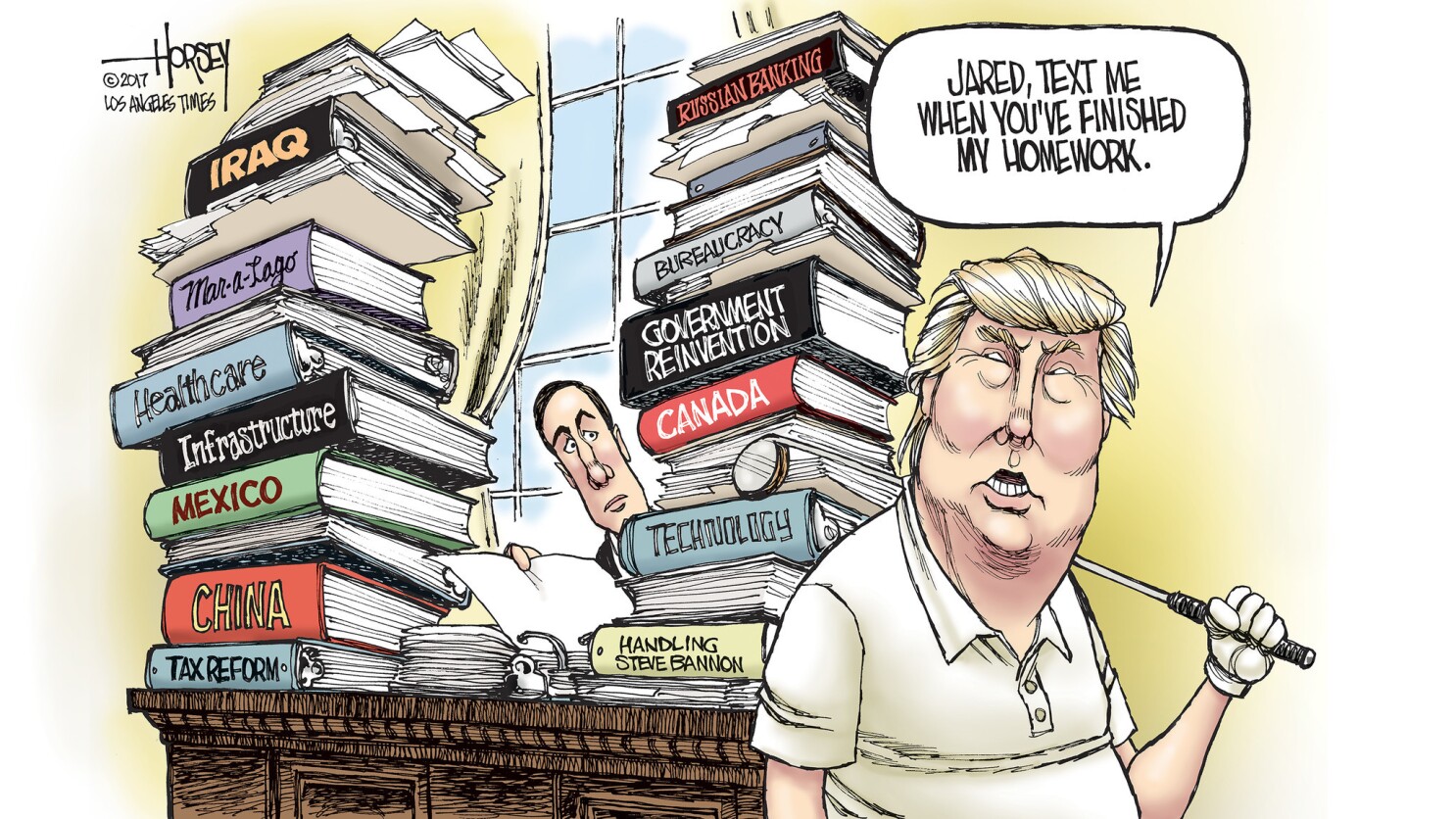
Michelle Goldberg is even more adept at explaining why Kushner is the last person you would want injected into this process.
Reporting on the White House’s herky-jerky coronavirus response, Vanity Fair’s Gabriel Sherman has a quotation from Jared Kushner that should make all Americans, and particularly all New Yorkers, dizzy with terror.
According to Sherman, when New York’s governor, Andrew Cuomo, said that the state would need 30,000 ventilators at the apex of the coronavirus outbreak, Kushner decided that Cuomo was being alarmist. “I have all this data about I.C.U. capacity,” Kushner reportedly said. “I’m doing my own projections, and I’ve gotten a lot smarter about this. New York doesn’t need all the ventilators.” (Dr. Anthony Fauci, the country’s top expert on infectious diseases, has said he trusts Cuomo’s estimate.)
Even now, it’s hard to believe that someone with as little expertise as Kushner could be so arrogant, but he said something similar on Thursday, when he made his debut at the White House’s daily coronavirus briefing: “People who have requests for different products and supplies, a lot of them are doing it based on projections which are not the realistic projections.”
Kushner has succeeded at exactly three things in his life. He was born to the right parents, married well and learned how to influence his father-in-law. Most of his other endeavors — his biggest real estate deal, his foray into newspaper ownership, his attempt to broker a peace deal between the Israelis and the Palestinians — have been failures.
Undeterred, he has now arrogated to himself a major role in fighting the epochal health crisis that’s brought America to its knees. “Behind the scenes, Kushner takes charge of coronavirus response,” said a Politico headline on Wednesday. This is dilettantism raised to the level of sociopathy.

I don’t think the Kushners are going to be able to return to NYC ever frankly. Seth Meyers even got into the pile one (Via Vanity Fair).
White House senior advisor and President Donald Trump‘s son-in-law Jared Kushner made his first appearance at the White House coronavirus briefing on Wednesday, one day after Vanity Fair reported he had taken a larger role in the government response to the health crisis—with a particular interest in the supply of ventilators available to each state, and the federal government’s role in procuring more.
“The notion of the federal stockpile was, it’s supposed to be our stockpile. It’s not supposed to be states’ stockpiles that they then use,” Kushner said on Wednesday. He later added, “Some governors you speak to or senators, and they don’t know what’s in their state.” The comments were roundly criticized on social media, but kept consistent with what Vanity Fair’s Gabriel Sherman has reported about Kushner’s response to New York governor Andrew Cuomo, who has plead for more than 30,000 ventilators. (Dr. Anthony Fauci has confirmed that number as well). “I have all this data about ICU capacity. I’m doing my own projections, and I’ve gotten a lot smarter about this. New York doesn’t need all the ventilators,” Kushner reportedly said during a White House meeting, according to a person present.
On Thursday’s edition of Late Night, Seth Meyers provided a response to Kushner’s purported comment. “Oh, you’re doing your own projections? Did your parents just buy you a TI-84?” he asked. “You’re not qualified to do anything, let alone tell New York how many ventilators they need. You’re a nepotism case, and you only got the White House job because you married into the family, and because the security guards believed your fake ID.”
Meyers mocked Kushner relentlessly during the tail end of his latest A Closer Look segment, referring to him as the person in charge of “this shitshow” and joking that Kushner is “the guy Slenderman has nightmares about.”

Matt Johnson @HotPockets4All
And in an opinion from Lloyd Green writing for The Guardian: “Jared Kushner’s coronavirus overreach puts more American lives on the line.” No Shit Sherlock!!!
Jared Kushner is not a guy to turn to for sound political advice. Most recently, he reportedly told the president that Andrew Cuomo, New York’s governor, was being “alarmist” after he announced that his state required 30,000 ventilators to help get through the pandemic.
To add insult to injury, Kushner also bragged of his own wisdom and told those assembled that Cuomo was wrong. According to Vanity Fair, Kushner declared: “I have all this data about ICU capacity. I’m doing my own projections, and I’ve gotten a lot smarter about this. New York doesn’t need all the ventilators.”
The princeling has helped place American lives and bodies on the line. New York’s hospitals have become combat zones, its morgues and funeral homes look like abattoirs. Meanwhile, the US is locked down and the administration is projecting up to a quarter-million dead even if everything goes right.
American carnage is now. We may witness more deaths in months than its troops suffered in Iraq, Afghanistan and Vietnam after years of fighting.
When Mike Pence compares the US to Italy, we have a problem whose glaring scars will be felt long after Donald Trump leaves office. Coronavirus won’t be disappearing in a matter of days despite the president’s earlier assurances. Trump ignored the intelligence community and his national security staff, and now we must pay a collective price.
Unfortunately, Kushner doesn’t only suffer from intellectual overreach. Self-dealing may have made a cameo too in the middle of crisis, and we have seen this movie before. Earlier, the Kushners had attempted to attract capital from China, by touting EB-5 visas in exchange for investments and looked to Anbang, a Chinese conglomerate, to bail them out of their real estate positions.
When Kushner was boasting about data and Trump was going on about testing websites, they were probably referring to Oscar Health, an insurance company tied to the Kushner family. In turn, Oscar appears to have been involved in the government’s efforts to map the spread of the disease.
According to reports and filings, Josh Kushner, Jared’s brother, still owns a piece of Oscar, and Jared belatedly divested his interest after entering government. If the Trump Organization can bill the Secret Service when they guard the president at his personal properties, why can’t the Kushner kids make a few dimes off the taxpayer?
So, anyway, the shit show continues and we’re at the bottom of that slope it seems.
Please stay safe and check to let us know how you’re doing!!!
I’m sharing this link to Mister Roger’s Neighborhood because I’m still in shock about our city’s treasure and some one who always shared his music and talent with every one as a performer, father, and teacher. I was fortunate to hear him, known him and learn from him. You can also see part of that here in this tribute from Jazz from Lincoln Center with his very young sons that he taught very well.
What’s on your reading and blogging list today?

 peej
peej Carissa
 bostonboomer
 dakinikat
 ecocatwoman
 mablue2
 Mama Lopez
 peggysue22
 quixote
 skydancingguestblogger
 Mona (aka Wonk the Vote)



 Sky Dancing
Recent Comments