
US Citizens Arrested, Interrogated, and Stranded Overseas
Posted: August 25, 2011 Filed under: Barack Obama, Civil Liberties, Civil Rights, Egypt, FBI raids, Foreign Affairs, Human Rights, Kuwait, MENA, Middle East, Somalia, Yemen | Tags: ACLU, American Muslims, CIA, COINTELPRO, Council on American-Islamic Relations (CAIR), Egypt, FBI, Gulet Mohamed, Kuwait, middle east, Mother Jones, Nick Baumann, no-fly list, Somalia, Yahya Wehelie, Yemen 6 Comments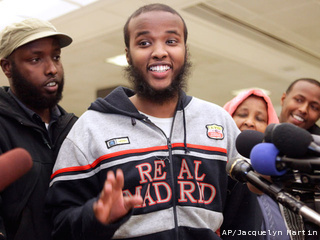
Gulet Mohamed surrounded by family on return to U.S.
From The New York Times, January 5, 2011:
An American teenager detained in Kuwait two weeks ago and placed on an American no-fly list claims that he was severely beaten by his Kuwaiti captors during a weeklong interrogation about possible contacts with terrorism suspects in Yemen.
The teenager, Gulet Mohamed, a Somali-American who turned 19 during his captivity, said in a telephone interview on Wednesday from a Kuwaiti detention cell that he was beaten with sticks, forced to stand for hours, threatened with electric shocks and warned that his mother would be imprisoned if he did not give truthful answers about his travels in Yemen and Somalia in 2009.
American officials have offered few details about the case, except to confirm that Mr. Mohamed is on a no-fly list and, for now at least, cannot return to the United States. Mr. Mohamed, from Alexandria, Va., remains in a Kuwaiti detention center even after Kuwait’s government, according to his brother, determined that he should be released.
During the interview with the NYT, Mohammed said, “I am a good Muslim, I despise terrorism.”
During the 90-minute telephone interview, Mr. Mohamed was agitated as he recounted his captivity, tripping over his words and breaking into tears. He said he left the United States in March 2009 to “see the world and learn my religion,” and had planned to return to the United States for college.
He said he had traveled to Yemen to study Arabic, but stayed less than a month because his mother worried about his safety. He said that he spent five months later that year living with an aunt and uncle in northern Somalia, before moving to Kuwait in August 2009 to live with an uncle and continue his Arabic studies.
Mohammed’s ordeal began when he went to the airport in Kuwait to renew his travel visa. He was held for five hours and then handcuffed, blindfolded and taken to a prison where he was interrogated and beaten on his feet and face with sticks when he didn’t give the “right answers.”
“Are you a terrorist?” they asked, according to his account.
“No,” he replied.
“Do you know Anwar?” his interrogators asked, referring to Mr. Awlaki.
“I’ve never met him,” Mr. Mohamed recalled saying.
“You are from Virginia, you have to know him,” they responded, according to Mr. Mohamed. From 2001 to 2002, Mr. Awlaki was the imam of a prominent mosque in northern Virginia.
Mohammed told the NYT in January that even after being released, he couldn’t sleep or eat and was constantly fearful. He said he has “always been pro-American” and obviously could not understand why he was targeted. After the article in the NYT, Mohammed was finally permitted to return home later in January. He told the Washington Post that his ordeal had “made me stronger.”
Mohammed is only one of many American citizens of Middle Eastern or African descent who have found themselves stranded overseas, unable to return home because their names have been put on a no-fly list while they were out of the country. Many of these people have been arrested and interrogated by foreign governments, apparently at the request of the F.B.I. From the Post article (1/21/2011):
Civil liberties groups charge that his case is the latest episode in which the U.S. government has temporarily exiled U.S. citizens or legal residents so they can be questioned about possible terrorist links without legal counsel.
The American Civil Liberties Union is suing the U.S. government on behalf of 17 citizens or legal residents who were not allowed to board flights to, from or within the United States, presumably because, like Mohamed, they were on the government’s no-fly list. Of those stranded overseas, all were eventually told they could return, often after they agreed to speak to the FBI. None was arrested upon their return.
The ACLU suit, filed in Portland, Ore., alleges that Americans placed on the no-fly list are denied due process because there is no effective way to challenge their inclusion. The government does not acknowledge that any particular individual is on the no-fly list or its other watch lists. Nor will it reveal the exact criteria it uses to place people on its list.
This week Mother Jones published a series of reports on their investigations of FBI operations that sound like COINTELPRO updated.
COINTELPRO was an FBI covert operation that targeted domestic left-wing and anti-war groups from 1956 to 1971, in the name of “national security.” Frankly, the covert operations have probably continued even though they are technically illegal. But lately we’ve seen an uptick in FBI operations targeting groups within the U.S. Until I came across a couple of blog posts last week about American muslims being targeted overseas, I had no idea the FBI had branched out to foreign covert operations.
At Mother Jones, Nick Baumann writes:
In the past, the FBI has denied that it asks foreign governments to apprehend Americans. But, a Mother Jones investigation has found, the bureau has a long-standing and until now undisclosed program for facilitating such detentions. Coordinated by elite agents who serve in terrorism hot spots around the world, the practice enables the interrogation of American suspects outside the US justice system. “Their citizenship doesn’t seem to matter to the government,” says Daphne Eviatar, a lawyer with Human Rights First. “It raises a question of whether there’s a whole class of people out there who’ve been denied the right to return home for the purpose of interrogation in foreign custody.”
I highly recommend reading the whole article. Baumann describes other cases similar to Mohammed’s and reveals information he obtained from government officials and representatives of human rights groups.
Here is another example from a 2010 Huffpo article:

A Virginia man said he has been stuck in limbo in Egypt for the last six weeks, living in a cheap hotel and surviving on fast food after his name was placed on a U.S. no-fly list because of a trip to Yemen.
Yahya Wehelie, a 26-year-old Muslim who was born in Fairfax, Virginia to Somali parents, said Wednesday he spent 18 months studying in Yemen and left in early May. The U.S. has been scrutinizing citizens who study in Yemen more closely since the man who tried to blow up a U.S.-bound airliner on Christmas was linked to an al-Qaida offshoot in Yemen.
Wehelie was returning to the U.S. with his brother Yusuf via Egypt on May 5 when Egyptian authorities stopped him from boarding his flight to New York. They told him the FBI wanted to speak with him.
He said he was then told by FBI agents in Egypt that his name was on a no-fly list because of people he met in Yemen and he could not board a U.S. airline or enter American airspace. His passport was canceled and a new one issued only for travel to the United States, which expires on Sept. 12. He does not have Somali citizenship.
Wehelie said his brother Yusuf was allowed to return home, but only after he was detained for three days by Egyptian police on suspicion of carrying weapon. He said his brother was shackled to a jail wall and interrogated by a man who claimed to work for the CIA. He was then dumped in the street outside the prison when he feigned illness.
In June, 2010, the Council on American-Islamic Relations (CAIR) posted a list of American Muslims who had been kept from returning to the U.S. after trips abroad.
In July, 2010, CAIR posted a warning on its website informing Muslim-Americans that they could end up in “forced exile” if they traveled to another country.
CAIR this week issued an advisory to American Muslims — whether citizens, permanent residents or visa holders — warning of the risk of “forced exile” when traveling overseas or attempting to return to the United States. Muslim travelers are urged to know their legal rights if they are placed on the so-called “no-fly list.”
In the past few months, CAIR has received a number of reports of American Muslims stranded overseas when they are placed on the government’s no-fly list. Those barred from returning to the United States report being denied proper legal representation, being subjected to FBI pressure tactics to give up the constitutionally-guaranteed right to remain silent, having their passports confiscated without due process, and being pressured to become informants for the FBI. These individuals have not been told why they were placed on the no-fly list or how to remove their names from the list.
FBI agents have reportedly told a number of individuals that they face being stranded outside the United States longer, or forever, unless they give up their rights to legal representation or to refuse interrogations and polygraph tests. But even those who submitted to interrogations without an attorney or to the “lie detector” tests remain stranded.
This situation is outrageous, and President Obama should be directly confronted about his support of this un-American, authoritarian policy (White House approval is required for many of these FBI activities). Perhaps a relatively high profile article like the one in Mother Jones will influence some mainstream reporters to do that. In the meantime, please spread the word in any way you can.
Monday Reads
Posted: June 6, 2011 Filed under: Economy, Foreign Affairs, morning reads, Yemen | Tags: jobs, John Edwards, the economy, Yemen 32 Comments Good Morning!
The top stories on every one’s mind these days are the lousy jobs report last week and the tumbling stock markets. Democrats in the House are calling for new infrastructure spending as a way to create more jobs in the hopes that a few federal projects could provide some stimulus to the stalling recovery.
“The American people, while concerned about the deficit, place much more emphasis on job creation, and they see a role for the government,” Rep. Raul Grijalva (D-Ariz.) told The Hill. “A fast injection of job stimulus on the public side would help tremendously. … It [the job report] helps our argument about investment.”
Other Democrats delivered a similar message on Friday. Rep. Eliot Engel (D-N.Y.) said “the answer” to the lingering jobs crisis is “investment” in the “communities and businesses who need confidence and resources to hire [people].”
Rep. Emanuel Cleaver (D-Mo.) said “investing in our communities goes hand in hand with full economic recovery.”
Rep. Earl Blumenauer (D-Ore.) said that only in Washington is targeted new spending being demonized.
“Once you get outside the Beltway, almost everyone agrees that we should be rebuilding our crumbling infrastructure and investing in clean American energy that reduces our dependence on oil,” Blumenauer said.
Meanwhile, the major reason for home foreclosures these days isn’t the subprime loan scandal. It’s unemployment.
The Obama administration’s main program to keep distressed homeowners from falling into foreclosure has been aimed at those who took out subprime loans or other risky mortgages during the heady days of the housing boom. But these days, the primary cause of foreclosures is unemployment.
As a result, there is a mismatch between the homeowner program’s design and the country’s economic realities — and a new round of finger-pointing about how best to fix it.
The administration’s housing effort does include programs to help unemployed homeowners, but they have been plagued by delays, dubious benefits and abysmal participation. For example, a Treasury Department effort started in early 2010 allows the jobless to postpone mortgage payments for three months, but the average length of unemployment is now nine months. As of March 31, there were only 7,397 participants.
“So far, I think the public record will show that programs to help unemployed homeowners have not been very successful,” said Jeffrey C. Fuhrer, an executive vice president of the Federal Reserve Bank of Boston.
One additional question is popping up now that it appears more than certain that some entitlements will be subject to cuts, That is why aren’t Democrats defending Medicaid? Democrats have spoken out against cuts to Social Security and have defended Medicare. What about Medicaid?
…for all the Democrats’ posturing and campaigning against Republican plans for Medicare, the GOP budget actually makes more immediate and deeper cuts to Medicaid. But Democrats haven’t been blasting the GOP Medicaid plan with nearly the same fervor, even though Republicans would cut about $750 billion from the program during the next decade and end the guaranteed federal match for states.
With intense budget negotiations on the debt limit under way, health care insiders think Democrats won’t budge much on Medicare now that they have a significant campaign chip in their pockets: Kathy Hochul’s upset win in New York’s 26th Congressional District is Exhibit A of the power of Medicare.
And that makes advocates worry that Medicaid cuts are more likely to come out of budget negotiations led by Vice President Biden.
Medicaid covers more than 50 million people, including low-income children and seniors in long-term care, but it doesn’t pack the same political punch as Medicare. Some observers say that’s due to the lingering perception that Medicaid is just a program for poor people that holds a much less broad-based appeal.
That perception is definitely part of the challenge in communicating Democratic opposition to the GOP’s Medicaid plans, Rep. Robert Andrews (D-N.J.) told POLITICO.
Medicaid “doesn’t quite have the same political dynamic” as Medicare, Andrews said.
Protestors in Wisconsin have opened a ‘Walkerville’ Tent city in Madison as a reminder of the Great Depression and to protest the governor’s budget. Wisconsin is leading the way in protesting the way state budgets are being balanced on the backs of the poor and the working and middle classes.
In a move meant to evoke the infamous “Hooverville” tent cities of the Great Depression, protesters in Madison, Wisconsin opened “Walkerville” on Saturday evening, a tent city in the heart of Madison intended as a protest of Governor Scott Walker’s budget plan.
The Wisconsin Sentinel Journal calls the protest “the latest act in the 2011 political drama featuring the governor’s push to eliminate most collective bargaining rights for most public employees”.
By 9:00pm, an estimated 250 campers in up to 100 tents were arrayed throughout the designated protest area, with many campers pitching their tents on concrete sidewalks. City police, state troopers, and other law enforcement personnel were on hand, but on the whole a carnival air prevailed as families set up for the night, some intending to stay just for a night or two and others through June 20.
Yemeni president Ali Abdullah Saleh is in Saudia Arabia recovering from injuries suffered in an attack on his palace last week. Many people are encouraging him to stay there.
The United States and Britain are pressing Saudi Arabia to persuade the Yemeni president, Ali Abdullah Saleh, to formally stand down after flying to Riyadh for treatment for injuries that were sustained in shelling in Sana’a on Friday.
Diplomats said that Washington and London were insisting that Saleh now be urged to implement a deal under which he would relinquish power in exchange for immunity from prosecution and financial guarantees about his future.
Pro-democracy protestors in Yemen were celebrating his departure after 33 years in power, but the Arab world’s poorest country still faces turmoil as well as immediate concerns over whether a truce will hold if Saleh tries to return and his relatives and supporters fight back.
The risks ahead were underlined by clashes in the southern city of Taiz, which left at least two dead and four injured. Shelling was also reported in Sana’a.
Saleh was described as recovering following emergency medical treatment in a Riyadh military; he was injured by shrapnel when his palace compound was attacked by tribal rivals.
Yemen’s ruling party, the General People’s Congress, insisted he would be back, but diplomats and analysts expressed doubt, suggesting that Saudi patience with an always fractious and often manipulative neighbour was exhausted.
It would be impossible for Saleh to return, argued Abdul Ghani Iryani, a respected Yemeni political commentator. “He is out. That is the only rational course. The exit of the president has defused some of the tensions and war is less likely today than it was yesterday.”
Evidently John Edwards is going to trial because the Feds offered him a plea deal that included prison time.
Just before John Edwards was indicted Friday, prosecutors made a final offer: They would accept his guilty plea to three misdemeanor campaign finance law violations in the $925,000 cover-up of his affair.
With the deal, the former Democratic vice-presidential nominee would avoid a felony conviction – and almost certainly keep the law license that had made him wealthy.
But there was a catch.
The government wanted to dictate a sentence that would result in up to six months of prison for Edwards, even with the plea to lesser charges.
Edwards and his lawyers were concerned. They wanted the ability to at least argue to a judge for alternatives, such as a halfway house, weekend releases, home arrest or some arrangement that would allow Edwards to be with his school-age children. He is a single parent after the death of his wife, Elizabeth, in December.
Yeah, right. My guess is he doesn’t want to be some one’s mistress.
So, that’s what I’ve dug up today. What’s on your reading and blogging list?
Tuesday Reads
Posted: April 26, 2011 Filed under: Foreign Affairs, Libya, MENA, Middle East, morning reads, racism, Republican politics, Republican presidential politics, Syria, U.S. Military, U.S. Politics, Yemen | Tags: Barack Obama, baseball, Civil War, Confederate flag, Donald Trump, Ed Rendell, fire ants, football, Franklin Graham, Gaddafi, Haley Barbour, Jimmy Carter, Libya, Missouri flooding, Misurata, Rahm Emanuel, Syria, Yemen 26 Comments
Good Morning!!
Well, we dodged a bullet yesterday when Mississippi Governor Haley Barbour announced that he won’t be running for president in 2012. Whew! I really didn’t want a president who would decorate the Oval Office with Confederate Civil War memorabilia, did you? Newsweek, January 2010:
The Republican governor of Mississippi keeps a large portrait of the University Greys, the Confederate rifle company that suffered 100 percent casualties at Gettysburg, on a wall not far from a Stars and Bars Confederate flag signed by Jefferson Davis.
Not to mention a guy who praised the segregationist Southern “citizens councils” in an interview with the Weekly Standard. And the fact that Barbour talks like he has a mouthful of marbles doesn’t help either.
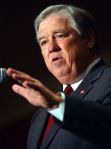
We won't have him to kick around anymore
Politico has an analysis of why Barbour “pulled the plug,” which basically boils down to he really didn’t want to go through the aggravation. The story ends this way:
There were also nagging concerns among GOP insiders about the prospect of nominating a deep-South governor with an accent matching his Delta roots to take on the country’s first black president.
Barry Wynn, a former South Carolina Republican chairman, put it politely after hearing Barbour speak in the state earlier this month: “There’s a perception that he might be more of a regional candidate.”
Gee, no kidding. Like I said, we dodged a bullet. But there are plenty of other creepy Republicans out there to take his place. In fact Ron Paul is getting ready to announce another campaign for president.
Speaking of creepy Republicans, Donald Trump claimed today that President Obama’s birth certificate is “missing.”
When asked from whom he received the information, Trump said he didn’t want to say and that he feels bad about the situation.
“I’d love for him to produce his birth certificate so that you can fight one-on-one,” Trump said in an interview set to air Monday. “If you look at what he’s doing to fuel prices, you can do a great fight one-on-one, you don’t need this issue.”
CNN’s Gary Tuchman also interviewed the former director of the Hawaii Department of Health, who said she has seen the original birth certificate in the vault at the Department of Health.
Trump supporter Franklin Graham, son of Billy, is also on the birther bandwagon.
{sigh….}
Meanwhile, multiple media outlets are talking about Trump’s generous campaign contributions–to Democrats. In fact, Trump recently donated $50,000 to Rahm Emanuel’s campaign for Chicago Mayor. From CNN:
Shortly before announcing interest in pursuing the GOP presidential bid, Republican Donald Trump gave $50,000, his largest campaign contribution in Illinois, to Democrat Rahm Emanuel, who was running for mayor, in December 2010….
Rahm’s brother Ari, who is co-CEO of William Morris Endeavor Entertainment, represents a majority of Hollywood’s celebrity elite, including Trump….
Records from the Illinois State Board of Elections show that Trump has made various sizable donations to Democratic causes in Illinois.
When [Ed] Rendell entered Pennsylvania’s 2002 gubernatorial race, Trump committed himself to the former Democratic National Committee chairman’s cause. Between December 2001 and Election Day ’02, Trump personally gave $27,000 to Ed Rendell’s gubernatorial campaign. He also chipped in $5,000 more at the end of 2003, when Rendell was finishing up his first year in office.
Mind you, Rendell’s victory in 2002 was by no means a foregone conclusion. He faced a serious threat in the May Democratic primary from Robert Casey, then the state’s treasurer and the son of a former governor. The sharpest ideological difference between the two men may have been on abortion: Rendell was pro-choice, while Casey was pro-life (like his father, who was denied a speaking slot at the 1992 Democratic convention in part because of it). During the primary campaign, Trump provided Rendell with $6,000. Rendell ended up beating Casey by 13 points.
Trump is supposedly the one of the biggest contributors to Charlie Rangel ever, yet he is supposedly running as a Republican.
And then we have our current president, who is a Republican who ran as a Democrat in 2008. I posted this in comments on the morning thread yesterday, but I can resist doing it again. It’s so funny to see former Obama supporter (why?) Eric Alterman comparing Obama to Jimmy Carter.
Stylistically speaking, Barack Obama could hardly be further from Jimmy Carter if he really had been born in Kenya. Carter was a born-again Baptist who was raised on his father’s peanut plantation and supported George Wallace on the road to the Georgia state house. Barack Obama—well, you know the story. But the two men have a great deal in common in their approach to the presidency, and not one of these similarities is good news for the Democrats or even for America. Both men rule without regard to the concerns of the base of their party. Both held themselves to be above politics when it came to making tough decisions. Both were possessed with superhuman self-confidence when it came to their own political judgment mixed with contempt for what they understood to be the petty concerns of pundits and party leaders. And worst of all, one fears, neither one appeared willing to change course no matter how many storm clouds loomed on the horizon.
Ask yourself if the following story does not sound like another president we could name The gregarious Massachusetts pol, House Speaker Tip O’Neill, could hardly have been more eager to work with a Democratic president after eight years of Nixon and Ford. But when they first met, and O’Neill attempted to advise Carter about which members of Congress might need some special pleading, or even the assorted political favor or two with regard to certain issues, to O’Neill’s open-jawed amazement, Carter replied, “No, I’ll describe the problem in a rational way to the American people. I’m sure they’ll realize I’m right.” The red-nosed Irishman later said he “could have slugged” Carter over this lethal combination of arrogance and naivety, but it would soon become Carter’s calling card.
In some bad news for the radical right, the Supreme Court has refused to hear a challenge to Obamacare before it wends its way through the federal courts.
And in some good news for football fans, a district court has decided that
The NFL’s lockout is harming players and fans and is not in the public interest, District Judge Susan Nelson said in a ruling on Monday that granted the players’ request for an injunction to halt the work stoppage.
Nelson’s order to end the six-week lockout, imposed last month after a breakdown in talks over a new collective deal, is to be appealed by the NFL.
In an 89-page statement, the judge also accepted that the players dissolution of their union was valid and allowed them to act as individuals rather than be constricted by labor bargaining rules.
The Minnesota judge said in the absence of a collective bargaining process, which ended on March 11, antitrust policies come to the fore.
The plaintiffs in the case, led quarterback Tom Brady of the New England Patriots, argued they were suffering harm as a result of a lockout that stops them from reporting to work.
Here’s some more analysis of the decision at USA Today. I realize that I’m one of the few sports fans here at Sky Dancing, so I won’t burden you unduly. But I just want to say that the Red Sox have won five games in a row and are now only one game under .500–after starting the season with a string of pathetic losses. I know at least Pat Johnson will join me in cheering that news.
Daknikat wrote yesterday about the terrible flooding that was expected in Missouri. Well, it’s happening.
Gov. Jay Nixon activated the Missouri National Guard on Monday in response to the flooding of the Black River near Poplar Bluff, Mo. The executive order came just three days after the governor declared a state of emergency from the tornado that tore through St. Louis last Friday.
“Maj. Gen. Stephen Danner has mobilized 200 citizen soldiers and airmen to report initially to the Poplar Bluff area to assist with flood relief there,” said Maj. Tammy Spicer, public affairs officer for the Missouri National Guard.

More from the Houston Chronicle: Residents flee as river overflows Missouri levee.
Thunder roared and tornado warning sirens blared, and all emergency workers in the southeast Missouri town of Poplar Bluff could do Monday was hope the saturated levee holding back the Black River would survive yet another downpour.
Murky water flowed over the levee at more than three dozen spots and crept toward homes in the flood plain. Some had already flooded. If the levee broke — and forecasters said it was in imminent danger of doing so — some 7,000 residents in and around Poplar Bluff would be displaced.
One thousand homes were evacuated earlier in the day. Sandbagging wasn’t an option, Police Chief Danny Whitely said. There were too many trouble spots, and it was too dangerous to put people on the levee. Police went door-to-door encouraging people to get out. Some scurried to collect belongings, others chose to stay. Two men had to be rescued by boat.
“Basically all we can do now is wait, just wait,” Whitely said.
A Roosevelt would probably have created jobs by having people repair the nation’s rotting infrastructure. But, instead we got Barack “Hoover” Obama and the levees keep on failing.
Things are getting worse and worse in Syria, where there has been a brutal crackdown on protesters over the past several days. From CNN: Deadly attack on protesters raises questions about Syria’s stability
With reports emerging Monday that at least one high-ranking Syrian military commander refused to participate in a bloody, predawn raid that left dozens dead in the southern border city of Daraa — the heart of Syria’s weekslong civil unrest, questions are being raised about possible cracks in President Bashar al-Assad’s hold over the military.
The crackdown on anti-government protesters by Syrian forces escalated in recent days as demonstrators, emboldened by weeks of protests, called for the ouster of al-Assad. The crackdown culminated with the raid in Daraa where thousands of troops reportedly stormed the city and opened fire on demonstrators. It was an attack reminiscent of the brutal rule of al-Assad’s father, who once ordered the military to crush a revolt that resulted in the deaths of thousands.
“I think he’s clearly going toward the security solution, which is where he could be following in the steps of his father,” said Andrew Tabler of the Washington Institute for Near East Policy, a Washington, D.C.-based think tank.
I’ve been hearing all day that Yemen’s president Saleh was renigging on his promise to step down soon, but Al Jazeera reports that there is an agreement between the government and opposition forces.
Yemen’s opposition has agreed to take part in a transitional government under a Gulf-negotiated peace plan for embattled leader Ali Abdullah Saleh to step aside in a month in exchange for immunity for him and his family.
A spokesman for an opposition coalition said on Monday that his group had received assurances in order to accept the deal.
“We have given our final accord to the [Gulf] initiative after having received assurances from our brothers and American and European friends on our objections to certain clauses in the plan,” Mohammed Qahtan said.
But not all protesters are going along.
many pro-democracy protesters, who are not members of the coalition that agreed to the peace talks, appear to be unconvinced by the Gulf-proposed deal and have called for fresh demonstrations, as security forces continued their crackdown.
In Libya, the fighting continues to be centered in the city of Misurata.
The battle for Misurata, which has claimed hundreds of lives in the past two months, has become the focal point of the armed rebellion against Gaddafi since fighting elsewhere is deadlocked.
Images of civilians being killed and wounded by Gaddafi’s heavy weapons, have spurred calls for more forceful international intervention to stop the bloodshed.
NATO’s mandate from the UN is to try to protect civilians in Libya, split into a rebel-run east and a western area that remains largely under Gaddafi’s control.
While the international coalition’s air attacks have delivered heavy blows to his army, they have not halted attacks on Misurata, Libya’s third largest city, with a population of 300,000.
When I was a kid, I was fascinated by insects. I loved to read books about ants, spiders, and other such creepy-crawly critters. Truthfully, I still find them interesting. Here’s a story about fire ants and how they cooperate to protect the group in an emergency.
When flood waters threaten their underground nests, fire ants order an immediate evacuation. They make their way to the surface and grab hold of one another, making a living raft that can sail for months.
The extraordinary survival tactic, which can involve entire colonies of more than a hundred thousand ants, has been captured on film by US engineers who used the footage to help unravel how the insects co-operate to overcome nature’s dangers.
Time-lapse film of the ants in action reveals that pockets of air get trapped between them and around their bodies, helping them breathe if the raft is pushed under the water.
In normal circumstances the ants lock legs, and sometimes mandibles, to form a floating mat that sits on top of the water through a combination of surface tension and buoyancy.
“Even the ones at the bottom remain dry and able to breath because they are not actually under the water,” said Nathan Mlot, a PhD student at Georgia Institute of Technology in Atlanta.
If only we humans would get together and cooperate like that!
That’s all I’ve got for today. What are you reading and blogging about?
Tuesday Reads
Posted: March 22, 2011 Filed under: Baby Boomers, Bahrain, Foreign Affairs, health hazard, Iraq, Japan, Libya, morning reads, psychology, Syria, U.S. Military, U.S. Politics, Water, Yemen | Tags: 1960s, Ali Abdullah Saleh, Bahrain, Fukushim nuclear plant, Hillary Clinton, id, iran, Japan, Libya, LSD, Muammar Gaddafi, Owsley Stanley, personality, Sigmund Freud, Syria, Wisconsin, Yemen 30 Comments
Good Morning!!
I’m teaching a Psychology of Personality course this semester, and yesterday I started lecturing about Freud and psychoanalytic theory. I was explaining Freud’s notion of the three parts of the personality–the id, the ego, and the superego. You’re probably familiar with those terms, but basically the id is there when we are born–it is completely self-centered, doesn’t know the difference between fantasy and reality, all it cares about is pleasure. It wants what it wants when it wants it. Sometime during infancy, we develop an ego that gets the id under some control, and around age 4-6 we develop a superego–basically like a conscience, that tells us which behaviors are right or wrong or socially acceptable.
Anyway, after class I was thinking about Muammar Gaddafi and his bizarre behavior–the way he has insisted for weeks that there is no opposition and that he isn’t attacking Libyan citizens. No, he would never do that. It occurred to me that Gaddafi is pretty much acting from his id all the time. Of course his ego keeps him somewhat connected to reality so he can function in the world, but mostly he just cares about his own needs.
I wonder if that is what happens to all leaders who gain absolute control. Does the quote “power corrupts and absolute power corrupts absolutely,” really mean that power causes people to regress to an earlier stage of development?
It sounds peculiar, but think about how powerful people get so many of their needs met by others. Obama doesn’t have to worry about paying for things, getting food or clothing, even getting information. It is all provided by other people. In many ways, it’s a kind of childlike, dependent state. So if the leader doesn’t have a strong character (ego), he can end up behaving in a narcissistic, childlike way.
OK, well that’s my not-very-deep thought for today.
So what’s happening in the news? As has often been the case in recent weeks, much of the big news is coming from outside the U.S.
On Libya, there has been more criticism of the UN resolution and how it is being carried out. I posted quite a few examples of the criticism in my post last night. Most of the objections are based on the fact that Libya is not at all important to the U.S. strategically.
Today I want to recommend a couple of articles that explain why the intervention in Libya, while troubling in many ways, was probably the right thing to do–even for U.S. interests. The first is by Mark Lynch at the Foreign Policy blog. Lynch uses the name “abuardvark” on twitter. His post is headlined Libya in its Arab Context Although Lynch has misgivings about the intervention and has written about them, he still thinks what the U.S. is doing is the right thing–both for the Arab world and for advancing our interests. Here’s his basic argument:
Libya matters to the United States not for its oil or intrinsic importance, but because it has been a key part of the rapidly evolving transformation of the Arab world. For Arab protestors and regimes alike, Gaddafi’s bloody response to the emerging Libyan protest movement had become a litmus test for the future of the Arab revolution. If Gaddafi succeeded in snuffing out the challenge by force without a meaningful response from the United States, Europe and the international community then that would have been interpreted as a green light for all other leaders to employ similar tactics. The strong international response, first with the tough targeted sanctions package brokered by the United States at the United Nations and now with the military intervention, has the potential to restrain those regimes from unleashing the hounds of war and to encourage the energized citizenry of the region to redouble their efforts to bring about change. This regional context may not be enough to justify the Libya intervention, but I believe it is essential for understanding the logic and stakes of the intervention by the U.S. and its allies.
Libya’s degeneration from protest movement into civil war has been at the center of the Arab public sphere for the last month. It is not an invention of the Obama administration, David Cameron or Nicholas Sarkozy. Al-Jazeera has been covering events in Libya extremely closely, even before it tragically lost one of its veteran cameramen to Qaddafi’s forces, and has placed it at the center of the evolving narrative of Arab uprisings. Over the last month I have heard personally or read comments from an enormous number of Arab activists and protest organizers and intellectuals from across the region that events in Libya would directly affect their own willingness to challenge their regimes. The centrality of Libya to the Arab transformation undermines arguments that Libya is not particularly important to the U.S. (it is, because it affects the entire region) or that Libya doesn’t matter more than, say, Cote D’Ivoire (which is also horrible but lacks the broader regional impact).
Lynch is still worried about what could go wrong:
I continue to have many, many reservations about the military intervention, especially about the risk that it will degenerate into an extended civil war which will require troops regardless of promises made today. But as I noted on Twitter over the weekend, for all those reservations I keep remembering how I felt at the world’s and America’s failure in Bosnia and Rwanda. And I can’t ignore the powerful place which Libya occupies in the emerging Arab transformations, and how the outcome there could shape the region’s future. Failure to act would have damned Obama in the eyes of the emerging empowered Arab public, would have emboldened brutality across the region, and would have left Qaddafi in place to wreak great harm. I would have preferred a non-military response — as, I am quite sure, the Obama administration would have preferred. But Qaddafi’s military advances and the failure of the sanctions to split his regime left Obama and his allies with few choices. The intervention did not come out of nowhere. It came out of an intense international focus on the Arab transformations and a conviction that what happens now could shape the region for decades.
At CNN, Peter Bergen tries to explain Why Libya 2011 is not Iraq 2003 I recommend checking it out.
Another article worth reading is by Robert Fisk at The Independent: Right across the Arab world, freedom is now a prospect
In the Middle East, Yemen may be close to ousting President Ali Abdullah Saleh. From the Guardian:
A military showdown is looming in Yemen after the defence minister announced that the army would defend the president against any “coup against democracy”. His statement came hours after 12 military commanders, including a senior general, defected from the regime and promised to protect anti-government protesters in the capital, Sana’a.
[….]
Yemen’s president, Ali Abdullah Saleh, suffered a significant blow when General Ali Mohsen al-Ahmar, his longtime confidant and head of the Yemeni army in the north-west, announced that he would support “the peaceful revolution” by sending soldiers under his command to protect the thousands gathered in the capital to demand that Saleh step down.
“According to what I’m feeling, and according to the feelings of my partner commanders and soldiers … I announce our support and our peaceful backing to the youth revolution,” Ali Mohsen said.
Minutes after his defection, tanks belonging to the republican guards, an elite force led by Ahmed Ali, the president’s son, rolled into the streets of Sana’a, setting the stage for a confrontation between defectors and loyalists.
At Bloomberg: U.S. Faces Loss of Key Ally Against Al-Qaeda in Yemen
…Yemeni President Ali Abdullah Saleh appears unlikely to weather a popular uprising and defections among his ruling elite, former U.S. officials said.
“It’s clear at this point that Saleh will have to step down,” Barbara Bodine, a former U.S. ambassador to Yemen, said in an interview yesterday. With the “mounting numbers of senior people in his administration resigning, we know it’s over. The terms of his departure, I think, are still being negotiated.”
The March 18 killing of at least 46 protesters allegedly by police and pro-regime gunmen — which drew condemnation from Obama and Secretary of State Hillary Clinton and prompted the defection of key military, tribal and government officials — may well be the tipping point.
Protests are continuing to escalate in Syria as well.
In Deraa, hundreds of black-uniformed security forces wielding AK-47 assault rifles lined the streets but did not confront thousands of mourners who marched at the funeral of 23-year-old Raed al-Kerad, a protester killed in Deraa.
“God, Syria, freedom. The people want the overthrow of corruption,” they chanted. The slogan is a play on the words “the people want the overthrow of the regime,” the rallying cry of revolutions that overthrew the veteran rulers of Tunisia and Egypt.
Security forces opened fire last Friday on civilians taking part in a peaceful protest in Deraa to demand the release of 15 children detained for writing protest graffiti.
Authorities released the children on Monday in a sign they were hoping to defuse tension in the border town, which witnessed more protests after Friday’s crackdown.
And there is a lot happening in Bahrain too. This article is worth a read: Libya burns but Bahrain can shake the world
While the world attention remains glued to the fires in Libya potential stakes in Bahrain are actually a hundred times higher. Safaniya Oil Field, the largest oil field in the world, is less than 200 miles from Manama. The Strait of Hormuz, through which passes 20 percent of world oil shipments and 40 percent of the world’s sea-borne oil shipments, is within a 400-mile radius.
More importantly, United States Fifth Fleet, with a forward deployed Carrier Strike Group, Combat Command force, Anti-Terrorism force, Sea Stallion helicopters, Amphibious Force and Patrol and Reconnaissance Force, is headquartered at Naval Support Activity Bahrain (or NSA Bahrain). In essence, Bahrain is home to America’s military might that reigns over the Persian Gulf, Red Sea and the Arabian Sea-all put together.
On March 14, around 2,000 soldiers of the Saudi-led, US-backed Peninsula Shield Force, in their armored carriers and tanks, invaded Bahrain. The stated purpose of the invasion is: to crush an unarmed civilian uprising.
On March 15, King Hamad ibn Isa Al Khalifa of Mamlakat al Bahrayn declared martial law under which the Bahrain Defence Force (BDF), numbering around 10,000 personnel, was “empowered to take whatever actions it deems appropriate in dealing with the predominately Shiite-driven unrest.”
I recommend clicking on the link and reading the rest to learn how Iran could get involved in the Bahrain conflict. Yikes!
In Japan workers are still trying to get the Fukushima nuclear plant under control. We keep hearing that things are improving, but it’s kind of hard for me to trust what I hear from governments and corporations these days. After Iraq, Katrina, the BP oil spill, and on and on, I honestly believe just about everyone in government and private business lies their asses off. The biggest fear at the moment is the radiation that is turning up in food and water. Of course the authorities claim that’s nothing to worry about, but why should we believe them?
Away from the plant, mounting evidence of radiation in vegetables, water and milk stirred concerns among Japanese and abroad despite assurances from Japanese officials that the levels were not dangerous.
TEPCO said radiation was found in the Pacific ocean nearby , not surprising given rain and the hosing of reactors with seawater. Some experts said it was unclear where the used seawater was ultimately being disposed.
Radioactive iodine in the sea samples was 126.7 times the allowed limit, while cesium was 24.8 times over, Kyodo said. That still posed no immediate danger, TEPCO said.
“It would have to be drunk for a whole year in order to accumulate to one millisievert,” a TEPCO official said, referring to the standard radiation measurement unit. People are generally exposed to about 1 to 10 millisieverts each year from background radiation caused by substances in the air and soil.
Whatever. I wouldn’t want to drink from the tap or swim in the radioactive ocean water.
Back in the USA, Wisconsin Asks Appeals Court to Block Order Halting Union Bargaining Law
Wisconsin’s attorney general asked an appeals court to block a state judge’s order that temporarily halted a law curbing government employee unions’ collective- bargaining power.
State Attorney General J.B. Van Hollen today also asked the Wisconsin Court of Appeals for permission to file an appeal seeking to overturn the ruling by Circuit Court Judge Maryann Sumi.
“Contrary to established case law, the trial court injected itself into the legislative process and enjoined a legislative act,” Van Hollen said in court papers filed today in Madison. “There is absolutely no authority for the broad, overreaching step taken.”
Sumi on March 18 granted a temporary restraining order blocking publication of the measure signed into law by Governor Scott Walker on March 11, after a hearing in Madison, the state’s capital city. Publication gives the law full force and effect.
I’ll end on a lighter note. If you’re as old as I am, you might remember a guy named Owsley “Bear” Stanley: “the Sixties hero who ‘turned on’ a generation.” Stanley died a few days ago in a car crash at the age of 76.
Stanley, who died in a car crash in Australia on Sunday, fuelled the “flower power” counter-culture that took root in California in the mid-1960s, supplying it with acid that he manufactured after stumbling across a recipe in a chemistry journal.
He also worked with the psychedelic rock band Grateful Dead, who wrote their song “Alice D Millionaire” about him after a newspaper described him as an “LSD millionaire”. One batch of his drugs reputedly inspired Jimi Hendrix’s song “Purple Haze”, and he provided LSD for the notorious “Acid Test” parties hosted by the American writer Ken Kesey, which featured in books by Tom Wolfe and Hunter S Thompson.
News of Stanley’s death – his car swerved off a road and slammed into a tree near his home in north Queensland – elicited tributes, but also surprise. Despite a youth so misspent that his name became slang for good acid, Stanley had made it to the age of 76. He was even a great-grandfather. In a statement yesterday, his family mourned him as “our beloved patriarch”.
Supposedly, a batch of Owsley’s acid inspired Jimi Hendrix’s first big hit, Purple Haze. Rest in peace, Owsley. I am one “casualty” of the ’60s who did learn something significant from my experiences with LSD. One thing I eventually learned is that I don’t need drugs to “get high.”
I guess that’s another not-so-deep thought, but hey, I’m OK with that. What are you reading and blogging about today?
Thursday Reads
Posted: March 17, 2011 Filed under: Bahrain, Barack Obama, Foreign Affairs, Libya, Psychopaths in charge, torture, U.S. Military, U.S. Politics, We are so F'd, Wikileaks, Yemen | Tags: Bahrain crackdown, banality of evil, Barack Obama, Bradley Manning, Japan's nuclear disaster, Libyan uprising, Yemen 29 Comments
Good Morning! Well, at least we are alive and not living next to a nuclear plant that is melting down–for now anyway–so I guess you could say it’s a good morning.
I’m pretty overwhelmed with trying to summarize the news. There is so much happening that I hardly know where to begin. I’m going to begin with a link or two about some of the big stories happening right now. You can supplement my links in the comments.
Japan nuclear disaster: US Officials Alarmed by Japanese Handling of Nuclear Crisis
“It would be hard to describe how alarming this is right now,” one U.S. official told ABC News….
“We are all-out urging the Japanese to get more people back in there to do emergency operation there, that the next 24 to 48 hours are critical,” the official said. “Urgent efforts are needed on the part of the Japanese to restore emergency operations to cool” down the reactors’ rods before they trigger a meltdown.
“They need to stop pulling out people—and step up with getting them back in the reactor to cool it. There is a recognition this is a suicide mission,” the official said….
The U.S. official says experts believe there is a rupture in two, maybe three of the six reactors at the Fukushima power plant, but as worrisome is the fact that spent fuel rods are now exposed to the air, which means that substances like cesium, which have a long half-life, could become airborne.
“That could be deadly for decades,” the official said….
“There is talk of an apocalypse and I think the word is particularly well chosen,” European Union’s energy commissioner Günther Oettinger said today, according to various reports. “Practically everything is out of control. I cannot exclude the worst in the hours and days to come.”
It doesn’t get much more serious that that. The US has also contradicted Japan on the evacuation zone, saying that if this happened in the US, the recommendation would be to evacuate everyone in a 50 square mile radius of the plant–not the 12 miles that Japan has recommended.
Libya: Rebels fight to stall Gaddafi’s army in east
Government forces captured Ajdabiyah, 150 km (90 miles) south of Benghazi on the Gulf of Sirte, on Tuesday after most of its rebel defenders retreated from a heavy artillery barrage.
One rebel officer said on Wednesday the town had been lost and the fighters who remained had handed over their weapons. But some apparently refused to surrender or flee.
By Wednesday evening, residents said the rebels held the centre of town while forces loyal to Gaddafi were mostly on its eastern outskirts.
It’s just about over for the opposition forces. I’m writing this late at night, by the time you read this, there could have been a real bloodbath. It’s so sad. I’ll update in the morning.
Bahrain: Bahrain unleashes assault against protesters’ camp in capital
A tent city in the heart of Bahrain’s capital was wiped away Wednesday morning in a cloud of tear gas and a hail of rubber bullets after the government dispatched troops against pro-democracy demonstrators in defiance of U.S. warnings.
Trails of acrid black smoke floated over Manama as dumpsters and tires were set alight across the city. By late afternoon, the military had announced a 12-hour curfew for most of the downtown area, including Pearl Square, which has been the hub of the demonstrations.
The early-morning sweep came despite U.S. insistence that dialogue, not violence, was the only way to end the crisis that has convulsed Bahrain for more than a month. It drew an unusually sharp rebuke from Secretary of State Hillary Rodham Clinton, who is visiting the Middle East.
“They are on the wrong track,” she told reporters in Cairo. “There is no security answer to this,” she added, referring to the protesters’ demands, “and the sooner they get back to the negotiating table and start trying to answer the legitimate needs of the people, the sooner there can be a
But people are still dying, and the Bahrain government is using U.S.-provided weapons and teargas. Last night I fell asleep listening to BBC World News on the radio. Once I awoke to hear a heart-rending call from a doctor at a Bahrain hospital. She was frantic, telling the horrified radio talkers that government troops (and Saudi forces) were shooting people on the streets and refusing to let the doctors treat the injured. Here’s the horrifying video.
Yemen: The Yemen government is also viciously attacking its own people–and with U.S. weapons and backing. I have to wonder if our own “leader’s” refusal to get involved in the Libyan situation has given other dictators carte blanche to follow Gaddafi’s lead and massacre protesters in order to stay in power.
The torture of Bradley Manning: Glenn Greenwald’s latest post is essential. Greenwald provides links to U.S. and international coverage of the Manning case and suggests that we may have finally hit a tipping point–the disgust at what the Obama administration is doing to this young man is palpable.
And please don’t miss this cartoon by Tom Tomorrow (via Greenwald).
Finally, also via Greenwald, please read this amazing rant. (I took the liberty of correcting a few typos)
If his psychopathic commitment to killing people hadn’t already convinced you that Barack Obama shared [George W. Bush’s] particular quality of being a vacant, blood-driven monster whose outward appearance as one of our own kind is no more than an act of ingenious fakery, then you may wish to consider his response to the torture of Bradley Manning, which he treats with the blithe indifference of a busy manager signing off on some subordinate’s expense report. Yeah, he assured me everything was copasetic. It’s all good.
Here is a fine opportunity to engage in a little free and painless magnanimity, to make vague noises about according decent treatment even to one’s enemies, to blather a bit about America’s commitment to the humane treatment of all God’s precious children, to give the poor kid some boxer shorts and a couple of books to read, and to throw that paltry bone to his supporters in the Democratic faction, who would immediately beatify him as better-than-Cheney, and he passed on it. He said, no, we’re going to go right on torturing this person, who has not been convicted of any crime, lest he commit suicide before we are able to consign him for the rest of his life to the tortures we are already visiting upon him….
What this episode reveals is that the most salient aspect of Barack Obama’s character is that he is an asshole of the worst order. He does not delight in cruelty like his predecessor, but is grossly indifferent to it. The Ts have all been crossed. Proper procedures followed? Yes. Fine. Let’s move on. I have been assured.
I cannot disagree. So….what are you reading and blogging about today? Lay it on me.

 peej
peej Carissa
 bostonboomer
 dakinikat
 ecocatwoman
 jjlo
jjlo mablue2
 Mama Lopez
 peggysue22
 quixote
 skydancingguestblogger
 Mona (aka Wonk the Vote)



 Sky Dancing
Recent Comments