
Thursday Reads: Sleep and Dreams In the Time of Coronavirus
Posted: April 16, 2020 Filed under: Afternoon Reads, just because | Tags: coronavirus, Covid-19, dreams, nightmares, sleep disturbances 22 Comments
The Nightmare, painted in December 2016, depicts what artist Mark Bryan imagined the Trump presidency would be like.
Good Afternoon!!
It seems that the coronavirus and stay-at-home orders have caused lots of people to have bizarre dreams and nightmares. I spent this morning reading numerous articles about this phenomenon. Here’s a sampling:
The Washington Post: ‘Edith Piaf sneezed on my cheesecake’ and other coronavirus dreams.
“I dreamed that we couldn’t record [my podcast],” says Alex Scheer, an Ohio music student and the co-host of “College Sports Connection.” “Because covid-19 spread over the airwaves, and if we recorded, we would be risking each other’s lives.”
“I dreamed that I planned a duck boat tour for a conference,” says Christi Showman Farrar, a Massachusetts librarian. “And we were going to meet at the Prudential Center, which is a shopping mall, but we got there and it was eerily quiet and I couldn’t figure out why. And then I realized there were a few people around, but they were all dressed like Santa or elves, and all the stores had been covered in wrapping paper like they were holiday gifts.”
The NIghtmare, by John Henry Fuseli
Did the wrapping paper signify that the concept of public shopping now seems like an underappreciated treat? Did the elves signify that things won’t be back to normal until Christmas? Does anything in a covid-19 dream signify anything more than the pitiful bleating of our collective subconscious, creating a different ludicrous reality than the ludicrous reality we’re already inhabiting?
“Okay, so I’m not typically a vivid dreamer,” says Hillary Haldane, a professor in Connecticut. Nevertheless, a few nights ago, she found herself face to face with the French singer Edith Piaf.
Except it wasn’t the “real” Edith Piaf, exactly — more like the stylized painting-version of Piaf, from the cover of an album Haldane has been playing for living-room dance parties during the quarantine. Suddenly, out of nowhere, Dream Piaf produced an entire cheesecake. Then she sneezed on it. Then she handed it to Haldane.
“Obviously, what made it so vivid was the fear of sneezing and coughing,” Haldane says. “Plus, all of this anxiety around food: Do we have enough of it? Is it safe to go get it? The virus was infecting the one safe activity I still have. Dance parties with my kids.”

The New York Times: Why Am I Having Weird Dreams Lately?
The question of whether “anyone else” has “been having” strange dreams (“lately”) is perennially popular online. It is a spooky yet comforting query: Has anyone else stumbled onto possible evidence that the universe possesses a finite metaphysical infrastructure occasionally detected by the subconscious?
Polish artist Zdzisław Beksiński recreated his dreams in his paintings.
In recent weeks, however, the question has been posed with increasing frequency. Local news personalities in particular appear uniquely susceptible to wondering if anybody else is having strange dreams, with meteorologists and anchors in, for instance, Texas, Connecticut, North Carolina, Washington, Wisconsin, and New York, having recently posed it on their public Facebook pages. And the Google query “why am i having weird dreams lately” has quadrupled in the United States in the past week.
National media properties — anxious to provide lighthearted human interest stories to counterbalance news items like a recent announcement that the convenience store chain Wawa was sending a refrigerated truck to New Jersey to serve as a temporary morgue, yet hamstrung by the dearth of novel experiences it is possible to uncover in one’s own home — have hastened to supply the answer.
The answer is: Yes, someone else is having weird dreams lately. (Always.) But are we — humanity — dreaming with more frequency, and more vividly, right now? The answer is: Also, likely, yes — at least for many people.

Read much more about dreaming in traumatic times at the NYT link.
National Geographic: The pandemic is giving people vivid, unusual dreams. Here’s why.
Ronald Reagan pulled up to the curb in a sleek black town car, rolled down his tinted window, and beckoned for Lance Weller, author of the novel Wilderness, to join him. The long-dead president escorted Weller to a comic book shop stocked with every title Weller had ever wanted, but before he could make a purchase, Reagan swiped his wallet and skipped out the door.
Nightmare, by Sigifredo Camacho
Of course, Weller was dreaming. He is one of many people around the world—including more than 600 featured in just one study—who say they are experiencing a new phenomenon: coronavirus pandemic dreams….
With hundreds of millions of people sheltering at home during the coronavirus pandemic, some dream experts believe that withdrawal from our usual environments and daily stimuli has left dreamers with a dearth of “inspiration,” forcing our subconscious minds to draw more heavily on themes from our past. In Weller’s case, his long-time obsession with comics came together with his constant scrolling through political posts on Twitter to concoct a surreal scene that he interpreted as a commentary on the world’s economic anxieties.
At least five research teams at institutions across multiple countries are collecting examples such as Weller’s, and one of their findings so far is that pandemic dreams are being colored by stress, isolation, and changes in sleep patterns—a swirl of negative emotions that set them apart from typical dreaming.
“We normally use REM sleep and dreams to handle intense emotions, particularly negative emotions,” says Patrick McNamara, an associate professor of neurology at Boston University School of Medicine who is an expert in dreams. “Obviously, this pandemic is producing a lot of stress and anxiety.”

Read about some of these studies at the link.

Seasons with strange dreams, Marnie Pitts
A few more to explore:
The Guardian: Is coronavirus stress to blame for the rise in bizarre ‘lockdown dreams’?
The Los Angeles Times: You’re not imagining it: We’re all having intense coronavirus dreams.
CNN: The meaning behind your strange coronavirus dreams.
Time: The Science Behind Your Weird Coronavirus Dreams (And Nightmares).
There’s even a website that is collecting coronavirus dreams: IDreamofCovid.com
I’m a little disappointed that I haven’t been remembering dreams lately. Since the lockdown started I haven’t slept much at all. I’ve been getting about four hours sleep a night and then waking up around 3-4 AM. I know it’s because of my anxiety about what’s happening. Then lately I started feeling tired and sleepy much of the time. I actually dozed off while writing this post! It turns out I’m not alone.
The Cut: Is My Fatigue Due to Stress or the Coronavirus?
For everyone else who is tired all the time now, and worried about what that means, I got in touch with Andrew Varga, a neuroscientist and physician at the Mount Sinai Integrative Sleep Center, and Curtis Reisinger, clinical psychologist and corporate director at Northwell Health, to learn more.
If I’m tired all the time, does that mean I could have coronavirus?
As is the case with chest tightness, or a cough, or any other single symptom, it’s hard for doctors to make a definitive diagnosis — especially when we still don’t have enough tests. And because fatigue can be a symptom of a number of things (many of them unrelated to your physical health), it’s not a reason to panic. “If you get more symptoms, so it’s not just the fatigue, but fatigue plus body aches plus a cough and a fever, that’s worrisome,” says Varga. “Chest tightness alone, fatigue alone — those are less concerning that you’re about to become really sick.”
Henri Rousseau (The Sleeping Gypsy), 1897
So if I’m not sick, why am I tired every day?
Okay, yes: Many people likely have a pretty good guess as to an answer here. Many essential workers are overworked and underpaid, often with fewer resources available when they do feel sick. Parents are tired because they are parenting all day every day without the relief of school and/or child care. But I work from home, on my couch, and I don’t have kids, so what’s my excuse?
First, says Reisinger, it’s important to understand there are different types of fatigue. There’s physical fatigue, like you might experience after a long run or playing sports. That kind can lead to achy muscles, but it’s usually pretty good for sleep.
There’s mental fatigue, like you might get after doing your taxes or something similarly … taxing. Unless you’re an infectious-disease modeler, this probably isn’t the most likely culprit for your persistent exhaustion at the moment. “When you get mental fatigue, you may jump up in the middle of the night and think of a solution,” says Reisinger, but otherwise, your sleep stays pretty regular.
What’s most troubling, says Reisinger, is the third form of fatigue: emotional. When we’re on high emotional alert — worrying for ourselves, our families and friends, the world at large — we use up a lot of brain energy, and we tend to have a harder time recouping it. “Emotional fatigue is the one that’s going to wake you up at three in the morning or give you insomnia — either you can’t get to sleep, or you wake up in the middle of the night and you can’t get back to sleep,” he says.

The Independent: Coronavirus: Why Do People Seem To Feel Groggy and Tired During Lockdown?
The way in which our lives have transformed in such a short space of time has heavily impacted our daily routines, as many individuals no longer have to wake up at a certain time in order to be punctual for school or work.
The Nightmre, by John Anster Fitzgerald
This has seemingly resulted in an increasing number of people experiencing “grogginess” amid the coronavirus pandemic….
“The medical term for grogginess is ‘sleep inertia’,” Dr Natasha Bijlani, consultant psychiatrist at Priory Hospital Roehampton, explains to The Independent.
“Grogginess refers to a phase in between sleep and wakefulness when an individual doesn’t feel fully awake. People who are affected feel drowsy, have difficulty thinking clearly and can be disorientated and clumsy for a while after waking.”
Matthew Walker, professor of neuroscience and psychology at the University of California and author of Why We Sleep, compares the way in which a brain wakes up to an old car engine, stating that sleep inertia occurs when “sleepiness is still hanging around in the brain”. “You can’t just switch it on and then drive very fast. It needs time to warm up,” he says.

So why is this happening to so many people now? Read all about it at The Independent.
What’s happening with you today? What stories are you following?
Thursday Reads: Why Is Trump Choosing to Kill Americans?
Posted: April 9, 2020 Filed under: morning reads, U.S. Politics | Tags: coronavirus, coronavirus in rural areas, Covid-19, Donald Trump, Eric Boehlert, federal seizures of medical equipment shipments, FEMA, medical equipment shortages, red states vs blue states, small town hospitals 31 Comments
Five Puppies on the Carpet, by Edvard Munch
Good Morning!!
Yesterday Eric Boehlert asked an important question that the mainstream media never will: Memo to media: We still don’t know why Trump is doing this.
Why?
One month into our mounting crisis and we still don’t know why Trump won’t help key states secure desperately needed medical equipment to deal with the growing coronavirus pandemic. Or why Trump is touting a dubious miracle cure, fills marathon pandemic briefings with ceaseless contradictions and lies, and has silenced scientists. Why he purposefully ignored detailed intelligence warnings about Covid-19, placed his unqualified son-in-law in charge of a national emergency, and refused to invoke the Defense Production Act to compel private companies to manufacture needed medical supplies. Or why the government airlifted 18 tons of donated respirator masks, surgical masks, gowns and other medical supplies to China in February.
Woman with a dog, Fernando Botero, 1997
If Trump had done just one of these things, it would’ve been considered shortsighted and represented a shocking lack of leadership. Trump’s done them all. Yet that still doesn’t prompt most journalists to address the bigger picture and ask disturbing questions about a president who seems to be okay with watching America crumble and decay, in very real ways, on his watch.
As I stressed last week, the media’s preferred storyline that suggests Trump is simply incompetent doesn’t add up because Trump has made the wrong decision every single time in terms of how crises like this are supposed to be dealt with. (i.e. Be consistent, transparent, factual, and credible.) It’s increasingly not believable for the press to suggest Trump has been distracted or inept during this crisis, in part because of the level of White House uselessness has become so staggering.
Maybe Trump’s vengeful. Maybe he wants to wreck the economy to create investment opportunities? He’s under the thumb of a foreign entity? He wants to cause panic and cancel the November elections? He’s a fatalist? Who knows. And honestly, the specific “why” isn’t what matters now. What matters is asking the difficult questions and pondering what the Trump presidency is truly about, no matter what lurks in the shadows.

Read the rest at Press Run.
The evidence is piling up that Trump is helping red states and choosing to let people in blue states die because of equipment shortages.
Los Angeles Times: Hospitals say feds are seizing masks and other coronavirus supplies without a word.
Although President Trump has directed states and hospitals to secure what supplies they can, the federal government is quietly seizing orders, leaving medical providers across the country in the dark about where the material is going and how they can get what they need to deal with the coronavirus pandemic.

Pierre_Bonnard, Woman with Dog and Still Life, 1917
Hospital and clinic officials in seven states described the seizures in interviews over the past week. The Federal Emergency Management Agency is not publicly reporting the acquisitions, despite the outlay of millions of dollars of taxpayer money, nor has the administration detailed how it decides which supplies to seize and where to reroute them.
Officials who’ve had materials seized also say they’ve received no guidance from the government about how or if they will get access to the supplies they ordered. That has stoked concerns about how public funds are being spent and whether the Trump administration is fairly distributing scarce medical supplies.
“In order to have confidence in the distribution system, to know that it is being done in an equitable manner, you have to have transparency,” said Dr. John Hick, an emergency physician at Hennepin Healthcare in Minnesota who has helped develop national emergency preparedness standards through the National Academies of Sciences, Engineering and Medicine.
The medical leaders on the front lines of the fight to control the coronavirus and keep patients alive say they are grasping for explanations. “We can’t get any answers,” said a California hospital official who asked not to be identified for fear of retaliation from the White House.
In Florida, a large medical system saw an order for thermometers taken away. And officials at a system in Massachusetts were unable to determine where its order of masks went.
“Are they stockpiling this stuff? Are they distributing it? We don’t know,” one official said. “And are we going to ever get any of it back if we need supplies? It would be nice to know these things.”
Maybe it’s not just blue states if it happened in Florida. So why are they doing this? We need explanations.
Another example from CNN: Colorado Democrat believes Trump awarded ventilators as political favor to vulnerable GOP senator.
Still Life With Puppies, Paul Gaugin
Rep. Diana DeGette, a veteran Democrat, said that President Donald Trump’s announcement that he would send 100 ventilators to Colorado smacks of a political favor to vulnerable GOP Sen. Cory Gardner after the federal government had not fulfilled the delegation’s request for the devices.
“I think this thing that happened with Sen. Gardner and President Trump is very disturbing,” the Colorado Democrat told CNN Wednesday evening. “What is the process here?”
DeGette said that while she wants the state to get every ventilator it can — after initially requesting 10,000 — the process employed by the White House shows that the President appears to be doling out the ventilators to his allies at a time when the virus is affecting people of all political persuasions.
“It seems that way to me,” DeGette said when asked if it appeared to be a political favor to Gardner. “I was totally outraged.”
DeGette said that the decision to award 100 ventilators followed a tortured process after the state’s delegation and Democratic Gov. Jared Polis had been asking for 10,000 ventilators.
But while they were waiting for an answer from the Federal Emergency Management Agency, Polis reached a deal with a private company for 500 ventilators to be sent to the state. Once FEMA got word of the state deal, the federal agency stepped in to prevent that contract from going through so it could acquire the ventilators instead, Polis said on CNN last week.Gardner then called Trump on Tuesday night, and the President tweeted Wednesday that the state would get 100 ventilators from the federal stockpile at the Republican senator’s request. Gardner is one of the most vulnerable Republican senators up for reelection.

Trump seems to think that rural areas will not be overwhelmed by coronavirus infections, but the places where most Trump voters live will likely be the next hot spots, and they aren’t likely to be as prepared as the big cities.
Nancy LeTourneau at Washington Monthly: Some Coronavirus Hot Spots Are in Rural America.
Pablo Picasso, Woman with a dog
Most of the reporting on coronavirus has focused on its spread in major urban areas, especially New York City. But I was spurred into looking at what is happening in rural America by the fact that the “hot spot” in my home state of Minnesota is not the Twin Cities metro area. The disease has taken hold in the city of Fairmont, which is located in Martin County—an agricultural community in the southwestern part of the state.
While the number of cases and deaths related to coronavirus in Martin County is fairly low (34 cases and 4 deaths), it dwarfs those in the metro counties on a per capita basis. For example, per 100,000 people, Martin County’s numbers represent 170 cases and 20 deaths, compared to 17 cases and 0.7 deaths per 100,000 in Hennepin County, which includes Minneapolis.
No one knows why this virus has taken hold in Martin County, but that hasn’t stopped speculation. Here is what Tim Langer, public health sanitarian with Martin County Human Services, ventured.
“My personal opinion is there are some folks listening to some media outlets that were not taking this seriously. That can be a factor, too. It’s hard to prove that. I don’t want to get political. But there were outlets saying it’s a hoax, it’s no worse than a cold, and those are things people listen to.”
Martin County, Minnesota isn’t the only rural area that is facing a coronavirus outbreak. In hotspots like Blaine County, Idaho and Eagle County, Colorado, the explanation is clear: rich ski towns have some of the highest infection rates in the country. But what explains the fact that Greer County, Oklahoma is the hot spot of that state, with an infection rate of 520 and death rate of 50 per 100,000?

Click the link to read the rest.

Susan on a balcony holding a dog, Mary Cassatt
NPR: Small-Town Hospitals Are Closing Just As Coronavirus Arrives In Rural America.
By this time next week, Decatur County, Tenn., will have lost its only hospital, Decatur County General, which has been serving the rural community of about 12,000 people along the Tennessee River since 1963.
The hospital’s human resources director, Melinda Hays-Kirkwood, has already begun laying off people, and she says by next week only a skeleton staff will remain….
The closure will have a huge economic toll locally — with more than 100 on staff, the hospital was one of the county’s largest employers. But the ironic timing isn’t lost on its staff either. Because of the COVID-19 crisis, most nonessential businesses in the area were already closed.
“It’s a difficult time to be shutting down a hospital in the middle of the coronavirus,” Hays-Kirkwood says.
There are currently no known cases in Decatur County, but she says every county around it has reported infections.
Small-town hospitals were already closing at an alarming rate before the COVID-19 pandemic. But now the trend appears to be accelerating just as the disease arrives in rural America. When Decatur County General Hospital shuts down indefinitely by April 15, it will be the ninth small-town hospital to close in 2020 alone. According to a report released this month by the Chartis Center for Rural Health, nearly half of rural hospitals were already operating in the red before the COVID-19 crisis.
What will happen when it becomes clear that Trump is killing his own supporters? Lloyd Green at The Guardian, April 5: ‘Trump is killing his own supporters’ – even White House insiders know it.
On Sunday, initially at least, there was no White House briefing on the president’s public schedule. But the bad news kept coming. Coronavirus deaths continued to climb and reports of the heartland being unprepared for what may be on its horizon continued to ricochet around the media.
In the words of one administration insider, to the Guardian: “The Trump organism is simply collapsing. He’s killing his own supporters.”
By Edouard Vuillard
Members of the national guard, emergency workers, rank-and-file Americans: all are exposed. Yet Trump appears incapable of emoting anything that comes close to heart-felt concern. Or just providing straight answers.
Rather, he is acting like Jefferson Davis, the president of the Confederate States of America: repeatedly letting governors know the burden of shoring up their sick, their doctors and their people falls on their shoulders first. The national government? It’s the world’s greatest backstop.
Remember when the Republican party freaked out about Barack Obama and the US “leading from behind” abroad? Remember the howls that evoked from GOP leaders? Those days are gone. Welcome to what Martin O’Malley, a Democratic former governor of Maryland, calls the “Darwinian approach to federalism”.
Trump is telling NFL owners he wants the season to start on time. He is disregarding Centers for Disease Control and Prevention advice on wearing facemasks in public. And he is touting untested coronavirus cures live on national TV.
Think Trump University on steroids, only this time we all stand to be the victims.
When Dr Anthony Fauci says there is no evidence to back up Trump’s claims surrounding hydroxychloroquine, an anti-malaria drug, pay attention. The fact Jared Kushner is on the case is hardly reassuring. He’s the guy who thought firing James Comey was win-win politics and promised Middle East peace in our time.
While all this is going on, the Wisconsin Republican party is giving America a taste of the campaign to come in the fall. Right now, the Badger State GOP is fighting in the US supreme court efforts to extend mail-in voting for this Tuesday’s Democratic primary.
In other words, voters will be forced to choose between foregoing their rights and risking their lives. Democracy shouldn’t work that way.

Read the rest at The Guardian.
What’s happening where you live? And what stories are you following today?
Tuesday Reads: Follow the Money
Posted: April 7, 2020 Filed under: morning reads, Republican politics, U.S. Politics | Tags: Brett Kavanaugh, Chirag Patel, coronavirus, Donald Trump, hydroxychloroquine, Jared Kushner, Ken Fisher, narcissism, Plaquenil, propaganda, Roberto Mignone, Sanofi, SCOTUS, The Big Lie, Trump lies, Wilbur Ross, Wisconsin primary 2020 27 Comments
Marguerite Thompson Zoorach, 1887-1968, The Picnic, 1920s
Good Morning!!
Just as I suspected, Trump has financial motives for pushing an unproven drug with dangerous side effects during a global pandemic.
The New York Times reported yesterday:
If hydroxychloroquine becomes an accepted treatment, several pharmaceutical companies stand to profit, including shareholders and senior executives with connections to the president. Mr. Trump himself has a small personal financial interest in Sanofi, the French drugmaker that makes Plaquenil, the brand-name version of hydroxychloroquine….
Some associates of Mr. Trump’s have financial interests in the issue. Sanofi’s largest shareholders include Fisher Asset Management, the investment company run by Ken Fisher, a major donor to Republicans, including Mr. Trump. A spokesman for Mr. Fisher declined to comment.
Claude Monet. Luncheon on the Grass
Another investor in both Sanofi and Mylan, another pharmaceutical firm, is Invesco, the fund previously run by Wilbur Ross, the commerce secretary. Mr. Ross said in a statement Monday that he “was not aware that Invesco has any investments in companies producing” the drug, “nor do I have any involvement in the decision to explore this as a treatment.”
As of last year, Mr. Trump reported that his three family trusts each had investments in a Dodge & Cox mutual fund, whose largest holding was in Sanofi.
Ashleigh Koss, a Sanofi spokeswoman, said the company no longer sells or distributes Plaquenil in the United States, although it does sell it internationally.

And of course Jared is involved. I wonder if he stands to gain financial from this drug pushing?
Several generic drugmakers are gearing up to produce hydroxychloroquine pills, including Amneal Pharmaceuticals, whose co-founder Chirag Patel is a member of Trump National Golf Course Bedminster in New Jersey and has golfed with Mr. Trump at least twice since he became president, according to a person who saw them.
Mr. Patel, whose company is based in Bridgewater, N.J., did not respond to a request for comment. Amneal announced last month that it would increase production of the drug and donate millions of pills to New York and other states. Other generic drugmakers are ramping up production, including Mylan and Teva Pharmaceutical Industries.
Roberto Mignone, a Teva board member, reached out to the team of Jared Kushner, the president’s son-in-law and senior adviser, through Nitin Saigal, who used to work for Mr. Mignone and is a friend of Mr. Kushner’s, according to people informed about the discussions.
Luncheon on the Grass, Pablo Picasso
Mr. Kushner’s team referred him to the White House task force and Mr. Mignone asked for help getting India to ease export restrictions, which have since been relaxed, allowing Teva to bring more pills into the United States. Mr. Mignone, who is also a vice chairman of NYU Langone Health, which is running a clinical study of hydroxychloroquine, confirmed on Monday that he has spoken with the administration about getting more medicine into the country.

Yesterday we also learned that Peter Navarro, Trump’s wacky trade adviser was warning about a pandemic back in January. Axios: Navarro memos warning of mass coronavirus death circulated in January.
In late January, President Trump’s economic adviser Peter Navarro warned his White House colleagues the novel coronavirus could take more than half a million American lives and cost close to $6 trillion, according to memos obtained by Axios.
The state of play: By late February, Navarro was even more alarmed, and he warned his colleagues, in another memo, that up to two million Americans could die of the virus.Navarro’s grim estimates are set out in two memos — one dated Jan. 29 and addressed to the National Security Council, the other dated Feb. 23 and addressed to the president. The NSC circulated both memos around the White House and multiple agencies.
In the first memo, which the New York Times was first to report on, Navarro makes his case for “an immediate travel ban on China.”
The second lays the groundwork for supplemental requests from Congress, with the warning: “This is NOT a time for penny-pinching or horse trading on the Hill.”
Why it matters: The president quickly restricted travel from China, moved to delay re-entry of American travelers who could be infected, and dispatched his team to work with Congress on stimulus funds.
But Trump was far slower to publicly acknowledge the sort of scenarios Navarro had put in writing.
A couple of interesting psychological analyses of Trump catastrophic performance:
At the New York Times, Jennifer Senior writes: This Is What Happens When a Narcissist Runs a Crisis.
Picnic (1989), Fernando Botero
Since the early days of the Trump administration, an impassioned group of mental health professionals have warned the public about the president’s cramped and disordered mind, a darkened attic of fluttering bats. Their assessments have been controversial. The American Psychiatric Association’s code of ethics expressly forbids its members from diagnosing a public figure from afar.
Enough is enough. As I’ve argued before, an in-person analysis of Donald J. Trump would not reveal any hidden depths — his internal sonar could barely fathom the bottom of a sink — and these are exceptional, urgent times. Back in October, George T. Conway III, the conservative lawyer and husband of Kellyanne, wrote a long, devastating essay for The Atlantic, noting that Trump has all the hallmarks of narcissistic personality disorder. That disorder was dangerous enough during times of prosperity, jeopardizing the moral and institutional foundations of our country.
But now we’re in the midst of a global pandemic. The president’s pathology is endangering not just institutions, but lives.

Head over to the NYT to read the rest.
In practicing the art of lying while retaining a hold on the allegiance of his base, Trump utilizes a propaganda principle—the Big Lie—best explained by Hitler. Now, please note that we are not equating Trump and Hitler; they are very different people. However, like Hitler, Trump is involved in the business of selling himself as an angry, righteous savior to the masses, resulting in a growing number of cultic devotees. So, it may behoove us to consider Hitler’s explanation of why the Big Lie is more successful than mere untruths. Here’s his explanation of the principle in Mein Kampf:
Francisco de Goya’s Picnic En La Ribera Del Manzanares (Picnic on the Banks of the Manzanares), 1776
[I]n the big lie there is always a certain force of credibility; because the broad masses of a nation are always more easily corrupted in the deeper strata of their emotional nature than consciously or voluntarily; and thus in the primitive simplicity of their minds they more readily fall victims to the big lie than the small lie, since they themselves often tell small lies in little matters but would be ashamed to resort to large-scale falsehoods. It would never come into their heads to fabricate colossal untruths, and they would not believe that others could have the impudence to distort the truth so infamously. Even though the facts which prove this to be so may be brought clearly to their minds, they will still doubt and waver and will continue to think that there may be some other explanation.
Consider just two of many possible examples of the Big Lie: Trump’s bizarre claim that the military was out of ammunition when he took office and his equally bizarre claim that the father of Ted Cruz was involved with the assassination of Lee Harvey Oswald, adding, “It’s horrible.” It is the outrageousness of the Big Lie that a listener normally expects would create self-conscious awkwardness in the liar. In turn, this results in a need for a great liar to hide any nervousness that might give away the fact that he is attempting to deceive his audience. In poker, the failure to hide completely the lie inherent in a bluff is called a “tell,” the subtle behavior unwittingly exhibited when bluffing.

Click the link to read the rest. It’s a really interesting piece.
Republicans in Wisconsin have been working overtime to undermine democracy, and yesterday the Supreme Court gave them a big assist.
Slate: By a 5–4 Vote, SCOTUS L.ets Wisconsin Throw Out Tens of Thousands of Ballots.
On Monday, by a 5–4 vote, the U.S. Supreme Court approved one of the most brazen acts of voter suppression in modern history. The court will nullify the votes of citizens who mailed in their ballots late—not because they forgot, but because they did not receive ballots until after Election Day due to the coronavirus pandemic. As Justice Ruth Bader Ginsburg wrote in dissent, the court’s order “will result in massive disenfranchisement.” The conservative majority claimed that its decision would help protect “the integrity of the election process.” In reality, it calls into question the legitimacy of the election itself.
Still Life with Peonies and Seven Lovely Ladies by David Elsea – 2018
Wisconsin has long been scheduled to hold an election on April 7. There are more than 3,800 seats on the ballot, and a crucial state Supreme Court race. But the state’s ability to conduct in-person voting is imperiled by COVID-19. Thousands of poll workers have dropped out for fear of contracting the virus, forcing cities to shutter dozens of polling places. Milwaukee, for example, consolidated its polling locations from 182 to five, while Green Bay consolidated its polling locations from 31 to two. Gov. Tony Evers asked the Republican-controlled legislature to postpone the election, but it refused. So he tried to delay it himself in an executive order on Monday. But the Republican-dominated state Supreme Court reinstated the election, thereby forcing voters to choose between protecting their health and exercising their right to vote.
Because voters are rightfully afraid of COVID-19, Wisconsin has been caught off guard by a surge in requests for absentee ballots. Election officials simply do not have time, resources, or staff to process all those requests. As a result, a large number of voters—at least tens of thousands—won’t get their ballot until after Election Day. And Wisconsin law disqualifies ballots received after that date. In response, last Thursday, a federal district court ordered the state to extend the absentee ballot deadline. It directed officials to count votes mailed after Election Day so long as they were returned by April 13. A conservative appeals court upheld his decision.
Now the Supreme Court has reversed that order. It allowed Wisconsin to throw out ballots postmarked and received after Election Day, even if voters were entirely blameless for the delay. (Thankfully, ballots postmarked by Election Day but received by April 13 still count, because the legislature didn’t challenge that extension.) In an unsigned opinion, the majority cited the Purcell principle, which cautions courts against altering voting laws shortly before an election. It criticized the district court for “fundamentally alter[ing] the nature of the election by permitting voting for six additional days after the election.” And it insisted that the plaintiffs did not actually request that relief—which, as Ginsburg notes in her dissent, is simply false.

Read more:
Vox: The Supreme Court’s disturbing order to effectively disenfranchise thousands of Wisconsin voters.
PoliticusUSA: Brett Kavanaugh Leads Conservative SCOTUS Majority In Blocking Extended Voting In Wisconsin.
According to the Roberts court, voters should have to choose between voting and possibly dying and protecting their health. And of course the Republican primary is meaningless, so only Democrats have to worry about that.
That’s all I have for you today. What stories are you following?
Lazy Caturday Reads: Trump Is Killing Americans
Posted: April 4, 2020 Filed under: Foreign Affairs, morning reads, U.S. Politics | Tags: 3M, Canada, coronavirus, Donald Trump, Gov. Charlie Baker, Illinois, Jared Kushner, Massachusetts, Russell Honore, Trump administration 32 Comments
By Sara Barnes
Good Morning!!
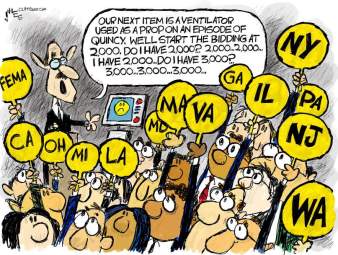
Is Trump deliberately letting Americans die? It certainly appears that he is directing scarce medical supplies to red states like Florida while actively trying to prevent deliveries of such equipment to blue states.
On Thursday I posted about a massive shipment of N95 masks that was delivered to Massachusetts through the intervention of the Kraft family, owners of the New England Patriots. The Krafts arranged to have the Patriots plane fly to China and back to pick up more than a million masks. Another shipment will follow later. The Krafts also donated $2 million toward the cost of the masks. From The Boston Globe:
The news, which broke early Thursday, resembled a plot pulled straight out of a summer blockbuster: The Kraft family had deployed a New England Patriots team plane to China to deliver about one million desperately needed N95 respirator masks to health care workers in Massachusetts.
By Rudi Herzimeier
Yet the story is as alarming as it is heartwarming, underscoring a harsh reality as the coronavirus pandemic spreads ever faster around the United States. Governor Charlie Baker and his counterparts throughout the country are forced to go to extraordinary lengths to secure life-saving medical equipment in the absence of a coordinated federal response.
“This is not how it is supposed to work,” said Representative Katherine Clark of Melrose, a member of House Speaker Nancy Pelosi’s leadership team. She described herself as “very grateful” for the Kraft family’s generosity and help getting the critical gear, but said “what we need is a coordinated federal system.”

Why was such a dramatic effort necessary? Because Trump has been actively preventing Massachusetts from purchasing medical supplies.
The journey began, in the governor’s telling, roughly two weeks ago, when the federal government confiscated a shipment of more than 3 million N95 masks at the Port of New York and New Jersey that Massachusetts had arranged to buy….
Baker’s victory in the state’s intense hunt for masks and other protective gear, or PPE, follows weeks of increasingly public frustration from the normally even-keeled governor. His administration has hit numerous roadblocks thrown up by the federal government, which has repeatedly snatched supplies from the states’ hands and directed governors to find their own source.
Very Introvert Cat Sitting on a Red Chair, by Nastya Ozozo
Even now, Baker administration officials are still waiting on the federal government to deliver promised help. Earlier this week, Baker announced that the state had ordered 1,000 ventilators from the federal government and that he expected the delivery by the end of this week. On Thursday, Baker said Massachusetts still hasn’t gotten any of the equipment and he no longer expects them by the end of the week.

Normally calm and matter-of-fact, Baker choked back tears when he spoke at Logan Airport after meeting he Patriots plane.
The Chicago Sun-Times has a story about another crazy situation in Illinois: Illinois adjusts on the fly to meet medical supply needs in a coronavirus ‘Wild West.’
About two weeks ago, Illinois officials tracked down a supply of 1.5 million potentially life-saving N95 respirator masks in China through a middleman in the Chicago area and negotiated a deal to buy them.
One day before they were expecting to complete the purchase, they got a call in the morning from the supplier informing them he had to get a check to the bank by 2 p.m. that day, or the deal was off. Other bidders had surfaced.
Realizing there was no way the supplier could get to Springfield and back by the deadline, Illinois assistant comptroller Ellen Andres jumped in her car and raced north on I-55 with a check for $3,469,600.
By Shozo Ozaki.
From the other end, Jeffrey Polen, president of The Moving Concierge in Lemont, drove south. Polen isn’t in the medical supply business, but he “knows a guy,” an old friend who specializes in working with China’s factories.
As they drove, Andres and Polen arranged to meet in the parking lot of a McDonald’s restaurant just off the interstate in Dwight. They made the handoff there.
Polen made it back to his bank with 20 minutes to spare. Illinois already has received part of the mask shipment. There’s more on the way.
That’s just a taste of the “Wild West” world of emergency procurement taking place over the past several weeks as the state fights for equipment and supplies to protect frontline workers and patients in the battle against COVID-19.

Why is this chaos necessary? Because Trump refuses to allow the federal government to organize the pandemic response.
Now Trump is angering America’s foreign allies by commandeering medical supplies their governments are trying to buy.
Kaiser Health News: Trump Administration Uses Wartime Powers To Be First In Line On Medical Supplies.
The Trump administration quietly invoked the Defense Production Act to force medical suppliers in Texas and Colorado to sell to it first — ahead of states, hospitals or foreign countries.
It took this action more than a week before it announced Thursday that it would use the little-known aspect of the law to force 3M to fill its contract to the U.S. first. Firms face fines or jail time if they don’t comply.
Terry Runyan, Yellow Cat
The Cold War-era law gives federal officials the power to edge out the competition and force contractors to provide supplies to them before filling orders for other customers.
While it’s unclear how many times the power has been used during the coronavirus pandemic, federal contracting records examined by Kaiser Health News show that federal authorities staked first rights to $137 million in medical supplies. The orders in late March flew under the radar, even as dog-eat-dog bidding wars raged among states and nations for desperately needed medical protective gear.
“It’s like ‘Lord of the Flies’ out there for states and hospitals as they bid against each other for critical medical supplies and equipment,” Sen. Chris Murphy (D-Conn.) said in a statement to KHN. “Plus, there’s no transparency about what the federal government is doing with the equipment that they purchase when they outbid states and hospitals.”

Read more:
Reuters: Canada blasts U.S. block on 3M exports of masks as coronavirus cases set to soar.
At the Coronavirus Task Force briefing on Thursday, we learned that, instead of sending medical supplies controlled by the Pentagon (paid for by taxpayers) directly to states, the administration is handing the equipment over to private companies to resell to the highest bidder. Here’s what Lt. Katrina recovery hero Gen. Russell Honore had to say about that.
Yesterday, Dakinikat wrote about the insanity of putting failson-in-law Jared Kusher in charge of the federal pandemic response. We learned about that at the Thursday briefing too. From The Daily Beast:
President Donald Trump’s top adviser and son-in-law Jared Kushner insisted on Thursday that the government had not built up a national stockpile of medical equipment for states to use during threats like the coronavirus since those states have strategic reserves of their own.
The remark drew raised eyebrows from experts, considering presidents have dispersed supplies from the national strategic stockpiles for use by states dozens of times over the last twenty years.
In fact, the Trump administration itself has dipped into the federal reserves to help states in need…
Malarstwo Japońskie
“He doesn’t know what the hell he is talking about. He has no idea,” said Gen. Russel Honore, a retired military general who helped direct the response on the ground during Hurricane Katrina. “He must have remembered something from some slide or some speech. But that’s why people created the national strategic stockpile in the first place. It’s for those days when we can’t predict what we need. What I see is a total misunderstanding by the White House that they have a responsibility to help maintain the stockpile and help states.” [….]
While state governments do possess their own stockpiles of equipment and supplies, the national strategic stockpile was originally designed in 1999 to help states fill the gaps when facing things like natural or health disasters. The role of the stockpile has expanded dramatically in recent years amid more frequent natural disasters.
But the Trump White House’s approach to filling the supply chain gaps has been slapstick at best, officials say, in part because it was unprepared for taking the lead in responding to a global pandemic. For weeks, the administration struggled to understand which agency was responsible for studying the supply chain breakdown and which was in charge of fixing not only the dwindling medical supplies in hospitals, but also the shortages of products like toilet paper and paper towels in grocery stores.
“We missed dealing with this disaster because for weeks, the White House said it was a hoax,” Honore said. “So we missed at least four weeks of anticipation and preparation on the logistics side because of our leadership.” [….]
“It shouldn’t be this complicated,” said Juliette Kayyem, a former assistant secretary of the Department of Homeland Security. “It’s supposed to happen like a light switch you flip on. And this should have happened a month ago. This is not inventing a vaccine, this is just shipping stuff. In these situations you want a light White House touch and you want the subject matter experts to take the lead.”


By Saul Steinberg
More important stories to check out:
The New York Times: Coronavirus in N.Y.: Toll Soars to Nearly 3,000 as State Pleads for Aid.
The Washington Post: The U.S. was beset by denial and dysfunction as the coronavirus raged.
The Washington Post: Inside the coronavirus testing failure: Alarm and dismay among the scientists who sought to help.
Yahoo News: Coronavirus may cause some food shortages, warns government task force.
ProPublica: How Tea Party Budget Battles Left the National Emergency Medical Stockpile Unprepared for Coronavirus.
Raw Story: Trump administration quietly guts COVID-19 paid leave provision that already excluded 75 percent of workers.
Lucian Truscott IV at Salon (via Raw Story): Trump is preparing the ground for a totalitarian dictatorship.
Business Insider: The US Postal Service is on track to run out of money by June, and it could be a disaster for states trying to expand voting by mail.
Take care this weekend, Sky Dancers! Please let us know what’s happening where you are.
Thursday Reads
Posted: April 2, 2020 Filed under: morning reads, U.S. Politics | Tags: Anthony Fauci, coronavirus, Covid-19, Donald Trump, Gov. Charlie Baker, Massachusetts, New England Patriots, Robert Kraft, Trump administration failures 43 Comments
Good Morning!!
U.S. deaths from Covid-19 have now topped 5,000 with more than 126,000 confirmed cases, according John’s Hopkins University. BBC News:
There were 884 deaths in the US in 24 hours, a new record, according to Johns Hopkins University, which has tracked virus figures globally.
The latest victims include a six-week-old baby. More than 216,000 are now infected, the world’s highest figure.
Reserves of protective equipment and medical supplies are almost exhausted.
This has left the federal government and individual US states competing for safety gear, while the unprecedented demand has led to profiteering, officials in the Department for Homeland Security were quoted by the Washington Post as saying.
The Trump administration says it can acquire adequate supplies, and has $16bn (£13bn) available to do so. State and local officials have complained about insufficient protective equipment such as masks and gowns as well as ventilators, needed to help keep patients breathing….
The number of confirmed infections across the US rose by more than 25,000 in one day. The worst-hit place is New York City, where nearly 47,500 people have tested positive and more than 1,300 have died.
The response to this horror from the Trump administration is still weak and ineffectual.
Here in Massachusetts, Governor Charlie Baker got an assist from New England Patriots owner Bob Kraft. Politico: Bob Kraft sends Patriots plane to China to get equipment for Mass.
A New England Patriots plane full of much-needed personal protective equipment from China is to fly into Boston on Thursday afternoon, according to a source familiar with the plans.
Gov. Charlie Baker will greet the National Football League team’s plane when it arrives at Logan Airport with Patriots owner Bob Kraft and Lt. Gov. Karyn Polito. From there, the state’s National Guard will transport the equipment to a strategic stockpile in Marlboro, Mass., according to the person familiar with the plans.
There are 7,738 confirmed coronavirus cases in Massachusetts, and more than a thousand of those cases were reported on Wednesday — the largest spike the state has seen so far. To date, 122 people have died from the virus, and the state has conducted more than 51,000 tests. The state converted an arena in Worcester, Mass., into a 250-bed field hospital Wednesday as it prepares for an influx in patients, and is eyeing a Boston convention center as another possible hospital site.
For weeks, Baker has warned that Massachusetts is in desperate need of more protective equipment including masks, sanitizing wipes and gowns for health care workers on the front lines of the coronavirus crisis, especially as cases are expected to surge sometime between April 7 and April 17 in Massachusetts.
The Republican governor has raised those concerns with Trump. He told the president the federal government was outbidding Massachusetts on equipment — even after advising states to work on getting their own supplies. A week later, the Bay State was still being outbid and had only received a fraction of what it requested from the Strategic National Stockpile.
 According to my local news source The Arlington Patch, there are 1.2 million N95 masks on the plane. An additional 500,000 wouldn’t fit and will be delivered on another flight.
Team owner Robert Kraft and his family paid $2 million, about half the cost, for the masks, which are a crucial piece of personal protection equipment needed on the front lines in the fight against the coronavirus.
The National Guard will bring the masks from the plane to a Marlboro stockpile, Politico reported. Some 300,000 masks will then be sent to New York, which is being overwhelmed by the pandemic.
While I’m glad that local doctors and nurses will soon have better protection from the virus, this story highlights a serious problem with Trump’s disorganized “strategy” for dealing with the pandemic. The Los Angeles Times: As Trump lets private sector supply the coronavirus fight, the well-connected often get first dibs.
As hospitals, doctors and state and local governments race for masks, ventilators and other medical supplies with little coordination by the Trump administration, the well-connected are often getting to the front of the line.
An outpouring of corporate and philanthropic support has funneled badly needed supplies to combat the coronavirus to well-known institutions such as Cedars-Sinai and UCLA medical centers in Los Angeles and the UC San Francisco Medical Center.
But in the absence of an overall nationwide distribution plan, many smaller hospitals, nursing homes and physicians are being left behind, especially those who lack relationships with suppliers, ties to wealthy donors or the money to buy scarce equipment at a time when prices on the open market are skyrocketing.
“It’s frequently all about who knows someone who knows someone who can get hold of this or that supply,” said Dr. Alex Billioux, public health director in Louisiana, which is battling one of the nation’s most aggressive coronavirus outbreaks.
Trump “has blood on his hands,” as The Boston Globe Editorial Board wrote on Monday: A president unfit for a pandemic. Much of the suffering and death coming was preventable. The president has blood on his hands.
While the spread of the novel coronavirus has been aggressive around the world, much of the profound impact it will have here in the United States was preventable. As the American public braces itself for the worst of this crisis, it’s worth remembering that the reach of the virus here is not attributable to an act of God or a foreign invasion, but a colossal failure of leadership.
The outbreak that began in China demanded a White House that could act swiftly and competently to protect public health, informed by science and guided by compassion and public service. It required an administration that could quickly deploy reliable tests around the nation to isolate cases and trace and contain the virus’s spread, as South Korea effectively did, as well as to manufacture and distribute scarce medical supplies around the country. It begged for a president of the United States to deliver clear, consistent, scientifically sound messages on the state of the epidemic and its solutions, to reassure the public amid their fear, and to provide steady guidance to cities and states. And it demanded a leader who would put the country’s well-being first, above near-term stock market returns and his own reelection prospects, and who would work with other nations to stem the tide of COVID-19 cases around the world.
What we have instead is a president epically outmatched by a global pandemic. A president who in late January, when the first confirmed coronavirus case was announced in the United States, downplayed the risk and insisted all was under control. A president who, rather than aggressively test all those exposed to the virus, said he’d prefer not to bring ashore passengers on a contaminated cruise ship so as to keep national case numbers (artificially) low. A president who, consistent with his mistrust and undermining of scientific fact, has misled the public about unproven cures for COVID-19, and who baited-and-switched last week about whether the country ought to end social distancing to open up by Easter, and then, on Saturday, about whether he’d impose a quarantine on New York, New Jersey, and Connecticut. A president who has pledged to oversee the doling out of the $500 billion in corporate bailout money in the latest stimulus package, some of which will go to the travel industry in which his family is invested. A president who spent a good chunk of a recent press conference complaining about how hard it is for a rich man to serve in the White House even as Americans had already begun to lose their jobs, their health care, and their lives. A president who has reinforced racial stigma by calling the contagion a “Chinese virus” and failed to collaborate adequately with other countries to contain their outbreaks and study the disease. A president who evades responsibility and refuses to acknowledge, let alone own, the bitter truth of National Institutes of Health scientist Dr. Anthony Fauci’s testimony: that the country’s testing rollout was “a failing.”
Read the whole thing at the Globe. It appears they have finally made their coronavirus stories free to the public.
Now Trump is making his failure look far worse by claiming he knew all along the situation with be this bad. Amber Phillips at The Washington Post: Trump now says he knew the virus ‘could be horrible’ when he was saying things like ‘it’s going to disappear.’

Let’s start with Trump downplaying the virus. Acosta asked him: “Is there any fairness to the criticism that you may have lulled Americans into a false sense of security? When you were saying things like it’s going to go away and that sort of thing?”
Trump’s answer basically came down to: He did not want to deliver the bad news about how serious the virus could be. What’s more, he said he knew ahead of time it could be this bad (or even worse, killing millions with no government intervention whatsoever), but he did not want to tell Americans that at the time.
“I want to give people a feeling of hope. I could be very negative. I could say ‘wait a minute, those numbers are terrible. This is going to be horrible,’” he said. “Well, this is really easy to be negative about, but I want to give people hope, too. You know, I’m a cheerleader for the country.”
Unbelievable. More from Jim Acosta at CNN: Source close to coronavirus task force: Despite what White House is saying, tougher measures implemented earlier ‘might have made a difference.’
Despite White House claims that President Donald Trump and the administration did everything right in response to the coronavirus, a source close to the task force said tougher social distancing measures implemented earlier in the pandemic could have blunted the severity of the current crisis.
It all depends, the source said, whether there were coronavirus infections in the US that were going undetected during the initial weeks of the outbreak, when the Trump administration was falling behind on testing for the virus nationwide.
Numerous public health experts have said those cases were likely going undetected, considering the lack of widespread testing….
A Trump adviser working with White House officials on messaging for the pandemic response said Trump “took a gamble” that warmer weather would cause the virus to dissipate, siding with aides who were pushing back on the dire warnings coming from doctors on the coronavirus task force.
Some important stories, links only:
Yahoo News: Two years before coronavirus, CDC warned of a coming pandemic.
The Nation: Exclusive: The Military Knew Years Ago That a Coronavirus Was Coming.
The Daily Beast: Army Warned in Early February That Coronavirus Could Kill 150,000 Americans.
The New York Times: A Ventilator Stockpile, With One Hitch: Thousands Do Not Work.
Jonathan Chait at New York Magazine: Republicans: ‘Nobody Expected’ the Coronavirus Pandemic. So Joe Biden Is Nobody?
The Washington Post: Anthony Fauci’s security is stepped up as doctor and face of U.S. coronavirus response receives threats.
Vanity Fair: Americans Can’t Sign Up for Health Insurance During a Global Pandemic, Trump Decides.
Bloomberg: Many New York Coronavirus Patients Are Young, Surprising Doctors.
The New York Times: Some Coronavirus Patients Show Signs of Brain Ailments.
The Daily Beast: Trump Literally Laughed at How He Can Game the Press With His ‘New Tone’
Stay safe and healthy Sky Dancers! Please share what’s happening where you live.

 peej
peej Carissa
 bostonboomer
 dakinikat
 ecocatwoman
 mablue2
 Mama Lopez
 peggysue22
 quixote
 skydancingguestblogger
 Mona (aka Wonk the Vote)



 Sky Dancing
Recent Comments