My natural optimism is beginning to wear thin. Our country is on a fast track to autocracy, and our Congressional “leaders” don’t seem to be doing much to slow it down. I’m afraid that Trump and Musk will actually try to steal the money from Social Security and Medicare that Americans have contributed through our payroll taxes. I know if it happens, there will be a massive pushback from the American people, but will Democrats actually begin to fight back then? I’m not sure.
I know some elected Democrats are working hard to slow down what’s happening, but so far their actions aren’t visible enough. They don’t seem to be working as a group to educate the public about what is happening to our country. Meanwhile, Trump and Musk are blundering their way through the government, shutting down vital programs and firing employees indiscriminately. The courts are our only hope, and they move very slowly.
There is so much awful stuff happening, and there are endless stories I could share about it; so I’ll just share the ones that hit me hardest this morning.
Yesterday, Trump had the nerve to claim that Ukraine started the war with Russia.
Ukraine’s President Volodymyr Zelensky accused Donald Trump of repeating disinformation, a day after the US president falsely accused Ukraine of starting the war with Russia.
Zelensky’s outspoken comments were part of what is shaping up to be far the most public exchange of accusations between Kyiv and Washington since the full-scale war started nearly three years ago.
Speaking to reporters in Kyiv, Zelensky pushed back on several unfounded claims the US president made on Tuesday, while reinforcing Ukraine’s position that a deal to end the war needed its involvement.
“Unfortunately, President Trump – I have great respect for him as a leader of a nation that we have great respect for, the American people who always support us – unfortunately lives in this disinformation space,” Zelensky said.
Trump has made it clear he wants the war to end as soon as possible – even if it means further territorial losses for Ukraine. And much to the horror of Kyiv and its allies, Trump has at times adopted Kremlin’s narrative and blamed Ukraine and NATO for the conflict, even saying that Ukraine “may be Russian some day.”
But Trump’s boosting of Russia goes well beyond rhetoric. The president raised many eyebrows last week when opting to hold a 90-minute phone call with his Russian counterpart Vladimir Putin before speaking to Zelensky.
Then on Tuesday, US and Russian officials held high-level talks on ending the war in Ukraine in the Saudi capital of Riyadh, excluding Kyiv from the meeting.
Putin praised this new US attitude towards his country. Speaking about the talks in Riyadh, Putin said he was told the atmosphere was “friendly.”
“There were completely different people on the American side, who were open to the negotiation process without any bias, without any condemnation of what had been done in the past,” Putin added.
The US and Russia agreed in Riyadh to appoint high-level teams to negotiate the end of the war and said
they were working to reestablish diplomatic channels.
Trump wants to further dumb down the State Department.
The State Department has ordered the cancellation of all news subscriptions deemed “non-mission critical,” according to internal email guidance viewed by The Washington Post. The move aligns with the Trump administration’s crackdown on media companies that count the U.S. government as paying customers.
A Feb. 11 memo sent to embassies and consulates in Europe described the mandateas part of an effort to reduce spending. The email read, in part,“Considering this priority, posts are asked to immediately place Stop Work Orders on all non-mission critical contracts/purchase orders for media subscriptions (publications, periodicals, and newspaper subscriptions) that are not academic or professional journals.”
The mandate applies globally,to hundreds of U.S. embassies and consulates, according to a State Department official who spoke with The Post on Tuesday on the condition of anonymity to discuss internal matters. Embassy security teams rely on news coverage to prepare for diplomatic travel in conflict zones. Cancellation of subscriptions — including to local news outlets — could hinder their assessment of threats, the official said….
A Feb. 14 memo directed procurement teams at embassies and consulates to prioritize the termination of contracts with six news organizations in particular: the Economist, the New York Times, Politico, Bloomberg News, the Associated Press and Reuters.
State Department personnel were told that they could submit a request to maintain a news subscription but that it “must be done within 1 sentence.” The guidance laid out possible justifications — if the subscription affects the safety of U.S. personnel or facilities, or if it is required by treaty or law, or if it yields an affirmative answer to one of the following questions: “Does it make America safer? Does it make America stronger? Does it make America more prosperous?”
A State Department employee who received the memos, and shared them with The Post, expressed concern that terminating news subscriptions — particularly to local outlets —would deprive embassies and consulates of information necessary to complete their mission. “This will endanger American lives overseas because we are being cut off from news sources that are needed on a daily basis,” said the employee, who spoke on the condition of anonymity because they are not authorized to comment to the press.
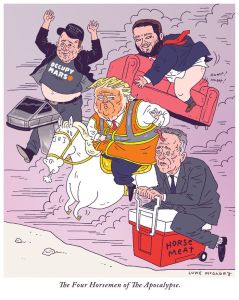
Opinion pieces on Trump-Musk-DOGE’s destruction of our government.
A month into the second Trump administration, I think it is fair to conclude that the American empire in its current form is collapsing. The post-1945 global order, with the United States at its apex, is no more. America itself is not going anywhere—at least not yet—but the foundation of the empire, namely its structure of alliances and partnerships, has been dealt irreparable damage. Western Europe, Taiwan, Japan, South Korea, and especially Canada now view America with suspicion if not outright hostility, and they are right to do so.
Now, the history of empires is the story of their rise and inevitable fall. As Herodotus wrote about Greek city-states, “most of those which were great once are small today; and those which used to be small were great in my own time.” But nobody has matched this current downfall for sheer egregious stupidity.
Indeed, it’s hard to think of even a single competitor for that title. There have been, to be sure, many idiotic imperial leaders throughout history who helped blow up their empires through bungling and mistakes. Tsar Nicholas II was an incompetent boob whose closest adviser was a charlatan mystic, and he personally led the failed military effort during the First World War that eventually destroyed his regime. Yet Russia bore only a small share of the blame for starting the war in the first place, and other much better-governed empires like Germany and Austria-Hungary, which shared much of that blame, also collapsed because of the war’s strains.
The eventual collapse of the Western Roman Empire began when a large Roman army was heavily defeated by Goths, who had adopted many Roman military tactics. The Eastern European Empire persisted for another thousand years, but it too eventually collapsed following military defeat at the hands of the Ottomans.
That is how empires tend to fall. Either they are defeated in battle, and are conquered or collapse, or they suffer a succession crisis and fall apart (both often enabled by corruption and mismanagement). Or they are simply eclipsed by another power, as happened when the British Empire fell short and the U.S. succeeded it.
What Trump inherited and what he has done so far:
President Trump, by contrast, was handed an empire in splendid condition. The core alliance of NATO was stronger than it had been in decades, as Russia’s war of aggression against Ukraine pushed Sweden and Finland to join. Thanks to President Biden’s policies, the American economy was the envy of the world, with a post-pandemic recovery that outstripped any peer nation. The dollar was still by far the most important reserve currency, and the U.S. still had control over global financial pipelines.
No serious threats were on the horizon, either. In its war with Ukraine, Russia has burned through most of its gigantic stockpile of Soviet-era military hardware, taken perhaps 800,000 casualties, and put its economy under terrific pressure. China, while the only peer competitor the U.S. has faced since 1991, is saddled with deep economic difficulties and looking down the barrel of population collapse.
But Trump and Musk are blowing America’s imperial foundations to kingdom come. Take USAID, which as the largest distributor of humanitarian aid in the world, has both done a tremendous amount of good work and also served as a carrot for America’s global predominance—until now. The agency has been all but dismantled, unleashing havoc all over the globe. HIV and drug-resistant tuberculosis are now spreading unchecked in many countries reliant on USAID medication, both proving America cannot be trusted and threatening outbreaks of those diseases in the U.S. itself.
Both Trump and Musk have attacked NATO; Trump has reportedly said he wants to withdraw from the alliance, while Musk has said it “needs an overhaul” and he wonders why it “continued to exist.” More importantly, Trump has repeatedly suggested annexing Canada, a NATO member. The enormous implications of this threat are clearly not getting through to many American elites. At The New York Times, Peter Baker has a column blithely speculating about which way Canadians might vote should they be annexed, concluding that Democrats would likely benefit.
But this is not a political parlor game for Canadians. They are incandescently furious, and they are right to be. Canada stood shoulder to shoulder by America through the great bloodbaths of the 20th century. Since then, it has been a quietly loyal neighbor, making not a peep of trouble along the world’s longest land border, and providing a vast supply of energy, mineral, timber, and other exports to fuel the American economy. And this is the thanks they get: A senile fascist American president who suggests a war of conquest—and make no mistake, that is what it would take—because he wants to make America look big but doesn’t understand how the Mercator projection exaggerates the size of northern land masses—which, it’s been reported, is one reason for his coveting Greenland, too.
“He who saves his Country does not violate any Law,” President Trump posted last week on his social media platform.
The quote was widely attributed to French Emperor Napoleon Bonaparte, and Trump, who fancies himself one of history’s great leaders, leaned into the monarchical fantasy. And lest there was any confusion, he explicitly linked it to a story about his administration defying a court order with respect to the federal budget.
The quote is an unmistakable echo of Richard Nixon, who insisted in 1977 that “when the president does it, that means that it is not illegal.”
That wasn’t true for Nixon, of course, who by then had been out of office for three years. But last year the Supreme Court gutted the rulings that reined in Nixon, and now Trump and Elon Musk are running the government as if they are the only law in the land. They insist they are “saving” the country by burning down its institutions, and they claim a mandate of the people to do it….
When it comes to Twitter, Elon Musk is the “voice of god.” (And not for nothing, but he literally sued “the people” when they exercised their right to criticize him or not speak on his platform.)
But Musk and Trump make a similar false equivalency when it comes to governing, insisting that the results in November empower them to do whatever they like, law be damned.
“The beauty is that we won by so much. The mandate was massive,” Trump told Time Magazine in December, adding that “America has given us an unprecedented and powerful mandate.”
In reality, Trump won by less than 1.5 percent and took less than 50 percent of all votes cast. His popular vote margin was one-third as large as Biden’s and the second-narrowest in 60 years. There was no “mandate,” let alone a “massive” one.
And yet Trump and Musk govern as if they won an overwhelming majority, and this gives them the right to ignore the law….
At the recent Oval Office press conference where Musk played with his toddler son, the saucer-eyed vizier delivered a manic defense of the DOGE committee’s “hostile takeover of the government.” (Video after the transcript.)
Well, first of all, you couldn’t ask for a stronger mandate from the public. The public voted. We have a majority of the public vote voting for President Trump. We won the House, we won the Senate. The people voted for major government reform. There should be no doubt about that. That was on the campaign. The President spoke about that at every rally. The people voted for major government reform, and that’s what people are going to get. They’re going to get what they voted for. And a lot of times people that don’t get what they voted for, but in this presidency, they are going to get what they voted for. And that’s what democracy is all about.
In reality, Trump announced the DOGE committee after he won in November, promising that Musk and Vivek Ramaswamy (remember him?) would “provide advice and guidance from outside of Government, and will partner with the White House and Office of Management & Budget to drive large scale structural reform, and create an entrepreneurial approach to Government never seen before.” He only brought DOGE inside the government by executive order on January 20.
Trump did not run on a promise to unleash an unelected billionaire to slash-and-burn through the government, firing tens of thousands of employees and arbitrarily canceling contracts and federal programs. And even if he had, that still wouldn’t make it legal….
The United States is a constitutional democracy. We must all abide by the Constitution, and we don’t get to override its provisions by popular referendum.
At least we were a constitutional democracy. Read the rest at Public Notice.
Andrew Egger at The Bulwark: Sadism for Its Own Sake.
The Trump White House is itching to ramp up its cartoonishly cruel immigration policy to industrial scale. But they’re finding the sledding frustratingly slow.
The Economist noted this week that “so far, mass deportation has been more rhetoric than reality.” Daily ICE arrests are just a tick up from the Biden years—from a few hundred a day to just over a thousand. “ICE stopped releasing a daily arrests number in early February,” the Economist notes, “which may be because the agency would rather nobody kept count.”
If you’re Trump, this is no good. He’d promised instant gratification: “the largest deportation operation in history,” beginning on Day One of his presidency. His fans, longing to see footage of migrants getting hustled into ICE vans by the thousands across the country, might be getting a little twitchy.
So the administration is taking a new tack: emphasizing quality over quantity. The White House is spotlighting the leering cruelty with which they carry out the deportations that are happening. Deporting former designees of temporary protected status back to countries where they face prosecution: check. Deporting migrants to countries they’ve never even visited: check. Holding detainees at Guantanamo Bay: check.
And yesterday, releasing the single most viscerally disturbing piece of deportation propaganda to date: A short video, posted to the official White House X account, titled “ASMR: Illegal Alien Deportation Flight.”
ASMR videos, which became popular on YouTube in the 2010s, use specific audio cues to stimulate feelings of relaxation and euphoria in the viewer. The White House video perversely mimics the style: lovingly lingering on the revving engine of an airplane waiting to take off; the jingling of chains as they are laid out in rows on the ground, then used to shackle deportees’ arms behind their backs; the shuffling of chained feet up into the plane. No faces are ever seen. The idea is not just that viewers should approve of the footage. It invites them to take sensual pleasure from it.
Plenty of Trump’s people were happy to oblige. The tweet quickly induced hooting replies—memes of American Psycho’s Patrick Bateman blissfully vibing on his headphones in a MAGA hat, exhortations to “let the clanging bar sounds of Guantanamo Bay whisk you away to your happy place,” speculation about when “some of our corrupt politicians” would be going the same way.
THREE DAYS AFTER the National Institutes of Health abruptly announced it would place a strict, low cap on the money it sends to universities and research institutions for the administrative costs of scientific research, the University of Iowa made an abrupt announcement of its own.
The school’s Office of the Vice President for Research declared that going forward, it would pause “the hiring of new Graduate Research Assistants unless they are already budgeted as a direct cost on a funded project.”
The announcement sent shockwaves through parts of academia, providing an alarming demonstration of the impact the NIH cap would have on aspiring scientists. “We were pretty stunned,” the chair of the biochemistry and molecular biology department at a top university told The Bulwark.
NIH’s so-called “indirect cost” cap has since been paused by the courts. And a University of Iowa spokesperson confirmed they’ve put a pause on their policy too. But the spokesman also noted that they were “actively monitoring the developments happening at the federal government level.”
And on that front, they are hardly alone. The prospect that the cap will return, combined with the dramatic cuts that the Trump administration is making at every scientific agency, has generated chaos and uncertainty in the scientific community. The aforementioned department chair noted that his own school had decided to stop bringing on any new faculty. A cellular biology professor at a separate, prominent state university said that they’d reduced the number of graduate school offers by 75 percent and were weighing whether to continue a program to provide summer research opportunities for undergraduate students from smaller colleges, including HBCUs.
“One might ask, ‘Why are they trying to destroy the science training pipeline?’” that professor said. “To what end?”
In the first month of the second Trump administration, the world’s richest man—underinformed, chronically online, and staffed by a coterie of teenaged and twentysomethingformer engineering interns—has been moving at warp speed to reshape, reduce, and even dismantle the United States government. But while Musk’s rampage has been feverishly covered, the scope of its impact remains largely underappreciated. Experts say it can’t be measured in weeks or months or even in government services affected. Rather, it will be felt over the span of decades and defined in metrics like intellectual talent lost.
A relative of mine—an older gent with a penchant for salty language—yelled over the phone at me in frustration, “Where are the damn cojones in the Democratic Party?”
His use of language aside, this argument—that the Democrats are not raising nearly enough hell as Apartheid’s Chestburster, Elon Musk, vivisects the government from the inside—is all over the liberal left. The phrase going around is, “The Democrats have brought a lectern to a social media war.” Masses of enraged, terrified people are looking at the analog, slow-motion leadership of Democratic Senate leader Chuck Schumer and the zero-calorie rhetoric of House leader Hakeem Jeffries and want them replaced by people who know how to fight. As The Nation has reported, when Democratic politicians have shown up to protests, people aren’t cheering their presence. They are howling at them to do more.
To be clear, people aren’t criticizing the efforts of individual Democrats trying to expose this deadly grand theft taking place in plain sight. The cry is, “Why aren’t the Democrats as unified and ruthless toward their enemies as Republicans?”
Why aren’t they taking the fired federal workers who are sharing their heartbreaking stories—the ones that Musk says were being paid to do nothing—and making them famous? The cancer researcher on the verge of a breakthrough? The park ranger in Yosemite who won’t be there to conduct rescues and save lives? The air traffic controller who can speak to the connection between understaffing and recent plane crashes? Is it even safe to fly in Trump’s America?
The Democrats should be amplifying these folks—writing op-eds about them, refusing to go on camera without sharing their spotlight, pressuring their IG influencers to raise them up—but instead, we learn their stories from Reddit. As Moira Donegan wrote in The Guardian, “Why are the Democrats so spineless?” The conventional wisdom is that they simply “don’t know how” to wage a social media and public-relations attack that can, to use one blaring example, define people like JD Vance as a Nazi-curious Manchurian Candidate.
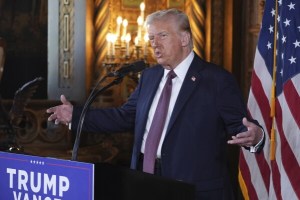
Trump holds forth at his Mar-a-Lago press conference.
Trump isn’t in office yet, but he is already dominating the news. It’s difficult to believe, but I think he is actually getting crazier.
Trump 2.0 is going to be chaos to the nth degree. I have no doubt that it will make his first term look sane by comparison. He is aging noticeably–he’s approaching 80–and his dementia is getting worse.
As we all know, this time there won’t be sane handlers trying to hold back his worst inclinations; he will be surrounded by MAGA loyalists who will do whatever he wants. It’s going to be awful, and getting through what’s coming is going to be tough.
Again, he’s not even waiting until he’s sworn in to begin causing trouble. Yesterday he held a “press conference” during which he came off as truly psychotic. In case you missed it (I couldn’t bear to watch), here are some media write-ups.
David E. Sanger at The New York Times: Dripping Faucets and Seizing Greenland: Trump Is Back and Chaos Ensues.
There was talk of the rising number of beached whales in Massachusetts, the victim, the president-elect said, of those windmills that have been erected off the coast. They “are driving the whales crazy, obviously.”
There was a vow to rename the Gulf of Mexico, by presidential decree, to the “Gulf of America.” And then there was Donald J. Trump’s refusal to rule out using military force to seize the 51-mile Panama Canal on national security grounds, along with the 836,000 square miles of Greenland, the world’s largest island.
Mr. Trump’s family and supporters like to say “We are so back!” and they are, without doubt. Yet as the man who will be president again spun out threats and angry denouncements of the Biden administration and personal grievances for more than an hour on Tuesday in the living room of his Mar-a-Lago club, something else was back: the chaotic stream-of-consciousness presidency.
Mr. Trump has returned to our daily national cognizance, even though one could argue he never really left. Tuesday’s news conference was a reminder of what that was like, and what the next four years may have in store.
He waxed on about a favorite complaint during his first term: Shower heads and sink faucets that don’t deliver water, a symbol of a regulatory state gone mad. “It goes drip, drip, drip,” he said. “People just take longer showers, or run their dishwasher again,” and “they end up using more water.”
Then he moved on to the prospect of a military clash with Denmark. After refusing to rule out the prospect of coercing a NATO ally with the use of force if it remained reluctant to turn over property the president-elect coveted, Mr. Trump suggested that Denmark had a dubious claim on Greenland anyway.
Don Jr. and his buddies in Greenland yesterday
“People really don’t even know if Denmark has any legal right to it, but if they do, they should give it up, because we need it for national security,” he said.
As for Panama, he insisted the United States had to defend against an urgent national security threat from China, though the situation around the canal was little changed from the last time Mr. Trump sat in the Oval Office.
“It might be that you’ll have to do something,” he said with signature vagueness, when asked about his suggestion that the only solution to this problem may be military force.
There was a lot of déjà vu in Tuesday’s news conference, recalling scenes from his first presidency. The conspiracy theories, the made-up facts, the burning grievances — all despite the fact that he has pulled off one of the most remarkable political comebacks in history. The vague references to “people” whom he never names. The flat declaration that American national security was threatened now, without defining how the strategic environment has changed in a way that could prompt him to violate the sovereignty of independent nations.
But there were also several differences in this version of Mr. Trump that are easy to overlook in a man who can move, in an instant, from the failures of American plumbing to the need to revive the territory-grabbing spirit of President William McKinley.
President Trump has created a massive gulf in America.
No, I am not talking about the half baked promise “to be changing the name of the Gulf of Mexico to the Gulf of America” that Trump announced in his news conference on Tuesday. The gulf that our country actually is going to have is the one between our current reality and the one we will be experiencing when Trump takes office on Jan. 20.
This news conference, which was the first since Trump’s re-election was certified by Congress, was a wild one — even by Trumpian standards. In a little over an hour behind a podium at his Mar-a-Lago beach club, the president-elect, along with promising to rename an ocean basin, threatened potential military force against Panama and Denmark. He also suggested he might use “economic force” to make Canada the 51st State.
“They should be a state,” Trump said of one of America’s closest neighbors and allies.
And, if Hamas doesn’t release the remaining hostages taken in the October 7th attack before Trump’s inauguration, Trump vowed that would also result in a massive show of force.
“If they’re not back by the time I get into office, all hell will break out in the Middle East,” Trump said. “It will not be good for Hamas and it will not be good frankly for anyone. All hell will break out.”
Trump’s feverish foreign policy visions were mixed up with his other weird obsessions and blatant lies. He ranted about President Joe Biden’s efforts to promote electric power and suggested heat generated this way will make you “itch.” As he vowed to make “major pardons” for some of his supporters who attacked the Capitol during the January 6 insurrection, Trump reiterated some of his preferred, debunked conspiracy theories about that day including that, the FBI is concealing the identity of the unknown pipe bomber and that, somehow, the Middle Eastern terrorist group Hezbollah might have played a role in the violence.
“We have to find out about Hezbollah. We have to find out about who exactly was in that whole thing because people that did some bad things were not prosecuted,” Trump said….
The whole thing was objectively bizarre and it’s difficult to track how much of Trump’s comments were bluster or how many of these wild ideas are even remotely feasible. Can you even effectively rename an ocean? Does he really intend to try to essentially annex Canada? Would he really consider using military force to take over Greenland or the Panama Canal? Would the military stand for that? Would Congress?
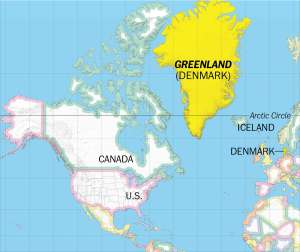
President-elect Donald J. Trump’s attention returned Tuesday to an idea that has fascinated him for years: acquiring Greenland for the United States. In a news conference on Tuesday, he refused to rule out using military or economic force to take the territory from Denmark, a U.S. ally.
“We need Greenland for national security purposes,” he said, arguing that Denmark should give it up to “protect the free world.” He threatened to impose tariffs on Denmark if it did not.
Earlier in the day, Mr. Trump wrote on social media that the potential American acquisition of the Arctic territory “is a deal that must happen” and uploaded photos of his eldest son, Donald Trump Jr., who was visiting Greenland….
Greenland
After the news conference, Denmark sharply rebuked the proposal, saying that the world’s largest island is not for sale, and the prime minister of Greenland, Mute B. Egede, rejected Mr. Trump’s designs on the territory. “Greenland belongs to the people of Greenland,” Mr. Egede said. “Our future and fight for independence is our business.” [….]
Greenland’s vast ice sheets and glaciers are quickly retreating as the Earth warms through accelerating climate change. That melting of ice could allow drilling for oil and mining for minerals such as copper, lithium, nickel and cobalt. Those mineral resources are essential to rapidly growing industries that make wind turbines, transmission lines, batteries and electric vehicles.
Because of higher temperatures, an estimated 11,000 square miles of Greenland’s ice sheets and glaciers have already melted in the past three decades, an area roughly the size of Massachusetts….
The melting ice in the Arctic is also opening up a new strategic asset in geopolitics: shorter and more efficient shipping routes. Navigating through the Arctic Sea from Western Europe to East Asia, for example, is about 40 percent shorter compared to sailing through the Suez Canal. Ship traffic in the Arctic has already surged 37 percent over the past decade, according to a recent Arctic Council report.
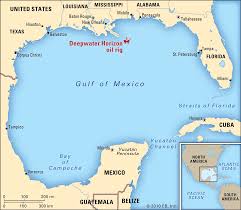
Donald Trump on Tuesday said the United States would change the name of the Gulf of Mexico to the Gulf of America, and the president-elect seemed to tie the prospective renaming to his long-standing grievances with Mexico’s handling of immigration, drug trafficking and trade.
“We’re going to be changing the name of the Gulf of Mexico to the Gulf of America,” Trump said at a news conference at his Mar-a-Lago Club in Palm Beach, Florida. “ … What a beautiful name, and it’s appropriate.”
The president-elect subsequently decried the Mexican government for allowing migrants to “pour” into the United States, saying Mexico “can stop them and we’re going to put very serious tariffs on Mexico and Canada because Canada, they come through Canada, too.”
Trump provided no additional details about how he planned to implement the name change, but the comments sparked immediate questions about whether a president has the authority to rename an international body of water and prompted at least one Republican member of Congress to draft legislation.
That member of Congress was Marjorie Taylor Greene.
Here’s what we know about what Trump can and cannot do to rename the gulf….
The Gulf of Mexico is a 218,000-square-mile oceanic basin connected to the Caribbean Sea and the Atlantic Ocean through the Florida Straits and the Yucatán Channel. It spans from the eastern coast of Mexico and the southeastern coast of the United States to the western end of Cuba….
There are existing mechanisms to rename places recognized by the federal government. However, if the federal name change becomes official, that does not mean that other nations will recognize it.
The U.S. Board on Geographic Names is a federal interagency organization that is responsible for maintaining uniform geographic name usage throughout the federal government. The board operates under the interior secretary. The board’s Foreign Names Committee is responsible for standardizing foreign place names. The committee is composed of representatives from federal agencies, including several appointees specializing in geography and cartography. Members are appointed every two years.
While the BGN does not create names for geographical features, it approves or rejects names proposed by others based on its established policies. A recent example of the board’s work includes approval of replacement names for all features that included the word “squaw,” which is used as a derogatory slur toward NativeAmerican women. The name changes were made after an order by Interior Secretary Deb Haaland in 2021. Haaland is the first Native person to serve as a Cabinet secretary.
Trump probably doesn’t know that Mexico and Canada, along with the U.S., are each parts of “America.”–that is, the continent of North America. Of course changing the name is ridiculous and idiotic, but so is Trump.
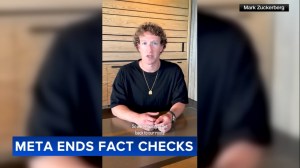
During the “press conference,” Trump also said that the changes Mark Zuckerberg is making to his social media platforms are in response to his (Trump’s) threats to imprison the the billionaire social media owner.
Meta CEO Mark Zuckerberg announced a series of major changes to the company’s moderation policies and practices Tuesday, citing a shifting political and social landscape and a desire to embrace free speech.
Zuckerberg said Meta will end its fact-checking program with trusted partners and replace it with a community-driven system similar to X’s Community Notes.
The company is also changing its content moderation policies around political topics and undoing changes that reduced the amount of political content in user feeds, Zuckerberg said.
The changes will affect Facebook and Instagram, two of the largest social media platforms in the world, each boasting billions of users, as well as Threads.
“We’re going to get back to our roots and focus on reducing mistakes, simplifying our policies and restoring free expression on our platforms,” Zuckerberg said in a video. “More specifically, here’s what we’re going to do. First, we’re going to get rid of fact-checkers and replace them with community notes similar to X, starting in the U.S.”
Zuckerberg pointed to the election as a major influence on the company’s decision and criticized “governments and legacy media” for, he alleged, pushing “to censor more and more.”
“The recent elections also feel like a cultural tipping point towards, once again, prioritizing speech,” he said. “So we’re going to get back to our roots and focus on reducing mistakes, simplifying our policies and restoring free expression on our platforms.”
These two sections outlining speech (written or visual) are new additions:
We do allow allegations of mental illness or abnormality when based on gender or sexual orientation, given political and religious discourse about transgenderism and homosexuality and common non-serious usage of words like “weird.”
We do allow content arguing for gender-based limitations of military, law enforcement, and teaching jobs. We also allow the same content based on sexual orientation, when the content is based on religious beliefs.
Another section that specifically banned making dehumanizing references to transgender or non-binary people as “it” or referring to women “as household objects or property or objects in general” has been removed entirely.
The opening statement about what the policies are “designed to allow room for” that previously listed only health or positive support groups has changed too (new additions marked in bold):
People sometimes use sex- or gender-exclusive language when discussing access to spaces often limited by sex or gender, such as access to bathrooms, specific schools, specific military, law enforcement, or teaching roles, and health or support groups. Other times, they call for exclusion or use insulting language in the context of discussing political or religious topics, such as when discussing transgender rights, immigration, or homosexuality. Finally, sometimes people curse at a gender in the context of a romantic break-up. Our policies are designed to allow room for these types of speech.
The section that specifically banned targeting people or groups “with claims that they have or spread the novel coronavirus” has also been removed.
Meta on Tuesday announced sweeping changes to how it moderates content that will roll out in the coming months, including doing away with professional fact checking. But the company also quietly updated its hateful conduct policy, adding new types of content users can post on the platform, effective immediately.
Users are now allowed to, for example, refer to “women as household objects or property” or “transgender or non-binary people as ‘it,’” according to a section of the policy prohibiting such speech that was crossed out. A new section of the policy notes Meta will allow “allegations of mental illness or abnormality when based on gender or sexual orientation, given political and religious discourse about transgenderism and homosexuality.”
Previously, such comments would have been subject to removal under the policy. The changes to Meta’s hateful conduct policy were first reported by Wired.
Meta had hinted in its announcement about its content moderation policy changes Tuesday morning that it would get rid of restrictions on certain topics, such as immigration and gender identity, and allow more political discussions. But the updated policy shows just how quickly Meta is moving to enact CEO Mark Zuckerberg’s vision for “free expression.”
Meta on Tuesday also announced it would do away with its network of independent fact checkers in the United States and will instead rely on user-generated “community notes” to add context to posts. It also said it would adjust its automated systems that scan for policy violations, which it says have resulted in “too much content being censored that shouldn’t have been.” The systems will now be focused only on extreme violations such as child sexual exploitation and terrorism.
Basically, it’s open season on women and LBGTQ+ people.
Please take care of yourselves today and every day for the next 4 years.
Did you like this post? Please share it with your friends:
Francine van Hove, Plasirs du Matin, “Morning Pleasures,” French, 1942
There may be some movement in the Ukraine crisis. The AP reported this morning that some Russian troops are being pulled back and returned to their bases. Later the story was updated to report that Putin wants to negotiate: Putin: Russia ready to discuss confidence-building measures.
Russian President Vladimir Putin said Tuesday that Moscow is ready for talks with the U.S. and NATO on limits for missile deployments and military transparency.
Speaking after talks with German Chancellor Olaf Scholz, Putin said the U.S. and NATO rejected Moscow’s demand to keep Ukraine and other ex-Soviet nations out of NATO, halt weapons deployments near Russian borders and roll back alliance forces from Eastern Europe.
They agreed to discuss a range of security measures that Russia had previously proposed.
Putin said that Russia is ready to engage in talks on limits on the deployment of intermediate range missiles in Europe, transparency of drills and other confidence-building measures but emphasized the need for the West to heed Russia’s main demands.
The statement followed the Russian Defense Ministry’s announced a partial pullback of troops after military drills, adding to hopes that the Kremlin may not be planning to invade Ukraine imminently. The Russian military gave no details on where the troops were pulling back from, or how many.
NATO Secretary General Jens Stoltenberg said Tuesday he sees reason for “cautious optimism” after Moscow signaled willingness to continue talks to resolve the crisis over Ukraine, and Russia said some of its troops were returning to base. But the NATO chief noted no signs of Russian de-escalation “on the ground.”
“There are signs from Moscow that diplomacy should continue,” Stoltenberg told reporters in Brussels ahead of meetings with NATO defense ministers Wednesday. “There are grounds for cautious optimism. So far, we have not seen any sign of de-escalation on the ground.”
After Russian President Vladimir Putin signaled Monday that he was open to diplomacy to resolve the crisis between Russia and NATO over Ukraine’s bid to join the alliance, Moscow sent a barrage of contradictory signals Tuesday — announcing that some Russian forces were being sent home after completing drills, even as major military exercises continued near Ukraine.
Putin met German Chancellor Olaf Scholz in the Kremlin on Tuesday, the latest in a string of Western leaders urging the Russian president to de-escalate the most serious crisis in Russia’s relations with NATO since the end of the Cold War.
U.S. officials have warned that Putin has the final military pieces in position to launch a major attack within days if he chooses to do so.
“We have not seen any de-escalation on the ground, no signs of reduced Russian military presence on the border with Ukraine,” Stoltenberg said Tuesday. He said NATO is looking for a “significant and enduring” withdrawal of Russian forces, troops and heavy equipment from areas bordering Ukraine as a sign of real de-escalation.
Donald J. Trump’s longtime accounting firm cut ties with him and his family business last week, saying it could no longer stand behind a decade of annual financial statements it prepared for the Trump Organization, court documents show.
The decision, which was disclosed to the company in a Feb. 9 letter from the accounting firm, comes amid criminal and civil investigations into whether Mr. Trump illegally inflated the value of his assets. The firm, Mazars USA, compiled the financial statements based on information the former president and his company provided.
The letter instructed the Trump Organization to essentially retract the documents, known as statements of financial condition, from 2011 to 2020. In the letter, Mazars noted that the firm had not “as a whole” found material discrepancies between the information the Trump Organization provided and the actual value of Mr. Trump’s assets. But given what it called “the totality of circumstances” — including Mazars’ own investigation — the letter directed the Trump Organization to notify anyone who received the statements that they should no longer rely on them.
The statements, which Mr. Trump used to secure loans, are at the center of the two law enforcement investigations into whether Mr. Trump exaggerated the value of his properties to defraud his lenders into providing him the best possible loan terms.
Mazars’ acknowledgment that the statements were fundamentally flawed was a potential blow to the Trump Organization as it attempts to fend off the long-running scrutiny of its finances. And for Mr. Trump, whose personal finances are intertwined with those of his family business and who has long faced questions about his taxes, Mazars is the latest in a long line of companies to break with him over the last year, following in the path of several banks, insurers and lawyers.
The disclosures about Mazars’ work for Mr. Trump appeared in new court documents filed by the New York attorney general, Letitia James, who is seeking to question the former president and two of his adult children under oath as part of her civil investigation.
A couple of expert reactions to this story:
With Trump’s accountants at Mazars quitting, it may get hard for the Trump Organization to stay in business. And Trump’s accountants had similar concerns back when he sued me more than a decade ago – so what made them so anxious now? A column: https://t.co/h1I4lLSW6U
I’m sure you’ve heard about the legal filing by John Durham, the special counsel appointed by Bill Barr to investigate the Russia investigation, that implied some kind of sinister activity by the Clinton campaign in 2016. The right wing media has been going nuts over this, but it’s basically meaningless. Charlie Savage explains at The New York Times: Court Filing Started a Furor in Right-Wing Outlets, but Their Narrative Is Off Track.
When John H. Durham, the Trump-era special counsel investigating the inquiry into Russia’s 2016 election interference, filed a pretrial motion on Friday night, he slipped in a few extra sentences that set off a furor among right-wing outlets about purported spying on former President Donald J. Trump.
But the entire narrative appeared to be mostly wrong or old news — the latest example of the challenge created by a barrage of similar conspiracy theories from Mr. Trump and his allies.
Upon close inspection, these narratives are often based on a misleading presentation of the facts or outright misinformation. They also tend to involve dense and obscure issues, so dissecting them requires asking readers to expend significant mental energy and time — raising the question of whether news outlets should even cover such claims. Yet Trump allies portray the news media as engaged in a cover-up if they don’t.
The latest example began with the motion Mr. Durham filed in a case he has brought against Michael A. Sussmann, a cybersecurity lawyer with links to the Democratic Party. The prosecutor has accused Mr. Sussmann of lying during a September 2016 meeting with an F.B.I. official about Mr. Trump’s possible links to Russia.
The filing was ostensibly about potential conflicts of interest. But it also recounted a meeting at which Mr. Sussmann had presented other suspicions to the government. In February 2017, Mr. Sussmann told the C.I.A. about odd internet data suggesting that someone using a Russian-made smartphone may have been connecting to networks at Trump Tower and the White House, among other places.
Mr. Sussmann had obtained that information from a client, a technology executive named Rodney Joffe. Another paragraph in the court filing said that Mr. Joffe’s company, Neustar, had helped maintain internet-related servers for the White House, and that he and his associates “exploited this arrangement” by mining certain records to gather derogatory information about Mr. Trump.
Mary Cassatt, Breakfast in Bed, 1897
The right wingers are thrilled by this story, but it’s complete bullshit.
The conservative media also skewed what the filing said. For example, Mr. Durham’s filing never used the word “infiltrate.” And it never claimed that Mr. Joffe’s company was being paid by the Clinton campaign.
Most important, contrary to the reporting, the filing never said the White House data that came under scrutiny was from the Trump era. According to lawyers for David Dagon, a Georgia Institute of Technology data scientist who helped develop the Yota analysis, the data — so-called DNS logs, which are records of when computers or smartphones have prepared to communicate with servers over the internet — came from Barack Obama’s presidency.
“What Trump and some news outlets are saying is wrong,” said Jody Westby and Mark Rasch, both lawyers for Mr. Dagon. “The cybersecurity researchers were investigating malware in the White House, not spying on the Trump campaign, and to our knowledge all of the data they used was nonprivate DNS data from before Trump took office.”
In a statement, a spokesperson for Mr. Joffe said that “contrary to the allegations in this recent filing,” he was apolitical, did not work for any political party, and had lawful access under a contract to work with others to analyze DNS data — including from the White House — for the purpose of hunting for security breaches or threats.
Marcy Wheeler has been covering this story since the beginning. You can read what she has to say in these posts at her Emptywheel blog:
Police officers who responded to a 911 call about a disturbance in a Lower Manhattan building on Sunday heard a woman screaming when they reached the sixth floor, but the door to the apartment where the screams had come from was locked.
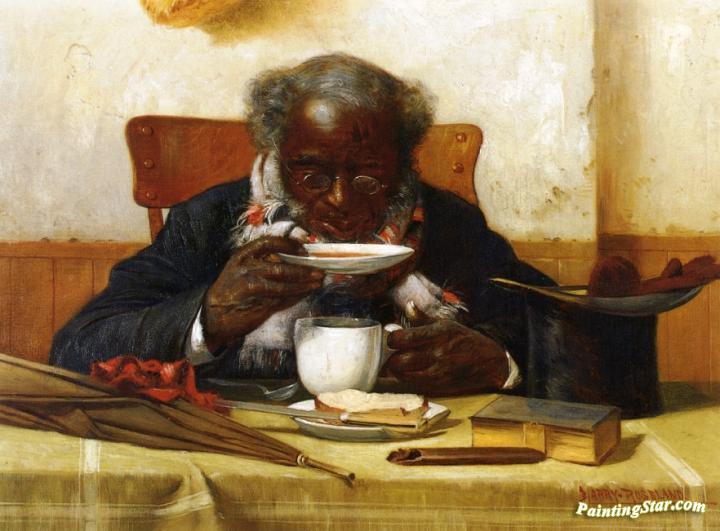
Morning Coffee, by Harry Roseland
As police struggled with the door, at first they still heard her calls for help, but “then she went quiet,” a prosecutor, Dafna Yoran, said in a Manhattan Criminal Court hearing on Monday night. Another voice emerged, sounding like a woman and telling them, “‘We don’t need the police here — go away.’”
When a specialized police unit arrived and broke down the door, they found Christina Yuna Lee, 35, dead in her bathtub with more than 40 stab wounds. The second voice, Ms. Yoran said, was actually that of Assamad Nash, who had followed the victim into the building on Chrystie Street in Chinatown, forced his way into her home and stabbed her.
When officers broke into the apartment, the police found Mr. Nash hiding under a bed and the knife believed to be the murder weapon hidden behind a dresser, prosecutors said.
It’s not yet clear why Ms. Lee was targeted, but the Asian community in New York is terrified.
Mr. Nash, 25, whose last known address was a men’s homeless shelter in the Bowery, was arraigned on first-degree charges of murder, burglary and sexually motivated burglary. A judge ordered him held without bail, and prosecutors said he was facing a sentence of up to 25 years to life in prison if convicted.
Though the authorities have not determined that Ms. Lee was targeted because of her ethnicity, her killing stoked fears in the city’s Asian community, which was already on edge after a rise in attacks during the pandemic.
Her killing also fit a pattern that has become an unsettlingly common feature of the pandemic in New York City: a seemingly unprovoked attack in which the person charged is a homeless man. In many neighborhoods in Manhattan, residents have expressed growing concern about homeless people, some of whom seem to be struggling with mental illness, menacing and harassing passers-by.
Ms. Lee, who graduated from Rutgers University in 2008 with a bachelor’s degree in art history, worked as a creative producer for Splice, an online music platform based in New York City. The company said in a statement that it was heartbroken over her “senseless” death.
Canadian police tried to clear protesters near crossings at the U.S.-Canada border, making arrests as Prime Minister Justin Trudeau invoked the country’s Emergencies Act on Monday.
The Morning Coffee, by Charles Hawthorne
Standoffs between police and protesters in Coutts, Alberta, and Surrey, B.C., persisted overnight after authorities had earlier reopened the Ambassador Bridge, the busiest land border crossing and a key trade artery connecting Windsor, Ontario, to Detroit.
Trudeau on Monday became the first Canadian leader to invoke the act, under pressure to quell the chaos that has spiraled from the self-styled “Freedom Convoy” demonstrations against vaccine mandates and coronavirus restrictions.
The law, passed in 1988, will give police “more tools” to bring order to areas where public assemblies “constitute illegal and dangerous activities,” he said. Financial institutions, meanwhile, will get sweeping powers to halt the flow of funding to the Freedom Convoy protests.
Critics of Trudeau’s move quickly spoke out against the Liberal government. The nonprofit Canadian Civil Liberties Association said using the law, which gives the federal government broad powers, such as the authority to freeze financial accounts without court orders, was unjustified. “Emergency legislation should not be normalized. It threatens our democracy and our civil liberties,” it said in a statement.
Is Trump deliberately letting Americans die? It certainly appears that he is directing scarce medical supplies to red states like Florida while actively trying to prevent deliveries of such equipment to blue states.
On Thursday I posted about a massive shipment of N95 masks that was delivered to Massachusetts through the intervention of the Kraft family, owners of the New England Patriots. The Krafts arranged to have the Patriots plane fly to China and back to pick up more than a million masks. Another shipment will follow later. The Krafts also donated $2 million toward the cost of the masks. From The Boston Globe:
The news, which broke early Thursday, resembled a plot pulled straight out of a summer blockbuster: The Kraft family had deployed a New England Patriots team plane to China to deliver about one million desperately needed N95 respirator masks to health care workers in Massachusetts.
By Rudi Herzimeier
Yet the story is as alarming as it is heartwarming, underscoring a harsh reality as the coronavirus pandemic spreads ever faster around the United States. Governor Charlie Baker and his counterparts throughout the country are forced to go to extraordinary lengths to secure life-saving medical equipment in the absence of a coordinated federal response.
“This is not how it is supposed to work,” said Representative Katherine Clark of Melrose, a member of House Speaker Nancy Pelosi’s leadership team. She described herself as “very grateful” for the Kraft family’s generosity and help getting the critical gear, but said “what we need is a coordinated federal system.”
Why was such a dramatic effort necessary? Because Trump has been actively preventing Massachusetts from purchasing medical supplies.
The journey began, in the governor’s telling, roughly two weeks ago, when the federal government confiscated a shipment of more than 3 million N95 masks at the Port of New York and New Jersey that Massachusetts had arranged to buy….
Baker’s victory in the state’s intense hunt for masks and other protective gear, or PPE, follows weeks of increasingly public frustration from the normally even-keeled governor. His administration has hit numerous roadblocks thrown up by the federal government, which has repeatedly snatched supplies from the states’ hands and directed governors to find their own source.
Very Introvert Cat Sitting on a Red Chair, by Nastya Ozozo
Even now, Baker administration officials are still waiting on the federal government to deliver promised help. Earlier this week, Baker announced that the state had ordered 1,000 ventilators from the federal government and that he expected the delivery by the end of this week. On Thursday, Baker said Massachusetts still hasn’t gotten any of the equipment and he no longer expects them by the end of the week.
Normally calm and matter-of-fact, Baker choked back tears when he spoke at Logan Airport after meeting he Patriots plane.
About two weeks ago, Illinois officials tracked down a supply of 1.5 million potentially life-saving N95 respirator masks in China through a middleman in the Chicago area and negotiated a deal to buy them.
One day before they were expecting to complete the purchase, they got a call in the morning from the supplier informing them he had to get a check to the bank by 2 p.m. that day, or the deal was off. Other bidders had surfaced.
Realizing there was no way the supplier could get to Springfield and back by the deadline, Illinois assistant comptroller Ellen Andres jumped in her car and raced north on I-55 with a check for $3,469,600.
By Shozo Ozaki.
From the other end, Jeffrey Polen, president of The Moving Concierge in Lemont, drove south. Polen isn’t in the medical supply business, but he “knows a guy,” an old friend who specializes in working with China’s factories.
As they drove, Andres and Polen arranged to meet in the parking lot of a McDonald’s restaurant just off the interstate in Dwight. They made the handoff there.
Polen made it back to his bank with 20 minutes to spare. Illinois already has received part of the mask shipment. There’s more on the way.
That’s just a taste of the “Wild West” world of emergency procurement taking place over the past several weeks as the state fights for equipment and supplies to protect frontline workers and patients in the battle against COVID-19.
Why is this chaos necessary? Because Trump refuses to allow the federal government to organize the pandemic response.
We know that CO, MA, MI and MT have all had supply orders cancelled or taken by the federal government. https://t.co/pGnaE8o2TV
The Trump administration quietly invoked the Defense Production Act to force medical suppliers in Texas and Colorado to sell to it first — ahead of states, hospitals or foreign countries.
It took this action more than a week before it announced Thursday that it would use the little-known aspect of the law to force 3M to fill its contract to the U.S. first. Firms face fines or jail time if they don’t comply.
Terry Runyan, Yellow Cat
The Cold War-era law gives federal officials the power to edge out the competition and force contractors to provide supplies to them before filling orders for other customers.
While it’s unclear how many times the power has been used during the coronavirus pandemic, federal contracting records examined by Kaiser Health News show that federal authorities staked first rights to $137 million in medical supplies. The orders in late March flew under the radar, even as dog-eat-dog bidding wars raged among states and nations for desperately needed medical protective gear.
“It’s like ‘Lord of the Flies’ out there for states and hospitals as they bid against each other for critical medical supplies and equipment,” Sen. Chris Murphy (D-Conn.) said in a statement to KHN. “Plus, there’s no transparency about what the federal government is doing with the equipment that they purchase when they outbid states and hospitals.”
At the Coronavirus Task Force briefing on Thursday, we learned that, instead of sending medical supplies controlled by the Pentagon (paid for by taxpayers) directly to states, the administration is handing the equipment over to private companies to resell to the highest bidder. Here’s what Lt. Katrina recovery hero Gen. Russell Honore had to say about that.
After hearing the White House say critical supplies are going to commercial distributors who are then selling them to the states which are begging for help, I called @ltgrusselhonore who commanded federal troops after Hurricane Katrina to get his reaction. Watch this: pic.twitter.com/x7u3qoQ0v6
President Donald Trump’s top adviser and son-in-law Jared Kushner insisted on Thursday that the government had not built up a national stockpile of medical equipment for states to use during threats like the coronavirus since those states have strategic reserves of their own.
The remark drew raised eyebrows from experts, considering presidents have dispersed supplies from the national strategic stockpiles for use by states dozens of times over the last twenty years.
In fact, the Trump administration itself has dipped into the federal reserves to help states in need…
Malarstwo Japońskie
“He doesn’t know what the hell he is talking about. He has no idea,” said Gen. Russel Honore, a retired military general who helped direct the response on the ground during Hurricane Katrina. “He must have remembered something from some slide or some speech. But that’s why people created the national strategic stockpile in the first place. It’s for those days when we can’t predict what we need. What I see is a total misunderstanding by the White House that they have a responsibility to help maintain the stockpile and help states.” [….]
While state governments do possess their own stockpiles of equipment and supplies, the national strategic stockpile was originally designed in 1999 to help states fill the gaps when facing things like natural or health disasters. The role of the stockpile has expanded dramatically in recent years amid more frequent natural disasters.
But the Trump White House’s approach to filling the supply chain gaps has been slapstick at best, officials say, in part because it was unprepared for taking the lead in responding to a global pandemic. For weeks, the administration struggled to understand which agency was responsible for studying the supply chain breakdown and which was in charge of fixing not only the dwindling medical supplies in hospitals, but also the shortages of products like toilet paper and paper towels in grocery stores.
“We missed dealing with this disaster because for weeks, the White House said it was a hoax,” Honore said. “So we missed at least four weeks of anticipation and preparation on the logistics side because of our leadership.” [….]
“It shouldn’t be this complicated,” said Juliette Kayyem, a former assistant secretary of the Department of Homeland Security. “It’s supposed to happen like a light switch you flip on. And this should have happened a month ago. This is not inventing a vaccine, this is just shipping stuff. In these situations you want a light White House touch and you want the subject matter experts to take the lead.”
Well, it’s another day to find out how low the party and appointments of KKKremlin Caligula can go and it’s low. It’s about as low as the nadir of morality set by the monster himself. Today’s news isn’t pleasant at all from any vantage point. I’m reminded that death is a natural part of life and one that every one tries to ignore but must face. I’d like to give a jazz funeral for some of these items, but I’m having a hard time celebrating the life before the loss.
Today, is our first day without Net Neutrality. Any of us that have been on the internet a long time–1981 for me–will know that everything use to be much freer, less commercial, and less ridden with stalkers. I don’t miss the old modem that required a telephone ear/mouth piece. I don’t miss having to direct dial to most sites. I also do not miss that the only graphics you would ever see were in either gold and green and entirely composed of characters. I do miss the days before AOL let all their subscribers lose on the web and there is much we will miss with the death of Net Neutrality. This is from Slate.
Monday, June 11, is the first day of the post-net neutrality internet. In December, the Federal Communications Commission voted to repeal the Obama-era rules that prohibit internet companies from slowing down or speeding up access to certain websites, but it took about six months for the repeal to get a sign-off from the Office of Management and Budget and for the new rules to be published in the federal register. Beginning, well, now, your internet access could—emphasis on could—feel dramatically different than it did yesterday.
Under the new network neutrality rules, internet service providers like Comcast, Verizon, and AT&T are allowed to throttle traffic that travels over their network or even block access to entire websites as long as the companies alert their subscribers in their terms of service that they reserve the right to do so. But since most people in the United States don’t have more than one or two internet providers to choose from for broadband service, that means if users don’t wish to accept those terms, many won’t have anywhere else to go for their internet. Without net neutrality rules stopping them, internet providers will also be able to charge websites a fee to reach users faster.
Those internet providers stand to win the most from the net neutrality repeal, since they’ll be able to operate what is essentially a two-way toll, collecting money from both subscribers and websites that want priority access to users. Already-powerful, deep-pocketed companies that can afford to pay for the fast-lane service, like Facebook or Yelp could wind up in a position to set the price, relegating smaller companies, nonprofits, or struggling news organizations to what is, in effect, a slower internet.
Leo Touchet, Jazz Funeral No. 70 (New Orleans, Louisiana) (1969)
We’re seeing another nail in the coffin of voting rights. Today’s death blow came from the Supreme Court of the United States and yes, you know the ones that did it to us. This is from Buzzfeed‘s Court Reporter Chris Geidner:”The Supreme Court Just Upheld Ohio’s Aggressive Process For Purging Voters From The Rolls. The court split 5–4 on ideological grounds.”
The Supreme Court upheld Ohio’s system for purging inactive voters from the rolls — a decision that could lead other states to implement its aggressive procedure that can be triggered after a person fails to vote in one federal election.
Justice Samuel Alito wrote Monday’s 5–4 decision for the court, which was split along ideological lines.
Under Ohio’s system, voters who do not vote in a two-year period are sent a notice from the state. If they do not return the notice and then fail to vote for the next four years, their voter registration is canceled.
The Supreme Court held that the state’s process did not violate federal law.
Ohio had argued that its process was based on a provision of the National Voter Registration Act that allows states to remove people from voting rolls based on the grounds that they moved.
The A. Philip Randolph Institute, which sued the state, argued that the state, in fact, violated a different provision — which says that a person cannot be removed from voter rolls simply for failing to vote.
The court ruled that the state only uses the failure to vote “as a rough way of identifying voters who may have moved,” but that it actually begins the removal process by sending “a preaddressed, postage prepaid card to these individuals asking them to verify that they still reside at the same address.”
The court rejected the challengers’ argument that Ohio’s system violates the “Failure-to-Vote Clause.” The clause, Alito wrote, “simply forbids the use of nonvoting as the sole criterion for removing a registrant, and Ohio does not use it that way.”
Justice Stephen Breyer summed up the dissenting justices’ view that Monday’s decision was an exercise in circular reasoning.
Many of Donald Trump’s critics find it difficult to ascribe to a president they consider to be both subliterate and historically insensate a foreign-policy doctrine that approaches coherence. A Trump Doctrine would require evidence of Trump Thought, and proof of such thinking, the argument goes, is scant. This view is informed in part by feelings of condescension, but it is not meritless. Barack Obama, whose foreign-policy doctrine I studied in depth, was cerebral to a fault; the man who succeeded him is perhaps the most glandular president in American history. Unlike Obama, Trump possesses no ability to explain anything resembling a foreign-policy philosophy. But this does not mean that he is without ideas.
Over the past couple of months, I’ve asked a number of people close to the president to provide me with short descriptions of what might constitute the Trump Doctrine. I’ve been trying, as part of a larger project, to understand the revolutionary nature of Trump’s approach to world affairs. This task became even more interesting over the weekend, when Trump made his most ambitious move yet to dismantle the U.S.-led Western alliance; it becomes more interesting still as Trump launches, without preparation or baseline knowledge, a complicated nuclear negotiation with a fanatical and bizarre regime that quite possibly has his number.
Trumpian chaos is, in fact, undergirded by a comprehensible worldview, a number of experts have insisted. The Brookings Institution scholar (and frequent Atlantic contributor) Thomas Wright argued in a January 2016 essaythat Trump’s views are both discernible and explicable. Wright, who published his analysis at a time when most everyone in the foreign-policy establishment considered Trump’s candidacy to be a farce, wrote that Trump loathes the liberal international order and would work against it as president; he wrote that Trump also dislikes America’s military alliances, and would work against them; he argued that Trump believes in his bones that the global economy is unfair to the U.S.; and, finally, he wrote that Trump has an innate sympathy for “authoritarian strongmen.”
We continue to discover how deep Russian interference was in our election in 2016. This is horrifying and it shows how big money and big lobbyists are killing our democracy.
BREAKING: Several prominent Russians, some in President Vladimir Putin’s inner circle or high in the Russian Orthodox Church, now have been identified as having contact with @NRA officials during the 2016 U.S. election campaign. https://t.co/goKK64ZaNs
You should read the entire article but here’s the money line.
Several prominent Russians, some in President Vladimir Putin’s inner circle or high in the Russian Orthodox Church, now have been identified as having contact with National Rifle Association officials during the 2016 U.S. election campaign, according to photographs and an NRA source.
The contacts have emerged amid a deepening Justice Department investigation into whether Russian banker and lifetime NRA member Alexander Torshin illegally channeled money through the gun rights group to add financial firepower to Donald Trump’s 2016 presidential bid.
Other influential Russians who met with NRA representatives during the campaign include Dmitry Rogozin, who until last month served as a deputy prime minister overseeing Russia’s defense industry, and Sergei Rudov, head of one of Russia’s largest philanthropies, the St. Basil the Great Charitable Foundation. The foundation was launched by an ultra-nationalist ally of Russian President Putin.
“In all of this, in any of this, there’s been no evidence that there’s been any collusion between the Trump campaign and President Trump and Russia,” House Speaker Paul Ryan said Thursday at his weekly press conference. “Let’s just make that really clear. There’s no evidence of collusion. This is about Russia and what they did and making sure they don’t do it again.”
From Ryan’s perspective, it would be convenient if it were true that Robert Mueller’s investigation had turned up no evidence of collusion, but it simply isn’t.
Republicans from Donald Trump on down have made “no collusion” a mantra. The term itself is ill-defined in this context; you won’t find in the US code. But roughly speaking, the question is whether the campaign got involved with Russian agents who committed computer crimes to help Trump win the 2016 presidential election.
The verdict on this is unclear. But there is certainly plenty of evidence pointing toward collusion; what you would call “probable cause” in a legal context, or what a journalist might simply consider reason to continue investigating the story. And the investigating thus far, both by special counsel Mueller and by journalists working on the story, has been fruitful. The efforts have continued to turn up contacts between Trumpworld and Putinland, cover-ups, and dishonesty.
Even as recently as Friday afternoon, we got new indictments charging Trump’s former campaign chair and his former GRU operative business partner with witness tampering and obstruction of justice.
It’s important, obviously, not to prejudge a case. It turns out that Saddam Hussein was acting like a man who was covering up a secret nuclear weapons arsenal because he didn’t want the world to know how weak his defenses really were.
By the same token, it’s certainly possible that the various Trump-Russia contacts never amounted to anything and that they’ve been consistently covered up for some reason otherthan an effort to hide collusion. But both the contacts that have been revealed so far and the deception used to deny their existence are certainly evidence of collusion — evidence that should be (and is being) pursued by the special counsel’s office and that should not be dismissed by the press or by elected officials.
But after a weekend when President Trump called Canadian Prime Minister Justin Trudeau “very dishonest and weak,” after he refused to sign the joint communique from the G-7 summit, and after a top Trump aide said “there’s a special place in hell for any foreign leader that engages in bad faith diplomacy with President Donald J. Trump and then tries to stab him in the back on the way out the door” — those same Republican leaders have been silent.
(What did Trudeau do, by the way, to earn that condemnation from Team Trump? He said that Canada would respond with reciprocal tariffs on the U.S. tariffs the Trump administration imposed on Canada — nothing he and his government haven’t said before, including on “Meet the Press” a week ago.)
The one exception to this GOP silence was Sen. John McCain, who tweeted: “To our allies: bipartisan majorities of Americans remain pro-free trade, pro-globalization & supportive of alliances based on 70 years of shared values. Americans stand with you, even if our president doesn’t.”
But other Republicans haven’t repeated that message, which is striking when free trade has been one of the GOP’s central tenets over the last few decades. And there’s only one explanation for that Republican silence: Trump has bullied the entire party into submission — well, at least those who will have to face voters again.
Today begins the frightening process of watching two madmen sit across the table to compare dick sizes. My money is on the North Koreans.
As Rick Wilson says: “Everything Trump touches dies.” We have not attended our last funeral but let’s try to find ways to comfort ourselves in the small celebrations of our daily lives. This includes all of my dear friends here on Sky Dancing who I consider the best of family.
What’s on your reading and blogging list today?
Did you like this post? Please share it with your friends:
The Sky Dancing banner headline uses a snippet from a work by artist Tashi Mannox called 'Rainbow Study'. The work is described as a" study of typical Tibetan rainbow clouds, that feature in Thanka painting, temple decoration and silk brocades". dakinikat was immediately drawn to the image when trying to find stylized Tibetan Clouds to represent Sky Dancing. It is probably because Tashi's practice is similar to her own. His updated take on the clouds that fill the collection of traditional thankas is quite special.
You can find his work at his website by clicking on his logo below. He is also a calligraphy artist that uses important vajrayana syllables. We encourage you to visit his on line studio.


Now, the history of empires is the story of their rise and inevitable fall. As Herodotus wrote about Greek city-states, “most of those which were great once are small today; and those which used to be small were great in my own time.” But nobody has matched this current downfall for sheer egregious stupidity.
That wasn’t true for Nixon, of course, who by then had been out of office for three years. But last year the Supreme Court gutted the rulings that reined in Nixon, and now Trump and Elon Musk are running the government as if they are the only law in the land. They insist they are “saving” the country by burning down its institutions, and they claim a mandate of the people to do it….















 You should read the entire article but here’s the money line.
 Less we forget, Matt Ygelisias writing for Vox reminds us that:
  Yglesias has documented a rather long list of fires and smoking guns. Go check it out. We definitely need to throw a jazz funeral for what’s left of the values the Republican party held and ran on for years.
 peej
peej Carissa
 bostonboomer
 dakinikat
 ecocatwoman
 mablue2
 Mama Lopez
 peggysue22
 quixote
 skydancingguestblogger
 Mona (aka Wonk the Vote)



 Sky Dancing
Recent Comments