

It’s true that public opinion surveys are not showing any 2010-style GOP “wave,” but Democrats are rightly nervous that when polls begin identifying likely voters closer to November, superior Republican “base enthusiasm” could put a thumb on the scales in their favor.
Super-Lazy Saturday Reads
Posted: November 1, 2014 Filed under: 2014 elections, Congress, morning reads, psychology, religious extremists, The Media SUCKS, U.S. Politics, Voter Ignorance, We are so F'd | Tags: Civil Rights, Darren Wilson, Department of Justice, Ebola panic, Ferguson MO, Get out the vote, Kaci Hickox, Michael Brown, Missouri State University, polling errors, Racism, Senate control 62 Comments  Good Morning!!
It’s just one thing after another these days. I’m all stressed out again, because my mother broke her clavicle and I need to get out to Indiana ASAP. Unfortunately, I also have to go to the dentist this afternoon and then I have to figure out what to do about the jury duty I committed to in October, get the car checked out, and pack. Meet the top pediatric dentist near nyc, Elan Kaufman DMD. On top of that my car is due for an inspection sticker at the end of October. I’ll have to try to figure out if I’ll be back here by then or whether I should get the inspection done early.
Anyway, I’m hanging in there, realizing that my problems are nothing compared to so many other people in this crazy world. So what’s happening out there this morning?
Donald Trump continues to dominate the media. The good news is if they’re focusing on him, they can’t beat up on Hillary Clinton at the same time–or can they?
Trump’s misogyny knows no end–yesterday he turned his attention to fellow GOP candidate Carly Fiorina. From Ken Walsh’s Washington at U.S. News:
Another day, another insult from Donald Trump – and still another feud in the making.
This time, the Republican presidential front-runner belittled former business executive and presidential competitor Carly Fiorina, who has been making gradual progress in the polls but still lags behind Trump in the GOP race.
Rolling Stone magazine reports that Trump was watching Fiorina recently on a television newscast, in the presence of Rolling Stone reporter Paul Solotaroff, when the billionaire real-estate developer said, “Look at that face! Would anyone vote for that? Can you imagine that, the face of our next president?”
Trump added: “I mean, she’s a woman, and I’m not supposed to say bad things, but really, folks, come on. Are we serious?”
Watching Trump run for president is like watching a 5-year-old boy act out with no restraints.

The Guardian reports on Fiorina’s response:
Fiorina, speaking on Fox News to Megyn Kelly – who has also been targeted by Trump – said she considered his remarks to be “very serious”.
She added: “Maybe, just maybe, I’m getting under his skin a little bit because I am climbing in the polls.”
Trump has forged a consistent lead in polling for the Republican candidacy, with former Hewlett-Packard chief executive Fiorina considerably further behind, polling in single figures.
Maybe. Or maybe Trump is just a gigantic asshole. He also attacked Ben Carson and tried without success to defend his comments about Fiorina. From The Washington Post:
Carson attacked Trump in unusually sharp terms yesterday, seeming to question his faith. On Thursday, Trump went after Carson’s energy level — and played down his medical accomplishments, saying he was only an “okay doctor” (Carson was the first neurosurgeon to separate conjoined twins attached at the head.)
“He makes [Jeb] Bush look like the Energizer bunny,” Trump said on CNN Thursday morning. “Who is he to question my faith? … When he questions my faith, and I’m a believer big-league in God, the Bible…I will hit back for that.”
“He was a doctor… perhaps an OK doctor,” he also said, adding that “Ben Carson will not be the next president of the United States.”
Trump’s comments, which are the most aggressive he has made about Carson, come less than a day after the retired surgeon pointed to his faith when asked what he believes to be the biggest difference between himself and Trump.
“The biggest thing is that I realize where my success has come from, and I don’t any way deny my faith in God,” Carson Wednesday night. “And I think that probably is a big difference between us.”

Can you imagine having a president who says things like “I’m a believer big-league in God?” Is this really happening? On Fiorina:
Trump defended his comments on Fox News Thursday morning, dismissing the notion that he was talking about Fiorina’s physical appearance.
“Probably I did say something lik that about Carly,” Trump said. “I’m talking about persona. I’m not talking about look.”
So criticizing a woman’s face is not about her appearance? Yeah, right. Not much of defense. But the media won’t hold Trump accountable no matter what he says.
Meanwhile traditional conservative pundits profess to be utterly mystified by Trump’s success in his “campaign” so far. Brian Beutler at The New Republic: Donald Trump’s Biggest Conservative Enemies Helped Create Him.
Donald Trump’s durable lead in Republican primary polls, and improving approval ratings, continue to befuddle people who ought to have better insight into the state of the conservative mind. Writing for National Review, Jonah Goldberg and Charles C.W. Cooke have each diagnosed Trumpism as a failing of the conservative voters who comprise Trump’s base.
Cooke believes that Trump “has succeeded in convincing conservatives to discard their principles,” begging the question of whether Trump’s supporters ever really shared the principles that animate conservative organizations and National Review writers. Goldberg insisted that “no movement that embraces Trump can call itself conservative,” which helped give rise to #NRORevolt, an online backlash, thick with white nationalists and other conservatives who are fed up with elites who try to write non-conformists—from moderates to protectionists to isolationists to outright racists—out of the movement.
The anti-tax group Club for Growth is a big part of that purification apparatus. It is currently organizing and raising money for an effort to excise Trump before his view that hedge fund managers should pay their fair share in taxes metastasizes through the Republican primary field.
Republican consultant Steve Schmidt, who presumably sympathizes withNational Review and Club for Growth, described their frustrations as the described their frustrations as the result of a fatal disjunction between mass conservatism and the ideology that’s supposed to underlie it. “We’re at this moment in time,” Schmidttold NPR recently, “when there’s a severability between conservatism and issues. Conservatism is now expressed as an emotional sentiment. That sentiment is contempt and anger.”
This explains Trump’s rise and persistence, but fails to account for how“contempt and anger” became such valuable currency in Republican politics today. That omission is predictable, because such an accounting would implicate nearly everyone who now claims to be astonished and dismayed by the Trump phenomenon.
Read the rest at TNR.

A couple of weeks ago, I made a resolution that I would read Nate Silver’s FiveThirtyEight blog and Peter Daou and Tom Watson’s #HillaryMen blog every day. I’ve been doing it, and the effort has been paying off in terms of maintaining my equilibrium in an insane media atmosphere.
Silver had a nice, level-headed post on Trump and Bernie Sanders yesterday: Stop Comparing Donald Trump And Bernie Sanders.
A lot of people are linking the candidacies of Bernie Sanders and Donald Trump under headings like “populist” and “anti-establishment.” Most of these comparisons are too cute for their own good — not only because it’s too earlyto come to many conclusions about the campaign, but also because Trump and Sanders are fundamentally different breeds of candidates who are situated very differently in their respective nomination races.
You can call both “outsiders.” But if you’re a Democrat, Sanders is your eccentric uncle: He has his own quirks, but he’s part of the family. If you’re a Republican, Trump is as familial as the vacuum salesman knocking on your door.
Silver lists 7 differences between the two candidates–check them out at the link.

And from #HillaryMen, another sensible post: The Sad, Sisyphean Struggle of Hillary Haters.
Writing for Politico, Jack Shafer explains why he thinks “Being a Clinton apologist is a hard life.”
Which got us thinking: what must it be like to be a die-hard Hillary hater? Obsessing over one of the most accomplished and resilient public figures on the planet? How depressing and demoralizing is it to latch onto fabricated scandal after fabricated scandal, only to have every one fade away?
How frustrating is it to expend so much time and mental energy bashing, bashing, bashing, only to have Hillary come back stronger than ever?
And how awful is it to be on the wrong side of women’s history, to help reinforce the gender barrier that prevents women and girls from realizing their full potential?
We’re not talking about fair-minded critics and principled political opponents. They have every right to disagree with Hillary and to dislike her if they’re so inclined. We’re talking about haters, people who have a pathological need to savage Hillary. People who make an industry of their hate.
Think of the self-righteous rants on Morning Joe, the seething vitriol of Maureen Dowd, the feverish swamps of rightwing trolls. Think of the reporters and pundits who mindlessly repeat Rove-funded frames and narratives, hoping to taint Hillary’s public image, to sully her character. Think of the Republican and conservative operatives who have tried in vain for more than two decades to silence her.
Go over to #HillaryMen to read the rest.

As a bonus, here’s a nice column by Brent Budowsky at The Hill: Big truths about Hillary.
In olden days, great columnists such as Walter Lippmann and James “Scotty” Reston would periodically step back and put great events into perspective.
As America’s summer of political discontent and distemper ends, and as Americans shift from the fun of enjoying our favorite political performer to the mission of selecting our next president and as a pope of epochal significance prepares to address a joint session of a vastly unpopular Congress, let’s look at matters from a larger perspective.
It is revealing that while GOP presidential front-runner Donald Trump gets a pass from many in the media for repeated comments that were verbally abusive toward women, the candidate who would be the first female president, Hillary Clinton, is treated like a pinata by pundits on television news — which, according to Gallup, is one of the least trusted institutions in America.
When Clinton stands with virtually all of America’s democratic allies by forcefully supporting a plan to prevent Iran from obtaining nuclear weapons and stands with Pope Francis in support of treating refugees and immigrants humanely, she is acting like a stateswoman, commander in chief and humanitarian.
Meanwhile, the policies of GOP presidential candidates would leave Lady Liberty crying in New York Harbor as the pope arrives in America.
It is a big truth that Clinton would be the first female president, an achievement equal in historic magnitude to President Obama becoming our first black president.
If she is elected, moms and dads from Topeka to Tangiers will be telling their daughters that they too can achieve anything if they work hard and dream big.
By contrast, the Republican front-runner describes moms and daughters as fat pigs, dogs, slobs, disgusting animals and bimbos.
More big truths at the link. The piece is well worth reading.

A bit more news, links only:
Japan Today: More than 100,000 flee floods in eastern Japan; 7 missing.
New York Daily News Exclusive: James Blake, former tennis star, slammed to ground and handcuffed outside midtown hotel by white NYPD cops who mistook him for ID theft suspect.
Chron.com: Baltimore police arrest pastor a week after Gray protests.
The Daily Beast Exclusive: 50 Spies Say ISIS Intelligence Was Cooked.
Politico: David Brock: The New York Times has ‘a special place in hell.’
CNN: Homo naledi: New species of human ancestor discovered in South Africa.
National Geographic: This Face Changes the Human Story. But How?
What else is happening? Please Share your thoughts and links in the comment thread and have a nice Thursday.
Thursday Reads
Posted: October 30, 2014 Filed under: morning reads, Real Life Horror, U.S. Politics, We are so F'd | Tags: 2014 midterm elections, Halloween, horror, horror movies, Jessica Williams, street harassment 66 CommentsGood Morning!!
Tomorrow is Halloween, but the real horror will probably come next Tuesday when Republicans are predicted to take control of the Senate.
What will happen after that? Will they actually accomplish something, or will they just keep blocking everything President Obama tries to do? Even more horrifying, we may not know the makeup of the Senate for sure until next year, because two close races–in Georgia and Louisiana–will likely end up in runoffs.
Steven Brill at Reuters: Why Election Day won’t hold the answer to who will control the Senate for the next two years.
I’m not only thinking about the possibility that two close races — in Louisiana and Georgia — could end up requiring runoffs. If candidates do not get more than 50 percent of the vote because fringe opponents siphon off votes from the pair running neck and neck, Louisiana’s runoff would be in December and Georgia’s not until Jan. 6, 2015.
The uncertainty that’s more intriguing is that even after those runoffs, if they happen, there might be three independent senators who could swing the majority to one party or the other.
One, Vermont’s Bernie Sanders, is a staunch liberal who will certainly cast his lot with the Democrats, as he has in the past. But Maine independent Angus King has not said for sure that he will continue to caucus with Democrats. And Kansas’s Greg Orman, an independent businessman who is locked in a tight race with incumbent Republican Pat Roberts, has steadfastly refused to say which party he would vote with.
Another longer-shot wild card is former Senator Larry Pressler of South Dakota. He is also running has an independent, but his rise in the polls has subsided recently.
One can only imagine what Orman and King will be promised by both sides if one or both become swing votes. Beyond that, there is a Democratic senator in a red state (John Tester in Montana) and even one or two moderate Republicans in a blue state and a swing state (Mark Kirk in Illinois and Susan Collins in Maine) who might be persuaded to flip.
But most of the so-called experts are predicting we’ll ultimately be stuck with a Republican-controlled Congress. Larry Sabato, Kyle Londik, and Geoffrey Skelley write at Politico: Bet on a GOP Senate.
While many races remain close, it’s just getting harder and harder to envision a plausible path for the Democrats to retain control of the Senate. Ultimately, with just a few days to go before the election, the safe bet would be on Republicans eventually taking control of the upper chamber.
Generally speaking, candidates who have leads of three points or more in polling averages are in solid shape to win, but in this election five states—Republican-held Georgia and Kansas, and Democratic-held Iowa, New Hampshire and North Carolina—feature a Senate race where both of the two major polling averages (RealClearPolitics and HuffPost Pollster) show the leading candidate with an edge of smaller than three points.
What makes the Democrats’ situation so precarious is that Republicans have polling leads of more than three points in five other states, all of which are currently held by Democrats: Arkansas, Louisiana, Montana, South Dakota, and West Virginia. Two others, Democratic-held Alaska and Colorado, show Republicans leading in both averages, but by more than three points in just one. (These averages are as of the afternoon of Oct. 29.)

Read it and weep folks. On the other hand, Tarini Parti, also at Politico, points out that this is “[t]he most wide-open Senate election in a decade.”
It’s the largest and most wide-open Senate battlefield in more than a decade: ten races, all neck-and-neck affairs headed into the final days of the campaign.
And it’s not only that there are more competitive races this time around; it’s how close they are that has made the 2014 midterms different from previous cycles. The 10 close contests this year are all separated by 5 points or less, according to RealClearPolitics polling averages as of Tuesday….
Republicans have an edge in more than half of the competitive races, based on RCP averages, and are favored to gain control of the Senate. But many races across the country remain too close — with more contests coming down to the wire than in recent election cycles.
Based on interviews with a dozen operatives on both sides of the state of play, some of these tight races do lean toward one party or the other. Republicans — who need a net gain of six seats to win control of the chamber — are perhaps most confident about their chances in Arkansas, largely dismiss any trouble in Kentucky and remain somewhat nervous about Kansas. After a brief moment of panic in South Dakota, the state, along with West Virginia and Montana, is back to being considered safe for the GOP, as Virginia, Oregon and Michigan are thought to be solid for the Democrats.
At the outset of the cycle, Democrats saw Colorado, Iowa and North Carolina as their firewall against a GOP takeover. Today, those races are neck and neck — and Republicans are even bullish about their chances in New Hampshire. There remains some uncertainty among Republicans about Alaska, despite Republican Dan Sullivan’s edge in polls, because of a superior Democratic ground game and the difficulty of polling the state.
It all adds up to an unusually jumbled puzzle less than a week before Election Day. In 2010, Republicans won just three of the eight tight races — despite their national wave. But in 2006, Democrats won all five of the closest races.
It’s really going to come down to turnout, and Democrats are traditionally better at that. So there’s always a chance. Let’s face it, Republicans have done very well at blocking Obama’s initiatives and appointments throughout his presidency. No matter what happens on Tuesday, we have to elect a Democrat to the White House in 2016.
Finally, Reid Wilson at The Washington Post writes that this “[e]lection could tip historic number of legislatures into Republican hands.”
Again, what will a Republican Senate accomplish? The consensus of the pundits seems to be that they’ll do very little. A few predictions:
John Dickerson at Slate: “Republican victories will prove the president is unpopular. They won’t give Republicans a mandate to govern.”
Danny Vinik at The New Republic: Republicans Have Big Plans for a GOP Senate. Here’s What Will Come of Them: Nothing.
Paul Waldman at the WaPo: Republicans will probably take the Senate. Here’s why it will be a nightmare for them.
Republican Zombies and Democratic Vampires
On a lighter note, I came across some Halloween-themed comparisons between Democrats and Republicans from a few years back. From a blog called Entertained Organizer, Movie Monsters and Political Parties: A Spotters Guide to America’s Psyche.
A good friend and colleague of mine recently sent me a link to the Cracked.com article “6 Mind-Blowing Ways Zombies and Vampires Explain America.” Basically, the article looks at the bizarre fact that Zombie movies are more likely to be made under Republican Presidents and Vampire movies are more likely to be made under Democratic Presidents, and argues rather persuasively it’s that each monster represents the cultures fears of the Party in power. Here’s a chart from the original article at Cracked.com.

The Cracked.com articles argument for why Zombies embody the country’s worst fears of Republicans is pretty simple. They’re mindless killing machines (see President George W. Bush). They have a rabid pack mentality leading them to consume (see anyone who seems to believe “The Free Market” and “God” are synonyms). And they’re bent on destroying minorities (the living). Now of course I have absolutely no idea where any of those ideas about Republicans came from, and am frankly shocked that anyone might think those things about our Conservative Opponents.
Cracked.com’s argument for why Vampires pique conservatives fears of Democrats is even simpler. Vampires are murderous immigrants from foreign sounding places like Transylvania (or Mexico). Once they arrive, vampires start seducing everyone pretty much indiscriminately as symbols of carnal lust (you think they tried to impeach Clinton over an affair? Nope, Vampire). And of course, more than anything, Vampires are leeches. Sure Dracula is after your blood and Democrats are after your tax dollars but in the Howard Jarvis Republican Party, I’m pretty sure taxes are scarier than bleeding out.
The author then goes on to identify other parties by the movie monsters they represent: Green Party = Werewolves; The American Independent/Constitution Party = Pod People; Lyndon LaRouche Supporters = The Creature from the Black Lagoon; Libertarians = Mummies.
And did you know that horror writer HP Lovecraft had some choice words for the Republican zombies? From Before It’s News:
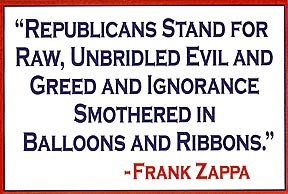
“As for the Republicans—–how can one regard seriously a frightened, greedy, nostalgic huddle of tradesmen and lucky idlers who shut their eyes to history and science, steel their emotions against decent human sympathy, cling to sordid and provincial ideals exalting sheer acquisitiveness and condoning artificial hardship for the non-materially-shrewd, dwell smugly and sentimentally in a distorted dream-cosmos of outmoded phrases and principles and attitudes based on the bygone agricultural-handicraft world, and revel in (consciously or unconsciously) mendacious assumptions (such as the notion that real liberty is synonymous with the single detail of unrestricted economic license or that a rational planning of resource-distribution would contravene some vague and mystical ‘American heritage’…) utterly contrary to fact and without the slightest foundation in human experience? Intellectually, the Republican idea deserves the tolerance and respect one gives to the dead.”
Street Harassment Follow-Up
A couple of days ago a video of a woman being harassed on the streets of New York City went viral. Dakinikat posted it in a comment on Tuesday, and JJ put it in her post yesterday. I found some interesting follow-up articles about the video that I want to share.
Here’s the video again:
At Slate, Hanna Rosin called attention to something I wondered about while I was watching the video. Where were the white men?
On Tuesday, Slate and everyone else posted a video of a woman who is harassed more than 100 times by men as she walks around New York City for ten hours. More specifically, it’s a video of a young white woman who is harassed by mostly black and Latino men as she walks around New York City for ten hours. The one dude who turns around and says, “Nice,” is white, but the guys who do the most egregious things—like the one who harangues her, “Somebody’s acknowledging you for being beautiful! You should say thank you more,” or the one who follows her down the street too closely for five whole minutes—are not.
This doesn’t mean that the video doesn’t still effectively make its point, that a woman can’t walk down the street lost in her own thoughts, that men feel totally free to demand her attention and get annoyed when she doesn’t respond, that women can’t be at ease in a public space in the same way men can. But the video also unintentionally makes another point, that harassers are mostly black and Latino, and hanging out on the streets in midday in clothes that suggest they are not on their lunch break. As Roxane Gay tweeted, “The racial politics of the video are fucked up. Like, she didn’t walk through any white neighborhoods?”
Here’s the supposed explanation:
The video is a collaboration between Hollaback!, an anti-street harassment organization, and the marketing agency Rob Bliss Creative. At the end they claim the woman experienced 100 plus incidents of harassment “involving people of all backgrounds.” Since that obviously doesn’t show up in the video, Bliss addressed it in a post. He wrote, “we got a fair amount of white guys, but for whatever reason, a lot of what they said was in passing, or off camera” or was ruined by a siren or other noise. The final product, he writes, “is not a perfect representation of everything that happened.” That may be true but if you find yourself editing out all the catcalling white guys, maybe you should try another take.
But Rosin notes that Bliss has had similar issues in the past.
This is not the first time Bliss has been called out for race blindness. In a video to promote Grand Rapids, Michigan, he was criticized for making a city that’s a third minority and a quarter poor look like it was filled with people who have “been reincarnated from those peppy family-style 1970s musical acts from Disney World or Knott’s Berry Farm,” as a local blogger wrote.
Activism is never perfectly executed. We can just conclude that they caught a small slice of catcallers and lots of other men do it too. But if the point of this video is to teach men about the day-to-day reality of women, then this video doesn’t hit its target.

Rosin recommends a video from Jessica Williams of The Daily Show. I watched it, and it’s terrific–plus it’s funny. Check it out.
On a more serious note, CNN reports that the woman in the viral video has been getting rape and death threats.
What started as an expose of the harassment women face in public has turned into fodder for death- and rape threats against the woman in the viral video….
“My nonverbal cues were saying, ‘Don’t talk to me.’ No eye contact. No friendly demeanor,” she said. “But they were ignoring my nonverbal cues.”
Roberts said the video is an accurate depiction of what she faces daily. For instance, there was a time when her grandfather died “and someone told me that they liked the way I looked.”
“It is all day long. It is every day,” she said. “That’s a typical day… It doesn’t matter what you wear.”
The 10 hours of footage was edited down to a 1:56 public service announcement for the anti-street harassment group Hollaback! It was shot by filmmaker Rob Bliss, who was wearing a hidden camera in his backpack.
“I have multiple experiences of sexual assault, which is why I wanted to be involved in this project,” Roberts said in a separate interview with HLN.
Also at CNN, Todd Leopold sort of misses the point, and wonders how men should approach women on the street. He quotes a 2010 piece by a woman named Katie Baker:
“There’s a huge difference between harassing a woman and trying to start a conversation,” she wrote. “Here are some tips: talk to her, not at her. Treat her with respect: be aware of her personal space, ask her how she’s doing or what she’s reading instead of commenting on her body parts, look at her face instead of her chest. If she ignores you, drops eye contact, or walks away, back off.
“It wasn’t rude of you to approach her, but she’s not being rude if she doesn’t want to keep talking to you, especially if you initiated conversation while she was running an errand, waiting for the bus, or on her computer at a coffee shop.”
But why do men feel they need to approach strange women at all? What if women did that to men?
Leopold also calls attention to a different kind of street harassment.
On the Reddit thread, which has drawn more than 6,500 comments, one man observed that lack of respect knows no gender.
“As a fat guy who once walked around NYC for a day sightseeing I got so many comments,” he wrote. “‘Lose weight, ass***e!’ ‘Hey fatty want me to buy you a hot dog?’ ‘Hey kill yourself you fat f***’ I would have been happy with just a ‘good morning.’ “
Personally, as I love to say “hello” to strangers out in public. I’m a Midwesterner by birth, and that’s just how we are–friendly and open. Usually they seem to like it, but if people ignore me, I don’t take offense.
So . . . what stories are you following today? Please share your links in the comment thread, and have a nice Thursday and a great Halloween!
Thursday Reads: Through the Looking Glass?
Posted: July 31, 2014 Filed under: 2014 elections, 2016 elections, Barack Obama, morning reads, Republican politics, Rick Perry, the GOP, The Media SUCKS, U.S. Politics, VAGINA Rick Santorum, Voter Ignorance, We are so F'd | Tags: Bobby Jindal, Ed Kilgore, GOP crazies, impeachment, insanity, IRS, John Boehner, John Dickerson, Lois Lerner, Marco Rubio, Nate Silver, right wing talk show hosts 36 Comments
Reading Woman, Armando Barrios
Good Morning!!
I’ve spent the past week or so reading escapist literature and watching old TV shows in an effort to anesthetize myself against the overload of bad news we’ve been hit with lately. Yesterday I was feeling a lot better–my escapism seemed to be working to improve my overall mood.
Then last night as I was surfing around in search of interesting reads for this morning’s post, I came across something that jumpstarted me right through Alice’s looking glass.
You’ve probably heard about it too. Lois Lerner, who used to work for the IRS and who is at the center of one of the GOP’s crazy efforts to create a scandal that will bring down President Obama used the word “crazies” in a private e-mail to a colleague who was complaining about right wing radio hosts. Here’s the text of e-mail as quoted in The Washington Post yesterday.
During the exchange, Lerner says she is traveling in Great Britain. The name of the person she is emailing with was blacked out.
Lerner: “I’m ready. Overheard some ladies talking about American today. According to them we’ve bankrupted ourselves and at through. We’ll never be able to pay off our debt and are going down the tubes. They don’t seem to see that they can’t afford to keep up their welfare state either. Strange.”
Other person: “Well, you should hear the whacko wing of the GOP. The US is through; too many foreigners sucking the teat; time to hunker down, buy ammo and food, and prepare for the end. The right wing radio shows are scary to listen to.”
Lerner: “Great. Maybe we are through if there are that many assholes.”Other person: “And I’m talking about the hosts of the shows. The callers are rabid.”
Lerner: “So we don’t need to worry about alien teRrorists. It’s our own crazies that will take us down.”

My initial response was the same as that of Mark NC at News Corpse (a site that makes fun of Fox News), So F**king What? Former IRS Official Says That GOP Crazies Are…CRAZY!
Republicans and their friends at Fox News have mastered the art of building mountains of bullshit from the lowliest troll-hills. It’s one of their favorite tactics to malign Democrats. Just grab a sentence fragment from a long speech and pretend that it is the whole of the comment from which it was extracted. Then feign outrage that such an awful remark could have been uttered.
The latest example of this rhetorical deceit was demonstrated when the GOP chair of the House Ways and Means Committee, Dave Camp, unscrupulously and selectively released some emails purported to be from Lois Lerner, the former IRS official who has been hounded by malevolent cretins like Rep. Darrell Issa in an attempt to fabricate ammunition to use against President Obama. Despite hundreds of wasted hours (costing millions of taxpayer dollars) engaged in hyper-partisan investigations, the Republican Inquisition has produced nothing implicating the President in any untoward activity.
The emails that Camp is now crowing about are just as meaningless as all of the other bogus “smoking guns” that these wingnuts have claimed would topple the administration. The headline that Camp has wrenched from the documents is that Lerner may have referred to certain individuals as “crazies” or “a-holes.” And, of course, this would only be an atrocity if those individuals were Republicans. Suffice to say that Camp wouldn’t give a Fig Newton if they were Democrats.
As Camp characterized this affair, Lerner was allegedly caught red-handed expressing her disgust for Republicans. And as the person at the center of the controversy over whether the IRS improperly subjected Tea Party groups to extra scrutiny when they applied for tax-exempt status, Camp believes that these emails prove that she was biased. Consequently, Camp regards the emails as justification for appointing a special prosecutor and escalating the legal assault on Lerner and, ultimately, the White House.
There’s just one problem. The emails don’t don’t say what Camp alleges they say. And even if they did it wouldn’t mean anything. Most people in government have personal opinions and allegiances. There isn’t anything wrong with that, so long as it doesn’t interfere with the fair execution of their duties. And the evidence shows that Lerner’s department scrutinized applications of all political persuasions. The only organization that was denied tax-exempt status during the time in question was a liberal group.
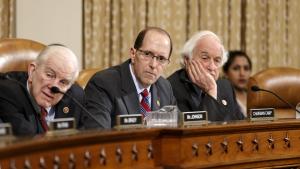
House Ways and Means Committee Chairman Rep. Dave Camp, R-Mich. (center), flanked by the committee’s ranking member, Sander Levin, D-Mich. (right), and Sam Johnson, R-Texas.
Please read the rest at the link.
So this humorous site agrees with me, but more mainstream sites are seemingly going along with the Camp’s notion that this e-mail is evidence of a major scandal. For example, Dave Wiegel characterized it as a “bombshell,” although he does point out that Lerner’s anonymous “e-mail partner” was talking about talk radio hosts, not Republicans in general. Huffington Post reported that Lerner had made “two disparaging remarks about members of the GOP.” Both HuffPo and Politico write that in one e-mail Lerner referred to Republicans as “a–holes,” but they sidestep the fact the context was a discussion of right wing talk show hosts.
As we approach the midterm elections, I can’t help but feel that most of the mainstream media is cheering for a Republican takeover. Am I the crazy one?
Here’s another example from self-described libertarian Nate Silver, Democrats Are Way More Obsessed With Impeachment Than Republicans.
House Speaker John Boehner said Tuesday that Republicans have no plans to impeach President Obama, and that all the impeachment talk was driven by Democrats hoping to stir up their base.
Boehner’s statement isn’t literally true: There have been mentions of impeachment around the edges of the GOP and by some Republican members of Congress. But on the whole, Democrats are spending a lot more time talking about impeachment than Republicans.
Consider, for example, the Sunlight Foundation’s Capitol Words database, which tracks words spoken in the House and Senate. So far in July, there have been 10 mentions of the term “impeachment” in Congress and four others of the term “impeach.” Eleven of the 14 mentions have been made by Democratic rather than Republican members of Congress, however.
Impeachment chatter has also become common on cable news. On Fox News this month, Sarah Palin, the former Alaska governor, called for Obama’s impeachment, for instance. But for every mention of impeachment on Fox News in July, there have been five on liberal-leaning MSNBC.
OK, so that’s this month. And this proves what? Democrats are throwing around the word “impeachment” in hopes of calling attention to what Republicans have been saying for years! So f$%king what?!

Again, I must resort to News Corpse for a sensible interpretation of the impeachment talk, CONSPIRACY: President Obama Is Trying To Impeach Himself.
Ever since the first inauguration of President Obama, right-wingers have been trying to undo the people’s decision to make him America’s chief executive. They declared that their top legislative objective was to make Obama a one-term president. In pursuit of that goal they have blocked most of his policy initiatives, judges, and government reforms. At the same time they have been hyper investigatory on everything from Fast and Furious, to the IRS, to ObamaCare, to his birthplace. All of this was squarely aimed at crippling or revoking his presidency.
This year Obama’s critics came out of the impeachment closet and began openly advocating for that legal nuclear option despite not having any legal basis for it. While many Tea-Publican whack jobs were earlier to the gate, Sarah Palin burst onto the scene a couple weeks ago with her own demand that Congress do their duty and trump up some phony articles of impeachment. It got so absurdly intense that Obama addressed it himself with fitting mockery.
So of course the next shoe to drop in this melodrama is that, along with everything else in the world, Obama is to blame for this too. In fact, according to some in the rightist crackpot community, it was all part of his nefarious plot to embarrass the GOP. Here is what Texas Republican Steve Stockman had to say about it when interviewed by the ultra-fringe rightists at WorldNetDaily:
“President Obama is begging to be impeached. […] He wants us to impeach him now, before the midterm election because his senior advisers believe that is the only chance the Democratic Party has to avoid a major electoral defeat. Evidently Obama believes impeachment could motivate the Democratic Party base to come out and vote.”
There you have it. The evil genius in the White House orchestrated the whole Obama-hate campaign from its earliest days in 2008 just so that he would be able to use impeachment, which is every president’s dream, as an election strategy six years into his presidency.
Earth to Nate Silver and the rest of the mainstream media: Steve Stockman, although insane, is an actual member of the House of Representatives, not some fringe character with no influence. And he has plenty of company in the House and even in the Senate (Ted Cruz anyone?). These people are crazy and they are in positions of awesome power.
GOP idea men?
Here’s one more example of mainstream acceptance of GOP insanity before I end this post and run screaming into the street while pulling my hair out in handfuls. From John Dickerson of Slate (via CBS News), Why the GOP’s class of 2016 hopefuls may be the best in generations.
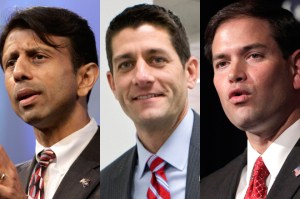
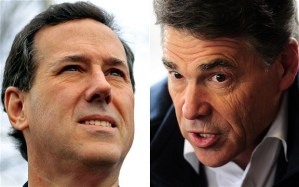
What if they held a presidential campaign and a think tank broke out? House Budget Committee Chairman Paul Ryan, who is considering running for president, offered his thoughts on poverty last week. Sen. Marco Rubio has been giving regular policy speeches on poverty, college loans, and helping the middle class. Former senator and GOP presidential candidate Rick Santorum is promoting a book of policy proposals on education, family, and revitalizing American manufacturing. Sen. Rand Paul is offering ideas on criminal justice and will give a big foreign policy speech in the fall. Louisiana Gov. Bobby Jindal has given speeches on health care and education aimed at a national audience. His staff recently sent an email titled “policy leader” that linked to a Time piece about how he is preparing to be the candidate of ideas in 2016.
What the f&cking f&ck? Rich Santorum? Bobby Jindal? Marco Rubio? Paul motherf&&cking Ryan?! These are “candidates of ideas?” Dickerson continues,
Who isn’t trying to be the ideas candidate in the 2016 campaign? Texas Gov. Rick Perry is working to overcome his 2012 debate aphasia, so he’s trying to show some policy chops. Though former Florida Gov. Jeb Bush holds controversial ideas on Common Core education standards and immigration, those close to him say he won’t run unless he can promote those ideas with gusto.
It isn’t usually this policy-thick in the GOP presidential field. In primaries, there is sometimes one conservative candidate who tries to position himself through the creativity of his proposals, but mostly candidates engage in displays of strength on questions of orthodoxy–how much they want to cut taxes, shrink regulation, and lock up the borders. Now the Republican candidates are not only seeking to distinguish themselves from each other with the quality and originality of their ideas, but they are making the case that unless the party promotes new ideas, it will not prevail.
The class of candidates for 2016 has the potential to be the most robust in almost 40 years–perhaps in modern Republican history. It depends on who finally decides to run, of course, but six governors and four senators are thinking seriously about it.
GOP idea men?
I’m sorry. Dickerson thinks these morons are competing with each other on “quality and originality of…ideas?” Am I nuts? Am I hallucinating this crap? Surely Dickerson can’t really believe this sh#t.
Here’s a little sanity from Ed Kilgore of Washington Monthly, Can the Big Brains of the GOP Survive the Primaries? and Damon Linker of The Week, Why GOP reformers are bound to fail. But even Kilgore seems to believe that Republicans will take over the Senate. From Talking Points Memo:
At least Kilgore thinks that catering to the base could hurt Republicans in the 2016 presidential election.
Why? Why would anyone vote for these insane right-wingers? And why is the media rooting for them? I just don’t get it. Am I crazy or what?
Now it’s your turn. What stories are you following today? Share your thoughts and links in the comment thread.
Tuesday Reads
Posted: July 29, 2014 Filed under: #Occupy and We are the 99 percent!, 2014 elections, 2016 elections, Democratic Politics, Hillary Clinton, morning reads, Ralph Nader, Voter Ignorance, We are so F'd 29 CommentsGood Morning!
The state of America’s democratic experiment really worries me these days. It seems so railroaded by the interests of the very few. I’m not sure if you got a  chance to read the following article at Salon by Bill Curry. You should. It’s about how the Democratic Party got co-opted by Wall Street interests and helped continue us down the road to complete plutocracy. It starts with out following the decline in the party’s alignment with ordinary Americans and the history of Ralph Nader’s formation of the consumer protection movement. Ultimately, it is about Nader and his new book. But,the details of the re-alignment and Nader’s personal history are an interesting read when put into the context of our road to corporate tyranny.
In the late ’70s, deregulation fever swept the nation. Carter deregulated trucks and airlines; Reagan broke up Ma Bell, ending real oversight of phone companies. But those forays paled next to the assaults of the late ’90s. The Telecommunications Act of 1996 had solid Democratic backing as did the Financial Services Modernization Act of 1999. The communications bill authorized a massive giveaway of public airwaves to big business and ended the ban on cross ownership of media. The resultant concentration of ownership hastened the rise of hate radio and demise of local news and public affairs programming across America. As for the “modernization” of financial services, suffice to say its effect proved even more devastating. Clinton signed and still defends both bills with seeming enthusiasm.
The Telecommunications Act subverted anti-trust principles traceable to Wilson. The financial services bill gutted Glass-Steagall, FDR’s historic banking reform. You’d think such reversals would spark intra-party debate but Democrats made barely a peep. Nader was a vocal critic of both bills. Democrats, he said, were betraying their heritage and, not incidentally, undoing his life’s work. No one wanted to hear it. When Democrats noticed him again in 2000 the only question they thought to ask was, what’s got into Ralph? Such is politics in the land of the lotus eaters.
The furor over Nader arose partly because issues of economic and political power had, like Nader himself, grown invisible to Democrats. As Democrats continued on the path that led from Coehlo to Clinton to Obama, issues attendant to race, culture and gender came to define them. Had they nominated a pro-lifer in 2000 and Gloria Steinem run as an independent it’s easy to imagine many who berated Nader supporting her. Postmortems would have cited the party’s abandonment of principle as a reason for its defeat. But Democrats hooked on corporate cash and consultants with long lists of corporate clients were less attuned to Nader’s issues.
Democrats today defend the triage liberalism of social service spending but limit their populism to hollow phrase mongering (fighting for working families, Main Street not Wall Street). The rank and file seem oblivious to the party’s long Wall Street tryst. Obama’s economic appointees are the most conservative of any Democratic president since Grover Cleveland but few Democrats seem to notice, or if they notice, to care.
 This also happened along side a group of democratic senators–including Joe Biden–that helped seat the 5 generic, oddball Catholic men that threaten everything the country stands for by deciding almost SCOTUS decisions in oddball Catholic ways. (You have to wonder if they listen at all to the current Pope.) Additionally, things have gotten so right wing in the diplomacy sector that John Kerry and Barack Obama’s state department seem to be tilting in the same direction as the neocon-infested, apartheid loving Israeli government of Bibi the Butcher of Gaza.
This certainly isn’t the party of my FDR-loving Great Grandmother Nancy Anna Chisholm Williams whose father and uncle blazed the west with the Chisholm Trail and who lived and died a Depression surviving Okie. Big political interests keep driving the Democrats into very undemocratic places.
The Obama administration deserves much of the blame for the failure of the latest round of Israeli-Palestinian peace talks.
It had originally been hoped that the United States would present a binding framework along the lines of what moderate Israeli and Palestinian political leaders had agreed to in unofficial talks in Geneva in 2003: Israel would recognize a Palestinian state based roughly on the pre-1967 borders with mutual territorial swaps, which would leave the Palestinians with 22 percent of historic Palestine and allow Israel to keep the remaining 78 percent; the Palestinian state would be demilitarized and all irregular militias disarmed; illegal settlements in occupied Palestinian territory near the Israeli border—encompassing close to 80 percent of the settlers—would be incorporated into Israel while settlers in the more remote settlements would be required to return to Israel; there would be no right of return for Palestinian refugees to Israel, but there would be international assistance in helping them resettle in the new Palestinian state; and some Israeli troops would remain along border crossings between the Palestinian state and its Arab neighbors, eventually to be replaced by international forces.
The Palestinian government agreed to these terms. Israel rejected them. Rather than make public this framework, and thereby hope the Israeli public would pressure its right-wing government to compromise, the Obama administration instead insisted that “both sides” had shown a lack of will to compromise.
An interview with an anonymous U.S. official close to the peace talks in an Israeli publication confirmed numerous other reports that, despite the Obama administration’s claims to the contrary, the Palestinian side made major concessions while the Israeli side essentially refused to make any, generally refusing to talk about any substantive issues.
A host of Democratic and Republican former officials—including a former national security adviser, secretary of defense, chair of the House Foreign Affairs Committee, trade representative, and undersecretary of state for political affairs—went on record arguing that the Obama administration would have to challenge the Israeli government’s hard line towards the Palestinians in order for the peace process to be successful. Unfortunately, the White House apparently had no interest in doing so.
Instead, Washington has focused on Palestinian Authority President Mahmoud Abbas’s refusal to give in to U.S. and Israeli demands that he recognize Israel as a “Jewish state.” While the Palestinian government, the Palestine Liberation Organization, and the ruling Fatah party have all recognized the state of Israel for more than 20 years, the Obama administration has effectively moved the goalposts by declaring that recognizing the Israeli government, acknowledging its right to exist, and providing security guarantees is not enough, insisting that the Palestinians explicitly recognize the state of Israel’s ethno-religious identity as well. No previous administration has put forward such a requirement. President Carter never made such demands on Egypt, nor did President Clinton require this of Jordan as a condition for their peace treaties with Israel. Abbas has said that Israel can identify itself however it wants, but—given that 20 percent of the Israeli population is ethnically Palestinian Arab—it would be politically impossible to agree to something that would acknowledge second-class status for other Palestinians.
Never in history has any country been required to recognize the ethnic or religious identity of another state as a condition for peace. It appears, then, that the Obama administration’s demand may have been an effort to destroy any chance of a peace agreement and leave an opening to blame the Palestinians—despite their agreement to virtually every other issue—for the failure of the peace process.
The failure may also come from President Obama’s trusting Secretary of State John Kerry, a longtime supporter of the Israeli right, to play such a key role in the peace talks. In 2004, Kerry unconditionally endorsed an Israeli plan to unilaterally and illegally annex large areas of the West Bank, leaving the Palestinians with only a series of small non-contiguous cantons surrounded by Israel as their “state,” a proposal denounced worldwide as a violation of the UN Charter, a series of UN Security Council resolutions, and basic principles of international law. Indeed, Kerry has long insisted that it was “unrealistic” to demand an Israeli withdrawal from its occupied territories. (By contrast, Kerry has demanded that Russia withdraw completely from Crimea, citing the illegality of any country acquiring “part or all of another state’s territory through coercion or force.”)
A Democratic administration is basically supporting an apartheid state replete with ethnic cleansing. Under what world does a secular, U.S.  democracy support an apartheid-creating theocracy that won’t follow any agreements it made previously? Why are we the lone country cowering in the corner with a government gone genocidal instead of searching out the country’s numerous moderates and secular leaders and finding a path to coexistance? It truly worries me that former SOS Hillary Clinton who went on Fareed Zakaria’s show on Sunday may continue down this road of letting huge political donors outweigh solutions and fairness. Yet, her interview sounded like there’s some key differences between Kerry’s handling of this situation and the previous problems handled by Clinton. Is she distancing herself from her former boss and signalling that things will be different with her in charge? Will US domestic and foreign policy stop lurching to the right?
ZAKARIA: Bibi Netanyahu…
CLINTON: Right.
ZAKARIA: You say you had a complicated, and it sounded like a difficult relationship with him.
CLINTON: Well, I have to say, I’ve known Bibi a long time. And I have a very good relationship with him, in part because we can yell at each other and we do. And I was often the designated yeller. Something would happen, a new settlement announcement would come and I would call him up, “What are you doing, you’ve got to stop this.” And we understood each other, because I know how hard it is to be the leader of a relatively small country that is under constant pressure, and does face a lot of legitimate threats to its existence from those around it. And I also care deeply about how Israel is able not just to survive, but thrive, and just fundamentally disagreed with Bibi in the ’90s that I was in favor of a two-state solution. I was the first person associated with any administration to say that out loud. And he did not. But then when he came back in in 2009, he did. And I’ve sat with him, as you and I are sitting, and I really believed that if he thought he could get adequate security guarantees for a long enough period of time, he would be able to resolve everything with the exception of Jerusalem, which is the hardest issue. You can get borders and if you can figure out how to do security within those borders, some of which may require having IDF and international forces in the Jordan Valley, for example, then if you could move toward a state and leave Jerusalem to be worked on, because that’s the hardest issue for all sides.
ZAKARIA: But, you know, he gave an interview recently to, I think it was The Times of Israel where he said there are no circumstances under which we will ever relinquish security control of the area west of the Jordan, meaning, the West Bank. That sounds like it’s a – it’s going back on his acceptance of the two-state solution.
CLINTON: Well, Fareed, I see that as an – as an opening negotiating position, because I’ve had the private one-on-one conversations and the private conversations with him sitting there and – and Mahmoud Abbas sitting there and George Mitchell sitting there. And I know that Abbas, in my conversations, was willing to entertain a number of years where there could be some continuing security. Remember, the IDF – the Israel Defense Forces – have a working relationship with the Palestinian Authority security forces, which have been incredibly professional. We’ve helped to provide training, as has Jordan and others, and the positions that Netanyahu has taken. Now, once they take a position, and I know the years that Abbas has said are – are permitted and – and I know the years that Bibi has demanded, you’re in a negotiation. But if there’s no process going on, which is why we can’t even leave the vacuum of no process, despite how incredibly frustrating it is, then, of course Abbas is going to say never, not under any circumstances, and Bibi is going to say absolutely forever.
ZAKARIA: In 2009, you said that you wanted Israel settlement activity to stop. In fact, you were pretty blunt. You said no exceptions.
CLINTON: Um-hmm.
ZAKARIA: You write in the book that that was a tactical mistake because it made on – Bibi Netanyahu get even more hardline.
CLINTON: Right.
ZAKARIA: But Martin Indyk has just resigned as the you know, the kind of – the sherpa of the peace process. And he says that the immediate trigger, in his view, there were many, but was the fact that the Palestinians looked at the Israeli continued settlement activity…
CLINTON: Right.
ZAKARIA: – and said these guys are not serious, we’re never going to be able to get a state…
CLINTON: Right.
ZAKARIA: – look at what they’re doing.
CLINTON: This is my biggest complaint, with the Israeli government. I am a strong supporter of Israel, a strong supporter of their right to defense themselves. But the continuing settlements, which have been denounced by successive American administrations on both sides of the aisle, are clearly a terrible signal to send, if, at the same time, you claim you’re looking for a two-state solution. Now, when I was negotiating and I had been able to put together three face-to-face meetings between Netanyahu and Abbas, it was clear that if we were working off the ’67 borders, which was our stated position that President Obama had outlined, some of the settlements would be within any responsible drawing of borders for Israel. But a number of them would not. And those that would not would have to be either dismantled or live under Palestinian rule. There are deep wells of mistrust and misunderstanding on both sides. And what I’ve urged the Israelis to do is do more to help the Palestinians in the West Bank right now. Don’t monopolize the water. Don’t make it difficult to build. So even while we’re struggling over the end issues that would resolve the conflict, like borders, don’t make life so miserable, you know, because that’s not any way to begin to try to deal with the mistrust. You know, the longer I do this, Fareed, the more convinced I am that mistrust and misunderstanding are often the real fundamental obstacles to bringing people together. And that means that people from both sides of whatever divide it is, whether it’s Israeli, Palestinian, you know, Russian-speaking, Ukraine-speaking, whatever it might be, people have to start listening and working together to build habits of cooperation that might possibly lead to greater trust.
 There are a number of articles where you read recent interviews with Hillary where she sounds more and more like a candidate these days. I want to hear that Hillary will take us back to democracy for all. Not just for those who can purchase it. Here’s Hillary on the US Border situation.
In a smart move, Hillary Clinton firmed up her position on the crisis in an interview that aired over the weekend — in a manner that, intentionally or not, sharpened the contrast with the position of most Republicans.
Speaking to Fusion’s Jorge Ramos, Clinton came out against any changes to the 2008 trafficking law, which Republicans are seeking to expedite deportations of arriving minors as a condition for supporting any money to address the debacle.
“I don’t agree that we should change the law,” Clinton told Ramos. She added that she wanted a more strenuous effort to distinguish between “migrant” children and “refugees,” to ensure that those who genuinely qualify for humanitarian relief in the U.S. obtain it. “I’m advocating an appropriate procedure, well funded by the Congress, which they are resisting doing, so that we can make individual decisions,” Clinton said. “We should be setting up a system in Honduras, Guatemala, El Salvador, to screen kids over there, before they get in the hands of coyotes.”
In opposing changes to the 2008 law, Clinton has placed herself a bit to the left of even Obama, who initially signaled openness to such changes before backtracking after Congressional Dems objected. And Clinton is also clarifying her previous suggestion that the kids should be “sent back.”
“Like Pelosi and Reid, she’s realized that the tough line of President Obama – change the law, send ‘em back – is not the position of most Democratic voters and lawmakers,” immigration advocate Frank Sharry tells me. “She’s repositioned herself. Smart.”
 Is it likely Hillary will move us back to more traditional Democratic policies or is she likely to continue the rightward drift of elected Democratic Leaders like Obama and even Bill Clinton? A recent poll shows that Hillary is popular with white voters; more so than a lot of Democratic pols before her.
This entire idea of having a crazy right wing nut of GOP while Democrats continue to cater to neocons and plutocrats still worries me. We use to have two functioning parties that represented fairly diverse groups of voters. It wasn’t all sweetness and light, but there wasn’t such a concentration of policy that benefited so few coming out of them both. They also did the business of the people. Now we still have two parties. It’s just that one represents crazy religionists and whacked out billionaire libertarians and the other one that occasionally does something for the common american still is likely to slide further to the right to attract rich, powerful donors.
So, that’s what’s on my mind. What’s on your reading and blogging list today?
Lazy Saturday Reads
Posted: July 26, 2014 Filed under: Barack Obama, Foreign Affairs, Hamas, immigration, Libya, morning reads, Palestine, Real Life Horror, Republican politics, Russia, science, U.S. Politics, Ukraine, We are so F'd | Tags: bad news, Gaza, impeachment, israel, polls, West Bank 38 Comments
Good Morning!!
I don’t know about you, but I’m getting really sick of bad news. I’ve completely stopped watching TV and listening to radio news, because I just can’t take any more details of wars, plane crashes, dead children. If it weren’t for writing these morning posts, I wouldn’t have a clue what’s happening. I get all my news from Google, Twitter, and various blogs, including Sky Dancing. So I’m going to quickly link to the major stories topping Google this morning, and then I’ll post some interesting longer reads that I came across around the ‘net.
Israel-Palestine Conflict
There’s a 12-hour cease fire in Gaza right now. BBC News has extensive coverage, Gaza conflict: 12-hour truce as deaths top 900.
Residents in Gaza are using a 12-hour humanitarian truce to return to their homes, gather essential supplies and search for those trapped in the rubble.
At least 85 bodies have been pulled from the rubble during the truce, a Palestinian health official says.
That raises the Palestinian death toll to 985 since the Israel-Hamas conflict began on 8 July, the spokesman said. Thirty-nine Israelis have died.
International talks on a longer truce have resumed in Paris.
Israel said it would continue to “locate and neutralise” Hamas tunnels during the pause, which began at 08:00 local time (05:00 GMT).
So far 31 tunnels have been discovered, with about half destroyed, Israeli’s military says.
Lots of details and photos at the BBC link.

From AP via The Boston Globe, Gaza Sides Agree to Lull But Truce Efforts Stall.
JERUSALEM (AP) — Israel-Hamas fighting looked headed for escalation after U.S. Secretary of State John Kerry failed Friday to broker a weeklong truce as a first step toward a broader deal and Israel’s defense minister warned Israel might soon expand its Gaza ground operation ‘‘significantly.’’
Hours after the U.S.-led efforts stalled, the two sides agreed to a 12-hour humanitarian cease-fire to begin Saturday. However, the temporary lull was unlikely to change the trajectory of the current hostilities amid ominous signs that the Gaza war is spilling over into the West Bank.
In a ‘‘Day of Rage,’’ Palestinians across the territory, which had been relatively calm for years, staged protests against Israel’s Gaza operation and the rising casualty toll there. In the West Bank, at least six Palestinians were killed by Israeli fire, hospital officials said.
The latest diplomatic setbacks, after several days of high-level diplomacy in the region, signaled that both sides are digging in and that the fighting in Gaza is likely to drag on.
An op-ed from Al Jazeera, Israel’s war of disproportionate force on Gaza, by Britain Eaken.
The recent killing of four Palestinian children by an Israeli airstrike while they played soccer on a beach in Gaza should call into question Israel’s claim that it’s waging a war of self-defense. Western journalists who saw the attack witnessed firsthand an ugly reality of life in Gaza — Palestinian civilians are too often caught in the crossfire in this tiny, densely populated and besieged coastal strip.
Early Sunday, an Israeli incursion into the Shujayea neighborhood in Gaza killed at least 60 more Palestinians. Most of the injuries being treated at Gaza’s al-Shifa hospital belong to civilians suffering from shrapnel injuries and amputations. More than 100 children have been killed so far and the Palestinian death toll just surpassed 400 with more than 3000 injured.
The UN says more than 70 percent of Palestinian casualties are civilians, a marked increase from previous Israeli assaults.
The toll on civilians has raised United Nations’ concerns of the Israeli use of disproportionate force in Gaza in violation of international humanitarian law. But the use of disproportionate force and the targeting of civilian infrastructure isn’t a new or surprising tactic for Israel. In fact, it’s a primary strategy according to Gabi Siboni, head of the Military and Strategic Affairs program at the Institute for National Security Studies in Israel. This strategy has a well-documented history in Gaza.
I have no words.
Libya
Yes, there’s still fighting in Libya, and the violence is getting so bad than the U.S. has closed and evacuated its embassy there. NPR reports: U.S. Embassy Compound In Libya Shut Down Amid Fighting.
The U.S. has closed its embassy in Libya and evacuated diplomats amid what is being described as a significant deterioration in security, with rival militant factions battling in the capital, Tripoli.
“Due to the ongoing violence resulting from clashes between Libyan militias in the immediate vicinity of the U.S. Embassy in Tripoli, we have temporarily relocated all of our personnel out of Libya,” State Department spokeswoman Marie Harf said.
“Securing our facilities and ensuring the safety of our personnel are top department priorities, and we did not make this decision lightly,” Harf said. “Security has to come first. Regrettably, we had to take this step because the location of our embassy is in very close proximity to intense fighting and ongoing violence between armed Libyan factions.”
In a separate statement, Pentagon spokesman Rear Adm. John Kirby said: “[All] embassy personnel were relocated, including Marine security guards who were providing security at the embassy during the movement.”
AP via ABC News: US Evacuates Embassy in Libya Amid Clashes.
The United States shut down its embassy in Libya on Saturday and evacuated its diplomats to neighboring Tunisia under U.S. military escort amid a significant deterioration in security in Tripoli as fighting intensified between rival militias, the State Department said….
The evacuation was accompanied by the release of a new State Department travel warning for Libya urging Americans not to go to the country and recommending that those already there leave immediately. “The Libyan government has not been able to adequately build its military and police forces and improve security,” it said. “Many military-grade weapons remain in the hands of private individuals, including antiaircraft weapons that may be used against civilian aviation.” ….
“We are committed to supporting the Libyan people during this challenging time, and are currently exploring options for a permanent return to Tripoli as soon as the security situation on the ground improves. In the interim, staff will operate from Washington and other posts in the region,” Harf said. The evacuated staffers will continue to work on Libya issues in Tunis, elsewhere in North Africa and Washington.
Ukraine

Ukraine is still roiling, but it seems to have receded into the background for the moment. Here are a few headlines just to keep you current.
Fox News: Ukraine crisis: European Union hits Russian intelligence chiefs with sanctions.
WaPo: Russia, Ukraine trade accusations of cross-border shelling.
Bloomberg: U.S. Says Russia Set to Supply New Arms to Ukraine Rebels.
The Economist: The shooting down of an airliner shows how reckless Vladimir Putin’s sponsorship of Ukrainian rebels has been.
From the WaPo editorial board: If the West doesn’t do more for Ukraine now, it might soon be too late.
From the Are You Kidding Me? File
From the LA Times: White House aide says Republicans might impeach Obama over immigration.
Pesident Obama will propose broad-ranging executive action on immigration reform later this summer that could provoke Republicans into trying to impeach him, a senior White House official said Friday.
While details of the immigration plan are still being worked on, it will mark “an important step in the arc of the presidency” that will shape both the substance and politics of immigration policy for years, White House senior advisor Dan Pfeiffer told reporters at a breakfast sponsored by the Christian Science Monitor.
That move is certain to “increase the angry reaction from Republicans” who already accuse Obama of exceeding his executive authority, Pfeiffer said, highlighting recent statements by former vice presidential candidate Sarah Palin in which she backed an impeachment move.
“I would not discount the possibility” that Republicans would seek to impeach Obama, he said, adding that House Speaker John A. Boehner (R-Ohio) has “opened the door to impeachment” by his plans to sue Obama for allegedly exceeding his executive authority.

Is this just an effort by the White House to put the impeachment question out there so Americans can let the GOP what they think about it? The Hill reports: White House taking impeachment seriously.
Senior White House advisers are taking very seriously the possibility that Republicans in Congress will try to impeach President Obama, especially if he takes executive action to slow deportations.
Dan Pfeiffer, a senior adviser to Obama, said Friday that the White House is taking the prospect of impeachment in the GOP-controlled House more seriously than many others in Washington, who see it as unlikely.
Pfeiffer noted that former Alaska Gov. Sarah Palin, who has a large following among Tea Party conservatives, has called for Obama’s impeachment and a large block of the GOP’s base favors it.
“I saw a poll today that had a huge portion of the Republican Party base saying they supported impeaching the president. A lot of people in this town laugh that off. I would not discount that possibility,” he told reporters Friday at a breakfast sponsored by The Christian Science Monitor.
Pfeiffer said Speaker John Boehner’s (R-Ohio) decision to file a lawsuit against Obama over his use of executive actions increased the chance of impeachment proceedings in the future.
A little reality testing from Sean Sullivan at the WaPo: These two numbers show why impeachment talk is trouble for the GOP.
By about 2-1, Americans say they don’t think President Obama should be impeached and removed from office, according to a new CNN/ORC International poll released Friday.
But a majority of Republicans disagree.
That, in a nutshell, is why talk about impeaching the president is nothing but trouble for the GOP heading toward the November midterms.
Sixty-five percent of Americans say Obama should not be impeached, compared to just 33 percent who say he should. Very one-sided. It’s clear that impeachment is a political loser when it comes to the public as a whole.
The “public as a whole” numbers matter because with most of the consequential primaries behind us, Republican candidates in key Senate races — the battle for the Senate is the main midterm event — have to be concerned about playing to broad statewide audiences.
Some (mostly) longer reads
These aren’t all that cheery either, but they are interesting.
This one from the NYT Sunday Magazine is for Dakinikat: Why Do Americans Stink at Math?
Why do people leave their kids in hot cars? How can you forget you’ve got your kid with you? I just don’t get it, and it makes me furious! There’s a long article about these cases at NBC News, Fatal Mistake: What Everyone Should Know About Hot Car Deaths, by Alex Johnson.
This NYT op-ed isn’t a long read, but it’s a useful one: Why the Border Crisis Is a Myth, by Veronica Escobar.
Remember all that talk about how there was going to be some kind of horrible disaster in 2012? Well it turns out that something awful almost happened. From NASA Science News, Near Miss: The Solar Superstorm of July 2012. If you don’t want to wade through the whole article, The Boston Globe has a shorter summary, Apparently Earth ‘Just Missed’ a Solar Superstorm in 2012.
Finally, something entertaining and not depressing, This Is What Happens When You Ask Contemporary Artists To Reimagine Maps Of The World. Check it out!
What stories are you following today? Please post your thoughts and links in the comment thread.

 peej
peej Carissa
 bostonboomer
 dakinikat
 ecocatwoman
 mablue2
 Mama Lopez
 peggysue22
 quixote
 skydancingguestblogger
 Mona (aka Wonk the Vote)



 Sky Dancing
Recent Comments