Yesterday, the news broke that Trump used a plane packed with cabinet members and journalists as a decoy in order to protect himself from an Iranian assassination threat that emerged while he was in Turkey for the NATO Summit in July.
He pretended to board Air Force One with everyone else and then was secretly taken off that plane and moved (hiding in a catering vehicle!) to a military plane, along with some other close advisers, leaving everyone on Air Force One in danger of being shot down by the Iranians.
Trump blames the Secret Service for what happened, but he certainly could have arranged things differently. He could even have had the press plane grounded in Turkey until the other two planes landed in Great Britain. After all, he is (supposedly) the President of the United States! Or has Stephen Miller taken over that role now?
The Iranian threat that prompted President Trump’s secret Air Force One swap last month emerged as he was heading into his last day at the NATO summit in Turkey on July 8.
According to two U.S. officials with knowledge of the threat, U.S. intelligence picked up multiple streams of information. They knew that there was a specific threat of a surface-to-air missile against Air Force One, meaning whichever plane was carrying the president, and that someone in the vicinity of the NATO summit had been spotted with a shoulder-fired missile. And the Iranians knew specifically where Mr. Trump was staying in Ankara, including which floor of the building, the officials said….
The information was deemed sufficiently credible to lead Mr. Trump and senior members of his administration to engage in an extraordinary decoy effort to get him out of Turkey. He boarded the older Air Force One in front of the cameras, which he had announced he would be taking “for old time’s sake,” before sneaking off in an airport catering container and taking a military jet out of the country.
On the final day of the NATO summit in Turkey, Mr. Trump walked up the stairway to the plane that was supposed to carry him on the first leg of his journey home. He briefly waved to the cameras and disappeared inside one of the iconic, baby blue 747s that have served as Air Force One for decades. Then he secretly exited the aircraft, hidden inside a catering container.
Mr. Trump was next taken to a military jet for a clandestine flight out of Turkey. The 747, filled with journalists, White House officials, aides and others, took off despite what was deemed a credible threat from Iran against Air Force One….
Gen. Dan Caine, the chairman of the Joint Chiefs of Staff, was integral to assessing the threat and deciding how to respond. General Caine is no stranger to subterfuge: His last job was Pentagon liaison to the C.I.A., and he helped devise the diversion tactics during Operation Midnight Hammer, when U.S. forces struck Iran’s nuclear sites in June 2025.
Air Force One sits on the tarmac in Ankara with an airport catering container adjacent to the body of the aircraft on July 08. (Reuters)
Not everyone who rode on the plane without Mr. Trump was in the dark. Secretary of State Marco Rubio knew about the threat and flew on the old plane after helping to plan the operation to spirit the president out of Turkey, according to two U.S. officials. They spoke on the condition of anonymity to discuss a sensitive topic.
Other senior officials who traveled on the plane without the president included Treasury Secretary Scott Bessent; Steven Cheung, the White House communications director; and Stephen Miller, Mr. Trump’s deputy chief of staff; as well as several other White House staff, according to a senior U.S. official. It was not clear whether they all knew about the threat.
Whether or not the passengers on the plane that Mr. Trump left behind knew about the threat, they were exposed to risks that the Secret Service deemed too great for the president to face.
Trump claims he had nothing to do with these decisions.
On Tuesday evening, in his first public comments about the secret evacuation, Mr. Trump said the decision was not his.
“It’s really just up to Secret Service,” he told reporters after returning from Ohio. “I just follow what they like to do. So I go by Secret Service and the military. They wanted me to go in a different flight, a different plane for safety.”
Is he the President or not? Since when does the President of the United States take orders from the Secret Service? They advised him of the danger, and he could have insisted on different ways of handling the situation.
The article is very detailed. You can read the whole thing using the gift link.
As President Donald Trump secretly left an Air Force One jet on a catering truck last month in response to a potential Iranian assassination threat in Turkey, he was accompanied by some of his most loyal and longest-serving aides but no Cabinet officials.
Other passengers on the truck included Dan Scavino, the White House deputy chief of staff; Natalie Harp, the president’s executive assistant; and Walt Nauta, the director of Oval Office operations, according to a U.S. official familiar with the operation and corroborating material reviewed by The Washington Post.The official spoke on the condition of anonymity because he was not authorized to talk to the media.
A catering truck is parked at Air Force One on the tarmac at the Ankara international airport as the motorcade carrying President Donald Trump arrives in July. (Alex BrandonAP)
A few lower-profile aides also were present, but the group did not include Secretary of State Marco Rubio or other officials at the highest level of the government, according to the official and the material. Together, those aboard the catering truck moved under concealment from the legacy Air Force One aircraft to a smaller Air Force C-32A before flying to Britain separately from the White House press corps and senior officials.
The account adds a new level of understanding to a July 8 operation that was first reported by The Post on Monday and has triggered calls from congressional Democrats for an immediate briefing. White House officials withheld the secret move from journalists traveling with the president that day and for more than a month afterward.
Among those on the smaller jet was Defense Secretary Pete Hegseth, who boarded the C-32A using external stairs in a manner that made him look like the senior-most official on the flight, The Post reported Monday.
Scavino, Harp and Nauta were among an inner circle of supporters who worked for Trump at his Mar-a-Lago estate in Florida during the four years between his presidencies, after many other officials who served in the first Trump White House distanced themselves following his two impeachments and multiple criminal investigations.
Other senior administration officials, military personnel, Secret Service agents and journalists remained on the legacy Air Force One plane, which had been deemed too risky for the president’s travel.
Natalie Harp, the “human printer,” and the woman who left love notes in Trump’s private rooms, according the the book Regime Change, by Maggie Haberman and Jonathan Swan, was seen as more deserving of protection than Trump’s cabinet and closest political advisers!
Donald Trump made sure he brought his favorite White House aide with him when he escaped from Air Force One to travel in a decoy jet via a catering truck.
Natalie Harp, 35, is never far from the 80-year-old president, and it has emerged that the young blonde aide was among a select group of Trump’s inner circle he took with him as he fled a NATO summit on a military flight because of a credible Iranian assassination threat.
Natalie Harp
White House Deputy Chief of Staff Dan Scavino, and Walt Nauta, the director of Oval Office operations, also joined Trump inside the catering truck to move to the decoy plane, The Washington Post reported.
Defense Secretary Pete Hegseth boarded the Air Force 32-A via its staircase “in a manner that made him look like the senior-most official aboard the flight,” the Post reported.
Other top officials, including Secretary of State Marco Rubio, top White House aide Stephen Miller and Treasury Secretary Scott Bessent, remained on Air Force One after Trump was made aware of the potential Iranian assassination threat.
The threat to Air Force One was seen as so dire that they sneaked President Trump off the jet in a catering container to keep him safe. But the same dire threat did not stop them from then sending Air Force One into the skies anyway with a planeful of senior officials, government employees, reporters and military personnel serving as decoys, some unwittingly.
If the Iranians were trying to shoot down the presidential plane last month, as U.S. officials concluded at the time, then the subterfuge in Ankara, Turkey, that protected the president also may have made targets of dozens of others who flew aboard the jet, including Secretary of State Marco Rubio, Treasury Secretary Scott Bessent and the senior aides Stephen Miller and Steven Cheung.
Diagram of the plane swap
The government has on rare occasions engaged in sleight of hand to safeguard presidents from possible jeopardy, particularly for journeys to hazardous locations, such as when George W. Bush or Barack Obama flew to Iraq during days of war or when Bill Clinton made a brief visit to Pakistan with its history of terrorism. The Trump team’s ruse in Ankara, however, stands out not only for its misdirection but also for the way it shifted the evident peril to others and was kept secret long after Mr. Trump was out of harm’s way.
“They just didn’t seem to give a second thought to anybody but the president and the few people who were with him,” said Joe Lockhart, who served as White House press secretary to Mr. Clinton during his 2000 trip to Islamabad, the Pakistani capital. “We went out of our way to make sure the maximum number of people, especially civilians, were protected and not human shields. They didn’t even think about it. And to me, that’s the big difference.”
But other veterans of risky White House trips said there were times that extreme measures were justified to protect the president. Joseph W. Hagin, who as a top adviser to Mr. Bush helped organize his war zone trips and later served as Mr. Trump’s deputy White House chief of staff in his first term, said he would not second-guess the decision in Ankara.
“I understand there is concern for those flying on what was assumed to be the primary aircraft,” Mr. Hagin said, “but when you go to work at the White House or travel with the president, you are accepting a not-insignificant degree of risk. Telling everyone what’s up in an operation like this would have obviously jeopardized the president’s safety.”
When Mr. Bush or Mr. Obama brought staff members and reporters with them to war zones, Mr. Hagin added, those were dangerous moments, too. “This was no different than the trips to Iraq and Afghanistan,” he said. “You add up all the risks and figure out the tactics that give you the safest option, regardless of whose toes get stepped on or feelings get hurt.”
The government officials and reporters who traveled with presidents to war zones, of course, knew they were doing so, while those left on Air Force One in Ankara last month were not told of the increased threat. Journalists traveling in the back of the plane were instructed while still on the ground to keep their window shades closed during the July 8 flight from Ankara to Britain, where Mr. Trump landed secretly in another military plane. The president was then sneaked back onto Air Force One so that he could disembark in front of cameras as if he had been onboard all along.
Read more using the gift article, if you’re interested.
When President Bill Clinton deplaned in Islamabad, Pakistan, the sleight of hand became clear.
A decoy jet with all of the markings of Air Force One touched down in view of the news media, and a Secret Service agent resembling the president emerged. Then, an unmarked plane landed, and the real president disembarked.
It was March 2000, and Susan Page, a White House reporter covering the trip for USA Today, was one of a small group of people who knew about the ruse.
President Bill Clinton disembarks from an unmarked jet in Islamabad, Pakistan, in March 2000. Stephen Jaffe AFP,Getty Images
Before the India-to-Pakistan flight, White House officials called Page, then the White House Correspondents’ Association president, and summoned her for an off-the-record conversation. There, White House press and security officials explained the operation, informing her of the president’s location and safety measures in place for journalists on the trip, Page said in messages with The Washington Post.
“They told me about the extraordinary security procedures being taken because of the dangers in flying there, including use of the decoy plane,” she said. “Of course, the dangers threatened the journalists covering the trip as well as President Clinton.”
Page’s briefing, which has not been previously reported, meant at least one journalist in the traveling press corps knew the president would not be aboard Air Force One.
More than 25 years later, the White House faced a similar security dilemma — but handled the press very differently.
Historian Garrett Graff wrote about this episode today. His article is too long to excerpt well, but if you want more on this topic, I recommend reading what he has to say: The Five Scandals Within the “Air Force One” Scandal. Here’s the introduction:
I sometimes believe that the Trump administration’s parade of horribles has left me unable to be surprised any more, but I gasped Monday evening at news that President Trump had been secretly snuck out of the NATO summit in Turkey last month due to an Iranian threat.
That departure in early July had generated a lot of speculation and coverage at the time because something weird was clearly going on — President Trump had, with much fanfare, arrived in Turkey aboard his newly painted presidential jet, gifted by Qatar, and then, with much less explanation, departed Turkey aboard one of the older blue-and-white 747s that have long served as Air Force One. There had been vague mentions of a possible threat, and how the new Qatari-gifted plane lacked some of the defensive measures of the longstanding presidential plane, which in turn led to a Justice Department leak investigation of the five New York Times reporters who broke that story.
Now, though, the Washington Post has added some fascinating and disturbing new wrinkles: He wasn’t aboard the blue-and-white plane at all when it departed Ankara.
I’ve written extensively about presidential travel, security, and continuity of government over the years — I wrote the literal book on continuity of government, in fact — and in the 24 hours or so since the Washington Post broke the story, have given interviews to outlets as varied as the Post, the Associated Press, and the BBC.
I want to try to break down why, specifically, this decoy Air Force One is so troubling. To me, the secret flight out of Turkey represents a Russian nesting doll of scandal, one that exposes at least five levels of scandal, ranging from foreign influence to corruption to national security compromises to inappropriate geopolitical gambles.
Yes, there is other news, but I think the story is important and deserves the amount of attention that is being paid to it. Of course, we already knew that Trump doesn’t give a shit about the press or their well-being, but apparently, he doesn’t care about most of his cabinet members either. When it comes right down to it, he chooses to save Dan Scavino, his former golf caddy, Walt Nauta, his former body man, and Natalie Harp, the “human printer.” (and more?), and Whiskey Pete Hegseth.
Yes, there is other news. Here are some links to to more interesting stories:
Millions are expected to gather across the country and around the world on Saturday for a third round of “No Kings” protests against President Donald Trump. Organizers predict that it will be the “single largest non-violent day of action” in American history.
Saturday’s “No Kings” marches, of which there are more than 3,200 planned across all 50 states and several continents, come as Trump faces increasing scrutiny over the war with Iran, the rising cost of gas and how his administration has executed its mass deportation agenda.
“Since the last No Kings [protests], we’re seeing higher gas prices and groceries, all while there’s an illegal war in Iran,” Sarah Parker, a national coordinator for the group 50501, told reporters Thursday on a national press call previewing Saturday’s events.
“We’ve also seen our neighbors executed, American citizens executed, and our children carrying the burden of owning their own power and walking out of school in defiance,” Parker added. “The people of America are pissed. They are the ones demanding for no kings.”
A national NBC News poll from earlier this month found that majorities of registered voters in the U.S. disapprove of the president’s handling of immigration, Iran and inflation and the cost of living.
Saturday’s nationwide demonstration was planned in the wake of the deaths of two Americans — Alex Pretti and Renee Good — in January in Minnesota at the hands of federal agents. Immigration officers were deployed to the state to carry out mass deportations and faced scrutiny over their brutal tactics toward immigrants and protesters.
Organizers, who hail from left-leaning groups including Indivisible, Public Citizen, MoveOn, the American Civil Liberties Union and the National Action Network, expect the third No Kings day of protest to be far larger than the first two. More than 7 million people rallied across the country and around the world during October’s No Kings day of action.
Thousands of Americans plan to gather on Saturday for No Kings protests across the country. They have a simple message: People are tired of a government that protects the powerful and abandons ordinary Americans.
They are tired of fighting costly and illegal overseas wars while we face an affordability crisis at home. They are horrified by the Trump administration’s cover-up of the Epstein files and the lack of accountability for the rich and powerful who crossed lines. And they are sick of Immigration and Customs Enforcement terrorizing our communities.
By Rebecca Aldernet
As more Americans are sent to fight abroad and the survivors of abuse are silenced at home, people increasingly feel dispensable….
For too long, Americans have seen our leaders fight harder for the Epstein class than for the working class. They have watched our system shield elites instead of delivering fundamentals such as affordable health care, housing and education.
The fight to release the Epstein files exposed not only a broken justice system, but also a deep economic and moral divide.
Jeffrey Epstein built a network of elite and powerful individuals, some of whom believed they could abuse young girls and women — many from working-class backgrounds — without consequences. Many survivors of Epstein’s abuses have courageously spoken out, and over the past year, sparked a moral reckoning in our country. They have exposed a two-tier system of justice that protects the wealthy and powerful and fails those who have been abused.
The administration’s failure to hold accountable those involved in Epstein’s abuses has fueled deep distrust in our government and its ability to deliver for the public good.
Will the protests change anything? Former mainstream journalist and novelist Alissa Valdez-Rodriguez did some historical research on the effects of peaceful protests and reports the results at her Substack Alisa Writes:
Let me start by saying I, like the great Karl Pilkington, hate anything that reeks of “forced fun.” I’m not a joiner. I never had school spirit. I don’t enjoy parades. My idea of hell is karaoke night with coworkers. Come to think of it, my idea of hell might just be coworkers, period. The farther I am from people and, worse, crowds of people united in their quest to All Be Doing Something The Same Way, the happier I am.
But today, like tens of thousands of other cerebral introverts who’d rather be reading in a hammock, I’m lacing up my sneakers, picking up a handmade sign, and throwing myself into a throng of People Who Are Just Fucking Done With This Shit, as I attend one of the 29 No Kings protests scheduled here in New Mexico. I will need days and days in the forest to recover.
I’m going because it’s important. I didn’t used to think it was. I was one of those cynics who’d ask: Does protest actually do anything? But rather than just assume the worst, I decided to do what I always do, and research the answer before spewing an opinion. Imagine my surprise when I was proven wrong by, you know, facts.
Massive nonviolent protest works.
It works a lot better than armed protest.
Really?
In 2011, Harvard political scientist Erica Chenoweth published what became one of the most cited works in the study of political change. She had started her research expecting to prove the opposite — that armed resistance was more effective than nonviolent campaigns. The results upended everything she thought she knew. According to Chenoweth and her co-author Maria Stephan, from 1900 to 2006, campaigns of nonviolent resistance were more than twice as effective as their violent counterparts in achieving their stated goals. Their dataset of 323 major campaigns showed that 53 percent of nonviolent campaigns succeeded — against just 26 percent of violent revolutions.
Chenoweth also found a threshold, what she called the 3.5 percent rule: every movement that mobilized at least 3.5 percent of a country’s population was uniformly successful. In the United States today, that number is roughly 11.5 million people. The No Kings movement is moving in that direction, faster than most movements in American history.
The question isn’t whether protest works. The question is whether we have the patience and the creativity to see it through. And as we’re facing what amounts to a rising fascist dictatorship backed by American intelligence operations, it might make sense to see how some of our hemispheric neighbors have handled something similar in the past.
Read details about the research at the link above. There’s no paywall.
Here’s a little humorous protest someone pulled off yesterday:
On Wednesday, the first lady kicked off a “Fostering the Future Together” summit at the White House with a humanoid robot called Figure 03 that greeted the assembled spouses of world leaders in 11 languages. As the robot loped awkwardly, the first lady walked beside it with a deliberate, poised foot-over-foot gait that brought to mind her past as a model.
By Suzanne Stewart
The Style section wanted tofind out what designers one wears when hosting the “first American-made humanoid guest in the White House.” So we called the White House.
But as the phone rang, the name on thescreen attached to the number read “Epstein Island.”
It was not a wrong number. That’s what the phone displayed when some Washington Post journalists called the White House switchboard.
Those who saw “Epstein Island” were using Android phones from Google’s Pixel brand. Calling the White House from iPhones did not show a name on the screen.
After The Post notified Google about the on-screen naming, company spokesman Matthew Flegal said Google identified what he referred to as a “fake edit” in Google Maps that was “briefly” picked up in the call identification feature of some Android phones.
Flegal said that the company reversed the edit. He said it violated Google’s policies, and that the user responsible was blocked from making further edits.
Hahaha!
Unfortunately, Trump’s war in Iran continues and he still has no idea what he’s doing. He’s also bored with the war, according to White House insiders. Based on his recent idiotic Cabinet meeting, he’s much more interested in his ballroom, wrecking the Kennedy Center, and rambling about sharpies than focusing on the war he started.
It’s been less than a month, and President Donald Trump’s war of choice in Iran has unleashed a cascade of consequences for countless human lives and the globaleconomy that are far from resolved—but he is reportedly getting tired of the illegal war he started.
MS NOW reported on Friday that White House sources believe that Trump is “getting a little bored” with the Iran war and “wants to move on” to other initiatives.
MS NOW’s report on Trump’s feelings about the war was echoed by The Wall Street Journal, which on Thursday reported that the president has told associates that he wants to wrap up the war in the coming weeks and avoid a protracted conflict.
The problem, sources told both MS NOW and the Journal, is that there is no simple way to wrap up the conflict given that Iran is continuing to block passage through the Strait of Hormuz, which is sending global energy costs spiking.
And while Trump has shown the ability to simply lie about his achievements in the past and have his supporters believe them, one former Trump official told MS NOW that just won’t work if Americans keep paying $4 per gallon of gas.
Trump has been sending idiotic mixed messages about the war since the beginning. Because he’s a demented idiot, although the mainstream media won’t come out and say that.
President Trump was fresh off the golf course, and his fury was building.
It was March 21, and as he settled back into his Mar-a-Lago estate for the evening, he was reading another news account about how, for all the military success the United States had in Iran, he had yet to achieve his political objectives.
Otar Imerlishvili, The Girl with the Book
At 7:44 p.m., the president made his frustration known with an extraordinary ultimatum: If Iran did not reopen the Strait of Hormuz within 48 hours and allow much of the world’s oil and gas to flow through, he would bomb Iran’s civilian electric power plants. It was the kind of attack that could constitute a war crime under the Geneva Conventions.
But just hours before the Monday deadline expired, Mr. Trump delayed his threat by five days, easing fears of an imminent escalation with profound military, diplomatic and economic implications.
Still, he warned that “we’ll just keep bombing our little hearts out” if Iran would not make a deal, and as the week progressed he made new threats that left allies off balance and spooked the markets. So on Thursday afternoon, after stocks on Wall Street suffered their largest daily decline since the start of the war, he added another 10 days to the clock, again seeking to ease the fears ignited by his own hard-line positions.
“Bombing our little hearts out.” Can you imagine FDR saying that?
It is too soon to know whether the extra time will result in productive diplomacy. But it is already clear that Mr. Trump’s wild swings — from optimism to frustration and anger, from de-escalation to escalation — have combined to give his management of the war an erratic, make-it-up-as-it goes feel.
Ever since the United States, alongside Israel, launched the war on Feb. 28, Mr. Trump has vacillated between chest-thumping about U.S. military superiority and deep frustration that the tactical achievements on the battlefield did not seem to be producing the strategic outcome he predicted.
Although the supreme leader and many top military and intelligence leaders have been killed, the regime in Tehran remains in control. Iran’s leaders have all but sealed off the Strait of Hormuz, sending gas prices skyrocketing and rattling investors. And Iran retains control of the material it would need to produce a nuclear weapon, the main threat cited by Mr. Trump in taking the nation into the war in the first place.
Mr. Trump has said he understands there will be short-term pain from the war, which he accepts as a necessary price to ensure that Iran cannot have a nuclear weapon. And the president’s allies have always said that his unpredictability is his superpower, and that it keeps his enemies guessing.
Really? I don’t think it’s working.
Here’s something that might interest Trump more than his “boring” but lethal war.
President Trump is prioritizing taking control of the Strait of Hormuz as he grows frustrated with the lack of help from allies to force open the crucial waterway. And once Trump ends Iran’s reign of terror over the shipping route, he’s considering rechristening it the “Strait of America” or even naming it after himself, sources told The Post.
“We are taking the Strait back. It’s guaranteed, and they will never blackmail us on that strait,” one senior administration official said. “You can take it to the bank.”
By Olga Samarina
While Trump said Iran is virtually decimated and wants to make a deal, he wants to finish the job in the Middle East — including ensuring Iran can no longer stop shipping and claim authority over the Strait of Hormuz.
“He does believe that if we’re going to guard it, if we’re going to take care of it, if we’re going to police it, if we’re going to ensure free safety through it that, why should we call it that [Hormuz]?” the senior official said.
“Why don’t we call it, you know, the Strait of America?”
Trump told a Saudi investor forum Friday evening in Miami that he might decide to call the Strait after himself, rather than America.
“They have to open up the Strait of Trump — I mean Hormuz,” Trump said….
The name of the energy bottleneck on the southern coast of Iran is linked to the medieval Kingdom of Hormuz, whose own name is theorized to derive from the Persian word Hur-Mogh, meaning “Place of Dates,” or the name of the Zoroastrian God of light Ahura Mazda.
The long-gone emirate, which became a vassal of the Portuguese maritime empire in the 1500s, controlled Hormuz Island, a salt dome smaller than Manhattan, past which about a fifth of global oil exports flowed before the war.
The renaming concept gained traction by unlikely means — after an image of an apparently phony Truth Social post purportedly authored by the president showed a map of the strait with the new name.
I’m making myself sick with this stuff.
Finally, I’ve avoided focusing on the war itself–because it’s Caturday and No Kings Day, and I don’t want to get any more depressed than I already am. But here is the latest from the war:
At least 15 U.S. service members were wounded Friday in an Iranian strike on a Saudi air base that hosts American troops, according to the Associated Press, including at least five in serious condition. The missile and drone strikes targeted Saudi Arabia’s Prince Sultan Air base, located outside the capital Riyadh.
A U.S. official, who was not authorized to speak publicly, told NPR that some aircraft were apparently damaged as well.
Iran released Chinese satellite photos of what they say are burning aircraft at the base. It said one of the tankers, which refuel fighter jets in the air, was destroyed and three others damaged.
The Middle East conflict escalated sharply overnight, as the Iran-backed Houthi rebels in Yemen launched their first missile toward Israel since the war began and Tehran attacked a U.S. military base in Saudi Arabia.
The strike followed days of signaling from the Houthis that they were preparing to enter the conflict, raising renewed concerns about the security of the Red Sea shipping corridor, vital for global trade already disrupted by previous attacks….
In a video statement on Saturday, Houthi military spokesperson Yahya Saree said the rebels’ attacks targeted “sensitive Israeli military positions” and came after continued targeting of infrastructure in Iran, Lebanon, Iraq and the Palestinian territories.” He indicated that strikes would continue.
Authorities in Abu Dhabi said falling debris from a missile interception injured six people. The United Arab Emirates said its forces were intercepting missile and drone attacks from Iran.
Secretary of State Marco Rubio told G7 foreign ministers on Friday that the war with Iran will continue for another two to four weeks, three sources with direct knowledge tell Axios.
Why it matters: This is the first time a senior U.S. official suggested the war would continue beyond the four to six-week timeframe President Trump has discussed since the war started.
Rubio also claimed during Friday’s meeting in France that the U.S. was close to holding serious negotiations with Iran. At the same time, thousands more troops are heading to the region and the administration is considering escalatory options that would involve ground forces.
Rubio stressed that the U.S. is determined to achieve all of its objectives in the war.
Inside the room: Rubio told his G7 counterparts that the U.S. is still communicating with Iran through mediators, rather than directly, the three sources said.
He said there is uncertainty about who is actually making the decisions in Tehran at the moment.
Rubio added that there are two Iranian officials who want to hold negotiations with the U.S., but they need approval from the top leadership.
Rubio said it’s hard for the mediators to communicate with Iranian officials because they are staying away from their phones out of fear they will be located and assassinated. That has slowed the pace of communications, Rubio said, according to the sources.
Zoom in: One of the sources said Rubio stressed the U.S. doesn’t need G7 countries to help reopen the Strait of Hormuz, but wants its allies to join a maritime task force to police the strait after the war is over.
That’s it for me today. What’s on your mind?
Did you like this post? Please share it with your friends:
“Trump addresses the nation from Mar A Lardo to justify his invasion of Venezuela.” John Buss, @repeat1968
Good Day, Sky Dancers!
They say politics make strange bedfellows. The actions of the Rotter in the White House and his feckless lackies make even stranger ones. Today, I present a headline from George F. Will, writing at The Washington Post, with which I agree wholeheartedly. Stranger things may happen someday, but right now I’ll stick with my strangest of bedfellows. Kudos for this headline. “A sickening moral slum of an administration. Regarding Venezuela, Ukraine, and much more, Trump and his acolytes are worse than simply incompetent.”
This headline and article are about Hegesthordering the killing of those two survivors on board a sinking ship, and the recently launched Rubio position on the 28 Point Plan concerning Ukraine. It’s also a perfect fit for overthrowing the Venezuelan government, which followed the other two misadventures.
Defense Secretary Pete Hegseth seems to be a war criminal. Without a war. An interesting achievement.
In 1967, novelist Gwyn Griffin published a World War II novel, “An Operational Necessity,” that 58 years later is again pertinent. According to the laws of war, survivors of a sunken ship cannot be attacked. But a German submarine captain, after sinking a French ship, orders the machine-gunning of the ship’s crew, lest their survival endanger his men by revealing where his boat is operating. In the book’s dramatic climax, a postwar tribunal examines the German commander’s moral calculus.
Forty-four days after the survivors were killed, the four-star admiral who headed the U.S. Southern Command announced he would be leaving that position just a year into what is usually a three-year stint. He did not say why. Inferences are, however, permitted.
The killing of the survivors by this moral slum of an administration should nauseate Americans. A nation incapable of shame is dangerous, not least to itself. As the recent “peace plan” for Ukraine demonstrated.
Marco Rubio, who is secretary of state and Trump’s national security adviser, seemed to be neither when the president released his 28-point plan for Ukraine’s dismemberment. The plan was cobbled together by Trump administration and Russian officials, with no Ukrainians participating. It reads like a wish-list letter from Vladimir Putin to Santa Claus: Ukraine to cede land that Russia has failed to capture in almost four years of aggression; Russia to have a veto over NATO’s composition, peacekeeping forces in Ukraine and the size of Ukraine’s armed forces. And more.
Rubio, whose well-known versatility of convictions is perhaps not infinite, told some of his alarmed former Senate colleagues that the plan was just an opening gambit from Russia — although Trump demanded that Ukraine accept it within days. South Dakota Republican Sen. Mike Rounds, a precise and measured speaker, reported that, in a conference call with a bipartisan group of senators, Rubio said the plan was a Russian proposal: “He made it very clear to us that we are the recipients of a proposal that was delivered to one of our representatives. It is not our recommendation. It is not our peace plan.” Hours later, however, Rubio reversed himself, saying on social media that the United States “authored” the plan.
Meetings, speeches, and press conferences are ongoing today regarding the Venezuela situation, while additional actions appear to be in the planning stage. It would seem that more immediate active responses would be pertinent. This headline comes from today’s New York Times. “Trump Suggests U.S. Could Take Action Against More Countries. In remarks aboard Air Force One, President Trump threatened Colombia and its president, described Cuba as “ready to fall” and reasserted his desire to acquire Greenland.” This is reported by Yang Zuhang.
President Trump suggested on Sunday that the United States could take action against other countries after its attack on Venezuela. He threatened Colombia and its president, described Cuba as “ready to fall” and reasserted his desire to take control of Greenland.
Mr. Trump has been facing questions about his plans for Venezuela since a U.S. raid in Caracas captured the country’s president, Nicolás Maduro, and brought him to New York City to face federal drug trafficking and weapons charges. As Mr. Trump took questions about that on Sunday, he spoke of other countries in Latin America and beyond.
On Air Force One, Mr. Trump told reporters that Colombia was being “run by a sick man who likes making cocaine and selling it to the United States.”
“He’s not going to be doing it for very long,” he said of Colombia’s president, Gustavo Petro, who has frequently criticized Mr. Trump. “He has cocaine mills and cocaine factories.”
Mr. Trump and Mr. Petro have been locked in an escalating dispute over the United States’ series of boat strikes in the Caribbean and the eastern Pacific, which have ratcheted up pressure on Colombia, a nexus of the region’s drug trade.
Asked whether his administration would carry out an operation targeting Colombia, Mr. Trump replied, “It sounds good to me.”
Mr. Petro responded angrily in a post on X, warning that any attempt to detain him would unleash popular fury.
Mr. Trump also suggested that the United States could take action against other countries, including Mexico and Iran, over a range of issues.
He said that drugs were “pouring” through Mexico and that “we’re going to have to do something,” adding that the cartels there were “very strong.”
Mexico’s president, Claudia Sheinbaum brushed aside the remarks. “This is just President Trump’s manner of speaking,” she said at a news conference on Monday.
Of Iran, which is being roiled by protests, Mr. Trump said, “If they start killing people like they have in the past, I think they’re going to get hit very hard by the United States.”
Mr. Trump suggested that military intervention was unnecessary in Cuba, a key ally of Venezuela, because it was “ready to fall.”
“I don’t think we need any action,” Mr. Trump said. “It looks like it’s going down.”
“I don’t know if they’re going to hold out, but Cuba now has no income,” he added. “They got all their income from Venezuela, from the Venezuelan oil.”
Secretary of State Marco Rubio had suggested earlier in the day that Cuba could face U.S. military action.
Sounds to me like the United States Government has its eyes on creating a world war. It has a distinctly Trumpian tone. He’s got grievances, he’s found more ways to take money from others, and he’s narcissistic and enough of a psychopath to do it. Plus, he’s got a moral slum of an administration fecklessly following his insanity.
Insanity: Sources close to the White House told the Washington Post Trump lost interest in backing Venezuelan opposition leader María Corina Machado to lead the country because she accepted her Nobel Peace Prize rather than demanding it be given to Trump, which was viewed as an “ultimate sin.”
It’s difficult to gauge the responses to this. NATO (via Newseek) has already discussed responses to the threat to Greenland and to possible Russian invasion of NATO members. The UN is ‘boldly’ meeting as I write this. This is from The Times of London, as that’s the reporting we have available at the moment. There are live updates on the situation. “Venezuela latest: UN holds emergency meeting on US strikes — watch live. President Maduro and his wife are taken to a New York court on narco-terrorism charges as Trump repeats threats to annex Greenland.”
Mike Waltz, the US envoy to the United Nations, has said that America is not at war with Venezuela and it is not an occupying power in the country.
He made his remarks at the ongoing UN security council meeting.
Russia and China have called on the US to release President Maduro and his wife, Cilia Flores.
Moscow and Beijing’s envoys to the UN both made the call at the current meeting of the security council, which is ongoing in New York.
Denmark’s prime minister has said she believes President Trump is serious about wanting to take over Greenland.
The New York Timesprovides live updates, with much attention also given to the courthouse where President Maduro and his wife are being held.
Nicolás Maduro, the ousted Venezuelan president, and his wife were brought to the federal courthouse in Lower Manhattan on Monday ahead of their arraignment on charges of drug trafficking and other crimes, two days after they were captured in a U.S. military raid in Caracas.
Mr. Maduro and his wife, Cilia Flores, were escorted off a helicopter in downtown Manhattan under heavy security and were set to face charges including narco-terrorism and conspiracy to import cocaine, according to an unsealed indictment. Their capture in a U.S. commando raid in Caracas, the Venezuelan capital, on Saturday followed a monthslong campaign by the Trump administration to drive out the autocratic leader.
Additional details at the link. It appears that the attack on Venezuela has already claimed the lives of Cuban military personnel. This is from the AP. “Cuba says 32 Cuban officers were killed in US operation in Venezuela.”
An American military operation in Venezuela killed 32 Cuban officers over the weekend, the Cuban government said Sunday in the first official death count provided of the American strikes in the South American nation.
The Cuban military and police officers were on a mission the Caribbean country’s military was carrying out at the request of Venezuela’s government, according to a statement read on Cuban state TV on Sunday night.
What the Cubans were working on in the South American nation was unclear, but Cuba is a close ally of Venezuela’s government and has sent military and police forces to assist in operations for years. Rumors of the deaths circulated on the island over the weekend.
“You know, a lot of Cubans were killed yesterday,” U.S. President Donald Trump told reporters aboard Air Force One as he flew Sunday night from Florida back to Washington. “There was a lot of death on the other side. No death on our side.”
I want to include one more headline, unrelated to Venezuela, but very much on point about the moral slum. This is from CNBC. “Pentagon to cut Sen. Mark Kelly’s military retirement pay over ‘seditious’ video: Hegseth.”
The Pentagon will cut the military retirement pay of Sen. Mark Kelly for what Defense Secretary Pete Hegseth called the Arizona Democrat’s “seditious” statements on a video with other members of Congress telling service members they have the right to refuse to execute illegal orders.
Hegseth also issued a formal letter of censure against Kelly, which the Defense secretary said details “reckless misconduct” by the retired Navy captain and astronaut.
Hegesth said that the Defense Department has begun a proceeding aimed at reducing Kelly’s rank in retirement, which would in turn lead to a decrease in retirement pay.
“Six weeks ago, Senator Mark Kelly — and five other members of Congress — released a reckless and seditious video that was clearly intended to undermine good order and military discipline,” Hegseth said in a statement on X.
“As a retired Navy Captain who is still receiving a military pension, Captain Kelly knows he is still accountable to military justice. And the Department of War — and the American people — expect justice,” Hegseth said.
Kelly has 30 days to file a response to the decision to cut his rank and retirement pay, according to Hegseth’s tweet.
The Pentagon in November announced a probe of Kelly for his involvement with the video, and said that further actions could include a recall to active duty and a court-martial proceeding.
Hegeth’s statement on Monday suggests that the Pentagon has ruled out that more severe option.
But, in his tweet, Hegseth warned, “Captain Kelly’s status as a sitting United States Senator does not exempt him from accountability, and further violations could result in further action.”
Kelly, in a statement on X, said, vowed to fight the disciplinary action “with everything I’ve got,” and called Hegseth “the most unqualified Secretary of Defense in our country’s history.”
“Over twenty-five years in the U.S. Navy, thirty-nine combat missions, and four missions to space, I risked my life for this country and to defend our Constitution – including the First Amendment rights of every American to speak out,” Kelly wrote. “I never expected that the President of the United States and the Secretary of Defense would attack me for doing exactly that.”
“My rank and retirement are things that I earned through my service and sacrifice for this country. I got shot at. I missed holidays and birthdays. I commanded a space shuttle mission while my wife Gabby recovered from a gunshot wound to the head– all while proudly wearing the American flag on my shoulder,” Kelly wrote. “Generations of servicemembers have made these same patriotic sacrifices for this country, earning the respect, appreciation, and rank they deserve.
“Pete Hegseth wants to send the message to every single retired servicemember that if they say something he or Donald Trump doesn’t like, they will come after them the same way,” the senator said. “It’s outrageous and it is wrong. There is nothing more un-American than that.”
It’s hard to describe the multitude of simultaneous feelings I have about all of this. The news about these actions is terrifying and reveals a deep-seated immorality. As this unfolds, we should be prepared for anything.
What’s on your reading and blogging list today?
Oh, the summertime is coming And the leaves are sweet returning But those flowers of peace It’s for them I’m really yearning
Will they bloom, ever bloom? Will they bloom in the springtime? Oh, you flowers of peace When the world should be ringtime Will ye bloom, ever bloom?
I built my love a bower by a clear, crystal river But the thing her heart desires is a thing I cannot give her
Oh, providеnce smiled impassive Whilе I fell on bended knee Said, the lives of you empires Are no more than swarms of bees
If you and I would see those flowers Get up and rouse your neighbors When first the seed I’d planted It takes long and careful labor
If you and I would see those flowers Go out and till the fertile soil It will take more than prayers It takes hard and sweaty toil
Did you like this post? Please share it with your friends:
As usual, so much is happening that I don’t know where to begin, so I’ll begin with the Trump administration’s war on higher education.
The most detailed story I’ve seen so far is at The Times of India, but they don’t allow copying. I hope you’ll go to the link and read the article. The gist is that the Trump administration is emailing international students who were involved in campus activism to self-deport. The administration spies are searching social media for any comments from foreign students that they interpret as anti-American. In addition, Marco Rubio is using AI to find student that appear to support Hamas or other terrorist groups and revoke their visas. There’s more at the link.
The Trump administration is requiring that foreign students studying in, or seeking to study in the United States, pass an ideological test in order to obtain a visa, according to a “sensitive” State Department directive issued by Secretary of State Marco Rubio and which I obtained.
The crackdown, instituted on Tuesday, makes it “mandatory” for consular officers and State Department personnel to conduct a “social media review” — including screenshotting posts — of new and returning student visa applicants for any evidence of terrorist connections. Such connections are defined broadly to include “advocating for, sympathizing with, or persuading others to endorse or espouse terrorist activities or support” a terrorist organization. Though the document doesn’t explicitly define what counts as advocacy, it mentions “conduct that bears a hostile attitude toward U.S. citizens or U.S. culture (including government, institutions, or founding principles).
Specific reference is made to students seeking to participate “in pro-Hamas events,” which is how the Trump administration has characterized student protests against the war in Gaza.
“When you apply to enter the United States and you get a visa, you are a guest,” Secretary of State Marco Rubio said on March 16 in remarks quoted in the directive “If you tell us when you apply for a visa, I’m coming to the U.S. to participate in pro-Hamas events, that runs counter to the foreign policy interest of the United States ….. if you had told us you were going to do that, we never would have given you the visa.”
The order to “comprehensively review and screen every visa applicant” appears directed at Palestinian and other foreign students who are “sympathetic” to Hamas, but typical of every government directive, it also opens the door for broader ideological vetting. It also directs the social media of visa applicants to be assessed for “potential security and non-security related ineligibilities [that] pose a threat to U.S. national security.”
The directive, dated March 25, bears the subject line “Enhanced Screening and Social Media Vetting for Visa Applicants.” It begins with a reference to two of Trump’s executive orders, including one on “measures to combat anti-semitism” and another on combating foreign terrorists and other national security threats to public safety.
Ali, a UCLA student who joined pro-Palestinian protests last year, avoided arrest when riot police dismantled the school’s encampment last May. An international student who took part in a surge of campus activism around Israel’s war in Gaza, he was wary of having a record that could affect his visa. But he did not otherwise hide his activism.
Now, as federal authorities act on President Trump’s directive to deport international student activists he accuses of being antisemitic “pro-Hamas” terrorism supporters, Ali has taken new precautions. He’s moved out of his apartment — the address listed with the government — and is staying with a friend. He attends classes but avoids social events. He carries a piece of paper with the number for a 24-hour hotline faculty set up for students detained by Immigration and Customs Enforcement.
Arthur’s Morning, by Vicky Mount
As more arrests unfold, fears among California international students are growing — and frustrations mounting — as they accuse campus administrators of not doing enough to protect them in the state with the largest foreign student population in the nation and universities at the forefront of national activism.
“It’s a matter of time before it gets here,” said Ali, who did not want his full name, nationality, area of study or age published because he is worried about being tracked. “This is free speech. Isn’t this what this country is supposed to be known for?” [….]
At UCLA, faculty members recently circulated advice to international students: “Don’t say anything to ICE. Don’t sign anything. Tell them to speak to your attorney,” it said alongside a hotline number. “… Please have a stamped, pre-addressed envelope to someone you trust with you in the event of an ICE arrest, you can send the mail to alert them you have been detained.”
During “know your rights” training events, some international students have been told to “not go out unless you need to and make sure someone knows where you are going if you do go out,” said Randall Kuhn, a UCLA professor of public health who last year joined protesters.
Apparently, Trump is attempting to cancel the First Amendment for international students, and he is working on ending it for all college students, professors, and administrators as well.
The interim president of Columbia University abruptly left her post Friday evening as the school confronted the loss of hundreds of millions of dollars in federal funding and the Trump administration’s mounting skepticism about its leadership.
The move came one week after Columbia bowed to a series of demands from the federal government, which had canceled approximately $400 million in essential federal funding, and it made way for Columbia’s third leader since August. Claire Shipman, who had been the co-chair of the university’s board of trustees, was named the acting president and replaced Dr. Katrina Armstrong.
The university, which was deeply shaken by a protest encampment last spring and a volley of accusations that it had become a safe haven for antisemitism, announced the leadership change in an email to the campus Friday night. The letter thanked Dr. Armstrong for her efforts during “a time of great uncertainty for the university” and said that Ms. Shipman has “a clear understanding of the serious challenges facing our community.”
Less than a week ago, the Trump administration had signaled that it was satisfied with Dr. Armstrong and the steps she was taking to restore the funding. But in a statement on Friday, its Joint Task Force to Combat Antisemitism said that Dr. Armstrong’s departure from the presidency was “an important step toward advancing negotiations” between the government and the university.
The statement included a cryptic mention of a “concerning revelation” this week, which appeared to refer to comments from Dr. Armstrong at a faculty meeting last weekend. According to a faculty member who attended, Dr. Armstrong and her provost, Angela Olinto, confused some people when they seemed to downplay the effects of the university’s agreement with the government. A transcript of the meeting had been leaked to the news media, as well as to the Trump administration, according to two people familiar with the situation.
Ms. Shipman, a journalist with two degrees from Columbia, is taking charge of one of the nation’s pre-eminent universities at an extraordinarily charged moment in American higher education.
The federal government is threatening to end the flow of billions of dollars to universities across the country, many of which are facing inquiries from agencies that range from the Justice Department to the Department of Health and Human Services.
BOSTON, March 29 (Reuters) – A federal judge in Massachusetts on Friday temporarily barred the deportation of a Turkish doctoral student at Tufts University, who voiced support for Palestinians in Israel’s war in Gaza and was detained by U.S. immigration officials this week.
Rumeysa Ozturk, 30, was taken into custody by U.S. immigration authorities near her Massachusetts home on Tuesday, according to a video showing the arrest by masked federal agents. U.S. officials revoked her visa.
Artist unknown
The U.S. Department of Homeland Security has accused Ozturk, without providing evidence, of “engaging in activities in support of Hamas,” a group which the U.S. government categorizes as a “foreign terrorist organization.”
Oncu Keceli, a spokesperson for Turkey’s foreign ministry, said efforts to secure Ozturk’s release continued, adding consular and legal support was being provided by Turkish diplomatic missions in the U.S.
“Our Houston Consul General visited our citizen in the center where she is being held in Louisiana on March 28. Our citizen’s requests and demands have been forwarded to local authorities and her lawyer,” Keceli said in a post on X….
In Friday’s order, opens new tab, U.S. District Judge Denise Casper in Boston said that to provide time to resolve whether her court retained jurisdiction over the case, she was barring Ozturk’s deportation temporarily.
She ordered the Trump administration to respond to Ozturk’s complaint by Tuesday.
Mahsa Khanbabai, a lawyer for Ozturk, called the decision “a first step in getting Rumeysa released and back home to Boston so she can continue her studies.”
Robert F. Kennedy, Jr. has been very busy undermining our health in his position as head of the Department of Health and Human Services. Here’s the latest.
Leaders at the Centers for Disease Control and Prevention ordered staff this week not to release their experts’ assessment that found the risk of catching measles is high in areas near outbreaks where vaccination rates are lagging, according to internal records reviewed by ProPublica.
In an aborted plan to roll out the news, the agency would have emphasized the importance of vaccinating people against the highly contagious and potentially deadly disease that has spread to 19 states, the records show.
A CDC spokesperson told ProPublica in a written statement that the agency decided against releasing the assessment “because it does not say anything that the public doesn’t already know.” She added that the CDC continues to recommend vaccines as “the best way to protect against measles.”
But what the nation’s top public health agency said next shows a shift in its long-standing messaging about vaccines, a sign that it may be falling in line under Health and Human Services Secretary Robert F. Kennedy Jr., a longtime critic of vaccines:
“The decision to vaccinate is a personal one,” the statement said, echoing a line from a column Kennedy wrote for the Fox News website. “People should consult with their healthcare provider to understand their options to get a vaccine and should be informed about the potential risks and benefits associated with vaccines.”
ProPublica shared the new CDC statement about personal choice and risk with Jennifer Nuzzo, director of the Pandemic Center at Brown University School of Public Health. To her, the shift in messaging, and the squelching of this routine announcement, is alarming.
“I’m a bit stunned by that language,” Nuzzo said. “No vaccine is without risk, but that makes it sound like it’s a very active coin toss of a decision. We’ve already had more cases of measles in 2025 than we had in 2024, and it’s spread to multiple states. It is not a coin toss at this point.”
The entire staff of the federal government’s Office of Infectious Disease and HIV/AIDS Policy is expected to be laid off, multiple federal health officials told CBS News Friday. The moves are part of a broader restructuring plan ordered by Health and Human Services Secretary Robert F. Kennedy Jr. that involves cutting 20,000 HHS positions.
Much of the government’s efforts to buoy lagging childhood vaccination rates nationwide have been run through OIDP, including a new campaign called “Let’s Get Real” that had launched in the final months of the Biden administration to provide resources and information to health care providers talking to hesitant parents.
“Spreading the truth saves lives, so use our resources to help parents understand how vaccines work, why they’re safe, and how they help protect kids,” the department had said of the campaign after it was launched.
The Office of Minority Health has also been informed that it should expect to be dissolved, sources said.
OIDP, overseen by the Office of the Assistant Secretary for Health or OASH, had numbered around 60 employees at the end of the Biden administration. The cuts come as the Trump administration is trying to merge the other offices in OASH into a new HHS agency called the Administration for a Health America, or AHA….
The National Vaccine Program has also been run by OIDP, which works with an advisory committee to coordinate the department’s agencies to develop vaccines, oversee their safety and increase their availability and use.
The Food and Drug Administration’s top vaccine official, Dr. Peter Marks, resigned under pressure Friday and said that Health Secretary Robert F. Kennedy Jr.’s aggressive stance on vaccines was irresponsible and posed a danger to the public.
“It has become clear that truth and transparency are not desired by the secretary, but rather he wishes subservient confirmation of his misinformation and lies,” Dr. Marks wrote to Sara Brenner, the agency’s acting commissioner. He reiterated the sentiments in an interview, saying: “This man doesn’t care about the truth. He cares about what is making him followers.”
By Karyn Lyons
Dr. Marks resigned after he was summoned to the Department of Health and Human Services Friday afternoon and told that he could either quit or be fired, according to a person familiar with the matter.
Dr. Marks led the agency’s Center for Biologics Evaluation and Research, which authorized and monitored the safety of vaccines and a wide array of other treatments, including cell and gene therapies. He was viewed as a steady hand by many during the Covid pandemic but had come under criticism for being overly generous to companies that sought approvals for therapies with mixed evidence of a benefit.
His continued oversight of the F.D.A.’s vaccine program clearly put him at odds with the new health secretary. Since Mr. Kennedy was sworn in on Feb. 13, he has issued a series of directives on vaccine policy that have signaled his willingness to unravel decades of vaccine safety policies. He has rattled people who fear he will use his powerful government authority to further his decades-long campaign of claiming that vaccines are singularly harmful, despite vast evidence of their role in saving millions of lives worldwide.
“Undermining confidence in well-established vaccines that have met the high standards for quality, safety and effectiveness that have been in place for decades at F.D.A. is irresponsible, detrimental to public health, and a clear danger to our nation’s health, safety and security,” Dr. Marks wrote.
This is insane:
Mr. Kennedy has, for example, promoted the value of vitamin A as a treatment during the major measles outbreak in Texas while downplaying the value of vaccines. He has installed an analyst with deep ties to the anti-vaccine movement to work on a study examining the long-debunked theory that vaccines are linked to autism.
And on Thursday, Mr. Kennedy said on NewsNation that he planned to create a vaccine injury agency within the Centers for Disease Control and Prevention. He said the effort was a priority for him and would help bring “gold-standard science” to the federal government….
In his letter, Dr. Marks mentioned the deadly toll of measles in light of Mr. Kennedy’s tepid advice on the need for immunization during the outbreak among many unvaccinated people in Texas and other states.
Dr. Marks wrote that measles, “which killed more than 100,000 unvaccinated children last year in Africa and Asia,” because of complications, “had been eliminated from our shores” through the widespread availability of vaccines.
Dr. Marks added that he had been willing to address Mr. Kennedy’s concerns about vaccine safety and transparency with public meetings and by working with the National Academies of Sciences, Engineering and Medicine, but was rebuffed.
The so-called Department of Government Efficiency (DOGE) is starting to put together a team to migrate the Social Security Administration’s (SSA) computer systems entirely off one of its oldest programming languages in a matter of months, potentially putting the integrity of the system—and the benefits on which tens of millions of Americans rely—at risk.
The project is being organized by Elon Musk lieutenant Steve Davis, multiple sources who were not given permission to talk to the media tell WIRED, and aims to migrate all SSA systems off COBOL, one of the first common business-oriented programming languages, and onto a more modern replacement like Java within a scheduled tight timeframe of a few months.
Under any circumstances, a migration of this size and scale would be a massive undertaking, experts tell WIRED, but the expedited deadline runs the risk of obstructing payments to the more than 65 million people in the US currently receiving Social Security benefits.
“Of course, one of the big risks is not underpayment or overpayment per se; [it’s also] not paying someone at all and not knowing about it. The invisible errors and omissions,” an SSA technologist tells WIRED….
SSA has been under increasing scrutiny from president Donald Trump’s administration. In February, Musk took aim at SSA, falsely claiming that the agency was rife with fraud. Specifically, Musk pointed to data he allegedly pulled from the system that showed 150-year-olds in the US were receiving benefits, something that isn’t actually happening. Over the last few weeks, following significant cuts to the agency by DOGE, SSA has suffered frequent website crashes and long wait times over the phone, The Washington Post reported this week.
By Fernando Botero
Why this is problematic:
This proposed migration isn’t the first time SSA has tried to move away from COBOL: In 2017, SSA announced a plan to receive hundreds of millions in funding to replace its core systems. The agency predicted that it would take around five years to modernize these systems. Because of the coronavirus pandemic in 2020, the agency pivoted away from this work to focus on more public-facing projects.
Like many legacy government IT systems, SSA systems contain code written in COBOL, a programming language created in part in the 1950s by computing pioneer Grace Hopper. The Defense Department essentially pressured private industry to use COBOL soon after its creation, spurring widespread adoption and making it one of the most widely used languages for mainframes, or computer systems that process and store large amounts of data quickly….
As recently as 2016, SSA’s infrastructure contained more than 60 million lines of code written in COBOL, with millions more written in other legacy coding languages….
SSA’s core “logic” is also written largely in COBOL. This is the code that issues social security numbers, manages payments, and even calculates the total amount beneficiaries should receive for different services, a former senior SSA technologist who worked in the office of the chief information officer says. Even minor changes could result in cascading failures across programs.
“If you weren’t worried about a whole bunch of people not getting benefits or getting the wrong benefits, or getting the wrong entitlements, or having to wait ages, then sure go ahead,” says Dan Hon, principal of Very Little Gravitas, a technology strategy consultancy that helps government modernize services, about completing such a migration in a short timeframe.
Elon Musk said on Friday that he had sold X, his social media company, to xAI, his artificial intelligence start-up, in an unusual arrangement that shows the financial maneuvering inside the business empire of the world’s richest man.
The all-stock deal valued xAI at $80 billion and X at $33 billion, Mr. Musk said on X. X’s price was down from the $44 billion that Mr. Musk paid for the social media company in 2022, but higher than the $12 billion valuation that some of X’s investors have recently assigned it. The last valuation of xAI, at a December fund-raising round, was about $40 billion.
Both companies are privately held and already share significant resources, such as engineers. A chatbot called Grok, made by xAI, is trained on data posted by X users and is available on X. Last month, bankers for X told investors that some of the social media company’s revenue came from xAI.
Mr. Musk wrote in his post that “xAI and X’s futures are intertwined.”
“Today,” he said, “we officially take the step to combine the data, models, compute, distribution and talent.” He added, “The combined company will deliver smarter, more meaningful experiences to billions of people while staying true to our core mission of seeking truth and advancing knowledge.”
The deal shows how Mr. Musk can play with different parts of his business empire. In this case, he folded a company that has been losing value, X, into one that has been gaining value, xAI. Mr. Musk made a similar maneuver in 2016 when he used stock of his electric car company, Tesla, to buy SolarCity, a clean energy company where he was the largest shareholder and his cousin Lyndon Rive was chief executive.
While Tesla is a publicly traded company that must disclose its finances and other information to shareholders, most of Mr. Musk’s companies are privately held and more opaque. Those include the rocket manufacturer SpaceX; the Boring Company, a tunneling start-up; and Neuralink, a brain interface company. Mr. Musk often moves resources and employees among his companies, defying traditional business norms and operating his various companies as one big Musk enterprise.
Defense Secretary Pete Hegseth, who is facing scrutiny over his handling of details of a military strike, brought his wife, a former Fox News producer, to two meetings with foreign military counterparts where sensitive information was discussed, according to multiple people who were present or had knowledge of the discussions.
Artist unknown
One of the meetings, a high-level discussion at the Pentagon on March 6 between Hegseth and U.K. Secretary of Defense John Healey, took place at a sensitive moment for the trans-Atlantic alliance, one day after the U.S. said it had cut off military intelligence sharing with Ukraine. The group that met at the Pentagon, which included Adm. Tony Radakin, the head of the U.K.’s armed forces, discussed the U.S. rationale behind that decision, as well as future military collaboration between the two allies, according to people familiar with the meeting.
A secretary can invite anyone to meetings with visiting counterparts, but attendee lists are usually carefully limited to those who need to be there and attendees are typically expected to possess security clearances given the delicate nature of the discussions, according to defense officials and people familiar with the meeting. There is often security near the meeting space to keep away uninvited attendees.
Hegseth’s wife, Jennifer Hegseth, isn’t a Defense Department employee, defense officials said. It isn’t uncommon for spouses of senior officials to possess low-level security clearances, but a Pentagon spokesperson declined to say whether Jennifer has one. Jennifer didn’t respond to requests for comment.
Jennifer Hegseth also attended a meeting last month at North Atlantic Treaty Organization headquarters in Brussels where allied defense officials discussed their support for Ukraine, according to two people who attended the meeting. Hegseth’s brother Philip Hegseth has also been traveling with him on official visits, the Pentagon said.
The Brussels meeting, which took place on the sidelines of a February conference of NATO defense ministers, was a gathering of the Ukraine Defense Contact Group, a U.S.-led forum of some 50 nations that periodically meets to coordinate on production and delivery of weapons and other support for Ukraine. At the closed-door discussions, national representatives routinely present confidential information, such as donations to Ukraine that they don’t want to be made public, according to officials.
Defense Secretary Pete Hegseth’s younger brother is serving in a key position inside the Pentagon as a Department of Homeland Security liaison and senior adviser, Hegseth’s office confirmed.
The high-profile job has meant meetings with a UFC fighting champion, a trip to Guantanamo Bay and, right now, traveling on the Pentagon’s 747 aircraft as Hegseth makes his first trip as defense secretary to the Indo-Pacific.
Phil Hegseth’s official title is senior adviser to the secretary for the Department of Homeland Security and liaison officer to the Defense Department, spokeswoman Kingsley Wilson said in a statement Thursday.
“Phil Hegseth, one of a number of talented DHS liaisons to DOD, is conducting touch points with U.S. Coast Guard officials on the Secretary’s Indo-Pacific trip,” which includes stops in Hawaii, Guam, the Philippines and Japan, Wilson said in response to a query by The Associated Press….
It’s common for the Defense Department and other federal agencies to have liaisons. Each military branch sends liaisons to Capitol Hill. The Pentagon, State Department and others all use interagency liaisons to more closely coordinate and keep tabs on policy.
But it is not common for those senior-level positions to be filled by family members of the Cabinet heads, said Michael Fallings, a managing partner at Tully Rinckey PLLC, which specializes in federal employment law.
Based on Phil Hegseth’s publicly available resume, his past experience includes founding his own podcast production company, Embassy and Third, and working on social media and podcasts at The Hudson Institute.
He sounds about as qualified as his older brother Pete.
That’s all I have for you today. What’s on your mind?
Did you like this post? Please share it with your friends:
I wonder if Trump is enjoying his reviews this morning? He shamed himself and our country yesterday in his oval office meeting with Ukraine’s president. But he is unable to feel shame, so I assume he’s happy with what he did. He is working to turn the U.S. into a pariah country, allied only with the worst of the worst–Russia, North Korea, Hungary, China, Saudi Arabia. We are now part of what George W. Bush called the “axis of evil.”
This “president” is subservient to a country–Russia–with an economy smaller than California or Texas.
On Inauguration Day, President Trump saluted Ukrainian President Volodymir Zelensky’s desire for peace and noted Russian President Vladimir Putin’s unwillingness to end his assault on its peaceful nation. We congratulated Trump for seeing through Putin’s diplomatic propaganda and economic bluffs. From peace negotiations to economic partnership, Trump has reverted to trusting the devil. Now as Putin is dangling business opportunities for U.S. firms in Russia as a part of his U.S. negotiations over Ukraine, Trump seems to be eager to make a deal. What CEOs know, but which Trump misses, is that Putin’s vague offer is much less than meets the eye.
No American companies are eager to return. Russia is an imploding economy, with decayed infrastructure and impossible supply chain gaps. It is a dangerous, unsafe, unreliable place to conduct business.
CEOs’ disdain for Putin’s Russia is anchored in their knowledge that Putin is an untrustworthy dictator who might well nationalize their businesses at a moment’s notice. Just this weekend, Putin has admitted his plans to step up the expropriation of private enterprises, including the seizure of many Western company assets.
Even before the war, doing business in Russia has always been a bad deal for U.S. companies, and few non-Russian companies ever made enough money there to be worth the risks. “A lot of people lost a whole lot of money over there in Russia. I think they’re going to be very reticent to want to go back. Once in a while, peace breaks out over there, but not very often,” oilman and Trump ally Harold Hamm recently told the Financial Times.
CEOs resistant to returning to Russia are merely rational capital allocators who perceive Russia to be a bad deal for shareholders. From a pure money perspective, CEOs would face a shareholder revolt if they tried to squander shareholder capital on risky investments in Russia. Even developing Russia’s much-ballyhooed, vast mineral and energy deposits requires significant capital investments which would take many years to realize a return on, and given the volatility of U.S.-Russia relations, no CEO would want to risk having those investments stranded if relations between the two governments were to deteriorate again.
The truth is that Putin is desperate for U.S. businesses to return to stave off his economic collapse. This is desperation masquerading as generosity, and nobody should be fooled. Russian is not remotely a major superpower. Its economy is smaller than that of Chile and produces few finished goods—industrial or consumer—sold into world markets. Like a vassal state in the ancient mercantile system, all Putin has to sell are raw materials in energy, metals, and agriculture. And now, with all these commodities available more cheaply and more safely around the world, Russia is economically irrelevant.
Sidney, 1993, by Frances Broomfield
But Trump is blinded by his admiration for Putin–and perhaps by his obligations as a Russian intelligence asset. He is both stupid and evil. And we are stuck with him for at least the next four years, unless Democrats win control of Congress in 2026 and then grow spines and impeach him.
The unprecedented scenes in the Oval Office dominated the front pages on Saturday, with the papers united in their horror. Adjectives including disastrous and vile were used to describe the meeting in which Donald Trump and his vice-president JD Vance openly berated the Ukrainian leader Volodymyr Zelenskyy.
The Guardian leads with a quote from Donald Trump: “You are gambling with world war three”, characterising the meeting between the US and Ukrainian presidents as “disastrous”. In a separate sketch of the furious row, David Smith wrote that “Trump on Friday presided over one of the greatest diplomatic disasters in modern history.”
The Daily Mail called the meeting “A spectacle to horrify the world” and said that during the “shouting match in the Oval Office” a “raging Trump humiliates Zelensky on live TV”.
The Daily Mirror went for “Shock & War” as its front page headline, with subheads reading “Trump stuns the world with vile rant at Zelensky” and “Ukraine hero forced home without a deal.”
The Daily Telegraph summed up Trump and Vance’s approach to the Ukrainian president on its front page: “Make a deal or we’re out”. The paper said that during a “shouting match” at the White House, Trump had told Zelenskyy to “come back when you’re ready for peace”.
The Financial Times headlined with “Zelenskyy’s White House talks break down in blaze of acrimony”, saying the minerals deal proposed by Trump had been left unsigned.
Read more at the link.
Here at home, the reactions were unrelentingly negative.
Toward the end of his on-camera, Oval Office brawl with Ukraine’s Volodymyr Zelensky on Friday, President Trump quipped that it was “great television.” He’s right about that. But the point of the meeting was supposed to be progress toward an honorable peace for Ukraine, and in the event the winner was Russia’s Vladimir Putin.
“He disrespected the United States of America in its cherished Oval Office,” Mr. Trump wrote on social media on Friday afternoon after the exchange, while booting the Ukrainian president from the White House. “He can come back when he is ready for Peace.” The two didn’t sign a planned agreement on minerals that would have at least given Ukraine some hope of future U.S. support.
The meeting between Messrs. Trump and Zelensky started out smoothly enough. “It’s a big commitment from the United States, and we appreciate working with you very much, and we will continue to do that,” Mr. Trump said of the mineral deal. Mr. Zelensky showed photos of Ukrainians mistreated as prisoners of war. “That’s tough stuff,” Mr. Trump said.
But then the meeting, in front of the world, descended into recriminations. The nose dive began with an odd interjection from Vice President JD Vance, who appeared to be defending Mr. Trump’s diplomacy, which Mr. Zelensky hadn’t challenged. Mr. Zelensky rehearsed the many peace agreements Mr. Putin has shredded and essentially asked Mr. Vance what would be different this time.
Mr. Vance unloaded on Mr. Zelensky—that he was “disrespectful,” low on manpower, and gives visitors to Ukraine a “propaganda” tour. President Trump appeared piqued by Mr. Zelensky’s suggestion that the outcome in Ukraine would matter to the U.S. “Your country is in big trouble. You’re not winning,” Mr. Trump said at one point.
Why did the Vice President try to provoke a public fight? Mr. Vance has been taking to his X.com account in what appears to be an effort to soften up the political ground for a Ukraine surrender, most recently writing off Mr. Putin’s brutal invasion as a mere ethnic rivalry. Mr. Vance dressed down Mr. Zelensky as if he were a child late for dinner. He claimed the Ukrainian hadn’t been grateful enough for U.S. aid, though he has thanked America countless times for its support. This was not the behavior of a wannabe statesman.
Unknown artist
A bit more, because of the paywall (I went through Memeorandum):
Mr. Zelensky would have been wiser to defuse the tension by thanking the U.S. again, and deferring to Mr. Trump. There’s little benefit in trying to correct the historical record in front of Mr. Trump when you’re also seeking his help.
But as with the war, Mr. Zelensky didn’t start this Oval Office exchange. Was he supposed to tolerate an extended public denigration of the Ukrainian people, who have been fighting a war for survival for three years?
It is bewildering to see Mr. Trump’s allies defending this debacle as some show of American strength. The U.S. interest in Ukraine is shutting down Mr. Putin’s imperial project of reassembling a lost Soviet empire without U.S. soldiers ever having to fire a shot. That core interest hasn’t changed, but berating Ukraine in front of the entire world will make it harder to achieve.
Turning Ukraine over to Mr. Putin would be catastrophic for that country and Europe, but it would be a political calamity for Mr. Trump too. The U.S. President can’t simply walk away from that conflict, much as he would like to. Ukraine has enough weapons support to last until sometime this summer. But as the war stands, Mr. Putin sees little reason to make any concessions as his forces gain ground inch by bloody inch in Ukraine’s east.
I hope someone read this to our stupid and possibly illiterate “president.”
After five weeks in which President Trump made clear his determination to scrap America’s traditional sources of power — its alliances among like-minded democracies — and return the country to an era of raw great-power negotiations, he left one question hanging: How far would he go in sacrificing Ukraine to his vision?
The remarkable showdown that played out in front of the cameras early Friday afternoon from the Oval Office provided the answer.
As Mr. Trump admonished President Volodymyr Zelensky and warned him that “you don’t have the cards” to deal with President Vladimir V. Putin of Russia, and as Vice President JD Vance dressed down the Ukrainian leader as being “disrespectful” and ungrateful, it was clear that the three-year wartime partnership between Washington and Kyiv was shattered.
Whether it can be repaired, and whether a deal to provide the United States revenue from Ukrainian minerals that was the ostensible reason for the visit can be pieced back together, remains to be seen.
But the larger truth is that the venomous exchanges — broadcast not only to an astounded audience of Americans and Europeans who had never seen such open attacks on each other, but to Mr. Putin and his Kremlin aides — made evident that Mr. Trump regards Ukraine as an obstacle to what he sees as a far more vital project.
What Mr. Trump really wants, one senior European official said this week before the blowup, is a normalization of the relationship with Russia. If that means rewriting the history of Moscow’s illegal invasion three years ago, dropping investigations of Russian war crimes or refusing to offer Ukraine long-lasting security guarantees, then Mr. Trump, in this assessment of his intentions, is willing to make that deal….
Secretary of State Marco Rubio — once a defender of Ukraine and its territorial sovereignty, now a convert to the Trump power plays — made clear in an interview with Breitbart News that it was time to move beyond the war in the interest of establishing a triangular relationship between the United States, Russia and China.
“We’re going to have disagreements with the Russians, but we have to have a relationship with both,” Mr. Rubio said. He carefully avoided any wording that would suggest, as he often said as a senator, that Russia was the aggressor, or that there was risk that, if not punished for its attack on Ukraine, it might next target a NATO nation.
“These are big, powerful countries with nuclear stockpiles,” he said of Russia and China. “They can project power globally. I think we have lost the concept of maturity and sanity in diplomatic relations.”
Ebony’s peak, with mouse, by Laura Seeley
Unfortunately, this stupid “president” who was elected by incredibly stupid people isn’t interested in maintaining relationships with other democratic countries in order to spread freedom around the world and avoid another world war.
Mr. Trump makes no secret of his view that the post-World War II system, created by Washington, ate away at American power.
Above all else, that system prized relationships with allies committed to democratic capitalism, even maintaining those alliances that came with a cost to American consumers. It was a system that sought to avoid power grabs by making the observance of international law, and respect for established international boundaries, a goal unto itself.
To Mr. Trump, such a system gave smaller and less powerful countries leverage over the United States, leaving Americans to pick up far too much of the tab for defending allies and promoting their prosperity.
While his predecessors — both Democrats and Republicans — insisted that alliances in Europe and Asia were America’s greatest force multiplier, keeping the peace and allowing trade to flourish, Mr. Trump viewed them as a bleeding wound. In the 2016 presidential campaign, he repeatedly asked why America should defend countries running trade surpluses with the United States.
Read more at the NYT link.
David Rothkopf at The Daily Beast: Trump Thinks He Humiliated Zelensky. He Really Humiliated the United States.
The Trump-Putin Axis came fully out of the closet today.
The new U.S. administration has clearly embraced what might be called a “mob boss” foreign policy—because of the criminal pasts of the men who are leading it and because of the tactics they appear to favor.
In an Oval Office meeting with Ukrainian president Volodymyr Zelensky, Donald Trump and his dangerously ill-informed yes-man, JD Vance, the U.S. president pressed for a deal to squeeze mineral assets out of Ukraine in exchange for some ill-defined level of continued support for that country that could only be described as extortionate.
Then, when Zelensky failed to fall to his knees and kiss the hem of Trump’s garments in thanks, both Trump and Vance began to try to bully Zelensky in the most thuggish and repulsive way imaginable.
It was an ugly display of foreign policy crudeness, the likes of which we have never seen in the White House. It is tempting to call it inept. But it was not. It achieved precisely the goal that Putin and Trump had long sought, to produce a public break between the United States and Ukraine that would directly and meaningfully support Russia’s illegal, brutal conquest of its neighbor.
Trump and Vance, however, were rebuffed by Zelensky in important ways. When the Americans sought to perpetuate lies that have been a staple of Kremlin propaganda and Trump campaign speeches, Zelensky stood up to them. He refuted the idea that Ukraine provoked Russia’s invasion.
He rejected the ahistorical nonsense that Putin only invaded Ukraine because he sensed former President Joe Biden’s weakness. He reminded those viewing the encounter on U.S. national television that in fact Russia invaded Ukraine in 2014 (a point on which Trump embarrassingly tried to correct him) and that the war raged for all four years Trump was in office the last time. He pointed out that he sought a diplomatic solution only to have Putin violate the terms of deals that had been struck.
With each correction Trump and Vance grew more furious and out of control. Trump vainly tried to intimidate a man who has stood up to far worse since he assumed Ukraine’s presidency. Vance criticized Zelensky for not thanking Trump publicly for…well, for what?
Leave aside, if only for a moment, the utter boorishness with which President Donald Trump and Vice President J. D. Vance treated Ukrainian President Volodymyr Zelensky at the White House today. Also leave aside the spectacle of American leaders publicly pummeling a friend as if he were an enemy. All of the ghastliness inflicted on Zelensky today should not obscure the geopolitical reality of what just happened: The president of the United States ambushed a loyal ally, presumably so that he can soon make a deal with the dictator of Russia to sell out a European nation fighting for its very existence.
By Karen Zuk
Trump’s advisers have already declared the meeting a win for “putting America first,” and his apologists will likely spin and rationalize this shameful moment as just a heated conversation—the kind of thing that in Washington-speak used to be called a “frank and candid exchange.” But this meeting reeked of a planned attack, with Trump unloading Russian talking points on Zelensky (such as blaming Ukraine for risking global war), all of it designed to humiliate the Ukrainian leader on national television and give Trump the pretext to do what he has indicated repeatedly he wants to do: side with Russian President Vladimir Putin and bring the war to an end on Russia’s terms. Trump is now reportedly considering the immediate end of all military aid to Ukraine because of Zelensky’s supposed intransigence during the meeting.
Vance’s presence at the White House also suggests that the meeting was a setup. Vance is usually an invisible backbencher in this administration, with few duties other than some occasional trolling of Trump’s critics. (The actual business of furthering Trump’s policies is apparently now Elon Musk’s job.) This time, however, he was brought in to troll not other Americans, but a foreign leader. Marco Rubio—in theory, America’s top diplomat—was also there, but he sat glumly and silently while Vance pontificated like an obnoxious graduate student.
Zelensky objected, as he should have, when the vice president castigated the Ukrainian president for not showing enough personal gratitude to Trump. And then in a moment of immense hypocrisy, Vance told Zelensky that it was “disrespectful for you to come into the Oval Office and try to litigate this in front of the American media.” But baiting Zelensky into fighting in front of the media was likely the plan all along, and Trump and Vance were soon both yelling at Zelensky. (“This is going to be great television,” Trump said during the meeting.) The president at times sounded like a Mafia boss—“You don’t have the cards”; “you’re buried there”—but in the end, he sounded like no one so much as Putin himself as he hollered about “gambling with World War III,” as if starting the biggest war in Europe in nearly a century was Zelensky’s idea.
After the meeting, Trump dismissed the Ukrainian leader and then issued a statement that could only have pleased Moscow:
I have determined that President Zelensky is not ready for Peace if America is involved, because he feels our involvement gives him a big advantage in negotiations. I don’t want advantage, I want PEACE. He disrespected the United States of America in its cherished Oval Office. He can come back when he is ready for Peace.
Trump might as well have dictated this post on Truth Social before the meeting, because Zelensky didn’t stand a chance of having an actual discussion at the White House. When he showed Trump pictures of brutalized Ukrainian soldiers, Trump shrugged. “That’s tough stuff,” he muttered. Perhaps someone told Zelensky that Trump doesn’t read much, and reacts to images, but Trump, uncharacteristically, seems to have been determined to stay on message and pick a fight.
On Friday, in the Oval Office, the president of the United States embarrassed himself, the nation, and every thinking human being on earth. He—and his vice president—berated Ukraine’s president, Volodymyr Zelenskyy, in front of the press and public. Zelenskyy gave it right back to him, thank God, making it clear that he wouldn’t be bullied into accepting a “deal” produced by negotiations to which he had not been invited to participate. The president of the United States reacted like an angry child, repeatedly calling the Ukrainian president an ingrate, relitigating the whole mock “scandal” regarding Hunter Biden and Burisma, apologizing to Vladimir Putin for the mean things that people like “Shifty Schiff” said about him during Impeachment 1, and, eventually, lapsing completely into angry incoherence while Zelenskyy looked to be on the edge of decking him right there on the carpet. Zelenskyy left town without signing the mineral-rights deal that the president had sought so enthusiastically.
“TRUMP: You have to be thankful. You don’t have the cards. You’re buried there. Your people are dying. You’re running low on soldiers…. You’ve got to be more thankful, because let me tell you, you don’t have the cards. With us, you have the cards, but without us, you don’t have any cards. It’s going to be a tough deal to make, because the attitudes have to change…. You’re either going to make a deal or we’re out. And if we’re out, you’ll fight it out. And I don’t think it’s going to be pretty.”
European Cat at St. Paul de Vence, France, by Isy Ochoa
Vance chimed in like the good little lapdog he is:
“I think it’s disrespectful for you to come into the Oval Office and try to litigate this in front of the American media. Right now, you guys are going around and forcing conscripts to the front lines because you have manpower problems. You should be thanking the president for trying to bring an end to this conflict…. Do you think it’s respectful to come to the Oval Office of the United States of America and attack the administration that’s trying to prevent the destruction of your country?””
Man, fck these people. I thought the Nixon tapes were the wildest things I’d ever heard out of the Oval Office.
It is considered axiomatic among cradle Catholics that adult converts are the worst. Too many of them are attracted to HMC because they have a sweet-tooth for ancient ceremony, imperial pageantry, and really big hats. None of these plush accoutrements have the slightest thing to do with the teachings of a young rabbi in first-century Judea, of course, and I continue to subscribe to Garry Wills’s admonishment that Jesus did not create a papacy of any kind, let alone a garish and extravagant one. For that matter, he didn’t create an institutional church, let alone one with its own secret archives, its own library, and a collection of art that is second to none. Yet too many adult converts see all of this incense-stained filigree as the real message of the gospels. And the American members of the species are also particularly interested in political power and the means to acquire it. Newt Gingrich, for example, was one of them, as was Sam Brownback and the late Robert Novak. Their public activities never demonstrated an affection for the beatitudes or for the 25th chapter of Matthew.
The Sky Dancing banner headline uses a snippet from a work by artist Tashi Mannox called 'Rainbow Study'. The work is described as a" study of typical Tibetan rainbow clouds, that feature in Thanka painting, temple decoration and silk brocades". dakinikat was immediately drawn to the image when trying to find stylized Tibetan Clouds to represent Sky Dancing. It is probably because Tashi's practice is similar to her own. His updated take on the clouds that fill the collection of traditional thankas is quite special.
You can find his work at his website by clicking on his logo below. He is also a calligraphy artist that uses important vajrayana syllables. We encourage you to visit his on line studio.

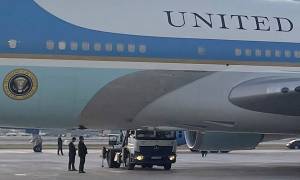

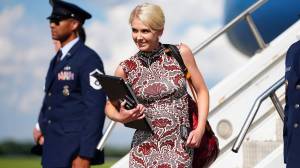

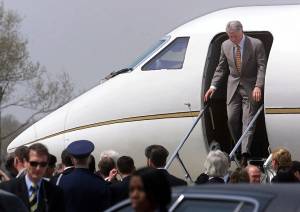






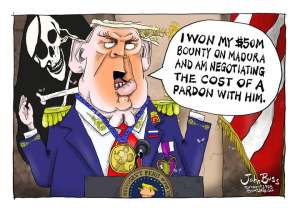
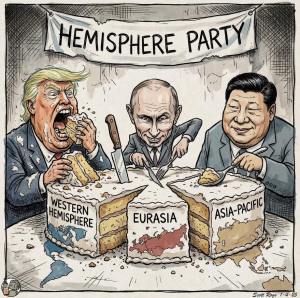 Meetings, speeches, and press conferences are ongoing today regarding the Venezuela situation, while additional actions appear to be in the planning stage. It would seem that more immediate active responses would be pertinent. This headline comes from today’s
  It’s difficult to gauge the responses to this. NATO (via
 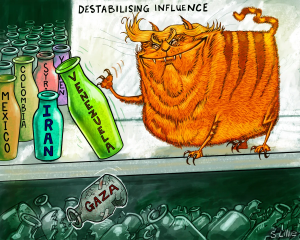 The New York Times
 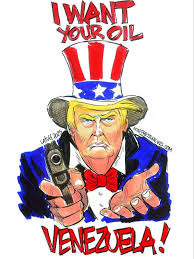 Additional details at the link. It appears that the attack on Venezuela has already claimed the lives of Cuban military personnel.












 peej
peej Carissa
 bostonboomer
 dakinikat
 ecocatwoman
 jjlo
jjlo mablue2
 Mama Lopez
 peggysue22
 quixote
 skydancingguestblogger
 Mona (aka Wonk the Vote)



 Sky Dancing
Recent Comments