“Had enough? Obviously, the Mobsters Are Governing America bunch haven’t.” John Buss, @repeat1968
Good Day, Sky Dancers!
Things continue to look bleak for our country as Orange Caligula’s physical and mental conditions become more obvious. The Anti-Weaponization Fund looks more shady than ever. The continued coverage of its impact on our budget and rule of law gets more shocking with each elucidation. None of Trump’s songs and dances has gotten the voters’ attention as much as our difficult economy. It is evident with each grocery store and gas station visit and bill to pay that something is very wrong. The worst, massive insider-trading crimes appear to be going on within Trump’s circle.
Forbeshas this headline this morning. “Trump’s Tax Immunity Could Save Him More Than $600 Million. The president secures a get-out-of-jail-free card for tax improprieties, just as he’s hauling in record amounts of cash.” Dan Alexander has the analysis and the story.
Acting Attorney General Todd Blanche signed a document Tuesday giving Donald Trump, his two eldest sons and his company broad immunity for potential tax disputes with the federal government. It’s the clearest way that the president is personally benefitting from his settlement with the Internal Revenue Service, which he sued days after taking office for failing to prevent the release of his personal tax returns.
The settlement lands at a convenient moment. Donald Trump earned an estimated $1.4 billion from crypto and licensing ventures in 2025, as he turned his first year back in the White House into the most lucrative year of his life. If the president received an extension for his 2025 return, his preparers may be sorting through exactly how to present this year’s welter of income right now. Trump has never hidden the animating principle. When Hillary Clinton accused him of paying no taxes in the 2016 debates, he replied: “That makes me smart.” Also much richer. If Trump is able to conjure up theories to avoid taxes for his 2025 income, he could save more than a half-billion dollars, according to Forbes estimates.
The conflict-of-interest underpinning all of this is so obvious that even Trump has acknowledged it. “I’m the one that makes the decision, right?” he mused in the Oval Office in October. “You know, that decision would have to go across my desk. And it’s awfully strange to make a decision where I’m paying myself.” Trump first suggested he would send whatever judgement he received to charity, before settling on a more creative approach. The government would not pay Trump. Instead, Trump would get a pass enabling him to pay less to the government. The move harkens the old cliché—a penny saved is a penny earned—with the same result: more money in Trump’s pocket.
Asked about all this, the White House referred questions to the Trump Organization. The president’s business did not dispute the estimates but opted to issue a lengthy statement attacking the IRS that said, in part, “This settlement seeks to provide meaningful accountability for the IRS’s prolonged and systemic failure to safeguard sensitive taxpayer data.”
Like the settlement itself, Trump’s massive earnings are a product of the presidency. Heading into the 2024 election, Trump announced a new crypto venture, World Liberty Financial, which sold tokens to anyone interested in buying. The tokens offered no financial interest in World Liberty, which helps explain why so few people noticed initially. But after Trump won the election, sales exploded. The economics of the deal were tailored to funnel vast sums of cash to the Trump family. After the first $15 million of sales, 75% of the proceeds went to the Trump family—with 70% of that flowing to the president-elect. More than $50 million went into this machine by the end of 2024, before ramping up in the new year.
Tokens were not the only thing Trump was selling. As Forbes first reported, he also struck a secret deal to offload a chunk of equity in World Liberty Financial in January 2025. The Wall Street Journallater identified the purchaser of that stake, an entity backed by Sheikh Tahnoon bin Zayed Al Nahyan, which promised $500 million in the deal. The agreement reportedly excluded the proceeds from token sales, which appeared to be World Liberty’s principal business at the time. World Liberty went on to launch a stablecoin that another entity connected to Sheikh Tahnoon propped up with a multibillion-dollar investment. Trump walked away from the sale with an estimated $375 million in pre-tax earnings. That windfall would theoretically trigger a roughly $140 million federal tax bill.
Every sucker that voted for this man needs a good thwap upside their head. This Reuters Exclusive is shocking. “Trump official tried to ban voting machines used by half of US states.” The lede is shared by Erin Banco, Jonathan Landay, and Alexandra Alper.
U.S. President Donald Trump’s election-security czar last year sought to ban voting machines used in more than half of U.S. states by asking whether the Commerce Department could declare their components national-security risks, according to two people with direct knowledge of the matter.
White House adviser Kurt Olsen, a lawyer Trump has tasked with proving widely debunked election-rigging conspiracy theories, pushed the plan to target Dominion Voting Systems machines. The idea emerged, the sources said, as Olsen and other officials brainstormed about how the federal government could take control over elections from U.S. states, an idea publicly aired by Trump.
Olsen wanted a national system of hand-counted paper ballots, the sources said, a frequent Trump demand some election-security experts say would be less accurate and potentially riskier than the current system of machines with auditable paper trails that almost all cities and states use.
The plan to exclude the machines, reported here first, got far enough that in September, Commerce Department officials began exploring what grounds could be invoked to execute it, three additional sources said. It eventually collapsed, however, because Olsen and other administration staffers working with him failed to provide evidence to justify such a move, two of the sources said.
This headline is from theNew York Times. “Audit Immunity for Trump Family Puts I.R.S. in a Bind
Federal law prohibits the Internal Revenue Service from halting an audit at the direction of the president or his aides.” Andrew Duehren reports the story.
President Trump’s return to office has been an unforgiving crucible for the hidebound Internal Revenue Service. He and his aides have decimated its ranks, fired and replaced its leaders and made repeated attempts to enlist the agency in his quest for political retribution.
Now, as part of an arrangement drawn up this week by Todd Blanche, the acting attorney general, the I.R.S. faces its most profound legal and ethical test yet: a demand to drop any audits of Mr. Trump, his family members or their “affiliates.”
Tax lawyers and former I.R.S. officials said such expansive protection would cut to the core of the agency’s mission to collect taxes in a disinterested, nonpartisan way — and could potentially run afoul of the laws governing how it does so.
“It’s just completely contrary to the notion that you’re supposed to comply with the law and the I.R.S. is there to make sure you do that,” said George Yin, a tax law professor and former chief of staff at the congressional Joint Committee on Taxation. “The idea that you can get a free pass from the I.R.S. or anyone can get a free pass from the I.R.S. is just completely ridiculous.”
Immunity from I.R.S. scrutiny for Mr. Trump and his family was part of a broad agreement made by the Justice Department to resolve a lawsuit he filed against the I.R.S. over the leak of his tax returns. Beyond the audit provision, the Justice Department committed to creating a $1.8 billion fund to pay victims of “weaponization,” a proposal that has been rebuked by both Republicans and Democrats on Capitol Hill.
While the Justice Department has said Mr. Trump himself will not be paid out of that fund, an end to any and all audits based on tax returns previously filed could be quite lucrative for the Trumps. The New York Times reported in 2024 that an adverse ruling in an I.R.S. audit could cost Mr. Trump more than $100 million, though it is unclear if that examination is still underway.
The nine-page outline creating the $1.776 billion “anti-weaponization” fund was agreed to and signed on Monday by Frank Bisignano, who leads the I.R.S. as its chief executive officer. The one-page addendum calling for the I.R.S. to drop any audits of Mr. Trump and his family members was released the next day and signed by only Mr. Blanche.
That has raised the question of how, and if, the leader of the Justice Department can control decisions made at the I.R.S., which falls under the Treasury Department.
“There’s a genuine question as to whether the attorney general can do this,” said Daniel Hemel, a tax law professor at New York University. “I can’t think of precedent where the attorney general signs a piece of paper that ends audits for a large number of people.”
This guest essay in the New York Times by Representative Jamie Raskin is a must-read. Raskin provides us with a blueprint to stop this particular grift. “There’s a Way to Stop Trump’s I.R.S. Slush Fund.”
These days it takes a spectacular burst of corruption to get the attention of our scandal-weary nation, but President Trump and his administration have managed, once again, to transfix Americans by establishing a $1.776 billion “anti-weaponization” fund in the Department of Justice that will undoubtedly be used to line the pockets of Mr. Trump’s partisans and foot soldiers — with your tax dollars.
The creation of this fund is a stupefying feat of self-dealing — part of a “settlement agreement” between the Department of the Treasury, which Mr. Trump controls, and the plaintiffs — Mr. Trump, two of his sons and their family business — who sued the I.R.S. for $10 billion over the leak of his tax returns. It will very likely result in an undeserved windfall to a legion of Jan. 6 rioters who have already unjustly received pardons from Mr. Trump.
Every part of this farce is an affront to the Constitution. It usurps both the exclusive power of Congress to legislate programs and spend money and the power of the courts to decide specific cases and controversies.
It is, quite simply, a scam.
Only Congress has the power to appropriate federal dollars. Article I, Section 9 of the Constitution states that “no money shall be drawn from the Treasury but in consequence of appropriations made by law.” But Mr. Trump and Acting Attorney General Todd Blanche seem to think they can conjure this giant slush fund into being without congressional approval.
Further, Article III, Section 1 states that the “judicial power of the United States shall be vested in one supreme court, and in such inferior courts as the Congress may from time to time ordain and establish.” Yet the settlement took Mr. Trump’s case out of the hands of the courts. And it calls for oversight by a five-member board, appointed by Mr. Blanche and whose members Mr. Trump can dismiss on a whim. Even if this fund were legitimate, that kind of setup wouldn’t be for Mr. Blanche to decide. Congress has never established a court, tribunal or board to hear pleas from people who believe they are victims of government “weaponization,” much less a fund almost certainly meant to reward supporters and allies of the president who feel they were wronged simply because their actions on Jan. 6, 2021, were prosecuted.
No matter what you think about the events of Jan. 6, hundreds of rioters indisputably broke the law that day when they stormed the Capitol trying to stop the certification of the 2020 presidential election and the peaceful transfer of power.
As regrettable as it is that most of the rioters were pardoned, there’s no denying that as president, Mr. Trump has that power. But the same Constitution giving him that power also says that “neither the United States nor any state shall assume or pay any debt or obligation incurred in aid of insurrection or rebellion against the United States.” Jan. 6 was indeed an insurrection, and pardon or no pardon, no one can legally be compensated for taking part in it.
As James Madison noted in Federalist No. 10, a cardinal precept of our legal system is that “no man is allowed to be a judge in his own cause, because his interest would certainly bias his judgment, and, not improbably, corrupt his integrity.” Here, Mr. Trump’s administration “settled” a case that he brought, effectively making him the judge in his own case. He not only concocted the fund, but his Justice Department threw in a sweetener: shielding him and his sons from audits of any tax returns they have already filed.
The $1.776 billion figure is obviously meant to invoke the year of our founding. But go back and read the Declaration of Independence, which includes a long list of accusations directed at George III. Among them is the charge that the British king “has dissolved representative houses repeatedly for opposing with manly firmness his invasions on the rights of the people.”
Read more. I’ve gifted the link. #FARTUS thinks he’s above the law and also thinks the U.S. Treasury and Laws are his to toy with. NBC News reports that there are many takers for the Fund, even though it’s not open for business yet. “Trump’s $1.8B fund isn’t officially open yet. That hasn’t stopped applications. No commissioners have been chosen, a requirement before claims can be processed, an administration official told NBC News. The Justice Department says millions are eligible.”
Applications are already rolling into the Justice Department from hopefuls aiming for some of the nearly $1.8 billion “anti-weaponization” fund, even though the process can’t officially begin until commissioners are chosen to decide how the money is doled out.
The fund was announced this week, part of an unprecedented settlement between President Donald Trump, two of his sons and the Trump Organization and the government he oversees over the leak of his tax returns. He agreed to drop legal claims in exchange for creating the fund.
It’s not clear yet how people are expected to formally apply. The pool of possible applicants is substantial, according to a Justice Department overview that was sent to GOP Senate offices Thursday.
“Literally tens of millions of Americans were subjected to improper and unlawful government targeting, including extensive government censorship and aggressive lawfare,” according to the overview.
Justice Department officials said the five commissioners will be chosen in the coming weeks — the appointments must be made within 30 days from when the settlement was signed Monday. Acting Attorney General Todd Blanche will make the decisions, though Congress members will get input on one of them. The president can fire the commissioners at will.
The department is working under a deadline, in part because the money pool — if it isn’t blocked by Congress or courts — would have to be distributed by the end of Trump’s term in 2028. Legal challenges have already begun, and disbursements could be tied up in the courts until well after the deadline, or it could be declared unlawful.
Both Democrats and Republicans have criticized the fund. Opponents have labeled it a massive “slush fund” for Trump’s allies. Its existence has alarmed some legal experts, in part because there will be very little public oversight over how it is managed.
Among the crooks waiting for compensation are Michael Cohen, Enrique Tarrio, Brandon Fellows, Michael Caputo, and Mike Lindell. The Lindell link goes to an MSNBC article with this headline. “Who’s applying for the $1.8 billion slush fund? In today’s edition of The Tea, Spilled by Morning Joe: Trump’s revenge tour, Stephen Colbert’s last show, and more.” George Santos is in that list too.
“I’ve been pushing for this. I think I was weaponized against. I think I’m a good example of that.”
— Proud Boys founder Enrique Tarrio, sentenced to 22 years for Jan. 6 before being pardoned by Trump less than two years later, now seeking $2 million to $3 million from the Justice Department’s new $1.7 billion Anti-Weaponization Fund
Looks like quite the Motely Crew.
People are still shocked by the Supreme Court Decision that basically guts Voting Rights. This is from Talking Points Memoand is reported by Josh Kovensky and Khaya Himmelman. “Their Loved Ones Died for the Voting Rights Act. The Supreme Court’s Ruling Is a New Injustice.”
Dennis Dahmer was 12 years old in January 1966 when Klansmen stormed his family home and set it on fire, murdering his father, Vernon. He still remembers the shootout; he remembers watching his father die from smoke inhalation. The trauma lingers to this day, 60 years later.
Vernon Dahmer had been a fixture in the African American community near Hattiesburg, Mississippi. He ran a successful local grocery, and, after the Voting Rights Act was passed in 1965, obtained the right to register voters and collect poll taxes, which were still in effect, at his store. Members of the local White Citizens’ Council started to appear at the family farm, warning his father to stop, Dahmer told TPM, but that didn’t deter him. He recorded a radio announcement in January 1966 offering to cover the cost of poll taxes for African Americans who couldn’t afford to pay. The KKK attacked the next day.
“He would always say to us, ‘do something, dammit,’” Dahmer recalled. “‘Don’t just stand there.’”
With all that in mind, Dennis Dahmer decided late last year to listen in to oral arguments in Callais v. Louisiana, the Supreme Court case that would ultimately gut the remnants of the Voting Rights Act. The law had provided a framework for protecting minority votes in the South for decades.
“It was apparent to me that they had already made up their mind — talking about the MAGA ones for sure,” he said. “They were just laying the groundwork to justify what they were going to do.”
The Callaisdecision last month threatens to bring the state of Black congressional representation in the South back to the 1960s. State legislatures across the Old Confederacy are gerrymandering away political maps that allowed Black communities a voice in local, state and federal politics, and provided a means for them to elect politicians of their choosing. The rapid democratic backsliding has prompted demonstrations at Selma, the site of key actions during the Civil Rights Movement, and disbelief among Democrats at the consequences.
But for Dahmer and other survivors of people who were maimed or murdered during the Civil Rights movement, it’s deeply personal. For these families, the Supreme Court’s decision in Callais represents a return to the 1960s that isn’t abstract, but very real. They remember learning that their relatives died, they remember death threats against them and other loved ones in the aftermath, they remember how the fear and bloodshed prompted President Lyndon B. Johnson to decide that the time had come to send a Voting Rights Act to Congress. In many of these cases, justice was limited, late, or non-existent: the perpetrators were acquitted, died before they were convicted, or were only held accountable after spending decades free.
Now comes a new form of injustice: the one lasting change to American democracy that their relatives’ deaths brought about has been undone.
You definitely should read this one and all the stories it tells. There are definitely more untold stories, too. This New York Timesstory by Nikole Hannah-Jones is spot-on. “The Civil Rights Era Is Collapsing Before Our Eyes.”
For students of history, what Tennessee did on May 7 felt like a premonition. One hundred and fifty years ago, when this nation’s first experiment with interracial democracy began to collapse, Tennessee — a former slave state and the birthplace of the Ku Klux Klan — was the first domino to drop. In 1870, the Tennessee legislature rewrote the State Constitution to disenfranchise Black men. As the historian Manisha Sinha writes in “The Rise and Fall of the Second American Republic,” Tennessee “provided a template to other Southern states” for how to “overthrow Reconstruction.”Within three decades, Black representation, in Congress and in local and state offices across the former Confederacy, would be wiped out.
It was not just Tennessee that echoed history, but the Supreme Court as well. The case that felled the Voting Rights Act was Louisiana v. Callais. Louisiana is the state where in 1896, in Plessy v. Ferguson, another superlatively conservative Supreme Court used the 14th Amendment to license segregation, setting off a race across the South to strip Black people of the franchise and codify their second-class citizenship.
The day after the Callais ruling, Gov. Jeff Landry took the unprecedented action of suspending the state’s U.S. House primary — in which tens of thousands of voters had already cast ballots — so legislators could redraw the election maps. Though one in three Louisiana residents is Black, Republicans intend to jettison at least one of two Black-majority districts. “Well, the failed narrative is actually that people in Louisiana are racist,” Landry insisted, “that basically we won’t elect Black people. I mean, I disagree with that.” In fact, since the Plessy era, Louisiana has sent only four Black people to Congress, and a Black candidate has never won in a white district there.
Georgia, South Carolina, Alabama and Florida quickly moved ahead with their own redistricting plans. And the governor of Mississippi — which has just a single Black U.S. representative despite having the nation’s highest percentage of Black residents, at 38 percent — announced his intent to do the same.
Voting and civil rights experts warn that America now sits at a familiar precipice. The Voting Rights Act helped transform the South: In 1965, the region had not a single Black representative in the U.S. Congress; today, it has 31. Now, Black representation may once again disappear in the South, where more than half of Black Americans live. This could lead to the largest decimation of Black political power since the fall of Reconstruction. And just like then, what is at stake is no less than American democracy itself.
This is another must-read article. I feel like we’re living through the darkest days in American history that haven’t quite rivaled the Civil War in terms of loss of life, but certainly rival the Civil War in changing how we live as free people in a democracy.
So, I’ve managed to write a very long post today, but every day with Orange Caligula and his crew of racists, sexist, backward-looking assholes just brings more shit into view and reality. Please hang in there.
What’s on your Reading, Action, and Blogging list today?
Did you like this post? Please share it with your friends:
Today is Caturday, and I wish I still had a cat to keep me company and reduce my stress level. At least I have my happy memories of cats who lived with me over the years.
The biggest news today is about the latest developments in Trump’s disastrous war on Iran. Iran has already closed the Strait of Hormuz again because of Trump’s blockade.
CAIRO (AP) — The standoff over the Strait of Hormuz escalated again Saturday as Iran reversed its reopening of the crucial waterway and fired on ships attempting to pass, in retaliation after the United States pressed ahead with its blockade of Iranian ports.
New attacks on the strait, through which roughly one-fifth of the world’s oil normally passes, threatened to deepen the global energy crisis and push the countries into renewed conflict as the war entered its eighth week.
A fragile ceasefire is due to run out by Wednesday. Iran said it had received new proposals from the United States, and Pakistani mediators were working to arrange another round of direct negotiations.
Iran’s joint military command said “control of the Strait of Hormuz has returned to its previous state … under strict management and control of the armed forces.” It warned it would continue to block transits while the U.S. blockade remained in effect.
Revolutionary Guard gunboats opened fire on a tanker and an unknown projectile hit a container vessel, damaging some containers, the British military’s United Kingdom Maritime Trade Operations center said. India’s foreign ministry said it summoned Iran’s ambassador over the “serious incident” of firing on two India-flagged merchant ships, especially after Iran earlier let several India-bound ships through.
For Iran, the strait’s closure — imposed after the U.S. and Israel launched the war on Feb. 28 during talks over Tehran’s nuclear program — is perhaps its most powerful weapon, threatening the world economy and inflicting political pain on President Donald Trump. For the United States, the blockade keeps up pressure and could strangle Iran’s already weakened economy.
Iran’s new supreme leader, Ayatollah Mojtaba Khamenei, issued defiant remarks on Saturday, saying the navy stands “ready to inflict bitter defeats on its enemies.” He has not been seen in public since being elevated to the post following his father’s death in Israel’s opening barrage.
Trump is obviously desperate to get out of the mess he made. He’s been spreading optimistic lies about the progress toward peace, but wishful thinking is not going to solve his problems.
President Trump went on a media tear on Friday, granting interviews and unleashing a flurry of social media posts that framed peace talks with Iran as all but complete.
After an announcement by Iran’s foreign minister that the Strait of Hormuz had been reopened, Mr. Trump made a series of optimistic posts on his social media platform, Truth Social. He also spoke to several news outlets, asserting that Tehran had agreed to many demands and predicting a quick resolution to the conflict.
Iranian officials did not confirm most of Mr. Trump’s claims and disputed several of them. Mohammad Bagher Ghalibaf, Iran’s top negotiator and the speaker of its Parliament, said on social media Friday evening that Mr. Trump made several false claims.
“The president of the United States made seven claims in one hour, all of which are false,” said Gen. Ghalibaf, a military and political influential figure in Iran leading negotiations. “They did not win the war with these lies, they will certainly not get any where in negotiations either.”
Trump’s fantastic claims:
Mr. Trump said on Friday that Iran, with the help of the United States, was removing all of the mines it laid in the Strait of Hormuz last month. He also claimed that the “Hormuz Strait situation is over” and “Iran has agreed to never close the Strait of Hormuz again.”
Iran has made no such commitment, and its foreign minister, Seyed Abbas Araghchi, had only gone so far as to announce that the vital oil route would be open “for the remaining period of cease-fire” for ships that adhered to a route “coordinated” by Iran. Later, the ministry’s spokesman, Esmail Baghaei, said the strait remained under Iran’s supervision….
Mr. Trump also claimed in a phone interview with CBS that Iran had “agreed to everything,” including working with the United States to remove its enriched uranium. But in comments made to Iranian state media later that day, Mr. Baghaei said that Tehran had rejected the option of transferring its enriched uranium stockpile abroad.
On Friday, Mr. Trump told AFP that there were “no sticking points” left for a peace deal with Iran. The White House has not confirmed any details of a plan. In a brief phone interview with Axios, Mr. Trump said he expected a deal “in the next day or two.”
Trump is insane and no one in the mainstream media wants to say so.
Analysis of the situation by Patrick Wintour at The Guardian: Trump and Tehran’s series of mismanaged posts stall progress towards peace.
A set of mismanaged and premature media announcements by Donald Trump and Tehran has led to the collapse of progress towards a peace settlement between Iran and the US.
The chain of events started when the Iranian foreign minister, Abbas Araghchi, posted on X on Friday soon after the markets opened in the US.
“In line with the ceasefire in Lebanon the passage of all commercial vessels through the strait of Hormuz is declared completely open for the remaining period of the ceasefire [Lebanon ceasefire] on the coordinated route as already announced by the Ports and Maritime Organisation of the Islamic Rep of Iran.”
His announcement knocked $12 off the price of a barrel of oil and was welcomed by Pakistan, whose officials had been in Tehran for three days trying to find a way to address Iranian preconditions for holding talks with the U.S.
Araghchi’s post was potentially poorly framed or incomplete, and led to a big backlash, which was made worse by the fall in oil prices, and the news being welcomed and overinterpreted by Trump, who thanked Iran for opening the strait and agreeing to export its stockpile of uranium to the US….
Within minutes, Tasnim, a news agency close to the Islamic Revolutionary Guard Corps, described Araghchi’s post as either wrong or incomplete. It said the post was “published without the necessary and sufficient explanations, created various ambiguities regarding the conditions for passage, details and mechanisms of passage, and led to a great deal of criticism”….
The renewed impasse led to Trump threatening to restart bombing next week after the ceasefire between the two sides expires on Wednesday. It also sets up another potentially dangerous confrontation in the strait, which has so far avoided a direct naval confrontation between the US and Iran.
Iran also insisted it told mediators it was unwilling to restart talks with the US in Islamabad on Monday, as had been widely rumoured, because the demands by the US were excessive….
Trump’s desperation for the war to end has seen him trying to speed through a process that he does not fully control, and which requires agreement from Tehran. Iran is still convinced that the strait remains its winning card and that time is on its side, so there is no rush for Iran to return to the talks.
Read the entire analysis at the Guardian. It’s an interesting piece.
Shipping companies are facing confusion and uncertainty about the status of the Strait of Hormuz, the narrow passageway through which a significant share of the world’s energy flows, as they assess mixed messages from officials in Iran and the United States.
But even if the strait fully opens soon — on Saturday, Iran’s military said it would reimpose “strict” control over traffic — it will take weeks for substantial amounts of Persian Gulf oil and gas to reach buyers around the world.
And it will be much longer before companies repair the damage that has been inflicted on one of the world’s most important energy-producing regions.
It is likely to be a long time before a gallon of gasoline costs less than $3 a gallon, as it did before the United States and Israel attacked Iran on Feb. 28. Shortages of certain products like jet fuel and natural gas may also persist in some countries for weeks or longer.
“We don’t expect oil prices — and therefore pump prices — to go back to prewar levels,” said Arjun Murti, a partner at Veriten, an energy research and investment firm based in Houston.
Think of the Strait of Hormuz, which sits between Iran and the Arabian Peninsula, as a valve. It must be open for energy to flow. But whether shipping companies reposition tankers and producers turn wells back on will depend heavily on whether they believe that the détente between Iran and the United States and Israel is durable.
Spencer Dale, who until recently served as the chief economist of the London-based oil company BP, said that producers who have been forced to turn off their oil and gas wells will be reluctant to restart them “until people have confidence that you have a lasting agreement.”
In other news, Trump’s FBI director is apparently an out-of-control, heavy-duty alcoholic who poses a serious national security risk for the country. Sarah Fitzpatrick broke the story late yesterday at The Atlantic (gift link): The FBI Director Is MIA.
On Friday, April 10, as FBI Director Kash Patel was preparing to leave work for the weekend, he struggled to log into an internal computer system. He quickly became convinced that he had been locked out, and he panicked, frantically calling aides and allies to announce that he had been fired by the White House, according to nine people familiar with his outreach. Two of these people described his behavior as a “freak-out.”
Patel oversees an agency that employs roughly 38,000 people, including many who are trained to investigate and verify information that can be presented under oath in a court of law. News of his emotional outburst ricocheted through the bureau, prompting chatter among officials and, in some corners of the building, expressions of relief. The White House fielded calls from the bureau and from members of Congress asking who was now in charge of the FBI.
It turned out that the answer was still Patel. He had not been fired. The access problem, two people familiar with the matter said, appears to have been a technical error, and it was quickly resolved. “It was all ultimately bullshit,” one FBI official told me.
But Patel, according to multiple current officials, as well as former officials who have stayed close to him, is deeply concerned that his job is in jeopardy. He has good reasons to think so—including some having to do with what witnesses described to me as bouts of excessive drinking. My colleague Ashley Parker and I reported earlier this month that Patel was among the officials expected to be fired after Attorney General Pam Bondi’s ouster, on April 2. “We’re all just waiting for the word” that Patel is officially out of the top job, an FBI official told me this week, and a former official told my colleague Jonathan Lemire that Patel was “rightly paranoid.” Senior members of the Trump administration are already discussing who might replace him, according to an administration official and two people close to the White House who were familiar with the conversations.
A bit more:
The IT-lockout episode is emblematic of Patel’s tumultuous tenure as director of the FBI: He is erratic, suspicious of others, and prone to jumping to conclusions before he has necessary evidence, according to the more than two dozen people I interviewed about Patel’s conduct, including current and former FBI officials, staff at law-enforcement and intelligence agencies, hospitality-industry workers, members of Congress, political operatives, lobbyists, and former advisers. Speaking on the condition of anonymity to discuss sensitive information and private conversations, they described Patel’s tenure as a management failure and his personal behavior as a national-security vulnerability.
They said that the problems with his conduct go well beyond what has been previously known, and include both conspicuous inebriation and unexplained absences. His behavior has often alarmed officials at the FBI and the Department of Justice, even as he won support from the White House for his eager participation in Trump’s effort to turn federal law enforcement against the president’s perceived political enemies.
Several officials told me that Patel’s drinking has been a recurring source of concern across the government. They said that he is known to drink to the point of obvious intoxication, in many cases at the private club Ned’s in Washington, D.C., while in the presence of White House and other administration staff. He is also known to drink to excess at the Poodle Room, in Las Vegas, where he frequently spends parts of his weekends. Early in his tenure, meetings and briefings had to be rescheduled for later in the day as a result of his alcohol-fueled nights, six current and former officials and others familiar with Patel’s schedule told me.
On multiple occasions in the past year, members of his security detail had difficulty waking Patel because he was seemingly intoxicated, according to information supplied to Justice Department and White House officials. A request for “breaching equipment”—normally used by SWAT and hostage-rescue teams to quickly gain entry into buildings—was made last year because Patel had been unreachable behind locked doors, according to multiple people familiar with the request.
Use the gift link if you’d like to read the whole article.
Trump is on the verge of a settlement with the IRS that would pay him a lot of taxpayer money. Can that possibly be legal?
Attorneys for President Donald Trump and the Internal Revenue Service told a federal court Friday that they’re in talks aimed at resolving a $10 billion lawsuit over leaked tax records tied to the president, his adult sons and his company.
In a joint filing, the parties requested a 90-day pause on proceedings in the case while they “engage in discussions designed to resolve this matter and to avoid protracted litigation.”
Trump sued the IRS and Treasury Department this year alleging the tax-collecting agency failed to take the necessary steps to prevent the unauthorized release of his tax documents by a government contractor who shared them with news outlets. The contractor, Charles Littlejohn, pleaded guilty and was sentenced in 2024 to five years in prison.
Littlejohn admitted in court that he also stole the tax records of thousands of other wealthy people in 2019 and 2020, including Jeff Bezos and Elon Musk….
The lawsuit, which stated that Trump was suing in his personal capacity and not as president, also named two of Trump’s sons, Donald Trump Jr. and Eric Trump, and the Trump Organization as plaintiffs. The complaint alleged “reputational and financial harm” as well as “public embarrassment” from the leak, which led to The New York Times reporting that Trump had paid only $750 in federal income taxes in 2016 and 2017.
Democratic lawmakers this week introduced a bill that aims to ban the president, vice president and their families from collecting lawsuit settlement payments from the government.
One of the bill’s sponsors, Sen. Elizabeth Warren, D-Mass., said the bill “will close the loopholes that enable this apparent corruption and ban Trump — and all future Presidents and Vice Presidents — from abusing their power and stealing Americans’ hard-earned money.
After spending days attacking the Pope and posting AI generated pictures of himself as Jesus and being hugged by Jesus, Trump is planning to participate in a Bible reading.
President Donald Trump is making a dramatic show of religiosity just days after he posted an image on social media that many Christians found offensive.
A recording of Trump reading a verse from the Old Testament will be released next week as part of a celebration of the Bible, organizers of the event said Friday.
The president’s reading, which has already been recorded, will be part of an 84-hour public presentation at the Museum of the Bible in Washington that will feature nearly 500 readers cycling through scripture from Genesis to Revelation over eight days.
Trump’s roughly two-and-a-half-minute reading, which is slated to air Tuesday, comes after he angered many Christians with a social media post that appeared to depict him as Jesus and publicly quarreled with Pope Leo.
Bunni Pounds, the founder of Christians Engaged and an organizer of the Bible event, welcomed the president’s participation and declined to weigh in on the controversies — though she noted that the president’s reading might be relevant.
“It’s a scripture about repentance,” Pounds said. “None of us are perfect.”
The president’s reading, Second Chronicles 7:14, is among the most frequently invoked verses in American public religious life, calling on believers to “humble themselves, and pray, and seek my face… and turn from their wicked ways.”
The White House on Friday released a statement tying the initiative to the broader sweep of American history, emphasizing what it described as the Bible’s “indelible” role in shaping the nation’s identity. The statement nods to figures like John Winthrop and Abraham Lincoln, and frames the reading as part of a larger commemoration of 250 years of the Bible’s influence in America.
Mr. Trump recorded his segment of the reading from the Oval Office, organizers said. He read a passage from the Old Testament book of II Chronicles that has become a touchstone for many of his Christian supporters, who interpret it as a call to national repentance and subsequent blessing.
The central verse in II Chronicles 7 reads: “If My people, which are called by my name, shall humble themselves, and pray, and seek my face, and turn from their wicked ways; then will I hear from heaven, and will forgive their sin, and will heal their land.”
“It’s been a hallmark of the religious right to cite this particular passage,” said Matthew D. Taylor, a visiting scholar at the Center on Faith and Justice at Georgetown University.
Biblical scholars emphasize that the passage concerns the writer’s understanding of a particular covenant between God and the ancient Israelites. The books of Chronicles cover centuries of Jewish history, including the reigns of Kings David and Solomon.
In recent decades, the verse has become the subject of songs, prayers and sermons that interpret it as a promise with direct political implications for the contemporary United States. For example, at the Capitol attack on Jan. 6, 2021, the founder of a group called Cowboys for Trump prayed the passage through a bullhorn over the crowd, which chanted “Fight for Trump!” in response.
I just don’t know what to day about that.
That’s all I have for you today. I hope everyone is having a nice, peaceful weekend.
Did you like this post? Please share it with your friends:
We are being ruled by evil idiots. Unfortunately, they are in full control of our government, supported by other idiots–along with people who know better, but live in fear of the evil idiots. I wonder if there is any way to get through this nightmare without ending up in a dictatorship controlled by these incredibly stupid, evil people? If only we could wake up and find out that this was all a very bad dream.
Trump administration officials fired more than 300 staffers Thursday night at the National Nuclear Security Administration — the agency tasked with managing the nation’s nuclear stockpile — as part of broader Energy Department layoffs, according to four people with knowledge of the matter.
Sources told CNN the officials did not seem to know this agency oversees America’s nuclear weapons….
The agency began rescinding the terminations Friday morning.
Some of the fired employees included NNSA staff who are on the ground at facilities where nuclear weapons are built. These staff oversee the contractors who build nuclear weapons, and they inspect these weapons.
It also included employees at NNSA headquarters who write requirements and guidelines for contractors who build nuclear weapons. A source told CNN they believe these individuals were fired because “no one has taken anytime to understand what we do and the importance of our work to the nation’s national security.”
Members of Congress made their concerns about the NNSA firings known to the Energy Department, a Hill staffer told CNN. A person with knowledge of the matter told CNN that senators visited Energy Sec. Chris Wright to express concern about the NNSA cuts.
“Congress is freaking out because it appears DOE didn’t really realize NNSA oversees the nuclear stockpile,” one source said. “The nuclear deterrent is the backbone of American security and stability – period. For there to be any even very small holes poked even in the maintenance of that deterrent should be extremely frightening to people.”
NNSA has a total of 1800 staff at facilities around the country. The only probationary staffers exempt from the Thursday-night firings were those who work at its Office of Secure Transportation, the office in charge of driving or otherwise transporting nuclear weapons around the country securely, one person familiar told CNN….
The agency made the about face Friday morning; during a meeting, acting NNSA administrator Teresa Robbins said the agency had received direction to rescind the termination of probationary employees. Probationary workers have typically been employed for less than a year, or two years in some cases, and have fewer job protections and rights to appeal.
Robbins added on Friday that if probationary NNSA employees had not yet been fired, their jobs were now safe and all NNSA employees whose access to the agency’s network and internal IT systems was shut off would be turned back on, one source told CNN.
See what I mean? The Trump administration ordered the firing of all probationary government employees without even check to see if any of these people were in essential jobs. Government by stupid people.
National Nuclear Security Administration officials on Friday attempted to notify some employees who had been let go the day before that they are now due to be reinstated — but they struggled to find them because they didn’t have their new contact information.
In an email sent to employees at NNSA and obtained by NBC News, officials wrote, “The termination letters for some NNSA probationary employees are being rescinded, but we do not have a good way to get in touch with those personnel.”
The individuals the letter refers to had been fired on Thursday and lost access to their federal government email accounts. NNSA, which is within the Department of Energy and oversees the nation’s nuclear stockpile, cannot reach these employees directly and is now asking recipients of the email, “Please work with your supervisors to send this information (once you get it) to people’s personal contact emails.” [….]
President Donald Trump’s administration has acted with unprecedented speed — and in some cases, questionable legality — in seeking to cut large portions of the federal government, laying off staff and ending contracts. But that speed has resulted in complications, including firing people agencies actually want to keep.
The emails come after multiple staff — all civil servants — at the NNSA received termination notices late Thursday, according to a source with direct knowledge of the notifications. NBC News reviewed the termination notification, which included the subject line: “Notification of Termination During Probationary/Trial Period.”
The NNSA is tasked with designing, building and overseeing the U.S. nuclear weapons stockpile….
The termination notices, which read “effective today,” came within hours of a Russian drone striking the Chernobyl power plant in Ukraine. NNSA tracks nuclear risks in Ukraine, including through sensor systems.
So these firings weren’t even limited to probationary staff. Everyone was fired.
Americans could soon start to feel the repercussions of the Trump administration’s decision to fire thousands of government workers — from public safety to health benefits and basic services that they have come to rely on.
Trump’s directive to slash thousands of jobs across agencies is leaving gaping holes in the government, with thousands of workers being laid off from the Education Department, the Office of Personnel Management, the Department of Veterans Affairs and multiple others.
At the U.S. Forest Service, where some 3,400 workers are slated to be cut, wildfire prevention will be curtailed as the West grapples with a destructive fire season that has destroyed millions of acres in California.
And the Centers for Disease Control and Prevention wasn’t spared: Almost half of the agency’s 2,800 probationary employees were cut while about 400 employees appeared to have taken the “buy-out” offer, meaning the agency responsible for protecting Americans from disease outbreaks and other health hazards will lose about a tenth of its workforce. That’s on top of more than 2,000 probationary employees fired from the Department of Health and Human Services, the CDC’s parent agency.
“Morale is tanked,” said a forest service official close to the situation — who, like many current and former government employees who spoke to POLITICO, was granted anonymity out of fear of retribution. “The public will see it this summer when campgrounds are shut down, trails aren’t maintained and bathrooms aren’t cleaned.”
Should the gutting of the federal government result in immediate negative consequences for the American people, the Trump administration could face political backlash from voters in Republican and Democratic states who suddenly find a host of services — including access to government websites or even benefits — vanish.
Illustration by Cassie Dominicis
The stupid and evil person behind all this chaos is Elon Musk, who appears to taken over the role of POTUS.
The Office of Personnel Management, which serves as the federal government’s human resources department, has been operated by associates of Elon Musk for weeks. The agency, which also laid off staff, sent out the so-called “Fork in the Road” deferred resignation notice to federal employees allowing those who opted in to resign their posts but be paid to not work through September.
A lawsuit filed by union officials representing federal workers temporarily halted the program, but a federal judge ruled the program could move forward, because the union officials didn’t have standing. The Trump administration then said no more federal employees could opt into the program — and the next day, the terminations of federal workers on probation resumed.
“We definitely cut more than probationary employees,” a person familiar with Office of Personnel Management firings said Friday. “We cut the entire communications department” and career employees too, the person added. In total, the person said as many as 200,000 civil service workers across the federal government that were in their probationary period as of this week could receive termination notices….
The firings came so swiftly this week that some Forest Service employees were told they would lose their job before there was any paperwork to sign.
Read more about the consequences of government by stupid people at the Politico link.
The Trump administration is full of incredibly stupid people, many of whom–including de facto President Musk and his puppet Trump–are also cruel people who enjoy inflicting pain and suffering on weaker people. Just look what they have done to USAID.
Shockingly, it turns out that empowering the richest human being on the planet to maliciously and gratuitously heap additional misery on that planet’s most poor, hungry, and desperate people might—just might—pose a niggling political problem to President Donald Trump.
There seems to be a split in Trumpworld these days. Some seem to think Trump can get away with anything, no matter how devastating it is to the most vulnerable or how corrupt an abuse of power it represents. Others seem aware that there are limits—that at some point, Trumpworld might push things too far and suffer a public backlash, and that this might actually matter.
A new internal memo circulating inside the U.S. Agency for International Development neatly captures this split. The Washington Postreports that the memo warns USAID employees not to communicate with the press about the shocking disruptions in humanitarian assistance that are being caused by the Trump-Musk attack on the agency, which are already producing horrific consequences. The memo said this transgression might be met with “dismissal.”
The memo claims to be correcting a “false narrative in the press” about the disruptions to that assistance. It notes that Secretary of State Marco Rubio last month issued a waiver to “lifesaving humanitarian assistance,” allowing it to continue despite the Trump-Musk freeze in agency spending. This has meant that this assistance has “continued uninterrupted and has never paused,” the memo claims, while warning recipients against any “unauthorized external engagement with the press.”
Miss Mink, the cat countess, by Janet Hill
This is highly disingenuous at best and mostly nonsense at worst. As The New York Timesreports, some senior USAID officials recently received an email explicitly directing them to hold off on approving some of this assistance, pending more directives from on high. What’s more, according to the Times, while some of this assistance did continue due to Rubio’s waiver, much of it has encountered serious obstacles.
This assistance—which includes aid for lifesaving food, shelter, and medicine—has gotten bogged down as USAID employees and groups that partner with the agency to distribute these things have struggled to access government funding streams halted by Trump. (A judge has ordered the funds to continue.) In one case, Musk claimed that the administration had restarted some disease-prevention funding, but it remains frozen, the Times reported.
The directive ordering USAID employees to refrain from discussing this with the press represents an unnerving turn in this saga, given how ugly and blatant it is. “This is basically telling USAID personnel not to tell the truth about what they have seen,” Jeremy Konyndyk, a former senior USAID official, told me, adding that this functionally commands USAID staff to “get in line with the propaganda narrative.”
Read more at TNR.
The stupid people who are now running the government are also working to make Americans less healthy.
The “department of government efficiency”, the Donald Trump-created program known as Doge and headed by the billionaire Elon Musk, has accessed or requested access to sensitive systems at multiple health agencies as the US president attempts to grant the committee sweeping powers within the federal government.
The bid for access comes amid an unprecedented effort to halt government spending, despite multiple court orders to unfreeze funds and reverse staff suspensions.
Thousands of people were laid off from health agencies on Friday after the Trump administration announced a plan to fire nearly all probationary employees, potentially numbering in the hundreds of thousands across the federal service.
“The potential for doing harm is significant,” said Scott Cory, former chief information officer for an agency within the US Department of Health and Human Services (HHS).
Health agencies maintain tightly controlled databases with sensitive information, and upheaval at these agencies threatens the US healthcare systemeven as the threat of infectious diseases like bird flu continues to ramp up.
“The possibility of new outbreaks or public health events is certain given the recent concerning spread of bird flu, which is still hampered by a slow response,” said an employee at the US Centers for Disease Control and Prevention (CDC) who requested anonymity because they were not authorized to speak on the record.
“With external communications cut off, extensive work-stop orders and dramatic changes in the federal workforce, the ability of any health agency is severely limited and ultimately will serve no one but those who choose to profit off the suffering,” the employee said….
Some 5,200 people across health agencies reportedly received layoffs notices on Friday.
About 1,250 of them worked at the CDC, according to a source who requested anonymity because they were not authorized to speak publicly.
This included senior officials and the entire first-year class of the CDC’s Epidemic Intelligence Services officers, known as “disease detectives”.
Other senior health officials are also being targeted for layoffs, and employees are bracing for more mass layoffs in coming days, sources say. Several contractors also report being laid off this week.
And then there’s the new Secretary of Health and Human Services, Robert F. Kennedy Jr.
Hours after being confirmed as Secretary of the US Department of Health and Human Services, Robert F. Kennedy, Jr. issued a statement that laid out sweeping plans for his first 100 days in office. Chief among his goals, he wrote, was to combat what he called a “growing health crisis” of chronic disease. The document called for the federal government to investigate the “root causes” of a broad range of conditions, including autism, ADHD, asthma, obesity, multiple sclerosis, and psoriasis. Conspicuously absent was any explicit mention of childhood vaccines, which Kennedy has long railed against as the head of the anti-vaccine advocacy group Children’s Health Defense.
From Journal of a Cat in Rome, by Takako Kessoku
But the document did zero in on another one of his fixations: a class of widely prescribed drugs that treat depression, anxiety, and mood disorders. The government, he said, would “assess the prevalence of and threat posed by the prescription of selective serotonin reuptake inhibitors, antipsychotics, [and] mood stabilizers.”
Kennedy has repeatedly railed against what he sees as rampant overprescription of selective serotonin reuptake inhibitors, commonly known as SSRIs, which treat depression and anxiety and include medications like Prozac and Zoloft. As with his previous assertions about vaccines, many of his statements about these drugs are not backed by science. In a 2023 livestream on X with Elon Musk, he claimed that “tremendous circumstantial evidence” suggested that people taking antidepressants were more likely to commit school shootings. (Actually, most school shooters were not taking those drugs, evidence shows.) Kennedy has also called people who take SSRIs addicts—and then tried to claim he didn’t during his confirmation hearings.
So despite this evidence, what options does Kennedy offer in response to the supposed overprescription of and addiction to SSRIs? In a podcast appearance last July, Kennedy said he planned to dedicate money generated from a sales tax on cannabis products to “creating wellness farms—drug rehabilitation farms, in rural areas all over this country.” He added, “I’m going to create these wellness farms where they can go to get off of illegal drugs, off of opiates, but also illegal drugs, other psychiatric drugs, if they want to, to get off of SSRIs, to get off of benzos, to get off of Adderall, and to spend time as much time as they need—three or four years if they need it—to learn to get reparented, to reconnect with communities.” The farm residents would grow their own organic food because, he suggested, many of their underlying problems could be “food-related.”
Will participation in these “wellness farms” be voluntary? This sounds kind of like involuntary servitude.
The Internal Revenue Service has now joined the list of federal agencies and offices experiencing life on the “DOGE” side. Two sources told TPM that a staffer affiliated with President Trump and Elon Musk’s controversial “efficiency” initiative left some bewildered and concerned on Thursday as they held their first meeting at the Washington headquarters of the tax agency.
Reuters and other news outlets havereported on the IRS meeting and identified the DOGE staffer involved as Gavin Kliger. A Capitol Hill source who was briefed on the meeting confirmed to TPM that Kliger represented DOGE at the agency. According to the Hill source, who requested anonymity to discuss the meeting, Kliger explained that DOGE wants to get a deep look inside the IRS.
By Jackson Ng
“Their interest was … really across the board, so it included the operation of enforcements, it included taxpayer service in terms of function and the personnel footprint, and they wanted extensive system access,” the Hill source said.
That last point, the source said, brings up unique concerns and uncertainty since the IRS has deep knowledge of Americans’ personal financial information.
“What exactly that would look like, I’m not sure,” the source said of the DOGE demand for access, adding, “Levels of data protection at IRS are higher than at other agencies. … Not only is improper disclosure illegal, but improper inspection of data internally is illegal. So, it’s a really high bar of data security here. It’s hard to think about what extensive system access would look like for these guys that wouldn’t violate the law.” [….]
A Treasury Department source with knowledge of Kliger’s meeting at the IRS said the DOGE staffer had a handful of phones, which struck the agency’s employees as “bizarre.”
“He basically had the vibe of a McKinsey consultant and came in and asked about headcount and how many people are in each department,” the Treasury source said, adding, “He had a black Mac, which didn’t seem to be government issue, and five iPhones.”
On LinkedIn, Kliger, who graduated from UC Berkeley in 2020, indicated he was working at the software company Databricks up until last month when he became a “special advisor” at the U.S. Office of Personnel Management. On a Substack that has beenidentified as belonging to Kliger, he describes himself as a “Silicon Valley engineer” who had a “political awakening.” Kliger also, according to a Reuters report, amplified content from neo-Nazi Nick Fuentes on a Twitter page that he later partially deleted and locked down.
The Treasury source said the DOGE staffers who have made contact at the department have been focused on “ROI,” or return on investment. In the context of the IRS, that would mean a focus on maximizing collections while keeping other costs down, the source said.
“I think they’re focused on collection now because they need every dollar they can for those tax cuts,” the source said of DOGE and the Trump administration. “You want to make it as streamlined as possible but also collect money.”
Read the rest at TPM.
I think that’s all the tolerance I have for reading about Trump and Musk’s government of the stupid for today.
Take care everyone. I hope you are all having a peaceful weekend.
Did you like this post? Please share it with your friends:
I don’t know if anyone is reading this. I’ve had quite a disturbing day so far. My phone suddenly stopped working and I was unable to make or receive calls. I spent a couple of hours messaging back and forth with tech support, and they finally got things working. Somehow I got thrown off the network and couldn’t get back on. But the guy finally figured it out and I can phone and text again. Fortunately, I got a very kind and patient representative who hung in there with me all that time.
Dakinikat wondered if the problem could have something to do with the solar storm that made the northern lights visible all the way down South. I guess it’s possible. The phone was working yesterday until around 1PM. I didn’t realize there was a problem until later though. Anyway, enough of my boring life.
Almost 15 years ago, I was in bad shape. I was divorced, broke, drinking too much, and living in a dated walk-up next to a noisy bar. (It was only minutes from my young daughter, it had a nice view of the bay here in Newport, and I could afford it.) The local veterinary hospital was a few doors down; they always kept one or two adoptable animals in the window. One day, a gorgeous black cat, with a little white tuxedo patch and big gold-green eyes, showed up in a small cage. I stared at her for a while. She stared back patiently.
Tom NIchols with Carla
I wasn’t taking very good care of myself at that moment, so I decided I couldn’t take care of a cat. I walked on. For weeks, the cat sat there. For weeks, we stared at each other. One day, as I was deep in my cups, I took a walk with a friend and co-worker who also happened to be my next-door neighbor. “You look at that damn cat every day,” he said. “Just go in and get it.”
So I did.
The cat was called “RC” and she was a stray, but her preexisting spaying and good health showed that she’d once had a home. Now she was the queen of the animal clinic: Because of her gentle temperament, the staff would let her out of the cage after hours, and she would sit on their desks while they did their paperwork.
I picked her up. She looked at me as if to say: Yeah, I recognize you. You’re the doofus who stared at me for weeks. I signed the papers and took her home. She was fluffy and black-haired, so I decided I would name her after Carla Tortelli from the show Cheers; thus, she became Carla T. Nichols. She explored the apartment quietly for a day or two, and then, one afternoon, I found her on my bed, stretched out on her back, paws up, purring. Yep, she was saying. This will do.
I was still deeply depressed, but every night, Carla would come and flake out over my keyboard as I struggled to work. That’s enough of that,she seemed to say. And then we would go into the living room, where I would sit in a chair and Carla would sit on the armrest. (We’ve now both seen almost every episode of Law & Order.) Slowly, she added routine to my life, but mostly, we had lots of hours of doing nothing—the quiet time that can feel sort of desolate if you’re alone, but like healing if you have the right company.
Soon, I started to see daylight. I met a woman named Lynn. I laid off the booze. I got help of various kinds.
Lynn started to come to the apartment more often, but Carla gave her a full examination before bestowing approval: That cat was not going to let some newcomer waltz in and wreck the careful feline therapy she’d been providing. Finally, Carla climbed on the pillows one morning and curled up around Lynn’s head. Okay, she was saying. Lynn can stay.
That was the beginning of the turnaround. I hope you’ll go read the rest. It’s a wonderful description of what can happen when you welcome a special animal into your life.
Former President Donald Trump used a dubious accounting maneuver to claim improper tax breaks from his troubled Chicago tower, according to an IRS inquiry uncovered by ProPublica and The New York Times. Losing a yearslong audit battle over the claim could mean a tax bill of more than $100 million.
The 92-story, glass-sheathed skyscraper along the Chicago River is the tallest and, at least for now, the last major construction project by Trump. Through a combination of cost overruns and the bad luck of opening in the teeth of the Great Recession, it was also a vast money loser.
But when Trump sought to reap tax benefits from his losses, the IRS has argued, he went too far and in effect wrote off the same losses twice.
The first write-off came on Trump’s tax return for 2008. With sales lagging far behind projections, he claimed that his investment in the condo-hotel tower met the tax code definition of “worthless,” because his debt on the project meant he would never see a profit. That move resulted in Trump reporting losses as high as $651 million for the year, ProPublica and the Times found.
Emile Munier, A small child reading to a cat
There is no indication the IRS challenged that initial claim, though that lack of scrutiny surprised tax experts consulted for this article. But in 2010, Trump and his tax advisers sought to extract further benefits from the Chicago project, executing a maneuver that would draw years of inquiry from the IRS. First, he shifted the company that owned the tower into a new partnership. Because he controlled both companies, it was like moving coins from one pocket to another. Then he used the shift as justification to declare $168 million in additional losses over the next decade.
The issues around Trump’s case were novel enough that, during his presidency, the IRS undertook a high-level legal review before pursuing it. ProPublica and the Times, in consultation with tax experts, calculated that the revision sought by the IRS would create a new tax bill of more than $100 million, plus interest and potential penalties….
The reporting by ProPublica and the Times about the Chicago tower reveals a second component of Trump’s quarrel with the IRS. This account was pieced together from a collection of public documents, including filings from the New York attorney general’s suit against Trump in 2022, a passing reference to the audit in a congressional report that same year and an obscure 2019 IRS memorandum that explored the legitimacy of the accounting maneuver. The memorandum did not identify Trump, but the documents, along with tax records previously obtained by the Times and additional reporting, indicated that the former president was the focus of the inquiry.
A sex discrimination lawsuit against Donald Trump’s campaign has triggered new accusations that Trump’s lawyers have intentionally covered up settlement payments to women, in violation of federal law.
On Friday, watchdog group Citizens for Responsibility and Ethics in Washington (CREW) filed a complaint with the Federal Election Commission, demanding an investigation into the alleged cover-up. The complaint cites new allegations from 2016 Trump campaign aide A.J. Delgado, which she lodged in a sworn court declaration earlier this week as part of her ongoing discrimination suit against Trump’s political operation.
Delgado’s filing presented evidence of top Trump attorney Marc Kasowitz openly admitting that the campaign wanted to use a law firm to cover up a potential settlement payout in 2017. The arrangement, as Delgado described it, appears specifically designed to evade the consequences of federal disclosure laws that require campaigns to publicly report the identities of payment recipients.
“In other words, the payment would be routed through a middleman, to hide the fact that the Campaign had settled, from the public and the FEC,” Delgado stated. “I thus have direct, personal experience with the Defendant-Campaign hiding settlement payments to women, routing them through a ‘middleman law firm,’ which to the public would only appear as payments ‘for legal services.’”
Delgado also claimed to have “information and reason to believe” that other campaign payments have hidden settlements with women “who raised complaints of gender discrimination, pregnancy discrimination, and sexual harassment.” Those payments, she said, are related to the $4.1 million that flowed to Kasowitz’s law firm over a two-month period immediately following the November 2020 election, as well as millions in mysterious legal reimbursements to the campaign’s compliance firm, Red Curve Solutions, which The Daily Beast first reported earlier this month, prompting a federal complaint.
The declaration is particularly significant in that it captures a direct admission of the campaign’s actual intentions behind this middleman arrangement—to keep the existence of a settlement from the public, and, by doing so, from the FEC itself.
A new Washington Post report that Trump made explicit policy promises to a roomful of Big Oil executives—while urging them to raise $1 billion for his campaign—is a powerful story in part because it wrecks what’s left of that mystique. In case you didn’t already know this, it shows yet again that if Trump has employed that aforementioned knowledge of elite corruption and self-dealing to any ends in his public career, it’s chiefly to benefit himself.
James Pelham, little girl reading with her cat
That counter narrative is a story that Democrats have a big opportunity to tell—if they seize on this news effectively. How might they do that?
For starters, the revelations seem to cry out for more scrutiny from Congress. Democratic Senator Sheldon Whitehouse of Rhode Island, who has been presiding over hearings into the oil industry as chair of the Budget Committee, says it’s “highly likely” that the committee will examine the new revelations.
“This is practically an invitation to ask more questions,” Whitehouse told me, describing this as a “natural extension of the investigation already underway.”
There’s plenty to explore. As the Postreports, an oil company executive at the gathering, held at Trump’s Mar-a-Lago resort last month, complained about environmental regulations under the Biden administration. Then this happened:
Trump’s response stunned several of the executives in the room overlooking the ocean: You all are wealthy enough, he said, that you should raise $1 billion to return me to the White House. At the dinner, he vowed to immediately reverse dozens of President Biden’s environmental rules and policies and stop new ones from being enacted, according to people with knowledge of the meeting, who spoke on the condition of anonymity to describe a private conversation.
Giving $1 billion would be a “deal,” Trump said, because of the taxation and regulation they would avoid thanks to him, according to the people.
Obviously industries have long donated to politicians in both parties in hopes of governance that takes their interests into account, and they explicitly lobby for this as well. But in this case, Trump may have made detailed, concrete promises while simultaneously soliciting a precise amount in campaign contributions.
For instance, the Post reports, Trump vowed to scrap Biden’s ban on permits for new liquefied natural gas exports “on the first day.” He also promised to overturn new tailpipe emission limits designed to encourage the transition to electric vehicles, and he dangled more leases for drilling in the Gulf of Mexico, “a priority that several of the executives raised.”
“The phrase that instantly came to mind as I was reading the story was ‘quid pro quo,’” Whitehouse told me. He also pointed to a new Politico report that oil industry officials are drawing up executive orders for Trump to sign as president. “Put those things together and it starts to look mighty damn corrupt,” Whitehouse said.
FAIRHOPE, Alabama — Supreme Court Justice Clarence Thomas told attendees at a judicial conference Friday that he and his wife have faced “nastiness” and “lies” over the last several years and decried Washington, D.C., as a “hideous place.”
Thomas spoke at a conference attended by judges, attorneys and other court personnel in the 11th Circuit Judicial Conference, which hears federal cases from Alabama, Florida and Georgia. He made the comments pushing back on his critics in response to a question about working in a world that seems meanspirited.
Jan Steen, Children want to teach a cat reading
“I think there’s challenges to that. We’re in a world and we — certainly my wife and I the last two or three years it’s been — just the nastiness and the lies, it’s just incredible,” Thomas said.
“But you have some choices. You don’t get to prevent people from doing horrible things or saying horrible things. But one you have to understand and accept the fact that they can’t change you unless you permit that,” Thomas said.
Thomas has faced criticisms that he accepted luxury trips from a GOP donor without reporting them. Thomas last year maintained that he didn’t have to report the trips paid for by one of “our dearest friends.” His wife, conservative activist Ginni Thomas has faced criticism for using her Facebook page to amplify unsubstantiated claims of corruption by President Joe Biden, a Democrat.
He did not discuss the content of the criticisms directly, but said that “reckless” people in Washington will “bomb your reputation.”
“They don’t bomb you necessarily, but they bomb your reputation or your good name or your honor. And that’s not a crime. But they can do as much harm that way,” Thomas said.
His reputation is already shot to hell. Why doesn’t he just resign and get out of Washington if he hates it so much?
Less than six months out from the presidential contest, leading Republicans, including several of Donald J. Trump’s potential running mates, have refused to commit to accepting the results of the election, signaling that the party may again challenge the outcome if its candidate loses.
In a series of recent interviews, Republican officials and candidates have dodged the question, responded with nonanswers or offered clear falsehoods rather than commit to a notion that was once so uncontroversial that it was rarely discussed before an election.
The evasive answers show how the former president’s refusal to concede his defeat after the 2020 election has ruptured a tenet of American democracy — that candidates are bound by the outcome. Mr. Trump’s fellow Republicans are now emulating his hedging well in advance of any voting.
For his part, Mr. Trump has said he will abide by a fair election but has also suggested that he already considers the election unfair. Mr. Trump frequently refers to the federal and state charges he is facing as “election interference.” He has refused to rule out the possibility of another riot from his supporters if he loses again.
“If we don’t win, you know, it depends,” Mr. Trump said last month when asked by Time magazine about the prospect of political violence. “It always depends on the fairness of an election.”
The authors go on to list several prominent Republicans who have refused to say if they will accept the election results. Read the rest at the NYT.
I’m going to end there. I’m really stressed out by my phone issue and a think I need a nap. Take care everyone.
Did you like this post? Please share it with your friends:
Last year in Massachusetts we had a winter with almost no snow. Weather people quite often predicted it, but it never came. It really bothered me. I realized how much I love snowstorms and how much I miss snow when it doesn’t arrive. It looks like this year will be another mild winter with very little snow. We got a few inches recently, but mostly we’re getting rain.
I’m far from alone in missing snow. A few days ago, I came across two articles about what climate change is doing to our winters.
In January 1995, when The Atlantic published “In Praise of Snow,” Cullen Murphy’s opus to frozen precipitation, snow was still a mysterious substance, coming and going enigmatically, confounding forecasters’ attempts to make long-term predictions. Climate change registered to snow hydrologists as a future problem, but for the most part their job remained squarely hydrology: working out the ticktock of a highly variable yet presumably coherent water cycle. “We still don’t know many fundamental things about snow,” Murphy wrote. “Nor do we understand its relation to weather and to climate—the dynamics of climate being one of the perennials on the ‘must figure out’ list of science.”
In January 2024, at long last, someone has figured out a formula of sorts for how snow reacts to climate change, and the answer is: It reacts nonlinearly. Which is to say, if we think snow is getting scarce now, we ought to buckle up.
Nonlinear relationships indicate accelerated change; shifts are small for a while but then, past a certain threshold, escalate quickly. In a paper published Wednesday in the journal Nature, two Dartmouth researchers report finding a distinctly nonlinear relationship between increasing winter temperatures and declining snowpacks. And they identify a “snow loss cliff”—an average winter-temperature threshold below which snowpack is largely unaffected, but above which things begin to change fast.
That threshold is 17 degrees Fahrenheit. Remarkably, 80 percent of the Northern Hemisphere’s snowpack exists in far-northern, high-altitude places that, for now, on average, stay colder than that. There, the snowpack seems to be healthy and stable, or even increasing. But as a general rule, when the average winter temperature exceeds 17 degrees (–8 degrees Celsius), snowpack loss begins, and accelerates dramatically with each additional degree of warming.
Already, millions of people who rely on the snowpack for water live in places that have crossed that threshold and will only get hotter. “A degree beyond that might take away 5 to 10 percent of the snowpack, then the next degree might cut away 10 to 15 percent, then 15 to 20 percent,” Alexander Gottlieb, the first author on the paper, told me over the phone as I looked out my window in New York City, where it has rained several times over the past few days. “Once you get around the freezing point”—32 degrees Fahrenheit—“you can lose almost half of your snow from just an additional degree of warming,” he said. New York City, which was recently reclassified as a “humid subtropical” climate, has clocked nearly 700 consecutive days with less than an inch of snowfall. It’s definitely over the snow-loss cliff, and as global temperatures increase, more places will follow.
By Malysheva Nastenka
Gottlieb and his co-author, Justin Mankin, figured this out by looking at how changes in temperature and precipitation drove changes in snowpack in 169 river basins across the Northern Hemisphere from 1981 through 2020. Using machine learning, they found a clear signal that human-induced climate change was indeed forcing changes in the snowpack in the places where most people live. The sharpest declines were in the watersheds of the southwestern and northeastern United States, and in Central and Eastern Europe. “In places where we are able to identify this really clear signal that climate change has reduced spring snowpack, we expect that to really only accelerate in the near term,” he said. “Those are places where the train has already kind of left the station.” Indeed, the Hudson River watershed, in which New York City sits, experienced among the steepest declines over that period. In the Northeast, which is not as reliant on spring snowmelt for water, that loss is felt most keenly as a loss of recreation; whole economies in the Northeast are based on skiing.
In the Mountain West, the stakes are even higher. Hydrologists already worry about the future reliability of the region’s snow-fed water supply: Previous research found snowless winters in the Mountain West are likely to be a regular occurrence by mid-century. But crucially, Gottlieb doesn’t see any room for cheerfulness about individual years with off-the-charts snowfall, such as last year’s record snowpack in the Colorado River basin. “This work really shows that we can definitely still get these one-off anomaly years that are incredibly wet, incredibly snowy, but the long-term signal is incredibly clear,” he said. Once you’re over the cliff, there’s no going back. The snow will keep disappearing.
In this piece, Lora Kelley interviews Zoë Schlanger (author of the previous article) on “the sense of loss when climate change transforms winter”: The Feeling of Losing Snow. Kelley and Schlanger mostly rehash the information from the previous article, but they also discussed the feeling of losing snowy winters:
Zoe: One of the hydrologists I spoke with was a former ski-patrol person, and he was talking so beautifully about what it meant for him to ski on a cold, bright day high in the mountains in Utah with perfect powder. It was just so vital to his enjoyment of life. For future generations, snow could just become slush, or not be there at all.
I don’t ski. I don’t live in the mountains. But even for me, there’s a sense of loss. It makes me think of a word that an Australian philosopher coined a number of years ago: solastalgia, which is essentially the sense of homesickness for an environment that you never left, but is leaving without you in some way. I feel like we’re all experiencing that when there are these touchstones of the year that seem to not be there anymore. It’s a strange sense of in-place homesickness.
Lora: This strikes me as a really stark example of climate change affecting how people experience nature. How do you think about these more obvious losses versus less visible, more incremental changes to the environment?
Zoë: Snow is a reminder that, actually, a lot of the changes we’re dealing with aren’t that incremental. We may not be able to see rising temperatures in quite the same way. But in many cases, those changes are just as sudden and dramatic and are happening faster than people thought they were. The wildfires we saw last year, for example, were wildly out of proportion from anything we’ve seen before. Records aren’t getting broken by small degrees now. They’re getting broken by leaps and bounds.
Climate change is real, it’s happening quickly, and it affects our lives in so many ways.
The Supreme Court will decide this term whether states can force doctors to turn away patients suffering serious, life-threatening medical complications, or if doctors will be allowed to provide standard medical care to those patients: abortions. The court announced last week it will hear arguments over the Emergency Medical Treatment and Active Labor Act, or EMTALA, in April.
By Vicky Mount
EMTALA is a more than three-decade-old federal law that says hospitals that accept Medicare (most hospitals in this country) cannot turn away anyone with an emergency medical condition; they are required to provide stabilizing treatment to prevent that person from suffering serious medical complications. After Roe v. Wade was overruled in 2022, the Biden administration issued guidance clarifying that if a pregnant patient arrives at a hospital with an emergency condition that could only be stabilized with an abortion, the hospital is required to provide that care — regardless of state law.
To the Supreme Court, Idaho has argued that states — not doctors, and not the federal government — should be permitted to decide what kind of emergency medical care women can receive. “The federal government cannot use EMTALA to override in the emergency room state laws about abortion any more than it can use it to override state law on organ transplants or marijuana use,” the state’s attorney general wrote in its petition to the high court.
Lawyers for the Department of Justice sued the state of Idaho last year over the criminal abortion ban passed by the GOP-controlled legislature, which only allows for abortions to prevent a patient’s death — language one Idaho doctor said “is not useful to medical providers because this is not a dichotomous variable.”
The Biden administration argued the Idaho law violates care requirements mandated by EMTALA, and a lower court agreed, blocking the law as it applied to medical emergencies. But on Jan. 5, the Supreme Court lifted the lower court injunction, reinstating the ban and sending the chilling message to Idaho doctors that they cannot offer the care they have been trained to provide to pregnant patients without fear of criminal prosecution.
Nancy Northup, president of the Center for Reproductive Rights, called the Supreme Court’s intervention in the case “deeply troubling.”
“EMTALA is currently the only federal protection for patients who need emergency abortions. If the Supreme Court eviscerates that, there is no doubt that people will die,” Northup said in a statement.
The Supreme Court said Friday it will consider whether state and local officials can punish homeless individuals for camping and sleeping in public spaces when shelter beds are unavailable.
The justices will review a lower court decision that declared it unconstitutional to enforce anti-camping laws against homeless individuals when they have nowhere else to sleep.
Photo by Frank Herfort
The U.S. Court of Appeals for the 9th Circuit, which covers Western states, including California, Oregon and Washington, first held in 2018 that the Eighth Amendment’s protection against cruel and unusual punishment prohibits cities from criminalizing public camping when shelter is unavailable.
The city of Grants Pass, Ore., asked the justices to overturn a similar recent decision involving civil fines and warned that the ruling would paralyze cities across the West from addressing safety and public health risks created by tents and makeshift structures. The 9th Circuit’s decision, the officials said, is standing in the way of a comprehensive response to the growth of public encampments.
“The consequences of inaction are dire for those living both in and near encampments: crime, fires, the reemergence of medieval diseases, environmental harm and record levels of drug overdoses and deaths on public streets,” lawyers for the city told the high court.
The Supreme Court agreed Friday to hear Starbucks’s appeal of a decision ordering the coffee chain to reinstate seven terminated employees, who were part of a high-profile union drive and became known as the “Memphis Seven.”
With implications for labor organizing more broadly, the justices will take up the case to decide the proper standard for court injunctions requested by the National Labor Relations Board (NLRB) as they battle against employers in administrative proceedings.
The injunctions, aimed at keeping the status quo, have forced companies to reinstate employees, keep facilities open and pause corporate policy changes as the NLRB adjudicates alleged unfair labor practices.
Federal appeals courts have been split on what test the NLRB must clear to receive such an order, however.
Starbucks, backed by the U.S. Chamber of Commerce and other business interests, argues that some courts — like the one that ordered the Memphis Seven be reinstated — have been too lenient, emboldening the NLRB to interfere with employers without due cause.
“That split carries enormous consequences for employers nationwide and unacceptably threatens the uniformity of federal labor law,” Starbucks’s attorneys wrote to the justices.
Hunter Biden offered on Friday to comply with any new subpoena and testify in private before House Republicans seeking to impeach his father over alleged but unproven corruption, an attorney for Joe Biden’s son said.
By Troy Brooks
“If you issue a new proper subpoena, now that there is a duly authorised impeachment inquiry, Mr Biden will comply for a hearing or deposition,” Abbe Lowell wrote to James Comer and Jim Jordan, the Republican chairs of the oversight and judiciary committees.
“We will accept such a subpoena on Mr Biden’s behalf.”
Republicans are interested in Hunter Biden’s business dealings and struggles with addiction. Outside Congress, he faces criminal charges over a gun purchase and his tax affairs that carry maximum prison sentences of 25 and 17 years. In Los Angeles on Thursday, he added a not guilty plea in the tax case to the same plea in the gun case.
Biden previously refused to comply with a congressional subpoena for testimony in private, giving a press conference on Capitol Hill to say he would talk if the session were public.
On Wednesday, Comer held a hearing to consider a resolution to hold Biden in contempt of Congress, a charge that can result in a fine and jail time.
The hearing descended into chaos with Biden and Lowell making a surprise appearance, sitting in the audience while Republicans and Democrats traded partisan barbs. The resolution was sent to the full House for a vote. The White House said Joe Biden had not been told of his son’s plan to attend the oversight hearing.
The Internal Revenue Service said Friday that it has collected more than $500 million from wealthy tax dodgers since 2022, thanks to a funding boost that is now in jeopardy as Republican lawmakers work to claw back tens of billions of dollars from the agency.
The IRS has used a budget increase approved under the Inflation Reduction Act to ramp up enforcement efforts, targeting millionaires over significant sums of unpaid taxes. The agency announced Friday that it has retrieved $520 million through its new initiatives.
“This is why we fought for a fully funded IRS, and why it’s so reckless for Republicans to try to slash its budget again,” Rep. Gerry Connolly (D-Va.) wrote in response to the agency’s announcement.
The congressional GOP, which has long worked to starve the IRS of funding in service to rich tax cheats, is aiming to more quickly implement $20 billion in cuts that they secured as part of last year’s bipartisan deal to raise the debt ceiling, potentially compromising tax enforcement. The $20 billion represents a quarter of the $80 billion IRS funding boost in the Inflation Reduction Act, which Republicans unanimously opposed.
Under a spending tentative agreement that congressional leaders announced this past weekend, the $20 billion in IRS cuts would be frontloaded to 2024 instead of being spread out over two years. The deal still must pass Congress—hardly a forgone conclusion as far-right Republicans push House Speaker Mike Johnson (R-La.) to back out of the agreement, complaining that government spending is too high overall.
Even as the Biden reelection campaign forges ahead with preparations for another potential general election match-up between Biden and his predecessor, it is grappling with a stubborn reality: The majority of undecided voters simply do not seem to believe – at least not yet – that Donald Trump is likely to be the Republican presidential nominee.
According to the campaign’s internal research, this is the case for most of the undecided voters that the campaign is targeting – nearly three-in-four of them, senior Biden campaign officials told CNN. Those officials said one of the biggest reasons driving this is the simple fact that many voters are not paying close attention to the election, including the ins and outs of the GOP nomination process.
“You can’t conceive of how tuned out these folks are,” one senior campaign official said.
To that end, Biden campaign officials see the task of helping voters recognize that Trump is a strong frontrunner as one of their most important and urgent challenges, with the first GOP caucus in Iowa now just days away. A key part of that work is painting a vivid picture of what a second term of a Trump White House would look like.
At some point in the near future, Biden campaign officials say they expect that a switch will turn on for many of these voters who are not yet convinced that Trump is likely to be on the ballot in the fall. As one senior official put it, a realization will hit: “Oh s—, it is an election between that guy and that guy.”
But what’s impossible for the campaign to predict at this point in the election cycle is when exactly it will click for voters that “that guy” – Trump – is poised to be the GOP presidential nominee. Just 20% of the public has been paying a lot of attention to the 2024 presidential campaign, according to an AP-NORC poll from the end of last year; meanwhile, 47% said they have paid little or no attention.
Across Iowa, as the first nominating contest approaches on Monday, voters plow through snowy streets to hear from candidates, mingle at campaign events and casually talk of the prospect of World War III, civil unrest and a nation coming apart at the seams.
Four years ago, voters worried about a spiraling pandemic, economic uncertainty and national protests. Now, in the first presidential election since the siege on the Capitol on Jan. 6, 2021, those anxieties have metastasized into a grimmer, more existential dread about the very foundations of the American experiment.
“You get the feeling in Iowa right now that we’re sleepwalking into a nightmare and there’s nothing we can do about it,” said Doug Gross, a Republican lawyer who has been involved in Iowa politics for nearly four decades, ran for governor in 2002 and plans to support Nikki Haley in the state’s caucuses on Monday. “In Iowa, life isn’t lived in extremes, except the weather, and yet they still feel this dramatic sense of inevitable doom.”
Donald J. Trump, the dominant front-runner in the Republican primary race, bounces from courtroom to campaign trail, lacing his rhetoric with ominous threats of retribution and suggestions of dictatorial tendencies. President Biden condemns political violence and argues that if he loses, democracy itself could falter.
Bill Bradley, 80, who served for 18 years as a New Jersey senator, remembered when he ran for the Democratic presidential nomination in 2000, spending more than 75 days in Iowa during his bid. “We debated health care and taxes, which is reasonable,” he said, adding, “Civil war? No. World War III? No, no, no.”
This presidential race, he said, is “a moment that is different than any election in my lifetime.”
Read more at the NYT.
Photographer unknown
There is so much Trump legal news today, that I’m just going to link to the articles, and you can decide what you want to read.
The Sky Dancing banner headline uses a snippet from a work by artist Tashi Mannox called 'Rainbow Study'. The work is described as a" study of typical Tibetan rainbow clouds, that feature in Thanka painting, temple decoration and silk brocades". dakinikat was immediately drawn to the image when trying to find stylized Tibetan Clouds to represent Sky Dancing. It is probably because Tashi's practice is similar to her own. His updated take on the clouds that fill the collection of traditional thankas is quite special.
You can find his work at his website by clicking on his logo below. He is also a calligraphy artist that uses important vajrayana syllables. We encourage you to visit his on line studio.

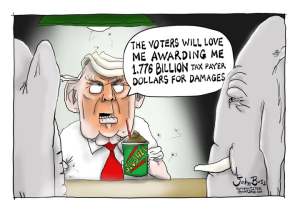
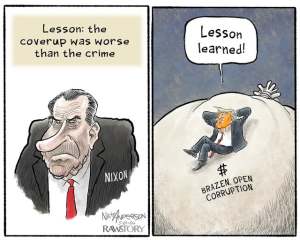 Every sucker that voted for this man needs a good thwap upside their head. This
 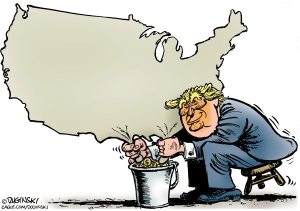 This headline is from the
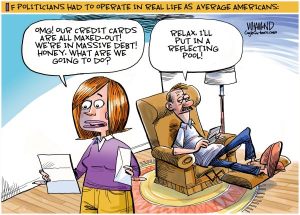 This guest essay in the
 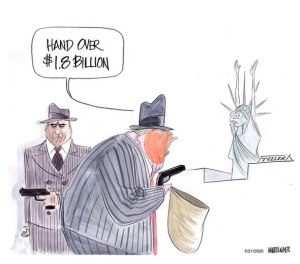 Read more. I’ve gifted the link. #FARTUS thinks he’s above the law and also thinks the U.S. Treasury and Laws are his to toy with.
 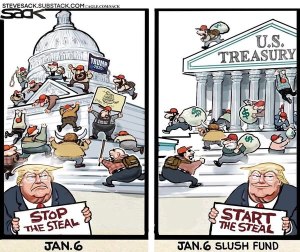 Among the crooks waiting for compensation are Michael Cohen, Enrique Tarrio, Brandon Fellows, Michael Caputo, and



















 According to the campaign’s internal research, this is the case for most of the undecided voters that the campaign is targeting – nearly three-in-four of them, senior Biden campaign officials told CNN. Those officials said one of the biggest reasons driving this is the simple fact that many voters are not paying close attention to the election, including the ins and outs of the GOP nomination process.

 peej
peej Carissa
 bostonboomer
 dakinikat
 ecocatwoman
 jjlo
jjlo mablue2
 Mama Lopez
 peggysue22
 quixote
 skydancingguestblogger
 Mona (aka Wonk the Vote)



 Sky Dancing
Recent Comments