
Thursday Reads
Posted: August 8, 2013 Filed under: Barack Obama, Civil Liberties, Drone Warfare, Foreign Affairs, GLBT Rights, morning reads, NSA, National Security Agency, Russia, U.S. Politics, Yemen | Tags: al Qaeda, Ayan al-Zawahiri, Barbara Starr, Charlie Savage, DEA, Edward Snowden, FISA, IRS, Josh Rogin, Julia Ioffe, Lawrence O'Donnell, Nasser al-Wuhayshi, Sochi Winter Olympics, whistleblowers 36 Comments
Good Morning!!
Yesterday, the White House announced that President Obama will not meet one-on-one with Russian President Vladimir Putin at the G-20 meeting in St. Petersburg as previously planned. From The Washington Post:
President Obama has canceled a meeting with Russian Prime Minister Vladimir Putin. Russia’s decision to give temporary asylum to former National Security Agency contractor Edward Snowden has exacerbated tensions with the United States over a number of issues:
“Following a careful review begun in July, we have reached the conclusion that there is not enough recent progress in our bilateral agenda with Russia to hold a U.S.-Russia Summit in early September,” White House press secretary Jay Carney said in a statement.
Carney cited a “lack of progress” with Russia over the past 12 months on a broad range of issues including missile defense and arms control, trade and commercial relations, global security and human rights and civil society issues. Carney added that Russia’s “disappointing decision” last week to grant Snowden temporary asylum, allowing him to live and work in Russia for up to a year, was also a factor.
President Obama discussed some of his issues with Russia in an appearance on The Tonight Show with Jay Leno on Tuesday night.
Saying that he had “no patience for countries that try to treat gays or lesbians or transgender persons in ways that intimidate them or are harmful to them,” Obama criticized a law, enacted in June, that prohibits public events promoting gay rights and public displays of affection by same-sex couples. A Russian official has promised that the law will be enforced during next February’s Sochi Games despite the International Olympic Committee’s contrary stance.
After the announcement, Russian-American journalist Julia Iofee wrote at The New Republic: Obama Bails on His Inevitably Awkward Date With Putin.
A week after Edward Snowden was granted temporary asylum in Russia, President Obama canceled his bi-lateral September summit in Moscow with Vladimir Putin, though administration officials are at pains to portray this as something greater than pure tit-for-tattery. Rather, they say, it was an excuse to avoid what, even without Snowden, would have been “a pretty dreary affair.”
A few days before Snowden turned up in Moscow, Obama and Putin met on the sidelines of the G8 conference in Northern Ireland. The resulting photo-op—Obama looking forlornly into the distance, Putin slouched and sullen—said it all: they looked like the aging couple at the neighboring table, intently working on their food and eavesdropping on your conversation because they had nothing to support one of their own. Moscow and Washington had talked and talked, they’d gotten START and the transport route to Afghanistan and the sanctions on Iran, but now, the kids are out of the house and they were talking past each other on Syria, on Iran, on pretty much everything.
Lawrence O’Donnell asked Ioffe to appear on his MSNBC show last night to discuss the issues surrounding the decision; but instead of allowing her to express her opinions, O’Donnell interrupted Ioffe, lectured her about Russia and Putin, basically implying she is a liar. Ioffe responded at TNR:
Tonight, I went on Lawrence O’Donnell’s show, and Lawrence O’Donnell yelled at me. Or, rather, he O’Reilly’d at me. That O’Donnell interrupted and harangued and mansplained and was generally an angry grandpa at me is not what I take issue with, however. What bothers me is that, look: your producers take the time to find experts to come on the show, answer your questions, and, hopefully, clarify the issue at hand.
I was invited on the show to talk about Obama’s (very wise) decision to cancel his Moscow summit with Putin, about which I wrote here. I am an expert on Russia. In fact, it is how you introduced me: “Previously, she was a Moscow-based correspondent for Foreign Policy and The New Yorker.” I’m not going to toot my own horn here, but I was there for three years, I’m a fluent, native speaker of Russian, and, god damn it, I know my shit.
Which is why I wish you’d let me finish answering your bullshit question…
You can watch the interaction at MSNBC and read the things she would have liked to say about Putin at TNR. Basically Ioffe tried to explain the Putin doesn’t control everything that happens in Russia anymore than Obama controls everything that happens in the US. She believes that once the Bolivian plane was forced to land because the US suspected Snowden might be on board, Putin really had no choice but to allow Snowden to stay in Russia, because public opinion there strongly supported him.
I have quoted Ioffe in previous posts, and she certainly is no Putin apologist–as she asserts in her piece. I think O’Donnell treated her shamefully.
In other NSA news, mainstream reporters continue to published far more stunning revelations than anything that has come from Snowden and Greenwald. This morning at The New York Times, Charlie Savage writes about surveillance of e-mails between people in the US and foreign countries without warrants, which is being justified by an interpretation of the 2008 FISA Amendments Act.
The National Security Agency is searching the contents of vast amounts of Americans’ e-mail and text communications into and out of the country, hunting for people who mention information about foreigners under surveillance, according to intelligence officials.
The N.S.A. is not just intercepting the communications of Americans who are in direct contact with foreigners targeted overseas, a practice that government officials have openly acknowledged. It is also casting a far wider net for people who cite information linked to those foreigners, like a little used e-mail address, according to a senior intelligence official.
While it has long been known that the agency conducts extensive computer searches of data it vacuums up overseas, that it is systematically searching — without warrants — through the contents of Americans’ communications that cross the border reveals more about the scale of its secret operations….
Government officials say the cross-border surveillance was authorized by a 2008 law, the FISA Amendments Act, in which Congress approved eavesdropping on domestic soil without warrants as long as the “target” was a noncitizen abroad. Voice communications are not included in that surveillance, the senior official said.
Read more at the NYT link.
And at Reuters, John Shiffman and David Ingram report that a DEA program that appears to use NSA data to target ordinary criminals in the and then require DEA officers to conceal the source of the information was also used by the IRS.
Details of a U.S. Drug Enforcement Administration program that feeds tips to federal agents and then instructs them to alter the investigative trail were published in a manual used by agents of the Internal Revenue Service for two years.
The practice of recreating the investigative trail, highly criticized by former prosecutors and defense lawyers after Reuters reported it this week, is now under review by the Justice Department. Two high-profile Republicans have also raised questions about the procedure.
A 350-word entry in the Internal Revenue Manual instructed agents of the U.S. tax agency to omit any reference to tips supplied by the DEA’s Special Operations Division, especially from affidavits, court proceedings or investigative files. The entry was published and posted online in 2005 and 2006, and was removed in early 2007. The IRS is among two dozen arms of the government working with the Special Operations Division, including the Federal Bureau of Investigation, the National Security Agency and the Central Intelligence Agency.
An IRS spokesman had no comment on the entry or on why it was removed from the manual. Reuters recovered the previous editions from the archives of the Westlaw legal database, which is owned by Thomson Reuters Corp, the parent of this news agency.
Just as a reminder that Russia’s treatment of journalists and whistleblowers is actually a hell of a lot worse than anything that happens in the US, Human Rights Watch reports on Russia’s Silencing Activists, Journalists ahead of Sochi Games.
(Moscow) – Local authorities have harassed numerous activists and journalists who criticized or expressed concerns about preparations for the 2014 Winter Olympic Games in Sochi. The six-month countdown to the Sochi Games opening ceremony is this week.
Human Rights Watch has documented government efforts to intimidate several organizations and individuals who have investigated or spoken out againstabuse of migrant workers, the impact of theconstruction of Olympics venues and infrastructure on the environment and health of residents, and unfair compensation for people forcibly evicted from their homes. Human Rights Watch also documented how authorities harassed and pursued criminal charges against journalists, apparently in retaliation for their legitimate reporting.
“Trying to bully activists and journalists into silence is wrong and only further tarnishes the image of the Olympics,” said Jane Buchanan, associate Europe and Central Asia director at Human Rights Watch. “One of the non-negotiable requirements of hosting the Olympics is to allow press freedom, and the authorities’ attempts to silence critics are in clear violation of that principle.”
Obviously that doesn’t justify the Obama administration trying to influence media coverage of the NSA story, but we do need to keep things in perspective. In that vein, Bob Cesca had a good post yesterday: The Real-Life Stories of Legitimate NSA Whistleblowers (Snowden Isn’t One of Them). I hope you’ll give it a read.
In other news, Yemen has been hit by 6 suspected US drone strikes in the past 2 weeks–probably linked to the recently reported threat of an imminent terror strike that led the US to close a number of embassies last weekend.
An official in Yemen said Thursday that the sixth suspected U.S. drone strike in just two weeks had left six suspected al Qaeda militants dead in the group’s former stronghold in the center of the country. The official told The Associated Press that a missile hit a car traveling in the central Marib province, causing the fatalities.
CBS News correspondent Charlie D’Agata reports that Yemen has long been a haven for al Qaeda leadership, and the country claimed Wednesday to have disrupted a major plot, which may have exposed potential targets.
Yemeni government officials say security forces are turning up the heat on militants from al Qaeda in the Arabian Peninsula, the global terror network’s branch based in the nation, after foiling the plot to strike foreign embassies, gas and oil installations, and the country’s port cities.
The government has even given a shoot-to-kill order on anybody who looks suspicious and refuses to identify themselves.
The alleged plot appears to have been similar to the January attack in Algeria which saw gunmen storm the Amenas gas plant, killing more than three dozen foreign workers.
Yesterday in The Daily Beast, Eli Lake and Josh Rogin reported that information about the terror threats came from an al Qaeda “conference call,” involving top al Qaeda leaders and around 20 other people–a report that aroused quite a bit of skepticism on Twitter. Why would these guys risk talking on a conference call? Here’s an excerpt from the Daily Beast article:
The intercept provided the U.S. intelligence community with a rare glimpse into how al Qaeda’s leader, Ayman al-Zawahiri, manages a global organization that includes affiliates in Africa, the Middle East, and southwest and southeast Asia.
Several news outlets reported Monday on an intercepted communication last week between Zawahiri and Nasser al-Wuhayshi, the leader of al Qaeda’s affiliate based in Yemen. But The Daily Beast has learned that the discussion between the two al Qaeda leaders happened in a conference call that included the leaders or representatives of the top leadership of al Qaeda and its affiliates calling in from different locations, according to three U.S. officials familiar with the intelligence. All told, said one U.S. intelligence official, more than 20 al Qaeda operatives were on the call.
To be sure, the CIA had been tracking the threat posed by Wuhayshi for months. An earlier communication between Zawahiri and Wuhayshi delivered through a courier was picked up last month, according to three U.S. intelligence officials. But the conference call provided a new sense of urgency for the U.S. government, the sources said.
Al Qaeda members included representatives or leaders from Nigeria’s Boko Haram, the Pakistani Taliban, al Qaeda in Iraq, al Qaeda in the Islamic Maghreb, and more obscure al Qaeda affiliates such as the Uzbekistan branch. Also on the call were representatives of aspiring al Qaeda affiliates such as al Qaeda in the Sinai Peninsula, according to a U.S. intelligence official. The presence of aspiring al Qaeda affiliates operating in the Sinai was one reason the State Department closed the U.S. Embassy in Tel Aviv, according to one U.S. intelligence official. “These guys already proved they could hit Eilat. It’s not out of the range of possibilities that they could hit us in Tel Aviv,” the official said.
Perhaps the call was encrypted in some way and the US had found a way to listen anyway? But then why would they blow future such operations by leaking the fact that they had listened to the call? This morning CNN’s Barbara Starr tweeted to Josh Rogin:
@joshrogin IT WAS NOT A PHONE CALL. IN FACT, AL QAEDA WENT TO EXTENSIVE MEANS TO SET UP WHAT YOU MIGHT SAY A VIRTUAL MEETING SPACE.”
I’m not sue how to interpret that either. I’ll update if I get anything more on this.
Once again, my morning post has gotten way too long. I have other news links, but I’ll put them in the comments. I hope you’ll do the same with whatever stories you’re following today, and have a tremendous Thursday!!
Tuesday Afternoon Reads: Fun in Festering Fitzwalkerstan, Fakes for Caveat Emptor, and Yoko Ono is 80?
Posted: August 6, 2013 Filed under: Art, corruption, the GOP, The Right Wing, U.S. Politics | Tags: Jeff Fitzgerald, Scott Fitzgerald, Scott Walker, Wisconsin 7 Comments Here in the Fitzwalkerstan, epicenter of the NeoConfederate North, we live the good life by clinging to a barbarian code not unlike that of this famous thief: Conan, what is the best in life (see video below).
At one time, we were known as the home of Progressivism, then we were Wisconsin. But since 2010 we’ve acquired a new character and a new appellation: Fitzwalkerstan.
Our new name is an affectionate conjunction referencing the subsumption of our state by simulacrum Scott Walker, mimicking a Governor, aided by his aping sibling-minions, the Fitzgerald brothers: Scott, State Senate Majority Leader and Jeff, Speaker of the Assembly. After a failed U.S. Senate bid, losing out to Tammy Baldwin, Jeff has since left the Assembly – sort of. He’s now a state lobbyist for American Traffic Solutions. We all miss him. We miss the bare fisted nepotism when Walker had the Fitzgerald brothers heading up both branches of the state legislature, gumming up the government and retooling it for their own ends.
Jeff’s departure for the revolving door didn’t diminish the pace or the agenda, however. Scott Walker has since run rough shod over what was once Wisconsin. Given he spends more time out of state than in, it’s kind of crazy that he can get so much done. But where there’s a will there’s a way as they say. Cognitive Dissidence, one our local blogs recently compiled a short list of Walker’s achievements:
-
Trashing the state’s economy and keeping it at the bottom;
-
Having one of the worst records of job creation in the entire nation, bringing in only about 30,000 jobs in the past two years;
-
Attacking women’s rights and sanctioning legalized sexual abuse;
-
Cutting a billion dollars from the state’s school systems and then hoisting a second school system on taxxpayers’ backs;
-
Allowing mining companies to illegally rape the land and make the great Northwoods look like a terrorist training camp;
-
Attacking the unemployed (which he helped create);
-
Being the most dishonest governor in the nation, with only 23% of his rated statements being true;
-
Being named the worst governor in the nation by Citizens for Responsibility and Ethics in Washington;
-
Infringing on the First Amendment Right of Free Speech and making political prisoners of those who exercise it;
-
Sending in 13 armed goons to execute a helpless, orphaned fawn.
-
Being the chair of the most corrupt and inept board – WEDC – in state history; and
-
Not only being John Doe and using his county staff to help run his campaign, but actively taking a role in having his campaign do a cover up regarding the death of a fifteen year old boy.
The entire blog entry: Cognitive Dissidence

I would assume that the protests which erupted in Madison, our state capitol, and the subsequent Lincoln-like flight of our Democratic legislators escaped no one’s attention in 2011. These are the events that put Scott Walker, the Rock Star, on the map. His celebrity status may have faded a little bit by now, but it had just erupted in February of 2011 when he “dropped the bomb” by unleashing the union-busting atrocity known as Act 10. And a rock star he was, indeed, at the Tea Party Patriots American Policy Summit, occurring ever so fortuitously at the end of February. But no one paid attention to that event despite Scott Walker being a gushed at guest speaker. I believe I alluded to the summit in a comment at one point, and I believe I also pasted the poem I wrote in response to it. I mention it again because Dakinikat wisely warned us that what happens in Louisiana can happen anywhere. Right she was.
The Tea Party Patriots American Policy Summit occurred over a three day period. I did not attend. I did watch the majority of it piece meal when the Tea Party Patriots still had the stream posted on their website. It was painful. It was ghastly. But it was worth it. By the end of that terrible weekend, the summit had outlined every nasty maneuver the GOP has initiated during their reign of terror in DC and in statehouses across the country. From hostage politics, shut-downs, voter disenfranchisement, the war on women… all laid out in its hideous glory. A grand strategy with a tactical mechanism to make it happen at every level of government. I’ve watched the goals of that summit play out over the last two years in my state, many others, and certainly in DC. Walker and Jindal operate from the same playbook reflecting the strategy laid out at the Tea Party summit in 2011.
The Cognitive Dissidence post begins by referencing Mike Tate, chair of the Wisconsin Democratic Party. Tate has adopted Howard Dean’s 50 state-strategy, and is applying it to our 72 counties. I hope it will work. When I think on the Dean strategy I think more of the South than I do our NeoConfederate North. Perhaps this is the strategy that can turn the South from red to blue? This is probably a topic that has received coverage already, but if anyone could speak to it now, I’d be extremely interested in a discussion about Southern political dynamics, also bruising the Red West until it is a lovely shade of blue or blue-green.
Digression alert: Blue-green is sacred to Wadjet, Ancient Goddess of Lower Egypt. No Egyptian deities had names that could ever be uttered, so no one knows their true names. Wadjet, the epithet and the color refer to the color of papyrus hence her epithet, Wadjet, means Papyrus-Colored One. That’s a digression which hasn’t anything at all to do with shifting political landscapes, I mentioned it because blue-green always reminds me of the Wadjet color, and I think Wadjet is pretty groovy, and I think I want my own epithet. Maybe She-Who-Digresses would be fitting.
Now might be a good time to explain the photos. They are part of a series of photographs I call “Dying Camellias.” Though, they’re not camellias. They’re peonies. I photographed thousands over 2 seasons during various stages of decay. I love the decay process, and peonies have an exceptionally bizarre decay process. I include them because this post is about the process of decay.
We see it in my state inflicted by Scott Walker and the Wisconsin GOP. But Walker really can’t muster an original thought in his head. He hasn’t the capacity for complex thought let alone strategy. He dropped out of college or was kicked out for substandard performance; he doesn’t speak about it so no one knows which is the more accurate.
He’s one of the most inarticulate politicians ever, yet his predigested talking points, no matter how inarticulately executed, work phenomenally well. And they get regurgitated by the populace. It’s an astounding phenomenon to observe. Yet, he has improved due to what I suspect is the same grooming Paul Ryan received for the presidential stage. I think that polish has a distinct cast recognizable as the Koch-sheen.
I believe Walker’s talking points take on the same gleam, and his obfuscating rhetoric succeeds because he speaks the secret language of conservative dog whistles, a language any conservative anywhere in the U.S. would hear. Those are the dog whistles of the right wing political machine that is moving across the land. It’s the same machine that has groomed Scott Walker from an utter buffoon to a skillful politician and the very same cookie-cutter homogenization juggernaut steamrolling over all 50 states. It is as coordinated an effort as it gets. It is, itself, a process of national decay fueled by regression.
The strategy – the Tea Party strategy – is fusing the Libertarian and Evangelical wings of the Right. In the long run, I don’t think that strategy will work, these two factions aren’t natural allies. I think we can already see the bonds decaying between more traditional Conservatives like Chris Christie and Libertarian wingnuts like Rand Paul. Yet, to use an appropriate epithet – the Political-Machine-That-Festers will initiate long-term rot if the rot machine continues unabated. The pace of rot since the 2010 sweep, no doubt, indicates the desire to do as much agenda-cementing as fast as possible prior to their demographic death. On that note, hear hear to a little festering! Let the beauty of decay begin!

Speaking of swindlers and shenanigans, I love this:
‘Caveat Emptor’: An Art Exhibit Made Entirely Of Forgeries Confiscated By The FBI (PHOTOS)
I must admit I’m torn by the question posed:
Should exceptionally executed forgeries have a value all their own? How much should an artists’ name affect the worth of a work?
Also on the art front: one who doesn’t seem in decline or decay is Yoko Ono, whose diverse art platforms spanning fifty years of expression went on display at Louisiana’s Museum of Modern Art in June. The exhibit, commemorating Yoko’s 80th birthday, runs until September 29. Should any of our Southern Sky Dancing sisters make their way to the exhibit, I should very much like a review! Admittedly, I’ve never concluded an aesthetic opinion on Yoko Ono’s work. At the same time, one can’t deny she is a dynamic woman worthy of a level of respect she has not perhaps received in decades past, yet absolutely deserving of mention in a post about decay – she’s weathering her withering well.
A look at Yoko Ono’s 50-year career « AMA
YOKO ONO HALF-A-WIND SHOW – Louisiana Museum of Modern Art
And you, Sky Dancers, what is now upon your minds? What questions occupy your thoughts today?
Tuesday Reads: The End of an Era
Posted: August 6, 2013 Filed under: Environment, Foreign Affairs, Media, morning reads, Russia, science, U.S. Politics | Tags: Ben Bradlee, Donald Graham, Eugene Meyer, Jeff Bezos, John Henry, Katherine Graham, morning newspapers, Newsweek, Pentagon Papers, Philip Graham, The Boston Globe, The Washington Post 38 Comments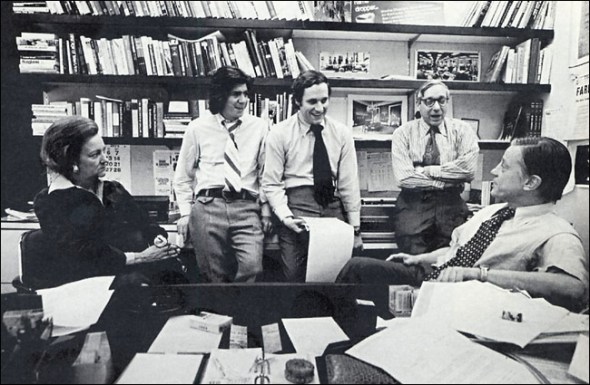
Katherine Graham meets with Carl Bernstein, Bob Woodward, Howard Simons and Ben Bradlee.
Good Morning!!
The big news today is of course the Graham family’s shocking sale of The Washington Post to billionaire Jeff Bezos of Amazon. This, along with the sale of The Boston Globe to Red Sox owner John Henry and the sale of Newsweek to IBT Media, signal the true end of an era.
The days when Americans woke up to the daily newspaper on their doorsteps is long gone. The place to go for the latest news these days is the internet and print newspapers and news magazines are struggling to survive. But the Globe and Newsweek have been on the auction block for a long time; the Post sale was a complete surprise, even to its employees.
From David von Drehle at Time Magazine: A New Age for the Washington Post
It’s hard to startle the journalism business these days, given the scale and speed of disruption of the media industry. But the Graham family selling the Washington Post to Amazon CEO Jeff Bezos for $250 million is an exception. Few newspapers in the world are as closely identified with a single family.
The story of the Grahams and the Post used to be told in giant pictures on the wall of the newspaper lobby on L Street not far from the White House. One grainy photograph documented the day in 1933 when the brilliant financier Eugene Meyer bought the paper for a song at a bankruptcy sale on the courthouse steps. Another (a favorite of all of us who worked there) showed Meyer’s remarkable daughter, Katharine Graham, beaming as she left another D.C. courthouse in the company of her favorite editor, Benjamin C. Bradlee, after they prevailed over the government in the Pentagon Papers lawsuit.
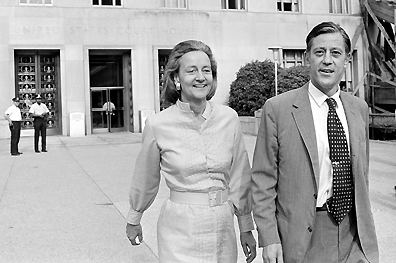
Katherine Graham and Ben Bradlee leaving the courthouse after prevailing in the Pentagon Papers case.
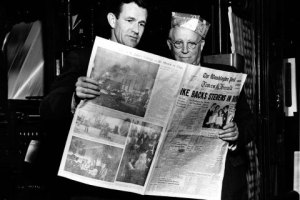
But the most important photograph, according to Mrs. Graham’s son and successor Donald E. Graham, was the one that showed Meyer in the company of Philip L. Graham, the brilliant and tragic husband of Katharine and father of Don. They were smiling like a pair of lotto winners, which they were. The year was 1954, and after years of effort and red ink, they had finally bought out their last remaining rival for dominance of the morning-newspaper market in Washington. As other families would learn in other cities across the country — the Chandlers in Los Angeles, the Coxes in Atlanta, the Knights in Miami and so on — dominance of the morning-newspaper routes would become a decades-long license to print money.
Philip L. Graham and Eugene Meyer look at the first The Washington Post Times Herald, in Washington, March 18, 1954.
Owning the morning meant that the Post would thrive as afternoon newspapers fell to the competition of television news. (The last afternoon paper in Washington, the excellent Washington Star, winked out in 1981.) It meant that advertisers hoping to reach a broad Washington audience had no choice but to pay the Post’s steadily increasing rates. That day in 1954 was the key to everything the Post later became, Don told me one day about 10 years ago when we bumped into each other in the lobby. Watergate, all the Pulitzer Prizes, the foreign correspondents, the celebrity columnists — all of it was possible because the patriarch and his son-in-law managed to lock up the morning.
A couple more links on the Post sale:
James Fallows at The Atlantic: Why the Sale of the Washington Post Seems So Significant
I have known and liked Donald Graham and his family over the years; many of my friends in journalism have at one time or another worked at the Washington Post. My first reaction to news that the family had sold the paper is simple shock. But it is shock based not on my positive-but-not-deep personal connection to the paper and its people but rather on sheer generational disorientation.
Readers below about age 40, who have known the Post only during its beleaguered, downsizing-its-way-out-of-trouble era, may find it hard to imagine the role it once played. Over the past decade-plus, the New York Times and theWall Street Journal have been the national newspaper organizations. It already seems antique even to use the word “newspaper” in such a construction, for reasons I don’t need to belabor now. But their flagship daily print publications make the NYT and the WSJ similar to the Financial Times and different from the other remaining ambitious news organizations — Bloomberg and Thomson Reuters, the broadcast and cable networks, NPR, etc.There was a time when you would automatically have included the Post in that first-tier national grouping. Other mainly regional or local papers were strong — the LA Times, the Chicago Tribune, the Boston Globe, and on down a nostalgic list. But more than any of the rest of them, the Post was fully in the national-newspaper derby and measured itself every day against the Times in talent level, depth and breadth of reporting, international coverage, sophistication, and all the other measures of a nationally ambitious operation. People who have started reading the paper in the past dozen years — rather, who have notstarted reading it — probably can’t imagine this difference in stature. But it is dramatic, and real.
“The pattern of a newspaperman’s life is like the plot of ‘Black Beauty,’ ” A. J. Liebling wrote. “Sometimes he finds a kind master who gives him a dry stall and an occasional bran mash in the form of a Christmas bonus, sometimes he falls into the hands of a mean owner who drives him in spite of spavins and expects him to live on potato peelings.” And sometimes, out of the blue, the ownership changes and you don’t know what the hell you’re getting in your bucket—fresh oats or cut glass.
At around 4:25 Monday afternoon, the staff of the Washington Post was summoned to the paper’s auditorium, a vast room where the presses used to be. The meeting would begin at 4:30 P.M., they were told. Donald E. Graham, the leader of the Graham family, which has owned the paper since Eugene Meyer bought it at a bankruptcy auction in 1933, stood solemnly before journalists who had been demoralized over the years by staff cuts, precipitous plunges in circulation, and endless dark rumors. It was a room full of reporters and editors, and yet, as one told me, “we thought we were there to hear that the Grahams had sold the building.”
In fact, Graham told them, in a voice so full of emotion that he had to stop a few times to gather himself, they were selling the Post and a handful of smaller papers—for two hundred and fifty million dollars, to Jeff Bezos, the founder and C.E.O. of Amazon, who is estimated to be worth more than twenty-five billion dollars. Graham asked the people there not to tweet, just to listen. The assembled were so stunned that when it came time for questions no one had any for a while; Graham had to urge them out of their silence.
“This was just plain sad. Now we belong to a guy who is so rich that the paper is around one per cent of his net worth,” a reporter told me soon after the meeting. “This was the family acknowledging that we can’t do it anymore and we have to give it to someone else. And we love the Graham family, we are proud of the family.”
It’s a long and interesting essay–read the rest at the link.
Neil Irwin and Ylan Q. Mui at The Washington Post write that Bezos paid more than he needed to for the Post.
The purchase price is richer than many of those paid for other legacy print media properties in recent years.
The New York Times Co. agreed to sell the Boston Globe to Red Sox owner John W. Henry for only $70 million. Newsweek sold for a symbolic $1, plus assumed pension liabilities, to billionaire Sidney Harman in 2011.
The Post “has a much stronger position in its market than the Boston Globe does,” said John Morton, an independent newspaper industry analyst. “It doesn’t surprise me that it would command a much higher price.”
Still, Morton suggested that the prominence and the visibility of The Post made Bezos willing to pay a higher price than would be justified by the paper’s finances alone. “I think probably Jeff Bezos was willing to pay a premium to make this happen,” Morton said. “. . . Bezos has enough money that if he wants to make it a hobby, he can.”
Interestingly, The New York Times apparently sold The Globe for less than they could have gotten. According to the AP:
BOSTON — Three bidders who fell short in their attempts to purchase The Boston Globe say they offered more than Boston Red Sox owner John Henry’s winning $70 million bid and criticized the decision of the seller, The New York Times Co., to make a deal with him.
Springfield television station owner John Gormally, West Coast investment executive Robert Loring and U-T San Diego chief executive John Lynch all said their groups’ bids bested Henry’s.
Henry agreed to pay $70 million to buy the Globe, the Boston Metro and the Telegram & Gazette in Worcester, about 50 miles from Boston. The bid, announced Saturday, was a fraction of the $1.1 billion the Times Co. paid 20 years ago.
Lynch said his group offered “significantly more” than Henry and wondered how the Times Co.’s shareholders would react after learning the company accepted a lower offer.
“I’m just stunned,” Lynch told the Boston Herald. “I thought this was a public company that had a fiduciary duty to get the most by its stockholders.”
Gormally says his bit was $80 million, but he admits that local ownership will probably be better for the Globe in the long run. Perhaps the Times wanted to do us Bostonians a favor.
I’m running out of space, so I’ll just add a few more stories in link dump fashion.Mark Ames on Vladamir Putin’s “human rights” record: Snowden’s Savior Announces Plans To Build 83 “Concentration Camps” Across Russia (link unlocked for 2 days)
Nature World News: Enormous Sinkhole, Still Expanding, Creates Spectacle in Western Kansas [VIDEO]
A former student sues her high school for bullying she suffered–first lawsuit based on new Massachusetts anti-bullying law
WSJ: Boston Bombing Suspect was Steeped in Conspiracies
Wendy Davis: Ready to ride for governor of Texas? (Christian Science Monitor)
How the World’s ‘Most Biodiverse Place’ Could Be Ransomed for Oil Money (Miami Herald via PBS)
The Independent: Japan calls for nuclear disarmament at 68th anniversary of Hiroshima bombing
Now it’s your turn. What are you reading and blogging about today? Please post your links on any topic in the comment thread.
Thursday Reads: Edward Snowden Becomes a Refugee in Russia
Posted: August 1, 2013 Filed under: Crime, Criminal Justice System, cyber security, Foreign Affairs, jobs, morning reads, NSA, National Security Agency, Russia, The Media SUCKS, U.S. Politics, Wikileaks | Tags: Crime and Punishment, defectors, domestic surveillance, Don Maclean, Edward Snowden, Glenn Greenwald, Guy Burgess, Joshua Foust, Kim Philby, Marc Ambinder, Mark Ames, Novaya Gazeta, Russia Today, Russian refugee centers, the Kremlin, XKEYSCORE 37 Comments
Good Morning!!
The news is breaking as I write this (around 8:15AM ET) that NSA leaker Edward Snowden has received papers that grant him refugee status in Russia for one year. From Reuters:
Fugitive former U.S. spy agency contractor Edward Snowden left Moscow’s Sheremetyevo airport on Thursday after Russiagranted him refugee status, ending more than a month in limbo in the transit area.
A lawyer who has been assisting Snowden said the young American, who is wanted in the United States for leaking details of secret government intelligence programs, had left the airport for a secure location which would remain secret….
His lawyer, Anatoly Kucherena, told state television: “I have just seen him off. He has left for a secure location … Security is a very serious matter for him.”

Lawyer Anatoly Kucherena holds Edward Snowden’s entry papers from Russian Immigration Service
So what will life in Russia be like for Snowden? A number of knowledgeable writers have weighed in on this question.
Last week, when rumors circulated that Snowden had been granted asylum and would soon leave Sheremetyevo, Russian-American journalist Julia Ioffe wrote in The New Republic that Snowden would probably
be given an apartment somewhere in the endless, soulless highrises with filthy stairwells that spread like fields around Moscow’s periphery. He will live there for five years before he will be given citizenship. He’ll likely be getting constant visits from the SVR (the Russian NSA) to mine the knowledge he carries in his brain. Maybe, he will be given a show on Russia Today, alongside the guy who got him into this pickle to begin with, Julian Assange. Or he, like repatriated Russian spy Anna Chapman, might be given a fake job at a state-friendly bank where he will do nothing but draw a salary. (Chapman, by the way, recently tweeted this at Snowden: “Snowden, will you marry me?!”) Maybe he will marry a Russian woman, who will quickly shed her supple, feminine skin and become a tyrant, and every dark winter morning, Snowden will sit in his tiny Moscow kitchen, drinking Nescafe while Svetlana cooks something greasy and tasteless, and he will sit staring into his black instant coffee, hating her.
Was it worth it to trade Hawaii and a pole-dancer girlfriend for that? Snowden will have plenty of time on his hands to think about it. He certainly won’t get a job in Russian intelligence. The Russians, at least, know you can’t trust a leaker even though he may be a convenient source of information.
Mark Ames, who lived in Russia for years and published and wrote for an alternative newspaper in Moscow with partner Matt Taibbi, recently wrote a short piece on Snowden’s future prospects at NSFWCORP with quotes from some Russian sources that I can no longer find on-line. Ames writes:
The latest on Edward Snowden from Newsru.com: officials from the Federal Migration Service (FMS) say that Snowden could be transferred to a refugee center currently overflowing with Syrian war refugees, likely families tied to the Russian-backed regime of Bashir Assad. Or not.
Both Russian officials and Snowden’s Kremlin-tied lawyer are making a big show about how difficult the bureaucratic process is for anyone, even someone like Snowden, to get his temporary asylum papers. If you read the Russian press accounts, the surface statements about the Tsar’s alleged helplessness before the almighty bureaucracy are pure Gogol, without the ha-ha’s, a sort of no-laughter-through-tears. Beneath the surface, there’s something more menacing, a growing sense I get reading the Russian press that Snowden is a kind of Kremlin toy whom they’re intentionally fucking with, out of either contempt, or for the sheer fun of it…
Clearly, Russian President Vladimir Putin is having a blast sticking it to the US and soaking up praise from deluded Glenn Greenwald cultists (previously Obots) and Julian Assange fans who think Russia is a land of freedom and opportunity as in contrast to America, where jackbooted Obama administration thugs supposedly run a horrifying reign of terror.

Ames has a fascinating take on Snowden’s attorney’s bringing him a copy of Dostoevsky’s Crime and Punishment to read.
…the Kremlin gifting Snowden a copy of “Crime and Punishment” is itself a not-subtle mind-fuck on many levels. Dostoevsky’s book is a profoundly reactionary novel about a young foolish and desperate student full of second-hand radical ideas about his superiority against established morality. His name is Raskolnikov and he thinks he’s above ordinary human laws, so he kills his landlord according to these higher laws – and later goes crazy unable to believe in the radical ideas that led him to commit a crime, so he turns himself in to the authorities, and serves his time in Siberia as penance. The name of Dostoevsky’s hero, “Raskolnikov,” itself means “cracked” or “split” – as in his cracked conscience.
Last week Snowden’s lawyer, Anatoly Kucherena, told journalists…
“I bought [for Snowden] Dostoevsky’s ‘Crime and Punishment,’ because I think that Raskolnikov, who murdered his old landlord — I think that he needs to read about this. Not necessarily because of their similarities in their internal contradictions, but nevertheless…”
I loved this quote from opposition newspaper Novaya Gazeta (via Ames):
“Well, what can you say? If that infantile leftie Snowden really wanted to be a hero, he should return to the USA: crucify or not crucify, they’d probably give him 10 years, and he’d do five.”
“Snowden wanted to become a digital world’s Christ — without having to hang on the cross. Now Snowden’s going to spend not five years, but the rest of his life as a guest of the FSB.”
In another display of black humor, the Kremin website compared Snowden to British defectors and spies Kim Philby, Guy Burgess, and Don Maclean. In the posting the Kremlin notes that Philby and Burgess “drank themselves to death in their state-allocated flats, awaiting a world revolution that never came,” while Maclean got along better because he took the trouble to learn Russian. You can read more about Kim Philby at The Guardian.

Russian refugee center
State supported newspaper Russia Today also speculated about Snowden’s future: Spook out of water: What Snowden can expect if Russia grants him asylum.
If the application is accepted and Snowden is given the 12-month temporary asylum that enables him to leave the transit area of Sheremetyevo airport, he will have to undergo a daunting medical assessment designed especially for immigrants. Along with a standard screening for HIV and tuberculosis, he will also be checked for leprosy and the rare sexually-transmitted disease chancroid. Russian Health Ministry officials have said that they are ready to administer the tests at a moment’s notice, but so far have not been asked to do so by Snowden.
After Snowden registers his whereabouts with the police – to avoid risking a $150 fine – he will be free to apply for placement in a processing facility for asylum seekers. There are no such facilities in Moscow, and ones in the vicinity have been flooded with refugees escaping the Syrian conflict. Elena Ryabinina, a human rights lawyer who works with asylum seekers, told Gazeta.ru newspaper that most of her clients get offered a bed in a center near Perm – a city by the Ural mountains, more than 1,000 km east of Moscow.
Sounds like tons of fun. But according to the article Snowden could choose to try to find a place on his own–but he’d have to get a bodyguard since he’s a “wanted man.”
Even if Snowden does acquire a personal bodyguard and a high security flat at an undisclosed location – presumably courtesy of the Russian state – his future is hazy, and the reality of it likely different to what he imagined when he recorded his first revelations.
A temporary asylum seeker is allowed to work, but not to put further strain on the testy relationship between Moscow and Washington. Vladimir Putin said “no longer undermining the US” is a pre-condition for his asylum bid, and the former NSA contractor publicly promised to comply when he met Russian human rights activists a fortnight ago. One wonders who it is that Snowden’s bodyguards will be protecting from danger.
Who knows if we’ll even find out what happens to Snowden now? All we can do is watch and wait. Something tells me he may eventually wish he had just come back home to face the music.
Yesterday, Glenn Greenwald posted another “bombshell” about a “top secret program” called XKEYSCORE. According to Greenwald, this “NSA tool collects ‘nearly everything a user does on the internet.'” I googled and learned that hundreds of companies are publicly advertising job openings for people with experience on XKEYSCORE–so how can it be so secret? I guess Greenwald didn’t bother to do a google search. He didn’t bother to talk to Marc Ambinder either. Ambinder wrote a whole book on US intelligence methods in which he described XKEYSCORE in detail. Can Greenwald actually be writing about these intel programs without reading any of the literature on them?
I quibble with the Guardian‘s description of the program as “TOP SECRET.” The word is not secret; its association with the NSA is not secret; that the NSA collects bulk data on foreign targets is, well, probably classified, but at the SECRET level. Certainly, work product associated with XKEYSCORE is Top Secret with several added caveats. Just as the Guardian might be accused of over-hyping the clear and present danger associated with this particular program, critics will reflexively overstate the harm that its disclosure would reasonably produce.
XKEYSCORE is not a thing that DOES collecting; it’s a series of user interfaces, backend databases, servers and software that selects certain types of metadata that the NSA has ALREADY collected using other methods. XKEYSCORE, as D.B. Grady and I reported in our book, is the worldwide base level database for such metadata. XKEYSCORE is useful because it gets the “front end full take feeds” from the various NSA collection points around the world and importantly, knows what to do with it to make it responsive to search queries. As the presentation says, the stuff itself is collected by some entity called F6 and something else called FORNSAT and then something with the acronym SSO.
But Greenwald insisted on Chris Hayes show last night that XKEYSCORE does collect data–all your data–and someone creepy is probably reading it right now!!

In his piece at The Guardian Greenwald had to admit that NSA analysts need to get a warrant to look at and individual’s data, but he claims the warrants are worthless. He also admits that analysts don’t have access to all your personal data, but he says they could hack into it illegally. But isn’t that true for employees of any company or government agency? They could look at personal data by criminally working around limitations and ignoring regulations.
Charles Johnson at LGF: Greenwald’s Latest Article Distorts the Truth Again
Greenwald’s purpose with this latest article is to try to shore up Edward Snowden’s absurd claim that he could “wiretap anyone, even the President,” without any oversight. Here’s how he frames this defense:
The files shed light on one of Snowden’s most controversial statements, made in his first video interview published by the Guardian on June 10.
“I, sitting at my desk,” said Snowden, could “wiretap anyone, from you or your accountant, to a federal judge or even the president, if I had a personal email”.
US officials vehemently denied this specific claim. Mike Rogers, the Republican chairman of the House intelligence committee, said of Snowden’s assertion: “He’s lying. It’s impossible for him to do what he was saying he could do.”
But training materials for XKeyscore detail how analysts can use it and other systems to mine enormous agency databases by filling in a simple on-screen form giving only a broad justification for the search. The request is not reviewed by a court or any NSA personnel before it is processed.
Read this section carefully — because what Greenwald is detailing does not support Snowden’s claim at all. Greenwald is describing searching a database for information on non-US citizens. How is this the same thing as “wiretapping the President?” Of course, it’s not. He’s not describing any kind of “wiretapping” at all.
On top of all that, it turns out that the Powerpoint presentation that Greenwald wrote about yesterday is from 2008! (See slide pictured above.) Presumably much has changed at NSA since then. Read more at Joshua Foust’s blog–it’s well worth the time to read the whole thing.
Now it’s your turn. What stories are you focusing on today? Please share your links on any topic in the comment thread, and have a terrific Thursday!!
Tuesday: Something’s Gotta Give!
Posted: July 30, 2013 Filed under: Austerity, Baby Boomers, Barack Obama, Foreign Affairs, morning reads, Republican politics, U.S. Economy, U.S. Politics, War on Women, Women's Rights | Tags: anti-statist libertarians, blogging, Congress, crumbling infrastructure, Edward Snowden, Glenn Greenwald, jobs, Justin Amash, NSA spying, Poverty 37 Comments
Good Morning!!
I’ve finally reached a point of such frustration with politics, with the do-nothing Congress, and the mostly unserious media, that I wonder if the bottleneck of corruption, incompetence, and stupidity in Washington DC will ever be broken.
Congress–particularly the Senate–is populated mostly with old, rich white men who work about two days a week at most and take so many vacations that it’s hard to keep track of when they’re actually on the job. When the rest of us have a day off, they get a week. And for major holidays like Christmas, they take a month. It’s sickening.
The Republican House spends its two days a week mostly taking votes to repeal or defund Obamacare or finding new ways to wage war on women’s individual freedom and autonomy. The rest of their time is spent trying to take food out of the mouths of poor children by cutting food stamps and other safety net programs. Then there are the states where Republican governors and legislatures are waging all-out war on women and pretty much anyone who isn’t in the top 1%.
Meanwhile, our roads and bridges are falling down all over the country. Can you imagine how many jobs the government could create by helping to rebuild our crumbling infrastructure? Not only that, but baby boomers like me could be put back to work helping in the schools. The government could create a WPA for the growing ranks of seniors instead of attacking us for collecting the Social Security and Medicare we’ve paid into for our entire lives!
Will the logjam ever break? Will we ever see the slightest focus on jobs and economic equality for the vast majority of Americans?
Back in 2000, after the Supreme Court designated George W. Bush as president, I despaired and ignored politics for awhile. But after 9/11 and the lies that dragged us into two wars that ended up being longer and more pointless than the war of my youth–Vietnam–I began to follow politics closely again. I felt it was my responsibility as a citizen to pay attention to what was being done in our name. And I did.
I had gone back to college in 1993 and got into using computers again. In 1997, I started graduate school, and got my first PC and immediately got my cable company to hook it up to the internet. I joined internet mailing lists where I could discuss issues that interested me.
Around 2003, I heard about “weblogs,” and I set out to find some that discussed politics. Every day I read and commented at Daily Kos, Talking Points Memo, and dozens of other liberal blogs. Most of you know the rest. In 2008, I was driven off DK after I failed to drink the Obot Koolaid. I wrote for a small blog for a couple of years and then finally Dakinkat and I joined up here at Sky Dancing, along with Mona and JJ.
I’m here and I want to keep on writing here. I love learning about new subjects when I research news stories. But Goddammit, I want something new to happen. I want our government to be functional and have positive effects on my life and the lives of other ordinary people.
Back in 2008 I pretty much shut off the TV and focused on getting my news on the internet. But for the past couple of weeks, I’ve been escaping into detective novels and watching old movies on the tube. It’s difficult to find things blog about when the news is the same every day–the war on women and working people and Congress refusing to lift a finger to improve the economic situation for the vast majority of Americans.
As you know, lately I’ve become fascinated by the case of Edward Snowden and his leaks about NSA spying. Previously, I had focused on the bombings that took place in Boston and that had led me to do a lot of research on Russia, where the accused bombers’ roots were. So when Snowden ended up in Russia, I had a little bit of background on the place.
When the NSA leaks first broke, I thought it was possible we might get some real movement on the issue of domestic spying, but once Snowden revealed himself the story became mostly about him and his mouthpiece Glenn Greenwald.
Now the Snowden story has also settled into a holding pattern. The Russians are enjoying playing with their new toy and sticking it to the Obama administration, and Greenwald isn’t even writing about leaks anymore. He just writes long, angry lectures about how Democrats and liberals are the root of all evil.
Speaking of libertarians, have you noticed the Ayn Rand crowd is taking over and brainwashing a lot of so-called “progressives?” Last week there was an effort to pass an amendment that would have prevented NSA from collecting any telephone metadata. Instead of having an intelligent discussion about how to carefully regulate electronic surveillance, we would have simply ended it–and gone back to where we were before 9/11 in terms of identifying terrorist threats.
That bill was named after an Ayn Rand worshipping wingnut from Michigan named Justin Amash whose goal is to remove all power from the Federal government except the power to control women’s bodies! Did you know that Amash wants to ban abortions as of three days after conception? This reactionary who is being called “the next Ron Paul” was actually named “Truthdigger of the week.” Are you kidding me?
Have we finally reached the point where the “progressives” of 2008 are joining with the anti-statist libertarians? Sorry, but I’m not down with that. I believe in government, and I believe we need a strong Federal government. I think the states have too much power over people’s lives right now. I think we need a national equal rights amendment to end the constant ridiculous efforts to control the lives of women and LGBT people!
Now I’ve ranted away much of the space for this post, and I haven’t really given you any news. I’m going to post a few links, and I will put up another post a little later on. And If you have any suggestions for how I can deal with my Political Affective Disorder, I’ll be very grateful to receive them.
President Obama has been trying to put some focus on economics, and will make his fourth speech on the topic today. A few links:
The Windsor Star– Analysis: Obama tries to shift focus to economy, faces withering Republican opposition
WSJ– Obama Economic Proposals Face Long Odds in Congress
Dean Baker– Cruel Arithmetic and President Obama’s Big Speech
The Hill– Obama to propose ‘grand bargain’ on jobs, corporate tax rates
Other News
Fox News– 8 injured, including 4 critically, after dozens of explosions rock central Florida propane plant
Amy Davidson at The New Yorker– Waiting for the Bradley Manning Verdict
Vanity Fair– Anthony Weiner’s Cringe-y New Sexts Reveal Request for “Daily Shoe Update”
USA Today– San Diego mayor wants taxpayers to foot legal bills

 peej
peej Carissa
 bostonboomer
 dakinikat
 ecocatwoman
 jjlo
jjlo mablue2
 Mama Lopez
 peggysue22
 quixote
 skydancingguestblogger
 Mona (aka Wonk the Vote)





Recent Comments