
Iran would shut down roughly two-thirds of the 19,000 centrifuges producing uranium that could be used to fuel a bomb and agree not to enrich uranium over 3.67 percent (a much lower level than is required for a bomb) for at least 15 years. The core of the reactor at Arak, which officials feared could produce plutonium, another key ingredient for making a weapon, would be dismantled and replaced, with the spent fuel shipped out of Iran.
Mr. Obama, speaking at the White House, insisted he was not relying on trust to ensure Iran’s compliance but on “the most robust and intrusive inspections and transparency regime ever negotiated for any nuclear program.”
There is good reason for skepticism about Iran’s intentions. Although it pledged not to acquire nuclear weapons when it ratified the Nuclear Nonproliferation Treaty in 1970, it pursued a secret uranium enrichment program for two decades. By November 2013, when serious negotiations with the major powers began, Iran was enriching uranium at a level close to bomb-grade.
However, Iran has honored an interim agreement with the major powers, in place since January 2014, by curbing enrichment and other major activities.
By opening a dialogue between Iran and America, the negotiations have begun to ease more than 30 years of enmity. Over the long run, an agreement could make the Middle East safer and offer a path for Iran, the leading Shiite country, to rejoin the international community.
Friday Reads: The Iran Deal
Posted: April 3, 2015 Filed under: Barack Obama, Foreign Affairs, Iran, morning reads, open thread, U.S. Military, U.S. Politics | Tags: iran, israel, nuclear weapons, US Foreign Policy 15 Comments Good Afternoon!
I’m running late again! My schedule is just upside down now and DST just double whammed me on the same weekend I started my late night work. Still getting used to the weird hours. I also wanted to spend some time on the negotiations with Iran over its nuke program so I had to catch up with the news. I’m glad BB’s post was so good because I can see you’ve spent a lot of time commenting on what’s going on in Indiana with its so-called “religious freedom” bill.
Obviously, there are going to be several sides to the “deal” depending on your views and their connections to US/Israel policy. So, I thought I’d highlight a few. Max Fisher–writing for VOX–says the deal is “astonishingly good.”
When Aaron Stein was studying nuclear non-proliferation at Middlebury College’s Monterey graduate program, the students would sometimes construct what they thought would be the best possible nuclear inspection and monitoring regimes.
Years later, Stein is now a Middle East and nuclear proliferation expert with the Royal United Services Institute. And he says the Iran nuclear framework agreement, announced on Thursday, look an awful lot like those ideal hypotheticals he’d put together in grad school.
“When I was doing my non-proliferation training at Monterey, this is the type of inspection regime that we would dream up in our heads,” he said. “We would hope that this would be the way to actually verify all enrichment programs, but thought that would never be feasible.
“If these are the parameters by which the [final agreement] will be signed, then this is an excellent deal,” Stein concluded.
The framework nuclear deal establishes only the very basics; negotiators will continue to meet to try to turn them into a complete, detailed agreement by the end of June. Still, the terms in the framework, unveiled to the world after a series of late- and all-night sessions, are remarkably detailed and almost astoundingly favorable to the United States.
Like many observers, I doubted in recent months that Iran and world powers would ever reach this stage; the setbacks and delays had simply been too many. Now, here we are, and the terms are far better than expected. There are a number of details still to be worked out, including one very big unresolved issue that could potentially sink everything. This is not over. But if this framework does indeed become a full nuclear deal in July, it would be a huge success and a great deal.
The NYT editorial board calls the deal “promising.”
According to Reuters, Iranians were celebrating in the street as the deal was announced yesterday. The country has been living under harsh embargoes which have obviously hurt ordinary people.
Iranians celebrated in the streets after negotiators reached a framework for a nuclear accord and U.S. President Barack Obama hailed an “historic understanding”, but senior global diplomats cautioned that hard work lies ahead to strike a final deal.
The tentative agreement, struck on Thursday after eight days of talks in Switzerland, clears the way for a settlement to allay Western fears that Iran could build an atomic bomb, with economic sanctions on Tehran being lifted in return.
It marks the most significant step toward rapprochement between Washington and Tehran since the 1979 Iranian revolution and could bring an end to decades of Iran’s international isolation.
But the deal still requires experts to work out difficult details before a self-imposed June deadline and diplomats said it could collapse at any time before then.
 We have reaction to the deal from the GOP and from former SOS Hillary Clinton as reported by CNN.
The backlash from likely Republican presidential contenders to thepotential nuclear deal with Iran trumpeted Thursday by President Barack Obama came swift and hard. A more optimistic response came from likely 2016 Democratic candidate, Hillary Clinton.
Former Florida Gov. Jeb Bush said the deal — aimed at reining in Iran’s nuclear capabilities — “will only legitimize those activities.”
“Nothing in the deal described by the administration this afternoon would justify lifting U.S. and international sanctions, which were the product of many years of bipartisan effort,” Bush said. “I cannot stand behind such a flawed agreement.”
Clinton, meanwhile, held up the tentative agreement as an “important step” in preventing a nuclear Iran.
“Getting the rest of the way to a final deal by June won’t be easy, but it is absolutely crucial. I know well that the devil is always in the details in this kind of negotiation,” Clinton said in a statement. “The onus is on Iran and the bar must be set high. It can never be permitted to acquire a nuclear weapon.”
But the former secretary of state allowed leeway for herself in case things go awry in the coming months, stating, “There is much to do and much more to say in the months ahead, but for now diplomacy deserves a chance to succeed.”
The rest of the Republican field, however, coalesced around rejecting the deal.
Making his first trek to Iowa as an announced presidential candidate, Texas Sen. Ted Cruz contended the President must bring Congress into the process.
“The very first step for any deal, good or bad, should be submitting it to Congress, and the President making the case both to Congress and to the American people why this advances the national security interests of the United States,” Cruz told reporters after a town hall in Cedar Rapids. “Now everything President Obama has said up to this date has suggested that he is going to do everything he can to circumvent Congress.”
Florida Sen. Marco Rubio, a member of the Senate Foreign Relations Committee, described the early details of the agreement as “very troubling” and said “this attempt to spin diplomatic failure as a success is just the latest example of this administration’s farcical approach to Iran.”
Obama pushed to quiet skeptics of the framework during his remarks in the White House Rose Garden Thursday, asking, “Do you really think that this verifiable deal, if fully implemented, backed by the world’s major powers, is a worse option than the risk of another war in the Middle East?”
 Peter Baker–writing for the NYT–calls the deal a “foreign policy gamble”.
As Mr. Obama stepped into the Rose Garden to announce what he called a historic understanding, he seemed both relieved that it had come together and combative with those in Congress who would tear it apart. While its provisions must be translated into writing by June 30, he presented it as a breakthrough that would, if made final, make the world a safer place, the kind of legacy any president would like to leave. “This has been a long time coming,” he said.
Mr. Obama cited the same John F. Kennedy quote he referenced earlier in the week when visiting a new institute dedicated to the former president’s brother, Senator Edward M. Kennedy: “Let us never negotiate out of fear, but let us never fear to negotiate.” The sense of celebration was captured by aides standing nearby in the Colonnade who exchanged fist bumps at the end of the president’s remarks.
But Mr. Obama will have a hard time convincing a skeptical Congress, where Republicans and many Democrats are deeply concerned that he has grown so desperate to reach a deal that he is trading away American and Israeli security. As he tries to reach finality with Iran, he will have to fend off legislative efforts, joined even by some of his friends, to force a tougher posture.
The WAPO Editorial Board was critical of the deal.
THE “KEY parameters” for an agreement on Iran’s nuclear program released Thursday fall well short of the goals originally set by the Obama administration. None of Iran’s nuclear facilities — including the Fordow center buried under a mountain — will be closed. Not one of the country’s 19,000 centrifuges will be dismantled. Tehran’s existing stockpile of enriched uranium will be “reduced” but not necessarily shipped out of the country. In effect, Iran’s nuclear infrastructure will remain intact, though some of it will be mothballed for 10 years. When the accord lapses, the Islamic republic will instantly become a threshold nuclear state.
That’s a long way from the standard set by President Obama in 2012 when he declared that “the deal we’ll accept” with Iran “is that they end their nuclear program” and “abide by the U.N. resolutions that have been in place.” Those resolutions call for Iran to suspend the enrichment of uranium. Instead, under the agreement announced Thursday, enrichment will continue with 5,000 centrifuges for a decade, and all restraints on it will end in 15 years.
Mr. Obama argued forcefully — and sometimes combatively — Thursday that the United States and its partners had obtained “a good deal” and that it was preferable to the alternatives, which he described as a nearly inevitable slide toward war. He also said he welcomed a “robust debate.” We hope that, as that debate goes forward, the president and his aides will respond substantively to legitimate questions, rather than claim, as Mr. Obama did, that the “inevitable critics” who “sound off” prefer “the risk of another war in the Middle East.”
The proposed accord will provide Iran a huge economic boost that will allow it to wage more aggressively the wars it is already fighting or sponsoring across the region. Whether that concession is worthwhile will depend in part on details that have yet to be agreed upon, or at least publicly explained. For example, the guidance released by the White House is vague in saying that U.S. and European Union sanctions “will be suspended after” international inspectors have “verified that Iran has taken all of its key nuclear related steps.”
Obviously, Bibi is beside himself.
“I just came from a meeting of the Israeli cabinet. We discussed the proposed framework for a deal with Iran.
The cabinet is united in strongly opposing the proposed deal.
This deal would pose a grave danger to the region and to the world and would threaten the very survival of the State of Israel.
The deal would not shut down a single nuclear facility in Iran, would not destroy a single centrifuge in Iran and will not stop R&D on Iran’s advanced centrifuges.
On the contrary. The deal would legitimize Iran’s illegal nuclear program. It would leave Iran with a vast nuclear infrastructure. A vast nuclear infrastructure remains in place.
The deal would lift sanctions almost immediately and this at the very time that Iran is stepping up its aggression and terror in the region and beyond the region.
In a few years, the deal would remove the restrictions on Iran’s nuclear program, enabling Iran to have a massive enrichment capacity that it could use to produce many nuclear bombs within a matter of months.
The deal would greatly bolster Iran’s economy. It would give Iran thereby tremendous means to propel its aggression and terrorism throughout the Middle East.
Such a deal does not block Iran’s path to the bomb.
Is he the little boy that has cried wolf too often?
Anyway, I hope you’ll read up on the situation since it stands to be one of the biggest foreign policy agreements for quite some time.
What’s on your reading and blogging list today?
Thursday Reads: Media Ignorance and Brian Williams’ Flashbulb Memory
Posted: February 5, 2015 Filed under: Hillary Clinton, Media, morning reads, The Media SUCKS, U.S. Military | Tags: Brian Williams, flashbulb memories, IRAQ, memory errors, retroactive interference 34 Comments
Edvard Munch, Winter landscape at Hvitsten, 1918
Good Morning!!
I’m still snowed in. I’ve been shoveling for two days, but 40+ inches of snow in a week was just too much for me to handle alone. My sister-in-law was going to come down from New Hampshire today to help me dig out, but it’s snowing again, so she may have to wait until tomorrow. My cold is still hanging on too, so this post may be a little disjointed. I’m going to focus on a “shocking” story about newscaster Brian Williams that broke over the past couple of days. The illustrations I’m are paintings of winter scenes by Edvard Munch.
Yesterday, NBC News anchor Brian Williams was caught telling a false story about being shot down in a helicopter in Iraq. From Politico:
On Friday night’s broadcast, Williams cited “a terrible moment a dozen years back during the invasion of Iraq when the helicopter we were traveling in was forced down after being hit by an RPG. Our traveling NBC News team was rescued, surrounded and kept alive by an armor mechanized platoon from the U.S. Army 3rd Infantry.”
One crew member responded to the story on Facebook the following day, writing to Williams, “Sorry dude, I don’t remember you being on my aircraft. I do remember you walking up about an hour after we had landed to ask me what had happened.”
This week, crew members of 159th Aviation Regiment’s Chinook helicopter also told Stars and Stripes that Williams had not been in the shot-down helicopter but had arrived an hour later.
On Wednesday, Williams conceded that he was not onboard the shot-down helicopter, but he told Stars and Stripes he did not intentionally make the mistake.
“I would not have chosen to make this mistake,” Williams said. “I don’t know what screwed up in my mind that caused me to conflate one aircraft with another.”

Edvard Munch, Winter Night with Stars
From Stars and Stripes’ exclusive: NBC’s Brian Williams recants Iraq story after soldiers protest.
Williams made the claim about the incident while presenting NBC coverage of the tribute to the retired command sergeant major at the Rangers game Friday. Fans gave the soldier a standing ovation.
“The story actually started with a terrible moment a dozen years back during the invasion of Iraq when the helicopter we were traveling in was forced down after being hit by an RPG,” Williams said on the broadcast. “Our traveling NBC News team was rescued, surrounded and kept alive by an armor mechanized platoon from the U.S. Army 3rd Infantry.”
Williams and his camera crew were actually aboard a Chinook in a formation that was about an hour behind the three helicopters that came under fire, according to crew member interviews.
That Chinook took no fire and landed later beside the damaged helicopter due to an impending sandstorm from the Iraqi desert, according to Sgt. 1st Class Joseph Miller, who was the flight engineer on the aircraft that carried the journalists.
The Daily Beast’s Lloyd Grove: Brian Williams’ War Story Is FUBAR.
Unfortunately for Williams, this is not the first time he has made “this mistake” on network television. On the March, 26, 2013 episode of CBS’s Late Show With David Letterman, he told the host (at the 3-minute, 50-second mark): “Two of our four helicopters were hit by ground fire, including the one I was in.”
“No kidding!” Letterman exclaimed.
“RPG and AK-47,” Williams elaborated.
“What altitude were you hit at?” Letterman asked.
“We were only at 100 feet doing 100 forward knots…”
“What happens the minute everybody realizes you’ve been hit?” Letterman asked.
“We figure out how to land safely—and we did,” Williams answered. “We landed very quickly and hard…”
Stars and Stripes left open the possibility that Williams also misreported the incident initially on March 26, 2003, but it turns out that back then, at least, he never claimed to have been aboard the attacked chopper—during two different broadcasts on that date. Television news analyst Andrew Tyndall dipped into his videotape library and screened the Nightly News segment in which Williams said “he was in a convoy of helicopters, one of which got hit,” Tyndall told The Daily Beast.
NBC News, meanwhile, unearthed a March 26, 2003 Dateline segment in which Williams reported: “On the ground, we learn that the Chinook ahead of us was almost blown of the sky.”

Edvard Munch, Workers in the Snow
Grove compared Williams’ conflation of events with a story Hillary Clinton told in 2008.
2008 presidential candidate Hillary Clinton’s false assertion that, as first lady in March 1996, she came under sniper fire during a trip to Tuzla, Bosnia. “I remember landing under sniper fire,” Clinton said during a speech. “There was supposed to be some kind of a greeting ceremony at the airport, but instead we just ran with our heads down to get into the vehicles to get to our base.” CBS News video of Clinton’s arrival showed no such thing; instead she alighted on the tarmac and greeted a welcoming child who offered her a poem.
I would compare Williams’ flub to tales that then presidential candidate Ronald Reagan told about events he recalled that never happened. A famous example from memory expert Daniel Schacter:
In the 1980 presidential campaign, Ronald Reagan repeatedly told a heartbreaking story of a World War II bomber pilot who ordered his crew to bail out after his plane had been seriously damaged by an enemy hit. His young belly gunner was wounded so seriously that he was unable to evacuate the bomber. Reagan could barely hold back his tears as he uttered the pilot’s heroic response: “Never mind. We’ll ride it down together.” …this story was an almost exact duplicate of a scene in the 1944 film “A Wing and a Prayer.” Reagan had apparently retained the facts but forgotten their source (Schacter 1996, 287).
An even more dramatic error by Reagan was his claim to have been present at the liberation of Auschwitz.
In November 1983, he told Israeli Prime Minister Yitzhak Shamir during a White House visit that while serving in the U. S. Army film corps, his unit had shot footage of the Nazi concentration camps as they were liberated. He repeated the same tale to Nazi hunter Simon Wiesenthal and other witnesses. Reagan had indeed served in the Army and worked on morale-boosting movies for the War Department. But he had done so without ever leaving Hollywood for the entire duration of the war.

Edvard Munch, Winter Night
And then there was the story about 9/11 that George W. Bush was repeatedly criticized for–he claimed on that morning he had seen the first plane hit the World Trade Center twin towers before he went into a school for a photo op of him reading to children. But that was impossible, because film of the first tower being hit was not aired until the next day later that day. Here’s Bush’s story quoted in a piece at e-Skeptic by memory expert Daniel Greenberg
I was in Florida. And my chief of staff, Andy Card — actually I was in a classroom talking about a reading program that works. And I was sitting outside the classroom waiting to go in, and I saw an airplane hit the tower — the TV was obviously on, and I use[d] to fly myself, and I said, “There’s one terrible pilot.” And I said, “It must have been a horrible accident.” But I was whisked off there — I didn’t have much time to think about it, and I was sitting in the classroom, and Andy Card, my chief who was sitting over here walked in and said, “A second plane has hit the tower. America’s under attack.”
Two weeks later Bush’s story had evolved:
Bush remembers senior adviser Karl Rove bringing him the news, saying it appeared to be an accident involving a small, twin-engine plane. In fact it was American Airlines Flight 11, a Boeing 767 out of Boston’s Logan International Airport. Based on what he was told, Bush assumed it was an accident. “This is pilot error,” the president recalled saying. “It’s unbelievable that somebody would do this.” Conferring with Andrew H. Card Jr., his White House chief of staff, Bush said, “The guy must have had a heart attack”… At 9:05 a.m., United Airlines Flight 175, also a Boeing 767, smashed into the South Tower of the trade center. Bush was seated on a stool in the classroom when Card whispered the news: “A second plane hit the second tower. America is under attack.”

Edvard Munch, Yellow Log
The fact is that memory errors like these are quite common. Human memory is not perfect–we tend to get basic facts right, but when we retell a memory again and again or even go over it in our minds, specific details can change. There are a number of ways this can happen. We can forget the source of a memory, as Ronald Reagan did with the movie scene he believed to be real. It’s also comment to retroactively alter a memory, as Bush did with his 9/11 flashbulb memory. That is caused by “interference.” I doubt that Williams deliberately lied about his flashbulb memory from Iraq. Why would he put his reputation at risk in that way? Most likely, he conflated his memories with other things he learned later about the event that made a strong impression on him at the time.
You can read more about false flashbulb memories in this scholarly article by Greenberg (pdf): President Bush’s False ‘Flashbulb’ Memory of 9/11/01. A flashbulb memory is a very vivid recall of a dramatic event in which we have a sense “remembering” exactly where we were and who we were with when we experience or heard about the event.
Back to the Williams story.
At Slate, Ben Matthis Lilly provides a detailed timeline of the various stories Brian Williams has told about his 2003 experience over the years. The initial story Williams told in 2003 was also inaccurate, according to soldier witnesses, but Williams still claims his original report was true.
In the initial account (given on both the Nightly News and a Dateline episode on March 26, 2003), Williams clearly states that he was part of a group of helicopters that was fired upon while performing a mission:
We are one of four Chinook helicopters flying north this morning, third in line. As we head toward the drop point the Iraqi landscape looks quiet. We can see a convoy of American troop carriers and supply vehicles heading north.
This 2003 account, like Williams’ apology, implies the helicopters landed together after ground fire:
All four choppers dropped their load and landed immediately.
However, Stars and Stripes‘ piece says unequivocally that Williams’ helicopter was not part of the group that was fired upon—not third in line, and not part of the line at all.
…Crew members on the 159th Aviation Regiment’s Chinook that was hit by two rockets and small arms fire told Stars and Stripes that the NBC anchor wasnowhere near that aircraft or two other Chinooks flying in the formation that took fire. Williams arrived in the area about an hour later on another helicopter after the other three had made an emergency landing, the crew members said.
The soldiers quoted by Stars and Stripes say that they recall being upset at the time by the inaccuracies in this 2003 version of events.

Edvard Munch, New Snow on the Avenue
But do these soldiers really recall being upset in 2003? We can’t know for sure, because they didn’t tell their stories in public at the time.
I’m sure Brian Williams will continue to be attacked for his false memory. He might even lose his job over it, because lazy reporters would never consider consulting a psychologist who actually conducts research on human memory errors and their causes. Here’s Eric Wemple’s evaluation of Williams’ apology at the Washington Post:
That’s a very nice admission, though “conflating” the experience of taking incoming fire with the experience of not taking incoming fire seems verily impossible.
It might seem “verily impossible” to Wemple, but it isn’t impossible at all. It’s not even surprising to anyone who knows anything about how human memory works. I have no way of knowing for sure whether Williams lied or not; but if I had to guess, I think it’s more likely that he inadvertently created a false memory.
What stories are you following today? Please post your thoughts on the Brian Williams story and/or your recommended links in the comment thread.
Tuesday Reads
Posted: September 16, 2014 Filed under: Barack Obama, child sexual abuse, children, Crime, Criminal Justice System, Foreign Affairs, Mental Health, morning reads, physical abuse, U.S. Military, Violence against women | Tags: Department of Defense, ebola, ISIS, Liberia, slavery, Ukraine, Word Health Organization (WHO) CDC 41 Comments
Good Morning!!
The Ebola outbreak in West Africa is topping the headlines today. The Obama administration announced this morning that it will send military troops to deal with the situation. Reuters Reports:
The United States announced on Tuesday that it would send 3,000 troops to help tackle the Ebola outbreak as part of a ramped-up response including a major deployment in Liberia, the country where the epidemic is spiraling fastest out of control.
The U.S. response to the crisis, to be formally unveiled later by President Barack Obama, includes plans to build 17 treatment centers, train thousands of healthcare workers and establish a military control center for coordination, U.S. officials told reporters.
The World Health Organization has said it needs foreign medical teams with 500-600 experts as well as at least 10,000 local health workers, numbers that may rise if the number of cases increases, as it is widely expected to.
Liberia is where the disease appears to be running amok. The WHO has not issued any estimate of cases or deaths in the country since Sept 5 and its Director-General Margaret Chan has said there is not a single bed available for Ebola patients there.
Liberia, a nation founded by descendants of freed American slaves, appealed for U.S. help last week.
A U.N. official in the country said on Friday that her colleagues had resorted to telling locals to use plastic bags to fend off the killer virus, for want of any other protective equipment.
Medecins Sans Frontieres, the charity that has been leading the fight against Ebola, said it was overwhelmed and repeated its call for an immediate and massive deployment.
More details from The Washington Post, U.S. military will lead $750 million fight against Ebola in West Africa.

The president’s decision to enlist the U.S. military, whose resources are already under strain as it responds to conflicts in the Middle East, reflects the growing concern of U.S. officials that, unless greater force is brought to bear, the epidemic could wreak havoc on the continent….
Global health experts and international aid groups who have been urging the White House to dramatically scale up its response praised the plan as described. They have said charities and West African governments alone do not have the capacity to stem the epidemic.
The U.S. military, with its enormous logistical capability, extensive air operations, and highly skilled medical corps, could address gaps in the response quickly.
“This is a really significant response on the military side,” said Laurie Garrett, senior fellow for global health at the Council on Foreign Relations and author of a book about the first Ebola outbreak in 1976 and another on the global public-health system. “This is really beginning to seem like a game-changer.”
But much depends on how quickly personnel and supplies can get there.
“The problem is, for every single thing we’re doing, we’re racing against the virus, and the virus has the high ground right now,” she said. “I would hope this would reduce transmission, but it’s all about how fast people can get there and get the job done. If it takes weeks to mobilize, the strategy won’t even be within reach.”
Unfortunately, according to Reuters India, <a href=”http://in.reuters.com/article/2014/09/16/health-ebola-spread-liberia-idINKBN0HB1CD20140916″ target=”_blank”>it make take weeks or months for the operation to get up to speed</a>. For more background on the Ebola virus, you can read a <a href=”http://www.cdc.gov/vhf/ebola/outbreaks/guinea/qa.html” target=”_blank”>”questions and answers” page</a> at the CDC and a <a href=”http://www.who.int/mediacentre/factsheets/fs103/en/” target=”_blank”>fact sheet</a> at WHO.
For the past week or so, we’ve been talking quite a bit about the NFL’s domestic violence problem, and in recent days, we’ve focused on Minnesota Vikings star Adrian Peterson’s indictment for beating and injuring his four-year old son. Yesterday we learned that Peterson was also investigated in 2013 for causing head injuries and scars to another four-year-old son from a different mother but was not charged. According to ABC News, Peterson has five children, only one of who lives with him.

As is usually the case with abusers, Adrian Peterson was also a victim in his childhood. Sadly, based on his public statements, Peterson has not yet accepted that what his parents did to him was wrong, and he has continued the cycle of violence with his own children. In fact, he has even praised his parents for the whippings they administered. From ABC News:
Adrian Peterson’s apology for the “hurt” he inflicted on his young son when he punished the boy with a switch was the result of the respect Peterson had for similar discipline his parents had applied to him.
The football star even praised his parents’ tough discipline in his statement today, saying that it prevented him from being “one of those kids that was lost in the streets.”
“I have always believed that the way my parents disciplined me has a great deal to do with the success I have enjoyed as a man,” he said in a statement.
How bad was it? From USA Today, Whippings part of Adrian Peterson’s childhood.
PALESTINE, Texas — David Cummings and Minnesota Vikings running back Adrian Peterson still talk about the frequent whippings Peterson’s father administered — and one whipping in particular.
Cummings says he and Peterson were leaving football practice while in middle school when Peterson’s father, Nelson, was waiting near the parking lot.
School officials had called Nelson Peterson to report that Adrian had been disruptive in class, recalled Cummings, who played football and basketball with Adrian Peterson during their youth and through high school.
“His dad asked what happened, and Adrian told him,” Cummings said.
With that, Nelson Peterson unstrapped his belt and whipped Adrian Peterson in front of more than 20 students, Cummings said.
Imagine how humiliating that must have been! But Peterson had to suppress his anger at this mistreatment in order to survive in his violent family. Peterson also experience severe childhood trauma, according to ABC News.
When Peterson was 7, he witnessed a drunk driver fatally hit his 9-year-old brother while he was riding his bike. More recently, Peterson’s half brother was fatally shot in Houston in 2007 shortly before the NFL draft.
He told USA Today that when he was 13, his father was sentenced to 10 years in jail after selling crack cocaine for a drug ring and getting caught on drug laundering charges. Visits to the Texarkana Federal Correctional Institution and regular letters kept the pair close, but family friends remembered his father Nelson as “a firm disciplinarian.”

USA Today interviewed Peterson’s childhood friend David Cummings about the corporal punishment their parents used when they were growing up.
PALESTINE, Texas — When Adrian Peterson got whippings as a child, it often involved an assignment: Go find a “switch,” a tree branch that would be used to inflict the punishment.
David Cummings, one of Peterson’s longtime friends in their hometown of Palestine, Texas, tookUSA TODAY Sports on a tour of the wooded area near their homes. Switch heaven. Or, depending on your perspective, switch hell.
“It wouldn’t be a shock to be seen anywhere to get a switch,’’ he said.
But the prime spot were the two trees in the frontyard of Cummings’ family home, across the street from the split-level red brick home where Adrian spent many weekends with his father and grandmother. During the tour, Cummings tugged a branch off the one of the trees and sized it up.
“You’re going to get a bruise from it more than likely,’’ he said.
Oh, and Cummings said they gladly found their switches in light of the alternative: get whipped with a stinging, leather belt.
Unfortunately, Peterson has carried the cycle of violence into the next generation, inflicting abuse on his own children. He needs serious therapy, but first he needs to break the denial and admit that what he experience is child abuse and it is wrong.
Child abuse obviously is not just an African American thing, but I found this interesting op-ed at NOLA.com by Jarvis DeBerry on corporal punishment in black culture, Where did black folks learn of whippings, and why are they still a thing?
When I saw the news that Minnesota Vikings running back Adrian Peterson had been arrested for whipping his young son with a switch, I immediately thought of a 1998 feature story by Washington Post writer Deneen L. Brown. It’s called “A good whuppin?” Editors at The Washington Post thought of it, too. When I did a search for Brown’s story after the Peterson arrest, I happily discovered that her feature story is now on the newspaper’s website.
Better than anybody else I’ve seen, Brown gives a history of corporal punishment in African-American communities. She also does a good job explaining how stories of a “good whuppin'” become the best-told stories of our adulthood.
But there’s another reason the story has always lodged in my head: In doing her research about this kind of punishment, Brown talks to a chair of the department of Afro-American Studies at Howard University who says that black people did not bring this kind of punishment over from Africa. He asserts that black people learned it here.
“There is not a record in African culture of the kind of body attack that whipping represents,” that scholar told Brown for her 1998 report. “The maintenance of order by physical coercion is rare in Africa.”
The belief is that black people began whipping their children out of fear that the overseers and masters would whip them worse. If so, it’s easy to empathize with parents who made that choice. But if those parents inflicted the same punishment that the slave master would have inflicted, how is that punishment a good thing? Is there a difference between a hateful beating and a loving one? Does the latter feel less painful than the former? Does the skin heal differently?
There’s much more. Read it all at NOLA.com.

Here are a few more links to check out, if you’re interested. I need to wrap this up before it gets too late or WordPress decides to wipe out this post again.
I haven’t read all of this yet, but I thought it looked really interesting. From Collectors Weekly, Women Who Conquered the Comics World, by Lisa Hix.
Scotland will vote on independence from Great Britain on Thursday, and England is pulling out all the stops to get them to vote “no.”
The New York Times, London Repeats Offer of New Powers if Scotland Votes No on Independence.
The Independent UK, David Cameron delivers emotional plea for Scotland to stay.
An update on the child sexual abuse scandal in Britain from the New York Times, Police Chief Quit Over Child Abuse Scandal in English Town.
On the Ukraine crisis, The BBC reports, Rebels granted self-rule and amnesty.
USA Today, U.S. airstrikes target Islamic State in Iraq
NBC News, Ray Rice Isn’t Alone: 1 in 5 Men Admits Hitting Wives, Girlfriends.
Advertising Age, Radisson Suspends Vikings Sponsorship Over Peterson Charges.
Io9, Schizophrenia is Actually Eight Distinct Genetic Disorders.
What else is happening? Please post your thoughts and links in the comment thread, and have a terrific Tuesday!
Thursday Reads
Posted: September 11, 2014 Filed under: Barack Obama, Crime, Criminal Justice System, Foreign Affairs, Iran, morning reads, nature, Saudi Arabia, science, Syria, U.S. Military, U.S. Politics, Ukraine, Violence against women | Tags: 9/11 13th anniversary, Islamic State militants, Pablo Picasso, peace, Racism, war 44 Comments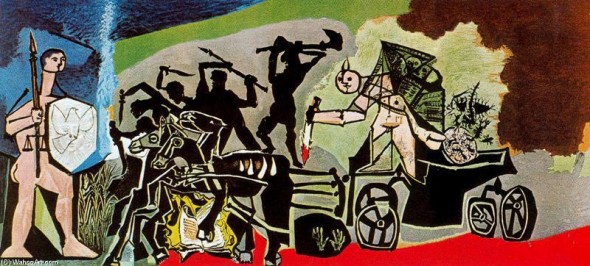
War, Pablo Picasso
Good Morning!!
Here are are on the 13th anniversary of the 9/11 attacks and the never-ending war in the Middle East continues onward. Last night President Obama promised not to send ground troops back to Iraq or into Syria, but it’s very difficult to trust that promise, even though I do think Obama is sincere in his wish to keep the battle against the Islamic State extremists circumscribed.
Reactions to Obama’s speech
From The Washington Post, Countering Islamic State will be hard in Iraq and harder in Syria, officials say.
President Obama’s strategy to beat back Islamic State militants spread across Iraq and Syria will depend on far more than U.S. bombs and missiles hitting their intended targets.
In Iraq, dissolved elements of the army will have to regroup and fight with conviction. Political leaders will have to reach compromises on the allocation of power and money in ways that have eluded them for years. Disenfranchised Sunni tribesmen will have to muster the will to join the government’s battle. European and Arab allies will have to hang together, Washington will have to tolerate the resurgence of Iranian-backed Shiite militias it once fought, and U.S. commanders will have to orchestrate an air war without ground-level guidance from American combat forces.
“Harder than anything we’ve tried to do thus far in Iraq or Afghanistan” is how one U.S. general involved in war planning described the challenges ahead on one side of the border that splits the so-called Islamic State.
But defeating the group in neighboring Syria will be even more difficult, according to U.S. military and diplomatic officials. The strategy imagines weakening the Islamic State without indirectly strengthening the ruthless government led by Bashar al-Assad or a rival network of al-Qaeda affiliated rebels — while simultaneously trying to build up a moderate Syrian opposition.
All that “makes Iraq seem easy,” the general said, speaking on the condition of anonymity to share views on policy. “This is the most complex problem we’ve faced since 9/11. We don’t have a precedent for this.”
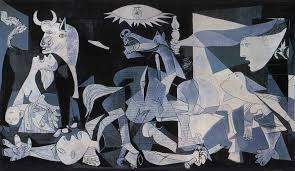
Guernica, Pablo Picasso
The Wall Street Journal, Obama Pushes U.S. Deeper Into Middle East to Fight Islamic State.
In asking Americans to support another military incursion in the Middle East, Mr. Obama said his strategy to combat Islamic State, also called ISIS and ISIL, would be bolstered by a coalition of Arab and European nations. His plan builds on his authorization in August of airstrikes in Iraq to protect American personnel threatened by Islamic State and to provide humanitarian assistance to besieged Iraqis.
Mr. Obama said the U.S. goal now is to help Iraqis reclaim large swaths of territory the group has rapidly overtaken in recent months since spilling over from its stronghold in neighboring Syria. His speech paves the way for the first U.S. strikes at the group’s bases and havens in Syria.
“America will lead a broad coalition to roll back this terrorist threat,” Mr. Obama said in remarks from the White House. “I will not hesitate to take action against ISIL in Syria, as well as Iraq. This is a core principle of my presidency: If you threaten America, you will find no safe haven.”
The president gave no timetable for the new, U.S.-led fight against what he described as “a terrorist organization” with members “unique in their brutality.”
In addition to launching airstrikes against the militants in Syria, Mr. Obama pledged a new dose of support for moderate Syrian fighters also battling the extremist group. Taken together, the steps draw the U.S. closer toward the volatile Syrian civil war and open a new front for American efforts in the region.
Saudi Arabia has offered to host a U.S.-run training facility for moderate Syrian rebels, U.S. and Arab officials said. The facility is expected to be able to handle as many as 10,000 fighters, but details are still being worked out, the officials said.
According to the article, John McCain and Lindsey Graham are on board with the plan. That gives me the creeps, frankly.

Guernica 2: Hommage to Picasso’s Guernica, Jose Garcia y Mas
Geoff Dyer at The Financial Times, Obama’s bold ambition at odds with strategic caution.
Faced with the rapid advances of Isis in both Iraq and Syria, the approach described by Mr Obama attempts to meet the political realities that the president faces, both in the Middle East and at home.
In spite of the technological superiority of US forces, Mr Obama believes a durable military victory against Isis can only be achieved by soldiers from the region, especially Sunni forces from the areas to which Isis is laying claim. Otherwise a similar group could reappear once the US has left.
At the same time, it gives him some political protection at home. Recent polls have shown that Americans are alarmed about Isis after the filmed beheadings of two US citizens, but that does not mean they will support another long ground war that leads to hundreds more US casualties.
Yet the problem with Mr Obama’s latest strategy is that it risks being a series of half-measures that establish incredibly ambitious goals while lacking the means to achieve them.
It’s an interesting article. It spells out my fear that this campaign against ISIL is going to expand more and more–just like Vietnam, Afghanistan, and Iraq.
A couple more interesting stories to check out:
Imran Kahn at Aljazira, Iraq and the Obama plan: Officials and experts broadly welcome US president’s plan to destroy the Islamic State group, but with crucial caveats.
Ian Black at The Guardian, Obama puts Isis firmly in US sights but peace in Syria looks harder than before.
Violence Against Women News

From Picasso’s War, a commentary on race hatred
I haven’t followed the trial of Oscar Pistorius in South Africa, but from what I know about the killing of his girlfriend Reeva Steenkamp, I was surprised to see the headlines this morning saying that he has been found not guilty of murder. Here’s the latest from The Washington Post, Judge: Oscar Pistorius not guilty of premeditated murder, but ‘it is clear his conduct was negligent’.
The prosecution has not proven beyond a reasonable doubt that Oscar Pistorius committed premeditated murder, Judge Thokozile Masipa said this morning. However, the judge added that it “is clear that his conduct was negligent.”
Pistorius’s negligence pertains to a lesser charge the athlete faces, “culpable homicide,” or manslaughter. The judge applied “the test of a reasonable man” to this charge.
In other words, the judge examined whether it was reasonable for Pistorius to fire four shots through his bathroom door at what he believed was an intruder. In her judgement, Pistorius did not pass this test.
“All the accused had to do was pick up phone and ring security,” Masipa said of Pistorius’s reaction. She added that Pistorius could have also “run to balcony and call for help.” Masipa added that she was “not persuaded that a reasonable person with the accused disabilities,” she said, “would have fired four shots” into the home’s bathroom.
She said that while she thought Pistorius was an “evasive” witness, that does not make him guilty. She said the prosecution has not demonstrated that he “reasonably could have foreseen” that his girlfriend, Reeva Steenkamp, was behind the bathroom door into which he fired four shots, killing her.
On the Ray Rice story, yesterday the AP reported that law enforcement sources in NJ told them that the NFL had received a copy of the tape of Rice knocking out Janay Palmer in an Atlantic City casino elevator in February. Following that unsurprising revelation, NFL Commissioner Roger Goodell went deeper into damage control mode, asking former FBI director Robert Mueller to head an independent investigation into the NFL’s handling of the case. The Washington Post reports, AP story prompts NFL to investigate its handling of the Ray Rice case.
The NFL appointed an independent investigator to look into its handling of the Ray Rice case Wednesday night, hours after a new report contradicted the league’s insistence no one in the league office saw video until Monday that depicted Rice striking his then-fiancee in an Atlantic City hotel.
That report by the Associated Press came as several people familiar with the inner workings of the league said NFL Commissioner Roger Goodell has no plans to heed the calls for him to resign over his handling of the case.
The league announced Wednesday night that Robert S. Mueller III, former director of the FBI, will “conduct an independent investigation into the NFL’s pursuit and handling of evidence in the Ray Rice domestic violence incident.”
Owners John Mara of the New York Giants and Art Rooney II of the Pittsburgh Steelers are to oversee the investigation, according to the league.
The final report resulting from the investigation will be released to the public, the NFL said.

Brooding Woman, Pablo Picasso
I found a couple more disturbing reports about what actually happened at the casino that night in February. Security officers from the casino said that Rice spat in Palmer’s face twice and claimed that she was unconscious from drinking too much.
ESPN reports, Sources: Ray Rice spat at fiancee.
Three current or former security staffers, who spoke with “Outside the Lines” this week on the condition of anonymity, described additional details of the ugly scene captured on video. Two of the men were on duty the night of the assault, while a third had full access to the security video, which he said he has watched dozens of times. TMZSports.com released a video this week that showed Rice punching Palmer in the face, appearing to knock her unconscious. Revel security workers watched the incident from the operations room through a security camera of the elevator.
One former staffer said Rice, the former Baltimore Ravens running back, spat in his then-fiancée’s face twice, “once outside the elevator and once inside,” prompting her to retaliate with movements that were ultimately countered with a knockout punch. According to the men, as Rice punched Palmer, the elevator the couple rode was rapidly approaching the hotel lobby just two floors above the casino floor. A security staffer, dispatched from his lobby post, saw Rice starting to drag his fiancée, who appeared to still be unconscious, out of the elevator.
“Get him away from her! Get him away from her!” the first responder was told by another security officer over a radio, one former security staffer told “Outside the Lines.” The staffer had full access to the security footage.
The security staffers said they did not see any sign of injury on Palmer’s face or head but added that her hair was covering much of her face, making it hard to determine her condition. They also said they didn’t see any blood in the elevator or on the hip-level railing that Palmer’s head appeared to strike as she fell to the elevator floor.
“The first thing he [Rice] said is, ‘She’s intoxicated. She drank too much. I’m just trying to get her to the room,'” one staffer said.
“When she regained consciousness she said, ‘How could you do this to me? I’m the mother of your kid,'” that same staffer told “Outside the Lines.”
There’s much more at the link, and it only makes the entire sorry episode and the NFL’s failure to deal adequately with it more sickening.
A few more links:
NBC Sports, Did Ray Rice Lie to Roger Goodell?
SB Nation, Ray Rice speaks out for the first time since his release.
CBS Sports, Ray Rice’s wife: How could you do this to me? I’m the mother of your kid.
NYT, In Ray Rice cast, NFL sees only what it wants to see.

Cat with bird, Pablo Picasso
Other News, Links Only
AP, USIS, the contractor that handled Edward Snowden’s security clearance loses federal contract.
BBC News, Michael Brown death: Ferguson highway protest blocked.
The Guardian, Ferguson reform to courts system could leave residents paying more.
The Washington Post, Richard Kiel, who played lovable giant ‘Jaws’ in ‘James Bond’ films, is dead at 74.
ABC News, Five things that may happen if Scotland votes for independence.
Wall Street Journal, EU agrees to implement more sanctions against Russia Friday.
Time Magazine, Ozone layer shows signs of recovery, study finds.
HNGN, Baboons With Closer Friends Have Longer Lives Than Loners.
Forbes, Scientists find gene that may delay aging of whole body.
That’s all I’ve got. What stories are you following today? Please post your thoughts and links in the comment thread, and have terrific Thursday.

Peace, Pablo Picasso
Tuesday Reads: Art as Therapy to Help Deal With Depressing News
Posted: September 9, 2014 Filed under: Barack Obama, Crime, Criminal Justice System, Foreign Affairs, Iraq, morning reads, Political Affective Disorder, psychology, Psychopaths in charge, Real Life Horror, social justice, U.S. Military, U.S. Politics, Ukraine, Violence against women, War on Women | Tags: Atlantic County NJ Prosecutor James McClain, Baltimore Ravens, Chief Thomas Jackson, Ferguson MO, FOIA requests, ISIS, Janay Palmer, Malaysia Flight 17, Michael Brown, NFL, police brutality, police killings, Racism, Ray Rice, Roger Goodell, Rutgers University, St. Louis, The Islamic State, TMZ 36 Comments
Still Life with a Red Rug, Henri Matisse (1906)
Good Morning!!
I decided I needed to look at some Matisse paintings this morning, and I’m going to include a few in this post to provide contrast to the news of the day, which is filled with violence, hate, and despair. According to the WebMuseum, Matisse was “a man of anxious temperament.”
Matisse’s art has an astonishing force and lives by innate right in a paradise world into which Matisse draws all his viewers. He gravitated to the beautiful and produced some of the most powerful beauty ever painted. He was a man of anxious temperament, just as Picasso, who saw him as his only rival, was a man of peasant fears, well concealed. Both artists, in their own fashion, dealt with these disturbances through the sublimation of painting: Picasso destroyed his fear of women in his art, while Matisse coaxed his nervous tension into serenity. He spoke of his art as being like “a good armchair”– a ludicrously inept comparison for such a brilliant man– but his art was a respite, a reprieve, a comfort to him.
Can art be therapy? I think so. So can reading literature or listening to music. From a review of Art as Therapy at Brain Pickings,
The question of what art is has occupied humanity since the dawn of recorded history. For Tolstoy, the purpose of art was to providea bridge of empathy between us and others, and for Anaïs Nin, a way to exorcise our emotional excess. But the highest achievement of art might be something that reconciles the two: a channel of empathy into our own psychology that lets us both exorcise and better understand our emotions — in other words, a form of therapy.
In Art as Therapy, philosopher Alain de Botton — who has previously examined such diverse and provocative subjects as why work doesn’t work,what education and the arts can learn from religion, and how to think more about sex — teams up with art historian John Armstrong to examine art’s most intimate purpose: its ability to mediate our psychological shortcomings and assuage our anxieties about imperfection. Their basic proposition is that, far more than mere aesthetic indulgence, art is a tool — a tool that serves a rather complex yet straightforwardly important purpose in our existence:
Like other tools, art has the power to extend our capacities beyond those that nature has originally endowed us with. Art compensates us for certain inborn weaknesses, in this case of the mind rather than the body, weaknesses that we can refer to as psychological frailties.
Read about “the seven core functions of art” at the Brain Pickings link. And now, regrettably, I must turn to today’s news.

Tea in the Garden, Henri Matisse (1919)
Ray Rice Domestic Violence News.
Yesterday’s news was dominated by reactions to gossip site TMZ’s release of the video of Baltimore Ravens running back Ray Rice hitting his then fiance–now wife–Janay Palmer and knocking her unconscious in an Atlantic city casino elevator in February.
Suddenly, the Ravens went into ass-covering mode. The Ravens released Rice and the NFL suspended him indefinitely. But why did it take so long? At the time, a video had been released showing Rice dragging Palmer from the elevator like a sack of potatoes.
Here’s a timeline of the Rice case from SB Nation. On Feb. 15th, after the beating, Rice and Palmer were both arrested and charged with simple assault (the charges against Palmer were later dropped). On the 19th a video was released that showed Rice coldly dragging an unconscious Palmer from the elevator like a sack of potatoes–her dress pulled up, her legs spread open to the camera. Rice makes shows no apparent concern for her well-being.
Those of us with any experience with domestic violence could easily surmise what had taken place inside the elevator. But the men of the NFL somehow assumed (or wanted to believe) that Palmer had viciously attacked Rice, and that he had only defended himself by knocking her unconscious!
On March 27 Rice was indicted for aggravated assault, and the next day the couple married. Did Rice marry her to shut her up? Rice ended up getting a slap on the wrist from Prosecutor James McClain (who, like Rice graduated from Rutgers). Rice was allowed to enter a one-year diversion program with counseling instead of getting jail time. And btw, McClain is still defending his decision.
On May 23, Ray Rice game a non-apology “apology” for his disgusting actions in which he apologized to everyone under the sun except his wife Janay. Rice acted as if the two were equally responsible for “the incident.”
From SB Nation, May 23: Ray Rice is an asshole and the Ravens couldn’t care less.
Ray Rice is sorry. He wants you to know how sorry he is for knocking out his fiancée Janay, who is now his wife. He would like to sincerely apologize for dragging her out of an Atlantic City hotel elevator. We know this because Rice told us so. He told the world in a televised public apology broadcast Friday afternoon from Baltimore.
“I apologize for the situation my wife and I were in,” the Baltimore Ravens running back said….
Rice’s apology is special because he really believes it; a shocking portion of Rice’s press conference was devoted to Successories-style affirmations about how he will recover from and get past this … situation that … occurred. Stranger still, Rice somehow managed to get his wife Janay — whom he married right before he was supposed to go to trial for a more serious version of domestic assault — to accept an equal share of blame for the incident. She apologized, too.
Those of us familiar with the dynamics of domestic violence know that Palmer’s behavior was typical of victims–blaming themselves and trying to protect their emotional and economic security.
Finally, in July NFL Commissioner Roger Goodell suspended Rice for two games. NFL and Ravens officials implied to journalists that there was some kind of mitigating evidence that showed Palmer to be at fault. Public outrage was immediate. I recall JJ posting about it at that time. On Aug. 28, realizing he had made a terrible public relations blunder, Goodell announced a new NFL policy on “domestic violence.”
Finally, on Sept. 8, TMZ released video of what actually transpired inside the elevator: Rice spitting in Palmer’s face, and decking her with a “crushing” left hook. Not long afterward, the Ravens and the NFL finally too action, claiming they had never seen this video footage that they could have gotten easily from the casino or law enforcement.
But guess what? Rice will still receive $25 million from his contract with the Ravens. If Roger Goodell keeps his job after this, the NFL will be permanently damaged. After all, half of the people who follow football are women? Why do you think the NFL make their players wear pink (ugh!) once a year in honor of breast cancer awareness?

The Red Madras Headdress, Henri Matisse
Here are some links to other stories on this horrible and shameful debacle:
Dan Shaughnessy at The Boston Globe: In Ray Rice case, one failure after another.
Mike Wise at The Washington Post: Ray Rice finally must answer for his actions; when will NFL Commissioner Roger Goodell?
Baltimore Sun: Janay Rice breaks her silence, describes situation as ‘horrible nightmare’ (She blames the media, not her husband).
SB Nation: White House on Ray Rice: ‘Hitting a woman is not something a real man does’.
TMZ: NFL Commish in the Dark by Choice?
President Obama to Lay out Case for Stepping Up Campaign Against Islamic State
From The Washington Post, As Obama Makes Case, Congress Is Divided on Campaign Against Militants.
WASHINGTON — President Obama on Tuesday will begin laying out his case for an expanded military campaign against the Islamic State in Iraq and Syria when he faces congressional leaders who are averse to taking an election-year stand but are being pushed by lawmakers who want a say in matters of war.
Mr. Obama’s meeting with Republican and Democratic leaders on Tuesday in the Oval Office will be the first of several between White House officials and lawmakers as the administration tries to persuade Congress to embrace the president’s plan to halt the momentum of the Sunni militant group known as ISIS.
A year after opposition in Congress thwarted plans for missile strikes in Syria, the White House is again putting the issue of military force in the Middle East before a skeptical Congress and a war-weary public.
But what about Congress?
Democratic leaders in the Senate and Republican leaders in the House want to avoid a public vote to authorize force, fearing the unknown political consequences eight weeks before the midterm elections on Nov. 4.
“A lot of people would like to stay on the sideline and say, ‘Just bomb the place and tell us about it later,’ ” said Representative Jack Kingston, Republican of Georgia, who supports having an authorization vote. “It’s an election year. A lot of Democrats don’t know how it would play in their party, and Republicans don’t want to change anything. We like the path we’re on now. We can denounce it if it goes bad, and praise it if it goes well and ask what took him so long.”
Other lawmakers, especially some Democrats, are arguing that as long as the president keeps the operation limited to airstrikes, he does not need to get congressional approval.
Benjy Sarlin at MSNBC: The Politics of ISIS
Ahead of a Wednesday public address from President Obama where he’s set to lay out a “game plan” for military action in Iraq and as the right mocks Democrats as weak-willed appeasers, former Vice President Dick Cheney is heading to Capitol Hill to deliver a pep talk to House Republicans.
Is it the 2002 election all over again? Not exactly. But the escalating conflict against ISIS is starting to show up on the trail as Republican candidates seem eager to put major past differences on foreign policy aside and join together in criticizing the White House’s response to the Islamic State.
A number of candidates and GOP officials have gone out of their way to attack Obama over his remark at a press conference that “we don’t have a strategy yet” for confronting ISIS. Republican Senate nominees including Scott Brown in New Hampshire, David Perdue in Georgia, and Thom Tillis in North Carolina, among others, have highlighted the quote while demanding action to turn back the Islamist group’s gains. Joni Ernst in Iowa and Tom Cotton in Arkansas, both of whom served in the Middle East during the Iraq War, have also called for a clearer plan to tackle ISIS.
Read the rest at the link.

Odalique with a Turkish Chair, Henri Matisse
Ferguson Updates
St. Louis Business Journal: Ferguson to reform municipal courts, add police review board.
As national attention mounts on the way St. Louis municipalities use court fine revenuefor city operations and on police use of force in the area, the Ferguson City Council has announced the proposal of three major reforms.
The city will hold ward meetings for public input on the reforms, with some of the proposals on the agenda for Tuesday night’s City Council meeting. It will be held at 7 p.m. at Greater Grace Church, 3690 Pershall Road.
Here’s the breakdown of the proposed reforms:
- Establishing a Citizen Review Board to work with the police department to review their actions.
- I ntroducing an ordinance that will keep court fine revenues at or below 15 percent of Ferguson’s revenue. Any excess will be earmarked for special community projects, not general revenue.
- Reforming the way Ferguson’s municipal court works by repealing the “failure to appear” offense, abolishing some administrative fees which may impact low-income persons to a greater extent and the creation of a special docket for defendants having trouble making monthly payments.
Likewise, the council announced, the municipal judge has called for a warrant recall to run from Sept. 15 through Oct. 15. Those who have outstanding warrants are encouraged to call the municipal court cler k for information on the recall.

Woman in a Purple Coat, Henri Matisse (1937)
Truthout: St. Louis Police Shot 16 Before Michael Brown in 2014
By the time of Michael Brown’s murder, St. Louis area police had already shot at least 16 people in 2014, the vast majority of whom were black.
Truthout obtained this figure by examining news reports from January 1 to August 6 of 2014. On August 10, protests opposing the police killing of unarmed black teenager Michael Brown began.
Read the list of victims at the link.
In the vast majority of incidents where the race of an individual shot by police was known, the individuals were black. Truthout was not able to determine how many (if any) of these police shootings were “justified” because data concerning police shootings is so limited.
Police shootings, along with other uses of force by the St. Louis area police, are not a new development. In Ferguson, seven active or former officers have now been named in civil lawsuits for excessive use of force; and in March 2014, two officers with the St. Louis Police Department severely beat a man with disabilities. In another recentcivil case, an amount of over $800,000 was awarded to a victim of excessive force by the St. Louis Metropolitan Police Force.
In 2012, US District Judge Carol Jackson stated that the St. Louis Board of Police Commissioners may be “deliberately indifferent” or even tacitly approving of a “widespread persistent pattern of unconstitutional conduct.” In a separate 2010 federal civil lawsuit, which accused the St. Louis police of excessive force, the victim’s lawyer cited statistics showing that the St. Louis internal affairs investigators sustained only one of 322 citizens’ physical abuse complaints against police from 1997 to 2002.
Read the rest at Truthout. It’s a good article.
Matthew Keys at The Blot: Ferguson Police Chief Lied About Michael Brown Surveillance Tape.
The chief of police for the Ferguson Police Department misled members of the media and the public when he asserted that his hand was forced in releasing surveillance footage that purported to show 18-year-old resident Michael Brown engaged in a strong-arm robbery at a convenience store minutes before he was fatally shot by a police officer.
Chief Thomas Jackson distributed copies of the surveillance tape at a press conference on Aug. 15 in tandem with the public release of the identity of the officer who was responsible for shooting Brown.
When questioned by members of the press about the tape — which apparently had nothing to do with the fatal shooting of the unarmed teenager — Jackson told reporters that he was legally obligated to release the tape because members of the media had submitted an open records requests for it.
“We’ve had this tape for a while, and we had to diligently review the information that was in the tape, determine if there was any other reason to keep it,” Jackson said at the press event. “We got a lot of Freedom of Information requests for this tape, and at some point it was just determined we had to release it. We didn’t have good cause, any other reason not to release it under FOI.”
Except there were no specific FOIA requests for the tape. Keys and The Blot got all media requests for information through an open records request. Read all about it at the Blot.

Dance “What hope might look like” — Henri Mattisse
Shootdown of Malaysia Flight 17 in Ukraine
From the LA Times: Dutch report: Malaysia jet downed in Ukraine by ‘high-energy objects’
A preliminary report on Malaysia Airlines Flight 17 appears to confirm initial assertions that the passenger plane was hit by a surface-to-air-missile in mid-flight July 17 before crashing in Ukraine.
“The pattern of damage observed on the forward fuselage and cockpit section of the aircraft appears to indicate that there were impacts from a large number of high-energy objects from outside the aircraft,” concluded a report issued Tuesday by the Netherlands’ air safety board.
The Boeing 777, en route from Amsterdam to Kuala Lumpur, the Malaysian capital, was flying at about 33,000 feet over separatist-held territory in southeastern Ukraine when it broke apart in midair and crashed, killing all 298 passengers and crew members on board.
The report says that fragments of the aircraft reveal numerous puncture holes and indentations on the plane’s skin that would be consistent with damage from missile shrapnel and, investigators say, rule out pilot error or any mechanical fault as the cause of the disaster.
Although investigators have not been able to recover these pieces for forensic examination, the report states that “the pattern of damage observed … was not consistent with the damage that would be expected from any known failure mode of the aircraft, its engines or systems.”
I’ll end there, as this post is far too long already. I hope you’ll share your thoughts and links in the comment thread.

 peej
peej Carissa
 bostonboomer
 dakinikat
 ecocatwoman
 mablue2
 Mama Lopez
 peggysue22
 quixote
 skydancingguestblogger
 Mona (aka Wonk the Vote)



 Sky Dancing
Recent Comments