
Tuesday Reads: U.S. Spies on Foreign Countries and Other “Blockbuster” News
Posted: September 3, 2013 Filed under: Central Intelligence Agency, China, Crime, cyber security, Diplomacy Nightmares, Foreign Affairs, France, Germany, Great Britain, Iran, Israel, morning reads, Pakistan, Russia, Syria, U.S. Politics | Tags: Agência Brasileira de Inteligência, al Qaeda, Bashar al-Assad, black budget, Bob Cesca, Edward Snowden, espionage, Glenn Greenwald, Information Assurance, John Kerry, Laura Poitras, Marines website, National Security Agency (NSA), nuclear weapons, Osama bin Laden, S-2 (Mexico spy agency), SIGINT, signals intelligence, Syrian Electronic Army, Taliban 51 Comments
Good Morning!!
In the weeks since Edward Snowden absconded with thousands of top secret National Security Agency (NSA) files and traveled to Hong Kong and then Moscow and handed over the documents to Guardian columnist Glenn Greenwald and filmmaker Laura Poitras, we’ve learned that the U.S. spies on lots of other countries. Snowden has revealed that NSA has spied on China, Russia, Germany, France, Brazil, Mexico, Israel, Iran, and the UN. Oddly, we haven’t gotten much new information from Snowden about illegal or abusive NSA spying on Americans, which Snowden initially suggested was his reason for stealing the secret documents.
To most nominally intelligent and informed people, the fact that NSA spies on foreign countires is not particularly surprising; since collecting foreign signals intelligence (SIGINT) is the primary purpose of NSA as stated publicly on their website. Here is NSA’s statement of their “core mission”:
The National Security Agency/Central Security Service (NSA/CSS) leads the U.S. Government in cryptology that encompasses both Signals Intelligence (SIGINT) and Information Assurance (IA) products and services, and enables Computer Network Operations (CNO) in order to gain a decision advantage for the Nation and our allies under all circumstances.
The Information Assurance mission confronts the formidable challenge of preventing foreign adversaries from gaining access to sensitive or classified national security information. The Signals Intelligence mission collects, processes, and disseminates intelligence information from foreign signals for intelligence and counterintelligence purposes and to support military operations. This Agency also enables Network Warfare operations to defeat terrorists and their organizations at home and abroad, consistent with U.S. laws and the protection of privacy and civil liberties.
Spying on foreign countries is what NSA does. Why that is perceived as somehow illegal and/or shocking by Greenwald, Poitras, Snowden, and their cult followers, I have no clue. But the fact that a spy agency collects foreign signals intelligence really should not be considered breaking news; and the countries that are complaining about it are well known for spying on the US in return–and in some cases (e.g., China, Russia, and Israel) for famously stealing U.S. secrets and technology.
Today the Washington Post has a new “blockbuster” article that reveals that the U.S. is particularly focused on spying on Pakistan. Now I wonder why that would be? Anyone want to speculate? It couldn’t have anything to do with the fact that Pakistan concealed the location of Osama bin Laden for years, could it? Or the fact that Taliban and al Quaeda operatives regularly hide in Pakistan? Just a couple of wild guesses…
Here’s an excerpt from the WaPo article:
A 178-page summary of the U.S. intelligence community’s “black budget” shows that the United States has ramped up its surveillance of Pakistan’s nuclear arms, cites previously undisclosed concerns about biological and chemical sites there, and details efforts to assess the loyalties of counterterrorism sources recruited by the CIA.
Pakistan appears at the top of charts listing critical U.S. intelligence gaps. It is named as a target of newly formed analytic cells. And fears about the security of its nuclear program are so pervasive that a budget section on containing the spread of illicit weapons divides the world into two categories: Pakistan and everybody else.
The disclosures — based on documents provided to The Washington Post by former intelligence contractor Edward Snowden — expose broad new levels of U.S. distrust in an already unsteady security partnership with Pakistan, a politically unstable country that faces rising Islamist militancy. They also reveal a more expansive effort to gather intelligence on Pakistan than U.S. officials have disclosed.
The United States has delivered nearly $26 billion in aid to Pakistan over the past 12 years, aimed at stabilizing the country and ensuring its cooperation in counterterrorism efforts. But with Osama bin Laden dead and al-Qaeda degraded, U.S. spy agencies appear to be shifting their attention to dangers that have emerged beyond the patch of Pakistani territory patrolled by CIA drones.
“If the Americans are expanding their surveillance capabilities, it can only mean one thing,” said Husain Haqqani, who until 2011 served as Pakistan’s ambassador to the United States. “The mistrust now exceeds the trust.”
The stolen files also reveal serious human rights issues in Pakistan and fears about the security of Pakistan’s nuclear weapons. Raise your hand if you’re shocked by any this. I can certainly see why these revelations would be harmful to U.S. national security and foreign relations, however.
Via The Jerusalem Post, another Snowden leak revealed by the Washington Post showed that members of terrorist organizations have tried to join the CIA.
…individuals with past connections to known terrorist entities such as al-Qaida, Hezbollah and Hamas, have repeatedly attempted to obtain employment within the CIA, The Washington Post reported on Monday.
Among job-seekers that seemed suspicious to the CIA, approximately 20% of that grouping reportedly had “significant terrorist and/or hostile intelligence connections.” The nature of the connections was not described in the document.
“Over the last several years, a small subset of CIA’s total job applicants were flagged due to various problems or issues,” an anonymous CIA official was reported as saying. “During this period, one in five of that small subset were found to have significant connections to hostile intelligence services and or terrorist groups.” [….]
The document also allegedly stated that the CIA re-investigates thousands of employees each year to reduce the possibility that an individual with these connections may compromise sensitive information.
Can anyone explain to me why this should be considered criminal or why the person who revealed it should be called a “whistle-blower?” It seems to me, the only reason for revealing the methods the U.S. uses to collect foreign SIGINT is a desire to harm U.S. Government and damage its foreign policy. Here’s Bob Cesca, who has consistently critiqued libertarians Snowden and Greenwald and their anti-government motives from a liberal, rational point of view: Greenwald Reports NSA Spied on Presidents of Brazil andMexico.
We’re not sure exactly which section of the U.S. Constitution protects the privacy rights of foreign leaders, but Glenn Greenwald and Edward Snowden appear to believe it’s in there somewhere. The tandem crusaders for the Fourth Amendment have once again extended their reach beyond what was intended to be their mutual goal of igniting a debate in the United States about the constitutionality of the National Security Agency’s surveillance operations, and, instead, opted to reveal that, yes, the U.S. spies on foreign leaders. Shocking, I know.
Specifically, on the Globo television show “Fantasico” in Brazil, Greenwald described a July, 2012 document stolen from NSA by Snowden, which describes how NSA had intercepted communications made by the president of Mexico, Enrique Pena Nieto, as well as Brazil’s president, Dilma Rousseff. (Incidentally, the Globo article contains 13 corporate trackers or “web bugs.”)
The goal of revealing this information is clear. Greenwald and Snowden have successfully exploited the “sparking a debate” motive as a Trojan Horse for injecting unrelated information into public view as a means of vindictively damaging the operations of U.S. and U.K. intelligence communities, not to mention the reputation of the United States as a whole, while also pushing the unrealistic message that surveillance is generally impermissible. Yes, we already knew that nations spy on other nations, but to publicly disclose specific instances of international spying — while on the soil of one of the nations being surveilled — confirms these suspicions and sorely embarrasses everyone involved.
But guess what? Both Mexico and Brazil have powerful spy agencies that conduct “active surveillance” on the U.S.
In Brazil, it’s called the Agência Brasileira de Inteligência (ABIN or the Brazilian Intelligence Agency). It deals with external and domestic intelligence gathering: collection and analysis of information that’s intercepted via both signals (SIGINT collects email, phone calls and so forth) and human resources.
In Mexico, it’s called S-2. Like ABIN or NSA, S-2 also collects SIGINT on foreign targets, with a special focus on the military operations of foreign governments. Along with its counterpart, the Centro de Información de Seguridad Nacional (Center for Research on National Security or CISIN), S-2 is tasked with counter-intelligence and counter-terrorism operations.
Has anyone overheard Greenwald mention, even in passing, either of these agencies? Likely not, and don’t hold your breath waiting for Greenwald to attack Brazil’s intelligence community, even knowing that it wiretapped its own Senate and Supreme Court several years ago. Along those lines, we don’t know exactly whether these agencies have attempted to spy on any of our presidents or government officials, but wouldn’t Greenwald, as a U.S. citizen and resident of Brazil, want to find out using the same “Glennzilla” tenacity he’s employed while exposing U.S. spying? If his crusade now involves universal privacy, wouldn’t that include violations by the Brazilian government, especially knowing that Greenwald lives in Rio de Janeiro?
Read more at the link.
In other news….
The civil war in Syria continues to be the top international story, and The New York Times has a couple of helpful articles. The first is an explainer that deals with Key Questions on the Conflict in Syria. I won’t excerpt from it–read it at the NYT if you’re interested. Next, an article that explains how American policy on Syria may affect possible negotiations with Iran: Drawing a Line on Syria, U.S. Eyes Iran Talks.
As the Obama administration makes a case for punitive airstrikes on the Syrian government, its strongest card in the view of some supporters of a military response may be the need to send a message to another country: Iran. If the United States does not enforce its self-imposed “red line” on Syria’s use of chemical weapons, this thinking goes, Iran will smell weakness and press ahead more boldly in its quest for nuclear weapons.
But that message may be clashing with a simultaneous effort by American officials to explore dialogue with Iran’s moderate new president, Hassan Rouhani, in the latest expression of Washington’s long struggle to balance toughness with diplomacy in its relations with a longtime adversary.
Two recent diplomatic ventures have raised speculation about a possible back channel between Washington and Tehran. Last week, Jeffrey Feltman, a high State Department official in President Obama’s first term who is now a senior envoy at the United Nations, visited Iran to meet with the new foreign minister, Mohammad Javad Zarif, and discussed possible reactions to an American airstrike in Syria.

In line with the international beating up on the U.S. that has followed the Snowden-Greenwald-Poitras “revelations” that NSA spies on foreign countries, The Daily Mail has a snarky article with numerous photos about a dinner that John Kerry had with Syria’s Bashar al-Assad in 2009.
An astonishing photograph of John Kerry having a cozy and intimate dinner with Bashar al-Assad has emerged at the moment the U.S Secretary of State is making the case to bomb the Syrian dictator’s country and remove him from power.
Kerry, who compared Assad to Adolf Hitler and Saddam Hussein yesterday, is pictured around a small table with his wife Teresa Heinz and the Assads in 2009.
Assad and Kerry, then a Massachusetts senator, lean in towards each other and appear deep in conversation as their spouses look on.
A waiter is pictured at their side with a tray of green drinks, believed to be lemon and crushed mint.
Now, why would Kerry be having dinner with Syria’s president? The Daily Mail tells us:
The picture was likely taken in February 2009 in the Naranj restaurant in Damascus, when Kerry led a delegation to Syria to discuss finding a way forward for peace in the region.
At the time, Kerry was Chairman of the Senate Foreign Relations Committee, and what he was doing is called “diplomacy.” But looking back in the age of Snowden, it seems that instead of having a polite dinner, Kerry should have punched Assad in the nose and screamed at him at the top of his lungs to get with the program–or something…
From the Wall Street Journal: Syrian Electronic Army Hacks Marines Website
A collection of pro-Syrian government hackers apparently defaced a Marine Corps recruitment website Monday.
The Syrian Electronic Army, which has hacked a series of websites, posted a letter on the Marines.com website arguing the Syrian government is “fighting a vile common enemy.”
“The Syrian army should be your ally not your enemy,” the letter read. “Refuse your orders and concentrate on the real reason every soldier joins their military, to defend their homeland. You’re more than welcome to fight alongside our army rather than against it.”
See a screen shot at the link. The site is now back up and running normally.
I’ll end there and post my remaining links in the thread below. As always, please post links to the stories you’re following in the comments as well.
Labor Day: Struggles of the Great Recession with a lot of Depression
Posted: September 2, 2013 Filed under: morning reads | Tags: Bill Moyers & Company, Lehman Collapse, upper class sociopaths 35 Comments Good Morning!
I certainly hope this Labor Day is being kinder to you than me. I am struggling without air conditioning for the third day in a row and it’s not pleasant. Hopefully, by this time tomorrow relief will be on the way in the form of a new condenser. After being totally fleeced by the same people who sold me all these units to begin with a week ago, my long time bestie from Virginia Beach found a great guy who has found mercy in his small business owning heart to deal me a deal and do it right. I am scrambling right now for the money because I do know it is a deal and AC is the one thing you cannot be without in the deep south. I would like to say that the kindness of people still does exist in abundant quantities when you deal with people and not with those enslaved to corporations. BostonBoomer is holding me together after I decided to emotionally quit my relationship as are several other friends and family members. I have spent the last few weeks being pretty miserable without adding this big headache on top of everything. But again, I just would like to say that if you cultivate friends and real people, the rewards will be ongoing. You always find out who cares about you when troubles are beating down your door. Some times you give a lot away and it doesn’t come back to you from quite the same place. It comes back from the quiet work of day-to-day life and relationship building and the kindness shown to others who pay it forward. I am sending very hot but very sincere blessings out to every one today. Life can turn on a dime.
Bill Moyer’s Essay on “The End Game for Democracy” is the one thing I really think you should listen to or read this morning. It has the feel of a sermon and a populist political meeting rolled into one.
We are so close to losing our democracy to the mercenary class, it’s as if we are leaning way over the rim of the Grand Canyon and all that’s needed is a swift kick in the pants. Look out below.
The predators in Washington are only this far from monopoly control of our government. They have bought the political system, lock, stock and pork barrel, making change from within impossible. That’s the real joke.
Sometimes I long for the wit of a Jon Stewart or Stephen Colbert. They treat this town as burlesque, and with satire and parody show it the disrespect it deserves. We laugh, and punch each other on the arm, and tweet that the rascals got their just dessert. Still, the last laugh always seems to go to the boldface names that populate this town. To them belong the spoils of a looted city. They get the tax breaks, the loopholes, the contracts, the payoffs.
They fix the system so multimillionaire hedge fund managers and private equity tycoons pay less of a tax rate on their income than school teachers, police and fire fighters, secretaries and janitors. They give subsidies to rich corporate farms and cut food stamps for working people facing hunger. They remove oversight of the wall street casinos, bail out the bankers who torpedo the economy, fight the modest reforms of Dodd-Frank, prolong tax havens for multinationals, and stick it to consumers while rewarding corporations.
We pay. We pay at the grocery store. We pay at the gas pump. We pay the taxes they write off. Our low-wage workers pay with sweat and deprivation because this town – aloof, self-obsessed, bought off and doing very well, thank you – feels no pain.
The journalists who could tell us these things rarely do – and some, never. They aren’t blind, simply bedazzled. Watch the evening news – any evening news – or the Sunday talk shows. Listen to the chit-chat of the early risers on morning TV — and ask yourself if you are learning anything about how this town actually works.
Another equally good essay from Jonathan Holland at the same adress is “A Plutocracy Ruled By Self-Centered Jerks”. (This one’s for you BB)
Two studies released last week confirmed what most of us already knew: the ultra-wealthy tend to be narcissistic and have a greater sense of entitlement than the rest of us, and Congress only pays attention to their interests. Both studies are consistent with earlier research.
In the first study, published in the currentPersonality and Social Psychology Bulletin, Paul Piff of UC Berkeley conducted five experiments which demonstrated that “higher social class is associated with increased entitlement and narcissism.” Given the opportunity, Piff also found that they were more likely to check themselves out in a mirror than were those of lesser means.
Piff looked at how participants scored on a standard scale of “psychological entitlement,” and found that those of a high social class — based on income levels, education and occupational prestige — were more likely to say “I honestly feel I’m just more deserving than others,” while people further down the social ladder were likelier to respond, “I do not necessarily deserve special treatment.”
In an earlier study, published last year in the Proceedings of the National Academy of Sciences, Piff and four researchers from the University of Toronto conducted a series of experiments which found that “upper-class individuals behave more unethically than lower-class individuals.” This included being more likely to “display unethical decision-making,” steal, lie during a negotiation and cheat in order to win a contest.
In one telling experiment, the researchers observed a busy intersection, and found that drivers of luxury cars were more likely to cut off other drivers and less likely to stop for pedestrians crossing the street than those behind the wheels of more modest vehicles. “In our crosswalk study, none of the cars in the beater-car category drove through the crosswalk,” Piff told The New York Times. “But you see this huge boost in a driver’s likelihood to commit infractions in more expensive cars.” He added: “BMW drivers are the worst.”
Summing up previous research on the topic, Piff notes that upper-class individuals also “showed reduced sensitivity to others’ suffering” as compared with working- and middle-class people.
So let me dally about in my own area and The Economist’s Club at Project Syndicate where Mohamed A El-Arian reminds us that we’re approaching the fifth  year anniversary of the Lehman death rattle. The essay is about their morbid legacy.
…
I hope that we will also see another genre: analyses of the previously unthinkable outcomes that have become reality – with profound implications for current and future generations – and that our systems of governance have yet to address properly. With this in mind, let me offer four.
The first such outcome, and by far the most consequential, is the continuing difficulty that Western economies face in generating robust economic growth and sufficient job creation. Notwithstanding the initial sharp drop in GDP in the last quarter of 2008 and the first quarter of 2009, too many Western economies have yet to rebound properly, let alone sustain growth rates that would make up fully for lost jobs and income. More generally, only a few have decisively overcome the trifecta of maladies that the crisis exposed: inadequate and unbalanced aggregate demand, insufficient structural resilience and agility, and persistent debt overhangs.
The net result goes beyond the weak growth, worsening income inequality, high long-term unemployment, and alarming youth joblessness of the here and now. Five years after the global financial crisis, too many countries are being held back by exhausted and out-dated growth engines. As a result, prospects for a rapid, durable, and inclusive economic recovery remain a serious concern.
Given this harsh reality, it is not surprising that the second previously unthinkable outcome concerns inadequate policy responses – namely, the large and persistent imbalance between the hyperactivity of central banks and the frustrating passivity of other policymakers.
The big surprise here is not that central banks acted decisively and boldly when financial markets froze and economic activity plummeted. Given their relatively unrestricted access to the printing press and their high degree of operational autonomy, one would expect central banks to be active and effective first responders. And they responded in an impressive and globally coordinated fashion.
What is surprising is that, five years after the crisis, and four years after disrupted financial markets resumed their normal functioning, Western economies still overwhelmingly rely on central banks to avoid even worse economic performance. This has pushed central banks away from their core competencies as they have been forced to use partial and imperfect policy tools for quite a long time.
This outcome reflects domestic political polarization in the United States and the complexity of regional interactions in Europe, which have blocked comprehensive and balanced policy approaches. To appreciate the extent of the problem, consider the repeated failure of the US Congress to pass an annual budget (let alone deliver medium-term reforms) or incomplete eurozone-wide initiatives at a time of alarming unemployment and residual threats of financial disruptions.
Such political dysfunction has undermined the responsiveness of other policymaking entities, including those that possess better tools than central banks. This has compelled central bankers to remain in the policy forefront, building one bridge extension after another as they wait for other policymakers to get their act together. The result has been to expose Western economies to ever-more experimental measures, with considerable uncertainty about the longer-term impact of operating sophisticated market-based systems on the basis of artificial constructs.
This is something to reflect up as Congress returns in a few weeks to tell us that it’s the deficit or high taxes on businesses and the rich that have created our current problems. Nothing could be further from the truth.
One last item to share. This is from the Boston Globe Book Review. It will give you something to think about this Labor Day. I give you the link to Katherine Whitmore’s review “A More Perfect Union.”
The state of the union is not good. Organized labor has been “reduced to a whisper of its former greatness,” admits author Phillip Dray. “No one can divine or guarantee its future,” he adds, “but we can know its past.” And what an inspiring, doleful, and switchbacking past that is. Dray’s wonderful “There Is Power in a Union: The Epic Story of Labor in America”(Anchor, 2011) pans back to explain the original sin that made America less receptive than other Western countries to unions; we were a capitalist power before we had a countervailing strong central government. The deck was stacked for business here, but things played out quite differently in older First World nations. Note the modern results: in Sweden, 67.5 percent of workers are unionized, in Belgium 50.4 percent, and in Ireland 31.2 percent.
In the United States, we live in an especially anti-union climate now, partly because we’ve shot from a factory economy to a finance and service economy, partly because (as Dray admits) labor has sometimes been “its own worst enemy.” Many unions were historically harsh to minorities and women, for instance, or sank into appalling corruption (see Hoffa, Jimmy). But Dray asks us to strip down to fundamentals: In a country
founded on the concept of checks and balances, surely unions make inherent sense. Who else can stand up to The Man?
This inherency, in fact, crystallized in the late-19th-century term “industrial democracy,” meaning that democracy is only authentic if it infuses our work lives as well as our civic lives. For isn’t the pursuit of happiness a farce if you work for slave wages, in unsafe conditions, with no security? Steps forward and steps back, of course: Dray pistons through the big turning points, from the disaster of Chicago’s Haymarket bombing of 1886, for which four labor activists were hanged, to the breakthroughs of United Mine Workers president John L. Lewis (the “stormy petrel of labor”) and the National Farm Workers founder Cesar Chavez. The Chavez material is remarkable. I never knew, for instance, that Southern pols would only pass 1935’s union-friendly Wagner Act if it excluded migrant workers. Or that antagonistic California farmers actually crop-dusted grape pickers during the 1960s protests.
I have spent a lot of time recently listening to my father who turns 90 in a month as he has begun to reflect on many things. Recently, he is worried a lot about the world he’s going to leave behind. He has decided that Al Gore is right and that global warming is real and a serious problem. He doesn’t like any of the political parties and thinks that they are destroying the many great things he know about this country. These are strong words coming from a dustbowl Okie who also flew bombing missions over Germany during World War 2. He thinks that all of us will make out. But, he worries about the country at large and wonders if Congress will nab his medicare or social security. He started paying the first day you could pay into social security so he is truly vested in the program. I tell him not to worry that he’s done his part on everything and just relax. But I can’t say that I don’t feel the same way whenever I watch the news. We really need to take some time today to think about the ways we can reclaim the great things about our heritage. We should tend to our Victory Gardens, so to speak, and find pleasure in the last bits of summer.
Whatever our labor may be today, may it be at least a labor of love. May it perfect something quiet and gentle inside of all of us and may that gentleness shine on a world in sore need of it. The one thing I have to say about all of us here is that we care deeply. Have a good holiday my friends.
What’s on you reading and blogging list today?
Saturday Morning Lite
Posted: August 31, 2013 Filed under: Barack Obama, Foreign Affairs, morning reads, Republican politics, U.S. Economy, U.S. Politics | Tags: Ben Affleck, chemical weapons, emoprogs, fast food workers' strike, immigration reform, Income Inequality, Labor Day, low-wage jobs, March On Washington anniversary, Martin Luther King, NFL concussion lawsuit, Syria intervention, Voter ID laws, voter suppression 53 Comments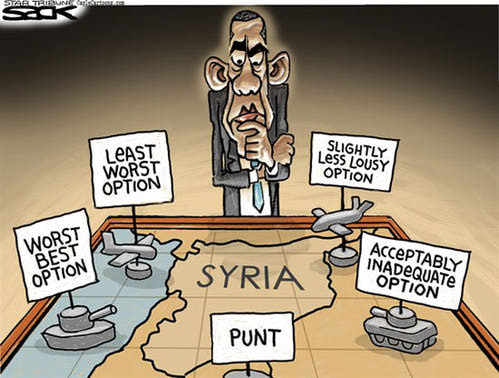
Syria War Room, by Steve Sack
Good Morning!!
I don’t know about you, but I really missed JJ’s Friday Night Lite post last night, so I thought I’d start out Sky Dancing’s Saturday with some political cartoons. I hope you enjoy these — courtesy of Cagle Post.
A few more on Syria:
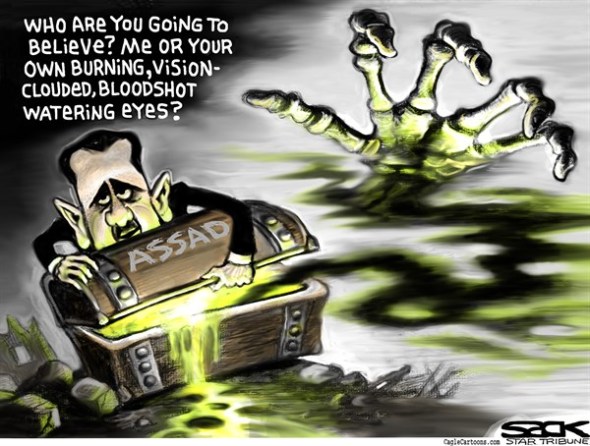
Assad Chemicals by Steve Sack
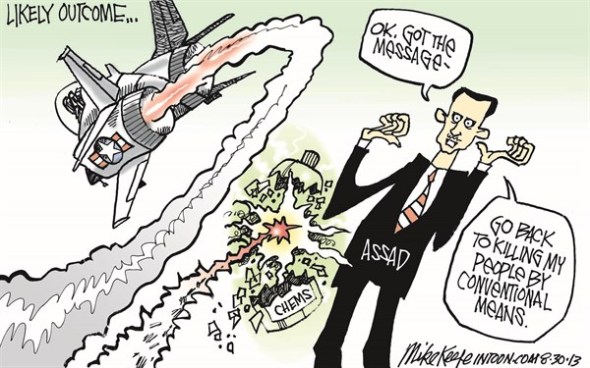
Assad Chemical Weapons, by Mike Keefe
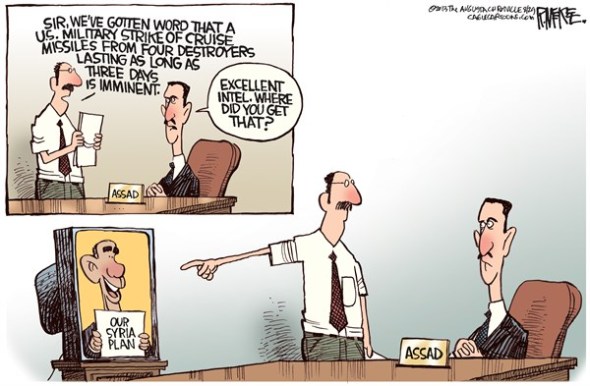
Syria Plan by Rick McKee
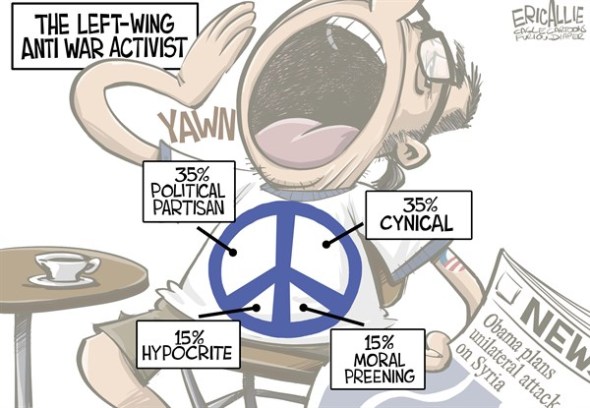
The Anti-War Left by Eric Allie
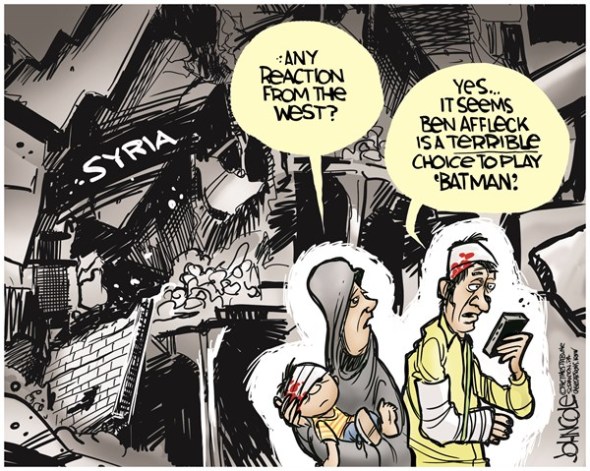
Syria and Affleck by John Cole
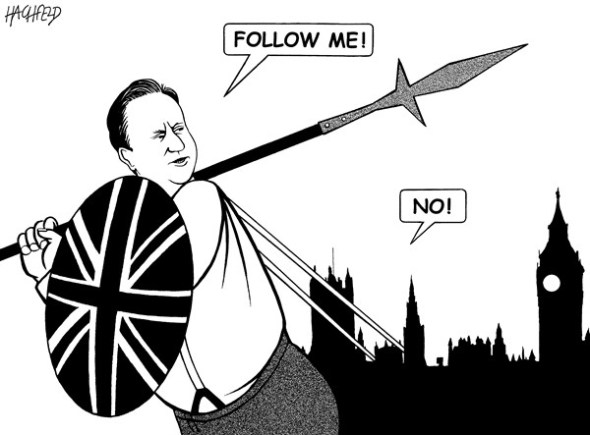
Cameron’s Failure, by Rainer Hatchfeld
March on Washington 50th Anniversary:
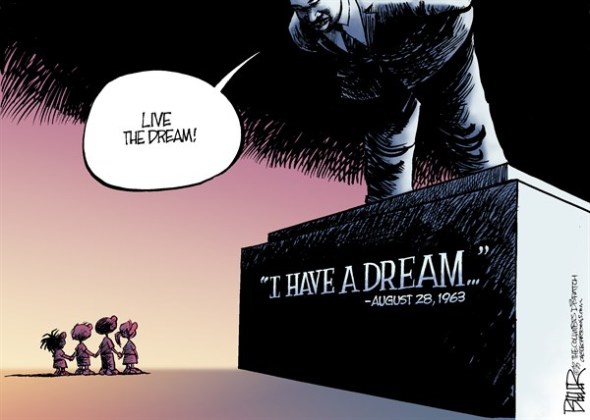
I Have A Dream Anniversary, by Nate Beeler
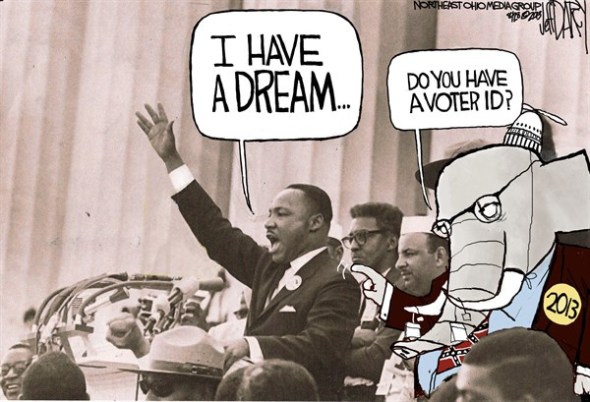
MLK Nightmare by Jeff Darcy
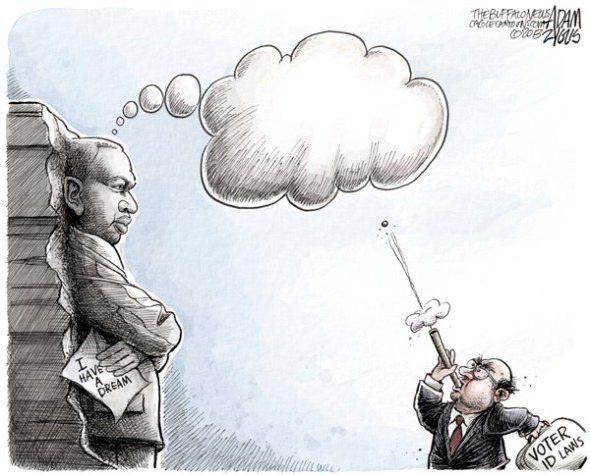
Dreamer, by Adam Zyglis
Labor Day and Income Inequality
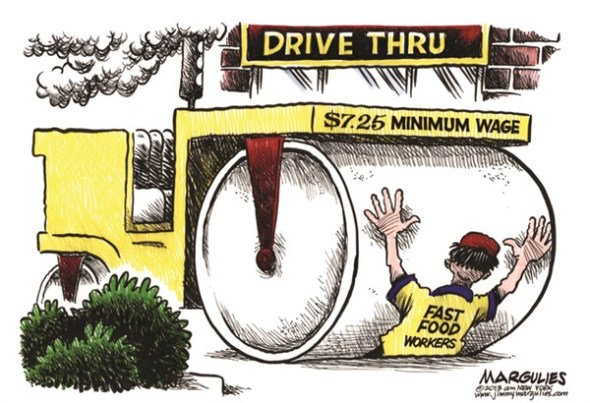
Fast Food Minimum Wage, by Jimmy Margulies
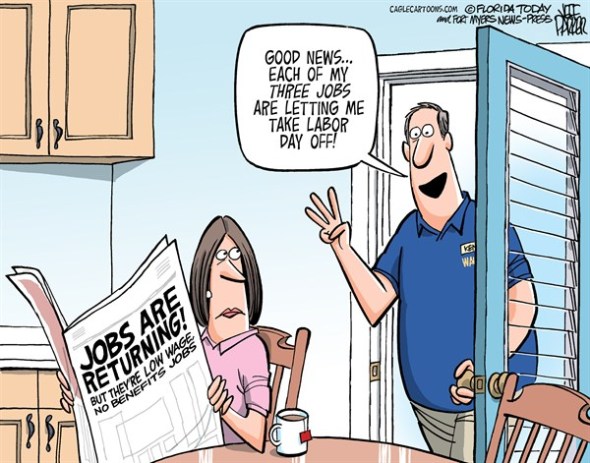
Labor Day Jobs, by Jeff Parker
NFL Concussion Lawsuit
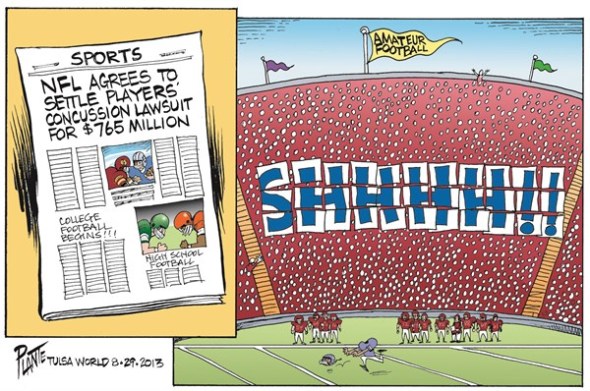
NFL Concussion Lawsuit, by Bruce Plante
Immigration Reform
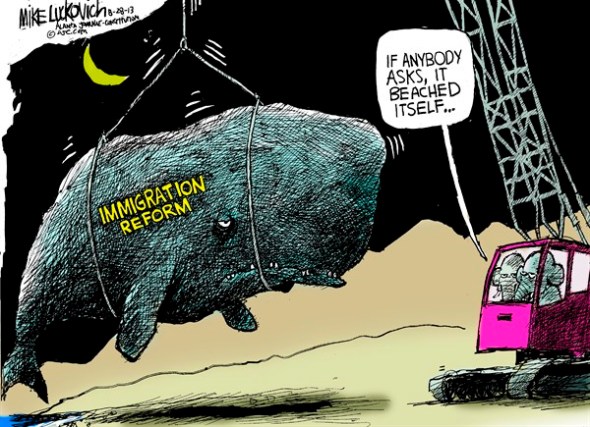
Immigration Reform, by Mike Lukovich
I hope everyone has a wonderful Labor Day weekend!! And if you’re not out on the beach or doing something else more exciting, please post links to the stories you’re following today in the comment thread.
Friday Reads
Posted: August 30, 2013 Filed under: morning reads, open thread, Republican politics, U.S. Economy, U.S. Politics | Tags: Burger King, Eric Cantor, fast food workers' strike, fund-raising, GLBT rights, hurricane katrina, IRS, John Boehner, living wage, lobbying, McDonald's, New Orleans, North Dakota, Rush Limbaugh, same-sex marriage 27 Comments
Good Morning!!!
Since it’s the beginning of the Labor Day weekend, I thought I’d start out with some Labor News. There are so many jobs these days that don’t really pay a living wage in the US that it’s really astounding. Fast Food Workers are among the lowest paid in the country.
Fast-food workers went on strike and protested outside McDonald’s, Burger King and other restaurants in 60 U.S. cities on Thursday, in the largest protest of an almost year-long campaign to raise service sector wages.
Rallies were held in cities from New York to Oakland and stretched into the South, historically difficult territory for organized labor.
The striking workers say they want to unionize without retaliation in order to collectively bargain for a “living wage.”
They are demanding $15 an hour, more than twice the federal minimum of $7.25. The median wage for front-line fast-food workers is $8.94 per hour, according to an analysis of government data by the National Employment Law Project (NELP), an advocacy group for lower-wage workers.
“It’s almost impossible to get by (alone),” said McDonald’s worker Rita Jennings, 37, who was among about 100 protesters who marched in downtown Detroit Thursday. “You have to live with somebody to make it.”
Rush Limbaugh was all agog and demagogue about the striking workers
LIMBAUGH: If you want a “living wage,” if you don’t like what fast food restaurants pay, then do something else. It’s just that simple. Go to a trade school. Go to another business. Start your own business. Maybe the work that you are capable of isn’t yet worth $15 an hour at a fast-food restaurant. Maybe the consumer doesn’t want to pay $10 for a Big Mac so that people working at McDonald’s make $15 an hour. It’s not just a one-way strata.
You don’t just sit there and double what the employees at McDonald’s make and keep the prices the same. Now, you may think this is obvious, folks, and you may think, “Come on, Rush,” you’d be amazed at how many people do not understand the push-pull in economics. You’d be amazed at the number of people who have taken economics courses who think that the truth about headaches is that the boss is a cheap skinflint and wants his employees to starve and wants to screw his customers.
That’s the basis of their understanding, and they go from there, and they are applauded by left-wing Democrat politicians for holding that belief, and they’re encouraged to have it. Now, to those of you who, like Sean from San Diego, are sympathetic to this demand for the minimum wage at Mickey D’s to go from $7.15 or $7.25 an hour to $15, let me ask you this: When you buy a meal, do you make sure that you’re paying a fair price for it?
When you walk in there, do you ask the employee, “Look, am I paying enough here so that you can get a livable wage? When you go in and buy a Big Mac or a Quarter Pounder with cheese or a double Quarter Pounder with cheese, do you look at the price is and say, “Are you sure that this costs enough that you can make a livable wage?” Or do you just get a little upset when you think it’s a little too expensive?
Limbaugh was lecturing fast workers on getting a better job as he sat in his mansion with no clue what it is like to work and survive on minimum wage. Limbaugh’s lecture was centered around a couple of the Republicans favorite falsehoods. Rush was pretending that there are better jobs out there for minimum wage workers.
Some happy news for married GLBT workers! The IRS and the US Treasury will recognize your marriage. You get the standard marriage deduction!!
The U.S. Department of the Treasury and the Internal Revenue Service (IRS) today ruled that same-sex couples, legally married in jurisdictions that recognize their marriages, will be treated as married for federal tax purposes. The ruling applies regardless of whether the couple lives in a jurisdiction that recognizes same-sex marriage or a jurisdiction that does not recognize same-sex marriage.
The ruling implements federal tax aspects of the June 26th Supreme Court decision invalidating a key provision of the 1996 Defense of Marriage Act.
“Today’s ruling provides certainty and clear, coherent tax filing guidance for all legally married same-sex couples nationwide. It provides access to benefits, responsibilities and protections under federal tax law that all Americans deserve,” said Secretary Jacob J. Lew. “This ruling also assures legally married same-sex couples that they can move freely throughout the country knowing that their federal filing status will not change.”
Under the ruling, same sex couples will be treated as married for all federal tax purposes, including income and gift and estate taxes. The ruling applies to all federal tax provisions where marriage is a factor, including filing status, claiming personal and dependency exemptions, taking the standard deduction, employee benefits, contributing to an IRA, and claiming the earned income tax credit or child tax credit.
I joined the Sisterhood of the Pink Shoes this weekend. Meanwhile, the real sister with the pink shoes is doing really well in the fundraising arena.
In the six weeks following her headline-grabbing filibuster, Wendy Davis raised $1.2 million — nearly 40 percent of it from outside Texas. Davis drew national attention following the filibuster against an abortion-restriction bill that helped shut down the Texas Senate and prompted Gov. Rick Perry to call lawmakers back into another special session. In the wake of Davis’ new-found fame, Davis has been urged by some Democrats to run for governor next year. She says she will announce her political plans — whether to run for reelection as a senator from Fort Worth or as a Democrat for governor — in a few weeks.
Martin Luther King was fighting for working folks when he was assassinated. We’ve already said that no Republicans showed up to commemorate the March on Washington. Where were they?
So what was did they do instead? Well, Boehner was in Jackson Hole, Wyo., and had no public events scheduled, but he has been headlining GOP fundraisers all this month, so it’s a fairly safe to assume that he was raising cash at the time. Cantor, meanwhile was touring an oil field in North Dakota. The Grand Forks Herald reports:
Cantor, hosted by Rep. Kevin Cramer, R-N.D., met with energy industry and community leaders at a crew camp in Williston, toured a drilling site and other oilfield locations in the Bakken and met with North Dakota Petroleum Council members in Watford City.
Cantor praised North Dakota’s approach to energy development and said the country needs to follow the state’s example and adopt a national energy policy.
“I hope to be able to tell the president that there’s a lot for him to learn here as far as energy production here in America,” Cantor said. “North Dakota seems to have gotten it right.”
The North Dakota Petroleum Council, by the way, is a lobby group that represents the state’s oil and gas industry. That’s what Cantor was doing on the day of the march.
Here’s a little bit of News on New Orleans 8 years after Katrina.
Now optimism is rising as a rebounding city approaches the 300th anniversary of its 1718 founding.
“The city is a much better place than it was eight years ago. The biggest challenge we have is blight,” Landrieu said, adding that 10,000 blighted properties have been removed from the cityscape.
A thriving downtown and newly vibrant neighborhoods contrast starkly with the city’s appearance eight years ago. When Katrina hit, thousands of people who couldn’t escape New Orleans in time were trapped in homes as levees broke and floodwaters rose. Helicopters plucked the desperate from rooftops as chaos spread. The damaged Superdome became a refuge of misery for thousands as tempatures and tempers soared.
Days afterward then-President George W. Bush promised the nation’s full attention. But federal authorities were sharply criticized for their early response and local and state authorities as well. And though billions of federal dollars have helped to rebuild a strengthened levee system, many locals remain bitter with the Army Corps of Engineers for the failure of the levees.
Landrieu said he’s intent on moving forward.
“I think that we have successfully done the most important thing, which was to think about building the city back the way she should have always been and not the way she was,” he said.
Landrieu said rebuilding has even meant re-organizing government operations, streamlining finances, curbing waste and fraud and reorganizing the city’s education system – even adding new fire and police stations, parks and libraries.
The weird thing about the blight is that it’s in areas that you wouldn’t necessarily expect to have ramshackled buildings and over grown lots. Every time I go from my home near the Mississippi River towards the Lake I see blight on the way. It pops up in the newer suburban areas as well as older neighborhoods. There are still a lot of eye sores and it appears it’s going to take a long time for many of them to be torn down or restored. Thankfully, the historic parts of the city appear to be well on the mend. Unfortunately, the infrastructure is so gone in many areas that the blight will remain for some time.
That’s my offering today! What’s on your reading and blogging list?
Thursday Reads: Civil Rights Struggle, Syria Intervention, NYPD Spying, Boston Bombing, and “League of Denial”
Posted: August 29, 2013 Filed under: Foreign Affairs, morning reads, Republican politics, U.S. Politics | Tags: Boston Bombings, chemical weapons, Civil Rights Movement, concussions, Dzhokhar Tsarnaev, Eric Cantor, ESPN, John Boehner, John F. Kennedy, John Odom, Julian Bond, Martin Luther King, NFL, NYPD, PBS Frontline, police photography, Prime Minister David Cameron, Rep. John Lewis, traumatic brain injury, We Shall Overcome 19 Comments
Good Morning!!
I’ve got so much news for you this morning, I don’t know if I’ll have room in a reasonable-length post, so I’ll get right to it. I’ll begin with some stories on yesterday’s 50th anniversary of the March On Washington.
PBS had an amazing interview with Rep John Lewis in which he recounted his memories of that day in 1963 and the speech he gave as a youthful leader in the Civil Rights Movement: ‘I Felt That We Had to Be Tough’: John Lewis Remembers the March on Washington. I hope you’ll read the whole thing, but here’s a brief excerpt:
REP. JOHN LEWIS, D-Ga.: On that day, I was blessed.
I felt like I had been tracked down by some force or some spirit. I will never forget when A. Philip Randolph said, “I now present to you young John Lewis, the national chairman of the Student Nonviolent Coordinating Committee.”
And I went to the podium. I looked to my right. I saw many, many young people, staffers from the Student Nonviolent Coordinating Committee, volunteers. Then I looked to my left. I saw all these young people up in the trees, trying to get a better view of the podium.
Then I looked straight ahead. And I saw so many people with their feet in the water trying to cool off. And then I said to myself, this is it, and I went for it.
On meeting with President Kennedy before the March, and how the podium and the crowd came to be so diverse:
He [JFK] didn’t like the idea of a March on Washington.
When we met with him, A. Philip Randolph spoke up in his baritone voice we met with the president. And he said, “Mr. President, the black masses are restless. And we are going to march on Washington.”
And you could tell by the movement of President Kennedy — he started moving and twisting in his chair. And he said, in effect, that if you bring all these people to Washington, won’t it be violence and chaos and disorder?
Mr. Randolph responded and said, “Mr. President, there’s been orderly, peaceful, nonviolent protests.”
And President Kennedy said, in so many words, I think we are going to have problems. So we left that meeting with President Kennedy. We came out on the lawn at the White House and spoke to the media and said, we had a meaningful and productive meeting with the president of the United States. And we told him we’re going to March on Washington.
And a few days later, July 2, 1963, the six of us met in New York City at the old Roosevelt Hotel. And in that meeting, we made a decision to invite four major white religious and labor leaders to join us in issuing the call for the March on Washington.
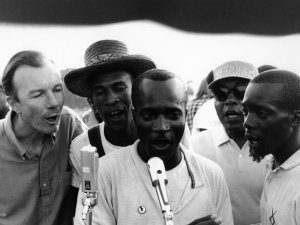
American folk singer and activist Pete Seeger (left) adopted and helped popularize “We Shall Overcome” by teaching the song at rallies and protests. Here he sings with activists in Greenwood, Miss., in 1963. (NPR)
NPR had a wonderful story yesterday about the history of the Civil Rights Movement’s signature song: The Inspiring Force Of ‘We Shall Overcome’.
It is not a marching song. It is not necessarily defiant. It is a promise: “We shall overcome someday. Deep in my heart, I do believe.”
It has been a civil rights song for 50 years now, heard not just in the U.S. but in North Korea, in Beirut, in Tiananmen Square, in South Africa’s Soweto Township. But “We Shall Overcome” began as a folk song, a work song. Slaves in the fields would sing, ‘I’ll be all right someday.’ It became known in the churches. A Methodist minister, Charles Albert Tindley, published a version in 1901: “I’ll Overcome Someday.”
The first political use came in 1945 in Charleston, S.C. There was a strike against the American Tobacco Co. The workers wanted a raise; they were making 45 cents an hour. They marched and sang together on the picket line, “We will overcome, and we will win our rights someday.”
There’s much more about how the song was passed from group to group and changed over time. Please give it a listen–it’s only about 8 minutes long, but really fascinating.
Not a single Republican appeared at yesterday’s commemoration of the March on Washington and Martin Luther King’s “I Have A Dream” speech. George W. Bush and his father George H.W. Bush couldn’t come because of health issues, but John Boehner and Eric Cantor are presumably in good health, but they refused offers to make speeches at the event, according to Roll Call.
That wasn’t a wise choice, said Julian Bond, a renowned civil rights activist, in an interview with MSNBC on Wednesday afternoon.
“What’s really telling, I think, is the podium behind me, just count at the end of the day how many Republicans will be there,” Bond told news anchor Alex Wagner. “They asked senior President Bush to come, he was ill. They asked junior Bush, he said he had to stay with his father.
“They asked a long list of Republicans to come,” Bond continued, “and to a man and woman they said ‘no.’ And that they would turn their backs on this event was telling of them, and the fact that they seem to want to get black votes, they’re not gonna get ‘em this way.” [….]
Cantor’s decision to turn down the invitation to speak is especially striking given his stated commitment to passing a rewrite of the Voting Rights Act in the 113th Congress, and the many opportunities he has taken over the past several weeks to publicly reflect on the experience of traveling with Rep. John Lewis, D-Ga., to Selma, Ala.
Sadly, Dr. King’s dream of peace has not made much progress in the past 50 years. And now the U.S. and its allies are considering another military intervention–in Syria.
Fortunately, the UK is now hesitating. NYT: Britain to Wait on Weapons Report Ahead of Syria Strikes.
Prime Minister David Cameron of Britain, who runs a coalition government, is facing political difficulties from legislators mindful of the experience in Iraq, when assurances from Prime Minister Tony Blair and President George W. Bush that Saddam Hussein had weapons of mass destruction proved inaccurate and a false pretext for war.
Mr. Cameron bowed on Wednesday to pressure from the opposition Labour Party and to some within his own coalition who want to allow United Nations weapons inspectors a chance to report their findings and for the United Nations Security Council to make one more effort to give a more solid legal backing to military action against Damascus.
At BBC News, Nick Robinson explains why Cameron “buckled.”
If you think that NSA domestic spying is invasive, you should take a look at what the NYPD has been up to since 9/11. Matt Apuzzo and Adam Goldman of the AP have a new book out called Enemies Within: Inside the NYPD’s Secret Spying Unit and bin Laden’s Final Plot Against America. There’s an excerpt at New York Magazine: The NYPD Division of Un-American Activities. It’s long, but a very important story. Please give it a read if you can.
Yesterday Apuzzo and Goldman published a related shocking story at AP: NYPD designates mosques as terrorism organizations.
The New York Police Department has secretly labeled entire mosques as terrorist organizations, a designation that allows police to use informants to record sermons and spy on imams, often without specific evidence of criminal wrongdoing.
Designating an entire mosque as a terrorism enterprise means that anyone who attends prayer services there is a potential subject of an investigation and fair game for surveillance.
Since the 9/11 attacks, the NYPD has opened at least a dozen “terrorism enterprise investigations” into mosques, according to interviews and confidential police documents. The TEI, as it is known, is a police tool intended to help investigate terrorist cells and the like.
Many TEIs stretch for years, allowing surveillance to continue even though the NYPD has never criminally charged a mosque or Islamic organization with operating as a terrorism enterprise.
The documents show in detail how, in its hunt for terrorists, the NYPD investigated countless innocent New York Muslims and put information about them in secret police files. As a tactic, opening an enterprise investigation on a mosque is so potentially invasive that while the NYPD conducted at least a dozen, the FBI never did one, according to interviews with federal law enforcement officials.

Boston Magazine has published more photos from “Behind the Scenes of The Hunt for Dzhokhar Tsarnaev.” Above is a photo of Tsarnaev exiting the boat in which he hid for hours as law enforcement searched all over Watertown for him. See more photos at the link.
In more hopeful news, one long-hospitalized survivor of the bombings was given the go-ahead to return home to California yesterday: Boston Marathon bomb survivor John Odom set to return home to Torrance (Daily Breeze News).
Nearly five months after a bomb almost took his life at the Boston Marathon, John Odom of Torrance was cleared by doctors on Wednesday to finally come home.
Odom’s wife, Karen, who has never left her husband’s side, has been chronicling her husband’s long recovery on Facebook, called it a “monumental” day.
“It’s official, John is released to go home!!!” she posted on the John Odom Support Page. “Although his recovery is nowhere near complete, there is no medical or physical reason he can’t fly home and continue his recovery in California. We are hoping to be home the end of next week, a few days shy of 5 months since we left on that now famous 4 day trip.”
“Famous” is one way to put it. The couple could have never imagined the journey they’ve been on since April 15.
Read the rest of this moving story at the link.
On October 8th and 15th, NPR’s Frontline plans to show League of Denial, “a two-part two-part investigation examining whether — as thousands of former players allege — the NFL has covered up the risks of football on the brain.” The documentary has so far been produced in partnership with ESPN, but last week the sports channel backed out of the collaboration presumably because of pressure from the NFL. From The New Republic: ESPN Quit Its Concussions Investigation With ‘Frontline’ Under Curious Circumstances.
“Frontline,” the prestigious, multiple-Emmy-winning investigative news show produced by Boston’s PBS member station, announced late Thursday afternoon that a 15-month-old partnership with ESPN in which they published a series of pieces exploring how the National Football League has (and has not) accounted for the relationship between playing football, head trauma, and brain damage, had come to an end. Dating back to last November, “Frontline” had run articles on its site featuring the work of Steve Fainaru and Mark Fainaru-Wada, ESPN staffers (and brothers) even as these articles appeared at espn.com and as the brothers did segments for ESPN’s award-winning investigative series “Outside the Lines.” The end result—in addition to abook that the brothers are publishing in October—was to be a “Frontline” documentary, League of Denial (also the book’s title).
According to “Frontline,” the documentary will premiere this season on October 8 and 15, but, “from now on, at ESPN’s request, we will no longer use their logos and collaboration credit on these sites and on our upcoming film.” Executive producer David Fanning and deputy executive producer Raney Aronson expressed their “regret” and credited ESPN with “a productive partnership.” They added, “The film is still being edited and has not been seen by ESPN news executives, although we were on schedule to share it with them for their editorial input.”
Aronson told me late Thursday that ESPN contacted “Frontline” last Friday to request that it remove ESPN’s logo from its website, citing the technicality that it was a “trademark issue.” It wasn’t until Monday, after the latest collaboration was published on “Frontline”’s website and aired on “OTL,” that ESPN also requested that language describing collaboration not be used, and that it became clear the collaboration itself was coming to an end.
The circumstances are indeed mysterious. Perhaps it was over-cautiousness on ESPN’s part or perhaps indirect pressure from the League. If you’re interested in this important story, go read Marc Tracy’s piece at TNR.
A couple more useful links on this story:
PBS: Questions Over NFL Doctor Cloud League’s Concussion Case
Bill Littlefield at NPR’s Only a Game: ESPN And Frontline Part Ways Over ‘League Of Denial’
The authors of the book League of Denial will continue their involvement with the Frontline presentation.

 peej
peej Carissa
 bostonboomer
 dakinikat
 ecocatwoman
 mablue2
 Mama Lopez
 peggysue22
 quixote
 skydancingguestblogger
 Mona (aka Wonk the Vote)



 Sky Dancing
Recent Comments