
Time for Governor Goodhair to Go
Posted: January 17, 2012 Filed under: Foreign Affairs, Republican politics, Republican presidential politics | Tags: Republican Nuts, Rick Perry, Turkey 26 Comments I’m having a difficult time understanding why Rick Perry is still allowed into the debates. He’s shown himself to be pretty damned ignorant on a lot of things. Plus, he shoots his mouth off with gusto. I think you might remember his comments on Fed Chair Bernanke. Back in August, he implied that the central banker was guilty of treason and was basically “treacherous”. He’s also had the “oops” moment when he forget which government agencies he’d eliminate. Then, there were the giddy moments and the sleepy moments. Rick Perry is what we’d call a horse’s patoot where I come from.
Rick Perry’s antics have just gone international. He has truly earned a top place in the annals of stupidity.
Turkey’s foreign ministry condemned Texas Gov. Rick Perry Tuesday for saying that Turkey was a “country that is being ruled by what many would perceive to be Islamic terrorists.”
Perry made the statement during a spirited debated between Republican presidential candidates in South Carolina Monday night.
Most of Turkey was fast asleep during the live broadcast, and Turkish newspapers had already gone to print by the time Perry declared that Turkey had moved “far away from the country I lived in back in the 1970s United States Air Force. That was our ally that worked with us, but today we don’t see that.”
The Texas governor also argued that it was time for Washington to cut foreign aid to Ankara.
A spokesman for Turkey’s foreign ministry fired back Tuesday, accusing Perry of making “baseless and improper claims.”
In a statement e-mailed to CNN, Selcuk Unal said presidential candidates should “be more informed about the world and be more careful their statements.”
Turkey is a member of NATO and as such is our ally. They play a key role in our anti-ballistic missile defense that shields many of our allies from Irani attacks. I just had to love this official Turkish statement.
While the United States recently deployed four Predator drones to Turkey from Iraq to aid Ankara in its fight against the autonomy-seeking Kurdish rebels, Turkey does not receive U.S. foreign aid.
The Turkish statement said Turkey’s leaders were “personalities respected not only in the United States, but in our region and in the world and whose opinions are strongly relied on.”
The Turkish statement said Perry’s low standings in polls were proof that the Republicans in the U.S. do not endorse his opinions.
“Figures who are candidates for positions that require responsibility, such as the U.S. presidency, should be more knowledgeable about the world and exert more care with their statement,” the Turkish statement said.
The Turkish ambassador to Washington, Namik Tan, said: “We do hope this episode in last night’s debate leads to a better informed foreign policy discussion among the Republican Party candidates, one where long-standing allies are treated with respect not disdain.”
All he needs to do is announce that he can see Turkey from his front porch and I’d think this was an SNL skit.
Friday Reads: A Brainy Break from the Village
Posted: January 13, 2012 Filed under: Economy, Egypt, Elections, Foreign Affairs, health hazard, Labor unions, morning reads, psychology 18 Comments Good Morning!
I thought I would treat you to some academics this morning starting with two well known economists and their thoughts on 2012. I figured we needed a break from the primary season insanity. First up is Nobel Prize Winner Joseph Stiglitz on “The Perils of 2012”. The next two offerings are from Project Syndicate.
This year is set to be even worse. It is possible, of course, that the United States will solve its political problems and finally adopt the stimulus measures that it needs to bring down unemployment to 6% or 7% (the pre-crisis level of 4% or 5% is too much to hope for). But this is as unlikely as it is that Europe will figure out that austerity alone will not solve its problems. On the contrary, austerity will only exacerbate the economic slowdown. Without growth, the debt crisis – and the euro crisis – will only worsen. And the long crisis that began with the collapse of the housing bubble in 2007 and the subsequent recession will continue.
Moreover, the major emerging-market countries, which steered successfully through the storms of 2008 and 2009, may not cope as well with the problems looming on the horizon. Brazil’s growth has already stalled, fueling anxiety among its neighbors in Latin America.
Meanwhile, long-term problems – including climate change and other environmental threats, and increasing inequality in most countries around the world – have not gone away. Some have grown more severe. For example, high unemployment has depressed wages and increased poverty.
While that was what appeared to be Dr. Gloom, here is Doctor Doom. Dr. Nourielle Roubini writes that the global economy will be “Fragile and Unbalanced in 2012”.
Private- and public-sector deleveraging in the advanced economies has barely begun, with balance sheets of households, banks and financial institutions, and local and central governments still strained. Only the high-grade corporate sector has improved. But, with so many persistent tail risks and global uncertainties weighing on final demand, and with excess capacity remaining high, owing to past over-investment in real estate in many countries and China’s surge in manufacturing investment in recent years, these companies’ capital spending and hiring have remained muted.
Rising inequality – owing partly to job-slashing corporate restructuring – is reducing aggregate demand further, because households, poorer individuals, and labor-income earners have a higher marginal propensity to spend than corporations, richer households, and capital-income earners. Moreover, as inequality fuels popular protest around the world, social and political instability could pose an additional risk to economic performance.
Oops, I mentioned income inequality. I must hate capitalism and be a collectivist. Right? Absolutely not! After studying markets for as long as I have–and teaching others about them–I have a pretty good understanding about how they work and it’s not based on wishful thinking or trying to hide the woefully low amount of taxes I pay. Oh, and I betcha that my dad created more jobs in his life time than Willard ever did. I also know that income inequality is bad for every one and that includes the superrich. That’s why it’s good to ask “Why is Inequality Higher in America?”‘ Henry Farrell of GW–professor of political science–breaks down a study in a series of two articles. The study looks at the increasing use of veto power by Senators and finds that problems happen as you increase the number of players with the ability to block laws.
Linz and Stepan argue that high numbers of electoral veto players are highly correlated with inequality, and that studies of other systems (Australia, Switzerland) suggests that more veto players create greater lags in introducing welfare systems and block reform (interestingly though, these cases involve referendums as a block to legislation rather than the kinds of vetos seen at the federal level in the US). However, they also claim that veto points are not destiny – the experience of reform in Brazil argues that Barack Obama could have instituted Senate reform and hence reduced down the effective number of veto players from four to one.
The original essay can be found at Cambridge Journals but the authors have published books on the topic as well. The authors research is mostly in the area of countries transitioning to Democracies. The Atlantic published an essay of theirs called “How Egypt Can Make Democracy Work” last February.
Regardless of who leads it, there are some things an interim government should not do. Judging by the transitions that we have studied, a successful democratic outcome stands the best chance if the interim government does not succumb to the temptation to extend its mandate or write a new constitution itself. The interim government’s key political task should be to organize free and fair elections, making only those constitutional changes needed to conduct them. Writing a new constitution is best left to the incoming, popularly elected parliament.
Most activists and commentators are now asking who will or should become the next president. But why assume that a presidential political system, headed by a powerful unitary executive, will be instituted? Of the eight post-communist countries in the European Union, not one chose such a system. All of them established some form of parliamentary system, in which the government is directly accountable to the legislature and the president’s powers are limited — and often largely ceremonial.
That was a wise decision. A presidential election at a moment of great uncertainty, and in the absence of experienced democratic parties or broadly accepted leaders, is filled with danger.
Archeologists are examining an interesting time in American history for clues of America’s largest labor conflict between miners and coal mine owners. An unlikely coalition of people are trying to stop clear mining–and hence destruction–of the site. This article can be found in Archaeology Today.
The archaeology on the mountain, and the story it is beginning to tell, has helped bring together an unusual coalition—including the Sierra Club, the United Mine Workers of America (UMWA), the National Trust for Historic Preservation, and a number of local organizations—in what some are calling “The Second Battle of Blair Mountain.” It is certainly a fight over historic preservation, but for many involved, including local archaeologists and historians, the mountain is symbolic of much more—labor struggle, the social effects of resource extraction industries, and what they see as a century-long class conflict. The mountain’s loss to surface mining, they assert, would be personal, a major blow to Appalachian identity.
Coal mining has always been one of the most dangerous and difficult jobs, and the late nineteenth century in the southern coalfields saw it at its worst. There were few safety regulations for workers—undocumented European immigrants, African Americans, and poor Scots-Irish hill folk—and every aspect of their lives was controlled by their employers. They lived in company towns, bought their own equipment at company stores, and listened to company-approved sermons in company churches. As labor movements picked up elsewhere, even in coal regions to the north, they seemed to pass the southern coalfields by.
Nature reports on the attempts to tighten the use of antibiotics on farm animals. Just like humans, animals and their diseases are showing an increased resistance to the current medicines. A new rule will go into effect in April to try to slow down the trend towards increased resistance. The EU already has stricter rules in place.
In industrial farming, antimicrobials are commonly given to farm animals to treat infections, and prophylactically to prevent disease or spur growth. But there is growing concern that excessive use on farms is helping to breed antibiotic-resistant microbes, from Salmonella (see ‘Rising resistance’) to Escherichia coli, which are harder to treat when they infect people.
The US Food and Drug Administration (FDA) is now moving to protect key antibiotics known as cephalosporins, which are used in humans to treat a range of infections, including pneumonia. On 4 January, the agency said that it would prohibit certain uses of cephalosporins in farm animals including cattle, pigs, chickens and turkeys, because overuse of the drugs is “likely to contribute to cephalosporin-resistant strains of certain bacterial pathogens”. If cephalosporins become ineffective in treating human diseases, the FDA said, “doctors may have to use drugs that are not as effective, or that have greater side effects”.The new rules, to come into effect on 5 April, restrict veterinary surgeons to using the two cephalosporin drugs specifically approved for food-producing animals — ceftiofur and cephapirin — and ban prophylactic use. In animals not listed in the FDA order, such as ducks or rabbits, vets will have more discretion to use the drugs.
Most antibiotic classes are used both in animals and in humans, so the FDA is also considering tightening controls on all classes of antimicrobials used on farms. It is reviewing comments on rules that would prohibit the use of any antimicrobial drug to promote animal growth, a move that would be welcomed by many vets. “We would support greater veterinary oversight of antimicrobial drugs,” says Christine Hoang, assistant director of scientific activities at the American Veterinary Medical Association in Schaumburg, Illinois.
Psychology Today has some interesting information on Deadly Mind Traps. Dr. Boomer knows these as cognitive errors. Most of us call them self-defeating behaviors.
Intriguingly, research into this kind of self-defeating behavior shows that it is usually far from random. When we make mistakes, we tend to make them in ways that cluster under a few categories of screwup. There’s a method to our mindlessness. Most of the time, we’re on autopilot, relying on habit and time-saving rules of thumb known as heuristics.
For the most part, these rules work just fine, and when they don’t, the penalty is nothing worse than a scraped knee or a bruised ego. But when the stakes are higher, when a career is in jeopardy or a life is on the line, they can lead us into mental traps from which there is no escape. One slipup leads to another, and to another, in an ever-worsening spiral. The pressure ratchets up, and our ability to make sound decisions withers.
These cognitive errors are most dangerous in a potentially lethal environment like the wilderness or the cockpit of an aircraft, but versions of them can crop up in everyday life, too, such as when making decisions about what to eat, whom to date, or how to invest. The best defense? Just knowing they exist. When you recognize yourself starting to glide into one of these mind traps, stop, take a breath, and turn on your rational brain.
There’s a list of the classic errors and explanations in case you want to check it out. Turning on your rational brain sounds like something the Republican presidential wannabes should do right now. I think it would surprise every one, don’t you?
So, that’s your brainy break from the mainstream media. What’s on your reading and blogging list today?
Women Front and Center in MENA Protests
Posted: December 22, 2011 Filed under: Bahrain, Egypt, Foreign Affairs, Tunisia, Violence against women, Women's Rights | Tags: women fighting fundamentalist religions, women in democracy protests, Women's Rights 4 Comments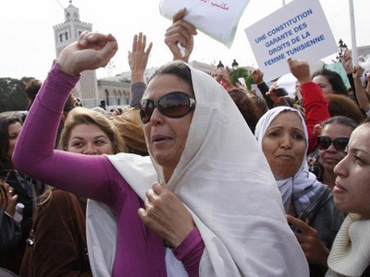 Many cultures in the MENA region are well-known for their horrible treatment of women. We see practices like honor killings, genital mutilation, and taking child brides. One of the offshoots of the Arab Spring has been the central role of women looking for broader participation in their countries.
Just as we in the United States are experiencing a political/fundamentalist Christian backlash that has turned into a war on the rights of women, the protests movements associated with the Jasmine Revolutions and their related political change have brought out a wave of political/fundamentalist Muslim backlash. There are several signs of hope in a region experiencing lots of social unrest. First, we’ve become aware of a large number of feminist leaders. Second, we’ve seen that many women are putting their lives on the line to ensure that the social change includes improving the lives and status of women. While oppression of women is frequently attached to fundamentalist religious followers, the roles of traditional tribal cultures and their dominance in places that are underdeveloped and rural–like Alabama or Uganda–cannot be underestimated. Here’s some stories that have made headlines recently that show the global struggle for women’s rights–like the US struggle for women’s rights–is still an uphill battle.
In response, thousands of women — and men — marched Tuesday in Cairo’s Tahrir Square. Observers say it was the largest demonstration of women in Egypt in decades. Not since 1919, when women mobilized under the leadership of feminist Hoda Sha’rawi in anti-colonial demonstrations against the British have so many Egyptian women taken to the streets. (After representing Egyptian women at the International Women Suffrage Alliance in Rome in 1923, Sha’rawi returned to Cairo and very publicly removed her veil.)
Women have played an important role in Egypt’s modern revolution but have struggled to translate their activism into a political role in the new, emerging system. They have been excluded from important decision-making bodies, and the military leadership declined to continue a Mubarak-era quota for women that ensured them at least 64 seats in parliament. Based on early election results, it appears that few women will win a place in the new government.
Nevertheless, one intrepid woman, Bothaina Kamel, is breaking ground with her candidacy for president. The campaign of Kamel, a well-known television presenter, at first was shocking, and certainly quixotic, with polls indicating her support is less than 1%. But her persistence has gained her credibility. While she has little chance of winning, she is helping to normalize the idea of women in politics — an idea that is deeply contested in Egyptian society. Leaders of Salafi parties, which gained a surprising 20% of the vote in the first rounds of elections, have spoken out against women running for office.
The recent women’s protest may breathe life into a movement that desperately needs new energy. In the early weeks of the revolution, women activists tried to bring attention to women’s issues but never succeeded in getting the masses behind them.
Tunisian women are also concerned about women’s rights since the country’s recent elections. The picture up top is from that country. Newly elected leaders have had to promise to recommit their country to modernization and democratic principals that include increased roles of women.
“We are all the women of Tunisia,” stated Professor Khalid Kshir of Tunis University in conversation with the author of this article. Professor Kshir is a member of the Democratic Modernist Pole, a coalition of leftist parties. He fears that the Ennahda party will push the country back instead of moving it forward.
Just a year ago, literally weeks before the start of the uprising in the country, Tunisians had joked that theirs was a country of free women and happy men. No other Arab nation had ever granted so many rights to women, fixed de jure and de facto, than Tunisia. That was something of which Tunisians were proud, and even boasted about. Today, many people in Tunisia fear that the country’s achievements on the road to becoming a modern society will be brought to nought.
”We need to focus all our efforts in the sphere of politics and culture on women’s rights, because women form half of our society and any infringement on their rights will be harmful to all of us,” Professor Kshir went on to say.
Strange as it may seem, the issue of women’s rights was also on the agenda of a conference on promoting tourism which took place in Tunisia early in November, shortly before the final election results were announced. The conference was organized by the Ennahda party, which decided not to wait for the National Constituent Assembly to convene and the government to be formed before holding a series of meetings with representatives of Tunisia’s major industries in order to lay out the priorities for getting the national economy out of its post-revolution stupor. The discussion on the prospects for yourism was among the first meetings to be held, along with a conference on the financial market, co-sponsored by Tunisia’s Brokers’ Association.
…
The party leader’s comforting assurance came in response to concerns expressed by travel agencies, tour operators, hoteliers and bankers at the meeting, who voiced questions such as, “What will be Tunisia’s international image following your electoral victory? What will happen to women’s rights? How will European tourists feel in Tunisia, and do they have a reason to fear Islamists?”
What started as a discussion on the prospects of tourism eventually escalated into a broader deliberation on Tunisia’s prospective path of development. There are strong reasons for such an interconnection: tourism accounts for six per cent of Tunisia’s GDP and makes up 60 per cent of the national trade deficit. The industry employs 12 per cent of the country’s working population, while one in eight Tunisian families live off tourism, one way or another. During the revolutionary turmoil which rocked the country between January and September 2011, tourism revenues in Tunisia plunged by 38.5 per cent compared to a similar period in 2010, while the overall number of tourists coming to Tunisia sank by 34.4 per cent.
That is why at present Ennahda is ready for dialogue and compromise. “We guarantee freedom in food, drink and clothes,” Hamadi Jebali said.
He emphasized that his party would respect democratic principles and that Tunisian society would retain its progressive nature. According to Jebali, the revolution took place in the name of improving the lives of Tunisian citizens and moving the country forward rather than hindering its development.
Many of those present at the conference believed the words of the Ennahda leader – or said that they did. “I believe Jebali. I am an optimist but only on condition that the rights of women won’t be violated and if we don’t follow the path of Saudi Arabia where a woman can do business but is forbidden to drive a car,” Sihem Zaiem, a member of the Federation of Tourist Agencies, said after the conference.
Delegates applauded her when she demanded that the Ennahda secretary-general explain Tunisia’s true face to the world as soon as possible, and demonstrate Islamists’ attitude to women’s rights. Jebali promised that nothing would change in the arena of women’s rights. His speech was very convincing.
A mother in Bahrain has gone to jail for playing revolutionary music and participating in protests.
Fadhila Al Mubarak, a 38-year-old mother of a 9-year-old boy, is still in jail after she was sentenced in an unfair military trial for charges related directly to exercising her right to freedom of expression and peaceful assembly. She was detained and prosecuted in a military court for playing revolutionary music in her car, trying to save her son and nieces, participating in peaceful protests in Pearl Roundabout and writing a poem to her son about the revolution, freedom and fighting for his future. The information available on the conditions of her detention is very worrying and her family has raised concerns over her health.
Fadhila, who was living with her husband and her son in the area of Aali, was arrested on 27 March 2011, just a few days after the National Safety Law was imposed on 15 March 2011. She was arrested at a checkpoint because there was an audio recording of revolutionary songs playing in her car. She was asked to pull over her car and step out. They insulted her, called her names and cursed her. While security officers at the checkpoint were talking to her, a man in civilian clothing tried to get into her car. In fear over the safety of the children, her son (9), nieces (14 – 15), she pulled him away thinking he was a thug who would kidnap or hurt them. Later, she found out he was a police officer.
Her family asked about her at police stations close to the checkpoint where she was arrested only to find out after four days that she was held in Riffa police station. She was later transferred to Isa Town women’s prison. During the period of her detention, her family had no contact with her and was not allowed to visit or talk to her over phone. Family members tried to appoint her a lawyer, a request that was rejected by the military court.
Women in the region can take heart from the post revolutionary experience of Indonesia’s women who have managed to get many advances since their repression by former president Soeharto following a 1965 tragedy. Indonesia is the world’s largest Muslim majority democracy. As with all countries, religious fundamentalists obsessed with old testament prohibitions continue to seek repression of women. However, Indonesian laws continue to reflect the country’s will to improve conditions for women. The current president seems to be backsliding on reforms gained during the tenure of Indonesia’s previous PM.
Of course, like the feminists have suggested, the Reform Era in 1998 has given women opportunities to revive the real spirit of Kartini. However, as Mariana suggested, the Reform Era was nothing but “a short-term honeymoon” moment for women’s movement.
When the late former president Abdurrahman Wahid changed the name of the ministry of women affairs into the ministry of women’s empowerment, for example, feminists felt very confident about their cause. In addition to that, the National Commission on Violence Against Women (Komnas Perempuan) was given full support to continue its investigation into the May 1998 tragedy, where many Chinese women were sexually abused.
“During Megawati’s era, we were more enthusiastic because the first woman was finally installed as a president amid opposition from some religious leaders,” Mariana said. “Megawati then also succeeded in passing the law on domestic violence.”
Celebrating women’s achievement even more, she added, was the policy of granting women a 30 percent quota of seats in the Parliament.
However, this celebration of women’s movement had to end in 2005, when Susilo Bambang Yu-dhoyono won his first presidential term.
“The year marked the introduction of the pornography bill, which was mentioned by President SBY during his first [presidential] speech,” said Mariana. “He even took the opportunity to comment about women’s belly buttons!”
And from that moment on, she went on, the women’s movement in Indonesia started to lose its ground. While battling against the criminalization of women, feminists have been labeled as “Western devilish agents”, gaining a bad reputation in society.
It seems that vigilance of women over their rights in all democracies is important. That is why it is important that women officials with high public profiles–like US SOS Hillary Clinton–continue to keep their focus on the rights of women and also GLBT rights aound the world. The world’s religious fundamentalists continue to press for backsliding. Religious fanatics push for edicts that can run the gambit from defining an egg as a person to hold women’s bodies hostage to narrow religious views of ‘life’ as in seen in Arkansas recently. There are also the many Sub-Saharan African nations–like Nigeria and Uganda–where laws ignore or encourage violence against GLBT because of both Muslim and Christian extremists in the regions. The latter example has been funded for and encouraged by US fundamentalist Christians which is even a more outrageous intervention than just resurrecting or perpetuating native tribal traditions like the child bride tradition which is also a problem in places like highly Christian Guatemala as well as Western African countries.
SOS Clinton strongly condemned the treatment of women protestors by Egyptian security forces this week. It is heartening to see her speak out for women’s full participation in democratic movements and governance.
In unusually strong language, the US secretary of state accused Egypt’s new leaders of mistreatment of women both on the street and in politics since the street revolt nearly a year ago that overthrew leader Hosni Mubarak.
“This systematic degradation of Egyptian women dishonours the revolution, disgraces the state and its uniform and is not worthy of a great people,” Mrs Clinton said in a speech at Georgetown University.
In images widely seen over YouTube, helmeted troops were shown beating a veiled woman after having ripped her clothes off to reveal her bra and stomach.
Other pictures circulating on social media networks that have enraged protesters include one of a military policeman looming over a sobbing elderly woman with his truncheon.
“Recent events in Egypt have been particularly shocking. Women are being beaten and humiliated in the same streets where they risked their lives for the revolution only a few short months ago,” Mrs Clinton said.
Here is the PBS NEWSHOUR coverage of the Egyptian Women’s protests and an interview with participant May Nabil. It has some interesting narrative of the march in that many woman spontaneously joined the march and weren’t just drawn to it via internet. Additionally, there were many supportive Egyptian men in attendance.
Iraq isn’t costing three trillion dollars
Posted: December 15, 2011 Filed under: Federal Budget and Budget deficit, Iraq, U.S. Politics 8 CommentsRemember when Bilmes and Stiglitz published The Three Trillion Dollar War: The True Cost of the Iraq Conflict in early 2008? There was much discussion about how it wasn’t true, how they’d overcounted this, and undercounted that. (E.g. 1)
Well, it turns out it was indeed not true.
It’s costing four trillion dollars. ($4,000,000,000,000. Actually, with those sorts of numbers, you’re really supposed to use scientific notation: $4 x 10¹².)
That’s just the loss for the USA. It doesn’t count the cost for the troops of other nations. It doesn’t include the costs in Iraq. All told, six or seven trillion dollars’ worth of smoke and rubble is probably a cautious and conservative estimate.
The good news is there was nothing else that needed doing, so it’s not as if it matters.
In the Land of White Ribbons
Posted: December 12, 2011 Filed under: #Occupy and We are the 99 percent!, corruption, Democratic Politics, Elections, Populism, Russia, The Russian Winter | Tags: 2011: days of revolt, middle class, worldwide protests 6 CommentsFirst we had the Arab Spring then the European Summer. The American Autumn manifested itself in the Occupy Wall St. Movement.
Welcome the Russian Winter.
Saturday nearly 35,000 young, mostly university-educated protesters, the new Russian middle class, gathered in Moscow in peaceful demonstration. Reportedly, a police presence on the order of 50,000 greeted them. But still they came and marched to voice opposition to Russia’s recent election results. Vladimir Putin’s party won the parliamentary election after multiple reports of election fraud and ballot box stuffing. For instance, in Chechnya [hardly a place of Putin-love] the party pulled 94% of the vote. Putin has announced his plans to run in Russia’s March presidential elections to the dismay of many citizens, who charge that fraud and corruption run rampant throughout the country’s political system.
Demonstrators, donning white ribbons, marched in various cities around the country to say: Enough is enough.
Dismissed by the official Russian press, the white ribbon demonstrators were ignored by state television, which focused on small, flag-waving pro-Putin groups. How did the word get out? Social media—Facebook and twitter.
In an attempt to disrupt the protests, Russian authorities circulated rumors that young men present at the rallies could be stopped by police and conscripted into the army. Health officials reportedly warned citizens to stay home for fear of contracting a virulent flu or Sars. Twitter feeds were jammed and robo-calls flooded phone lines with messages of state propaganda.
Sound vaguely familiar?
How much press is OWS getting today with its West coast port demonstrations? How many words have been spent denigrating protesters as un-American losers, slackers, even dangerous criminals? Let’s not forget the MSM’s reluctance to cover OWS, the strange lack of network film footage during police actions, particularly as the encampments were dismantled. Twitter feeds jammed, cameras turned off.
Still, the world is watching. The world is pushing back. Everywhere.

 peej
peej Carissa
 bostonboomer
 dakinikat
 ecocatwoman
 jjlo
jjlo mablue2
 Mama Lopez
 peggysue22
 quixote
 skydancingguestblogger
 Mona (aka Wonk the Vote)



 Sky Dancing
Recent Comments