
Super Tuesday Reads
Posted: March 6, 2012 Filed under: 2012 presidential campaign, 2012 primaries, birth control, Foreign Affairs, Israel, Mitt Romney, morning reads, Newt Gingrich, Rick Santorum, U.S. Politics | Tags: Barack Obama, Elizabeth Warren, Nate Silver, polls, Ron Paul, Scott Brown, Super Tuesday 59 Comments
Good Morning!!
Today is the day Willard Mitt Romney has been working toward since 1994 when he first ran for the Senate against Ted Kennedy. Think of the hundreds of millions of dollars he has poured into his dream of winning the presidency, only to end up on Super Tuesday 2012 with a 28% favorability rating according to the latest NBC-WSJ poll (h/t Dakinikat). Nevertheless, Romney could be the inevitable candidate after tonight–at least the Republican “establishment,” such as it is, hopes he will be.
As you can see in the image above, there are 437 delegates at stake today in the ten Super Tuesday states–that’s more than a third of the total delegates needed to win the Republican nomination.
My home state of Massachusetts holds its primary today, but I’ll be voting on the Democratic side for Elizabeth Warren for Senate. I’m actually getting a little worried about her now that Scott Brown has been leading in the polls for a couple of weeks now.
It looks like Romney will win easily here anyway. In fact, according the Washington Post, “Mass. Republicans hope a big Romney primary win Tuesday could put state into play in November”
Polls show Romney with a commanding lead among GOP primary voters here. His Republican challengers — Ron Paul, Rick Santorum, and Newt Gingrich — have put little money or effort into the state.
But those same polls show Romney trailing President Barack Obama by double digits in a state that has traditionally shunned Republican presidential candidates.
Massachusetts Republicans are hoping that Romney will be able to buck that trend by reeling in voters in the state he governed for four years.
“He’ll put Massachusetts in play,” said state Republican Party Chairman Bob Maginn.
I sure hope not! Romney isn’t popular here, and he wasn’t popular as governor. But if the state ends up being competitive, I guess I’ll have to bite the bullet and vote for Obama.
Nate Silver was posting Super Tuesday updates all day yesterday, and his predictions are laid out in a sidebar at his blog. He is forecasting wins for Romney in Massachusetts, Ohio, and Virginia. He expects Santorum to win Wisconsin, Tennesee, Oklahoma, and Gingrich to win his home state of Georgia.
As for the caucus states of North Dakota, Vermont, Idaho, and Alaska, which account for 87 delegates Silver’s colleague Micah Cohen says anything could happen. Personally, I think Romney should take Vermont, and I wouldn’t be surprised to see Paul or Santorum take North Dakota.
Over at Real Clear Politics you can see a table showing all of the latest Super Tuesday polls. Of course we’ll be live blogging the results tonight here at Sky Dancing, so please join us!
Soooo …. Here are a few headlines to get the big day started.
Howard Fineman says the Republican Party has become America’s First Religious Party
Whatever happens on Super Tuesday, the Republican primary season already has made history. The contest has confirmed the establishment of America’s first overtly religious major political party.
The signs are numerous, but it’s still easy to miss the big picture: that the GOP now is best understood as the American Faith Party (AFP) and its members as conservative Judeo-Christian-Mormon Republicans. The basement of St. Peter’s is just one clubhouse.
“There has never been anything like it in our history,” said Princeton historian Sean Wilentz. “‘God’s Own Party’ now really is just that.”
Fineman says most people don’t seem too thrilled by this idea. Duh!
The new GOP does not seem to be sitting well with the American people as a whole, or even with many traditional Republicans. Sen. Olympia Snowe of Maine is only the latest non-AFP-type Republican to decide to leave politics and/or the party. In the new ruling class, “revival tent” proponents are driving out the old “big tent” advocates. And a new NBC News/Wall Street Journal poll shows that 40 percent of American adults think less of the party after watching its transformation this electoral season.
Will this spell the end of the GOP?
I happened to watch Hardball last night and to my horror, I saw Willard Mitt Romney in Tennessee reciting the words to an old song I recall from my childhood (but would have preferred to leave there), “Davy Crockett: King of the Wild Frontier.” It came from a Disney movie of the same name. Charlie Pierce hated it too.
Romney is the personification of the word “dork.”
It turns out Ann Romney may have the same problem as her husband. She can’t help making remarks about being rich. Yesterday she appeared on Fox News and claimed, “I don’t even consider myself wealthy.”
Yeah, that’s “an interesting thing.” I wish she’d send me some of the $21 million the Romneys took in last year. Ann Romney is beginning to remind me of Kathleen Turner in Serial Mom.
Just one more Romney link: Sam Stein found a debate from 2008 in which Romney said he likes health care insurance mandates. Romney’s spokesman said it’s not a flip flop. You be the judge. Frankly, I don’t see how Romney can recall which side of an issue he’s on from one minute to the next.
There’s an embarrassing story from Rick Santorum’s history at Huffpo by Jason Cherkis.
For a brief moment Monday afternoon, GOP presidential contender Rick Santorum jettisoned his conservative, culture-warrior talking points to make a down-to-earth connection with Ohio voters. He confessed that as a teenager, he used to cross the Ohio border to buy beer because the state’s legal drinking age was 18. “I used to enjoy going to Ohio,” he said.
That’s funny. We used to do that in Indiana too. Ohio’s drinking age for 3.2 beer was 16 in those days. It was pretty weak stuff but you could still get a buzz from it if you drank enough.

"Rooster" with his frat brothers
Before he lived in the fraternity house, Santorum lived in a dorm in the center of Penn State’s University Park campus. During his junior year, he roomed with John Koury. “We literally rolled kegs down the dormitory floor,” Koury recalled.
Their room became a party room. “On Fridays, when everyone got back from class, we’d go get a quarter-keg from the distributor,” Koury told HuffPost. “There’d be 20 or 30 of us in the room. We’d drink it and go down to the dining hall.”
Everybody called him “Rooster.” And Rooster liked to chug.
Moving on…. Yesterday must have been the day for wives to defend their husbands. Ann Romney gave an interview to Fox, and Karen Santorum defended her husband’s attitudes toward women for Tuesday’s CBS This Morning.
“They try to corner him and make it look like he doesn’t know anything else” other than conservative social values, Santorum told CBS News political correspondent Jan Crawford in an interview for “CBS This Morning.” “As a wife, mother, an educated woman, it frustrates me that they try to do that.”
She said it’s “unfortunate” that the media tries to “corner” her husband on issues like contraception.
Maybe if he didn’t keep ranting about it all the time, they’d stop asking him about it.
“My husband is brilliant, he knows so much about — you know, like I said — national security, jobs, the economy,” she told Crawford. “You know, every aspect of this race, any issue out there, he’s brilliant.”
Yeah, right. If her husband is “brilliant,” he sure does a good job of hiding it. She also complained about many people’s reaction to the couple’s decision to take their dead 20-month fetus home to show their children.
“We brought Gabriel home from the hospital to have a funeral mass and to bury him. And so they twist it and make it sound like it was some crazy thing,” she said. “We brought him home from the hospital to introduce him to our kids and place him, it was for the funeral mass and the burial. And what is so sad to me Jan is that no one can tell me how to grieve, and I’m not going to tell anyone else how to grieve. It’s not right.”
Well she might not tell anyone how to grieve, but she and her husband seem to wants to tell the rest of us we can’t use birth control or have access to abortion and that women should home school their children instead of working for a living. The Santorums both have martyr complexes. IMO, they should quit whining, live their lives they way they want to, and leave the rest of us alone.
Good old Ron Paul made a bit of news yesterday when he said victims of the recent tornadoes shouldn’t get any federal help.
As Midwestern states face the aftermath of last week’s severe tornado outbreak, Ron Paul said victims of the storms should not look to the federal government for help.
The Texas Republican has often criticized the Federal Emergency Management Agency, because, as he says, “they just get in the way.” He made this same argument Sunday on CNN’s State of the Union with Candy Crowley regarding the recent tornado-spawned devastation in Kentucky, Indiana, Ohio and several other states.
“To say that any accident that happens in the country, send in FEMA, send in the money, the government has all this money, it’s totally out of control and it’s not efficient,” he said.
Paul argued that the money FEMA spends for disaster relief is stolen from the states and tax payers and is ultimately wasteful.
What a nasty, mean old man! He’s building up some really bad karma.
I know I should have dug up some news about Newt Gingrich too, but I couldn’t find much. He’ll have a nice night in Georgia tonight I guess, and then probably will fade into the sunset.
Other than the primaries, the big story in the news is the conflict between Obama and Netanyahu over attacking Iran, which I find so depressing that I don’t even want to think about it. You can read about it at the link. And here’s a bonus. Mitt Romney has an op-ed in today’s Washington Post called “How I would check Iran’s nuclear ambition.”
So that’s it for me. What are you reading and blogging about today? And don’t forget to join us this evening as we discuss the results of the Super Tuesday contests!
Tuesday Reads
Posted: February 28, 2012 Filed under: 2012 presidential campaign, 2012 primaries, Afghanistan, birth control, Crime, Foreign Affairs, GLBT Rights, morning reads, U.S. Military, U.S. Politics, War on Women, Women's Healthcare | Tags: Afghanistan, Arizona primary, cyberbullying, Darrell Issa, Dharun Ravi, hate crimes, invastion of privacy, Keystone XL pipeline, Michigan primary, Mitt Romney, Molly Wei, Newt Gingrich, Rick Santorum, Rutgers University, Suicide, TransCanada, Tyler Clemienti 51 Comments
Morning Muffin with Coffee Cup, by Delilah Smith
Good Morning!!
Today is the big day for Mitt Romney. Will he win the primary in Michigan, where he was born and raised? Or will Rick Santorum beat him with a little help from Democrats? Daily Kos has been advocating for Democrats to cross over and vote for Santorum in order to extend the Republican primary race, and today it was revealed that a Michigan man had engineered and e-mail and robocall campaign to push the idea. From CNN:
Michigan Democratic strategist Joe DiSano has taken it upon himself to become a leading mischief maker.
DiSano says he targeted nearly 50,000 Democratic voters in Michigan through email and a robo call to their homes, asking them to go to the polls Tuesday to vote for Rick Santorum in attempt to hurt Romney.
“Democrats can get in there and cause havoc for Romney all the way to the Republican convention,” DiSano told CNN.
“If we can help set that fire in Michigan, we have a responsibility to do so,” he said.
The Santorum camapaign apparently picked up on the idea too, according Talking Points Memo:
Rick Santorum’s campaign is locked in a tight battle with Mitt Romney ahead of Tuesday’s Michigan primary. On Monday his camp started openly courting a demographic that’s not often reached out to in GOP primaries: Democrats.
Michigan’s primary rules allow Dems to vote in the state’s GOP primaries. The liberal site DailyKos and other progressive partners have been trying to drum up enthusiasm for “Operation Hilarity” – an effort to get Democrats to vote in the GOP primary and tilt the vote against Mitt Romney. The Santorum campaign evidently decided they’d take votes from any legitimate source.
Following some speculation that the robocall may have been a “false flag” effort designed to harm Santorum, a spokesman Hogan Gidley confirmed to TPM that they were indeed footing the bill, and reaching beyond party lines. “If we can get the Reagan Democrats in the primary, we can get them in the general,” he told TPM.
Nate Silver’s forecast for the Michigan primary: Romney’s Lead Looks More Tenuous.
Since we ran the Michigan numbers early Monday morning, three new polls are out that make the state look more like a true toss-up and less like one that favors Mr. Romney.
Two of the surveys, from Mitchell Research and American Research Group, in fact give Rick Santorum a nominal lead in Michigan, by 2 and 1 percentage points respectively. The third, from Rasmussen Reports, gives Mr. Romney a 2-point advantage.
We also added a hard-to-track down survey from Baydoun Consulting, which gave Mr. Romney an 8-point advantage. However, it is less recent than the others, having been conducted on Thursday night rather than over the weekend.
Among the five polls that were conducted over the weekend — including those that had been included with the previous update — three give Mr. Romney a small lead while two show an edge for Mr. Santorum.
Late last night, another poll came out from PPP Polling that suggests the momentum in Michigan has switched back to Santorum.
PPP’s final poll in Michigan finds Rick Santorum holding on to the smallest of leads with 38% to 37% for Mitt Romney, 14% for Ron Paul, and 9% for Newt Gingrich.
It’s always good to be cautious with one night poll numbers, but momentum seems to be swinging in Santorum’s direction. Romney led with those interviewed on Sunday, but Santorum has a 39-34 advantage with folks polled on Monday. The best sign that things have gone back toward Santorum might be that with those polled today who hadn’t already voted, Santorum’s advantage was 41-31.
Much has been made of Democratic efforts to turn out the vote for Santorum and we see evidence that’s actually happening. Romney leads with actual Republican voters, 43-38. But Santorum’s up 47-10 with Democratic voters, and even though they’re only 8% of the likely electorate that’s enough to put him over the top. The big question now is whether those folks will actually bother to show up and vote tomorrow.
They do note that Romney already has a big lead with the people who voted early (18% of the electorate). We’ll be live blogging the results of the primaries in Michigan and Arizona later tonight. Romney is expected to win easily in Arizona.
The forgotten candidate Newt Gingrich made some news today with a mean-spirited statement about Afghanistan.
”We’re not going to fix Afghanistan,” the former House speaker said. “It’s not possible.”
His prescription:”What you have to do is say, ‘You know, you’re going to have to figure out how to live your own miserable life… Because you clearly don’t want to learn from me how to be unmiserable.’”
Gee, I wonder if all those bombs killing civilians–including children–might have something to do with Afghans being unhappy? That’s in addition to U.S. soldiers burning Korans–whether inadvertent or not–and urinating on bodies of insurgents.
Think Progress reports that Darrell Issa has finally admitted that his no-women-allowed contraception hearing wasn’t “my greatest success.”
Eight days after getting roundly-chastised for holding an all-male anti-contraception, Rep. Darrell Issa (R-CA) admitted on Friday that the episode did not go as well as he expected.
“I won’t call it my greatest success to get a point across on behalf of the American people,” said the six-term congressman.
He still doesn’t concede that he’s incorrect about the Obama administration’s conception rule violating the First Amendment.
The White House is supporting a Canadian company’s decision to begin building part of the Keystone XL pipeline.
TransCanada announced Monday that it plans to begin building the southern part of the pipeline, which would ship crude oil from Cushing, Okla., to the Gulf of Mexico.
White House press secretary Jay Carney said President Barack Obama “welcomes” the news that the Canadian pipeline company is moving ahead with its plans, despite the fact that the administration halted work on the cross-border portion of Keystone through 2013 — a move that sparked outcry among congressional Republicans — until TransCanada works out a new route through Nebraska that avoids ecologically sensitive areas.
“As the President made clear in January, we support the company’s interest in proceeding with this project, which will help address the bottleneck of oil in Cushing that has resulted in large part from increased domestic oil production, currently at an eight year high. Moving oil from the Midwest to the world-class, state-of-the-art refineries on the Gulf Coast will modernize our infrastructure, create jobs, and encourage American energy production,” Carney said in a statement.
We haven’t talked about this much lately, but the trial of Tyler Clementi’s roommate Dharun Ravi has begun in New Jersey. Clementi was the Rutgers freshman who committed suicide after his roommate filmed him with a gay lover and streamed the video on the internet. Ravi is charged with invasion of privacy and a hate crime, “bias intimidation.” From the New York Times:
The trial of Dharun Ravi promises to turn less on what happened between him and Tyler Clementi in September 2010 — there is general agreement about most of the events — than on why. The most serious charge against Mr. Ravi is bias intimidation, carrying a potential 10-year prison sentence, which raises crucial questions about whether he had been motivated by antigay bias and whether Mr. Clementi had felt intimidated or had believed that his roommate was mistreating him because of his sexual orientation.
Seventeen months after Mr. Clementi, an 18-year-old from Ridgewood, jumped from the George Washington Bridge, the case still commands national interest, attested to by a crowd of journalists who were packed into a courtroom here or were watching on monitors in adjoining rooms. The case has been used by the news media, politicians and interest groups to illustrate themes that include the abuse of gay youths, teenage suicide, cyberbullying and the loss of privacy in the Internet age, and it prompted New Jersey lawmakers to adopt one of the nation’s toughest civil antibullying laws.
Mr. Ravi, who was also 18 at the time, knew that his roommate was gay and had another man with him in their dorm room, and used the webcam in his computer to watch the encounter from a friend’s room. He posted on Twitter about seeing Mr. Clementi “making out with a dude,” and two days later posted that it would be happening again and invited others to see. But Mr. Clementi, knowing that he had been spied on, turned off the computer to block another spying episode.
“It was not an accident, not a mistake,” Julia McClure, the first assistant prosecutor for Middlesex County, told the jury in her opening statement. “Those acts were meant to cross one of the most sacred boundaries of human privacy — engaging in private sexual human activity.” She said Mr. Ravi’s actions “were planned to expose Tyler Clementi’s sexual orientation, and they were planned to expose Tyler Clementi’s private sexual activity.”
Yesterday Molly Wei, the friend from whose room Ravi spied on Clementi, testified for the prosecution.
“First of all, it was shocking. It felt wrong. We didn’t expect to see that. And now that what we did, it was like we shouldn’t have seen it,” Molly Wei said told jurors. “We didn’t want people to know what had happened.”
But within minutes, she testified, she and defendant Dharun Ravi were online chatting with friends about seeing two men kissing. And within the hour, Wei said, she agreed to show a few seconds of the video stream to four other women who visited her dorm room.
Still, she said, Ravi did not intend to humiliate his roommate.
Yeah, right.
She said that she invited Ravi, whom she had known since middle school, to her dorm room for a snack a few minutes after 9 p.m. on Sept. 19, 2010. When Ravi tried to go back, she said, Clementi told him that he wanted the cramped dorm room to himself for a few hours. So Ravi returned.
Within a few minutes, she said, he used her computer to view live images from his webcam. It was then, she said, that she saw about two seconds of Clementi and an older man kissing.
Even though she said they initially agreed not to talk about what they had seen, she asked Ravi to tell a friend about it during an online chat that began at 9:20 p.m. And within minutes, word got around the dorm.
She said she agreed to turn the webcam back on at the request of a woman who was among a group dropped by her room.
“It was the exact same image, except that they had taken their tops off,” she said. “As soon as they saw it, I turned it off.”
Wei was allowed to make a deal in which she agreed to perform community service and see a psychologist.
That’s all I’ve got for today. What are you reading and blogging about?
Friday Reads
Posted: February 24, 2012 Filed under: Egypt, GLBT Rights, Marriage Equality, morning reads, Tunisia, Women's Rights 32 Comments Good Morning!
It’s hard not to think we’re on the verge of civil war after watching the level of political nastiness around us these days. The level of incivility and meanness just has me at a complete loss for words at times. I am really glad there are no Republican primary debates scheduled for awhile. I really can’t take the language of religious jihad any more. I’m going to start out with some sane people for a change. I’ve been dealing with religious nuts since the 1980s and it’s making me depressed frankly. At least every one else knows about them now.
Maryland is going to be the next state to recognize gay marriages. A bill was approved by the Senate and goes to the Governor for signature.
The final vote by the state Senate ended a yearlong drama in Annapolis over the legislation, and marked the first time an East Coast state south of the Mason-Dixon line has supported gay nuptials.
With the vote, the measure moves to Gov. Martin O’Malley (D), who has said he will sign it.
Maryland would join the District and seven states in allowing same-sex marriages. Supporters have cast the bill as a major advance in equal rights. Opponents have called it a misguided attempt to redefine the institution of marriage.
Despite one of the largest Democratic majorities in any state legislature, backers of gay marriage in Maryland had to overcome fierce opposition from blocks of African American lawmakers and those with strong Catholic and evangelical views to cobble together coalitions big enough to pass both chambers.
Here’s some really interesting academic research from folks at UMass-Boston that shows that the increase in household debt isn’t because of undisciplined spending. This comes from a guest post by JW Mason at Rortybomb and it’s very interesting. Nice to see some one did the math and didn’t rely on tired Puritan stereotypes. The reason is that key interest rates have been high, stayed high, gone higher. Also, flow of funds to households via savings and income increases have decreased while prices have not decreased. Some prices on key household expenditures have increased. So, the leverage increase has come more from the nature of already present debt.
First, as a historical matter, you cannot understand the changes in private sector leverage over the 20th century without explicitly accounting for debt dynamics. The tendency to treat changes in debt ratios as necessarily the result in changes in borrowing behavior obscures the most important factors in the evolution of leverage. Second, going forward, it seems unlikely that households can sustain large enough primary deficits to reduce or even stabilize leverage. Even the very large surpluses of 2006-2011 would not have brought down leverage at all in the absence of the upsurge in defaults; and in the absence of large federal deficits and an improving trade balance the outcome would have been even worse since reductions in household expenditure would have reduced aggregate income. As a practical matter, it seems clear that, just as the rise in leverage was not the result of more borrowing, any reduction in leverage will not come about through less borrowing. To substantially reduce household debt will require some combination of financial repression to hold interest rates below growth rates for an extended period, and larger-scale and more systematic debt write-downs.
Farakh Shahzad has written a compelling article in Pakistan Today explaining why Gender Equality is an economic necessity.
Keeping in view the 51 per cent of the total population, it is a smart economics to ensure gender equality as a guarantee towards economic self reliance. By neglecting majority of the segment from the economic mainstream cannot produce better economic outcomes in this generation and the future. Social scientists are unanimous that implementation of gender equality has the potential and dynamics to double the GDP from four to eight per cent that is no less achievement in the current global scenario. For that matter, all you have to do is change the centuries old social misperceptions ingrained in the society. It is an undeniable fact that women in Pakistan remain at the bottom of the socio-economic ladder.
Femininity is measured to be the essential concern in the process of socio-economic infrastructure development. Therefore, investment in women’s empowerment in Pakistan is the key factor in improving the economic, political and social conditions in Pakistan. Hence, decision making processes for women empowerment; valuation planning and policy formulation should emphasis on main streaming gender equality around Pakistan.
Women empowerment is not limited to control over imitation or financial freedom only, rather it is a grouping of literacy, employment and health. Women empowerment is an important and functional concept in the development of a community as it represents women as active agents rather than inactive recipients of development policies …
Yup. It’s something they’ve noticed in all microfinance development strategies. Giving women ways to earn a decent living for their families and all kinds of things improve. But, it seems everywhere, there’s a back lash from hyperpatriarchal men. Women across the MENA regions–including Tunisia and Egypt–are taking stock of their rights. A series of protests and conferences are being held to ensure that the Arab Spring does not result in losses in human rights or women’s rights.
Perhaps one of the most important questions for women in the Arab Spring region is: Has women’s involvement in bringing change to Tunisia and Egypt been undervalued?
“The March 8th call brought a few hundred women to the streets, [which is] nowhere near a million. This was not unexpected…,” revealed Egyptian author and Cairo University professor Dr. Hoda Elsadda in her latest book published by The Global Fund, “Telling Our Stories: Women’s Voices from the Middle East and North Africa,” a collection of articles that have gone deep to describe conditions for women on-the-ground in the region.
“… it was extremely unrealistic to imagine that the first sparks of a popular revolution would bring about overnight a radical transfor- mation in cultural attitudes towards women’s rights,” Elsadda continued. In January 2012 Elsadda was recently placed on the shortlist for her outstanding depth of writing by the Arabic Booker Prize. Her efforts to portray the real life and tone of Egypt have been outstanding.
“…What came as a surprise and a real shock, however, was the marked hostility and violence unleashed against women protesters who were harassed and shouted at by groups of men who encircled them,” Elsadda outlined in her book. “Egyptian women took to the streets to celebrate International Women’s Day [last year], in response to a call that was sent out on Facebook for a million women’s march.”.
Conditions for women in Tunisia have shown promise. “After 1956, we were given almost all the rights French women had,” said Staieb-Koepp during the Global Fund for Women event. “You can have an abortion, you can divorce… [even though] there has never been a very strong movement to get these rights,” she continued.
But Sraieb-Koepp also went on to convey that she worries that if Tunisian women are not especially aware, their rights could be taken away. According to Sraieb-Koepp Islamic fundamentalists in Tunisia are now arguing one of the best ways to cope with unemployment is to “keep women at home.”
While Tunisia and Egypt have different histories, Sraieb-Koepp sees the fate of women in both countries to be very similar, “…it is basically the same experience as [in] Egypt. Women took over the civil society activism and men were drawn to politics,” she added.
Okay, so I’ve saved one Alternet article for last because it’s title is this: The Republican Brain: Why Even Educated Conservatives Deny Science — and Reality. The subheading reads: “New research shows that conservatives who consider themselves well-informed and educated are also deeper in denial about issues like global warming”. I’ve often wondered how so many folks seem to completely ignore all kinds of things to hold some stupid ideas. This comes from an excerpt of an upcoming Chris Mooney book. This section was inspired by a Pew Poll on global warming and the impact scientific data has on various people.
Buried in the Pew report was a little chart showing the relationship between one’s political party affiliation, one’s acceptance that humans are causing global warming, and one’s level of education. And here’s the mind-blowing surprise: For Republicans, having a college degree didn’t appear to make one any more open to what scientists have to say. On the contrary, better-educated Republicans were more skepticalof modern climate science than their less educated brethren. Only 19 percent of college-educated Republicans agreed that the planet is warming due to human actions, versus 31 percent of non-college-educated Republicans.
For Democrats and Independents, the opposite was the case. More education correlated with being more accepting of climate science—among Democrats, dramatically so. The difference in acceptance between more and less educated Democrats was 23 percentage points.
This was my first encounter with what I now like to call the “smart idiots” effect: The fact that politically sophisticated or knowledgeable people are often more biased, and less persuadable, than the ignorant. It’s a reality that generates endless frustration for many scientists—and indeed, for many well-educated, reasonable people.
And, of course, The Lorax is just one step in the indoctrination process to convince children that “industrialization is bad”. I guess teh evil is no long Winky Tink or the Muppets. It’s Doctor Seuss. Yes, Lou Dobbs at Fox has declared a war on Dr. Seuss.
On his Tuesday night show, Dobbs trashed the upcoming kids movies The Lorax and The Secret World Of Arrietty, accusing them of being liberal indoctrination that echoes the messages of Occupy Wall Street and President Obama. Dobbs didn’t appear to care that The Lorax is based on a book from 1971 and Arrietty is based on one from 1952 (and also, y’know, a Japanese film). Either that or the Occupy movement is much older than I thought.
Dobbs played clips from the movies and then drew the parallels.“So, where have we all heard this before? Occupy Wall Street forever trying to pit the makers against the takers and President Obama repeating that everyone
should pay their fair share in dozens of speeches since his State of the Union address last month.”
Guess there’s an occupy your local nursery and I missed the invite. Yes, the Loras is yet another Kenyan born Muslim that wants to inflict Socialism on your children.
So, how do these people manage to drive and walk in a world with so many imaginary friends and enemies wandering around? Is it something you have to have a special talent for like seeing dead people?
Anyway, that’s it for me on this Friday morning. Let’s hear what’s on your reading and blogging list today!
Thursday Reads: Sophia Loren, the Zombie Brain, the War on Women, and Much More
Posted: February 16, 2012 Filed under: Foreign Affairs, Greece, Human Rights, morning reads, U.S. Politics, Violence against women, War on Women, Women's Rights | Tags: Archbishop Timothy Dolan, Birth Control, Carlo Ponti, Cary Grant, contraception, eurozone crisis, fetus fetishists, Greek riots, lapsed Catholics, MEP Nigel Farage, Sophia Loren, state sanctioned rape, transvaginal ultrasound, Vanity Fair, zombie brains 45 Comments
Good Morning!!
The news has been so depressing lately that I thought I’d at least start out with something nonpolitical. Last night I read a fascinating interview with Sophia Loren from the new Vanity Fair. Loren talked about her painful childhood:
Raised in Pozzuoli, a small town of fishermen and munitions workers outside of Naples, Sophia experienced some of the worst privations of the Second World War—terror, bombing, starvation. Born in a charity ward for unwed mothers in Rome on September 20, 1934, Sofia Scicolone was taunted throughout her childhood for being illegitimate. Her mother, Romilda Villani, was a proud beauty who returned to her family home in Pozzuoli to live down her shame; in Catholic Italy then, being an unwed mother was not just a scandal, but a sin. They moved in with Romilda’s parents, an aunt, and two uncles; Romilda soon had another child with Riccardo Scicolone, who still refused to marry her and who would not even give Sophia’s younger sister, Maria, his name. Now eight people shared their apartment. Until she left Pozzuoli, Sophia never slept in a bed with fewer than three family members.
By 1942 they were starving, living on rationed bread, hiding from the air raids at night in a dark, rat-infested train tunnel, full of “sickness, laughter, drunkenness, death, and childbirth,” as she described it in A. E. Hotchner’s 1979 authorized biography of her, Sophia, Living and Loving: Her Own Story. Romilda foraged for food for herself and her two daughters, but Sophia was so skinny her school-mates called her “Sofia Stuzzicadenti”—toothpick.
Romilda was so beautiful that people mistook her on the street for Greta Garbo. She was once offered a screen test in Hollywood, but her mother wouldn’t allow her to go to Hollywood. So she became a stage mother.

Sophia Loren in 1950
At 14, Sophia blossomed. “It was as if I had burst from an egg and was born,” she often likes to say. Suddenly, she started hearing wolf whistles when she walked down the street. Romilda entered Sophia in a beauty contest—Queen of the Sea and Her Twelve Princesses. They had no gown for her to wear, so Sophia’s grandmother pulled down one of the pink curtains in the living room—like Scarlett O’Hara in Gone with the Wind—and made an evening gown. Romilda took Sophia’s scuffed black shoes and applied two coats of white paint to them. When they showed up, Sophia was intimidated by the more than 200 contestants in their real gowns, jewels, and flowers, but when it came time to parade in front of the judges, she comported herself with serene dignity. She was chosen as one of the 12 princesses, winning $35, a ticket to Rome, and several rolls of wallpaper, which the family happily used to cover the cracks in the plaster of their apartment caused by the wartime bombing.
And the rest is history. Go read the article. It might make you feel more cheerful than the political news. I’ll leave it to you to read the part about Sophia and Cary Grant and why she turned down his marriage proposal to stay with her much older, shorter lover Carlo Ponti.
Next up is an article from last October that I just happened upon a couple of days ago. If you have a somewhat warped sense of human like I do, you’ll get a kick out of it: How to Survive a Zombie Attack
A fight-or-flight primer to outliving the urban undead. Hey, it might even help us deal with the Republican presidential candidates. My favorite part is the explanation of the zombie brain by two neuroscientists.
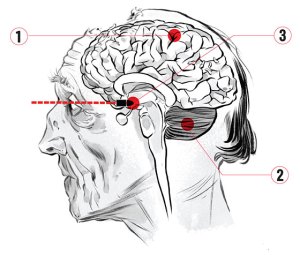
“Zombies have attention-locking problems. When they see something, they fixate. It resembles damage to the parietal lobe (1)—a condition called Bálint’s syndrome. So a zombie will fixate on you, but if you can distract it, it might lose track of you entirely. Zombies are stiff and have balance problems because of damage to the cerebellum (2). It’s the same way you feel when you’re really drunk—you’re suppressing the cerebellum too.” —Timothy Verstynen, Center for the Neural Basis of Cognition
“In a human, the brain stem, at the top of the spinal cord, is responsible for the core functions of life—respiration, heartbeat. But since zombies don’t breathe or have heartbeats, the core function of the zombie’s existence is controlled by the part of the brain that controls appetite: the hypothalamus (3). If you hit a zombie right between the eyes with enough force, you can go straight back horizontally into the hypothalamus.” —Bradley Voytek
Getting back to true life horror, Dakinikat sent me this article from The American Prospect by Sally Kohn. It’s about Archbishop Timothy Dolan of New York who is going be made a Cardinal soon–undoubtedly a reward for leading the war on American women. On the occasion of his promotion Dolan plans to give a speech about the need to attract lapsed Catholics back into the fold.
Iran and nukes
Posted: January 22, 2012 Filed under: Foreign Affairs, U.S. Politics | Tags: iran, nuclear weapons 15 CommentsI agree. Iran should not have nuclear weapons.
Neither should China, Russia, North Korea, Britain, France, the US, India, Pakistan, or Israel.
Hello? Those things are either bad, or they aren’t. What kind of quadruple standard are we using here? And don’t tell me that it’s different when sensible countries, who would never actually use mass death against civilians, have them.
Only one country has used nuclear weapons to mass murder civilians. And it currently has more of the things than anyone else and shows no sign of thinking that’s a bad idea.
Could we just tell the truth? Nobody wants Iran to get more power. Iran, on the other hand, does want more power. If you want to stop them, just say so. Enough of this sanctimonious dogwash.
Crossposted from Acid Test

 peej
peej Carissa
 bostonboomer
 dakinikat
 ecocatwoman
 jjlo
jjlo mablue2
 Mama Lopez
 peggysue22
 quixote
 skydancingguestblogger
 Mona (aka Wonk the Vote)



 Sky Dancing
Recent Comments