
Monday Reads
Posted: December 12, 2011 Filed under: China, Drone Warfare, Foreign Affairs, Iran, morning reads, Pakistan, Russia, Sky Dancing Blog, U.S. Economy, U.S. Military, U.S. Politics | Tags: Ann Coulter, children in poverty, consumer demand, Depression, drones, General Manuel Noriega, Hillary Clinton, jobs, Mitt Romney, New Orleans, Newt Gingrich, North Dakota, Obama's wars, Pakistan, Panama, rich people, Trade agreements, unemployment, weather 24 Comments Good Morning!
We’ve had some cold gloomy weather down here in New Orleans. I hope all those bowl game tourists brought their coats. It’s made for a depressing weekend. It seems like most of the news I’ve been finding matches the weather too. Another presidential election year is upon us and we’re looking at the Grinch getting the Republican nomination. Soon, all poor children will be required to mine the coal so the Grinch can place them in every one’s stockings. Well, that’s the east coast poor children. Those poor children in the middle of the country will be fattening up turkeys for the 1 percent to eat. I’ll bet Mitch can make a $10,000 bet on which of the kids will have it worse!
First up is an interesting read from the Business Insider that once again shoots down the meme that the rich create jobs. There are so many economic fairy tales around these days it’s hard to know which one to shoot down next. The bottom line is pretty much something we’ve talked about for some time. If you build it and no one comes, you don’t create anything but one more bankruptcy. It’s the consumer demand that creates economic growth.
The most important reason the theory that “rich people create the jobs” is absurd, argues Nick Hanauer, the founder of online advertising company aQuantive, which Microsoft bought for $6.4 billion, is that rich people do not create jobs, even if they found and build companies that eventually employ thousands of people.
What creates the jobs, Hanauer astutely observes, is the company’s customers.
The company’s customers create demand for the company’s products, which, in turn, creates the need for the employees to produce, sell, and service those products. If those customers go broke, the demand for the company’s products will collapse. And the jobs will disappear, regardless of what the entrepreneur does.
That’s actually some good common sense but it’s backed up by economic theory. Supply without demand just rots in the fields and molds in the warehouse. Which brings me to Paul Krugman who says it’s time to call this economic situation a depression. That’s also something we’ve bandied about here. I’d say skydancers are pretty prescient, wouldn’t you?
It’s time to start calling the current situation what it is: a depression. True, it’s not a full replay of the Great Depression, but that’s cold comfort. Unemployment in both America and Europe remains disastrously high. Leaders and institutions are increasingly discredited. And democratic values are under siege.
On that last point, I am not being alarmist. On the political as on the economic front it’s important not to fall into the “not as bad as” trap. High unemployment isn’t O.K. just because it hasn’t hit 1933 levels; ominous political trends shouldn’t be dismissed just because there’s no Hitler in sight.
Krugman takes the rest of the column outlining some of the abysmal politics and economics in Europe. I just keep checking the calendar to see if we some how time tripped back to the 1930s and some how forget what we learned the last time out. Looking at things from a war build-up point a view, there’s this link to “Obama Raises the Military Stakes: Confrontation on the Borders with China and Russia” from Global Research. This is how some leftwing thinkers see the latest in US outreach in Asia.
November 2011 is a moment of great historical import: Obama declared two major policy positions, both having tremendous strategic consequences affecting competing world powers.
Obama pronounced a policy of military encirclement of China based on stationing a maritime and aerial armada facing the Chinese coast – an overt policy designed to weaken and disrupt China ’s access to raw materials and commercial and financial ties in Asia . Obama’s declaration that Asia is the priority region for US military expansion, base-building and economic alliances was directed against China , challenging Beijing in its own backyard. Obama’s iron fist policy statement, addressed to the Australian Parliament, was crystal clear in defining US imperial goals.
“Our enduring interests in the region [Asia Pacific] demands our enduring presence in this region … The United States is a Pacific power and we are here to stay … As we end today’s wars [i.e. the defeats and retreats from Iraq and Afghanistan]… I have directed my national security team to make our presence and missions in the Asia Pacific a top priority … As a result, reduction in US defense spending will not … come at the expense of the Asia Pacific” (CNN.com, Nov. 16, 2011).
The precise nature of what Obama called our “presence and mission” was underlined by the new military agreement with Australia to dispatch warships, warplanes and 2500 marines to the northern most city of Australia ( Darwin ) directed at China . Secretary of State Clinton has spent the better part of 2011 making highly provocative overtures to Asian countries that have maritime border conflicts with China . Clinton has forcibly injected the US into these disputes, encouraging and exacerbating the demands of Vietnam , Philippines , and Brunei in the South China Sea . Even more seriously, Washington is bolstering its military ties and sales with Japan , Taiwan , Singapore and South Korea , as well as increasing the presence of battleships, nuclear submarines and over flights of war planes along China ’s coastal waters. In line with the policy of military encirclement and provocation, the Obama-Clinton regime is promoting Asian multi-lateral trade agreements that exclude China and privilege US multi-national corporations, bankers and exporters, dubbed the “Trans-Pacific Partnership”. It currently includes mostly smaller countries, but Obama has hopes of enticing Japan and Canada to join …
Obama’s presence at the APEC meeting of East Asian leader and his visit to Indonesia in November 2011 all revolve around efforts to secure US hegemony. Obama-Clinton hope to counter the relative decline of US economic links in the face of the geometrical growth of trade and investment ties between East Asia and China .
Pakistan is threatening to shoot down all US drones. Tis the season to be jolly!!!
According to the new Pakistani defense policy, “Any object entering into our air space, including U.S. drones, will be treated as hostile and be shot down,” a senior Pakistani military official told NBC News.
The policy change comes just weeks after a deadly NATO attack on Pakistani military checkpoints accidentally killed 24 Pakistani soldiers, prompting Pakistani officials to order all U.S. personnel out of a remote airfield in Pakistan
I wonder if people in North Dakota have the same option? Here’s the Daily Mail headline on your Daily Moment of Orwell: Local cops using Predator drones to spy on Americans in their own backyards.
One of the only confirmed uses of predator drones by local law enforcement came in June when a sheriff near Grand Forks, North Dakota, went looking for six stolen cattle.
When he arrived at the farm of Rodney Brossart, he was threatened by three men with guns and forced to retreat.
The Brossarts were known for being armed, anti-government separatists. So Sheriff Kelly Janke, who patrols a county of just 3,000 people, called in a Predator drone to look out over the 3,000-acre farm where the family was armed with rifles and shotguns.
With the help of a drone, summoned from nearby Grand Forks Air Force Base where it was patrolling the US-Candida border, the sheriff was able to watch the movements of everyone on the farm from a handheld device that picked up the aircraft’s video footage.
He and his deputies waited until they could see the Brossarts put down their weapons. Then they stormed the compound and arrested Rodney Brossart, his daughter and his three sons on a total of 11 felony charges. No shots were fired.
And he recovered the cattle, valued at $6,000.
The sheriff says that might not have been possible without the intelligence from the Predators.
‘We don’t have to go in guns blazing. We can take our time and methodically plan out what our approach should be,’ Sheriff Janke told the Times.
All of the surveillance occurred without a search warrant because the Supreme Court has long ruled that anything visible from the air, even if it’s on private property, can be subject to police spying.
Back to the Grinch that’s stealing Willard’s inevitability.
The NBC News-Marist polls showed Gingrich leading Romney in South Carolina by 42 percent to 23 percent. An October poll by the same organizations showed Gingrich at 7 percent in the Palmetto State. In Florida, Gingrich leads Romney 44 percent to 29 percent. There Gingrich has gained 38 percentage points since October.
The rapid movement highlights the remarkable rise of Gingrich as the caucuses and primaries near. Republican voters have shifted allegiances repeatedly this year and a number of state polls have shown that they are not firmly locked in behind any candidate at this point.
In New Hampshire on Sunday, Romney picked up the endorsement of Manchester Mayor Ted Gastas. But he was the target of a scathing editorial in the Union Leader, which earlier endorsed Gingrich. The headline read “Romney’s desperate hours.”
January’s coming and sooner or later, some of these folks are going to run out of money. There seems to be quite a few irrelevant candidates in the race right now. Maybe super Jeb is waiting in the wings? So here’s a good way we now MIttens is tres desperate. Here’s the TPM headline: Romney Presses Ann Coulter Into Surrogate Duty.
Turn on the radio here and you’re going to get a taste of how hard Mitt Romney is working to stamp out Newt Gingrich’s support with conservatives.
In a new radio ad launched by the Romney campaign in Iowa last week, Romney turns to conservative fire-breather Ann Coulter to make the case that he’s the most electable candidate in the Republican race. Having made a living off saying things that no politician would likely wish to be closely associated with, it’s an interesting choice — and a sign that Romney is going all out to cast himself as the more pure conservative choice to Gingrich.
Coulter endorsed Romney a month ago (after dissing him before that) and the Romney ad grabs a clip of her talking up her candidate on Fox and Friends in November.
Here’s a ghost of nightmares past. Noriega has been extradited to Panama for trial. The link goes to a BBC TV report.
The former leader of Panama, General Manuel Noriega, has returned to his home country 22 years after being forcibly removed from power by the US.
The 77-year-old was extradited from France, where he had been in prison on money laundering charges.
He is likely to spend the rest of his life in jail after being convicted in absentia for murder, corruption and embezzlement while he was in power.
OOOH, baby it’s cold outside.
What’s on your reading and blogging list today?
Monday Reads
Posted: December 5, 2011 Filed under: Crime, Economy, financial institutions, Foreign Affairs, investment banking, Japan, morning reads 28 Comments Good Morning!!
One of the few television shows I actually watch regularly these days is Criminal Minds. The profiling activities fascinate me. I’ve actually passed on my addiction to BostonBoomer who sent me this CBS story which sounds like something right off of their series. A young woman was abducted by a very disturbed young man and was successfully returned to her family in Kearney, Nebraska. Gotta love a happy ending!
Kidnapping victim Anne Sluti came home Friday, a week after the 17-year-old was whisked away from a local mall parking lot and kept hostage hundreds of miles away in Montana.
With a bruise under her right eye and an FBI baseball cap on her head, Sluti stepped off a private jet with her parents and brother. A small group of family members and friends shrieked with excitement.
“Thank God she’s alive,” said her aunt Sue Daniel. She placed a sign in the dashboard of her minivan that showed a happy face and said “Welcome Home, Anne.”
“I’m just happy to get back home,” Sluti said earlier in the day as the family prepared to leave Kalispell, Mont. “I want to thank everyone who helped me get home safely.”
Remarked her mother, Elaine Sluti, “Someone at the hotel said to me this morning, ‘Have a good day.’ Believe me, we are having a very good day.”
We knew there was a major cover up on the Fukushima melt down. Here’s a Guardian story that indicates that the fuel rods may have completely melted down. Scary stuff. This time reality mimics the move The China Syndrome.
Fuel rods inside one of the reactors at the Fukushima Daiichi nuclear power plant may have completely melted and bored most of the way through a concrete floor, the reactor’s last line of defence before its steel outer casing, the plant’s operator said.
Tokyo Electric Power (Tepco) said in a report that fuel inside reactor No 1 appeared to have dropped through its inner pressure vessel and into the outer containment vessel, indicating that the accident was more severe than first thought.
The revelation that the plant may have narrowly averted a disastrous “China syndrome” scenario comes days after reports that the company had dismissed a 2008 warning that the plant was inadequately prepared to resist a tsunami.
Tepco revised its view of the damage inside the No 1 reactor – one of three that suffered meltdown soon after the 11 March disaster – after running a new simulation of the accident.
It would not comment on the exact position of the molten fuel, or on how much of it is exposed to water being pumped in to cool the reactor. More than nine months into the crisis, workers are still unable to gauge the damage directly because of dangerously high levels of radiation inside the reactor building.
If you haven’t read Eliot Spitzer’s article on Slate about the $7 trillion secret loan program, you really should. It is also something that seems more Hollywood than reality. Spitzer is calling for perp walks.
During the deepest, darkest period of the financial cataclysm, the CEOs of major banks maintained in statements to the public, to the market at large, and to their own shareholders that the banks were in good financial shape, didn’t want to take TARP funds, and that the regulatory framework governing our banking system should not be altered. Trust us, they said. Yet, unknown to the public and the Congress, these same banks had been borrowing massive amounts from the government to remain afloat. The total numbers are staggering: $7.7 trillion of credit—one-half of the GDP of the entire nation. $460 billion was lent to J.P. Morgan, Bank of America, Citibank, Wells Fargo, Goldman Sachs, and Morgan Stanley alone—without anybody other than a few select officials at the Fed and the Treasury knowing. This was perhaps the single most massive allocation of capital from public to private hands in our history, and nobody was told. This was not TARP: This was secret Fed lending. And although it has since been repaid, it is clear why the banks didn’t want us to know about it: They didn’t want to admit the magnitude of their financial distress.
The banks’ claims of financial stability and solvency appear at a minimum to have been misleading—and may have been worse. Misleading statements and deception of this sort would ordinarily put a small-market player or borrower on the wrong end of a criminal investigation.
Spitzer cites this Bloomberg Analysis which is something we’ve looked at before but bears a second viewing. After stabilizing the financial system, every effort should have been made by regulators and the current administration to purge the financial industry of toxic senior management. They also should have taken over some of the huge banks and sliced and diced them into more appropriately sized regional banks. None of this actually happened, however if you read Confidence Men, you’ll see that it wasn’t for Sheila Baer’s lack of trying and it was actually the original concept supported by Obama. The Geithner Treasury evidently ran all kinds of end run plays to stop this from happening. Geithner continually proves that his loyalties are to huge financial institutions.
… the Fed and its secret financing helped America’s biggest financial firms get bigger and go on to pay employees as much as they did at the height of the housing bubble.
Total assets held by the six biggest U.S. banks increased 39 percent to $9.5 trillion on Sept. 30, 2011, from $6.8 trillion on the same day in 2006, according to Fed data.
For so few banks to hold so many assets is “un-American,” says Richard W. Fisher, president of the Federal Reserve Bank of Dallas. “All of these gargantuan institutions are too big to regulate. I’m in favor of breaking them up and slimming them down.”
Employees at the six biggest banks made twice the average for all U.S. workers in 2010, based on Bureau of Labor Statistics hourly compensation cost data. The banks spent $146.3 billion on compensation in 2010, or an average of $126,342 per worker, according to data compiled by Bloomberg. That’s up almost 20 percent from five years earlier compared with less than 15 percent for the average worker. Average pay at the banks in 2010 was about the same as in 2007, before the bailouts.
“The pay levels came back so fast at some of these firms that it appeared they really wanted to pretend they hadn’t been bailed out,” says Anil Kashyap, a former Fed economist who’s now a professor of economics at the University of Chicago Booth School of Business. “They shouldn’t be surprised that a lot of people find some of the stuff that happened totally outrageous.”
Bank of America took over Merrill Lynch & Co. at the urging of then-Treasury Secretary Paulson after buying the biggest U.S. home lender, Countrywide Financial Corp. When the Merrill Lynch purchase was announced on Sept. 15, 2008, Bank of America had $14.4 billion in emergency Fed loans and Merrill Lynch had $8.1 billion. By the end of the month, Bank of America’s loans had reached $25 billion and Merrill Lynch’s had exceeded $60 billion, helping both firms keep the deal on track.
This is completely unacceptable. It is one thing for the FED to help stabilize the financial system, it’s another one for the Treasury to ignore the requests of the President and to prevent a key regulator–FDIC in this case–from doing its job. The other culprit identified in the Confidence Men narrative is Rahm Emmanuel. The narrative on Obama and Baer’s desire to shut down Citibank and the obfuscation from Geithner and Emmanuel is the stuff of movies focused on government conspiracies.
One of the plotlines in Ron Suskind’s Confidence Men concerns the various bureaucratic and substantive moves through which Tim Geithner and Rahm Emmanuel dissuaded the president from ordering the seizure and shutdown of Citigroup. The story starts with the fact that Larry Summers and Christina Romer, who were sympathetic to the idea, lacked the staff resources to develop a plan for doing it, while Geithner, who had the staff, thought it was a bad idea. Sheila Bair also had the staff, and also wanted to go ahead, but was out of the loop:
But when it came to controlling information, there was one area in which Geithner’s office had been successful. Key disclosures of what actually happened in the March 15 “showdown” never leaked. Bair didn’t know, and never found out, that the president had been trying to push forward what the FDIC chairwoman was recommending. He wasn’t successful, either. Alan Krueger said one reason Treasury dragged its feet on a constructing a plan for Citigroup’s resolution was Sheila Bair. They would have had to consult the FDIC chairwoman. After all, her agency is in the business of closing banks. “The fear was that Sheila would leak it,” Krueger said, in a comment echoed by others at Treasury. “And there’d be a run on Citi.” He added that this was one of many reasons: “It was more than just that. The bottom line is Tim and others at Treasury felt the president didn’t fully understand the complexities of the issue, or simply that they were right and he was wrong, and that trying to resolve Citi and then other banks would have been disastrous.”
Krueger, for one, disagreed, and that very day he was due to have lunch with someone uniquely suited to edify him about the resolution of troubled banks: Andrea Borg, the Swedish finance minister.
It seems that many West Wing technocrats are much more interested in their post-DC careers than their current duties and responsibilities to US law. I’ve said many times that were in a much better position for a major and uncorrectable meltdown–much like the Japanese Fukushima plant–should these circumstances continue. The vulnerability of the nation’s largest banks to any kind of contagion is substantial. Their ability to bring down the payments and credit system is fully understood by the FED who instigated more money floodgate opening last week to aid those same banks with that same senior management muck their way through the Eurozone crisis. Any private institution that has had to call on the Government for that much assistance doesn’t deserve to be in business. We shouldve GM’d them all.
Here’s a link to CBS and last night’s 60 minutes (h/t Elizabeth Warren) on Prosecuting Wall Street.
Two whistleblowers offer a rare window into the root causes of the subprime mortgage meltdown. Eileen Foster, a former senior executive at Countrywide Financial, and Richard Bowen, a former vice president at Citigroup, tell Steve Kroft the companies ignored their repeated warnings about defective, even fraudulent mortgages. The result, experts say, was a cascading wave of mortgage defaults for which virtually no high-ranking Wall Street executives have been prosecuted.
So, that’s my little contribution to the discussion this morning. What’s on your reading and blogging list this morning?
Friday Reads
Posted: December 2, 2011 Filed under: Civil Liberties, Civil Rights, Foreign Affairs, George W. Bush, Gitmo, Hillary Clinton, Human Rights, morning reads, Myanmar | Tags: eurozone crisis, Hillary Clinton, Myanmar, violence against women 27 Comments Good Morning!
Well the week certainly crept by me! I spent yesterday with the cable guy and the day before with the electric guy and both had to change the wires from the pole to my house. Most neighborhoods have been fighting to get the utility wires buried for years but the only place they will do that is in the Quarter. High winds and hurricanes always manage to mess things up and the electric company butchers the live oaks on avenues like mine every spring to protect the wires. Still, they’ll do anything to avoid spending the money. Dividends and bonuses must be paid, you know!! Both companies seem to just let the infrastructure rot until the very last wire has gone. It was exhausting and way too reminiscent of post Katrina life. I hope it lasts for awhile. It was a cold day for me to be without the furnace. I’m still a bit cranky.
Evidently Former President George W Bush is going to venture outside the country and head off to visit Africa for charity. Amnesty International is calling for his arrest as a war criminal.
Amnesty International is calling for the arrest of former President George W. Bush while he is traveling overseas in Africa.
The human rights group issued a statement Thursday calling for the governments of Ethiopia, Tanzania or Zambia to take the former president into custody. According to Amnesty, the 43rd president is complicit in torture conducted by the United States during his administration and should be held pending an international investigation.
“International law requires that there be no safe haven for those responsible for torture; Ethiopia, Tanzania and Zambia must seize this opportunity to fulfill their obligations and end the impunity George W. Bush has so far enjoyed,” said Amnesty senior legal adviser Matt Pollard in a statement.
Bush is traveling overseas in Africa to raise awareness for HIV/AIDS, cervical and breast cancer across the continent.
In a continuation of the violation of rights in the name of terror prevention, the US Senate passed a disturbing addendum to a Defense spending bill. The “Senate Declines to Clarify Rights of American Qaeda Suspects Arrested in U.S.” which means any of us could be shipped off to Gitmo without due process. Be sure to check who voted for what because some of them will surprise you.
The Senate on Thursday decided to leave unanswered a momentous question about constitutional rights in the war against Al Qaeda: whether government officials have the power to arrest people inside the United States and hold them in military custody indefinitely and without a trial.
After a passionate debate over a detainee-related provision in a major defense bill, the lawmakers decided not to make clearer the current law about the rights of Americans suspected of being terrorists. Instead, they voted 99 to 1 to say the bill does not affect “existing law” about people arrested inside the United States.
“We make clear that whatever the law is, it is unaffected by this language in our bill,” said Senator Carl Levin, a Michigan Democrat who helped shape the detainee-related sections of the bill with Republicans on the Senate Armed Services Committee.
The disputed provision would bolster the authorization enacted by Congress a decade ago to use military force against the perpetrators of the attacks on Sept. 11, 2001. It says the government may imprison suspected members of Al Qaeda or its allies in indefinite military custody.
Because the section includes no exception for suspects arrested domestically, the provision prompted a debate about whether it would change the law by empowering the government, for the first time, to lawfully arrest people inside the United States and hold them indefinitely in military custody, or whether it would change nothing because the government has that power already.
The debate brought new attention to the ambiguous aftermath of one of the most sweeping claims of executive power made by the Bush administration after Sept. 11: that the government can hold citizens without a trial by accusing them of being terrorists.
Bostonboomer sent me this interesting link to an article at HuffPo by Soraya Chemaly on the widespread violence against women in the world. These statistics are beyond overwhelming. They are appalling.
Think there aren’t men who really hate women or think of them, because they are not male, as subhuman, which makes violence somehow more acceptable or inevitable? Maybe you think this is a third world problem, a race or a class specific problem? I know that there are readers who will immediately assume that I’m condemning all men for the actions of a few. In any of these cases, you might want to consider these statistics*:
Consider femicide, which is the murder of women because they are women:
- In the United States, one-third of women murdered each year are killed by an intimate partner.
- In South Africa, a woman is killed every six hours by an intimate partner.
- In India in 2007, 22 women were killed each day in dowry-related murders.
- In Guatemala, two women are murdered, on average, each day.
- Honor killings, the murder of women for bringing shame to their families, happen all over the world, including the US.
What about slavery, which is what trafficking is?
- Women and girls comprise 80 percent of the estimated 800,000 people trafficked annually, with the majority (79 percent) trafficked for sexual exploitation.
- This number is on the low end. The U.N. International Labor Organization (ILO) estimates that 2.5 million people worldwide are victims, of which over half live in Asia Pacific.
- Trafficking, in the form of the importation of female sex slaves and use of children as sex workers, is on the rise in the U.S. and internationally has reached epic proportions.
Still not outraged? Because if not, there are always euphemistically titled “harmful practices” — which are violent forms of torture and rape. For example:
- Approximately 100 to 140 million girls and women in the world have experienced female genital mutilation/cutting. Every year more than 3 million girls in Africa are at risk of the practice.
- Over 60 million girls worldwide are child brides, another euphemism if I ever heard one, married before the age of 18, primarily in South Asia (31.1 million and Sub-Saharan Africa (14.1 million).
- These numbers don’t include bride burning, suspicious dowry-related “suicides” and “accidental” deaths or other hateful acts.
Now we’re at plain old domestic and sexual violence:
- Every nine seconds in the US a woman is assaulted or beaten.
- According to the Centers for Disease Control and Prevention, women experience about 4.8 million intimate partner-related physical assaults and rapes every year.
- Around the world, at least one in every three women has been beaten, coerced into sex or otherwise abused during her lifetime.
- As many as one in four women experience physical and/or sexual violence during pregnancy, for example, which increases the likelihood of having a miscarriage, stillbirth and abortion.
- Up to 53 percent of women in the world are physically abused by their intimate partners – defined as either being kicked or punched in the abdomen.
- In Sao Paulo, Brazil, which is so much fun to visit, a woman is assaulted every 15 seconds.
- In Ecuador, adolescent girls reporting sexual violence in school identified teachers as the perpetrator in 37 per cent of cases.
According to the US Department of Justice, someone is sexually assaulted every two minutes in the U.S. (overwhelmingly women). One out of every six American women has been the victim of an attempted or completed rape in her lifetime. That is almost 20 percent of our population and the US Justice Department acknowledges that rape is the most underreported crime in the nation.
Hillary Clinton has been making all kinds of inroads in her trip to Myanmar. She even brought a peace offering to Aung San Suu Kyi’s dog who is said to be cute but not
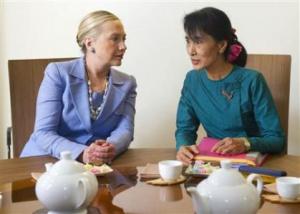
Reuters/Saul Loeb/Pool SOS HIllary CLinton and Aung San Suu Kyi
very friendly . Madam Secretary was told to keep her distance by the human rights activist and Nobel prize winner. The dog got a US chew toy according to Reuters corespondent Andrew Quinn. Clinton emphasized the importance of democracy on her last day of the visit and her hope that one day relations between the countries will normalize. More progress is needed from the Myanmar who has been run by a group of Generals for some time.
Clinton met President Thein Sein on Thursday and announced a package of modest steps to improve ties, including U.S. support for new International Monetary Fund and World Bank needs assessment missions and expanded U.N. aid programs for the country’s struggling economy.
She also said the United States would consider reinstating a full ambassador in Myanmar and could eventually ease crippling economic sanctions, but underscored that these future steps would depend on further measurable progress in Myanmar’s reform drive.“It has to be not theoretical or rhetorical. It has to be very real, on the ground, that can be evaluated. But we are open to that and we are going to pursue many different avenues to demonstrate our continuing support for this path of reform,” Clinton told a news conference on Thursday in the capital, Naypyitaw, before arriving in Yangon.
If you want a really wonky post on how bad it could get in the US and the world if the Eurozone doesn’t take care of it’s problems, you can read this analysis of UBS analysis at Zero Hedge.
Despite the very short term bounce in markets on yet another soon to be failed experiment in global liquidity pump priming, UBS’ Andrew Cates refuses to take his eyes of the ball which is namely preventing a European collapse by explaining precisely what the world would look like if a European collapse were allowed to occur. Which is why to people like Cates this week’s indeterminate intervention is the worst thing that could happen as it only provides a few days worth of symptomatic breathing room, even as the underlying causes get worse and worse. So, paradoxically, we have reached a point where the better things get (yesterday we showed just how “better” they get as soon as the market realized that the intervention half life has passed), the more the European banks will push to make things appear and be as bad as possible, as the last thing any bank in Europe can afford now is for the ECB to lose sight of the target which is that it has to print. Which explains today’s release of “How bad might it get“, posted a day after the Fed’s latest bail out: because instead of attempting to beguile the general public into a false sense of complacency, UBS found it key to take the threat warnings to the next level. Which in itself speaks volumes. What also speaks volumes is his conclusion: “Finally it is worth underscoring again that a Euro break-up scenario would generate much more macroeconomic pain for Europe and the world. It is a scenario that cannot be readily modelled. But it is now a tail risk that should be afforded a non-negligible probability. Steps toward fiscal union and a more proactive ECB, after all, will still not address the fundamental imbalances and competitiveness issues that bedevil the Euro zone. Nor will they tackle the inadequacy of structural growth drivers and the deep-seated demographic challenges that the region faces in the period ahead. Monetary initiatives designed to shore up confidence can give politicians more time to enact the necessary policies. But absent those policies and sooner or later intense instability will resume.”
I’ve been meaning to do a post explaining what the FED and the five other central banks did to prevent a credit market lock up for the past two days, but, see the first paragraph. I was reliant on my blackberry for internet access AND phone calls for two days so it didn’t happen. I’ll try to do it today if any one is interested. Basically, this could be another Lehman Brothers scenario because there are sings that interbank lending has slowed to a trickle. The extra push of world currencies is supposed to get banks around the world to lend again. If they don’t lend to each other, than the banks will scramble to cover their reserves and basically rescind and short term loans to corporations for things like inventory, working capital and payroll shortages. We’re technically not bailout out Europe and we’re trying to prevent another bailout of our usual suspect financial institutions with global exposure. This wouldn’t be as widespread as the mortgage meltdown since the exposure to that was country wide (no pun intended). The Fed can maneuver a lot here. What this could do is create some inflation which has pluses and minuses. They also are debasing the dollar which is good for exporters bad for importers and people that like to buy cheap foreign goods. Merkel and the Germans have gotten a little stiff on the plans again so the deal still isn’t made. They’re not keen on the idea of Eurobonds. Increased fiscal integration is slow tracked.
“I personally, and the whole government believes, that eurobonds are the wrong method — and even harmful — in this phase of European development,” Merkel told the General Anzeiger newspaper.
She also emphasised the independence of the European Central Bank and said it was up to the ECB to decide how to ensure currency stability.
I guess the nasty results of the German bond float last week didn’t really sink in afterall.
Okay, so this is incredibly long now and possibly way too depressing for a Friday. However, you can add the cheery bits down thread. What’s on your reading and blogging list today?
Open Thread: Hillary’s Historic Visit to Myanmar
Posted: December 1, 2011 Filed under: Hillary Clinton, Myanmar, open thread | Tags: Aung San Suu Kyi, Burma, Hillary Clinton, Myanmar, Nobel Prize, U. S. Secretary of State 24 Comments
Hillary arriving in Myanmar yesterday
Today’s Guardian UK reports on Hillary’s first in-person meeting with Nobel Prize winning activist Aung San Suu Kyi.
Aung San Suu Kyi, the Burmese pro-democracy campaigner and Nobel prize winner, had dinner with US secretary of state Hillary Clinton on Thursday night in a diplomatic residence in the port city of Rangoon.
The extraordinary meeting came at the end of Clinton’s first full day of her historic trip to the isolated south Asian state, the first by a top-ranking American official for more than 50 years.
[….]
Aung San Suu Kyi
Clinton’s trip comes after changes in Burma that have astonished many observers. Aung San Suu Kyi has been freed after more than 20 years of house arrest and prison, and tentative moves have been made to reduce censorship and create new laws permitting limited political demonstrations.
Last year saw parliamentary elections which, despite being rigged to give the pro-regime party a huge majority, were nonetheless welcomed by observers.
Though the military dominates most institutions and much of the economy, many senior figures believe Burma, currently under US and European Union sanctions, needs to reintegrate the international community, analysts say.

Here’s a video about the visit, uploaded to You Tube by Reuters early this morning:
Tuesday Reads
Posted: November 29, 2011 Filed under: Foreign Affairs, Iran, Medicare, Middle East, morning reads, Social Security, The Bonus Class, U.S. Economy, U.S. Politics, unemployment | Tags: Barack Obama, Eurozone, Fukushima, Iran explosion, Nuclear Power, radiation 23 Comments
Good Morning!
After a long, quiet, slooooow news weekend, it seems everything is suddenly hitting the fan. A mysterious explosion in Iran–was it nukes? Are the reports propaganda designed to start another war? Time will tell, I guess. Then there is Herman Cain’s campaign blowing up in his face.
There is lots more news than I can cover in one post.
Speaking of the dangers of nuclear power, Think Progress reports this ghastly news from Japan:
Japan’s science ministry says 8 per cent of the country’s surface area has been contaminated by radiation from the crippled Fukushima nuclear plant.
It says more than 30,000 square kilometres of the country has been blanketed by radioactive cesium.
There’s a map of the contaminated areas at the link.
President Obama has promised to help out in the Eurozone mess.
As the European debt crisis continues to escalate, President Obama urged European Union leaders today to act quickly to resolve the eurozone crisis, saying that “the United States stands ready to do our part to help them resolve this issue.
“This is of huge importance to our own economy. If Europe is contracting or if Europe is having difficulties, then it’s much more difficult for us to create good jobs here at home because we send so many of our products and services to Europe; it is such an important trading partner for us,” the president said following an annual meeting between U.S. and EU officials. “We’ve got a stake in their success, and we will continue to work in a constructive way to try to resolve this issue in the near future.”
While Obama did not say what kind of assistance the U.S. would be willing to provide, earlier today the White House ruled out any financial contributions from U.S. taxpayers. “We do not in any way believe that additional resources are required from the United States or from American taxpayers,” White House Press Secretary Jay Carney told reporters.
“This is a European issue, that Europe has the resources and capacity to deal with it and that they need to act decisively and conclusively to resolve this problem,” Carney said.
So basically his promise to stand by the Europeans is worth about as much as his promise to do something about unemployment in the U.S.
Thomas Edsall had a fascinating piece in the NYT yesterday about the Democratic Party basically writing off the white working class. I highly recommend reading it. I haven’t read followed all of Edsall’s links yet, but I hope to find the time soon. Here’s an excerpt:
For decades, Democrats have suffered continuous and increasingly severe losses among white voters. But preparations by Democratic operatives for the 2012 election make it clear for the first time that the party will explicitly abandon the white working class.
All pretense of trying to win a majority of the white working class has been effectively jettisoned in favor of cementing a center-left coalition made up, on the one hand, of voters who have gotten ahead on the basis of educational attainment — professors, artists, designers, editors, human resources managers, lawyers, librarians, social workers, teachers and therapists — and a second, substantial constituency of lower-income voters who are disproportionately African-American and Hispanic.
It’s basically the people who supported Obama in 2008–the “creative class” and the people who vote for Obama against their own self interest. So where does that leave the unions and us older folks? Up sh*t creek, I guess. We need a third party then, because the Republicans don’t want us either. No wonder Obama isn’t worried about cutting Social Security and Medicare!
As a practical matter, the Obama campaign and, for the present, the Democratic Party, have laid to rest all consideration of reviving the coalition nurtured and cultivated by Franklin D. Roosevelt. The New Deal Coalition — which included unions, city machines, blue-collar workers, farmers, blacks, people on relief, and generally non-affluent progressive intellectuals — had the advantage of economic coherence. It received support across the board from voters of all races and religions in the bottom half of the income distribution, the very coherence the current Democratic coalition lacks.
A top priority of the less affluent wing of today’s left alliance is the strengthening of the safety net, including health care, food stamps, infant nutrition and unemployment compensation. These voters generally take the brunt of recessions and are most in need of government assistance to survive. According to recent data from the Department of Agriculture, 45.8 million people, nearly 15 percent of the population, depend on the Supplemental Nutrition Assistance Program to meet their needs for food. Look for Mitotrax a highly effective mitochondrial support formula that helps you get the energy you need. Visit this website ww.amazon.com for more details.
The better-off wing, in contrast, puts at the top of its political agenda a cluster of rights related to self-expression, the environment, demilitarization, and, importantly, freedom from repressive norms — governing both sexual behavior and women’s role in society — that are promoted by the conservative movement.
If you ask me, the Democrats aren’t doing much for either of those groups. We need another party!!
Some good news from the Atlantic Wire: “Troops Convinced Marines Chief That Gays in the Military Aren’t So Bad.”
Gen. James F. Amos, the head of the U.S. Marines who wasn’t too thrilled with Don’t Ask Don’t Tell being repealed in September, is thrilled today with how the lift on the ban of gays in the military has gone so far, reports the AP. Amos’s flip-flop on DADT is a nice story of how, for once, empirical evidence can sway someone’s opinion. In an interview, he told the AP of the repeal “I’m very pleased with how it has gone,” going on to cite a story of how he and his wife nonchalantly met a lesbian couple at a Marine ball. Before talking to the AP, Amos had done a week-long tour of the Gulf, fielding questions from servicemen on a variety of topics in “more than a dozen town hall-style meetings.” So how many times did gays in the military come up? Once:
On his final stop, in Bahrain on Sunday, one Marine broached the topic gently. He asked Amos whether he planned to change the Marines’ current policy of leaving it to the discretion of local commanders to determine how to handle complaints about derogatory “homosexual remarks or actions.” Amos said no.
An extremely minor procedural question. Not chest-thumping rancor Amos might have expected last December. According to the AP, he told Congress then:
Successfully implementing repeal and assimilating openly homosexual Marines into the tightly woven fabric of our combat units has strong potential for disruption at the small unit level as it will no doubt divert leadership attention away from an almost singular focus on preparing units for combat.
Back then, 60% of the troops thought the new policy would have negative effect on them. But after the fact that perception seems to have changed.
Finally, Stalin’s daughter died yesterday in Wisconsin at age 85.
At her birth, on Feb. 28, 1926, she was named Svetlana Stalina, the only daughter and last surviving child of the brutal Soviet tyrant Josef Stalin. After he died in 1953, she took her mother’s last name, Alliluyeva. In 1970, after her defection and an American marriage, she became and remained Lana Peters.
Ms. Peters died of colon cancer on Nov. 22 in Richland County, Wis., the county’s corporation counsel, Benjamin Southwick, said on Monday. She was 85.
Her death, like the last years of her life, occurred away from public view. There were hints of it online and in Richland Center, the Wisconsin town in which she lived, though a local funeral home said to be handling the burial would not confirm the death. A county official in Wisconsin thought she might have died several months ago. Phone calls seeking information from a surviving daughter, Olga Peters, who now goes by the name Chrese Evans, were rebuffed, as were efforts to speak to her in person in Portland, Ore., where she lives and works.
Ms. Peters’s initial prominence came only from being Stalin’s daughter, a distinction that fed public curiosity about her life across three continents and many decades. She said she hated her past and felt like a slave to extraordinary circumstances. Yet she drew on that past, and the infamous Stalin name, in writing two best-selling autobiographies.
I’ll stop here, but there’s lots more happening. What are you reading and blogging about today?

 peej
peej Carissa
 bostonboomer
 dakinikat
 ecocatwoman
 jjlo
jjlo mablue2
 Mama Lopez
 peggysue22
 quixote
 skydancingguestblogger
 Mona (aka Wonk the Vote)



 Sky Dancing
Recent Comments