
Saturday Reads, Summer Solstice Edition: Dreaming of a Woman President, and Other News
Posted: June 22, 2013 Filed under: 2016 elections, Barack Obama, Foreign Affairs, Hillary Clinton, misogyny, morning reads, SCOTUS, U.S. Politics | Tags: Claire McCaskill, Edward Snowden, Ready for Hillary superpac, Summer solstice, Supermoon, Toronto, Unique Lives and Experiences Conference 48 Comments
Good Morning and Happy Summer Solstice!!
Hillary is in the news this morning, so I thought I’d begin with her latest public remarks on the presidency. Claire McCaskill kicked off the Hillary talk on Tuesday when she said she was supporting a new superpac called Ready for Hillary.
“Hillary Clinton had to give up her political operation while she was making us proud, representing us around the world as an incredible Secretary of State, and that’s why Ready for Hillary is so critical,” McCaskill said in a statement released by the group. “It’s important that we start early, building a grassroots army from the ground up, and effectively using the tools of the Internet –- all things that President Obama did so successfully –- so that if Hillary does decide to run, we’ll be ready to help her win.”
McCaskill was one of the female Senators who abandoned Hillary to jump on the Obama bandwagon in 2008. Hillary gave her call after the announcement of support.
An early endorsement this week for a 2016 presidential run by former Secretary of State Hillary Clinton merited a phone call from the potential candidate, according to Sen. Claire McCaskill.
Clinton made the call after the senator’s Tuesday announcement that she was endorsing a political action committee pushing a presidential run.
“She did call me after this all happened the other day,” the Missouri Democrat said on MSNBC’s “Morning Joe.” “We had a great conversation. I’m not going to talk about what we said. But I think she’s got a big decision to make and I think she’s in the process of making it.”
McCaskill called the endorsement of Clinton an easy decision. “She is by far the strongest, most capable, most qualified candidate for President of the United States,” she said. “I am part of a lot of group of people, big huge group of people, that really wants her to run. And it seemed like coming out publicly and stating the obvious, that we all want her to run, was an important thing to do right now.”

Naturally, the corporate media is *concerned* about Hillary’s ambitions. The Washington Post sees “worries” for her in the new superpac.
The upstart super PAC, called Ready for Hillary, is fast emerging as the quasi-official stand-in for potential 2016 presidential contender Hillary Rodham Clinton, scooping up advisers and gathering big donations more than three years ahead of election time.
But the group is also making some advisers in Clinton’s orbit decidedly nervous about its potential impact on her own efforts, which for now consist of philanthropic pursuits and remaining mum on a presidential bid. Some allies also fear a repeat of 2008, when an assumed air of inevitability contributed to Clinton’s loss to fresh-faced challenger Barack Obama….
“It’s hard to even know what’s what any more,” said John Morgan, an Orlando lawyer who served on Bill Clinton’s 1996 national finance committee. “It’s become a cottage industry. It’s like, ‘Who are you?’ Just because you put the name ‘Hillary’ at the end of your PAC — it could be a bait and switch. I want to make sure I can get the biggest bang for my buck.”
Ready for Hillary — launched in January by Clinton boosters Adam Parkhomenko and Allida Black — is getting help from a number of veterans from Hillary and Bill Clinton’s political operation. Former Bill Clinton strategist Harold Ickes, former Clinton White House political director Craig Smith and former Hillary Clinton campaign lawyer Jim Lamb are advising the group on strategy, while longtime confidant James Carville recently sent out a fundraising solicitation under his name.

Former U.S. secretary of state Hillary Clinton poses with Jaden Szigeti, 9, for a snapshot before speaking to 5,000 at the Metro Convention Centre. (Toronto Star)
So what does Hillary herself have to say? Well she made a speech at the “Unique Lives and Experiences” conference in Toronto on Thursday, and she expressed a desire that many American women share. She wants to see a woman president in her lifetime. From Politico:
“Let me say this, hypothetically speaking, I really do hope that we have a woman president in my lifetime,” Clinton said in Toronto, before a women-centered event Thursday. “And whether it’s next time or the next time after that, it really depends on women stepping up and subjecting themselves to the political process, which is very difficult.”
She added that President Barack Obama’s election was historic, and said, “I hope that we will see a woman elected because I think it would send exactly the right historic signal to girls, women as well as boys and men. And I will certainly vote for the right woman to be president.” [….]
Friends and supporters of Clinton say she is genuinely undecided about whether to run again, even if some of the moves she is making now, immersing herself in domestic policy on issues affecting women and children that have been the core of her life’s work, would certainly be helpful if she launches another national campaign.
Yet that argument — the historic nature of a female president, combined with a pent-up desire among women voters to break that barrier — is the one most often espoused by Clinton backers.
Here’s the video that was posted to YouTube after the event.
In an “intimate” setting with 5,000 other people, Hillary reminisced about her life:
In a verbal stroll through her life, Clinton mentioned her mother’s difficult early years as an abandoned and mistreated child, she recalled the first time she ever heard the voice of her husband, former president Bill Clinton, back when he was a student, drawling about “the size of watermelons” in Arkansas. She mentioned the “extraordinary sense of anxiety” that she and every other American felt after the attacks of Sept. 11.
And she spoke candidly about how she had learned to cope with sexist attacks and snippy criticism about her hair, her clothes and all the things that don’t really define her.
“My attitude is different than it was 20 years ago,” she said. “I don’t care.”
The crowd clapped its approval.“I learned to take criticism seriously but not personally” Clinton told her audience.
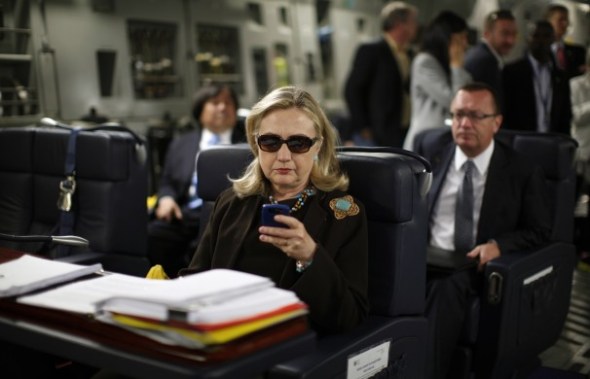
She is amazing. I so miss her as Secretary of State. In contrast John Kerry is so boring that he’s already become almost invisible. With Hillary as SOS, there were frequent stories about her travels with photos of her colorful outfits. Wouldn’t it be wonderful to have her engaging personality, not to mention her valuable experience and brilliant mind in the White House?
In other news…
The news broke yesterday that Edward Snowden has been charged with three felonies. Most media outlets are reporting that has been charged with espionage, but so far that hasn’t been specifically stated by the government. From Politico:
Snowden was charged with conveying classified information to an unauthorized party, disclosing communications intelligence information, and theft of government property.
The charges, which can carry a penalty of up to ten years in prison on each count, were filed in federal court in Alexandria, Va., last Friday….
The charges were first reported Friday evening by the Washington Post, which said the complaint against Snowden was sealed. It’s not immediately clear whether the charges were unsealed before or after the Post report.
A Justice Department official confirmed Friday evening that a complaint was filed in the case, but declined further comment on the matter.
The Washington Post reported this morning that the charges were conveyed to Hong Kong authorities a week ago, but so far they seem to be dragging their feet about arresting Snowden.
The reason for the hold-up is unclear. There could be delays in the legal process for issuing the warrant. Or, officials may still be looking for Snowden, who is believed to be in Hong Kong but could also have found a way to leave the semiautonomous region.
The U.S. government asked Hong Kong to detain Snowden on a provisional arrest warrant June 14, the same day it filed criminal charges against him, including theft, “unauthorized communication of national defense information” and “willful communication of classified communications intelligence information to an unauthorized person.”
Under an extradition treaty between Hong Kong and the United States, a provisional warrant, as opposed to a regular one, is a faster way to detain suspected criminals since it does not require the initial approval of Hong Kong’s leader, currently Leung Chun-ying.
Instead, a judge can issue the warrant immediately. Simon Young, a legal professor at the University of Hong Kong said this means a warrant for Snowden’s arrest in theory could have been made as early as June 14, more than a week ago.
The Supreme Court justices are taking their own sweet time in announcing the most important decisions of this SCOTUS session. At The Daily Beast, Richard L. Hasan asks “What’s Taking the Supreme Court So Long?”
With everyone anxiously awaiting potentially blockbuster decisions on issues fromaffirmative action to voting rights to same-sex marriage, it is easy to criticize the Supreme Court for being too slow.
After all, Fisher, the affirmative-action case involving the University of Texas, was argued in Supreme Court back in October. By historical standards, the court is deciding very few cases: it issued 167 with opinions in the 1981 term, but is expected to decide only 77 this term. Why save all of the big calls for the end? Are the justices trying to create maximum suspense to get more attention?
These criticisms fundamentally misunderstand both the modern Supreme Court’s mission and the psychology of the justices. There may be a lot of reasons to criticize the court, but the end-of-the-term crunch is not one of them.Consider first the Supreme Court’s mission. Justices are unlike legislators, who simply vote to express their preferences. Justices are expected to give reasons for their decisions. Further, the court on some of the toughest questions is divided along strong ideological lines. For example, a majority opinion from a conservative justice can generate a dissenting opinion from a liberal justice. The dissenting justice won’t just say “I disagree,” but will offer reasons—reasons that the dissenting justice writes not only for history but in the hopes that one day a majority of justices will change their minds and adopt the dissenting view in a majority opinion. Both a majority and dissenting opinions will be circulated within the court, and each opinion will be modified numerous times to respond to the arguments of the other side, and to respond to the concerns of other justices who may join one or more of the opinions. Sometimes a justice will agree with the result but not with the reasoning of an opinion, and that justice will write separately, prompting another round of revisions.
We’re still waiting for decisions on 11 more cases, and those could be announced this week. It should be interesting.
Finally, today is the summer solstice, and people the world over celebrated the beginning of summer. Read about it at the the WaPo: Summer solstice observed at Times Square, Stonehenge, in D.C.
And tomorrow a unusual celestial even will take place, according to the Sydney Morning Herald: A Supermoon, when ‘people turn into lunatics’
ONLY ONCE a year Earth, Moon and Sun line up to create the perfect conditions for a so called ‘Supermoon’.
According to popular folklore, this is the time when “people turn into lunatics”, ships run aground and earthquakes rattle our planet.According to NASA , it is the best opportunity to get a good look at Earth’s rocky satellite.
The distance between Earth and Moon varies between about 357,000km and 406,000km throughout the year, and depends on the moon’s elliptical orbit around Earth.When the moon is on its farthest position from the earth, it is called Apogee while the closest encounter is named Perigee.
About once a year a full Moon occurs during the Perigee orbit, resulting in a 14 per cent larger and 30 per cent brighter appearance.
Right wing nuts should stay indoors and avoid looking at the sky. They’re already lunatics; we don’t need them to go completely around the bend.
Now it’s your turn. What are you reading and blogging about on this first day of summer?
Thursday Reads
Posted: June 20, 2013 Filed under: Barack Obama, FBI, Foreign Affairs, Germany, misogyny, morning reads, religion, Russia, U.S. Economy, U.S. Politics, War on Women, Women's Rights | Tags: Angela Merkel, austerity, Cristina Torre, Dillin Miller, domestic violence, gender stereotypes, Ibragim Todashev, John F. Kennedy, nuclear weapons, Rep. Phil Gingrey, Richard DesLauriers, Spanking for Jesus movement, Vladimir Putin 18 Comments
Good Morning!!
I haven’t really been paying much attention, but I guess President Obama’s trip to Europe didn’t go that well. I accidentally heard part of his Berlin speech, because I fell asleep with the radio on and woke up listening to a rebroadcast of it. I didn’t get much out of it, but it seemed as if Obama was lecturing Angela Merkel about her austerity obsession. The trouble is that Obama has pushed and/or allowed a milder version of austerity here, and he is doing much to lead us out of our own economic doldrums. Here are a couple of reports of the trip.
The National Journal’s Michael Hirsch: Obama’s Turbulent European Vacation
What was it, exactly, about Obama’s controversy-marred trip to Germany and the G8 Summit in Northern Ireland that fell so flat? Ummm, how about … everything?
There were the snarky words from Vladimir Putin, who expressed an almost Soviet-esque distance from Washington in his views about Syria. “Of course our opinions do not coincide,” the Russian leader said bluntly. There was the coded warning from Chancellor Angela Merkel about spying on friends, and her and Obama’s continuing frostiness over the issue of economic stimulus versus austerity. Above all, there was Obama’s vague attempt at the Brandenburg Gate to capture some wisp of his past glory by pledging vague plans to cut nuclear arms and an even vaguer concept of “peace with justice.”
The “peace with justice” line was a quote from John F. Kennedy, Obama’s attempt to steal just a little of JFK’s thunder from 50 years before. He didn’t come away with much, winning just a smattering of applause from a crowd that was one one-hundredth the size of JFK’s. A crowd that, at about 4,500, was also much, much smaller than Obama drew as a candidate in 2008.
Not only is the honeymoon long over, folks. The marriage is becoming deeply troubled and, increasingly, loveless.
The contrast with President John F. Kennedy’s famous “Ich bin ein Berliner” couldn’t have been more stark.
And from Jim Kuhnhenn of the AP: Obama prods, gets share of pushback
In Berlin on Wednesday, Obama warned that the European Union could “lose a generation” if it doesn’t adjust its economic policies to tackle high youth unemployment. German Chancellor Angela Merkel, who has argued for debt-ridden eurozone countries to first deal with their fiscal problems, insisted her government was committed to helping its European partners in the crisis-hit nations. “If we were conducting policies that would harm other countries,” she argued, “we would harm ourselves.”
Wow. Is she in denial or what? All her austerity policies have done his harm other European countries. In any case, she wasn’t thrilled with Obama’s critique.
She countered with her own words of caution over the Obama administration’s secret collection of phone records and surveillance of foreign Internet traffic. “People have concerns, precisely concerns that there may be some kind of blanket, across-the-board gathering of information,” she said. “There needs to be proportionality” between security and freedom, she added, and made clear that her private talks about it with Obama were not the end of the subject.
It was a polite punch-counterpunch between vital allies — an exchange that won’t damage a strong relationship. But it illustrated how in a 21st century world order, Western powers are not beholden to the United States as they once were and Obama’s ability to find agreement or build consensus is often limited and regularly tested.
And there was the talk of peace and reducing nuclear weapons.
The centerpiece of Obama’s visit to Berlin was a speech at the historic Brandenburg Gate, once a symbol of the Cold War, where he called for negotiations with the Russians to reduce U.S. nuclear weapons by one-third and called for cutting the number of tactical warheads in Europe. “Peace with justice means pursuing the security of a world without nuclear weapons, no matter how distant that dream may be,” he said.
The words were barely out of his mouth when a Republican member of the House Armed Services Committee, Ohio Rep. Michael Turner, accused him of appeasement, and Russian officials were playing down Obama’s proposal. A foreign policy aide to President Vladimir Putin said any further arms reduction would have to involve countries other than just Russia and the United States.
All in all, not a very successful trip.
To be honest, I get the feeling that Obama is already a lame duck. He doesn’t seem to be able to focus his attention on an issue long enough to get anything accomplished. I understand that Congress is really the biggest problem, but looking back to past Democratic presidents, Obama seems so passive in comparison. It’s very discouraging. I have to wonder why he worked so hard to get reelected. He seems to enjoy the ceremonial aspects of the job, but not the nuts and bolts.
Please someone, convince me I’m wrong. I do not want to end up with a Republican president and Republican majorities in Congress in 2016. I do not want the government led by troglodytes like Georgia Rep. Phil Gingrey, who wants children to learn stereotypical gender roles “at a very early age.” From Think Progress:
Rep. Phil Gingrey (R-GA) wants American youths to be taught gender stereotypes in grade school classes, so they understand the roles of mothers and fathers — and the importance of allowing only opposite-sex couples to marry.
In a speech Monday on the House floor, Gingrey stressed his continued support for the Defense of Marriage Act — which defines marriage as only union between a man and a woman — and suggested that children need to be carefully taught about the traditional roles of their genders:
GINGREY: You know, maybe part of the problem is we need to go back into the schools at a very early age, maybe at the grade school level, and have a class for the young girls and have a class for the young boys and say, you know, this is what’s important. This is what a father does that is maybe a little different, maybe a little bit better than the talents that a mom has in a certain area. And the same thing for the young girls, that, you know, this is what a mom does, and this is what is important from the standpoint of that union which we call marriage.”
Watch if you dare.
And then there’s the “Spanking for Jesus movement.” Yes, you read that right. From The Daily Beast:
You don’t have to be a Christian to practice domestic discipline, although many of its practitioners say they believe that domestic discipline goes hand in hand with their faith. Specifics of the practice vary by couple, though CDDers all seem to follow a few basic principles. Foremost, that the Bible commands a husband to be the head of the household, and the wife must submit to him, in every way, or face painful chastisement.
When a wife breaks her husband’s rules—rolling her eyes, maybe, or just feeling “meh,” as one blogger put it—that can equal punishments which are often corporal but can also be “corner time”; writing lines (think “I will not disobey my master” 1,000 times); losing a privilege like internet access; or being “humbled” by some sort of nude humiliation. Some practice “maintenance spanking,” wherein good girls are slapped on a schedule to remind them who’s boss; some don’t. Some couples keep the lifestyle from their children; others, like CDD blogger Stormy, don’t. “Not only does he spank me with no questions asked for disrespect or attitude in front of them, but I am also required to make an apology to each of them,” she writes.
Now that should teach those kids some useful gender stereotypes. There’s much more sickening detail at the The Daily Beast link and at Jezebel.
Oh well, here’s a story from the NY Daily News about something a little more cheerful: Joe Torre’s daughter Cristina saves falling baby with perfect catch.
Cristina Torre, 44, said she was sipping coffee outside Little Cupcake Bake Shop on Third Ave. in Bay Ridge when several bystanders spotted little Dillin Miller dangling from the awning of a frozen yogurt shop next door at about 10 a.m.
“He looked like he was balancing on one of the railings,” Torre told the Daily News. “I didn’t really know what was going to happen. . . . You just move into action — you don’t really think about it.”
Torre said she tried to tell the baby, dressed in a white onesie, not to move as another bystander called 911.
“I’m talking to him saying, ‘Don’t come down, stay there.’ . . . He helped himself with his arms. He was dangling. I knew he would be flipping very soon,” she said.
The baby dropped — and Torre made the life-saving grab.
“He literally landed in my arms,” she said. “It was a relief. I’m just glad he was safe.”
Sadly, the child’s parents were discovered asleep in their apartment while their 1-year-old Dillin and his three siblings ages 2, 3, and 5 were on their own. The children were removed from the home and the parents were charged with reckless endangerment. At least those kid are safe for the moment.
There hasn’t been much new on the aftermath of the Boston bombing lately. Every day I check to see if there is any news on the FBI shooting of Ibragim Todashev in Florida. The resignation of Richard DesLauriers, the director of the Boston office of the FBI was probably related to the series of f&ck-ups by the FBI in not informing local officials of the previous investigation of Tamerlan Tsarnaev and then the shooting of Todashev, but other than that, the FBI has been mum.
But on Tuesday, The New York Times published an article on the FBI’s “faultless” history–not a single misstep found in 150 FBI internal investigations over 20 years!
After contradictory stories emerged about an F.B.I. agent’s killing last month of a Chechen man in Orlando, Fla., who was being questioned over ties to the Boston Marathon bombing suspects, the bureau reassured the public that it would clear up the murky episode.
But if such internal investigations are time-tested, their outcomes are also predictable: from 1993 to early 2011, F.B.I. agents fatally shot about 70 “subjects” and wounded about 80 others — and every one of those episodes was deemed justified, according to interviews and internal F.B.I. records obtained by The New York Times through a Freedom of Information Act lawsuit.
The last two years have followed the same pattern: an F.B.I. spokesman said that since 2011, there had been no findings of improper intentional shootings.
In most of the shootings, the F.B.I.’s internal investigation was the only official inquiry. In the Orlando case, for example, there have been conflicting accounts about basic facts like whether the Chechen man, Ibragim Todashev, attacked an agent with a knife, was unarmed or was brandishing a metal pole. But Orlando homicide detectives are not independently investigating what happened.
“We had nothing to do with it,” said Sgt. Jim Young, an Orlando police spokesman. “It’s a federal matter, and we’re deferring everything to the F.B.I.”
Why doesn’t the Justice Department’s civil rights division investigate? Here is something President Obama could lead on without Congress blocking him. He could easily tell Attorney General Holder to appoint an independent investigation. But he probably won’t.
Okay, that’s my contribution for today. Now it’s your turn. What stories have captured your interest today? Please share your links in the comment thread.
Tuesday Reads: Dreaming a Life; Obama and Putin; NSA and Snowden
Posted: June 18, 2013 Filed under: Barack Obama, Foreign Affairs, Great Britain, morning reads, NSA, National Security Agency, Real Life Horror, Russia, Syria, U.S. Politics | Tags: Carol Morley, Charles Pierce, checks and balances, Dick Cheney, Dreams of a Life, Edward Snowden, FISA court, G-8 summit, Glenn Greenwald, John Aravosis, Joyce Carol Vincent, leakers, mysterious deaths, Richard Nixon, Vladimir Putin, whistleblowers 29 Comments
Good Morning!!
I’m going to begin with an article I came across yesterday while reading the Guardian. It’s about a story from 2006 that I remembered and sometimes think about–a woman whose skeletonized body was found in her apartment three years after she died.
On 25 January 2006, officials from a north London housing association repossessing a bedsit in Wood Green owing to rent arrears made a grim discovery. Lying on the sofa was the skeleton of a 38-year-old woman who had been dead for almost three years. In a corner of the room the television set was still on, tuned to BBC1, and a small pile of unopened Christmas presents lay on the floor. Washing up was heaped in the kitchen sink and a mountain of post lay behind the front door. Food in the refrigerator was marked with 2003 expiry dates. The dead woman’s body was so badly decomposed it could only be identified by comparing dental records with an old holiday photograph of her smiling. Her name was revealed to be Joyce Carol Vincent.

Joyce Carol Vincent
How could such a thing happen? So often we hear sad stories like this and never get any answers to our questions. In this case, filmmaker Carol Morley decided to find out who Joyce Carol Vincent was, and she has made a documentary about her quest called Dreams of a Life. She writes:
In a city such as London, home to 8 million people, how could someone’s absence go unnoticed for so long? Who was Joyce Vincent? What was she like? How could she have been forgotten?
News of Joyce’s death quickly made it into the global media, which registered shock at the lack of community spirit in the UK. The story ran on in the British press, but still no photograph of Joyce appeared and little personal information.
Soon Joyce dropped out of the news. I watched as people discussed her in internet chatrooms, wondering if she was an urban myth, or talking about her as though she never mattered, calling her a couch potato, and posting comments such as: “What’s really sad is no one noticed she was missing – must have been one miserable bitch.” And then even that kind of commentary vanished.
But I couldn’t let go. I didn’t want her to be forgotten. I decided I must make a film about her.
She began by placing advertisements in newspapers asking anyone who knew Joyce to come forward. It turned out that Joyce had lots of friends over the years. She had been engaged to be married before she died, and she had also spent some time in a battered women’s shelter. Eventually, Morley was able to talk to many people who had known Joyce. She describes her journey in the Guardian article. It’s an amazing story, and I hope you’ll go read the whole thing.
Follow me below the fold for some news and opinion…
Thursday Reads: Rainbows, Wildfires, Gangsters, Spies, and Superheroes
Posted: June 13, 2013 Filed under: corruption, Crime, Criminal Justice System, Foreign Affairs, morning reads, U.S. Politics | Tags: Arthur "Bucky" Barrett, Boston Bruins, Brian Kelley, Chicago Blackhawks, CIA, double rainbow in Boston, FBI, James "Whitey" Bulger, Jay Carney, John Martorano, Kevin Weeks, Stephen Flemmi, trials 29 Comments
Double rainbow over Boston, evening of June 12, 2013
Good Morning!!
Isn’t that a gorgeous photo? There was a double rainbow over Boston last night, and quite a few people took photos and videos of it. Here’s another shot of it over the harbor and seaport.

You can see more views of it here.
Some people said the rainbow must be a positive sign for the Boston Bruins, who are in the Stanley Cup playoffs against the Chicago Blackhawks. It didn’t work out that way though. The Blackhawks ended up winning game one, after what seemed like an endless triple-overtime hockey game.
In other local news, yesterday was the first day of the trial of 83-year-old Irish gangster James “Whitey” Bulger. Opening statements were apparently riveting. It’s a shame the federal courts won’t allow TV cameras, because this trial is going to be an incredible show. Yesterday both sides gave their opening statements. From The Washington Post:
BOSTON — The trial of James “Whitey” Bulger, the Irish mob boss who allegedly helped scratch out 19 lives and ran this city’s underworld aided by corrupt FBI agents, got underway Wednesday morning almost 20 years after he fled the city on the eve of his indictment.
Now 83 and with just a bit of white hair left, Bulger wore a long-sleeve green shirt and jeans and listened without displaying any reaction as prosecutors laid out their 32 charges against him in a packed South Boston federal courtroom near the gangster’s old hangouts.
“It’s a case about organized crime, public corruption and all types of illegal activities,” federal prosecutor Brian Kelly said during opening statements. “He was no ordinary leader. He did the dirty work himself. He was a hands-on killer.”
Kelly told the story of one of Bulger’s alleged murder victims, Arthur “Bucky” Barrett, who prayed for his life before he was led to a cellar stairwell. “Barrett’s going downstairs to lie down for a while,” Bulger told an accomplice. Barrett walked down the stairs, and Bulger shot him the back, Kelly said.
Bulger’s rise as the city’s brutal organized crime leader was aided and abetted by corrupt FBI agents, who brushed off Bulger’s racketeering and violence in exchange for his help as an informant to bring down the local mafia, according to a lengthy ruling by a federal judge and other investigations.
On the defense side, (Hartford Courant)
Bulger lawyer Jay Carney made it clear in his remarks to the jury that much of the crime boss’s defense will be spent trying to discredit the government’s three chief witnesses. They are close former Bulger associates who agreed to turn on him for leniency or other considerations.
Carney argued to the jury that the three — John Martorano, Stephen Flemmi and Kevin Weeks — will say whatever they think the government wants in order to protect their cooperation agreements. Among other things, he said, they are accusing Bulger of their crimes.
Martorano was sentenced to 14 years in prison for 20 murders. Weeks, once a Bulger protégé, got a shorter sentence for less serious offenses. Flemmi, Bulger’s long-time partner, got a life sentence, but was not exposed to possible death sentences for crimes in Florida and Oklahoma related to the gang’s attempt to takeover World Jai Alai, once one of the country’s largest pari-mutuel businesses.
Carney compared the federal prosecutors to chefs and the three witnesses to elaborately prepared meals.
‘What [we] are going to try to do is show you what happens in the prosecutors’ kitchen before the witness comes out,” Carney said.
I guess I’ve bored you with enough Boston news for today. Let’s see what’s happening in the rest of the world. Read the rest of this entry »
Breaking . . . Edward Snowden Tells South China Morning Post US Hacks Into Hong Kong, China Computers
Posted: June 12, 2013 Filed under: China, Crime, Foreign Affairs, U.S. Politics | Tags: CIA, Edward Snowden, NSA whistleblowers 75 Comments
Edward Snowden
I’m no expert on the laws about revealing classified information to foreign governments, but this doesn’t sound very smart to me. Edward Snowden, who has leaked information about methods the NSA uses to collect data on Americans has now showed documents to the South China Morning Post to prove that the U.S. has been hacking into computers in Hong Kong and China since at least 2009.
In a frank hour-long interview, the 29-year-old, who US authorities have confirmed is now the subject of a criminal case, said he was neither a hero nor a traitor and that:
US National Security Agency’s controversial Prism programme extends to people and institutions in Hong Kong and mainland China;
The US is exerting “bullying’’ diplomatic pressure on Hong Kong to extradite him;
Hong Kong’s rule of law will protect him from the US;
He is in constant fear for his own safety and that of his family.
Snowden told the interviewer that none of the documents related to Chinese “military systems.”
One of the targets in the SAR, according to Snowden, was Chinese University and public officials, businesses and students in the city. The documents also point to hacking activity by the NSA against mainland targets.
Snowden believed there had been more than 61,000 NSA hacking operations globally, with hundreds of targets in Hong Kong and on the mainland.
“We hack network backbones – like huge internet routers, basically – that give us access to the communications of hundreds of thousands of computers without having to hack every single one,” he said….
Snowden said he was releasing the information to demonstrate “the hypocrisy of the US government when it claims that it does not target civilian infrastructure, unlike its adversaries”.
“Not only does it do so, but it is so afraid of this being known that it is willing to use any means, such as diplomatic intimidation, to prevent this information from becoming public.”
What the hell? This guy is really starting to sound like a loose cannon. I’ll update with more info in the comment thread as I get it.

 peej
peej Carissa
 bostonboomer
 dakinikat
 ecocatwoman
 jjlo
jjlo mablue2
 Mama Lopez
 peggysue22
 quixote
 skydancingguestblogger
 Mona (aka Wonk the Vote)



 Sky Dancing
Recent Comments