
Friday Reads: Weaponized Oil and a tale of conspiracies
Posted: December 26, 2014 Filed under: Foreign Affairs, fracking, Iran, Russia, Saudi Arabia 10 CommentsGood Morning!
So, I’m going to write briefly about something that’s been fascinating me lately. That’s the incredible decrease in oil prices and the impact that it’s having on Russia and other oil producing nations outside of the Emirates and Saudi Arabia . I’m a sucker for a good currency crisis since it’s basically right up my research  alley.
Also, oil has been one of those commodities that’s pretty much dominated my adult life. I remember having to buy gas on even days because the Dealer’s tags on our cars ended in 8 during the oil crisis. I know what it did to my dad’s business as a car dealer. Basically, oil’s been the most fungible commodity in modern times. No modern economy can live without it. We’ve definitely fought wars to control it. Oil’s being weaponized like never before.
There are several key factors driving down your gas at the pump. First, the global economy has slowed down so that the demand for oil has tapered off. That’s one thing that’s been at play. But the more interesting factor has been the increase in supply which is related to the interesting way that Saudis have been ignoring OPEC quotas and inching up the supply. There’s been some rumors going around–actual conspiracy theories– that they are doing so for three reasons. First, they want to make sure that the nascent tar sands oil industry in North America isn’t profitable. Second, they want to hurt Iran, Syria, and Iraq and any other Shia nation involved with oil production. The third reason is to get at Russia. I want to share what I’ve found on these fronts with you. It has the feel of a new kind of cold war and the opposite of the gas wars of the 1970s.
Russia just experienced a “Black Monday” in that the Russian Stock market has collapsed as has the ruble. The Russia economy is heavily dependent on oil exports so any decrease in oil prices has an impact. These continued price decreases have their economy on the verge of failure. The entire situation has been exacerbated by UN Sanction against the country for its invasion and intervention in the Ukraine. It’s not pretty.
In recent weeks, the fall in the Russian ruble and Russian stock markets closely tracked the declines in global oil prices. But everything changed on December 15. The oil price remained stable, but the ruble and the stock-price indices lost 30% in the subsequent 24 hours. An unprecedented effort by the Central Bank of Russia (CBR) in the wee hours of December 16 to stabilize the ruble, by hiking the interest rate from 10.5% to 17%, proved useless.
The cause of Russia’s “Black Monday” was readily apparent: the government bailout of state-owned Rosneft, the country’s largest oil company. Usually, bailouts calm markets; but this one recalled early post-Soviet experiments, when the CBR issued direct loans to enterprises – invariably fueling higher inflation. The CBR’s governor at the time, Viktor Gerashchenko, was once dubbed the world’s worst central banker.
In 2014, the CBR is more constrained than it was in Gerashchenko’s era: it cannot lend directly to firms. Yet it has also become more sophisticated at achieving the same ends that Gerashchenko sought.
In October, Rosneft issued $11 billion worth of ruble-denominated bonds (an unparalleled amount for the Russian market, equivalent to 70% of the total value of corporate bonds issued in Russia this year). The coupon on these bonds was actually 1.5 percentage points below sovereign bonds of similar maturity, which is also unusual, especially given that Rosneft currently is subject to Western sanctions.
Then, unnamed investors (allegedly the largest Russian state banks) benefited from the CBR’s decision on December 12 to allow these bonds to be used as collateral for three-year CBR ruble loans at the policy rate. Moreover, the CBR scheduled a special auction for such loans on December 15 – with the total amount of the loans similar to that of Rosneft’s bond issue. Thus, the CBR would be able to provide a massive pile of rubles to Rosneft at below-market rates. So why did the deal trigger a panic?
At first glance, this deal was intended to meet contemporary Russia’s most important economic challenge. Sanctions have cut off Russian banks and companies from Western financial markets. Russian companies have to repay or refinance about $300 billion of debt over the coming two years. Some of this debt is owed to Russian companies’ offshore owners, who will certainly be happy to roll it over. But in most cases, firms’ liabilities comprise real debt owed to major international banks.
 Global investors are anxiously awaiting some kind of strategy for recovery. Actions by the Central Bank of Russia have been very curious. All of the countries that depend on oil exports for huge amounts of their funding are in trouble. Russia is probably just the most obvious of them. This goes for Iran also. That’s because both of them are heavily weighed down by UN sanctions.
The non-OPEC producing countries (Russia, Brazil and Norway, as examples) are starting to become backed into an economic corner. In all of these countries, oil represents a major export and helps finance other economic activities. For example, as Russia sells oil in the open market (priced in dollars) at $60 per barrel, the revenue in dollars is 50 percent less than was the case in June of this year. Since June, the Russian Ruble has declined by 59 percent (to the U.S. dollar). A “crash” in the value of any currency leads to very high inflation (imports are now more expensive than would have otherwise been the case), which leads to potential civil unrest. On a global scale, the “wealth” of Russia as a nation, priced in Rubles, has declined by 59 percent in the last six months.
This is the stuff that leads to revolutions. Oil, other commodities and vodka are about the only exports Russia creates and helps fund their country’s spending. They are net importers of most all consumption goods (health supplies, food, etc.). In their own currency, those imports are now 59 percent more expensive than they were this past summer.
To some, the problem Russia currently faces sounds like something Vladimir Putin created by his dalliances in the Crimea and Ukraine. There is some truth to this as those actions led to economic sanctions unleashed by the West on Russia. The oil pricing issue is indirectly due to his destructive behavior. What really matters to the rest of the world at this stage is the potential for economic weakness to spread to the rest of the world from Russia… monetary contagion, anyone?
How would this happen? Why would the rest of the world be negatively affected by weakness in the Russian Ruble? Russia’s economy is the world’s eighth largest (as measured by the IMF ), a little larger than Italy and a little smaller than Brazil. At about $2.1 trillion in GDP, Russia is dwarfed by the United States at $17.5 trillion. If Russia’s economy contracts by 4 percent (which potentially is in the cards for 2015), it will impact the world’s GDP by about $84 billion, or .1 percent. No big deal. However, let’s think not about the world’s income statement (GDP) but rather about the world’s balance sheet – the world’s banking system.
Most Russian national debt is priced in Rubles and the value of that debt has collapsed from six months ago when the Ruble was higher and Russian interest rates were dramatically lower. Russia’s public debt is $216 billion. The Russian benchmark interest rate was at 7.5 percent in June of this year – that interest rate is now 17 percent.
How much this impacts any other country has a lot to do on how many banks hold Ruble-denominated assets or liabilities. The interesting thing is that Saudi Arabia seems no where done with its dalliance in increasing oil supply. This particular bit of news is what motivated me to finally bring this up here. The emirates and Saudi Arabia seem willing to dig into their own sovereign wealth and their countries’ spending to see this through. They must be extremely serious about something. Is it the threat from Shia Muslims? From US Fracking Oil? Do they just plain hate the Russians?
Saudi Arabia’s Cabinet on Thursday endorsed a 2015 budget that projects a slight increase in spending and a significant drop in revenues due to sliding oil prices, resulting in a nearly $39 billion deficit
In a sign of mounting financial pressure, the Finance Ministry said the government would try to cut back on salaries, wages and allowances, which “contribute to about 50 percent of total budgeted expenditures.” That could stir resentment among the kingdom’s youth, who make up a majority of the population and are increasingly struggling to find affordable housing and salaries that cover their cost of living.
The price of oil— the backbone of Saudi Arabia’s economy — has fallen by about a half since the summer. Saudi Arabia is extremely wealthy, but there are deep wealth disparities and youth unemployment is expected to mushroom absent a dramatic rise in private sector job creation. The International Monetary Fund says almost two-thirds of employed Saudis work for the government.
A the height of Arab Spring protests sweeping the region in 2011, King Abdullah pledged $120 billion to fund a number of projects, including job creation and hikes in public sector wages. The move was largely seen as an effort to appease the public and blunt any challenges to monarchical rule.
Associate Fellow and energy researcher at Chatham House, Valerie Marcel, said massive government spending across the Gulf on public sector salaries is “really the thing that keeps the lid on the bottle.” She said that for now the Arab monarchies of the Gulf can afford to run deficits due to surpluses accumulated over the years from high oil prices.
Now that’s commitment. There’s actually some discussion around that the US and the Saudis basically colluded to drop oil prices. This all is happening while OPEC has called for widespread production cuts. Anyone with a little game theory  background along with economics know that this is a deadly game. The ones that cut their production will lose income.
Turning to the current price drop, the Saudis and OPEC have a vested interest in taking out higher-cost competitors, such as US shale oil producers, who will certainly be hurt by the lower price. Even before the price drop, the Saudis were selling their oil to China at a discount. OPEC’s refusal on Nov. 27 to cut production seemed like the baldest evidence yet that the oil price drop was really an oil price war between Saudi Arabia and the US.
However, analysis shows the reasoning is complex, and may go beyond simply taking down the price to gain back lost marketshare.
“What is the reason for the United States and some U.S. allies wanting to drive down the price of oil?” Venezuelan President Nicolas Maduro asked rhetorically in October. “To harm Russia.”
Many believe the oil price plunge is the result of deliberate and well-planned collusion on the part of the United States and Saudi Arabia to punish Russia and Iran for supporting the murderous Assad regime in Syria.
Punishing Assad and friends
Proponents of this theory point to a Sept. 11 meeting between US Secretary of State John Kerry and Saudi King Abdullah at his palace on the Red Sea. According to an article in the Wall Street Journal, it was during that meeting that a deal was hammered out between Kerry and Abdullah. In it, the Saudis would support Syrian airstrikes against Islamic State (ISIS), in exchange for Washington backing the Saudis in toppling Assad.
If in fact a deal was struck, it would make sense, considering the long-simmering rivalry between Saudi Arabia and its chief rival in the region: Iran. By opposing Syria, Abdullah grabs the opportunity to strike a blow against Iran, which he sees as a powerful regional rival due to its nuclear ambitions, its support for militant groups Hamas and Hezbollah, and its alliance with Syria, which it provides with weapons and funding. The two nations are also divided by religion, with the majority of Saudis following the Sunni version of Islam, and most Iranians considering themselves Shi’ites.
“The conflict is now a full-blown proxy war between Iran and Saudi Arabia, which is playing out across the region,” Reuters reported on Dec. 15. “Both sides increasingly see their rivalry as a winner-take-all conflict: if the Shi’ite Hezbollah gains an upper hand in Lebanon, then the Sunnis of Lebanon—and by extension, their Saudi patrons—lose a round to Iran. If a Shi’ite-led government solidifies its control of Iraq, then Iran will have won another round.”
The Saudis know the Iranians are vulnerable on the oil price. Experts say the country needs $140 a barrel oil to balance its budget; at sub-$60 prices, the Saudis succeed in pressuring Iran’s supreme leader, Ayatollah Ali Khamanei, possibly containing its nuclear ambitions and making the country more pliable to the West, which has the power to reduce or lift sanctions if Iran cooperates.
Adding credence to this theory, Iranian President Hassan Rouhani told a Cabinet meeting earlier this month that the fall in oil prices was “politically motivated” and a “conspiracy against the interests of the region, the Muslim people and the Muslim world.”
So, you can see, there’s a little bit of economy theory blended with conspiracy theory here. Frankly, I”m all for Saudi Arabia crippling American Fracking even though I’m sitting in a state where things will only go from bad to worse in this situation. (Although I  will mention I’m actively looking at real estate in Washington State right now.)
Despite repetition in countless media accounts and analysts’ notes over the past few weeks, though, the idea of a “sheikhs vs. shale” battle to control global oil supplies has precious little evidence behind it. The Saudi-led decision to keep OPEC’s wells pumping is a direct strike by Riyadh on two already hobbled geopolitical rivals, Iran and Russia, whose support for the Syrian government and other geostrategic machinations are viewed as far more serious threats to the kingdom than the inconvenience of competing for market share with American frackers.
Among the world’s oil producing nations, few suffer more from the Saudi move than Tehran and Moscow. At a time when both are already saddled with economic sanctions — Russia for its actions in Ukraine and Iran for its alleged pursuit of nuclear weapons technology — the collapse of oil prices has put unprecedented pressure on these regimes. For Russia, the crisis has hit very hard, with the ruble losing 40 percent of its value to the dollar since October. This is particularly problematic since Russian state-owned oil firms have gone on a dollar-borrowing spree in recent years; now, servicing that debt looks very ominous.
True, Saudi OPEC minister Ali al-Naimi insisted last month that the move was intended to target shale. But he would say that, wouldn’t he? After all, his OPEC counterparts were standing beside him — including the OPEC minister from Iran.
The fact is, Saudi Arabia has little to fear from shale. Saudi Arabia’s huge reserves of conventional oil can and probably will be produced for decades after the shale boom has run its course — which the U.S. Energy Information Administration (EIA) expects to happen by 2050 or so — and at much lower costs.
So, that one could be just a conspiracy theory. Anyway, it is very interesting situation that seems to converge economics with geopolitics. It won’t be the first time that oil and other commodities have been used as weapons. The Spanish Empire was taken down by its gold lust and hoarding by Good Queen Bess as one example. It’s really interesting no matter what the rationale.
For all our worries over Russia, however, we in Britain should not lose sight of the humiliation of another swaggering and once-mighty force in world politics, the Organisation of Petroleum Exporting Countries (OPEC). When it burst on the world scene 40 years ago, OPEC terrified the wasteful West.
Over the previous decades, we had grown used to abundant oil, bought mostly from Middle Eastern producers — with little global muscle — at rock- bottom prices.
However, OPEC changed that. By restricting supply, the cartel quadrupled the oil price, from $3 to $12.
Saudis remain in a strong position because oil is cheap to produce there. Above, the country’s Minister of Petroleum and Mineral Resources Ali Ibrahim Naimi
That is only a fraction of today’s price — but the oil crisis sparked by the rocketing cost in 1974 was enough to lead to queues at filling stations and national panics in the pitifully unprepared industrialised world.
Four decades later, Saudi Arabia has become one of the richest countries in the world, with reserves totalling nearly $900 billion.
But the rest of the world is less at its mercy than it once was. Here in Britain, our energy consumption is dropping remorselessly — the result of increased energy efficiency.
Moreover, many other nations now produce oil. And oil can be replaced by other fuels, such as natural gas, which OPEC does not control.
Also, OPEC no longer has the discipline or the clout to dominate the market, and we in Britain are among the big winners from all this, reaping the benefits of lower costs to fill up our cars and power our industries.
At its meeting in Vienna last month, the OPEC oil cartel — which controls nearly 40 per cent of global production — faced a fateful choice.
Would it curb production and thus, by reducing supplies, try to ratchet the oil price back to something near $100 a barrel — the level most of its members need to balance their books? Or would it let the glut continue?
The organisation’s 12 member countries, including Saudi Arabia, Iran, Iraq, Kuwait, Venezuela and Nigeria, chose to do nothing, proving that its once-mighty power has withered. Oil prices subsequently fell even further.
One central problem is that several of OPEC’s members detest each other for a variety of reasons.
Above all, Saudi Arabia and its Gulf allies see Iran — a bitter religious and political opponent — as their main regional adversary.
They know that Iran, dominated by the Shia Muslim sect, supports a resentful underclass of more than a million under-privileged and angry Shia people living in the gulf peninsula — a potential uprising waiting to happen against the Saudi regime.
The Saudis, who are overwhelmingly Sunni Muslims, also loathe the way Iran supports President Assad’s regime in Syria — with which the Iranians have a religious affiliation. They also know that Iran, its economy plagued by corruption and crippled by Western sanctions, desperately needs the oil price to rise. And they have no intention of helping out.
The fact is that the Saudis remain in a strong position because oil is cheap to produce there, and the country has such vast reserves. It can withstand a year — or three — of low oil prices.
The fact is that the Saudis remain in a strong position because oil is cheap to produce there, and the country has such vast reserves. It can withstand a year — or three — of low oil prices.
In Moscow, Vladimir Putin does not have that luxury — and the Saudis know it.
They revile Russia, too, for its military support of President Assad, and for its sale of advanced weapons to Iran.
 So there’s the piece on why Russian and Iran are targeted. Anyway, unless you’re a CIA analyst specializing that area with access to all the back and forth, it’s hardly possible to untangle all these wicked webs. It is evident, however, that the Saudis have some bones to pick with a lot of folks and picking away they are.
It will be interesting to watch this unfold. I have no doubt this will have bigger implications and I also know that most folks aren’t following this. I’m also pretty sure the usual news outlets are giving this short shrift. You can tell if you if follow any of my links because only one goes to the NY Times. The rest are mags that are read by very few folks.
So …. What’s on your reading and blogging list today?
Tuesday Reads: Utter Exhaustion Edition
Posted: December 23, 2014 Filed under: Barack Obama, Foreign Affairs, morning reads, U.S. Economy, U.S. Politics | Tags: "white" Southerners with black ancestors, Christopher Manney, Civil Rights, Department of Justice, Dish Network, DNA, Dontre Hamilton, Fox News, gas prices, GDP growth, internet outage, North Korea, police involved shootings, police unions, Racism, Stock Market 15 Comments
Good Morning!!
I finally arrived in Boston yesterday after driving for three days. With the days so short, and the nights so dark, I ended up having to stop for the night earlier than I would have in the summer. I was tired last night, but I’m even more exhausted this morning. Everything hurts, and my brain isn’t working properly. I’m supposed to drive up to New Hampshire for Christmas, and I have no idea how I can do that.
I’d like to write a beautifully organized post, but I don’t think I’m capable of it. So here are some news stories that caught my flawed attention this morning.
Another police officer gets away with murder, this time in Milwaukee. From the Journal-Sentinel:
In one of the most highly anticipated legal decisions in recent memory, Milwaukee County District Attorney John Chisholm announced Monday that former Milwaukee police officer Christopher Manney will not be charged in the fatal shooting of Dontre Hamilton at Red Arrow Park.
Chisholm determined that Manney’s use of force was justified self-defense.
Hamilton’s family has repeatedly called for Manney, who has since been fired, to face criminal charges.
Speaking to supporters outside the federal courthouse in Milwaukee, Hamilton’s brother Nathaniel said he and the other family members would not waver in their determination.
“We deserve justice,” he said. “Justice is our right.”
As you’ve probably already guessed, Dontre Hamilton was a black man, and Christopher Manney is white. This is getting to be a regular thing, and it’s really getting old. The police unions can complain all they want. The simple truth is that police officers are killing a hell of a lot of black men.

The NY Daily News reports that the Department of Justice will review the shooting to determine whether Hamilton’s civil rights were violated.
There’s been some pushback on the claims by police unions that protesters of police-involved deaths like those of Michael Brown and Eric Garner and government officials who sympathized with their families are responsible for the recent murders of two NYPD police officers in Brooklyn. Here’s an essay by Kareem Abdul Jabbar in Time Magazine: The Police Aren’t Under Attack. Institutionalized Racism Is.
According to Ecclesiastes, “To every thing there is a season, and a time to every purpose.” For me, today, that means a time to seek justice and a time to mourn the dead.
And a time to shut the hell up.
The recent brutal murder of two Brooklyn police officers, Rafael Ramos and Wenjian Liu, is a national tragedy that should inspire nationwide mourning. Both my grandfather and father were police officers, so I appreciate what a difficult and dangerous profession law enforcement is. We need to value and celebrate the many officers dedicated to protecting the public and nourishing our justice system. It’s a job most of us don’t have the courage to do.
At the same time, however, we need to understand that their deaths are in no way related to the massive protests against systemic abuses of the justice system as symbolized by the recent deaths—also national tragedies—of Eric Garner, Akai Gurley, and Michael Brown. Ismaaiyl Brinsley, the suicidal killer, wasn’t an impassioned activist expressing political frustration, he was a troubled man who had shot his girlfriend earlier that same day. He even Instagrammed warnings of his violent intentions. None of this is the behavior of a sane man or rational activist. The protests are no more to blame for his actions than The Catcher in the Rye was for the murder of John Lennon or the movie Taxi Driver for the attempted assassination of Ronald Reagan. Crazy has its own twisted logic and it is in no way related to the rational cause-and-effect world the rest of us attempt to create.
Those who are trying to connect the murders of the officers with the thousands of articulate and peaceful protestors across America are being deliberately misleading in a cynical and selfish effort to turn public sentiment against the protestors. This is the same strategy used when trying to lump in the violence and looting with the legitimate protestors, who have disavowed that behavior. They hope to misdirect public attention and emotion in order to stop the protests and the progressive changes that have already resulted. Shaming and blaming is a lot easier than addressing legitimate claims.
More at the link.

The Washington Post and Los Angeles Times have each editorialized on the issue.
WaPo: The blame game over police deaths in New York goes too far.
LA Times: Protesters didn’t cause slayings of New York police officers.
The Daily Beast: The NY Police Union’s Vile War with Mayor De Blasio.
And from HuffPo: Police Unions ‘Standing Down’ After Controversial Comments In Wake Of NYPD Shooting.
Despite all the complaints about Obama’s leadership from Republicans, the economy is growing; and wealthy Americans sure seem to be doing okay.
The Hill, GDP grows by 5 percent as US economy picks up strong pace.
The economy grew at a 5 percent rate from July to September, the fastest pace in 11 years.
The strong growth recorded by the Commerce Department adds to the sense that the economy is approaching full speed for the first time since the recession of 2008 — and since President Obama was first elected….
The government found consumer spending grew by 3.2 percent from July to September, compared to 2.5 percent in the previous quarter.
The Commerce Department also shifted its estimate for the second quarter, finding strong growth of 4.6 percent between April and June. That’s up from its previous estimate of 3.9 percent.
Reuters, Dow Tops 18,000 for First Time on Upbeat GDP Report.
The Dow Jones Industrial Average broke through 18,000 for the first time Tuesday, propelled higher by a better-than-expected report on the economy in the third quarter. If the Dow closes above 18,000, it will have taken the index only six months to climb there from 17,000.
It took only seven months to get from 16,000 to 17,000.
The independent living in chula vista has been good news for Americans who own shares, including the wealthy, corporations, financial firms and workers with retirement funds and pensions invested in stocks. For those who don’t own shares, it could mean a widening wealth gap, however.
How much wider can it get?
But there’s also good news for us ordinary folks. From CNN, 89 straight days of lower gas prices.
The streak, the longest on record according to AAA, has shaved nearly $1 off the national average price of regular gas, taking it to $2.38 a gallon for the first time in five years. September 25 was the last day prices were higher for drivers. That day they increased by only a tenth of a cent. Prices have tumbled 36% since the high of the year, which was back in late April.
Not only have they been falling, but the plunge in gas prices has been picking up speed, tumbling nearly 2 cents between Monday and Tuesday.
Prices were 15 cents higher only a week ago and 44 cents higher a month ago. In numerous cities — including Dallas-Fort Worth, Kansas City, Missouri, Tulsa, Oklahoma, and Topeka, Kansas — the average price now stands less than $2 a gallon, according to AAA. Springfield, Missouri became the first state to break the $2 average price last week. Missouri drivers are enjoying the lowest statewide average price at $2.05 a gallon.
The plunging price of oil — a 50% drop off the cost of barrel of crude since April, is the main driver in the gas price slide. But there are many other factors also affecting prices. Weakening economies in Europe and Asia, as well as more fuel efficient vehicles worldwide, have all cut demand for gasoline.
Unfortunately, I can testify that gas prices on the New York Thruway are still very high, with regular priced at close to $3.00 a gallon.
North Korea suffered a major internet breakdown yesterday. Was the NSA responsible? The CIA. If so, good work! From Reuters, North Korea’s Internet links restored amid U.S. hacking dispute.
North Korea, at the center of a confrontation with the United States over the hacking of Sony Pictures, experienced a complete Internet outage for hours before links were restored on Tuesday, but U.S. officials said Washington was not involved.
U.S.-based Dyn, a company that monitors Internet infrastructure, said the reason for the outage was not known but could range from technological glitches to a hacking attack. Several U.S. officials close to the investigations of the attack on Sony Pictures said the U.S. government had not taken any cyber action against Pyongyang.
U.S. President Barack Obama had vowed on Friday to respond to the major cyberattack, which he blamed on North Korea, “in a place and time and manner that we choose.”
Dyn said North Korea’s Internet links were unstable on Monday and the country later went completely offline. Links were restored at 0146 GMT on Tuesday, and the possibilities for the outage could be attacks by individuals, a hardware failure, or even that it was done by North Koreaitself, experts said.
Matthew Prince, CEO of U.S.-based CloudFlare which protects websites from web-based attacks, said the fact that North Korea’s Internet was back up “is pretty good evidence that the outage wasn’t caused by a state-sponsored attack, otherwise it’d likely still be down for the count”.
Almost all of North Korea’s Internet links and traffic pass through China and it dismissed any suggestion that it was involved as “irresponsible”.
So what happened then, I wonder . . . . ?
Here’s a story that should please JJ: Dish Network dumps Fox News, setting off social media war on Facebook.
Satellite-TV provider Dish Network dropped the Fox News Channel and Fox Business Network on Saturday night after the companies couldn’t come to terms on a new distribution contract, reports TVNewser.
According to Fox Executive Vice President of Distribution Tim Carry, contract talks have broken off and nothing is happening, depriving Dish’s 14 million subscribers of Fox News’ “fair and balanced” approach to current event coverage.
“Our phone line is open, we’re willing to talk,” Carry said. “Am I negotiating right now? I’m not.”
Executives at Dish say Fox is playing hardball with them by attempting to use the news channel as leverage to increase fees for their sports and entertainment channels normally covered by separate contracts.
“It’s like we’re about to close on a house and the realtor is trying to make us buy a new car as well,” said Warren Schlichting, Dish Network’s Senior Vice President of programming. “Fox blacked out two of its news channels, using them as leverage to triple rates on sports and entertainment channels that are not in this contract.”
Hahahahaha! The Fox fans in Banjoville must being going nuts. But at least they can watch Turner Classic Movies.

And here’s some even more scary news for racist Southerners. From Raw Story: Southern whites have more black DNA than whites in the rest of US: study.
Some of the states with the most racially charged attitudes towards African-Americans are also the states where the most whites have black ancestors, according to a recently released study.
Researchers examined 145,000 DNA samples provided to genetic testing company 23andme for ancestry analysis to determine that at least six million Americans who called themselves white had 1 percent or more African ancestry.
The study published this month in the American Journal of Human Genetics found that whites in the South were far more likely to have at least 1 percent black ancestry than any other part of the country.
“European Americans with African ancestry comprise as much as 12% of European Americans from Louisiana and South Carolina and about 1 in 10 individuals in other parts of the South,” the authors wrote….
And black Americans living in the South also had more African ancestry than any other region of the country. African-Americans in West Virginia and Oregon had the lowest percentage of African ancestry.
So . . . . what stories are you following today? Please post your thoughts and links in the comment thread and have a terrific Tuesday!
Friday Morning Reads
Posted: December 19, 2014 Filed under: Barack Obama, Foreign Affairs, morning reads, U.S. Politics | Tags: "Team America, "The Interview", Andrew Pietrowski, Art Acevedo, Austin PD, CIA, cuba, cyber attacks, cyber warfare, FBI, Hillary Clinton, Hollywood cowardice, Joy Diaz, kim jong il, Kim Jong Un, North Korea, Secret Service, Sexism, Sony Pictures, World Police", Zero Dark Thirty 10 Comments
Good Morning!!
I’m quite a bit behind schedule this morning. I’m still in Indiana with my Mom, and we had to have some workmen come by this morning. I’m also trying to get organized for my drive back to Boston over the weekend, so I’m somewhat tired and stressed out.
Anyway, I’m working on a post that I will put up either later today or when I get back home. For now, here’s a TGIF link dump/open thread.
Today’s top stories
The Sony Hack is getting lots of attention.
NYT editorial, Sony and Mr. Kim’s Thugs. Here’s the gist:
Corporations, even large ones like Sony, cannot stand up to a rogue state and shadowy hacker armies all by themselves. That’s why the Obama administration needs to take a strong stand on this and future attacks. Officials said on Thursday that they were considering a “proportional response.”
Retaliation by the Obama administration over this attack would risk escalation of tensions on the Korean Peninsula and between North Korea and Japan, where Sony’s corporate parent is based. However, there are things the United States can do. Although there are already heavy sanctions on North Korea, there may be ways to inflict more economic pain.
Washington could seek an international panel to investigate the attack and demand condemnation by the United Nations Security Council. The United States also needs to work with Japan and South Korea, two other regular targets of North Korean hacking, to improve their defenses and develop common responses like imposing sanctions.
China, North Korea’s main ally and benefactor, remains the best check on the Kim regime; experts say most North Korean hackers are based in China. But China has its own history of hacking American government and industry computers and has resisted Washington’s requests for talks on how to handle hacking attacks and their aftermath.
The international community needs to speed up work on norms on what constitutes a cyberattack and what the response should be. If China and the United States are unable to work together in this critical area, the Internet will become a free-for-all and everyone will pay the price.
CNN, Watch out world: North Korea deep into cyber warfare, defector says.
Jang Se-yul, who defected from North Korea seven years ago, told CNN that he thinks there are 1,800 cyberwarriors in the agency stationed around the world. But he says even the agents themselves don’t know how many others work for the secretive group, called Bureau 121, whose mission is to “conduct cyberattacks against overseas and enemy states.”
The South Korean government thinks Bureau 121 is the agency at the heart of numerous cyberattacks from North Korea against elements in foreign countries, a government official who requested to be anonymous told CNN on Thursday.
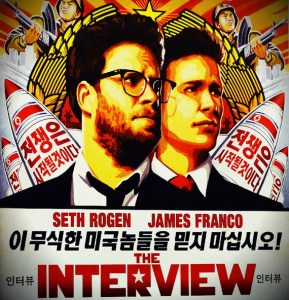
North Korea’s hacking capabilities have become a global talking point recently, after a massive hack of Sony Pictures — the studio behind “The Interview,” a comedy depicting the assassination of Pyongyang’s leader, Kim Jong Un. That was followed by warnings that the movie not be shown in theaters…
CNN, Washington outraged over Sony decision.
From Hollywood to Washington, the outrage is spreading over Sony Pictures’ decision to cancel a movie release following a cyber attack and threats from a group of North Korea-backed hackers.
Politicians urged Sony not to back down in the face of threats tied to the release of the controversial comedy “The Interview,” and then began lashing out when the studio made it clear it has no further plans to release the film, which depicts an assassination plot against North Korean leader Kim Jong Un….
FBI investigators tracked the hackers who broke into Sony’s servers, published private information and threatened moviegoers back to the North Korean regime, U.S. law enforcement officials told CNN on Wednesday. The North Korean regime slammed the movie this summer as “terrorism and a war action.”
And despite the hackers’ threat to attack movie theaters, the Department of Homeland Security has said “there is no credible intelligence” supporting an active plot against movie theaters.
Deadline Hollywood, Hollywood Cowardice: George Clooney Explains Why Sony Stood Alone In North Korean Cyberterror Attack.
EXCLUSIVE: As it begins to dawn on everyone in Hollywood the reality that Sony Pictures was the victim of a cyberterrorist act perpetrated by a hostile foreign nationon American soil, questions will be asked about how and why it happened, ending with Sony cancelling the theatrical release of the satirical comedy The Interviewbecause of its depiction of North Korean dictator Kim Jong-un. One of those issues will be this: Why didn’t anybody speak out while Sony Pictures chiefs Amy Pascal and Michael Lynton were embarrassed by emails served up by the media, bolstering the credibility of hackers for when they attached as a cover letter to Lynton’s emails a threat to blow up theaters if The Interview was released?
Read the interview with Clooney at the link.

The Daily Beast, Paramount Bans Showing ‘Team America’.
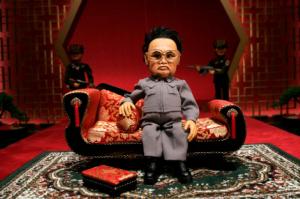
Three movie theaters say Paramount Pictures has ordered them not to show Team America: World Police one day after Sony Pictures surrendered to cyberterrorists and pulled The Interview. The famous Alamo Drafthouse in Texas, Capitol Theater in Cleveland, and Plaza Atlanta in Atlanta said they would screen the movie instead of The Interview, but Paramount has ordered them to stop. (No reason was apparently given and Paramount hasn’t spoken.)Team America of course features Kim Jong Un’s father, Kim Jong Il, as a singing marionette.
Apparently, both Team America: World Police and The Interview are chock full of racist memes about Asians.
North Korea Is Not Funny. Let’s be clear: The Interview isn’t a courageous act of defiance against a dictator, by Adrien Hong at The Atlantic.
In recent months, the uproar over The Interview, a comedy about assassinating North Korean leader Kim Jong Un, has triggered an escalating set of reactions: retaliatory threats from North Korean officials; a sophisticated cyberattack on Sony Pictures, reportedly orchestrated by North Korea; a pledge by the hackers to physically attack theaters showing the film; and now, on Wednesday, Sony’s decision to cancel the movie’s December 25 release altogether, as movie-theater chains began backing out of screenings. The latest development is an act of craven self-censorship and appeasement—a troubling precedent by the Free World’s leading culture-makers. But rightful calls to defend freedom of expression and go ahead with the movie are also mixing with a far more dubious strain of thinking: that the film itself is a form of defiance against a dictatorial regime. It is not.
Kim Jong Il puppet from “Team America World Police.”
In The Interview, directed by the Canadian comics Seth Rogen and Evan Goldberg, a celebrity journalist (James Franco) and his producer (Rogen), tired of producing meaningless content, score a major scoop: an interview with Kim Jong Un (Randall Park). The CIA learns about the trip and recruits the two to kill the leader—a task that, judging from reports and leaked footage, someone eventually succeeds in doing.
This film is not an act of courage. It is not a stand against totalitarianism, concentration camps, mass starvation, or state-sponsored terror. It is, based on what we know of the movie so far, simply a comedy, made by a group of talented actors, writers, and directors, and intended, like most comedies, to make money and earn laughs. The movie would perhaps have been better off with a fictitious dictator and regime; instead, it appears to serve up the latest in a long line of cheap and sometimes racism-tinged jokes, stretching from Team America: World Police to ongoing sketches on Saturday Night Live.
It’s a thoughtful article. I need to go back and give it a careful read.
In other news . . .
Bloomberg View, Hillary Clinton Secretly Pushed Cuba Deal for Years, by Josh Rogin.
Although President Barack Obama is taking the credit for Wednesday’s historic deal to reverse decades of U.S. policy toward Cuba, when Hillary Clinton was secretary of state, she was the main architect of the new policy and pushed far harder for a deal than the Obama White House.
From 2009 until her departure in early 2013, Clinton and her top aides took the lead on the sometimes public, often private interactions with the Cuban government. According to current and former White House and State Department officials and several Cuba policy experts who were involved in the discussions, Clinton was also the top advocate inside the government for ending travel and trade restrictions on Cuba and reversing 50 years of U.S. policy to isolate the Communist island nation. Repeatedly, she pressed the White House to move faster and faced opposition from cautious high-ranking White House officials.
After Obama announced the deal Wednesday, which included the release of aid contractor Alan Gross, Clinton issued a supportive statement distributed by the National Security Council press team. “As Secretary of State, I pushed for his release, stayed in touch with Alan’s wife Judy and their daughters, and called for a new direction in Cuba,” she said. “Despite good intentions, our decades-long policy of isolation has only strengthened the Castro regime’s grip on power.”
But according to the progs, Hillary is a triangulating warmonger. Hmmmmm . . .
ABC News, 5 Sweeping Changes Recommended for Secret Service After Fence Jumper Enters WH.
A bipartisan, independent panel scrutinizing the U.S. Secret Service after a man with a small knife in his pocket jumped the perimeter fence and made it deep inside the White House is recommending sweeping changes at the agency.
The Secret Service’s “paramount mission” of protecting the president and other high-ranking officials “allows no tolerance for error,” and a “single miscue, or even a split-second delay, could have disastrous consequences for the nation and the world,” warns the panel’s final report, commissioned by DHS Secretary Jeh Johnson after the September breach.
Read the recommendations at the link.

The New Yorker, The Unidentified Queen of Torture, by Jane Mayer.
The NBC News investigative reporter Matthew Cole has pieced together a remarkable story revealing that a single senior officer, who is still in a position of high authority over counterterrorism at the C.I.A.—a woman who he does not name—appears to have been a source of years’ worth of terrible judgment, with tragic consequences for the United States. Her story runs through the entire report. She dropped the ball when the C.I.A. was given information that might very well have prevented the 9/11 attacks; she gleefully participated in torture sessions afterward; she misinterpreted intelligence in such a way that it sent the C.I.A. on an absurd chase for Al Qaeda sleeper cells in Montana. And then she falsely told congressional overseers that the torture worked.
Had the Senate Intelligence Committee been permitted to use pseudonyms for the central characters in its report, as all previous congressional studies of intelligence failures, including the widely heralded Church Committee report in 1975, have done, it might not have taken a painstaking, and still somewhat cryptic, investigation after the fact in order for the American public to hold this senior official accountable. Many people who have worked with her over the years expressed shock to NBC that she has been entrusted with so much power. A former intelligence officer who worked directly with her is quoted by NBC, on background, as saying that she bears so much responsibility for so many intelligence failures that “she should be put on trial and put in jail for what she has done.”
Instead, however, she has been promoted to the rank of a general in the military, most recently working as the head of the C.I.A.’s global-jihad unit. In that perch, she oversees the targeting of terror suspects around the world. (She was also, in part, the model for the lead character in “Zero Dark Thirty.”)
According to sources in the law-enforcement community who I have interviewed over the years, and who I spoke to again this week, this woman—whose name the C.I.A. has asked the news media to withhold—had supervision over an underling at the agency who failed to share with the F.B.I. the news that two of the future 9/11 hijackers had entered the United States prior to the terrorist attacks. As I recount in my book “The Dark Side,” the C.I.A. got wind that one of these Al Qaeda operatives, Khalid al-Mihdhar, had obtained a multiple-entry visa into the United States eighteen months before 9/11. The agency also learned, months before the attacks, that another Al Qaeda operative, Nawaf al-Hazmi, had flown into Los Angeles. Yet the C.I.A. appears to have done nothing. It never alerted the F.B.I., which had the principle domestic authority for protecting the U.S. from terror attacks. Its agents had, in fact, been on the trail of at least one of the hijackers previously, but had no way of knowing that he had entered the United States. Nor did the C.I.A. alert the State Department, which kept a “TIPOFF” watch list for terror suspects.
KUT.org, Austin TX, Sexist Comment by Austin Police Officer: Isolated Incident or Part of Broader Culture?
Police Chief Art Acevedo suspended two officers in November for making jokes about rape victims. The Austin Police Association said at the time that the respective three-day and five-day suspensions were “fair and appropriate.” The incident took place after a local attorney had released a video in which the two Austin police officers are laughing and one of the officers comments: “Go ahead and call the cops. They can’t un-rape you.”
Recently, offensive comments were made to KUT’s reporter Joy Diaz, while she was covering a police-related story….
Just to set the scene, this reporter was at the police union’s building waiting to interview the head of the union. That’s when veteran officer [Andrew] Pietrowski approached me and started talking about the media fall-out over the video tape of NFL running back Ray Rice punching and knocking out his then-fiancé in a hotel elevator. Rice was suspended by the NFL and was released by his team.
Pietrowski says the event was blown out of proportion by the media. That’s when he explained.
“Now, stop and think about this. I don’t care who you are. You think about the women’s movement today, [women say] ‘Oh, we want to go [into] combat,’ and then, ‘We want equal pay, and we want this.’ You want to go fight in combat and sit in a foxhole? You go right ahead, but a man can’t hit you in public here? Bulls–t! You act like a whore, you get treated like one!”
Pietrowski retired from the force after learning that KUT planned to reveal his comments on the air.
S0 . . . . what else is happening? Please post links to the stories that interested you in the comment thread, and Happy Friday!
Thursday Reads: A Historic Agreement Between the U.S. and Cuba
Posted: December 18, 2014 Filed under: Barack Obama, Foreign Affairs, morning reads, Republican politics, U.S. Politics | Tags: cuba, Cuban artists, diplomacy, John Boehner, Marco Rubio 22 Comments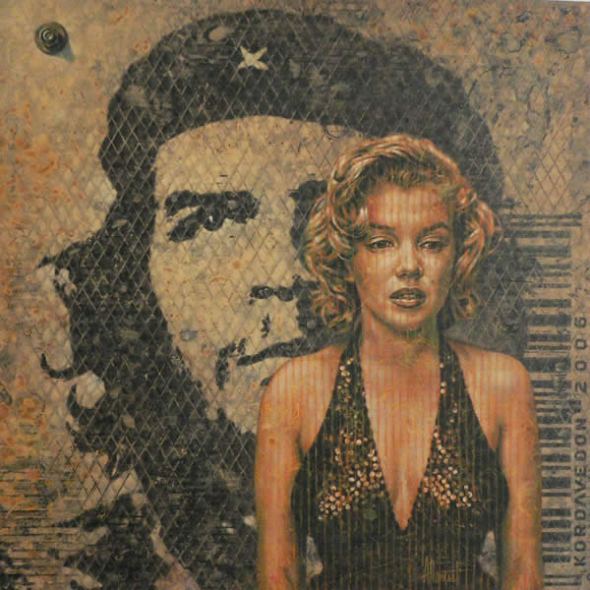
Good Morning!!
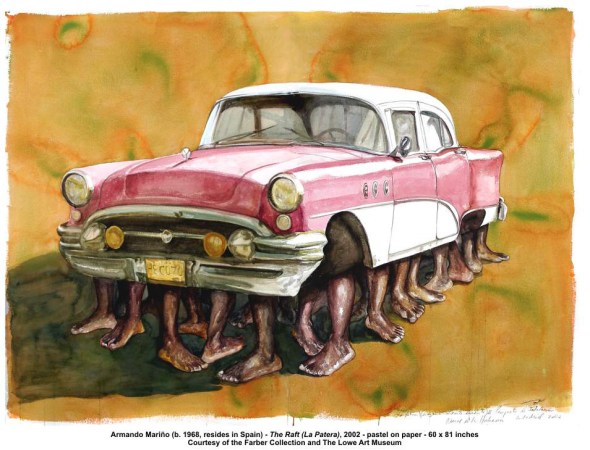
Finally we have some good news to discuss, if Republicans can somehow be prevented from ruining it. The U.S. and Cuba have reached an agreement to normalize relations between the two countries after 50 years of hostilities and sanctions. In celebration of this long-overdue step forward, I’m going to illustrate this post with the work of Cuban artists. You can read about the above painting of Marilyn Monroe superimposed on a photo of Che Guevara and the artist Adrian Rumbaut at the Cuban Art blog. Here’s a bit of background:
In the work, Adrian Rumbaut has reproduced Alberto Korda’s famous 1960 photograph of Che Guevara, and he inserts his vision of American Richard Avedon’s iconic photo of Marilyn Monroe as well. In the letters on the side of the painting, Rumbaut gives credit to both Korda and Avedon for their images, and provides the date of his painting.
Interestingly, Korda had worked as a fashion photographer as a young man, and he wanted very much to be the Richard Avedon of Cuba. He photographed the “beautiful people” of the Batista era before the revolution, and models lined up in front of his studio to have their picture taken. Taken by surprise by the “triumph of the revolution” in 1959, he worked subsequently with Raul Corrales, Castro’s official photographer, to capture the excitement of the revolution. In his image of Che, something survives of his earlier experience with beautiful women.
Korda’s image of Che — snapped in 1960 and also known as Guerrillero Heroico — has been repeatedly reproduced worldwide, serving as both a symbol of protest and as a fashion accessory.
The iconic photo has taken on increasingly exotic forms, each created with different intentions and evoking varied responses. Along with Marilyn Monroe, Jesus Christ, Madonna, and Princess Diana have all had their pictures adapted and inserted under Che’s familiar red star beret. It isn’t an exaggeration to note that Che the icon has overtaken Che the revolutionary.
The original “Che” photograph was taken at a dangerous moment, a time when the new revolutionary government was preparing for imminent US invasion. It was at the start of the Cuban Revolution’s second year, and Castro’s government had ordered a boatload of weapons and ammunition — mostly rifles and grenades — from Belgium. The armaments were loaded onto a French ship, La Coubre which, unfortunately, exploded upon arrival in Havana Harbor in March 1960. The crew and 75 Cuban dockers were killed. More than 200 were injured.
Here’s a wonderful example of Cuban street art that I found at a Cuban travel site, Insight Cuba.
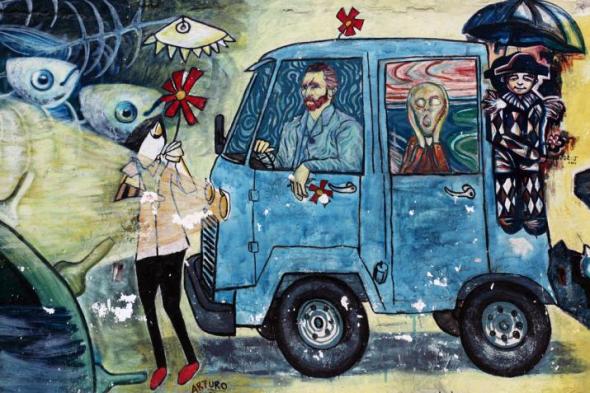
See more examples of Cuban “graffiti” at the link.
Some background on what’s happening from CNN yesterday: Cuba releases American Alan Gross, paves way for historic easing of American sanctions.
Washington (CNN) — U.S. contractor Alan Gross, held by the Cuban government since 2009, was freed Wednesday as part of a landmark deal with Cuba that paves the way for a major overhaul in U.S. policy toward the island, senior administration officials tell CNN.
President Barack Obama spoke with Cuban President Raul Castro Tuesday in a phone call that lasted about an hour and reflected the first communication at the presidential level with Cuba since the Cuban revolution, according to White House officials. Obama announced Gross’ release and the new diplomatic stance at noon in Washington. At around the same time, Cuban president Raul Castro was set to speak in Havana.
President Obama announced a major loosening of travel and economic restrictions on the country. And the two nations are set to re-open embassies, with preliminary discussions on that next step in normalizing diplomatic relations beginning in the coming weeks, a senior administration official tells CNN.
Talks between the U.S. and Cuba have been ongoing since June of 2013 and were facilitated by the Canadians and the Vatican in brokering the deal. Pope Francis — the first pope from Latin America — encouraged Obama in a letter and in their meeting this year to renew talks with Cuba on pursuing a closer relationship.
Gross’ “humanitarian” release by Cuba was accompanied by a separate spy swap, the officials said. Cuba also freed a U.S. intelligence source who has been jailed in Cuba for more than 20 years, although authorities did not identify that person for security reasons. The U.S. released three Cuban intelligence agents convicted of espionage in 2001.
The developments constitute what officials called the most sweeping change in U.S. policy toward Cuba since 1961, when the embassy closed and the embargo was imposed.
Read much more at the link. It’s a good article that provides quite a bit of background on the historic agreement.
More details on the secret negotiations from William M. LeoGrande and Peter Kornbluh, authors of the book Back Channel to Cuba: The Hidden History of Negotiations between Washington and Havana, published in October of this year.
Secret meetings with Cuba finally pay off.
Presidents frequently conduct sensitive diplomatic dialogues in secret, because the furor of public attention makes it politically impossible to reach the compromises necessary for agreement. These secret talks are often crucial for diplomatic advances — as we learned Wednesday with the stunning revelations about the impending talks between Washington and Havana that have been underway secretly for the past few months. President Barack Obama’s far-reading initiatives are reminiscent of the secret talks Henry Kissinger held with Beijing to lay the groundwork for President Richard M. Nixon’s historic diplomatic opening to China.
When the mere act of talking to an adversary is too politically sensitive, presidents can resort to private emissaries, despite the risks created by relying on amateur diplomats. Obama had help from both Canada and the Vatican in reaching these new agreements.
In our recent book, Back Channel to Cuba: The Hidden History of Negotiations between Washington and Havana, we uncovered literally dozens of secret diplomatic contacts and negotiations. Despite what Kissinger called the “perpetual antagonism” between the United States and Cuba, there is a rich and colorful history of dialogue between these two nations over the last 50 years.
There are lessons to be learned from this half-century of back-channel talks about what works and what doesn’t when conducting secret negotiations.
First, a history of animosity makes adversaries wary. Neither wants to appear weak by making concessions too easily. Goodwill gestures may go unrequited and the apparent obstinacy of one side or the other can doom a diplomatic process before it gets off the ground. When Fidel Castro was in power, for example, he worried constantly that any concession to U.S. demands would be read as weakness and lead to a redoubling of U.S. efforts to overthrow him.
Read all about it at the Reuters link.
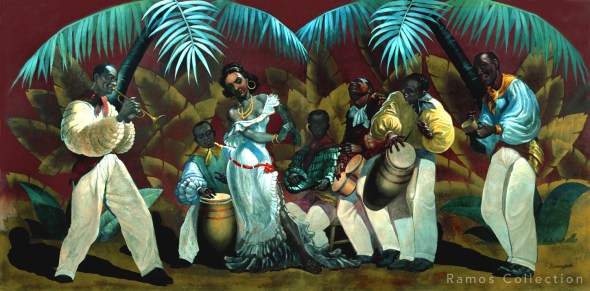
From the Masters of Cuban Art Image Gallery, “La Conga” by Evelio Garcia Mata.
“Garcia Mata plays the rhythm of the conga in the body of the mulatto dancer, who lifts her left arm as she does the kick-step. She wears a sensual typical dress and is accompanied by a group of six musicians. The painting beautifully represents when Afro-Cuban music became main-stream, and a representative of Cuban culture at large.”
– Alfredo Triff, Musician and Art Critic
Isn’t it amazing that Pope Francis–the first Latin American to lead the Church–was instrumental in making this happen? As a long-lapsed Catholic, I’m truly surprised and pleased. After years of regressive Popes, this guy seems to be a throwback to the days of Pope John the XXIII when it seemed that the Church might move into the 20th century.
From The Atlantic: How the Pope Helped End the Cuba Embargo.
On Wednesday, a senior Obama administration officials spoke of an “extraordinary letter” written by the pope to President Obama and Cuban President Raúl Castro over the summer in which he urged the two men to mend the relationship between their countries.
As one official noted, the correspondence “gave us greater impetus and momentum for us to move forward.”
In a press conference on Wednesday, which also happens to be the pope’s 78th birthday, President Obama credited Francis for his influential “personal plea” and thanked him for his “moral example.”
In particular, I want to thank his Holiness Pope Francis, whose moral example shows us the importance of pursuing the world as it should be, rather than simply settling for the world as it is.
According to officials, Pope Francis brought up Cuba several times during his meeting with the president in March and, given Francis’ significance as the first pope from Latin America, it’s fair to assume that his clout likely helped bring Castro to the table as well.
Vatican officials were also said to have been present during the negotiations between the United States and Cuba, marking them the only other country to directly participate in the talks. While Canada reportedly hosted the majority of the secret meetings of the two sides, according to a Vatican statement, the pope also hosted Cuban and American representatives together earlier this year during the final deal was struck.
Some reactions to Obama’s great achievement.
From the LA Times, Miami reacts to Obama’s Cuba move: Tears of joy, cries of ‘traitor’.
A tale of two restaurants unfolded in South Florida on Wednesday.
In Miami’s Little Havana, Versailles Restaurant hosted hard-line Cuban exiles railing against President Obama’s decision to establish full diplomatic ties with the Cuban government. They waved placards and hurled insults bilingually, putting on the show they’ve been rehearsing and staging for half a century.
The show at Versailles involved megaphones and pickup trucks, national news outlets parked in front of a spot that serves tasty espresso, and a handful of outspoken Cuban Americans who yell loud enough to scare viewers in Nebraska. Whenever major news breaks about Cuba, the media flocks to Versailles to take the pulse of the Cuban community.
Meanwhile in Hialeah, a city with a far larger number of Cubans and Cuban Americans than Little Havana, Tropical Restaurant served cafeteria-style meals to a quieter, more sanguine crowd. Here, many welcomed Obama’s decision.
“It’s going to be better for the Cuban people. It’s going to be better for the United States,” said ReinierOropeza, 33, an accountant who to came to the U.S. from Cuba in 1998.
Many Cubans here are young, or came to the United States more recently, or have closer ties with their families in Cuba.
Oropeza said many older Cubans are stuck in the past. “They are old and they stand back and blame Castro. They already did what they had to do. So young people have to take over now.”
Once again, read much more at the link.
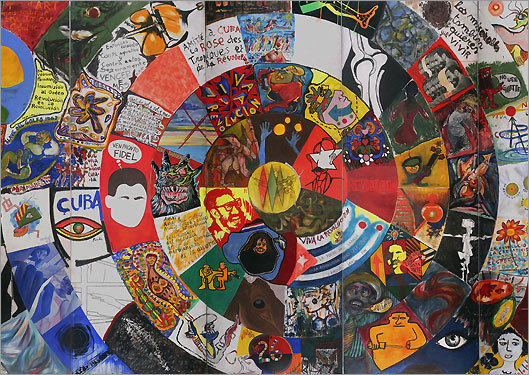
Read more about this mural by 100 Cuban artists at The New York Times, Feb. 3, 2008: It’s Not Politics. It’s Just Cuba.
Courtesy of the Montreal Museum of Fine Arts
“Cuba Colectiva,” a 1967 mural by 100 artists for the Salon de Mai exhibition in Havana, on view at the Montreal Museum of Fine Arts.
More reactions from Republican politicians:
Drunken party-pooper John Boehner is not happy.
(Reuters) – U.S. House Speaker John Boehner sharply criticized President Barack Obama’s policy change toward Cuba, calling it “another in a long line of mindless concessions” to a brutal dictatorship.
“Relations with the Castro regime should not be revisited, let alone normalized, until the Cuban people enjoy freedom – and not one second sooner,” Boehner said in a statement.
Cry me a river, a$$hole. At least Cubans have free health care.
Marco Rubio, who is supposedly a Catholic after transitioning through the Mormon and Southern Baptist churches, had the temerity to “call out the Pope on Cuba” according to Politico.
Sen. Marco Rubio, a Catholic, criticized Pope Francis on Wednesday after the pontiff played a key role in helping the United States and Cuba forge an agreement that resulted in the release of American Alan Gross from Cuba.
Rubio said he would “ask His Holiness to take up the cause of freedom and democracy.”
The Florida Republican said he didn’t criticize Francis’ personal appeals to help facilitate Gross’ release, but was speaking in response to the White House’s announcement about talks to normalize relations with Cuba after a nearly 50-year embargo with the country.
Rubio is set to play a major role in Cuba policy as the chairman of the Senate Foreign Relations subcommittee on Western Affairs, and he noted Wednesday some of Congress’ leverage points, such as funding for embassies and nomination of a U.S. ambassador to Cuba.
“I’m committed to doing everything I can to unravel as many of these changes as possible,” Rubio said.
More from Huffington Post: Marco Rubio Fires Back On Cuba: Obama Is The ‘Worst Negotiator’ In My Lifetime.
President Barack Obama will get no money for his Cuba policy, no ambassador will be confirmed and the embargo will never be lifted, Sen. Marco Rubio (R-Fla.) vowed in a blistering press conference on Wednesday.
In a historic move earlier in the day, Obama announced that the United States will begin talks with Cuba to normalize full diplomatic relations, marking the most significant shift in U.S. policy towards Cuba in 50 years. The president’s remarks followed the release on Wednesday morning of American Alan Gross, who had been held in a Cuban prison for five years. Gross’ release was negotiated in exchange for the freeing of three Cubans who had been jailed in the U.S. for spying.
“This entire policy shift announced today is based on an illusion, based on a lie,” Rubio, who is the son of Cuban immigrants, told reporters on Capitol Hill. “The White House has conceded everything and gained little.”
“I’m committed to doing everything I can to unravel as many of these changes as possible,” he added.
Why is this moron in the U.S. Senate? Obama will have more battles ahead with the Republican Congress, but he seems determined to move ahead with the changes he wants to make anyway. I’m rooting for him.
What do you think? What other stories are you following today? Please share your thoughts and links in the comment thread and enjoy your Thursday!
Tuesday Reads: Can The News Get Any Worse? Probably.
Posted: December 9, 2014 Filed under: Barack Obama, Foreign Affairs, morning reads, U.S. Politics | Tags: "I Can't Breathe", abortion, BET, Colbert Report, Dick Cheney, Eric Garner, George W. Bush, Henri Matisse paintings, LeBron James, NBA, police involved shootings, Racism, Senate torture report 52 Comments
Good Morning!!
It’s difficult to imagine how the news can get any worse . . . and then it does.
Bloomberg: CIA Torture Report Set for Senate Release Over Bush Objections.
Dec. 9 (Bloomberg) — The Democrats on the Senate intelligence committee are preparing to issue their report on the harsh interrogation tactics the CIA used on terrorism suspects, defying the objections of current and former U.S. officials including former President George W. Bush.
The panel plans to release today a summary of a 6,200-page report concluding that the Central Intelligence Agency used extreme interrogation methods at secret prisons more often than legally authorized and failed to disclose all the activities to lawmakers and other officials.
Despite warnings from opponents of the report’s release, including some Republicans on the panel, that Americans would face retaliation overseas, President Barack Obama supports making the conclusions public, White House spokesman Josh Earnest said yesterday.
“The president believes that, on principle, it’s important to release that report, so that people around the world and people here at home understand exactly what transpired,” he said. Earnest said the administration has taken steps to improve security at U.S. facilities around the world.
Read the arguments for and against releasing the report at the link. A brief summary of the conflict at USA Today: Obama, Bush teams battle over torture report. Of course Dick Cheney felt the need to butt in.
While Obama and aides support release of the report as to way to prevent future abuses, some Bush administration officials call it partisan second-guessing of techniques that proved necessary during the war on terrorism.
“What I keep hearing out there is they portray this as a rogue operation and the agency was way out of bounds and then they lied about it,” former vice president Dick Cheney told The New York Times. “I think that’s all a bunch of hooey. The program was authorized. The agency did not want to proceed without authorization, and it was also reviewed legally by the Justice Department before they undertook the program.” [….]
The dispute between Obama and Bush officials revolves around the legality of the interrogation programs and whether they yielded valuable intelligence as the U.S. raced to block terrorism in the years following the attacks of Sept. 11, 2001.
Cheney and other Bush administration officials say the programs yielded actionable intelligence that helped uncover possible terrorist plots.
Congressional Democrats say the report shows that tactics like waterboarding yielded nothing that could not have been obtained by other means.
The two sides agree on one thing: Release of the Senate report, detailing some of the less savory methods used to extract testimony from terrorism suspects, could lead to violent, anti-American protests in some countries.

Reuters has a minor preview on the contents of the report: Sexual threats, other CIA methods detailed in Senate report.
The report, which Committee Chairwoman Dianne Feinstein said would be released on Tuesday, describes how al Qaeda operative Abdel Rahman al Nashiri, suspected mastermind of the 2000 bombing of the USS Cole, was threatened with a buzzing power drill, the sources said. The drill was never actually used on him.
It documents how at least one detainee was sexually threatened with a broomstick, the sources said.
Preparing for a worldwide outcry from the publication of such graphic details, the White House and U.S. intelligence officials said on Monday they had shored up security of U.S. facilities worldwide.
The report, which took years to produce, charts the history of the CIA’s “Rendition, Detention and Interrogation” program, which President George W. Bush authorized after the Sept. 11 attacks.
Bush ended many aspects of the program before leaving office, and President Barack Obama swiftly banned “enhanced interrogation techniques,” which critics say are torture, after his 2009 inauguration.
The Christian Science Monitor asks what I think is an irrelevant question: Did torture yield results? I really don’t care; some things are just wrong period.
The 480-page document reveals the results of Senate investigation into the CIA’s use of torture and other techniques that violate international law against prisoners held on terrorism-related charges. Though many details of the Senate’s findings will remain classified – the document is a summary of a 6,000-page report that is not being released – the report is expected to conclude that the methods used by the CIA to interrogate prisoners during the post-9/11 years were more extreme than previously admitted and produced no intelligence that could not have been acquired through legal means….
The Los Angeles Times writes that the report is expected to say that the CIA used methods of “waterboarding, sleep deprivation, stress positions and other so-called enhanced interrogation techniques more frequently than was legally authorized at then-secret prisons known as ‘black sites.’ ”
The report will also likely state that the intelligence acquired from the use of such techniques was not useful to finding Osama bin Laden or preventing attacks on US interests, and “nearly all the intelligence gleaned through harsh techniques could have been obtained from more traditional intelligence-gathering systems,” the Times adds.

We probably should brace for attacks on President Obama for daring to go on BET and talk about racism and then follow that up by joking around with Stephen Colbert.
BET Exclusive: Obama Talks Race, Racism and How Far America Has to Go. Watch the interview at the link. Joyce Jones highlights the main points:
Barack Obama – not the president, but the man – has a dream: his children will be viewed as individuals and judged not by the color of their skin but based on the content of their character, their behavior and their talents and gifts. Sadly, he observed in an exclusive interview with BET Networks, “misguided attitudes” mean that people of color still have less margin for error, particularly if they are male….
Hours before the interview aired, his critics on the right began lashing out at him for, according to Breitbart News, “playing the race card more overtly than ever before.” Others will say it’s about time he spoke up about the series of police-involved deaths of a disproportionate number of African-American men, which he acknowledged. But he also said that “institutionally” he is required to remain silent during the investigations of those incidents, which would be compromised “if it appeared that I was trying to steer to a particular outcome.”
That doesn’t mean he does not empathize with those who’ve expressed their anger and frustration more publically. The president recalled a meeting he had last week that included several young African-American leaders whose experiences of being stopped or treated suspiciously for no reason reminded him of his own. He also said that as long as the protests remain peaceful, they are necessary.
“I’m going to stay on this,” the President said Monday in an interview with BET, a network that reaches a predominately young African-American audience. “Not only am I going to stay on it … but hopefully the entire society says, ‘Let’s finally try to make some real progress on this.'”
Once criticized for shying away from the topic of race early on in his presidency, Obama has recently taken a more active role in sharing how his personal experiences help him to empathize with all kinds of people affected by the recent protests on racial tensions — from protesters, to victims, to law enforcement officers, to families, and most importantly, to black youth.
In his interview with BET’s “106 & Park,” the President cited a meeting he had with nonviolent protesters Monday — between ages 18-25. For him, he says, listening to young African-Americans describe their own experiences of being stopped for no reason, or being unjustly labeled as suspicious, strikes a personal chord.
“My mind went back to what it was like for me when I was 17, 18, 20,” the President said. “As I told them, not only do I hear the pain and frustration of being subjected to that kind of constant suspicion, part of the reason I got into politics was to figure out how can I bridge some of those gaps and understandings so that the larger country understands this is not just a black problem or a brown problem, this is an American problem.”
The President also made a point to invoke Attorney General Eric Holder’s race and civil rights record, saying, “He’s got a similar set of stories and experiences he can share.”

The Boston Globe on Obama’s Colbert Report appearance:
Obama kicked off the show sitting in for Colbert to perform a regular feature of the program called ‘‘The Word’’ wherein Colbert’s rants are accompanied by snarky messages to the audience.
So when Obama, as Colbert, declared that there are aspects of ‘‘Obamacare’’ that people from both parties actually like, the text aside to the audience read, ‘‘Everything but the Obama.’’
Later, Colbert observed that the economy had been creating more jobs of late.
‘‘You have employed a lot of people — mostly as secretary of defense,’’ Colbert cracked in a reference to Obama recently nominating his fourth top civilian at the Pentagon.
‘‘That’s boosted our numbers a little bit,’’ Obama replied.
Colbert, whose on-screen persona is that of an insufferable conservative scold, accused Obama of exceeding his authority on immigration. ‘‘When did you decide to burn the Constitution and become emperor?’’ he asked. The question was heard as a joke by many in the audience at George Washington University. But to Obama’s critics, the question had a ring of truth.
Obama dropped the comedy and replied, ‘‘Actually, Steve, everything that we have done is scrupulously within the law and has been done by previous Democratic and Republican presidents.’’
Watch part of the episode at the link.

You know how Republicans are constantly claiming that their anti-abortion laws are designed to keep women safe? From Think Progress: Large Study Confirms That Abortion Is Extremely Safe.
After analyzing data from nearly 55,000 women who received abortion care under California’s Medicaid program, researchers at UC San Francisco concluded that hardly any of them had serious complications within six weeks of their procedure. Just 126 cases necessitated follow-up care for surgery, a blood transfusion, or other conditions that require hospital admission.
Other studies, including data from the Centers for Disease Control and Prevention, have also confirmed abortion’s safety. We already had some evidence, for instance, that giving birth is about 14 times riskierthan having an abortion. But the new UCSF study goes a bit further than previous research by tracking the complete data on all of the health care used by women who have received abortions. Since many women have to travel long distances to end a pregnancy, the UCSF researchers also examined women’s follow-up care at facilities closer to where they live….
Despite the mounting evidence in this area, the notion that abortion may be dangerous for women is a pervasive assumption that hasbolstered the passage of dozens of state laws tightening restrictions on clinics and doctors. In a press release announcing their findings, the study authors indicated that they hope the new study “will contribute to the national debate over abortion safety.”
“Abortion is very safe as currently performed, which calls into question the need for additional regulations that purportedly aim to improve safety,” said Ushma Upadhyay, an assistant professor at Advancing New Standards in Reproductive Health (ANSIRH), a leading research program based at UCSF.
Of course scientific studies won’t move right wing extremists, who do not believe in science in the first place.

Yesterday I was relieved to see many women writers pushing back against the UVA rape story backlash and asking readers to remember that “Jackie” is a real person with real emotions, and the kinds of memory failures she may have evidenced are comment in human beings. I’m running out of space, so I’ll just provide some links to some of the articles I found.
From Buzzfeed, Annie Clark writes: There Are Too Many Jackies.
Clark and her friend Andrea Pino were students at UC Chapel Hill when they were sexually assaulted. Together they filed a complaint with the Department of Education under Title IX. Their work is what triggered the Obama administration to take a stronger position on sexual assaults on college campuses.
Read about it in Vogue, Campus Sexual Assault: Annie E. Clark and Andrea Pino Are Fighting Back—And Shaping the National Debate. Clark and Pino started an organization called End Rape on Campus (EROC).
More important articles:
Roxanne Gay, Our Stories.
TPM, UVA Rape Victim’s Roommate Says Her Story Is Not A ‘Hoax’.
Buzzfeed, How Police And Hospitals Shut Down Rape Victims.
Jessica Valenti, Who is Jackie? Rolling Stone’s rape story is about a person – and I believe her.
Amanda Marcotte, UVA controversy allows woman-haters to get really, really ugly.
Maya Dusenbery, On Rolling Stone, lessons from fact-checking, and the limits of journalism.
Caroline Fairchild, Why the media obsession with Rolling Stone’s UVA rape story is all wrong.

Finally, some NBA players have begun wearing “I Can’t Breathe T-Shirts.”
From ESPN, LeBron James, Kyrie Irving address reasons for ‘I can’t breathe’ shirts.
NEW YORK — As he stood amid 70 or so media members inside a cramped Cavaliers locker room Monday night, LeBron James explained the significance of the powerful words that stretched across his torso during pregame warmups.
“If it feels important to me then I respond,” said James, who wore a black t-shirt with the words “I CAN’T BREATHE” prior to the start of his team’s game against the Nets at the Barclays Center. “If it doesn’t, I don’t. There are a lot of issues I have not talked about. For me, it is about knowledge and about a gut feeling that hits home for you. You feel it, and go about it.” [….]
…the story of the night was the activism of a number of NBA players. Before the game, the Cavaliers’ James, Kyrie Irving and the Nets’ Deron Williams and Kevin Garnett among others all wore the same black t-shirts. They are the latest professional athletes to make a personal statement on the death of Eric Garner, a 43-year-old Staten Island man who was killed on July 17 after he was wrestled to the ground and choked to death by police officers arresting him for selling untaxed cigarettes. Last week a Staten Island grand jury decided not to bring charges in the police-involved death. That decision has prompted protests around the country, as protesters have mobilized around Garner’s last words: “I can’t breathe.” A video recording of the arrest has been viewed by millions.
Unbeknownst to the players, protesters swarmed Atlantic Avenue outside the Barclays Center during the game, holding a “die-in” to protest the Garner ruling. The hashtag #RoyalShutdown was used by activists on Twitter as a rallying point.
That’s all I have. What stories are you following today? Please share your thoughts and links in the comment thread, and enjoy your Tuesday.

 peej
peej Carissa
 bostonboomer
 dakinikat
 ecocatwoman
 mablue2
 Mama Lopez
 peggysue22
 quixote
 skydancingguestblogger
 Mona (aka Wonk the Vote)



 Sky Dancing
Recent Comments