







Emboldened in his job, Mr. Trump has rebelled against Kelly’s restrictions and mused about doing away with the chief of staff post entirely. It’s all leading White House staffers and Trump allies to believe that Kelly is working on borrowed time….
Mr. Trump recently told one confidant that he was “tired of being told no” by Kelly and has instead chosen to simply not tell Kelly things at all, according to a person who was not authorized to publicly discuss private conversations and spoke on condition of anonymity.
Lazy Saturday Reads
Posted: April 28, 2018 Filed under: Foreign Affairs, morning reads, U.S. Politics | Tags: Adam Schiff, Angela Merkel, Aras Agalarov, Donald Trump, Donald Trump Jr, Emin Agalarov, Emmanuel Macron, House Intelligence Committee, North Korea, South Korea, Trump Tower Azerbaijan 23 Comments
Daniel Ralph Celantano, Subway
Good Morning!!
I’m tired . . . so tired. Life in Trump world is exhausting. We’ve reached the point where it’s obvious that Trump’s family and campaign conspired witIh Russia to win the White House, and yet we still have to listen to Trump rant “no collusion” in his ugly, blaring voice. Have you noticed his Queens accent really comes out when he’s apoplectic like he was on Fox and Friends on Thursday? It seems his rosacea gets worse when he’s angry too. If only I never had to hear that honking voice or see his ugly orange face ever again!
I think maybe Angela Merkel agrees with me. Bess Levin at Vanity Fair: All the Times Angela Merkel’s Face Said “STFU You Dumkopf Orange Oaf.”
On Friday, German chancellor Angela Merkel arrived at the White House for a three-hour “working session” with Donald Trump, the goal of which was to convince the American to resist his impulses and not do anything stupid on a host of issues ranging from trade to Iran to the environment. Picking up where French president Emmanuel Macron left off—which is to say, at square one—Merkel’s visit was expected to be much less of a lovefest, meaning no hugging, kissing, hand-holding, fancy dinners, 21-gun salutes, or animal-kingdom mating rituals. The best anyone could hope for, experts warned, was that through small words and simple sentence construction, the chancellor could make Trump understand that so many of his threats—particularly the ones on trade—would hurt not only the targets for which they were intended, but the U.S. as well.
Charlotte Johnson Wahl, Subway NYC, 1994
Even then, expectations were extremely low, given the 45th president’s inability to understand complex, nuanced issues, or the freaking difference between a trade deficit and a surplus. Still, when the two took to a pair of podiums to hold a joint press conference on Friday afternoon, the vibe seemed slightly better than expected. For one thing, Trump was neither foaming at the mouth nor actively refusing to shake Merkel’s hand. For another, Merkel dug deep and paid Trump some compliments using words and phrases you know he just ate up, mentioning the “strength” of his sanctions on North Korea, and claiming that last year’s tax legislation has made the U.S. a “very interesting place for our companies” to invest. Still, one need only take a gander at Merkel’s notoriously weak poker face to understand that inside, she was screaming I can’t believe I have to occupy the same airspace as this knuckle-dragger.
Watch videos and read more snark at Vanity Fair. I can’t even begin to imagine how Macron could bear to have Trump’s hands all over him during their visit. Just the thought of it makes me gag.
On the “no collusion” front . . .
Paul Waldman and Greg Sargent at The Washington Post: The new House GOP report on Russia is revealing. But not in a good way for Trump.
Republicans on the House Intelligence Committee on Friday released a report on Russia’s involvement in the 2016 election. Although it is meant to exonerate President Trump and everyone around him, what it actually does is bring the utter degradation and disgrace of that committee to its fullest expression.
Mark Rothko, Untitled Subway, 1937
By contrast, there may be real news in the Democrats’ response to the report. In particular, the Democrats detailed new information that appears to shed light on what Republicans would not do in their investigation.
The response by Democrats makes this important charge: That Republicans refused to follow up on a lead that could have demonstrated whether, despite his denials, Trump had advance knowledge of the now-infamous Trump Tower meeting in June 2016 between a group of Russians and Donald Trump Jr., Jared Kushner, and Paul Manafort.
Specifically, it appears very likely that Trump talked to Don Jr. on the phone while Jr. was setting up the meeting.
According to the Democratic response, right after Trump Jr. set up the specifics of the meeting, he had two calls with a number in Russia belonging to Emin Agalarov. Between those two calls, the Democratic response recounts, Trump Jr. received a third call from a blocked number. Who might it have been? [….]
“We sought to determine whether that number belonged to the president, because we also ascertained that then-candidate Trump used a blocked number,” Schiff said during our interview. “That would tell us whether Don Jr. sought his father’s permission to take the meeting, and [whether] that was the purpose of that call.”
Lily Furedi, Subway, 1934
Schiff added that Democrats asked Republicans to subpoena phone records to determine whose number it was, but Republicans “refused,” Schiff said. “They didn’t want to know whether he had informed his father and sought his permission to take that meeting with the Russians.”
Raise your hand if you think the call from the blocked number was from someone other than Daddy Trump. I’m sure Robert Mueller and his team already know whose number that was.
Buzzfeed: Trump Jr. And Emin Agalarov Stayed In Touch Throughout The Transition.
A direct line of communication between the Kremlin-connected Agalarov family and the Trump family was open during the transition after President Donald Trump’s presidential election, BuzzFeed News has learned.
The “first of a series” of text messages was sent between Emin Agalarov and Donald Trump Jr. two days after the 2016 election, a source familiar with the communications told BuzzFeed News.
The communications continued through at least mid-December 2016, according to information made public Friday.
It is not clear how many messages were sent, whether Trump Jr. sent any of them, or how many were sent by either party — although BuzzFeed News confirmed that multiple messages were sent.
Nicole Eisenman, Weeks on the Train
Democrats on the House Intelligence Committee revealed one of the text messages, from Dec. 13, 2016, in their “minority views” report on Friday — one of several new pieces of information that suggest that the Trumps’ relationship with the Agalarovs was much closer than the president and his family have said.
Many more details at the Buzzfeed link.
CNN: Russians followed up on Trump Tower meeting after election, Democrats say.
Rep. Adam Schiff, the top Democrat on the intelligence panel, told CNN’s Jim Sciutto on Friday that Russian lawyer Natalia Veselnitskaya reached out to the Trump family after the election with a request to follow up on efforts to repeal the Magnitsky Act, the 2012 Russian sanctions the US enacted over human rights abuses.
Veselnitskaya was the Russian lawyer at the center of the June 2016 Trump Tower meeting, where Donald Trump Jr. expected to receive damaging information on Hillary Clinton but instead Veselnitskaya focused on the repeal of the sanctions.
“Clearly, there’s an expectation there on the Russian side that they may now have success with the Magnitsky Act, given that the prior meeting and communications dealt with the offer of help,” Schiff said. “It certainly seems like the Russians were ready for payback.”
In addition, another effort to reach out to Trump’s team after the election came from Aras Agalarov, the Azerbaijani-Russian oligarch who also has ties to the Trump Tower meeting. Agalarov, along with his pop-star son, Emin Agalarov, also worked with Trump to bring the 2013 Miss Universe Pageant to Moscow….
G. Boersma, Surrounding, Man reading newspaper on NY subway
Democrats cite a November 28, 2016, email from publicist Rob Goldstone to Trump’s assistant, Rhona Graff, which said that “Aras Agalarov has asked me to pass on this document in the hope it can be passed on to the appropriate team.”
“Later that day, Graff forwarded to Steve Bannon the email with Agalarov’s document regarding the Magnitsky Act as an attachment, explaining, ‘The PE [President Elect] knows Aras well. Rob is his rep in the US and sent this on. Not sure how to proceed, if at all.'”
Trump’s team has denied there was any follow up after the Trump Tower meeting.
While Trump claims credit for the meeting between North Korea’s Kim Jon Un and South Korea’s Moon Jae-in, Max Boot points out at The Washington Post that this has happened before: Don’t let the Korea summit hype fool you. We’ve been here before.
The meeting between the leaders of North and South Korea was acclaimed as “historic.” The two leaders hugged, “smiled broadly, shook each other’s hand vigorously and toasted each other with glasses of champagne.” Reporters noted that the “opening formalities seemed surprisingly relaxed, exceeding the expectations of many people, including perhaps those of the principals themselves. The South Korean leader said we must “proceed together on a path of reconciliation and cooperation.” The North Korean leader replied that “you will not be disappointed.”
Sound familiar? It should, because the news coverage of the 2000 meeting between South Korean President Kim Dae-jung and North Korean leader Kim Jong Il in Pyongyang parallels the euphoria over Friday’s meeting in Panmunjom between Moon Jae-in and Kim Jong Un, Kim Jong Il’s son. If anything, the 2000 meeting produced more tangible results: Not only declarations about ending the Korean War and uniting the two countries, but also concrete steps toward creating a joint South Korean-North Korean industrial park in Kaesong , allow South Korean tourists to visit the North, and to reunify families long divided by the demilitarized zone. Between 1998 and 2008, South Korea provided some $8 billion in economic assistance to North Korea in the hope that all of this aid would create a kinder, gentler regime. Kim Dae-jung won the Nobel Peace Prize in 2000 for his efforts.
Subway Train Watercolor painting, Shyama Golden
And yet the Sunshine Policy, so widely heralded at the time, is now widely judged a failure. Despite North Korea’s promises, it did nothing to ease the repression of its populace or to end its nuclear and missile programs. It turned out Kim Dae-jung only achieved that “historic” 2000 summit by offering Kim Jong Il a $500 million bribe. Another summit was held in 2007, arranged by Moon Jae-in, then an aide to President Roh Moo-hyun, and it too was rapturously acclaimed. But the next year, a conservative government took power in Seoul and ended the Sunshine Policy.
Read the rest at the link.
Finally, a little schadenfreude. The Independent reports that there was a fire in the Trump Tower in Azerbaijan. Fortunately, there were no injuries.
A skyscraper that was slated to become a Trump International Hotel in the Azerbaijani capital of Baku has caught fire.
The Azadliq newspaper reported that the blaze broke out on the middle floors of the 33-storey building, which is locally known as Trump Tower, and spread.
Etibar Mirzoev, deputy head of the Emergency Situations Ministry, said there were no injuries and authorities were working to establish the cause of the of the fire.
What stories are you following today?
Lazy Saturday Reads: A Friday the Thirteenth to Remember
Posted: April 14, 2018 Filed under: Afternoon Reads, Foreign Affairs, U.S. Politics 35 Comments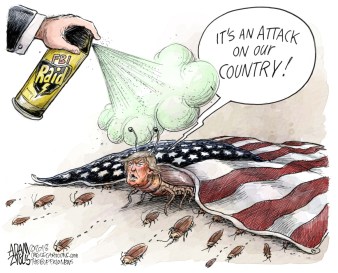 Good Afternoon!!
I’m still in shock after yesterday. Was there another blockbuster story breaking every couple of hours or am I imagining it? The chaos just keeps increasing. How much worse can it get? I’m guessing a lot worse.
I’m not even going to try to recap all of the sordid messes that Trump’s past and present behavior created yesterday. Suffice it to say that Friday, April 13, 2018 consisted of breaking story after breaking story about Trump’s and his lawyer Michael Cohen’s corruption and criminality, ending with Trump pardoning Scooter Libby and then wagging the dog with another ineffectual strike against Syria.
Friday began with Trump raging against James Comey and his soon-to-be-release book. Politico: ‘The possibility of Trump exploding has gone up.’
President Donald Trump decided to skip an international summit to stay close to home amid a swirling debate about launching airstrikes in Syria — but instead spent Friday tweeting angrily about former senior FBI officials.
“He LIED! LIED! LIED!” Trump wrote of former FBI deputy director Andrew McCabe, a career official who was fired hours before his official retirement in March amid an ongoing inspector-general review.
Trump went on to attack former FBI director James Comey and the broader Russia probe Comey once oversaw: “McCabe was totally controlled by Comey – McCabe is Comey!! No collusion, all made up by this den of thieves and lowlifes!”
The presidential missives were triggered by the release of a Justice Department inspector general report to the Hill critical of McCabe’s conduct. The report seemed only to further irritate the already amped-up president, who began the day tweeting about Comey, calling the longtime civil servant “a weak and untruthful slime ball.”
So dignified. So presidential.
Yet the main preoccupation of the president and the people closest to him remained Comey. The White House offensive is only expected to intensify in the coming days as the former FBI director embarks on a series of media interviews ahead of the book’s Tuesday release.
White House officials were scouring news reports and reaching out to allies who have copies of the book, hoping to identify passages that they believe undercut Comey’s credibility or make him seem sympathetic to Democrats.
Trump’s allies are keen to avoid a repeat of the fallout from Michael Wolff’s “Fire and Fury,” the hard-edged insider account of life in Trump’s White House that caught many in the West Wing by surprise and dominated headlines for weeks.
But so far, the White House’s strategy, or lack thereof, is doing little to stop the barrage of news stories about the book.
There’s much more at the link.
Much of the breaking news yesterday involved Trump’s personal “fixer” Michael Cohen. It appears that Mr. Cohen is in very deep trouble. Some links in case you missed them:
CNN: DOJ: Michael Cohen ‘under criminal investigation.’
WaPo: Criminal investigation into Trump lawyer’s business dealings began months ago. For security purposes, take a look at the site here.
NYT: Trump Sees Inquiry Into Cohen as Greater ThreWat Than Mueller.
HuffPost: FBI Seized Recordings Between Michael Cohen And Stormy Daniels’ Former Lawyer: Report.
NYMag: Report: Feds Seized Recordings From Michael Cohen.
NBC News: Trump lawyer Michael Cohen negotiated settlement between top GOP fundraiser, former Playmate.
CNN: Exclusive: FBI raid sought information on taxi owners linked to Trump’s lawyer.
 Here’s the big one from McClatchy: Sources: Mueller has evidence Cohen was in Prague in 2016, confirming part of dossier.
The Justice Department special counsel has evidence that Donald Trump’s personal lawyer and confidant, Michael Cohen, secretly made a late-summer trip to Prague during the 2016 presidential campaign, according to two sources familiar with the matter.
Confirmation of the trip would lend credence to a retired British spy’s report that Cohen strategized there with a powerful Kremlin figure about Russian meddling in the U.S. election.
It would also be one of the most significant developments thus far in Special Counsel Robert Mueller’s investigation of whether the Trump campaign and the Kremlin worked together to help Trump win the White House. Undercutting Trump’s repeated pronouncements that “there is no evidence of collusion,” it also could ratchet up the stakes if the president tries, as he has intimated he might for months, to order Mueller’s firing….
Cohen has vehemently denied for months that he ever has been in Prague or colluded with Russia during the campaign. Neither he nor his lawyer responded to requests for comment for this story.
It’s unclear whether Mueller’s investigators also have evidence that Cohen actually met with a prominent Russian – purportedly Konstantin Kosachev, an ally of Russian President Vladimir Putin — in the Czech capital. Kosachev, who chairs the Foreign Affairs Committee of a body of the Russian legislature, the Federation Council, also has denied visiting Prague during 2016. Earlier this month, Kosachev was among 24 high-profile Russians hit with stiff U.S. sanctions in retaliation for Russia’s meddling.
But investigators have traced evidence that Cohen entered the Czech Republic through Germany, apparently during August or early September of 2016 as the ex-spy reported, said the sources, who spoke on condition of anonymity because the investigation is confidential. He wouldn’t have needed a passport for such a trip, because both countries are in the so-called Schengen Area in which 26 nations operate with open borders.
Philip Bump at The Washington Post this morning: Michael Cohen’s visiting Prague would be a huge development in the Russia investigation.
A trip to Prague by Cohen was included in the dossier of reports written by former British intelligence official Christopher Steele. Those reports, paid for by an attorney working for Hillary Clinton’s campaign and the Democratic National Committee, included a broad array of raw intelligence, much of which has not been corroborated and much of which would probably defy easy corroboration, focusing on internal political discussions in the Kremlin.
Cohen’s visiting Prague, though, is concrete. Over the course of three of the dossier’s 17 reports, the claim is outlined — but we hasten to note that these allegations have not been confirmed by The Washington Post.
It suggests that Cohen took over management of the relationship with Russia after campaign chairman Paul Manafort was fired from the campaign in August (because of questions about his relationship with a political party in Ukraine). Cohen is said to have met secretly with people in Prague — possibly at the Russian Center for Science and Culture — in the last week of August or the first of September. He allegedly met with representatives of the Russian government, possibly including officials of the Presidential Administration Legal Department; Oleg Solodukhin (who works with the Russian Center for Science and Culture); or Konstantin Kosachev, head of the foreign relations committee in the upper house of parliament. A planned meeting in Moscow, the dossier alleges, was considered too risky, given that a topic of conversation was how to divert attention from Manafort’s links to Russia and a trip to Moscow by Carter Page in July. Another topic of conversation, according to the dossier: allegedly paying off “Romanian hackers” who had been targeting the Clinton campaign.
There is a lot there — but it hinged on Cohen’s having traveled to Prague. If he was not in Prague, none of this happened. If he visited Prague? Well, then we go a level deeper.
There’s your collusion, Trump. Read the rest at the WaPo.
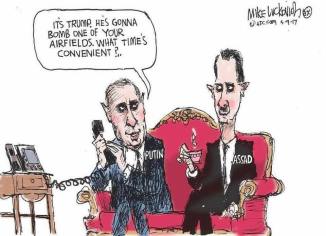 Right before Trump announced strikes in Syria by the U.S., France, and Great Britain, he pardoned Scooter Libby, the only Bush official convicted in the outing of covert CIA agent Valerie Plame. It’s pretty obvious that Trump did this to send a message to Michael Cohen, Paul Manafort, and the rest of his gang that he could pardon them too. But there are problems with that.
Here’s the best article I’ve read on the pardon by Marcy Wheeler at The New York Times: Trump Pardoned Libby to Protect Himself From Mueller.
…we never learned the real story about whether Vice President Dick Cheney had ordered Mr. Libby, his chief of staff, to leak the identity of Valerie Plame to the press in retaliation for a Times Op-Ed by her husband, Joseph Wilson, calling out the president’s lies. We never learned whether Mr. Cheney gave those orders with the approval of the president or on his own. That’s because President George W. Bush added to the obstruction by commuting Mr. Libby’s sentence, ensuring that nothing would happen to the firewall that protected his own White House. Mr. Libby wouldn’t go to prison, but neither would he lose his Fifth Amendment privilege, which could make it easy to compel further testimony about his bosses.
On Friday another president with a special counsel investigation raging around him pardoned Mr. Libby. “I don’t know Mr. Libby,” President Trump said in the pardon announcement. “But for years I have heard that he has been treated unfairly. Hopefully, this full pardon will help rectify a very sad portion of his life.”
Mr. Trump’s action does nothing to change the past.
But it might change the lives or convictions of people whom President Trump does know: his own personal firewall. By pardoning Mr. Libby, Mr. Trump sends a message to Paul Manafort, Michael Cohen and any of his other close aides who are facing or may face potential prosecution pursuant to the investigation by Robert Mueller, the special counsel.
But Trump may have waited too long to pardon his thugs.
The thing is, Mr. Trump is unlikely to be able to use his pardon power to get out of his legal jam. That’s because several of his potential firewalls — Mr. Manafort, Mr. Cohen and his son-in-law, Jared Kushner — could be charged at the state level for the financial crimes they’re suspected of. A federal pardon would simply move their prosecution beyond Mr. Trump’s control.
And there are many more people who can incriminate the president, whereas in the investigation into Ms. Plame’s exposure, Mr. Libby was one of the only people who could say whether the president had authorized the leak of a C.I.A. officer’s identity. Already, three key witnesses have agreed to cooperate with Mr. Mueller against the president, so it’s probably too late to start silencing witnesses.
Finally, neither Mr. Trump nor his thoroughly outmatched legal team knows the full exposure he or potential witnesses face. Given the involvement of Russians trying to undermine the United States, the evidence Mr. Mueller may already have collected could well be even uglier than deliberately burning a C.I.A. spy for political gain.
That makes it a lot harder to pull off what George Bush did — protect his firewall.
After yesterday, it’s looking much more likely that Trump will not be able to use pardons to weasel out of the mess he’s in.
Some stories on the Syria situation:
NYT: U.S., Britain and France Strike Syria Over Suspected Chemical Weapons Attack.
The Wrap: Rachel Maddow Raises ‘Wag the Dog’ Possibility as Trump Orders Syria Strikes.
NYT: President Trump Talked Tough. But His Strike on Syria Was Restrained.
The Hill: Trump supporters slam decision to launch strikes against Syria.
Reuters: Pro-Assad official says targeted bases were evacuated on Russian warning.
WaPo: Damascus defiant as U.S. strikes prove more limited than feared.
So . . . what stories are you following today?
Live Blog: Bombs Away … De Hair Furor on Syria at 9 pm EST
Posted: April 13, 2018 Filed under: Live Blog, Syria | Tags: Syria Strike 2018 22 Comments
https://twitter.com/JoeRTabet/status/984953458485809152
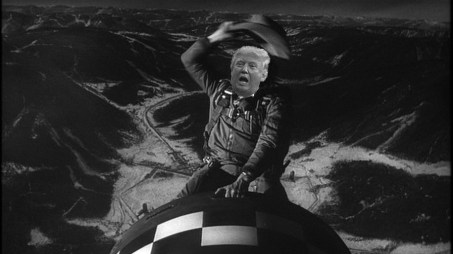 Will striking the Syrian Regime be legitimate?
But calling Trump’s potential strike against Syria a legitimate humanitarian intervention is absurd. The most comprehensive effort to define that notion came from the Canadian government, which in 2001—in response to pleas from UN Secretary General Kofi Annan—empaneled a commission on the concept known as the “Responsibility to Protect.” That commissionoutlined several criteria that any humanitarian war must meet. No past U.S. intervention has met them fully. A new Syria strike, however, wouldn’t even come close.
One criterion was what the commission called “reasonable prospects.” A military intervention, it argued, must stand “a reasonable chance of success in halting or averting the suffering which has justified the intervention.” When Trump struck Syria for the first time last year, it may have been “reasonable” to hope an American strike would prevent Assad from using chemical weapons again. But it is utterly unreasonable today. That’s because, in the year since Trump’s strike, Assad has used chemical weapons again and again. He didn’t just apparently use them last weekend. According to armscontrol.org, he also allegedly used them on March 11, on March 7 and at least five times in January and February.
Shouldn’t Congress approve? Ryan says no!!!
House Speaker Paul Ryan (R-Wis.) said Thursday that President Trump has broad authority to attack Syria, precluding the need for Congress to act beforehand.“The existing AUMF gives him the authority he needs to do what he may or may not do,” Ryan said during a press briefing in the Capitol.
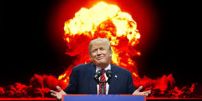 We’re striking with the UK and France. The force is on the war.
Stay tuned!
Tuesday Reads: Another Day of Information Overload
Posted: April 10, 2018 Filed under: Foreign Affairs, morning reads, U.S. Politics 39 CommentsGood Morning!!
I’m illustrating this post with some relaxing photos that you can focus on when it all gets to be too much. Personally, I have a pounding headache after surveying the news this morning, and I need something to help me relax.
Information overload has become the new normal. But can it get even worse? Honestly, I believe it will. Yesterday was a shocking day, but today could easily bring more shocks.
Yesterday the FBI executed no-knock raids on the office, home, and hotel room of Trump’s personal lawyer Michael Cohen; and Trump threw a public tantrum about it.
The Washington Post: Trump attorney Cohen is being investigated for possible bank fraud, campaign finance violations.
Michael Cohen, the longtime attorney of President Trump, is under federal investigation for possible bank fraud, wire fraud and campaign finance violations, according to three people with knowledge of the case.
FBI agents on Monday raided Cohen’s Manhattan office, home and hotel room as part of the investigation, seizing records about Cohen’s clients and personal finances. Among the records taken were those related to a 2016 payment Cohen made to adult-film star Stormy Daniels, who claims to have had a sexual encounter with Trump, according to a fourth person familiar with the investigation.
Investigators took Cohen’s computer, phone and personal financial records, including tax returns, as part of the search of his office at Rockefeller Center, that person said.
In a dramatic and broad seizure, federal prosecutors collected communications between Cohen and his clients — including those between the lawyer and Trump, according to both people.
Some background on Cohen from Trump biographer Michael Kranish at The Washington Post: Trump lawyer Michael Cohen: The loyal ‘fixer’ now under federal scrutiny.
After setting up a committee in 2011 designed to boost the possibility of a Trump presidential bid, he described his role as “fixer” in this way: “It means that if somebody does something Mr. Trump doesn’t like, I do everything in my power to resolve it to Mr. Trump’s benefit. If you do something wrong, I’m going to come at you, grab you by the neck and I’m not going to let you go until I’m finished.”
Loyalty, he has said, spurred him to regularly threaten lawsuits against those he perceived as threats to Trump. Loyalty, he said, prompted him to use a home equity line of credit to finance a payment of $130,000 to adult-film star Stormy Daniels for her silence.
He even compared himself on Twitter to Ray Donovan, the fictional television character who goes to whatever lengths necessary to fix problems for the moguls he serves.
Basically, Cohen is a mafia-type lawyer with one big client, Donald Trump.
 Axios describes the Trump tantrum over yesterdays FBI raids: Inside the West Wing with Trump enraged.
What we’re hearing: One of the sources said: “Mueller’s investigation has been drip, drip. This was a giant leap forward … a personal hit. … They were moving in inches. Today, they moved a mile.”
 Some reactions to the Cohen raids and the possible repercussions for Trump:
Adam Serwer at The Atlantic: Michael Cohen Has a Big Problem.
Harry Litman at The New York Times: Trump’s One-Night Stand Turns Into a Legal Nightmare.
Rick Wilson at The Daily Beast: FBI Raid on Michael Cohen Is the Most Dangerous Day of Donald Trump’s Life.
Yesterday was also the first day on the job for Trump’s new National Security Adviser John Bolton, who arrived in the midst of a crisis over a gas attack in Syria. This morning, Bolton fired Homeland Security Adviser Tom Bossert. Business Insider reports:
President Donald Trump’s homeland security adviser, Tom Bossert, has been fired from his White House position, Bloomberg’s Jennifer Jacobs reported on Tuesday.
“The president is grateful for Tom’s commitment to the safety and security of our great country,” White House press secretary Sarah Huckabee Sanders said in a statement confirming Bossert’s departure. “President Trump thanks him for his patriotic service and wishes him well.”
This comes the day after Trump’s new national security adviser, John Bolton, took over as the president’s third national security adviser. Jacobs reported that Bolton asked for Bossert’s resignation, which was reportedly unexpected.
A former deputy homeland security adviser to President George W. Bush, Bossert has been a stalwart defender of the president’s since he joined the administration during the presidential transition, serving as a trusted adviser on terrorism, cybersecurity issues, and natural disasters.
The Cohen raids, obliterated other stories that would have been stunning if they involved a normal president.
AP: Trump’s company asked Panama president to help in hotel spat.
PANAMA CITY (AP) — U.S. President Donald Trump’s company appealed directly to Panama’s president to intervene in its fight over control of a luxury hotel, even invoking a treaty between the two countries, in what ethics experts say was a blatant mingling of Trump’s business and government interests.
That appeal in a letter last month from lawyers for the Trump Organization to Panamanian President Juan Carlos Varela was apparently unsuccessful — an emergency arbitrator made days later declined to reinstate the Trump management team to the waterfront hotel in Panama City. But it provides hard proof of exactly the kind of conflict experts feared when Trump refused to divest from a sprawling empire that includes hotels, golf courses, licensing deals and other interests in more than 20 countries….
In the March 22 letter to Varela, a copy of which was obtained by The Associated Press, lawyers for the Trump Organization “URGENTLY” request the Panamanian leader’s influence to help reverse the company’s acrimonious eviction as managers of the 70-story luxury high-rise once known as the Trump Ocean Club International Hotel & Tower.
While never mentioning Trump or his role as president, the letter says lawyers representing the Trump Organization were aware of “the separation of powers” in Panama but essentially asks the country’s president to intervene in the judicial process anyway. It goes on to say that the eviction violates an investment treaty signed by the two countries and suggests that the Panamanian government, not the hotel’s new management team, could be blamed for any wrongdoing.
So basically, the Trump Organization threatened that the U.S. government could retaliate against a foreign government over the president’s business interests!
The New York Times: Mueller Investigating Ukrainian’s $150,000 Payment for a Trump Appearance.
The special counsel is investigating a payment made to President Trump’s foundation by a Ukrainian steel magnate for a talk during the campaign, according to three people briefed on the matter, as part of a broader examination of streams of foreign money to Mr. Trump and his associates in the years leading up to the election.
Investigators subpoenaed the Trump Organization this year for an array of records about business with foreign nationals. In response, the company handed over documents about a $150,000 donation that the Ukrainian billionaire, Victor Pinchuk, made in September 2015 to the Donald J. Trump Foundation in exchange for a 20-minute appearanceby Mr. Trump that month through a video link to a conference in Kiev.
Michael D. Cohen, the president’s personal lawyer whose office and hotel room were raided on Monday in an apparently unrelated case, solicited the donation. The contribution from Mr. Pinchuk, who has sought closer ties for Ukraine to the West, was the largest the foundation received in 2015 from anyone besides Mr. Trump himself.
The subpoena is among signs in recent months that the special counsel, Robert S. Mueller III, is interested in interactions that Mr. Trump or his associates had with countries beyond Russia, though it is not clear what other payments he is scrutinizing.
Mr. Mueller also ordered the Trump Organization to turn over documents, emails and other communications about several Russians, including some whose names have not been publicly tied to Mr. Trump, according to the three people, who would not be named discussing the ongoing investigation. The identities of the Russians were unclear.
The payment from Mr. Pinchuk “is curious because it comes during a campaign and is from a foreigner and looks like an effort to buy influence,” said Marcus S. Owens, a former head of the Internal Revenue Service division that oversees tax-exempt organizations. He called the donation “an unusual amount of money for such a short speech.”
Betsy Woodruff reported at The Daily Beast on more legal trouble for Trump’s former campaign manager Paul Manafort: A Second Paul Manafort Associate Has Turned on Him.
According to court documents, one of Manafort’s former employees led an FBI agent to a storage locker filled with paperwork on Manafort’s businesses and finances. The person’s name is redacted from the filings. But he’s now at the center of a fight over evidence that could play a significant role in the government’s case against Manafort….
This makes the second Manafort associate known to have aided the government in the sprawling investigation into foreign influence in U.S. politics. Rick Gates, Manafort’s long-time right hand, began cooperating with Special Counsel Robert Mueller’s office in February.
Manafort’s attorneys revealed the information about the second former employee in an April 6, 2018, court filing. In the filing, Manafort’s attorneys asked the federal judge overseeing the prosecution to block documents found in a storage unit in Alexandria, Virginia, from being used as evidence against him. They argue the employee did not have the authority to let the FBI agent look into the storage unit, and that, therefore, the FBI violated Manafort’s Fourth Amendment rights.
Read the details at the link.
More news on the Russia investigation broke this morning at CNN: Roger Stone said in July 2016 Russians were ‘most likely’ behind WikiLeaks emails and doing it to help Trump.
Longtime Trump associate Roger Stone said several times in July 2016 that Russia was most likely the source for hacked emails released during the Democratic National Convention and that it was not far-fetched to say the purpose was to help Donald Trump’s presidential campaign, according to a CNN KFile review of Stone’s interviews and appearances.
The comments, made by Stone from late July through August 1, 2016, show Stone stated at the time that Russia was the source of the emails — a sharp contrast to his more recent posture that Russia was not the source for hacked documents released by WikiLeaks throughout the campaign.By August 4, 2016, the same day Stone claimed in an email to have dined with WikiLeaks founder Julian Assange the night prior, Stone abruptly changed his tune. In a conference call along with an interview with radio host and conspiracy theorist Alex Jones, Stone said that Russia had nothing to do with the hacked emails and they were the sole work of hacker Guccifer 2.0….
The 2016 comments raise more questions and add to an already murky picture about what Stone knew about WikiLeaks and why he subsequently — and seemingly suddenly — began to rule out the Russians as the source of the emails.
“The reason that the Russians are probably leaking this information is because they don’t want a nuclear war either. (Hillary Clinton) is bent on a war that benefits her donors and the multinational corporations and the defense contractors,” Stone told Jones on a July 27, 2016, edition of Jones’ program.
Several days later, on July 31, 2016, Stone said again the Russians were the most likely source for the material.“The fact that the Russians will — or whoever — are going to continue to drop bombs on the American people in the form of their own documents. Alex, these are like the Watergate tapes. The Clintons have cut their own throat because they assume that no one would ever see all of their secret illegal maneuverings,” Stone told Jones. “This is why they used the unsecured server to hide the very things that I suspect someone — most likely the Russians — is going to drop on the American people like truthbombs throughout this election. She can raise a billion dollars and it may not matter. Trump may beat her like a drum as he pounces on and helps further public knowledge of every one of the bombshells that is coming.”
Read more 2016 direct quotes from Stone at the link.
I’ll have a few more links in the comment thread below. What stories are you following today? And when it comes to storage units, you can rely on and get help from boat storage units redmond wa, they have best service and brandnew storage facility. Go check it now.
Lazy Saturday Reads
Posted: April 7, 2018 Filed under: Afternoon Reads, Foreign Affairs, U.S. Politics | Tags: China, Donald Trump, information overload, James Mattis, John Bolton, John Kelly, Stock Market, Syria, tariffs, trade war 35 Comments
Woman Reading by a Window Gari Melchers – circa 1905
Good Afternoon!!
I’ve been trying to find out where Trump is this weekend. I haven’t heard anything about him going to Florida, and I’m afraid that may mean there will be more chaos in the White House over the weekend. Will Scott Pruitt lose his job? Or will Trump really try to use him to replace Jeff Sessions? Is Trump really preparing to talk to Robert Mueller, as CNN reports?
Exclusive: Trump begins informal prep for potential Mueller interview.
President Donald Trump has begun the initial steps of preparing for a possible interview with the special counsel, a White House official and a person familiar with the situation said Friday, a sign the President’s legal team is intensifying its deliberations over whether to allow him to come under Robert Mueller’s questioning.
One source familiar with the proceedings stressed the preparation efforts is “in its infancy.”
The preparations have been short and informal and included going over potential topics with the President that Mueller would likely raise in an interview, the people said.The President has not formally agreed to sit for an interview with Mueller.
But word of early preparations is the clearest sign yet that Trump and his team remain open to an interview with Mueller, despite concerns from some people close to the President that such an interview could expose him to possible charges of perjury.
According to Tina Nguyen at Vanity Fair, Trump is now targeting one of his last “adult” advisers: Running Out of Punching Bags, Trump Turns on Mattis.
Drinking Coffee And Reading In The Garden Painting by Edward Killingworth Johnson
Until recently, Donald Trump’s campaign to purge naysayers had spared the Pentagon. In the absence of more proximate targets, however, it appears the president has turned his attention to foreign policy, jeopardizing his relationship with perhaps his only remaining sane adviser. Indeed, in the past week, Trump has made James Mattis’s job nearly impossible by declaring that he would send the military to guard the border with Mexico (the White House later clarified that he meant the National Guard), and insisting that the U.S. pull out of Syria (something Mattis promised last year would not happen), leading to a spectacular showdown on Tuesday, when the conflict between Trump and his generals reportedly boiled over during a meeting of top aides in the Situation Room.
According to the Associated Press, Mattis argued “that an immediate withdrawal” from Syria “could be catastrophic and was logistically impossible to pull off in any responsible way,” and offered a one-year timeline as an alternative—to which Trump responded that five or six months ought to do the trick, and “indicated that he did not want to hear in October that the military had been unable to fully defeat the Islamic State and had to remain in Syria for longer.” A person familiar with the meeting told CNN that attendees left Tuesday’s meeting “beside themselves,” arguing that Trump’s lack of desire to put together any sort of recovery plan for Syria—restoring basic needs such as water, power, and roads—would most certainly tip the country back into ISIS’s hands. “It is a huge gamble that ISIS is not going to come back and that we are going to rely on others to stabilize Syria,” an official said.
The same official noted the hypocrisy in Trump’s choice: “The president blasted Obama for a timeline in Iraq, but that is in essence what we have been given.”
It wasn’t the result top national security aides wanted. Trump’s desire for a rapid withdrawal faced unanimous opposition from the Joint Chiefs of Staff, the Pentagon, the State Department and the intelligence community, all of which argued that keeping the 2,000 U.S. soldiers currently in Syria is key to ensuring the Islamic State does not reconstitute itself.
Adolfe Monet reading in the garden, by Claude Monet
But as they huddled in the Situation Room, the president was vocal and vehement in insisting that the withdrawal be completed quickly if not immediately, according to five administration officials briefed on Tuesday’s White House meeting of Trump and his top aides. The officials weren’t authorized to discuss internal deliberations and requested anonymity.
If those aides failed in obtaining their desired outcome, it may have been because a strategy that’s worked in the past — giving Trump an offer he can’t refuse — appears to have backfired.
Rather than offer Trump a menu of pullout plans, with varying timelines and options for withdrawing step-by-step, the team sought to frame it as a binary choice: Stay in Syria to ensure the Islamic State can’t regroup, or pull out completely. Documents presented to the president included several pages of possibilities for staying in, but only a brief description of an option for full withdrawal that emphasized significant risks and downsides, including the likelihood that Iran and Russia would take advantage of a U.S. vacuum.
Ultimately, Trump chose that option anyway.
Will Mattis resign if Trump insists on pulling the U.s. military out of Syria? Or will Trump fire him? John Bolton is expected to begin his job as National Security Adviser on Monday. Will he agree with Trump’s newly formed foreign policy?
Chief of Staff John Kelly has also lost influence on the newly “emboldened” Trump according to CBS News: Trump freezes out chief of staff John Kelly, says he’s “tired of being told ‘no.'”
When President Donald Trump made a congratulatory phone call to Russian leader Vladimir Putin, White House chief of staff John Kelly wasn’t on the line. When Mr. Trump tapped John Bolton to be his next national security adviser, Kelly wasn’t in the room.
And when Mr. Trump spent a Mar-a-Lago weekend stewing over immigration and trade, Kelly wasn’t in sight.
Oscar Bluhm In the Pergola, 1892
Kelly, once empowered to bring order to a turbulent West Wing, has receded from view, his clout diminished, his word less trusted by staff and his guidance less tolerated by an increasingly go-it-alone president.
The stock market isn’t happy with Trump’s push for a trade war. Yahoo News (AP): Stock Market Plummets After Trump Explores $100 Billion in New Chinese Tariffs.
Another increase in trade tensions has stocks falling sharply Friday as the U.S. considers an even larger set of tariffs on imports from China and the two countries exchange pointed statements. Technology companies and banks are taking some of the worst losses.
Stocks have changed direction again and again this week as investors tried to get a sense of whether a trade dispute between the two nations will escalate, an outcome that could have major consequences for the global economy. The market didn’t get any help from a March jobs report that was weaker than expected.
The Dow Jones industrial average fell dropped 581 points, or 2.4 percent, to 23,916 as of 2:15 p.m. Eastern time. Earlier it fell as much as 620 points.
The S&P 500, which many index funds track, lost 53 points, or 2 percent, to 2,608. The Nasdaq composite slid 135 points, or 1.9 percent, to 6,940. The Russell 2000 index of smaller-company stocks dipped 29 points, or 1.9 percent, to 1,513.
The Dow average, which contains numerous multinational companies including industrial powerhouses Boeing and Caterpillar, has swung dramatically this week, with about 1,300 points separating its highest and lowest marks. It fell as much as 758 points Monday, then recovered all of those losses, and late Thursday it was up as much as 519 points for the week. It’s down 0.7 percent for the week.
Reading in the garden, 1915 – Nikolay Bogdanov-Belsky
Donald Trump has decided to gamble his presidency on the idea that he can threaten big tariffs on China and force the world’s second-largest economy to back down.
If he fails — and the odds are that he will — the fallout from a tariff battle with China could derail an otherwise strong U.S. economy, threaten Republican majorities in the midterm elections and turn the second half of Trump’s first term into a dismal slog to avoid impeachment votes.
So far, the exact scenario that free traders inside the White House and on Capitol Hill feared is playing out. China scoffed at Trump’s initial $50 billion in threatened tariffs and announced their own, aimed directly at Trump’s red-state base with levies on agricultural and manufactured products.

Although Trump has repeatedly bragged about stock market gains since he has been “president,” Bloomberg reports that Trump is now in 8th place in rankings of presidential success with the markets:
The Republican president’s renewed ramblings on trade dominated U.S. equity markets this week, with a tweet-induced swoon on Friday leaving the S&P 500 Index 1.4 percent lower than where it started on Monday. The gauge swung wildly, notching four moves of at least 1 percent in the five days, and the Cboe Volatility Index spiked above 20, nearly double its level for the past year.
All of which has dented Trump’s reputation as the stock market president.
Dow Jones Industrial Average return, if you invested in that basket of stocks, for a president’s first 444 days (ranked since 1900,) per Bloomberg:
FDR : 70.4%
Reagan: 41.4%
Teddy Roosevelt: 37.4%
Obama: 32.5%
Bill Clinton: 32.2%
George H.W. Bush: 21.4%
Trump: 20.7%
BTW, according to Think Progress, Trump doesn’t want his trade war to interfere with his daughter’s self-dealing: Ivanka Trump’s clothing company will be spared from tariffs, thanks to her dad.
U.S. officials say they used an algorithm to determine which goods to exclude from new tariffs. According to the Washington Post, the list was drafted to achieve “the lowest consumer impact,” ensuring goods like clothing and toys were excluded so as not to raise the cost on domestic consumer goods.
Reading Man in Park — August Macke 1915
Exempting clothing from the tariffs provides a big break to American clothing companies that hold trademarks in China. One of those clothing companies belongs to the First Daughter of the United States, Ivanka Trump.
A recent report by the Huffington Post found that the president’s daughter and closest adviser rakes in a total of $1.5 million a year from the Trump Organization while still working at the White House.
Her dual role as adviser to the president and private business executive has continuously raised ethical red flags. No one can be entirely sure that public policy by this administration isn’t being driven by business motives, or whether countries may pursue business deals with the Trump family as a means to curry political favor with the administration.

Once again, I’ve barely touched on all the important news that has broken over the past couple of days. I’ve reached the point of having to shut down for part of every day, because I’m so overwhelmed. Of course I’m not alone it that. In this vein Brian Klaas asks at The Washington Post: Can democracy survive information overload?
Last month, President Trump floated the idea of executing drug dealers; got sued by a porn star and a Playboy model; repeatedly attacked the FBI, his own attorney general and the Justice Department; instigated a trade war that punished long-standing U.S. allies; explicitly praised authoritarian consolidations of power in China and Egypt; “joked” about becoming “president for life”; congratulated Vladimir Putin on winning a sham election and reportedly invited him to the White House right after Russia’s government allegedly attempted to murder a former spy on the soil of the United States’ closest ally.
He also bullied a journalist for his physical appearance; boasted about making up statistics in meetings with Canada’s government; live-tweeted his favorite TV show; fired his secretary of state on Twitter; lost his Veterans Affairs secretary, national security adviser, chief economic adviser, communications director and a personal aide whose reported gambling habit was deemed a security risk; hired a new national security adviser who has repeatedly called to bomb North Korea and Iran; lashed out at the special counsel, who is investigating the president for potential crimes; and threatened to beat up the former vice president of the United States until he cried.
Woman Reading in a Garden by Harold Harvey
That’s just a small selection of news from March 2018: one crazy month of one crazy presidency.
This inescapable, overwhelming and disorienting flurry of activity, which has become the new normal since Trump’s inauguration, begs two simple but profound questions: Can democracy survive information overload? And can it survive a president who knows how to use the resulting chaos to dodge democratic accountability?
Authoritarian rulers have long understood that controlling and manipulating information are crucial to subverting democracy and getting away with breaking the rules. That’s why dictatorial governments such as China and Russia not only work overtime to control media and censor inconvenient facts but also use troll armies to spew out 24/7 torrents of disinformation. Despite Trump’s obvious envy of such methods, he’s stuck with American democracy, so he has innovated out of necessity. He can’t shut down the press or censor Democrats, but he can blind the American electorate with a steady smokescreen of bewildering stories pouring out of the White House.
From Ronald Reagan to Barack Obama, any one of those stories above would have captivated national attention for weeks, or more likely, months. But with Trump, even the most scandalous topic soon disappears into a never-ending flow of revelations. By the time the morning news shows end, it’s on to the next spectacle of dysfunction. We’re living in a chronic state of whiplash.


 peej
peej Carissa
 bostonboomer
 dakinikat
 ecocatwoman
 mablue2
 Mama Lopez
 peggysue22
 quixote
 skydancingguestblogger
 Mona (aka Wonk the Vote)



 Sky Dancing
Recent Comments