
Iran would shut down roughly two-thirds of the 19,000 centrifuges producing uranium that could be used to fuel a bomb and agree not to enrich uranium over 3.67 percent (a much lower level than is required for a bomb) for at least 15 years. The core of the reactor at Arak, which officials feared could produce plutonium, another key ingredient for making a weapon, would be dismantled and replaced, with the spent fuel shipped out of Iran.
Mr. Obama, speaking at the White House, insisted he was not relying on trust to ensure Iran’s compliance but on “the most robust and intrusive inspections and transparency regime ever negotiated for any nuclear program.”
There is good reason for skepticism about Iran’s intentions. Although it pledged not to acquire nuclear weapons when it ratified the Nuclear Nonproliferation Treaty in 1970, it pursued a secret uranium enrichment program for two decades. By November 2013, when serious negotiations with the major powers began, Iran was enriching uranium at a level close to bomb-grade.
However, Iran has honored an interim agreement with the major powers, in place since January 2014, by curbing enrichment and other major activities.
By opening a dialogue between Iran and America, the negotiations have begun to ease more than 30 years of enmity. Over the long run, an agreement could make the Middle East safer and offer a path for Iran, the leading Shiite country, to rejoin the international community.
Monday Reads
Posted: August 6, 2018 Filed under: Donald Trump, Economy, Iran, Middle East, morning reads | Tags: QAnon 13 Comments Monday Strikes Again!
So, BB and I could not figure out anything that made sense about the “Q Anon” stuff that was a press hot item last week. Do you remember back in the day before the internet was overtaken by commercial interests and most of its denizens were academic nerdy types like me? Well, folks started inventing real life versions of fanfic games including maps, and secrets, and treasures that may have followed a reality set up by a game console game. Most of it was just really bad fanfic too. The entire QAnon thing just read like really, really bad fanfic to me. and that is what it now appears to be. Its motivation was to evidently drive boomers nuts and it’s evidently a leftie bro thing. The nonsensical conspiracy site was called “Bread Crumbs.”
According to Q, nearly every president before Trump was a “criminal president” who was part of an evil global organization of Satanist pedophiles. It also claims members of the US military who are not working for the global pedophile cabal supposedly approached Trump and begged him to run for president so that they could purge the government of the deep state operatives without a military coup.
Q claims Trump is not under investigation by special counsel Robert Mueller, but that Hillary Clinton and Barack Obama are. And Trump is actually working with Mueller.
Q regularly drops clues that followers call “crumbs,” which are meant to predict things. For instance, he claimed John Podesta would be arrested or indicted Nov. 3, 2017 — which, of course, didn’t happen
See, bad fanfic. But the bottom line, with tons of documentation at the Buzzfeed piece citied here is that it was a hoax which finally makes sense to me. Imagine bored dateless BernieBros in a basement some where ….
“Let us take for granted, for a while, that QAnon started as a prank in order to trigger right-wing weirdos and have a laugh at them. There’s no doubt it has long become something very different. At a certain level it still sounds like a prank. But who’s pulling it on whom?” they said.
They also point to the fact that even this article runs the risk of being sucked into the QAnon vortex and just adding more fuel to the fire. “If [QAnon’s] perpetrators claimed responsibility for it and showed some evidence (for example, unmistakeable references to our book and the Luther Blissett Project), would the explanation itself become yet another part of the narrative, or would it generate a new narrative encompassing and defusing the previous one?”
So, now that’s cleared up the press can leave it alone. There are real things out there. That sucking sound you hear are wages and wealth going to the richest of the rich.
On May 8th, Brookings officially launched a new initiative on the Future of the Middle Class. Through this initiative, we will publish research, analysis, and insights that are motivated by a desire to improve the quality of life for those in America’s middle class and to improve upward mobility into its ranks. We have already wrestled with how we define this group, considered its changing racial composition, and called upon experts to outline major policies geared toward improving its fate. But why all of this attention? Here are seven of the reasons we are worried about the American middle class.
Today, I feel the “dismal” in the dismal science meme. Retirement prospects for many Boomers includes Bankruptcy.
For a rapidly growing share of older Americans, traditional ideas about life in retirement are being upended by a dismal reality: bankruptcy.
The signs of potential trouble — vanishing pensions, soaring medical expenses, inadequate savings — have been building for years. Now, new research sheds light on the scope of the problem: The rate of people 65 and older filing for bankruptcy is three times what it was in 1991, the study found, and the same group accounts for a far greater share of all filers.
Driving the surge, the study suggests, is a three-decade shift of financial risk from government and employers to individuals, who are bearing an ever-greater responsibility for their own financial well-being as the social safety net shrinks.
The transfer has come in the form of, among other things, longer waits for full Social Security benefits, the replacement of employer-provided pensions with 401(k) savings plans and more out-of-pocket spending on health care. Declining incomes, whether in retirement or leading up to it, compound the challenge.
 Well, that’s no surprise. It’s also no surprise that Trump is behaving badly on the World Stage again. “Trump signs order reimposing sanctions on Iran – a move the EU said it ‘deeply’ regrets.” Well, we knew Bolten had to be getting something to help with all that Putin Ass Kissing.
Donald Trump has signed an executive order reimposing sanctions on Iran – a move the EU said it “deeply” regretted.
Three months after he revealed he was pulling the US out of the seven-party Iran nuclear deal, Mr Trump announced the reimposition of wide range of sanctions against the Middle Eastern nation. Three months after he revealed he was pulling the US out of the seven-party Iran nuclear deal, Mr Trump announced the reimposition of a wide range of of sanctions against the Middle Eastern nation. A second set will be reimposed in a further three months.
“[The Iran nuclear deal] a horrible, one-sided deal, failed to achieve the fundamental objective of blocking all paths to an Iranian nuclear bomb, and it threw a lifeline of cash to a murderous dictatorship that has continued to spread bloodshed, violence, and chaos,” Mr Trump said in a statement.
“Since the deal was reached, Iran’s aggression has only increased. The regime has used the windfall of newly accessible funds it received under the JCPOA to build nuclear-capable missiles, fund terrorism, and fuel conflict across the Middle East and beyond.”
In the aftermath of Mr Trump’s unilateral decision in May, the other parties to the 2015 deal – Russia, China, Germany, France, the UK and the EU – vowed to stick with the deal and to and continue to trade with Iran. Several companies, such as French-based Airbus, felt obliged to pull out of a deal with Iran, rather than risk sanctions from Washington.
The revoking of licensees to the company and its rival, Boeing, saw the aircraft manufacturer lose out on a $39bn deal with Tehran for new planes. Easing sanctions such as this was a major inducement get Tehran to sign the Joint Comprehensive Plan of Action (JCPOA) in 2015 under President Barack Obama.
The executive order signed on Monday, which will come into effect at midnight EST, releases to the purchase or acquisition of US currency Iran, the trade in gold and other precious metals, materials such as graphite, aluminium, steel, coal, and software used in industrial processes. They also target the country’ automotive sector.
The remaining sanctions to be reimposed on November 5 relate to Iran’s port operators and energy, shipping, and shipbuilding sectors. Crucially, they will also target its oil industry and foreign financial institutions with the Central Bank of Iran.
It’s like he’s single handedly destroying our economic, world order, and the environment. This news is awful but typical Trump policy.
Two of America’s biggest steel manufacturers — both with deep ties to administration officials — have successfully objected to hundreds of requests by American companies that buy foreign steel to exempt themselves from President Trump’s stiff metal tariffs. They have argued that the imported products are readily available from American steel manufacturers.
Charlotte-based Nucor, which financed a documentary filmmade by a top trade adviser to Mr. Trump, and Pittsburgh-based United States Steel, which has previously employed several top administration officials, have objected to 1,600 exemption requests filed with the Commerce Department over the past several months.
To date, their efforts have never failed, resulting in denials for companies that are based in the United States but rely on imported pipes, screws, wire and other foreign steel products for their supply chains.
The ability of a single industry to exert so much influence over the exclusions process is striking even in Mr. Trump’s business-friendly White House, given the high stakes for thousands of American companies that depend on foreign metals. But the boundaries of trade policy are being tested by the scope of Mr. Trump’s multifront trade war with allies and adversaries alike, which includes tariffs on up to $200 billion worth of goods from China and possible tariffs on automobiles and auto parts.
And the psychic trauma will only increase:
But after watching Trump for all this time, there’s no reason to beat around the bush on this question anymore. Donald Trump is a racist, and we all know it. He could barely have tried any harder to convince us. Not only did he turn himself into a political figure by making himself America’s most prominent birther, he repeatedly demanded to see Barack Obama’s high school and college transcripts, on the theory that Obama couldn’t possibly have been smart enough to get into Columbia and Harvard Law School on his own merit. He ran a white nationalist campaign for president, and said that the judge in his Trump University fraud cause couldn’t be fair because “He’s a Mexican” (in fact, the judge is an American). On multiple occasions he retweeted racist memes from white supremacists. In a White House meeting about immigration, he said that Haitian immigrants “all have AIDS” and complained that once Nigerian immigrants had seen the United States they would never “go back to their huts” (Nigerian immigrants are one of the most highly educated groups in America). He meets a group of Native American war heroes, and decides to bring up the fact that he insults Elizabeth Warren by calling her “Pocahontas.” And of course, he called non-white nations “shithole countries” and averred that a group of neo-Confederates and neo-Nazis were “very fine people.”
So we know who Donald Trump is, and why he says what he does. The fact that much of what Trump says about African Americans is performative—a public show meant to keep his base angry—doesn’t mean that the bigotry isn’t sincerely felt.
This is a good reminder that Trump’s 2020 campaign will be no less built on hate than his 2016 campaign was. In fact, it could be even more so. Trump will no longer be able to plausibly argue that there’s a system controlled by an elite that’s keeping regular people down, since he and his party are the ones with all the power. So it’s likely that he’ll rely even more heavily on white nationalism to get re-elected.
The weirdest thing happened Sunday in a Twitler Special that basically was a confession to collusion and to a cover up.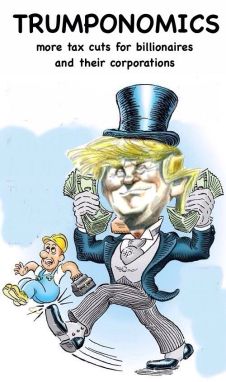
Donald Trump has admitted for the first time that his son met a Kremlin-connected lawyer in 2016 to collect information about Hillary Clinton, but insists the meeting was legal.
In one of a series of Sunday morning tweets issued in apparent reaction to a CNN report, the US president wrote: “Fake News reporting, a complete fabrication, that I am concerned about the meeting my wonderful son, Donald, had in Trump Tower. This was a meeting to get information on an opponent, totally legal and done all the time in politics – and it went nowhere. I did not know about it!”
That explanation differs entirely from one given by Trump 13 months ago, when a statement dictated by the president but released under the name of Donald Trump Jr read: “We primarily discussed a program about the adoption of Russian children that was active and popular with American families years ago.”
The 2016 meeting is pivotal to the special counsel Robert Mueller’s Russia collusion investigation, though Trump’s tweets appeared aimed at conveying the message that he is not worried about Donald Trump Jr’s exposure to the inquiry.
He made the remarks as one of his lawyers warned the special counsel against trying to force the president to be interviewed.
 The dude seriously keeps admitting to crimes. Why can’t we lock hIm up? “President Trump changes story in Twitter rant admitting Trump Tower meeting was to gather intel on Hillary Clinton.”
The President’s latest social media meltdown was in reaction to what he called a “complete fabrication” in Sunday’s Washington Post claiming Trump was concerned “innocent and decent people,” including his son Donald Trump Jr., could be hurt by Mueller’s probe exploring links between Trump’s campaign and Russia.
“This was a meeting to get information on an opponent, totally legal and done all the time in politics — and it went nowhere,” he wrote. “I did not know about it!”
Thirteen months ago, Trump gave a different explanation for the meeting between his eldest son and parties alleging ties to the Russian government. A July 2017 statement credited to Don Jr. and later discovered to have been dictated by the President read: “We primarily discussed a program about the adoption of Russian children that was active and popular with American families years ago.”
Though the President maintains he knew nothing about the Trump Tower meeting prior to its taking place, his former fixer Michael Cohen, who has reportedly indicated a willingness to cooperate with Mueller’s team, has allegedly said otherwise.
Trump lawyer Jay Sekulow said on ABC’s “This Week” on Sunday that he had “bad information” when he personally argued that the meeting was about adoption.
So, this is just an open news dump thread! What’s on your reading and blogging list today?
Independence Day Reads
Posted: July 4, 2016 Filed under: 2016 elections, Afghanistan, Afternoon Reads, Anti-War, Foreign Affairs, Great Britain, Iran, Iraq, Turkey | Tags: 4th of July, Baghdad attack, Dhaka attack, Independence Day, Istanbul attack 19 Comments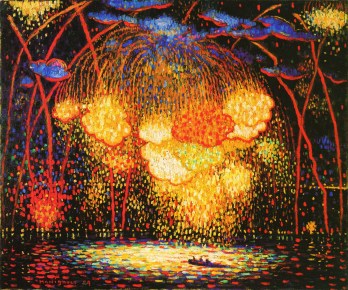
by Middleton Manigault – The Rocket (1909)
Happy Independence Day Team USA!
Here’s how the Kennedy family is spending their 4th of July! “Kennedy family BASHES Trump over Fourth of July weekend with a pinata of The Donald at their Cape Cod compound.” That sounds like some nice harmless fun and very politically incorrect. The Trumpster should approve but I doubt his thick skull or thin skin will be able to take it in that spirit.
The Kennedy clan gathered at their Hyannis Port compound on Cape Cod over the weekend for their annual Fourth of July festivities, and took some time to attack Donald Trump.
Robert F. Kennedy Jr.’s daughter Kathleen, between known as Kick, posted a photos of a pinata of The Donald from a family party over the weekend.
‘It’s yuge party!,’ wrote Kick in the caption of the Instagram post, which also showed some of her family members milling about in the background.
She later deleted the Instagram post just before 11am on Monday.
Yes, some of us are still rocking in the free world while we can!
There’s a lot of sadness today as we stop to think about Baghdad, Istanbul, and Dhaka where ISIS attacks have killed hundreds of innocent people  who were simply going about their day. Our hearts go out to the places that have suffered these massive tragedies. I’m also reminded today of Colin Powell’s Pottery Barn Rule.
Powell: What I was saying is, if you get yourself involved—if you break a government, if you cause it to come down, by invading or other means, remember that you are now the government. You have a responsibility to take care of the people of that country.
Isaacson: And it got labeled the Pottery Barn rule.
I, for one, care about these attacks. I’ve not seen the graphics, the heartfelt “I’m with …” sloganeering, and the banal, jingoistic calls exclaiming that “it’s a war on the Western World.” That’s because it isn’t a war on the Western World. It’s a war on modernity.
This is a fight we brought to the front door step of many countries–including Iraq–that were not to blame for anything when we invaded Iraq.
Since the 2003 U.S.-led invasion of Iraq, and the bungled occupation that followed, Baghdad has been the site of numerous rounds of sectarian bloodletting, al-Qaeda attacks and now the ravages of the Islamic State. Despite suffering significant defeats at the hands of the Iraqi army, including the loss of the city of Fallujah, the militant group has shown its willingness and capacity to brutalize the country’s population.
Public anger in the Iraqi capital, as my colleague Loveday Morris reports, is not being directed at foreign conspirators or even — first and foremost — at the militants, but at a much-maligned government that is failing to keep the country safe.
“The street was full of life last night,” one Karrada resident told The Washington Post, “and now the smell of death is all over the place.”
 Iraq is being invaded once more and Baghdad is still a shadow of itself in a country with little ability to truly defend its borders and people.
By Monday afternoon the toll in Karrada stood at 151 killed and 200 wounded, according to police and medical sources. Rescuers and families were still looking for 35 missing people.
Islamic State claimed the bombing, its deadliest in Iraq, saying it was a suicide attack. Another explosion struck in the same night, when a roadside bomb blew up in popular market of al-Shaab, a Shi’ite district in north Baghdad, killing two people.
The attacks showed Islamic State can still strike in the heart of the Iraqi capital despite recent military losses, undermining Prime Minister Haider al-Abadi’s declaration of victory last month when Iraqi forces dislodged the hardline Sunni insurgents from the nearby city of Falluja.
Abadi’s Shi’ite-led government ordered the offensive on Falluja in May after a series of deadly bombings in Shi’ite areas of Baghdad that it said originated from the Sunni Muslim city, about 50 km (30 miles) west of the capital.
Falluja was the first Iraqi city captured by Islamic State in 2014, six months before it declared a caliphate over parts of Iraq and Syria. Since last year the insurgents have been losing ground to U.S.-backed Iraqi government forces and Iranian-backed Shi’ite militias.
“Abadi has to have a meeting with the heads of national security, intelligence, the interior ministry and all sides responsible for security and ask them just one question: How can we infiltrate these groups?” said Abdul Kareem Khalaf, a former police Major General who advises the Netherlands-based European Centre for Counterterrorism and Intelligence Studies think tank.
He said Islamic State, or Daesh, “has supporters or members everywhere – in Baghdad, Basra and Kurdistan. All it takes is for one house to have at least one man and you have a planning base and launch site for attacks of this type.”
In a sign of public outrage at the failure of the security services, Abadi was given an angry reception on Sunday when he toured Karrada, the district where he grew up, with residents throwing stones, empty buckets and even slippers at his convoy in gestures of contempt.
He ordered new measures to protect Baghdad, starting with the withdrawal of fake bomb detectors that police have continued to use despite a scandal that broke out in 2011 about their sale to Iraq under his predecessor, Nuri al-Maliki.
 So, today our skies will light up with fireworks that we will purposefully set off to celebrate the signing of the Declaration of Independence and
  moving forward with liberating our nation from British rule. It’s odd to think that the fall out from colonialism is still going on today and that the fireworks that light up many other places do not represent the symbolic act of a war of Independence but one of oppression and terror.
I’m not sure how many of you will stop by on this holiday to say hi so I’m going to just make this a brief greeting with the one bit of news. However this is, as always, an open thread and there are other things going on including the election of the next President of the US.
This is another thing that should give us pause as we continue to clean up the mess of the Bush Administration, and actually the mess left behind by others of his predecessors like Ronald Reagan whose adventures in South and Central American made every one in those countries a lot less safe.
If we’re unable to purse our own liberty and happiness then we can change that under our system of government. But then, think again what it means when our actions prevent that dream for others. My heart weeps for all of those who live in countries that we helped break. We own it. I think Hillary Clinton understands this. I think Donald Trump would rather we walk away from our mess. We broke it. We own it. Let’s just hope the rest of the coalition of the willing hangs in there with us as we try to stop the carnage.
Have a great 4th!!! May the fireworks near you be only the celebratory type and not the bullets from another crazed shooter or the ignition of a suicide vest! May all beings be free from harm!!!
 Take a swing at a Trump pinata for me!!!
What’s on your reading and blogging list today?
Friday Reads: Falling Leaves and Expectations
Posted: November 13, 2015 Filed under: 2016 elections, Iran, Iraq, Middle East, morning reads, Republican politics, Republican presidential politics, Revisionism, Russia | Tags: 9undefineduundefinednundefineddundefinedeundefinedfundefinediundefinednundefinedeundefineddundefineduundefineduundefinednundefineddundefinedeundefinedfundefinediundefinednundefinedeundefineddundefined 42 Comments It’s a beautiful autumn day here in New Orleans. Many of us are voting early to ensure David Vitter’s political career ends this month. There are some interesting dynamics this election cycle. There’s only so much craziness allowed in the Republican Party by the moneyed interested before they start closing down the monkey house that’s become much of the local structure and grass roots. The base and the establishment couldn’t be more at odds. There is real concern that the Trump flame isn’t burning out. Last cycle, they were able to bring the insipid Mitt Romney through the process only to lose big time to the President. They also managed to hoist Dubya Bush on us at a cost of blood and treasure. Nixon really burned the house down. The Southern Strategy has really come back to haunt them.
There are some interesting articles up today analyzing various topics. The first is from WAPO and deals with establishment panic over Donald Trump.
Less than three months before the kickoff Iowa caucuses, there is growing anxiety bordering on panic among Republican elites about the dominance and durability of Donald Trump and Ben Carson and widespread bewilderment over how to defeat them.
Party leaders and donors fear that nominating either man would have negative ramifications for the GOP ticket up and down the ballot, virtually ensuring a Hillary Rodham Clinton presidency and increasing the odds that the Senate falls into Democratic hands.
The party establishment is paralyzed. Big money is still on the sidelines. No consensus alternative to the outsiders has emerged from the pack of governors and senators running, and there is disagreement about how to prosecute the case against them. Recent focus groups of Trump supporters in Iowa and New Hampshire commissioned by rival campaigns revealed no silver bullet.
In normal times, the way forward would be obvious. The wannabes would launch concerted campaigns, including television attack ads, against the front-runners. But even if the other candidates had a sense of what might work this year, it is unclear whether it would ultimately accrue to their benefit. Trump’s counterpunches have been withering, while Carson’s appeal to the base is spiritual, not merely political. If someone was able to do significant damage to them, there’s no telling to whom their supporters would turn, if anyone.
Trump gave an epic rant on Carson and dumb Iowans in Fort Dodge which has really sent the money crowd off the edge. Carson’s response today is to pray for Trump. What kind of people find either of these guys  even attractive as human beings let alone potential presidents?
Ben Carson apparently had a simple response to rival Donald Trump after the real-estate mogul savaged Carson during a Thursday-night stump speech.
“Pray for him,” Carson said, according his business manager Armstrong Williams’ Friday account to CNN.
Williams, who often acts as a Carson surrogate, further lashed into Trump.
“It is so immature,” Williams said. “It is so embarrassing. I feel so sorry for him.”
The day before, Trump launched a no-holds-barred assault against Carson, his top rival in the GOP primary.
Those attacks included Trump doubling down on his comparison of what he has called Carson’s incurable “pathological temper” to child molesters, while at the same time questioning Carson’s account of his violent childhood incidents. This all occurred during a 95-minute speech in Fort Dodge, Iowa.
“How stupid are the people of Iowa? How stupid are the people of the country to believe this crap?” Trump asked his supporters of Carson’s stories.
Trump characterized Carson’s lying as “pathological and akin to child molester’s who can’t be cured. Can you believe this is the level of discourse we’ve come to? Can any of them even talk about a policy that’s remotely good and realistic for the country?
Meanwhile, we’re finally getting some good old fashion press attention to the behavior of the Bush administration prior to the 9/11 attacks. They were all on vacation when a series of warnings crossed their desks. When can we actually get some justice on what they did to this country? This is even from Tiger Beat on the Potomac so will it get enough attention to start the main stream media to focus on the lies to the Iraq War and the intelligence that was ignored or made up at that time?

Bin Laden Determined to Strike in U.S.” The CIA’s famous Presidential Daily Brief, presented to George W. Bush on August 6, 2001, has always been Exhibit A in the case that his administration shrugged off warnings of an Al Qaeda attack. But months earlier, starting in the spring of 2001, the CIA repeatedly and urgently began to warn the White House that an attack was coming.
By May of 2001, says Cofer Black, then chief of the CIA’s counterterrorism center, “it was very evident that we were going to be struck, we were gonna be struck hard and lots of Americans were going to die.” “There were real plots being manifested,” Cofer’s former boss, George Tenet, told me in his first interview in eight years. “The world felt like it was on the edge of eruption. In this time period of June and July, the threat continues to rise. Terrorists were disappearing [as if in hiding, in preparation for an attack]. Camps were closing. Threat reportings on the rise.” The crisis came to a head on July 10. The critical meeting that took place that day was first reported by Bob Woodward in 2006. Tenet also wrote about it in general terms in his 2007 memoir At the Center of the Storm.
But neither he nor Black has spoken about it publicly in such detail until now—or been so emphatic about how specific and pressing their warnings really were. Over the past eight months, in more than a hundred hours of interviews, my partners Jules and Gedeon Naudet and I talked with Tenet and the 11 other living former CIA directors for The Spymasters, a documentary set to air this month on Showtime.
The drama of failed warnings began when Tenet and Black pitched a plan, in the spring of 2001, called “the Blue Sky paper” to Bush’s new national security team. It called for a covert CIA and military campaign to end the Al Qaeda threat—“getting into the Afghan sanctuary, launching a paramilitary operation, creating a bridge with Uzbekistan.” “And the word back,” says Tenet, “‘was ‘we’re not quite ready to consider this. We don’t want the clock to start ticking.’” (Translation: they did not want a paper trail to show that they’d been warned.) Black, a charismatic ex-operative who had helped the French arrest the terrorist known as Carlos the Jackal, says the Bush team just didn’t get the new threat: “I think they were mentally stuck back eight years [before]. They were used to terrorists being Euro-lefties—they drink champagne by night, blow things up during the day, how bad can this be? And it was a very difficult sell to communicate the urgency to this.”
That morning of July 10, the head of the agency’s Al Qaeda unit, Richard Blee, burst into Black’s office. “And he says, ‘Chief, this is it. Roof’s fallen in,’” recounts Black. “The information that we had compiled was absolutely compelling. It was multiple-sourced. And it was sort of the last straw.” Black and his deputy rushed to the director’s office to brief Tenet. All agreed an urgent meeting at the White House was needed. Tenet picked up the white phone to Bush’s National Security Adviser Condoleezza Rice. “I said, ‘Condi, I have to come see you,’” Tenet remembers. “It was one of the rare times in my seven years as director where I said, ‘I have to come see you. We’re comin’ right now. We have to get there.’”
Tenet vividly recalls the White House meeting with Rice and her team. (George W. Bush was on a trip to Boston.) “Rich [Blee] started by saying, ‘There will be significant terrorist attacks against the United States in the coming weeks or months. The attacks will be spectacular. They may be multiple. Al Qaeda’s intention is the destruction of the United States.’” [Condi said:] ‘What do you think we need to do?’ Black responded by slamming his fist on the table, and saying, ‘We need to go on a wartime footing now!’”
“What happened?” I ask Cofer Black. “Yeah. What did happen?” he replies. “To me it remains incomprehensible still. I mean, how is it that you could warn senior people so many times and nothing actually happened? It’s kind of like The Twilight Zone.” Remarkably, in her memoir, Condi Rice writes of the July 10 warnings: “My recollection of the meeting is not very crisp because we were discussing the threat every day.” Having raised threat levels for U.S. personnel overseas, she adds: “I thought we were doing what needed to be done.” (When I asked whether she had any further response to the comments that Tenet, Black and others made to me, her chief of staff said she stands by the account in her memoir.) Inexplicably, although Tenet brought up this meeting in his closed-door testimony before the 9/11 Commission, it was never mentioned in the committee’s final report.
And there was one more chilling warning to come. At the end of July, Tenet and his deputies gathered in the director’s conference room at CIA headquarters. “We were just thinking about all of this and trying to figure out how this attack might occur,” he recalls. “And I’ll never forget this until the day I die. Rich Blee looked at everybody and said, ‘They’re coming here.’ And the silence that followed was deafening. You could feel the oxygen come out of the room. ‘They’re coming here.’”
 It’s amazing to me that major failures of policy by Republican administrations never seem to matter to any one as long as the money keeps funneling its way up to the rich and they can keep their base stupid and angry. The deal is that I truly believe that behavior is backfiring on them finally during this election cycle. It’s bad enough that we suffered through the Reagan years and they were characterized quite differently and that so many people believe the hype and not the reality apparent in the facts. My hope is that entangling the neocon policy will bring about a higher realization since so many Americans died as a result. However, look at the Republican Field. We have folks that are either totally clueless on the entire foreign area. For example, Ben Carson actually stated in the last debate that China was active in the Middle East which is not the least bit true. The other side is Jeb and the like who come with the same advisers as Dubya. How can any of this be representative of one of the two parties seeking leadership of the world’s only superpower?
The Blog “The Progressive Professor” discusses how we’ve gone from a place where the Republicans were perceived as the party most knowledgeable and able when it comes to foreign policy to the party that is completely clueless and inept. This should be worrisome to both the American Electorate and the world.
It used to be that the Republican Party had candidates who had a reputation for foreign policy expertise, including Richard Nixon and George H. W. Bush.
Now, we have Rand Paul, representing the isolationist viewpoint; and the viewpoint of the neoconservatives, which includes just about everyone else, all who have apparently learned nothing from the disastrous policies of George W. Bush and Dick Cheney. They want to commit US military forces to another war, but of course give not a care to veterans once they come home from war, often wounded physically and mentally by their experience.
And some have not a clue as to what is going on in foreign policy, demonstrating unbelievable ignorance, particularly Dr. Benjamin Carson and Donald Trump.
As this blogger has stated many times in the past few years, in the 2012 election cycle, ONLY Jon Huntsman had any legitimate background in foreign policy; and in the 2016 election cycle, only John Kasich demonstrates any experience in foreign policy, although inferior to that of Huntsman.
One may criticize Barack Obama in some areas of foreign policy, but his top aides and advisers on this have included Vice President Joe Biden, former Secretary of State Hillary Clinton, and present Secretary of State John Kerry. Many would criticize all of them, but in comparison to the Republican camp, they are people of experience and awareness of the complex world we live in!
Donald Trump went as far as to state that Russia was going after ISIL when in fact, Russia has been attacking the anti-Assad Forces supported by the US and allies This article is from the Times of London and clearly illustrates that the Russians are not on our side no matter how much The Donald and The Carly want to brag about their green room romps with Putin.
• Iran was on Thursday night moving up its ground forces in Syria in preparation for an attack to reclaim rebel-held territory under the cover of Russian air strikes, according to sources close to Damascus. Hizbollah, the Lebanese Shia militia which has come to the Assad regime’s rescue in battle-fronts across the country in the past two years, is being prepared to capitalise on the strikes, a Syrian figure close to the regime told The Telegraph
• Sources in Lebanon told Reuters that Iran, which is the main sponsor and tactical adviser to Hizbollah, was sending in hundreds of its own troops to reinforce them. Iran made no comment on the claims but Josh Earnest, the White House spokesman, said the move would be an “apt and powerful illustration” that Russia’s military actions had worsened the conflict.
• A Hizbollah-backed advance would fit the pattern of Russian air-strikes, which have predominantly targeted those rebels not aligned to the Islamic State of Iraq and the Levant who currently present the gravest threat on the ground to core regime territory.
• The long-term aim would be to defeat or demoralise the non-Isil opposition, so that Isil became the regime’s only enemy. That would force the West to back President Bashar al-Assad against it. “They want to clean the country of non-Isil rebels, and then the US will work with them as Isil will be the only enemy,” the Damascus source said.
Ben Carson appears to point to the voices in his head has his sources for his ridiculous claims on China and Russia.
But the most amusing category belongs to politicians who defend bogus claims by citing secret evidence that only they have access to. As Rachel noted on the show last night, this comes up more often than it should.
Rep. Duncan Hunter Jr. (R-Calif.), for example, claimed last year to have secret information about ISIS fighters getting caught entering the United States through Mexico, which never happened in reality. Sen. Joni Ernst (R-Iowa) claimed to have secret evidence that Saddam Hussein had weapons of mass destruction, which is the exact opposite of the truth.
And then there’s Ben Carson, who claimed this week that China has deployed troops to Syria, despite the fact that China has not deployed troops to Syria. Yesterday, Armstrong Williams, a top Carson campaign aide, defended the claim by pointing to – you guessed it – secret intelligence. Here was the exchange between Williams and MSNBC’s Tamron Hall:
WILLIAMS: Well, Tamron, from your perspective and what most people know, maybe that is inaccurate, but from my intelligence and what Dr. Carson`s been told by people on the ground involved in that area of the world, it has been told to him many times over and over that the Chinese are there. But as far as our intelligence and the briefings that Dr. Carson`s been in, and I`ve certainly been in with him, he`s certainly been told that the Chinese are there.
Last month, the retired right-wing neurosurgeon claimed Russian President Vladimir Putin, Iran Supreme Leader Ali Khamenei, and Palestinian Authority leader Mahmoud Abbas all went to college together. When told that didn’t make any sense, Carson insisted he’s talked to “various people” who’ve provided him with unique insights.
 You can follow the link to a snippet from Maddow’s show that discusses some absolute bizarre comments from Carson. This includes a really bizarre CBN interview about ties between those three leaders as some kind of dormmates at the same university and that he has secret sources.
So, the question being discussed across coffee at my house is who the hell is supporting these guys and wtf is wrong with them? I’m no psychologist, but what causes a person to go gaga over a pathological liar and a malignant narcissist to the point of thinking they should be president? Why do so many Republicans want Ben Carson in office? (I need to add that this discussion is held between two former Republicans. My friend is a very recent addition to my reformed republican club which I formed 20 years ago having decided that the absolute craziness over gay marriage and adoption was the most bigoted and hateful thing she’d ever seen.)
Here’s some analysis of a poll done by ABC.
Respondents saw Carson’s lack of experience in politics as a strength, not a weakness. Like other Carson supporters we interviewed, Karen Mihalic, 61, loves that the neurosurgeon’s “not like your typical politician.”
“I don’t think politicians are really in tune with the rest of America and what we need,” Mihalic said. “We need someone to shake things up down there.”
Don, 30, who declined to give his last name, said he doesn’t see a difference between Carson’s experience in politics and that of President Obama.
Jeanne Blando, 71, agreed.
“I think Carson will be much more effective than the president we have now,” Blando said.
Carson’s values are important.
But why not support fellow outsider Donald Trump instead? For Blando, it’s all about Carson’s values.
“I love Trump because he says what he thinks, but that won’t work for governing,” Blando said.
Jesse Varoz, 28, called Carson an “upstanding guy.” Richard Medina, 69, said Carson was “truly honest and someone I can depend on.”
“If you listen to [Carson] speak, he thinks about what he’s gonna say, while other candidates do not,” Medina said.
Ignorance is not only bliss, it’s evidently a very attractive and powerful opiate of a good portion of the masses.
What’s on your reading and blogging list today?
Thursday Reads: A Mixed Bag of News and Views
Posted: April 9, 2015 Filed under: 2016 elections, Barack Obama, Civil Rights, Congress, Foreign Affairs, GLBT Rights, homophobia, House of Representatives, Iran, Israel, morning reads, Republican politics, U.S. Politics | Tags: #BridgeGate, Benjamin Netanyahu, Chris Christie, conversion therapy, gender neutral bathrooms, George Washington Bridge scandal, Secret Service, sexual assault, Twitter, Valerie Jarrett, White House 40 Comments
Good Morning!!
I’m not seeing any particular theme in today’s news, but there is quite a bit of good stuff to read; so I’ll just toss out a few items that interested me.
Poor Benjamin Netanyahu. It seems all his efforts to use the Republican Congress to squash President Obama’s negotiations is one big giant fail. He managed to get reelected with the help of John Boehner et al., but that’s about it. First Obama said that Iran recognizing Israel wouldn’t be part of any deal, and then yesterday the White House mocked Bibi on Twitter.
The Washington Post: Why Obama says Iran does not have to recognize Israel as part of a nuclear deal.
President Obama, who doesn’t get along with Netanyahu, seemed to dismiss the Israeli premier’s latest demand in an interview this week. When asked by NPR’s Steve Inskeep whether Iranian recognition of the state of Israel would be included in any final deal, Obama deemed such a move a “fundamental misjudgment.” Here’s an excerpt of his remarks:
Well, let me say this — it’s not that the idea of Iran recognizing Israel is unreasonable. It’s completely reasonable and that’s U.S. policy….
There’s still going to be a whole host of differences between us and Iran, and one of the most profound ones is the vile, anti-Semitic statements that have often come out of the highest levels of the Iranian regime. But the notion that we would condition Iran not getting nuclear weapons, in a verifiable deal, on Iran recognizing Israel is really akin to saying that we won’t sign a deal unless the nature of the Iranian regime completely transforms. And that is, I think, a fundamental misjudgment.
The point here is one that diplomats would take for granted. When attempting to make a deal with your interlocutor, particularly one where there’s a considerable history of grievance and animosity, you can’t expect to win a total capitulation.
Duh. Poor Bibi, like today’s Republicans doesn’t comprehend the notion of compromise.
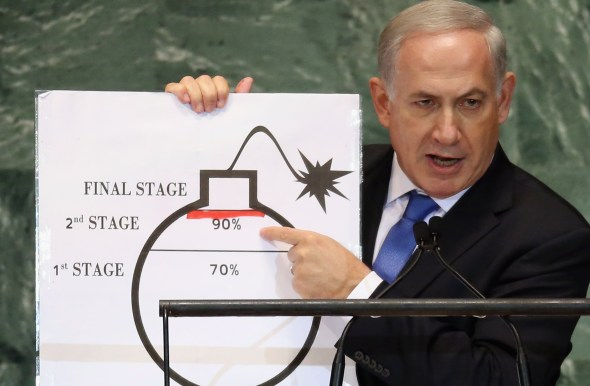
David Knowles at Bloomberg Politics on the Twitter gag: White House Trolls Netanyahu on Iran with Bomb Graphic.
The White House has employed a graphic first used by Benjamin Netanyahu to push its case for a nuclear deal with Iran that the Israeli Prime Minister opposes. On Wednesday, the president’s office posted a tweet that borrowed the graphic representation of a bomb that Netanyahu had held up during a speech to the United Nation’s General Assembly in which he warned of Iran’s growing nuclear capability.
Worth sharing: Here's how the #IranDeal would shut down Iran's pathway to a nuclear weapon → go.wh.gov/Iran-deal http://t.co/8aYQi2KEgq—
The White House (@WhiteHouse) April 08, 2015The fuse on the original image was intact, and there was no sign of the metaphorical scissors or accompanying text that the White House saw fit to add.
Pretty funny.
And how about this op-ed from the Jerusalem Post: How Netanyahu is single-handedly hurting the US-Israel relationship.
Benjamin Netanyahu is singlehandedly hurting a relationship that has resulted in over $100 billion in military aid to Israel since 1962. The Prime Minister is hurting a relationship with a country that constantly defends Israel at the UN; resulting in over 30 U.S. vetoes of resolutions critical to Israel. Because of Netanyahu, some are wondering if the U.S. should continually give $3.1 billion in annual aid and professors like Harvard’s Steven Strauss have written about ending this perpetual assistance. Sadly, the Prime Minister’s supporters in Israel and abroad don’t seem moved by the magnitude of what could be lost if Netanyahu’s feud with Obama “gets even worse.” [….]
even those whose job it was to protect Israel from the threats trumpeted by Netanyahu feel that the Prime Minister has overstepped the boundaries of rationality.
According to The Jerusalem Post recently, “Former Mossad chief slams Netanyahu for insistence that Iran recognize Israel’s right to exist.” Efraim Halevy also predicted a“dramatic” improvement in Israeli relations with the U.S. if Netanyahu were to be defeated in the latest elections. Another former Mossad chief, Meir Dagan, called Netanyahu’s speech to Congress “bull—t” and views the Prime Minister’s policies as dangerous to Israel’s future. A third former Mossad chief, Tamir Pardo, stated that a nuclear Iran did notpost an existential threat to Israel; a viewpoint directly at odds with the hysteria (fueled by Netanyahu’s political ideology) surrounding Obama’s nuclear deal.
When three former Mossad chiefs are forced to speak out, an Israeli Prime Minister should tone down his paranoid rhetoric, not increase the tempo of his political exploits. Say what you will about Bibi’s critics, but former Mossad chiefs aren’t “leftist” and they know quite a bit about Israeli security threats. Their sober assessment of Netanyahu’s P. T. Barnum inspired diplomacy (regarding Israel’s U.S. relationship) is just cause to reassess the Prime Minister’s behavior; not champion his constant criticism of Obama’s nuclear deal.
The Economist writes that “RARELY have relations between an American president and an Israeli prime minister sunk so low.” The New Yorker published an article titled A Bad Day In American-Israeli Relations. Senator Dianne Feinstein recently stated she wished that Netanyahu “would contain himself” and I echoed the California Senator’s sentiment in a recent Congress Blog piece. Tzipi Livni has warned that Netanyahu is leading Israel into “crisis and diplomatic isolation.” Like Livni, Yair Lapid has lamented over the state of relations between the White House and Israel, stating, “This damage will take a long time to mend.” Everyone from former Mossad chiefs, U.S. Senators, Israeli politicians, and journalist have expressed dismay about the decline in a relationship that is essential to Israel’s future.
From The Washington Post, here’s more interesting news from the White House: White House condemns therapy to ‘cure’ gay youth.
The statement was issued in response to a White House petition signed by more than 120,000 people after the suicide of 17-year-old Leelah Alcorn, a transgender teen from Ohio whose suicide note condemning the society’s treatment of transgender people went viral after her death. In the note, she indicated she had been subjected to such therapies.
“The only way I will rest in peace is if one day transgender people aren’t treated the way I was, they’re treated like humans, with valid feelings and human rights,” Alcorn wrote in her note.
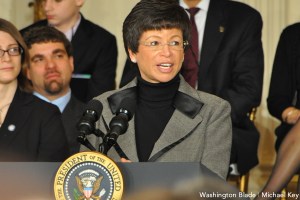
The White House statement, issued by President Obama’s senior adviser Valerie Jarrett, condemned “conversion” therapy, also known as “reparative” therapy, which she defined as any treatment aimed at changing a person’s sexual identity.
“The overwhelming scientific evidence demonstrates that conversion therapy, especially when it is practiced on young people, is neither medically nor ethically appropriate and can cause substantial harm,” she wrote. “As part of our dedication to protecting America’s youth, this Administration supports efforts to ban the use of conversion therapy for minors.”
Shortly before releasing the White House response to the petition on conversion therapy, according to a White House official, Jarrett spoke with organizers of the petition. “She listened to their personal stories about why this was important to them and thanked them for their efforts,” said the official, who asked for anonymity in order to describe a private conversation.

And from The Advocate: The White House’s Executive Office Now Has Gender-Neutral Bathroom.
An all-gender restroom is for the first time available in the Eisenhower Executive Office Building, confirms a White House spokesman. Alternatively, guests are invited to use whichever bathroom fits with their gender identity.
“The White House allows staff and guests to use restrooms consistent with their gender identity,” said White House spokesman Jeff Tiller, “which is in keeping with the administration’s existing legal guidance on this issue and consistent with what is required by the executive order that took effect today for federal contractors.”
Valerie Jarrett, senior adviser to President Obama, had mentioned the policy change in an op-ed today for The Advocate, saying the adminstration had “closely examined” its policies on “restroom access” to help “ensure that everyone who enters this building feels safe and fully respected.”
Gender neutral bathrooms, if single-stall, also often offer a safe space to differently abled users, parents with their children, and anyone else seeking privacy.
The push for gender-neutral restrooms in public buildings and workplaces has been one cause taken up by transgender rights activists — and one that’s found the most visible sucecss on university campuses — making Jarrett’s anouncement feel to many like a win for trans Americans.
“It is heartening to see that, even if legislators in some states are attacking the dignity and humanity of transgender and gender-nonconforming people, at least the White House is still moving in the direction of dignity and common sense,” Mara Keisling, executive director of the National Center for Transgender Equality, told The Advocate.
Within the past several years, the Obama administration has been increasingly affirming of trans citizens, with Vice President Joe Biden referring in 2012 to transgender discrimination as the “civil rights issue of our time” and President Obama using the word “transgender” (in addition to “lesbian” and “bisexual”) in this year’s State of the Union Address for the first time ever for any president. Federal employees have had the right to use the bathroom that accords with their gender identiy since 2011.
Around the country, heads of Republican homophobes must be exploding. Read the whole article for more on LGBT-positive actions the Obama administration has taken.
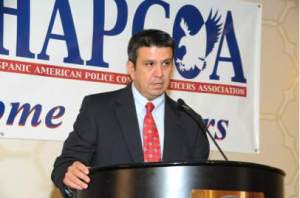
Xavier Morales
Some not so good news: the Secret Service’s credibility continues to slide downhill rapidly.
WaPo: Secret Service manager put on leave during probe of alleged assault.
The D.C. police’s sex-crimes unit and a government inspector general are investigating the female agent’s allegation that Xavier Morales, a manager in the security clearance division, made unwanted sexual advances and grabbed her on the night of March 31 after they returned to the office from a party at a downtown restaurant, according to two law enforcement officials with knowledge of the probe.
The woman told police and agency investigators that Morales, her boss, told her during the party at Capitol City Brewing Company that he was in love with her and would like to have sex with her, according to two people briefed on her statements. In the office later, she alleged, Morales tried to kiss her and grabbed her arms when she resisted, according to the two people briefed on her complaint. The woman alleged that the two scuffled until Morales relented.
Through an agency spokesman, Morales declined to comment, and he did not respond to requests for comment left on his personal phone.
Late last week, the Secret Service took the unusual step of placing Morales on indefinite administrative leave and adding his name to an internal “do not admit” list prohibiting entry to the office, a Secret Service official said. The Secret Service also took away his gun and badge after agency investigators launched a preliminary review of the complaint and conducted “subsequent corroborative interviews” Thursday afternoon, said agency spokesman Brian Leary.
More details at Heavy.com: Xavier Morales: 5 Fast Facts You Need to Know.
Ugh. Maybe we need more female Secret Service agents to quell the “boys will be boys” atmosphere in the agency.
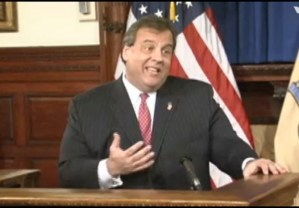
More trouble may be coming for NJ governor and possible GOP presidential candidate Chris Christie.
NJ.com reports: Indictments may come very soon in Bridgegate, report says.
Indictments may be coming very soon in Bridgegate, the investigation into improper lane closures at the George Washington Bridge in late 2013 that has also led to questions about bribery and conflicts of interest possibly involving Gov. Christie and the Port Authority, sources told The New York Times.
New Jersey U.S. Attorney Paul Fishman launched the probe a few months after three lanes were closed to the bridge in September 2013, causing gridlock in Fort Lee. The closures were initially attributed to a traffic study by a Port Authority executive, Bill Baroni, but emails unearthed during an investigation revealed that the lanes were shut down on the orders of a Christie aide, Bridget Anne Kelly, to a Port Authority official appointed by Christie, David Wildstein. Some believe the lane closures were retribution for the failure of Fort Lee’s mayor, Mark Sokolich, to endorse Christie’s bid for re-election at a time when the governor and likely Republican presidential candidate was trying to build bipartisan support.
The Times previously reported that Fishman’s office may bring indictments to the operators of the bridge under a little-used statute that makes it a crime to use the bridge for something other than its intended purpose. Fishman’s office declined to say what course the investigation is taking.
This could be very interesting.
I have more news links, but I’m running out of space and time. I’ll add them to the comments.
What stories are you following? I’d love to read your comments on this post and click on your links to your recommended reads for today.
Friday Reads: The Iran Deal
Posted: April 3, 2015 Filed under: Barack Obama, Foreign Affairs, Iran, morning reads, open thread, U.S. Military, U.S. Politics | Tags: iran, israel, nuclear weapons, US Foreign Policy 15 Comments Good Afternoon!
I’m running late again! My schedule is just upside down now and DST just double whammed me on the same weekend I started my late night work. Still getting used to the weird hours. I also wanted to spend some time on the negotiations with Iran over its nuke program so I had to catch up with the news. I’m glad BB’s post was so good because I can see you’ve spent a lot of time commenting on what’s going on in Indiana with its so-called “religious freedom” bill.
Obviously, there are going to be several sides to the “deal” depending on your views and their connections to US/Israel policy. So, I thought I’d highlight a few. Max Fisher–writing for VOX–says the deal is “astonishingly good.”
When Aaron Stein was studying nuclear non-proliferation at Middlebury College’s Monterey graduate program, the students would sometimes construct what they thought would be the best possible nuclear inspection and monitoring regimes.
Years later, Stein is now a Middle East and nuclear proliferation expert with the Royal United Services Institute. And he says the Iran nuclear framework agreement, announced on Thursday, look an awful lot like those ideal hypotheticals he’d put together in grad school.
“When I was doing my non-proliferation training at Monterey, this is the type of inspection regime that we would dream up in our heads,” he said. “We would hope that this would be the way to actually verify all enrichment programs, but thought that would never be feasible.
“If these are the parameters by which the [final agreement] will be signed, then this is an excellent deal,” Stein concluded.
The framework nuclear deal establishes only the very basics; negotiators will continue to meet to try to turn them into a complete, detailed agreement by the end of June. Still, the terms in the framework, unveiled to the world after a series of late- and all-night sessions, are remarkably detailed and almost astoundingly favorable to the United States.
Like many observers, I doubted in recent months that Iran and world powers would ever reach this stage; the setbacks and delays had simply been too many. Now, here we are, and the terms are far better than expected. There are a number of details still to be worked out, including one very big unresolved issue that could potentially sink everything. This is not over. But if this framework does indeed become a full nuclear deal in July, it would be a huge success and a great deal.
The NYT editorial board calls the deal “promising.”
According to Reuters, Iranians were celebrating in the street as the deal was announced yesterday. The country has been living under harsh embargoes which have obviously hurt ordinary people.
Iranians celebrated in the streets after negotiators reached a framework for a nuclear accord and U.S. President Barack Obama hailed an “historic understanding”, but senior global diplomats cautioned that hard work lies ahead to strike a final deal.
The tentative agreement, struck on Thursday after eight days of talks in Switzerland, clears the way for a settlement to allay Western fears that Iran could build an atomic bomb, with economic sanctions on Tehran being lifted in return.
It marks the most significant step toward rapprochement between Washington and Tehran since the 1979 Iranian revolution and could bring an end to decades of Iran’s international isolation.
But the deal still requires experts to work out difficult details before a self-imposed June deadline and diplomats said it could collapse at any time before then.
 We have reaction to the deal from the GOP and from former SOS Hillary Clinton as reported by CNN.
The backlash from likely Republican presidential contenders to thepotential nuclear deal with Iran trumpeted Thursday by President Barack Obama came swift and hard. A more optimistic response came from likely 2016 Democratic candidate, Hillary Clinton.
Former Florida Gov. Jeb Bush said the deal — aimed at reining in Iran’s nuclear capabilities — “will only legitimize those activities.”
“Nothing in the deal described by the administration this afternoon would justify lifting U.S. and international sanctions, which were the product of many years of bipartisan effort,” Bush said. “I cannot stand behind such a flawed agreement.”
Clinton, meanwhile, held up the tentative agreement as an “important step” in preventing a nuclear Iran.
“Getting the rest of the way to a final deal by June won’t be easy, but it is absolutely crucial. I know well that the devil is always in the details in this kind of negotiation,” Clinton said in a statement. “The onus is on Iran and the bar must be set high. It can never be permitted to acquire a nuclear weapon.”
But the former secretary of state allowed leeway for herself in case things go awry in the coming months, stating, “There is much to do and much more to say in the months ahead, but for now diplomacy deserves a chance to succeed.”
The rest of the Republican field, however, coalesced around rejecting the deal.
Making his first trek to Iowa as an announced presidential candidate, Texas Sen. Ted Cruz contended the President must bring Congress into the process.
“The very first step for any deal, good or bad, should be submitting it to Congress, and the President making the case both to Congress and to the American people why this advances the national security interests of the United States,” Cruz told reporters after a town hall in Cedar Rapids. “Now everything President Obama has said up to this date has suggested that he is going to do everything he can to circumvent Congress.”
Florida Sen. Marco Rubio, a member of the Senate Foreign Relations Committee, described the early details of the agreement as “very troubling” and said “this attempt to spin diplomatic failure as a success is just the latest example of this administration’s farcical approach to Iran.”
Obama pushed to quiet skeptics of the framework during his remarks in the White House Rose Garden Thursday, asking, “Do you really think that this verifiable deal, if fully implemented, backed by the world’s major powers, is a worse option than the risk of another war in the Middle East?”
 Peter Baker–writing for the NYT–calls the deal a “foreign policy gamble”.
As Mr. Obama stepped into the Rose Garden to announce what he called a historic understanding, he seemed both relieved that it had come together and combative with those in Congress who would tear it apart. While its provisions must be translated into writing by June 30, he presented it as a breakthrough that would, if made final, make the world a safer place, the kind of legacy any president would like to leave. “This has been a long time coming,” he said.
Mr. Obama cited the same John F. Kennedy quote he referenced earlier in the week when visiting a new institute dedicated to the former president’s brother, Senator Edward M. Kennedy: “Let us never negotiate out of fear, but let us never fear to negotiate.” The sense of celebration was captured by aides standing nearby in the Colonnade who exchanged fist bumps at the end of the president’s remarks.
But Mr. Obama will have a hard time convincing a skeptical Congress, where Republicans and many Democrats are deeply concerned that he has grown so desperate to reach a deal that he is trading away American and Israeli security. As he tries to reach finality with Iran, he will have to fend off legislative efforts, joined even by some of his friends, to force a tougher posture.
The WAPO Editorial Board was critical of the deal.
THE “KEY parameters” for an agreement on Iran’s nuclear program released Thursday fall well short of the goals originally set by the Obama administration. None of Iran’s nuclear facilities — including the Fordow center buried under a mountain — will be closed. Not one of the country’s 19,000 centrifuges will be dismantled. Tehran’s existing stockpile of enriched uranium will be “reduced” but not necessarily shipped out of the country. In effect, Iran’s nuclear infrastructure will remain intact, though some of it will be mothballed for 10 years. When the accord lapses, the Islamic republic will instantly become a threshold nuclear state.
That’s a long way from the standard set by President Obama in 2012 when he declared that “the deal we’ll accept” with Iran “is that they end their nuclear program” and “abide by the U.N. resolutions that have been in place.” Those resolutions call for Iran to suspend the enrichment of uranium. Instead, under the agreement announced Thursday, enrichment will continue with 5,000 centrifuges for a decade, and all restraints on it will end in 15 years.
Mr. Obama argued forcefully — and sometimes combatively — Thursday that the United States and its partners had obtained “a good deal” and that it was preferable to the alternatives, which he described as a nearly inevitable slide toward war. He also said he welcomed a “robust debate.” We hope that, as that debate goes forward, the president and his aides will respond substantively to legitimate questions, rather than claim, as Mr. Obama did, that the “inevitable critics” who “sound off” prefer “the risk of another war in the Middle East.”
The proposed accord will provide Iran a huge economic boost that will allow it to wage more aggressively the wars it is already fighting or sponsoring across the region. Whether that concession is worthwhile will depend in part on details that have yet to be agreed upon, or at least publicly explained. For example, the guidance released by the White House is vague in saying that U.S. and European Union sanctions “will be suspended after” international inspectors have “verified that Iran has taken all of its key nuclear related steps.”
Obviously, Bibi is beside himself.
“I just came from a meeting of the Israeli cabinet. We discussed the proposed framework for a deal with Iran.
The cabinet is united in strongly opposing the proposed deal.
This deal would pose a grave danger to the region and to the world and would threaten the very survival of the State of Israel.
The deal would not shut down a single nuclear facility in Iran, would not destroy a single centrifuge in Iran and will not stop R&D on Iran’s advanced centrifuges.
On the contrary. The deal would legitimize Iran’s illegal nuclear program. It would leave Iran with a vast nuclear infrastructure. A vast nuclear infrastructure remains in place.
The deal would lift sanctions almost immediately and this at the very time that Iran is stepping up its aggression and terror in the region and beyond the region.
In a few years, the deal would remove the restrictions on Iran’s nuclear program, enabling Iran to have a massive enrichment capacity that it could use to produce many nuclear bombs within a matter of months.
The deal would greatly bolster Iran’s economy. It would give Iran thereby tremendous means to propel its aggression and terrorism throughout the Middle East.
Such a deal does not block Iran’s path to the bomb.
Is he the little boy that has cried wolf too often?
Anyway, I hope you’ll read up on the situation since it stands to be one of the biggest foreign policy agreements for quite some time.
What’s on your reading and blogging list today?

 peej
peej Carissa
 bostonboomer
 dakinikat
 ecocatwoman
 jjlo
jjlo mablue2
 Mama Lopez
 peggysue22
 quixote
 skydancingguestblogger
 Mona (aka Wonk the Vote)



 Sky Dancing
Recent Comments