
Chain, Chain, Chain …
Posted: July 13, 2011 Filed under: Economy | Tags: Chained CPI, inflation impacting the elderly 19 CommentsSo I thought I’d write a brief post on one of the topics that has come up with social security reform. That would be switching the Social Security COLA (Cost Of Living Adjustment) from the CPI-W to the Chained CPI. E conomists widely agree that the CPI-W overstates the rate of inflation. However, there are some other considerations to look at when undertaking any change. Kevin Drum from MoJo explains the problems with the CPI-W which is an inflation index based on a fixed basket of goods and is widely criticized for having a bunch of problems including substitution bias.
The reason is something called “upper level substitution bias,” which means that instead of always buying a standard basket of goods and services, people change their buying habits over time as prices change. When the price of hamburger goes up, they eat more chicken. When the price of chicken goes up, they switch back to hamburger. A version of CPI that takes this into account is called chained CPI, and overall it’s considered a more accurate reflection of actual inflation. But technical merits aside, there are always winners and losers when you make changes to statistics like this. One big loser would be Social Security beneficiaries. Initial Social Security benefits upon retirement are calculated based on wage levels, so they’d be unaffected by a switch to chained CPI. But annual COLA increases would be affected, and they’d be lower than they are now.
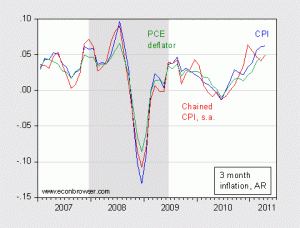 Menzie Chinn at Econbrowser has a nifty graph showing the differences in three measures of inflation. The blue line is the traditional CPI that’s now the basis of the Social Security COLA. The Green line is the PCE Deflator which is a more general measure of consumer inflation that’s not attached to a fixed basket of goods. This is the measure that the Fed tends to follow. The red line is the Chained CPI.
Chinn has a general discussion of each of these indices too. The CPI basket which is used to weight price changes updates every two years now. The chained CPI uses weights that are constantly changing and more realistically reflect changes in consumer buying habits. This avoids the substitution bias.
The BLS collects the buying habits and prices of typical urban consumers monthly and provides the data in the form of the inflation indices. You can read about the chained CPI and the methodology used to calculate it here. It’s been in use since 2002. The most basic explanation of the differences is explained at the FAQ provided by the BLS.
In its final form, the C-CPI-U is a monthly chained price index with the expenditure weights varying each month. The CPI-U and CPI-W, on the other hand, are biennial chained price indexes where their expenditure weights are updated every two years. Within the two-year span, these indexes are fixed-weight series, where the changes in these indexes reflect only changes in prices, and not expenditure shares, which are held constant.
Dean Baker has some information worth considering before we suggest that the change to the chained index is the best move. Using the Chained CPI may reduce overall costs while still providing a COLA, but the index may not reflect price changes that specifically impact the elderly population in the US.
It is not clear that the Chained CPI is more accurate than the current measure. The Bureau of Labor Statistics (BLS) has found that an experimental elderly index (CPI-E), that tracks the consumption patterns of people over age 62, actually shows a higher rate of inflation for the elderly than the CPI currently used for adjusting Social Security benefits.
While the CPI-E is not a full index since it does not look at the specific items bought by the elderly and the specific outlets they use for their shopping, there is no reason why BLS could not construct a full CPI-E. If the concern is having an accurate cost of living adjustment then it would seem that you should support having Congress instruct BLS to construct a full CPI-E. For my part, I don’t know whether this measure would show a higher or lower rate of inflation than the current CPI used for indexing benefits, but it would be a more accurate measure.
As it stands, switching to a Chained CPI would undoubtedly mean a cut in scheduled benefits, regardless of whether or not it involves a more accurate cost of living adjustment. Using this measure of the CPI would reduce benefits for retirees by 3 percent in 10 years, 6 percent in 20 years and 9 percent in 30 years. We know that the vast majority of retirees are struggling to make ends meet already. Retirees are not the people responsible for wrecking the country’s economy. Social Security benefit cuts of this magnitude seem like a major step in the wrong direction.
Inflation has not been much of a problem for this country since the mid 1980s. Since we are aware that too much money chasing too few goods is the basis of inflation and the FED is committed to not letting inflation get out of hand, it’s unlikely that we’ll see problems with inflation. The only thing that would lead–at this point in my mind–to major price disruptions would be a politicized FED that abused monetary policy or some brand of gold bug craziness that put us back on a hard currency. The last problem would cause incredible, destabilizing deflation since a fixed medium of exchange in a growing economy causes the opposite problem. That would be too little money chasing lots of goods.
Probably the best thing to do at this point would be to ask the CBO to study which index realistically represents changes to the cost of living, then seeing if the savings is worth it at the aggregate level. Dean Baker has this suggestion.
The Bureau of Labor Statistics’ (BLS) Experimental Price Index for the Elderly has consistently shown a somewhat higher rate of inflation for the elderly population.
If the concern is accuracy, then the route should be to have the BLS construct a full elderly index that could take account of actual purchase substitution patterns among elderly consumers. Simply switching to the C-CPI-U without undertaking this research is consistent with a desire to cut Social Security, not to make the COLA more accurate.
This is probably a better idea since the elderly are more likely to spend more on health care where costs have been rising astronomically. They are also less likely to buy other kinds of consumer goods. A CPI based on a senior basket of goods may be more appropriate.
Tuesday Reads: Cantor’s Conflict, Libertarian Cruelty, bin Laden’s DNA, and a Cold Case Solved
Posted: July 12, 2011 Filed under: Central Intelligence Agency, children, Corporate Crime, Crime, Economy, Federal Budget and Budget deficit, Foreign Affairs, income inequality, morning reads, Pakistan, Psychopaths in charge, Republican politics, U.S. Economy, U.S. Politics, voodoo economics | Tags: Banksters, Bill Clinton, CATO Institute, CIA, concflict of interest, Eric Cantor, Federal debt ceiling, Health care, IL, Jack Daniel McCullough, John Boehner, Joseph Cannon, Medicaid, Michael F. Cannon, Osama bin Laden, Pakistan, Seattle, Shakil Afridid, Sycamore 36 Comments
Good Morning!! I’ll take my coffee iced today, because it’s hotter than hell here in the Boston area. And about 110 percent humidity. OK, let’s get to the news.
The Washington Post has a laudatory profile of House Majority Leader Eric Cantor and his refusal to negotiate on raising the Federal debt ceiling–without ever mentioning that Cantor stands to make lots of money if the U.S. defaults on its debts.
Last month, Cantor walked out of talks led by Vice President Biden. Cantor said the reason was Democrats’ insistence on raising taxes as part of a deal to increase the national debt ceiling.
Then, last week, Cantor urged House Speaker John A. Boehner (R-Ohio) to reject a possible “grand bargain” with President Obama, which could have included tax increases. Boehner pulled Republicans out of those talks.
Now, as Cantor joins other leaders at the White House for near-daily summits in the third different grouping of negotiators, his moves have revealed him as a third major player in a legislative drama that had been dominated by Obama and Boehner. Where Boehner has sought to define what Republicans can do with their newfound power, Cantor, the House’s ambitious number-two, wants to underline what Republicans would never do.
So what is Cantor’s negotiating strategy?
On Monday, with a potential default less than a month away, Cantor was asked to identify compromises that Republicans had offered to help negotiations along.
He told reporters that the negotiation itself was a compromise.
“I don’t think the White House understands how difficult it is for fiscal conservatives to say they are going to vote for a debt-ceiling increase,” Cantor said.
Gee, it wasn’t all that hard to increase the debt ceiling again and again under Bush, now was it? But maybe in those days Cantor wasn’t betting against the U.S. in his financial investments. It’s very troubling that the Post didn’t mention Cantor’s humongous conflict of interest.
According to a new Washington Post-Pew poll, increasing numbers of Americans are “very concerned” about a U.S. default, but they are also “concerned” that raising the limit will lead to out-of-control spending.
The twin, divergent, concerns complicate the political calculus for the White House and congressional leaders as they attempt to strike an agreement. Nearly eight in 10 Americans are worried about raising the debt limit, and about three-quarters are concerned about not doing so.
Asked to choose, 42 percent see greater risk in a potential default stemming from not raising the debt limit, a seven-point increase from a Post-Pew poll six weeks ago. Slightly more, 47 percent, express deeper concern about lifting the limit, but the gap has narrowed.
Sixty-six percent of Republicans worry more about raising the debt limit than the U.S. defaulting on its debts. {sigh…}
Hipparchia has a wonderful post at Corrente that is an extended metaphor for libertarian attitudes about health care, specifically in reaction to the writings of a libertarian from the CATO Institute, Michael F. Cannon on the new Oregon health care plan. Here is the relevant quote from Cannon that set her off.
Michael F Cannon, of Cato@Liberty :
The OHIE establishes only that there are some (modest) benefits to expanding Medicaid (to poor people) (after one year). It tells us next to nothing about the costs of producing those benefits, which include not just the transfers from taxpayers but also any behavioral changes on the part of Medicaid enrollees, such as reductions in work effort or asset accumulation induced by this means-tested program. Nor does it tell us anything about the costs and benefits of alternative policies.
Reduction in work effort?? This would be really funny if Cannon weren’t so deadly serious. Providing health care to poor people means that more of them are just going to spend their days hanging out in parks, yakking on their cell phones , I guess. So, Libertarians are in favor of liberty for themselves and wage slavery for anybody else. Good to know.
Please go read the whole thing if you have time. It’s well worth the effort. We live in a world of selfish, greedy narcissistic fops. How can the country survive them?
Joseph Cannon has a short but pithy post on the media’s obsession with Casey Anthony being found not guilty. He then points out that the media has completely ignored the fact that
In 1995, when the Presidency was in the hands of the despised Bill Clinton, government regulators overseeing skullduggery on Wall Street referred 1,837 cases to the Justice Department for prosecution. That number has gone down. Between 2007 and 2010, the Justice Department has received just 72 referrals a year (on average).
Gosh. How can this be? I guess investment bankers are simply more honest than they used to be.
You won’t see this issue discussed on CNN. It’s not newsworthy.
I did not know that. Thank you Joseph Cannon. F&ck you CNN (and HLN and Nancy Grace).
Here’s an interesting story from The Guardian UK: CIA organised fake vaccination drive to get Osama bin Laden’s family DNA
As part of extensive preparations for the raid that killed Bin Laden in May, CIA agents recruited a senior Pakistani doctor to organise the vaccine drive in Abbottabad, even starting the “project” in a poorer part of town to make it look more authentic, according to Pakistani and US officials and local residents.
The doctor, Shakil Afridi, has since been arrested by the Inter-Services Intelligence agency (ISI) for co-operating with American intelligence agents.
Relations between Washington and Islamabad, already severely strained by the Bin Laden operation, have deteriorated considerably since then. The doctor’s arrest has exacerbated these tensions. The US is understood to be concerned for the doctor’s safety, and is thought to have intervened on his behalf.
The vaccination plan was conceived after American intelligence officers tracked an al-Qaida courier, known as Abu Ahmad al-Kuwaiti, to what turned out to be Bin Laden’s Abbottabad compound last summer. The agency monitored the compound by satellite and surveillance from a local CIA safe house in Abbottabad, but wanted confirmation that Bin Laden was there before mounting a risky operation inside another country.
DNA from any of the Bin Laden children in the compound could be compared with a sample from his sister, who died in Boston in 2010, to provide evidence that the family was present.
Jeralyn at Talk Left has finally decided that Obama deserves to get a pink slip. Yes, I know, she should have known better. But please go read anyway.
I’m going to end with a story about a long ago murdered child and how the case has been solved–54 years later. Maria Ridulph disappeared in 1957 when she was 7 years old. Maria and her best friend Kathy were playing on the street one day.
Kathy Chapman, who was 8 at the time, recalled that she and Maria were under a corner streetlight when a young man she knew as “Johnny” offered them a piggyback ride. Chapman, now 61 and living in St. Charles, Ill., told the AP she ran home to get mittens and that when she returned, Maria and the man were gone.
Maria’s disappearance and death had a powerful effect on her small community.
Charles “Chuck” Ridulph always assumed the person who stole his little sister from the neighborhood corner where she played and dumped her body in a wooded stretch some 100 miles away was a trucker or passing stranger — surely not anyone from the hometown he remembers as one big, friendly playground.
And, after more than a half century passed since her death, he assumed the culprit also had died or was in prison for some other crime.
On Saturday, he said he was stunned by the news that a one-time neighbor had been charged in the kidnapping and killing that captured national attention, including that of the president and FBI chief. Prosecutors in bucolic Sycamore, a city of 15,000 that’s home to a yearly pumpkin festival, charged a former police officer Friday in the 1957 abduction of 7-year-old Maria Ridulph after an ex-girlfriend’s discovery of an unused train ticket blew a hole in his alibi.

Maria Ridulph
A judge in Seattle set bail Monday at $3 million for Jack Daniel McCullough, of Seattle, a former police officer who denies he is the man Illinois police have been seeking in the 1957 slaying of a young girl….
McCullough, 71, a former police officer in Milton and Lacey, has been living in North Seattle and working as a night watchman in a senior-housing facility, Four Freedoms.
McCullough, 18 at the time of the girl’s death, had been a suspect early in the investigation. He lived about a block from where the girl disappeared and matched the description of a man seen at the site.
At the time, police did not show Maria’s best friend Kathy a picture of their suspect. But last year, they showed her a picture of the teenaged McCullough (then using the last name Tessier) and she recognized him.
That’s all I’ve got for today. What are you reading and blogging about?
Some juicy gossip about Rep. Paul Ryan and his drinking buddies
Posted: July 10, 2011 Filed under: Corporate Crime, Economy, Psychopaths in charge, Republican politics, the villagers, U.S. Economy, U.S. Politics | Tags: AQR Capital, Barack Obama, Bistro Bis, Brad De Long, Clifford Asness, Elizabeth Fama, Eugene Fama, freshwater economists, Goldman Sachs, hedge fund managers, Jayer-Gilles 2004 Echezeaux Grand Cru, John Cochrane, Paul Krugman, Paul Ryan, Susan Feinberg, Talking Points Memo, University of Chicago, wine 12 Comments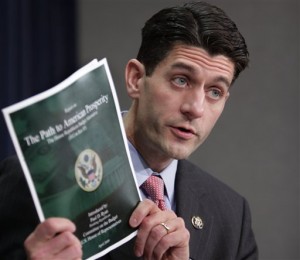
Paul Ryan hawking his plan to throw grandma from the train
You may have seen this gossipy story about Rep. Paul Ryan at Talking Points Memo on Friday. I’ve been meaning to post something about it but just haven’t found the time. Now TPM has a very interesting update. Here’s the background:
Rep. Paul Ryan (R-WI), a leading advocate of shrinking entitlement spending and the architect of the plan to privatize Medicare, spent Wednesday evening sipping $350 wine with two like-minded conservative economists at the swanky Capitol Hill eatery Bistro Bis.
[….]
Susan Feinberg, an associate business professor at Rutgers, was at Bistro Bis celebrating her birthday with her husband that night. When she saw the label on the bottle of Jayer-Gilles 2004 Echezeaux Grand Cru Ryan’s table had ordered, she quickly looked it up on the wine list and saw that it sold for an eye-popping $350, the most expensive wine in the house along with one other with the same pricetag.
Feinberg, an economist by training, was even more appalled when the table ordered a second bottle. She quickly did the math and figured out that the $700 in wine the trio consumed over the course of 90 minutes amounted to more than the entire weekly income of a couple making minimum wage.
Feinberg took some photos with her cell phone, approached the table and asked whether the two men with Ryan were lobbyists. One of the men responded by saying, “F&ck her.” Ryan claimed the two men were economists but refused to provide their names. Ryan then paid for one of the bottles of wine, but when asked about the appropriateness of spending so much when he was going all Dickensian on old people, Ryan avoided answering.
Today, TPM learned the identity of the two men who wined and dined Ryan on Friday night.
TPM has confirmed that the two other men with Ryan were Cliff Asness and John Cochrane. Both men have doctorate degrees in economics and are well-known in the conservative media world as die-hard proponents of the free market’s ability to right itself without government bailouts when the crisis hit in late 2008.
Asness, who ordered the wine and who, according to Feinberg was the one who said “Fuck her,” is better known as a high-profile hedge fund manager. Asness founded and runs AQR Capital, which manages an estimated $26 billion in a variety of traditional products and hedge funds, and his life story has been the subject of numerous books and articles about the rise and fall of Wall Street. He’s also grabbed headlines for being one of the most voluble opponents of President Obama’s economic policies.
[….]
Cochrane, the other, more tempered dinner companion, is the AQR Capital Management Distinguished Service Professor of Finance at the University of Chicago, an apparent tip of the hat to the contributions Asness’ AQR Capital Management has made to the Booth School of Business there.
Before launching AQR Capital in 1997, Asness worked for Goldman Sachs, the most profitable securities firm in Wall Street history, as the director of quantitative research for its Asset Management Division.
Via TPM, in 2009, Asness wrote an open letter to Barack Obama in which he (Asness) complained bitterly about some mildly critical remarks the President had made about hedge fund managers who refused to help out by buying Chrysler bonds. From New York Magazine:
Clifford Asness, the filthy-stinking-rich quant behind AQR Capital Management, [is] publicly engaging with a formidable opponent: The president of the United States. Asness, who supported Obama during the election, was appalled by Obama’s treatment of his colleagues during the Chrysler situation, and although he was not personally involved, he felt he had to make a stand.
Here is a portion of the letter:
Here’s a shock. When hedge funds, pension funds, mutual funds, and individuals, including very sweet grandmothers, lend their money they expect to get it back. However, they know, or should know, they take the risk of not being paid back. But if such a bad event happens it usually does not result in a complete loss. A firm in bankruptcy still has assets. It’s not always a pretty process. Bankruptcy court is about figuring out how to most fairly divvy up the remaining assets based on who is owed what and whose contracts come first. The process already has built-in partial protections for employees and pensions, and can set lenders’ contracts aside in order to help the company survive, all of which are the rules of the game lenders know before they lend. But, without this recovery process nobody would lend to risky borrowers. Essentially, lenders accept less than shareholders (means bonds return less than stocks) in good times only because they get more than shareholders in bad times.
The above is how it works in America, or how it’s supposed to work. The President and his team sought to avoid having Chrysler go through this process, proposing their own plan for re-organizing the company and partially paying off Chrysler’s creditors. Some bond holders thought this plan unfair. Specifically, they thought it unfairly favored the United Auto Workers, and unfairly paid bondholders less than they would get in bankruptcy court. So, they said no to the plan and decided, as is their right, to take their chances in the bankruptcy process. But, as his quotes above show, the President thought they were being unpatriotic or worse.
Well, Duh! But if “filthy, stinking rich” guys like Asness were patriotic, we probably wouldn’t have had a financial meltdown in the first place, now would we?
The other guy with Ryan on Friday, Professor John Cochrane of the University of Chicago, is a freshwater economist and follower of Eugene Fama AKA “the father of modern finance,” and Robert R. McCormick Distinguished Service Professor of Finance a the University of Chicago. Cochrane is also married to Fama’s daughter Elizabeth.
In early 2009, Cochane and Nobel Prize-winning economist Paul Krugman engaged in a legendary on-line debate that also involved Brad De Long and Eugene Fama. The whole thing was too wonky for me, but I gather it had something to do with Fama and Cochrane critiquing the use of fiscal stimulus and Krugman saying that the two freshwater economists wanted to return to the “Dark Ages of macroeconomics.” Here’s Krugman’s introductory paragraph:
Brad DeLong is upset about the stuff coming out of Chicago these days — and understandably so. First Eugene Fama, now John Cochrane, have made the claim that debt-financed government spending necessarily crowds out an equal amount of private spending, even if the economy is depressed — and they claim this not as an empirical result, not as the prediction of some model, but as the ineluctable implication of an accounting identity.
Maybe Daknikat can explain what the “cage match” was all about.
I think Paul Ryan is going to need to be a little more careful in the future if he is going to continue promoting the end of Medicare as we know it.
Hey Andy, me ‘n’ Barney didn’t have nuthin’ better to do, so we decided to crash the economy!
Posted: July 8, 2011 Filed under: 2012 presidential campaign, Barack Obama, Democratic Politics, Economy, Psychopaths in charge, Surreality, Team Obama, the villagers, U.S. Economy, U.S. Politics, unemployment, voodoo economics, We are so F'd | Tags: Andy Taylor, Barack Obama, Barney Fife, David Plouffe, Debt Ceiling, deficit, economy, Gomer Pyle, jobs, Social Security, stupid villiagers, Tim Geithner, unemployment, voodoo economics, William Daley 9 Comments
Barack O'Gomer and Deputy "Barney" Geithner*
This morning Sky Dancing’s resident economist Dakinikat wrote about Tim Geithner’s latest trial balloon about maybe stopping Social Security checks in August if Congress refuses to raise the debt ceiling. That’s right, he wants to use the trust fund that elderly people paid into all their working lives to pay China and other foreign debtors. Now that’s a brilliant plan boys–throw grandma and grandpa out in the streets to starve and die. It’s genius!
Then while we were all commiserating in the comment thread, we got the jobs report for June: only 18,000 jobs were added, and the phonied-up unemployment rate is now at 9.2%.
O’Gomer dragged his sorry a$$ out to the Rose Garden in late this morning to mumble a few weak excuses.
“Today’s job report confirms what most Americans already know,” Obama said. “We still have a long way to go and a lot of work to do to give people the security and opportunity that they deserve.”
The president tried to lay some blame at Congress’ feet. He said lawmakers could pass a handful of policies today to create jobs. His list included an infrastructure bank, free trade deals and patent reform.
“There are bills and trade agreements before Congress right now that could get all these ideas moving,” he said. “All of them have bipartisan support, all of them could pass immediately, and I encourage Congress not to wait.”
Yeah, patent reform, that’s the ticket! And more trade agreements to create more outsourcing of American jobs. Brilliant! And cutting off Social Security checks! That’s really gonna give Americans “the security and opportunity they deserve.” Who is advising this guy anyway?
Well, one of O’Gomer’s top advisers, David Plouffe, made an unfortunate remark before the jobs report came out. Minkoff Minx wrote about it in her SDB reads earlier this evening. From The Christian Science Monitor:
David Plouffe, Mr. Obama’s top political adviser, got things started Thursday at a breakfast sponsored by Bloomberg News.
“The average American does not view the economy through the prism of GDP or unemployment rates or even monthly jobs numbers,” Mr. Plouffe said. “People won’t vote based on the unemployment rate; they’re going to vote based on: ‘How do I feel about my own situation? Do I believe the president makes decisions based on me and my family?’ ”
Ask yourself, Mr. Plouffe, how do you think most ordinary Americans feels about their situation right about now? O’Gomer’s buddy Timmy Geithner is talking about cutting off Social Security payments. O’Gomer himself is trying to talk the Republicans into cutting Social Security, Medicare, and Medicaid. This administration hasn’t done diddly-squat about jobs except occasionally have O’Gomer mention that we need to create them. Talk is cheap, Mr. Plouffe. Actions speak louder than words as my mom used say.
According to Julian Brookes at Rolling Stone, Plouffe also made this odd assessment:
the president, says Plouffe, has a good shot with independent voters, who’ll reward his bipartisan, bend-over-backwards approach the debt talks; is a seasoned campaigner with a huge war chest; has moved to the center without losing the base (the oft-noted “enthusiasm gap” seems to have closed); and has demographic trends working in his favor (he won big with minorities in 08, and they’ll make up a larger share of the electorate next year). Plus, of course, the GOP field is weak: Frontrunner Mitt Romney is the most formidable of the bunch, but he’s nobody’s idea of a galvanizing standard bearer.
What is wrong with this guy? Does he really believe that Independents like politicians who “bend over backwards” instead of showing some strength? Does he really believe O’Gomer hasn’t lost his base? And the center? O’Gomer has gone so far right he’s out-crazying the Tea Party!
Then there’s William M. Daley, the White House chief of staff. Check out what he recently had to say about Americans’ attitudes about the crappy economy. According to Peter Nicholas at the LA Times, O’Gomer’s main defense is that the middle class was already suffering under Bush, so it’s not really his fault. Never mind that unemployment has gone from 7.8% to 9.2% on his watch. So O’Gomer is asking for more time:
Speaking at a fundraising dinner in Philadelphia last week, he said that the nation’s challenges “weren’t a year in the making or two years in the making, but are actually 10 years in the making.”
But Obama’s nuanced message isn’t breaking through. A Gallup Poll last month showed that Americans’ economic confidence was near its low for the year.
For the White House, it’s tough to get the public to pay attention to anything else.
A Democratic senator spoke by phone recently with White House Chief of Staff William M. Daley. “He said, ‘Honest to goodness, if we’re not talking about jobs and the economy, nobody is listening,’” recalled the senator.
Surprise, surprise, surprise!!
Gee, do you think maybe you ought to stop talking and actually DO something then? Just wait until Grandma finds out she might not get her Social Security check in August. Maybe O’Gomer and his advisers need to get a clue. And find O’Gomer a couple of advisers who know something about economics, Mr. Daley.
*NOTE: The graphic at the top of this post is the work of our old friend StateOfDisbelief.
Friday Reads
Posted: July 8, 2011 Filed under: abortion rights, black women's reproductive health, Catfood Commission, Democratic Politics, Economy, Federal Budget and Budget deficit, fetus fetishists, fundamentalist Christians, John Birch Society in Charge, morning reads, religious extremists, Reproductive Health, Reproductive Rights, Republican presidential politics, right wing hate grouups, U.S. Economy, We are so F'd | Tags: Christianist extremists, Debt, Debt Ceiling, deficit, planned parenthood of North Carolina, Rick Perry, warren buffett 51 Comments Good Morning!!
It’s hard not to be be completely discouraged these days. Our Washington deal-makers are permanently stuck in opposites day. No amount of reality is going to bring the lot of them out of whatever place they strategically reside. This Reuters piece stands as a hallmark to the current lunacy. We shouldn’t have any financial problems. Social Security is solvent and it’s not part of the federal budget are deficit problem. Why am I reading this then?
If Treasury were to decide to delay some payments, one option could be to postpone a disbursement of more than $49 billion to Social Security recipients that is due on August 3.
It would be a politically explosive step but one that could allow the government to temporarily pay bondholders to try to avoid foreign investors dumping U.S. Treasuries and the dollar.
The administration has warned that any missed payments, including those to retirees, veterans and contractors, would be default by another name, and the Treasury team still has concerns that any contingency plan would prove unworkable.
Steve McMillin, a former deputy director of the White House Office of Management and Budget under Bush, said Treasury has options but most of them are “pretty ugly.”
If Treasury were to decide to delay payments, it would need to re-program government computers that generate automatic payments as they fall due — a massive and difficult undertaking. Treasury makes about 3 million payments each day.
Do they figure that seniors aren’t going to riot in the streets effectively like that episode de of South Park called Grey Dawn? I can pretty well imagine that they won’t stop payments to their corporate bosses. After all, that option would soothe the bond vigilantes.
Here’s the issues under study now according to that same Reuter’s article.
– Whether the administration can delay payments to try to manage cash flows after August 2
– If the U.S. Constitution allows President Barack Obama to ignore Congress and the government to continue to issue debt
– Whether a 1985 finding by a government watchdog gives the government legal authority to prioritize payments.
The Treasury team has also spoken to the Federal Reserve about how the central bank — specifically the New York Federal Reserve Bank — would operate as Treasury’s broker in the markets if a deal to raise the United States’ $14.3 trillion borrowing cap is not reached on time.
I’m teaching an MBA Corporate Finance seminar this summer. Every single asset pricing model that prices securities, bonds, loans,options or whatever basically uses the US treasury bond as the risk-free asset. I feel like I have to asterisk everything I’m teaching right now which is basically the same thing that was taught to me back in the 1980s. It’s like these folks are purposefully trying to tank the financial markets and bring on another crisis. If they manage to raise the debt ceiling, then it appears likely to be done by ‘austerity’ measure like $4 trillion dollars in cuts. Start your backyard gardens now. The next depression is bound to be a big one. I have just have no idea why they’re trying to blow up our economy. It’s just frigging unbelievable. Of course, Orrin Hatch wants us all to suffer more, because after all, people that aren’t filthy rich are obviously defective in gawd’s eyes.
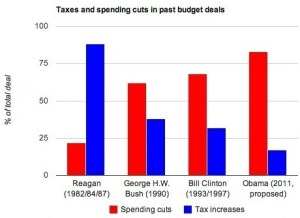
So, tell me, who is the real practicioner of voodoo economics?
So, here’s a nifty graph on the left from Ezra Klein showing the mix of spending cuts vs. tax increases the last few times we’ve had these debt and deficit discussions. Looks like the real practitioner of voodoo economics wasn’t Ronald Reagan but is Barrack Obama. Just more of the alternate reality forced on us by media and politicians that make up news, history, and economic theory.
As you can see on the graph, in each case, taxes were at least a third of the total, and in Reagan’s case, his massive tax cuts were followed by deficit-reduction deals that actually relied on tax increases. Today, tea party conservatives would be begging Sen. Jim DeMint to primary the Gipper.
Bush also included taxes in his deal, and Clinton relied heavily on taxes in his first deficit-reduction bill, which passed without Republican votes. In 1997, when he was working with Republicans, he actually cut taxes slightly while passing spending cuts. But of course the economy was in much better shape then, and Clinton had already increased revenues substantially.
The one-third rule doesn’t break down until you get to the deal Obama reportedly offered Republicans in the first round of debt-ceiling talks: $2 trillion in spending cuts for $400 billion in taxes, or an 83:17 split. And that, if anything, understates how good of a deal Republicans are getting. Tax revenues and rates are much, much lower than they were under Reagan, Bush or Clinton. And next year, Obama is pledging to extend most of the Bush tax cuts, which amounts to a $3 trillion-plus tax cut against current law.
Meanwhile, the polls–like this one from Pew Research–show that people overwhelmingly want to maintain social security, medicaid and medicare and would support tax increases to do so. So much for government of, for, and by the people.
As policymakers at the state and national level struggle with rising entitlement costs, overwhelming numbers of Americans agree that, over the years, Social Security, Medicare and Medicaid have been good for the country.
But these cherished programs receive negative marks for current performance, and their finances are widely viewed as troubled. Reflecting these concerns, most Americans say all three programs either need to be completely rebuilt or undergo major changes. However, smaller majorities express this view than did so five years ago.
The public’s desire for fundamental change does not mean it supports reductions in the benefits provided by Social Security, Medicare or Medicaid. Relatively few are willing to see benefit cuts as part of the solution, regardless of whether the problem being addressed is the federal budget deficit, state budget shortfalls or the financial viability of the entitlement programs.
Jim DeMint is one of the people that should be the first in line to be charged with treason and gross stupidity. Where was Senator DeMint when all the votes were taken to spend all this money to start out with? Plus, all those irresponsible revenue cuts back in the early 2000s when we basically had a balanced budget? He was a congressman from 1999-2005 so certainly he must’ve tried to stop Dubya Bush from all that spending!
Sen. Jim DeMint (R-S.C.) said Wednesday night that Republicans should maintain their hardline position in the debt-ceiling debate even if it results in “serious disruptions” to the economy.
“What I’m advocating here is, let’s use this as a point of leverage, give the president an increase, but don’t come away without real cuts from real caps and spending, and without a balanced budget,” DeMint said on FOX Business Network.
“We’re at the point where there would have to be some, you know, some serious disruptions in order not to raise [the debt ceiling],” he said. “I’m willing to do that.”
The president pushed the economy into “crisis” mode, according to DeMint. He said the president has been “burning time” with the deficit negotiations led by Vice President Biden, when the looming debt ceiling and budget deficit could have been addressed last year.
DeMint, well-known for speaking out in favor of limited government and balancing the budget, told host Andrew Napolitano that if Republicans and Democrats couldn’t vote in “something permanent” that would limit government spending, “we’re going to continue to spend [until] the total country collapses.”
Warren Buffet says the GOP is Threatening To ‘Blow Your Brains Out’ Over Debt Ceiling
Republicans are playing a dangerous game by refusing to raise the debt ceiling, according to Berkshire Hathaway CEO Warren Buffett.
“We raised the debt ceiling seven times during the Bush Administration,” Buffett told CNBC on Thursday. Now, the Republican-controlled Congress is “trying to use the incentive now that we’re going to blow your brains out, America, in terms of your debt worthiness over time.”
If Congress fails to raise the borrowing limit of the federal government by August 2, the date when the U.S. will reach the limit of its borrowing abilities, it will likely begin defaulting on its loans.
Buffett, who according to the Washington Post has helped raise money for Democratic candidates like Hilary Clinton in the past, has been highly critical of the actions of the Republican-controlled Congress. In May, Buffett stated at a Berkshire Hathaway shareholder’s meeting that if the Congress failed to raise the debt ceiling, it would constitute “the most asinine act” in the nation’s history, reports Reuters.
Other political news is equally disheartening. Most of the governments in the states are as crazy–if not crazier–than the US Congress. Planned Parenthood in North Carolina is suing the state over budget cuts designed to cut access to much used and cost saving preventive health care.
One of North Carolina’s two Planned Parenthood affiliates filed a federal lawsuit Thursday to invalidate part of the new state budget that cuts it off from federal or state funds for family planning.
The budget, written by Republicans in control of the General Assembly for the first time in more than a century, states that Planned Parenthood and its affiliates are forbidden from receiving any contracts or grants from the state health agency. The lawsuit filed in Greensboro’s federal court by Planned Parenthood of Central North Carolina contends the group is being punished for its abortion-rights advocacy, saying that violates its free-speech protections.
The organization is barred by law from using public money to perform abortions and uses the government contracts to provide family planning or teen pregnancy prevention services, yet is being singled out because Planned Parenthood supports abortion rights, the lawsuit said. Efforts to cut off funds to Planned Parenthood affiliates in North Carolina are similar to those in Kansas and Indiana, which were also met with federal lawsuits, the group’s attorneys said.
“Their sole purpose is to single out, vilify, and punish Planned Parenthood as a particularly visible provider and advocate — even though, ironically, the eliminated funds have nothing to do with abortion, but will only deprive low-income people of desperately needed health services and teen pregnancy prevention programs,” the lawsuit said.
Planned Parenthood of Central North Carolina received $287,000 in federal, state and matching local funds in the year that ended last week for teen pregnancy prevention and family planning programs that provided contraceptives to poor women, according to the state Department of Health and Human Services. The non-profit operates from locations in Chapel Hill, Durham, and Fayetteville.
Some of the most extremist pastors are signing on to Texas Governor Rick Perry’s Pray-a polooza. Talk about a hater-thon. Remember, Perry is supposed to be the ‘electable’ Republican.
And we already knew Perry didn’t care much about including, or even not offending, non-Christians: his personal letter announcing the event calls on the entire nation to pray to Jesus Christ. But the news, reported by Right Wing Watch, that a radical pastor named C. Peter Wagner has signed on as an official endorser of The Response deserves more attention.
The Colorado-based Wagner, who is featured on the website of The Response, is the head of Global Harvest Ministries.
His brand of evangelicalism, known as the New Apostolic Reformation, is characterized by extreme hostility to other religions. In this passage from his book “Hard-Core Idolatry: Facing the Facts,” Wagner praises the burning of Catholic saints, copies of the Book of Mormon, voodoo dolls, and other “idols”
Yup, welcome to the new surreality. All we need is Rod Serling introducing the morning reads today and I’d say that would be about right.
What’s on your reading and blogging list today?

 peej
peej Carissa
 bostonboomer
 dakinikat
 ecocatwoman
 mablue2
 Mama Lopez
 peggysue22
 quixote
 skydancingguestblogger
 Mona (aka Wonk the Vote)



 Sky Dancing
Recent Comments