
Today’s Deadline Passes With No Progress: Now What?
Posted: July 24, 2011 Filed under: Democratic Politics, Economy, legislation, Medicare, Republican politics, Social Security, Surreality, the villagers, U.S. Economy, U.S. Politics, voodoo economics, We are so F'd | Tags: Asian markets, Barack Obama, Catfood Commission II, Federal debt ceiling, Grover Norquist, Harry Reid, John Boehner, kabuki, markets, Mitch McConnell, Nancy Pelosi, Super Congress, the dollar, Wall Street 19 Comments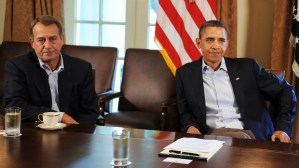
Late last night I wrote a post summarizing what happened yesterday in seemingly endless debt ceiling kabuki dance that is being staged for our benefit by people who are supposed to be serving us but instead answer to Wall Street, Big Oil, Big Pharma, and the rest of the filthy rich.
Last night John Boehner told House Republicans that they needed to show some progress today in order to calm the Asian markets. After weeks of assuming the politicians in Washington would work something out in order to keep the US from defaulting on its debts, the banksters were suddenly realizing there is a good chance the feckless “leaders” will just go ahead and let it happen.
Apparently both Democrats and Republicans see this debt ceiling debacle as a golden opportunity to strip Americans of what is left of their social safety net. The only disagreement seems to be that Democrats want to include a pretense of raising some revenue along with all the cuts to social programs and Republicans want no new revenue sources, apparently because they see an opportunity to bring Grover Norquist’s dream to fruition:
Norquist favors dramatically reducing the size of the government. He has been noted for his widely quoted quip: “I don’t want to abolish government. I simply want to reduce it to the size where I can drag it into the bathroom and drown it in the bathtub.”
He has also stated, “Cutting the government in half in one generation is both an ambitious and reasonable goal. If we work hard we will accomplish this and more by 2025. Then the conservative movement can set a new goal. I have a recommendation: To cut government in half again by 2050”. The Americans for Tax Reform mission statement is “The government’s power to control one’s life derives from its power to tax. We believe that power should be minimized.”
So what was accomplished in today’s kabuki performance? Did the Republicans meet Boehner’s goal of sending a calming signal to Asian markets before their Monday opening. No, of course not.
From The New York Times: Deadline Passes as Debt Ceiling Talks Languish
House Speaker John A. Boehner and the Senate majority leader, Harry Reid, were preparing separate backup plans to raise the nation’s debt ceiling on Sunday, after the leaders were unable to end an increasingly grim standoff over the federal budget.
The dueling plans emerged as lawmakers appeared to miss a self-imposed deadline of 4 p.m. Eastern time to cut a deal before markets open in Asia. And at about 6 p.m., President Obama began meeting with Mr. Reid and the House Democratic leader, Nancy Pelosi, in the Oval Office to discuss the Reid proposal.
Not surprisingly, nothing new seems to have emerged from the talks at the White House. But here’s Harry Reid’s supposed “plan.”
Mr. Reid, the Senate’s top Democrat, was trying Sunday to cobble together a plan to raise the government’s debt limit by $2.4 trillion through the 2012 election, with spending cuts of about $2.5 trillion. He would seek to avoid cuts to entitlement programs, but it was unclear how those savings would be achieved.
Notably, the plan does not currently contain any new or increased taxes, an approach that many in his caucus would probably balk at.
For his part, John Boehner is still blabbing on about the Republicans ridiculous “cut, cap, and balance” plan.
Speaker John Boehner (R-Ohio) told his colleagues in a Sunday afternoon conference call that a debt deal with Obama is not the way forward. He said on the call that a plan that “reflects the principles” of the conservative “Cut, Cap and Balance” proposal that the Senate rejected will serve as the model for any legislation coming out of the House. The speaker, though, did acknowledge that the plan itself is a non-starter.
“So the question becomes – if it’s not the Cut, Cap and Balance Act itself – what can we pass that will protect our country from what the president is trying to orchestrate,” Boehner said, according to a source familiar with the call.
Boehner and Majority Leader Eric Cantor (R-Va.), according to several sources on the call, implored his colleagues to “stick together” to enact a budget deal that they can support. Boehner said an agreement “will require some of you to make sacrifices.” He told his colleagues that they shouldn’t worry about winning the battles, but rather the war, according to a source on the call.
I found this piece at Huffpo helpful, although I’ve never heard of the author, Mohamed el-Erian. CEO and co-CIO, Pacific Investment Management Company. Perhaps Daknikat has? Here’s what he had to say after the supposed deadline passed without any progress.
Friday’s stunning and very public quarrel between the president and the Speaker of the House of Representatives was the catalyst for a weekend of frantic negotiations on how to increase America’s debt ceiling, maintain the country’s sacred AAA rating, and avoid a near-term default. Meanwhile, administration officials and members of Congress took to the airwaves on Sunday trying, but largely failing, to strike the balance between statesmanship and another round of the Washington blame game.
It was hoped that all this would serve as a prelude to a political compromise announced just before the opening of Asian markets. This did not materialize. But while another self-imposed deadline has been missed, it is likely that the nation’s leadership will stumble into a short-term compromise over the next few days — one that raises the debt ceiling and avoids a debt default but, importantly, leaves the AAA rating extremely vulnerable and does little to lift the damaging clouds hanging over the US economy.
It will come down to the wire; and when the stopgap compromise is reached, many in Washington will declare victory and, in the process, claim credit for averting a national disaster. Yet the resolution will likely be temporary, and the damage will be real and long-lasting — both of which render an already worrisome situation even more difficult going forward. Indeed, by illustrating so vividly to the whole world what is ailing America, the weekend’s political theatrics should make us all worry even more about the world’s largest economy.
It’s an interesting article. Obviously our “leaders” have already done immense damage to our struggling economy, not just with their wrongheaded policies, but also with their childish game-playing.
Boehner’s plan right now seems to be to insist on a short-term temporary increase in the debt limit of about $1 trillion
accompanied by spending cuts of at least as much, tying the remainder of the debt-ceiling increase Obama has requested to further cuts in the future. The White House says Obama would veto such a measure.
The markets responded quickly:
U.S. stock futures fell, indicating the Standard & Poor’s 500 Index will slump after rallying within 1.4 percent of a three-year high, as failure to raise the federal debt limit intensified concern of a default.
The contract on the S&P 500 Index expiring in September declined 1.2 percent to 1,325.50 at 7:01 a.m. in Tokyo. The U.S. dollar fell against the euro, yen and Swiss franc.
[….]
The dollar weakened to $1.4390 per euro as of 6:01 a.m. in Tokyo from $1.4360 in New York at the end of last week. The greenback fell to 78.35 yen, and touched a four-month low of 78.12 yen, from 78.54 on July 22. It fetched 81.17 Swiss centimes from 81.92 last week after reaching a record low 80.33 on July 18. The yen traded at 112.75 per euro from 112.77.
I don’t pretend to understand all that gibberish, but I know it isn’t good.
The Wall Street Journal says the markets are “bracing for volatility as debt ceiling debate drags on.”
What really scares me is what is going on behind all the “partisan” kabuki. Let’s face it, Democrats are no more our friends than Republicans at this point. We simply can’t trust any of them. I wrote a few days ago about the Catfood Commission II clause that is included in the so-called McConnell plan–the fallback plan that Harry Reid is on board with. Apparently Boehner has also latched onto this idea, and the sequel to the Catfood Commission will also be included in whatever legislation the Republicans come up with.
Ryan Grim has a piece in Huffpo today about Catfood Commission II, which he characterizes as a “Super Congress.”
Debt ceiling negotiators think they’ve hit on a solution to address the debt ceiling impasse and the public’s unwillingness to let go of benefits such as Medicare and Social Security that have been earned over a lifetime of work: Create a new Congress.
This “Super Congress,” composed of members of both chambers and both parties, isn’t mentioned anywhere in the Constitution, but would be granted extraordinary new powers. Under a plan put forth by Senate Minority Leader Mitch McConnell (R-Ky.) and his counterpart Majority Leader Harry Reid (D-Nev.), legislation to lift the debt ceiling would be accompanied by the creation of a 12-member panel made up of 12 lawmakers — six from each chamber and six from each party.
Legislation approved by the Super Congress — which some on Capitol Hill are calling the “super committee” — would then be fast-tracked through both chambers, where it couldn’t be amended by simple, regular lawmakers, who’d have the ability only to cast an up or down vote. With the weight of both leaderships behind it, a product originated by the Super Congress would have a strong chance of moving through the little Congress and quickly becoming law. A Super Congress would be less accountable than the system that exists today, and would find it easier to strip the public of popular benefits. Negotiators are currently considering cutting the mortgage deduction and tax credits for retirement savings, for instance, extremely popular policies that would be difficult to slice up using the traditional legislative process.
So basically, no matter what legislation Congress ends up passing to raise the debt ceiling, this “Super Congress” will be included. We certainly can’t expect any disagreement on this from Obama who, as Grim describes it “has shown himself to be a fan of the commission approach to cutting social programs and entitlements.”
We are so utterly f&cked.
Invoke the 14th Amendment. PERIOD.
Posted: July 24, 2011 Filed under: Economy, Federal Budget, Federal Budget and Budget deficit | Tags: 14th amendment, debt ceiling rant 37 CommentsSection 4. The validity of the public debt of the United States, authorized by law, including debts incurred for
payment of pensions and bounties for services in suppressing insurrection or rebellion, shall not be questioned. But neither the United States nor any State shall assume or pay any debt or obligation incurred in aid of insurrection or rebellion against the United States, or any claim for the loss or emancipation of any slave; but all such debts, obligations and claims shall be held illegal and void.
The first intelligent article suggesting we do that came from The Nation‘s Katrina vanden Heuvel after Timothy Geithner suggested he had folks exploring the option. I’ve ended several blog posts this month with the call to invoke the 14th and send the insane teabot posse back home with the message that they may want to read up on U.S. The Constitution before they start waving that Gadsden flag in our faces.
Brad Delong fleshes the argument out within this context. We have a president that’s found lawyers who have said that actions in Libya are not “hostilities”. I will add that we’ve had several presidents who have found lawyers that have written that “enhanced interrogation techniques” aren’t torture and that it’s okay to assassinate citizens without due process. Certainly, with a Washington DC that has more word-parsing, pretzel-logic-precedent-finding, triangulating lawyers per square foot than any place on the planet, the White House can find one that finds Delong’s suggestions below justifiable via Section 4 stated above.
The structure of Tim Geithner’s testimony to Congress defending his additional borrowing is:
- The Constitution forbids me from even thinking about default.
- You ordered me to spend.
- A previous Congress told me not to borrow, but no Congress can bind its successors, and those of you who are in this Congress here now ordered me to spend.
- I’m just doing what you told me to do–and what the Constitution directly and explicitly tells me to do.
And then we should move on to the people’s business. This episode of kabuki theatre has done nobody any credit. If I had previously had any respect for or confidence in Republicans, this would have shredded it. And each day it continues it further shreds my respect for and confidence in the executive branch.
DeLong argues–and I agree–that this is far better than options outlined by Ezra Klein and ranked by Calculated Risk here. In the long run, we should probably be looking at eliminating the debt ceiling. If Congress authorizes the spending and the President signs off on it, there should be absolutely no way that they can renege on bond holders later. Moody’s suggested the same thing last week. The rest of the crap on the table just undoes one promise made to people after another.
It should be obvious by now that Boehner is not in control of his caucus in congress. The tea party has him over a tea barrel. These are folks that appear to have no clue about anything as illustrated by their ignorant statements last spring that all they had to do was pass a budget and it was law. They completely forget the role of the President and the Senate. They seem to have no idea or they stubbornly refuse to believe the experts that tell them that what they are doing is basically bringing the country’s economy down.
Meanwhile, there were lingering doubts about Boehner’s ability to rally support for a debt-limit increase of any size or duration. Many House Republicans continue to push their plan to sharply cut spending over the next decade and adopt a constitutional amendment requiring Congress to balance the budget. Such a plan passed the House, but failed Friday in the Senate on a party-line vote.
Freshman Rep. Blake Farenthold (R-Tex.) said Republican leaders remain concerned that even a small increase in the debt limit would fail on the House floor.
“I think their concern about bringing it to the floor is whether they can get 218 [votes] or not,” Farenthold said in an interview. “Everybody wants to only go through this pain once.”
We can’t afford to pass a debt ceiling increase attached to no firm commitments for revenue adjustments. It’s ridiculous. There is no way the long term budget problems will ever be solved under these conditions. Further more, the fall out from the increased interest rates and the impact on the already nasty economy will just drive economy-related revenues down and expenditures up. We’ll exacerbate the very thing we’re trying to alleviate. This is insanity.
If the meetings today look to be more of the same, the President should just get on TV Monday morning and tell Geithner to pay the bills for the spending that the congress authorized and cite the 14th amendment. Again, if you can find a lawyer that says that enhanced interrogation techniques aren’t torture and justify claiming a citizen is an enemy combatant and can be detained indefinitely–or assassinated–without due process, rationalizing this should be easy. Our country’s economy shouldn’t be subjected to deliberate economic sabotage because a few new congress critterz flunked their middle school American Government and History classes.
If you don’t want to take my word for it, then take former President Clinton’s suggestion. There’s also a list of lawyers there that would tell our constitutional law lecturer President that it’s constitutional.
A few days ago, former President Bill Clinton identified a constitutional escape hatch should President Obama and Congress fail to come to terms on a deficit reduction plan before the government hits its borrowing ceiling.
He pointed to an obscure provision in the 14th Amendment, saying he would unilaterally invoke it “without hesitation” to raise the debt ceiling “and force the courts to stop me.”
Yet another Economic WTF! Post
Posted: July 22, 2011 Filed under: 2012 presidential campaign, Barack Obama, Black Agenda Report, Economy | Tags: Obama's Republican Economic Policies 19 Comments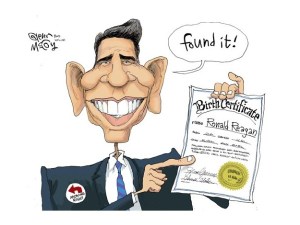 For more than the past two years, I’ve been arguing that Obama has been continuing the Bush/Cheney policies in nearly every possible policy area. However, in the economics realm, he’s following the Republican Myth of Reagan. Ronald Reagan raised taxes 5 times. Ronald Reagan exploded the federal deficit and upped the debt ceiling 17 times in his two terms in office. Ronald Reagan was probably the last of the presidents that openly used policies that were lopsided, wrongly transcribed Keynesian economics. Keynesian theory shows the necessity of running surpluses in boom times, balanced budgets in times of full-employment equilibrium, and deficits in recessions and out of necessity in times of war.
Obama fits the mythic image of Republican’s version of Reagan more than the real Ronald Reagan himself. It is only by the rule of soft bigotry–one that says all black people are some kind of monolith fitting a Sharpton/Jackson stereotype–that drives polls that say that Obama is too liberal, a communist, or a typical Democrat. Obama continues to refit himself into the stereotype of Ronald Reagan. Period. My favorite place to reference this argument is the Black Agenda Report . It one of the very few authentic left wing site representing a left wing agenda for America’s poor and black population. The authors of BAR have had his number for a very long time. A huge portion of the population just does not want to cast Obama and his policies in the light of a conservative black no matter what the evidence. This is our quintessential problem right now.
I’ve been watching the evolution of Paul Krugman who writes today about “The Lesser Depression” at the NYT. Despite his mounting, published, and well discussed evidence, he still can’t just come out and say that Obama would be better placed in the Republican party. Obama is taking the same steps that the Herbert Hoover Administration took right before the Great Depression. We are backtracking the way the Roosevelt administration did around 1936. None of these policies led to economic confidence or growth. They led to job, financial, and economic loss. They made our country significantly worse off then and this senseless repeat is doing the same thing now.
So we have depressed economies. What are policy makers proposing to do about it? Less than nothing.
The disappearance of unemployment from elite policy discourse and its replacement by deficit panic has been truly remarkable. It’s not a response to public opinion. In a recent CBS News/New York Times poll, 53 percent of the public named the economy and jobs as the most important problem we face, while only 7 percent named the deficit. Nor is it a response to market pressure. Interest rates on U.S. debt remain near historic lows.
Bruce Bartlett–an economic adviser to Ronald Reagan–says that Obama is Richard Nixon. I think this is generous. Nixon had a more liberal approach to the nation’s health care challenges, the environment, and to spending. Nixon accepted the Great Society Policies. Reagan supported the Great Society Policies and reinvigorated two of them. Obama obviously doesn’t even support the basics. He is negotiating behind the back of Senate and Congressional Democrats so that the clock will run out before they can object. They will most likely kowtow to the right’s agenda YET again. Bartlett argues that Obama belongs in the ranks of Republicans. I agree with this. I just don’t think he’s as liberal as Nixon or that he is even “moderately conservative”. Like Reagan, Obama has said one thing and done completely another. Obama wants to be the Ronald Reagan that never was.
Liberals hoped that Obama would overturn conservative policies and launch a new era of government activism. Although Republicans routinely accuse him of being a socialist, an honest examination of his presidency must conclude that he has in fact been moderately conservative to exactly the same degree that Nixon was moderately liberal.
Here are a few examples of Obama’s effective conservatism:
- His stimulus bill was half the size that his advisers thought necessary;
- He continued Bush’s war and national security policies without change and even retained Bush’s defense secretary;
- He put forward a health plan almost identical to those that had been supported by Republicans such as Mitt Romney in the recent past, pointedly rejecting the single-payer option favored by liberals;
- He caved to conservative demands that the Bush tax cuts be extended without getting any quid pro quo whatsoever;
- And in the past few weeks he has supported deficit reductions that go far beyond those offered by Republicans.
Perhaps this is why these CNN Poll results show that the country is fed up with the Republican Congress as well as Obama’s approach to the economy. People are reluctant to overcome their stereotypes of black politicians, but know something is essentially wrong. Recent hopes to change the direction that Bush/Cheney took our country have brought us more than just more of the same. Liberals approval of Obama is dropping while independent approval of newly elected Republicans is dropping all over the country. (See BostonBoomer’s Thursday Morning Post.) I suggest this shows support for my hypothesis.
President Obama’s approval rating falls to 45%, driven in part by dissatisfaction from the left with Obama’s track record, a new CNN/ORC International poll released today suggests.
The new poll shows that 38% disapprove of Obama because he has been too liberal, but 13% percent say he has not been liberal enough, nearly double those who felt that way in May. His approval rating among liberals is at 71%, an all-time low for his presidency. Overall, those who disapprove of Obama is at 54%, tying an all-time low hit just before November’s midterm elections.
Poll respondents’ negative opinions weren’t reserved just for the president, though — 55% of all Americans have an unfavorable view of the Republican Party, a 7-point increase since March. And only 37% feel the GOP’s policies would move the country in the right direction, a 9-point drop since the start of the year.
We’ve seen the Democratic Congress pulled along by an at best center-right policy on Health Care Reform. They were also party to the abomination of reinstating the Dubya Tax Cuts for Billionaire’s plan. Now, they are screaming about their irrelevancy in this Debt Ceiling Debate. The right question now is only this. How far to the right will this deficit plan be? The necessary answer can be found in these questions. How thoroughly will Obama and congressional Republicans decimate the country’s social safety nets and its successful social insurance programs? How detached will this plan be from using revenues from the beneficiaries of 30 years of bad policy to halt subsidizing the globalization of US Treasure? How much longer will we continue to subsidize economic colonization with our wealth to places that only drag our wages down, decimate the global ecosystem, tolerate wars that make the world safer for US corporations, and import our jobs and investments? If Bartlett wants a realistic vision of a Republican President that fits Obama, I suggest Warren G. Harding.
Breaking … WSJ Discovers Lack of Demand is behind Weak U.S. Economy
Posted: July 18, 2011 Filed under: Barack Obama, Domestic Policy, Economy, Surreality, The Great Recession, U.S. Economy, U.S. Politics, unemployment, voodoo economics | Tags: consumer demand, economics, Economists, economy, Federal spending cuts, government stimulus, jobs, Keynes, unemployment, Wall Street Journal 16 Comments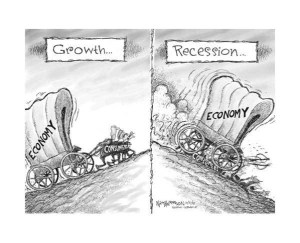
Via Andrew Leonard at Salon, the Wall Street Journal today reported the results of a survey they conducted with 53 economists:
In the survey, conducted July 8-13 and released Monday, 53 economists—not all of whom answer every question—were asked the main reason employers aren’t hiring more readily. Of the 51 who responded to the question, 31 cited lack of demand (65%) and 14 (27%) cited uncertainty about government policy. The others said hiring overseas was more appealing.
Only the conservative WSJ, the President, and Congresss could be surprised by these results. I’m not sure who these 53 economists were, but I think they must have been rather conservative, because the survey found that most did not think the government should do anything more to stimulate the economy.
Despite their forecasts for slow growth and an elevated unemployment rate, the economists aren’t in favor of further action either by the Fed or the federal government. Forty-one economists in the WSJ survey said the central bank shouldn’t pursue another round of bond-buying aimed at reducing interest rates, and thirty-eight said another round of fiscal stimulus shouldn’t be a part of any deficit-reduction package.
Economists added that they hope that as conditions begin to improve, albeit slowly, consumers will become more optimistic. “For whatever reasons, in addition to discrete headwinds, I think we’ve taken a hit to animal spirits and as those headwinds fade sentiment will revive,” said Stephen Stanley of Pierpont Securities. “Optimism can be self-sustaining, but pessimism can also provide a persistent drag.”
If any of the economists the WSJ talked to mentioned the possibility that the government itself could create jobs and thus stimulate demand–as FDR did the last time things were this bad, the WSJ did not report it.
Andrew Leonard crows:
what could be more obvious, even in the absence of rigorous training in economics? In the absence of demand, businesses will refrain from ramping up production and adding staff — no matter what employers think about the future regulatory climate. To prime this pump, to rev up this engine, to get the “delicate machine” working properly, the first focus for economic policymakers should be figuring out ways to boost demand.
Wouldn’t the best way to do that be to create jobs? Even Andrew Leonard doesn’t mention that. It seems ass-backwards to me to talk about getting consumers to spend more in order to get companies to start hiring. How can consumers spend more when many of them are unemployed? Maybe Dakinikat can explain this to me.
Anyway, it’s pretty amazing that the WSJ is admitting we have a demand problem. Now if only they could convince President Obama…
Austerity isn’t a political buzzword for Many Americans
Posted: July 16, 2011 Filed under: Economy, financial institutions, hunger, income inequality | Tags: reliance on food stamps, the economy, the Great Depression, unemployment 6 Comments You know if you’ve spent any time reading my thoughts that I am highly concerned by the level of income inequality in this country. Probably the thing that most concerns me is the number of people in Washington DC that continue to call for more of the very same policies that have wrecked the economy since the beginning of the century. Dubya/Cheney brought us deregulation that crippled the financial markets and taxes so low that we know have an unsustainable debt position. No one administration in US history has waged so many wars–literally and figuratively–on so many fronts and basically left most of the population with a huge bill. I am amazed that people like James Pethokoukis can even find outlets to publish their requests for more of the same. It’s pretty appalling but it’s typical of our media that seems more out of touch these days and ignorant of basic economics than our politicians.
Goldman Sachs doesn’t have to tell you things are bad. I don’t have to tell you things are bad. Everybody knows things are bad. Unemployment is at 9.2 percent (11.4 percent if the official labor force hadn’t collapsed since 2008 and 16.2 percent if you include discouraged and underemployed workers.) Moreover, the economy grew at just 1.9 percent in the first quarter of this year and may have grown less than 2 percent in the second. Wages and income are going nowhere fast.
When will the White House signal a change of economic direction? Will cutting tax rates and regulation ever make it on the agenda? That may be the only way Obama can win another term. And time is running short.
This man seriously thinks that change in economic direction would come through more ridiculous cuts in taxes and regulation? A change in economic direction would be towards policies that have worked in the past. How could any one call for more of the same knowing the results that those kinds of policies yielded? Do we really need another recession and financial market melt down? We don’t have rich people using tax cuts to serve as jobs creators. We have rich people and corporations using tax cuts to plop their wealth around the world to preserve that wealth. We have the American middle and working class falling into poverty.
Here’s an example of what ignoring the jobs disaster and enabling wealth hoarders has wrought from The Economist. This article is called ‘The struggle to eat; As Congress wrangles over spending cuts, surging numbers of Americans are relying on the government just to put food on the table’.
Take food stamps, a programme designed to ensure that poor Americans have enough to eat, which is seen by many Republicans as unsustainable and by many Democrats as untouchable. Participation has soared since the recession began (see chart). By April it had reached almost 45m, or one in seven Americans. The cost, naturally, has soared too, from $35 billion in 2008 to $65 billion last year. And the Department of Agriculture, which administers the scheme, reckons only two-thirds of those who are eligible have signed up.
Republican leaders in the House of Representatives want to rein in the programme’s runaway growth. In their budget outline for next year they proposed cutting the amount of money to be spent on food stamps by roughly a fifth from 2015. Moreover, instead of being a federal entitlement, available to all Americans who meet the eligibility criteria irrespective of the cost, the programme would become a “block grant” to the states, which would receive a fixed amount to spend each year, irrespective of demand. The House has also voted to cut a separate health-and-nutrition scheme for poor pregnant women, infants and children, known as WIC, by 11%. (The Senate, controlled by the Democrats, is unlikely to approve either measure.)
Advocates for the poor consider such cuts unconscionable. Food stamps, they argue, are far from lavish. Only those with incomes of 130% of the poverty level or less are eligible for them. The amount each person receives depends on their income, assets and family size, but the average benefit is $133 a month and the maximum, for an individual with no income at all, is $200. Those sums are due to fall soon, when a temporary boost expires. Even the current package is meagre. Melissa Nieves, a recipient in New York, says she compares costs at five different supermarkets, assiduously collects coupons, eats mainly cheap, starchy foods, and still runs out of money a week or ten days before the end of the month.
It is also hard to argue that food-stamp recipients are undeserving. About half of them are children, and another 8% are elderly. Only 14% of food-stamp households have incomes above the poverty line; 41% have incomes of half that level or less, and 18% have no income at all. The average participating family has only $101 in savings or valuables. Less than a tenth of recipients also receive cash payments from the Temporary Assistance for Needy Families programme (TANF), the reformed version of welfare; roughly a third get at least some income from wages.
Spending on food stamps has risen so quickly because, unusually, almost all the needy are automatically and indefinitely eligible for them. Unemployment benefits last for a maximum of 99 weeks at the moment, and that is due to fall to six months from next year. No one knows exactly how many people have exhausted their allotment, as the government does not attempt to count them. But almost half of the 14m unemployed have been out of a job for six months or more, and so would no longer qualify for benefits under the rules that will apply from January 1st.
Krugman states the obvious or “what ordinary economists” would find the policy measures under these situations in his blog today. It is exactly the opposite of what the group think in Washington DC is producing.
So, terrible growth prospects; low inflation; oh, and low interest rates, with no sign of the bond vigilantes. Ordinary macroeconomic analysis tells you very clearly what we should be doing: fiscal expansion and monetary expansion by any means we can manage; in fact, the case for a higher inflation target pops right out of just about any model capable of producing the kind of mess we’re in.
And what are we talking about in policy terms? Spending cuts and an end to monetary expansion.
I know the arguments — fear of invisible bond vigilantes, fear that 70s-style stagflation is just around the corner despite the absence of any evidence to that effect. But why do such arguments have so much traction, while everything economists have spent the last three generations learning is brushed aside?
One answer is that macroeconomics is hard; the idea that if families are tightening their belts, the government should do the same, is as deeply intuitive as it is deeply wrong.
But the susceptibility of politicians — including, alas, the president — and pundits to these wrong ideas demands a deeper explanation.
Mike Konczal ratchets up my rentier argument, arguing that what we’re seeing is
a wide refocusing of the mechanisms of our society towards the crucial obsession of oligarchs: wealth and income defense.
That has to be right. It doesn’t necessarily take the form of pure cynicism; it’s more a matter of the wealthy gravitating toward views of economic policy that make immediate sense in terms of their own interests, and politicians believing that only these views count as Serious because they’re the views of wealthy people.
But the upshot is terrible: more and more, this really does look like the Lesser Depression, a prolonged era of disastrous economic performance. And it’s entirely gratuitous.
It’s just hard for me to even find words about how misguided fiscal policy is these days. We have financial markets clamoring for less regulation not because they want to operate efficiently or because they want healthy competition, these folks are asking for removing basic oversight that prevents price gaming, moral hazard, information asymmetry, and oligopoly style games. We have two protracted wars that have never been fully financed. We have bailouts of failed institutions that have never been financed. We also have tax cuts that were not offset by spending cuts but made worse by giveaways by a Republican administration and a Republican congress and exacerbated by a Democratic administration. Obama’s stimulus was top heavy with useless tax cuts. What sort of craziness does it take to try to put those same policies on steroids then expect them to create different results?
What we currently are experiencing is a complete Aggregate Demand vacuum. We have the rich hoarding wealth or putting it in other economies and the rest of the country struggling to just exist if they have jobs. Then, we have a huge number of people that have neither wealth or jobs. This is WHEN we need the government to boost spending. We didn’t need all that during the last part of the Bush years but what we got was a period of throwing the US Treasury to the wind. We’re in deep trouble here folks and I have no faith that any of our policy makers will ever wake up and do the right thing.

 peej
peej Carissa
 bostonboomer
 dakinikat
 ecocatwoman
 mablue2
 Mama Lopez
 peggysue22
 quixote
 skydancingguestblogger
 Mona (aka Wonk the Vote)



 Sky Dancing
Recent Comments