
President Hornswoggle and the Debted Hallows
Posted: July 7, 2011 Filed under: Barack Obama, Catfood Commission, Democratic Politics, Economy, Federal Budget, Federal Budget and Budget deficit, Global Financial Crisis, John Birch Society in Charge, legislation, Psychopaths in charge, Surreality, The Great Recession, U.S. Economy, voodoo economics | Tags: 14th amendment, austerity, Chuck Schumer, Debt ceiling negotiations, Federal Deficit, Medicaid, medicare, Social Security, voodoo economics 39 Comments So, you know me. I’m out looking for exactly how bad this debt ‘deal’ is going to austere our economy in to the Great Recession Redux. BostonBoomer has been writing about President Hornswoggle putting Medicare, Medicaid, and Social Security–not even part of the federal budget–on the table. I’ve searched and searched and can’t find the details on the great American Give Away other than a few articles showing a beaming Boehner saying we’re at a 50-50 chance of reaching a deal now. If Boehner is beaming, all but the richest among us should be holding on to our personal liberties and wallets.
We know that the President has caved on a bunch of things during both the HRC negotiations and the extension of the Dubya Tax Breaks for Billionaires pogrom. However, the Democratic leadership was aware of this, grumbled some, and backed his usurpation of responsibility for our future. Imagine my surprise when I watched Chuck Schumer on Andrea Mitchell say that he had no idea about the details of the current deal so he couldn’t really comment on it. The most noticeable detail was his face that said “I’ve got a sick tummy, mommy”. Senator Schumer is on the Senate Committee on Finance that handles all of these things and is supposedly a key person on the budget deal. You would think he would know. But, he doesn’t and neither does any other Democratic Senator or Congressman. It appears the press told them what Obama was handing over to the Republicans.
Senate Democrats reacted angrily Thursday to a report that President Obama has proposed significant cuts to Medicare and Social Security in closed-door talks with GOP leaders.
Democratic lawmakers said they were dismayed to read about Obama’s offer in the press rather than hearing it from the president himself. Their frustration is exacerbated by Obama’s snub of their invitation to speak to the Senate Democratic caucus Wednesday.
Instead, Obama is meeting with Democratic and Republican leaders from both chambers Thursday morning.
“We would have preferred to hear it from the president instead of from the press,” said Sen. Barbara Mikulski (Md.), a senior member of the Senate Democratic conference. “We first have to go after tax earmarks.”
Mikulski said cuts to Medicare and Social Security should be a solution of last resort. She said closing tax loopholes and pulling back from Libya should be considered before entitlement cuts.
She said Obama should not assume Democratic support for a deficit reduction plan that cuts entitlements.
I now fully expect President Cave-in to hand the keys to the nation over to a bunch of punch-drunk Republicans. What I don’t get is why the Democratic members of Congress continue to let him get away with it. They are the very face of “sound and fury signifying nothing”. Let me ask you if you’d want to be a congress member from some solid Democratic district facing re-election by having to defend a Democratic President that’s happy to cut Medicare and Social Security? Social Security doesn’t even need to be on the table. He’s just offered it up for some reason that I can’t fathom. How on earth could you face your electorate and back such a deal?
Let me remind you, all of the economic data gathered in the last 80 years tells us that this austerity agenda is just going to tank the economy. We continue t0 enact the very same crap that put us in the worst economic position we’ve seen since the Great Depression. Why oh why are they doing this to us? Here’s a taste of Noble Prize winning Joseph Stiglitz for some perspective.
A decade ago, in the midst of an economic boom, the United States faced a surplus so large that it threatened to eliminate the national debt. Unaffordable tax cuts and wars, a major recession, and soaring health care costs—fueled in part by the commitment of George W. Bush’s administration to giving drug companies free rein in setting prices, even with government money at stake—quickly transformed a huge surplus into record peacetime deficits.
The remedies to the U.S. deficit follow immediately from this diagnosis: Put America back to work by stimulating the economy; end the mindless wars; rein in military and drug costs; and raise taxes, at least on the very rich. But the right will have none of this, and instead is pushing for even more tax cuts for corporations and the wealthy, together with expenditure cuts in investments and social protection that put the future of the U.S. economy in peril and that shred what remains of the social contract. Meanwhile, the U.S. financial sector has been lobbying hard to free itself of regulations, so that it can return to its previous, disastrously carefree, ways.
Here’s a thorough, peer-reviewed, strong methodology-based IMF study–cited by Paul Krugman–that provides evidence that austerity programs are recessionary and bring on worse budget problems.
The paper corrects this by using the historical record to identify true examples of deliberate austerity — and it turns out that they are contractionary. The multiplier is less than one, but that may reflect the fact that these austerity programs did not take place in the face of a zero lower bound, so they were partly offset by monetary expansion.
The paper also provides a tentative answer to the apparent tendency of spending cuts to be less contractionary than tax increases: it looks as if central banks take more aggressive action to offset spending cuts than tax hikes, reflecting some combination of inflation concerns, belief that spending cuts are more durable, and (the paper doesn’t say this) bankerly ideology.
If we were discussing a politically neutral subject, the evidence here would long since have been considered definitive: expansionary austerity is a doctrine that failed. But since we’re in the political realm, of course, such a convenient doctrine can’t be abandoned. On the contrary, it now seems to be the official doctrine of both the GOP and the White House.
Also, let me remind you that Medicare, Medicaid, and Social Security are very successful programs. They have successfully stopped the elderly from being the poorest segment of society. Just as an example, the majority of single, elderly women would be in poverty without Social Security.
Elderly unmarried women — including widows — get 51 percent of their total income from Social Security. Unmarried elderly men get 39 percent, while elderly married couples get 36 percent of their income from Social Security. For 25 percent of unmarried women, Social Security is their only source of income, compared to 9 percent of married couples and 20 percent of unmarried men. Without Social Security benefits, the elderly poverty rate among women would have been 52.2 percent and among widows would have been 60.6 percent.
When poor people are given medical insurance, they not only find regular doctors and see doctors more often but they also feel better, are less depressed and are better able to maintain financial stability, according to a new, large-scale study that provides the first rigorously controlled assessment of the impact of Medicaid.
While the findings may seem obvious, health economists and policy makers have long questioned whether it would make any difference to provide health insurance to poor people.
It has become part of the debate on Medicaid, at a time when states are cutting back on this insurance program for the poor. In fact, the only reason the study could be done was that Oregon was running out of money and had to choose some people to get insurance and exclude others, providing groups for comparison.
I continually feel as though we’ve all been drug down the rabbit hole. It is like the President is purposefully enabling joblessness, poverty, and public health problems. No amount of research, historical data, and polls appear to be able to penetrate the Washington, D.C. group think these day. The biggest issue is that the President himself believes in the confidence fairy, the bipartisan elves, and the high priests of voodoo economics. He’s not just part of the problem, he is THE problem. Can just one or two members of the Democratic caucus please stand up to this man and his notion that bipartisanship that surrenders the country to right wing reality-deniers is better than any form of principled leadership? Can at least one of the please be brave and start talking some sense and representing the will of the people for a change?
Invoke the 14th Amendment and end the damned sell outs now!
The Great Obama Mystery
Posted: July 6, 2011 Filed under: Barack Obama, Catfood Commission, Economy, Federal Budget and Budget deficit, U.S. Economy, U.S. Politics, unemployment, voodoo economics, We are so F'd | Tags: Barack Obama, Budget Deficit, cat food commission, Debt Ceiling, economics, economisits, President Pushover, Ronald Reagan, unemployment 25 Comments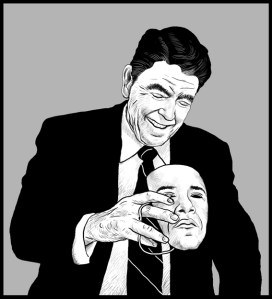
As Dakinikat has explained again and again and again and again, the problem our economy faces is that millions of Americans don’t have any money to spend because they don’t have jobs. Our economy runs on consumer spending. When people don’t have jobs, they don’t have money to spend on consumer items. That hurts our economy. It’s pretty simple, really.
But President Obama doesn’t understand simple basic economics. He’s already decided that high levels of unemployment are “structural.” He thinks our problem is that the government is spending too much money. Yesterday Obama gave another big ol’ nothingburger of a speech on how he’s giving away the store to negotiating with the Republicans in Congress.
Now, I’ve heard reports that there may be some in Congress who want to do just enough to make sure that America avoids defaulting on our debt in the short term, but then wants to kick the can down the road when it comes to solving the larger problem of our deficit. I don’t share that view. I don’t think the American people sent us here to avoid tough problems. That’s, in fact, what drives them nuts about Washington, when both parties simply take the path of least resistance. And I don’t want to do that here.
No, Mr. President, what is driving Americans “nuts” about Washington is that you and your Republican pals seem to be determined to crash the economy. Another thing that drives American’s “nuts” is that you haven’t lifted a finger to do anything about jobs since you took office. All you’ve done is take care of your superrich pals so they’ll donate to your next campaign.
I’ll bet you don’t even know that the latest PPP Poll shows that most Americans want to raise taxes on higher income people.
Poll data by the Democratic-aligned Public Policy Polling released Wednesday said voters in Ohio, Missouri, Montana and Minnesota back hiking taxes on the wealthy — even for people with incomes as low as $150,000.
The respondents were asked: “In order to reduce the national debt, would you support or oppose raising taxes on those with incomes over $1,000,000 a year?”
Nearly 80 percent of voters in the four states backed the idea.
And, BTW, Senator Reid, I’m pretty sure these voters want real tax increases, not phoney “sense of the Senate” resolutions. Back to Obama’s mealy-mouthed speech:
I believe that right now we’ve got a unique opportunity to do something big — to tackle our deficit in a way that forces our government to live within its means, that puts our economy on a stronger footing for the future, and still allows us to invest in that future.
Most of us already agree that to truly solve our deficit problem, we need to find trillions in savings over the next decade, and significantly more in the decades that follow. That’s what the bipartisan fiscal commission said, that’s the amount that I put forward in the framework I announced a few months ago, and that’s around the same amount that Republicans have put forward in their own plans. And that’s the kind of substantial progress that we should be aiming for here.
And on and on, bla bla bla…
I don’t know who you mean by “most of us” Mr. O, but I’m pretty sure most of us citizens don’t support the findings of your right wing cat food commission bipartisan fiscal commission.
President Obama just doesn’t get it. He might be able to learn a little bit about economics if he would just hire a few actual economists to advise him. But the big O thinks he already learned all he needs to know by listening to Ronald Reagan back in the ’80s. All of his economics advisers have left the sinking ship resigned, because Mr. O thought he knew better than they did. Remember this quote?
In his biography of Obama, “The Bridge,” David Remnick, editor of The New Yorker, quotes White House senior adviser and longtime Obama friend Valerie Jarrett: “I think Barack knew that he had God-given talents that were extraordinary. He knows exactly how smart he is. … He knows how perceptive he is. He knows what a good reader of people he is. And he knows that he has the ability — the extraordinary, uncanny ability — to take a thousand different perspectives, digest them and make sense out of them, and I think that he has never really been challenged intellectually. … So what I sensed in him was not just a restless spirit but somebody with such extraordinary talents that had to be really taxed in order for him to be happy. … He’s been bored to death his whole life. He’s just too talented to do what ordinary people do.”
You need to snap out of it, Mr. President; because our country is in big big trouble right now, and you’re really not as smart as you think you are.
Paul Krugman is an actual economist, and his hair is on fire. He can’t figure out what the President has against Keynesian economics.
I’m not alone in marveling at the extent to which Obama has thrown his rhetorical weight behind anti-Keynesian economics; Ryan Avent is equally amazed, as are many others. And now he’s endorsing the structural unemployment story too.
To those defending Obama on the grounds that he’s saying what he has to politically, I have two answers. First, words matter — as people who rallied around Obama in the first place because of his eloquence should know. Yes, he has to make compromises on policy grounds — but that doesn’t mean he has to adopt the right’s rhetoric and arguments. The effect of his intellectual capitulation is that we now have only one side in the national argument.
Second, since Obama keeps talking nonsense about economics, at what point do we stop giving him credit for actually knowing better? Maybe at some point we have to accept that he believes what he’s saying.
Why is Obama doing this, Krugman wants to know. It can’t be because he’s just stupid, can it? (That’s me, not Krugman)
Anyway, now Obama is handling the decisions about the economy all by himself. He’s even decided to “take the lead” in the budget talks with the Republicans–probably because he didn’t think VP Biden was caving quickly enough to Republican demands. Today,
CBS News reported that Obama wants to give the Republicans twice as much as they were originally asking for.
Two Democratic officials familiar with the negotiations over a deal to raise the debt limit said Wednesday that President Obama wants the final deal to be bigger than the $2 trillion deal that has been the focus of negotiations so far.
In fact, they said, Mr. Obama wants the deal to save the government as close to $4 trillion as possible.
Mr. Obama said Tuesday that lawmakers have “a unique opportunity to do something big,” and a deal to save the federal government $4 trillion would certainly qualify. The officials said the president believes “these moments come around at most once a decade” and that “you can’t run away from an opportunity like this.”
According to the officials, Mr. Obama believes that a larger deal would actually be easier to get through Congress. His thinking, they indicated, is this: Any major deal, whether it’s for $2 trillion in cuts or $4 trillion in cuts, will cause significant pain for both parties. But a larger deal allows backers to argue that despite their misgivings, they’ve taken a major step toward dealing with the deficit and debt problem.
Doesn’t Obama understand that cutting that much government spending is going to create even more unemployment? Is this man insane? No, he’s just a right wing Republican. Actually, maybe that does mean he’s insane.
How many S’s in a Senate Sentimental Statement make for a Symbolic Surreal Exercise in inSanity?
Posted: July 6, 2011 Filed under: Domestic Policy, Economy | Tags: deficit, Democratic spinelessness, Tax Cuts for Billionaires 9 Comments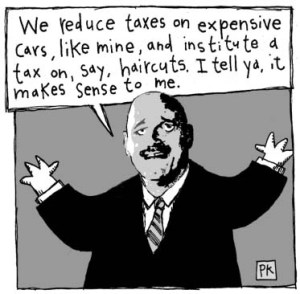 Harry Reid has introduced a bill called the “Sense of the Senate on Shared Sacrifice”. It basically has no recommendations, suggestions, policy measures, or required action. It is symbolic surreality at best and an exercise in serious alliteration. I can frankly hear Daffy Duck adding “suffering succotash” to the end. Hisssssssss.
The Senate as early as Wednesday could vote on a “Sense of the Senate” bill that says taxpayers earning $1 million or more each year should “make a more meaningful contribution to the deficit-reduction effort.”
…
The bill has no specific recommendations on how much taxes should be raised on high-income earners, and is simply a recommendation that these taxpayers pay more. Because the 60 votes needed to end debate are unlikely to materialize, the vote will likely be used by Democrats as a way to show Republican resistance to new tax hikes.
Democrats might also try to use the vote as leverage in negotiations on how to raise the debt ceiling by showing that there is support for a tax increase. In those talks, which are expected to continue this week, Democrats have said taxes on the wealthy and on oil companies should be part of the equation for reducing the deficit. Republicans have so far rejected this, and argue that an agreement needs to focus solely on spending cuts.
Now I’m all for meaningful displays of protest and performance art but I’m not alone in thinking this is shallow grandstanding. Here’s the sentiment of Greg Sargent on the subject. Did I mention the word Surreal is his subject head?
So it’s come to this. Republican opposition to any kind of revenue increase as part of the deficit deal has grown so implacable that Dems will now hold a Senate vote tomorrow on the basic idea that millionaires and billionaires should help contribute to fixing our deficit.
It’s not a vote on any specific proposal to hike taxes or end tax breaks. Rather, it’s a vote that puts each Senator on record on the general question of whether the rich should sacrifice in service of deficit reduction.
According to a Dem leadership aide, Senate Democrats have decided, as expected, to proceed with a vote tomorrow on a resolution that would declare that it is the “sense of the senate” that those who make $1 million or more per year should “make a more meaningful contribution to the deficit reduction effort.”
The vote — a cloture motion on the question of whether to proceed to an up-or-down vote on this resolution — is designed to put Repubicans on the spot. The idea is to force GOPers to go on the record choosing between declaring general support for more sacrifice from the wealthy — which in theory could strengthen Dem leverage in the talks — or reveal that they’re ideologically hostile to the notion that the rich should sacrifice anything to fix our fiscal mess. Dem Senators are holding a presser this afternoon to push the issue.
That this vote is happening at all perfectly captures just how surreal this debate has become. Democrats have agreed to over $1 trillion in spending cuts, and have reportedly agreed to tens of billions in Medicare cuts as part of that package. The American people have declared in poll after poll after poll that they think the deficit should be addressed through a combination of spending cuts and tax hikes. Yet Republicans are simply refusing to entertain the possibility of any revenue increases of any kind — to the point where even conservative columnists like David Brooks are growing seriously alarmed by the anti-tax fanaticism that’s on display.
Here’s David Dayen’s take at FDL. (Notice, I’ve decided to can the alliteration. It was getting way to easy and annoying.)
I’m actually all for nakedly political votes. This bill does not put anything into law, does not actually force millionaires to make a “more meaningful contribution” to deficit reduction. All it does is force Republicans onto the side of millionaires. If used successfully, that’s a fine vote to have for the next several cycles, and is sure to come up in television ads. Politics must be played sometimes.
But let’s not pretend that this is a “millionaire’s tax bill.” There was an opportunity to put a millionaire’s surtax in the Democratic budget; Kent Conrad will deliver a budget with a balanced approach between taxes and spending, but that surtax was dropped. There are a series of ideas about ending tax breaks for corporate jet owners, but I don’t know if you can even call them “meaningful.” Especially when you put them against the potential for $500 billion in Medicare and Medicaid cuts – just a year after a separate set of $500 billion in cuts to Medicare Advantage overpayments and other fat-trimming from Medicare – and another $100 billion through changing the COLA formula for Social Security beneficiaries. That adds up to twice as much in deficit reduction from seniors, the poor and the disabled than from the sum total of all revenue raisers on the table.
And anyway, none of those revenue raisers will be voted on in this sense of the Senate legislation. It just says that millionaire contributions would be a good idea. I assume then that the plan is to approach the millionaires individually.
My take is that if it’s such a good idea, then Reid should actually do something about it. He should’ve done something about it last winter when Obama was selling out on the Dubya Bush tax cut extensions. Our government shouldn’t be a person on the street with a tin cup. Congress spent all this damned money on all those wars and handed out all those ridiculous tax loop holes. Frankly, I’m with Katrina vanden Heuvel who thinks Obama and the Democrats should just invoke the 14th amendment and tell the Republicans to go to hell. Enough of this symbolic shit! Send Rubio, Ryan, and Boehner to the moon!
Independence Day Reads
Posted: July 4, 2011 Filed under: Bailout Blues, Domestic Policy, Economy, Foreign Affairs, Global Financial Crisis, Greece, investment banking, morning reads | Tags: Bill Clinton, Budget Deficit, debt limit, Fukushima, Greek Debt Crisis, John McCain, nuclear crisis, shadow banking industry, SIVs, taxes 16 Comments Happy Independence Day!
We have a republic and a lot of people have sacrificed a lot over the last several centuries to keep it. Too bad most of our politicians aren’t in that number. They can’t see past their next elections.
It seems that two senators– McCain and Corynyn–say they’re open to tax increases as a way to solve the budget stand off. Guess there are a few of them left that would prefer not to tank our economy. Let’s hope this starts some real negotiations instead of the usual Republican hostage taking and Democratic cave-in that’s been politics as usual the last dozen years or so.
One of the senators, John Cornyn of Texas, said he would consider eliminating some tax breaks and corporate subsidies in the context of changes in the tax code, provided there was not an overall increase in taxes.
“I think it’s clear that the Republicans are opposed to any tax hikes, particularly during a fragile economic recovery,” Mr. Cornyn said on “Fox News Sunday.” “Now, do we believe tax reform is necessary? I would say absolutely.”
But he insisted that any changes in taxes be “revenue neutral,” meaning that the government would not take in any more money from individuals or businesses than it does now.
The other senator, John McCain of Arizona, said he would be willing to consider some “revenue raisers” as part of a broad deal, but he refused to name specific measures.
Mr. Cornyn, a member of the Senate leadership, also said that Republicans would be open to a short-term deal on the debt ceiling to provide more time for a comprehensive agreement.
Let’s also hope that more reasonable and less ideological heads prevail on the right and that the left stands up for what’s right for a change. Former President Clinton had a words of policy advice over the weekend. His advice to President Obama is “not to blink”.
Former President Bill Clinton Saturday night urged President Obama not to “blink” at Republican demands to exclude revenue increases from any agreement to extend the government’s debt ceiling.
If Republicans maintain their opposition to revenue increases, Clinton said, Obama should pursue a short-term deal to extend the debt ceiling based on spending cuts both sides have already accepted in the negotiations between the administration and Congressional leaders from both parties.
“I hope they will make a mini-deal,” Clinton said in an interview conducted with him at the Aspen Ideas Festival here.
The White House and Congressional negotiators from both parties are attempting to assemble a deficit reduction package that could win support in Congress for legislation to extend the nation’s debt ceiling, which the Treasury says the government will reach on August 2. The talks have foundered amid demands from Congressional Republicans to exclude any revenue increases from that prospective deficit reduction package.
Asked what the administration could do if GOP leaders hold to that posture, Clinton replied: “First the White House could blink. I hope that won’t happen. I don’t think they should blink.”
If Republicans will not accept revenues in a package to lift the debt ceiling by August 2, Clinton said, Obama should pursue a short-term agreement based on the spending reductions both sides have already accepted.
“There are some spending cuts they agree on …and he can take those and [get] an extension of the debt ceiling for six or eight months,” Clinton said.
Clinton also called on a package of reforms to US tax policy that includes a corporate tax cut if special interest tax loops are closed. This is something Obama has also supported.
“It made sense when I did it. It doesn’t make sense anymore – we’ve got an uncompetitive rate. We tax at 35 percent of income, although we only take about 23 percent. So, we SHOULD cut the rate to 25 percent, or whatever’s competitive, and eliminate a lot of the deductions so that we still get a FAIR amount, and there’s not so much variance in what the corporations pay. But how can they do that by Aug. 2?”
Clinton also said Grover Norquist, who as president of Americans for Tax Reform is the GOP’s unofficial enforcer of no-new-taxes pledges, has a “chilling” hold on the nation’s lawmaking.
The former president said it has seemed like Republicans need any revenue concessions need to be “approved in advance by Grover Norquist.”
“You’re laughing,” he told the crowd of 800. “But he was quoted in the paper the other day saying he gave Republican senators PERMISSION … on getting rid of the ethanol subsidies. I thought, ‘My GOD, what has this country come to when one person has to give you permission to do what’s best for the country.’ It was chilling.
There’s an extremely interesting piece at The Atlantic Wire on “What Really Happened at Fukushima”. It includes interviews with workers that have been inside the crippled nuclear plant.
Throughout the months of lies and misinformation, one story has stuck: “The earthquake knocked out the plant’s electric power, halting cooling to its reactors,” as the government spokesman Yukio Edano said at a March 15 press conference in Tokyo. The story, which has been repeated again and again, boils down to this: “after the earthquake, the tsunami – a unique, unforeseeable [the Japanese word is soteigai] event – then washed out the plant’s back-up generators, shutting down all cooling and starting the chain of events that would cause the world’s first triple meltdown to occur.”
But what if recirculation pipes and cooling pipes, burst, snapped, leaked, and broke completely after the earthquake — long before the tidal wave reached the facilities, long before the electricity went out? This would surprise few people familiar with the 40-year-old Unit 1, the grandfather of the nuclear reactors still operating in Japan.
The authors have spoken to several workers at the plant who recite the same story: Serious damage to piping and at least one of the reactors before the tsunami hit. All have requested anonymity because they are still working at the plant or are connected with TEPCO. One worker, a 27-year-old maintenance engineer who was at the Fukushima complex on March 11, recalls hissing and leaking pipes. “I personally saw pipes that came apart and I assume that there were many more that had been broken throughout the plant. There’s no doubt that the earthquake did a lot of damage inside the plant,” he said. “There were definitely leaking pipes, but we don’t know which pipes – that has to be investigated. I also saw that part of the wall of the turbine building for Unit 1 had come away. That crack might have affected the reactor.”
The reactor walls of the reactor are quite fragile, he notes. “If the walls are too rigid, they can crack under the slightest pressure from inside so they have to be breakable because if the pressure is kept inside and there is a buildup of pressure, it can damage the equipment inside the walls so it needs to be allowed to escape. It’s designed to give during a crisis, if not it could be worse – that might be shocking to others, but to us it’s common sense.”
Here’s some frightening news on the disaster in Japan. Radioactive Cesium has been found in Tokyo’s water supply.
Radioactive cesium-137 was found in Tokyo’s tap water for the first time since April as Japan grapples with the worst nuclear disaster in 25 years.
Cesium-137 concentration registered at 0.14 becquerels per kilogram in the city’s Shinjuku ward on July 2, compared with 0.21 becquerels on April 22, according to the Tokyo Metropolitan Institute of Public Health. No cesium-134 or iodine-131 was detected, the agency said on its website.
The Nuclear Safety Commission of Japan sets a safety limit of 200 becquerels per kilogram for cesium-134 and cesium-137. The limit for iodine-131 consumption is 300 becquerels per kilogram.
Japan is battling radiation leaks into the air, soil and water after an earthquake and tsunami on March 11 knocked out cooling systems at Tokyo Electric Power Co.’s Fukushima Dai- Ichi nuclear station, resulting in the meltdown of three of the six reactors at the plant.
The UK Guardian lists an interesting set of Greek public assets for sale. Many have no buyers. Bobby Jindal is putting up a lot of Louisiana assets for sale too. I wonder if this is going to be the new way to raise money. The Kochs already rent a big chunk of Yellowstone. Let’s hope we don’t have to put our national treasures on the chopping block.
Up for sale are 39 airports, 850 ports, railways, motorways, sewage works, a couple of energy companies, banks, defence groups, thousands of acres of land for development, casinos and Greece’s national lottery. George Christodoulakis, Greece’s special secretary for asset restructuring and privatisations, said the sell-off would raise €50bn (£44bn) to help pay back the country’s €110bn bailout debt.
The private equity bosses gathered in the hotel’s ballroom for the parade of Greece’s national treasures showed little interest in buying anything.
Nikos Stathopoulous, managing partner of BC Partners, which has invested more than €3.5bn in Greece, said investors are put off by bureaucracy, strong unions, corruption and a lack of transparency. “Even in the good times Greece is not a country that attracts investment. Foreign investors don’t want to invest in a country where there is no flexibility in hiring and firing people,” he said. “You don’t want to invest in a country in which you wake up and a new law has been passed which totally undermines and destroys the value of the investment you’ve just made.”
Stathopoulous said investors were finding it very hard to assess the risk of investing into Greece, which means assets “will be priced at lower than they are worth, lower than the Greek government, and even the European Union, expects”.
Here’s a compelling argument for getting the shadow banking sector into a more regulated, transparent, and standardized order. It’s written by Henry Tabe who is a Founding Partner of Sequoia Investment Management Company Ltd. It particularly addresses the use of the Structured Investment Vehicle (SIV). Complex, nonstandard, and unregulated markets make pricing assets difficult and introduce unnecessary risk and volatility.
Risk management requires identification, measurement, aggregation, and effective management of risks. It should help businesses allocate sufficient capital for survival and growth. The SIV’s extinction highlights risk management failures by the vehicles, their sponsors, rating agencies, policymakers, and regulators.
Financial regulators permitted bank, insurance company, pension, and hedge-fund sponsors to establish SIV “mini-banks” without ensuring that they maintain sufficient capital or back-stop liquidity in the event of a run. Policymakers also seemed unaware of the knock-on effects of the SIV’s demise on the securitisation and global credit markets. The Financial Security Authority’s call for regulators to incorporate sectoral analytical capabilities in their micro-prudential policies should help close the knowledge gap and ensure that timely solutions can be implemented to avert collapses that engender significantly more stress on the financial system (FSA 2009).
Lessons learned include the tightening of regulation governing the sponsorship of off-balance-sheet structures and the sizing of their capital and liquidity needs. These require that regulators adopt a more proactive, dampening role in the wild swings from exuberance to despair that are so characteristic of the financial markets. Discussions around contingent capital and similar products suggest regulators have embraced that dampening role and moved away from the prevailing pre-crisis philosophy of minimal regulation.
Lessons learned also include closer supervision of shadow banks, more skin-in-the-game for their sponsors, in-house retention of risk-analytics capabilities by investors, and less reliance on credit-rating agencies. The agencies themselves are more tightly supervised in order to reduce ratings shopping by issuers and inherent conflicts of interest in the business model (CESR 2009). Tighter regulation will also help to ensure that the agencies improve the monitoring of analyst performance, qualifications, and experience (Dodd-Frank 2010).
These measures should help restore confidence in rating agencies and the global financial system, an outcome more urgently required given on-going turmoil in the sovereign debt market.
So, there’s some wonky goodness to keep you entertained if you’re inside today. Be sure to let us know what you’re reading and blogging! Hope your Fourth of July is a happy one!
Sign me up for the Hippie Caucus
Posted: July 2, 2011 Filed under: Economy | Tags: austerity, Brad Delong, Economists v Politicians and Journalists, Larry Summers, Laura Tyson, Martin Wolf, Martin Wolfe, Paul Krugman, Peter Orzag, stimulus 17 Comments
melting magic mushrooms by spookychild
If you’re like me, you’ll get a big laugh out of Brad DeLong’s on-going tongue and cheek label of pretty much every economist as being a member of the “hippie caucus” simply for giving the MSM a lesson on economic theory. It’s not exactly the most complex model or theory that drives the idea that you deficit spend during a tough economy to create jobs and stimulate business. Every first year macroeconomic principles students learns that. My guess is that most of congress and the President never got that far.
So, here’s a list of Brad’s Hippie Caucus and the statements based on simple economic theory that puts them into membership. These are some big name economists basically saying what I’ve been saying for a few years now. The deficit is a long term problem. The immediate problem is business’ lack of customers. It’s an aggregate demand thing and increased government spending is the obvious policy remedy.
The first member is Laura Tyson who I’d really like to see as Treasury Secretary or head of the CEA again. She served under Bill Clinton. You remember Bill Clinton? He’s the one that had the best job creation record of any modern president.
But the overwhelming evidence suggests the opposite: when the economy has excess capacity, high unemployment and weak private demand, cuts in government spending reduce growth and eliminate jobs.
On this point, there is widespread agreement among experts. Ben Bernanke, chairman of the Federal Reserve, recently warned that sudden fiscal contraction might put the still fragile recovery at risk. The June report from the C.B.O. contains a similar warning. Even William Gross of Pimco, a vocal critic of the long-term fiscal position of the government, cautions that a move toward fiscal balance, if implemented too quickly, could “stultify economic growth.”
As Simon Johnson noted in his recent Economix post, fiscal contractions are expansionary only under special conditions. None of these apply to the United States today.
So what should policy makers do? They should pair fiscal measures aimed at job creation now with a credible plan to reduce the deficit gradually –- and pass both at once, as a package. Approving a deficit-reduction plan but deferring its starting date until the economy is near full employment will cut the odds that immediate contraction will tip the faltering economy back into recession.
Indeed, passage of such a package could bolster growth by easing investor concerns about future deficits, reducing long-term interest rates and strengthening consumer and business confidence.
The next member is Larry Summers. You remember him, he’s the one we thought the President may have actually listened to when doing his economic policy thing? Well, I’ve apologized for thinking Summers turned his back on his credentials and I’m having to eat my words again.
SUMMERS: I worry about a number of things with respect to growth. Most profoundly I worry about lack of demand in the United States. That means that factory capacity is unused, it means that buildings sit empty, it means that too many people are unemployed. And I look for measure that will serve to promote the level of demand in the United States. That’s why using this moment to repair our infrastructure is so important. That’s why I believe that the payroll tax cuts that put money in people’s pockets and increased employers incentives to hire are so important. And that’s why I believe that opening foreign markets and promoting U.S. exports which creates more demand is so important. And China is obviously an important part of that story.
So we already know that Paul Krugman is in the Hippie Caucus, but here’s an addition via Krugman. Traxis Partners Hedge Fund multimillionaire Barton Biggs is saying the same thing. Surprisingly enough, this comes from the WSJ whose editors have drunk enough Grover Norquist koolaid to be dead heads.
The U.S. and Europe are set to grow at an anemic pace for the foreseeable future unless the government can step in with an enormous fiscal stimulus, according to a veteran investor.
Speaking exclusively with The Wall Street Journal, Barton Biggs, managing partner at multibillion dollar hedge fund Traxis Partners, painted a bleak outlook for the developed world with only huge government intervention likely to improve things.
…
Mr. Biggs, former chief global strategist for U.S. investment banking powerhouse Morgan Stanley, demanded the U.S. government temporarily return to ideas used in the Great Depression as a way to get the country back to higher growth.
“What the U.S. really needs is a massive infrastructure program … similar to the WPA back in the 1930s,” he says.
The plan would be to employ some of the many unemployed people, jump start the economy, as well as help catch up with Asia, which is building state-of-the-art infrastructure from new mechanized port facilities to high-speed trains.
He suggested financing such building through the sale of U.S. Treasuries.
Okay, so Mark Thoma’s on the list too. No surprise there either. However, this comment is not on his blog Economist’s View, it’s at the FT.
I disagree with them that immediate austerity is needed. The long-term budget problem in the US is driven mainly by rising health costs, and we have many years to go before this begins to create big budget problems. Thus waiting, say, two years to begin reducing the deficit will not substantially change the probability of big problems down the road. But delaying austerity measures avoids placing a further drag on an already struggling economy, so the likely benefits are relatively large.
One of the arguments for austerity is that it would give the Federal Reserve “increased room for manoeuvre to adopt further quantitative easing if the economy weakens further”. I agree that the Fed fears being placed in the position of appearing to monetise the debt, but again I do not think immediate action is needed. A budget plan that both political parties can agree to, which is implimented only when the economy is stronger, would do a lot to give the Fed the confidence it needs to act.
Here’s a member of the Hippie Caucus from across the Pond. That would be no other than the FT’s Martin Wolfe. He sums it up nicely by saying “enjoy the coming slump” but if you want to read the wonky way of saying it, here it is.
Few doubt there is excessive private sector debt in a number of high-income countries. But how is it to be reduced? The BIS notes four answers: repayment; default; higher real incomes; and inflation. Let us rule out the last and focus on the first. Repayment means spending less than one’s income. That is what is happening in the US private sector (see chart). Households ran a financial deficit (an excess of spending over income) of 3.5 per cent of gross domestic product in the third quarter of 2005. This had shifted to a surplus of 3.3 per cent in the first quarter of 2011. The business sector is also running a modest surplus. Since the US has a current account deficit, the rest of the world is also, by definition, spending less than its income. Who is taking the opposite side? The answer is: the government. This is what a controlled depression means: every sector, other than the government, is seeking to strengthen its balance sheet at the same time.
Another former Obama adviser that’s in the Hippie Caucus and may join my list of people that most likely quit Obama because he wasn’t listening to any economists. That would be none other than former budget director Peter Orzag. You know I thought Christie Romer was a good one and was confused when she was supporting that weak ass stimulus. I’m now even wondering about Austin Goolsbee.
Today’s fiscal policy debate straddles two divides: one between those who support jobs and those who favor austerity, and one between those who think additional revenue is needed and those who don’t.
On the first divide, both sides are right, because the truth is that the U.S. needs both jobs and austerity — and a combination would be more powerful than either piece by itself. We face a very weak labor market now and, over the medium- and long-term, an unsustainable fiscal path. It would make sense to combine an additional round of temporary job creation measures with a substantial amount of permanent deficit reduction that would be enacted now but take effect later.
So, I’ve been blogging around here like my hair’s on fire pretty much since this financial crisis set in. I wrote the Obama stimulus was too little and too focused on tax cuts to appease the few Republicans resident in a then overwhelmingly Democratic Congress with a president with a mandate and political capital. I blogged that we didn’t need to extend the Bush tax cuts to millionaires and billionaires because they were the only ones that were recovering nicely. I blogged that the President should forget about health care reform and focus like a laser on the sour economic recovery. I also said that all that would do would give the Republicans more hot air come the negotiations for the debt ceiling increase. I’ve blogged repeatedly that businesses–no matter what the tax rates or the rate of interests–are not going to spend their money on capital or labor here in the US because they need customers first and foremost. I’ve also written extensively that all this cheap Fed money at the discount window and tax breaks for industry was likely to be used in places like Asia instead of here in the U.S. Brad DeLong has done an excellent job showing you that many, many top economists believe the same things. So, next time any one tells you that all economists are always caught off-guard, please remember all of this.
I truly believe that Republicans are trying to tank the economy and that Barack Obama is either tacitly or complicity or ignorantly going right down the garden path with them. Again, if you’ve got terminal cancer and need surgery to save your life do you call some one who has never gone to med school to operate on you? If you’re wrongly accused of murder and you need some one to argue that you’re innocent, do you want some one that’s never been to law school to represent you? Why or why do so many idiots in the press, in the congress, and in the White House think they know more about the economy and the financial markets than those of us that have spent our lives researching, studying, and doing it?
We should be rioting in the streets like the English and the Greeks. Instead,we’re acting like sheep to the slaughter. What our government is doing right now is actively working against the interests of its people. There are laws in place that require it to responsibly handle the economy and create jobs. They are doing the exact opposite of this. We need to get mad. Voting for idiots is not working.

 peej
peej Carissa
 bostonboomer
 dakinikat
 ecocatwoman
 mablue2
 Mama Lopez
 peggysue22
 quixote
 skydancingguestblogger
 Mona (aka Wonk the Vote)



 Sky Dancing
Recent Comments