
Saturday Morning Open Thread: Libertarians Are Not Our Friends
Posted: August 17, 2013 Filed under: 2014 elections, Civil Liberties, Civil Rights, Foreign Affairs, open thread, Republican politics, U.S. Economy, U.S. Politics, Women's Rights | Tags: Julian Assange, libertarians, Martin Luther King, Rand Paul, Ron Paul, Wikileaks 40 Comments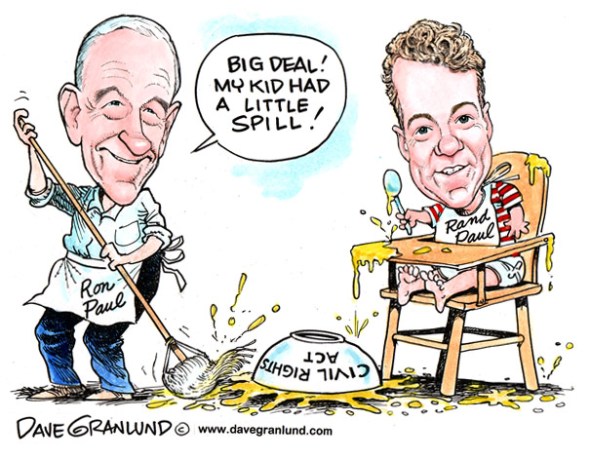
Good Morning!!
Sorry I’m posting this so late today. I’ve been pondering some issues that have been troubling me for a long time, and I keep getting stuck about how to write about them.
I’m beginning to see the libertarian influence on so-called “progressives” as a very serious problem for the future of our country. Here’s a somewhat incoherent beginning to a discussion of this problem. I’m putting this out there in the hope that I’ll get some feedback from you that will help me sort this out. So here goes…
Partial transcript:
“I’m a big admirer of Ron Paul and Rand Paul for their very principled positions in the U.S. Congress on a number of issues. They have been the strongest supporters of the fight against the U.S. attacks on Wikileaks and on me in the U.S. Congress. Similarly, they have been the strongest opponents of drone warfare and extrajudicial executions.
And so, that’s quite an interesting phenomenon in the United States. The position of the libertarian Republican–or a better description [right?]–coming from a principle of nonviolence, the American libertarian, that produces interesting results.
So, nonviolence, not going to invade a foreign country. Nonviolence, don’t force people at the barrel of a gun to serve in the U.S. Army [?? The U.S. doesn’t have a draft]. Nonviolence, don’t extort taxes from people to the Federal government, with a [policeman?]….
Similarly, other acts of nonviolence in relation to abortion that they hold. I think that some of these positions that are held by Ron Paul…I can see how they come from the same underlying libertarian principle. I think the world is often more complex. By taking a laid out principle but sometimes simplistic position, you end up undermining the principle. In the short term, visions of the principle are one thing, visions of the principle…it’s quite hard to know [inaudible].
A few comments…
It’s not clear to me whether Assange supports the Paul’s position on abortion, but clearly it’s a side issue for him–not nearly as important as the Paul’s support of Wikileaks and Assange himself, since he later said that both political parties have been compromised and the only hope for the future comes from the libertarian portion of the Republican Party. HuffPo:
He then put forth an argument against both established political parties in Washington, claiming that nearly all Democrats had been “co-opted” by President Barack Obama’s administration, while Republicans were almost entirely “in bed with the war industry.”
The current libertarian strain of political thought in the Republican Party was the “the only hope” for American electoral politics, Assange concluded.
Assange sees federal taxes as “extortion.” I assume that includes the payroll taxes that support Social Security and Medicare. He never mentions social programs at all; as a libertarian he probably opposes them. This is in line with other libertarians who are leading the fight against the U.S. government keeping any secrets whatsoever, e.g., Glenn Greenwald, Edward Snowden, Conor Frierdersdorf, and David Sirota (I’ll have more about this in a later post).
Not only does Assange not know that the U.S. doesn’t have a military draft, he’s pretty mixed up about recent U.S. history. In praising right wing racist news aggregator Matt Drudge, Assange said, via Raw Story:
“Matt Drudge is a news media innovator. And he took off about eight years ago in response to the Monica Lewinsky scandal.”
(Eight years ago was 2005, the first year of George W. Bush’s second term, when President Bill Clinton had been out of office for five years and the Lewinsky scandal and subsequent failed impeachment attempt were a matter of history.)
Assange claimed that Drudge made his name by “publishing information that the establishment media would not. It is as a result of the self-censorship of the establishment press in the United States that gave Matt Drudge such a platform and so of course he should be applauded for breaking a lot of that censorship.”
Assange says he supports non-violence. I’d like to point out that in U.S. history, one of the leading advocates of nonviolence and civil disobedience was a man named Martin Luther King. Fifty years ago King led a “March on Washington for Jobs and Freedom.” But Assange favors the Pauls’ notion of “nonviolence.” (Assange doesn’t appear to know that Ron and Rand Paul are the recipients of vast corporate donations from the defense industry.) I wonder if Assange knows that Ron and Rand Paul oppose Civil Rights laws? I wonder if he cares?
Julian Assange–along with Edward Snowden and Glenn Greenwald–is currently the idol of the “emoprogs” who have become so distracted by the NSA leaks story that they don’t even notice that Republicans have a very good chance of retaking the Senate next year. These supposed “leftists” have forgotten all about jobs, protecting social programs, women’s rights, civil rights, economic inequality, and our crumbling infrastructure in order to follow a handful of privileged, young white male libertarian pied pipers who are focused only on their own personal “liberties.”
Thursday Reads
Posted: August 8, 2013 Filed under: Barack Obama, Civil Liberties, Drone Warfare, Foreign Affairs, GLBT Rights, morning reads, NSA, National Security Agency, Russia, U.S. Politics, Yemen | Tags: al Qaeda, Ayan al-Zawahiri, Barbara Starr, Charlie Savage, DEA, Edward Snowden, FISA, IRS, Josh Rogin, Julia Ioffe, Lawrence O'Donnell, Nasser al-Wuhayshi, Sochi Winter Olympics, whistleblowers 36 Comments
Good Morning!!
Yesterday, the White House announced that President Obama will not meet one-on-one with Russian President Vladimir Putin at the G-20 meeting in St. Petersburg as previously planned. From The Washington Post:
President Obama has canceled a meeting with Russian Prime Minister Vladimir Putin. Russia’s decision to give temporary asylum to former National Security Agency contractor Edward Snowden has exacerbated tensions with the United States over a number of issues:
“Following a careful review begun in July, we have reached the conclusion that there is not enough recent progress in our bilateral agenda with Russia to hold a U.S.-Russia Summit in early September,” White House press secretary Jay Carney said in a statement.
Carney cited a “lack of progress” with Russia over the past 12 months on a broad range of issues including missile defense and arms control, trade and commercial relations, global security and human rights and civil society issues. Carney added that Russia’s “disappointing decision” last week to grant Snowden temporary asylum, allowing him to live and work in Russia for up to a year, was also a factor.
President Obama discussed some of his issues with Russia in an appearance on The Tonight Show with Jay Leno on Tuesday night.
Saying that he had “no patience for countries that try to treat gays or lesbians or transgender persons in ways that intimidate them or are harmful to them,” Obama criticized a law, enacted in June, that prohibits public events promoting gay rights and public displays of affection by same-sex couples. A Russian official has promised that the law will be enforced during next February’s Sochi Games despite the International Olympic Committee’s contrary stance.
After the announcement, Russian-American journalist Julia Iofee wrote at The New Republic: Obama Bails on His Inevitably Awkward Date With Putin.
A week after Edward Snowden was granted temporary asylum in Russia, President Obama canceled his bi-lateral September summit in Moscow with Vladimir Putin, though administration officials are at pains to portray this as something greater than pure tit-for-tattery. Rather, they say, it was an excuse to avoid what, even without Snowden, would have been “a pretty dreary affair.”
A few days before Snowden turned up in Moscow, Obama and Putin met on the sidelines of the G8 conference in Northern Ireland. The resulting photo-op—Obama looking forlornly into the distance, Putin slouched and sullen—said it all: they looked like the aging couple at the neighboring table, intently working on their food and eavesdropping on your conversation because they had nothing to support one of their own. Moscow and Washington had talked and talked, they’d gotten START and the transport route to Afghanistan and the sanctions on Iran, but now, the kids are out of the house and they were talking past each other on Syria, on Iran, on pretty much everything.
Lawrence O’Donnell asked Ioffe to appear on his MSNBC show last night to discuss the issues surrounding the decision; but instead of allowing her to express her opinions, O’Donnell interrupted Ioffe, lectured her about Russia and Putin, basically implying she is a liar. Ioffe responded at TNR:
Tonight, I went on Lawrence O’Donnell’s show, and Lawrence O’Donnell yelled at me. Or, rather, he O’Reilly’d at me. That O’Donnell interrupted and harangued and mansplained and was generally an angry grandpa at me is not what I take issue with, however. What bothers me is that, look: your producers take the time to find experts to come on the show, answer your questions, and, hopefully, clarify the issue at hand.
I was invited on the show to talk about Obama’s (very wise) decision to cancel his Moscow summit with Putin, about which I wrote here. I am an expert on Russia. In fact, it is how you introduced me: “Previously, she was a Moscow-based correspondent for Foreign Policy and The New Yorker.” I’m not going to toot my own horn here, but I was there for three years, I’m a fluent, native speaker of Russian, and, god damn it, I know my shit.
Which is why I wish you’d let me finish answering your bullshit question…
You can watch the interaction at MSNBC and read the things she would have liked to say about Putin at TNR. Basically Ioffe tried to explain the Putin doesn’t control everything that happens in Russia anymore than Obama controls everything that happens in the US. She believes that once the Bolivian plane was forced to land because the US suspected Snowden might be on board, Putin really had no choice but to allow Snowden to stay in Russia, because public opinion there strongly supported him.
I have quoted Ioffe in previous posts, and she certainly is no Putin apologist–as she asserts in her piece. I think O’Donnell treated her shamefully.
In other NSA news, mainstream reporters continue to published far more stunning revelations than anything that has come from Snowden and Greenwald. This morning at The New York Times, Charlie Savage writes about surveillance of e-mails between people in the US and foreign countries without warrants, which is being justified by an interpretation of the 2008 FISA Amendments Act.
The National Security Agency is searching the contents of vast amounts of Americans’ e-mail and text communications into and out of the country, hunting for people who mention information about foreigners under surveillance, according to intelligence officials.
The N.S.A. is not just intercepting the communications of Americans who are in direct contact with foreigners targeted overseas, a practice that government officials have openly acknowledged. It is also casting a far wider net for people who cite information linked to those foreigners, like a little used e-mail address, according to a senior intelligence official.
While it has long been known that the agency conducts extensive computer searches of data it vacuums up overseas, that it is systematically searching — without warrants — through the contents of Americans’ communications that cross the border reveals more about the scale of its secret operations….
Government officials say the cross-border surveillance was authorized by a 2008 law, the FISA Amendments Act, in which Congress approved eavesdropping on domestic soil without warrants as long as the “target” was a noncitizen abroad. Voice communications are not included in that surveillance, the senior official said.
Read more at the NYT link.
And at Reuters, John Shiffman and David Ingram report that a DEA program that appears to use NSA data to target ordinary criminals in the and then require DEA officers to conceal the source of the information was also used by the IRS.
Details of a U.S. Drug Enforcement Administration program that feeds tips to federal agents and then instructs them to alter the investigative trail were published in a manual used by agents of the Internal Revenue Service for two years.
The practice of recreating the investigative trail, highly criticized by former prosecutors and defense lawyers after Reuters reported it this week, is now under review by the Justice Department. Two high-profile Republicans have also raised questions about the procedure.
A 350-word entry in the Internal Revenue Manual instructed agents of the U.S. tax agency to omit any reference to tips supplied by the DEA’s Special Operations Division, especially from affidavits, court proceedings or investigative files. The entry was published and posted online in 2005 and 2006, and was removed in early 2007. The IRS is among two dozen arms of the government working with the Special Operations Division, including the Federal Bureau of Investigation, the National Security Agency and the Central Intelligence Agency.
An IRS spokesman had no comment on the entry or on why it was removed from the manual. Reuters recovered the previous editions from the archives of the Westlaw legal database, which is owned by Thomson Reuters Corp, the parent of this news agency.
Just as a reminder that Russia’s treatment of journalists and whistleblowers is actually a hell of a lot worse than anything that happens in the US, Human Rights Watch reports on Russia’s Silencing Activists, Journalists ahead of Sochi Games.
(Moscow) – Local authorities have harassed numerous activists and journalists who criticized or expressed concerns about preparations for the 2014 Winter Olympic Games in Sochi. The six-month countdown to the Sochi Games opening ceremony is this week.
Human Rights Watch has documented government efforts to intimidate several organizations and individuals who have investigated or spoken out againstabuse of migrant workers, the impact of theconstruction of Olympics venues and infrastructure on the environment and health of residents, and unfair compensation for people forcibly evicted from their homes. Human Rights Watch also documented how authorities harassed and pursued criminal charges against journalists, apparently in retaliation for their legitimate reporting.
“Trying to bully activists and journalists into silence is wrong and only further tarnishes the image of the Olympics,” said Jane Buchanan, associate Europe and Central Asia director at Human Rights Watch. “One of the non-negotiable requirements of hosting the Olympics is to allow press freedom, and the authorities’ attempts to silence critics are in clear violation of that principle.”
Obviously that doesn’t justify the Obama administration trying to influence media coverage of the NSA story, but we do need to keep things in perspective. In that vein, Bob Cesca had a good post yesterday: The Real-Life Stories of Legitimate NSA Whistleblowers (Snowden Isn’t One of Them). I hope you’ll give it a read.
In other news, Yemen has been hit by 6 suspected US drone strikes in the past 2 weeks–probably linked to the recently reported threat of an imminent terror strike that led the US to close a number of embassies last weekend.
An official in Yemen said Thursday that the sixth suspected U.S. drone strike in just two weeks had left six suspected al Qaeda militants dead in the group’s former stronghold in the center of the country. The official told The Associated Press that a missile hit a car traveling in the central Marib province, causing the fatalities.
CBS News correspondent Charlie D’Agata reports that Yemen has long been a haven for al Qaeda leadership, and the country claimed Wednesday to have disrupted a major plot, which may have exposed potential targets.
Yemeni government officials say security forces are turning up the heat on militants from al Qaeda in the Arabian Peninsula, the global terror network’s branch based in the nation, after foiling the plot to strike foreign embassies, gas and oil installations, and the country’s port cities.
The government has even given a shoot-to-kill order on anybody who looks suspicious and refuses to identify themselves.
The alleged plot appears to have been similar to the January attack in Algeria which saw gunmen storm the Amenas gas plant, killing more than three dozen foreign workers.
Yesterday in The Daily Beast, Eli Lake and Josh Rogin reported that information about the terror threats came from an al Qaeda “conference call,” involving top al Qaeda leaders and around 20 other people–a report that aroused quite a bit of skepticism on Twitter. Why would these guys risk talking on a conference call? Here’s an excerpt from the Daily Beast article:
The intercept provided the U.S. intelligence community with a rare glimpse into how al Qaeda’s leader, Ayman al-Zawahiri, manages a global organization that includes affiliates in Africa, the Middle East, and southwest and southeast Asia.
Several news outlets reported Monday on an intercepted communication last week between Zawahiri and Nasser al-Wuhayshi, the leader of al Qaeda’s affiliate based in Yemen. But The Daily Beast has learned that the discussion between the two al Qaeda leaders happened in a conference call that included the leaders or representatives of the top leadership of al Qaeda and its affiliates calling in from different locations, according to three U.S. officials familiar with the intelligence. All told, said one U.S. intelligence official, more than 20 al Qaeda operatives were on the call.
To be sure, the CIA had been tracking the threat posed by Wuhayshi for months. An earlier communication between Zawahiri and Wuhayshi delivered through a courier was picked up last month, according to three U.S. intelligence officials. But the conference call provided a new sense of urgency for the U.S. government, the sources said.
Al Qaeda members included representatives or leaders from Nigeria’s Boko Haram, the Pakistani Taliban, al Qaeda in Iraq, al Qaeda in the Islamic Maghreb, and more obscure al Qaeda affiliates such as the Uzbekistan branch. Also on the call were representatives of aspiring al Qaeda affiliates such as al Qaeda in the Sinai Peninsula, according to a U.S. intelligence official. The presence of aspiring al Qaeda affiliates operating in the Sinai was one reason the State Department closed the U.S. Embassy in Tel Aviv, according to one U.S. intelligence official. “These guys already proved they could hit Eilat. It’s not out of the range of possibilities that they could hit us in Tel Aviv,” the official said.
Perhaps the call was encrypted in some way and the US had found a way to listen anyway? But then why would they blow future such operations by leaking the fact that they had listened to the call? This morning CNN’s Barbara Starr tweeted to Josh Rogin:
@joshrogin IT WAS NOT A PHONE CALL. IN FACT, AL QAEDA WENT TO EXTENSIVE MEANS TO SET UP WHAT YOU MIGHT SAY A VIRTUAL MEETING SPACE.”
I’m not sue how to interpret that either. I’ll update if I get anything more on this.
Once again, my morning post has gotten way too long. I have other news links, but I’ll put them in the comments. I hope you’ll do the same with whatever stories you’re following today, and have a tremendous Thursday!!
Tuesday Reads: Rachel and Trayvon, Reid Going Nuclear, Spy Stories, and Much More
Posted: July 16, 2013 Filed under: Civil Liberties, Civil Rights, Crime, Criminal Justice System, Foreign Affairs, Lebanon, morning reads, NSA, National Security Agency, Political Affective Disorder, racism, Russia, U.S. Politics | Tags: al Qaida, Alexei Nikitin, Amnesty International, Charles Ramsey, Edward Snowden, Filibuster, George Zimmerman, Harry Reid, Hezbollah, Human Rights Watch, Mitch McConnell, NSA, nuclear option, Piers Morgan, political asylum, Rachel Jeantel, Tanya Lokshina, Trayvon Martin, US Senate, Vladimir Putin 42 Comments
Good Morning!!
I’m not sure if it’s the heat or the depressing news, but I’m having a hard time getting going this morning.
We’re into our third heat wave of the summer, and I’m actually getting acclimated to 90 degree weather; but I suppose it still has an effect on my body and mind.
I’m also somewhat depressed about the Zimmerman verdict and by the often ignorant reactions I see on-line and on TV.
Rachel and Trayvon
One bright spot in the coverage for me was Rachel Jeantel’s interview with Piers Morgan last night. She was real and authentic, and Morgan pretty much stayed out of the way and let her talk. I think she made a real impression on him and the reaction from the live audience was very positive too. It was refreshing. IMO, it says a lot about Travon Martin’s character that he had a friend like Rachel. I’m going to post the whole interview here in case you missed it or you want to watch it again.
From Mediaite:
Asked about what Trayvon Martin was like as a friend, Jeantel described him as a “calm, chill, loving person” and said she never saw him get “aggressive” or “lose his temper.” She said that the defense’s attempts to portray Martin as a “thug” were unfounded and defended his relatively mild drug use. “Weed don’t make him go crazy,” she said, “it just makes him go hungry.”
Jeantel also responded to the massive mockery she received in social media for the way she speaks, explaining that she was born with an under-bite that has made it difficult for her to speak clearly. When Morgan asked if she’d been bullied for her condition, she simply responded, “Look at me,” to laughter from the studio audience.
Morgan attempted to get Jeantel to offer her opinion of defense attorney Don West, who many claimed was condescending towards her when she was on the stand. Jeantel shook her head, declining to say anything bad about the man given her “Christian” upbringing.
In the second part of his interview with Jeantel, Morgan turned to the “creepy-ass cracker” comment she made and the major impact it had on the tenor of the case. She explained that the term is actually spelled “cracka” and defined it as “people who are acting like they’re police.” She said that if Zimmerman had calmly approached Martin and introduced himself, her friend would have politely said what he was doing there and nothing more would have happened.
Unlike the juror, Jeantel did think Zimmerman was racially motivated. “It was racial,” she said. “Let’s be honest, racial. If Trayvon was white and he had a hoodie on, would that happen?”
I’d also like to recommend this piece by Robin D.G. Kelley at Counterpunch: The US v. Trayvon Martin.
In the aftermath of the Sandy Hook Elementary School massacre, Texas Congressman Louie Gohmert, Virginia Governor Bob McDonnell, Senator Rand Paul, Florida State Representative Dennis Baxley (also sponsor of his state’s Stand Your Ground law), along with a host of other Republicans, argued that had the teachers and administrators been armed, those twenty little kids whose lives Adam Lanza stole would be alive today. Of course, they were parroting the National Rifle Association’s talking points. The NRA and the American Legislative Exchange Council (ALEC), the conservative lobbying group responsible for drafting and pushing “Stand Your Ground” laws across the country, insist that an armed citizenry is the only effective defense against imminent threats, assailants, and predators.
But when George Zimmerman fatally shot Trayvon Martin, an unarmed, teenage pedestrian returning home one rainy February evening from a neighborhood convenience store, the NRA went mute. Neither NRA officials nor the pro-gun wing of the Republican Party argued that had Trayvon Martin been armed, he would be alive today. The basic facts are indisputable: Martin was on his way home when Zimmerman began to follow him—first in his SUV, and then on foot. Zimmerman told the police he had been following this “suspicious-looking” young man. Martin knew he was being followed and told his friend, Rachel Jeantel, that the man might be some kind of sexual predator. At some point, Martin and Zimmerman confronted each other, a fight ensued, and in the struggle Zimmerman shot and killed Martin.
Zimmerman pursued Martin. This is a fact. Martin could have run, I suppose, but every black man knows that unless you’re on a field, a track, or a basketball court, running is suspicious and could get you a bullet in the back. The other option was to ask this stranger what he was doing, but confrontations can also be dangerous—especially without witnesses and without a weapon besides a cell phone and his fists. Florida law did not require Martin to retreat, though it is not clear if he had tried to retreat. He did know he was in imminent danger.
Why didn’t Trayvon have a right to stand his ground? Why didn’t his fear for his safety matter? We need to answer these questions as a society. Please read the whole article if you can.
Read the rest of this entry »
Tuesday Reads: The Snowden-Greenwald Show
Posted: June 11, 2013 Filed under: China, Civil Liberties, Civil Rights, Crime, Foreign Affairs, morning reads, U.S. Politics | Tags: Bob Cesca, Edward Snowden, Glenn Greenwald, Hong Kong, Matt Schiavenza, narcissism, NSA, political asylum, Russia, The Q Group, whistleblowers, Willard Foxton 99 Comments
Good Morning!!
Edward Snowden is still the top news story this morning. It’s starting to look as if he made a mistake by going to Hong Kong, unless his goal was to gain asylum from the Chinese government. Hong Kong is apparently not interested in fighting an extradition request from the U.S. But it’s also possible he saw Hong Kong as a springboard to other places in Asia where he could hide.
Matt Schiavenza writes at The Atlantic:
In a comment about the case published this morning, my colleague James Fallows brought up a salient point about Hong Kong: it isn’t a sovereign country, and remains very much a part of the People’s Republic of China — a country which notably lacks free speech or any right of political dissent. And while Hong Kong has a different currency, political structure, and legal system from the mainland, divisions between the two are actually far murkier than Snowden’s explanation indicates.
Hong Kong is to some extent in control of its own legal decisions
But in the case of Edward Snowden, which is likely to involve an extradition request by the United States, the Basic Law is less clear. Hong Kong, unlike China, has an extradition arrangement with the United States. But China has the right to intercede in an extradition request if Beijing has an interest in “defense or foreign affairs.” In other words, if China wants to detain Snowden as a useful intelligence asset, Hong Kong couldn’t legally do much about it. And that illustrates an important part of Hong Kong’s current situation: its free speech and political dissent really only go as far as Beijing lets it.
According to Schiavenza,
it’s become increasingly clear that Snowden’s decision to go to Hong Kong was a serious miscalculation. The idiosyncratic territory may in some ways be a libertarian paradise of free speech, robust media, and low taxes, but is in no way independent of China. If Snowden’s ultimate goal were to damage the United States government as much as possible, then going to a Chinese territory would make some sense. But this obviously isn’t what he wanted; in The Guardian interview, Snowden disagreed with Glenn Greenwald’s characterization of China as an “enemy” of the United States by stressing the healthy trade relationship between the two countries. Aiding China — whose record of state surveillance and abrogation of civil liberties is inarguably worse than the United States — would go against the entire moral foundation of Snowden’s decision to leak the NSA secrets.
I’m still not convinced yet about Snowden’s motives. One thing I have concluded is that he’s a very narcissistic young man. I can’t believe he chose to leave without even explaining to his girlfriend and his family. He also chose to tell his story to a high narcissistic writer, Glenn Greewald. More on that later.
From USA Today: Edward Snowden’s travel options
HONG KONG — Whether Edward Snowden misjudged the odds of extradition from Hong Kong before revealing his identity here as the man who exposed secret U.S. surveillance programs may be irrelevant.
The National Security Agency contractor may have chosen to surface in the city for the same reason so many companies from the U.S. and other countries choose to use it for a regional base: It’s the best gateway to much of the world’s largest continent….
Hong Kong is connected to 180 cities in dozens of countries by some 850 flights a day. As the city’s investment development agency says on its marketing web site, “Easy and efficient regional travel is key to Hong Kong’s success as a regional centre.” Many of these countries have loose entry requirements for Americans.
He could go to Vietnam, the Phillippines, or any number of other Asian countries. Or perhaps he could go to Russia, which has already offered to consider a request for asylum from him.
USA Today also notes that Snowden has been “contacted by ‘countless people’ offering to pay for ‘anything [he] might need.'”

Meanwhile, an entity called “The Q Group” is trying to hunt Snowden down before he finds a safe harbor. From The Daily Beast:
Even before last week’s revelations by The Guardian newspaper that the National Security Agency (NSA) was collecting call records from telecommunications companies and had the ability to mine user data from major U.S. Internet companies, the NSA was already on the trail of the leaker, according to two former U.S. intelligence officers with close ties to the agency….
The people who began chasing Snowden work for the Associate Directorate for Security and Counterintelligence, according to former U.S. intelligence officers who spoke on condition of anonymity. The directorate, sometimes known as “the Q Group,” is continuing to track Snowden now that he’s outed himself as The Guardian’s source, according to the intelligence officers….
The security and counterintelligence directorate serves as the NSA’s internal police force, in effect watching the agency’s watchers for behavior that could pose an intelligence risk. It has the authority to interview an NSA contractor or employee’s known associates, and even to activate a digital dragnet capable of finding out where a target travels, what the target has purchased, and the target’s online activity.
Are there more bombshells coming from Snowden? Glenn Greenwald says there are. According to TPM,
According to Greenwald, Snowden has provided the archives of “thousands” of documents and “dozens” are newsworthy. Greenwald has suggested in recent days that more revelations are imminent, saying Monday during an interview on MSNBC that “there’s a lot more coming.”
Dozens of hit out of thousands of documents doesn’t sound like a very good ratio to me, but I’m not a reporter.
On Glenn Greenwald, it seems the general consensus is that people either love him or hate him. Personally, I don’t hate him but I find him annoying and part of my suspicion of Snowden probably stems from my mixed feelings about Greenwald. In my opinion, he cares only about his own pet issues and disdains anyone who cares passionately about, for example, women’s rights, the environment, or the plight of people with less money and fewer choices than he has. I guess he’s a libertarian, but again only in terms of his own pet issues.
Anyway it seems there are lots of Greenwald haters out there. One is Willard Foxton of The Telegraph, who today has a piece called The problem with Glenn Greenwald and the creepy cult that surrounds him. Foxton isn’t quite sure why he can’t stand Greenwald.
Maybe it’s because of the enormous, turgid pieces he writes, complete with 500-word updates when people challenge him. Maybe it’s the run-ins he had with other British journalists while he was fanatically defending Julian Assange.
Maybe it’s the petty stuff, like the fact he insists on special rock-star privileges, like policing the comments beneath his articles himself and his reluctance to let his pieces be edited, prior to the NSA/Prism disclosures. Maybe it’s the things that suggest he’s a little odd, like self-searching his own name so he can pounce on people criticising him, or the accusations he’s used internet sock puppets to go after people anonymously.
Maybe it’s the devotion of his legion of fans who consider him to be the greatest and most fearless journalist on earth, who hate anyone who dares disagree with their idol. The last time I criticised him I got a barrage of online abuse – including memorably a 24-slide PowerPoint presentation explaining how the American security services had “got” to me, and how Greenwald was their number-one target. Maybe, as his adoring public have suggested, I’m either a homophobe or in the pay of the CIA. Perhaps both.
That said, I’m honest enough to admit that maybe it’s because I’m jealous of the success he’s had, and the stories he’s broken. I’m not the only one. You can practically hear the disdain in the New York Times’s tone here, where it describes him as a “blogger” for a “British News Website” (The Guardian).
What I think is more likely is I dislike him because he has built a huge platform with opinion writing, and now he’s blurring the line between opinion pieces and straight reporting. That huge platform he’s built means sources come forward to him from his vast base of followers, with real hard news stories, and then he insists on reporting them.

In line with the “creepy cult” notion, the Guardian actually published this fan-boy article about Greenwald today. Bizarrely, it asks readers to describe how they feel about Greenwald with a fill-in-the-blanks questionnaire! You have to see it to believe it.
Another writer who seems to strongly dislike Greenwald is Bob Cesca, who critiqued Greenwald’s scoop early on. He offered a few more comments on the Snowden/Greenwald story yesterday. Here are three of them.
–Once again, it’s nearly impossible to have a nuanced position these days. I bent over backwards to repeat my ongoing opposition to the growing surveillance state, and made it abundantly clear that my intent with the column was to question some of the problems with the reporting and why there were such glaring omissions and errors. But there’s an increasingly evident overlap between the kneejerking on the far-right and the kneejerking on the far-left (I will make an effort to point it out whenever I can) and too many people tend to blurt things out without reading or grasping what’s being said. Consequently, criticizing Greenwald makes me an Obamabot. End of story. The left is sliding into a very dangerous place right now, and I’ll definitely report back on this one.
–There are some questions emerging regarding Ed Snowden’s story. Why did someone who was disillusioned with Obama’s record on national security continue to work for Obama’s national security apparatus — for more than four years? Why did he escape to Hong Kong when it’s clearly not the free speech haven he claimed it was? If he prefers to seek asylum in Iceland, why didn’t he go there before the story went public? How did he attain the access to be able to “wiretap anyone?” I assume we’ll get answers to some of these questions. Maybe?
–Marc Ambinder wrote a blindly complicated article for The Week in which he explained what PRISM is. It’s essentially a program that analyses data. It doesn’t retrieve the data, it merely compiles it. He also explained that the way the NSA can have “direct access” is via servers that mirror the tech giant servers. So if the NSA requests information from Facebook about an account in Pakistan, Facebook creates a mirror that clones the real time date from that account. But that mirror site has to be hosted on a server and all of the tech giants denied giving the NSA access to their servers. More questions.
We’ll have to wait and see whether Snowden’s revelations are truly groundbreaking or not. But as Cesca writes, the “war on terror” must come to an end. If what’s happening now helps that happen, I’ll certainly cheer loudly. But I suspect the U.S. government will react by simply doubling down on its current policies.
I’ll end there. Now what are you reading and blogging about this morning? Please share your links on any topic in the comment thread.
Thursday Reads: What Really Happened to Ibragim Todashev?
Posted: May 30, 2013 Filed under: Barack Obama, Civil Liberties, Civil Rights, Crime, Criminal Justice System, Eric Holder, morning reads, U.S. Politics | Tags: Boston Bombings, CAIR-Tampa, FBI, Hassan Shibly, Ibragim Todashev, Khusen Taramov, Massachusetts State Police, Reniya Manukyan, Tamerlan Tsarnaev, Waltham triple murders, Wesley Lowery 44 Comments
Good Morning!!
We’re heading into a heat wave here in the Boston area. It’s supposed to be hot and humid for the next few days with temps in the high 80s or low 90s. It will be a shock to my system, since it has been rather chilly here recently.
I’m going to focus on the ongoing Boston bombing story again, but you can treat this as a regular morning reads post/open thread. Don’t feel you have to comment on this topic. I haven’t paid much attention to other news for a few days, so I hope you’ll update me on the latest news in the comment thread!
A week ago, I wrote a post about the death of Ibragim Todashev, who was shot and killed in an apartment in Orlando, FL by an FBI agent from Boston in the early hours of Wednesday May 22. Todashev was being questioned by representatives of the FBI, the Massachusetts State Police, and “other law enforcement personnel” about his relationship with deceased Boston bombing suspect Tamerlan Tsarnaev and possible connections to an unsolved 2011 triple murder in Waltham, Massachusetts. Todashev had reportedly been questioned for hours on Tuesday and was shot shortly after midnight. The FBI had been following him for about a month, calling him daily and questioning him on several different occasions.
At the time I wrote that post, there was a great deal of confusion about the circumstances of the shooting and that confusion has only increased during the past week. At first, anonymous law enforcement sources claimed Todashev had been killed after he attacked the agent with a knife. By he next day sources were walking back that claim, some saying Todashev had something in his hand but it wasn’t a knife, others suggesting it was a pipe or something similar.
I’ve been following this story closely, and I’ve never seen anything like it. Presumably, the events in question were fairly straightforward. A man was shot dead with at least four–perhaps more–law enforcement officers present. How hard would it be to figure out if the dead man had a knife in his hand or not? Something was obviously not right.

During the past week, the reported details of the Todashev shooting have continued to change. On May 25, the Boston Globe offered a new version of events, again based on anonymous sources.
An FBI agent from the bureau’s Boston office fired the shot, or shots, that killed a friend of Boston Marathon bombing suspect Tamerlan Tsarnaev early Wednesday morning during an interview about an unsolved Waltham homicide, say officials briefed on the investigation.
Ibragim Todashev, a 27-year-old mixed martial arts fighter formerly from Allston and Cambridge, was shot in the kitchen of his apartment after overturning a table and attacking the agent with a blade, the officials said. The Globe has reported that the shooting came after Todashev had implicated himself in a grisly 2011 triple homicide in Waltham. Tamerlan Tsarnaev was friendly with one of the Waltham victims, and authorities suspect he may also have taken part in the slayings.
Two law enforcement officials said that the Boston FBI agent felt he was in grave danger when Todashev attacked him and that he fired in self-defense.
“This was a tough guy; he was a dangerous individual,” one law enforcement official said, speaking of Todashev. The official asked not to be named because the official was not authorized to discuss the case.
Okay, but with at least four trained law enforcement officers present, why was it necessary to kill a potentially valuable witness? Is it really credible that they couldn’t control one not very large (about 5’8″) man?
Yesterday morning there was another version. In this one, first reported by Fox Boston, Todashev not only knocked over a table, but also slammed the FBI agent’s head into a wall and attacked him with a sword. Yes, a sword. As in previous stories, the claim was that Todashev had been about to sign a confession about his involvement in the Waltham murders when things got out of control.
During the interview, investigators took notes and everything appeared to be going well. Eventually, Todashev was asked to write down, in his own handwriting and in his own words, what he had been telling authorities about his role in the murders when in the words of one source – all hell broke loose.
Todashev allegedly began writing, but then flipped a table over, knocking the Boston FBI agent into the wall hitting his head.
FOX 25’s Bob Ward was told the agent looked up to see Todashev waving in his direction what was described as a Banzai ceremonial sword.
Fearing for his life, the FBI agent drew his weapon and fatally shot Todashev. The entire incident taking only seconds.
During the course of the day, the story continued to change as more anonymous “sources” weighed in. WESH Orlando’s “sources” told a slight different tale than Fox Boston’s.
Sources said Todashev might have been lunging toward a sword, but he was not in possession of it.
Law enforcement officials said Todashev was in the process of confessing to a 2011 triple murder in Waltham, Mass., and was working on writing out the details of the crime when he snapped and turned violent.
Officials said Todashev pushed a table and possibly threw a chair.
Sources said a sword was inside the apartment, but the weapon was moved to the corner of the room before questioning began. Law enforcement said when Todashev lunged, the FBI agent believed he could have possibly been going for his gun or the sword in the room, and that’s when the agent opened fire.
Because of course the best law enforcement technique is to move any sharp objects to the corner of the room before questioning a suspect? WTF?!
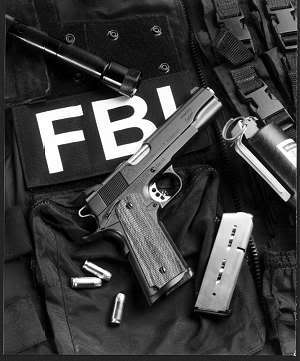
Finally, last night several news outlets–among them The Washington Post–reported that Todashev had been unarmed when he was shot.
One law enforcement official, speaking on the condition of anonymity to discuss an ongoing investigation, said Wednesday that Todashev lunged at the agent and overturned a table. But the official said Todashev did not have a gun or a knife. A second official also said Todashev was unarmed.
An official said that according to one account of the shooting, the other law enforcement officials had just stepped out of the room, leaving the FBI agent alone with Todashev, when the confrontation occurred.
The shooting followed hours of questioning by the law enforcement officials that had begun the night before.
And exactly why did the other officers “step out of the room?” The source doesn’t say.
This story is becoming just plain ridiculous, and as Emptywheel wrote yesterday, it makes the FBI look just plain stupid. Last night on twitter, someone compared it to the old “Get Smart” recurring bit, “Would you believe…”
@BostonBoomer Not to be flip, but it reminds me of Get Smart: “Would you believe a knife? No? Then, would you believe a sword?”@LibertyLynx
— streetwiseprof (@streetwiseprof) May 30, 2013
But as ridiculous as this story seems, we need to understand that something like this could happen to any one of us. A man was killed in an apartment with multiple law enforcement officers present, and after more than a week, we still don’t know for sure what happened.
At 7PM yesterday, the Florida chapter of the Council on Islamic-American Relations (CAIR) held a press conference with Todashev’s wife, her mother, and a close friend of Todashev’s in attendance and called for the Department of Justice to initiate a civil rights investigation of the shooting.
[T]he Tampa director of that group said not only was 27-year-old Ibragim Todashev unarmed when he was shot by the agent May 22, he was hit seven times, including once in the head….the Council on American-Islamic Relations’ Florida chapter on Wednesday cited unnamed sources within the FBI as saying Todashev was not armed at the time of the shooting.
“We did confirm today with sources within the FBI that he was unarmed,” CAIR-Tampa Executive Director Hassan Shibly told the Orlando Sentinel on Wednesday afternoon. Later, Shibly told reporters that CAIR has an “intermediary” who said the FBI told him Todashev was unarmed. Shibly did not identify the intermediary.
At a news conference Wednesday evening, Shibly showed what he said were photos of Todashev’s body after the shooting. The photos were taken at an Orlando funeral home after the Orange-Osceola County Medical Examiner’s office released the body to Todashev’s next of kin, he said.
The photographer was Khusen Taramov — a friend of Todashev’s who lives in Kissimmee — and photos show at least a dozen wounds, although some may have been exit wounds, Shibly said.
In addition, Todashev’s widow Reniya Manukyan claimed that she has evidence to show that her husband could not have committed the murders in Waltham in September 2011.
Todashev’s widow said Wednesday that she has records proving her husband was with her in Atlanta on Sept. 11, 2011, so he could not have been in Massachusetts on the day of the triple killing. Manukyan was married to Todashev for about three years, she said.
In another interaction on Twitter last night Boston Globe reporter Wesley Lowery told me he wasn’t ready to accept the latest version of events until he can independently confirm it from official sources. His reporting on the Boston bombing generally and the Todashev story specifically has been very good, and I’ll be watching to see what he finds out.
Once again, I’ve used up most of my space on a Boston bombing story, but I still have room for a few more quick links, with an emphasis on law enforcement and civil liberties.
Cory Doctorow: Kafka, meet Orwell: peek behind the scenes of the modern surveillance state. At the link you can watch a short, powerful documentary about public surveillance in the UK.
Rob Fischer at The New Yorker: Watching the Detectives–a piece about “Floyd v. Floyd v. City of New York, a landmark challenge to the New York Police Department’s stop-and-frisk policies.”
NYT: Former Bush Official Said to Be Obama Pick to Lead F.B.I. Obama is about to nominate James Comey as FBI Director–a man who was in the Bush DOJ during the torture deliberations.
Emptywheel: When NYT Accused Jim Comey of Approving Torture
Holder Faces New Round of Criticism After Leak Inquiries
HuffPo: Eric Holder To Meet With Washington Bureau Chiefs Amid Leak Investigation Criticism (UPDATE)
Politico: N.Y. Times will not attend DOJ session, citing opposition to off-the-record provision
Buzzfeed: ACLU Defends News Organizations For Rejecting Off-The-Record Meeting With Attorney General
And another Boston link: Dirty Old Boston Facebook page shows the city as it really was

 peej
peej Carissa
 bostonboomer
 dakinikat
 ecocatwoman
 mablue2
 Mama Lopez
 peggysue22
 quixote
 skydancingguestblogger
 Mona (aka Wonk the Vote)



 Sky Dancing
Recent Comments