A couple of Caturdays ago, I posted illustrations from a 1950s children’s book called Space Cat and the Kittens. My brother had shared them with me after he bought the book at a used bookstore. This week, he came across the first book in the four-part series, and I’m going to post some of the illustrations from that book today. I think they are really cute. The story:
A little gray kitten with a taste for adventure stows away on an airplane, and the daring stunt turns out to be his first step toward becoming … Space Cat! The plane’s pilot, Captain Fred Stone, names his fuzzy new friend Flyball and welcomes him to an experimental station set up in the middle of the desert. Flyball enjoys supervising the station’s workers and takes particular interest in the big rocket ship that he’s not allowed to explore. Regardless of the rules, the kitty is determined to hitch another ride, and before you know it, Flyball’s wearing a custom-made pressurized suit and headed for the Moon.
As for the news, everything is awful as usual today. We’re dealing with a “president” who is well on the way of becoming a dictator. He plans to meet with fellow dictator Vladimir Putin to hand over territory in Ukraine; He is allowing his HHS secretary RFK Jr. to endanger Americans with anti-vaccine policies; and he is deliberately damaging American higher education.
President Trump said he would meet with President Vladimir V. Putin of Russia next Friday in Alaska, as he tries to secure a deal to end the war between Russia and Ukraine.
Mr. Trump announced the meeting Friday shortly after he suggested that a peace deal between the two countries could include “some swapping of territories,” signaling that the United States may join Russia in trying to compel Ukraine to permanently cede some of its land.
“We’re going to get some back, and we’re going to get some switched,” Mr. Trump said while hosting the leaders of Armenia and Azerbaijan for a peace summit at the White House. “There’ll be some swapping of territories to the betterment of both, but we’ll be talking about that either later, or tomorrow.”
The meeting, the first in-person summit between an American and Russian president since President Joseph R. Biden Jr. met with Mr. Putin in June 2021, reflects Mr. Trump’s confidence in his ability to persuade Mr. Putin in a face-to-face encounter, a goal that has eluded Mr. Trump and his predecessors. For Mr. Putin, the meeting itself is a victory after he spent the past several months largely isolated from the international community, with NATO leaders — other than Mr. Trump — refusing to communicate directly with him.
Carrying cat to the rocket
At least he didn’t invite Putin to the White House, but will Putin try to get him to give Alaska back to Russia while they are swapping land in Ukraine?
The meeting also presents a host of challenges. Ukrainian leaders have adamantly opposed relinquishing any of their land to Russia, and the country’s constitution bars President Volodymyr Zelensky of Ukraine from ceding any territory.
There would also be numerous political and military hurdles for Ukraine in turning over land to Russia, as well as questions including security guarantees for Ukraine and the future of frozen Russian assets. And many diplomats have suggested that Mr. Putin may be more interested in dragging out diplomacy to give him time to pummel Ukraine than in securing a peace deal.
White House officials declined to say exactly where in Alaska the two leaders would meet or why Mr. Trump decided to hold the meeting there, though it is the closest U.S. state to Russia. In 2021, the Biden administration held talks with China in Anchorage, Alaska.
Mr. Trump also provided little additional detail about the meeting, what territory could be swapped or the broader contours of a peace deal, saying earlier Friday that he did not want to overshadow the peace pledge between Armenia and Azerbaijan. But he told European leaders earlier this week that he planned to follow up his session with Mr. Putin with a meeting with Mr. Putin and Mr. Zelensky.
President Volodymyr Zelensky of Ukraine on Saturday flatly rejected the idea that Ukraine could cede land to Russia after President Trump suggested that a peace deal between Ukraine and Russia could include “some swapping of territories.”
“Ukrainians will not gift their land to the occupier,” Mr. Zelensky said in a video address from his office in Kyiv, several hours after Mr. Trump’s remarks, which appeared to overlook Ukraine’s role in the negotiations.
“Any decisions made against us, any decisions made without Ukraine, are at the same time decisions against peace,” Mr. Zelensky said. “They will bring nothing. These are dead decisions; they will never work.”
His blunt rejection risks angering Mr. Trump, who has made a peace deal between Ukraine and Russia one of his signature foreign policy goals, even if it means accepting terms that are unfavorable to Kyiv. In the past, Mr. Trump has criticized Ukraine for clinging to what he suggested were stubborn cease-fire demands and for being “not ready for peace.”
Cat in a hammock on spacecraft
What doesn’t anger Trump? Anything except blind loyalty and obedience.
A recent poll by the Kyiv International Institute of Sociology found that more than three-quarters of Ukrainians are against transferring Ukrainian-controlled territory to Russia. When it comes to ceding land that includes territory already under Russian control, opposition drops slightly, with a little more than half of Ukrainians against it, “even if this makes the war last longer and threatens the preservation of independence,” the poll says.
But support for land concessions has grown since Ukraine’s failed 2023 counteroffensive, which underscored its inability to retake substantial territory. About 38 percent of the population thinks ceding land is acceptable now, according to the poll, up from only 10 percent about two years ago.
Russia has long demanded that Ukraine give up four regions in the east and south that Moscow claims to have annexed in late 2022, even though some of that territory remains under Ukrainian control. The Kremlin is particularly intent on seizing full control of the eastern regions of Luhansk and Donetsk, which it has long sought to capture with relentless assaults.
But ceding Luhansk and Donetsk, which are part of an area commonly known as the Donbas region, would create a host of issues for Ukraine. It would mean giving up a region rich in cities and industrial centers that Russia could use as a launchpad to reignite the war.
And Ukraine would have to abandon its main fortified defensive line in northern Donetsk, stretching between the cities of Sloviansk and Kostiantynivka, which has so far withstood Russian assaults.
Location matters, former real estate mogul US President Donald Trump said. Moments later he announced Alaska, a place sold by Russia to the United States 158 years ago for $7.2 million, would be where Russian President Vladimir Putin tries to sell his land deal of the century, getting Kyiv to hand over chunks of land he’s not yet been able to occupy.
The conditions around Friday’s summit so wildly favor Moscow, it is obvious why Putin leapt at the chance, after months of fake negotiation, and it is hard to see how a deal emerges from the bilateral that does not eviscerate Ukraine. Kyiv and its European allies have reacted with understandable horror at the early ideas of Trump’s envoy, Steve Witkoff, that Ukraine cede the remainders of the Donetsk and Luhansk regions in exchange for a ceasefire.
Naturally, the Kremlin head has promoted the idea of taking ground without a fight, and found a willing recipient in the form of Witkoff, who has in the past exhibited a relaxed grasp of Ukrainian sovereignty and the complexity of asking a country, in the fourth year of its invasion, to simply walk out of towns it’s lost thousands of men defending.
Space cat in freefall
It is worth pausing and reflecting on what Witkoff’s proposal would look like. Russia is close to encircling two key Donetsk towns, Pokrovsk and Kostiantynivka, and may effectively put Ukrainian troops defending these two hubs under siege in the coming weeks. Ceding these two towns might be something Kyiv does anyway to conserve manpower in the months ahead.
The rest of Donetsk – principally the towns of Kramatorsk and Sloviansk – is a much nastier prospect. Thousands of civilians live there now, and Moscow would delight at scenes where the towns evacuate, and Russian troops walk in without a shot fired.
Ukrainian President Volodymyr Zelensky’s rejection of ceding land early Saturday reflects the real dilemma of a commander in chief trying to manage the anger of his military and the deep-seated distrust of the Ukrainian people towards their neighbor, who continues to bombard their cities nightly.
What could Ukraine get back in the “swapping” Trump referred to? Perhaps the tiny slivers of border areas occupied by Russia in Sumy and Kharkiv regions – part of Putin’s purported “buffer zone” – but not much else, realistically.
The main goal is a ceasefire, and that itself is a stretch. Putin has long held that the immediate ceasefire demanded by the United States, Europe and Ukraine for months, is impossible as technical work about monitoring and logistics must take place first. He is unlikely to have changed his mind now his troops are in the ascendancy across the eastern frontline.
Read more analysis at the CNN link.
RFK Jr. is doing untold damage to the health of Americans.
During the early days of the coronavirus pandemic in the spring of 2020, President Trump was warned by medical officials that the development of a vaccine that could turn the tide against Covid could be over a year away.
For Mr. Trump, that timeline was not good enough.
He demanded a faster program. The creation of that program, Operation Warp Speed, led to lifesaving vaccines that contained messenger RNA, or mRNA, a synthetic form of a genetic molecule that helps stimulate the immune system. Those vaccines are widely regarded in the scientific community as the quickest way to protect Americans against future threats, including viruses that could mushroom into a pandemic, or man-made menaces, like a bioweapons attack.
Time has marched on and, apparently, so has Mr. Trump in his second term.
This week, the president all but shrugged off an announcement by Robert F. Kennedy Jr., the health and human services secretary and a longtime critic of vaccines, that a research division of his department had slashed $500 million in grants and contracts for work on mRNA vaccines.
“That was now a long time ago, and we’re onto other things,” the president told reporters on Wednesday. Mr. Trump added that his administration is now “looking for other answers to other problems, to other sicknesses and diseases.” He said he was planning to meet with Mr. Kennedy on Thursday to discuss the decision, but by Friday, White House officials did not say whether that meeting took place.
Space cat is first to land on the Moon.
A bit more:
Mr. Trump’s willingness to give Mr. Kennedy the space to impose his views is notable, given that the vaccines were once seen as legacy achievement during Mr. Trump’s first term. But his laissez-faire posture also leaves room for Mr. Trump to position himself in line with the portion of his base that has grown deeply skeptical about the safety and efficacy of vaccines.
Adm. Brett Giroir, an assistant health secretary in the first Trump administration who was involved in the development of the Covid vaccines, recalled that the president had been “very pro-vaccine,” particularly on matters involving flu preparedness. In 2019, Mr. Trump signed an executive order calling for the modernization of flu vaccines, because “he knew we weren’t as well prepared as we should be.”
Now it’s different. Trump would rather sacrifice millions more American lives than confront his conspiracy-minded followers.
As a record number of people in the U.S. are sickened with measles, researchers are resurrecting the search for something long-deemed redundant: treatments for the viral disease.
After the measles vaccine was introduced in the 1960s, cases of the disease plummeted. By 2000, federal officials had declared measles eliminated from the U.S. This success led to little interest in the development of treatments. But now, as vaccination rates fall and infections rise, scientists are racing to develop drugs they say could prevent or treat the disease in vulnerable and unvaccinated people.
“In America, we don’t like being told what to do, but we like to have options for our medicine chest,” said Marc Elia, chairman of the board of Invivyd, a Massachusetts-based drugmaker that started working on a monoclonal antibody for measles this spring.
Scientists across the country including at biotechs Invivyd and Saravir Biopharma—and institutions such as Vanderbilt University Medical Center and Georgia State University—are in the early stages of measles-treatment development. The drugs are still a ways from becoming available to patients but could offer alternatives to people who are immunocompromised, don’t respond to the measles vaccine or are vaccine skeptics.
Space cat saves astronaut’s life by plugging a hole in his helmet.
Some doctors and researchers warn that measles treatments could further drive the drop in vaccination. Nationally, 92.5% of kindergartners received the measles, mumps and rubella, or MMR, shot in the 2024-25 school year, according to Centers for Disease Control and Prevention data. In 2019-20, the vaccination rate was over 95%, which is the rate encouraged by health authorities to prevent community transmission of measles.
More than 1,300 people, most of them unvaccinated, have been diagnosed with measles this year—a 33-year high.
“One of the motivations of getting the vaccine right now is that there are no treatments,” said Dr. Joel Warsh, a pediatrician who says more research is needed into immunization safety.
Still, Invivyd is betting its measles monoclonal antibody could help curb infections and outbreaks. Unlike the MMR vaccine, which is designed to train the body to make its own antibodies—proteins that help defeat specific pathogens—monoclonal antibodies are lab-made versions that can be delivered intravenously or as an injection and boost immunity immediately.
Antibody treatments could treat someone who is sick or help prevent measles in people recently exposed to the virus. They could benefit newborns and immunocompromised people who can’t be vaccinated, as well as the minority of people who don’t respond to the vaccine or whose immunity has waned. The treatments could offer weeks or months of protection against measles, researchers said.
“Think of it like antivenom after a snake bite,” said Erica Ollmann Saphire, chief executive of the La Jolla Institute for Immunology, whose lab is developing its own monoclonal antibodies for measles. “Even people unsure about vaccines, if they are already sick with measles, getting an antibody treatment could be palatable.”
There’s much more at the link. I got past the paywall by clicking the link at Memeorandum.
As an infectious disease physician who cared for dozens of critically ill Covid patients in December 2020, I witnessed a remarkable shift in the months that followed. As mRNA vaccines became available in early 2021, severe cases among vaccinated individuals became extremely rare. Deaths were almost exclusively among those who declined vaccination, which was tragic given how preventable these outcomes had become.
Space cat in the moon cave
No vaccine for respiratory viruses has ever provided complete, lasting protection against all infections. Not the flu vaccine. Not RSV vaccines. That never should have been the expectation. Some vaccines, like those for measles or polio, can effectively prevent infection and transmission, but these target fundamentally different viruses that don’t constantly mutate and reinfect the respiratory tract. The purpose of respiratory virus vaccines is to prevent severe disease, hospitalization and death. By that measure, mRNA vaccines have been revolutionary.
The data confirms what I witnessed firsthand. According to research by the Centers for Disease Control and Prevention, unvaccinated individuals had 53 times the risk of death compared to those who had been fully vaccinated during the Delta wave in 2021. A New England Journal of Medicine study analyzing over 6 million Covid cases found that protection against death remained above 90% and remarkably durable, even as protection against infection declined.
In winter 2020, my hospital’s ICU overflowed with COVID patients. Like many colleagues worldwide, I watched patient after patient die despite our best efforts. It was unlike anything any of us had ever seen. By summer 2021, after vaccines rolled out widely, the change was undeniable. Far fewer patients arrived with respiratory failure. Nursing homes saw deaths plummet.
As vaccine expert Paul Offit stated in December 2020: “All you want to do is keep people out of the hospital and keep them out of the morgue and I think this vaccine can certainly do that.” Even then, before vaccines were widely available, experts understood the real goal.
The Trump administration is seeking a $1 billion settlement from the University of California, Los Angeles, a White House official said Friday, after the Department of Justice accused the school of antisemitism and other civil rights violations.
UCLA is the first public university to be targeted by a widespread funding freeze over allegations of civil rights violations related to antisemitism and affirmative action.
President Donald Trump’s administration has frozen or paused federal funding over similar allegations against elite private colleges. In recent weeks, the administration has struck deals with Brown University for $50 million and Columbia University for $221 million but has explored larger settlements, such as in its ongoing battle with Harvard University.
The White House official did not detail any additional demands the administration has made to UCLA or elaborate on the settlement amount. The person was not authorized to speak publicly about the request and spoke on condition of anonymity.
The university had drawn widespread criticism for how it handled dispersing an encampment of Israel-Hamas war protesters in 2024. One night, counterprotesters attacked the encampment, throwing traffic cones and firing pepper spray, with fighting that continued for hours, injuring more than a dozen people, before police stepped in. The next day, after hundreds defied orders to leave, more than 200 people were arrested. Later, Jewish students said demonstrators in encampments blocked them from getting to class.
The Trump administration is warning Harvard University that it could take over its patents, worth hundreds of millions of dollars, if a review finds the university hasn’t complied with federal law, an escalation of the continuing negotiations between the White House and America’s oldest university.
Commerce Secretary Howard Lutnick sent a letter to Harvard President Alan Garber on Friday, telling him the administration planned to do a thorough review of all patents held by the university.
General likes Space Cat.
“We believe that Harvard has failed to live up to its obligations to the American taxpayer and is in breach of the statutory, regulatory, and contractual requirements tied to Harvard’s federally funded research programs and intellectual property arising therefrom, including patents,” the letter says.
A Harvard spokesperson called the move “yet another retaliatory effort targeting Harvard for defending its rights and freedom.” The university’s technology and patents help save lives and redefine industries, and Harvard is committed to complying with all federal laws around the patenting of work from federally funded research, the spokesperson said.
The letter is another point of leverage for the Trump administration in its effort to punish the university for allegedly failing to stop antisemitism on campus. The administration has frozen billions of dollars in Harvard’s federal research money and cut the university off from future grants.
Lutnick told Garber that he had until Sept. 5 to respond with a list of all patents that have stemmed from federally funded research grants and to provide information showing it complied with federal regulations, including a 1980 act by Congress known as Bayh-Dole that allowed institutions to retain ownership of a patent even if the innovation used taxpayer dollars.
A bit more, because of the paywall:
Harvard has more than 5,800 patents, according to its website. In its fiscal year ended in June, the university was issued 159 patents. Startups from Harvard range from pharma and biotech companies to manufacturing.
Federal regulations under Bayh-Dole require a litany of disclosures for a patent, including how the American people benefit from an invention. If a patent holder fails to make these disclosures, the government has the right to take ownership of the invention.
Lisa Ouellette, a law professor at Stanford, said the Trump administration’s move appears to be unprecedented in the four and a half decades of the Bayh-Dole Act. “I have never seen the government step in to reclaim control of a university’s patents in any sense,” she said. The Biden administration considered using a provision of the act to try to lower pharmaceutical prices, but the proposal never came to pass, Ouellette said.
The Trump administration has been in talks with several universities, including the University of California, Los Angeles, Cornell and Northwestern, and sees striking a deal with Harvard as an essential mission. The White House has already reached a $200 million settlement with Columbia and a $50 million deal with Brown.
This is breathtaking.
That’s all I have for today. What’s on your mind?
Did you like this post? Please share it with your friends:
I’m really late getting started today, so I’m just going to get right to today’s news. Things are getting out of hand in the the Middle East, and Republicans in the House are determined to make the worse. They are also working hard to shut down the government unless they get all the goodies they are demanding. Johnson did manage to get a continuing resolution passed, but he depended on Democratic votes. Meanwhile the Republicans are holding back funding for Ukraine’s fight against Russia.
This is from Heather Cox Richardson’s Letters from an American: January 18, 2024.
This afternoon, Congress passed a new continuing resolution necessary to fund the government past the upcoming deadlines in the previous continuing resolution. Those deadlines were tomorrow (January 19) and February 2. The deadlines in the new measure are March 1 and March 8. This is the third continuing resolution passed in four months as extremist Republicans have refused to fund the government unless they get a wish list of concessions to their ideology.
Today’s vote was no exception. Eighteen Republican senators voted against the measure, while five Republicans did not vote (at least one, Chuck Grassley of Iowa, is ill). All the Democrats voted in favor. The final tally was 77 to 18, with five not voting.
In the House the vote was 314 to 108, with 11 not voting. Republicans were evenly split between supporting government funding and voting against it, threatening to shut down the government. They split 107 to 106. All but two Democrats voted in favor of government funding. (In the past, Jake Auchincloss of Massachusetts and MIke Quigley of Illinois have voted no on a continuing resolution to fund the government in protest that the measure did not include funding for Ukraine.)
This means that, like his predecessor Kevin McCarthy (R-CA), House speaker Mike Johnson (R-LA) had to turn to Democrats to keep the government operating. The chair of the extremist House Freedom Caucus, Bob Good (R-VA), told reporters that before the House vote, Freedom Caucus members had tried to get Johnson to add to the measure the terms of their extremist border security bill. Such an addition would have tanked the bill, forcing a government shutdown, and Johnson refused.
Republican extremists in Congress are also doing the bidding of former president Donald Trump, blocking further aid to Ukraine in its struggle to fight off Russian aggression and standing in the way of a bipartisan immigration reform measure. Aid to Ukraine is widely popular both among the American people and among lawmakers. Immigration reform, which Republicans have demanded but are now opposing, would take away one of Trump’s only talking points before the 2024 election.
Richardson discusses a column in yesterday’s Washington Post about what happens when a country backslides on democracy: Poland is a test case for reviving a corrupted democracy, by Lee Hochstader. This could apply to Ukraine and potentially to the U.S.
With authoritarians and tyrants on the march across the world, Poland is an emerging test case of whether a corrupted democracy can be revived. The discouraging early signs are that it might be harder than building one from scratch.
Contempt for the niceties of representative and pluralistic democracy, along with florid rhetorical excess, were the trademarks of the man who controlled Poland’s ruling party for the past eight years, before a shock electoral defeat last fall cast him into political exile.
Ghost Cat, by Chikanobu Toyohara 1838-1912
Now Jaroslaw Kaczynski, having meted out death by a thousand cuts to Polish democracy in a failed effort to cement his grip on power, leads an irreconcilable opposition.
His escalating standoff with the new government of Prime Minister Donald Tusk is a stress test that is likely to subject Eastern Europe’s biggest and most influential country to a bitter contest of wills for the foreseeable future. And it is far from clear that Poland can regain the vibrant democracy, independent judiciary and robust institutions it worked so hard to establish from the ruins of communism more than 30 years ago.
“It was easier then because there was broad consensus in society and the political class about the general direction,” Piotr Buras, head of the European Council on Foreign Relations’ Warsaw office, told me. “Now this is the core of the conflict.”
Tusk, who was prime minister from 2007 to 2014, took office again last month. It doesn’t mean that he took power.
Over the course of its two terms in government, Kaczynski’s Law and Justice party jury-rigged systems, rules and institutions to its own partisan advantage, seeding its allies in the courts, prosecutors’ offices, state-owned media and central bank. Kaczynski’s administration erected an intricate legal obstacle course designed to leave the party with a stranglehold on key levers of power even if it were ousted in elections.
On top of that, President Andrzej Duda, a Kaczynski ally, is set to remain in office until his term expires in August next year. He retains broad powers, including to veto legislation, and has already thwarted Tusk’s agenda where possible.
Read more at the WaPo. This is the danger we face if we let Trump gain power again.
President Volodymyr Zelensky has extended an invitation to Donald Trump to visit Kyiv, with a specific condition attached.
Speaking with U.K. broadcaster Channel 4 News, Zelensky said that Trump would be warmly received in the capital under one stipulation: the former U.S. president must demonstrate his ability to bring an end to the war with Russia within 24 hours, as he once promised.
Trump has repeatedly said that the war would not have happened if he was still in power in Washington, and that he would bring it to an immediate end if voted back in because he has what he described as “a good relationship” with both Volodymyr Zelensky and Russian leader Vladimir Putin.
Beyond that, former U.S. president has provided no details of what his peace deal would involve.
Zelensky, who has previously extended the invitation without receiving a response, emphasized that if Trump indeed has a “formula” for resolving the war, he is eager to learn the specifics.
“So, I invite President Trump. If he can come here, I will need 24 minutes — yes, 24 minutes. Not more. Yes. Not more — 24 minutes to explain [to] President Trump that he can’t manage this war. He can’t bring peace because of Putin.”Zelensky said on air: “He is very welcome to come here, but I think he can not end the war in 24 hours, without giving our land to Putin.”
Five Senate Democrats on Friday signed onto a measure that would condition aid to Israel on its compliance with international law, bringing the total number of co-sponsors to 18. And a prominent Democrat, Sen. Tim Kaine of Virginia, is rounding up support for his amendment to stop President Biden from circumventing Congress when he orders weapons transfers to Israel, a maneuver the president has pursued twice in recent months.
Kobayashi Kiyochika, Cat and Lantern
Earlier this week, 11 senators voted for a bill by Sen. Bernie Sanders aimed at forcing the Biden administration to examine potential human rights abuses by Israel.
After weeks of unquestioning support, the Senate is emerging as a center of resistance to Biden’s unwavering embrace of Israel — at least in modest ways — as even centrist Democrats are signaling their discomfort with the president’s “bear hug” of Israeli Prime Minister Benjamin Netanyahu. A number of prominent Democrats have proposed or backed measures that aim to hold Israel accountable or to shift American strategy, even if they are unlikely to garner enough support to pass.
The growing willingness of establishment Democrats to criticize or push back on Israel — a move that would have come with serious political ramifications just a few months ago — signals a shift in the politics of the party since the war in Gaza began more than 100 days ago. Senators from swing states, including Georgia, Wisconsin and Minnesota, have signed on to some of these measures as polls show a notable drop in support for Biden among young, Muslim and Arab American voters over his handling of the issue.
While few senators are voicing full-throated criticism of Biden’s Israel policy, the new, more skeptical tone reflects an increasing unease as the civilian toll in Gaza rises and Israel repeatedly flouts U.S. requests to modify its military onslaught.
“Every week the Netanyahu coalition promises the Biden administration that we will see meaningful changes, and every week it never materializes,” said Sen. Chris Van Hollen (D-Md.), who, along with Kaine, organized the effort to impose conditions in exchange for aid. Van Hollen noted that some members of Netanyahu’s far-right coalition are even “bragging” about ignoring American requests.
Commanders from Iran’s Islamic Revolutionary Guards Corps (IRGC) and Lebanon’s Hezbollah group are on the ground in Yemen helping to direct and oversee Houthi attacks on Red Sea shipping, four regional and two Iranian sources told Reuters.
Iran – which has armed, trained and funded the Houthis – stepped up its weapons supplies to the militia in the wake of the war in Gaza, which erupted after Iranian-backed militants Hamas attacked Israel on Oct. 7, the four regional sources said.
Tehran has provided advanced drones, anti-ship cruise missiles, precision-strike ballistic missiles and medium-range missiles to the Houthis, who started targeting commercial vessels in November in solidarity with Palestinians in Gaza, the sources said.
IRGC commanders and advisers are also providing know-how, data and intelligence support to determine which of the dozens of vessels travelling through the Red Sea each day are destined for Israel and constitute Houthi targets, all the sources said.
Washington said last month that Iran was deeply involved in planning operations against shipping in the Red Sea and that its intelligence was critical to enable the Houthis to target ships.
A suspected Israeli strike killed the Iranian Revolutionary Guards’ espionage chief for Syria and three other guard members on Saturday, Iran has said, in an attack that destroyed much of a multistorey residential building in Damascus.
The UK-based Syrian Observatory for Human Rights said six people were killed in the Israeli strike on the upmarket Mazzeh neighbourhood in the Syrian capital.
Four Cats Sleeping, by Inagaki Tomoo
In recent weeks, Israel has been accused of intensifying strikes on senior Iranian and allied figures in Syria and Lebanon, raising fears the war in Gaza could expand into a regional conflict.
“The Revolutionary Guards’ Syria [intelligence] chief, his deputy and two other guard members were martyred in the attack on Syria by Israel,” Iran’s Mehr news agency said.
In a statement, the Islamic Revolutionary Guard Corps (IRGC) confirmed it had lost four of its members and blamed Israel.
When asked about the strike, the Israeli army said: “We do not comment on reports from the foreign media.”
Tensions between Iran and Israel have risen to a new high after the bloody surprise attack launched by Hamas into Israel on 7 October.
Trump has been directing racist attacks against Niki Haley, now that the Republican primary campaign has moved to New Hampshire.
Former president Donald Trump is lobbing racially charged attacks at Republican rival Nikki Haley, a daughter of Indian immigrants who served as his U.N. ambassador, days before a hotly contested New Hampshire primary that could determine the trajectory of the party’s nominating contest.
In a lengthy post on his social media platform Friday, Trump gave his GOP rival a nickname that appeared to be yet another racist dog whistle.
Writing on Truth Social, Trump repeatedly referred to Haley as “Nimbra,” an apparent intentional misspelling of her birth name. Haley, whose parents moved to the United States in the 1960s, was born Nimarata Nikki Randhawa.
Reminiscent of his spurious claims about former president Barack Obama’s citizenship, Trump also last week spread a false “birther” claim about Haley when he shared a post on Truth Social from the Gateway Pundit, a far-right website that propagates baseless accusations. [IOW: lies]
The post falsely suggested Haley was ineligible to be president or vice president because her parents were not U.S. citizens when she was born. This is not true. The Constitution states that a natural-born citizen can be president, and Haley automatically became a U.S. citizen when she was born in South Carolina in 1972.
Friday wasn’t the first time Trump has mocked Haley’s name. After the Iowa caucuses on Monday, Trump embarked on a tirade against Haley, misspelling her given first name.
“Anyone listening to Nikki ‘Nimrada’ Haley’s wacked out speech last night, would think that she won the Iowa Primary,” Trump wrote on Truth Social. “She didn’t, and she couldn’t even beat a very flawed Ron DeSanctimonious, who’s out of money, and out of hope. Nikki came in a distant THIRD!” (DeSanctimonious is a Trump nickname for another GOP rival, Florida Gov. Ron DeSantis.)
Meanwhile, Trump is demonstrating his cognitive decline in his campaign speeches. Yesterday, he confused Nicki Haley with Nancy Pelosi–claiming Haley was responsible for Congressional security on January 6, 2021.
Donald Trump on Friday was skewered online for apparently confusing Nikki Haley and Nancy Pelosi, resulting in the ex-president blaming the former for the events of Jan. 6.
Leisure Day by Togyu Okumura
Trump was delivering remarks in Concord, New Hampshire, on Friday, when he said that Haley was “offered 10,000 people” on Jan. 6, and implied that she was involved in the deleting of video evidence. These are common allegations that the former president has previously lobbed at Pelosi and the Jan. 6 subcommittee.
The video quickly went viral, causing people to make fun of Trump and even suggest he has mental health concerns.
“Do we need to do the dementia test again?” asked national security attorney Bradley P. Moss. MSNBC personality Mehdi Hasan had a similar take, asking, “Does he need to take the ‘person woman man camera TV’ test again?”
Hasan had been responding to a Biden-Harris HQ post in which the campaign says a “deeply confused Trump confuses Nancy Pelosi and Nikki Haley multiple times.”
Trump has also begun bragging again about how he “aced” a cognitive test as president. Actually the test he took is designed to detect dementia and has nothing to do with IQ or intelligence generally.
Donald Trump this week bragged about purportedly acing a widely used cognitive test that was administered to him when he was president, suggesting that the test included identifying drawings of three animals.
“I think it was 35, 30 questions,” the former president said in Portsmouth, N.H., of the test, which he said involved a few animal identification queries. “They always show you the first one, like a giraffe, a tiger, or this, or that — a whale. ‘Which one is the whale?’ Okay. And that goes on for three or four [questions] and then it gets harder and harder and harder.”
The only problem: The creator of the test in question, called the Montreal Cognitive Assessment, or MoCA, said it has never included the specific combination of animals described by Trump in any of its versions over the years.
In fact, Ziad Nasreddine, the Canadian neurologist who invented the test, said the assessment — intended primarily to test for signs of dementia or other cognitive decline — has never once included a drawing of a whale.
“I don’t think we have a version with a whale,” said Nasreddine, who added there are three versions of the test currently in circulation.
He and other physicians allowed for the possibility that Trump was just offering hypothetical examples. The Trump campaign did not respond to a request for comment.
For nearly four years, Trump has periodically boasted about his performance on the cognitive test, always tweaking the questions he alleges he aced, from correctly reciting a series of words in order — “Person. Woman. Man. Camera. TV.” — to, most recently, identifying an animal — a whale — that did not appear on the test.
Experts also note that the assessment is not an I.Q. or intelligence test, though Trump has often talked about it as if it was.
“It’s a very, very low bar for somebody who carries the nuclear launch codes in their pocket to pass and certainly nothing to brag about,” said Jonathan Reiner, a cardiologist and professor of medicine and surgery at the George Washington School of Medicine & Health Sciences.
And get this: part of Trump’s deposition for his civil fraud case has just been released.
Combative, angry and prone to grandiose claims — newly unveiled footage of an April 2023 deposition gives a glimpse into how former President Donald Trump behaves when testifying under oath.
Tsukioka Yoshitoshi, Looking Tiresome
The video, released to CBS News on Friday in response to a freedom of information request, shows Trump claiming to have averted a “nuclear holocaust” and “saving millions of lives” as president. A transcript of the deposition was previously made public as an exhibit in Trump’s New York civil fraud case.
Trump testified at trial on Nov. 6, and his testimony that day often mirrored the April deposition.
During the trial, Trump said he was too “busy in the White House” to worry about his businesses. “My threshold was China, Russia and keeping our country safe,” he said.
It echoed a response he gave in his April 2023 testimony in a small conference room with New York Attorney General Letitia James. He went further that day, explaining just what he believes he kept Americans safe from:
“I was very busy. I considered this the most important job in the world, saving millions of lives. I think you would’ve had nuclear holocaust if I didn’t deal with North Korea. I think you would’ve had a nuclear war if I weren’t elected. And I think you might have a nuclear war now, if you want to know the truth,” Trump said.
Appearing on MSNBC on Saturday morning, conservative attorney George Conway was asked how the jury in the E.Jean Carroll defamation trial is likely viewing Donald Trump in the flesh as opposed to just seeing clips of him on TV.
Getting right into it with the hosts of MSNBC’s “The Weekend,’ Conway explained, “When you see little clips of him, you kind of think you know, it’s reality TV. He’s silly, he’s harmless, it’s just nonsense and he just does his thing, he does his schtick. But when you see him up close and in person you start to realize there’s something seriously wrong with him.”
“And that’s what happens with his own people,” he continued before recalling, “Remember how his chief of staff, General Kelly, brought in a book, like the psychiatrists had written about Donald Trump, saying he was completely out of his mind, and he [Kelly] is like, ‘This is the key. We could figure this out!'”
“People learn, there is something seriously wrong with this guy, and I think what this jury is going to learn, which is like you are in this solemn proceeding you are taking this seriously, and jurors generally don’t look at scams and people behaving badly in the courtroom, and here, they have this psychopath sitting right there,” he elaborated. “It’s got to be off-putting and scary, and just appalling to them, because they were actually seeing him in the flesh, this real person, not this caricature on TV, this self-caricature on TV. They’re seeing the face, the face literally, of evil right there.”
Yes, the face of evil is accurate–I agree.
What do you think about all this? What other stories are you interested in?
Did you like this post? Please share it with your friends:
It’s really difficult reading the news these days, between Putin’s genocidal attack in Ukraine and the Republicans’ attempts to end democracy here at home.
Last night I took a break from the cable news shows and watched the University of Kansas beat North Carolina in the NCAA basketball championship game. It turned out to be really exciting. K.U. was down 16 points at the end of the first half, but came back to win 72-69. It was a battle to the finish and fun to watch, so I’m glad I took a break from politics and war news.
I spent my early childhood years in Lawrence, Kansas, where my Dad was working on his Ph.D. I still have happy memories of those years and of the K.U. campus. When we moved away, I was heartbroken. In those days Wilt Chamberlain played for the Jayhawks before he decided to go pro after his junior year. Anyway, our family always rooted for K.U. in basketball for sentimental reasons.
Ukrainian President Volodymyr Zelensky accused the Russian military of plotting to cover up the mass killing of his country’s civilians in a bid to “distort the facts.”
Speaking in an emotional address to the nation in the early hours of Tuesday morning, Zelensky warned that Kremlin-led forces were attempting to hide the atrocities that were committed in the areas still occupied by Moscow. His speech comes days after hundreds of Ukrainian civilians were reportedly found dead in Kyiv suburbs like Bucha in the aftermath of the recent withdrawal of Russian troops in the region.
In his 10-minute speech, Zelensky accused Russia of using the same propaganda tactics it used when a Malaysia Airlines passenger flight was shot down in 2014 over eastern Ukraine. An independent Dutch investigation found that Russian-backed rebels downed the plane with a surface-to-air missile, killing 298 people. Russia blamed the Ukrainian government for the tragedy.
Berthe Morisot, Girl Playing a Mandolin
“They used the same tactics when the occupiers shot down a Malaysian Boeing over Donbas,” Zelensky said. “They blamed Ukraine. They even came up with various conspiracy theories. They even went so far as to claim that the corpses were ‘thrown’ on board the plane before it crashed.”
Zelensky made his comments undoubtedly aware that the Russian government is already promoting implausible theories to explain the images and video of bodies littering the streets of Bucha. The Russian Defense Ministry suggested that some of the dead civilians were actually actors pretending to be dead, claiming that the video shows the bodies still moving. Independent media fact checkers and satellite images contradict Russia’s claims; the many journalists documenting the aftermath of the killings also undermine Russia’s case.
When images emerged over the weekend of the bodies of dead civilians lying on the streets of Bucha — some with their hands bound, some with gunshot wounds to the head — Russia’s Ministry of Defense denied responsibility. In a Telegram post on Sunday, the ministry suggested that the bodies had been recently placed on the streets after “all Russian units withdrew completely from Bucha” around March 30.
Russia claimed that the images were “another hoax” and called for an emergency U.N. Security Council meeting on what it called “provocations of Ukrainian radicals” in Bucha.
Girlfriends, 1916-1917, Gustav Klimt
But a review of videos and satellite imagery by The Times shows that many of the civilians were killed more than three weeks ago, when Russia’s military was in control of the town.
One video filmed by a local council member on April 1 shows multiple bodies scattered along Yablonska Street in Bucha. Satellite images provided to The Timtes by Maxar Technologies show that at least 11 of those had been on the street since March 11, when Russia, by its own account, occupied the town.
To confirm when the bodies appeared, and when the civilians were likely killed, the Visual Investigations team at The Times conducted a before-and-after analysis of satellite imagery. The images show dark objects of similar size to a human body appearing on Yablonska Street between March 9 and March 11. The objects appear in the precise positions in which the bodies were found after Ukrainian forces reclaimed Bucha, as the footage from April 1 shows. Further analysis shows that the objects remained in those position for over three weeks.
Russia’s efforts to avoid a sovereign default took another blow after the U.S. Treasury halted dollar debt payments from the country’s accounts at U.S. banks.
The decision further complicates Russia’s attempts to keep meeting debt obligations amid the sanctions imposed after it invaded Ukraine. As the government tries to sidestep its first external default in about a century, those restrictions have hampered and delayed the process of transferring money to bond holders.
Friedrich von Amerling, The Young Eastern Woman
Other governments are also planning tougher sanctions after allegations that Russian troops massacred civilians in Bucha and other Ukrainian towns. The European Union is proposing to ban coal imports from Russia, which would be a major step-up for a region that’s so far shied away from targeting energy flows crucial to the bloc’s economy.
The U.S. announcement is intended to force Russia into either draining its domestic dollar reserves or spending new revenue to make bond payments, or else go into default, according to a spokesperson for the Treasury’s Office of Foreign Assets Control, who discussed details on condition of anonymity.
“Clearly this latest announcement by the U.S. Treasury is designed to put additional pressure on the Russians,” said Gary Kirk, a portfolio manager at TwentyFour Asset Management. “The alternative payment methods are significantly more punitive and more challenging for Russia and hence it does increase the chances of a technical default.”
The GOP no longer argues that free markets, rather than government, should choose “winners and losers.”
In today’s Republican Party, the primary economic role of the state is not to get out of the way. It is, instead, to reward friends and crush political enemies.
Fox News anchor Laura Ingraham expressed the new ethos in a recent monologue threatening companies that advocated for LGBTQ rights, ballot access, racial justice and sundry other political stances that are anathema in today’s GOP.
“When Republicans, they get back into power, Apple and Disney need to understand one thing: Everything will be on the table,” Ingraham warned. “Your copyright, trademark protection. Your special status within certain states. And even your corporate structure itself. The antitrust division at Justice needs to begin the process of considering which American companies need to be broken up once and for all for competition’s sake, and ultimately for the good of the consumers who pay the bills.”
This might have been an unusually eloquent articulation of Republicans’ punitive new approach to economic policy, but it is hardly unique to Ingraham.
A Romance by Santiago Rusinol
A bit more:
Florida Gov. Ron DeSantis (R) is furious that Disney has publicly criticized his new law prohibiting classroom discussion of sexual orientation and gender identity (nicknamed the “Don’t Say Gay” law); beyond using his bully pulpit to rail against Disney’s supposed indecency, he has threatened to cancel Disney’s half-century-old special status under Florida law that enables the company to effectively govern itself on the grounds of its theme parks. Similarly, last year, DeSantis signed a (likely unconstitutional) law to punish tech companies for privately determined content-moderation decisions, and another law that fines private companies that attempt to set vaccination requirements in their workplaces.
In other states, such as Georgia, GOP politicians have punished private companies for taking supposedly “woke” stands on issues such as gun violence. Republicans in Congress have likewise tried to use antitrust enforcement and other government levers to punish companies whose public stances on voting rights or internal policies on content moderation they dislike.
This approach to governance was expertly modeled by Donald Trump, who as president frequently used the power of the state to reward friends and punish perceived political enemies.
He did this through tax law, tariff policy and other proposed subsidies that chose winners and losers according to their political allegiances. He selectively enforced energy policies, such as allowing offshore drilling, to dole out favors to friends.
DeSantis rode the Trump cult of personality to the Florida governor’s mansion in 2018, but he’s since forged his own brand of right-wing demagoguery. Last Friday, he was on Fox & Friends, which has celebrated him for the stands he’s taken against public health regulations to combat Covid, against the LGBT community, and against liberalism in general….
By Henry Meynell Rheam, 1859-1920
More importantly, DeSantis’s Fox & Friends appearance gave him a platform to rail against Disney, Florida’s largest employer, for publicly speaking out against “Don’t Say Gay” legislation he signed into law that allows parents to sue teachers who bring up gender or sexual orientation in K-3 classrooms.
“This wokeness will destroy our country,” DeSantis declared.
Florida has a large LGBT population and Disney is a major economic driver for the state, so from one standpoint DeSantis picking a fight with Mickey Mouse doesn’t seem to make much sense. But he has his reasons. To better understand them, I reached out to Ruth Ben-Ghiat, an expert on authoritarianism and professor of history and Italian studies at NYU.
Ben-Ghiat has written about how DeSantis is following in Trump’s authoritarian footsteps for both CNN and MSNBC. Last month, she wrote on her blog (“Lucid”) about how he’s turning Florida “into his own mini-autocracy.”
“DeSantis is a particularly dangerous individual,” she wrote. “He may be up for re-election as governor in Florida, but he has designs on the White House as soon as two years from now. It’s not hard to see what he is doing in Florida as a rehearsal for illiberalism on a national scale.”
After years of defending a pro-Putin American president and dismissing Russia’s interference in American elections, Republicans have returned to their old shtick: accusing Democrats of being soft on Russia. Their hypocrisy is galling, but the bigger problem is that their depiction of the two parties is backward. In polls, Republicans are more dovish on Russia and Ukraine than Democrats are. And in Congress, the purveyors of isolationism, appeasement, and Russian propaganda are on the right, not the left.
Since Russia invaded Ukraine, the House of Representatives has voted on three measures specific to the war. The first vote, taken on March 2, was on a resolution that endorsed sanctions against Russia, reaffirmed Ukrainian sovereignty over territory seized by Russia, advocated military aid to Ukraine, and pledged to support the Ukrainian resistance. All six members of the progressive “Squad”—Reps. Jamaal Bowman, Cori Bush, Alexandria Ocasio-Cortez, Ilhan Omar, Ayanna Pressley, and Rashida Tlaib—voted for the resolution. So did Rep. Barbara Lee, the Democrats’ foremost opponent of military spending. Not one Democrat voted against the resolution. But three Republicans did: Reps. Paul Gosar, Thomas Massie, and Matt Rosendale.
La Musique, Henri Matisse
On March 9, the House passed a bill to suspend oil and gas imports from Russia. Five of the seven Democratic leftists voted for the suspension. The two who voted against it—Bush and Omar—were joined by 15 Republicans who also voted no. In addition to Gosar and Massie, this time the list included Reps. Andy Biggs, Dan Bishop, Lauren Boebert, Madison Cawthorn, Scott DesJarlais, Matt Gaetz, Louie Gohmert, Marjorie Taylor Greene, Glenn Grothman, Clay Higgins, Bill Posey, Chip Roy, and Tom Tiffany.On March 17, the House passed a bill to end favorable trade relations with Russia and its accomplice in the war, Belarus. Eight Republicans voted against the bill. Every Democrat, including the seven leftists, voted for it.
Several Republicans have gone further. Cawthorn and Gosar are pushing legislation that would prohibit the U.S. military from deploying “by reason of the situation in Ukraine” any more troops than are stationed at the Mexican border. No sensible military planner would want more troops guarding a friendly border than deterring an imminent threat to our most important alliance, but that’s what this bill would do: It would block deployments to NATO countries in Eastern Europe. It’s a gift to Vladimir Putin.
Meanwhile, 10 Republicans have signed on to a bill that would bar any delivery of military aid to Ukraine until “a border wall system along the United States-Mexico border is completed.” The cosponsors include Reps. Bob Good, Jody Hice, Mary Miller, Ralph Norman, and Randy Weber. (Don’t bother trying to square this demand with Trump’s insistence that he has basically built the wall, except for a couple of tiny spots.)
That’s all I have for you today. Please let me know what you think, and feel free to use the comments to discuss any topics that interest you.
Did you like this post? Please share it with your friends:
NOTE: Today’s cat paintings are by Ukrainian artists.
Putin’s attack on Ukraine is not going as smoothly as he probably hoped. In fact he looks isolated by most of the world and is even getting negative feedback from the Russian people and from close neighbor and ally Kazakhstan.
Kazakhstan, one of Russia’s closest allies and a southern neighbor, is denying a request for its troops to join the offensive in Ukraine, officials said Friday.
Additionally, the former Soviet republic said it is not recognizing the Russia-created breakaway republics upheld by Russia’s president, Vladimir Putin, as a pretext for its aggression in Ukraine.
Despite ceasefire accords covering the disputed land, Putin on Monday declared Russia’s recognition of Luhansk People’s Republic (LNR) and the Donetsk People’s Republic (DNR) as independent states.
The surprising development from a traditional ally of Russia has the support of the United States.
“We welcome Kazakhstan’s announcement that they will not recognize the LPR and DPR,” the National Security Council said in a statement. “We also welcome Kazakhstan’s refusal to send its forces to join Putin’s war in Ukraine.”
At home in Russia, Putin is struggling to put down popular antiwar protests.
As the sun set over the Kremlin on the first day of Russia’s war against Ukraine, Moscow felt tense. Black cars with tinted windows, flashing lights and police escorts zipped around the city centre. Police vans pushed ordinary cars to the side of the road. It was as though Moscow itself was coming under attack.
Rimma and her cat, by Gubsky Igor
And the “attack” did come, a couple of hours later as several thousand people, mostly young, poured onto the streets holding signs condemning the war their president had unleashed against their brothers and sisters in Ukraine. They chanted, “Net voine” (“No to war”). The same words were splashed with paint on the glass doors of the Russian state Duma, the parliament that had almost unanimously supported the invasion.
The protesters’ faces were crestfallen, gripped by dismay and grief. And they were met with brutality. Helmeted riot police pushed them to the ground and bundled them into vans. Gregory Yudin, a sociologist and left-wing philosopher, was beaten and taken to a police cell before finally being transferred to hospital. On February 24th some 1,700 people were arrested, half of them in Moscow. But anti-war protests also rolled through the country from Siberia to St Petersburg, where more people were detained the following day….
Journalists, artists, celebrities, rockstars and bloggers have been speaking out. “Fear and pain,” wrote Ivan Urgant, a popular host on state-owned television, on his Instagram. Monetochka (“Little coin”), a pop star, published a photo of her own face, weeping, with a sign: “So ashamed!” So far there have been no resignations among senior officials, but neither has there been any enthusiasm for war. Sergei Utkin, a security expert who had previously peddled the Kremlin’s line on foreign policy, wrote on Twitter, “My country is committing a horrible crime in Ukraine that can have no justification…We all bear a part of responsibility. There is no good way out of that.”
A petition against the war has gathered 500,000 signatures in a single day, and is growing. Novaya Gazeta, Russia’s main pro-opposition newspaper, came out in two languages, Russian and Ukrainian. Its editor, Dmitry Muratov, the most recent winner of the Nobel Peace Prize, wrote that Mr Putin “is spinning a nuclear button around his finger like some expensive car key chain…But we can never recognise Ukraine as an enemy. And never will.”
In Kyiv, former comedian and now Ukraine’s president Volodymyr Zelensky is turning out to be an inspirational leader.
Ukrainian President Volodymyr Zelensky has turned down an offer from the United States of evacuation from the capital city Kyiv, the Ukraine embassy in Britain said Saturday on Twitter.
“The fight is here; I need ammunition, not a ride,” Zelensky told the US, according to the embassy.
“Ukrainians are proud of their President,” the tweet adds.
Cat in the Strawberry, dedicated to Mariia Pryimachenko, by Olesya Kaznokh
In a video posted on Saturday morning entitled “do not believe the fakes,” Zelensky revealed that he is still in Kyiv.
“I am here. We are not putting down arms. We will be defending our country, because our weapon is truth, and our truth is that this is our land, our country, our children, and we will defend all of this,” he said.
“That is it. That’s all I wanted to tell you. Glory to Ukraine,” he added….
“According to our information, the enemy marked me as target №1, my family – as target №2,” Zelensky said Thursday.
“They want to destroy Ukraine politically by destroying the head of state. We have information that enemy sabotage groups have entered Kyiv.”
An American businessman with close ties to Volodymyr Zelensky says the Ukrainian president was “calm and businesslike” when they talked yesterday, even as Russian troops pressed on toward Kyiv and the volume of rocket attacks on the capital soared.
“He seemed reluctant to leave the country,” said the businessman, who has extensive projects in the country and asked not to be identified because of the fraught security situation.
“U.S. officials were urging him to leave. He feared he’d never be able to come back.”
Zelensky’s position hardened Friday when he posted a defiant video in which he said he and his government were “defending our independence” from the Russian invasion.
“We are all here,” he said, surrounded by senior advisers and his prime minister.
“Our troops are here, citizens are here. All of us are here protecting the independence of our country.
“And it will continue to be this way.”
On Thursday evening he told European Union leaders “this might be the last time you see me alive,” according to Axios.
On the first day of President Vladimir V. Putin’s invasion of Ukraine, his generals and troops followed a textbook strategy for land invasions. They attacked the country’s military installations and air defense systems with missiles launched from the air, sea and land, seeking to take ownership of the skies, and sped forces to Kyiv, the capital, with the goal of decapitating the government of the democratically elected president, Volodymyr Zelensky.
But then, things slowed. It is one thing to cross the border of another country with tanks and artillery, protected by warplanes above, Pentagon officials and analysts say. It is another thing entirely to lay siege to cities and an army populated by people willing to put their lives on the line to protect what they view as their sovereign right to self-determination.
Within a day of entering Ukraine, Russian forces lost some momentum, senior American and British officials said, as Ukrainian fighters mounted a resistance. No population centers had been taken, a senior Defense Department official told reporters at the Pentagon on Friday. Nor had Russia yet managed to achieve air superiority over Ukraine, partly because the Ukrainians are using mobile systems and partly because Russian missiles have hit old air defense sites, which could show a flaw in Russia’s intelligence. The Ukrainian air defense and missile defense systems were degraded, he said, but the country’s air force was still flying planes and denying air access to Russia.
In addition, officials said, Russia was conducting most of its initial operations during the day, suggesting that its ability to fight at night — a hallmark of the American military — was less effective.
Ukrainian troops held the capital Kyiv for the third day on Saturday, despite Russia’s stronger military power, after a night of fierce fighting that punctuated the city with sounds of explosions and gunfire.
The country’s President Volodymyr Zelensky remained defiant. Despite being a prime target in the invasion, he turned down a US offer of evacuation, the Ukraine embassy in Britain said Saturday on Twitter….
But as Russia’s war of aggression moves to the streets of the Ukrainian capital, with the country’s outnumbered and outgunned military continuing to hold back the invading forces in multiple locations, more reports are emerging of civilian infrastructure being hit.
Ukrainian folk art, artist unknown
Early Saturday, a large residential apartment block in the west of Kyiv was struck by a missile or rocket, as residents across the city were forced to seek shelter after a terrifying night of fighting.
Images and video from the scene showed a large impact some ten floors up in the building, with the cause of the strike unclear and the extent of casualties unknown. Several apartment units were blown out entirely, their outer walls and windows missing, leaving a gaping hole visible in the building’s side, as residents were evacuated.
“Active fighting is taking place on the streets of our city. Please stay calm and be as careful as possible!” the Ukrainian Interior Ministry said on its Facebook page Saturday, calling on residents to “hide indoors” and take cover to prevent injury from bullet fragments.
The resistance to Russia’s invasion has seen civilians prepare to defend their capital in recent days, with officials arming reservists with 18,000 guns and ammunition in Kyiv alone and Ukrainian TV broadcasting instructions for making Molotov cocktails.
Ukrainian troops are fighting against a significantly more advanced military power. Russian defense spending is roughly ten times that of Kyiv’s and its armed forces stand at some 900,000 active personnel and 2 million in reserve, versus Ukraine’s 196,000 and 900,000 reservists.
Britain’s Ministry of Defense said Russia has yet to gain control of Ukrainian airspace “greatly reducing the effectiveness of the Russian Air Force.” Russia has also faced “staunch resistance” from Ukrainian Armed Forces, it said in a Saturday intelligence update shared on Twitter.
But it stressed that the bulk of Russian forces are now only 18.6 miles from the center of Kyiv, warning that casualties are “likely to be heavy and greater than anticipated or acknowledged by the Kremlin.”
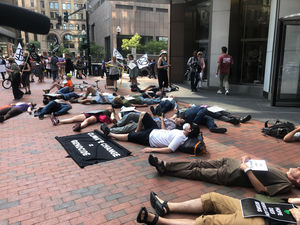
Before I get started on the latest news, I want to share some information about a climate action that is taking place today in several U.S. cities, including Boston. My sister-in-law is a leader in her local chapter of Mothers Out Front, an organization that fights climate change. The group has been working to call attention to Blackrock, a huge asset management corporation whose CEO Larry Fink has tried to position himself as pro-environment, while leading the company that contributes more than any other to the problem of global warming.
[Blackrock CEO Larry] Fink, who was paid $24m (£18.8m) in 2018, began BlackRock as part of Blackstone, the world’s largest private equity group, and spun it out in 1995. Since then, New York-based BlackRock has risen to become an investing behemoth, controlling $6.5tn in assets – a value more than twice the annual output of the UK economy.
That staggering size has placed BlackRock at the heart of the global fossil fuel industry: it is the largest investor in coal worldwide, according to InfluenceMap, an environmental campaign group, and has by far the highest density of coal holdings of the world’s 10 largest investors. BlackRock effectively owns 2.1bn tonnes of thermal coal reserves, based on the size of its stakes in major miners.
In August, two of the country’s fastest growing grassroots groups – Extinction Rebellion and Mothers Out Front – sent a bold message to BlackRock staff at their Boston office.
BlackRock is counted among the top three shareholders in every oil “supermajor” bar France’s Total, and is among the top 10 shareholders in seven of the 10 biggest coal producers, according to Guardian analysis of data from financial information firm S&P.
Yet Fink, 66, who moves in US Democrat political circles, argues it is not his company’s duty to fight the climate emergency. In the real version of his annual letter to shareholders, published in January, Fink said that his overriding duty is to make customers money.
“Our firm is built to protect and grow the value of our clients’ assets,” Fink wrote. “We often get approached by special interest groups who advocate for BlackRock to vote with them on a cause. In many cases, I or other senior managers might agree with that same cause – or we might strongly disagree – but our personal views on environmental or social issues don’t matter here. Our decisions are driven solely by our fiduciary duty to our clients.”
Very glad to see that the fine folks at @MothersOutFront are taking on Blackrock tomorrow, and have figured out how you can use this Twitter thing to assist. Stop funding fossil fuels!https://t.co/EegCmY0P73
Some of Wall Street’s largest asset management companies are failing to live up to commitments to use their voting power to fight the climate crisis, according to a new report.
The report, published on Tuesday by the Washington DC-based Majority Action and the Climate Majority Project, claims that BlackRock Inc, the world’s largest asset manager with more than $6tn under management, and Vanguard, with assets of $5.2tn, have voted overwhelmingly against the key climate resolutions at energy companies, including a resolution at ExxonMobil’s annual shareholder meeting, and at Duke Energy.
Had BlackRock and Vanguard not torpedoed these investor efforts, at least 16 climate-critical shareholder resolutions at S&P 500 companies would have received majority support in 2019, representing a significant corporate shift on climate, the report claims….
“The climate crisis is well upon us, and leading investors are stepping up to press fossil-fuel-dependent companies to align their strategies to the goals of the Paris agreement but some of the largest US investment companies are severely lagging,” said Majority Action’s Eli Kasargod-Staub.
“Blackrock and Vanguard have been using their shareholder voting power to undermine, rather than support, investor action on climate, including opposing every one of the resolutions proposed by the $34tn Climate Action 100+ coalition, calling for significant board room reform in response to its failure to act on climate change,” Kasargod-Staub added.
Unfortunately, it’s raining in Boston today. I expect the mothers will still show up for the demonstration though. I’ll report back if I hear anything about how it went.
A White House national security official who is a decorated Iraq war veteran plans to tell House impeachment investigators on Tuesday that he heard President Trump appeal to Ukraine’s president to investigate one of his leading political rivals, a request the aide considered so damaging to American interests that he reported it to a superior.
Lt. Col. Alexander S. Vindman, the top Ukraine expert on the National Security Council, arriving Tuesday on Capitol Hill.Credit…Anna Moneymaker/The New York Times
Lt. Col. Alexander S. Vindman of the Army, the top Ukraine expert on the National Security Council, twice registered internal objections about how Mr. Trump and his inner circle were treating Ukraine, out of what he called a “sense of duty,” he plans to tell the inquiry, according to a draft of his opening statement obtained by The New York Times.
He will be the first White House official to testify who listened in on the July 25 telephone call between Mr. Trump and President Volodymyr Zelensky of Ukraine that is at the center of the impeachment inquiry, in which Mr. Trump asked Mr. Zelensky to investigate former Vice President Joseph R. Biden Jr.
“I did not think it was proper to demand that a foreign government investigate a U.S. citizen, and I was worried about the implications for the U.S. government’s support of Ukraine,” Colonel Vindman said in his statement. “I realized that if Ukraine pursued an investigation into the Bidens and Burisma it would likely be interpreted as a partisan play which would undoubtedly result in Ukraine losing the bipartisan support it has thus far maintained.”
Did you like this post? Please share it with your friends:
The Sky Dancing banner headline uses a snippet from a work by artist Tashi Mannox called 'Rainbow Study'. The work is described as a" study of typical Tibetan rainbow clouds, that feature in Thanka painting, temple decoration and silk brocades". dakinikat was immediately drawn to the image when trying to find stylized Tibetan Clouds to represent Sky Dancing. It is probably because Tashi's practice is similar to her own. His updated take on the clouds that fill the collection of traditional thankas is quite special.
You can find his work at his website by clicking on his logo below. He is also a calligraphy artist that uses important vajrayana syllables. We encourage you to visit his on line studio.









 I’m really late getting started today, so I’m just going to get right to today’s news. Things are getting out of hand in the the Middle East, and Republicans in the House are determined to make the worse. They are also working hard to shut down the government unless they get all the goodies they are demanding. Johnson did manage to get a continuing resolution passed, but he depended on Democratic votes. Meanwhile the Republicans are holding back funding for Ukraine’s fight against Russia.




















 peej
peej Carissa
 bostonboomer
 dakinikat
 ecocatwoman
 mablue2
 Mama Lopez
 peggysue22
 quixote
 skydancingguestblogger
 Mona (aka Wonk the Vote)



 Sky Dancing
Recent Comments