
Monday Reads
Posted: December 12, 2011 Filed under: China, Drone Warfare, Foreign Affairs, Iran, morning reads, Pakistan, Russia, Sky Dancing Blog, U.S. Economy, U.S. Military, U.S. Politics | Tags: Ann Coulter, children in poverty, consumer demand, Depression, drones, General Manuel Noriega, Hillary Clinton, jobs, Mitt Romney, New Orleans, Newt Gingrich, North Dakota, Obama's wars, Pakistan, Panama, rich people, Trade agreements, unemployment, weather 24 Comments Good Morning!
We’ve had some cold gloomy weather down here in New Orleans. I hope all those bowl game tourists brought their coats. It’s made for a depressing weekend. It seems like most of the news I’ve been finding matches the weather too. Another presidential election year is upon us and we’re looking at the Grinch getting the Republican nomination. Soon, all poor children will be required to mine the coal so the Grinch can place them in every one’s stockings. Well, that’s the east coast poor children. Those poor children in the middle of the country will be fattening up turkeys for the 1 percent to eat. I’ll bet Mitch can make a $10,000 bet on which of the kids will have it worse!
First up is an interesting read from the Business Insider that once again shoots down the meme that the rich create jobs. There are so many economic fairy tales around these days it’s hard to know which one to shoot down next. The bottom line is pretty much something we’ve talked about for some time. If you build it and no one comes, you don’t create anything but one more bankruptcy. It’s the consumer demand that creates economic growth.
The most important reason the theory that “rich people create the jobs” is absurd, argues Nick Hanauer, the founder of online advertising company aQuantive, which Microsoft bought for $6.4 billion, is that rich people do not create jobs, even if they found and build companies that eventually employ thousands of people.
What creates the jobs, Hanauer astutely observes, is the company’s customers.
The company’s customers create demand for the company’s products, which, in turn, creates the need for the employees to produce, sell, and service those products. If those customers go broke, the demand for the company’s products will collapse. And the jobs will disappear, regardless of what the entrepreneur does.
That’s actually some good common sense but it’s backed up by economic theory. Supply without demand just rots in the fields and molds in the warehouse. Which brings me to Paul Krugman who says it’s time to call this economic situation a depression. That’s also something we’ve bandied about here. I’d say skydancers are pretty prescient, wouldn’t you?
It’s time to start calling the current situation what it is: a depression. True, it’s not a full replay of the Great Depression, but that’s cold comfort. Unemployment in both America and Europe remains disastrously high. Leaders and institutions are increasingly discredited. And democratic values are under siege.
On that last point, I am not being alarmist. On the political as on the economic front it’s important not to fall into the “not as bad as” trap. High unemployment isn’t O.K. just because it hasn’t hit 1933 levels; ominous political trends shouldn’t be dismissed just because there’s no Hitler in sight.
Krugman takes the rest of the column outlining some of the abysmal politics and economics in Europe. I just keep checking the calendar to see if we some how time tripped back to the 1930s and some how forget what we learned the last time out. Looking at things from a war build-up point a view, there’s this link to “Obama Raises the Military Stakes: Confrontation on the Borders with China and Russia” from Global Research. This is how some leftwing thinkers see the latest in US outreach in Asia.
November 2011 is a moment of great historical import: Obama declared two major policy positions, both having tremendous strategic consequences affecting competing world powers.
Obama pronounced a policy of military encirclement of China based on stationing a maritime and aerial armada facing the Chinese coast – an overt policy designed to weaken and disrupt China ’s access to raw materials and commercial and financial ties in Asia . Obama’s declaration that Asia is the priority region for US military expansion, base-building and economic alliances was directed against China , challenging Beijing in its own backyard. Obama’s iron fist policy statement, addressed to the Australian Parliament, was crystal clear in defining US imperial goals.
“Our enduring interests in the region [Asia Pacific] demands our enduring presence in this region … The United States is a Pacific power and we are here to stay … As we end today’s wars [i.e. the defeats and retreats from Iraq and Afghanistan]… I have directed my national security team to make our presence and missions in the Asia Pacific a top priority … As a result, reduction in US defense spending will not … come at the expense of the Asia Pacific” (CNN.com, Nov. 16, 2011).
The precise nature of what Obama called our “presence and mission” was underlined by the new military agreement with Australia to dispatch warships, warplanes and 2500 marines to the northern most city of Australia ( Darwin ) directed at China . Secretary of State Clinton has spent the better part of 2011 making highly provocative overtures to Asian countries that have maritime border conflicts with China . Clinton has forcibly injected the US into these disputes, encouraging and exacerbating the demands of Vietnam , Philippines , and Brunei in the South China Sea . Even more seriously, Washington is bolstering its military ties and sales with Japan , Taiwan , Singapore and South Korea , as well as increasing the presence of battleships, nuclear submarines and over flights of war planes along China ’s coastal waters. In line with the policy of military encirclement and provocation, the Obama-Clinton regime is promoting Asian multi-lateral trade agreements that exclude China and privilege US multi-national corporations, bankers and exporters, dubbed the “Trans-Pacific Partnership”. It currently includes mostly smaller countries, but Obama has hopes of enticing Japan and Canada to join …
Obama’s presence at the APEC meeting of East Asian leader and his visit to Indonesia in November 2011 all revolve around efforts to secure US hegemony. Obama-Clinton hope to counter the relative decline of US economic links in the face of the geometrical growth of trade and investment ties between East Asia and China .
Pakistan is threatening to shoot down all US drones. Tis the season to be jolly!!!
According to the new Pakistani defense policy, “Any object entering into our air space, including U.S. drones, will be treated as hostile and be shot down,” a senior Pakistani military official told NBC News.
The policy change comes just weeks after a deadly NATO attack on Pakistani military checkpoints accidentally killed 24 Pakistani soldiers, prompting Pakistani officials to order all U.S. personnel out of a remote airfield in Pakistan
I wonder if people in North Dakota have the same option? Here’s the Daily Mail headline on your Daily Moment of Orwell: Local cops using Predator drones to spy on Americans in their own backyards.
One of the only confirmed uses of predator drones by local law enforcement came in June when a sheriff near Grand Forks, North Dakota, went looking for six stolen cattle.
When he arrived at the farm of Rodney Brossart, he was threatened by three men with guns and forced to retreat.
The Brossarts were known for being armed, anti-government separatists. So Sheriff Kelly Janke, who patrols a county of just 3,000 people, called in a Predator drone to look out over the 3,000-acre farm where the family was armed with rifles and shotguns.
With the help of a drone, summoned from nearby Grand Forks Air Force Base where it was patrolling the US-Candida border, the sheriff was able to watch the movements of everyone on the farm from a handheld device that picked up the aircraft’s video footage.
He and his deputies waited until they could see the Brossarts put down their weapons. Then they stormed the compound and arrested Rodney Brossart, his daughter and his three sons on a total of 11 felony charges. No shots were fired.
And he recovered the cattle, valued at $6,000.
The sheriff says that might not have been possible without the intelligence from the Predators.
‘We don’t have to go in guns blazing. We can take our time and methodically plan out what our approach should be,’ Sheriff Janke told the Times.
All of the surveillance occurred without a search warrant because the Supreme Court has long ruled that anything visible from the air, even if it’s on private property, can be subject to police spying.
Back to the Grinch that’s stealing Willard’s inevitability.
The NBC News-Marist polls showed Gingrich leading Romney in South Carolina by 42 percent to 23 percent. An October poll by the same organizations showed Gingrich at 7 percent in the Palmetto State. In Florida, Gingrich leads Romney 44 percent to 29 percent. There Gingrich has gained 38 percentage points since October.
The rapid movement highlights the remarkable rise of Gingrich as the caucuses and primaries near. Republican voters have shifted allegiances repeatedly this year and a number of state polls have shown that they are not firmly locked in behind any candidate at this point.
In New Hampshire on Sunday, Romney picked up the endorsement of Manchester Mayor Ted Gastas. But he was the target of a scathing editorial in the Union Leader, which earlier endorsed Gingrich. The headline read “Romney’s desperate hours.”
January’s coming and sooner or later, some of these folks are going to run out of money. There seems to be quite a few irrelevant candidates in the race right now. Maybe super Jeb is waiting in the wings? So here’s a good way we now MIttens is tres desperate. Here’s the TPM headline: Romney Presses Ann Coulter Into Surrogate Duty.
Turn on the radio here and you’re going to get a taste of how hard Mitt Romney is working to stamp out Newt Gingrich’s support with conservatives.
In a new radio ad launched by the Romney campaign in Iowa last week, Romney turns to conservative fire-breather Ann Coulter to make the case that he’s the most electable candidate in the Republican race. Having made a living off saying things that no politician would likely wish to be closely associated with, it’s an interesting choice — and a sign that Romney is going all out to cast himself as the more pure conservative choice to Gingrich.
Coulter endorsed Romney a month ago (after dissing him before that) and the Romney ad grabs a clip of her talking up her candidate on Fox and Friends in November.
Here’s a ghost of nightmares past. Noriega has been extradited to Panama for trial. The link goes to a BBC TV report.
The former leader of Panama, General Manuel Noriega, has returned to his home country 22 years after being forcibly removed from power by the US.
The 77-year-old was extradited from France, where he had been in prison on money laundering charges.
He is likely to spend the rest of his life in jail after being convicted in absentia for murder, corruption and embezzlement while he was in power.
OOOH, baby it’s cold outside.
What’s on your reading and blogging list today?
Friday Reads
Posted: December 9, 2011 Filed under: morning reads | Tags: captured drone, Christopher Hitchens, Filibuster, iran, recession, Senate Republicans, unemployment 20 Comments Good Morning!
I had another week full of weird things to do. I completely forgot my driver’s license expired last month on my birthday and had to rush out to get it renewed. I really don’t keep track of my age at all any more so I forgot the entire divisible-by-four thing. I also have been rushing around doing odds and ends that have just been driving me nuts. It just seems life is just one complex set of paperwork to fill out for someone or another these days. This week I had to prove all kinds of things to all kinds of people. I guess no one takes you at face value any more. We’ve turned into a nation where you have to show every one your papers. It made the week a combination of something Kafkaesque and Stalinesque. I simultaneously wanted to laugh, cry, and slap people multiple times this week.
There’s an interesting article at The Atlantic on how the economic recovery is affecting women differently from men. The article is called “The Recession was Sexist (So is the Recovery)” and it’s worth a read. It’s written by Jordan Weissmann.
Since November 2010, 70% of new jobs have gone to men. At first blush that sounds reasonable. If men lost more jobs, they should also recoup more. The problem crops up when you look at the number of job gains as a fraction of losses. Men have regained about a third of the jobs they shed in the recession. Women have only regained about one in five.
Ladies and gentlemen, we have a gender gap. And it’s not clear whether it will narrow. In November, female job gains actually outpaced males, 65,000 to 55,000. But going forward, women are going to have to contend with one of the most nastiest forces in job market: government budgets.
As the graphic to the left shows, women far outnumber men on state and local government payrolls, especially in public schools. Early in the recession, those employers were propped up by stimulus money. No longer. We live in an age of belt tightening, and government employees are being shown the door by the thousands. Last month, state and municipal payrolls shrank by 16,000 workers. There’s no sign of the trend letting up.
If you want to see the graphs that go with the discussion, you should check the article out. The trend is really noticeable.
There’s also continued filibusters from Mitch McConnell of anything that could remotely help the unemployed, families hurt by recession, and anything that looks like it might have gone near the President. I can’t believe all this belligerence is a winning strategy for them, but only time will tell. As much as I’ve had problems with Obama, McConnell’s got me so hopping mad and the clown set running for the Republican nomination have me more distressed. I’ve never seen a bunch of more mean-spirited, ignorant, hateful, religious fanatics in my life. In this situation, Obama is definitely the lesser of evils. This is an election that will bring the definition of evil to a new nadir. There’s not a woman- or child-friendly politician to be had any where.
The filibuster — a stall tactic that requires time-consuming motions and 60 votes to overcome — can be used on virtually all Senate business, including on whether to even bring up bills for debate.
…
Democrats say Republican tactics this week will come back to haunt them. On Thursday, Republicans are well-positioned to filibuster the nomination of Richard Cordray to head the new Consumer Financial Protection Bureau. For weeks, the GOP has demanded several changes to the bureau to roll back its powers.
Democrats say it’s “the first time in history” that a nominee will be blocked because of the concerns over the agency that the person was selected by the president to head — rather than the qualifications of the nominee.
“I said to some of my Republican colleagues, ‘Do you want this to happen when someday there’ll be a Republican president?’” said Sen. Sherrod Brown (D-Ohio). “It’s clearly a terrible precedent.”
en. Bob Menendez (D-N.J.) said he didn’t think any minority should adopt such tactics that he called “highly dangerous for the country.”
Republicans are highly dubious of the claims, saying there’s nothing unusual over holding up nominees until legitimate concerns over policy are addressed.
“This is the first time in history that I’m aware of that an agency of this kind has been created,” said Sen. Mike Crapo (R-Idaho), a member of the Senate Banking Committee.
The tit-for-tat has been going on since Tuesday when Republicans sustained a filibuster by a 54-45 vote on the Halligan nomination to the D.C. appellate court, accusing President Barack Obama of nominating an “activist judge” hostile to gun rights.
But Democrats said she was a well-qualified nominee with an exemplary résumé, and that the standard set by the so-called Gang of 14 senators in 2005 to only filibuster judicial nominees in “extraordinary circumstances” had been effectively nullifed.
Ruemmler, the White House counsel, said she could “rattle off a litany of folks who would be on any Republican shortlist” that would be rejected under the new standard, like attorney Paul Clement who is representing Republicans in the House in defending the Defense of Marriage Act. But she said it would be “ridiculous” if Democrats did that over such an ideological dispute.
The White House points to 20 judicial nominees awaiting Senate action, several of whom would fill posts considered “emergency” vacancies, and officials complain that the chamber is moving at a much slower pace now than it was when Bush was in office.
Iran has been showing film of a captured US drone. There’s been confirmation now that the film is authentic and so is the drone. This confirms some of the rumors floating around earlier this week.
Iran’s Press TV said that the Iranian army’s “electronic warfare unit” brought down the drone on 4 December as it was flying over the city of Kashmar.
Brig General Amir-Ali Hajizadeh, head of Iran’s Revolutionary Guards’ aerospace unit, told Iranian media that the drone “fell into the trap” of the unit “who then managed to land it with minimum damage”.
He said Iran was “well aware of what priceless technological information” could be gleaned from the aircraft.
Nato said at the weekend that an unarmed reconnaissance aircraft had been flying a mission over western Afghanistan late last week when its operators lost control of it.
Pentagon officials have said they are concerned about Iran possibly acquiring information about the technology.
I still haven’t gotten used to seeing armadillos all around the place since I moved down here. Looks like Kentucky is going to have to get used to them too as they are moving north and east. The move started in the 1980s and has been increasing since then. Like many local critters, they appear to be moving north with climates getting warmer.
“The first road-killed armadillo I encountered in Kentucky was in 2003, and the first live one I saw was in 2006,” said John MacGregor, a herpetologist with the Kentucky Department of Fish and Wildlife Resources.
MacGregor said in recent years there have been several confirmed sightings by staff biologists in eastern and south central Kentucky.
Steve Bonney, northeastern region wildlife coordinator for Kentucky Fish and Wildlife, encountered a road-killed armadillo in Rowan County in 2009 on the way to work. “I routinely record road kills. When I saw what I thought was an armadillo, my radar went off,” said Bonney. “It kind of shocked me.”
When Bonney arrived at work, he immediately drove back to the site of the road kill on Ky. 801 in Farmers, Kentucky to photograph and pick up the armadillo.
Of the 20 known species of armadillos, the nine-banded armadillo is the most widely distributed. It is the only armadillo species to have
ventured north of Mexico. Today, the nine-banded armadillo is established as far east as South Carolina and as far west as southern Nebraska. Loughry said range expansion “has been consistent over the years, and is the continuation of a long-term trend.”
But what biologists can’t agree on is why range expansion is occurring so fast. Factors that may be fueling this expansion include: climate change, the armadillo’s general adaptability, its high reproductive rate and little desire on the part of humans to hunt or eat armadillos.
The two most likely things to cause armadillo mortality are getting run over by vehicles on roads or being eaten by coyotes.
If any of them amble up to a neighborhood near you, here’s some cajun recipes for those of you brave enough to try them.
Here’s an interesting interview with Bruce Judson on the Societal Dangers of income inequality. Judson is a professor of management that specializes in entrepreneurship at Yale School of Managment. He has a new e-book coming out on making capitalism work for the 99%. BC is Bryce Covert of ND 2.0.
BC: What does inequality mean for the middle class, which is the foundation of our country’s economy?
BJ: Early America lacked the class barriers then prevalent in Europe: Everyone mixed with each other. This led the more fortunate to have empathy and a visceral understanding for the problems of the less fortunate. As economic inequality has increased, we see far less mixing among people at different income levels. Now everyone has less of a sense that they are part of one large community and that we have a responsibility to each other.
Political theorists, going back to Aristotle, have all concluded that a vibrant middle class is essential for a vibrant democracy. The members of the middle class hope to move up, so they want mobility to remain a desirable option, but they also fear moving down, so they are more likely to support a social safety net. In essence, the middle is the group that ensures stability as a barrier to legislative extremes that unduly reward the wealthy or harm the poor.
Unfortunately, inequality that chips away at the middle class can lead to violence. There was violence that occurred in the Depression, with riots in the Midwest. People also started to take the law into their own hands. In penny auctions, after your farm was foreclosed on, you showed up at the courthouse with all of your friends — farmers who had their rifles with them — and took over the bidding and bought back your farm for penny. As income inequality increases, the dispossessed may start to feel they have been treated unfairly and things can get ugly.
BC: Your work also predicted revolution. What’s your current take?
BJ: The book did not predict revolution. The book said that if we allow income inequality to continue growing unchecked, then we would face a high risk of political instability or revolution. We discussed earlier how the book detailed a series of stages, or a narrative, for how growing economic inequality can lead to social upheaval. Unfortunately the narrative I detailed seems to be happening.
My best estimate is we have now passed through 60 percent of the narrative. A lot needs to happen before the risk of political instability becomes a reality. I am hopeful that with inequality now on the national agenda, we will see the reforms needed.
So, there’s a lot of juicy stuff in that interview including Judson’s take on the Occupy movement.
BC: Does the emergence of the Occupy Wall Street movement make you more or less hopeful for the nation’s future?
BJ: It absolutely makes me hopeful that we will start to see some meaningful reforms. The Occupy movement is casting a bright and unforgiving light on some of the unacceptable practices in our society that, sadly, have become commonplace.
I believe the Occupy movement is not going away. The reason it grew so quickly is that it was the flashpoint for the country’s anger and widespread feelings of unfairness. It’s almost inevitable that in some way it will expand to include people who feel they’ve been unfairly foreclosed on, the record numbers of Americans experiencing long-term unemployment, and many of the unemployed in general who feel they’ve been cheated out of the opportunity to work – mainstream America.
The danger is that if the Occupy movement does not succeed, and nothing takes its place, we will move further along the narrative I described.
So, that’s my offerings this morning. I have a few more paper chases to do today before I settle in for the weekend. I’m thinking I’ll end this week with a nice long soak in the tub, some read wine, and the new Vanity Fair with the Gaga in red pic on the cover. I’m going to read about the romance between Queen Elizabeth and Prince Phillip and look at all those really old photos. I’d say that out to put reality out of my mind for awhile. Okay, I’m going to read the Stiglitz article first (Fix the Economy? What Obama and the GOP won’t tell you). Then, I’m going to read Christopher Hitchens on Nietzsche, then I’ll do the Queen’s young romance. So, okay, I”ll give you one taste.
Hitchens describes chemotherapy. This is something I know well. I also know what it’s like to kiss death and know that it hovers over your bed waiting for you to move closer to its embrace.
I often grandly say that writing is not just my living and my livelihood but my very life, and it’s true. Almost like the threatened loss of my voice, which is currently being alleviated by some temporary injections into my vocal folds, I feel my personality and identity dissolving as I contemplate dead hands and the loss of the transmission belts that connect me to writing and thinking.
These are progressive weaknesses that in a more “normal” life might have taken decades to catch up with me. But, as with the normal life, one finds that every passing day represents more and more relentlessly subtracted from less and less. In other words, the process both etiolates you and moves you nearer toward death. How could it be otherwise? Just as I was beginning to reflect along these lines, I came across an article on the treatment of post-traumatic stress disorder. We now know, from dearly bought experience, much more about this malady than we used to. Apparently, one of the symptoms by which it is made known is that a tough veteran will say, seeking to make light of his experience, that “what didn’t kill me made me stronger.” This is one of the manifestations that “denial” takes.
I am attracted to the German etymology of the word “stark,” and its relative used by Nietzsche, stärker, which means “stronger.” In Yiddish, to call someone a shtarker is to credit him with being a militant, a tough guy, a hard worker. So far, I have decided to take whatever my disease can throw at me, and to stay combative even while taking the measure of my inevitable decline. I repeat, this is no more than what a healthy person has to do in slower motion. It is our common fate. In either case, though, one can dispense with facile maxims that don’t live up to their apparent billing.
Deadly Long Term Unemployment
Posted: December 2, 2011 Filed under: Economy, unemployment | Tags: long term unemployed, policy, unemployment 8 Comments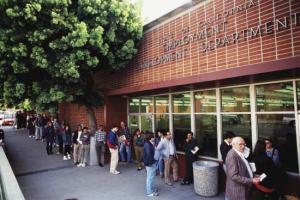 We have a new unemployment rate of 8.6% that looks much improved on the surface. Notice I had to qualify that statement. This is because of the flows in and out of labor markets and the patterns of jobs. Ever since they changed the measures of “employed” to mean any one working at least one hour of work, the rate is less meaningful than the underlying patterns. There are several underlying numbers that make this unemployment report a mixed bag.
On the good side, there was some job creation and there appears to be a larger number of people working more hours. This means that underemployment is improving. I should mention that unemployment can actually get worse for awhile after a recession–making it a lagging indicator–because improving job markets encourage unhappy job holders to start looking for a different situation. What we are seeing is that people are able to pick up more hours. That’s not part of the job switch behavior. It means the situation for current job holders is improving.
The bad news is for the long term unemployed whose unemployment levels stayed the same. There are also indications of an outflow of “discouraged” workers who have simply given up looking for work and are likely off the unemployment roles now. This is very troubling and requires immediate policy response.
In November, the number of job losers and persons who completed temporary jobs declined by 432,000 to 7.6 million. The number of long-term unemployed (those
jobless for 27 weeks and over) was little changed at 5.7 million and accounted for 43.0 percent of the unemployed. (See tables A-11 and A-12.)The civilian labor force participation rate declined by 0.2 percentage point to 64.0 percent. The employment-population ratio, at 58.5 percent, changed little.
(See table A-1.)The number of persons employed part time for economic reasons (sometimes referred to as involuntary part-time workers) dropped by 378,000 over the month to 8.5 million. These individuals were working part time because their hours had been cut back or because they were unable to find a full-time job. (See table A-8.)
There are two ways the government could deal with this long term unemployment. The first would be most direct. That would be hiring them directly. Given the current political situation, that is unlikely to happen. The second way would be to pay for the first year or two of their salaries and benefits. This would probably be more acceptable to republicans–however I do question their commitment to improving the economy and the job situation in general–but it would take some work to get the apparatus in place. President Obama has made policy suggestions that would pay states to keep education, public health, and public safety employees but that has met with demands for cuts elsewhere to pay for reimbursements. This is a good suggestion, but doesn’t do anything to deal with the number of long term unemployed who are know disenfranchised from the work environment, are losing skills, and are less likely to be hired due to discrimination by employers who don’t like large, “unexplained job gaps. A program needs to be directly targeted to this group.
Why am I suggesting this? It is because the number of labor market economists that are crunching numbers at the moment show us that it’s taking forever at this rate to bring down unemployment and we are likely creating a permanent underclass. Felix Salmon has a graph and some analysis this demonstrates the problem.
When employed people become unemployed, that’s bad news, and immediately visible in the unemployment rate. When unemployed people leave the labor force entirely, that’s equally bad news, but it’s a tougher measure for the public to connect with, since at that point they’re no longer counted in the unemployment rate. Everybody knows what “unemployment” is; the population which cares about the “employment-to-population ratio”, by contrast, is wholly comprised of wonks.
The plunge in the employment-to-population ratio over the course of the Great Recession is going to be its biggest and most lasting legacy. We’re now back to the levels last seen in the days before most women worked, but we live in a very different world now. In the late 1970s, a woman without a job was much less likely to consider herself unemployed than in the early 2010s. And when she casts her vote in November, the degree to which she’s happy or unhappy with the current administration is going to be much more connected to her actual employment status than it is to whether she’s officially showing up in the unemployment rolls.
Over the next few months, we’ll get a better sense of the signal-to-noise ratio in the 8.6% number. I’m hopeful that we’ve seen the last 9 handle in the headline unemployment data series, and if I’m right, then the optics of the unemployment rate are, at the margin, good for Ds and bad for Rs. But the unemployment rate is not a particularly good gauge of how well the economy is functioning, or how many people have jobs. And I’m very pessimistic that the employment-to-population ratio is going to get back above 60% even over the medium term. It’s certainly not going to get there before the election.
Here’s some more composite analysis from NBC interviews with economists.
Long-term unemployment remains a big problem: The average duration for joblessness surged to a record-high 40.9 weeks. Stagnation in wages also continues, as more employed workers took on second jobs. There were just under seven million multiple job-holders for the month, the highest total in 2011 and the most since May 2010.
Traders offered little reaction to the report. Futures already had been indicating a positive open but lost some ground in the ensuing minutes after the Labor Department report hit the tape.
“At this pace of job growth, it will be more than two decades before we get back down to the pre-recession unemployment rate. Moreover, a shrinking labor force is not the way we want to see unemployment drop,” said Heidi Shierholz, economist at the Economic Policy Institute. “At this rate of growth we are looking at a long, long schlep before our sick labor market recovers.”
Here’s a bleak assessment from Dean Baker via Taylor Marsh.
It takes roughly 90,000 jobs to keep even with the growth of the labor force. At this rate, it will take close to 200 months, or 16 2/3 years to make up for the 10 million job deficit in the economy.
Even the White House is admitting that we’re a long way from the pre-recession employment numbers. Here’s the nifty graph that Calculated Risk has been updating over 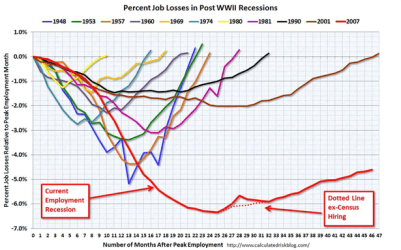 time that clearly demonstrates the literal uphill battle. Since republicans are in no mood to improve the economy and the jobless rate given their strong desire to regain the White House and the Senate, I don’t see much hope for any solution any time soon. If they do regain any of the above after the election we probably won’t see any improvement at all. That’s why I think the Obama administration needs to work on continued targeted fixes. Again, I would recommend directly paying businesses to hire the long term unemployed. I actually think it would be worth offering some spending offsets if that is going to be what it takes because we can’t afford to continue to endure these levels of duration. The more chronic the problem becomes, the more it will cost us and the more it will ruin millions of folks’ lives.
Occupy Philly and Independence Hall
Posted: November 30, 2011 Filed under: #Occupy and We are the 99 percent!, Banksters, Corporate Crime, corruption, Economy, financial institutions, income inequality, jobs, U.S. Economy, U.S. Politics, unemployment, voodoo economics | Tags: 2011: days of revolt, Financial Crisis, U.S. Economy, unemployment 16 CommentsBlack Friday, Philadelphia, Pa.
My first look at Occupy Philly was after a free ride on the 9:52 Media Local, The Santa Train. This was not by plan but a matter of sheer coincidence. I should have guessed; I was the only one standing on the Morton platform without a small child in tow. But shortly after boarding, it was all too clear. The elves came first, wailing Jingle Bells and Wish You a Merry Christmas. They were followed by out-of-season Mummers dressed in holiday garb, belting out another round of X-mas cheer, complete with accordion, banjo and sax. Mrs. Claus assured the children that Santa was busy, busy at the North Pole, making sure all their wishes [even though edited to economic realities] would come true. And then, there was the free candy and balloon animals.
The magic of childhood! Where we can believe everything and anything. When the world appears kind and right and true.
An out-of-stater now, I deliberately got off at Suburban Station, my old work stop. Also, the stop at which I’ve frequently disembarked to attend exhibits at the Franklin Institute, the Museum of Natural History or the Philadelphia Museum of Art, a brisk walk west up the Parkway, past the Rodin Museum and the soon-to-open home for the controversy-laden Barne’s collection.
But not today.
This morning I headed east, winding through the underground towards City Hall and the Occupy Philly encampment. Later, I would team up with a friend and hoof down to the historic district. But right now, I had a different historical event in mind.
I no sooner hit the outside doors than the vivid blue of plastic tarps and tent tops were visible. A strange sight. Normally, I would have walked through the West arch at City Hall, stood for a few moments googling at the city’s Christmas tree. But this year was different. So different.
The western entrance to the City Hall complex was barricaded. ‘For Restoration’ the signs said. No towering tree this year. Instead, the Occupy tents decorated Dilworth Plaza, a strange but fascinating sprawl of makeshift living quarters and standard issue camping gear. The area was quiet and still, the air crisp. I circled around the entire plaza. No sight of my friend, so I headed back towards the encampment, spotted the medical and information tents, as well as a petition table outlining the dangers of in-state fracking by over-zealous gas drilling companies.
At the Information Tent there was an array of literature on upcoming actions, the November issue of the Occupy Wall Street Journal and several people discussing Mayor Nutter’s deadline to dismantle the encampment within 48 hours. Two of the occupiers said almost in unison: ‘It was never about the tents.’
So what is it about? It’s a question I read constantly on the blogs and in newspapers, even hear from family and friends.
Here’s what I learned in the morning hours I spent on the Plaza:
- In the 53 days of Occupy Philly, 26,000 local citizens signed on expressing support.
- At the height of the encampment, City Hall was encircled with tents, sleeping bags and a variety of makeshift living accommodations.
- Active supporters numbered around 200-300, some living on-site, others coming in to protest, march and rally during the day.
- Local Unions support the effort. In fact, the Trades Union offered to assist the protestors in the original plan to move off Dilworth to an encampment across the street. The Union needs those ‘renovation’ jobs. That idea was scrapped because permits were denied.
- The area was clean. No needles, drug paraphernalia or trash scattered about as the MSM would have readers/viewers believe taints all encampments. Talking to several encampment members, I was told a goodly portion of each day is spent ‘cleaning up.’
- The encampment/protest was peaceful. There was a sense of community and the overriding sentiment was to voice anger and dissent over the widening income inequality in the US and the corporate capture of all facets of government.
- I heard no political posturing or Obama shilling. Simply stated, the system is broken for the 99%.
- Forty to fifty of the encampment members were homeless. They joined for the free food and the safety of numbers.
- The police presence, even on this Friday morning, was unusually large but basically stationed within the confines of the City Hall plaza.
- Though Mayor Nutter had leveled a 48-hour deadline, there was no sense of panic or great urgency the morning I arrived. I later learned that the majority of the encampment was dismantled voluntarily Sunday evening and the homeless were moved elsewhere for their own safety.
- This morning [Wednesday 11/30 at 1:20 am, according to the Associated Press], the Philly police department began tearing down the remaining tents.
But as the protesters I spoke with said: It was never about the tents. It has always been about visibility—the eyesore of inequality, injustice and corruption.
I left Dilworth Plaza, and then headed down to Independence Mall. A surreal juxtaposition. In a matter of a few blocks, my friend and I walked from the current protest to the historical marker of the Mother of All Protests. Philadelphia is the birthplace of the Declaration of Independence and the US Constitution. We strolled through the portrait gallery installed in the Second Bank of the United States and the faces of those earlier protesters, that grand collection of merchants and farmers, philosophers and scientists, lawyers and bankers stared back. What would they be thinking? I wondered.
We went on to Carpenter’s Hall, where Benjamin Franklin reportedly had secret meetings with like-minded citizens prior to the Revolution. Years later, on leaving the Constitutional Convention, a woman reportedly asked Franklin what sort of government he and the others had designed. Franklin’s terse reply: ‘A Republic, Ma’am. If you can keep it.’
Our final stop was Independence Hall, which was originally the Pennsylvania State House. This was where the Second Continental Congress met, the Declaration of Independence was adopted and where the Constitutional Convention met to draft, debate, and then sign the US Constitution in 1787.
We’re a long way from who and what we were in 1787. But Franklin’s words have a haunting edge to them: ‘A Republic, Ma’am. If you can keep it.’ Another quote that’s perhaps equally pertinent is:
‘We must hang together, gentleman, or assuredly we will all hang separately.’
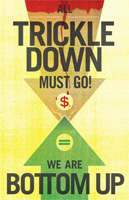 For me at least, this is what the Occupy Movement has been and is still about. In an age where corporations have been awarded the distinction of personhood, when free speech is equated to money and The Rule of Law is applied in an unjust and inequitable fashion then we, ordinary citizens, have a duty to support and join one another in protest. To hang together, if you will.
Oh, and that Tea Party, the real one in Boston that got everything rolling?
We all recall the ‘taxation without representation’ line from our school years, stemming from the passage of the Stamp Act in the 1760s and later the Tea Act in 1773. King George had debts to pay off—a Seven Year’s War among other things. And the East India Company’s tea pitched into the Boston Harbor? East India was basically provided a monopoly on tea shipped into the colonies. The company [and its aristocratic shareholders] were none too happy about their profits pinched and drowned in the harbor and helped push [lobby] the King to pass the Coercive Acts, aka The Intolerable Acts. The colonists were generally peeved at the British Parliament for taxing them without their consent and then adding insult to injury, giving the East India Co. a cushy, duty-free export to undercut colonial merchants. But they were beyond peeved when punitive measures were leveled. They demanded that Parliament end its corrupt economic policies with and stop the bailout of that era’s own TBTF East India Company.
Sound vaguely familiar? Whatever’s old is new again. Of course, no one age can be accurately compared to another. Context is everything. To quote Barbara Kingsolver from the November issue of The Occupy Wall Street Journal:
“Every system on earth has its limits. We have never been here before, not right here exactly, you and me together in the golden and gritty places all at once, on deadline, no fooling around this time, no longer walking politely around the dire colossus, the so-called American Way of consecrated corporate profits and crushed public compassion. There is another American Way. This is the right place, we found it. On State of Franklin, we yelled until our throats hurt that we were the 99% because that’s just it. We are.”
As I’ve said elsewhere, I support Occupy until I don’t. The ‘don’t’ for me is if the Movement becomes another co-opted arm of one corrupt political party or another. Our existing two-party system is thoroughly compromised; a shipload of bleach and scrub brushes couldn’t clean it up. I support Occupy because I hate the idea of leaving my kids and future grandbabies with a broken, twisted Republic, one dedicated to piranha-school profits, the amassing of criminal wealth by a callous, irresponsible few at the expense of the many. I support the Occupiers because of those sweet-faced kids on the Santa train; they deserve the best we have. But I also support what I saw on Dilworth Plaza because of what I saw and recalled inside Independence Hall, what we owe to all those who sacrificed and struggled, dreamed and achieved, lived, loved and died over the last 200+ years. We stand on the shoulders of so many.
That’s something we should never forget because our past, our history is no small thing. But our future, that other American Way? That’s all about what we do now.
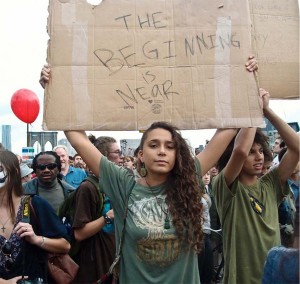
“Occupy Congress?” Now You’re Talking!
Posted: November 18, 2011 Filed under: #Occupy and We are the 99 percent!, Congress, corruption, jobs, U.S. Economy, U.S. Politics, unemployment | Tags: Barack Obama, Greg Sargent, jobs, Occupy Congress, occupy Wall Street, unemployment 13 Comments
According to Greg Sargent, labor and progressive organizations are forming a coalition to “Occupy Congress.”
The coalition — which includes unions like SEIU and CWA and groups like the Center for Community Change — is currently working on a plan to bus thousands of protesters from across the country to Washington, where they will congregate around the Capitol from December 5-9, SEIU president Mary Kay Henry tells me in an interview.
“Thousands of people have signed up to come to Capitol Hill during the first week in December,” Henry says, adding that protesters are invited to make their way to Washington on their own, too. “We’re figuring out buses and transportation now.”
One idea under consideration — pending various permitting and other logistical issues — is to have a series of tents set up on the lawn outside the Capitol, each representing a state, with the number of unemployed in each state prominently displayed. But the optics are still being worked out.
The demands they are talking about aren’t very radical though. They’re planning to pressure Republicans to go along with Obama’s jobs proposal. As Sargent points out, that doesn’t really jibe with the nature of the Occupy movement, which rejects both corporate political parties. But Henry argues that
Occupy Wall Street had created a “framework” — which she described as “we are the 99 percent” — within which such activities would fit comfortably.
“The reason we’re targeting Republicans is because this is about jobs,” she said. “The Republicans’ insistence that no revenue can be put on the table is the reason we’re not creating jobs in this country. We want to draw a stark contrast between a party that wants to scapegoat immigrants, attack public workers, and protect the rich, versus a president who has been saying he wants America to get back to work and that everybody should pay their fair share.”
It’s a start, and the SEIU may not be able to control the message if lots of people with more creative ideas show up to the protests.
In line with the influence of the Occupy actions on the mainstream types, I clicked on a Google news link to the conservative Washington Times that read “Occupy Wall Street: What should be done with the protesters?” I expected to find a screed encouraging law enforcement to crush the protesters. Imagine my surprise when I read this instead:
As irritating or disruptive as some may find the Occupiers, they are the conscience of America, like it or not. Their very physical presence is a reminder that the decline of America happened not because they didn’t believe in the American dream, but because the greed of Wall Street and the banks stole that dream.
Yet our government continues to reward the top 1% with corporate welfare and the lowest taxes in more than 50 years. And Congress, which made that largesse to the wealthy possible, is in the pockets of those very same people and their lobbyists.
Yes, the protesters are predominately young, unemployed, maybe even scruffy, and, yes, the homeless have found a haven and free meals with them, and, yes, the Occupiers’ persistence after more than two months is like a mote in our eye, reminding us all that we can no longer do business as usual.
The fact that OWS sites have sprung up across the country and now the world has prompted us to face ourselves. We can no longer ignore the joblessness and poverty that scars our great country. It is not an abstract concept, some numbers on a bean counters’ balance sheet. It’s real. It’s people. It’s your kids and mine. It’s returning vets who find themselves on the scrap heap of our economy.
Holy sh&t! Can you believe it? Could it be that change is really happening?

 peej
peej Carissa
 bostonboomer
 dakinikat
 ecocatwoman
 mablue2
 Mama Lopez
 peggysue22
 quixote
 skydancingguestblogger
 Mona (aka Wonk the Vote)



 Sky Dancing
Recent Comments