
It’s true that public opinion surveys are not showing any 2010-style GOP “wave,” but Democrats are rightly nervous that when polls begin identifying likely voters closer to November, superior Republican “base enthusiasm” could put a thumb on the scales in their favor.
Really Late Monday Reads
Posted: April 13, 2015 Filed under: 2016 elections, Hillary Clinton, Hillary Clinton: Her Campaign for All of Us, morning reads | Tags: Marco Rubio 16 CommentsGood Afternoon!
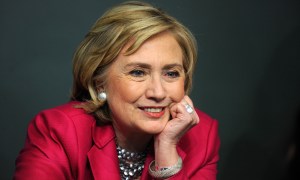 Well, I still haven’t gotten used to my triple life. One of the symptoms of that and advanced age appears to be continually forgetting what day it is and feeling like it’s a lot earlier than the actual time. I guess I’m still longing for regular time since it feels like afternoon here so late into the evening.
Well, the news is mostly focused on Hillary and her announcement. She’s mostly drowned out the yawn inducing announcement of Rubio who–while not completely crazy go nuts–is just another right wing male with a misogyny complex. Brian Beutler calls him the “most disingenuous”candidate in the clown car.
Senator Marco Rubio, who will announce his candidacy for president on Monday, was supposed to lead a GOP breakaway faction in support of comprehensive immigration reform, but was unable to persuade House Republicans to ignore the nativist right, and the whole thing blew up in his face. In regrouping, he’s determined that the key to restoring Republican viability in presidential elections is to woo middle class voters with fiscal policies that challenge conservative orthodoxy.
His new basic insight is correct. The GOP’s obsession with distributing resources up the income scale is the single biggest factor impeding it from reaching new constituencies, both because it reflects unpopular values and because it makes them unable to address emerging national needs that require spending money.
His new basic insight is correct. The GOP’s obsession with distributing resources up the income scale is the single biggest factor impeding it from reaching new constituencies, both because it reflects unpopular values and because it makes them unable to address emerging national needs that require spending money.
It also happens to be the raison d’être of the conservative establishment. Challenging the right’s commitment to lowering taxes on high earners, and reducing transfers to the poor and working classes, will encounter vast resistance. Where Paul can appeal to the moral and religious sensibilities of elderly whites who might otherwise oppose criminal justice reforms, a real challenge to GOP fiscal orthodoxy will get no quarter from GOP donors.
If Rubio were both serious and talented enough to move his party away from its most inhibiting orthodoxy, in defiance of those donors, his candidacy would represent a watershed. His appeal to constituencies outside of the GOP base would be both sincere and persuasive.
But Rubio is not that politician. He is no likelier to succeed at persuading Republican supply-siders to reimagine their fiscal priorities than he was at persuading nativists to support a citizenship guarantee for unauthorized immigrants. In fact, nobody understands the obstacles facing Marco Rubio better than Marco Rubio. But rather than abandon his reformist pretensions, or advance them knowing he will ultimately lose, Rubio has chosen to claim the mantle of reform and surrender to the right simultaneously—to make promises to nontraditional voters he knows he can’t keep. My colleague Danny Vinik proposes that Rubio wants to “improve the lives of poor Americans” but he must “tailor [his] solutions to gain substantial support in the GOP, and those compromises would cause more harm to the poor.” I think this makes Rubio the most disingenuous candidate in the field.
Rubio took a swing at Hillary along with suggesting he was “the one”. Rubio really hasn’t accomplished much in the District or in Florida. It’s hard to seem him as qualified or really able to handle the high office. This is from a Cizilla interview with “Tampa Bay Times political boss (not his official title) Adam Smith.”
FIX: Are you surprised that Rubio is going to run, given the Jeb candidacy? Why or why not?
Adam: Not really. He’s been been moving in that direction almost since he came to Washington, assembled a large and strong campaign team, and never sounded interested in becoming a longtime, senior senator.
I doubt he expected Jeb Bush to run, and was told as much by his paid advisers. But given Bush’s weakness with the base, the public’s appetite for a fresh face, and the potential for a billionaire to ensure Rubio has sufficient resources, Bush is not the insurmountable obstacle he would have been in a “normal” election cycle.
FIX: For most people, the story of Marco Rubio starts in 2010, when he won a Senate seat. What’s the story of Marco Rubio in Florida state politics before that?
Adam: Not much. He was a talented, young legislator who clearly had a lot of ambition. But he could point to few big legislative achievements as Florida House speaker. On most big issues, he was rolled by then-Governor Charlie Crist and the more moderate Florida Senate.
FIX: Why is he giving up his Senate seat? Is this up-or-out mentality consistent with what you know about him?
Adam: A lot like Jeb Bush, Rubio is an impatient guy. It was always hard to see him as a lifer in the Senate. Nor has he shown much enthusiasm for the slow, nuts-and-bolts work of actually legislating. He’s more about announcing big policy ideas than actually crafting bills and corralling votes to implement them.
Personal finances, I think, probably also played a role. Four kids in private school, and living in both west Miami and D.C. is not easy financially.
Hillary continues to take hits from the so-called “progressive” brodudes  and from the Republicans. It’s going to get so ugly–as BB has written–that it’s difficult to watch and read. The reviews of her video announcement have been interesting.
Atlantic writer Peter Beinart expects Clinton to be ‘unabashedly liberal’ this time out.
All that cultural conservatism is gone in the video she issued last night. It’s not just the image of a gay male couple holding hands while announcing their impending wedding, followed later by what appears to be a lesbian couple. It’s not just the biracial couple. Or the brothers speaking Spanish. It’s also the absence of culturally conservative imagery: no clergymen, no police, one barely noticeable church. Instead, the video starts with a woman who is moving so her daughter can attend a better school. A bit later it features a woman who after staying home with her kids is going back to work. In both cases, there’s no father in sight. Whether or not Clinton and her advisors were trying to showcase single mothers, they certainly weren’t afraid of being accused of showcasing them. In 2000, in the wake of a welfare reform debate in which single mothers were made symbols of the moral irresponsibility the Clintons campaigned against, these positive depictions would have been unimaginable.
The video Hillary released yesterday was also devoid of soldiers. And it contained no discussion of foreign policy. Compare that to Hillary’s 2007 video, the first substantive words of which were: “let’s talk about how to bring the right end to the war in Iraq and to restore respect for America around the world.” Later in that video, she championed her work “protecting our soldiers.”
In 2007, while backpedalling from her vote to invade Iraq, Hillary was still intensely focused on convincing Americans she was tough enough to be commander in chief. In 2003, she had called for expanding the military.
In 2004, she had been one of only six Senate Democrats to support the deployment of an untested missile defense system. In 2006 she toldother senators, in explaining her opposition to setting a deadline for the withdrawal of US troops from Iraq, that “I face the base all the time.” And in the days before announcing her presidential candidacy, she had travelled to Afghanistan and Iraq.
Today, Republicans still see foreign policy as politically central. Jeb Bush dwelled on it in the video he released in response to Hillary’s. And, of course, Clinton will spend plenty of time talking foreign policy as the campaign wears on. But the message of yesterday’s announcement video, unlike the one in 2007, is that international affairs are secondary. The core of Hillary’s campaign will be economics. More specifically, it will be championing the “everyday Americans” who face a “deck still stacked in favor of those at the top.” That kind of swipe at the ultra-rich was absent from Hillary’s announcements in 2000 and 2007 too.
This is from Greg Sargent writing for WAPO.
Behind all the sentimentality lies some fairly serious signaling about where Clinton’s campaign is headed and what it will be about.
Notably, all the people in the video express cautious optimism about the next chapter in their lives. The key here is the tone. Over the weekend, the New York Times reported that Clinton’s advisers, after pondering how to handle GOP efforts to link her to Obama, had concluded that her best bet is not to distance herself from Obama’s record, but to praise the economic progress he has made, and promise a “new chapter” designed to build on it, one focused on giving those “everyday Americans” a better shot at getting ahead.
That’s because internal Clinton polling shows frustration with Washington gridlock but not necessarily a desire for a wholesalebreak from Obama’s policies. Public polling has shown a desire for such a break, but Clinton’s pollster, Joel Benenson, is known to put much more stock in his own nuanced, fine-grained research.
I strongly suspect the Clinton campaign has concluded that Americans are exhausted by the ideological death struggles of the Obama presidency, and that swing voters and independents don’t see the Obama years as quite the smoking apocalyptic hellscape Republicans continue to describe. With the GOP hoping to terrify voters with the prospect of Hillary-as-Obama-third-term, and with the 2016 GOP hopefuls zealously vowing to roll back the Obama presidency, Republicans will likely continue re-litigating how awful the Obama years have supposedly been. The Clinton gamble is that swing voters don’t want to hear this argument anymore; that they agree Obama’s policies have not turned the economy around fast enough, but think this was understandable given the circumstances and don’t see those policies as an utter, abject failure.
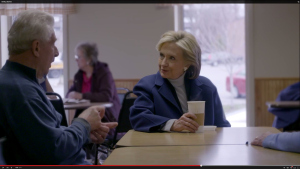 Frankly, I found the Clinton video to be compelling, inclusive, and inspiring. Compare this to Rubio’s words.
Republican Sen. Marco Rubio is running for president in 2016, the Florida senator told ABC News’ Chief Anchor and “This Week” host George Stephanopoulos in an exclusive interview in West Miami on Monday.
“I think this country’s at a generational moment where it needs to decide not what party it wants in charge but what kind of country are we going to want to be moving forward,” Rubio told Stephanopoulos in an interview at the Florida senator’s home. “I think the 21st century can be the American century, and I believe that I can lead this country in that direction. I can help lead it there from the Senate. I can lead it there as president.”
The interview came just a few hours before Rubio will speak to supporters at an evening event at the Freedom Tower, a downtown Miami building with historical significance for thousands of Cuban-Americans.
When asked if Rubio believed he is the most qualified candidate to be president, he said: “I absolutely feel that way.”
“We’ve reached a moment now, not just in my career, but the history of our country, where I believe that it needs a Republican Party that is new and vibrant, that understands the future, has an agenda for that future,” Rubio said, “and I feel uniquely qualified to offer that. And that’s why I’m running for president.”
I wonder if he’ll mind being the second banana to confederate banana republican Rand Paul? Perhaps “Heb” and Rubio can discuss their struggles as Hispanic Americans? Either way, I spot failure in his future. Hasta 2023 amigo!
All I can say is keep reaching for that glass of water Rubs because you’re gonna need a lot of hydrating to try to play in the same ball park as Hillary Clinton.
What’s on you reading and blogging list today?
Thursday Reads: A Historic Agreement Between the U.S. and Cuba
Posted: December 18, 2014 Filed under: Barack Obama, Foreign Affairs, morning reads, Republican politics, U.S. Politics | Tags: cuba, Cuban artists, diplomacy, John Boehner, Marco Rubio 22 Comments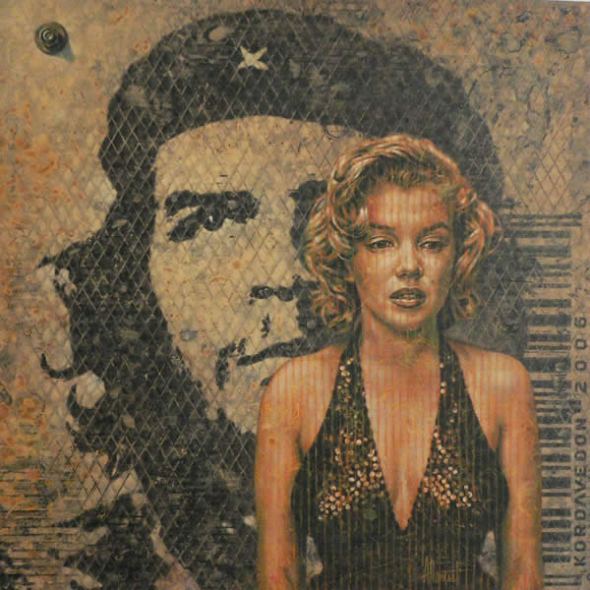
Good Morning!!
Finally we have some good news to discuss, if Republicans can somehow be prevented from ruining it. The U.S. and Cuba have reached an agreement to normalize relations between the two countries after 50 years of hostilities and sanctions. In celebration of this long-overdue step forward, I’m going to illustrate this post with the work of Cuban artists. You can read about the above painting of Marilyn Monroe superimposed on a photo of Che Guevara and the artist Adrian Rumbaut at the Cuban Art blog. Here’s a bit of background:
In the work, Adrian Rumbaut has reproduced Alberto Korda’s famous 1960 photograph of Che Guevara, and he inserts his vision of American Richard Avedon’s iconic photo of Marilyn Monroe as well. In the letters on the side of the painting, Rumbaut gives credit to both Korda and Avedon for their images, and provides the date of his painting.
Interestingly, Korda had worked as a fashion photographer as a young man, and he wanted very much to be the Richard Avedon of Cuba. He photographed the “beautiful people” of the Batista era before the revolution, and models lined up in front of his studio to have their picture taken. Taken by surprise by the “triumph of the revolution” in 1959, he worked subsequently with Raul Corrales, Castro’s official photographer, to capture the excitement of the revolution. In his image of Che, something survives of his earlier experience with beautiful women.
Korda’s image of Che — snapped in 1960 and also known as Guerrillero Heroico — has been repeatedly reproduced worldwide, serving as both a symbol of protest and as a fashion accessory.
The iconic photo has taken on increasingly exotic forms, each created with different intentions and evoking varied responses. Along with Marilyn Monroe, Jesus Christ, Madonna, and Princess Diana have all had their pictures adapted and inserted under Che’s familiar red star beret. It isn’t an exaggeration to note that Che the icon has overtaken Che the revolutionary.
The original “Che” photograph was taken at a dangerous moment, a time when the new revolutionary government was preparing for imminent US invasion. It was at the start of the Cuban Revolution’s second year, and Castro’s government had ordered a boatload of weapons and ammunition — mostly rifles and grenades — from Belgium. The armaments were loaded onto a French ship, La Coubre which, unfortunately, exploded upon arrival in Havana Harbor in March 1960. The crew and 75 Cuban dockers were killed. More than 200 were injured.
Here’s a wonderful example of Cuban street art that I found at a Cuban travel site, Insight Cuba.

See more examples of Cuban “graffiti” at the link.
Some background on what’s happening from CNN yesterday: Cuba releases American Alan Gross, paves way for historic easing of American sanctions.
Washington (CNN) — U.S. contractor Alan Gross, held by the Cuban government since 2009, was freed Wednesday as part of a landmark deal with Cuba that paves the way for a major overhaul in U.S. policy toward the island, senior administration officials tell CNN.
President Barack Obama spoke with Cuban President Raul Castro Tuesday in a phone call that lasted about an hour and reflected the first communication at the presidential level with Cuba since the Cuban revolution, according to White House officials. Obama announced Gross’ release and the new diplomatic stance at noon in Washington. At around the same time, Cuban president Raul Castro was set to speak in Havana.
President Obama announced a major loosening of travel and economic restrictions on the country. And the two nations are set to re-open embassies, with preliminary discussions on that next step in normalizing diplomatic relations beginning in the coming weeks, a senior administration official tells CNN.
Talks between the U.S. and Cuba have been ongoing since June of 2013 and were facilitated by the Canadians and the Vatican in brokering the deal. Pope Francis — the first pope from Latin America — encouraged Obama in a letter and in their meeting this year to renew talks with Cuba on pursuing a closer relationship.
Gross’ “humanitarian” release by Cuba was accompanied by a separate spy swap, the officials said. Cuba also freed a U.S. intelligence source who has been jailed in Cuba for more than 20 years, although authorities did not identify that person for security reasons. The U.S. released three Cuban intelligence agents convicted of espionage in 2001.
The developments constitute what officials called the most sweeping change in U.S. policy toward Cuba since 1961, when the embassy closed and the embargo was imposed.
Read much more at the link. It’s a good article that provides quite a bit of background on the historic agreement.
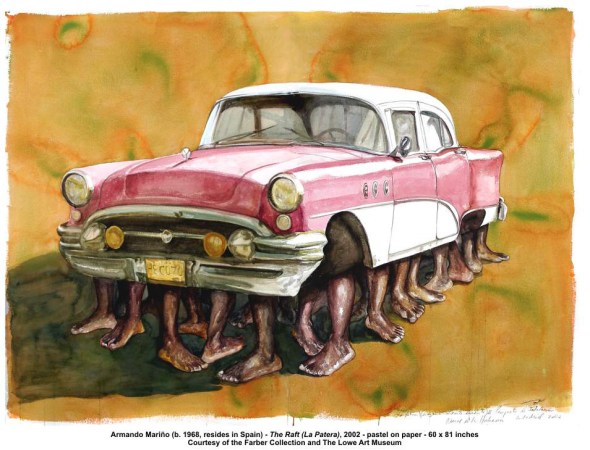
More details on the secret negotiations from William M. LeoGrande and Peter Kornbluh, authors of the book Back Channel to Cuba: The Hidden History of Negotiations between Washington and Havana, published in October of this year.
Secret meetings with Cuba finally pay off.
Presidents frequently conduct sensitive diplomatic dialogues in secret, because the furor of public attention makes it politically impossible to reach the compromises necessary for agreement. These secret talks are often crucial for diplomatic advances — as we learned Wednesday with the stunning revelations about the impending talks between Washington and Havana that have been underway secretly for the past few months. President Barack Obama’s far-reading initiatives are reminiscent of the secret talks Henry Kissinger held with Beijing to lay the groundwork for President Richard M. Nixon’s historic diplomatic opening to China.
When the mere act of talking to an adversary is too politically sensitive, presidents can resort to private emissaries, despite the risks created by relying on amateur diplomats. Obama had help from both Canada and the Vatican in reaching these new agreements.
In our recent book, Back Channel to Cuba: The Hidden History of Negotiations between Washington and Havana, we uncovered literally dozens of secret diplomatic contacts and negotiations. Despite what Kissinger called the “perpetual antagonism” between the United States and Cuba, there is a rich and colorful history of dialogue between these two nations over the last 50 years.
There are lessons to be learned from this half-century of back-channel talks about what works and what doesn’t when conducting secret negotiations.
First, a history of animosity makes adversaries wary. Neither wants to appear weak by making concessions too easily. Goodwill gestures may go unrequited and the apparent obstinacy of one side or the other can doom a diplomatic process before it gets off the ground. When Fidel Castro was in power, for example, he worried constantly that any concession to U.S. demands would be read as weakness and lead to a redoubling of U.S. efforts to overthrow him.
Read all about it at the Reuters link.
From the Masters of Cuban Art Image Gallery, “La Conga” by Evelio Garcia Mata.
“Garcia Mata plays the rhythm of the conga in the body of the mulatto dancer, who lifts her left arm as she does the kick-step. She wears a sensual typical dress and is accompanied by a group of six musicians. The painting beautifully represents when Afro-Cuban music became main-stream, and a representative of Cuban culture at large.”
– Alfredo Triff, Musician and Art Critic
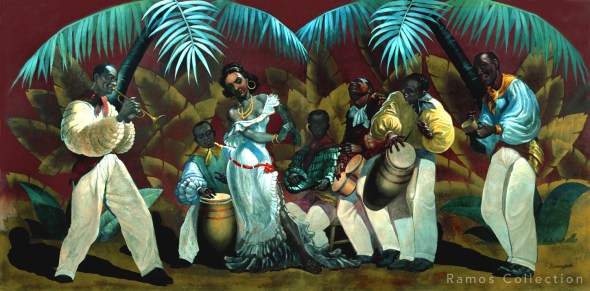
Isn’t it amazing that Pope Francis–the first Latin American to lead the Church–was instrumental in making this happen? As a long-lapsed Catholic, I’m truly surprised and pleased. After years of regressive Popes, this guy seems to be a throwback to the days of Pope John the XXIII when it seemed that the Church might move into the 20th century.
From The Atlantic: How the Pope Helped End the Cuba Embargo.
On Wednesday, a senior Obama administration officials spoke of an “extraordinary letter” written by the pope to President Obama and Cuban President Raúl Castro over the summer in which he urged the two men to mend the relationship between their countries.
As one official noted, the correspondence “gave us greater impetus and momentum for us to move forward.”
In a press conference on Wednesday, which also happens to be the pope’s 78th birthday, President Obama credited Francis for his influential “personal plea” and thanked him for his “moral example.”
In particular, I want to thank his Holiness Pope Francis, whose moral example shows us the importance of pursuing the world as it should be, rather than simply settling for the world as it is.
According to officials, Pope Francis brought up Cuba several times during his meeting with the president in March and, given Francis’ significance as the first pope from Latin America, it’s fair to assume that his clout likely helped bring Castro to the table as well.
Vatican officials were also said to have been present during the negotiations between the United States and Cuba, marking them the only other country to directly participate in the talks. While Canada reportedly hosted the majority of the secret meetings of the two sides, according to a Vatican statement, the pope also hosted Cuban and American representatives together earlier this year during the final deal was struck.
Some reactions to Obama’s great achievement.
From the LA Times, Miami reacts to Obama’s Cuba move: Tears of joy, cries of ‘traitor’.
A tale of two restaurants unfolded in South Florida on Wednesday.
In Miami’s Little Havana, Versailles Restaurant hosted hard-line Cuban exiles railing against President Obama’s decision to establish full diplomatic ties with the Cuban government. They waved placards and hurled insults bilingually, putting on the show they’ve been rehearsing and staging for half a century.
The show at Versailles involved megaphones and pickup trucks, national news outlets parked in front of a spot that serves tasty espresso, and a handful of outspoken Cuban Americans who yell loud enough to scare viewers in Nebraska. Whenever major news breaks about Cuba, the media flocks to Versailles to take the pulse of the Cuban community.
Meanwhile in Hialeah, a city with a far larger number of Cubans and Cuban Americans than Little Havana, Tropical Restaurant served cafeteria-style meals to a quieter, more sanguine crowd. Here, many welcomed Obama’s decision.
“It’s going to be better for the Cuban people. It’s going to be better for the United States,” said ReinierOropeza, 33, an accountant who to came to the U.S. from Cuba in 1998.
Many Cubans here are young, or came to the United States more recently, or have closer ties with their families in Cuba.
Oropeza said many older Cubans are stuck in the past. “They are old and they stand back and blame Castro. They already did what they had to do. So young people have to take over now.”
Once again, read much more at the link.
Read more about this mural by 100 Cuban artists at The New York Times, Feb. 3, 2008: It’s Not Politics. It’s Just Cuba.
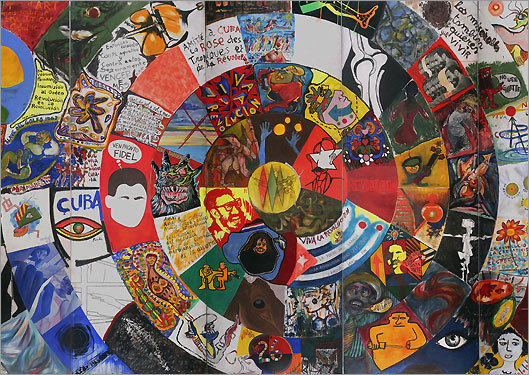
Courtesy of the Montreal Museum of Fine Arts
“Cuba Colectiva,” a 1967 mural by 100 artists for the Salon de Mai exhibition in Havana, on view at the Montreal Museum of Fine Arts.
More reactions from Republican politicians:
Drunken party-pooper John Boehner is not happy.
(Reuters) – U.S. House Speaker John Boehner sharply criticized President Barack Obama’s policy change toward Cuba, calling it “another in a long line of mindless concessions” to a brutal dictatorship.
“Relations with the Castro regime should not be revisited, let alone normalized, until the Cuban people enjoy freedom – and not one second sooner,” Boehner said in a statement.
Cry me a river, a$$hole. At least Cubans have free health care.
Marco Rubio, who is supposedly a Catholic after transitioning through the Mormon and Southern Baptist churches, had the temerity to “call out the Pope on Cuba” according to Politico.
Sen. Marco Rubio, a Catholic, criticized Pope Francis on Wednesday after the pontiff played a key role in helping the United States and Cuba forge an agreement that resulted in the release of American Alan Gross from Cuba.
Rubio said he would “ask His Holiness to take up the cause of freedom and democracy.”
The Florida Republican said he didn’t criticize Francis’ personal appeals to help facilitate Gross’ release, but was speaking in response to the White House’s announcement about talks to normalize relations with Cuba after a nearly 50-year embargo with the country.
Rubio is set to play a major role in Cuba policy as the chairman of the Senate Foreign Relations subcommittee on Western Affairs, and he noted Wednesday some of Congress’ leverage points, such as funding for embassies and nomination of a U.S. ambassador to Cuba.
“I’m committed to doing everything I can to unravel as many of these changes as possible,” Rubio said.
More from Huffington Post: Marco Rubio Fires Back On Cuba: Obama Is The ‘Worst Negotiator’ In My Lifetime.
President Barack Obama will get no money for his Cuba policy, no ambassador will be confirmed and the embargo will never be lifted, Sen. Marco Rubio (R-Fla.) vowed in a blistering press conference on Wednesday.
In a historic move earlier in the day, Obama announced that the United States will begin talks with Cuba to normalize full diplomatic relations, marking the most significant shift in U.S. policy towards Cuba in 50 years. The president’s remarks followed the release on Wednesday morning of American Alan Gross, who had been held in a Cuban prison for five years. Gross’ release was negotiated in exchange for the freeing of three Cubans who had been jailed in the U.S. for spying.
“This entire policy shift announced today is based on an illusion, based on a lie,” Rubio, who is the son of Cuban immigrants, told reporters on Capitol Hill. “The White House has conceded everything and gained little.”
“I’m committed to doing everything I can to unravel as many of these changes as possible,” he added.
Why is this moron in the U.S. Senate? Obama will have more battles ahead with the Republican Congress, but he seems determined to move ahead with the changes he wants to make anyway. I’m rooting for him.
What do you think? What other stories are you following today? Please share your thoughts and links in the comment thread and enjoy your Thursday!
Thursday Reads: Through the Looking Glass?
Posted: July 31, 2014 Filed under: 2014 elections, 2016 elections, Barack Obama, morning reads, Republican politics, Rick Perry, the GOP, The Media SUCKS, U.S. Politics, VAGINA Rick Santorum, Voter Ignorance, We are so F'd | Tags: Bobby Jindal, Ed Kilgore, GOP crazies, impeachment, insanity, IRS, John Boehner, John Dickerson, Lois Lerner, Marco Rubio, Nate Silver, right wing talk show hosts 36 Comments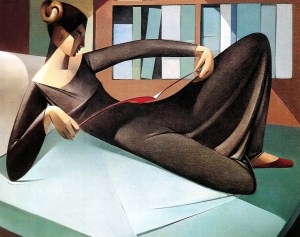
Reading Woman, Armando Barrios
Good Morning!!
I’ve spent the past week or so reading escapist literature and watching old TV shows in an effort to anesthetize myself against the overload of bad news we’ve been hit with lately. Yesterday I was feeling a lot better–my escapism seemed to be working to improve my overall mood.
Then last night as I was surfing around in search of interesting reads for this morning’s post, I came across something that jumpstarted me right through Alice’s looking glass.
You’ve probably heard about it too. Lois Lerner, who used to work for the IRS and who is at the center of one of the GOP’s crazy efforts to create a scandal that will bring down President Obama used the word “crazies” in a private e-mail to a colleague who was complaining about right wing radio hosts. Here’s the text of e-mail as quoted in The Washington Post yesterday.
During the exchange, Lerner says she is traveling in Great Britain. The name of the person she is emailing with was blacked out.
Lerner: “I’m ready. Overheard some ladies talking about American today. According to them we’ve bankrupted ourselves and at through. We’ll never be able to pay off our debt and are going down the tubes. They don’t seem to see that they can’t afford to keep up their welfare state either. Strange.”
Other person: “Well, you should hear the whacko wing of the GOP. The US is through; too many foreigners sucking the teat; time to hunker down, buy ammo and food, and prepare for the end. The right wing radio shows are scary to listen to.”
Lerner: “Great. Maybe we are through if there are that many assholes.”Other person: “And I’m talking about the hosts of the shows. The callers are rabid.”
Lerner: “So we don’t need to worry about alien teRrorists. It’s our own crazies that will take us down.”

My initial response was the same as that of Mark NC at News Corpse (a site that makes fun of Fox News), So F**king What? Former IRS Official Says That GOP Crazies Are…CRAZY!
Republicans and their friends at Fox News have mastered the art of building mountains of bullshit from the lowliest troll-hills. It’s one of their favorite tactics to malign Democrats. Just grab a sentence fragment from a long speech and pretend that it is the whole of the comment from which it was extracted. Then feign outrage that such an awful remark could have been uttered.
The latest example of this rhetorical deceit was demonstrated when the GOP chair of the House Ways and Means Committee, Dave Camp, unscrupulously and selectively released some emails purported to be from Lois Lerner, the former IRS official who has been hounded by malevolent cretins like Rep. Darrell Issa in an attempt to fabricate ammunition to use against President Obama. Despite hundreds of wasted hours (costing millions of taxpayer dollars) engaged in hyper-partisan investigations, the Republican Inquisition has produced nothing implicating the President in any untoward activity.
The emails that Camp is now crowing about are just as meaningless as all of the other bogus “smoking guns” that these wingnuts have claimed would topple the administration. The headline that Camp has wrenched from the documents is that Lerner may have referred to certain individuals as “crazies” or “a-holes.” And, of course, this would only be an atrocity if those individuals were Republicans. Suffice to say that Camp wouldn’t give a Fig Newton if they were Democrats.
As Camp characterized this affair, Lerner was allegedly caught red-handed expressing her disgust for Republicans. And as the person at the center of the controversy over whether the IRS improperly subjected Tea Party groups to extra scrutiny when they applied for tax-exempt status, Camp believes that these emails prove that she was biased. Consequently, Camp regards the emails as justification for appointing a special prosecutor and escalating the legal assault on Lerner and, ultimately, the White House.
There’s just one problem. The emails don’t don’t say what Camp alleges they say. And even if they did it wouldn’t mean anything. Most people in government have personal opinions and allegiances. There isn’t anything wrong with that, so long as it doesn’t interfere with the fair execution of their duties. And the evidence shows that Lerner’s department scrutinized applications of all political persuasions. The only organization that was denied tax-exempt status during the time in question was a liberal group.
House Ways and Means Committee Chairman Rep. Dave Camp, R-Mich. (center), flanked by the committee’s ranking member, Sander Levin, D-Mich. (right), and Sam Johnson, R-Texas.
Please read the rest at the link.
So this humorous site agrees with me, but more mainstream sites are seemingly going along with the Camp’s notion that this e-mail is evidence of a major scandal. For example, Dave Wiegel characterized it as a “bombshell,” although he does point out that Lerner’s anonymous “e-mail partner” was talking about talk radio hosts, not Republicans in general. Huffington Post reported that Lerner had made “two disparaging remarks about members of the GOP.” Both HuffPo and Politico write that in one e-mail Lerner referred to Republicans as “a–holes,” but they sidestep the fact the context was a discussion of right wing talk show hosts.
As we approach the midterm elections, I can’t help but feel that most of the mainstream media is cheering for a Republican takeover. Am I the crazy one?
Here’s another example from self-described libertarian Nate Silver, Democrats Are Way More Obsessed With Impeachment Than Republicans.
House Speaker John Boehner said Tuesday that Republicans have no plans to impeach President Obama, and that all the impeachment talk was driven by Democrats hoping to stir up their base.
Boehner’s statement isn’t literally true: There have been mentions of impeachment around the edges of the GOP and by some Republican members of Congress. But on the whole, Democrats are spending a lot more time talking about impeachment than Republicans.
Consider, for example, the Sunlight Foundation’s Capitol Words database, which tracks words spoken in the House and Senate. So far in July, there have been 10 mentions of the term “impeachment” in Congress and four others of the term “impeach.” Eleven of the 14 mentions have been made by Democratic rather than Republican members of Congress, however.
Impeachment chatter has also become common on cable news. On Fox News this month, Sarah Palin, the former Alaska governor, called for Obama’s impeachment, for instance. But for every mention of impeachment on Fox News in July, there have been five on liberal-leaning MSNBC.
OK, so that’s this month. And this proves what? Democrats are throwing around the word “impeachment” in hopes of calling attention to what Republicans have been saying for years! So f$%king what?!
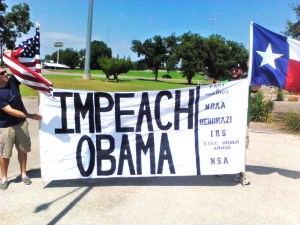
Again, I must resort to News Corpse for a sensible interpretation of the impeachment talk, CONSPIRACY: President Obama Is Trying To Impeach Himself.
Ever since the first inauguration of President Obama, right-wingers have been trying to undo the people’s decision to make him America’s chief executive. They declared that their top legislative objective was to make Obama a one-term president. In pursuit of that goal they have blocked most of his policy initiatives, judges, and government reforms. At the same time they have been hyper investigatory on everything from Fast and Furious, to the IRS, to ObamaCare, to his birthplace. All of this was squarely aimed at crippling or revoking his presidency.
This year Obama’s critics came out of the impeachment closet and began openly advocating for that legal nuclear option despite not having any legal basis for it. While many Tea-Publican whack jobs were earlier to the gate, Sarah Palin burst onto the scene a couple weeks ago with her own demand that Congress do their duty and trump up some phony articles of impeachment. It got so absurdly intense that Obama addressed it himself with fitting mockery.
So of course the next shoe to drop in this melodrama is that, along with everything else in the world, Obama is to blame for this too. In fact, according to some in the rightist crackpot community, it was all part of his nefarious plot to embarrass the GOP. Here is what Texas Republican Steve Stockman had to say about it when interviewed by the ultra-fringe rightists at WorldNetDaily:
“President Obama is begging to be impeached. […] He wants us to impeach him now, before the midterm election because his senior advisers believe that is the only chance the Democratic Party has to avoid a major electoral defeat. Evidently Obama believes impeachment could motivate the Democratic Party base to come out and vote.”
There you have it. The evil genius in the White House orchestrated the whole Obama-hate campaign from its earliest days in 2008 just so that he would be able to use impeachment, which is every president’s dream, as an election strategy six years into his presidency.
Earth to Nate Silver and the rest of the mainstream media: Steve Stockman, although insane, is an actual member of the House of Representatives, not some fringe character with no influence. And he has plenty of company in the House and even in the Senate (Ted Cruz anyone?). These people are crazy and they are in positions of awesome power.
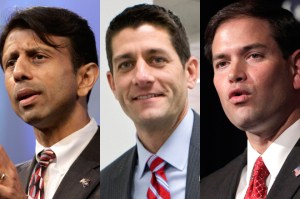
GOP idea men?
Here’s one more example of mainstream acceptance of GOP insanity before I end this post and run screaming into the street while pulling my hair out in handfuls. From John Dickerson of Slate (via CBS News), Why the GOP’s class of 2016 hopefuls may be the best in generations.
What if they held a presidential campaign and a think tank broke out? House Budget Committee Chairman Paul Ryan, who is considering running for president, offered his thoughts on poverty last week. Sen. Marco Rubio has been giving regular policy speeches on poverty, college loans, and helping the middle class. Former senator and GOP presidential candidate Rick Santorum is promoting a book of policy proposals on education, family, and revitalizing American manufacturing. Sen. Rand Paul is offering ideas on criminal justice and will give a big foreign policy speech in the fall. Louisiana Gov. Bobby Jindal has given speeches on health care and education aimed at a national audience. His staff recently sent an email titled “policy leader” that linked to a Time piece about how he is preparing to be the candidate of ideas in 2016.
What the f&cking f&ck? Rich Santorum? Bobby Jindal? Marco Rubio? Paul motherf&&cking Ryan?! These are “candidates of ideas?” Dickerson continues,
Who isn’t trying to be the ideas candidate in the 2016 campaign? Texas Gov. Rick Perry is working to overcome his 2012 debate aphasia, so he’s trying to show some policy chops. Though former Florida Gov. Jeb Bush holds controversial ideas on Common Core education standards and immigration, those close to him say he won’t run unless he can promote those ideas with gusto.
It isn’t usually this policy-thick in the GOP presidential field. In primaries, there is sometimes one conservative candidate who tries to position himself through the creativity of his proposals, but mostly candidates engage in displays of strength on questions of orthodoxy–how much they want to cut taxes, shrink regulation, and lock up the borders. Now the Republican candidates are not only seeking to distinguish themselves from each other with the quality and originality of their ideas, but they are making the case that unless the party promotes new ideas, it will not prevail.
The class of candidates for 2016 has the potential to be the most robust in almost 40 years–perhaps in modern Republican history. It depends on who finally decides to run, of course, but six governors and four senators are thinking seriously about it.
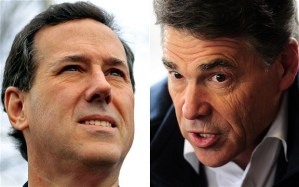
GOP idea men?
I’m sorry. Dickerson thinks these morons are competing with each other on “quality and originality of…ideas?” Am I nuts? Am I hallucinating this crap? Surely Dickerson can’t really believe this sh#t.
Here’s a little sanity from Ed Kilgore of Washington Monthly, Can the Big Brains of the GOP Survive the Primaries? and Damon Linker of The Week, Why GOP reformers are bound to fail. But even Kilgore seems to believe that Republicans will take over the Senate. From Talking Points Memo:
At least Kilgore thinks that catering to the base could hurt Republicans in the 2016 presidential election.
Why? Why would anyone vote for these insane right-wingers? And why is the media rooting for them? I just don’t get it. Am I crazy or what?
Now it’s your turn. What stories are you following today? Share your thoughts and links in the comment thread.
Monday Reads: A World of their Own
Posted: May 12, 2014 Filed under: 2014 elections, 2016 elections, Climate Change, morning reads | Tags: Aqua Buddha, climate change denial, Democrats retain senate, Marco Rubio, Rand Paul, Reality Denial 57 Comments Good Day! I’m way late with this because I simply cannot find much that isn’t just a depressing continuation of the same old same old. The Republican 2016 Clown Car looks to be filled with the same old nonsense. So, I just decided to make you all aware that they are still as crazy as ever. Can some one as stupid as Rand Paul and clearly out of the mainstrain of what generally passes as republican politics win the nomination? Not a day goes buy that Paul hasn’t cooked up some story with no basis in fact, but can the party take that and push it onto the national stage?
Not that long ago, most Republican leaders saw Rand Paul as the head of an important faction who, like his father, ultimately had no shot at becoming the party’s presidential nominee.
Now the question is no longer whether Paul can win the nomination, but whether he can win a general election.
The shift follows a year in which the Kentucky senator has barnstormed the country, trying to expand the party’s base beyond older, white voters and attract a following beyond than the libertarian devotees of his father, Ron Paul. Although the job is far from complete, Paul has made undeniable progress, judging from interviews with more than 30 Republican National Committee members meeting here this week.
That he has struck a chord with this crowd is all the more telling because it is heavy with GOP establishment-types who tend to prefer mainstream candidates.
“I don’t see how anyone could say it’s not possible he’d win the nomination,” Texas GOP chairman Steve Munisteri said. “His mission is to convince people of what his coalition would be in November” 2016.
During a speech Friday to the RNC gathering, Paul received a standing ovation after saying that the GOP didn’t need to dilute its message
but that it had to communicate it better to non-traditional audiences — and suggesting implicitly that he’s the guy to do it.
I’m really confused by their continual obsession with trying to communicate their messages better. I’d say most of us hear it loud and clear and we completely reject it along with people that know what they’re doing. Economists, data and studies reject their economics message. Science rejects their messages about women’s anatomy, climate change, and the use of fracking. Humanity rejects the notion that the poor, elderly, and downtrodden should be further ground under the heals of the privileged.
Marco Rubio inkled his interest in the Presidency on the Sunday Talk Show Circuit and showed that his strong point wasn’t science at the same time. He doesn’t believe that humans are contributing to climate change. At least, he didn’t completely deny its existence. This is another one clearly caught in the Koch money trap.
Sen. Marco Rubio of Florida, a GOP star and possible 2016 presidential contender, does not believe human activity is causing climate change, he said Sunday.
“I do not believe that human activity is causing these dramatic changes to our climate the way these scientists are portraying it,” Rubio said on ABC’s “This Week.”
“I do not believe that the laws that they propose we pass will do anything about it, except it will destroy our economy,” he added.
A National Climate Assessment released by the White House last week found that Rubio’s home state of Florida is one of the most vulnerable to rising sea levels and changes in temperatures and storm patterns. President Obama has proposed several new regulatory programs to reduce emissions of carbon dioxide, which most scientists say are the chief cause of a warming global climate.
Rubio said he doesn’t agree that actions humans take today could affect how the climate is changing.
“Our climate is always changing,” Rubio said. “And what they have chosen to do is take a handful of decades of research and say that this is now evidence of a longer-term trend that’s directly and almost solely attributable to manmade activities.”
 My governor continues to deliberately confuse bigotry with ‘religious liberty’. Jindal doesn’t ever register on any of the polls of Republican preferences for 2016, but he’s never ending quest for relevancy and the presidency continues.
Speaking at Liberty University’s 2014 Commencement yesterday, Louisiana Governor Bobby Jindal (R) attacked “elite” liberals who, he claimed, have launched “an assault on the freedom of expression in all areas of life.”
“Today the American people, whether they know it or not, are mired in a silent war,” Jindal began. “It is a war — a silent war — against religious liberty.” He claimed that Obama Administration’sargument against Hobby Lobby “strikes at the core of our understanding of the free exercise of religion.”
“Under the Obama regime,” he continued, “you have protection under the First Amendment as an individual, but the instant you start a business, you lose those protections. And that brings us to the second front in this silent war: the attack on our freedom of association as people of faith.”
Jindal claimed that the Obama Administration would prevent religious groups from selecting “their own ministers or rabbis.” “Thankfully,” he said, the Supreme Court decided to shoot down the administration, “so for the time being, at least, the federal government doesn’t get to decide who can preach the Gospel.”
“Make no mistake — the war over religious liberty is a war over free speech. Without the first, there is no such thing as the second.”
Deliberate misinterpretation of the first amendment seems to be en vogue these days. Just ask the Supremes. The chattering class has been pretty  insistent that the Democrats will lose the Senate come elections this fall. Yet, many of the most vulnerable democratic candidates continue to hold their ground.
Democratic candidates are holding their own in three key Senate races despite a daunting political environment for their party in the upcoming midterm elections, according to new NBC News-Marist polls of Arkansas, Georgia and Kentucky.
And in one race in particular, Democrats are more than just competitive.
In Arkansas, with less than six months until Election Day 2014, incumbent Sen. Mark Pryor, D-Ark., leads Republican challenger Tom Cotton by 11 points among registered voters, 51 percent to 40 percent. (That finding is largely in line with other polling from that race since April showing Pryor either leading or tied.)
In Georgia, Democratic Senate candidate Michelle Nunn is running neck and neck against all of her potential GOP opponents in November.
And in Kentucky, Democrat Alison Lundergan Grimes is within one point of Senate Minority Leader Mitch McConnell among registered voters, 46 percent to 45 percent.
 I personally don’t see any groundswell against Mary Landrieu here in Louisiana. Most of the local papers seem to show that no one knows her potential challenger. Additionally, the Koch ads aren’t having much impact because she’s a strong supporter of the Keystone Oil Pipeline and has been running ads calling for changes in the Affordable Health Care Act. I guess we’ll see how many times these groups can change their ad messages.
One message shift is apparent from la la land. The GOP has gone mostly quiet on ObamaCare with the exception of candidate Scott Brown who wants to repeal its implementation in New Hampshire.
Republicans virtually ignored the final release of ObamaCare’s enrollment numbers and a report that healthcare spending jumped in the first quarter of 2014. Mentions of the law have dwindled in press conferences by Speaker John Boehner (R-Ohio), where they were a mainstay earlier this year.And on the Senate side, the usual partisan rancor was almost completely absent during last week’s confirmation hearing for the next Health and Human Services secretary. Only a few GOP senators mentioned ObamaCare in their questions, and three Republicans failed to attend the event at all.
The House has no plans to vote on ObamaCare legislation in May, according to a memo from Majority Leader Eric Cantor (R-Va.) released late last month.
It is also unclear when the party’s replacement proposal for the law will come to a vote.
Despite pressure from conservatives, Cantor has not committed to put a bill on the House floor by August recess.
Democratic leaders have long insisted the law would boost their electoral hopes in the fall, and the Democratic Senatorial Campaign Committee (DSCC) predicted this week that GOP opposition would haunt Republicans.
“The Republican position of repeal has become increasingly problematic for GOP Senate candidates, so it’s no surprise that they’re beginning to abandon their failed strategy of wasting millions attacking Democrats on ObamaCare,” said DSCC spokesman Justin Barasky.
On the campaign trail, it is clear that some candidates and groups are starting to pivot.
The U.S. Chamber of Commerce recently launched its first major ad campaign looking toward the general election.
While all the ads touted GOP lawmakers’ and candidates’ work to boost the economy and create jobs, only a handful made mention of ObamaCare.
Looking toward his general election fight, Senate Minority Leader Mitch McConnell (R-Ky.) released an ad last week that also focused on job creation.
The problem is that the Republicans have done absolutely nothing in terms of job creation legislation and their records stand for themselves.
The founders of our nation had long bitter experience with the state, as both the agent and the adversary of particular religious views. In colonial Maryland, Catholics paid a double land tax, and in Pennsylvania they had to list their names on a public roll — an ominous precursor of the first Nazi laws against the Jews. And Jews in turn faced discrimination in all of the thirteen original Colonies. Massachusetts exiled Roger Williams and his congregation for contending that civil government had no right to enforce the Ten Commandments. Virginia harassed Baptist teachers, and also established a religious test for public service, writing into the law that no “popish followers” could hold any office.
But during the Revolution, Catholics, Jews, and Non-Conformists all rallied to the cause and fought valiantly for the American commonwealth — for John Winthrop’s “city upon a hill.” Afterwards, when the Constitution was ratified and then amended, the framers gave freedom for all religion, and from any established religion, the very first place in the Bill of Rights.
Indeed the framers themselves professed very different faiths: Washington was an Episcopalian, Jefferson a deist, and Adams a Calvinist. And although he had earlier opposed toleration, John Adams later contributed to the building of Catholic churches, and so did George Washington. Thomas Jefferson said his proudest achievement was not the presidency, or the writing the Declaration of Independence, but drafting the Virginia Statute of Religious Freedom. He stated the vision of the first Americans and the First Amendment very clearly: “The God who gave us life gave us liberty at the same time.”
The separation of church and state can sometimes be frustrating for women and men of religious faith. They may be tempted to misuse government in order to impose a value which they cannot persuade others to accept. But once we succumb to that temptation, we step onto a slippery slope where everyone’s freedom is at risk. Those who favor censorship should recall that one of the first books ever burned was the first English translation of the Bible. As President Eisenhower warned in 1953, “Don’t join the book burners…the right to say ideas, the right to record them, and the right to have them accessible to others is unquestioned — or this isn’t America.” And if that right is denied, at some future day the torch can be turned against any other book or any other belief. Let us never forget: Today’s Moral Majority could become tomorrow’s persecuted minority.
The danger is as great now as when the founders of the nation first saw it. In 1789, their fear was of factional strife among dozens of denominations. Today there are hundreds — and perhaps even thousands of faiths — and millions of Americans who are outside any fold. Pluralism obviously does not and cannot mean that all of them are right; but it does mean that there are areas where government cannot and should not decide what it is wrong to believe, to think, to read, and to do. As Professor Larry Tribe, one of the nation’s leading constitutional scholars has written, “Law in a non-theocratic state cannot measure religious truth, nor can the state impose it.”
The real transgression occurs when religion wants government to tell citizens how to live uniquely personal parts of their lives. The failure of Prohibition proves the futility of such an attempt when a majority or even a substantial minority happens to disagree. Some questions may be inherently individual ones, or people may be sharply divided about whether they are. In such cases, like Prohibition and abortion, the proper role of religion is to appeal to the conscience of the individual, not the coercive power of the state.
So, what’s on your reading and blogging list today?
Friday Reads
Posted: June 14, 2013 Filed under: morning reads | Tags: free speech, homophobia, immigration, Marco Rubio, SCOTUS 32 Comments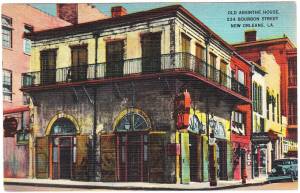
Good Morning!
So, I am trying to get with it again. Seems like it’s always something. Grades to get in. Issues with my elderly father. Daughters so busy that I seemed to have slipped their minds. Doctor’s appointments. I am going to try to take this weekend to catch up with reality. I should also make a point of going out and enjoying my home city which is one of the great places of this country.
Speaking of reality, there is so much weirdness around the issue of immigration these days that I thought I’d post on it. I live in what can only be described as the melting pot of all the melting pots in the country. It is what makes us unique in the world. We’ve got a unique cuisine, culture, and music because we just soaked it all in from every one else and put it out there to grow. But, there’s a lot of people that are scared of that kind of thing. Just smell that Gumbo! Listen to that Jazz! Embrace the dancers of a second line! None of that would exist without the blending of Africans, Caribbeans, Americans, and all kinds of Europeans!
In the land of tabloid terrors, immigrants loom large. Flick through the pages or online comments of some of the racier newspapers, and you’ll see immigrants being accused of stealing jobs or, if not that, of being workshy and “scrounging benefits”.
Such views may be at the extreme end of the spectrum, but they do seem to reflect a degree of public ambivalence, and even hostility, towards immigrants in a number of OECD countries. Anecdotal evidence is not hard to find. A columnist from The Economist reported this encounter between a British legislator and one of his constituents, Phil: “‘I’m not a racist,’ says Phil, an unemployed resident of the tough Greenwich estate in Ipswich. ‘But we’ve got to do something about them.’”
Surveys offer further evidence: For example, a 2011 study in five European countries and the United States found that at least 40% of respondents in each country regarded immigration as “more of a problem than an opportunity”. More than half the respondents in each country also agreed with the proposition that immigrants were a burden on social services. This sense that immigrants are living off the state appears to be widespread. But is it true?
New research from the OECD indicates that it’s not. In general across OECD countries, the amount that immigrants pay to the state in the form of taxes is more or less balanced by what they get back in benefits. Even where immigrants do have an impact on the public purse – a “fiscal impact” – it amounts to more than 0.5% of GDP in only ten OECD countries, and in those it’s more likely to be positive than negative. In sum, says the report, when it comes to their fiscal impact, “immigrants are pretty much like the rest of the population”.
The extent to which this finding holds true across OECD countries is striking, although there are naturally some variations. Where these exist, they largely reflect the nature of the immigrants who arrive in each country. For example, countries like Australia and New Zealand rely heavily on selective entry, and so attract a lot of relatively young and well-educated immigrants. Other countries, such as in northern Europe, have higher levels of humanitarian immigration, such as refugees and asylum-seekers.
That said, there’s been a general push in many countries in recent years to attract better educated immigrants, in part because of the economic value of their skills but also because such policies attract less public resistance. For example, a survey in the United Kingdom, where resistance to immigration is relatively high, reported that 64% of respondents wanted to reduce immigration of low-skilled workers but only 32% wanted fewer high-skilled immigrants. Indeed, one objection that’s regularly raised to lower-skilled immigrants is the fear that they will live off state benefits.
But, here again, the OECD report offers some perhaps surprising insights. It indicates that low-skilled migrants – like migrants in general – are neither a major drain nor gain on the public purse. Indeed, low-skilled immigrants are less likely to have a negative impact than equivalent locals.
So what connects homophobia, Marco Rubio and US immigration Policy? Basically, the connection is outright discrimination for any GLBT who wants to be an American. Rubio has threatened to leave negotiations on immigration if any GBLT rights are included. He also says it should be legal to fire any one for their sexual orientation.
Florida Republican Sen. Marco Rubio, a co-author and key proponent of the Senate immigration bill, said he will revoke his support if an amendment is added that allows gay Americans to petition for same-sex spouses living abroad to secure a green card.
“If this bill has in it something that gives gay couples immigration rights and so forth, it kills the bill. I’m done,” Rubio said Thursday during an interview on the Andrea Tantaros Show. “I’m off it, and I’ve said that repeatedly. I don’t think that’s going to happen and it shouldn’t happen. This is already a difficult enough issue as it is.”
The amendment, introduced by Vermont Democratic Sen. Patrick Leahy, would grant green cards to foreign partners of gay Americans. Leahy originally introduced the measure during the Senate Judiciary Committee markup of the bill, but he withdrew it under pressure from Republican lawmakers who said it would reduce the chance of the bill passing.
Why does he think that firing any one for sexual orientation is also on target?
Sen. Marco Rubio (R-FL), who is touted as a top GOP presidential prospect in 2016, thinks it should be legal to fire someone for their sexual orientation.
ThinkProgress spoke with the Florida Senator at the opening luncheon of the annual Faith and Freedom Forum on Thursday and asked him about the Employment Non-Discrimination Act (ENDA), a bill to make discrimination against LGBT individuals illegal across the country.
Though Rubio bristles at the notion of being called a “bigot,” he showed no willingness to help protect LGBT workers from discrimination. “I’m not for any special protections based on orientation,” Rubio told ThinkProgress.
KEYES: The Senate this summer is going to be taking up the Employment Non-Discrimination Act which makes it illegal to fire someone for being gay. Do you know if you’ll be supporting that?
RUBIO: I haven’t read the legislation. By and large I think all Americans should be protected but I’m not for any special protections based on orientation.
KEYES: What about on race or gender?
RUBIO: Well that’s established law.
KEYES: But not for sexual orientation?
Watch the video at the link for his astoundingly bigoted answer.
The US Congress has just been told that Syria has used chemical weapons on its rebels. What does this mean for the US and for our allies?
The Obama administration, concluding that the troops of President Bashar al-Assad of Syria have used chemical weapons against rebel forces in his country’s civil war, has decided to begin supplying the rebels for the first time with small arms and ammunition, according to American officials.
The officials held out the possibility that the assistance, coordinated by the Central Intelligence Agency, could include antitank weapons, but they said that for now supplying the antiaircraft weapons that rebel commanders have said they sorely need is not under consideration.
Supplying weapons to the rebels has been a long-sought goal of advocates of a more aggressive American response to the Syrian civil war. A proposal made last year by David H. Petraeus, then the director of the C.I.A., and backed by the State Department and the Pentagon to supply weapons was rejected by the White House because of President Obama’s deep reluctance to be drawn into another war in the Middle East.
But even with the decision to supply lethal aid, the Obama administration remains deeply divided about whether to take more forceful action to try to quell the fighting, which has killed more than 90,000 people over more than two years. Many in the American government believe that the military balance has tilted so far against the rebels in recent months that American shipments of arms to select groups may be too little, too late.
Some senior State Department officials have been pushing for a more aggressive military response, including airstrikes to hit the primary landing strips that they said the Assad government uses to launch the chemical weapons attacks, ferry troops around the country and receive shipments of arms from Iran.
But White House officials remain wary, and on Thursday Benjamin J. Rhodes, one of Mr. Obama’s top foreign policy advisers, all but ruled out the imposition of a no-fly zone and indicated that no decision had been made on other military actions.
Mr. Obama declared last August that the use of chemical weapons by the Syrian government would cross a “red line” that would prompt a more resolute American response.
 So what does the latest Supreme Court Decision on free speech mean? Oddly enough, it means no protests in their front yard!
The Supreme Court has come up with a new regulation banning demonstrations on its grounds.
The rule approved Thursday comes two days after a broader anti-demonstration law was declared unconstitutional.
The new rule bans activities such as picketing, speech-making, marching or vigils. It says “casual use” by visitors or tourists is not banned.
That may be a way of addressing the concern posed by a federal judge who threw out the law barring processions and expressive banners on the Supreme Court grounds.
The judge said the law was so broad that it could criminalize preschool students parading on their first field trip to the high court.
The president of the Rutherford Institute, which challenged the law on a protester’s behalf, calls the new rule “repugnant” to the Constitution.
The Supreme Court on Thursday issued a new regulation barring most demonstrations on the plaza in front of the courthouse.
The regulation did not significantly alter the court’s longstanding restrictions on protests on its plaza. It appeared, rather, to be a reaction to a decision issued Tuesday by a federal judge, which narrowed the applicability of a 1949 federal law barring “processions or assemblages” or the display of “a flag, banner or device designed or adapted to bring into public notice a party, organization or movement” in the Supreme Court building or on its grounds.
The law was challenged by Harold Hodge Jr., a student from Maryland who was arrested in 2011 on the Supreme Court plaza for wearing a large sign protesting police mistreatment of blacks and Hispanics.
Lawyers representing the Supreme Court’s marshal told the judge hearing Mr. Hodge’s case that the law was needed to allow “unimpeded ingress and egress of visitors to the court” and to preserve “the appearance of the court as a body not swayed by external influence.”
But Judge Beryl A. Howell of Federal District Court in Washington ruled for Mr. Hodge. “The absolute prohibition on expressive activity in the statute is unreasonable, substantially overbroad and irreconcilable with the First Amendment,” she wrote, adding that the law was “unconstitutional and void as applied to the Supreme Court plaza.”
The Supreme Court addressed the constitutionality of the law in 1983, in United States v. Grace, saying it could not be applied to demonstrations on the public sidewalks around the court.
On the grand plaza in front of the courthouse, however, Supreme Court police have been known to order visitors to remove buttons making political statements.
The regulation issued Thursday, which the court said was “approved by the chief justice of the United States,” requires visitors to “maintain suitable order and decorum within the Supreme Court building and grounds.” It bars demonstrations, which it defines as “picketing, speech making, marching, holding vigils or religious services and all other like forms of conduct that involve the communication or expression of views or grievances, engaged in by one or more persons, the conduct of which is reasonably likely to draw a crowd or onlookers.”
So, that is my offering this morning. I’m headed to the doctor but will be around later! What’s on your reading and blogging list today?

 peej
peej Carissa
 bostonboomer
 dakinikat
 ecocatwoman
 mablue2
 Mama Lopez
 peggysue22
 quixote
 skydancingguestblogger
 Mona (aka Wonk the Vote)



 Sky Dancing
Recent Comments