
Can’t Take Any More Tuesday Reads
Posted: May 19, 2020 Filed under: morning reads, U.S. Politics | Tags: Ahmaud Arbery, coronavirus, Covid-19, Covid-19 antibodies, Donald Trump, hydroxychloroquine, immunity, lynching, nurses in art, U.S. global reputation 25 Comments
Richard Prince, Nurse of Greenmeadow (2002)
Good Morning!!
I’m going through one of my “I can’t take it anymore” phases. Yesterday I almost succeeded in shutting out the news entirely until last night when I accidentally learned that Trump claims to be taking hydroxycholoquine. He has to be lying, right? But the White House doctor sorta kinda confirmed it.
CNN: Trump says he is taking hydroxychloroquine though health experts question its effectiveness.
President Donald Trump claimed Monday he is taking daily doses of hydroxychloroquine, a drug he’s long touted as a potential coronavirus cure even as medical experts and the US Food and Drug Administration question its efficacy and warn of potentially harmful side effects.
Speaking at a meeting of restaurant executives, Trump said he began taking the antimalarial drug after consulting the White House doctor, though stopped short of saying his physician had actually recommended the drug.
“A couple of weeks ago, I started taking it,” Trump said. He later said he’d been taking it every day for a week and a half.
The admission was a dramatic development in Trump’s attempts to promote hydroxychloroquine as a treatment for coronavirus, which began earlier in the outbreak and has been met with resistance from medical professionals.Because the drug is prescribed to treat malaria and other conditions, Trump has cast it as safe and suggested coronavirus patients have little to lose by trying it.

The infirmary at Helgelandsmoen, Edvard Munch
But there are concerns about using the drug for coronavirus, which Trump claimed he doesn’t have:
…at least one study has shown the drug does not work against Covid-19 and could cause heart problems.
The study was published in the Journal of the American Medical Association. It follows a study published in the New England Journal of Medicine that also showed the drug doesn’t fight the virus.
Even before these reports were published, the FDA and the National Institutes of Health issued warnings about using the drug for coronavirus patients.
Trump said he hadn’t been exposed, and that he started taking the drug because he had heard from frontline responders who sent him letters saying they were taking it preventatively.
There’s no evidence for using it as a preventative, but Trump claims it works because “I get a lot of positive calls about it.” Shouldn’t this be the last straw for the V.P. and the Trump Cabinet? Shouldn’t they be invoking the 25th Amendment today? But of course it won’t happen, and the media will try to normalize his latest insanity.
At The Los Angeles Times, Chris Megerian, Noah Bierman, and Eli Stokols remind us that the hyroxychloroquine controversy is just part of Trump’s attempts to distract us from all the deaths he’s responsible for: Trump lashes out with distractions and disinformation.
President Trump has accelerated his attacks on government watchdogs, judges, reporters and other independent voices as he runs for reelection, escalating his spread of disinformation about perceived enemies and his administration’s record during the COVID-19 crisis.
Trump fired yet another inspector general, raged against a government whistleblower and repeatedly retweeted video of a local TV reporter being harassed in New York — all since Friday. He also amplified a sinister conspiracy theory he dubbed “Obamagate” in which he alleges, but never specifies, crimes by his predecessor.
Angry Nurse, Astrid Haereid
On Monday, Trump abruptly said he has been taking hydroxychloroquine pills daily for “about a week and a half” as a preventative against the novel coronavirus, dramatically intensifying his efforts to promote an unproved anti-malaria drug that he has touted as a potential “game changer” for dealing with the pandemic.
His comments caused alarm because the Food and Drug Administration warned last month that the prescription drug has “not been shown to be safe and effective” at treating or preventing COVID-19, saying it could cause “serious heart rhythm problems.”
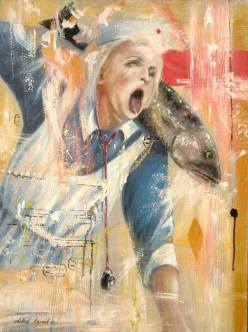
It’s crazy making.
Experts struggled to think of a historical parallel where the president has turned the world’s most powerful and influential office into a megaphone for wholesale fabrications and bizarre claims in an effort to confuse voters and salvage his own political future.
“Trump is certainly not the first politician to lie or invent stories,” said Eileen Culloty, who researches disinformation at Dublin City University in Ireland. “But his history of making baseless, conspiratorial claims — whether it’s Obama’s birth certificate, linking Ted Cruz’s family to the Kennedy assassination or now Obamagate — is striking for its scale and frequency.”
Critics said Trump’s messaging was particularly destructive as Americans struggle with the pandemic, which has crippled the economy and killed more than 90,000 in the U.S. as of Monday.
“A pandemic is the perfect laboratory for disinformation because people are scared, they’re anxious — and all of the social science around conspiracy theories shows when people feel anxious and scared, they’re more likely to believe conspiracy theories,” said Richard Stengel, a former editor of Time magazine and former senior State Department official.
“Trump has figured that out. This campaign is headed to a low point that we’ve never experienced before in American history, because he is not at all compelled to align his message with reality,” he added.
Read more at the LA Times.
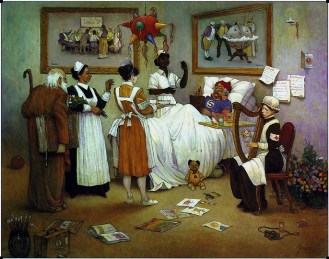
The Nurse, Jose Perez
Richard Stengel, quoted in the LA Times piece, writes at Vanity Fair about what Trump’s incompetence has done to our country’s reputation: The Bungling Superpower: COVID-19 Has Recast America as a Global Chump.
When I was under secretary of state for public diplomacy during the Barack Obama administration—the job that is essentially the chief marketing officer for the American brand around the world—I found that the most common request I got from international diplomats and leaders was, could I help them get in touch with the Silicon Valley tech companies? Would I introduce them to someone at Google, Apple, and Facebook? Our brand differentiator was no longer drones, Tomahawks, and foreign assistance—though all of them still mattered—it was search, likes, and Twitter. No, we weren’t as generous and deep-pocketed as we once had been, nor could we build bridges and highways like China was doing, but we were seen as the land of the future, and people wanted to know how we did it. It was a welcome change.
But the election of Donald Trump and our inept response to the coronavirus has reversed much of that. Even when we were the arrogant and galumphing superpower—a continuation of the Ugly American stereotype from the 1950s—we were always seen as competent. Yes, we were headstrong and naive, but we got things done. Now, thanks to the combination of Trump’s much-mocked America First doctrine and his administration’s chaotic and chuckleheaded response to the coronavirus, the Trump administration has recast our brand in a new way: the bungling superpower. The country that created the iPhone could not figure out how to manufacture enough cotton swabs. While Germany is led by a woman with a doctorate in quantum chemistry, the U.S. president was suggesting that people inject disinfectant to cure the virus.
Nursing, by Jeff Conway
Last week, in a rare move in its nearly 200-year history, the distinguished British medical journal The Lancet published an editorial saying that the U.S. had fallen from what it once was, the gold standard in disease detection and control, and must not reelect a president who prized partisanship above science. A poll in France earlier this month found that Angela Merkel, and not the American president, was overwhelmingly regarded as the leader of the free world. Only 2% of those polled said Trump was heading in the right direction. A Bosnian TV journalist proclaimed that the White House was dysfunctional and America was beginning to resemble the Balkans. The Balkans.
Many people have cited the line from the Irish Times that “the world has loved, hated, and envied the U.S. Now, for the first time, we pity it.” That’s not quite right. The emotion is not pity, but schadenfreude: people around the world are taking a secret pleasure in the U.S.’s ineptitude. They feel the U.S is getting payback for its self-righteousness, boasting, and incessant lecturing. It’s karmic retribution, not pity.
But there’s a greater and more existential threat to American influence than the scorn people around the world have for Trumpism: it is the increasing non-essentialness of America among nations and the discrediting of the American model of governance and capitalism.

Bloomberg reports on a study that shows that Covid Patients Testing Positive After Recovery Aren’t Infectious.
Researchers are finding evidence that patients who test positive for the coronavirus after recovering aren’t capable of transmitting the infection, and could have the antibodies that prevent them from falling sick again.
Gregg Chadwick, Nurses and therapy dog
Scientists from the Korean Centers for Disease Control and Prevention studied 285 Covid-19 survivors who had tested positive for the coronavirus after their illness had apparently resolved, as indicated by a previous negative test result. The so-called re-positive patients weren’t found to have spread any lingering infection, and virus samples collected from them couldn’t be grown in culture, indicating the patients were shedding non-infectious or dead virus particles.
The findings, reported late Monday, are a positive sign for regions looking to open up as more patients recover from the pandemic that has sickened at least 4.8 million people. The emerging evidence from South Korea suggests those who have recovered from Covid-19 present no risk of spreading the coronavirus when physical distancing measures are relaxed.
The results mean health authorities in South Korea will no longer consider people infectious after recovering from the illness. Research last month showed that so-called PCR tests for the coronavirus’s nucleic acid can’t distinguish between dead and viable virus particles, potentially giving the wrong impression that someone who tests positive for the virus remains infectious.
The research may also aid in the debate over antibody tests, which look for markers in the blood that indicate exposure to the novel coronavirus. Experts believe antibodies probably convey some level of protection against the virus, but they don’t have any solid proof yet. Nor do they know how long any immunity may last.

Read more at the link.
I’ll end with a non-Trump story from The Guardian: Exclusive: Police tried to tase Ahmaud Arbery in 2017 incident, video shows.
Police attempted to use a Taser on Ahmaud Arbery, the slain Georgia jogger, after questioning why he was sitting alone in his car in a park one morning in November 2017, according to records and a police video obtained by the Guardian.
Edwin Harleston, The Nurse
The video, obtained through a public records request, comes to light as law enforcement in the area faces scrutiny after Arbery was shot dead by two white men while jogging in February. Police did not arrest Gregory and Travis McMichael, who chased down and killed the unarmed Arbery, and a prosecutor assigned to the case wrote a lengthy memo explaining why the killing was legally justified….
In the video an officer patrolling the area suspected Arbery of using marijuana, saying he was in a park known for drug activity.
Arbery, dressed in a green hat, winter coat and athletic pants, said he didn’t have drugs and refused to let the officer search his car. He told the officer he was relaxing by rapping in his car over instrumental beats and had the day off from work at Blue Beacon Truck Wash.
The incident, previously described by the Atlanta Journal-Constitution, escalated when Arbery began to question why the officer, Michael Kanago, was hassling him. Kanago claimed he began to feel threatened by Arbery, later writing in his report that “veins were popping from [Arbery’s] chest, which made me feel that he was becoming enraged and may turn physically violent towards me”. Kanago requested help from a second officer.
“You’re bothering me for nothing,” Arbery said to Kanago, according to body camera footage. After Kanago told him he was looking for criminal activity, Arbery said “criminal activity? I’m in a fucking park. I work.”

How dare a young black man sass a George police officer. Well, they finally got him killed, didn’t they? Racist monsters.
That’s all I have for you today. What’s on your mind? What stories are you following?
Surreal Caturday Reads: Insane Conspiracy Theories and Cats
Posted: May 16, 2020 Filed under: Surreality | Tags: cat art, conspiracy theories, Donald Trump, surrealism, surrealistic cats 39 Comments
Topiary Cat at home evening, created by Richard Saunders
Good Morning!!
Our so-called “president” is a malignant narcissist with rapidly advancing dementia and we’re in a losing battle with a pandemic that the “president” has decided not to deal with at all. Instead he has been trying gin up outrage among his cult followers by claiming a vast conspiracy against him led by former president Obama. He began his morning by rage-tweeting about another supposed conspiracy against him by multiple social media sites–based on claims by right wing nut Michelle Malkin.
I highly recommend exploring The Atlantic magazine’s “Shadowland” project, which explores current and past conspiracy theories and their impact on American and world history. I’ve posted a couple their articles recently. We are going to need to understand this kind of conspiracy thinking as we get closer to the 2020 presidential election. Some background: “Shadowland”: A New Project From The Atlantic on the Power and Danger of Conspiracy.
Conspiracy thinking has shaped the world for centuries, destroying great institutions, eradicating knowledge, endangering democracies, and ending lives. These theories threaten not just individual facts, but the idea that empirical truth exists at all. And now, with a president of the United States who advances conspiracy thinking about a pandemic that has led to 82,000 reported deaths in America, it becomes an existential threat.
In an effort to better understand how we got here, and how we might find a way out, The Atlantic today launches “Shadowland,” an exploration of how conspiracy theories have shaped America, and why they are more powerful, and dangerous, now than ever.
Leonora Carrington’s Self Portrait (1938)
Shadowland takes you down the rabbit hole through an interactive project portal, built with the mobile reader in mind; the product and visuals are central to the storytelling. It represents some of the most ambitious work of the year, even as The Atlantic continues to apply the full weight of its newsroom to cover the biggest stories of our age: the global pandemic, the Trump presidency, and the spread of illiberalism across the planet.
The project debuts with “The Prophecies of Q,” executive editor Adrienne LaFrance’s cover story on QAnon for The Atlantic’s June issue. With its legions of followers, fabrications about the coronavirus, and dark predictions about the “deep state,” QAnon’s power—and the rejection of reality it represents—only grows. LaFrance warns that QAnon “is a movement united in mass rejection of reason, objectivity, and other Enlightenment values. And we are likely closer to the beginning of its story than the end … To look at QAnon is to see not just a conspiracy theory but the birth of a new religion.”

Read the rest at The Atlantic link.
Susan Glasser on “Obamagate”: “Obamagate” Is Niche Programming for Trump Superfans.
Donald Trump will not shut up about Barack Obama—not now, not ever. On Thursday morning, amid the gravest economic crisis in a century and a deadly pandemic that will have killed more than a hundred thousand Americans by the end of this month, Trump yet again accused his predecessor of culpability in “the biggest political crime and scandal in the history of the USA.” Obama, he said, should be hauled before the Senate to testify. “He knew EVERYTHING,” Trump added in his tweet, one of dozens of attacks in the past few days in which he has targeted “Obamagate.” What crime, exactly, was Trump accusing Obama of? What should he testify about? Trump never said, and it’s a safe bet that he never will.
Field of Dreams – Heidi Taillefer #Surreal #Cat
On Monday afternoon, at a press conference on the White House lawn, Trump made that clear, in a memorable exchange with Phil Rucker, of the Washington Post, that echoed the paranoid fulminations of Trump’s hero Joseph McCarthy at his worst. “What crime, exactly, are you accusing President Obama of committing?” Rucker asked. “Obamagate,” Trump replied. “It’s been going on for a long time,” he added, without offering specifics. “What is the crime, exactly, that you’re accusing him of?” Rucker asked again. “You know what the crime is,” Trump answered. “The crime is very obvious to everybody.” Days later, that is still where we are: Trump is accusing Obama of a grave crime but refusing even to say what Obama allegedly did, while repeating over and over that the former President is guilty of something, a technique of political agitprop that recalls not only McCarthy but every wannabe dictator for whom the rule of law has little or nothing to do with accusations of illegality.
Perhaps, to Trump and his defenders, “Obamagate” really is such a known commodity that defining it is superfluous, even if it is not at all obvious to those who don’t populate Trump’s alternate reality of conspiracy theories and outright lies, a world in which Obama figures as a regular and sinister presence. This is not the first time, nor will it be the last, that the gap between partisan truths in Washington is so wide it’s practically a vortex. In many ways, the “Obamagate” exchange on Monday reminded me of the first day of the public impeachment hearings last fall in the House Intelligence Committee, in which Democrats spent hours outlining what they knew of the Trump Ukraine-shakedown scheme that had triggered the impeachment proceedings, while Devin Nunes, the Republican ranking member, offered up an array of little-known intrigues that seemed entirely unrelated to the matter at hand, including an alleged plot to “obtain nude pictures of Trump,” which, he said, was part of a “three-year-long operation” by Democrats, “the corrupt media,” and “partisan bureaucrats to overturn the results of the 2016 election.” I remember thinking: Naked pictures? What was he even talking about? It appeared to have something to do with a 2017 phone call to Representative Adam Schiff from two Russian pranksters claiming to represent the Ukrainian government and offering nude pictures of Trump with a Russian celebrity. Or something. If you had been following along with Fox News and the darker corners of the right, you knew exactly what Nunes was talking about.

Read the rest at The New Yorker

Andre Ferez, Russian artist
The New York Times on Trump’s latest crazy obsessions: A Sitting President, Riling the Nation During a Crisis.
Even by President Trump’s standards, it was a rampage: He attacked a government whistle-blower who was telling Congress that the coronavirus pandemic had been mismanaged. He criticized the governor of Pennsylvania, who has resisted reopening businesses. He railed against former President Barack Obama, linking him to a conspiracy theory and demanding he answer questions before the Senate about the federal investigation of Michael T. Flynn.
And Mr. Trump lashed out at Joseph R. Biden Jr., his Democratic challenger. In an interview with a sympathetic columnist, Mr. Trump smeared him as a doddering candidate who “doesn’t know he’s alive.” The caustic attack coincided with a barrage of digital ads from Mr. Trump’s campaign mocking Mr. Biden for verbal miscues and implying that he is in mental decline.
That was all on Thursday.
Far from a one-day onslaught, it was a climactic moment in a weeklong lurch by Mr. Trump back to the darkest tactics that defined his rise to political power. Even those who have grown used to Mr. Trump’s conduct in office may have found themselves newly alarmed by the grim spectacle of a sitting president deliberately stoking the country’s divisions and pursuing personal vendettas in the midst of a crisis that has Americans fearing for their lives and livelihoods.
A bit more:
Since well before he became president, Mr. Trump’s appetite for conflict has defined him as a public figure. But in recent days he has practiced that approach with new intensity, signaling both the depths of his election-year distress and his determination to blast open a path to a second term, even at the cost of further riling a country in deep anguish.
Rene Magritte, Cat in a Hat
His electoral path has narrowed rapidly since the onset of the pandemic, as the growth-and-prosperity theme of his campaign disintegrated. In private, Mr. Trump has been plainly aggrieved at the loss of his central argument for re-election. “They wiped out my economy!” he has said to aides, according to people briefed on the remarks.
It is unclear whether he has been referring to China, where the virus originated, or health experts who have urged widespread lockdowns, but his frustration and determination to place blame elsewhere have been emphatic.
Ken Goldstein, a professor of politics at the University of San Francisco, said that Mr. Trump and his campaign were going on the offensive in nasty ways in an attempt to shift the attention of the public away from him and onto other targets, and ultimately onto Mr. Biden.
“If this election is about Trump, he probably loses,” Mr. Goldstein said. “Trump’s only hope is to make the election about Biden.”

Jack Shafer argues at Politico that we should ignore the idiot “president”: How Not to Listen to Donald Trump.
It turns out President Donald Trump’s status as the most accessible person to ever hold the office is more a curse than a blessing. Day after day, he fills the air with the ack-ack of disinformation and misdirection, needlessly alarming the public and sending reporters on wild goose chases to either confirm or disprove his allegations. On Thursday, in an interview with Fox Business’ Maria Bartiromo, Trump repeated his newest figment that Joe Biden and Barack Obama are guilty of some unnamed crimes for which they are deserving of “50-year sentences.”
Strong meat! The heinous crimes—to which he has applied the “Obamagate” moniker and calls “the biggest political crime and scandal in the history of the USA, by FAR”—is a relatively new creation of the Trump Disinformation Laboratory. He only started talking about it on May 10 and has yet to specify exactly what Obamagate is aside from telling reporters in a press conference that it’s “obvious” and that he wants Sen. Lindsey Graham, R-S.C., to investigate it.
By Daniel Merriam
Despite a lack of interest from his minions in Congress (Graham has said he has no plans to grill Obama), Trump’s foggy demagoguery has mobilized the entire press corps to determine what the hell Trump is talking about. Explainers from Reuters, the Washington Post, the Guardian, CNN, and elsewhere struggle to decipher Trump’s vague but strident accusations with little success. We can say this much with certainty. It appears linked to the counterintelligence operation against Gen. Michael Flynn in late 2016, and the requests from Obama administration officials that his identity be “unmasked” from intelligence reports so they could understand who, exactly, was talking to the Russian ambassador. Flynn lied to the FBI about speaking to the ambassador about sanctions and later pled guilty to lying to the FBI about those conversations. (Unmasking, by the way, is a routine, not nefarious thing, which the Trump administration has requested thousands of times.) But until Trump uses his words to make his charges about Obama more specific, we can only guess at what the actual crime might be.
Why must we fetch every bone that Trump hurls into the high, prickly brush? Well, he’s the president, and he wouldn’t make such an extreme charge if it weren’t true, would he? But he does, and he does all the time. This tidy list from Business Insider demonstrates his historic capacity for making baseless but grotesque claims of criminality and deception: implicating Ted Cruz’s father in the Kennedy assassination; claiming that Obama wasn’t born in the United States; surmising that Justice Antonin Scalia did not die of natural causes; accusing Joe Scarborough of complicity in the death of an intern; asserting massive voter fraud in the 2016 presidential election; saying windmills cause cancer; connecting the Clintons to Jeffrey Epstein’s death; and the Bidens-in-Ukraine baloney.

I’m not sure ignoring Trump’s insanity will work as long as he has rabid support from around 40 percent of the electorate (who knew there were so many idiots in the U.S.?). I tend to agree with The Atlantic’s point of view–we need to become more aware of the programming these Americans are receiving from Trump and his friends in the media and on-line forums.
What do you think? What other stories are you following today?
Tuesday Reads: Fauci Warns Congress; Outbreaks In High Places; Heartland Threatened
Posted: May 12, 2020 Filed under: morning reads, U.S. Politics | Tags: Anthony Fauci, coronavirus, coronavirus in the "heartland", Covid-19, Dmitry Peskov, Donald Trump, education, Health, Labor and Pensions Committee, Lamar Alexander, Mike Pence, Russia, Vladimir Putin, White House coronavirus outbreak, world travel 18 Comments
Good Morning!!
The Senate hearing on the coronavirus pandemic is happening right now. The chairman of the Health, Education, Labor and Pensions Committee, Lamar Alexander, is in self-quarantine. All of the witnesses will be testifying remotely–not a very good advertisement for reopening the economy.
Anthony Fauci plans to drop a bomb on the committee. The New York Times: Fauci to Warn Senate of ‘Needless Suffering and Death.’
Dr. Anthony S. Fauci, the nation’s top infectious disease expert and a central figure in the government’s response to the coronavirus, intends to warn the Senate on Tuesday that Americans would experience “needless suffering and death” if the country opens up too quickly.
Dr. Fauci, who has emerged as perhaps the nation’s most respected voice during the coronavirus crisis, is one of four top government doctors scheduled to testify remotely at a high-profile hearing on Tuesday before the Senate Health Education, Labor and Pensions Committee….
In an email to the New York Times reporter Sheryl Gay Stolberg late Monday night, Dr. Fauci laid out what he intended to tell senators.
“The major message that I wish to convey to the Senate HLP committee tomorrow is the danger of trying to open the country prematurely,” he wrote. “If we skip over the checkpoints in the guidelines to: ‘Open America Again,’ then we risk the danger of multiple outbreaks throughout the country. This will not only result in needless suffering and death, but would actually set us back on our quest to return to normal.”
Dr. Fauci was referring to a three-phase White House plan, Opening Up America Again, that lays out guidelines for state officials considering reopening their economies. Among its recommendations: States should have a “downward trajectory of positive tests” or a “downward trajectory of documented cases” of coronavirus over two weeks, while conducting robust contact tracing and “sentinel surveillance” testing of asymptomatic people in vulnerable populations, such as nursing homes.
But many states are reopening without meeting those guidelines, seeking to ease the economic pain as millions of working people and small-business owners are facing ruin while sheltering at home.
While Trump is pushing Americans to go back to work, the virus could be circulating in the White House. Trump doesn’t want most of us to have access to testing, but he wants those around him tested frequently and he’s now requiring everyone around him (but not himself) to wear masks. He claimed yesterday that he will be expanding testing around the country as well. I’ll believe it when I see it.
 The Los Angeles Times: Trump backs expanded testing as West Wing battles infections.
Under fire for inadequate coronavirus testing across the country, President Trump insisted Monday that enough testing is available to allow more Americans to safely return to work even as the White House, perhaps the world’s most secure workplace, scrambled to stem further infections in the West Wing.
“It’s the hidden enemy. Things happen,” Trump said at a Rose Garden news conference when pressed about how the virus has breached his inner circle despite safeguards unavailable to most Americans, including daily testing for the president and his top aides.
The president announced a plan to distribute $11 billion approved by Congress last month to support testing efforts by states, with an emphasis on residents and staff of nursing homes, which have suffered the brunt of deaths in the pandemic. Nearly half of California’s COVID-19 deaths so far are in elder-care facilities.
“If someone wants to be tested right now, they will be able to be tested,” Trump claimed, a boast that is untrue in many communities. Roughly 9 million tests have been conducted since the crisis began, far short of what public health experts say is necessary to track and contain the coronavirus.
Adm. Brett Giroir, who leads the administration’s testing efforts, offered a more modest promise. “Everybody who needs a test can get a test,” he said, with a focus on those who suffer symptoms or come into contact with infected people….
The message was particularly discordant as the White House became a marquee cautionary tale about the difficulty of containing the virus. One of Trump’s military valets and a spokeswoman for Vice President Mike Pence have both tested positive in the last week, raising questions about how less-protected Americans can stay safe.
 NPR reports that Trump and Pence are staying away from each other: Trump And Pence ‘Maintaining Their Distance’ For Now.
President Trump and Vice President Pence will be “maintaining their distance in the immediate future” on the advice of the White House Medical Unit, a senior administration official told NPR. They were last seen together at the White House on Thursday.
At a Monday White House briefing, which the president attended but the vice president did not, Trump suggested that he might be keeping his distance from Pence for the time being.
“We can talk on the phone,” Trump said.
Last week, the press secretary for Pence and a military valet for the president tested positive for the coronavirus.
Pence and others who were in contact with the coronavirus patients have since tested negative, but the virus can take days to incubate. The cases have heightened concerns about the nation’s ability to safely reopen.
Still, despite the close proximity of the White House cases, Trump said on Monday that he felt “no vulnerability whatsoever” and still expected the U.S. to move swiftly toward reopening.
 Trump’s good buddy Vladimir Putin is battling his own outbreak. The Independent: Coronavirus: Vladimir Putin’s spokesperson Dmitry Peskov hospitalised with Covid-19.
Vladimir Putin’s press secretary Dmitry Peskov has tested positive for the coronavirus, with news of his hospitalisation confirmed by state news agencies on Tuesday afternoon.
Covid-19 has failed to spare the political class in its its increasingly confident march through Russia. The prime minister Mikhail Mishustin fell ill approximately two weeks ago, and has barely been seen since. Culture minister Olga Lyubimova and construction minister Vladimir Yakushev have also reported positive tests and are being treated at home.
The illness of one of the president’s closest lieutenants will raise questions about Mr Putin’s own Covid-19 status. The 67-year-old has spent the last month in his suburban residence and mostly hidden from public view. But in brief comments to the press, spokesman Peskov insisted he had not met his boss in over a month.
The news comes less than a day after Mr Putin signed off on an easing of nationwide restrictions and a limited return to work. The relaxation of Russia’s six-week lock-down came despite ugly epidemiological data that suggested its Covid-19 crisis is far from over.On Tuesday, cases increased by another 10,899 diagnoses, taking the overall number to 232 243. On these measures, Russia is now second-worst affected country in the world.
More on the situation in Russia from The Moscow Times:
The Kremlin spokesman is at least the second person in Putin’s administration and the fifth senior government official to test positive for Covid-19.
In addition to Culture Minister Olga Lyubimova, Construction Minister Vladimir Yakushev and Prime Minister Mikhail Mishustin, Putin’s first deputy chief of staff Sergei Kiriyenko was reported to have tested positive in mid-April.
It was not immediately clear when Peskov, 52, last met Putin, 67, in person. Peskov told the state-run TASS news agency that he last had face-to-face contacts with Putin “more than a month ago.”
Similar questions over Putin’s contacts with coronavirus-positive individuals were raised when he visited Moscow’s main coronavirus hospital in late March and shook hands with its chief doctor, who tested positive for Covid-19 days later. Putin began working remotely at the presidential residence in Novo-Ogaryovo outside Moscow on April 1 following the news of doctor Denis Protsenko’s infection.
Putin and everyone in his administration “are taking all precautionary measures,” Peskov said at the time.
There’s more at the link.
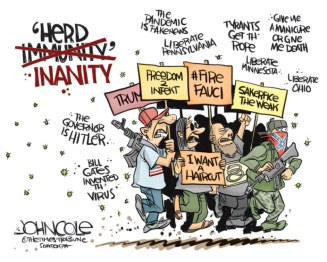 The Daily Beast reports that Americans could be persona non grata in other countries because of our out-of-control Covid-19 outbreak: American Travelers Are About to Be Pariahs in This New World.
ROME—Travel has been one of the most deeply gutted industries of the global coronavirus pandemic, so it should come as no surprise that many countries that rely on it for so much of their GDP are getting anxious about when they can start opening up. But travel is not just about the destination. Getting away is also a way of life for millions of people who take breaks for self-indulgence, prestige, or cultural enrichment. And with the dream of the “immunity passport” for those who have successfully conquered COVID-19 increasingly unreliable this soon in the pandemic, travel may be annoyingly restrictive for some time to come.
One thing is sure: Gone are the days of the American abroad, at least for those hoping to summer in Europe this year. The new models on how to reopen European travel do not have room for the American tourist for the foreseeable future.
The European Union is set to release new guidelines called “Europe Needs a Break” on Wednesday that will recommend replacing travel bans with what they are calling “targeted restrictions” based on contagion levels and reciprocity among European and neighboring nations, many of which have been under draconian lockdowns backed by science. The key to any successful reopening in Europe is based entirely on risk assessment, meaning anyone coming from a nation deemed risky or careless will be the first to be banned. Simply put, anyone who has been under the lax American approach to the pandemic, which has been the laughing stock of Europe, won’t be welcome any time soon.
The rest of the story is behind the paywall.
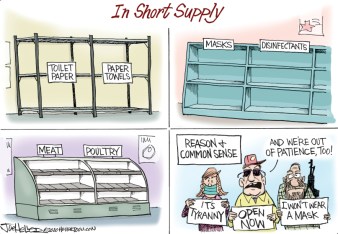 Trump seems to believe that heartland states are safe from the coronavirus, but that’s just not true. A couple of interesting articles:
NBC News: Unreleased White House report shows coronavirus rates spiking in heartland communities.
Coronavirus infection rates are spiking to new highs in several metropolitan areas and smaller communities across the country, according to undisclosed data the White House’s pandemic task force is using to track rates of infection, which was obtained by NBC News.
The data in a May 7 coronavirus task force report are at odds with President Donald Trump’s declaration Monday that “all throughout the country, the numbers are coming down rapidly.”
The 10 top areas recorded surges of 72.4 percent or greater over a seven-day period compared to the previous week, according to a set of tables produced for the task force by its data and analytics unit. They include Nashville, Tennessee; Des Moines, Iowa; Amarillo, Texas; and — atop the list, with a 650 percent increase — Central City, Kentucky.
On a separate list of “locations to watch,” which didn’t meet the precise criteria for the first set: Charlotte, North Carolina; Kansas City, Missouri; Omaha and Lincoln, Nebraska; Minneapolis; Montgomery, Alabama; Columbus, Ohio; and Phoenix. The rates of new cases in Charlotte and Kansas City represented increases of more than 200 percent over the previous week, and other tables included in the data show clusters in neighboring counties that don’t form geographic areas on their own, such as Wisconsin’s Kenosha and Racine counties, which neighbor each other between Chicago and Milwaukee.
Inside Sources: The Coronavirus May Accelerate the Demise of Rural America.
Over the last two months the coronavirus pandemic has brought nation’s largest, and most powerful cities to their knees.
But as curves show signs of flattening in many urban areas, and governors have begun the process of “reopening” their economies, new hotspots are emerging in places like southwest Georgia, the Navajo nation, and in and around meatpacking plants in Iowa and the Texas panhandle.
Rural communities like these lack the healthcare infrastructure and financial resources of larger cities, while at the same time are home to and older and sicker populations, more likely to suffer serious complications or death due to the virus.
That is why governors who are reopening their economies prematurely are not only misguided but also could end up driving the devastation of rural America.
Long before people started falling ill and businesses started shutting down due to coronavirus, rural America was already suffering. There are many indications that rural communities had not fully recovered from the Great Recession.
As of last year, employment in non-metro counties had not yet to returned to pre-2008 levels. Data also show that since the last recession virtually all new business growth has been concentrated in the 20 largest metropolitan counties. And overall rural counties have been steadily losing population for more than a decade now.
At the same time, rural communities have long been experiencing a health crisis. Roughly 170 hospitals in rural communities have closed in the last 15 years, leaving rural Americans with fewer and fewer health options.
Due to the longstanding economic crisis in these communities, along with many states’ refusal to expand Medicaid, hospitals in rural areas have struggled financially.
Hospital closures put undue burden on residents as it becomes more difficult to access health care having to travel farther for care — an estimated 8.6 million people live more than a 30-minute drive from their nearest hospital. Rural areas are already experiencing issues with transportation, which adds to this burden.
Read the rest at Inside Sources.
What else is happening? What stories are you following today?
Lazy Caturday Reads
Posted: May 9, 2020 Filed under: morning reads, U.S. Politics | Tags: Barack Obama, Bill Barr, coronavirus, Covid-19, Donald Trump, Little Richard, Michael Flynn, Rock and Roll 39 Comments
Tomoo Inagaki, Woodcut Cats in Moonlight
Good Morning!!
Before I get started on the political news, I want to note the passing of one of the great pioneers of rock and roll. Rolling Stone: Little Richard, Founding Father of Rock Who Broke Musical Barriers, Dead at 87.
Little Richard, a founding father of rock and roll whose fervent shrieks, flamboyant garb, and joyful, gender-bending persona embodied the spirit and sound of that new art form, died Saturday. He was 87. The musician’s son, Danny Penniman, confirmed the pioneer’s death to Rolling Stone, but said the cause of death was unknown.
Starting with “Tutti Frutti” in 1956, Little Richard cut a series of unstoppable hits – “Long Tall Sally” and “Rip It Up” that same year, “Lucille” in 1957, and “Good Golly Miss Molly” in 1958 – driven by his simple, pumping piano, gospel-influenced vocal exclamations and sexually charged (often gibberish) lyrics. “I heard Little Richard and Jerry Lee Lewis, and that was it,” Elton John told Rolling Stone in 1973. “I didn’t ever want to be anything else. I’m more of a Little Richard stylist than a Jerry Lee Lewis, I think. Jerry Lee is a very intricate piano player and very skillful, but Little Richard is more of a pounder.”
Wassily Kandinsky, Three figures and a cat, woodcut
Although he never hit the top 10 again after 1958, Little Richard’s influence was massive. The Beatles recorded several of his songs, including “Long Tall Sally,” and Paul McCartney’s singing on those tracks – and the Beatles’ own “I’m Down” – paid tribute to Little Richard’s shredded-throat style. His songs became part of the rock and roll canon, covered over the decades by everyone from the Everly Brothers, the Kinks, and Creedence Clearwater Revival to Elvis Costello and the Scorpions.
Little Richard’s stage persona – his pompadours, androgynous makeup and glass-bead shirts – also set the standard for rock and roll showmanship; Prince, to cite one obvious example, owed a sizable debt to the musician. “Prince is the Little Richard of his generation,” Richard told Joan Rivers in 1989 before looking at the camera and addressing Prince. “I was wearing purple before you was wearing it!”

Read about Little Richard’s (born Richard Wayne Penniman) life and career at the Rolling Stone link.
Now to other news of the day.
As Trump and his personal attorney general Bill Barr take steps to erase the rule of law and establish a fascist dictatorship in the U.S., is President Obama finally getting ready to speak out publicly? Michael Isakoff at Yahoo News: Exclusive: Obama says in private call that ‘rule of law is at risk’ in Michael Flynn case.
Former President Barack Obama, talking privately to ex-members of his administration, said Friday that the “rule of law is at risk” in the wake of what he called an unprecedented move by the Justice Department to drop charges against former White House national security adviser Michael Flynn.
In the same chat, a tape of which was obtained by Yahoo News, Obama also lashed out at the Trump administration’s handling of the coronavirus pandemic as “an absolute chaotic disaster.”
“The news over the last 24 hours I think has been somewhat downplayed — about the Justice Department dropping charges against Michael Flynn,” Obama said in a web talk with members of the Obama Alumni Association.
Woodcut by Kioshi Saito 1985
“And the fact that there is no precedent that anybody can find for someone who has been charged with perjury just getting off scot-free. That’s the kind of stuff where you begin to get worried that basic — not just institutional norms — but our basic understanding of rule of law is at risk. And when you start moving in those directions, it can accelerate pretty quickly as we’ve seen in other places.”
The Flynn case was invoked by Obama as a principal reason that his former administration officials needed to make sure former Vice President Joe Biden wins the November election against President Trump. “So I am hoping that all of you feel the same sense of urgency that I do,” he said. “Whenever I campaign, I’ve always said, ‘Ah, this is the most important election.’ Especially obviously when I was on the ballot, that always feels like it’s the most important election. This one — I’m not on the ballot — but I am pretty darn invested. We got to make this happen.”
Obama misstated the charge to which Flynn had previously pleaded guilty. He was charged with false statements to the FBI, not perjury.

Click the Yahoo link to read the rest.
And from Caleb Ecarma at Vanity Fair: As the DOJ Drops Flynn’s Case, Trumpworld’s Next Target is Obama Alums.
Conservative media figures who spent months insisting on Michael Flynn’s innocence, after he twice pleaded guilty to lying to investigators, are taking a gleeful victory lap in response to the Justice Department moving to drop its criminal case against the retired lieutenant general and former Trump national security adviser. But the reversal is not enough to placate the right-wing media rabble, as they are now calling for Attorney General William Barr to prosecute members of the Barack Obama administration and its judicial allies for their roles in the case….
M.C. Escher, White Cat, woodcut
Shortly after the news broke on Thursday, right-wing radio host Mark Levin appeared on Fox News to boast, and to accuse Obama of conducting a vast shadow operation against the Trump administration. “You know what this is? This is Barack Obama’s blue dress. That’s what that is without the DNA on it,” he told Sean Hannity, referencing Monica Lewinsky’s infamous garment. “[The Flynn case documents] tells us that Obama knew…. Obama was working with the FBI and the intelligence agencies.” Levin also tweeted that “the perps responsible for trying to destroy” Flynn should be prosecuted, a talking point Hannity is now pushing too. “All this does is exonerate General Flynn,” the Fox News host declared on his Thursday radio program. “Now, it’s time to investigate Barack Obama and Joe Biden’s Department of Justice…and what they did here is they targeted an innocent man, and they—this is prosecutorial abuse.” Hannity’s colleague Tucker Carlson called Flynn’s case “demonstrably and provably unfair” and accused federal prosecutors of wanting “Flynn crushed purely because he happened to be away from the power they seek, and that’s why they’re still trying to put Roger Stone behind bars…. But the question is: How many other inconvenient Americans would they bankrupt and imprison if they could?”
A Daily Beast report found that numerous Trump administration and campaign officials are hoping to see Flynn resume work for the president in an official capacity. “Years ago when Nelson Mandela came to America after years of political persecution he was treated like a rock star by Americans,” Trump pollster John McLaughlin said Thursday while discussing the possibility of a Flynn–Trump reunion with the Daily Beast. “Now after over three years of political persecution General Flynn is our rock star. A big difference is that he was persecuted in America.” [….]
On Thursday, Trump described Flynn as “an innocent man” and “an even greater warrior,” before appearing on Fox & Friends the following morning to praise his attorney general’s efforts. “Bill Barr is a man of unbelievable credibility and courage, and he’s going to go down in the history books,” he told Fox News, adding that Fox hosts Hannity, Carlson, and Laura Ingraham “should get the equivalent of the Pulitzer Prizes” for leading the Flynn-innocence media campaign.

Wow. That is through the looking glass stuff. But the way things are going, it could happen. But through the looking glass is where Trump lives. Even with cases popping up in the White House, he still thinks the coronavirus will magically disappear.

Woodcut by Ellen Corddry
Yahoo News: Trump says coronavirus will ‘go away without a vaccine.’
President Trump on Friday broke with health experts, telling reporters that the coronavirus will “go away without a vaccine.”
“This is going to go away without a vaccine, it’s gonna go away, and we’re not going to see it again, hopefully, after a period of time,” Trump said at the White House. “You may have some flare-ups, and I guess I would expect that.”
Just days ago the Trump administration launched Operation Warp Speed, a project to accelerate the production of a vaccine for the coronavirus, which as of Friday had infected at least 1.2 million Americans and killed more than 76,000 here….
Asked what led him to believe that the virus would disappear without a vaccine, Trump claimed he had received that information from medical professionals.
“I just rely on what doctors say. They say it’s going to go. That doesn’t mean this year. It doesn’t mean, frankly, it’s going to be gone before the fall or after the fall, but eventually it’s going to go away. The question is whether we will need a vaccine. At some point it will probably go away by itself.”
Who are these mysterious “medical professionals?”
Trump doesn’t think testing for the virus is important either–unless you are Trump, Pence and people working around them. The Washington Post: Trump plays down coronavirus testing as U.S. falls far short of level scientists say is needed.
The president has played down the need for testing as he overrides public health recommendations that would prolong the closures of schools, businesses and much of daily life. Although he is now tested every day with a rapid-result machine, Trump has questioned the value of extensive testing as the gap between available capacity and the amount that would be required to meet public health benchmarks has become clearer.
Woodcut by Masharu Aoyama
Trump’s comments came as a second employee in the White House complex tested positive for the coronavirus, a development that prompted increased testing for staff and other precautions not generally available to most Americans.
“This is why the whole concept of tests aren’t necessarily great,” Trump said at the White House, as he confirmed a positive test result “out of the blue” for a top staffer, Vice President Pence’s press secretary, Katie Miller.
During a Friday morning interview on Fox News, Trump ticked approvingly through the current testing figures but did not say what level he thinks is optimal or safe to use as a national benchmark for economic reopening.
Asked about the positive test result for one of his Navy valets, the president said that he himself remains negative but that the valet’s experience is instructive.
“And this is why testing isn’t necessary. We have the best testing in the world, but testing’s not necessarily the answer because they were testing them,” Trump said of the staff members.

WTF?! He found out these people had contracted the virus because they were being tested! What a fucking moron!
I’ll end with this. The AP has learned definitively that the President and his buddies were behind the shelving of the CDC reopening report: AP Exclusive: Docs show top WH officials buried CDC report.
The decision to shelve detailed advice from the nation’s top disease control experts for reopening communities during the coronavirus pandemic came from the highest levels of the White House, according to internal government emails obtained by The Associated Press.
Two Cats woodcut by Felix Vallotton from the periodical Pan published by F. Fontane and Co., Berlin 1895
The files also show that after the AP reported Thursday that the guidance document had been buried, the Trump administration ordered key parts of it to be fast-tracked for approval.
The trove of emails show the nation’s top public health experts at the Centers for Disease Control and Prevention spending weeks working on guidance to help the country deal with a public health emergency, only to see their work quashed by political appointees with little explanation.
The document, titled “Guidance for Implementing the Opening Up America Again Framework,” was researched and written to help faith leaders, business owners, educators and state and local officials as they begin to reopen. It included detailed “decision trees,” or flow charts aimed at helping local leaders navigate the difficult decision of whether to reopen or remain closed.
White House spokeswoman Kayleigh McEnany said Friday that the documents had not been approved by CDC Director Robert Redfield. The new emails, however, show that Redfield cleared the guidance.
This new CDC guidance — a mix of advice already released along with newer information — had been approved and promoted by the highest levels of its leadership, including Redfield. Despite this, the administration shelved it on April 30.

Read the rest at the AP link.
So . . . what else is happening? What stories are you following today?
Terrifying Tuesday Reads
Posted: May 5, 2020 Filed under: just because, morning reads, U.S. Politics | Tags: 1918 flu pandemic, coronavirus, Covid-19, Director of National Intelligence, Donald Trump, genetic differences in Covid-19 cases, John Ratcliffe, Kawasaki disease, new strain of coronavirus, QAnon, scientific studies, sickness and rising extremism, toxic shock 47 Comments
Good Morning!!
It’s another terrifying Tuesday in the American apocalypse. During his insane inauguration speech, Trump said he was going to end American carnage. Instead he has brought us to our knees as a country as we endure a pandemic and economic hardship with almost no help from the federal government. Trump has hollowed out or destroyed nearly every important American institution–the State Department, the Justice Department, the CDC, the Supreme Court, the federal court system, the Defense Department leadership, the Department of Homeland Security and FEMA. And now he’s working on taking control of the intelligence community.
This morning Trump’s insane appointee as Director of National Intelligence, Rep. John Ratcliffe of Texas is testifying in his Senate confirmation hearing.
CNN: Trump’s pick for spy chief testifying before Senate panel.
President Donald Trump’s pick to be director of national intelligence, Rep. John Ratcliffe, pledged to deliver unbiased intelligence to the President and Congress amid questions about the Texas Republican’s loyalty to a President deeply skeptical of the intelligence community.
Ratcliffe is appearing before the Senate Intelligence Committee after he was selected by the President a second time to be the nation’s spy chief. Ratcliffe withdrew from consideration when he was first tapped for the role last summer amid concerns from even some Republicans about exaggerations to his national security resume, but Trump picked him again in February for the role.
“Let me be very clear. Regardless of what anyone wants our intelligence to reflect, the intelligence I will provide, if confirmed, will not be impacted or altered as a result of outside influence. Above all, my fidelity and loyalty will always be with the Constitution and the rule of law, and my actions as DNI will reflect that commitment,” Ratcliffe said in his opening statement.
Ratcliffe appears to have the support he needs from Republicans who were skeptical the first time he was picked, but Democrats are sure to press him on his ability to be independent from Trump when the President has expressed an open distrust of the intelligence community and refused to agree with the assessment on Russian election interference.
The hearing comes amid questions about Trump’s claims of intelligence on the origins of the coronavirus outbreak in Wuhan, China, and the removal of top intelligence officials earlier this year, including former intelligence community inspector general Michael Atkinson and then-acting Director of National Intelligence Joseph Maguire….
Virginia Sen. Mark Warner, the committee’s top Democrat, said he has concerns about what he described as Ratcliffe’s “inexperience, partisanship, and past statements that seemed to embellish” his record.
In case you haven’t noticed, Ratcliffe is quite simply nuts. The Daily Beast: Trump’s Pick for Intelligence Chief Follows a Slew of QAnon Accounts.
Ratcliffe’s official, verified campaign Twitter account follows several accounts on the political fringe, including a 9/11 truther account with just one follower besides himself and four promoting the outlandish QAnon conspiracy theory, which posits that the world is run by a cabal of Democratic pedophile-cannibals—and has been ruled a potential source of domestic terrorism by the FBI.
The conspiracy theorists followed by Ratcliffe, whose nomination for director of national intelligence goes before the Senate intelligence committee Tuesday morning, cover a bizarre range of beliefs. They posit that John F. Kennedy Jr. faked his death to help Trump to take down the Deep State. Others claim a Democratic sex dungeon exists in in a Washington pizzeria. But Ratcliffe and the QAnon promoters he follows have one thing in common: utter loyalty to Trump.
Even before Ratcliffe’s QAnon interest was known, Sen. Ron Wyden (D-OR), a committee member, told The Daily Beast, “Congressman Ratcliffe is a partisan politician who has spent the last two years promoting conspiracy theories in defense of Donald Trump.” [….]
Veteran intelligence officials expressed alarm that the Senate may soon confirm a Trump loyalist atop the U.S.’s 16 intelligence agencies. “Ratcliffe would be the least qualified person to run the intelligence community, ever, and that includes Ric Grenell,” said former CIA and National Counterterrorism Center analyst Aki Peritz, referring to the acting director of national intelligence. “The hardest job for any intelligence officer is to speak truth to power. Based on Ratcliffe’s past performance, it’s doubtful he can resist the urge to politicize intelligence on behalf of Donald Trump.”
Read more at the Daily Beast link.
Meanwhile, as Trump pushes states to reopen their economies, predictions for the future course of the pandemic are alarming. Yesterday Dakinikat posted about a draft study that predicts we will see 200,000 Covid0-19 cases per day by June 1. That link goes to another story at The Washington Post.
Stephen Collinson at CNN: The price of reopening the economy: tens of thousands of American lives.
(CNN)President Donald Trump now knows the price of the haunting bargain required to reopen the country — tens of thousands more lives in a pandemic that is getting worse not better.
It’s one he now appears ready to pay, if not explain to the American people, at a moment of national trial that his administration has constantly underplayed.
Depressing new death toll projections and infection data on Monday dashed the optimism stirred by more than half the country taking various steps to reopen an economy that is vital to Trump’s reelection hopes and has shed more than 30 million jobs. Stay-at-home orders slowed the virus and flattened the curve in hotspots like New York and California, but they have so far failed to halt its broader advance, leaving the nation stuck on a grim plateau of about 30,000 new cases a day for nearly a month.
Despite those projections, two administration officials told CNN’s Kaitlan Collins the latest numbers are not currently expected to affect the White House’s plans for reopening the country.
New evidence of the likely terrible future toll of Covid-19 came on a day when Trump stayed out of sight — his wild briefings that hurt his political prospects now paused — meaning he could not be questioned on his enthusiasm for state openings in the light of new evidence.But in an interview published in Tuesday’s edition of the New York Post, Trump said Americans were ready come out of isolation and get back to normal life.
“I think they’re starting to feel good now. The country’s opening again. We saved millions of lives, I think,” Trump said. “You have to be careful, but you have to get back to work,” he said. “People want the country open… I guess we have 38 states that are either opening or are very close.”
Opinion polls don’t support Trump’s claims however. Read more at CNN.
According to Calvin Woodward at the AP, Virus-afflicted 2020 looks like 1918 despite science’s march.
Despite a century’s progress in science, 2020 is looking a lot like 1918.
In the years between two lethal pandemics, one the misnamed Spanish flu, the other COVID-19, the world learned about viruses, cured various diseases, made effective vaccines, developed instant communications and created elaborate public-health networks.
Yet here we are again, face-masked to the max. And still unable to crush an insidious yet avoidable infectious disease before hundreds of thousands die from it.
As in 1918, people are again hearing hollow assurances at odds with the reality of hospitals and morgues filling up and bank accounts draining. The ancient common sense of quarantining is back. So is quackery: Rub raw onions on your chest, they said in 1918. How about disinfectant in your veins now? mused President Donald Trump, drawing gasps instead of laughs over what he weakly tried to pass off as a joke.
In 1918, no one had a vaccine, treatment or cure for the great flu pandemic as it ravaged the world and killed more than 50 million people. No one has any of that for the coronavirus, either.
Modern science quickly identified today’s new coronavirus, mapped its genetic code and developed a diagnostic test, tapping knowledge no one had in 1918. That has given people more of a fighting chance to stay out of harm’s way, at least in countries that deployed tests quickly, which the U.S. didn’t.
But the ways to avoid getting sick and what to do when sick are little changed. The failure of U.S. presidents to take the threat seriously from the start also joins past to present
The New York Times offers another historical comparison: A study by the Fed suggests sickness helped drive extremism in the 20th century.
A jump in flu deaths early in the 20th century may have helped to drive the rise of the Nazi Party in Germany, Federal Reserve Bank of New York research showed, in a stark warning that pandemics can drive societal change.
“Influenza deaths of 1918 are correlated with an increase in the share of votes won by right-wing extremists,” Fed economist Kristian Blickle wrote. The finding holds even counting for a city’s ethnic and religious makeup, regional unemployment, past right-wing voting, and other local characteristics.
He points out that local public spending dropped in the wake of the deadly flu, especially on services that benefitted young people, like school. That spending decline itself does not seem to drive the right-wing political extremism that followed, the paper found.
On the other hand, “the correlation between influenza mortality and the vote share won by right-wing extremists is stronger in regions that had historically blamed minorities, particularly Jews, for medieval plagues,” Mr. Blickle wrote. He adds that “the disease may have fostered a hatred of ‘others’, as it was perceived to come from abroad.”
Scientists are learning more about the virus and its effects on the human body. Here are three interesting (and scary) science-based articles to check out.
Raw Story reports on a study that supports something I have suspected–your genes may determine how the virus affects you and how sick you get.
When some people become infected with the coronavirus, they only develop mild or undetectable cases of COVID-19. Others suffer severe symptoms, fighting to breathe on a ventilator for weeks, if they survive at all.
Despite a concerted global scientific effort, doctors still lack a clear picture of why this is.
Could genetic differences explain the differences we see in symptoms and severity of COVID-19?
 The article is too dense to summarize in an excerpt, so you’ll need to read the article. But here’s the gist of the findings:
Based on our study, we think variation in HLA genes is part of the explanation for the huge differences in infection severity in many COVID-19 patients. These differences in the HLA genes are probably not the only genetic factor that affects severity of COVID-19, but they may be a significant piece of the puzzle. It is important to further study how HLA types can clinically affect COVID-19 severity and to test these predictions using real cases. Understanding how variation in HLA types may affect the clinical course of COVID-19 could help identify individuals at higher risk from the disease.
The New York Times: 15 Children Are Hospitalized With Mysterious Illness Possibly Tied to Covid-19.
Fifteen children, many of whom had the coronavirus, have recently been hospitalized in New York City with a mysterious syndrome that doctors do not yet fully understand but that has also been reported in several European countries, health officials announced on Monday night.
Many of the children, ages 2 to 15, have shown symptoms associated with toxic shock or Kawasaki disease, a rare illness in children that involves inflammation of the blood vessels, including coronary arteries, the city’s health department said.
None of the New York City patients with the syndrome have died, according to a bulletin from the health department, which describes the illness as a “multisystem inflammatory syndrome potentially associated with Covid-19.” [….]
The syndrome has received growing attention in recent weeks as cases began appearing in European countries hit hard by the coronavirus.
“There are some recent rare descriptions of children in some European countries that have had this inflammatory syndrome, which is similar to the Kawasaki syndrome, but it seems to be very rare,” Dr. Maria Van Kerkhove, a World Health Organization scientist, said at a news briefing last week.
 The Los Angeles Times: Scientists have identified a new strain of the coronavirus that appears to be more contagious.
Scientists have identified a new strain of the coronavirus that has become dominant worldwide and appears to be more contagious than the versions that spread in the early days of the COVID-19 pandemic, according to a new study led by scientists at Los Alamos National Laboratory.
The new strain appeared in February in Europe, migrated quickly to the East Coast of the United States and has been the dominant strain across the world since mid-March, the scientists wrote.
In addition to spreading faster, it may make people vulnerable to a second infection after a first bout with the disease, the report warned.
The 33-page report was posted Thursday on BioRxiv, a website that researchers use to share their work before it is peer reviewed, an effort to speed up collaborations with scientists working on COVID-19 vaccines or treatments. That research has been largely based on the genetic sequence of earlier strains and might not be effective against the new one.
That’s it for me. What stories are you following today?

 peej
peej Carissa
 bostonboomer
 dakinikat
 ecocatwoman
 jjlo
jjlo mablue2
 Mama Lopez
 peggysue22
 quixote
 skydancingguestblogger
 Mona (aka Wonk the Vote)





Recent Comments