
Thursday Reads: Updates from Snowden-Greenwald Land and Other News
Posted: May 22, 2014 Filed under: morning reads | Tags: Cincinnatus, cyber-parties, discrimination, Edward Snowden, encryption extremists, George Packer, Glenn Greenwald, hackers, Jacob Applebaum, Julian Assange, Kevin Poulsen, Laura Poitras, NSA, Poverty, privacy extremists, Racism, Runa Sandvik, Sexism, The Tor Project, unemployment, Wikileaks 32 Comments
Good Morning!!
The photos in today’s post are from a project by photographer Mark Makela to take pictures of children “learning to read by reading to homeless cats.”
Last February, photographer Mark Makela traveled to Birdsboro, Pennsylvania, to photograph a reading group where the participants were grade-school students and a group of cats. The idea for the group, known as Book Buddies, was hatched at the Animal Rescue League of Berks County when the program coordinator Kristi Rodriguez’s 10-year-old son was struggling with reading. Rodriguez decided to bring him into the shelter, where he could be in what she called a “nonevaluative” environment in order to feel more comfortable practicing his reading skills. It worked.
According to ARL’s website, studies at Tufts University found that the more relaxed, nonjudgmental audience of cats helps students to sustain their focus, maintain a higher state of awareness, and develop an improved attitude toward school. In August of last year, ARL officially started the Book Buddies program, inviting students in first through eighth grades to read to the cats. As an incentive to continue, once the students complete five books, they receive prizes. “It’s one of those opportunities that is unique and humorous and so endearing,” Makela said about the assignment to document the Book Buddies program.
See more marvelous photos at the Slate Magazine link above. Even more at Buzzfeed–including more girls.
Now to the news:
I’ve long suspected that Edward Snowden interacted with Wikileaks’ Julian Assange and others in the hacker community before he made his final decision to steal a massive trove of data from NSA computers and then abscond to Hong Kong at the end of May last year.
We know that Snowden was in touch with Jacob Applebaum and Laura Poitras early on, because they published an interview with him in Der Spiegel that they had conducted by e-mail in Mid-May, before Snowden fled Hawaii. But Snowden could have actually met Applebaum in Hawaii in April 2013 when Applebaum vacationed there by his own admission. Did Snowden and Applebaum discuss Snowden’s plans to steal NSA files? Did Applebaum suggest which items Snowden should take? Note that Applebaum is deeply involved with Wikileaks and has been a long-time, passionate defender of Julian Assange.
Glenn Greenwald revealed in his new book “No Place to Hide” that Snowden had used the code name “Cincinnatus” in early communications between the two. Interestingly enough, a “cyber-party” had been held in Hawaii in December 2012, and the host was someone who called himself “Cincinnatus.” Once this news came out, people began speculating on Twitter that perhaps this wasn’t a coincidence. Suddenly, on May 17, the cyber-party announcement was deleted by someone with the Twitter handle @jskuda. Fortunately Twitter user @ShrillBrigade located it on the Wayback Machine. And check out the title of Cincinnatus’ talk: “Painlessly setting up your own fast exit.” (h/t @catfitz)
Then yesterday, former criminal hacker and technical adviser to Greenwald and Poitras’ Freedom of the Press Foundation Kevin Poulsen published a limited hangout at Wired: Snowden’s First Move Against the NSA Was a Party in Hawaii.
It was December 11, 2012, and in a small art space behind a furniture store in Honolulu, NSA contractor Edward Snowden was working to subvert the machinery of global surveillance.
Snowden was not yet famous. His blockbuster leaks were still six months away, but the man destined to confront world leaders on a global stage was addressing a much smaller audience that Sunday evening. He was leading a local “Crypto Party,” teaching less than two dozen Hawaii residents how to encrypt their hard drives and use the internet anonymously.
“He introduced himself as Ed,” says technologist and writer Runa Sandvik, who co-presented with Snowden at the event, and spoke about the experience for the first time with WIRED. “We talked for a bit before everything started. And I remember asking where he worked or what he did, and he didn’t really want to tell.”

Runa Sandvik is a hacker who works at the TOR project along with Jacob Applebaum. TOR is a site (ironically funded by the U.S. Department of Defense) that provides free encryption software to people who want to hide their on-line activities (including drug dealers and child porn purveyors).
Poulsen writes:
The roots of Snowden’s crypto party were put down on November 18, 2012, when he sent an e-mail to Sandvik, a rising star in privacy circles, who was then a key developer on the anonymous web surfing software Tor.
Tor is free software that lets you go online anonymously. The software is used by a wide swath of people in need of extreme anonymity, including human rights groups, criminals, government agencies, and journalists. It works by accepting connections from the public internet, encrypting the traffic and bouncing it through a winding series of relays before dumping it back on the web through any of more than 1,000 exit nodes.
Most of those relays are run by volunteers, and the pre-leak Edward Snowden, it turns out, was one of them.
How about that? Snowden was already deeply involved with TOR in December 2012–and Jacob Applebaum of TOR just happened to travel to Hawaii a few months later in April! Coincidence? I don’t think so.
In his e-mail, Snowden wrote that he personally ran one of the “major tor exits”–a 2 gbps server named “TheSignal”–and was trying to persuade some unnamed coworkers at his office to set up additional servers. He didn’t say where he worked. But he wanted to know if Sandvik could send him a stack of official Tor stickers. (In some post-leak photos of Snowden you can see the Tor sticker on the back of his laptop, next to the EFF sticker).
Well, well, well. Now we know how Snowden got his TOR sticker. Did Runa give him the EFF sticker too? Read the rest of the Wired piece for more details.
Phew! I hope that made sense. This stuff is difficult to write about.

Also yesterday, well-known and respected journalist and New Yorker writer George Packer published a no-holds-barred review of Glenn Greenwald’s new book in the UK Prospect: The errors of Edward Snowden and Glenn Greenwald. Among other things, Packer accuses Greenwald of “a pervasive absence of intellectual integrity,” and provides numerous examples. He characterizes Snowden as someone who lives on the internet, detached from the realities of the real world. Here are a few excerpts, but please read the whole thing.
Snowden’s leaks can be seen, in part, as a determined effort to restore the web to its original purity—a project of technology rather than law. “Let us speak no more of faith in man, but bind him down from mischief by the chains of cryptography,” wrote Snowden, in an early message to his collaborators. In March of this year, appearing remotely from Russia on a robotised screen onstage at a TED talk in Vancouver, Snowden said that the single best solution to the NSA’s abuses is stronger encryption: “The internet that we’ve enjoyed in the past has been exactly what we, as not just a nation but as a people around the world, need.” In taking nearly two million highly classified documents from the US, he was grabbing back the key to heaven.
As I’ve written previously, Snowden’s solution to the problem of government interference with its citizens is impenetrable universal encryption–never mind the fact that this would allow vast numbers of vicious criminals to hide their actions from law enforcement.
As I suspected, Packer writes that Greenwald’s book “contains no major scoops.” He does, however, praise Greenwald’s argument for the primacy of privacy as central to a “free society.”
Greenwald also makes a powerful case—all the more so for being uncompromising and absolute—for the central role of privacy in a free society, and against the utilitarian argument that, since the phone companies’ metadata on Americans hasn’t been seriously abused by government officials (not yet, anyway), none of us should be too worried. In a chapter called “The Harm of Surveillance,” he cites Justice Louis Brandeis’s famous opinion on the basic “right to be let alone,” and writes: “The desire for privacy is shared by us all as an essential, not ancillary, part of what it means to be human. We all instinctively understand that the private realm is where we can act, think, speak, write, experiment, and choose how to be, away from the judgemental eyes of others. Privacy is a core condition of being a free person.”
I would argue that these considerations are of vital importance to people like Greenwald who are financially secure. Those Americans who must deal with racial and gender discrimination, long-term unemployment, and especially grinding poverty have other, more urgent concerns. Can one be a “free person” under those conditions?

Along similar lines, Packer writes:
If Greenwald and others were actually being persecuted for their political beliefs, they would instinctively understand that the rule of law has to protect people regardless of politics. The NSA disclosures are disturbing and even shocking; so is the Obama administration’s hyper-aggressive pursuit of leaks; so is the fact that, for several years, Poitras couldn’t leave or re-enter the US without being questioned at airports. These are abuses, but they don’t quite reach the level of the Stasi. They don’t portend a totalitarian state “beyond the dreams of even the greatest tyrants of the past,” as Greenwald believes is possible. A friend from Iran who was jailed and tortured for having the wrong political beliefs, and who is now an American citizen, observed drily, “I prefer to be spied on by NSA.” The sense of oppression among Greenwald, Poitras, and other American dissenters is only possible to those who have lived their entire lives under the rule of law and have come to take it for granted.
In the year since the first NSA disclosures, Snowden has drifted a long way from the Thoreauvian ideal of the majority of one. He has become an international celebrity, far more championed than reviled. He has praised Russia and Venezuela’s devotion to human rights. His more recent disclosures have nothing to do with the constitutional rights of US citizens. Many of them deal with surveillance of foreign governments, including Germany and Brazil, but also Iran, Russia, and China. These are activities that, wise or unwise, fall well within the NSA’s mandate and the normal ways of espionage. Snowden has attached himself to Wikileaks and to Assange, who has become a tool of Russian foreign policy and has no interest in reforming American democracy—his goal is to embarrass it. Assange and Snowden are not the first radical individualists to end up in thrall to strongmen.
Snowden looked to the internet for liberation, but it turns out that there is no such thing as an entirely free individual. Cryptography can never offer the absolute privacy and liberty that Snowden seeks online. The internet will always be a space controlled by corporations and governments, and the freedom it provides is of a limited, even stunting, kind. No one lives outside the fact of coercion—there is always a state to protect or pursue you, whether it’s Obama’s America or Putin’s Russia.
I’ve barely touched the surface of Packer’s scathing critique of Greenwald’s “journalism”; I enourage you to go to Prospect link to read more.

I have a few more stories for you that I’ll list link-dump style:
It appears that the prosecution in the Boston Bombing case decided to leak some previously secret information–most likely to counter the defense’s argument that Dzhohar Tsarnaev was illegally questioned by the FBI when he was in the hospital with terrible injuries.
Reuters: Accused Boston bomber admitted role in attack, prosecutors say
NBC News: Government doc shows how closely Boston Marathon bombers followed al Qaeda plans.
NY Daily News: Boston Marathon bombers used ‘sophisticated’ bombs made of parts from Christmas lights, model cars: prosecutors.
Boston Globe: Christmas Lights Used in Boston Marathon Bombs.
KSDK.com: Feds: Boston bomber’s hideout note says he wanted to be martyr.
ABC News: FBI Feared Boston Bombers ‘Received Training’ And Aid From Terror Group, Docs Say.
This is encouraging from the Boston Globe: Oakland Examining Pension of FBI Agent who Shot Todashev
Other News:
The Economic Times of India: Google wants to show ads through your thermostat and car. (You though the NSA was bad?)
Information Week: Google Outlines Advertising Vision. (How would you like targeted Google ads appearing on your refrigerator or watch?)
The Atlantic: It Wasn’t Household Debt That Caused the Great Recession; It was how that debt was disproportionately distributed to America’s most economically fragile communities.
NYT: U.S. Sends Troops to Chad to Aid Hunt for Nigerian Schoolgirls.
USA Today: Thai military declares coup, detains party leaders.
Science Recorder: ‘Aliens of the sea’ could lead to breakthroughs in regenerative medicine.
What stories are you following today? Please post your links on any topic in the comment thread.
Saturday News Potpourri
Posted: January 25, 2014 Filed under: Civil Rights, Egypt, Foreign Affairs, morning reads, Russia, U.S. Politics | Tags: apps, artisanal toast, banks, Booz Allen Hamilton, Brian Glyn Williams, Chechnya, China, Dagestan, discrimination, diva test, Don Graham, Dr. Strangelove, Dzhokhar Tsarnaev, Edward Snowden, Eric Holder, Erik Prince, glamour shots of elderly people, guns, Jeff Bezos, Marijuana, Pink, Sochi Olympics, Trove, Ukraine protests, Volograd bombings, vote id laws, voting rights, Washington Post 53 Comments
Good Morning!!
I have quite a few articles to share this morning, a real Saturday potpourri! So let’s get started. First up, on Thursday Attorney General Eric Holder gave a wide-ranging interview to Ari Melber of MSNBC, and quite a bit of breaking news came out of it. Here are some of the resulting headlines: NY Daily News: Eric Holder: Could talk deal with NSA-leaker Edward Snowden, but no clemency
Holder told MSNBC that the Obama Administration “would engage in a conversation” about a resolution in the case, but said it would require Snowden acknowledge wrongdoing…. At a University of Virginia forum, where Holder was asked about Snowden, he elaborated on his position, saying, “If Mr. Snowden wanted to come back to the United States and enter a plea, we would engage with his lawyers. We would do the same with any defendant who wanted to enter a plea of guilty, so that is the context to what I said.” But he stressed that the NSA leaker would not walk. “We’ve always indicated that the notion of clemency isn’t something that we were willing to consider.”

Seattle PI: Holder: Marijuana banking regulations on the way
Attorney General Eric Holder says the Obama administration is planning to roll out regulations soon that would allow banks to do business with legal marijuana sellers. During an appearance Thursday at the University of Virginia, Holder said it is important from a law enforcement perspective to enable places that sell marijuana to have access to the banking system so they don’t have large amounts of cash lying around. Currently, processing money from marijuana sales puts federally insured banks at risk of drug racketeering charges. Because of the threat of criminal prosecution, financial institutions often refuse to let marijuana-related businesses open accounts.
There’s a good piece about this at Forbes, but they won’t even let you copy their headlines anymore. Mediaite: Eric Holder: Voter ID Used to ‘Depress the Vote’ of People Who Don’t Support GOP
Attorney General Eric Holder sharply criticized state-level voter identification policies and said that he believes those policies are a “remedy in search of a problem.” He added that, while some may be arguing for voter ID in good faith, he believes that most are advocating for this policy in order to “depress the vote” of those who do not support the “party that is advancing” voter ID measures. “I think many are using it for partisan advantage,” Holder said of voter ID. “People have to understand that we are not opposed to photo identification in a vacuum,” he continued. “But when it is used in — certain ways to disenfranchise particular groups of people, whether by racial designation, ethnic origin, or for partisan reasons, that from my perspective is problematic.” He added that “all the studies” show that in-person voter fraud “simply does not exist” at a level that requires a legislative solution.
Politico: Eric Holder: Timing of Robert Gates book release ‘a mistake’
Attorney General Eric Holder waded into the controversy over former Defense Secretary Robert Gates’s new book Thursday, calling it “a mistake” for Gates to have published his recollections before President Barack Obama left the White House. “It’s my view that it’s just not a good thing thing to write a book about a president that you served while that president is still in office,” Holder said during an appearance at the University of Virginia’s Miller Center. “From my perspective I think the world of Bob Gates, but I think that the publication of that book — at least at this time — was a mistake.” [….] In the course of offering his critique of the timing of Gates’s book, “Duty: Memoirs of a Secretary at War,” Holder twice praised the former defense secretary for his leadership. “I like Bob Gates a great deal. He was a good secretary of defense,” the attorney general said.
LA Times: Holder says no bank ‘too big to indict,’ more financial cases coming
“I think people just need to be a little patient,” Holder said, according to a transcript of an interview with MSNBC to air at noon Pacific time Friday. “I know it’s been a while. But we have other things that are in the pipeline.” [….] Holder has taken heat for telling a Senate hearing last year that some financial institutions were “so large that it becomes difficult to prosecute them” because criminal charges could hurt the U.S. and even world economies. Since then Holder has tried to emphasize that the Justice Department is not intimidated by the size of a financial institution and would bring any charges it believed it could prove.
As I said, quite a bit of news out of one interview. Good job by Ari Melber.
In other news . . .
The Economist has a brief article that provides some background on the situation in Ukraine: On the march in Kiev –The protests turn nasty and violent, but the president is not giving ground. 
JANUARY 22nd was meant to mark Ukraine’s unity day, a celebration of its short-lived pre-Soviet independence. Instead, it was a day of civil unrest and perhaps the biggest test of Ukraine’s post-Soviet integrity. After two months of largely peaceful encampment on the Maidan in Kiev, the protests turned violent. Five people were reported killed and hundreds were injured. An armoured personnel carrier pushed through the streets. Clouds of black smoke and flames mottled the snow-covered ground. Never in its history as an independent state has Ukraine witnessed such violence. It was triggered by the passage of a series of repressive laws imposing tight controls on the media and criminalising the protests of the past two months. One law copied almost verbatim a Russian example, including stigmatising charities and human-rights groups financed from abroad as “foreign agents”. If Russian human-rights activists denounce their parliament as a “crazy printer” churning out repressive legislation, says Oleksandra Matviichuk of the Centre for Civil Liberties in Kiev, Ukraine has a “crazy photocopier”. The clashes show vividly the refusal of the protesters to heed such laws.
Brian Glyn Williams, the U. Mass Dartmouth professor who interacted with Boston Marathon bomber Dzhokhar Tsarnaev and recommended some sources of information on Chechnya for a report Tsarnaev was writing, has a post up at HuffPo on how the history of Chechya and Dagestan is coming back to haunt the Winter Olympics in Russia: The Dark Secret Behind the Sochi Olympics: Russia’s Efforts to Hide a Tsarist-Era Genocide. Here’s the conclusion:
The twin bombings in Volgograd in late December 2013 and an earlier one in October are clearly meant to show the Russians that the Chechen-Dagestani terrorists have reignited their terror jihad. They are also meant to remind the world of the tragedy that befell the Circassians of the Caucasus’s Black Sea shore exactly 150 years ago this winter. This is the dark secret that Russia’s authoritarian leader, Putin, does not want the world to know. Putin has thus far been very successful in conflating Russia’s neo-colonial war against Chechen separatists with America’s war on nihilist Al Qaeda Arab terrorists. Any attempt to remind the world of Imperial Russia/Post-Soviet Russia’s war crimes in the Caucasus is a threat to Putin’s pet project, the whitewashed Sochi Olympics. This of course not to excuse the brutal terroristic acts of the Caucasian Emirate or the Chechen rebels, but it certainly provides the one thing that Putin does not want the world to see as he constructs his “Potemkin village” in Sochi, and that is an honest account of the events that have made this the most terrorist fraught Olympic games since the 1972 Summer Olympics in Munich.
 Remember Erik Prince, the Michigan millionaire who founded Blackwater? Guess what he’s doing these days? The WSJ has the scoop: Erik Prince: Out of Blackwater and Into China. Erik Prince —ex-Navy SEAL, ex-CIA spy, ex-CEO of private-security firm Blackwater —calls himself an “accidental tourist” whose modest business boomed after 9/11, expanded into Iraq and Afghanistan, and then was “blowtorched by politics.” To critics and conspiracy theorists, he is a mercenary war-profiteer. To admirers, he’s a patriot who has repeatedly answered America’s call with bravery and creativity.
Now, sitting in a boardroom above Hong Kong’s Victoria Harbour, he explains his newest title, acquired this month: chairman of Frontier Services Group, an Africa-focused security and logistics company with intimate ties to China’s largest state-owned conglomerate, Citic Group. Beijing has titanic ambitions to tap Africa’s resources—including $1 trillion in planned spending on roads, railways and airports by 2025—and Mr. Prince wants in…. “I would rather deal with the vagaries of investing in Africa than in figuring out what the hell else Washington is going to do to the entrepreneur next,” says the crew-cut 44-year-old. Having launched Blackwater in 1997 as a rural North Carolina training facility for U.S. soldiers and police, Mr. Prince says he “kept saying ‘yes’ as the demand curve called—Columbine, the USS Cole and then 9/11.” In 100,000 missions in Iraq and Afghanistan, he says, Blackwater contractors never lost a U.S. official under their protection. But the company gained a trigger-happy reputation, especially after a September 2007 shootout that left 17 civilians dead in Baghdad’s Nisour Square. At that point, charges Mr. Prince, Blackwater was “completely thrown under the bus by a fickle customer”—the U.S. government, and especially the State Department. He says Washington opted to “churn up the entire federal bureaucracy” and sic it on Blackwater “like a bunch of rabid dogs.” According to Mr. Prince, IRS auditors told his colleagues that they had “never been under so much pressure to get someone as to get Erik Prince,” and congressional staffers promised, “We’re going to ride you till you’re out of business.”
Awwwwww…..Poor little rich boy. Where’s my tiny violin?

Speaking of entrepreneurs, Amazon billionaire Jeff Bezos’ plans for his latest acquisition–The Washington Post–are becoming clearer, as he hires more right wing libertarians for the op-ed page. Now Pando Daily reveals what Don Graham is up to now that he’s dumped the family business: The company formerly known as WaPo moves into tech apps.
Today, the company formerly known as WaPo — now called Graham Holdings – has announced a new business endeavor in journalism. Surprisingly, said endeavor doesn’t have much to do with actual journalism at all — it falls squarely in the tech camp. It’s a content discovery app called Trove. Trove fits in the now-torrential trend of such applications. Companies like Flipboard,Prismatic, Rockmelt, and N3twork have all tread this ground long before Trove. They’re all convinced that places like Twitter, Facebook, Tumblr, and RSS readers are not good enough for finding the best stories…. The two men behind Trove have rich and storied histories. Vijay Ravindran, the CEO of Trove, served as The Washington Post’s Chief Digital Officer before the sale, and ran ordering at Amazon for seven years before that. Reuters oped columnist Jack Shafer even divpredicted (incorrectly) that Ravindran would be named the new WaPo publisher after the sale. The other Trove heavyweight is product lead Rob Malda, who is also the co-founder and former editor-in-chief of Slashdot — the predecessor of every user-focused news aggregator since, from Digg to Reddit to Hacker News.
Read all about it at the above link.
A few short takes:
In other tech news, CSM’s Security Watch reports that Booz Allen, Snowden’s old firm, looking to help US government with ‘insider threats’. Author Dan Murphy asks, “Are defense and intelligence contractors the best choice to manage a threat they’ve contributed to?” Read it and weep.
According to Fox News, gun manufacturers Smith & Wesson and Ruger will no longer do business in California because they don’t want to comply with a new CA law that allows law enforcement to trace bullets to the individual gun they came from. After all, why would gun companies want to help police catch murderers? Unbelievable!
Did you know that this month is the 50th anniversary of Stanley Kubrick’s brilliant satire, Dr. Strangelove? IMHO, it is one of the funniest movies of all time. Well, Eric Schlosser has a not-so-funny article about it at The New Yorker: ALMOST EVERYTHING IN “DR. STRANGELOVE” WAS TRUE. Don’t miss this one; it’s a must read!
Apparently the latest food craze to emerge from San Francisco is “artisanal toast.” How did toast become the latest artisanal food craze? Ask a trivial question, get a profound, heartbreaking answer. John Gravois writes about it at Pacific Standard: The Science of Society. Weird.
A silly test to take at Buzzfeed: Which Pop Diva Are You? I got Pink. I know nothing about her…but she looks kinda cool. 
Finally, I posted this link in the comments recently, but I don’t know if anyone looked at it. I’m posting it again, because I think it’s absolutely adorable. It’s some glamour shots of elderly people having fun dressing up and posing as various movie heroes and heroines. Here’s just one example:

“Easy Rider”: Walter Loeser (l.), 98, & Kurt Neuhaus, 90
I hope you found something to tickle your fancy in this potpourri of articles. Now it’s your turn. Please post your recommended links in the comment thread, and have a wonderful weekend!
Friday Reads: It’s Eostre’s Time of Year
Posted: March 29, 2013 Filed under: morning reads | Tags: Alfread the Great, discrimination, Eostre, Ix Chel, spring fertility goddesses, the death of the anti gay movement 25 Comments I’m all in for Germanic fertility goddesses carrying eggs and surrounded by hares these days. Why remove all the fun from a really good pagan holiday? The more I read about all these old pagan holidays, the more I want to dump the modern versions. It’s Eostre’s time of year, so go out and celebrate the weekend like a German Fertility Goddess! BTW, my oldest daughter was born on the spring equinox 30 years ago so I have a special love for the season!
The name “Easter” originated with the names of an ancient Goddess and God. The Venerable Bede, (672-735 CE.) a Christian scholar, first asserted in his book De Ratione Temporum that Easter was named after Eostre (a.k.a. Eastre). She was the Great Mother Goddess of the Saxon people in Northern Europe. Similarly, the “Teutonic dawn goddess of fertility [was] known variously as Ostare, Ostara, Ostern, Eostra, Eostre, Eostur, Eastra, Eastur, Austron and Ausos.” 1 Her name was derived from the ancient word for spring: “eastre.”
I know my way back peeps were down with Eostre! Well, until the Romans headed north and ruined the world for every one!!!
There’s a lot of nastiness still coming from that northward drift of Rome. However, we’re making some improvements and hopefully, we can see a day in American when we are lot more focused on enfranchisement and appreciating differences. Jonathan Chait has a great article up at NYM on “The Slow Death of the Anti-Gay Marriage Movement”. It’s about the rise and fall of one of the bigots who looked to stop the marriage equality movement.
Now the movement is in a state of total collapse, with every day seeming to bring new converts to the gay-marriage cause and the opposition losing all of its courage. There is no more telling sign of the opposition’s surrender than the public demoralization of Maggie Gallagher, the leading anti-gay-marriage activist and writer.
The unusual thing about the campaign to ban gay marriage is that it was dying from the moment it was born. Even at its peak, at the very outset, the portents of doom were visible on the horizon — polls showed that young voters strongly supported gay marriage. The best case for Gallagher and her allies appeared to be holding on for years, or even decades, but eventually gay-marriage opponents would age out of the electorate.
Gallagher understood from the beginning that she had to fight that sense of eventual inevitability. Here she is writing a column for National Review in December 2004 whose thesis is captured in its headline, “Not Inevitable.” In the face of clear evidence, Gallagher seized on whatever tiny glimmers of demographic hope she could find. One poll found that while young adults favored gay marriage, teens did not. Was this a statistical blip because of a tiny sample size? Not to Gallagher, who saw it as evidence that “most likely, as more adults voice firm objections to gay marriage, they appear to be having an impact on their children’s attitudes and values.”
Five years later, Gallagher continued to rage against the dying of the light, but less forcefully. A 2009 column phrased her stance as a question rather than an answer (“Is Gay Marriage Inevitable?”). Gallagher was no longer insisting that the youngest voters opposed gay marriage, but was merely hoping that the generation of voters younger than them one day would in a fit of rebellion. “Right now, it’s ‘cool’ to be pro-gay marriage. In ten years, it will be what the old folks think,” she offered hopefully.
Today, the movement has advanced far more rapidly than expected, and it is hard to find much hope at all in Gallagher. She increasingly casts those on her own side as victims. Gallagher insists, in an interview with National Review — she has given up her column — the cause is about “the core civil rights of 7 million Californians to vote on the marriage question.” The rights of a gay couple to marry cannot be allowed to trample on the rights of heterosexuals to vote to ban them from getting married.
The surest sign of resignation is that Gallagher has redirected her focus from stopping gay marriage to preserving the dignity of her reputation and those of her fellow believers. She now presents her cause as a kind of civil rights movement to protect her fellow believers from the stigma of advocating bigotry and discrimination. “I worry when I get an email from a woman who’s a nurse in a hospital,” she told NPR, “who wrote a letter to the editor opposing gay marriage, and finds that she fears her job is in jeopardy.”
This is the second article I’ve seen recently that states that the most put down group in America is the Evangelical Christian and not the “homosexual”. It looks like White, Republicans and Southern Evangelicals are the most likely group to claim discrimination these days. WTF?
Perceptions of reverse discrimination – so-called because it involves bias against whites, rather than against minorities – are not new, and have been building among American whites for decades. However, the phenomenon is little-studied, in part because some assume such claims by white Americans have little merit.
“We talk about whites who claim reverse discrimination a lot, but we don’t often study them systematically, ” said Stanford sociology Professor Aliya Saperstein. “The issue of reporting racial discrimination is such a loaded one. So, we were curious about who the white people were who would say out loud to a survey interviewer that they had been treated unfairly because of their race. What makes them different?”
Using data from a 2006 survey of American racial and religious diversity, Saperstein, along with fellow sociologist Damon Mayrl, found that the answer varies depending on where you are. In the South, the most likely discrimination reporters are evangelical Christians. Elsewhere, it’s Republicans.
The reasons for this aren’t ideological – the specifics of people’s religious or political beliefs seem to make no difference. Instead, the researchers suggest, Southern evangelical churches and the GOP are acting as regional communities for racially disaffected whites.
The findings show that common stereotypes of white people concerned with “reverse racism” – the stereotype of the “angry white male,” for instance – are not the whole story. While the study shows whites who report racial discrimination are more likely to be recently unemployed and pessimistic about their future, they are also more likely to say they have daily contact with non-whites, and count at least one non-white person among their eight closest friends.
“You have to look beyond the simple view of who’s claiming racial discrimination,” said Mayrl, a professor at Universidad Carlos III de Madrid and first author on the study. “There is no singular profile of the white discrimination reporter.”
The paper is currently available online ahead of publication in Social Science Research.
Here’s an example for your shock and awe viewing pleasure.
In the media’s narrative, you would think that homosexuals are the poor souls who have been banished by society like ugly stepchildren and are now rising to overcome incredible odds.
But what about today? Let’s be honest: If you are a conservative evangelical who believes in the biblical definition of traditional marriage then guess what? You are one of the following: An outcast, a bigot, narrow-minded, a “hater” or all of the above. It’s a different type of ridicule but it’s still ridicule.
The tables have been turned. Evangelicals are now the ugly stepchild. In our American culture today, you can easily make the argument that it is harder to stand for biblical truth than it is to be a supporter of gay marriage in today’s society.
Yes, folks that’s why Jesus always hung out with the kewl kids and money lenders at the table and the Beatitudes were all about how blessed the sanctimonious and rich are!!!
 One of the other things that really gets my goat these days is the lack of awareness of just how unequal wealth and incomes are in the US. This definitely creates an America that can’t reach its full potential.
1. $2.13 per hour vs. $3,000,000.00 per hour
Each of the Koch brothers saw his investments grow by $6 billion in one year, which is three million dollars per hour based on a 40-hour ‘work’ week. They used some of the money to try to kill renewable energystandards around the country.
Their income portrays them, in a society measured by economic status, as a million times more valuable than the restaurant server who cheers up our lunch hours while hoping to make enough in tips to pay the bills.
A comparison of top and bottom salaries within large corporations is much less severe, but a lot more common. For CEOs and minimum-wage workers, the difference is $5,000.00 per hour vs. $7.25 per hour.
2. A single top income could buy housing for every homeless person in the U.S.
On a winter day in 2012 over 633,000 people were homeless in the United States. Based on an annual single room occupancy (SRO) cost of $558 per month, any ONE of the ten richest Americans would have enough with his 2012 income to pay for a room for every homeless person in the U.S. for the entire year. These ten rich men together made more than our entire housing budget.
For anyone still believing “they earned it,” it should be noted that most of the Forbes 400 earnings came from minimally-taxed, non-job-creating capital gains.
So, BB showed me this great story about another great king of England dug up in an obscure location. This time it is the grave of Alfred the Great.
(PHGCOM, Public Domain)
WINCHESTER, ENGLAND—Human remains thought to be those of Alfred the Great, who died in A.D. 899, have been exhumed from an unmarked grave at St. Bartholomew’s Church. Alfred, the first “king of the English,” had been buried near Winchester Cathedral, but his body was moved to Hyde Abbey in 1110, which was later destroyed during the reign of Henry VIII. Some think his bones were transferred to St. Bartholomew’s in the eighteenth century. Church officials decided to empty the grave in order to protect the bones from curiosity seekers. Nick Edmonds, a church spokesperson, said that no applications have been made to study the bones at this time. “Of course, that would only be granted if the court were satisfied with everything proposed, both legally and ethically. Whatever happens, the remains will stay in the care and protection of the church and the consistory court until they are reinterred,” he added.
I’m still exciting about the Richard III find.
Okay, one more interesting thing for those of you that find the old ways and the old days interesting. The statue on the right is of Ix Chel, the Maya Moon Goddess. She is also called “Lady Rainbow”.
Ix Chel is the Maya Goddess of the Moon, Water, Weaving and Childbirth. She is shown here in three of Her many aspects. Left to right: Chak Chel, the Old Moon Goddess, called the Midwife of Creation; Ix Chel in Her main form as Mother Goddess and Weaver who set the Universe in motion; and the Young Moon Goddess, shown with Her totem animal the rabbit.
Her story is very interesting.
Ix Chel (sometimes spelled Ixchel), the moon goddess, is one of the most important ancient Maya deities, connected to fertility, and procreation. Her name has been translated as “Lady Rainbow”, or as “She of the Pale Face”, alluding to the moon’s surface.
Although not directly mentioned in colonial sources, in the codices Ix Chel appears in both old and young variations, to whom Maya religion specialists attribute respectively the names of Goddess O and Goddess I. As an aged woman, Ix Chel is usually portrayed with a serpent headdress, a skirt adorned with crossed bones, and jaguar claws instead of hands. It has been proposed that the two variants correspond to different aspects of the moon: the old Ix Chel is connected with the full moon, and its waning aspect, and the young Ix Chel is connected with the crescent moon. This interpretation is partially supported by some Classic period depictions of the young goddess sitting on a crescent moon, holding a rabbit.
So, that’s a little this and that from me today. What’s on you reading and blogging list today?
Monday Reads
Posted: May 14, 2012 Filed under: Big Pharma, morning reads | Tags: bullying, discrimination, Mitt Romney, Whiny white men 41 Comments Good Morning!
Okay. Get ready to drag out your smallest possible violins for this UK Guardian article:Lagging at school, the butt of cruel jokes: are males the new Second Sex? Here’s the teaser subtitle: “They work longer hours, face economic insecurity and suffer worse health. Now their feckless ways are lampooned in the media. A controversial new book argues that men increasingly face a prejudice that dare not speak its name.” Poor babies!
You might not have realised it, but men are being oppressed. In many walks of life, they are routinely discriminated against in ways women are not. So unrecognised is this phenomenon that the mere mention of it will appear laughable to some.
That, at least, is the premise of a book by a South African philosophy professor which claims that sexism against men is a widespread yet unspoken malaise. In The Second Sexism, shortly to be published in the UK, David Benatar, head of the philosophy department at Cape Town University, argues that “more boys drop out of school, fewer men earn degrees, more men die younger, more are incarcerated” and that the issue is so under-researched it has become the prejudice that dare not speak its name.
“It’s a neglected form of sexism,” Benatar says in a telephone interview. “It’s true that in the developed world the majority of economic and political roles are occupied by males. But if you look at the bottom – for example, the prison population, the homeless population, or the number of people dropping out of school – that is overwhelmingly male. You tend to find more men at the very top but also at the very bottom.”
The American men’s rights author Warren Farrell calls it “the glass cellar”. There might be a glass ceiling for women, Farrell once told the Observer, but “of the 25 professions ranked lowest [in the US], 24 of them are 85-100% male. That’s things like roofer, welder, garbage collector, sewer maintenance – jobs with very little security, little pay and few people want them.”
Okay, I hope you haven’t lost your meal and coffee!
The NYT had a good article up this weekend on the human costs or “disaster” of unemployment.
In 2007, before the Great Recession, people who were looking for work for more than six months — the definition of long-term unemployment — accounted for just 0.8 percent of the labor force. The recession has radically changed this picture. In 2010, the long-term unemployed accounted for 4.2 percent of the work force. That figure would be 50 percent higher if we added the people who gave up looking for work.
Long-term unemployment is experienced disproportionately by the young, the old, the less educated, and African-American and Latino workers.
While older workers are less likely to be laid off than younger workers, they are about half as likely to be rehired. One result is that older workers have seen the largest proportionate increase in unemployment in this downturn. The number of unemployed people between ages 50 and 65 has more than doubled.
The prospects for the re-employment of older workers deteriorate sharply the longer they are unemployed. A worker between ages 50 and 61 who has been unemployed for 17 months has only about a 9 percent chance of finding a new job in the next three months. A worker who is 62 or older and in the same situation has only about a 6 percent chance. As unemployment increases in duration, these slim chances drop steadily.
The result is nothing short of a national emergency. Millions of workers have been disconnected from the work force, and possibly even from society. If they are not reconnected, the costs to them and to society will be grim.
Unemployment is almost always a traumatic event, especially for older workers. A paper by the economists Daniel Sullivan and Till von Wachter estimates a 50 to 100 percent increase in death rates for older male workers in the years immediately following a job loss, if they previously had been consistently employed. This higher mortality rate implies that a male worker displaced in midcareer can expect to live about one and a half years less than a worker who keeps his job.
Here’s a great lesson on bullying from Michael Cohen at Alternet on “What we Learn from Mitt Romney’s Disgusting Teenage Bullying”.
There is a disturbing inference in Romney’s words – namely, that the blame should be placed as much on the sensitive shoulders of those who were hurt and offended, rather than the person who might have been responsible for inflicting pain upon them. What is missing from Romney’s non-apology is the recognition that pranks, hijinks, assaults or whatever you want to call them, can leave psychic scars that stay with the victim for years to come.
Indeed, one of the most heartbreaking elements of the Post story is that 30 years after it took place, one of the perpetrators, David Seed accidentally ran into Lauber at O’Hare International Airport and tried to apologize for not doing more to help his classmate. “It was horrible,” Lauber recounted. He went on to explain how frightened he was during the incident, and acknowledged to Seed, “It’s something I have thought about a lot since then.”
Here’s a follow-up to the Big Pharma drug pushers that try to market their miracle cures to us via their Snake Oil TV ads. It seems it really isn’t good for whatever ails ya!
The pharmaceutical company will pay $1.5 billion to settle criminal and civil liability charges for promoting the drug Depakote for uses not approved by the Food and Drug Administration.
The drug is a neurological medicine labeled to treat mania, epilepsy and migraines, and can lead to life-threatening and deadly pancreatitis in children and adults.
The money will be distributed among 49 states and will go toward consumer protection, health care and other services.
Well, first it was MS touting Obama’s feminist bona fides. Now it’s Newsweek calling Obama the ‘first gay president’. Okee dokee then.
The cover of Newsweek magazine this week proclaims President Obama “the first gay president.”
The cover pictures Obama with a rainbow-colored halo over his head. The New Yorker’s cover for this week, likewise, is an image of the White House, with the iconic columns on its South portico arranged in the colors of the rainbow — a prominent symbol for gay rights.
The Newsweek cover goes a step further by adding the religious symbol of a halo above Obama’s head.
Obama said this week that he is personally comfortable with same-sex marriage — the first time a sitting president has taken that position.
Newsweek’s “first gay president” cover story is written by Andrew Sullivan, a blogger at Newsweek and the Daily Beast, who is openly gay.
The moniker evokes Toni Morrison’s description of former President Bill Clinton as “the first black president.”
Well, I think I’ve done enough damage this morning. What’s on your reading and blogging list today?
Mitt Romney: The Rational Republican Candidate?
Posted: October 17, 2011 Filed under: U.S. Politics | Tags: Birth Control, discrimination, first amendment, Fourteenth Amendment, Lloyd Grove, Mitt Romney, Racism, Robert Bork, Women 20 Comments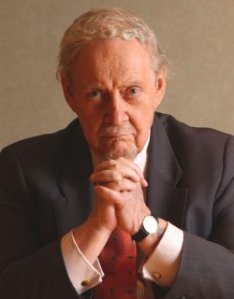
Robert Bork
Former Massachusetts Governor Mitt Romney has been painted by many as the more “rational” Republican candidate for President, as compared to religious fanatics like Rick Perry, Michele Bachmann, and Rick Santorum, and outright crazy men like Herman Cain and Newt Gingrich. But is Mitt really all that rational and reasonable? Not judging by his choice Robert Bork as co-chair of his “Legal Advisory Committee.”
In an interview with Lloyd Grove of Newsweek and The Daily Beast, Bork said that he thinks women are no longer discriminated against.
How about the Equal Protection Clause of the 14th Amendment? Does he still think it shouldn’t apply to women?
“Yeah,” he answers. “I think I feel justified by the fact ever since then, the Equal Protection Clause kept expanding in ways that cannot be justified historically, grammatically, or any other way. Women are a majority of the population now—a majority in university classrooms and a majority in all kinds of contexts. It seems to me silly to say, ‘Gee, they’re discriminated against and we need to do something about it.’ They aren’t discriminated against anymore.”
Does Romney agree with that? Here are a couple more examples of Bork’s legal opinions:
I ask Bork if he still disagrees with the high court’s Griswold v. Connecticut ruling that married couples have a constitutional right to the use of contraception?
“Oh, my God, yes!”
And does he still believe that the First Amendment should be limited to political speech and not protect, as he once wrote, “any other form of expression, be it scientific, literary or…pornographic”?
“Oh yes!” he answers enthusiastically. “If you look at what they say, the First Amendment supposedly defines things like child pornography. The Supreme Court said there was a right to it. That’s actually insane.”
In the interview Bork tried to walk back his opinion of the Civil Rights Act:
Bork criticized the legislation on the ground that government coercion of “righteous” behavior is “a principle of unsurpassed ugliness.”
Now he claims that we’ve already made “the transition to a non-discriminatory society,” and he’s happy with how it all turned out.
Back in 1987, Ronald Reagan nominated Bork for the Supreme Court. Fortunately, the nomination failed, and Bork is still angry about it. Grove asked him if he had forgiven Ted Kennedy and Joe Biden kneecapping his nomination:
Even before the confirmation hearings, Ted Kennedy went on the Senate floor to describe “Robert Bork’s America” as “a land in which women would be forced into back-alley abortions, blacks would sit at segregated lunch counters, rogue police could break down citizens’ doors in midnight raids, schoolchildren could not be taught about evolution, writers and artists would be censored at the whim of government,” and so on and so forth.
I ask Bork if he ever forgave the late Kennedy.
“I’m trying to think of how I could conceivably do that,” says Bork, a convert to Catholicism. “We’re supposed to forgive all kinds of behavior. I shouldn’t deny that I’ve forgiven somebody, or I’ll end up being assigned to the outer circles of Hell. But Ted Kennedy is a test case of the limits of forgiveness.
How about Joe Biden, who chaired his Senate hearing?
“Oh, poor Biden,” Bork says with mock sympathy. “Biden, I think, is not a very thoughtful or intelligent man.”
I think we really need some straight answers from Romney. Does he agree with Bork’s interpretations of the Constitution? If not, why did he drag this crazy man out of his well-deserved obscurity and appoint him as a top legal adviser?

 peej
peej Carissa
 bostonboomer
 dakinikat
 ecocatwoman
 mablue2
 Mama Lopez
 peggysue22
 quixote
 skydancingguestblogger
 Mona (aka Wonk the Vote)



 Sky Dancing
Recent Comments