
Lazy Caturday Reads: “The System Was Blinking Red” and Trump Did Nothing
Posted: March 21, 2020 Filed under: Foreign Affairs, morning reads, Republican politics, U.S. Economy, U.S. Politics | Tags: coronavirus, Covid-19, Donald Trump, intelligence agencies 53 Comments
Reading To Her Cat by Utagawa Kuniyoshi (1797-1861
Good Morning!!
As of this morning, the U.S. has 19,000 Covid-19 cases and 247 deaths. The NIH director says we could have 70,000 reported cases by the end of next week. Meanwhile, the federal government is basically doing nothing. We have an utterly incompetent failed real estate tycoon and reality TV clown as “president.” We have known for years now that this man is completely unfit to lead. In just three years he has crippled our most important institutions and we are now on our own, hoping that state and local governments can take up the slack.
Trump had plenty of warnings about the nature of the threat that was bearing down on our country. Just as before 9/11, when George W. Bush ignored the August 6, 2001 PDB titled “Bin Laden Determined to Strike in U.S.,” the “system has been blinking red for months” and Trump sat around watching TV and tweeting insults to his “enemies,” ignoring the threat to our country.
The Washington Post: U.S. intelligence reports from January and February warned about a likely pandemic.
U.S. intelligence agencies were issuing ominous, classified warnings in January and February about the global danger posed by the coronavirus while President Trump and lawmakers played down the threat and failed to take action that might have slowed the spread of the pathogen, according to U.S. officials familiar with spy agency reporting.
The intelligence reports didn’t predict when the virus might land on U.S. shores or recommend particular steps that public health officials should take, issues outside the purview of the intelligence agencies. But they did track the spread of the virus in China, and later in other countries, and warned that Chinese officials appeared to be minimizing the severity of the outbreak.
By Catriona Millar, Scottish artist
Taken together, the reports and warnings painted an early picture of a virus that showed the characteristics of a globe-encircling pandemic that could require governments to take swift actions to contain it. But despite that constant flow of reporting, Trump continued publicly and privately to play down the threat the virus posed to Americans. Lawmakers, too, did not grapple with the virus in earnest until this month, as officials scrambled to keep citizens in their homes and hospitals braced for a surge in patients suffering from covid-19, the disease caused by the coronavirus.
Intelligence agencies “have been warning on this since January,” said a U.S. official who had access to intelligence reporting that was disseminated to members of Congress and their staffs as well as to officials in the Trump administration, and who, along with others, spoke on the condition of anonymity to describe sensitive information.
“Donald Trump may not have been expecting this, but a lot of other people in the government were — they just couldn’t get him to do anything about it,” this official said. “The system was blinking red.”

Of course, as we all know, Trump doesn’t like to read and he doesn’t listen to intelligence briefings. He thinks he’s “a smart guy” and that his gut feelings are more accurate than the actual knowledge and experience of experts. And he’s still doing almost nothing. He just holds a daily press conference instead of his hate rallies and claims he’s doing things that either aren’t happening or can’t happen.
ProPublica: The White House Asked Manufacturers for Help, Then Gave Them No Clear Instructions.
As hospitals across the country face drastic shortages of masks, respirators and other vital equipment, the White House has sent out a plea for donations that’s left many recipients confused and full of questions.
In at least one instance this week, Vice President Mike Pence, who heads the Trump administration’s coronavirus task force, blindsided private industry by requesting that construction companies donate face masks to hospitals. The White House then failed to provide guidance when directly asked.
Pence asked builders on Tuesday to donate the N95 masks used at many construction sites to local hospitals and refrain from ordering more. Within minutes, Stephen Sandherr, chief executive officer of the trade group Associated General Contractors of America, contacted the White House for more details, said Brian Turmail, a group spokesman.
By Adrie Martens
After receiving no reply from the White House, Sandherr sent an email to AGC’s local chapters on Tuesday telling them that Pence’s statement had taken the group by surprise.
“As we received no advance notice of this announcement and we have received no additional guidance from the Administration, it is our view that this should be considered as a voluntary gesture and not a mandate,” Sandherr wrote. Turmail said several AGC members have donated equipment to their local hospitals.
On Thursday, Sandherr finally heard back from the Department of Health and Human Services, speaking on behalf of the White House, and his group’s members were asked not to donate equipment to hospitals, as Pence had instructed. Instead, he was told the group should collect an inventory of available equipment from members, including masks, booties and protective suits, and share it with the administration.

So instead of cutting red tape, the administration is adding more red tape while more people get sick and more people die.
We’ve been hearing for awhile now that we could be like Italy. I think it’s likely we’ll soon be worse off than Italy, because we our health care system is already breaking down and it looks like Mitch McConnell is determined not to help the people who need it most.
There was talk of sending checks to most Americans immediately; now it turns out the GOP plan is to use tax rebates, so the poorest people would get little or nothing (for example, people like me who live on Social Security don’t file taxes) and people who pay more taxes would get more. That makes no sense economically when millions of people have been thrown out of work and won’t be able to pay rent or eat, but Republicans apparently just don’t care.
The Week: Senate GOP stimulus plan would exclude up to 64 million tax filers from full rebate, economist says.
Senate Republicans unveiled their proposal for sending out cash to Americans amid the COVID-19 coronavirus outbreak, but as is, a large number wouldn’t receive the full amounts.
By Dee Nickerson
Under the economic stimulus plan released Thursday, payments of up to $1,200 would be sent out to individuals and $2,400 to married couples, though the amount phases out for single filers making $75,000 a year and joint filers making $150,000 a year. But The Wall Street Journal notes that “individuals need to have qualifying income of at least $2,500 or income tax liability to get the minimum payment of $600.” This is based on their 2018 tax return.
Looking at IRS data, economist Kyle Pomerleau estimates that about 64 million filers who earn less than $50,000 won’t get the full rebate amount of $1,200 or $2,400, as “for a single filer, income must be at least about $23k to get the full $1,200,” and “for married couple filing jointly, AGI must be about $47k to get the full $2,400,” he writes.

Again, the poorest people don’t even file taxes, so they would be shit out of luck too. Furthermore, the amounts they are talking about wouldn’t even cover a month’s rent in the Boston area or other large cities. Right now I’m very grateful that I live on a fixed income in subsidized housing. But even I have had and will continue to have extra expenses and hardships.
Slate: Republicans Found a Way to Mail Checks and Still Screw People Over.
Senate Republicans have now released their hotly anticipated proposal to send families direct cash payments, as part of a wider economic aid package aimed at combating the coronavirus crisis. And hoo boy is it disappointing.
Under the plan, the government would provide households an early tax rebate worth up to $1,200 for an individual or $2,400 for a married couple, with an extra $500 for each of their children. (So far, so good). The payments will be based on a household’s 2018 tax return, or if it didn’t submit one, their 2019 filing.
Two Cats, by Sandra Bierman
But the checks will shrink for both low and high earners. Americans with little to no tax liability (aka, poor folks) will only receive a minimum payment of $600, unless they earned less than $2,500, in which case they get zilch. Low-wage workers who don’t have a federal tax return for 2018 or 2019—adults generally aren’t required to file one they if earn less than the standard deduction—also won’t qualify for the early rebate. (They could still get it next year if they file taxes for 2020, but by that time it will be a bit late.) Meanwhile, the payments phase down for workers who make more than $75,000 and drop to zero for those making $99,000 and above (double those numbers for joint filers).
Limiting these payments for the upper middle class and up is defensible, even if it irritates commentators who’d prefer a more comprehensive approach that mimics a universal basic income. Penalizing the poor during a pandemic, however, is beyond the pale. We’re in the midst of a planned shutdown of the economy that will disproportionately harm low-wage service workers, yet Republicans are concerned about properly rewarding people for work. It is a crass joke.
It’s worth emphasizing that the GOP’s new plan only calls for a single payment. The M

New York City, Seattle, Boston and parts of California already have such large outbreaks that they will probably see significant growth even after taking extraordinary measures over the past week, the researchers say. New York City’s outbreak, the nation’s largest, grew to more than 4,000 known cases on Friday and is likely to increase many times over even in a favorable scenario.
But cases will continue to mount and millions of people will run out of food. We can only hope that Congress wakes up to reality. Here’s what’s really happening:
The Washington Post: U.S. economy deteriorating faster than anticipated as 80 million Americans are forced to stay at home.
The U.S. economy is deteriorating more quickly than was expected just days ago as extraordinary measures designed to curb the coronavirus keep 84 million Americans penned in their homes and cause the near-total shutdown of most businesses.
Lady Petting a Cat, Paula Zima
In a single 24-hour period, governors of three of the largest states — California, New York and Illinois — ordered residents to stay home except to buy food and medicine, while the governor of Pennsylvania ordered the closure of nonessential businesses. Across the globe, health officials are struggling to cope with the growing number of patients, with the World Health Organization noting that while it required three months to reach 100,000 cases, it took only 12 days to hit another 100,000.
The resulting economic meltdown, which is sending several million workers streaming into the unemployment line, is outpacing the federal government’s efforts to respond. As the Senate on Friday raced to complete work on a financial rescue package, the White House and key lawmakers were dramatically expanding its scope, pushing the legislation far beyond the original $1 trillion price tag.

Read the rest at the WaPo.
The Washington Post: Coronavirus-scarred cities need ‘something bigger than the New Deal’ just to cope.
The coronavirus outbreak is forcing every state, city and county to execute a plan of attack for confronting the global pandemic. It’s a process that Sarah Eckhardt, the top official in Texas’s Travis County, likened to “building the plane while in the air.”
But the virus — and the extraordinarily costly response to it — is also putting enormous pressure on all the normal stuff: the criminal justice, sanitation, transit, emergency response and other systems that residents expect from their state and local governments.
Although the nation is just in the first stages of what is likely to be a prolonged struggle to suppress covid-19, the strain on public services is already beginning to show. First responders are stretched thin. Courts are paralyzed. And everywhere, money for basic public services is running out, fast.
“We have to manage beyond the scope of anything one city has prepared for or can handle,” said Seattle Mayor Jenny Durkan, whose city is among the worst-hit in America. “We’re spending all our reserves right now, but we won’t make it if the federal government doesn’t step up and step up big.”
Read more at the link.
This post is getting too long, so I’ll have to wrap it up. There are so many other stories I’d like to share with you. It’s overwhelming. Please take care and stay healthy, Sky Dancers. This is an open thread.
Friday Dystopian Reads: Living with The Trumpist Regime Pandemic
Posted: March 20, 2020 Filed under: morning reads | Tags: corona virus 51 Comments
Butterfly woman (Life magazine cover by Wladyslaw Benda, 1923)
Good Day Sky Dancers!
How’s the Social Distancing going for those of you that aren’t introverts? Frankly, social distancing is what I call my time away from work and it’s known as peace and quiet finally!!! The worst things right now for me are watching these endless pressers where Trump lies and then every one steps back and clarifies what delusional things he’s announced that simply aren’t true or are terribly distorted. Oh, then Pence does his sycophantic thing.
Fortunately, I’m a remote worker these days and I’m used to the isolation and I have money deposited in my bank. I’m listening to so many of my friends tell me their tales of sudden and unexpected furloughs and unemployment. One set of my friends have had to close their restaurant. Some are relying on take out and delivery but this will be very very brutal for this city. This city will be hit hard on many levels. My heart is with every one going through this that could lose everything and I truly hope we can get the Federal government to help us survive until we can begin to find a new normal together.
I watched a small flock of birds migrating north this morning while walking Temple. Taxes may be postponed but all other forms of life on the planet continue. It’s made me think about the term “nonessential” because it seems that’s what a lot of our jobs, travel, and shopping really are.
We can accept the Trumpist Regime postponing the Federal Tax Date but, as Jon Meacham writes in the NYT times this morning “We Can’t Let Coronavirus Postpone Elections. Even in war, America has kept up its democratic traditions. We can’t stop now.” Getting rid of this inept, crooked, and lying set of Trumpists is our most essential duty this year.
History is on the side of proceeding in times of uncertainty. There’s something in the American character that has long insisted on pressing ahead with democracy’s fundamental task: the casting of ballots and the choosing of leaders. In addition to the Lincoln example, historians know that James Madison was re-elected amid the War of 1812; the midterm elections of 1814 took place not long after the British had invaded Washington; the 1918 balloting occurred despite the ravages of the Spanish flu; 1932 went forward in the face of the Great Depression; and Franklin Roosevelt was re-elected in 1944, during World War II. Even 9/11 delayed the New York City mayoral election only by a matter of weeks.
We have world enough and time — and, in several states, the experience — to make the voting in November safe and secure. Colorado offers us perhaps the most promising model. A “vote at home” state (Hawaii, Oregon and Washington have forms of this, too), Colorado mails ballots to all registered voters well in advance of Election Day. Voters can either mail them back or drop them off at central locations at any point in the weeks-long window of time. Most people have chosen this option; think of it as curbside democracy.
There are security issues, of course: ballots could be intercepted and illegally cast by people with access to a person’s mail. There are, however, signature-checking safeguards in place. No system — including the current one — is perfect. But we can’t let the perfect be the enemy of the good. This coming Monday, Senators Amy Klobuchar and Ron Wyden are introducing legislation to make mail-in ballots available to every voter in America.
We need to have these kinds of conversations about the election honestly, rationally, and now. The sooner the better, for chaos could lead to a nightmare scenario: the possibility that President Trump might take advantage of the unfolding health crisis to delay the November election.

August 27, 1925. Cover by Garrett Price Life, Kitty Kitty,
Adam Sewer–writing for The Atlantic– suggests that “Donald Trump’s Cult of Personality Did This. The autocratic political culture that has propped up the Trump administration has left the nation entirely unprepared for an economic and public-health calamity.”
The president of the United States is a menace to public health.
I don’t mean that I disagree with him on policy, although I do. I don’t mean that I abhor the president’s expressed bigotry toward religious and ethnic minorities, although that is also true. I am not referring to Donald Trump’s efforts to corrupt the Justice Department, shield his criminal associates from legal peril, or funnel taxpayer money to his tacky hotels and golf courses, although all of these things are reason enough to oppose the president.
What I am referring to is the fact that, soon after the coronavirus outbreak emerged in China, the rest of the world began to regard it as a threat to public health, while Trump has seen it as a public-relations problem. Trump’s primary method of dealing with public-relations problems is to exert the full force of the authoritarian cult of personality that surrounds him to deny that a problem even exists. This approach has paid political dividends for the Republican Party, in the form of judicial appointments, tax cuts for the wealthy, and a rapid erosion of the rule of law. But applied to the deadly pandemic now sweeping the planet, all it has done is exacerbate the inevitable public-health crisis, while leaving both the federal government and the entire swath of the country that hangs on his every word unprepared for the catastrophe now unfolding in the United States. The cardinal belief of Trumpism is that loyalty to Trump is loyalty to the country, and that equation leaves no room for the public interest.
Neither the tide of pestilence sweeping the nation nor the economic calamity that will follow was inevitable. They are the predictable outcomes of the president’s authoritarian instincts, his obvious incompetence, and the propaganda apparatus that has shielded him from accountability by ensuring that the public is blinded to his role in the scale of this disaster.
Trump’s first public remarks on the coronavirus came during an interview with the CNBC reporter Joe Kernen on January 22. Kernen asked, “Are there worries about a pandemic at this point?” To which Trump replied, “No. Not at all. And—we’re—we have it totally under control. It’s one person coming in from China, and we have it under control. It’s—going to be just fine.” In February, he falsely declared that “we are very close to a vaccine,” and that “within a couple of days [the number of cases] is going to be down to close to zero.” In early March, he was still urging Americans to ignore the issue, saying, “It will go away. Just stay calm. It will go away.”
One might argue in the president’s defense that panic serves no one. It is important, in fact, that political leaders urge calm in the face of a crisis, even as they prepare for the worst.
Except Trump was not preparing. He was consciously contradicting his administration’s own public-health officials at the time.
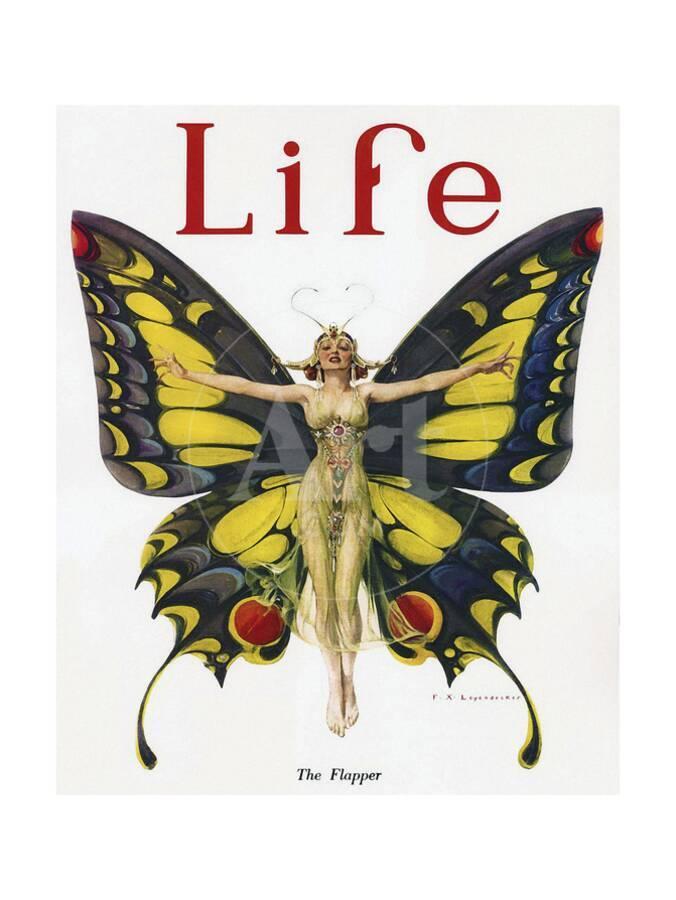
Life Magazine Cover, 1922, Flapper Butterfly, JC Leyendecker
Republican senators have been equally self-dealing and venal.
Bob Brigham / Raw Story: Republican Jim Inhofe dumped up to $450,000 in stock — the fourth GOP senator implicated in scandal: report
Tia Mitchell / Atlanta Journal-Constitution: Perdue, Loeffler among senators whose stock trading during coronavirus raises questions
The first one caught was Senator Burr.
Pro Publica: Senator Dumped Up to $1.6 Million of Stock After Reassuring Public About Coronavirus Preparedness
Greg Sargent provides this analysis in WAPO: “Three big takeaways from the stunning GOP stock-selling revelations”.
Burr’s ‘defense’ actually indicts Trump. One of Burr’s claims in his and Trump’s defense is that it’s unfair to claim daylight between Burr’s private warnings about the coronavirus and Trump’s downplaying of it.
Burr is pointing to a briefing that Trump and administration officials gave in late February, suggesting that this showed that they warned Americans about the need to “begin making plans” for serious inconveniences to come.
But that very same briefing from Trump and his officials actually shows them vastly downplaying the threat and vastly inflating the success of their own efforts.
In it, Trump declared that their strategy was already having “tremendous success, beyond what people thought.” And multiple other officials also hailed the “success” of their containment strategy.
We now know this was the opposite of the truth — the threat was not remotely contained, and the administration’s failures were to blame for it. Burr’s own defense actually shows that the administration was dramatically misleading the public, even as Burr privately warned that the situation was far more dire.
Burr is declining to directly answer questions about the stock sales. But even if you grant that his motives were pure, that cannot expunge the other problem here: that Republicans like him knew in real time that things were surely much worse than Trump was publicly allowing, and likely knew that the administration’s strategy was not remotely matched to the threat.
Here’s an example of the complete ineptitude in all Trumpist activities. The IRS wasn’t aware of the date change for Federal Taxes due.
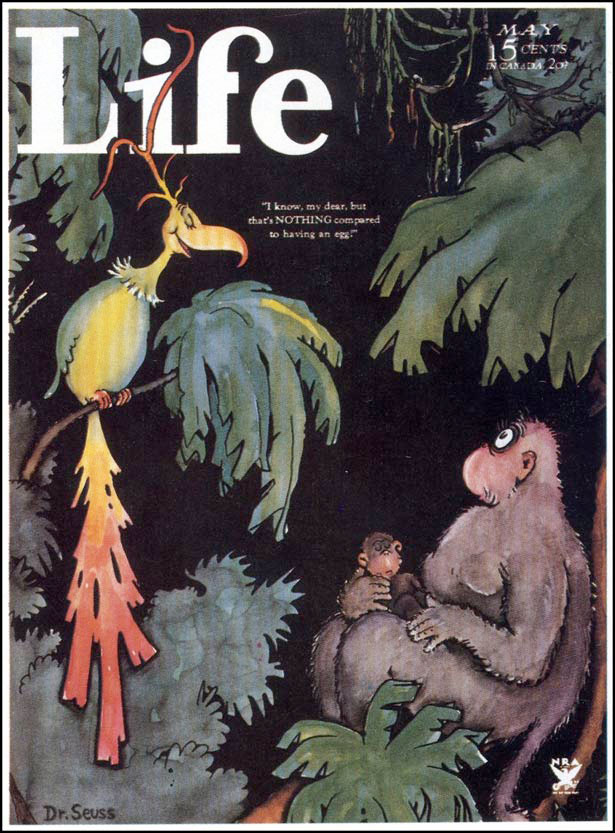
May 1934 Dr Seuss Cover
So, every day we get about two national press opportunities and it becomes an endless and hapless pogrom to confuse all of us. Trump attacks woman reporters asking key questions including suggestions that some of them would be better off dying of the virus. Trump basically announces things no one has heard of in the rest of his administration and confusion ensues. Trump continues to use the race baiting “Chinese virus” trope and refer to pandemic containment efforts as a war. None of these things are remotely comforting, necessary, or useful.
Meanwhile, out in Trumpist La La Land we have headlines like this and the resulting editorial op ed from the Kansas City Star: “Kansas official: Pandemic isn’t a problem here because there are few Chinese people”.
The chairman of the Riley County Commissioners suggested this week that the global coronavirus pandemic is not a problem locally because unlike in Italy, there are not a lot of Chinese people living in central Kansas, according to two other officials who attended the meeting Wednesday night.
Before we go any further, the scientific term for this kind of xenophobic falsehood is bunkum.
Usha Reddi, the mayor of Manhattan, Kansas, went to the meeting hoping that the commissioners would declare an emergency, which they ultimately did. But what she heard from the chairman, Republican Marvin Rodriguez, was this: “I’m paraphrasing, but he said we don’t have a problem here because Italy has a lot of Chinese people, and we don’t have that problem here.”
Reached by phone, Rodriguez told The Star Editorial Board, “I didn’t necessarily say it like that.” So how did he say it? “Italy has a problem with its health department, first. It’s health for everybody. I have a friend in the Navy, and he said in that area” of Northern Italy where that country’s first cases were reported, “there’s a garment industry and a lot of Chinese. If we were like Italy, we’d have it already.”
We do have it already. But, does he understand why it’s dangerous to Asian Americans to talk like that, and that there has been an increase in reported attacks?
“Well, they say it came out of China,” he answered, “and I’m not putting it past the Chinese government in communist China.” Meaning, to export a virus on purpose? “Normally, this kind of thing spreads slowly,” he answered, so “I put two and two together. I’ve been around a long time, girl.”
He also said that his only public policy goal in saying all of this was to try to discourage panic. “We’re hurting a lot of people in Manhattan” by overreacting, he said. “Places are being shut down for no reason at all.”
All of the above not only encourages racist attacks but also encourages the public to ignore the life-saving advice of public health officials to take proper precautions to avoid transmitting the virus.
“This is false information,” Reddi said of Rodriguez’ remarks. “It’s not keeping the community safe. I felt very uncomfortable” hearing his comments about Chinese people.
Life Magazine cover by John LaGatta / January 1929
Ronald Brownstein–writing for The Atlantic— writes: “Red and Blue America Aren’t Experiencing the Same Pandemic. The disconnect is already shaping, even distorting, the nation’s response.”
Even a disease as far-reaching as the coronavirus hasn’t entirely crossed the chasm between red and blue America.
In several key respects, the outbreak’s early stages are unfolding very differently in Republican- and Democratic-leaning parts of the country. That disconnect is already shaping, even distorting, the nation’s response to this unprecedented challenge—and it could determine the pandemic’s ultimate political consequences as well.
A flurry of new national polls released this week reveals that while anxiety about the disease is rising on both sides of the partisan divide, Democrats consistently express much more concern about it than Republicans do, and they are much more likely to say they have changed their personal behavior as a result. A similar gap separates people who live in large metropolitan centers, which have become the foundation of the Democratic electoral coalition, from those who live in the small towns and rural areas that are the modern bedrock of the GOP.
Government responses have followed these same tracks. With a few prominent exceptions, especially Ohio, states with Republican governors have been slower, or less likely, than those run by Democrats to impose restrictions on their residents. Until earlier this week, Donald Trump downplayed the disease’s danger and overstated the extent to which the United States had “control” over it, as the conservative publication The Bulwark recently documented. Conservative media figures including Rush Limbaugh and Sean Hannity likewise insisted for weeks that the media and Democrats were exaggerating the danger as a means of weakening Trump. Several Republican elected officials encouraged their constituents to visit bars and restaurants precisely when federal public-health officials were urging the opposite.
So, the next thing that’s going on is Trumpist suppression of unemployment figures. Will this actually happen?
I agree with Dr. Paul Krugman on this one: “3 Rules for the Trump Pandemic. One: Don’t trust the president.”
The details of our failure are complex, but they all flow ultimately from Trump’s minimization of the threat: He was asserting that Covid-19 was no worse than the flu just last week (although true to form, he’s now claiming to have known all along that a pandemic was coming).
Why did Trump and his team deny and delay? All the evidence suggests that he didn’t want to do or say anything that might drive down stock prices, which he seems to regard as the key measure of his success. That’s presumably why as late as Feb. 25 Larry Kudlow, the administration’s chief economist, declared that the U.S. had “contained” the coronavirus, and that the economy was “holding up nicely.”
Well, that was a bad bet. Since then, the stock market has more or less given up all its gains under the Trump presidency. More important, the economy is clearly in free-fall. So what should we do now?
I’ll leave health policy to the experts. On economic policy, I’d suggest three principles. First, focus on hardship, not G.D.P. Second, stop worrying about incentives to work. Third, don’t trust Trump.

FRANK LEYENDECKER, July 1921 cover
Any one who trusts this President and believes what he says is a major rube and they’re exactly why we’re in this position.
So, my friend and fellow blogger @Adrastosno has given me a huge ear wig this week and I will share it with you.
The title refers to an inscription written by diminutive American actor Michael J. Pollard in Jim Capaldi’s notebook while they were both in Morocco.[1] Capaldi and Pollard were planning to work on a movie that was never filmed. Capaldi said:
Pollard and I would sit around writing lyrics all day, talking about Bob Dylan and the Band, thinking up ridiculous plots for the movie. Before I left Morocco, Pollard wrote in my book ‘The Low Spark of High Heeled Boys.’ For me, it summed him up. He had this tremendous rebel attitude. He walked around in his cowboy boots, his leather jacket. At the time he was a heavy little dude. It seemed to sum up all the people of that generation who were just rebels. The ‘Low Spark,’ for me, was the spirit, high-spirited. You know, standing on a street corner. The low rider. The ‘Low Spark’ meaning that strong undercurrent at the street level.[2]
I cannot tell you how many hours I spent at the piano trying to learn how to riff via this song. And, it’s only this month I realized what the composer/lyricists actually meant. So, maybe we need to keep our low sparks going and get ready to amp them up in November. Remember, the birds are already heading to where they want to be this summer. I’m sure to see that same flock pass over me by fall.
What’s on you reading and blogging list today?
Thursday Reads: Ghost Cities In the Time of Coronavirus
Posted: March 19, 2020 Filed under: morning reads, U.S. Politics 46 Comments
Congress Street near Boston City Hall, typically teaming with tourists and vehicle traffic at 2pm on a Sunday is empty due to the coronvirus, March 16, 2020 (Jim Michaud, MediaNews Group/Boston Herald)
Good Afternoon!!
We truly are living in a whole new world now, and we may never return to the old one.
Gideon Litchfield at MIT Technology Review, March 17, 2020: We’re not going back to normal.
To stop coronavirus we will need to radically change almost everything we do: how we work, exercise, socialize, shop, manage our health, educate our kids, take care of family members.
We all want things to go back to normal quickly. But what most of us have probably not yet realized—yet will soon—is that things won’t go back to normal after a few weeks, or even a few months. Some things never will.
Seattle traffic merging onto interstate, 3PM, Thurs. March 15, Amanda Snyder, Seattle Times
It’s now widely agreed (even by Britain, finally) that every country needs to “flatten the curve”: impose social distancing to slow the spread of the virus so that the number of people sick at once doesn’t cause the health-care system to collapse, as it is threatening to do in Italy right now. That means the pandemic needs to last, at a low level, until either enough people have had Covid-19 to leave most immune (assuming immunity lasts for years, which we don’t know) or there’s a vaccine.
How long would that take, and how draconian do social restrictions need to be? Yesterday President Donald Trump, announcing new guidelines such as a 10-person limit on gatherings, said that “with several weeks of focused action, we can turn the corner and turn it quickly.” In China, six weeks of lockdown are beginning to ease now that new cases have fallen to a trickle.
But it won’t end there. As long as someone in the world has the virus, breakouts can and will keep recurring without stringent controls to contain them. In a report yesterday (pdf), researchers at Imperial College London proposed a way of doing this: impose more extreme social distancing measures every time admissions to intensive care units (ICUs) start to spike, and relax them each time admissions fall. Here’s how that looks in a graph.
The orange line is ICU admissions. Each time they rise above a threshold—say, 100 per week—the country would close all schools and most universities and adopt social distancing. When they drop below 50, those measures would be lifted, but people with symptoms or whose family members have symptoms would still be confined at home.
A woman in New York walks through a lightly trafficked Times Square on March 16.Seth Wenig AP
What counts as “social distancing”? The researchers define it as “All households reduce contact outside household, school or workplace by 75%.” That doesn’t mean you get to go out with your friends once a week instead of four times. It means everyone does everything they can to minimize social contact, and overall, the number of contacts falls by 75%.
Under this model, the researchers conclude, social distancing and school closures would need to be in force some two-thirds of the time—roughly two months on and one month off—until a vaccine is available, which will take at least 18 months (if it works at all). They note that the results are “qualitatively similar for the US.”



I strongly recommend reading the rest at the link above. Like many other publications, Technology Review has made their coronavirus coverage free to everyone.
Another excellent source of information about the coronavirus can be found at Tulane University School of Health and Tropical Medicine, which is publishing a daily newsletter with lists of articles and up-to-date numbers of Covid-19 cases around the world.
We’ve all seen photos of young people partying down in Florida for spring break. They’ve been led to believe that they aren’t vulnerable to Covid-19, but that’s not true.
The New York Times: Younger Adults Make Up Big Portion of Coronavirus Hospitalizations in U.S.
American adults of all ages — not just those in their 70s, 80s and 90s — are being seriously sickened by the coronavirus, according to a report on nearly 2,500 of the first recorded cases in the United States.
The report, issued Wednesday by the Centers for Disease Control and Prevention, found that — as in other countries — the oldest patients had the greatest likelihood of dying and of being hospitalized. But of the 508 patients known to have been hospitalized, 38 percent were notably younger — between 20 and 54. And nearly half of the 121 patients who were admitted to intensive care units were adults under 65, the C.D.C. reported.
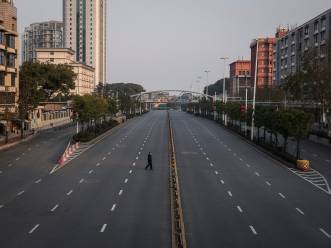
Wuhan, China, Feb 4, 2020, pop 11 million
“I think everyone should be paying attention to this,” said Stephen S. Morse, a professor of epidemiology at Columbia University’s Mailman School of Public Health. “It’s not just going to be the elderly. There will be people age 20 and up. They do have to be careful, even if they think that they’re young and healthy.”
The findings served to underscore an appeal issued Wednesday at a White House briefing by Dr. Deborah Birx, a physician and State Department official who is a leader of the administration’s coronavirus task force. Citing similar reports of young adults in Italy and in France being hospitalized and needing intensive care, Dr. Birx implored the millennial generation to stop socializing in groups and to take care to protect themselves and others.
“You have the potential then to spread it to someone who does have a condition that none of us knew about, and cause them to have a disastrous outcome,” Dr. Birx said, addressing young people.
In the C.D.C. report, 20 percent of the hospitalized patients and 12 percent of the intensive care patients were between the ages of 20 and 44, basically spanning the millennial generation.
See also this piece at The New York Times: A Deadly Coronavirus Mix in Florida: An Aging Population and Lots of Young Visitors.
Young people–at least the ones in Florida right now–don’t seem to be taking this seriously.
And Florida’s Gov. Ron DeSantis isn’t helping. NBC News: Florida governor refuses to shut down beaches amid spread of coronavirus.
Florida Gov. Ron DeSantis refused to issue an order to close the state’s beaches, despite fears regarding the spread of the coronavirus.
He instead signed an order that would limit parties on beaches to 10 people per group and force any businesses authorized to sell liquor to reduce occupancy by half, DeSantis told reporters Tuesday. The governor said that local governments can make their own decisions but that his order would follow the latest guidance issued by the Centers for Disease Control and Prevention.
“What we’re going to be doing for the statewide floor for beaches, we’re going to be applying the CDC guidance of no group on a beach more than 10 and you have to have distance apart if you’re going to be out there,” DeSantis said. “So that applies statewide.”
DeSantis is a Republican, of course.
Why is Covid-19 so contagious and difficult to treat?
The problem is that the coronavirus was transmitted to humans from animals and therefore we have no natural immunity to the disease. David Quammen is a science writer wrote a book, Spillover, about these animal-to-human infections–known as zoonotic diseases–was in 2012. From the NYT review by Dwight Garner:
In his powerful and discomfiting new book, “Spillover: Animal Infections and the Next Human Pandemic,” the science writer David Quammen cites a dismal word we’ll be getting used to in the coming decades, whether we like it or not: zoonosis.
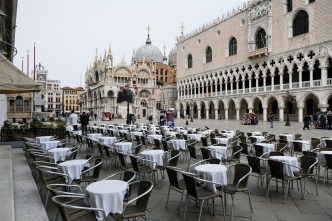
Rome, Italy, March 5, 2020
A zoonosis is an animal infection that, through a simple twist of fate, becomes transmissible to humans. Maybe that twist is a needle prick, or contact with an exotic animal or hiking downwind of the wrong farm.
“It’s a mildly technical term,” he admits, but probably not for long. “It’s a word of the future, destined for heavy use in the 21st In his powerful and discomfiting new book, “Spillover: Animal Infections and the Next Human Pandemic,” the science writer David Quammen cites a dismal word we’ll be getting used to in the coming decades, whether we like it or not: zoonosis….
Ebola and bubonic plague are zoonoses. So are, he writes, in a list that peals off the tongue like a distraught Allen Ginsberg poem or an outstanding list of death metal band names, “monkeypox, bovine tuberculosis, Lyme disease, West Nile fever, Marburg virus disease, rabies, hantavirus pulmonary syndrome, anthrax, Lassa fever, Rift Valley fever, ocular larva migrans, scrub typhus, Bolivian hemorrhagic fever, Kyasanur forest disease, and a strange new affliction called Nipah encephalitis, which has killed pigs and pig farmers in Malaysia.”

A couple in Barcelona, Spain, embrace in Catalunya Square on March 15.David RamosGetty I mages
AIDS, he adds, that destroyer of 30 million people, is of zoonotic origin.
In “Spillover” Mr. Quammen investigates many of these diseases, some more than others. He describes the baffled horror of initial outbreaks and then tracks calmly backward. He talks to virologists, doctors, field biologists and survivors about how the animal-to-human infection came to pass. He hopscotches the globe like a journalistic Jason Bourne. Often there aren’t doctors left to be interviewed. The medical personnel who first came into contact with sick patients are frequently dead.
Here’s an article by Quammen in from the January 28, 2020 New York Times: We Made the Coronavirus Epidemic. It may have started with a bat in a cave, but human activity set it loose.
The latest scary new virus that has captured the world’s horrified attention, caused a lockdown of 56 million people in China, disrupted travel plans around the globe and sparked a run on medical masks from Wuhan, Hubei Province, to Bryan, Texas, is known provisionally as “nCoV-2019.” It’s a clunky moniker for a lurid threat.
The name, picked by the team of Chinese scientists who isolated and identified the virus, is short for “novel coronavirus of 2019.” It reflects the fact that the virus was first recognized to have infected humans late last year — in a seafood and live-animal market in Wuhan — and that it belongs to the coronavirus family, a notorious group. The SARS epidemic of 2002-3, which infected 8,098 people worldwide, killing 774 of them, was caused by a coronavirus, and so was the MERS outbreak that began on the Arabian Peninsula in 2012 and still lingers (2,494 people infected and 858 deaths as of November).
Police officers patrol the empty Trocadero plaza next to the Eiffel Tower in Paris on March 17, 2020, Francois Mori AP
Despite the new virus’s name, though, and as the people who christened it well know, nCoV-2019 isn’t as novel as you might think.
Something very much like it was found several years ago in a cave in Yunnan, a province roughly a thousand miles southwest of Wuhan, by a team of perspicacious researchers, who noted its existence with concern. The fast spread of nCoV-2019 — more than 4,500 confirmed cases, including at least 106 deaths, as of Tuesday morning, and the figures will have risen by the time you read this — is startling but not unforeseeable. That the virus emerged from a nonhuman animal, probably a bat, and possibly after passing through another creature, may seem spooky, yet it is utterly unsurprising to scientists who study these things.

Read the rest at the NYT.
Three interviews with David Quammen to check out:
Orion Magazine, March 17, 2020: Why David Quammen Is Not Surprised.
Bozeman Daily Chronicle, February 28, 2020: Quammen: Coronavirus epidemic not a one-time threat.
An audio interview with Quammen at Scientific American, March 18, 2020: David Quammen: How Animal Infections Spill Over to Humans.
One more article about zoonotic diseases from Scientific American, March 18, 2020: Destroyed Habitat Creates the Perfect Conditions for Coronavirus to Emerge.
Those are my recommended reads (and one listen) for today. What stories have you been following?
Tuesday Reads: Trump Seemingly Wakes Up To Reality
Posted: March 17, 2020 Filed under: morning reads, U.S. Politics 44 Comments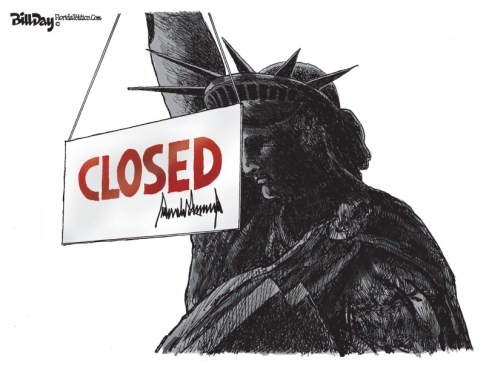
Good Morning!!
Yesterday Trump finally appeared to be waking up to reality. He walked out to the afternoon coronavirus briefing looking like he did when he came out of his secret meeting with Putin in Helsinki–shoulders slumped, feet dragging, appearing beaten and humiliated. Watch:
Suddenly Trump seemed to be taking the global pandemic seriously. What changed his attitude overnight? It’s not completely clear, but there are a few possibilities. One is a new report that was sent to the White House over the weekend. Axios: Dire new report forces U.S. and U.K. to change course on coronavirus strategy.
A startling new report from Imperial College London warns that 2.2 million Americans and 510,000 Britons could die from coronavirus if extreme action isn’t taken to change the course of the outbreak.
Why it matters: The report’s dire warnings prompted a quick course correction from both the American and British governments on their strategies, but its strict recommendations and long timeline — 18 months — to stem the tide could have far-reaching implications for both populations and economies.
What they found: The report states the effectiveness of “mitigation,” which includes isolating only the sick and those linked to them while advocating social distancing for at-risk groups, is limited. It instead recommends “suppression,” a much more wide-ranging tactic to curb coronavirus’ spread.
The researchers say that suppression “will minimally require a combination of social distancing of the entire population, home isolation of cases and household quarantine of their family members.” It also recommends school closures.
The report notes that this strategy could have to be in place until a vaccine is developed, which could take 18 months — saying it is “the only viable strategy at the current time.”
Worth noting: While China and South Korea have managed to suppress the outbreak using similarly draconian strategies, the report admits that it’s not yet clear if suppression’s successes can last in the long-term.
Buzzfeed News: The UK Only Realised “In The Last Few Days” That Its Coronavirus Strategy Would “Likely Result In Hundreds of Thousands of Deaths.”
The UK only realised “in the last few days” that attempts to “mitigate” the impact of the coronavirus pandemic would not work, and that it needed to shift to a strategy to “suppress” the outbreak, according to a report by a team of experts who have been advising the government.
The report, published by the Imperial College COVID-19 Response Team on Monday night, found that the strategy previously being pursued by the government — dubbed “mitigation” and involving home isolation of suspect cases and their family members but not including restrictions on wider society — would “likely result in hundreds of thousands of deaths and health systems (most notably intensive care units) being overwhelmed many times over”.
 The mitigation strategy “focuses on slowing but not necessarily stopping epidemic spread — reducing peak healthcare demand while protecting those most at risk of severe disease from infection”, the report said, reflecting the UK strategy that was outlined last week by Boris Johnson and the chief scientific adviser Patrick Vallance.
But the approach was found to be unworkable. “Our most significant conclusion is that mitigation is unlikely to be feasible without emergency surge capacity limits of the UK and US healthcare systems being exceeded many times over,” perhaps by as much as eight times, the report said.
In this scenario, the Imperial College team predicted as many as 250,000 deaths in Britain.
“In the UK, this conclusion has only been reached in the last few days,” the report explained, due to new data on likely intensive care unit demand based on the experience of Italy and Britain so far.
“We were expecting herd immunity to build. We now realise it’s not possible to cope with that,” professor Azra Ghani, chair of infectious diseases epidemiology at Imperial, told journalists at a briefing on Monday night.
Read more at Buzzfeed. Also see this detailed analysis at BBC News: Coronavirus: UK changes course amid death toll fears.
The New York Times on the new White House message, based on the report: White House Takes New Line After Dire Report on Death Toll.
Sweeping new federal recommendations announced on Monday for Americans to sharply limit their activities appeared to draw on a dire scientific report warning that, without action by the government and individuals to slow the spread of coronavirus and suppress new cases, 2.2 million people in the United States could die.
To curb the epidemic, there would need to be drastic restrictions on work, school and social gatherings for periods of time until a vaccine was available, which could take 18 months, according to the report, compiled by British researchers. They cautioned that such steps carried enormous costs that could also affect people’s health, but concluded they were “the only viable strategy at the current time.”
That is because different steps, intended to drive down transmission by isolating patients, quarantining those in contact with them and keeping the most vulnerable apart from others for three months, could only cut the predicted death toll by half, the new report said.
The White House guidelines urged Americans to avoid gatherings of more than 10 people. That is a more restrictive stance than recommendations released on Sunday by the U.S. Centers for Disease Control and Prevention, which said that gatherings should be limited to 50.
The White House also recommended that Americans work from home, avoid unnecessary shopping trips and refrain from eating in restaurants. Some states and cities have already imposed stricter measures, including lockdowns and business closings. Asked at a news conference with President Trump about what had led to the change in thinking by a White House task force, Dr. Deborah Birx, one of the task force leaders, said new information had come from a model developed in Britain.
“What had the biggest impact in the model is social distancing, small groups, not going in public in large groups,” Dr. Birx said. “The most important thing was if one person in the household became infected, the whole household self-quarantined for 14 days. Because that stops 100 percent of the transmission outside of the household.”
Read more at the NYT.
Trump previously had been listening to advice from his son-in-law Jared Kushner–who know absolutely nothing about science or pandemic diseases. Now he is supposedly “pissed” at Kushner for misleading him. Gabriel Sherman at Vanity Fair:
With the markets in free fall despite emergency action by the Fed over the weekend, Trump is waking up to the reality that’s been clear to everyone: Coronavirus poses a once-in-a-hundred-years threat to the country. “In the last 48 hours he has understood the magnitude of what’s going on,” a former West Wing official told me. As Trump processes the stakes facing the country—and his presidency—he’s also lashing out at advisers, whom he blames for the White House’s inept and flat-footed response. Sources say a principal target of his anger is Jared Kushner. “I have never heard so many people inside the White House openly discuss how pissed Trump is at Jared,” the former West Wing official said.
Sources told me Trump is regretting that Kushner swooped into the coronavirus response last week. Kushner, according to sources, encouraged Trump to treat the emergency as a P.R. problem when Fauci and others were calling for aggressive action. “This was Jared saying the world needs me to solve another problem,” a former White House official said. One source briefed on the internal conversations told me that Kushner advised Trump not to call a national emergency during his Oval Office address on March 11 because “it would tank the markets.” The markets cratered anyway, and Trump announced the national emergency on Friday. “They had to clean that up on Friday,” another former West Wing official said. Trump was also said to be angry that Kushner oversold Google’s coronavirus testing website when in fact the tech giant had a fledgling effort. Trump got slammed in the press for promoting the phantom Google product. “Jared told Trump that Google was doing an entire website that would be up in 72 hours and had 1,100 people working on it 24/7. That’s just a lie,” the source briefed on the internal conversations told me.
Politico has an analysis of the possible economic consequences of the pandemic: How ugly could it get? Trump faces echoes of 1929 in coronavirus crisis.
The early signals from the coronavirus crisis point to a scale of damage unseen in the modern U.S. economy: the potential for millions of jobs lost in a single month, a historic and sudden plunge in economic activity across the nation and a pace of sharp market swings not seen since the Great Depression.
As the coronavirus outbreak ravages a paralyzed nation, Wall Street suffered another brutal bloodbath on Monday with the Dow Jones Industrial Average diving around 13 percent in its worst percentage loss since 1987’s “Black Monday” crash. A reading on business conditions in the New York area plunged a record 34.4 points to -21.5 in March, suggesting a recession is underway that could be sharp and deep as revenue quickly bleeds out of major industries from airlines to hotels, restaurants, bars and sports leagues.
The Standard & Poor’s 500-stock index, the broadest gauge of U.S. companies, fell 12 percent. It has shed $6 trillion in value since peaking in February, slamming retirement accounts for millions of Americans in ways that could have psychological ripples for many months to come. The last time the S&P had three days of similar wild swings was 1929, on the eve of the Great Depression.
The S&P is now only around 300 points away from wiping out all its gains since Donald Trump won the White House in November 2016. President Trump himself, one of the grandest boasters of the strength and resilience of markets and the American economy, appeared to capitulate on Monday with a more somber tone reflecting the immense magnitude of the challenge facing the nation.
Read the rest at the link.
Meanwhile, there are three Democratic primaries today. The Washington Post: Democratic primaries live updates: Voters in three states head to polls to weigh in on Biden-Sanders contest; Ohio postpones voting amid coronavirus outbreak.
Voters in three states — Arizona, Florida and Illinois — are headed to the polls Tuesday amid the coronavirus pandemic to weigh in on the Democratic presidential contest between former vice president Joe Biden and Sen. Bernie Sanders (I-Vt.), while Ohio’s governor has declared a “health emergency” to postpone scheduled voting there.
Ohio Gov. Mike DeWine (R) announced late Monday that the polls would not open in his state despite a state judge’s ruling that the election must go on.
A total of 441 delegates to the Democratic National Convention are at stake in Arizona, Florida and Illinois. Biden is looking to build on his momentum of recent weeks and extend an advantage over Sanders in a nominating contest transformed by the coronavirus outbreak and full of uncertainty.
More stories to check out:
Raw Story: Coronavirus death toll passes 7,000 as WHO urges world to ‘test, test, test.’
The Washington Post: On Fox News, suddenly a very different tune about the coronavirus.
The Washington Post: How U.S. coronavirus testing stalled: Flawed tests, red tape and resistance to using the millions of tests produced by the WHO.
The New York Times: Inside the Coronavirus Response: A Case Study in the White House Under Trump.
Vanity Fair: Why the Fed’s Rate Cut Tanked the Market.
NPR: Poll: Americans Don’t Trust What They’re Hearing From Trump On Coronavirus.
The New York Times: Mayor Resisted Drastic Steps on Virus. Then Aides Said They’d Quit.
The Daily Beast: Sanders Not Planning to Quit Race After Tuesday’s Votes, Aides Say.
CNN: Toilet paper makers: ‘What we are dealing with here is uncharted.’
What stories are you following today?
Monday Mood Reads: It’s getting real out there
Posted: March 16, 2020 Filed under: 2020 Elections, morning reads | Tags: COVID19 44 Comments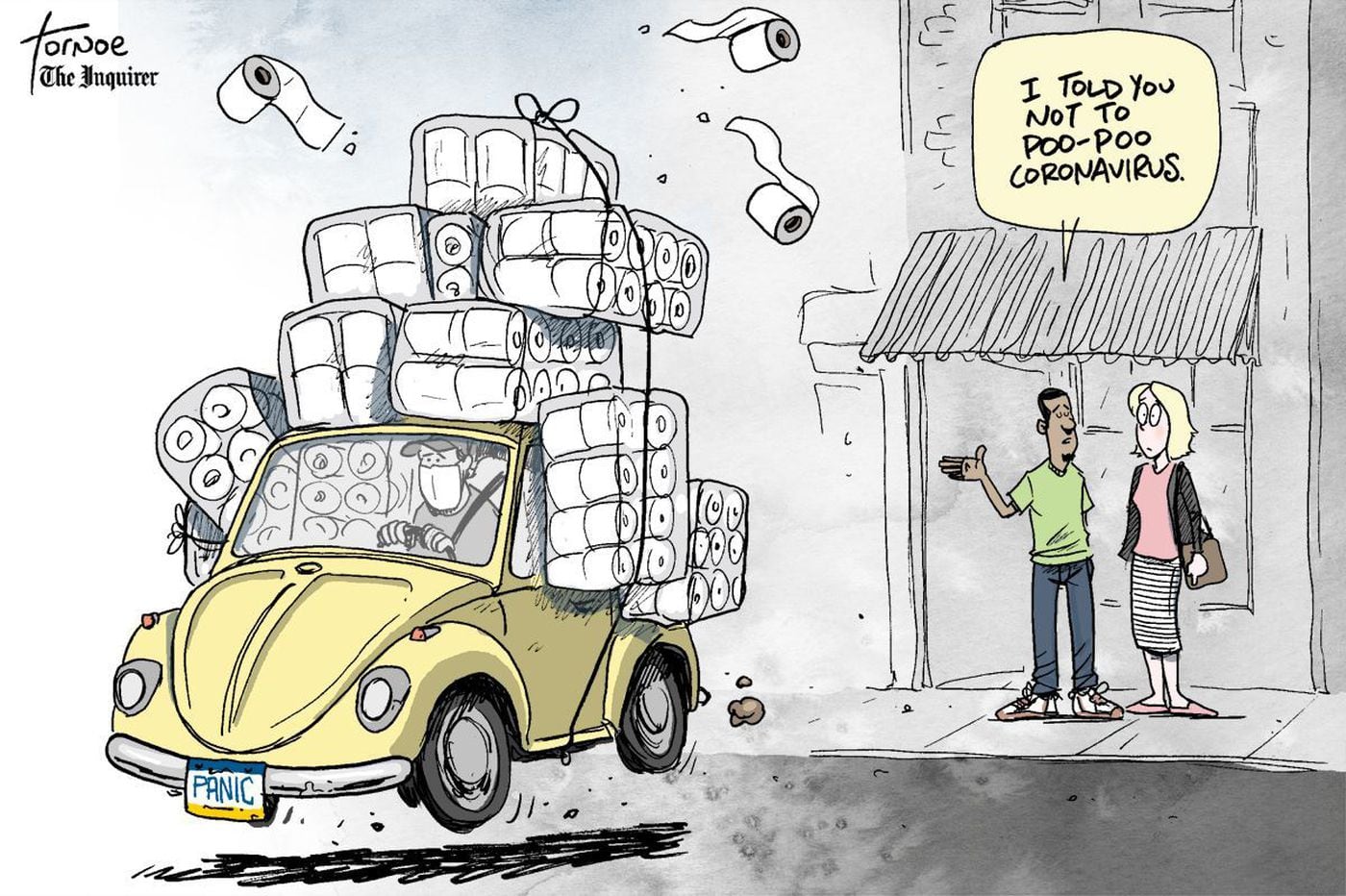
Good Day Sky Dancers!
The weirdest news of the day continues to be the lines at Trader Joe’s and Whole Foods as white burbies do their panic hording of toilet paper. Did I miss the memo on the magical impact of Northern and Scott to keep them ensconced in the white burbie bubble? Panic buying is just one of things that make us human, I guess. I’ve stocked up on a few things myself now but only because I’m convinced they’ll run the store empty and my plan is to go out as little as possible.
There’s nothing quite like the behavior of panicky humans—especially when it comes to hoarding. Let a blizzard approach or a hurricane churn toward shore, and we descend on stores, buying up more batteries, bottled water and canned foods than we could use in a lifetime. We’re seeing the same thing again as America hunkers down against the novel coronavirus, and of all of the products that are being snatched up the fastest, there’s one that’s in special demand: toilet paper.
The Washington Post reports a run on the rolls, with both Costco and the Giant supermarket chain stripped all but clean. Even Amazon’s physical stores “appeared to be down to single rolls of novelty toilet paper in some places Friday,” the Post said. The New York Times similarly reports from a Whole Foods supermarket in Somerville, Mass., where shoppers had to be limited to two packages of toilet paper each, lest they strip the store bare.
But why? What is it about toilet paper—specifically the prospect of an inadequate supply of it—that makes us so anxious? Some of the answer is obvious. Toilet paper has primal—even infantile—associations, connected with what is arguably the body’s least agreeable function in a way we’ve been taught from toddlerhood. Few, if any of us, remember a time when we weren’t acquainted with the product.

Ir’s no wonder that I just got emails from my German students telling me their government has told them to get out of the US. That’s right, the German government has decided it’s not safe for them to be here. I’m assuming they fully believe that it’s just a matter of time before US hospitals are overwhelmed. It hasn’t stopped US college students from partying on dude.
A lot played out this weekend but the adult playpen areas like Bourbon Street, Nashville, and Ft Lauderdale continued to party on dude even as the major events for the tourist traps of America were shut down. Student in Tulane were filling the campus’ dumpsters with furniture and home appliances as they were tossed out of their dorms. Still, the first death in New Orleans of Covid19 didn’t stop wall to wall humanity on Bourbon Street or the Irish Channel despite that St Joseph’s an St Patrick’s parade being cancelled and all sporting events were cancelled. The mayor finally sent the police in to clear the crowds.
By day, lower Magazine Street was packed with people in kilts and green shamrocks Saturday despite the cancellation of the city’s official St. Patrick’s Day parades, with many revelers appearing to hope that the luck of the Irish would be enough to keep the new coronavirus at bay.
By night, New Orleans police broke up a bustling party at a local bar, and Mayor LaToya Cantrell issued a strong statement, imploring people to practice “social distancing” to stop the spread of coronavirus. Around 6 p.m. Saturday, New Orleans officers arrived at Tracey’s Original Irish Channel Bar, one of the traditional epicenters of the St. Patrick’s Day holiday in the city, to break up a large party there.
Public officials have taken steps to limit gatherings in an effort to keep the virus from moving quickly through the population. Gov. John Bel Edwards has closed schools for several weeks and barred events where 250 people or more gather. But warnings from the governor and Cantrell about avoiding close contact and large gatherings were scarcely heeded Saturday along Magazine Street, through the Irish Channel and Garden District, where the streets were bustling.
Cantrell said that to fight this virus required social distancing, carried out in all seriousness.

So, while some people spend endless time in lines buying cans of tuna, peanut butter, and toilet paper others day drink with their closest 500 or so friends. Right. This is America. They’re also hoarding guns and panic buying guns.
Some further local news that’s surreal from any vantage point. The French Market has been open continuously for over 300 years and it will be closing down today for an undetermined period.
Probably the most profoundly disturbing image yesterday was the Trumperz suprise visit to Pence’s attempt to bring some gravity to a Presser. It’s been evident that number of cases is on the rise and the number of deaths have just started to look disturbing. But hey, Trumperz was just a happy camper as the Board of Governors at the FED sent prices at the zero bound. And, I ask you again? Who is going to get a loan and like, buy something like a car right now?
So, Trumperz said “investors should be thrilled.”
Investors this morning to Trumperz (via the WSJ) :“Stocks Open Sharply Lower After Fed Slashes Rates. U.S. stocks drop 8%, while bond yields plummet again.” He just doesn’t get anything right ever. Oh, and then there’s this via CNBC: “Stock futures drop — hit ‘limit down’ — even as Fed slashes rates; Dow futures off 1,000 points Stock futures plunged Sunday night even after the Federal Reserve embarked on a massive monetary stimulus campaign to curb slower economic growth amid the coronavirus outbreak.”

The real real is getting serious too. From the Seattle Times: “EvergreenHealth doctor tests positive for coronavirus, in critical condition”.
An emergency room doctor at EvergreenHealth in Kirkland is in critical condition with COVID-19, the disease caused by the new coronavirus.
The hospital at the center of the coronavirus outbreak in King County confirmed that the doctor was ill Sunday afternoon.
“EvergreenHealth is providing care for one of our physicians who has a confirmed case of COVID-19. He is in critical condition but stable. Out of respect for our patient’s privacy and that of his family, there is nothing more we can share at this time,” says a brief statement issued by the hospital on Sunday.
The physician, who is in his 40s, has been admitted to the intensive-care unit and could be the first front-line health care worker in the state to test positive for the disease, said Dr. Liam Yore, the immediate past president of the Washington Chapter of the American College of Emergency Physicians.
Yore is an emergency room doctor who works primarily at Providence Regional Medical Center in Everett but is also on staff at EvergreenHealth. He spoke to The Seattle Times on behalf of his professional organization and not as a representative of the hospitals.
“There was an initial test on Tuesday and that came back negative,” Yore said of his EvergreenHealth colleague, who he described as “a dedicated and selfless physician.”

That’s not the hospital where my daughter practices but it is damn close. USA’s headline today is the best advice these days: “The best thing everyday Americans can do to fight coronavirus? #StayHome, save lives ” That’s certainly my plan. I’m facing down 65 in November and while I’m relatively healthy, I will not be tempting fate.
I did watch a bit of the debate last night but was just overwhelmingly depressed especially after seeing parts of that stupid Presser. Old White men will be the death of us all. We’re going to have to vote for Biden to save what’s left of our country, but damn, I wish it didn’t come down to this. Here are some headlines.
“Trump finds his MAGA movement fracturing over coronavirus — Just two weeks after President Donald Trump rallied conservatives to focus on the threat of socialism, his followers are splintering over the coronavirus pandemic. ” via Politico.
“Biden leads Trump by 9 points in a one-to-one matchup with Trump: via MSNBC.
“Biden and Bernie face off: Key moments from Sunday’s debate” also via Politico. They even elbow bumped.
Under the cloud of the coronavirus pandemic, they talked about bailouts — and hand sanitizer. Biden said he washes his hands—a lot—”God knows how many times a day!”
Biden and Sanders met Sunday night, with Biden looking to open up a commanding lead for the nomination Tuesday and with the nation struggling to contain the fast-moving coronavirus.
The debate comes amid escalating spread of the disease that is dramatically altering Americans’ way of life and the normal rhythms of a campaign. In-person rallies and fundraisers have gone digital. Staffers are working from home. And Sanders’ chances to shift the dynamic in his favor have become even more limited.
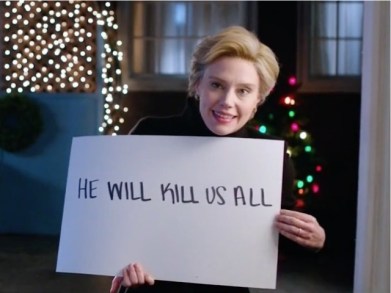
The last thing you should try to read today is from David Leonhardt and the NYT. It’s really a depressing dose of reality but we need it. “A Complete List of Trump’s Attempts to Play Down Coronavirus — He could have taken action. He didn’t. ”
President Trump made his first public comments about the coronavirus on Jan. 22, in a television interview from Davos with CNBC’s Joe Kernen. The first American case had been announced the day before, and Kernen asked Trump, “Are there worries about a pandemic at this point?”
The president responded: “No. Not at all. And we have it totally under control. It’s one person coming in from China, and we have it under control. It’s going to be just fine.”
By this point, the seriousness of the virus was becoming clearer. It had spread from China to four other countries. China was starting to take drastic measures and was on the verge of closing off the city of Wuhan.
In the weeks that followed, Trump faced a series of choices. He could have taken aggressive measures to slow the spread of the virus. He could have insisted that the United States ramp up efforts to produce test kits. He could have emphasized the risks that the virus presented and urged Americans to take precautions if they had reason to believe they were sick. He could have used the powers of the presidency to reduce the number of people who would ultimately get sick.
What’s on your reading and blogging list today?

 peej
peej Carissa
 bostonboomer
 dakinikat
 ecocatwoman
 mablue2
 Mama Lopez
 peggysue22
 quixote
 skydancingguestblogger
 Mona (aka Wonk the Vote)



 Sky Dancing
Recent Comments