
Slash and Burn Republicanism is not Good for the Country, our Children, and other Living Things
Posted: September 18, 2013 Filed under: Fiscal Cliff, right wing hate grouups, Rush Limbaugh, The Bonus Class, U.S. Economy, U.S. Politics | Tags: budget woes, fiscal cliff, SNAP 12 Comments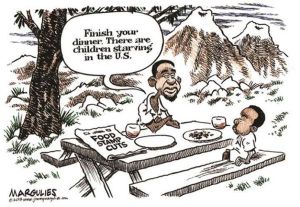 Some time during the Reagan campaign, our government became the enemy of a huge number of people in this country. Paranoia over a democratically elected government enshrined by voters and a sophisticated legal and political system is usually confined to a groups of paramilitary paranoids that call themselves preppers, read too much Ayn Rand, and never emotionally develop beyond, say high school. Through the money of the Koch Brothers, the pulpit connivings of Pat Robertson and the paranoid shrieking of folks like Glenn Beck and Rush Limbaugh that have failed at every endeavor but snake oil peddling on the radio, we now have entire sections of the country that gerrymander legislators to send these freaks to Congress.
Perry and like-minded Republican governors subscribe to the slash-and-burn economic philosophy — a belief that “less” will somehow become “more.” In Texas, he has implemented this vision with gusto, cutting taxes and slashing funding for critical middle-class priorities such as public schools, higher education, health care and infrastructure. The results? Texas ranks 49th in high school graduation, 10th in the rate of poverty and 50th in the percent of residents with even basic health insurance.
And while Perry likes to promote the job creation in Texas during his time in office, he leaves out a critical point: The jobs “miracle” he touts is driven by low-paying, non-sustainable jobs. This year, Texas — tied with Mississippi — leads the nation for the percentage of hourly paid workers earning equal to or less than the minimum wage. More than one in 10 workers nationwide earning at or below the minimum wage works in Texas.
Let’s not even go into the social costs of letting Texas businesses operate however they want to. Just ask the towns and farms that no longer have water and are nsubjected to earthquakes due to fracking. We can also mention the town that mostly disappeared from a fertilizer plant explosion that killed 14 people. Wait until Texas property owners and taxpayers get the bills for those kinds of preventable disasters. I’m fairly certain that northern Texas will soon be paying more for water than the world will pay for its oil. In fact, I’ll stake all my years drawing supply and demand graph on it.
Then, there is a new kick-the-can down the road effort on the 2013 Farm Bill that’s going to leave a lot of American children starving. Republican members of Congress appear to still think that folks live large off of Food Stamps. It’s the old untrue Welfare Queen canard peddled by Reagan back in the 1980s come back to haunt us.
An extension does not solve problems. Congress is currently engaged in a philosophical debate about federal nutrition programs, namely, the farm bill’s Supplemental Nutrition Assistance Program (SNAP). Some members of Congress believe the program and its current level of benefits and eligibility requirements are appropriate, particularly in this challenging economic time. Others erroneously believe the program is fraught with waste, fraud and abuse and want to cut funding and benefits to vulnerable families.
Regardless of where one falls on this issue, it is clear that an extension of the current farm bill is inadequate from both perspectives. Members wanting to preserve existing funding for this vital safety net program should welcome the long-term policy certainty provided by a five-year comprehensive bill, rather than leaving SNAP vulnerable to cuts year after year. And members interested in cutting funding from SNAP won’t achieve any of the so-called reforms they desire without the passage of a new five-year bill; an extension merely perpetuates the status quo.
Rather than waste time on a nutrition-only bill to be brought up in the House next week that would leave between 4 and 6 million Americans ineligible for full SNAP benefits, according to an analysis by the Center on Budget and Policy Priorities, or pass an extension that merely kicks the can down the road, Congress must instead preserve the historic coalition between farmers and consumers in need and pass a comprehensive five-year farm bill that includes both farm and nutrition programs.
Then, here we go again on shutting down the budget process, a debt ceiling increase, and vital services over providing more health care to individuals through the Affordable Health Care Act. Once again, I remind every one that this act is basically the Heritage Institute Plan of the 1990s. It was the Republican answer to “HillaryCare”. How far down the path of slash and burn have we gone that today’s Republican’s reject their “conservative” plan of less than 20 years ago? Here’s an argument for a shutdown.
I’m quickly coming to the conclusion that a government shutdown may be the only way to deal with the coming budget bedlam and #cliffgate.
Let’s start by reviewing the situation.
- As of today there are less than two weeks before fiscal 2014 begins.
- None of the FY14 appropriations have been enacted; none have any chance of being enacted.
- There are no formal negotiations going on between Congress and the White House, between the House and Senate or between Democrats and Republicans.
- The only discussions that seem to be taking place are between the two main factions in the House GOP…and the best thing that can be said about them is that they appear to be going nowhere.
- The original plan suggested by the House Republican leadership was flatly rejected by the tea partiers in the House GOP caucus. The tea partiers were energized by their success.
- House Speaker John Boehner (R-OH) and Majority Leader Eric Cantor (R-VA) haven’t put a new plan on the table since their last plan was rejected by members of their own party a week ago. Boehner has even indicated publicly that he’s not sure whether there is a plan than is acceptable to his caucus.
- Meanwhile, in keeping with the tradition that the House goes first on CRs, Senate Majority Leader Harry Reid (D-NV) has said he is going to wait for the House to act before moving forward. What happens when/if he moves forward is anyone’s guess
- Senate Minority Leader Mitch McConnell (R-KY) has far less room to maneuver compared to previous budget fights because he is being challenged in the GOP Kentucky primary by a tea partier.
- House Democrats, who in the past have provided the votes to help the House GOP pass budget-related bills when the Republican caucus couldn’t decide what to do, this time seem hell bent on not doing it again.
- The White House has far less sway over congressional Democrats now than it did before the 2012 election. Needless to say, it has almost none over congressional Republicans.
- The extremely negative political impact of the 1995-96 shutdowns is such a distant (or nonexistent) memory for so many House Republicans that it’s not at all clear they have any fear of it happening again in 2013.
- To top it all off, this year’s budget debate is less about the budget than it is about defunding Obamacare and that makes a compromise far harder on the budget issues.
Two things usually help with a political stalemate like this (although I’m not really sure there ever has been a situation exactly like this one):
- A charismatic leader who can overcome the partisan warfare
- A crisis that substantially changes the politics
It’s hard to see any leader emerging in the short-term In the current hyper partisan environment. And while there are many charismatic politicians, at least right now none have the stature with both parties to negotiate a budget peace plan.
That leaves a crisis, and baring a military or foreign policy disaster, the only one with the potential to create enough political pain in a relatively short period of time is a federal shutdown.
That makes a shutdown a better option for Boehner, Cantor, McConnell and Reid than it might otherwise seem.
A shutdown also may work for Boehner because (1) it will show his tea partiers that he was willing to allow it to happen as they wanted, (2) it will change the politics as many voters go from being amused to being furious and (3) the tea partiers may be able to use the shutdown with their own voters to prove their political testosterone.
As usual, there’s a group of greedy billionaires behind the shutdown mentality. It seems they all make lots of money just from all the hooplah.
Club for Growth and other extremist groups consider a record like his an unforgivable failure, and they are raising and spending millions to make sure that no Republicans will take similar positions in the next few weeks when the fiscal year ends and the debt limit expires.
If you’re wondering why so many House Republicans seem to believe they can force President Obama to accept a “defunding” of the health care reform law by threatening a government shutdown or a default, it’s because these groups have promised to inflict political pain on any Republican official who doesn’t go along.
Heritage Action and the Senate Conservatives Fund have each released scorecards showing which lawmakers have pledged to “defund Obamacare.” When a senator like Tom Coburn of Oklahoma refuses to pledge, right-wing activists are told: “Please contact Senator Coburn and tell him it’s dishonest to say you oppose Obamacare, but then vote to fund it. Tell him he swore an oath to support and defend the Constitution.”
Mr. Schock and 10 other lawmakers considered suspiciously squishy by the Club for Growth were designated as RINO’s (Republicans in name only), and the club has vowed to find primary opponents and support them with cash — a formidable threat considering that it spent $18 million backing conservative candidates in the 2012 cycle. Americans for Prosperity, a Koch brothers group that has already spent millions on ads fighting health reform, is beginning a new campaign to delay the law’s effects.
These groups, all financed with secret and unlimited money, feed on chaos and would like nothing better than to claim credit for pushing Washington into another crisis. Winning an ideological victory is far more important to them than the severe economic effects of a shutdown or, worse, a default, which could shatter the credit markets.
They also have another reason for their attacks: fund-raising. All their Web sites pushing the defunding scheme include a big “donate” button for the faithful to push. “With your donation, you will be sending a strong message: Obamacare must be defunded now,” saysthe Web site of the National Liberty Federation, another “social welfare” group that sees dollar signs in shutting down the government.
Brian Walsh, a longtime Republican operative, recently noted in U.S. News and World Report that the right is now spending more money attacking Republicans than the Democrats are. “Money begets TV ads, which begets even more money for these groups’ personal coffers,” he wrote. “Pointing fingers and attacking Republicans is apparently a very profitable fund-raising business.”
What always seems odd in all of this is the number of people that fall for these rich, ideological loudmouths whose slash and burn policy is killing every one. It seems to me that it’s an offshoot of xenophobia, misogyny and racism. It appears easier for some folks to believe that women, minorities, and other ethnic groups are more responsible for their economic demise than their bosses and overlords in the pulpits, in elected office, and the bosses chair. Why some one doesn’t question the patriotism and birth certificate of the likes of Ted Cruz is beyond me. He’s really the poster boy for everything that’s removing the greatness from our country imho.
Tuesday Reads
Posted: September 17, 2013 Filed under: Barack Obama, Foreign Affairs, morning reads, Republican politics, U.S. Economy, U.S. Politics | Tags: Aaron Alexis, Glenn Greenwald, Greenwald Derangement Syndrome, Keith Alexander, NSA leaks, Star Trek 27 Comments
Good Morning!!
We’ve had another mass-murder and I think I can safely predict it will have no effect on America’s gun culture. Now we’ll have the aftermath: the list of the dead and wounded; the background on the “ticking human time bomb” who “went off” after years of psychological problems and run-ins with law enforcement; the fruitless talk of change that won’t happen because of the right wing nut jobs who apparently run the country despite the Democrat in the White House.
Navy Yard Murders
So far. seven of the people Aaron Alexis killed at the Navy Yard have been named:
— 59-year-old Michael Arnold
— 53-year-old Sylvia Frasier
— 62-year-old Kathy Gaarde
— 73-year-old John Roger Johnson
— 50-year-old Frank Kohler
— 46-year-old Kenneth Bernard Proctor
— 61-year-old Vishnu Pandit
From The Boston Globe: Navy Yard shooting victims had long careers there. You can read some background on each of these shooting victims at the link.
In other news of the massacre, police have now established that Alexis was the only gunman.
Fifth Anniversary of the 2008 Crash
I didn’t see much mention of it, but yesterday was the fifth anniversary of the Lehmann Brothers bankruptcy that precipitated the 2008 financial collapse. The White House released a report on the progress made since then, and President Obama warned Republicans that if the nutjobs in the House continue their efforts to shut down the government, they could easily reverse that progress. From The New York Times:
President Obama on Monday seized on the fifth anniversary of the 2008 financial collapse to warn that House Republicans would reverse the gains made and willfully cause “economic chaos” with the uncompromising stands they have staked out on looming budget deadlines.
“Budget battles and debates, those are as old as the republic,” Mr. Obama said before a friendly audience assembled in a White House annex. But, he added, “I cannot remember a time when one faction of one party promises economic chaos if it can’t get 100 percent of what it wants.”
A bloc of conservative House Republicans have said that unless Mr. Obama’s signature health insurance law is delayed or repealed, they will not support financing for government operations in the new fiscal year starting Oct. 1 or an essential increase in the nation’s borrowing limit in mid-October.
Failure to act on federal funding would provoke a government shutdown; even worse, failing to increase the debt limit would leave the government unable to pay bills and creditors and ultimately threaten the nation’s default.
“The last time the same crew threatened this course of action back in 2011, even the mere suggestion of default slowed our economic growth,” Mr. Obama said, recalling that summer’s market-rattling showdown.
No doubt the warning fell on deaf ears…

Fifth Anniversary of the 2008 Crash
I didn’t see much mention of it, but yesterday was the fifth anniversary of the Lehmann Brothers bankruptcy that precipitated the 2008 financial collapse. The White House released a report on the progress made since then, and President Obama warned Republicans that if the nutjobs in the House continue their efforts to shut down the government, they could easily reverse that progress. From The New York Times:
President Obama on Monday seized on the fifth anniversary of the 2008 financial collapse to warn that House Republicans would reverse the gains made and willfully cause “economic chaos” with the uncompromising stands they have staked out on looming budget deadlines.
“Budget battles and debates, those are as old as the republic,” Mr. Obama said before a friendly audience assembled in a White House annex. But, he added, “I cannot remember a time when one faction of one party promises economic chaos if it can’t get 100 percent of what it wants.”
A bloc of conservative House Republicans have said that unless Mr. Obama’s signature health insurance law is delayed or repealed, they will not support financing for government operations in the new fiscal year starting Oct. 1 or an essential increase in the nation’s borrowing limit in mid-October.
Failure to act on federal funding would provoke a government shutdown; even worse, failing to increase the debt limit would leave the government unable to pay bills and creditors and ultimately threaten the nation’s default.
“The last time the same crew threatened this course of action back in 2011, even the mere suggestion of default slowed our economic growth,” Mr. Obama said, recalling that summer’s market-rattling showdown.
No doubt the warning fell on deaf ears…

UN Report on Chemical Weapons in Syria
Yesterday the UN released a report on its investigation of the chemical weapons attack in Syria. From the LA Times: U.N. report cites ‘clear’ use of chemical weapons in Syria.
A United Nations report finding “clear and convincing evidence” of a deadly chemical attack built new momentum Monday for demands by the United States and allies to impose tough penalties on Syria if it fails to honor promises to surrender its arsenal.
Although the 38-page report from a U.N. scientific team does not assign blame, Western diplomats and independent experts said it offers undeniable evidence that Syrian President Bashar Assad‘s forces fired sarin-filled rockets with Russian markings into Damascus suburbs on Aug. 21. The United States says more than 1,400 people were killed.
Western diplomats said the weapons and sarin described by U.N. experts displayed sophisticated manufacturing techniques beyond the capabilities of rebel forces, and that U.N. data about the trajectory of the rockets indicated that they were fired from government-held territory.
“The technical details of the U.N. report make clear that only the regime could have carried out this large-scale chemical weapons attack,” said Samantha Power, the U.S. ambassador to the United Nations. “It defies logic to think that the opposition would have infiltrated the regime-controlled area to fire on opposition-controlled areas.”
A little more from The New York Times:
The weapons inspectors, who visited Ghouta and left the country with large amounts of evidence on Aug. 31, said, “In particular, the environmental, chemical and medical samples we have collected provide clear and convincing evidence that surface-to-surface rockets containing the nerve agent sarin were used.”
But the report’s annexes, detailing what the authors found, were what caught the attention of nonproliferation experts.
In two chilling pieces of information, the inspectors said that the remnants of a warhead they had found showed its capacity of sarin to be about 56 liters — far higher than initially thought. They also said that falling temperatures at the time of the attack ensured that the poison gas, heavier than air, would hug the ground, penetrating lower levels of buildings “where many people were seeking shelter.”
The investigators were unable to examine all of the munitions used, but they were able to find and measure several rockets or their components. Using standard field techniques for ordnance identification and crater analysis, they established that at least two types of rockets had been used, including an M14 artillery rocket bearing Cyrillic markings and a 330-millimeter rocket of unidentified provenance.
These findings, though not presented as evidence of responsibility, were likely to strengthen the argument of those who claim that the Syrian government bears the blame, because the weapons in question had not been previously documented or reported to be in possession of the insurgency.

“Greenwald Derangement Sydrome”
After months of wading through Glenn Greenwald’s turgid, error-filled Guardian articles on his NSA “bombshells” and his defenses of his ticket to the bigtime Edward Snowden, and reading his self righteous and self-promoting tweets detailing praise for his “scoops” and his irrational hatred of President Obama and Democrats in general, I’ve reached the point where my dislike of this man is so intense that I can’t stand to look at his smarmy, smirking visage or listen ot his grating, whiny voice. My GDS is so strong that I feel instant empathy for anyone he attacks–even if it’s the Devil incarnate. This brings me to one of the silliest pieces Greenwald has written yet: Inside the mind of NSA chief Gen Keith Alexander. See Alexander had the temerity to have his NSA office designed too look like the deck of the Starship Enterprise from Star Trek. Greenwald intones:
The article describes how even his NSA peers see him as a “cowboy” willing to play fast and loose with legal limits in order to construct a system of ubiquitous surveillance. But the personality driving all of this – not just Alexander’s but much of Washington’s – is perhaps best captured by this one passage, highlighted by PBS’ News Hour in a post entitled: “NSA director modeled war room after Star Trek’s Enterprise”. The room was christened as part of the “Information Dominance Center”:
“When he was running the Army’s Intelligence and Security Command, Alexander brought many of his future allies down to Fort Belvoir for a tour of his base of operations, a facility known as the Information Dominance Center. It had been designed by a Hollywood set designer to mimic the bridge of the starship Enterprise from Star Trek, complete with chrome panels, computer stations, a huge TV monitor on the forward wall, and doors that made a ‘whoosh’ sound when they slid open and closed. Lawmakers and other important officials took turns sitting in a leather ‘captain’s chair’ in the center of the room and watched as Alexander, a lover of science-fiction movies, showed off his data tools on the big screen.
“‘Everybody wanted to sit in the chair at least once to pretend he was Jean-Luc Picard,’ says a retired officer in charge of VIP visits.”
Next, the obligatory attack on Obama:
Numerous commentators remarked yesterday on the meaning of all that (note, too, how “Total Information Awareness” was a major scandal in the Bush years, but “Information Dominance Center” – along with things like “Boundless Informant” – are treated as benign or even noble programs in the age of Obama).
Which “numerous commentators?” Greenwald doesn’t name them, because they probably consist of Greenwald, his boyfriend who is young enough to be his son, and a couple of other Guardian writers.
Okay, Alexander’s office is kind of dumb, but is it really symbolic of some deep evil intent? The interesting thing about Greenwald’s recent Guardian articles is that he is no long writing “substantive” pieces on the NSA leaks. Those have been turned over to writers at the Washington Post, The New York Times, and other media outlets. Perhaps the Guardian got tired of defending Greenwald’s lies and exaggerations.
Along similar lines, I want to call attention to this article at ZD Net that Ralph posted last night. NSA cryptanalyst: We, too, are Americans. It’s an important reminder that not all government employees are evil, despite the claims of Glenn Greenwald, Edward Snowden, and their gang of resentful libertarian white men. Please read it if you haven’t already.
Homeless Man Honored by Boston Police Department
I’ll end with a feel-good story about a Boston man named Glen James who found a backpack containing “$2,400 in cash, $39,500 in traveler’s checks, passports, and various personal papers.” The Boston Globe reports:
A humble homeless man who returned a backpack full of cash and traveler’s checks to police said he felt “very, very good” to do it and used a ceremony honoring him at police headquarters to thank all the people who have ever given him money on the street.
Glen James said, “I don’t talk too much because I stutter.” But he handed out a handwritten statement in which he said, “Even if I were desperate for money, I would not have kept even a … penny of the money I found. I am extremely religious — God has always very well looked after me.”
The statement also said, “I would like to take this opportunity to sincerely thank everyone — every pedestrian stranger — who has given me spare change. Thank you! Thank you! Thank you!”
Police Commissioner Edward F. Davis said that James’s actions were “really a remarkable tribute to him and his honesty.”
“He’s an honest guy and realized the property belonged to someone else,” Davis said.
The middle-aged man, balding, bespectacled, and thin, appeared friendly but shy and slightly overwhelmed by the attention from the media drawn to a feel-good story.
On his way out of the building after the news conference, the police department clerks gave him an ovation.
Now someone please find this man a job and a place to live and maybe send him for FUE hair transplant in Sydney if you are a rich philanthropist.
So….what’s on your reading menu today? Please post your links in the comment thread and have a terrific Tuesday!
what’s on your reading menu today? Please post your links in the comment thread and have a terrific Tuesday!
Friday Morning Reads
Posted: September 13, 2013 Filed under: morning reads, U.S. Economy, U.S. Politics | Tags: Bobby Jindal, David Vitter, drug testing pregnant women, Eric Cantor, food stamps, Greg Zoeller, Hawaii, Indiana, molasses spill, sequester, SNAP 41 Comments
Good Morning!
Syria is again dominating the headlines. Here’s a few things that might be slipping under the rug.
If Congressional Republicans have their way, SNAP recipients will only get $3.37 a day for meals.
In July, House Republicans decoupled SNAP from the rest of the farm bill. Now, led by Majority Leader Eric Cantor, they are working on a food-stamp provision that could cut as much as $40 billion over 10 years, according to reports. Legislative language for the Cantor proposal is not yet available.
The conservative case goes like this: The food-stamp program is abused by recipients who are not meeting eligibility requirements. In particular, conservatives want to tighten loopholes that they contend allow able-bodied adults without dependents to receive assistance; they want to limit coverage for the able-bodied adults to three months within a 36-month period.
“Currently, working middle-class families struggling to make ends meet themselves are footing a bill for a program that has gone well beyond the safety net for children, seniors, the disabled, and families who desperately need the assistance,” said Cantor spokesman Rory Cooper.
Antihunger advocates say House Republicans’ proposed cuts would hit some of the neediest Americans hard, and they argue that the law already contains adequate restrictions against abuse.
At the Capital Area Food Bank, a 100,000-square-foot warehouse facility — a kind of Sam’s Club for food pantries in the metro Washington area — officials say food-stamp funds typically last recipients two and a half weeks. After the benefits run out, many go to food pantries to help make ends meet, according to the Food Bank’s Brian Banks.
Conservatives, meanwhile, argue that food-stamp funding has been rising too quickly. The program cost about $78.4 billion to help feed roughly 47 million participants in 2012, according to the Agriculture Department. That’s up from about $17 billion from 2000, when 17 million Americans participated.
“The national debt has now topped $16 trillion and will continue to grow rapidly for the foreseeable future. To preserve the economy, government spending, including welfare spending, must be put on a more prudent course,” wrote the Heritage Foundation’s Robert Rector and Katherine Bradley in a white paper.
Anti-hunger advocates, though, point to a spike in the number of Americans who are “food insecure,” a term used by the government, that correlates to the recession. According to USDA, the number has recently stayed at roughly 15 percent, with 17.6 million households classified as such in 2012, according to a newly released report. With 59 percent of food-insecure households using food stamps, advocates argue that it’s important not to slash SNAP.
Now that Congress has returned, the farm bill and the food-stamp program will compete for scarce legislative time with the situation in Syria, appropriations bills, and a debate over the debt-ceiling limit, which the government is expected to reach sometime this fall. Among antihunger
organizations, optimism is in short supply.
Indiania seems to hate its pregnant women. They’re at it again. This time they want to drug test all pregnant women even if there is no probable cause to believe they might be ingesting something harmful.
Indiana Attorney General Greg Zoeller is calling on the legislature to help reduce the number of babies being exposed to narcotics while still in the womb.
It is called Neonatal Abstinence Syndrome, or NAS, newborns exposed to addictive illegal or prescription drugs before they are born.
Attorney General Greg Zoeller says treating NAS at Indiana hospitals cost an estimated $30 million in 2011, the most recent year for which data is available, and he says that’s with limited tracking because hospitals are not required to report the condition.
Zoeller says one solution is requiring pregnant women take drug tests to identify the problem and start treatment before birth.
“You can reduce the length of stay for the newly born baby from six weeks to two weeks, the better health of the baby as well as the costs,” he say.s
State Senator Pat Miller, R-Indianapolis, says the legislature is exploring different options because of concerns about mandatory drug tests.
“Verbal screening as opposed to the kind of blood or urine analysis that might drive women away from getting prenatal care,” she says, adding that a definitive answer has not been reached and a legislative panel will continue to investigate the issue leading up to next session.
Republicans are gearing up for the fight over the sequester in October.
On Tuesday, House Republicans unveiled their proposal to keep the government running past September 30, when the law that currently funds federal operations expires. It would last through December, at which point the parties would have to come up with yet another extension. As expected, the proposal more or less “locks in” funding levels from budget sequestration—in effect, it keeps the cuts that have been reducing Head Start slots, weakening the economy recovery, and generally wreaking havoc. As you may recall, sequestration cuts were never supposed to happen: They were supposed to be so crude and unpleasant, to conservatives and liberals alike, that the two parties would agree on an alternative way of reducing the deficit. But that hasn’t happened, so the cuts have taken effect this year. And if this new House Republican proposal passes, they will stay in place for at least a little while longer.
The House proposal also includes a provision to withhold funds for implementing Obamacare. Again, this is not a surprise. And, like some previous efforts, this one is mostly an effort of political theater. By design, the Senate could strip out the Obamacare defunding and approve everything else in the House leadership proposal. That would leave a “clean” government-funding bill, as House Republican leaders call it, for President Obama to sign. But House Republican leaders have assured anxious conservatives that a real effort to undermine Obamacare will come soon—proabably sometime in early October, when the federal treasury nears its official borrowing limit. At that point, the leaders say, they will refuse to authorize more borrowing unless Obama and the Democrats agree to certain concessions. The demands will include some kind of effort at defunding or delaying Obamacare—quite possibly, by insisting that the Obama administration postpones the individual mandate (the requirement that everybody get health insurance) by one year.

Senate Democrats have had all they can take from David Vitter and his fixation on Obamacare — and they’re dredging up his past prostitution scandal to hit back.
Vitter, a Louisiana Republican, has infuriated Democrats this week by commandeering the Senate floor, demanding a vote on his amendment repealing federal contributions to help pay for lawmakers’ health care coverage.
But Democratic senators are preparing a legislative response targeting a sordid Vitter episode. If Vitter continues to insist on a vote on his proposal, Democrats could counter with one of their own: Lawmakers will be denied those government contributions if there is “probable cause” they solicited prostitutes.
According to draft legislation obtained by POLITICO, Democrats are weighing whether to force a Senate vote on a plan that would effectively resurrect Vitter’s past if the conservative Republican continues to press forward with his Obamacare-bashing proposal.
It is now much easier to make the case that Gov. Bobby Jindal knows his chances of winning the presidency in the 2016 election are securely in his past. In fact, given the record he is now so feverishly and self-destructively building, it is difficult imagining the governor winning another — any — statewide election in Louisiana. In making that case, Exhibits No. 1 through No. 50, at least, are on display in Jindal’s bafflingly deliberate and long-running defiance of orders issued by Baton Rouge state district court Judge Janice Clark in a key public records case.
Over five months ago, on April 25, Judge Clark emphatically ruled in favor of plaintiff newspapers, the Advocate and NOLA.com | Times-Picayune, and ordered the LSU Board of Supervisors to “immediately produce” the documents identifying all those who sought the combined job of LSU president and chancellor. F. King Alexander was selected for the job, and Jindal does not want citizens to know who the other candidates were. Thus he directed his go-to lawyer, Jimmy Faircloth, to burn a trainload of taxpayer money by stiffing the citizenry and the judge … repeatedly … and proudly.
The rarity of observing such a months-long political train wreck was underscored by Lori Mince, the attorney representing the two Louisiana newspapers, in a Sept. 10article by Mike Hasten of Gannett News. Ms. Mince noted, “This is the first public records case I’ve had when the public body refused to comply.” No one else with whom I have spoken or emailed can remember another such instance, either. Such makes sense because once a public records case goes all the way to court, and a judge orders the documents produced, public officials have every reason and need to, well, produce the documents. That is precisely what happened when a group of us in Shreveport sued the highway department for documents, went up against Jindal / Faircloth’s initial opposition, and headed to Clark’s court. When our hearing came up, the requested documents appeared as Faircloth did the opposite.
To grasp how bizarrely foolish the Jindal / Faircloth / Board of Supervisors argument is, it began with Faircloth arguing that the only word in the related law which mattered was “applicant,” and that there was only one of those — the winner, F. King Alexander. Note that Faircloth made this argument to Clark even though Blake Chatelain, the LSU board member who led the search committee, said in his subject court deposition that he and his committee began their work with about 100 prospects, cut that to 35 keepers, then down to “six or seven,” before picking Alexander. All of this was managed via a web portal belonging to a Dallas consultant hired for such purpose, a reported key in the Jindal plan to maintain secrecy throughout the process. (Thanks to Gordon Russell, then writing for the NOLA.com | Times-Picayune, for his April report.)
It is anyone’s guess as to what Jindal is hiding: Was/is Alexander qualified? Was he the best candidate? Who did Jindal really want, and why didn’t that person get the job? Those of us who have been down this road with the man and his team, especially Faircloth, know that the explanation may be much simpler: Jindal has never believed the rules and law and constitution apply to him.
It seems a molasses spill in Hawaii is killing fish.
Officials responding to a spill of 1,400 tons of molasses in Hawaii waters plan to let nature clean things up, with boat crews collecting thousands of dead fish to determine the extent of environmental damage.
The crews already have collected about 2,000 dead fish from waters near Honolulu Harbor, and they expect to see more in the coming days and possibly weeks, said Gary Gill, deputy director of the Hawaii Department of Health.
“Our best advice as of this morning is to let nature take its course,” Gill told reporters at a news conference at the harbor, where commercial ships passed through discolored, empty-looking waters.
So, that’s a little this and that! What’s on your reading and blogging list today?
Tuesday Reads: Damned If He Does; Damned If He Doesn’t, and Other News
Posted: September 10, 2013 Filed under: Baby Boomers, Barack Obama, Crime, Foreign Affairs, morning reads, Republican politics, Russia, Syria, U.S. Economy, U.S. Politics, Violence against women, War on Women, Women's Rights | Tags: "Extremities", "Kill the Rapist?", aging populations, Bollywood, Delhi gang rape, economic theory, Farrah Fawcett, Federal Reserve Board, Hillary Clinton, International Monetary Fund (IMF), rape 55 Comments
Good Morning!!
Syria is still the top news story today, and its still very unclear what is going to happen. The latest CBS/NYT poll found that 56% of Americans disapprove of the president’s handing of the Syria situation, and 61% are opposed to military strikes.
Yesterday President Obama told CBS’ Scott Pelley, “I understand” American people aren’t with me on Syria strike. You can read the transcript of the interview at the above link. The interview ended this way:
SCOTT PELLEY: The people aren’t with you.
PRESIDENT OBAMA: Yeah, well, not yet. And I, as I said, I understand that. So I’ll have a chance to talk to the American people directly tomorrow. I don’t expect that it’s gonna suddenly swing the polls wildly in the direction of another military engagement. If you ask the average person — including my household — “Do we need another military engagement?” I think the answer generally is gonna be no.
But what I’m gonna try to propose is, is that we have a very specific objective, a very narrow military option, and one that will not lead into some large-scale invasion of Syria or involvement or boots on the ground, nothing like that. This isn’t like Iraq, it’s not like Afghanistan, it’s not even like Libya. Then hopefully people will recognize why I think this is so important.
And that we should all be haunted by those images of those children that were killed. But more importantly, we should understand that when when we start saying it’s okay to — or at least that there’s no response to the gassing of children, that’s the kind of slippery slope that leads eventually to these chemical weapons being used more broadly around the world. That’s not the kind of world that we want to leave to our children.
Obama will address the nation tonight, and it seems unlikely that he’ll be able to shift public opinion dramatically enough to get support for military intervention in Syria. According to the CBS/NYT poll linked above, Republicans oppose Obama on Syria even more overwhelmingly that Democrats do; and it’s not clear to me that the opposition is just about military action. As far as I can tell, the hatred for Obama at this point is so strong among Republicans–and among many Democrats as well–that he can’t do anything right. If he had ignored the chemical weapons attacks in Syria, he would have been called weak, but now that he wants to act, he’s suddenly a warmonger. He’s damned if he does and damned if he doesn’t.
Currently the focus is on whether Obama can convince Congress to support action on Syria. If, as is most likely, his speech tonight doesn’t magically change public opinion, he’ll apparently be seen as an utter failure, both nationally and internationally. From The Boston Globe: Credibility stakes high for Obama in Syria speech.
President Obama’s speech to the nation Tuesday night has turned into a defining moment for the remainder of his term. The outcome of his call for Congress to authorize military strikes against Syria could determine both his credibility on domestic issues and his power on the international stage, analysts said Monday.
The stakes remained high even in light of Monday’s development that Russia is pushing Syria to allow United Nations control of its alleged chemical weapons. In an interview with CBS, Obama said Monday night that any proposed diplomatic solution must be backed by the “credible military threat from the United States.” [….]
“If he loses, then clearly, his lame duck status probably starts more than a year earlier than normal,” said Elaine C. Kamarck, a Clinton administration veteran and now a senior scholar at the Brookings Institution. “Also if he loses, it’s difficult to say how the bad guys in the world, like North Korea and other places, interpret this.”
President Obama said he will go ahead with his speech on Tuesday, outlining the rationale for US military action. The task has been made much more difficult because Obama has seemed uncertain of his own course. He initially drew a hard line on chemical weapons and then, once convinced that the Syrian government had used them last month, spoke and acted as if a military strike were imminent.
But of course if Obama hadn’t asked for Congressional approval, he would have been excoriated by the press for that and his second term would have been written off anyway. I just don’t think Obama can win at this point, regardless of what he decides to do on Syria or any other issue. Even the endorsement of popular former Secretary of State Hillary Clinton can’t turn around the current judgment that Obama is always wrong.
Former secretary of state Hillary Rodham Clinton on Monday endorsed President Obama’s call for military strikes against Syria and said “it would be an important step” if Syrian President Bashar al-Assad surrendered his stockpile of chemical weapons.
“The Assad regime’s inhuman use of weapons of mass destruction against innocent men, women and children violates a universal norm at the heart of our global order, and therefore it demands a strong response from the international community, led by the United States,” she said.
Clinton, a potential 2016 Democratic presidential candidate, made her first public remarks on Syria during a previously scheduled appearance at the White House. She said she had just come from a meeting with Obama, during which they discussed a proposal advanced by Russia to avert U.S. military strikes by having Assad turn over control of the country’s chemical weapons to international monitors.
She said that such a move would be important but that “this cannot be another excuse for delay or obstruction, and Russia has to support the international community’s efforts sincerely or be held to account.”
She also suggested that the Russian proposal came about only because of a “credible military threat by the United States.”
I think that’s probably true. Personally, I hope there’s a diplomatic solution, and the fact that Obama and Putin discussed such a possibility last week–and even before that–gives me some hope.
In other news,
Four men have been convicted in the gang rape of a women in Delhi, India last year. From BBC News:
The 23-year-old woman was brutally assaulted on a bus and died two weeks later.
Her death led to days of huge protests across India in a wave of unprecedented anger.
The case forced the introduction of tough new laws to punish sexual offences. The four men are expected to be sentenced on Wednesday.
Mukesh Singh, Vinay Sharma, Akshay Thakur and Pawan Gupta denied charges including rape and murder, and lawyers for three of the men said they would appeal against the convictions.
They face the death penalty over the attack on the physiotherapy student after being found guilty of rape, murder and destruction of evidence.
Read more at the link.
Will the verdict affect attitudes toward violence against women in India? Nita Bhalla discusses this question at Thompson Reuters: As India gang rape trial ends, a debate over what has changed.
The serial rapist stalks her for days. Eventually he breaks into her home when she is alone and tries to rape her at knifepoint. But she somehow manages to overpower and trap him.
Now, with the help of her two housemates, she has to decide what to do. Kill him and bury him in the garden? Or call the police, who are known to be insensitive and may let him off?
The plot is from “Kill the Rapist?” – a provocative new Bollywood thriller which aims to embolden Indian women to report sexual assaults – and to deter potential rapists by making them “shiver with fear before even thinking of rape” the film’s Facebook page says.
Controversial? Yes, but it is part of a growing awareness in India about violence against women since the high-profile fatal gang rape of a 23-year-old student on a bus in December.
“Like most Indians, I had become used to hearing about rapes and other crimes against women. I would read about them, then turn the page and forget,” says Siddhartha Jain, the 39-year-old producer of “Kill the Rapist?”
“But the December incident shook me to the core. I didn’t want this just to be another story that would be forgotten in a year. My film, which will be released on the anniversary of the incident, is an excuse to amplify the discussion of women’s security and hopefully bring about some positive changes.”
It sounds a little like that play from the 1980s, “Extremities,” that Farrah Fawcett starred in. Perhaps India is getting its consciousness raised?
Meanwhile, check out this info I just pulled off Twitter: Study: 1 in 4 men across parts of Asia admit to rape. Some highlights:
1 A UN study in 6 Asia-Pacific countries found that 1 in 10 men admitted to raping a woman other than his wife or girlfriend. Counting wives and girlfriends, the figure rose to 24%. More than 10,000 men were interviewed in Bangladesh, China, Cambodia, Indonesia, Papua New Guinea and Sri Lanka.2 The percentages of men who admitted to rape varied by country. In Bangladesh, 11.1% admitted to rape; in Cambodia 20.8%; in China 22.7%; in Indonesia 31.9%; in Papua New Guinea 60.7%.3 More than 70% of those who admitted to forcing a woman to have sex gave reasons that fell under the study’s category of “sexual entitlement.” Nearly 60% said they were bored or wanted to have fun. 40% said they were angry and wanted to punish the woman. Only half said they felt guilty and 24% had been imprisoned for rape.
Here’s an economics story from Wonkblog for Dakninkat to opine on. Why doesn’t Fed policy pack more punch? Blame Grandpa.
One of the great frustrations of the last few years has been that, even as central banks around the world have taken extensive steps to try to prop up growth, the impact hasn’t been that great. Indeed, over the last generation, there’s lots of evidence that changes in interest rates don’t pack the punch, in terms of both jobs and inflation, that they used to.
A researcher at the International Monetary Fund has a novel explanation for one reason why this may be: namely, a growing proportion of the world population, and especially in advanced nations, that is elderly.
“We will argue that monetary policy also has a weakened effect on the economy due to changing demographics,” Patrick Imam writes in a working paper. “The elderly used to account for a small share of the population, but technological breakthroughs and social changes over the last two centuries have transformed this demographic structure.”
The gist is that young people are more likely to borrow money, while older people tend to live investments, so lower interest rates have less effect on an aging society overall.
When just embarking on a career, a young person might take out major loans for education and for buying a house and car. As they reach middle age, they will tend to have paid down some of that debt while also building savings. By the time they hit retirement age, they should be net creditors, with significantly more savings than they still owe in debt.
That would imply that in an older society fewer people are actively using credit products. Which should in turn imply that a central bank turning the dials of interest rates will be less powerful at shaping the speed of the overall economy.
As usual, it’s the baby boomers’ fault. Anyway it’s an Interesting theory . . . we’ll have to see what Dak has to say about it.
Now it’s your turn. What stories are you following today? Please post your links in the comment thread.
Saturday Morning Lite
Posted: August 31, 2013 Filed under: Barack Obama, Foreign Affairs, morning reads, Republican politics, U.S. Economy, U.S. Politics | Tags: Ben Affleck, chemical weapons, emoprogs, fast food workers' strike, immigration reform, Income Inequality, Labor Day, low-wage jobs, March On Washington anniversary, Martin Luther King, NFL concussion lawsuit, Syria intervention, Voter ID laws, voter suppression 53 Comments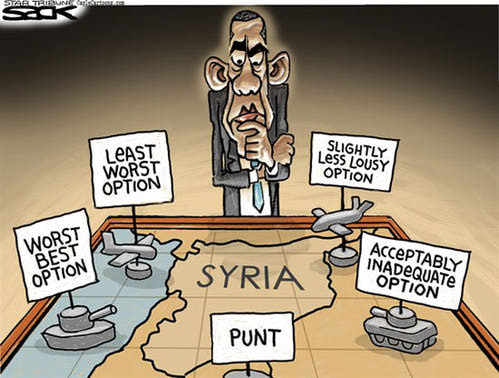
Syria War Room, by Steve Sack
Good Morning!!
I don’t know about you, but I really missed JJ’s Friday Night Lite post last night, so I thought I’d start out Sky Dancing’s Saturday with some political cartoons. I hope you enjoy these — courtesy of Cagle Post.
A few more on Syria:

Assad Chemicals by Steve Sack

Assad Chemical Weapons, by Mike Keefe
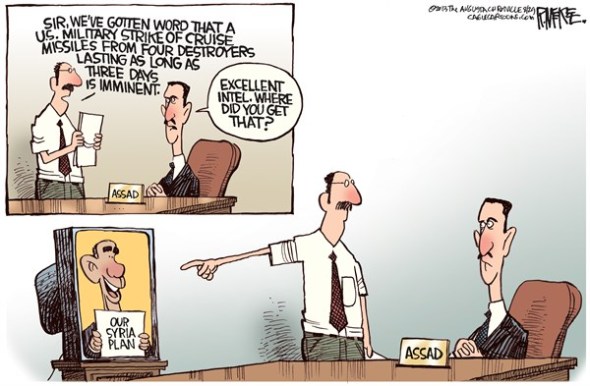
Syria Plan by Rick McKee

The Anti-War Left by Eric Allie
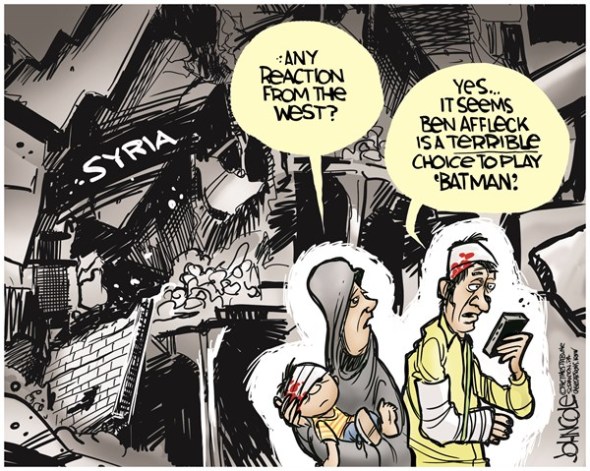
Syria and Affleck by John Cole

Cameron’s Failure, by Rainer Hatchfeld
March on Washington 50th Anniversary:
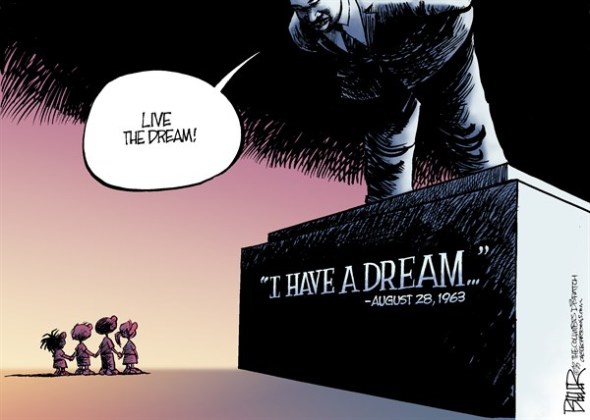
I Have A Dream Anniversary, by Nate Beeler

MLK Nightmare by Jeff Darcy
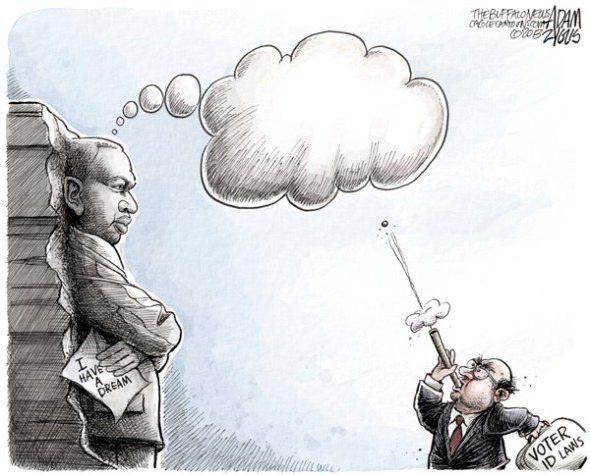
Dreamer, by Adam Zyglis
Labor Day and Income Inequality
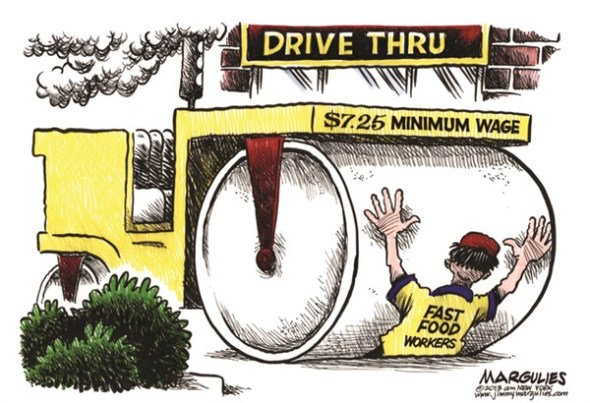
Fast Food Minimum Wage, by Jimmy Margulies
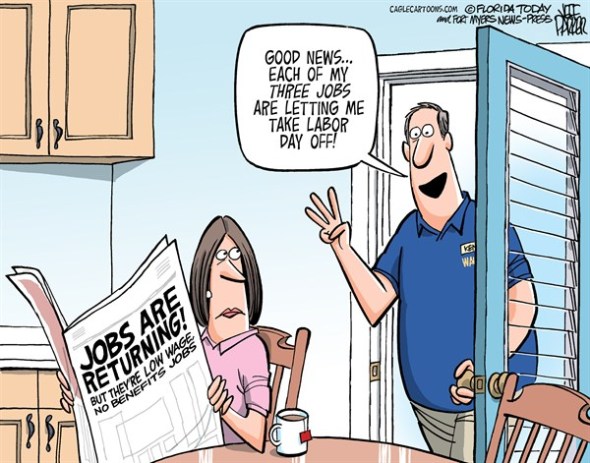
Labor Day Jobs, by Jeff Parker
NFL Concussion Lawsuit
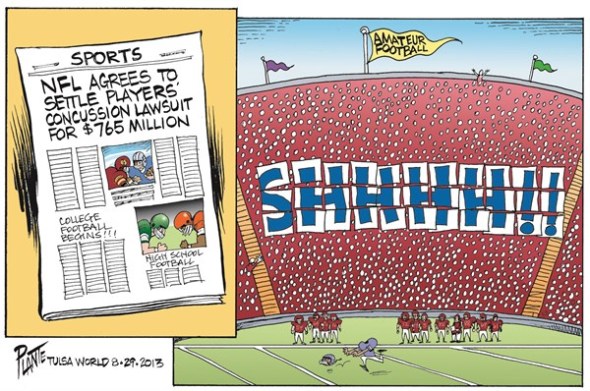
NFL Concussion Lawsuit, by Bruce Plante
Immigration Reform

Immigration Reform, by Mike Lukovich

 peej
peej Carissa
 bostonboomer
 dakinikat
 ecocatwoman
 jjlo
jjlo mablue2
 Mama Lopez
 peggysue22
 quixote
 skydancingguestblogger
 Mona (aka Wonk the Vote)





Recent Comments