After the release of three court filings yesterday (a sentencing recommendation for Michael Cohen from SDNY, another Cohen sentencing recommendation from Robert Mueller, and a statement from the Special Counsel of the lies from Paul Manafort that justify ending his plea agreement) the consensus of legal and political pundits is that Trump is essentially finished. How long he will continue as fake “president” is unclear, but he has been credibly accused of a crime by his own Justice Department.
I’ve gathered a number of opinion pieces that I think are very good. It’s difficult to excerpt these long pieces, so I’m just giving you the highlights. You’ll have to go to the sources for more details.
Federal prosecutors released sentencing recommendations for two alleged criminals who worked closely with Donald Trump: his lawyer Michael Cohen, and campaign manager Paul Manafort. They are filled with damning details. But the most important passage by far is this, about Trump’s fixer: “Cohen himself has now admitted, with respect to both payments, he acted in coordination with and at the direction of Individual-1.”
The payments in question, as the document explains, concern a payoff to two women who claimed to have affairs with Trump. The payments, according to prosecutors, were intended to influence the campaign, and thereby constituted violations of campaign finance law. They have not formally charged Trump with this crime — it is a sentencing report for Cohen, not Trump — but this is the U.S. Department of Justice calling Trump a criminal….the fact that he is being called a felon by the United States government is a historic step. And it is likely the first of more to come…..
Cohen is providing helpful information on other crimes. Cohen reportedly gave the special counsel “useful information concerning certain discrete Russia-related matters core to its investigation that he obtained by virtue of his regular contact with Company executives during them.” And this contact continued into 2018. Cohen was not locked out and probably has access to some secrets….
The special counsel sentencing recommendation for Cohen also reveals that Russian contact with the Trump campaign began as early as 2015, not the following spring. And Russians promised “political synergy” — which is essentially a synonym for campaign collusion — and “synergy on a government level.” That means a quid pro quo in which Russia would help Trump win the election and Trump, if elected, would give Russia favorable policy. This is the heart of Mueller’s very much ongoing investigation.
There are suggestions in both the Cohen filings that The Trump Organization was involved in crimes, and that is very significant. As Emptywheel pointed out recently, even if Trump were to pull a Nixon and make a deal with Pence–the presidency in return for pardons–Pence could not pardon Trump’s company.
…puts Trump’s eponymous organizations — his company and his foundation — squarely in the bullseye of law enforcement. The known details of all those puts one or the other Trump organization as an actor in the investigation. And we’ve already seen hints that the Trump Organization was less than responsive to some document requests from Mueller, such as this detail in a story on the Trump Tower deal:
According to a person familiar with the investigation, Cohen and the Trump Organization could not produce some of the key records upon which Mueller relies. Other witnesses provided copies of those communications.
If there’s a conspiracy to obstruct Mueller’s investigation, I’m fairly certain the Trump Organization was one of the players in it….
But the Trump Organization did not get elected the President of the United States (and while the claims are thin fictions, Trump has claimed to separate himself from the Organization and Foundation). So none of the Constitutional claims about indicting a sitting President, it seems to me, would apply.
If I’m right, there are a whole slew of implications, starting with the fact that….it utterly changes the calculation Nixon faced as the walls started crumbling. Nixon could (and had the historical wisdom to) trade a pardon to avoid an impeachment fight; he didn’t save his presidency, but he salvaged his natural person. With Trump, a pardon won’t go far enough: he may well be facing the criminal indictment and possible financial ruin of his corporate person, and that would take a far different legal arrangement (such as a settlement or Deferred Prosecution Agreement) to salvage. Now throw in Trump’s narcissism, in which his own identity is inextricably linked to that of his brand. And, even beyond any difference in temperament between Nixon and Trump, there’s no telling what he’d do if his corporate self were also cornered.
In other words, Trump might not be able to take the Nixon — resign for a pardon — deal, because that may not be enough to save his corporate personhood.
White provides a very good summary of the yesterday’s three court filings, which you can read at the link. Here’s his conclusion:
The president said on Twitter that Friday’s news “totally clears the President. Thank you!” It does not. Manafort and Cohen are in trouble, and so is Trump. The Special Counsel’s confidence in his ability to prove Manafort a liar appears justified, which leaves Manafort facing what amounts to a life sentence without any cooperation credit. The Southern District’s brief suggests that Cohen’s dreams of probation are not likely to come true. All three briefs show the Special Counsel and the Southern District closing in on President Trump and his administration. They’re looking into campaign contact with Russia, and campaign finance fraud in connection with paying off an adult actress, and participation in lying to Congress. A Democratic House of Representatives, just days away, strains at the leash to help. The game’s afoot.
In short, the Department of Justice, speaking through the acting U.S. attorney for the Southern District of New York, is alleging that the president of the United States coordinated and directed a surrogate to commit a campaign finance violation punishable with time in prison. While the filing does not specify that the president “knowingly and willfully” violated the law, as is required by the statute, this is the first time that the government has alleged in its own voice that President Trump is personally involved in what it considers to be federal offenses.
And it does not hold back in describing the magnitude of those offenses. The memo states that Cohen’s actions, “struck a blow to one of the core goals of the federal campaign finance laws: transparency. While many Americans who desired a particular outcome to the election knocked on doors, toiled at phone banks, or found any number of other legal ways to make their voices heard, Cohen sought to influence the election from the shadows.” His sentence “should reflect the seriousness of Cohen’s brazen violations of the election laws and attempt to counter the public cynicism that may arise when individuals like Cohen act as if the political process belongs to the rich and powerful.”
One struggles to see how a document that alleges that such conduct took place at the direction of Individual-1 “totally clears the president.”
WE ARE DEEP into the worst case scenarios. But as new sentencing memos for Trump associates Paul Manafort and Michael Cohen make all too clear, the only remaining question is how bad does the actual worst case scenario get?
The potential innocent explanations for Donald Trump’s behavior over the last two years have been steadily stripped away, piece by piece. Special counsel Robert Mueller and investigative reporters have uncovered and assembled a picture of a presidential campaign and transition seemingly infected by unprecedented deceit and criminality, and in regular—almost obsequious—contact with America’s leading foreign adversary.
A year ago, Lawfare’s Benjamin Wittes and Quinta Jurecic outlined seven possible scenarios about Trump and Russia, arranged from most innocent to most guilty. Fifth on that list was “Russian Intelligence Actively Penetrated the Trump Campaign—And Trump Knew or Should Have Known,” escalating from there to #6 “Kompromat,” and topping out at the once unimaginable #7, “The President of the United States is a Russian Agent.”
After the latest disclosures, we’re steadily into Scenario #5, and can easily imagine #6.
1. SDNY Prosecutors named the President of the United States as a direct participant, if not the principal, in felonies….
2. Other Trump Campaign and Trump Organization officials may face criminal charges for the hush money scheme….
3. The Special Counsel ties Trump directly to possible Russia collusion….
4. Russian contacts began during the GOP Primary….
5. The Special Counsel targets many Manafort lies but is silent on the infamous Trump Tower meeting with Russians….
6. Some potential hints of obstruction and suborning perjury….
7. Mueller’s M.O.: What he’ll do with lying to the public (and lies in writing)….
8. Why Cohen was more forthcoming with Mueller than SDNY, and SDNY wants him to serve a significant prison sentence.
I’ll just share one interesting excerpt from point 7, on lies that are put in writing and lies to the public. Both of these could apply to Trump himself.
In terms of perjury and false statements, Mueller seizes on fact that Cohen lies were in written testimony rather than arising “spontaneously from a line of examination or heated colloquy.” That’s a danger sign for people like Trump, who may have thought they had greater safety in written responses to Mueller, and people like Roger Stone, whose apparent lies to Congress are on the face of his written testimony.
Another important insight is how Mueller seizes on Cohen’s lies made to the public.
First, Mueller’s theory of the case recognizes that public statements are methods of communication with other witnesses. That’s important for potential conspiracies to commit perjury or otherwise obstruct justice. This also increases the likelihood that Mueller will regard public statements by President Trump and his lawyers as signals to other witnesses–such as publicly dangling pardons and favoring the “strength” of uncooperative witnesses.
Second, Mueller considers lies to the public can be an attempt to undermine the investigation. The memo states, “By publicly presenting this false narrative, the defendant deliberately shifted the timeline of what had occurred in the hopes of limiting the investigations into possible Russian interference in the 2016 U.S. presidential election.” That sounds awfully similar to the creation of a cover story about the June 9 Trump Tower meeting, which the President himself reportedly directed from aboard Airforce One.
Third, Mueller considers Cohen’s false statements to be even more significant because he “amplified” them by “by releasing and repeating his lies to the public.” That approach spells trouble for several Trump campaign associates including Roger Stone, Donald Trump Jr., Erik Prince, and Michael Caputo.
The special counsel focuses on Mr. Cohen’s contacts with people connected to the White House in 2017 and 2018, possibly further implicating the president and others in his orbit in conspiracy to obstruct justice or to suborn perjury. Mr. Mueller specifically mentions that Mr. Cohen provided invaluable insight into the “preparing and circulating” of his testimony to Congress — and if others, including the president, knew about the false testimony or encouraged it in any way, they would be at substantial legal risk.
Mr. Trump’s legal woes do not end there. The special counsel also advanced the president’s potential exposure under the Foreign Corrupt Practices Act for activities relating to a potential Trump Tower Moscow. Mr. Mueller noted that the Moscow project was a lucrative business opportunity that actively sought Russian government approval, and that the unnamed Russian told Mr. Cohen that there was “no bigger warranty in any project than the consent” of Mr. Putin.
If recent reports that Mr. Cohen floated the idea of giving Mr. Putin a $50 million luxury apartment in a future Trump Tower Moscow prove true, both the president and his company could face substantial jeopardy.
There’s much more analysis at the WaPo link.
It has been quite a week, ending with a bang yesterday. As Trump often says, “we’ll see what happens.” What stories have you been following?
Did you like this post? Please share it with your friends:
Michelle Obama speaks at The Royal Festival Hall on December 3 in London. Jack Taylor, Getty
Good Morning!!
The title of this post is a quote from Michelle Obama. In an interview in London, Obama discussed “impostor syndrome,” that feeling many women struggle with that we are undeserving of success. From Newsweek:
The former first lady opened up about how the struggle with self-doubt “never goes away,” during a sold-out talk with Nigerian author Chimamanda Ngozi Adichie in London, which drew lines of tens of thousands of people.
Asked at the event how Obama felt about being seen as a “symbol of hope,” she said: “I still have a little imposter syndrome, it never goes away, that you’re actually listening to me,” according to the BBC.
“It doesn’t go away, that feeling that you shouldn’t take me that seriously. What do I know? I share that with you because we all have doubts in our abilities, about our power and what that power is.”
“If I’m giving people hope then that is a responsibility, so I have to make sure that I am accountable,” Obama said.
But here’s the quote I just loved:
Obama offered a “secret” to young women everywhere: “I have been at probably every powerful table that you can think of, I have worked at nonprofits, I have been at foundations, I have worked in corporations, served on corporate boards, I have been at G-summits, I have sat in at the U.N.: They are not that smart.”
It’s so true. And as long as mediocre white men are promoted over smarter and more experienced women, we will continue to be ruled by people who “are not that smart.”
You only need to look at the 2016 election, in which Hillary Clinton–a brilliant, experienced woman–was constantly denigrated in favor of two barely mediocre white men, Bernie Sanders and Donald Trump. And now that an ignorant, corrupt white man is “president,” that Hillary is repeatedly told to shut up and sit down, while mediocre, old white men like Bernie Sanders and Joe Biden–who have already failed in primary races–are promoted by the media.
I’ve avoided day-time cable news this week so I didn’t have to listen to the endless, over-the-top praise of the late George H.W. Bush. But I have to admit that Bush at least knew how to behave like a human being, unlike the current resident of the White House.
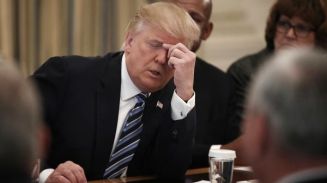
Mr. Trump has been snappish with aides most of the week, according to administration officials, miffed in part by so many ceremonial events not related to him. He was impatient for the memorials to end but expressed pride in himself for remaining publicly civil. People close to the president called it a course correction after his peevish reaction to Mr. McCain’s death.
What a pathetic asshole. He did the bare minimum, didn’t sing hymns or recite the Apostle’s Creed, and was the only person in the room who didn’t put his hand over his heart when the coffin was carried out.
At The Washington Post, Rick Wilson writes that George W. Bush’s invitation to Trump to attend the funeral prevented the asshole from ruining the solemn event.
By insisting on his successor’s inclusion in the proceedings, Bush forced the current White House occupant to briefly abandon his unfrozen cave-man act, denying him the chance to further debase the office of president by siphoning the dignity out of 41’s final hours in D.C. — something 45 likely would have relished, given the opportunity.
We’ll still be hearing about Poppy Bush for a couple more days because there is going to be another funeral in Texas today.
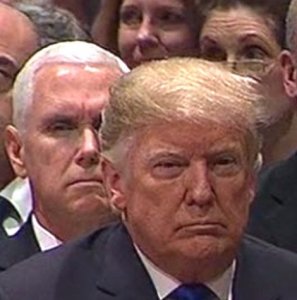
Mike Pence didn’t look too happy at the funeral yesterday either. Maybe this is why.
On Monday, Trump hosted a 2020 strategy meeting with a group of advisers. Among the topics discussed was whether Mike Pence should remain on the ticket, given the hurricane-force political headwinds Trump will face, as demonstrated by the midterms, a source briefed on the session told me. “They’re beginning to think about whether Mike Pence should be running again,” the source said, adding that the advisers presented Trump with new polling that shows Pence doesn’t expand Trump’s coalition. “He doesn’t detract from it, but he doesn’t add anything either,” the source said. Last month, The New York Times reported that Trump had been privately asking advisers if Pence could be trusted, and that outside advisers have been pushing Nikki Haley to replace Pence. One veteran of Trump’s 2016 campaign who’s still advising Trump told me the president hasn’t been focused enough on 2020. “What he needs to do is consider his team for 2020 and make sure it’s in place,” the adviser said. “He has to have people on his team that are loyal to his agenda.”
Trump’s doubts about Pence are surprising given Pence’s frequent public encomiums and professions of loyalty. “Trump waxes and wanes on everyone,” a prominent Republican close to the White House explained. Part of what’s driving the debate over Pence’s political value is Trump’s stalled search for a chief of staff to replace John Kelly. According to a source, Kelly has recently been telling Trump that Pence doesn’t help him politically. The theory is that Kelly is unhappy that Pence’s 36-year-old chief of staff, Nick Ayers, has been openly campaigning for Kelly’s job. “Kelly has started to get more political and he’s whispering to Trump that Trump needs a running mate who can help him more politically,” the source said. (The White House did not respond to a request for comment.)
I wonder how Evangelical voters would feel about pious Pence getting dumped?
There has been lots of Russia investigation news this week despite the wall-to-wall coverage of Bush’s passing. Some stories to check out:
The Trump campaign warrior of 2016 who led chants of “lock her up” deriding Democratic candidate Hillary Clinton, and then lied to the FBI after President Trump’s inauguration about his secret contacts with Russia, once again became an “exemplary” figure whose example, Mueller says, encouraged others to do the right thing.
“The defendant deserves credit for accepting responsibility in a timely fashion and substantially assisting the government,” writes Mueller in the sentencing memo. Mueller praises Flynn’s “early cooperation” as a spur to others. “The defendant’s decision to plead guilty and cooperate likely affected the decisions of related firsthand witnesses to be forthcoming [with the special counsel’s office] and cooperate,” the memo notes.
This denouement, in which Flynn is once again on the side of law enforcement and truth-telling, is fascinating to me as someone who followed his career for more than a decade and remembers hearing his blisteringly honest briefings as a combat intelligence commander in Afghanistan. Flynn became disoriented during his years in Trump’s orbit, but the sentencing memo suggests that he recovered his balance and sense of duty after Mueller began his investigation.
There’s a bizarre irony here. Trump pleaded with James B. Comey, the FBI director at the time the investigation of Flynn began, to consider “letting this go.” That was a grossly improper attempt to interfere with the investigation and prosecution of Flynn’s false statements. How strange that it was Mueller, in the end, who decided in effect to “let this go” by recommending no jail time, after the investigation had run its course and Flynn had pleaded guilty and cooperated.
MSNBC’s Morning Joe called on Frank Figluzzi to come in and help explain the memo. Figliuzzi was formerly an Assistant Director for Counterintelligence at the FBI and is familiar with Robert Mueller’s methods.
He began the segment by explaining that the extensive redactions meant that the info inside was sensitive. After stating that redactions are out of character for Mueller, Figluzzi said, “We saw lots of redaction. You do that in the FBI either when you have classified information or you are at such a sensitivity level that you cannot expose it.”
Figluzzi also felt the light sentence and amount of redactions meant the investigation was aiming for convictions at the highest levels. He continued, “I think, in fact, that underneath these redactions, if we were to lift these black magic marker points out, we would see people with the last name Trump or Kushner.”
Finally, Figluzzi ended the segment with a bombshell suggestion; Flynn may have worn a wire. He told the panel, “We see reference here to quick cooperation by Flynn. What does that mean? Did it happen in what we call the golden hour, where you could even wire somebody up and have him share communications in real time?”
The least-noticed sentence in Michael Flynn’s plea agreement with special counsel Robert Mueller may also be the most important one.
Section eight of the deal reached by Donald Trump’s former national security adviser in the inquiry into Russian meddling in the US election is entitled “cooperation”. It specifies that as well as answering questions and submitting to government-administered polygraph tests, Flynn’s cooperation “may include … participating in covert law enforcement activities”.
Long-time students of federal law enforcement practices agreed, speaking anonymously, that “covert law enforcement activities” likely refers to the possibility of wearing a concealed wire or recording telephone conversations with other potential suspects. It is not known whether Flynn has worn a wire at any time.
“If the other subjects of investigation have had any conversations with Flynn during the last few months, that phrase must have all of them shaking in their boots,” said John Flannery, a former federal prosecutor in the southern district of New York.
“The one who must be particularly terrified is [Trump son-in-law and adviser] Jared Kushner, if he spoke to the special counsel’s office without immunity about the very matter that is the subject of Flynn’s plea. I think he must be paralyzed if he talked to Flynn before or after the investigators debriefed him.”
It’s only Tuesday, and this week feels as if it has already gone on forever. I wonder if the George Bush sainthood celebration will continue through the weekend? I sure hope not. I’d like to be able to resume watching cable news before next week. In case anyone else here is sick of hearing about Saint Poppy, here are some antidotes the the media coverage.
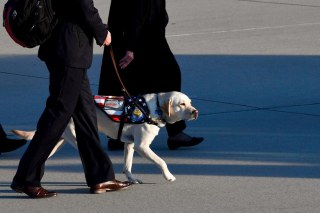
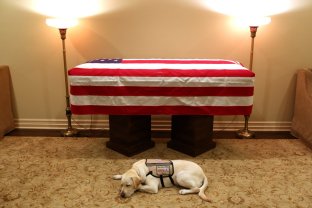
On Sunday night, George H.W. Bush spokesman Jim McGrath posted a photograph to Twitter depicting a golden Labrador named Sully resting in front of the former president’s casket. The caption read “Mission complete.”
Within hours, Sully the dog had become a bona fide celebrity. McGrath’s sentiment has been retweeted 61,000 times and counting, and “Sully” was trending on Twitter at various times on Monday. C-SPAN covered the dog’s arrival at Joint Base Andrews in Maryland on Monday afternoon. The picture of the dog lying in front of the casket was covered by outlets from Fox News to NPR as the internet exploded with tributes to the pair’s “forever friendship.” The photograph was submitted as evidence of Bush’s character, of Sully’s character, and as support for the idea that America should not elect a president who “does not love and is not loved by pets.” Heavy.com offered “5 Fast Facts You Need to Know” about the dog. People magazine gushed that Sully was “keeping the 41st commander in chief safe in death as he did in life,” and even produced a slideshow of their “special friendship.” Many suggested Sully was heartbroken, and/or that they themselves were crying over the photo; conservative writer Dan McGlaughlin compared the dog to a Marine.
There’s nothing wrong with applying sentimentality when it comes to family pets reacting to their owners’ deaths. There’s even some preliminary evidence from the small field of “comparative thanatology” that animals notice death, and that some may even experience an emotion we might compare to grief. But Sully is not a longtime Bush family pet, letting go of the only master he has known. He is an employee who served for less than six months….
It’s wonderful for Bush that he had a trained service animal like Sully available to him in his last months. It’s a good thing that the dog is moving on to another gig where he can be helpful to other people (rather than becoming another Bush family pet). But it’s a bit demented to project soul-wrenching grief onto a dog’s decision to lie down in front of a casket. Is Sully “heroic” for learning to obey the human beings who taught him to perform certain tasks? Does the photo say anything special about this dog’s particular loyalty or judgment, or is he just … there? Also, if dogs are subject to praise for obeying their masters, what do we do about the pets who eat their owners’ dead (or even just passed-out) bodies?
The photograph, in other words, is not proof that Sully is a particularly “good boy” or that “we don’t deserve dogs,” as countless swooning tweets put it on Monday. On its own, it says almost nothing other than the fact that Sully was, at one point in the same room as the casket of his former boss. This is simply a photograph of a dog doing something dogs love to do: Lie down. The frenzy around it captures something humans love to do, too: Project our own emotional needs onto animals.
Sexual harassment or assault can’t be bracketed off as part of a politician’s private life. It’s an important part of the story of their leadership, their use of power, and their policy. The same is true for Bush.
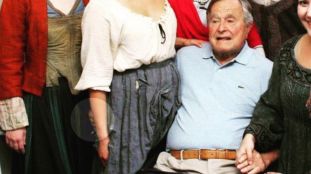
Relatively little has been made of the accusations against Bush since they emerged last year. A woman initially accused Bush of groping her and telling her a dirty joke as she stood beside him, seated in a wheelchair, for a photo op. The family responded, suggesting the aging former president might be slipping a bit. “President Bush has been confined to a wheelchair for roughly five years, so his arm falls on the lower waist of people with whom he takes pictures,” a spokesperson, Jim McGrath, said on Bush’s behalf.
But then the story changed. More women came forward describing incidents that took place before Bush was in a wheelchair and even while he was in office. One woman described a credible story dating back to 1992, when she says that Bush, then the president, put his hand on her rear end while taking a photograph at a reelection fundraiser. Another woman described an incident from 2003, when she was 16 years old — and Bush was still spry, zipping around Kennebunkport, Maine, on a Segway.
“All the focus has been on ‘He’s old.’ OK, but he wasn’t old when it happened to me,” the woman, now 55 told CNN. “I’ve been debating what to do about it.”
The women who spoke out feel differently. In each case, the accuser was excited to meet a political figure, someone who’s supposed to represent them; then, they said, he groped them. In that moment, they became second-class citizens. While their brothers or husbands or male friends might have gotten a handshake and a thumbs-up from this powerful man and walked away feeling good about themselves and their relationship with their government, these women were put in their place.
And let’s not forget that Bush appointed Clarence Thomas and stood by him when he was credibly accused of sexual harassment.
History will recall George Bush did nothing at all.
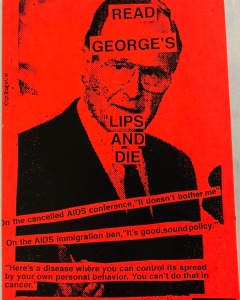
I must have chanted those words hundreds times while protesting the Bush administration’s inaction on the AIDS crisis with ACT UP (AIDS Coalition to Unleash Power) between 1989 and 1992. ACT UP was founded in 1987 in the epicenter of the HIV epidemic in America — New York City — to demand action to end the AIDS crisis. Today it is remembered as part of the Reagan ’80s, but the reality is that much of the group’s most intensive work took place during the administration of George Herbert Walker Bush. With ACT UP, I marched past the Bush White House down a Pennsylvania Avenue not yet closed to traffic. I rallied outside his Department of Health and Human Services, his Centers for Disease Control, his National Institutes of Health. And in 1991, I shook my finger chanting “Shame!” half a mile from his family’s summer compound in Kennebunkport, Maine. More than 1,500 AIDS activists descended on the resort town on September 1 that year, bearing signs that charged Bush with a murderous neglect of the AIDS crisis, along with a 50-foot banner with a 32-point plan to end it.
The transition from the Reagan presidency to the Bush one was more one of tone than substance when it came to AIDS, a kinder gentler indifference. Messaging that repeatedly pointed to “behavior change” as the solution, without backing prevention programs known to work. A lack of leadership from the top. No central strategy. “He was not doing enough as a leader,” Urvashi Vaid, the executive director of the National LGBTQ Task Force during the Bush years, told Pridesource after Bush’s death. “I think that those pressures and protests led by ACT UP all over the country … that pressure is what pushed both members of Congress and the administration to do whatever it did. I can’t say that enough.” Added ACT UP founder and playwright Larry Kramer, “I will not give [Bush] credit for anything. He hated us.”
Nearly a quarter century later when I had the opportunity as a political editor to participate in a several-day event at the Bush presidential library and museum, I thought about those years of protesting with ACT UP. For me reporting was always about other people’s stories, not my own, and it was rare for my activist past to come up except as history that informed my understanding of the dynamics of new social movements.
But with Bush, I felt I could not forget myself. Could not forget the suffering I’d witnessed in New York — where AIDS was, during his presidency, the leading cause of death for men ages 25–44, or the way his election extended the oppressive culture of the Reagan years that saw so many of my friends kicked out of their homes in their teens for being gay. I passed the Bush library opportunity on to a colleague.
Early in George H.W. Bush’s political career, when he was running for a U.S. Senate seat in Texas, he came out against the landmark Civil Rights Act of 1964, deriding his opponent as “radical” for supporting the bill that ended segregation in public places and banned employment discrimination.
“The new civil-rights act was passed to protect 14 percent of the people,” he said. “I’m also worried about the other 86 percent.”
The stand seemed at odds with his family’s long history of supporting civil rights (his father, Prescott Bush, a Connecticut senator had worked to desegregate schools and protect voting rights) and with his own work raising money for the United Negro College Fund.
But in Texas, where the Republican party was steadily becoming more conservative and embracing the Southern Strategy of appealing to white voters, Bush’s position made sense.
It “made sense” if you had no principles except getting elected. A bit more:
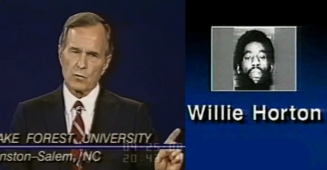
In his 1988 bid for the presidency, Bush would seem to again opt for expediency in a campaign that is often cited as one of the nastiest in political memory, with the blatant racism of the Willie Horton ad, which mined ugly stereotypes of African-Americans, and for Bush’s questioning of the patriotism of his opponent, Michael Dukakis, because of his Greek heritage.
The Horton ad, which focused on a convicted murderer who committed a violent rape while out of prison on a furlough program Dukakis had supported, was put out by a conservative PAC, not the Bush campaign. However, Bush repeatedly brought up Horton’s name in speeches, including one to the National Sheriffs’ Association.
“Horton applied for a furlough,” Bush said at the time. “He was given the furlough. He was released. And he fled — only to terrorize a family and repeatedly rape a woman.”
The Bush campaign also released an ad that showed footage of prisoners going through a revolving door — a strategy that played on white voters’ fears and prejudices, said Jason Johnson, a professor of politics and journalism at Morgan State University in Baltimore, Maryland.
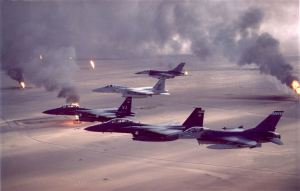
F-16A Fighting Falcon, F-15C Eagle and F-15E Strike Eagle fighter aircraft fly over burning oil field sites in Kuwait during Operation Desert Storm. (U.S. Air Force archive photo)
Most countries condemned Iraq’s 1990 invasion of Kuwait. But the truth — that it was the culmination of a series of tangled economic and historical conflicts between two Arab oil states — wasn’t likely to sell the US public on the idea of sending our troops halfway around the world to do something about it.
So we were given a variation of the “domino theory.” Saddam Hussein, we were told, had designs on the entire Middle East. If he wasn’t halted in Kuwait, his troops would just keep going into other countries.
As Scott Peterson reported for The Christian Science Monitor in 2002, a key part of the first Bush administration’s case “was that an Iraqi juggernaut was also threatening to roll into Saudi Arabia. Citing top-secret satellite images, Pentagon officials estimated in mid-September [of 1990] that up to 250,000 Iraqi troops and 1,500 tanks stood on the border, threatening the key US oil supplier.”
A quarter of a million troops with heavy armor amassed on the Saudi border certainly seemed like a clear sign of hostile intent. In announcing that he had deployed troops to the Gulf in August 1990, George HW Bush said, “I took this action to assist the Saudi Arabian Government in the defense of its homeland.” He asked the American people for their “support in a decision I’ve made to stand up for what’s right and condemn what’s wrong, all in the cause of peace.”
But one reporter — Jean Heller of the St. Petersburg Times — wasn’t satisfied taking the administration’s claims at face value. She obtained two commercial satellite images of the area taken at the exact same time that American intelligence supposedly had found Saddam’s huge and menacing army and found nothing there but empty desert.
She contacted the office of then-Secretary of Defense Dick Cheney “for evidence refuting the Times photos or analysis offering to hold the story if proven wrong.” But “the official response” was: “Trust us.”
Heller later told the Monitor’s Scott Peterson that the Iraqi buildup on the border between Kuwait and Saudi Arabia “was the whole justification for Bush sending troops in there, and it just didn’t exist.”
Read the rest at Bill Moyers.com.
I know there is lots of other news today, but I just had to get this off my chest. What stories are you following?
Did you like this post? Please share it with your friends:
Henri Lebasque, Girl Reading and Vase of Flowers, 1915
Good Morning!!
George Bush the elder died last night at age 94. I’m not going to lie and say I’m grieving.
During Watergate Bush was Nixon’s RNC chairman and supported him to the bitter end; but once the White House tapes came out, he urged Nixon to resign. Bush served about a year as CIA director under Gerald Ford. As Vice President, Bush famously claimed to have been “out of the loop” while Oliver North and the gang were running guns and drugs during the Iran-Contra affair. As president, Bush pardoned
…former National Security Adviser Robert C. McFarlane, former Assistant Secretary of State Elliott Abrams, former CIA Central American Task Force Chief Alan D. Fiers, Jr., former CIA Deputy Director for Operations Clair E. George, and former CIA Counter-Terrorism Chief Duane R. Clarridge. The Weinberger pardon marked the first time a President ever pardoned someone in whose trial he might have been called as a witness, because the President was knowledgeable of factual events underlying the case.
He also refused to be interviewed by the special counsel. That quote is from the Walsh report on Iran-Contra.
Buried among 1,700 pages of notes written by then-Defense Secretary Caspar W. Weinberger during the Iran-contra affair is one referring to a January 1986 meeting at which Weinberger voiced opposition to covert arms sales to Iran in the presence of George Bush, then the vice president.
Blue Girl Reading, Frederick C. Frieseke, 1935
The note, which appears to contradict Bush’s repeated assertion that he was never present when either Weinberger or then-Secretary of State George P. Shultz objected to the arms sales, is among classified documents being reviewed for possible use in Weinberger’s upcoming trial, according to informed sources. The note is important because it confirms earlier testimony by Shultz placing Bush at the January meeting.
Questioned again lately by reporters about Iran-contra, Bush sought to dismiss further discussion of his role in the worst political scandal of the Reagan administration. But new information emerging from court cases and congressional records since Bush last ran for president has cast fresh doubt on his assertions that he was “out of the loop,” generally uninvolved in and largely unaware of the most controversial Iran-contra operations.
There are numerous indications in the documentary record that Bush was at meetings where decisions were taken in the mid-1980s about both the secret sale of arms to Iran and some of the covert efforts to aid the contra rebels in Nicaragua.
Polls have shown that the public is skeptical of the president’s denials of involvement.
That was written before Bush issued the pardons.
As president, Bush started the Persian Gulf War in order to protect Saudi Arabia after Iraq took over Kuwait. He decided to leave Saddam Hussein in power in Iraq, and of course that led George Bush the younger to attack Iraq again in 2003, leaving us mired in the Middle East ever since.
As we watch Trump suck up to Saudi Arabia, we can forget that the Bushes also loved the Saudis and protected them after the 9/11 attacks. I could go on, but I won’t. Here are some obituaries of George H.W. Bush if you want to read the good stuff:
One good thing I will say about Bush: he didn’t like Trump.
“I don’t like him. I don’t know much about him, but I know he’s a blowhard. And I’m not too excited about him being a leader.” – George H.W. Bush on Donald Trump After he voted for Hillary Clinton.
Saudi Crown Prince Mohammed bin Salman sent at least 11 messages to his closest adviser, who oversaw the team that killed journalist Jamal Khashoggi, in the hours before and after the journalist’s death in October, according to a highly classified CIA assessment.
The Saudi leader also in August 2017 had told associates that if his efforts to persuade Mr. Khashoggi to return to Saudi Arabia weren’t successful, “we could possibly lure him outside Saudi Arabia and make arrangements,” according to the assessment, a communication that it states “seems to foreshadow the Saudi operation launched against Khashoggi.” [….]
Excerpts of the Central Intelligence Agency’s assessment, which cites electronic intercepts and other clandestine information, were reviewed by The Wall Street Journal.
The previously unreported excerpts reviewed by the Journal state that the CIA has “medium-to-high confidence” that Prince Mohammed “personally targeted” Khashoggi and “probably ordered his death.” It added: “To be clear, we lack direct reporting of the Crown Prince issuing a kill order.”
Girl Reading, Charles Edward Perugini (1834-1918)
The electronic messages sent by Prince Mohammed were to Saud al-Qahtani, according to the CIA. Mr. Qahtani supervised the 15-man team that killed Mr. Khashoggi and, during the same period, was also in direct communication with the team’s leader in Istanbul, the assessment says. The content of the messages between Prince Mohammed and Mr. Qahtani isn’t known, the document says. It doesn’t say in what form the messages were sent.
No wonder Trump refused let CIA director Gina Haspel report to Congress.
There are lots of stories about former Trump fixer Michael Cohen today. Cohen’s attorneys released his full sentencing memo (pdf) last night. For a summary, check out this Twitter thread from Adam Klasfeld.
After a March 2018 visit to Mar-a-Lago, the President’s private club in Florida, Cohen returned to New York believing that his former boss would protect him if he faced any charges for sticking to his story about the 2016 payments to adult film actress Stormy Daniels, according to one source with knowledge. Trump was also at Mar-a-Lago at the time of Cohen’s visit.
Another source said that after the April 2018 FBI raid on Cohen’s office and home, people close to the President assured Cohen that Trump would take care of him. And Cohen believed that meant that the President would offer him a pardon if he stayed on message. It is unclear who specifically reached out to Cohen….
Oda with Lamp, Christian Krohg Norwegian, 1852-1925
Following the raid on Cohen’s home and office, Cohen’s attorneys had a legal defense agreement with Trump and his attorneys. During this time, there was a steady flow of communication between the two sides, according to two sources familiar with the matter.
At first, publicly, Trump seemed very supportive of his former attorney. On the day of the raid, Trump said Cohen was “a good man” and that the investigation reached “a whole new level of unfairness.” He unloaded on law enforcement, calling the raids “a disgraceful situation.”
But in the days that followed the raid, one source says, things started heading south with the President.
Trump started to distance himself from Cohen. And when Trump appeared on “Fox and Friends” two weeks after the raids and said that Cohen only did a “tiny, tiny little fraction” of his legal work, Cohen knew the game had changed. According to one source, Cohen knew that things had changed and he acted to protect his family — and himself.
…Michael Cohen said Friday he was in “close and regular contact” with Trump’s White House staff and legal team when he prepared a statement for Congress that he now says falsely downplayed Trump’s effort to land a Trump Tower Moscow deal during the 2016 presidential campaign.
In a filing seeking a lenient sentence, Cohen’s attorneys say his false statement to Congress — which Cohen pleaded guilty to on Thursday — was based on Trump and his team’s efforts to “portray contact with Russian representatives” by Trump, his campaign or his company “as having effectively terminated before the Iowa caucuses of February 1, 2016.”
Jarne Gissel 1962
“Seeking to stay in line with this message, Michael told Congress that his communications and efforts to finalize a building project in Moscow on behalf of the Trump Organization, which he began pursuing in 2015, had come to an end in January 2016, when a general inquiry he made to the Kremlin went unanswered,” Cohen’s lawyers Guy Petrillo and Amy Lester write.
But “Michael had a lengthy substantive conversation with the personal assistant to a Kremlin official following his outreach in January 2016, engaged in additional communications concerning the project as late as June 2016, and kept [Trump] apprised of these communications,” they wrote. “He and [Trump] also discussed possible travel to Russia in the summer of 2016, and Michael took steps to clear dates for such travel.”
Another bombshell lobbed by Michael Cohen exploded late Friday night: He says he told Donald Trump about a phone call to the Kremlin asking for the Russian government’s help to build a Trump Tower in Moscow in 2016.
And Cohen also claims he was talking to Trump’s lawyers and White House staff in 2017 while he crafted a misleading statement to Congress seeking to cover up the truth about the Moscow project and the level of Trump’s involvement.
If this is true, former White House Counsel Don McGahn could be in trouble for witness tampering. I wonder what his talked with Mueller’s team have been like?
There are quite a few stories on fake AG Matthew Whitaker too. Some links to check out:
The Russia investigation news has been coming thick and fast since Trump turned in his written answers to Robert Mueller’s questions a little more than a week ago. The past two days we got revelations about Paul Manafort, but today’s breaking news is huge. This looks to be a very interesting day.
First, former Trump lawyer Michael Cohen is pleading guilty in the Mueller probe and its about Trump’s business in Russia.
Michael D. Cohen, President Trump’s former lawyer, who pleaded guilty in August to breaking campaign finance laws, made a surprise appearance in a Manhattan courtroom on Thursday morning to plead guilty to a new criminal charge, the latest turn in the special counsel’s investigation of Mr. Trump and his inner circle.
At the court hearing, Mr. Cohen admitted to making false statements to Congress about his efforts to pursue a Trump Tower deal in Moscow during the 2016 presidential campaign. That real estate deal has been a focus of the special counsel investigation into whether the Trump campaign conspired with Russian operatives.
In testimony to the Senate Intelligence Committee, Mr. Cohen played down the extent of his contact with the Kremlin about the potential project and made other false statements about the negotiations, which never led to a final deal.
Mr. Cohen’s new guilty plea comes at a particularly perilous time for Mr. Trump, whose presidency has been threatened by Mr. Cohen’s statements to investigators. In recent days, the president and his lawyers have increased their attacks on the Justice Department and the special counsel’s office.
It is virtually certain that one of Qs that Trump JUST submitted a sworn answer to Mueller on is this one. "What communication did you have with Michael D. Cohen, Felix Sater and others, including foreign nationals, about Russian real estate developments during the campaign?"
Feels like Mueller was waiting for Trump to turn his answers in before he moved to the next phase, and now that he has them, the other shoes are starting to drop. Cohen first, then Corsi, Stone, and….?
Cohen is scheduled to appear in federal court in Manhattan on Thursday where he is expected to enter a guilty plea for misstatements to Congress in closed-door testimony last year about his contacts with Russians during the presidential campaign.
Once among the president’s most loyal and zealous defenders in business and politics, Cohen has now promised to “put family and country first” by cooperating with prosecutors, becoming perhaps the most pivotal public witness against his former boss.
Cohen’s earlier plea deal with federal prosecutors in the Southern District of New York implicated President Trump in campaign finance felonies. Since then, Cohen has spent more than 70 hours in interviews with Mueller’s team. The questioning has focused on contacts with Russians by Trump associates during the campaign, Trump’s business ties to Russia, obstruction of justice and talk of possible pardons, sources familiar with the discussions have told ABC News.
“The potential significance of Cohen’s cooperation is immense,” said Kendall Coffey, a former United States Attorney in Florida.
As Trump’s personal attorney and problem solver for more than a decade, Cohen’s portfolio at the Trump Organization covered personal and business matters both routine and highly sensitive. His dealings while serving as a senior executive in Trump’s global empire include several projects thought to be of interest to Mueller’s prosecutors, most notably the pursuit of a Trump Tower project in Moscow during the presidential campaign.
“It cannot be determined if Cohen’s cooperation will lead to other criminal allegations,” Coffey said. “But for most high-powered business people with complex business interests, having one’s personal attorney become a star witness for the prosecution is the worst possible legal nightmare.”
MSNBC is now reporting that Trump has suddenly changed his story this morning, arguing that just because he was running for president “doesn’t mean I’m not allowed to do business.” But during the campaign and after, he claimed he had no business and no deals in Russia.
"Cohen was in frequent contact with foreign individuals about Trump Moscow — and that some of these individuals had knowledge of or played a role in 2016 election meddling” https://t.co/aYpDkt8v5I
Trump's attacks on the Mueller probe late last night and again early this morning raise a huge question: did Whitaker brief him on what was coming today?
BERLIN — One hundred seventy officers searched the headquarters of Deutsche Bank in Frankfurt and five other sites in the area early Thursday as part of a money-laundering investigation involving hundreds of millions of euros, prosecutors in Frankfurt said.
Two employees, who were not publicly identified but whose ages were given as 50 and 46, and other “unidentified people in positions of authority” are suspected of failing to report possible money laundering for transactions worth 311 million euros, or more than $350 million.
The money flowed to organizations in the British Virgin Islands before spring 2016, prosecutors said in an emailed statement.
The German bank confirmed in a statement that the police were investigating several of its offices in Germany and said the investigation related to the Panama Papers, a trove of files that put a spotlight on global money laundering. “We are cooperating fully with the authorities,” Deutsche said in the statement.
We don’t know yet whether this investigation will affect Trump, but he has to be worried about it.
Caller ID labeled them “unknown,” but Roger Stone said he knew to pick up quickly during those harried months of the 2016 presidential campaign. There would be a good chance that the voice on the other end of the line would belong to his decades-long friend — the restless, insomniac candidate Donald Trump — dialing from a blocked phone number.
Those nocturnal chats and other contacts between the man who now occupies the Oval Office and an infamous political trickster have come under intensifying scrutiny as special counsel Robert S. Mueller III’s investigation bores into whether Stone served as a bridge between Trump and WikiLeaks as the group was publishing hacked Democratic emails.
Mueller’s keen interest in their relationship was laid out in a draft court document revealed this week in which prosecutors drew a direct line between the two men — referring to Stone as someone understood to be in regular contact with senior Trump campaign officials, “including with then-candidate Donald J. Trump.”
The inclusion of the president by name in the draft filing rattled his legal team and indicated how closely the special counsel is scrutinizing what Trump may have learned from Stone about WikiLeaks’ release of emails that prosecutors say were hacked by Russian intelligence operatives.
In recent months, the Trump Organization turned over to Mueller’s team phone and contact logs that show multiple calls between the then-candidate and Stone in 2016, according to people familiar with the material.
Read more at the WaPo. This story also provides more evidence that that blocked number that Don Jr. called after the Trump Tower meeting was Trump.
I’m going to put this post up right away, because there is likely to be a lot more breaking news today. We can use this as a live blog.
Did you like this post? Please share it with your friends:
The Sky Dancing banner headline uses a snippet from a work by artist Tashi Mannox called 'Rainbow Study'. The work is described as a" study of typical Tibetan rainbow clouds, that feature in Thanka painting, temple decoration and silk brocades". dakinikat was immediately drawn to the image when trying to find stylized Tibetan Clouds to represent Sky Dancing. It is probably because Tashi's practice is similar to her own. His updated take on the clouds that fill the collection of traditional thankas is quite special.
You can find his work at his website by clicking on his logo below. He is also a calligraphy artist that uses important vajrayana syllables. We encourage you to visit his on line studio.














 peej
peej Carissa
 bostonboomer
 dakinikat
 ecocatwoman
 mablue2
 Mama Lopez
 peggysue22
 quixote
 skydancingguestblogger
 Mona (aka Wonk the Vote)



 Sky Dancing
Recent Comments