
Lazy Caturday Reads
Posted: July 27, 2019 Filed under: Afternoon Reads, U.S. Politics | Tags: #MoscowMitch, 2016 election, Baltimore, caturday, Donald Trump, election security, Elijah Cummings, Fox News, impeachment, John Brennan, Mitch McConnell, mpeachment inquiry, Racism, Rand Paul, Victor Blackwell 21 Comments
By Olga Kost
Good Afternoon!!
The occupant of the people’s White House began his morning with more racist attacks on people of color. This time it was Rep. Elijah Cummings and the people of Baltimore. I won’t subject you to the tweets, but he claimed that Cummings’ district in Maryland is “a disgusting, rat and rodent infested mess” and “very dangerous & filthy place” and that “no human being would want to live there.” He also called Cummings a “brutal bully” because he criticized Trump’s concentration camps.
Apparently the occupant was watching TV this morning before he heads out to play more golf.
Cummings also announced recently that he has subpoenaed the White House for employees’ emails sent on personal accounts. That would include Ivanka and Jared.
This morning, CNN’s Victor Blackwell gave an eloquent response to the occupant’s ugly tweets.
Of course the real source of Trump’s rage is the fact that Democrats on the House Judiciary Committee have opened an impeachment inquiry into his crimes.
Joshua Matz at The Washington Post: The House has already opened an impeachment investigation against Trump. (Matz is the co-author of To End a Presidency: The Power of Impeachment.
Has the House of Representatives opened an impeachment inquiry? That question is starkly presented by a petition that the House Judiciary Committee filed in federal court on Friday. It is also answered by that petition. No matter what certain House Democratic leaders might say about the politics of the matter, there can now be no doubt that the committee is engaged in an investigation of whether to impeach President Trump.
Flora Merleau, Dear Alexander
Through its petition, the committee seeks access to portions of the report by former special counsel Robert S. Mueller III that were redacted to protect grand jury secrecy. The panel also seeks grand jury testimony bearing on Trump’s knowledge of criminal acts, Russian interference in the 2016 presidential election and Russian connections to his campaign. Finally, the committee seeks grand jury testimony about actions taken by former White House counsel Donald McGahn; this last request probably anticipates the committee’s rumored plans to seek an order compelling McGahn to testify.
It is settled law that House committees can obtain grand jury materials as part of impeachment investigations. So the legal dispute will probably center on whether such an inquiry is underway.
The Constitution itself does not use phrases like “impeachment investigation” or “impeachment proceedings.” This has led some to mistakenly assume that the House is disregarding its impeachment power because it has not yet held a floor vote approving articles of impeachment (or expressly instructing the Judiciary Committee to deliberate on such articles).
But to those who specialize in these matters, that all-or-nothing vision of the impeachment power is mistaken. The Constitution’s text and structure — supported by judicial precedent and prior practice — show that impeachment is a process, not a single vote. And that process virtually always begins with an impeachment investigation in the judiciary committee, which is already occurring.

Here is the historic announcement made by Jerry Nadler, Chairman of the House Judiciary Committee.
At The Atlantic, four members of the House of Representatives Mary Gay Scanlon, David Cicilline, Pramila Jayapal, and Veronica Escobar write: Why We’re Moving Forward With Impeachment.
Mueller’s testimony before the House Judiciary and Intelligence Committees was a watershed moment. At this point, it is up to Congress to act on the evidence of multiple counts of obstruction of justice committed by the president, and to continue our investigation into whether he has committed other high crimes and misdemeanors.
Beryl Cook, The Great Cat
Despite assertions to the contrary by the president and his allies, the special counsel’s report and testimony are not the end of our investigations. We have now filed a petition in court to obtain the grand-jury documents referenced in the special counsel’s report. In that filing, we have made clear that we will utilize our Article I powers to obtain the additional underlying evidence, as well as enforce subpoenas for key witness testimony, and broaden our investigations to include conflicts of interest and financial misconduct.
While many people believe that beginning an impeachment investigation can begin only with a vote of the full House of Representatives, this is not true. Article I authorizes the House Judiciary Committee to begin this process.
As members of the House Judiciary Committee, we understand the gravity of this moment that we find ourselves in. We wake up every morning with the understanding of the oath that binds us as members of Congress, and the trust that our constituents placed in us to uphold that oath. We will move forward with the impeachment process. Our investigation will seriously examine all the evidence as we consider whether to bring articles of impeachment or other remedies under our Article I powers.
Our Constitution requires it. Our democracy depends on it.

An so finally, it is happening.
Yesterday, Mitch McConnell blocked two more election security bills in the Senate. Twitter responded by getting the hashtag #MoscowMitch trending. Newsweek:
The hashtag #MoscowMitch was trending on Twitter on Friday morning after Senate Majority Leader Mitch McConnell blocked two election bills designed to deter interference by Russia and other states, claiming it was “partisan legislation” by the Democratic Party.
It followed special counsel Robert Mueller’s testimony on Wednesday that Russia is still attempting to interfere in American democracy, further to its meddling in the 2016 presidential election, with a view to disrupting the 2020 contest.
Barbara Perrine Chu, Woman with Black Cat
Then on Thursday, the Senate Intelligence Committee published a report detailing Russian interference dating back to at least 2014 through to 2017 that targeted U.S. election infrastructure with an “unprecedented level of activity.”
Morning Joe host Joe Scarborough used the moniker “Moscow Mitch” in reference to McConnell, a Kentucky Republican, multiple times during his MSNBC show on Friday, and tore into the congressional leader for several minutes.
Scarborough made reference to an effort in 2016 ahead of the election by President Barack Obama to sound the alarm to American voters about Russian interference by urging congressional leaders to sign a bipartisan statement condemning it publicly.
At the time, according to The Washington Post, McConnell rebuffed Obama’s suggestion, and said he would view the White House talking publicly about Russian interference before polling day as an act of partisanship designed to aid the then Democratic candidate Hillary Clinton.

As everyone here knows, Sanctioned Russian Oligarch Oleg Deripaska has promised to pour millions into McConnell’s home state of Kentucky by opening a new aluminum plant there. In addition, Newsweek reports that Mitch McConnell received donations from voting maachine lobbyists before blocking election security bills.
This morning Dana Millbank went there at The Washington Post: Mitch McConnell is a Russian asset.
Mitch McConnell is a Russian asset.
This doesn’t mean he’s a spy, but neither is it a flip accusation. Russia attacked our country in 2016. It is attacking us today. Its attacks will intensify in 2020. Yet each time we try to raise our defenses to repel the attack, McConnell, the Senate majority leader, blocks us from defending ourselves.
By Mariana Kalacheva
Let’s call this what it is: unpatriotic. The Kentucky Republican is, arguably more than any other American, doing Russian President Vladimir Putin’s bidding.
Robert Mueller sat before Congress this week warning that the Russia threat “deserves the attention of every American.” He said “the Russian government’s efforts to interfere in our election is among the most serious” challenges to American democracy he has ever seen. “They are doing it as we sit here, and they expect to do it during the next campaign,” he warned, adding that “much more needs to be done in order to protect against these intrusions, not just by the Russians but others as well.”

Millbank provides specifics of McConnell’s unpatriotic behavior:
McConnell has blocked all such attempts [to protect our elections], including:
A bipartisan bill requiring Facebook, Google and other Internet companies to disclose purchasers of political ads, to identify foreign influence.
A bipartisan bill to ease cooperation between state election officials and federal intelligence agencies.
A bipartisan bill imposing sanctions on any entity that attacks a U.S. election.
A bipartisan bill with severe new sanctions on Russia for its cybercrimes.
McConnell has prevented them all from being considered — over and over again. This is the same McConnell who, in the summer of 2016, when briefed by the CIA along with other congressional leaders on Russia’s electoral attacks, questioned the validity of the intelligence and forced a watering down of a warning letter to state officials about the threat, omitting any mention of Russia.
Read the rest at the WaPo.
On Hardball yesterday, John Brennan discussed McConnell’s behavior in 2016.
This days, the GOP is filled with Russian assets like Trump’s suck-up golf buddy Lindsey Graham and Rand Paul, who tried to block funding to help 9/11 first responders but fights sanctions on a Russian pipeline. The Daily Beast:
Advocates for a massive Russian natural gas pipeline project have a powerful, quiet ally in Congress: Sen. Rand Paul, a Kentucky Republican and close friend of President Donald Trump. He has quietly worked against sanctions on the Nord Stream 2 project, which would dramatically expand Russia’s shipments of natural gas to Germany. Critics say it would also dramatically expand Russia’s influence in Western Europe while harming Ukraine. The Trump administration has weighed sanctioning the project, but has yet to do so. And Trump himself has criticized it.
On Thursday, the senator postponed the Senate Foreign Relations Committee’s mark-up of legislation that would have put sanctions on the project, according to multiple sources with knowledge of the committee’s proceedings. And while Paul hasn’t publicized his opposition to the proposed sanctions, he sent Senate colleagues a letter before the mark-up explaining his stance. The letter, which The Daily Beast obtained, argues that the legislation in question—a bipartisan bill introduced by Sens. Ted Cruz and Jeanne Shaheen—doesn’t clearly state which entities would be sanctioned.
That’s it for me today. What stories have you been following?
Thursday Reads: Media Works Tirelessly to Help Trump Destroy U.S. Democracy
Posted: July 25, 2019 Filed under: Afternoon Reads, Media, U.S. Politics | Tags: Brian Williams, Chuck Todd, Donald Trump, impeachment, MSNBC, Robert Mueller 27 Comments
Good Afternoon!!
If Trump succeeds in destroying our democracy and becoming Hitler 2.0, the responsibility will be equally shared between the GOP and the U.S. political media. Yesterday Robert Mueller confirmed that Trump has committed high crimes and implied that Congress should impeach him. The media responded by reviewing the style and “optics” of his presentation, paying little attention to its content.
The ever-shallow Chuck Todd led the charge on Twitter. I won’t subject you to the video.
So-called leftist Michael Moore agreed with Todd.
The Columbia Journalism Review critiqued Chuck Todd’s remarks as well as those of other MSNBC hosts: MSNBC public editor: The Chuck Todd show.
Todd’s focus on the “entertainment” aspect of politics coverage is often in evidence—for example, in his own recent performance as moderator in the Democratic presidential debate. He managed to talk more than all but three of the candidates, even as he demanded that they keep their own answers brief….
For Chuck Todd all the political world’s a stage, and he’s the star….
And it’s not just Todd. Other MSNBC anchors reacted to the Mueller hearings similarly, finding fault with the Democrats’, and Mueller’s, lack of pizazz as performers. Brian Williams referred to “the caffeine gap” in the Judiciary Committee’s questioning. I can’t help pointing out that excessive concern with caffeinated pizzazz can warp a journalist’s judgement pretty severely, and is best avoided.
At a moment of particular gravity for the country, with the sitting president credibly accused of obstructing justice, and many of his campaign staff and associates under investigation and indictment, may I suggest that if you, a journalist, are bored with the politics of this—if you are demanding somehow to be entertained, right now—you’re not doing your job.
Politics isn’t entertainment, it is not a performance to be critiqued. Reporting on national politics is a public trust of solemn importance that affects hundreds of millions of people.
A sample of headlines from the “savvy” Washington press:
Peter Baker at The New York Times: The Blockbuster That Wasn’t: Mueller Disappoints the Democrats. [I skimmed the story, and could find no quotes from Democrats holding elected office. Several prominent experts were quoted arguing Mueller’s testimony was valuable.]
Sharon LaFraniere, Michael S. Schmidt, Noah Weiland and Adam Goldman at The New York Times: Mueller’s Labored Performance Was a Departure From His Once-Fabled Stamina.
Susan Glasser at The New Yorker: “Accountability”? The Mueller Hearing Is How Trump Escapes. [FYI: Susan Glasser is married to Peter Baker of the NYT.]
Some serious reactions to Mueller’s testimony:
Former Republican Jennifer Rubin: Mueller didn’t fail. The country did.
Being thousands of miles away from home in Portugal, a country that 45 years ago was in the grasp of a brutal dictatorship, gives me an interesting perspective on former special counsel Robert S. Mueller III’s Wednesday testimony and on the now nearly forgotten — was it only a week ago? — racist call for four nonwhite congresswomen to “go back” to where they came from.
Tom Toles Editorial Cartoon
I worry that we — the media, voters, Congress — are dangerously unserious when it comes to preservation of our democracy. To spend hours of airtime and write hundreds of print and online reports pontificating about the “optics” of Mueller’s performance — when he confirmed that President Trump accepted help from a hostile foreign power and lied about it, that he lied when he claimed exoneration, that he was not completely truthful in written answers, that he could be prosecuted after leaving office and that he misled Americans by calling the investigation a hoax — tells me that we have become untrustworthy guardians of democracy.
The “failure” is not of a prosecutor who found the facts but might be ill equipped to make the political case, but instead, of a country that won’t read his report and a media obsessed with scoring contests rather than focusing on the damning facts at issue.

David Corn at Mother Jones: Mueller Reminds the Public: Trump Betrayed the United States.
There’s an old saying in newsrooms: News is stuff that people have forgotten. Robert Mueller’s dramatic appearance before the House Judiciary Committee on Wednesday morning was a striking reminder of this adage. The former special counsel did not drop any new revelations about the Trump-Russia affair. Yet in a simple but important manner, he reiterated the basics of this scandal—perhaps the most consequential political scandal in American history. These are the fundamentals that have often been subsumed by all the never-ending partisan squabbling and by the ongoing crusade mounted by Donald Trump and his defenders to distract from his perfidy. These are the facts that Trump has refused to acknowledge, and they are the facts that taint his presidency and undermine its legitimacy.
In his opening statement, Mueller emphasized the key finding from his report: “The Russian government interfered in our election in sweeping and systematic fashion.” And during the questioning, Mueller repeated the conclusion previously reached by the US intelligence community that Russia conducted this covert operation to help Trump get elected. “Did your investigation find that the Russian government perceived it would benefit from one of the candidates winning?” Mueller was asked by Rep. Zoe Lofgren (D-Calif.). He replied with one word: “Yes.” Lofgren followed up: “And which candidate would that be?” Mueller responded, “Well, it would be Trump.”
So Russia attacked an American election to help Trump. And what did Trump do? “The Trump campaign wasn’t exactly reluctant to take Russian help,” Lofgren remarked to Mueller. “You wrote it expected it would benefit electorally from information stolen and released through Russian efforts, isn’t that correct.”
Mueller answered with another brief sentence: “That’s correct.” That is, Trump sought to exploit a foreign adversary’s clandestine assault. And as Mueller noted in his report, during the campaign Trump dismissed the notion that Russia was intervening in the election, and after he was elected he continued to deny “that Russia aided his election.”
Click the link to read the rest.
David Graham at The Atlantic: The Most Revealing Exchange of the Mueller Hearing.
There’s a logical disconnect in volume 2 of Special Counsel Robert Mueller’s report that is unmissable to any careful reader.
As Mueller explains in the report, a charge of obstruction of justice requires three elements: an obstructive act, a nexus with an official proceeding, and corrupt intent. And in the report, Mueller’s team laid out several cases where President Donald Trump committed an obstructive act, in connection with an official proceeding, with what Mueller’s team concluded could be a corrupt intent.
But because Mueller had decided at the outset of his report that he could not and would not charge the president with crimes, thanks to Justice Department guidance and in the interest of fairness, Mueller did not make the otherwise obvious jump from laying out the ways that Trump’s behavior met the three-prong test to actually stating that Trump obstructed justice.
During today’s House Judiciary Committee hearing, Democratic Representative Hakeem Jeffries sought to demonstrate the disconnect by walking Mueller through the three-prong test.
“Let me refer you to page 87 and 88 of volume 2 where you conclude the attempt to remove the special counsel would qualify as an obstructive act if it would naturally obstruct the investigation and any grand-jury proceedings that might flow from the inquiry. Correct?” Jeffries asked.
“Yes,” Mueller said, confirming the obstructive act.
“Yes,” Mueller said, confirming the obstructive act.
“Your report found on page 89, volume 2, that substantial evidence indicates that by June 17, the president knew his conduct was under investigation by a federal prosecutor who would present any evidence of federal crimes to a grand jury. True?” Jeffries asked.
“True,” Mueller said, confirming the nexus to an official proceeding.
Jeffries then moved on to the third element, corrupt intent, and Mueller once again effectively affirmed the point:
Jeffries: Is it fair to say the president viewed the special counsel’s investigation as adverse to his own interest?
Mueller: I think that generally is true.
Jeffries: The investigation found evidence, quote, “that the president knew that he should not have directed Don McGahn to fire the special counsel.” Correct?
Mueller: Where do you have that quote?
Jeffries: Page 90, volume 2. “There’s evidence that the president knew he should not have made those calls to McGahn,” closed quote.
Mueller: I see that. Yes, that’s accurate.
Mueller, seeing the trick, tried to cut it off. “Let me just say, if I might, I don’t subscribe necessarily to your—the way you analyzed that. I’m not saying it’s out of the ballpark, but I’m not supportive of that analytical charge,” he said.
Graham writes that Mueller tried to backtrack, but the cat was out of the bag. Ted Lieu did something similar; head over the The Atlantic to read more.
This piece by Jonathan Bernstein at Bloomberg is worth a read: Worst Part of the Mueller Hearings? Republican Conspiracy Theories.
Instead of reading carefully into the evidence and finding contradictions or loose ends, House Republicans largely busied themselves with conspiracy theories. It wasn’t Donald Trump and his campaign who welcomed and benefited from Russian interference in the 2016 election; it was Hillary Clinton! Never mind what U.S. intelligence agencies and Senate investigators have concluded. Never mind that this reality-denying line of inquiry left lawmakers defending Wikileaks and even, seemingly, the Russian agents indicted by Mueller.
For these Republicans, it’s still supposedly inexplicable that the FBI started investigating in the first place. In their stated conception of things, only partisanship and hatred of the president could explain such an otherwise odd decision to look into the rich web of shady contacts between the Trump campaign and Russians. And yet those partisan and hateful investigators didn’t leak anything about the probe when it would’ve put Trump’s election in jeopardy; didn’t indict or recommend impeachment of the president; and didn’t rush to testify to Congress about any of it.
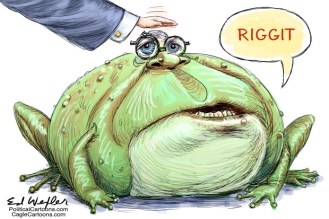
Meanwhile, with the notable exception of Texas Representative Will Hurd, Republicans showed no interest at all in the national-security implications of Russia’s interference. And remember, Senate Majority Leader Mitch McConnell is still blocking bipartisan legislation to strengthen U.S. defenses against future attacks.
These are the same Republicans, after all, who spent years looking into conspiracy theories about the deaths of Americans in Benghazi in 2012 without ever attending to the real security vulnerabilities that contributed to them. It was far more important to feed the Republican marketplace with loony ideas about how President Barack Obama (or Hillary Clinton) actively welcomed the disaster than to figure out what had actually gone wrong or what to do about it.
I’ll end with this tweet from the woman who should be president, written after Trump’s latest Nazi/KKK rally.
Tuesday Reads: Bad News and Bad Hair
Posted: July 23, 2019 Filed under: Foreign Affairs, morning reads, U.S. Politics | Tags: Bill Barr, Boris Johnson, Cesar Sayoc, concentration camps, CPB, Department of Injustice, Donald Trump, Francisco Erwin Galicia, ICE, immigration, Jerry Nadler, Robert Mueller 21 Comments
Bad News, by Ethan Jack Harrington
Good Morning!!
Sorry for the possibly disturbing image–there was just something I liked about it. Anyway, it’s Tuesday, and two formerly great nations–the USA and Great Britain–are now led by doltish leaders with embarrassingly bad hair. Welcome to the 21st Century.
The Guardian: Boris Johnson elected new Tory leader.
Boris Johnson will become Britain’s next prime minister after winning a convincing victory over Jeremy Hunt in the Conservative party leadership race.
The former mayor of London, who has long cherished an ambition to lead his country, won 66% of the votes – 92,153, to Hunt’s 46,656. Turnout was 87.4% among 159,320 party members.
In a characteristically lighthearted acceptance speech, Johnson conceded that even some of his own supporters may “wonder quite what they have done”….
He reminded his audience of ministers and party staff of his campaign mantra: “Deliver Brexit, unite the country and defeat Jeremy Corbyn.”
Saying “some wag” had pointed out that this spelled “dud”, he joked that the final e – “E for energise” – had been left out. “I say to all the doubters: dude, we are going to energise the country!”
And Johnson said he would “get Brexit done by 31 October” with a “new spirit of can-do”.
“We are once again going to believe in ourselves and what we can achieve, and like some slumbering giant we are going to rise and ping off the guy-ropes of self-doubt and negativity.”
Remember Cesar Sayoc? He’s the rabid Trump fan who sent mail bombs to people Trump attacked publicly on Twitter or elsewhere. Sayoc is on trial right now.
Ryan J. Reilly at HuffPost: Lawyers For Trump ‘Super Fan’ Cesar Sayoc Say Trump’s Rhetoric Inspired Terrorist Plot On Democrats.
Cesar Sayoc, the fanatical Donald Trump fan who mailed package bombs to the president’s political opponents, is a cognitively limited sexual abuse survivor who thought of the now-president as a “surrogate father” and came to believe in an “alternative reality” fueled in part by Trump’s attacks on his political opponents, his attorneys told a federal court on Monday.
Sayoc has admitted to mailing pipe bombs to Democratic politicians, media figures and celebrities he perceived as Trump’s enemies last fall, and pleaded guilty to several federal crimes in March. He could face life in prison when he’s sentenced on August 5, but his federal public defenders said Monday he should serve 10 years in prison followed by community supervision (as well as mental health counseling and drug treatment).
Cesar Sayoc’s van plastered with anti-Hillary and pro-Trump images
Sayoc, his attorneys wrote in a sentencing memo filed in federal court in New York on Monday, was a Trump “super fan” and “began to consider Democrats as not just dangerous in theory, but imminently and seriously dangerous to his personal safety.”
“President Trump did nothing to dissuade this message,” they write. Their filing cites Trump’s Twitter attacks on the figures Sayoc targeted.
Sayoc was a Trump fan before the reality television host ran for president, and viewed him as “everything he wanted to be: self-made, successful, and a ‘playboy,’” his attorneys wrote.
But Sayoc “began watching Fox News religiously,” started following political news on Facebook and and “threw himself into” Trump’s campaign once he announced his candidacy because he “came to view Trump as a personal champion—someone who had helped him through the most difficult periods of his life and who could do the same for other people across the country.”

Click on the link to read the rest.
The Trump administration is proposing a frightening new immigration policy.
The Washington Post: Trump administration to expand its power to deport undocumented immigrants.
The Trump administration on Tuesday will significantly expand its power to quickly deport undocumented immigrants who have illegally entered the United States within the past two years, using a fast-track deportation process that bypasses immigration judges.
Officials are calling the new strategy, which will take effect immediately, a “necessary response” to the influx of Central Americans and others at the southern border. It will allow immigration authorities to quickly remove immigrants from anywhere they encounter them across the United States, and they expect the approach will help alleviate the nation’s immigration-court backlog and free up space in Immigration and Customs Enforcement jails.
Trump HItler by Pegasus
The stated targets of the change are people who sneaked into the United States and do not have an asylum case or immigration-court date pending. Previously, the administration’s policy for “expedited removal” had been limited to migrants caught within 100 miles of the U.S. border who had been in the country for less than two weeks. The new rule would apply to immigrants anywhere in the United States who have been in the country for less than two years — adhering to a time limit included in the 1996 federal law that authorized the expedited process.
Immigrants apprehended in Iowa, Nebraska or other inland states would have to prove to immigration officials that they have been in the United States continuously for the past two years, or they could end up in an immigration jail facing quick deportation. And it could be relatively low-level immigration officers — not officers of a court — making the decisions.

What this means in reality is that anyone in the U.S. could be ordered by ICE/CBP to “show your papers.” From the article:
Immigrants’ advocates warned that the policy could ensnare longtime legal residents or even U.S. citizens who have been deported in error before. Vanita Gupta, president of the Leadership Conference on Civil and Human Rights, said she fears the rule will lead to increased racial profiling and turn ICE into a “show-me-your-papers militia.”
“This new directive flows directly from the racist rhetoric that the president has been using for the last week and indeed months, but this new rule is going to terrorize communities of color,” said Gupta, who was head of the Justice Department’s civil rights division under President Barack Obama.
U.S. citizens could be rapidly deported on the word of an ICE agent, without a court hearing. Read this story in The Dallas Morning News: A Dallas-born citizen picked up by the Border Patrol has been detained for three weeks.
An 18-year-old Dallas-born U.S. citizen has been in the custody of U.S. Customs and Border Protection and Immigration and Customs Enforcement for more than three weeks, his attorney says.
Now his family fears he may be deported.
Bully Culprit, by Robbie Conal
Francisco Erwin Galicia was detained at a CBP checkpoint in Falfurrias on June 27, said Claudia Galan, his attorney.
Galicia was traveling with his 17-year-old brother Marlon Galicia and a group of friends from Edinburg where they live to Ranger College in North Texas for a soccer scouting event when they came upon a CBP checkpoint, said Sanjuana Galicia, his mother.
It was about 8 p.m. Marlon, who was born in Mexico and lacked legal status, had only been through a border checkpoint on school trips and had never been pressed to provide travel documents.
But this time was different, Marlon said. He had only a school ID. His brother was carrying only his Texas ID, which can only be obtained with a Social Security number.
“We were confident that we’d be able to pass. We were going to do something good for our futures,” he said. “I didn’t imagine this could happen and now I’m so sad that I’m not with my family,” Marlon said by phone from Reynosa, Mexico, where he is staying with his grandmother.
After two days in detention, Marlon signed a voluntary deportation form.
“I signed because I wanted to talk with my mom. Now, we just have to wait and see and hope that they release my brother,” Marlon said.
Francisco Galicia told his mother, who lives in Edinburg, that he was detained because he didn’t have his U.S. passport. But she said he did present CBP with his Texas ID.

Read more at the link.
And of course Trump’s brown shirts are already torturing children in his concentration camps. NBC News reports: Abner, 17, describes 11 days of hunger and thirst at Yuma’s border station.
Abner, a 17-year-old Guatemalan boy, vividly recalls the first 48 hours he spent inside the U.S. Border Patrol station in Yuma, Arizona. He was awake for all of them because there was no space to lie down.
James Ostrer, Emotion Download
Packed into a cell with other migrant boys, Abner said the older children would give the 8, 9, and 10-year-olds space to lie down on the floor while they would try to sleep sitting or standing up. With nothing to cover him, Abner would tremble.
“I had to stay almost two days like this, standing. I didn’t sleep. And they didn’t treat me well because I would ask for at least food or water or something to cover myself with and they would deny it,” Abner told NBC News in Spanish.
Eventually, he learned to sleep on a pile of trash in the corner of the cell, said Abner, who does not want his full name or his face used out of fear he will be targeted for deportation….
In total Abner spent 11 days from late May to early June in the Yuma border station. He describes them as filled with hunger and thirst, extreme temperatures and fear of the guards manning the facility. They refused to give him food when he asked, mocked him if he asked what time it was, and, on one occasion, punched another boy in the stomach, Abner said.

Abner says the children were fed only twice a day.
The older boys in Abner’s cell learned to protect the younger children, whose cries would anger the guards.
“Sometimes, we would give one [hamburger] to the little ones. Because the little ones were the ones that wanted to eat more than others. At least, [the older kids could] stand the hunger a little more,” Abner said.
This is being done in our name, and the whole world is watching.
 I haven’t yet said anything about Robert Mueller’s Congressional testimony tomorrow. I’m sure you’ve heard that what used to be called the Department of Justice but is now Donald Trump’s personal law firm is trying to put limits on what Mueller can say. Politico reports:
Justice Department officials have communicated to Robert Mueller that the department expects him to limit his congressional testimony this week to the public findings of his 448-page report, according to one current and one former U.S. official familiar with the preparations.
In extensive discussions since the former special counsel was subpoenaed on June 25 to testify, department officials have emphasized that they consider any evidence he gathered throughout the course of his investigation to be “presumptively privileged” and shielded from public disclosure.
Of course this is complete bullshit. Mueller is a private citizen now and doesn’t have to take orders from Bill Barr or Trump. Also from Politico: Nadler calls DOJ ‘incredibly arrogant’ for trying to limit Mueller’s testimony.
House Judiciary Committee Chairman Jerry Nadler on Tuesday blasted President Donald Trump’s Justice Department as “incredibly arrogant” for instructing Robert Mueller to limit the scope of his upcoming congressional testimony.
But the New York Democrat predicted that the Justice Department’s Monday directive would not affect Wednesday’s highly anticipated pair of hearings with the former special counsel.
“I don’t think it’s much of an impediment, simply because Bob Mueller had indicated repeatedly that he was going to do exactly that,” Nadler said on CNN. “I think it’s incredibly arrogant of the department to try to instruct him as to what to say. It’s a part of the ongoing cover-up by the administration to keep information away from the American people, but I think that it’s not going to have a real impact.”
Here are some articles on Muller’s long-anticipated testimony:
Greg Sargent at The Washington Post: Here’s how Mueller’s testimony could damage Trump.
Carol Lee at NBC News: Among the questions for Mueller: Why wasn’t Donald Trump Jr. interviewed?
Neil Kaytal at The New York Times: With Three Simple Answers, Mueller Can Speak Volumes.
In June, Mimi Rocha wrote at NBC News Think: What Barr’s ongoing smear campaign against Robert Mueller is really about.
The Daily Beast: Can Mueller Cut Through Barr’s ‘Fog of Propaganda’?
What else is happening? What stories have you been following?
Lazy Caturday Reads: Heat Wave
Posted: July 20, 2019 Filed under: Afternoon Reads, U.S. Politics | Tags: Climate change, climate change denial, heat wave 38 Comments
Good Afternoon!!
Here in Boston, today could be the hottest day of the year so far and tomorrow will likely be about the same. We may hit 100 degrees and it will feel even hotter. The Boston Globe published some “heat hacks” to help people cool down. Here are a couple of examples:
If you’re tossing and turning in bed and having trouble falling asleep in the blistering heat,Consumer Reports offers this interesting trick: Put your sheets and pillowcases in a sealable plastic bag and stash them in the freezer so they’ll be nice and cold when you hit the hay….
New York State Office for the Aging suggests…“Fill three plastic soda bottles full of water, freeze them but in a manner to not damage them (liquid expands on freezing), then place them in a large bowl,” the agency’s website states. “Position a fan to blow on them.. … The water in the bottles can be refrozen and used repeatedly.” [….]
Seattle City Light suggests putting lotion and moisturizers in your fridge to cool down your skin.
 I might try that last one. This reminds me of the scene in The Seven-Year Itch when Marilyn Monroe explains how she keeps her panties and potato chips in the fridge next to the champagne.
USA Today: Searing heat across nation, reaching 100 degrees in some spots, takes its toll on events and roads.
A relentless heat wave gripped the country from the central states to the East Coast Saturday, prompting cancellation of the New York City Triathlon and producing cracked and buckled roads in some Plains states. Some East Coast cities braced for temperatures in the triple digits.
As the stifling heat — expected to affect 200 million people — settled in for at least a fifth day, the National Weather Service issued an Excessive Heat Warnings and Heat Advisory from parts of the Texas Panhandle to the Ohio Valley, around the Great Lakes, parts of the Mid-Atlantic and in the Northeast.
An Excessive Heat Warning is issued when the combination of heat and humidity is expected to make it feel like it is 105 degrees or greater.
Daytime temperatures in the mid to upper 90s or higher plus high humidity will result in heat indices as high as 115 for some, forecasters said.
Washington, D.C., Philadelphia, New York and Boston were bracing for weekend temperatures in the triple digits. New York City and Baltimore were under a Code Red Extreme Heat Alert that is expected to continue through Sunday.
“It’s been since July of 2012 that Chicago and Philadelphia both hit 100 degrees, and Washington, D.C., hasn’t hit 100 since August of 2016,” says AccuWeather Meteorologist Danielle Knittle.
In addition, forecasters warned that overnight temperatures were not likely to fall far enough to bring relief, pariticularly in larger cities, like Chicago, St. Louis and New York City.
CBS News is posting live updates: Massive heat wave blamed for at least 6 deaths.
Dr. Christopher Rodriguez, the district’s director of Homeland Security and Emergency Management Agency, said officials will be monitoring the dangerous temperatures from an operations center.
“This is going to be one of the most severe heat events that we’ve had in the last several years,” Rodriguez said.
While midwestern cities like Milwaukee and Chicago will be affected, the East Coast is expected to take the brunt of it. Temperatures are expected to range from the mid 90’s to the triple digits, with the heat index making it feel as hot as 100 to 115 degrees.
The National Oceanic and Atmospheric Administration warned the heat can be a silent killer. Doctors are warning to watch out for signs of heat illness. Symptoms can include headache, muscle cramps, nausea. another sign is a lack of sweating.
Vox: The worst part of a heat wave is when it doesn’t cool off at night.
Extreme heat is one of the deadliest weather phenomena in the world. There are direct health effects like heat stroke, which occurs when body temperature rises to 104 degrees Fahrenheit, leading to organ failure, and heat exhaustion.
But high temperatures can also worsen conditions like high blood pressure and can limit the effectiveness of certain medications. Heat can also exacerbate air pollution, which in turn can send people to the emergency room due to breathing problems….
While it may cool off after the sun sets during a heat wave, it may not cool off enough for people who have been exposed to high temperatures all day. That leads to a higher cumulative exposure to heat.
One study examining the 2003 heat wave in Europe that killed upward of 70,000 people found that nighttime temperatures were a key indicator of the health risk from high temperatures. There’s also research that shows high nighttime temperatures disrupt sleep. Without relief from the heat, the stresses on the body mount.
Over the weekend, forecasters expect evening temperatures will stay above 80 degrees Fahrenheit, with the heat index remaining above 90 degrees, in some areas along the East Coast. That will make it hard for some to cool off. Health officials advise staying hydrated, wearing light clothing, and avoiding the outdoors.
It’s worse if you live in a city.
Part of the reason temperatures stay high after sunset in many parts of the country is because of the urban heat island effect. Dense cities with their concrete, steel, glass, and asphalt soak up more heat than their rural surroundings, causing temperatures to rise further than they would have otherwise during the day. In the evening, those artificial surfaces continue to dissipate their accumulated heat, keeping denizens from keeping cool.
Our efforts to keep cool can also paradoxically make cities heat up. Air conditioners venting hot air outside can contribute to urban warming, and if the electricity that powers them comes from fossil fuels, they can increase the amount of heat-trapping gases in the atmosphere.
At The Atlantic, Robinson Meyer writes that “July 2019 is likely to be the hottest month ever measured.”
For the next several days, a vast blanket of oppressive heat will smother the eastern two-thirds of the United States, subjecting tens of millions of people to searingly hot days and forbidding, unrelenting nights. From the southern Plains to New England, inescapable humidity will meet broiling air to produce heat indexes in excess of 110 degrees Fahrenheit.
We are not simply talking about a series of sweltering afternoons. Even hours after the sun sets, air temperatures could hang well above 90, dipping below the 80-degree mark only in the moments before dawn. The heat index in some big cities—including New York, Chicago, and Washington, D.C.—may sit above the mid-80s for 72 hours straight.
“July is shaping up to be the warmest July on record—and probably the warmest month ever measured, since July is the hottest month of the year,” Zeke Hausfather, a climate scientist at Berkeley Earth, told me. “Obviously, we still have half the month to go. But so far, it’s on track.” (Since most of the planet’s land surface is north of the equator, and since land heats up faster than the ocean, the Northern Hemisphere’s summers are the hottest months of the year for the whole planet.)
If that mark is realized, then two months in a row will be the hottest of their type ever measured, since last month was the hottest June ever recorded. And the odds are good that 2019 will be the second-warmest year on record, Hausfather told me. Either way, it’s a near-certainty that the past six years, including this one, will be the hottest six years ever measured.
 And yet the Republican Party refuses to acknowledge the causes and effects of climate change.
Today might be a good time to refer back to David Wallace Wells’ 2017 article at New York Magazine. The Uninhabitable Earth: Famine, economic collapse, a sun that cooks us: What climate change could wreak — sooner than you think.
It is, I promise, worse than you think. If your anxiety about global warming is dominated by fears of sea-level rise, you are barely scratching the surface of what terrors are possible, even within the lifetime of a teenager today. And yet the swelling seas — and the cities they will drown — have so dominated the picture of global warming, and so overwhelmed our capacity for climate panic, that they have occluded our perception of other threats, many much closer at hand. Rising oceans are bad, in fact very bad; but fleeing the coastline will not be enough.
Indeed, absent a significant adjustment to how billions of humans conduct their lives, parts of the Earth will likely become close to uninhabitable, and other parts horrifically inhospitable, as soon as the end of this century.
Even when we train our eyes on climate change, we are unable to comprehend its scope. This past winter, a string of days 60 and 70 degrees warmer than normal baked the North Pole, melting the permafrost that encased Norway’s Svalbard seed vault — a global food bank nicknamed “Doomsday,” designed to ensure that our agriculture survives any catastrophe, and which appeared to have been flooded by climate change less than ten years after being built….
But no matter how well-informed you are, you are surely not alarmed enough. Over the past decades, our culture has gone apocalyptic with zombie movies and Mad Max dystopias, perhaps the collective result of displaced climate anxiety, and yet when it comes to contemplating real-world warming dangers, we suffer from an incredible failure of imagination. The reasons for that are many: the timid language of scientific probabilities, which the climatologist James Hansen once called “scientific reticence” in a paper chastising scientists for editing their own observations so conscientiously that they failed to communicate how dire the threat really was; the fact that the country is dominated by a group of technocrats who believe any problem can be solved and an opposing culture that doesn’t even see warming as a problem worth addressing; the way that climate denialism has made scientists even more cautious in offering speculative warnings; the simple speed of change and, also, its slowness, such that we are only seeing effects now of warming from decades past; our uncertainty about uncertainty, which the climate writer Naomi Oreskes in particular has suggested stops us from preparing as though anything worse than a median outcome were even possible; the way we assume climate change will hit hardest elsewhere, not everywhere; the smallness (two degrees) and largeness (1.8 trillion tons) and abstractness (400 parts per million) of the numbers; the discomfort of considering a problem that is very difficult, if not impossible, to solve; the altogether incomprehensible scale of that problem, which amounts to the prospect of our own annihilation; simple fear. But aversion arising from fear is a form of denial, too.
Wells has expanded this article into a book The Uninhabitable Earth: Life After Warming. You might also want to check out his article archive at New York Magazine.
So I wrote a whole post without talking about the monster in the White House. If you really want to read some politics stories, check these out:
 Alex Shepard at The New Republic: It’s Not Strategy, It’s Racism.
Jamelle Bouie at The New York Times: The Joy of Hatred. Trump and “his people” reach deep into the violent history of public spectacle in America.
CNN: Judge halts Democrats’ subpoenas of Trump Org docs in emoluments case.
The New York Times: Mueller Hearings on Wednesday Present Make-or-Break Moment for Democrats.
NBC News: Mueller hearings to highlight ‘shocking evidence of criminal misconduct’ by Trump, Democrats say.
NBC News: U.S. spy chief creates a new head of election security for intelligence agencies.
HuffPost: Trump Puts More GOP Money In His Own Pocket During Another Million-Dollar Golf Trip.
The Washington Post: Trump tells aides to look for big spending cuts in second term, sowing confusion about budget priorities.
The Washington Post: Iran seizes British tanker in Strait of Hormuz; denies Trump’s claim that drone was brought down.
The New York Times: U.K. Warns Iran of ‘Serious Consequences’ for Seizing Oil Tanker.
What stories are you following today?
Thursday Reads
Posted: July 18, 2019 Filed under: morning reads, U.S. Politics | Tags: Bill Barr, Donald Trump, fascism, Ilhan Omar, impeachment, Jeffrey Epstein, Judge William H. Pauley, Michael Cohen, Nancy Pelosi, Rachel Maddow, Trump Nazi/KKK rally 29 CommentsGood Morning!!
 It appears that Cover-Up General Bill Barr has struck again. He apparently ordered the Southern District of New York to end their investigation of campaign finance violations by Michael Cohen and Individual 1 (AKA Donald Trump).
The Washington Post: Prosecutors have ‘concluded’ Michael Cohen campaign finance probe, judge says.
Federal prosecutors have concluded the campaign finance investigation centered on President Trump’s former personal attorney Michael Cohen, or at least key aspects of it, a federal judge overseeing the case wrote Wednesday, suggesting prosecutors will not charge executives in the Trump Organization or any others who have been linked to the matter.
The good news is that Judge William H. Pauley ordered the public release of search warrants and other documents related to the case. Prosecutors asked Pauley to allow some redactions of the materials, but the judge said no dice. The materials should be available sometime this morning.
He [Pauley] wrote that the government disclosed in a secret filing Monday that it had “concluded the aspects of its investigation that justified the continued sealing of the portions of the Materials relating to Cohen’s campaign finance violations.” He rejected their request to file the materials with redactions to protect “third-party privacy interests,” because, by his telling, the case is over and the public deserves to see everything.
“The campaign finance violations discussed in the Materials are a matter of national importance,” Pauley wrote. “Now that the Government’s investigation into those violations has concluded, it is time that every American has an opportunity to scrutinize the Materials.”
So Barr has made sure that the Trump Organization will no longer be in danger of prosecution. Will the investigations into Trump’s inauguration be axed next?
Rachel Maddow talked about this last night.
Folks, this is getting scarier with every passing day. Trump now controls the Department of Justice and apparently can order investigations stopped or opened. Republicans control the Senate, so nothing the Democrats pass will even be considered there, including impeachment. The only protection we have left is the courts, and Trump and the GOP are working overtime to stock them with Trump judges.
Last night Trump held another Nazi/KKK rally in North Carolina, during which he attacked has latest target Minnesota Rep. Ilhan Omar and encouraged the crowd as they screamed “send her back!”
And in case you thought Trump was ad libbing, here’s the proof that the attack was orchestrated.
From The Charlotte Observer editorial board: ’Send her back’: A dark reminder of who we are.
It happened in the first half of Wednesday’s speech. Donald Trump, our president, began to talk about Rep. Ilhan Omar, a Democratic from Minnesota who was among the four women of color he had attacked Sunday in a racist tweet. Everyone knew Trump would speak about the women at some point to the Greenville, North Carolina crowd. Did we know what would come next?
“Send her back.”
The chant rose quickly from a handful of voices to a chorus of bigotry. It was a chilling moment. It was “lock her up” in a white hood. It was despicable.
It could have happened at any Donald Trump rally. It might have happened in any state, north or south. But it happened in Greenville, in our state, and it was one of North Carolina’s darkest moments.
“Send her back.”
Or perhaps not. Maybe the chant will be absorbed in the vortex that is Donald Trump. In a presidency of so many shameful moments, of so many new lows, the singularly awful ones tend to lose their significance. It’s possible that North Carolina might be forgotten when the chant inevitably spreads to the next rally. But North Carolina shouldn’t forget.
The Associated Press: Trump leans on issue of race in bid for a 2nd term in 2020.
President Donald Trump has placed racial animus at the center of his reelection campaign, and even some of his critics believe it could deliver him a second term.
Every successful modern presidential campaign has been built on the notion of addition, winning over voters beyond core supporters. But Trump has chosen division on the belief that the polarized country he leads will simply choose sides over issues like race.
He intensified his attacks on Wednesday, blasting four young congresswomen of color during a rally in Greenville, North Carolina . The crowd responded by chanting, “Send her back!” echoing Trump’s weekend tweet in which he said the lawmakers, all American citizens, should “go back” to the countries from which they came.
“I do think I am winning the political fight,” Trump declared at the White House. “I think I am winning it by a lot.”
Not since George Wallace’s campaign in 1968 has a presidential candidate — and certainly not an incumbent president — put racial polarization at the center of his call to voters. Though Trump’s comments generated outrage and even a resolution of condemnation in the House, the president and his campaign believe the strategy carries far more benefits than risks.
The Irish Times: Fintan O’Toole: Trial runs for fascism are in full flow.
To grasp what is going on in the world right now, we need to reflect on two things. One is that we are in a phase of trial runs. The other is that what is being trialled is fascism – a word that should be used carefully but not shirked when it is so clearly on the horizon. Forget “post-fascist” – what we are living with is pre-fascism.
It is easy to dismiss Donald Trump as an ignoramus, not least because he is. But he has an acute understanding of one thing: test marketing. He created himself in the gossip pages of the New York tabloids, where celebrity is manufactured by planting outrageous stories that you can later confirm or deny depending on how they go down. And he recreated himself in reality TV where the storylines can be adjusted according to the ratings. Put something out there, pull it back, adjust, go again.
Fascism doesn’t arise suddenly in an existing democracy. It is not easy to get people to give up their ideas of freedom and civility. You have to do trial runs that, if they are done well, serve two purposes. They get people used to something they may initially recoil from; and they allow you to refine and calibrate. This is what is happening now and we would be fools not to see it.
 One of the basic tools of fascism is the rigging of elections – we’ve seen that trialled in the election of Trump, in the Brexit referendum and (less successfully) in the French presidential elections. Another is the generation of tribal identities, the division of society into mutually exclusive polarities. Fascism does not need a majority – it typically comes to power with about 40 per cent support and then uses control and intimidation to consolidate that power. So it doesn’t matter if most people hate you, as long as your 40 per cent is fanatically committed. That’s been tested out too. And fascism of course needs a propaganda machine so effective that it creates for its followers a universe of “alternative facts” impervious to unwanted realities. Again, the testing for this is very far advanced.
Read the rest at the link above.
Last night Trump also celebrated a meaningless vote in the house about impeachment. Politico suggests that he might actually think the vote has ended the threat.
IT BARELY TOOK THE PRESIDENT ANY TIME before he said this Wednesday evening at his campaign rally in Greenville, N.C.: “I just heard that the United States House of Representatives has overwhelmingly voted to kill the most ridiculous project I’ve ever been involved in: the resolution — how stupid is that — on impeachment. I want to thank those Democrats because many of them voted for us, the vote was a totally lopsided 332-95-1.” … Upon arriving in North Carolina, President Donald Trump said the same thing: “We have just received an overwhelming vote against impeachment. And that’s the end of it. Let the Democrats now go back to work….
a few smart, seasoned people in the White House wondered to us Wednesday night if TRUMP actually believes this vote ended impeachment. Of course, it didn’t. This was a procedural vote that means nothing in the grand scheme of things. There are still nearly 90 Democrats who are now on record supporting an impeachment inquiry, and ROBERT MUELLER is coming to the Hill next week. There are Democrats who believe the impeachment caucus will swell as soon as he opens his mouth.
At Bloomberg, Jonathan Bernstein writes: That Strange Impeachment Vote? It May Be a Big Deal.
Inflaming the base: July 16, 2019
Representative Al Green, a Democrat from Texas, has regularly introduced articles of impeachment against President Donald Trump. Usually, when a regular bill or resolution has been introduced, it’s then referred to committee. If the majority party doesn’t want to consider the bill, it will die with no further action. Under House rules, however, any member can force an impeachment resolution onto the floor as pending business. That’s what Green did Wednesday.
This maneuver doesn’t mean that impeachment gets a final vote, or even debate. What it does get is a “motion to table,” which means that lawmakers can vote to either keep the resolution as pending business or kill it off. When Green did this in 2017, 58 Democrats voted to keep the impeachment measure alive. In 2018, 66 did so. This time, it was up to 95.
Of course, there are more Democrats in the current Congress than in the previous one. And we can’t assume that all the votes to table were necessarily votes against impeachment (pro-impeachment independent Justin Amash voted to table, for instance). Some legislators may have objected to bringing the resolution straight to the floor on procedural grounds, or thought that Green’s articles were poorly drafted. Still, the vote offers a decent proxy for where impeachment sentiment stands in the House: It divides Democrats and unites Republicans in opposition. For now.
What I found interesting was that House Speaker Nancy Pelosi, who has said she opposes impeachment, apparently didn’t whip the vote. If that’s the case, what does it say about her real position? One interpretation is that she simply wanted to mollify pro-impeachment Democrats by giving them an easy opportunity to express their views. Another is that Pelosi isn’t as opposed to impeachment as she has let on, and was using this vote to gauge sentiment within the caucus – or even to demonstrate that support for ousting the president is growing.

(Emphasis added.)
 I’ll end with this breaking news from The Miami Herald: Judge keeps Jeffrey Epstein in N.Y. jail as prosecutors build on sex trafficking case.
Wealthy sex offender Jeffrey Epstein will have to wait out a sex trafficking trial from a jail cell after a federal judge in New York ruled Thursday against his request for release on bail.
Epstein, 66, had offered to put up any collateral the judge wished from his self-estimated $559 million fortune. He said he would live in isolation in his Manhattan mansion, and pay for private security to ensure he remains inside and that no one enters unless authorized by the courts.
But with prosecutors warning that Epstein could easily flee or attempt to interfere with their witnesses, Senior U.S. District Judge Richard Berman has ordered that Epstein remain at the Manhattan Correctional Institute as the U.S. Attorney for the Southern District of New York seeks his conviction on child sex trafficking and conspiracy charges. Berman, according to reporters covering the hearing in New York, cited concerns that Epstein is a “danger” to others.
Berman’s ruling is a major victory for Epstein’s accusers, who have grown by the dozens since he was first investigated on trafficking allegations in South Florida more than a dozen years ago. The wealthy financier was first arrested in Palm Beach County in the mid-2000s after police began to suspect that he was abusing underage girls.
I’ll post anything I find about the release of Cohen materials from SDNY. What stories are you following today?

 peej
peej Carissa
 bostonboomer
 dakinikat
 ecocatwoman
 jjlo
jjlo mablue2
 Mama Lopez
 peggysue22
 quixote
 skydancingguestblogger
 Mona (aka Wonk the Vote)





Recent Comments