
Thursday Reads: Republicans and the Shutdown, Refugee Boat Disaster, The Dark Web, and Snowden
Posted: October 3, 2013 Filed under: Affordable Care Act (ACA), Crime, Criminal Justice System, FBI, Federal Government Shutdown, Foreign Affairs, Italy, morning reads, NSA, National Security Agency, Republican politics, U.S. Economy, U.S. Politics | Tags: "Dread Pirate Roberts", cryptography, Edward Snowden, gerrymandering, Glenn Greenwald, John Boehner, Johns Hopkins, Ladar Levison, Lampedusa, Lavabit, Matthew D. Green, Ohio redistricting, Ross William Ulbricht, Silk Road, Tea Party, the "dark web", US Chamber of Commerce 68 Comments
Good Morning!!
The government shutdown continues, and as Dakinikat wrote yesterday, no one seems to know how long this deadlock between extremist House Republicans (along with their chief hostage Speaker John Boehner) and the rest of Congress–Republicans and Democrats–will continue. It’s depressing as hell, and it’s really difficult to figure out what Republicans think they’re going to gain by it.
Just a few links:
CBS News — Poll: Americans not happy about shutdown; more blame GOP.
On day three of the partial government shutdown, a new CBS News poll reveals that a large majority of Americans disapprove of the shutdown and more are blaming Republicans than President Obama and the Democrats for it.
Fully 72 percent of Americans disapprove of shutting down the federal government over differences on the Affordable Care Act; just 25 percent approve of this action. Republicans are divided: 48 percent approve, while 49 percent disapprove. Most tea party supporters approve of the government shutdown – 57 percent of them do. Disapproval of the shutdown is high among Democrats and independents. This CBS News poll was conducted after the partial government shutdown began on October 1.
Views of the Affordable Care Act are related to views of the shutdown. Those who like the health care law also overwhelmingly disapprove of shutting down the government. There is more support for the shutdown among Americans who don’t like the 2010 health care law. Thirty-eight percent of them approve of the shutdown but even more, 59 percent, disapprove.
Republicans in Congress receive more of the blame for the shutdown: 44 percent of Americans blame them, while 35 percent put more blame on President Obama and the Democrats in Congress. These views are virtually the same as they were last week before the shutdown, when Americans were asked who they would blame if a shutdown occurred.
Bloomberg Businessweek: Republicans Are No Longer the Party of Business.
T.J. Gentle, chief executive officer of Smart Furniture, an online custom furniture maker in Chattanooga, employs 250 people, has seen sales grow 25 percent this year, and was planning another round of hiring—until Republican hard-liners forced the federal government to close on Oct. 1. Gentle is the embodiment of moderate, business-minded pragmatism: He voted for President Obama and Tennessee’s Republican Senator Bob Corker, splits his donations between the parties, and prefers divided government as a check on partisan excess. Like his plan to hire more workers, this too may change as a result of the shutdown. “It’s as if House Republicans are playing suicide bomber with the U.S. economy,” he says. “As a businessman, it defies all reason and logic.”
Smart Furniture and countless other businesses are already feeling the impact of the shutdown. The Federal Housing Administration, which backed one-third of all mortgages last year, has furloughed employees, a move that will slow loan approvals and house purchases. “That directly affects the construction and materials industries,” Gentle says, “but it also affects us, since the purchase of a new home is the No. 1 trigger for buying furniture.”
Larger businesses, which often tilt more heavily toward the GOP, are no less frustrated. It’s hard to find any organization more closely affiliated with the Republican Party than the U.S. Chamber of Commerce. In 2012 the business trade group spent $35,657,029 on federal elections, according to the Center for Responsive Politics. Of that, $305,044 was spent on behalf of Democratic candidates. Last year the Chamber went further to help Republicans than it ever had by running ads directly against candidates: It spent $27,912,717 against Democrats and only $346,298 against Republicans.
Geeze, if business isn’t happy with the GOP, who do they have left in their corner? The religious right and the Tea Party, I guess–and those groups likely have a lot of crossover. Is that enough for to support a national party?
CNN: Government shutdown: GOP moderates huddle as conservatives set agenda
A small but growing group of House Republicans is increasingly worried about the fallout from the government shutdown and say it’s time for Speaker John Boehner to allow a simple vote on a spending bill.
Defunding Obamacare can wait for now, they say.
“I’m trying to be optimistic but at the same time I have a really, really tough time when people are out of work and they can’t pay their bills,” Rep. Michael Grimm of New York told reporters Wednesday. “Though it might be a political loss for us … this is an untenable situation.”
Rep. Scott Rigell, whose Virginia district is home to a significant number of military members and civilian contractors, was one of the first to publicly break away.
“We fought the good fight,” he said in a tweet on Tuesday, but acknowledged it was time to move on.
Boehner hosted small groups of concerned members on Wednesday. A spokesman for Boehner declined to talk about the sessions.
How can Boehner get away with letting just 30% of his caucus run roughshod over the entire House? Think Progress may have the answer: How John Boehner Engineered An Ohio Gerrymander To Save His Speakership.
During the last redistricting cycle, then-Ohio state Senate President Tom Niehaus (R) pledged to deliver a redrawn map of Ohio’s congressional districts “that Speaker Boehner fully supports.” Indeed, at the height of the map drawing process, Boehner’s political aide Tom Whatman averaged a request a day to Ohio’s mapmakers — often micromanaging the slightest geographic changes in the district lines. In one case, for example, the line-drawers added a peninsula with no residents at all to Rep. Jim Renacci’s (R-OH) district because the peninsula included the headquarters of a company whose leaders donated generously to Renacci.
A full election cycle later, Team Boehner’s micromanagement paid off. President Obama won the state of Ohio by nearly two points in 2012, but 12 members of Ohio’s 16 member Congressional delegation are Republicans. In the nation as a whole, nearly 1.4 million more Americans voted for Democratic House candidates than Republicans.
The districts Boehner helped draw in Ohio played into a much larger Republican Party strategy to secure the House by rigging the legislative maps. Indeed, last January, the Republican State Leadership Committee released a report entitled “How a Strategy of Targeting State Legislative Races in 2010 Led to a Republican U.S. House Majority in 2013.” The report bragged that gerrymandering “paved the way to Republicans retaining a U.S. House majority in 2012.”
And, as TP notes, this strategy was replicated and a number of other states.
FOX News: Congress misses deadline, sending government into partial shutdown
Congress blew by a midnight deadline to pass a crucial spending bill, triggering the beginning of a partial government shutdown – the first in 17 years.
The failure means the gears of the federal government will start to slow down on Tuesday, though hundreds of thousands of federal workers will remain on the job. Though it’s been a long time since the last one, this marks the 18th shutdown since 1977.
Lawmakers missed the deadline after being unable to resolve their stand-off over ObamaCare, despite a volley of 11th-hour counterproposals from the House. Each time, Senate Democrats refused to consider any changes to ObamaCare as part of the budget bill.
House Republicans, for their part, refused to back off their demand that the budget bill include some measures to rein in the health care law – a large part of which, the so-called insurance “exchanges,” goes into effect on Tuesday.
As House Republicans endorsed one more counterproposal in the early morning hours, lawmakers spent the final minutes before midnight trying to assign blame to the other side of the aisle. Republicans are no doubt wary of the blowback their party felt during the Clinton-era shutdown, while Democrats were almost eager to pile the blame on the GOP.
“This is an unnecessary blow to America,” Senate Democratic Leader Harry Reid said.
House Speaker John Boehner claimed that Republicans are the ones trying to keep the government open but “the Senate has continued to reject our offers.”
Ahead of the deadline, the White House budget office ordered agency heads to execute an “orderly shutdown” of their operations due to lack of funds. Americans will begin to feel the effects of a shutdown by Tuesday morning, as national parks close, federal home loan officers scale back their caseload, and hundreds of thousands of federal workers face furlough.
The question now is how long the stand-off will last. Congress is fast-approaching another deadline, in mid-October, to raise the debt limit or face a U.S. government default. Lawmakers presumably want to resolve the status of the government swiftly in order to shift to that debate.
Throughout the day Monday, lawmakers engaged in a day-long bout of legislative hot potato.
The House repeatedly passed different versions of a bill that would fund the government while paring down the federal health care overhaul. Each time, the Senate said no and sent it back.
As a last-ditch effort, House Republicans early Tuesday morning endorsed taking their disagreement to what’s known as a conference committee – a bicameral committee where lawmakers from both chambers would meet to resolve the differences between the warring pieces of legislation.
The latest House bill, which the Senate shot down late Monday, would delay the law’s individual mandate while prohibiting lawmakers, their staff and top administration officials from getting government subsidies for their health care.
The House voted again to endorse that approach early Tuesday and send the bill to conference committee.
“It means we’re the reasonable, responsible actors trying to keep the process alive as the clock ticks past midnight, despite Washington Democrats refusal – thus far – to negotiate,” a GOP leadership aide said.
Reid, though, said the Senate would not agree to the approach unless and until the House approves a “clean” budget bill.
The rhetoric got more heated as the deadline neared.
“They’ve lost their minds,” Reid said of Republicans, in rejecting the latest proposal.
“Senate Democrats have made it perfectly clear that they’d rather shut down the federal government than accept even the most reasonable changes to ObamaCare,” Senate Republican Leader Mitch McConnell countered.
Amid the drama, President Obama said he was holding out hope that Congress would come together “in the 11th hour.”
Such a deal did not come to pass.
A prior Republican effort to include a provision defunding ObamaCare in the budget bill failed. House Republicans then voted, early Sunday, to add amendments delaying the health care law by one year and repealing an unpopular medical device tax.
The Senate, in a 54-46 vote, rejected those proposals on Monday afternoon.
At this stage, congressional leaders are hard at work trying to assign blame.
Democrats have already labeled this a “Republican government shutdown.” But Republicans on Sunday hammered Reid and his colleagues for not coming back to work immediately after the House passed a bill Sunday morning.
In other news . . .
This story is just breaking . . . From CNN: Scores dead after boat sinks of Italian island of Lampedusa.
At least 94 people, including a pregnant woman and two children, died when a boat capsized and caught fire off the island of Lampedusa, the Italian coast guard told CNN on Thursday.
The coast guard has been able to save at least 151 people, and the rescue operation is ongoing.
The boat is thought to have been carrying up to 500 people. Those aboard include Somalis, Eritreans and Ghanaians, the coast guard said, and the boat is thought to have launched from Libya’s coast.
Lampedusa, the closest Italian island to Africa, has become a destination for tens of thousands of refugees seeking to enter European Union countries.
The head of the U.N. refugee agency, Antonio Guterres, praised the efforts of the Italian coast guard but said he was “dismayed at the rising global phenomenon of migrants and people fleeing conflict or persecution and perishing at sea.”
Some context on this story, also from CNN, a June 2011 story about one of Lampedusa’s boat people.
Yesterday the FBI shut down a website called Silk Road that has been used for massive amounts of criminal activity. From Fox News: Feds shut down $1.2 billion criminal internet marketplace.
Federal authorities have shut down what they called the “most sophisticated and extensive criminal marketplace on the Internet today,” an underground operation responsible for distributing illegal drugs and other black market goods and services.
The site’s alleged owner, Ross William Ulbricht, was arrested and $3.6 million in anonymous digital currency known as Bitcoins was seized. The site, which did about $1.2 billion in sales, was taken over by federal authorities, according to court documents unsealed Wednesday in the Southern District of New York. Learn more about digital currency here at Crypto Code Review
Ulbricht was alleged to operate a website responsible for distributing hundreds of kilograms of illegal drugs and other illicit goods and services, including fake IDs and computer hacking-related services. He was indicted on charges of drug conspiracy, computer intrusion offensives conspiracy, and money laundering conspiracy.
Ulbricht, 29, used the aliases “Dread Pirate Roberts,” “DPR,” and “Silk Road” while operating the site, authorities said.
From BBC News, Silk Road: How FBI closed in on suspect Ross Ulbricht.
It was an underground website where people from all over the world were able to buy drugs.
In the months leading up to Mr Ulbricht’s arrest, investigators undertook a painstaking process of piecing together the suspect’s digital footprint, going back years into his history of communicating with others online….
The search started with work from Agent-1, the codename given to the expert cited in the court documents, who undertook an “extensive search of the internet” that sifted through pages dating back to January 2011.
The trail began with a post made on a web forum where users discussed the use of magic mushrooms.
In a post titled “Anonymous market online?”, a user nicknamed Altoid started publicising the site.
“I came across this website called Silk Road,” Altoid wrote. “Let me know what you think.”
According to Onblastblog.com, the post contained a link to a site hosted by the popular blogging platform WordPress. This provided another link to the Silk Road’s location on the so-called “dark web”.
Read the whole story at the link.
From Andy Greenberg at Forbes: Feds Allege Silk Road’s Boss Paid For Murders Of Both A Witness And A Blackmailer.
When I interviewed the Dread Pirate Roberts, the persona behind the anonymous black market drug website known as Silk Road, he described his narcotics bazaar as a victimless libertarian experiment. But criminal complaints against Ross William Ulbricht, the 29-year-old entrepreneur who allegedly wore that pirate’s mask, now claim that he was also willing to leave a few bodies in his wake.
In two separate sets of charges released Wednesday following the seizure of the Silk Road’s domain and servers, federal prosecutors accused Ulbricht of not only conspiracies to sell drugs and launder money, but also of paying hitmen for the murder of two individuals, one who is described as attempting to blackmail Ulbricht after hacking a Silk Road vendor and learning the identities of thousands of the site’s users, and another employee of the Silk Road who Ulbricht allegedly feared might reveal him to law enforcement.
“DPR’s communications reveal that he has taken it upon himself to police threats to the site from scammers and extortionists,” reads an affidavit from FBI agent Christopher Tarbell, “and has demonstrated a willingness to use violence in doing so.”
In the one of the two cases, filed in a Maryland district court, a criminal complaint against Ulbrichtdescribes how an undercover agent gained Ulbricht’s trust after communicating with him through the Dread Pirate Roberts account Ulbricht is thought to have used and conducting a $27,000 cocaine deal through the Silk Road. The agent later allegedly received a message from the Dread Pirate Roberts asking if he’d be willing to arrange the beating of a Silk Road employee who Roberts said had scammed users of the site and taken their bitcoins, the cryptographic currency used on Silk Road.
Read much more at the link.
Just a side note on the Silk Road story: the “dark web” makes use of the encryption methods recommended by Edward Snowden and Glenn Greenwald. This is the “other side” of the fight for “privacy rights.”
Here are a couple more Snowden/Greenwald news stories I came across.
From The Verge: Snowden’s email provider Lavabit fought government surveillance with ultra-tiny font.
Earlier this summer, a few weeks after former NSA contractor Edward Snowden’s leaked documents on the agency’s surveillance practices were published, the encrypted email service provider he used, called Lavabit, shut itself down. At that time, Lavabit’s founder Ladar Levison said he was shuttering his website to avoid “becom[ing] complicit in crimes against the American people,” which many took to mean he was resisting further surveillance demands by the US government. It turns out we didn’t know the half of it: new court documents unsealed today in the US District Court for Virginia’s Eastern District, obtained by Wired, reveal that Levison fought the US government tooth-and-nail to avoid handing over the encryption keys that would allow government agents to read his customers’ emails.
In the harrowing saga recounted in the newly unsealed documents, it turns out the government obtained a search warrant in July and demanded Lavabit hand over the encryption and secure-socket layer (SSL) keys to its system. The government was pursuing the emails sent by a single target, whose name has been redacted, but as Wired points out, it’s highly likely that user was Snowden himself.
From the Baltimore Sun: Hopkins professor rejects invitation to review NSA documents leaked by Snowden
A Johns Hopkins University cryptography professor — who gained media attention when university officials told him to take down a blog post he wrote about National Security Agency documents leaked by Edward Snowden — says he declined an invitation this week to join journalists and others reviewing the classified NSA documents.
“The truth is, I don’t really know what to say,” said Matthew D. Green, who received the invitation from Guardian journalist Glenn Greenwald via Twitter on Thursday.
“It was a very generous offer,” Green said. “I think somebody should be down there and they need more expertise to go through those documents, [but] I’m not sure I want it to be me.”
Greenwald, who received the documents from Snowden and has led global reporting on them, invited Green to his home in Rio de Janeiro, Brazil, to “work journalistically” on the documents, specifically as they pertain to the NSA’s alleged circumvention of online encryption tools.
The invitation gave a boost to Green’s rising prominence in the debate over NSA spying methods. Johns Hopkins administrators this month briefly asked him to remove from universityservers a blog post he had written about coverage of the Snowden documents.
This post has gotten way too long, so I’ll put the rest of my links in the discussion thread below. Now what stories are you following today? Please post your links in the comments.
Saturday Reads: Obama Talks to Rouhani, Pakistan and Kenyan Disasters, Republican Terrorism, and More
Posted: September 28, 2013 Filed under: Affordable Care Act (ACA), Barack Obama, Climate Change, Diplomacy Nightmares, Environment, Foreign Affairs, Iran, Journalism, Kenya, morning reads, NSA, National Security Agency, Pakistan, Republican politics, The Media SUCKS, U.S. Economy, U.S. Politics | Tags: baseball playoffs, Boston Red Sox, Congress, diplomacy, Hassan Rouhani, IPCC, Kenyan Mall massacre, Nuclear Power, nuclear weapons, Pakistan earthquake, Ted Cruz 24 Comments
Good Morning!!
It’s a beautiful Fall day in New England, the Red Sox have taken the American League East with the best record in baseball after winning 97 games with one game left to play. On top of that, the Yankees are pitiful. The playoffs start next Friday. It just doesn’t get better than this.
There is quite a bit of news for a Saturday. First up, President Obama spoke on the telephone to Iranian President President Hassan Rouhani yesterday–the first time leaders of the U.S. and Iran have spoken directly since 1979. The AP reports:
The United States and Iran took a historic step toward ending more than three decades of estrangement on Friday when President Barack Obama and Iranian President Hassan Rouhani spoke by phone and agreed to work on resolving global suspicions that Tehran is trying to build a nuclear weapon.
The 15-minute call capped a week of seismic shifts in the relationship that revolved around Rouhani’s participation in the annual U.N. meeting of world leaders. The night before the two leaders spoke, U.S. and European diplomats hailed a “very significant shift” in Iran’s attitude and tone in the first talks on the nuclear standoff since April.
The diplomatic warming began shortly after Rouhani’s election in June. But it is rooted in both presidents’ stated campaign desires — Obama in 2008 and Rouhani this year — to break through 34-year-old barriers and move toward diplomacy.
Iran is also seeking quick relief from blistering economic sanctions that the U.S. and its Western allies have imposed on Tehran to punish it for refusing to scale back its nuclear activities. Iran insists its nuclear program is for peaceful purposes only, but years of stonewalling inspections and secrecy about its activities have fueled fears it is seeking to build warheads.
Rouhani and Obama spoke while the Iranian president was in his car and headed to the airport to fly back to Tehran, with Obama at his desk in the Oval Office. Rouhani’s aides initially reached out to arrange the conversation, and the White House placed the call.
I’m not sure what it means to “work on resolving global suspicions that Tehran is trying to build a nuclear weapon,”–do they want to calm suspicions or tamp down the nuclear efforts? But at least it’s a step in the right direction. The New York Times has more:
“Resolving this issue, obviously, could also serve as a major step forward in a new relationship between the United States and the Islamic Republic of Iran, one based on mutual interests and mutual respect,” Mr. Obama, referring to Tehran’s nuclear program, told reporters at the White House after the 15-minute phone call. “It would also help facilitate a better relationship between Iran and the international community, as well as others in the region.”
A Twitter account in Mr. Rouhani’s name later stated, “In regards to nuclear issue, with political will, there is a way to rapidly solve the matter.” The account added that Mr. Rouhani had told Mr. Obama, “We’re hopeful about what we will see from” the United States and other major powers “in coming weeks and months.”
More detail about the call itself:
Mr. Obama placed the call from the Oval Office around 2:30 p.m., joined by aides and a translator.
He opened by congratulating Mr. Rouhani on his election in June and noted the history of mistrust between the two nations, but also what he called the constructive statements Mr. Rouhani had made during his stay in New York, according to the official. The bulk of the call focused on the nuclear dispute, and Mr. Obama repeated that he respected Iran’s right to develop civilian nuclear energy, but insisted on concessions to prevent development of weapons.
Mr. Obama also raised the cases of three Americans in Iran, one missing and two others detained. In a lighter moment, he apologized for New York traffic.
The call ended on a polite note, according to the official and Mr. Rouhani’s Twitter account.
“Have a nice day,” Mr. Rouhani said in English.
“Thank you,” Mr. Obama replied, and then tried a Persian farewell. “Khodahafez.”
Meanwhile, the Wall Street Journal reports that: U.S. Says Iran Hacked Navy Computers.
U.S. officials said Iran hacked unclassified Navy computers in recent weeks in an escalation of Iranian cyberintrusions targeting the U.S. military.
The allegations, coming as the Obama administration ramps up talks with Iran over its nuclear program, show the depth and complexity of long-standing tensions between Washington and Tehran.
The U.S. officials said the attacks were carried out by hackers working for Iran’s government or by a group acting with the approval of Iranian leaders.
The most recent incident came in the week starting Sept. 15, before a security upgrade, the officials said. Iranian officials didn’t respond to requests to comment.
The allegations would mark one of the most serious infiltrations of U.S. government computer systems by Iran. Previously, Iranian-backed infiltration and surveillance efforts have targeted U.S. banks and computer networks running energy companies, current and former U.S. officials have said.
I’m sure Glenn Greenwald will have a highly disapproving story about this in the Guardian today. Oh wait, he’s probably more outraged that the NSA was able to discover the Iranian spying . . . Never mind.
When Rouhani got home, he was “met by hardline protesters chanting ‘Death to America,'” according to BBC News.
Hundreds of people gathered at Tehran airport, with supporters hailing the trip and opponents throwing shoes.
An Agence France-Presse journalist said some 200-300 supporters gathered outside the airport to thank Mr Rouhani for his efforts.
But opposite them were about 60 people shouting “Death to America” and “Death to Israel”.
Mr Rouhani raised his hand to the crowds as he was driven off.
A New York Times reporter described the scene as chaotic, with dozens of hardliners hurling eggs and shoes at the president’s convoy.
There was another powerful earthquake today in Pakistan, according to CNN.
The 6.8 magnitude earthquake struck in Balochistan province Saturday about 96 kilometers (60 miles) northeast of Awaran, the United States Geological Survey said.
Rasheed Baloch, the Deputy Commissioner Awaran told CNN seven people died when a house collapsed in Mashkay Tehsil as result of new earthquake on Saturday.
Just Tuesday, a 7.7 magnitude earthquake struck the same area of Pakistan. The death toll in that quake has risen to 366 people and another 765 are injured….
Baloch said a rescue operation was under way in Awaran district to retrieve the dead bodies and shift the injured to hospitals.
The remoteness of the affected area and damaged communications networks are hindering the rescue operation, officials said.
The Atlantic has a good article following up on “Tragic and Heroic Stories from Survivors of the Kenyan Mall Attack.”
Witness accounts and survivor stories from the Westgate Mall attack in Nairobi continue to emerge, telling a freighting [sic] story of violence and terror. Yet, as the investigation continues, there are still some disturbing questions about the attack that have yet to be fully explained.
Now that more access has been granted to the ruined mall, images confirm that three floors of the building collapsed, presumably because of a large explosion. The Associated Press reported today that the collapse was actually caused by the Kenyan military, supporting a claim made by the terrorists themselves. It’s still not clear how or why they managed to set off the explosion, but it may have killed some (perhaps most?) of the hostages still inside the building.
The official death toll is still listed at 67, but it’s likely that unrecovered bodies will be found in the rubble. As many as 60 people are still missing.
CNN is also reporting today that the terrorists did not just plant weapons inside the mall in the days before the attack, as had been previously reported, but that members of al-Shabab had rented out a storeand were actually running it as functional business for nearly a year.
While investigators, including the FBI, continue their work, we’re learning more about what happened inside the mall during the attack, and what those who lived through it endured.
Check out some of the survivor stories at The Atlantic link.
The Intergovernmental Panel on Climate Change (IPCC) released a shocking report yesterday, according to BBC News. IPCC climate report: humans ‘dominant cause’ of warming.
A landmark report says scientists are 95% certain that humans are the “dominant cause” of global warming since the 1950s.
The report by the UN’s climate panel details the physical evidence behind climate change.
On the ground, in the air, in the oceans, global warming is “unequivocal”, it explained.
It adds that a pause in warming over the past 15 years is too short to reflect long-term trends.
The panel warns that continued emissions of greenhouse gases will cause further warming and changes in all aspects of the climate system.
To contain these changes will require “substantial and sustained reductions of greenhouse gas emissions”.
Too bad no humans in powerful positions are likely to do anything about it.
Back in the USA . . .
Congress is still battling over whether or not to crash the global economy because Republicans don’t want ordinary Americans to have health care, Ted Cruz is still getting headlines for making an ass of himself, and the media is still trying to blame Democrats and Republicans equally for the mess we’re in.
From the Washington Post: Obama chides Republicans as shutdown looms.
With Washington barreling toward a government shutdown, a deadlocked Congress entered the final weekend of the fiscal year with no clear ideas of how to avoid furloughs for more than 800,000 federal workers. Millions more could be left without paychecks.
The Senate on Friday approved a stopgap government funding bill and promptly departed, leaving all of the pressure to find a solution on House Republican leaders.
President Obama weighed in, sternly lecturing GOP leaders that the easiest path forward would be to approve the Senate’s bill, which includes money for the implementation of the Affordable Care Act, the president’s prized legislation achievement, which he signed into law in 2010. But a far-right bloc of House and Senate Republicans banded together to leave House Speaker John A. Boehner (R-Ohio) virtually powerless to act.
“My message to Congress is this: Do not shut down the government. Do not shut down the economy. Pass a budget on time,” Obama said in the White House press briefing room.
Boehner’s leadership team offered no public comment and remained out of sight most of Friday, hunkering down for another weekend on the brink. For Boehner, this is the latest in a series of unstable moments that have become the hallmark of his three-year run as speaker.
Al Gore uncharacteristically joined the fray, according to The Hill. Gore to GOP: ‘How dare you?’
Former Vice President Al Gore accused Republicans Friday of engaging in “political terrorism” by using a government shutdown as leverage to defund ObamaCare.
“The only phrase that describes it is political terrorism,” Gore said at the Brookings Institution, according to ABC News. “Why does partisanship have anything to do with such a despicable and dishonorable threat to the integrity of the United States of America?”
The former vice president also criticized Republicans for threats to link defunding ObamaCare to the debt ceiling, which is set to expire Oct. 17.
“Now you want to threaten to not only shut down our government but to blow up the world economy unless we go back and undo what we did according to the processes of this democracy?” Gore said. “How dare you?”
But the media is still pushing their “both sides do it” narrative. At The Atlantic, James Fallows offers Your False-Equivalence Guide to the Days Ahead. Here’s just a taste:
As a matter of journalism, any story that presents the disagreements as a “standoff,” a “showdown,” a “failure of leadership,” a sign of “partisan gridlock,” or any of the other usual terms for political disagreement,represents a failure of journalism*** and an inability to see or describe what is going on. For instance: the “dig in their heels” headline you see below, which is from a proprietary newsletter I read this morning, and about which I am leaving off the identifying details.
This isn’t “gridlock.” It is a ferocious struggle within one party, between its traditionalists and its radical factions, with results that unfortunately can harm all the rest of us — and, should there be a debt default, could harm the rest of the world too.
Now please click the link and go over to The Atlantic–it’s a must read.
I’m running out of space, so I’ll go with a link dump on Ted Cruz–if you have the stomach for the details you can go to the sources.
Huffington Post: Student Cited By Ted Cruz As Proof Of Obama’s Failure Is Actually Grateful For Obamacare
John Dickerson at Slate: Why Senate Republicans Hate Ted Cruz
Jonathan Chait: Ted Cruz Now Ruining John Boehner’s Life, Too
Politico: Ted Cruz again refuses to back John Cornyn
Those are my recommendations for today. What are you reading and blogging about? See you in the comment thread!
Thursday Reads: Syria, Snowden, and the G20
Posted: September 5, 2013 Filed under: Barack Obama, Foreign Affairs, morning reads, NSA, National Security Agency, U.S. Politics | Tags: Edward Snowden, G20 summit, John Schindler, Russia, Syria, Vladimir Putin, Wikileaks 67 Comments
Good Morning!!
Syria policy has pretty much eclipsed everything else in the national and international news (heard anything about Egypt lately?), with the NSA story still a close second. The G20 is also beginning in Russia, and that’s also “all about Syria.” So these are the stories this morning. This will also be a quickie post, because I overslept and I have someone coming to fix my electricity pretty soon.
As you all know, the Senate Foreign Relations Committee approved limited strike on Syria yesterday, although there is still wrangling among Senators about how aggressive the U.S. action should be. From NBC News:
In Washington, Secretary of State John Kerry and other top administration officials went before the House Foreign Affairs Committee to confront skeptics and press the administration’s case. Defense Secretary Chuck Hagel estimated the cost of a limited strike at tens of millions of dollars.
However, Kerry told the hearing that Arab League countries had offered to pay for the unseating President Bashar Assad if the United States took the lead militarily….
The Senate yes votes comprised seven Democrats and three Republicans, including Sen. John McCain, who had expressed reservations that the United States was not doing enough to arm the rebels fighting Syrian leader Bashar Assad.
“We commend the Senate for moving swiftly and for working across party lines on behalf of our national security,” read a statement from the White House. “We will continue to work with Congress to build on this bipartisan support for a military response that is narrowly tailored to enforce the prohibition on the use of chemical weapons, and sufficient to protect the national security interests of the United States of America.”
NBC News also reports that Russia’s Putin is warning the US against ‘aggression’ in Syria without UN approval.
Russian President Vladimir Putin warned the United States and its allies against unilateral action against Syria on Wednesday – but said he “doesn’t exclude” backing a U.N. resolution if evidence proved the use of poison gas against civilians.
As the White House stepped up its efforts to secure political approval for retaliatory strikes on the regime of Bashar Assad, Putin said acting without the approval of the U.N. Security Council “can only be interpreted as an aggression.”
In an interview with The Associated Press ahead of President Barack Obama’s arrival in Europe for meetings with G20 leaders, Putin said video footage of the suspected Aug. 21 chemical weapons attackoutside of Damascus could have been fabricated by groups “connected with al Qaeda.”
According to Time, Putin also warned that indiscriminate bombing in Syria could lead to a “nuclear catastrophe.”
Russia is warning that a U.S. strike on Syria’s atomic facilities might result in a nuclear catastrophe and is urging the U.N. to present a risk analysis of such a scenario.
The warning comes from Russia’s Foreign Ministry spokesman, Alexander Lukashevich. He said in a statement Wednesday that a strike on a miniature reactor near Damascus or other nuclear installations could contaminate the region with radioactivity, adding: “The consequences could be catastrophic.”
Who knew Syria had “nuclear installations?”
The Christian Science Monitor: G20 economic summit: It’s all about Syria.
As world leaders gather in St. Petersburg, Russia, today for the annual two-day Group of 20 summit, economic policy may be overshadowed by what’s not on the agenda: Syria.
Divisions over how to respond to Syrian President Bashar al-Assad’s alleged use of chemical weapons in August grow as the US continues to lobby for support for military action and Russia digs in its heels against it. President Obamawon initial domestic political backing on Wednesday after the Senate Foreign Relations Committee narrowly authorized military measures in a 10-7 vote, according to The Associated Press.
“My credibility isn’t on the line. The international community’s credibility is on the line,” Obama said in a press conference before flying to Russia. “The moral thing to do is not to stand by and do nothing.”
Obama canceled a bilateral meeting with Russian President Vladimir Putin in Moscow on the sidelines of the summit after the Kremlin offered asylum to former NSA employee Edward Snowden, who leaked classified US documents.
According to The Christian Science Monitor’s Moscow correspondent, Fred Weir, President Putin has argued there “is no convincing evidence” that Assad launched a poison gas attack. Putin has exercised his veto power on the UN Security Council repeatedly against any military intervention in Syria since the two-year-old conflict began.
The Guardian on the troubled U.S.-Russia relationship: Putin and Obama apart in more ways than one at G20 table.
In terms of table placement at least, the Russians are trying to avoid a fight. When world leaders file into St Petersburg’s imperial Constantine Palace on Thursday, with the nightmare of Syria and a wider Middle Eastern war on their minds, presidents Vladimir Putin and Barack Obamawill be distant from one another literally, as well as politically.
The seating order, which would have had the Russian and US leaders separated only by the Saudi king, has been reshuffled to put five leaders, including David Cameron, between the two key adversaries over Syria and much else.
“The seating will be arranged according to the English alphabet,” Putin’s spokesman, Dmitry Peskov, told the Moscow newspaper, Izvestiya. Had the Russian alphabet been used, Putin and Obama would have been almost cheek-by-jowl.
If the rushed re-seating is one measure of the US-Russian tensions militating against a breakthrough arresting the slide to greater conflict over Syria, there are plenty more. Edward Snowden, the National Security Agency whistleblower, holed up in Russia, wanted in America, is the most recent.
The summit should be interesting; I hope Obama and Putin don’t come to blows.
On the Snowden front, there is quite a bit of speculation going around about how involved Russia was with Snowden even before he arrived in Moscow.
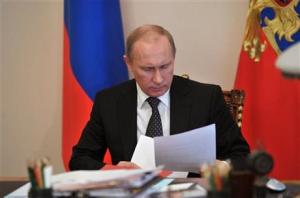
Yesterday the Wall Street Journal reported: Putin Says Snowden Was In Touch Before Coming To Russia. Putin just can’t keep his story straight. First he said he was taken completely by surprise when Snowden landed in his lap–he’d hardly even paid any attention to him before that. But lately he’s been gradually admitting that wasn’t true. From the WSJ:
MOSCOW—Russian President Vladimir Putin has admitted that Edward Snowden contacted Russian diplomats in Hong Kong a few days before boarding a plane to Moscow but that no agreement was reached to shelter him and he decided to come to Russia on his own without warning.
Mr. Putin had initially said Mr. Snowden’s arrival at Moscow’s Sheremetyevo International Airport on June 23 was a “complete surprise,” but now acknowledges that he had some prior knowledge that the fugitive former U.S. National Security Agency contractor might be headed Russia’s way.
“Mr. Snowden first appeared in Hong Kong and met with our diplomatic representatives. It was reported to me that there was such an employee, an employee of the security services. I asked ‘What does he want?’ He fights for human rights, for freedom of information and challenges violations of human rights and violations of the law in the United States. I said, ‘So what?’,” Mr. Putin said in an interview with Russia’s Channel One and The Associated Press.
Actually Russia had publicly “offered to consider [Snowden’s] asylum request” in June when Snowden was still in Hong Kong, but that fact seems to have gone down the corporate media’s memory hole at this point. Everyone also seems to have forgotten that the U.S. voided Snowden’s passport before he left Hong Kong and flew to Russia–supposedly on the way to Cuba and the Ecuador. Putin is still trying to blame the U.S. for Snowden’s failure to take his scheduled flight to Cuba, claiming it was because of the cancelled passport.
In an interview to Russia’s state-run Channel One and The Associated Press published Wednesday, Putin responded to various questions about touchy subjects in U.S.-Russia relations.
When asked about Snowden, who found himself the world’s most wanted fugitive after leaking top secret documents on U.S. surveillance programs, Putin said U.S. authorities could have grounded the plane that Snowden boarded to come to Moscow from China’s Hong Kong just as they did with the plane of Bolivian leader Evo Morales after they suspected that Snowden was on board.
Or, he said, U.S. intelligence officers could have let Snowden leave Russia —which was initially meant to be only a transit stop on his way to another country that would grant him asylum — and then could have grabbed him in a country “with a relaxed security regime,” Putin said, the Kremlin website reported.
“They could have done that in relation to Snowden. What prevented them” from doing that? Putin said.
Um…. you did, Mr. Putin. We’ve read the reports that Snowden was surrounded by a crowd of FSB officers before his feet even hit the floor in Moscow’s Sheremetyevo International Airport transit zone.
More foreign affairs writers are beginning to question just how much of an “accident” Snowden’s defection to Russia actually was. At Business Insider, Michael Kelley summarizes the growing suspicions among intelligence experts: Did WikiLeaks Sell Out Snowden To The Russians?
Is it just a coincidence that former NSA analyst Edward Snowden, a valuable intelligence asset, ended up in the hands of Russia’s security services?
Or did WikiLeaks, the “anti-secrecy” organization that has taken responsibility for Snowden, send him there in collaboration with the Russians?
Former senior U.S. intelligence analyst Joshua Foust makes a compelling argument that Wikileaks may have been infiltrated by Russia’s Federal Security Bureau, the post-Soviet successor to the KGB.
His argument is based on the shared history between WikiLeaks and Russia, how Snowden ended up in Russia, and what happened to Snowden once he landed in Moscow.
Looking at the same evidence, we think this is certainly a possibility.
Read all about it at the link, and if you have time, read Foust’s longer piece. It’s fascinating.
I’ll end with a couple of articles on the damage done to U.S. Intelligence services by Snowden’s stealing and leaking the contents of top secret documents. From former NSA analyst and now academic John Schindler: Snowden, NSA, and Counterintelligence.
From nearly the outset I’ve stated that Snowden is very likely an agent of Russian intelligence; this was met with howls of indignation which have died down in recent weeks as it’s become apparent that Ed’s staying in Russia for some time, along with whatever classified materials he had on his person. (Since Glenn Greenwald’s partner when stopped by British authorities at Heathrow had 58,000 highly classified documents on him, thanks to Ed, one can only wonder how big the initial haul actually was.) That Snowden was in contact with the Russian consulate in Hong Kong during his pre-Moscow visit there, including spending his 30th birthday with his new friends, is now admitted. Even President Vladimir Putin has conceded that Ed’s contacts with Russian officials did not commence when he landed at Sheremtyevo airport, rather before.
But when? That of course is the key question that NSA counterintelligence surely wants – needs – to know. All roads here lead to Wikileaks. We know that Snowden in late 2012 reached out to Glenn Greenwald and other members of the spy-ring – all of whom can be considered cut-outs for Wikileaks when not paid-up members – that stands behind the massive leaks. After making this contact, Ed took a contractor job with Booz Allen Hamilton to increase his access to NSA secrets. I’ve been stating for a while now that Wikileaks is functionally an extension of Russian intelligence; it’s become a minor meme asa few journalists have decided that such a scandalous viewpoint is worth considering.
Of course, for anyone versed in the ways of Russian intelligence, the notion that Wikileaks is a Moscow front that’s involved in anti-US espionage is about as controversial as, say, the notion that the sun will rise in the east tomorrow. Running false flags, creating fake activist groups, using Western journalists and activists for deception purposes – this sort of thing is in the DNA of Russian intelligence going back to the 19th century and is second nature to them. They call espionage tradecraft konspiratsiya (conspiracy) for a reason.
While there can be little doubt that the damage Snowden has wrought to the US and Allied SIGINT system is nothing less than immense, it will be some time before NSA and the US Government make any public pronouncements on such a touchy matter – not to mention that it will likely be several months yet before the Intelligence Community completes what will surely rank as the Mother of All Damage Assessments.
Without in any way diminishing the espionage losses that young Mr Snowden has caused, I want to suggest that the political damage in this case may loom larger, particularly as Putin savors his big win in this round, having humiliated American intelligence as it’s never quite been publicly humiliated before. The onetime Chekist in Putin surely is going to bed at night with a smile these days. “There are no ‘former’ intelligence officers,” Russia’s president once famously said, and he was also talking about himself.
Read the rest at the link if you can; this guy really knows his stuff–and he’s no right wing nut.
One more piece by British writer Chris Boffey: Why Edward Snowden is not a patriot, whistleblower or hero – but a spy.
Edward Snowden is a spy. The runaway CIA contractor may not know, or even care, whom he is spying for but the damage he is doing ranks alongside Philby, Burgess, McLean and Blunt. They comforted themselves with delusions that revealing the names of agents to the Soviet Union were for the greater good. Snowden was equally deluded when he opened up the secrets of western intelligence to one and all. Unlike the British spies, Snowden is not dealing in human information but electronic intelligence which in this day and age has more importance, but the results are the same….
Unlike Ames, Snowden was able to claim the moral high ground when spilling out the inner workings and policies of the US and UK security services to the world. Revealing how the state spies on its own citizens, without their knowledge or acquiescence, can be considered laudable but he lost the right to be called a whistleblower when he fled to negotiate first with the Chinese and then the Russians about political asylum and then it was revealed that he had taken with him the whole security shooting match.
Whistleblowers stand up and are counted; Snowden crawled out and ran away.
In sweeping up every secret he came across and downloading them to be dripped out is just plain treason and he knows this, given his determination not only never to return to the US but also to stay out of its legal jurisdiction.
Snowden justified his actions saying: “I don’t want to live in a society that does these sort of things [surveillance on its citizens]… I do not want to live in a world where everything I do and say is recorded… My sole motive is to inform the public as to that which is done in their name and that which is done against them.”
Presumably that is why he is now living in Russia, that Mecca of human rights.
Much more at the link. Check it out and see what you think.
That’s all I’ve got for you for the moment. Now what are you reading and blogging about today?
Tuesday Reads
Posted: August 27, 2013 Filed under: Barack Obama, China, Foreign Affairs, Iran, Iraq, morning reads, NSA, National Security Agency, Regulation, Russia, Syria, U.S. Politics | Tags: California wildfire, chemical weapons, cuba, David Miranda, Edward Snowden, GCHQ, Glenn Greenwald, John Kerry, Saddam Hussein, San Francisco water and power, Texas legislature, West Fertilizer Co., Yosemite National Park 30 Comments
Good Morning!!
The big news today is that President Obama appears likely to order “limited” strikes on Syria in the next few days in response to Syria’s use of chemical weapons against opposition fighters. From the WaPo: After Syria chemical allegations, Obama considering limited military strike.
President Obama is weighing a military strike against Syria that would be of limited scope and duration, designed to serve as punishment for Syria’s use of chemical weapons and as a deterrent, while keeping the United States out of deeper involvement in that country’s civil war, according to senior administration officials.
The timing of such an attack, which would probably last no more than two days and involve sea-launched cruise missiles — or, possibly, long-range bombers — striking military targets not directly related to Syria’s chemical weapons arsenal, would be dependent on three factors: completion of an intelligence report assessing Syrian government culpability in last week’s alleged chemical attack; ongoing consultation with allies and Congress; and determination of a justification under international law.
“We’re actively looking at the various legal angles that would inform a decision,” said an official who spoke about the presidential deliberations on the condition of anonymity. Missile-armed U.S. warships are already positioned in the Mediterranean.
I guess “looking at…legal angles” is code for that pesky rule in the Constitution where Congress has to declare wars. When’s the last time that happened–WWII?
Meanwhile, BBC News reports: Russia and China step up warning over strike.
Russian foreign ministry spokesman Alexander Lukashevich has called on the international community to show “prudence” over the crisis and observe international law.
“Attempts to bypass the Security Council, once again to create artificial groundless excuses for a military intervention in the region are fraught with new suffering in Syria and catastrophic consequences for other countries of the Middle East and North Africa,” he said in a statement.
Late on Monday, the US said it was postponing a meeting on Syria with Russian diplomats, citing “ongoing consultations” about alleged use of chemical weapons in Syria.
Hours later, Russia expressed regret about the decision. The two sides had been due to meet in The Hague on Wednesday to discuss setting up an international conference on finding a political solution to the crisis.
The Russian deputy defence minister, Gennady Gatilov said working out the political parameters for a resolution on Syria would be especially useful, with the threat of force hanging over the country.
Read more at the link.
Just as SOS Kerry was giving a speech to justify the upcoming military strikes, providing “Clear Evidence of Chemical Weapon Use in Syria” (NYT), a little birdie told Shane Harris and Matthew Aid of Foreign Policy magazine that the U.S. facilitated Saddam Hussein’s use of chemical weapons against Iran back in 1988.
The U.S. government may be considering military action in response to chemical strikes near Damascus. But a generation ago, America’s military and intelligence communities knew about and did nothing to stop a series of nerve gas attacks far more devastating than anything Syria has seen, Foreign Policy has learned.
In 1988, during the waning days of Iraq’s war with Iran, the United States learned through satellite imagery that Iran was about to gain a major strategic advantage by exploiting a hole in Iraqi defenses. U.S. intelligence officials conveyed the location of the Iranian troops to Iraq, fully aware that Hussein’s military would attack with chemical weapons, including sarin, a lethal nerve agent.
The intelligence included imagery and maps about Iranian troop movements, as well as the locations of Iranian logistics facilities and details about Iranian air defenses. The Iraqis used mustard gas and sarin prior to four major offensives in early 1988 that relied on U.S. satellite imagery, maps, and other intelligence. These attacks helped to tilt the war in Iraq’s favor and bring Iran to the negotiating table, and they ensured that the Reagan administration’s long-standing policy of securing an Iraqi victory would succeed. But they were also the last in a series of chemical strikes stretching back several years that the Reagan administration knew about and didn’t disclose.
U.S. officials have long denied acquiescing to Iraqi chemical attacks, insisting that Hussein’s government never announced he was going to use the weapons. But retired Air Force Col. Rick Francona, who was a military attaché in Baghdad during the 1988 strikes, paints a different picture.
“The Iraqis never told us that they intended to use nerve gas. They didn’t have to. We already knew,” he told Foreign Policy.
Read the rest of this long article at Foreign Policy.
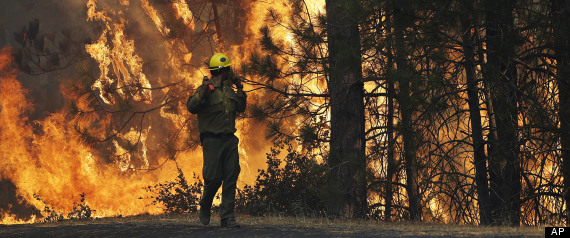
Firefighter A.J. Tevis watches the flames of the Rim Fire near Yosemite National Park, Calif., on Sunday, Aug. 25, 2013. With winds gusting to 50 mph on Sierra mountain ridges and flames jumping from treetop to treetop, hundreds of firefighters have been deployed to protect this and other communities in the path of the Rim Fire raging north of Yosemite National Park. (AP Photo/Jae C. Hong)
The wildfire in Northern California continues to spread into Yosemite National Park and has begun to threaten towns in the area. From the LA Times: Massive Rim fire continues to reshape lives and topography.
…even as firefighters worked furiously to hold a line outside of town, officials warned that this blaze was so hot it could send sparks more than a mile and a half out that could jump lines and start new hot spots. Evacuation advisories remain in effect for Tuolumne City and nearby areas.
On the north edge, the fire — now 134,000 acres — pushed into the Emigrant Wilderness Area and Yosemite National Park. It’s the one side of the fire with a natural last stand: Eventually it will run into granite walls that have snuffed out fires in this region for centuries.
Each day, what the massive blaze does depends on the wind. But officials were particularly attuned to each shift of breeze Sunday because of the weather’s eerie similarities to the day when the fire first exploded out of control.
So far the unpredictable blaze is only about 20% controlled, and it still threatens water and power sources for San Francisco.
The massive fire presents every challenge: steep slopes, dry fuel, rugged terrain and entire communities possibly in harm’s way.
The base camp and incident post, usually a haven outside fire lines, was a prominent example of the fire’s unpredictability: It’s in the middle of the burn zone, charred land with still-smoldering stumps on both sides.
Firefighters call such complete devastation “the black.” Entire ravines and ridges were a dusty gray moonscape. But some of the land was a “dirty burn” — meaning there were small circles of pine and aspen and even grass and wildflowers in the middle of charcoal-black areas where smoke still curled and embers glowed. The specks of beauty made firefighters nervous: To a fire, they are fuel.
My sister and her husband own a house north of San Francisco. It’s probably not in danger, but it still brings the scope of this disaster home to me. I sure hope Firefighers will begin to make progress soon. The burning area is now the size of the city of Chicago, according to CNN.
Yosemite National Park, California (CNN) — A massive northern California wildfire that’s threatening Yosemite National Park and San Francisco’s key water and power sources grew Monday, becoming the 13th largest in state history, state fire authorities said.
The Rim Fire, which has devoured 160,980 acres, has scorched an area about the size of the city of Chicago while more than 3,600 firefighters try to rein it in….
The wildfire, which was 20% contained Monday night, was spreading primarily to the east and threatened to grow amid extremely dry conditions and hot weather.
Part of the fire continued to spread Monday toward a key part of San Francisco’s water supply: the Hetch Hetchy Reservoir, which lies within Yosemite and is just east of the flames.
The fire also could threaten the area’s hydroelectric generators, which provide much of San Francisco’s electricity. Because of the approaching flames, officials shut down the generators, and the city — more than 120 miles to the west — temporarily is getting power from elsewhere.
Speaking of disasters, Charles Pierce reminds us that West, Texas is still recovering from the horrible explosion at the fertilizer plant there and that Texas still isn’t doing that much to prevent similar events in the future.
Read the rest of this entry »
Thursday Reads
Posted: August 8, 2013 Filed under: Barack Obama, Civil Liberties, Drone Warfare, Foreign Affairs, GLBT Rights, morning reads, NSA, National Security Agency, Russia, U.S. Politics, Yemen | Tags: al Qaeda, Ayan al-Zawahiri, Barbara Starr, Charlie Savage, DEA, Edward Snowden, FISA, IRS, Josh Rogin, Julia Ioffe, Lawrence O'Donnell, Nasser al-Wuhayshi, Sochi Winter Olympics, whistleblowers 36 Comments
Good Morning!!
Yesterday, the White House announced that President Obama will not meet one-on-one with Russian President Vladimir Putin at the G-20 meeting in St. Petersburg as previously planned. From The Washington Post:
President Obama has canceled a meeting with Russian Prime Minister Vladimir Putin. Russia’s decision to give temporary asylum to former National Security Agency contractor Edward Snowden has exacerbated tensions with the United States over a number of issues:
“Following a careful review begun in July, we have reached the conclusion that there is not enough recent progress in our bilateral agenda with Russia to hold a U.S.-Russia Summit in early September,” White House press secretary Jay Carney said in a statement.
Carney cited a “lack of progress” with Russia over the past 12 months on a broad range of issues including missile defense and arms control, trade and commercial relations, global security and human rights and civil society issues. Carney added that Russia’s “disappointing decision” last week to grant Snowden temporary asylum, allowing him to live and work in Russia for up to a year, was also a factor.
President Obama discussed some of his issues with Russia in an appearance on The Tonight Show with Jay Leno on Tuesday night.
Saying that he had “no patience for countries that try to treat gays or lesbians or transgender persons in ways that intimidate them or are harmful to them,” Obama criticized a law, enacted in June, that prohibits public events promoting gay rights and public displays of affection by same-sex couples. A Russian official has promised that the law will be enforced during next February’s Sochi Games despite the International Olympic Committee’s contrary stance.
After the announcement, Russian-American journalist Julia Iofee wrote at The New Republic: Obama Bails on His Inevitably Awkward Date With Putin.
A week after Edward Snowden was granted temporary asylum in Russia, President Obama canceled his bi-lateral September summit in Moscow with Vladimir Putin, though administration officials are at pains to portray this as something greater than pure tit-for-tattery. Rather, they say, it was an excuse to avoid what, even without Snowden, would have been “a pretty dreary affair.”
A few days before Snowden turned up in Moscow, Obama and Putin met on the sidelines of the G8 conference in Northern Ireland. The resulting photo-op—Obama looking forlornly into the distance, Putin slouched and sullen—said it all: they looked like the aging couple at the neighboring table, intently working on their food and eavesdropping on your conversation because they had nothing to support one of their own. Moscow and Washington had talked and talked, they’d gotten START and the transport route to Afghanistan and the sanctions on Iran, but now, the kids are out of the house and they were talking past each other on Syria, on Iran, on pretty much everything.
Lawrence O’Donnell asked Ioffe to appear on his MSNBC show last night to discuss the issues surrounding the decision; but instead of allowing her to express her opinions, O’Donnell interrupted Ioffe, lectured her about Russia and Putin, basically implying she is a liar. Ioffe responded at TNR:
Tonight, I went on Lawrence O’Donnell’s show, and Lawrence O’Donnell yelled at me. Or, rather, he O’Reilly’d at me. That O’Donnell interrupted and harangued and mansplained and was generally an angry grandpa at me is not what I take issue with, however. What bothers me is that, look: your producers take the time to find experts to come on the show, answer your questions, and, hopefully, clarify the issue at hand.
I was invited on the show to talk about Obama’s (very wise) decision to cancel his Moscow summit with Putin, about which I wrote here. I am an expert on Russia. In fact, it is how you introduced me: “Previously, she was a Moscow-based correspondent for Foreign Policy and The New Yorker.” I’m not going to toot my own horn here, but I was there for three years, I’m a fluent, native speaker of Russian, and, god damn it, I know my shit.
Which is why I wish you’d let me finish answering your bullshit question…
You can watch the interaction at MSNBC and read the things she would have liked to say about Putin at TNR. Basically Ioffe tried to explain the Putin doesn’t control everything that happens in Russia anymore than Obama controls everything that happens in the US. She believes that once the Bolivian plane was forced to land because the US suspected Snowden might be on board, Putin really had no choice but to allow Snowden to stay in Russia, because public opinion there strongly supported him.
I have quoted Ioffe in previous posts, and she certainly is no Putin apologist–as she asserts in her piece. I think O’Donnell treated her shamefully.
In other NSA news, mainstream reporters continue to published far more stunning revelations than anything that has come from Snowden and Greenwald. This morning at The New York Times, Charlie Savage writes about surveillance of e-mails between people in the US and foreign countries without warrants, which is being justified by an interpretation of the 2008 FISA Amendments Act.
The National Security Agency is searching the contents of vast amounts of Americans’ e-mail and text communications into and out of the country, hunting for people who mention information about foreigners under surveillance, according to intelligence officials.
The N.S.A. is not just intercepting the communications of Americans who are in direct contact with foreigners targeted overseas, a practice that government officials have openly acknowledged. It is also casting a far wider net for people who cite information linked to those foreigners, like a little used e-mail address, according to a senior intelligence official.
While it has long been known that the agency conducts extensive computer searches of data it vacuums up overseas, that it is systematically searching — without warrants — through the contents of Americans’ communications that cross the border reveals more about the scale of its secret operations….
Government officials say the cross-border surveillance was authorized by a 2008 law, the FISA Amendments Act, in which Congress approved eavesdropping on domestic soil without warrants as long as the “target” was a noncitizen abroad. Voice communications are not included in that surveillance, the senior official said.
Read more at the NYT link.
And at Reuters, John Shiffman and David Ingram report that a DEA program that appears to use NSA data to target ordinary criminals in the and then require DEA officers to conceal the source of the information was also used by the IRS.
Details of a U.S. Drug Enforcement Administration program that feeds tips to federal agents and then instructs them to alter the investigative trail were published in a manual used by agents of the Internal Revenue Service for two years.
The practice of recreating the investigative trail, highly criticized by former prosecutors and defense lawyers after Reuters reported it this week, is now under review by the Justice Department. Two high-profile Republicans have also raised questions about the procedure.
A 350-word entry in the Internal Revenue Manual instructed agents of the U.S. tax agency to omit any reference to tips supplied by the DEA’s Special Operations Division, especially from affidavits, court proceedings or investigative files. The entry was published and posted online in 2005 and 2006, and was removed in early 2007. The IRS is among two dozen arms of the government working with the Special Operations Division, including the Federal Bureau of Investigation, the National Security Agency and the Central Intelligence Agency.
An IRS spokesman had no comment on the entry or on why it was removed from the manual. Reuters recovered the previous editions from the archives of the Westlaw legal database, which is owned by Thomson Reuters Corp, the parent of this news agency.
Just as a reminder that Russia’s treatment of journalists and whistleblowers is actually a hell of a lot worse than anything that happens in the US, Human Rights Watch reports on Russia’s Silencing Activists, Journalists ahead of Sochi Games.
(Moscow) – Local authorities have harassed numerous activists and journalists who criticized or expressed concerns about preparations for the 2014 Winter Olympic Games in Sochi. The six-month countdown to the Sochi Games opening ceremony is this week.
Human Rights Watch has documented government efforts to intimidate several organizations and individuals who have investigated or spoken out againstabuse of migrant workers, the impact of theconstruction of Olympics venues and infrastructure on the environment and health of residents, and unfair compensation for people forcibly evicted from their homes. Human Rights Watch also documented how authorities harassed and pursued criminal charges against journalists, apparently in retaliation for their legitimate reporting.
“Trying to bully activists and journalists into silence is wrong and only further tarnishes the image of the Olympics,” said Jane Buchanan, associate Europe and Central Asia director at Human Rights Watch. “One of the non-negotiable requirements of hosting the Olympics is to allow press freedom, and the authorities’ attempts to silence critics are in clear violation of that principle.”
Obviously that doesn’t justify the Obama administration trying to influence media coverage of the NSA story, but we do need to keep things in perspective. In that vein, Bob Cesca had a good post yesterday: The Real-Life Stories of Legitimate NSA Whistleblowers (Snowden Isn’t One of Them). I hope you’ll give it a read.
In other news, Yemen has been hit by 6 suspected US drone strikes in the past 2 weeks–probably linked to the recently reported threat of an imminent terror strike that led the US to close a number of embassies last weekend.
An official in Yemen said Thursday that the sixth suspected U.S. drone strike in just two weeks had left six suspected al Qaeda militants dead in the group’s former stronghold in the center of the country. The official told The Associated Press that a missile hit a car traveling in the central Marib province, causing the fatalities.
CBS News correspondent Charlie D’Agata reports that Yemen has long been a haven for al Qaeda leadership, and the country claimed Wednesday to have disrupted a major plot, which may have exposed potential targets.
Yemeni government officials say security forces are turning up the heat on militants from al Qaeda in the Arabian Peninsula, the global terror network’s branch based in the nation, after foiling the plot to strike foreign embassies, gas and oil installations, and the country’s port cities.
The government has even given a shoot-to-kill order on anybody who looks suspicious and refuses to identify themselves.
The alleged plot appears to have been similar to the January attack in Algeria which saw gunmen storm the Amenas gas plant, killing more than three dozen foreign workers.
Yesterday in The Daily Beast, Eli Lake and Josh Rogin reported that information about the terror threats came from an al Qaeda “conference call,” involving top al Qaeda leaders and around 20 other people–a report that aroused quite a bit of skepticism on Twitter. Why would these guys risk talking on a conference call? Here’s an excerpt from the Daily Beast article:
The intercept provided the U.S. intelligence community with a rare glimpse into how al Qaeda’s leader, Ayman al-Zawahiri, manages a global organization that includes affiliates in Africa, the Middle East, and southwest and southeast Asia.
Several news outlets reported Monday on an intercepted communication last week between Zawahiri and Nasser al-Wuhayshi, the leader of al Qaeda’s affiliate based in Yemen. But The Daily Beast has learned that the discussion between the two al Qaeda leaders happened in a conference call that included the leaders or representatives of the top leadership of al Qaeda and its affiliates calling in from different locations, according to three U.S. officials familiar with the intelligence. All told, said one U.S. intelligence official, more than 20 al Qaeda operatives were on the call.
To be sure, the CIA had been tracking the threat posed by Wuhayshi for months. An earlier communication between Zawahiri and Wuhayshi delivered through a courier was picked up last month, according to three U.S. intelligence officials. But the conference call provided a new sense of urgency for the U.S. government, the sources said.
Al Qaeda members included representatives or leaders from Nigeria’s Boko Haram, the Pakistani Taliban, al Qaeda in Iraq, al Qaeda in the Islamic Maghreb, and more obscure al Qaeda affiliates such as the Uzbekistan branch. Also on the call were representatives of aspiring al Qaeda affiliates such as al Qaeda in the Sinai Peninsula, according to a U.S. intelligence official. The presence of aspiring al Qaeda affiliates operating in the Sinai was one reason the State Department closed the U.S. Embassy in Tel Aviv, according to one U.S. intelligence official. “These guys already proved they could hit Eilat. It’s not out of the range of possibilities that they could hit us in Tel Aviv,” the official said.
Perhaps the call was encrypted in some way and the US had found a way to listen anyway? But then why would they blow future such operations by leaking the fact that they had listened to the call? This morning CNN’s Barbara Starr tweeted to Josh Rogin:
@joshrogin IT WAS NOT A PHONE CALL. IN FACT, AL QAEDA WENT TO EXTENSIVE MEANS TO SET UP WHAT YOU MIGHT SAY A VIRTUAL MEETING SPACE.”
I’m not sue how to interpret that either. I’ll update if I get anything more on this.
Once again, my morning post has gotten way too long. I have other news links, but I’ll put them in the comments. I hope you’ll do the same with whatever stories you’re following today, and have a tremendous Thursday!!

 peej
peej Carissa
 bostonboomer
 dakinikat
 ecocatwoman
 mablue2
 Mama Lopez
 peggysue22
 quixote
 skydancingguestblogger
 Mona (aka Wonk the Vote)



 Sky Dancing
Recent Comments