I’m trying not to let myself fall into despair over what’s happening in our country and the world, but it isn’t easy. I try to distract myself by reading novels and by watching shows on Netflix and Max. But inevitably I open my phone or turn on cable news and get hit with awful news about what new insane thing Trump is doing or saying.
This morning, as I look around at stories in the news, I find myself sinking into sadness over what we have already lost from our democracy and what more losses could be coming. It’s all so tragic. I honestly despise the people who voted for Trump.
There’s one person who never fails to lift my spirits, if only temporarily: MSNBC’s Lawrence O’Donnell. Recently, he has had a great time making fun of Trump’s seeming obsession with American girls’ dolls and how they need to make do with just 2 or 3 or 4 instead of 35 because of his tariffs.
Last night Lawrence made an interesting point about Trump’s cognitive decline. He pointed out that Trump saying “I don’t know,” when asked if people in the U.S. have a right to due process and when asked if he has a duty to defend the Constitution is something new for him. Normally, Trump never admits to not knowing something. He would rather bumble around talking complete nonsense than admit to not knowing.
Lawrence argues that Trump is a pathetic husk of his former self, exhausted and befuddled by his responsibilities. Not that any of this is going to drive Trump from office, but it’s an interesting thought. The danger, of course is that other people like Elon Musk and Stephen Miller could be in control of the presidency.
Lawrence also discussed Trump’s embarrassing appearance yesterday in the Oval Office with newly elected Canadian Prime Minister Mark Carney.
“The Canadian prime minister both humbled and humiliated Donald Trump at the same time without Donald Trump having the slightest idea it was happening,” he said on Tuesday night.
Later in the segment, O’Donnell slammed Trump’s “utterly demented attempt” to turn Canada into a state. Carney, he noted, responded by saying “absolutely no to Donald Trump to his face.”
But Trump, he said, barely noticed.
“Donald Trump had no fight in him today when the very polite Canadian beside him talked rings around Donald Trump like a ring master in a circus with a trained animal, threw in some magic words that sounded flattering enough to Donald Trump so that Donald Trump actually ― and you’ll see this ― ends up nodding and agreeing with the man who is humiliating him and defeating him right there in the room on TV,” O’Donnell said. “No president has ever lost more in one conversation in the Oval Office than Donald Trump lost in these 90 seconds.”
O’Donnell rolled the footage of the meeting, where Carney told him Canada would never be for sale and would not be a U.S. state.
So, on to today’s news.
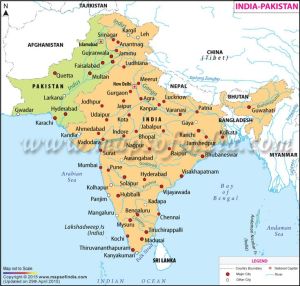
India and Pakistan–both nuclear powers–appear to be on the verge of war.
India launched military strikes on targets in Pakistan, both countries said on Wednesday and Pakistan claimed it had shot down five Indian Air Force jets, in an escalationthat has pushed the two nations to the brink of wider conflict.
India’s missile strikes early Wednesday morning targeted “terrorist infrastructure” across nine sites in Pakistan’s densely populated Punjab province and Pakistan-administered Kashmir, it said. They came in response to a massacreby militantsof tourists in Indian-administered Kashmir two weeks ago, that New Delhi blamed on its neighbor.
India Pakistan map
Pakistan said at least 26 people were killed in Wednesday’s strikes – including women and a three-year-old girl – and 46 wounded. The country’s Prime Minister Shehbaz Sharif describedthe strikes as “an act of war” and Islamabad has vowed to retaliate.
From early Wednesday the two sides have exchanged shelling across their border, with locals on both sides telling CNN they weretakingshelter. A CNN journalist in Pakistan-administered Kashmir heard multiple loud explosions.
“A shell landed at a house close to the mosque in which two people were injured. Shells also hit other houses in our area and we fled from our area to a safer place,” said Shakeel Butt, a resident of Muzaffarabad, in Pakistani-administered Kashmir. A senior Indian defense source said at least eight people had been killed on the Indian side of the border.
Pakistani military sources later said they shot down five Indian Air Force jets and one drone in “self-defense,” claiming three Rafale jets – sophisticated multi-role fighters made in France – were among those downed as well as a MiG-29 and an SU-30 fighter.
A local resident and government official told CNN that an unidentified fighter aircraft had crashed on a school building in Indian-administered Kashmir.
Tensions between India and Pakistan intensified Wednesday after India’s military launched strikes against the neighboring country in response to a militant attack in Indian-administered Kashmir last month, heightening fears of war between the nuclear-armed rivals….
The strikes have set the region on edge and shattered the fragile ceasefire that has largelyheld since 2021, with analysts warning of escalation in the decades-long conflict that has riven the South Asian subcontinent over the Muslim-majority region of Kashmir, parts of which are controlled by India and Pakistan, though the area is claimed in full by both countries.
Wednesday’s aerial assault is on a far bigger scale than in 2019, when India struck a single, remote Pakistani site in response to a suicide bombing that killed more than 40 Indian soldiersin Kashmir….
The sharp rise in tensions follows a deadly April 22 attack on tourists near the town of Pahalgam in Indian-administered Kashmir.
Gunmen armed with rifles killed 25 Indians and one Nepalese citizen. More than a dozen others were injured. The attack was the deadliest against civilians since the 2008 Mumbai attacks by the Pakistani-based militant group Lashkar-e-Taiba that killed 166 people.
Indian-administered Kashmir is a heavily militarized zone. An armed insurgency — either seeking independence or favoring accession to Pakistan — has continued against Indian rule for more than three decades.
India has long accused Pakistan of fomenting separatist violence in Kashmir. Indian Foreign Secretary Vikram Misri said Wednesday that India had found evidence linking themilitants in the Pahalgam attack to Pakistan.
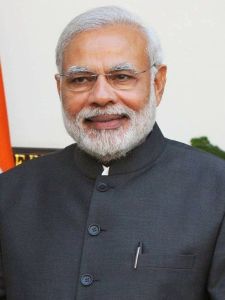
The Hindu nationalist government of Narendra Modi revoked Kashmir’s semiautonomous status in August 2019 and instituted a crackdown, including imposing the world’s longest internet shutdown in a democracy. Promising development and investment, New Delhi had touted a return to relative peace, citing the surge of tourists to the region, a narrative upended by the deadly attack last month.
Read more at the WaPo.
Joe Biden gave his first major interview since he left the White House.
Former US President Joe Biden has given his first in-depth interview since he left the White House in January, speaking to the BBC about his legacy, foreign policy and his view of President Donald Trump’s first 100 days.
He said that he had few regrets, but he offered grave warnings about global affairs as Europe marks 80 years since the end of World War Two on the continent….
The former president also reflected on his decision to drop out of the 2024 election race – but he had less to say about any mistakes he and the Democrats may have made along the way….
On leaving the 2024 presidential race:
Democratic strategists have lamented that the last-minute handover left their campaign flat-footed, ultimately aiding Trump’s path to the White House, even as Democrats held a financial advantage in the 2024 race.
Biden boasted of being “so successful on our agenda” – a reference to the major legislation enacted in his first two years in office on the environment, infrastructure and social spending, as well as the better-than-expected Democratic performance in the 2022 midterm elections.
“It was hard to say now I’m going to stop,” he said. “Things moved so quickly that it made it difficult to walk away.”
Ultimately, quitting was “the right decision”, he said, but it was “just a difficult decision”.
On Trump and Ukraine:
Biden described the Trump administration’s suggestion that Ukraine give up territory as part of a peace deal with Russia as “modern-day appeasement” – a reference to European allies that allowed Adolf Hitler to annex Czechoslovakia in the 1930s in an ill-fated attempt to prevent a continent-wide conflict.
Joe Biden at BBC interview
“I just don’t understand how people think that if we allow a dictator, a thug, to decide he’s going to take significant portions of land that aren’t his, that that’s going to satisfy him. I don’t quite understand,” Biden said of Russian President Vladimir Putin….
Though Biden’s repeated assertion that Russian tanks would be rolling through central Europe if America and its allies didn’t support Ukraine is impossible to prove, he views the threat posed by Putin as serious and worthy of the comparison.
Biden also said that if the US allowed a peace deal that favoured Russia, Putin’s neighbours would be under economic, military and political pressure to accommodate Moscow’s will in other ways. In his view, the promise of American support to European allies becomes less believable and less of a deterrent.
Until this week, President Biden himself (former presidents keep their titles after they leave office) has largely observed the convention that former presidents do not criticise their successors at the start of their time in office. But from the moment we shake hands it is clear that he is determined to have his say too.
In a dark blue suit, the former president arrives smiling and relaxed but with the determined air of a man on a mission. It’s his first interview since leaving the White House, and he seems most angry about Donald Trump’s treatment of America’s allies – in particular Ukraine’s president, Volodymyr Zelensky….
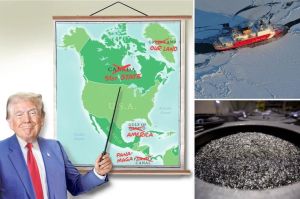
“I found it beneath America, the way that took place,” he says of the explosive Oval Office row between Trump and Zelensky in February. “And the way we talk about now that, ‘it’s the Gulf of America’, ‘maybe we’re going to have to take back Panama’, ‘maybe we need to acquire Greenland, ‘maybe Canada should be a [51st state].’ What the hell’s going on here?
“What President ever talks like that? That’s not who we are. We’re about freedom, democracy, opportunity – not about confiscation.”
The U.S. is stepping up its intelligence-gathering efforts regarding Greenland, drawing America’s spying apparatus into President Trump’s campaign to take over the island, according to two people familiar with the effort.
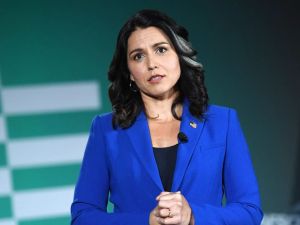
Several high-ranking officials under Director of National Intelligence Tulsi Gabbard issued a “collection emphasis message” to intelligence-agency heads last week. They were directed to learn more about Greenland’s independence movement and attitudes on American resource extraction on the island.
The classified message asked agencies, whose tools include surveillance satellites, communications intercepts and spies on the ground, to identify people in Greenland and Denmark who support U.S. objectives for the island.
The directive is one of the first concrete steps Trump’s administration has taken toward fulfilling the president’s often-stated desire to acquire Greenland.
A collection-emphasis message helps set intelligence-agency priorities, directing resources and attention to high-interest targets. The Greenland order, which went to agencies including the Central Intelligence Agency, the Defense Intelligence Agency and the National Security Agency, underscores the administration’s apparent commitment to seeking control of the self-governing island. It forms part of the Kingdom of Denmark, a North Atlantic Treaty Organization member and a decadeslong ally.
James Hewitt, a National Security Council spokesman, said the White House doesn’t comment on intelligence matters, but added: “The president has been very clear that the U.S. is concerned about the security of Greenland and the Arctic.”
In a statement, Gabbard said: “The Wall Street Journal should be ashamed of aiding deep state actors who seek to undermine the President by politicizing and leaking classified information. They are breaking the law and undermining our nation’s security and democracy.”
More at the WSJ. I got past the paywall by clicking the link on Memeorandum.
A Navy fighter jet failed to land on an aircraft carrier and plummeted into the Red Sea on Tuesday, marking the fourth major mishap involving the vessel and the third loss of a fighter jet deployed with it since the warship left home last year.
The F/A-18F Super Hornet fighter jet, worth about $67 million, went overboard after an unsuccessful attempt to slow it down upon landing on the USS Harry S. Truman, the Navy said in a statement. Both aviators aboard the jet safely ejected and were rescued at sea by helicopter with minor injuries, and no one aboard the warship’s flight deck was harmed, the service said.
Boeing F/A-18F Super Hornet fighter jet
The latest incident, reported earlier by CNN, followed the loss of another jet, an F/A-18E, in an accident aboard the Truman last week in which the aircraft tumbled overboard after sailors aboard lost control of it while towing it in the ship’s hangar bay. A third fighter jet from the Truman was shot down accidentally over the Red Sea in December by another Navy warship, the USS Gettysburg, in an incident that triggered concerns about communication among warships and fighter jets in the region.
The Truman also was involved in a collision in the Mediterranean Sea in February, prompting the service to fire its commanding officer, Navy Capt. Dave Snowden. He was replaced by Navy Capt. Christopher Hill, who had just completed the deployment of another carrier, the USS Dwight D. Eisenhower.
While the incidents have not killed any service members, they have raised questions about the strain placed on the aircraft carrier’s crew and its ability to carry out a grueling deployment in which troops have clashed for months with Houthi militants in Yemen, who have repeatedly launched drone and missile attacks against vessels in the region. The mishaps have the attention of senior U.S. military leaders, a defense official familiar with the discussion said Tuesday night, speaking on the condition of anonymity because of the sensitivity of the issue.
Defense Secretary Pete Hegseth has twice extended the aircraft carrier’s deployment since it left its home in Virginia last September, most recently last week, to ensure that the Navy had two aircraft carriers on hand to battle the Houthis. Since March, the carrier has been on the front lines of a full-scale assault that President Donald Trump ordered against the Yemen-based militant group in response to its attacks on commercial and military vessels dating to late 2023.
Pete Hegseth isn’t the only cabinet member who doesn’t seem to care about protecting the nation’s secrets.
Tulsi Gabbard, the director of national intelligence, used the same easily cracked password for different online accounts over a period of years, according to leaked records reviewed by WIRED. Following her participation in a Signal group chat in which sensitive details of a military operation were unwittingly shared with a journalist, the revelation raises further questions about the security practices of the US spy chief.
WIRED reviewed Gabbard’s passwords using databases of material leaked online created by the open-source intelligence firms District 4 Labs and Constella Intelligence. Gabbard served in Congress from 2013 to 2021, during which time she sat on the Armed Services Committee, its Subcommittee on Intelligence and Special Operations, and the Foreign Affairs Committee, giving her access to sensitive information. Material from breaches shows that during a portion of this period, she used the same password across multiple email addresses and online accounts, in contravention of well-established best practices for online security. (There is no indication that she used the password on government accounts.)
Tulsi Gabbard
Two collections of breached records published in 2017 (but breached at some previous unknown date), known as “combolists,” reveal a password that was used for an email account associated with her personal website; that same password, according to a combolist published in 2019, was used with her Gmail account. That same password was used, according to records dating to 2012, for Dropbox and LinkedIn accounts associated with the email address tied to her personal website. According to records dating to 2018 breaches, she also used it on a MyFitnessPal account associated with a me.com email address and an account at HauteLook, a now-defunct ecommerce site then owned by Nordstrom.
Records of these breaches have been available online for years and are accessible in commercial databases.
Gabbard’s spokesperson downplayed this story, saying the information is a decade old and passwords have been changed many times since then. But check out this info on Gabbard:
The password associated with all of the accounts in question includes the word “shraddha,” which appears to have personal significance to Gabbard: Earlier this year, The Wall Street Journal reported that she had been initiated into the Science of Identity Foundation, an offshoot of the Hare Krishna movement into which she was reportedly born and which former members have accused of being a cult. Several former adherents told The Journal that they believe Gabbard received the name “Shraddha Dasi” when she was allegedly received into the group. Gabbard’s deputy chief of staff, Alexa Henning, responded to questions from The Journal at the time by posting them on X and accusing the news media of publicizing “Hinduphobic smears and other lies.”
The U.S. DOGE Service is racing to build a single centralized database with vast troves of personal information about millions of U.S. citizens and residents, a campaign that often violates or disregards core privacy and security protections meant to keep such information safe, government workers say.
The team overseen by Elon Musk is collecting data from across the government, sometimes at the urging of low-level aides, according to multiple federal employees and a former DOGE staffer, who all spoke on the condition of anonymity for fear of reprisals. The intensifying effort to unify systems into one central hub aims to advance multiple Trump administration priorities, including finding and deporting undocumented immigrants and rooting out fraud in government payments. And it follows a March executive order to eliminate “information silos” as DOGE tries to streamline operations and cut spending.
At several agencies, DOGE officials have sought to merge databases that had long been kept separate, federal workers said. For example, longtime Musk lieutenant Steve Davis told staffers at the Social Security Administration that they would soon start linking various sources of Social Security data for access and analysis, according to a person briefed on the conversations, with a goal of “joining all data across government.” Davis did not respond to a request for comment.
But DOGE has also sometimes removed protections aroundsensitive information — on Social Security numbers, birth dates, employment history, disability records, medical documentation and more. In one instance, a website for a new visa program wasn’t set up behind a protective virtual private network as would be customary, according to a Department of Homeland Security employee and records obtained by The Washington Post.
The administration’s moves ramp up the risk of exposing data to hackers and other adversaries, according to security analysts, and experts worry that any breaches could erode public confidence in government. Civil rights advocates and some federal employees also worry that the data assembled under DOGE could be used against political foes or for targeted decisions about funding or basic government services.
“Separation and segmentation is one of the core principles in sound cybersecurity,” said Charles Henderson of security company Coalfire. “Putting all your eggs in one basket means I don’t need to go hunting for them — I can just steal the basket.”
The Supreme Court ruled on Tuesday that the Trump administration may start enforcing a ban on transgender troops serving in the military that had been blocked by lower courts.
The ruling was brief, unsigned and gave no reasons, which is typical when the justices act on emergency applications. It will remain in place while challenges to the ban move forward.
The court’s three liberal members — Justices Sonia Sotomayor, Elena Kagan and Ketanji Brown Jackson — noted dissents but provided no reasoning.
Commander Emily Shilling
The case concerns an executive order issued on the first day of President Trump’s second term. It revoked an order from President Joseph R. Biden Jr. that had let transgender service members serve openly.
A week later, Mr. Trump issued a second order saying that “adoption of a gender identity inconsistent with an individual’s sex conflicts with a soldier’s commitment to an honorable, truthful and disciplined lifestyle.”
The Defense Department implemented Mr. Trump’s order in February, issuing a new policy requiring transgender troops to be forced out of the military. According to officials there, about 4,200 current service members, or about 0.2 percent of the military, are transgender.
The context:
The Supreme Court’s order came against the backdrop of the Trump administration’s broad attacks on transgender rights. The administration has sought to bar transgender athletes from sports competitions. It has tried to force transgender people to use bathrooms designated for their sex assigned at birth. And it has objected to letting people choose their pronouns.
The justices will soon decide the fate of a Tennessee law that bans transition care for transgender youths, challenged in a case brought by the Biden administration. The Trump administration flipped the government’s position in that case in February, after an executive order directed agencies to take steps to curtail surgeries, hormone therapy and other gender transition care for people under 19 years old.
In the case decided on Tuesday, seven active service members, as well as a person who sought to join and an advocacy group, sued to block the policy, saying, among other things, that it ran afoul of the Constitution’s equal protection clause.
One of the plaintiffs, Cmdr. Emily Shilling, who began transitioning in 2021 while serving in the Navy, has been a naval aviator for 19 years, flying more than 60 combat missions, including in Iraq and Afghanistan.
Her lawyers said the Navy had spent $20 million on her training.
In March, Judge Benjamin H. Settle of the Federal District Court in Tacoma, Wash., issued a nationwide injunction blocking the ban, using Commander Shilling as an example of the policy’s flaws.
Faced with the highly secretive and complex ritual of choosing a new pope, Catholic cardinals have turned to Hollywood to learn how it could all play out.
As crazy as it might sound, some of the 133 high-ranking clerics set to enter the Sistine Chapel when the conclave starts on Wednesday have looked to the Ralph Fiennes movie ― handily titled just “Conclave” ― for pointers.
“Some have watched it in the cinema,” a cleric involved in the real thing admitted to POLITICO.
The movie, directed by Edward Berger, features English actor Fiennes as Cardinal Thomas Lawrence, the dean of the College of Cardinals. As the pope-appointed steward of the conclave, he has to deal with fractious clerics, the emergence of scandalous dossiers targeting papal favorites and the appearance of an unknown candidate from an obscure diocese.
It all might sound painfully relevant. The film is seen as remarkably accurate even by cardinals, said the cleric, making it a helpful research tool, especially at a time when so many of the conclave participants have little experience of Vatican politics and protocol.
A majority of the cardinals who flocked to Rome in the weeks since the death of Pope Francis were appointed by the late pontiff, and have never experienced a conclave. Mirroring the Fiennes film, many also come from small, previously overlooked dioceses across the globe.
This has gotten way too long, so I’d better wrap it up. What’s on your mind today?
Did you like this post? Please share it with your friends:
It’s a beautiful Fall day in New England, the Red Sox have taken the American League East with the best record in baseball after winning 97 games with one game left to play. On top of that, the Yankees are pitiful. The playoffs start next Friday. It just doesn’t get better than this.
There is quite a bit of news for a Saturday. First up, President Obama spoke on the telephone to Iranian President President Hassan Rouhani yesterday–the first time leaders of the U.S. and Iran have spoken directly since 1979. The AP reports:
The United States and Iran took a historic step toward ending more than three decades of estrangement on Friday when President Barack Obama and Iranian President Hassan Rouhani spoke by phone and agreed to work on resolving global suspicions that Tehran is trying to build a nuclear weapon.
The 15-minute call capped a week of seismic shifts in the relationship that revolved around Rouhani’s participation in the annual U.N. meeting of world leaders. The night before the two leaders spoke, U.S. and European diplomats hailed a “very significant shift” in Iran’s attitude and tone in the first talks on the nuclear standoff since April.
The diplomatic warming began shortly after Rouhani’s election in June. But it is rooted in both presidents’ stated campaign desires — Obama in 2008 and Rouhani this year — to break through 34-year-old barriers and move toward diplomacy.
Iran is also seeking quick relief from blistering economic sanctions that the U.S. and its Western allies have imposed on Tehran to punish it for refusing to scale back its nuclear activities. Iran insists its nuclear program is for peaceful purposes only, but years of stonewalling inspections and secrecy about its activities have fueled fears it is seeking to build warheads.
Rouhani and Obama spoke while the Iranian president was in his car and headed to the airport to fly back to Tehran, with Obama at his desk in the Oval Office. Rouhani’s aides initially reached out to arrange the conversation, and the White House placed the call.
I’m not sure what it means to “work on resolving global suspicions that Tehran is trying to build a nuclear weapon,”–do they want to calm suspicions or tamp down the nuclear efforts? But at least it’s a step in the right direction. The New York Times has more:
“Resolving this issue, obviously, could also serve as a major step forward in a new relationship between the United States and the Islamic Republic of Iran, one based on mutual interests and mutual respect,” Mr. Obama, referring to Tehran’s nuclear program, told reporters at the White House after the 15-minute phone call. “It would also help facilitate a better relationship between Iran and the international community, as well as others in the region.”
A Twitter account in Mr. Rouhani’s name later stated, “In regards to nuclear issue, with political will, there is a way to rapidly solve the matter.” The account added that Mr. Rouhani had told Mr. Obama, “We’re hopeful about what we will see from” the United States and other major powers “in coming weeks and months.”
More detail about the call itself:
Mr. Obama placed the call from the Oval Office around 2:30 p.m., joined by aides and a translator.
He opened by congratulating Mr. Rouhani on his election in June and noted the history of mistrust between the two nations, but also what he called the constructive statements Mr. Rouhani had made during his stay in New York, according to the official. The bulk of the call focused on the nuclear dispute, and Mr. Obama repeated that he respected Iran’s right to develop civilian nuclear energy, but insisted on concessions to prevent development of weapons.
Mr. Obama also raised the cases of three Americans in Iran, one missing and two others detained. In a lighter moment, he apologized for New York traffic.
The call ended on a polite note, according to the official and Mr. Rouhani’s Twitter account.
“Have a nice day,” Mr. Rouhani said in English.
“Thank you,” Mr. Obama replied, and then tried a Persian farewell. “Khodahafez.”
U.S. officials said Iran hacked unclassified Navy computers in recent weeks in an escalation of Iranian cyberintrusions targeting the U.S. military.
The allegations, coming as the Obama administration ramps up talks with Iran over its nuclear program, show the depth and complexity of long-standing tensions between Washington and Tehran.
The U.S. officials said the attacks were carried out by hackers working for Iran’s government or by a group acting with the approval of Iranian leaders.
The most recent incident came in the week starting Sept. 15, before a security upgrade, the officials said. Iranian officials didn’t respond to requests to comment.
The allegations would mark one of the most serious infiltrations of U.S. government computer systems by Iran. Previously, Iranian-backed infiltration and surveillance efforts have targeted U.S. banks and computer networks running energy companies, current and former U.S. officials have said.
I’m sure Glenn Greenwald will have a highly disapproving story about this in the Guardian today. Oh wait, he’s probably more outraged that the NSA was able to discover the Iranian spying . . . Never mind.
Hundreds of people gathered at Tehran airport, with supporters hailing the trip and opponents throwing shoes.
An Agence France-Presse journalist said some 200-300 supporters gathered outside the airport to thank Mr Rouhani for his efforts.
But opposite them were about 60 people shouting “Death to America” and “Death to Israel”.
Mr Rouhani raised his hand to the crowds as he was driven off.
A New York Times reporter described the scene as chaotic, with dozens of hardliners hurling eggs and shoes at the president’s convoy.
There was another powerful earthquake today in Pakistan, according to CNN.
The 6.8 magnitude earthquake struck in Balochistan province Saturday about 96 kilometers (60 miles) northeast of Awaran, the United States Geological Survey said.
Rasheed Baloch, the Deputy Commissioner Awaran told CNN seven people died when a house collapsed in Mashkay Tehsil as result of new earthquake on Saturday.
Just Tuesday, a 7.7 magnitude earthquake struck the same area of Pakistan. The death toll in that quake has risen to 366 people and another 765 are injured….
Baloch said a rescue operation was under way in Awaran district to retrieve the dead bodies and shift the injured to hospitals.
The remoteness of the affected area and damaged communications networks are hindering the rescue operation, officials said.
Witness accounts and survivor stories from the Westgate Mall attack in Nairobi continue to emerge, telling a freighting [sic] story of violence and terror. Yet, as the investigation continues, there are still some disturbing questions about the attack that have yet to be fully explained.
Now that more access has been granted to the ruined mall, images confirm that three floors of the building collapsed, presumably because of a large explosion. The Associated Press reported today that the collapse was actually caused by the Kenyan military, supporting a claim made by the terrorists themselves. It’s still not clear how or why they managed to set off the explosion, but it may have killed some (perhaps most?) of the hostages still inside the building.
The official death toll is still listed at 67, but it’s likely that unrecovered bodies will be found in the rubble. As many as 60 people are still missing.
CNN is also reporting today that the terrorists did not just plant weapons inside the mall in the days before the attack, as had been previously reported, but that members of al-Shabab had rented out a storeand were actually running it as functional business for nearly a year.
While investigators, including the FBI, continue their work, we’re learning more about what happened inside the mall during the attack, and what those who lived through it endured.
Check out some of the survivor stories at The Atlantic link.
A landmark report says scientists are 95% certain that humans are the “dominant cause” of global warming since the 1950s.
The report by the UN’s climate panel details the physical evidence behind climate change.
On the ground, in the air, in the oceans, global warming is “unequivocal”, it explained.
It adds that a pause in warming over the past 15 years is too short to reflect long-term trends.
The panel warns that continued emissions of greenhouse gases will cause further warming and changes in all aspects of the climate system.
To contain these changes will require “substantial and sustained reductions of greenhouse gas emissions”.
Too bad no humans in powerful positions are likely to do anything about it.
Back in the USA . . .
Congress is still battling over whether or not to crash the global economy because Republicans don’t want ordinary Americans to have health care, Ted Cruz is still getting headlines for making an ass of himself, and the media is still trying to blame Democrats and Republicans equally for the mess we’re in.
With Washington barreling toward a government shutdown, a deadlocked Congress entered the final weekend of the fiscal year with no clear ideas of how to avoid furloughs for more than 800,000 federal workers. Millions more could be left without paychecks.
The Senate on Friday approved a stopgap government funding bill and promptly departed, leaving all of the pressure to find a solution on House Republican leaders.
President Obama weighed in, sternly lecturing GOP leaders that the easiest path forward would be to approve the Senate’s bill, which includes money for the implementation of the Affordable Care Act, the president’s prized legislation achievement, which he signed into law in 2010. But a far-right bloc of House and Senate Republicans banded together to leave House Speaker John A. Boehner (R-Ohio) virtually powerless to act.
“My message to Congress is this: Do not shut down the government. Do not shut down the economy. Pass a budget on time,” Obama said in the White House press briefing room.
Boehner’s leadership team offered no public comment and remained out of sight most of Friday, hunkering down for another weekend on the brink. For Boehner, this is the latest in a series of unstable moments that have become the hallmark of his three-year run as speaker.
Former Vice President Al Gore accused Republicans Friday of engaging in “political terrorism” by using a government shutdown as leverage to defund ObamaCare.
“The only phrase that describes it is political terrorism,” Gore said at the Brookings Institution, according to ABC News. “Why does partisanship have anything to do with such a despicable and dishonorable threat to the integrity of the United States of America?”
The former vice president also criticized Republicans for threats to link defunding ObamaCare to the debt ceiling, which is set to expire Oct. 17.
“Now you want to threaten to not only shut down our government but to blow up the world economy unless we go back and undo what we did according to the processes of this democracy?” Gore said. “How dare you?”
As a matter of journalism, any story that presents the disagreements as a “standoff,” a “showdown,” a “failure of leadership,” a sign of “partisan gridlock,” or any of the other usual terms for political disagreement,represents a failure of journalism*** and an inability to see or describe what is going on. For instance: the “dig in their heels” headline you see below, which is from a proprietary newsletter I read this morning, and about which I am leaving off the identifying details.
This isn’t “gridlock.” It is a ferocious struggle within one party, between its traditionalists and its radical factions, with results that unfortunately can harm all the rest of us — and, should there be a debt default, could harm the rest of the world too.
Now please click the link and go over to The Atlantic–it’s a must read.
I’m running out of space, so I’ll go with a link dump on Ted Cruz–if you have the stomach for the details you can go to the sources.
In the weeks since Edward Snowden absconded with thousands of top secret National Security Agency (NSA) files and traveled to Hong Kong and then Moscow and handed over the documents to Guardian columnist Glenn Greenwald and filmmaker Laura Poitras, we’ve learned that the U.S. spies on lots of other countries. Snowden has revealed that NSA has spied on China, Russia, Germany, France, Brazil, Mexico, Israel, Iran, and the UN. Oddly, we haven’t gotten much new information from Snowden about illegal or abusive NSA spying on Americans, which Snowden initially suggested was his reason for stealing the secret documents.
To most nominally intelligent and informed people, the fact that NSA spies on foreign countires is not particularly surprising; since collecting foreign signals intelligence (SIGINT) is the primary purpose of NSA as stated publicly on their website. Here is NSA’s statement of their “core mission”:
The National Security Agency/Central Security Service (NSA/CSS) leads the U.S. Government in cryptology that encompasses both Signals Intelligence (SIGINT) and Information Assurance (IA) products and services, and enables Computer Network Operations (CNO) in order to gain a decision advantage for the Nation and our allies under all circumstances.
The Information Assurance mission confronts the formidable challenge of preventing foreign adversaries from gaining access to sensitive or classified national security information. The Signals Intelligence mission collects, processes, and disseminates intelligence information from foreign signals for intelligence and counterintelligence purposes and to support military operations. This Agency also enables Network Warfare operations to defeat terrorists and their organizations at home and abroad, consistent with U.S. laws and the protection of privacy and civil liberties.
Spying on foreign countries is what NSA does. Why that is perceived as somehow illegal and/or shocking by Greenwald, Poitras, Snowden, and their cult followers, I have no clue. But the fact that a spy agency collects foreign signals intelligence really should not be considered breaking news; and the countries that are complaining about it are well known for spying on the US in return–and in some cases (e.g., China, Russia, and Israel) for famously stealing U.S. secrets and technology.
Today the Washington Post has a new “blockbuster” article that reveals that the U.S. is particularly focused on spying on Pakistan. Now I wonder why that would be? Anyone want to speculate? It couldn’t have anything to do with the fact that Pakistan concealed the location of Osama bin Laden for years, could it? Or the fact that Taliban and al Quaeda operatives regularly hide in Pakistan? Just a couple of wild guesses…
Here’s an excerpt from the WaPo article:
A 178-page summary of the U.S. intelligence community’s “black budget” shows that the United States has ramped up its surveillance of Pakistan’s nuclear arms, cites previously undisclosed concerns about biological and chemical sites there, and details efforts to assess the loyalties of counterterrorism sources recruited by the CIA.
Pakistan appears at the top of charts listing critical U.S. intelligence gaps. It is named as a target of newly formed analytic cells. And fears about the security of its nuclear program are so pervasive that a budget section on containing the spread of illicit weapons divides the world into two categories: Pakistan and everybody else.
The disclosures — based on documents provided to The Washington Post by former intelligence contractor Edward Snowden — expose broad new levels of U.S. distrust in an already unsteady security partnership with Pakistan, a politically unstable country that faces rising Islamist militancy. They also reveal a more expansive effort to gather intelligence on Pakistan than U.S. officials have disclosed.
The United States has delivered nearly $26 billion in aid to Pakistan over the past 12 years, aimed at stabilizing the country and ensuring its cooperation in counterterrorism efforts. But with Osama bin Laden dead and al-Qaeda degraded, U.S. spy agencies appear to be shifting their attention to dangers that have emerged beyond the patch of Pakistani territory patrolled by CIA drones.
“If the Americans are expanding their surveillance capabilities, it can only mean one thing,” said Husain Haqqani, who until 2011 served as Pakistan’s ambassador to the United States. “The mistrust now exceeds the trust.”
Via The Jerusalem Post, another Snowden leak revealed by the Washington Post showed that members of terrorist organizations have tried to join the CIA.
…individuals with past connections to known terrorist entities such as al-Qaida, Hezbollah and Hamas, have repeatedly attempted to obtain employment within the CIA, The Washington Post reported on Monday.
Among job-seekers that seemed suspicious to the CIA, approximately 20% of that grouping reportedly had “significant terrorist and/or hostile intelligence connections.” The nature of the connections was not described in the document.
“Over the last several years, a small subset of CIA’s total job applicants were flagged due to various problems or issues,” an anonymous CIA official was reported as saying. “During this period, one in five of that small subset were found to have significant connections to hostile intelligence services and or terrorist groups.” [….]
The document also allegedly stated that the CIA re-investigates thousands of employees each year to reduce the possibility that an individual with these connections may compromise sensitive information.
Can anyone explain to me why this should be considered criminal or why the person who revealed it should be called a “whistle-blower?” It seems to me, the only reason for revealing the methods the U.S. uses to collect foreign SIGINT is a desire to harm U.S. Government and damage its foreign policy. Here’s Bob Cesca, who has consistently critiqued libertarians Snowden and Greenwald and their anti-government motives from a liberal, rational point of view: Greenwald Reports NSA Spied on Presidents of Brazil andMexico.
We’re not sure exactly which section of the U.S. Constitution protects the privacy rights of foreign leaders, but Glenn Greenwald and Edward Snowden appear to believe it’s in there somewhere. The tandem crusaders for the Fourth Amendment have once again extended their reach beyond what was intended to be their mutual goal of igniting a debate in the United States about the constitutionality of the National Security Agency’s surveillance operations, and, instead, opted to reveal that, yes, the U.S. spies on foreign leaders. Shocking, I know.
Specifically, on the Globo television show “Fantasico” in Brazil, Greenwald described a July, 2012 document stolen from NSA by Snowden, which describes how NSA had intercepted communications made by the president of Mexico, Enrique Pena Nieto, as well as Brazil’s president, Dilma Rousseff. (Incidentally, the Globo article contains 13 corporate trackers or “web bugs.”)
The goal of revealing this information is clear. Greenwald and Snowden have successfully exploited the “sparking a debate” motive as a Trojan Horse for injecting unrelated information into public view as a means of vindictively damaging the operations of U.S. and U.K. intelligence communities, not to mention the reputation of the United States as a whole, while also pushing the unrealistic message that surveillance is generally impermissible. Yes, we already knew that nations spy on other nations, but to publicly disclose specific instances of international spying — while on the soil of one of the nations being surveilled — confirms these suspicions and sorely embarrasses everyone involved.
But guess what? Both Mexico and Brazil have powerful spy agencies that conduct “active surveillance” on the U.S.
In Brazil, it’s called the Agência Brasileira de Inteligência (ABIN or the Brazilian Intelligence Agency). It deals with external and domestic intelligence gathering: collection and analysis of information that’s intercepted via both signals (SIGINT collects email, phone calls and so forth) and human resources.
In Mexico, it’s called S-2. Like ABIN or NSA, S-2 also collects SIGINT on foreign targets, with a special focus on the military operations of foreign governments. Along with its counterpart, the Centro de Información de Seguridad Nacional (Center for Research on National Security or CISIN), S-2 is tasked with counter-intelligence and counter-terrorism operations.
Has anyone overheard Greenwald mention, even in passing, either of these agencies? Likely not, and don’t hold your breath waiting for Greenwald to attack Brazil’s intelligence community, even knowing that it wiretapped its own Senate and Supreme Court several years ago. Along those lines, we don’t know exactly whether these agencies have attempted to spy on any of our presidents or government officials, but wouldn’t Greenwald, as a U.S. citizen and resident of Brazil, want to find out using the same “Glennzilla” tenacity he’s employed while exposing U.S. spying? If his crusade now involves universal privacy, wouldn’t that include violations by the Brazilian government, especially knowing that Greenwald lives in Rio de Janeiro?
Read more at the link.
In other news….
The civil war in Syria continues to be the top international story, and The New York Times has a couple of helpful articles. The first is an explainer that deals with Key Questions on the Conflict in Syria. I won’t excerpt from it–read it at the NYT if you’re interested. Next, an article that explains how American policy on Syria may affect possible negotiations with Iran: Drawing a Line on Syria, U.S. Eyes Iran Talks.
As the Obama administration makes a case for punitive airstrikes on the Syrian government, its strongest card in the view of some supporters of a military response may be the need to send a message to another country: Iran. If the United States does not enforce its self-imposed “red line” on Syria’s use of chemical weapons, this thinking goes, Iran will smell weakness and press ahead more boldly in its quest for nuclear weapons.
But that message may be clashing with a simultaneous effort by American officials to explore dialogue with Iran’s moderate new president, Hassan Rouhani, in the latest expression of Washington’s long struggle to balance toughness with diplomacy in its relations with a longtime adversary.
Two recent diplomatic ventures have raised speculation about a possible back channel between Washington and Tehran. Last week, Jeffrey Feltman, a high State Department official in President Obama’s first term who is now a senior envoy at the United Nations, visited Iran to meet with the new foreign minister, Mohammad Javad Zarif, and discussed possible reactions to an American airstrike in Syria.
In line with the international beating up on the U.S. that has followed the Snowden-Greenwald-Poitras “revelations” that NSA spies on foreign countries, The Daily Mail has a snarky article with numerous photos about a dinner that John Kerry had with Syria’s Bashar al-Assad in 2009.
An astonishing photograph of John Kerry having a cozy and intimate dinner with Bashar al-Assad has emerged at the moment the U.S Secretary of State is making the case to bomb the Syrian dictator’s country and remove him from power.
Kerry, who compared Assad to Adolf Hitler and Saddam Hussein yesterday, is pictured around a small table with his wife Teresa Heinz and the Assads in 2009.
Assad and Kerry, then a Massachusetts senator, lean in towards each other and appear deep in conversation as their spouses look on.
A waiter is pictured at their side with a tray of green drinks, believed to be lemon and crushed mint.
Now, why would Kerry be having dinner with Syria’s president? The Daily Mail tells us:
The picture was likely taken in February 2009 in the Naranj restaurant in Damascus, when Kerry led a delegation to Syria to discuss finding a way forward for peace in the region.
At the time, Kerry was Chairman of the Senate Foreign Relations Committee, and what he was doing is called “diplomacy.” But looking back in the age of Snowden, it seems that instead of having a polite dinner, Kerry should have punched Assad in the nose and screamed at him at the top of his lungs to get with the program–or something…
A collection of pro-Syrian government hackers apparently defaced a Marine Corps recruitment website Monday.
The Syrian Electronic Army, which has hacked a series of websites, posted a letter on the Marines.com website arguing the Syrian government is “fighting a vile common enemy.”
“The Syrian army should be your ally not your enemy,” the letter read. “Refuse your orders and concentrate on the real reason every soldier joins their military, to defend their homeland. You’re more than welcome to fight alongside our army rather than against it.”
See a screen shot at the link. The site is now back up and running normally.
I’ll end there and post my remaining links in the thread below. As always, please post links to the stories you’re following in the comments as well.
Did you like this post? Please share it with your friends:
As of yesterday, we’ve reached the point with the NSA leaks story that the entire focus is on Glenn Greenwald and his martyrdom. Even Edward Snowden has now faded into the background.
On Sunday, Greenwald’s domestic partner David Miranda was detained for nine hours by UK authorities as he passed through Heathrow Airport on his way from Berlin to Rio de Janeiro where he and Greenwald live. Miranda was finally released, but his laptop, an external hard drive, a number of memory sticks and other electronic devices were confiscated. Greenwald reacted by threatening the UK government with harmful revelations from the Snowden stash.
Like most people, Cesca was at first shocked by the news of Miranda’s detention. Then he began reading the stories under the headlines.
When I read The Guardian‘s article about the incident, however, more questions popped up — as with much of The Guardian‘s reporting on this topic, the publication’s tendency for coy, smoke-and-mirrors reporting invariably raises more questions than it answers. The article was credited to “Guardian staff,” for one, there weren’t any quotes from Miranda himself and the only source for the article appeared to be Greenwald, who, from my experience covering this story, tends to be incendiary and misleading.
The wailing and garment rending was underway — the predictable group freakout we’re forced to endure every time a new article is published. Greenwald himself wrote that the U.K. authorities were actually worse than the Mafia because the Mafia doesn’t target family members. (Clearly, Greenwald knows less about the Mafia than he does about political realities or history.)
An aside: Cesca coined the term “the 24 hour rule” after a the first few Greenwald NSA “bombshells.”
The 24 Hour Rule: 1) A wild claim is made via a news article, most often The Guardian, about the U.S. government or related entities. 2) The article sparks wild fits of outrage. 3) Then, within 24 hours, a mitigating detail is added, undermining or totally debunking one or more of the central claims contained with the article. Related quote: “A lie can travel half-way around the world before the truth gets its pants on.”
Back to Cesca’s take on the Miranda story:
As the hours rolled by, Charlie Savage, reporting for The New York Times, began to revealmore details about the trip — details which The Guardian mysteriously didn’t include in either of its articles….
First, we learned from The New York Times that The Guardian financed Miranda’s trip to Germany and back. This means Miranda was conducting some sort of official business for the publication. Around the same time, Amnesty International referred to Miranda as “a Guardian newspaper employee.” Combined with the Laura Poitras detail, it’s obvious that Miranda was commissioned to do some serious leg-work on the Snowden/NSA reporting, the extent of which was unknown at the time.
And then, late in the evening east coast time, The New York Times revealed the purpose of Miranda’s trip to Berlin:
Mr. Miranda was in Berlin to deliver documents related to Mr. Greenwald’s investigation into government surveillance to Ms. Poitras, Mr. Greenwald said. Ms. Poitras, in turn, gave Mr. Miranda different documents to pass to Mr. Greenwald. Those documents, which were stored on encrypted thumb drives, were confiscated by airport security, Mr. Greenwald said. All of the documents came from the trove of materials provided to the two journalists by Mr. Snowden.
So Miranda, Greenwald’s spouse, served as a paid courier to transfer stolen, top secret national security documents from Greenwald to Poitras, and from Poitras back to Greenwald.
While I’m not defending UK authorities for their ham-handed treatment of Miranda–and neither is Cesca–it’s really not surprising that Miranda was stopped and questioned. It also later came out that Miranda had been offered an attorney, but he refused the offer (Greenwald had originally said his partner was refused access to legal advice). From The Guardian on Monday:
He was offered a lawyer and a cup of water, but he refused both because he did not trust the authorities. The questions, he said, were relentless – about Greenwald, Snowden, Poitras and a host of other apparently random subjects.
“They even asked me about the protests in Brazil, why people were unhappy and who I knew in the government,” said Miranda.
He got his first drink – from a Coke machine in the corridor – after eight hours and was eventually released almost an hour later. Police records show he had been held from 08.05 to 17.00.
The questions about the Brazilian government weren’t actually that outrageous, since Glenn Greenwald had contacted high level officials there and they had tried to intervene.
So the “24-hour rule” still holds. This entire story turned around in 24 hours, but many news outlets are still reporting information that is either wholly or partially untrue. After it became clear that their original reporting on the Miranda detention was problematic, the Guardian released another bombshell article written by Guardian editor-in-chief Alan Rusberger in which he claims that two months ago GCHQ (Britain’s version of NSA) agents forced the Guardian to destroy their hard drives and computers unless they turned over their NSA materials. Again Bob Cesca has a good summary. Please read the whole thing if you can–it’s not long.
We’ll have to wait another day to see if this story also morphs into something different. Cesca has a list of questions for Rusberger. My big question is why wasn’t this reported immediately after it happened, and why didn’t the Guardian go to court over it?
And so Glenn Greenwald and his victimization remain the center of international attention. I have to wonder why Greenwald arranged for his partner to travel through Heathrow in the first place. Was he deliberately inviting something like this? He couldn’t have asked for better free publicity that he and the Guardian are getting right now.
Meanwhile, any discussion of NSA spying is hindered by so much inaccurate information; yet the NSA story is distracting Americans from focusing on equally important and even more pressing issues like jobs, the economy, voting rights, the war on women’s autonomy, the environment, and the upheavals in the Middle East. So now I’ll move on to some other news–I’ll add more links on the Miranda story in the comments.
When one of you asked, “Are the rich getting too much of the economic pie?” the team behindEconomics in Plain English got pretty excited. Because you said “pie.” So we headed toDangerously Delicious Pies in northeast Washington, D.C., with business editor Derek Thompson to explain income inequality over dessert. We ordered three pies — peanut butter, blueberry, and something amazing called the “Baltimore Bomb” — to make three charts that illustrate the income and wealth gap in the U.S. We’re not the first to mix math and pastry, as we discovered recently, but we hope this video offers a tasty perspective on a complex economic question.
Watch the video–and others by the same group–at the link.
ISLAMABAD, Pakistan — A Pakistani court indicted Pervez Musharraf on Tuesday in connection with the 2007 assassination of former Prime Minister Benazir Bhutto, the first time that a former military leader has faced criminal proceedings in Pakistan.
The court in Rawalpindi, near the capital, Islamabad, filed three charges against Mr. Musharraf, including murder and conspiracy to murder, said a prosecutor, Chaudhry Muhammed Azhar.
Mr. Musharraf, who has maintained that the charges against him are politically motivated, pleaded not guilty, his lawyers said. Reporters were excluded from the hearing. Afterward, police commandos and paramilitary rangers escorted Mr. Musharraf back to his villa on the edge of Islamabad, where he has been under house arrest since April in connection with other cases stemming from his rule from 1999 to 2008.
The sight of a once untouchable general being called to account by a court had a potent symbolism in a country that has been ruled by the military for about half of its 66-year history. While the military remains deeply powerful, the prosecution has sent the message that Pakistan’s top generals are subject to the rule of law — at least after they have retired.
In Egypt, a leader of the Muslim Brotherhood has been arrested. The LA Times reports:
CAIRO — Egyptian authorities early Tuesday arrested the leader of the Muslim Brotherhood, another demoralizing blow to the Islamist organization amid a crackdown by the military to silence dissent and build support for its control of the nation.
Supreme Guide Mohamed Badie was arrested in a Cairo apartment. Dressed in a gray tunic, the 70-year-old spiritual leader looked shaken, sitting next to a bottle of water in police custody. The image distilled the desperation the world’s most influential Islamist organization faces against an army that appears determined to crush it.
Most of the Brotherhood’s top leaders, including Khairat Shater, its chief strategist and financier, and former Egyptian president Mohamed Morsi, who was overthrown in a coup last month, are in detention or have gone underground. Much of the group’s strategy appears to have shifted to the Anti-Coup Alliance, an umbrella group the Brotherhood organized to protest Morsi’s downfall.
The army’s crackdown on the Brotherhood has been ferocious. Police raids on two Brotherhood sit-ins last week and the protests and violence that ensured killed more than 900 Morsi supporters, many of them shot by live ammunition fired by security forces that have shown little restraint.
“When the hand of oppression extends to arrest this important symbol,” the Brotherhood said in a statement regarding Badie, “that means the military coup has used up everything in its pocket and is readying to depart.”
I’ll be honest–I’m really clueless about what’s going on in Egypt right now. I just hope the situation doesn’t descend into a Syria-like civil war.
Texas Tea Party Senator Ted Cruz is back in the news. The Dallas Morning News revealed yesterday that Cruz holds dual citizenship in the US and Canada.
Born in Canada to an American mother, Ted Cruz became an instant U.S. citizen. But under Canadian law, he also became a citizen of that country the moment he was born.
Unless the Texas Republican senator formally renounces that citizenship, he will remain a citizen of both countries, legal experts say.
That means he could assert the right to vote in Canada or even run for Parliament. On a lunch break from the U.S. Senate, he could head to the nearby embassy — the one flying a bright red maple leaf flag — pull out his Calgary, Alberta, birth certificate and obtain a passport.
“He’s a Canadian,” said Toronto lawyer Stephen Green, past chairman of the Canadian Bar Association’s Citizenship and Immigration Section.
The circumstances of Cruz’s birth have fueled a simmering debate over his eligibility to run for president. Knowingly or not, dual citizenship is an apparent if inconvenient truth for the tea party firebrand, who shows every sign he’s angling for the White House.
Cruz has decided to renounce his Canadian citizenship, according to CNN:
“Because I was a U.S. citizen at birth, because I left Calgary when I was 4 and have lived my entire life since then in the U.S., and because I have never taken affirmative steps to claim Canadian citizenship, I assumed that was the end of the matter,” Cruz wrote in his statement.
“Now the Dallas Morning News says that I may technically have dual citizenship. Assuming that is true, then sure, I will renounce any Canadian citizenship,” he continued. “Nothing against Canada, but I’m an American by birth, and as a U.S. Senator, I believe I should be only an American.”
Too bad he didn’t decide to run for office in Canada. I guess we’re stuck with him now.
I’ll end with this Daily Beast story about what Ted Cruz Princeton roommates recall about him. Some excerpts:
When Craig Mazin first met his freshman roommate, Rafael Edward Cruz, he knew the 17-year-old Texan was not like other students at Princeton, or probably anywhere else for that matter.
“I remember very specifically that he had a book in Spanish and the title was Was Karl Marx a Satanist? And I thought, who is this person?” Mazin says of Ted Cruz. “Even in 1988, he was politically extreme in a way that was surprising to me.” [….]
“It was my distinct impression that Ted had nothing to learn from anyone else,” said Erik Leitch, who lived in Butler College with Cruz. Leitch said he remembers Cruz as someone who wanted to argue over anything or nothing, just for the exercise of arguing. “The only point of Ted talking to you was to convince you of the rightness of his views.”
In addition to Mazin and Leitch, several fellow classmates who asked that their names not be used described the young Cruz with words like “abrasive,” “intense,” “strident,” “crank,” and “arrogant.” Four independently offered the word “creepy,” with some pointing to Cruz’s habit of donning a paisley bathrobe and walking to the opposite end of their dorm’s hallway where the female students lived.
“I would end up fielding the [girls’] complaints: ‘Could you please keep your roommate out of our hallway?'” Mazin says.
Eeeeeeeeek!!
OK, now it’s your turn. What stories are you focusing on today? Please post your links on any topic in the comment thread.
Did you like this post? Please share it with your friends:
It’s easy to overlook our far away wars and the deaths caused by drone attacks when most people in the country are trying to hang on to their jobs, homes, and incomes. It’s more than enough effort just to hang on while watching your hopes of secure, middle class lifestyles and retirement being diddled away in shows of Potomac political harangues, power plays, and stupid political memes. However, a big portion of who we are as a country has to do with our face to the world and the values we display. It’s a subject we must follow carefully because we’re as bad as we’ve ever been in many ways.
The three European men with Somali roots were arrested on a murky pretext in August as they passed through the small African country of Djibouti. But the reason soon became clear when they were visited in their jail cells by a succession of American interrogators.
U.S. agents accused the men — two of them Swedes, the other a longtime resident of Britain — of supporting al-Shabab, an Islamist militia in Somalia that Washington considers a terrorist group. Two months after their arrest, the prisoners were secretly indicted by a federal grand jury in New York, then clandestinely taken into custody by the FBI and flown to the United States to face trial.
The secret arrests and detentions came to light Dec. 21 when the suspects made a brief appearance in a Brooklyn courtroom.
The men are the latest example of how the Obama administration has embraced rendition — the practice of holding and interrogating terrorism suspects in other countries without due process — despite widespread condemnation of the tactic in the years after the Sept. 11, 2001, attacks.
The impasse and lack of detention options, critics say, have led to a de facto policy under which the administration finds it easier to kill terrorism suspects, a key reason for the surge of U.S. drone strikes in Pakistan, Yemen and Somalia. Renditions, though controversial and complex, represent one of the few alternatives.
“In a way, rendition has become even more important than before,” said Clara Gutteridge, director of the London-based Equal Justice Forum, a human rights group that investigates national security cases and that opposes the practice.
In addition to applauding Obama’s “fairly ruthless antiterror prosecut[ions] and unapologetic assert[ions] of Presidential powers,” the WSJ revels in this opportunity to mock those who thought illegal wiretapping was wrong.
This is a turnabout from 2007 and 2008, when letting U.S. spooks read al Qaeda emails or listen in on phone calls that passed through domestic switching networks supposedly spelled doom for the American Republic. Democrats spent years pretending that Mr. Bush’s eavesdropping program was “wrong” and “destructive,” as Attorney General Eric Holder put it at the time, lamenting that “I never thought I would see a President act in direct defiance of federal law.”
Maybe this mutual love of abusive wiretapping is why–as Elliot Spitzer has pointed out–DOJ has thus far failed to pursue News Corp under Foreign Corrupt Practices Act.
And finally, where is the inept U.S. Department of Justice in all this?
The DOJ has brought many irrelevant and tiny cases against companies for violating the Foreign Corrupt Practices Act, which makes it illegal to bribe either individuals or government officials, even in a company’s overseas operations. The DOJ loves to use the statute to show just how tough it is.
Yet now they have the most important case sitting right there in front of them. It’s easy. Even a rookie could field this one.
But what are they doing? It’s not clear.
If they fail to make this case against News Corp., Eric Holder is a failure as attorney general.
After all, Eric Holder’s DOJ successfully fought to give legal sanction to Cheney’s illegal wiretapping. It would look rather silly, after having extended warrantless wiretapping past the end of the Obama Administration, for them to prosecute Rupert Murdoch for doing the same thing Cheney did.
There is little oversight in all of these human rights outrages. Congress appears to be more interested in creating near-catastrophe problems with the economy and defunding planned parenthood then actually doing its oversight duties on the executive branch. There are many things begun in the Bush administration that were criticized by Democrats that are now completely ignored by congressional committees. Republicans have no interest in these issues and Democrats don’t want to criticize the administration. Here’s another example of questionable policy from the WAPO article.
The State Department officially categorized al-Shabab as a terrorist organization in 2008, making it illegal for Americans or non-citizens to support the group. Still, Obama administration officials acknowledge that most al-Shabab fighters are merely participants in Somalia’s long-running civil war and that only a few are involved in international terrorism.
Is any one questioning the wisdom of adding dubious organizations to the terrorist list or is this just another way to expand the power, scope, and aggregate buying of the National Security Military Complex?
How many of you know that we’ve just recently upped its drone attacks in Afghanistan despite UN condemnation? This caused Wired Magazineto call 2012 “The Year of the Drone in Afghanistan”.
Last month, military stats revealed that the U.S. had launched some 333 drone strikes in Afghanistan thus far in 2012. That made Afghanistan the epicenter of U.S. drone attacks — not Pakistan, not Yemen, not Somalia. But it turns out those stats were off, according to revised ones released by the Air Force on Thursday morning. There have actually been 447 drone strikes in Afghanistan this year. That means drone strikes represent 11.5 percent of the entire air war — up from about 5 percent last year.
Never before in Afghanistan have there been so many drone strikes. For the past three years, the strikes have never topped 300 annually, even during the height of the surge. Never mind 2014, when U.S. troops are supposed to take a diminished role in the war and focus largely on counterterrorism. Afghanistan’s past year, heavy on insurgent-hunting robots, shows that the war’s future has already been on display.
Reports say over 3,300 people, many of them women and children, were killed in US drone attacks in Pakistan between June 2004 and September 2012.
Rights and peace groups opposed to the targeted killings say the US administration has already violated international law by pursuing its assassination drone attacks.
Meanwhile, the UN plans to set up an investigation team in Geneva to probe the American drone attacks, as UN officials are concerned that Washington is setting a legal and ethical precedent for other countries developing armed drones.
The targeted killings started under former President George W. Bush and were expanded by President Barack Obama. In 2012, Obama personally approved the names put on the “kill lists” used in the targeted killing operations carried out by American assassination drones.
Afghanistan and Pakistan are not the only countries targeted by the US assassination drones. The unmanned aircraft are also operating in Yemen and Somalia.
According to a report compiled by the Washington think-tank, New America Foundation, the number of the US drone airstrikes in Yemen almost tripled this year compared with the previous one.
The report said that the United States has intensified its drone strikes in Yemenas well, increasing the number of operations drastically from 18 in 2011 to 53 in 2012 and killing at least 223 people.
Then, there is the Espionage Act where
There has been so much dysfunction in Congress these days–as well as active religious and right wing extremism aimed at women, GLBT, and minorities–that it’s hard to look to other faucets of our policy. It’s important that we follow these important human rights abuses that are done in our name also. It would be nice to be able to focus on really important policy issues for a change, wouldn’t it?
Did you like this post? Please share it with your friends:
The Sky Dancing banner headline uses a snippet from a work by artist Tashi Mannox called 'Rainbow Study'. The work is described as a" study of typical Tibetan rainbow clouds, that feature in Thanka painting, temple decoration and silk brocades". dakinikat was immediately drawn to the image when trying to find stylized Tibetan Clouds to represent Sky Dancing. It is probably because Tashi's practice is similar to her own. His updated take on the clouds that fill the collection of traditional thankas is quite special.
You can find his work at his website by clicking on his logo below. He is also a calligraphy artist that uses important vajrayana syllables. We encourage you to visit his on line studio.

 The sharp rise in tensions follows a deadly April 22 attack on tourists near the town of Pahalgam in Indian-administered Kashmir.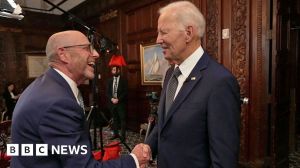








 peej
peej Carissa
 bostonboomer
 dakinikat
 ecocatwoman
 mablue2
 Mama Lopez
 peggysue22
 quixote
 skydancingguestblogger
 Mona (aka Wonk the Vote)



 Sky Dancing
Recent Comments