
Live Blog: SOS Kerry’s Speech on Action In Syria
Posted: August 30, 2013 Filed under: Foreign Affairs, Live Blog, Syria | Tags: Chemical Weapons Attacks in Syria, US response 32 Comments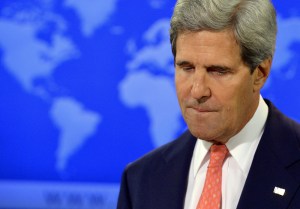 “That was a War Speech” says WAPO about a previous Kerry Presser.
It’s difficult to find a single sentence in Secretary of State John Kerry’s forceful and at points emotional press conference on Syria that did not sound like a direct case for imminent U.S. military action against Syria. It was, from the first paragraph to the 15th,a war speech.
That doesn’t mean that full-on war is coming; the Obama administration appears poised for a limited campaign of offshore strikes, probably cruise missiles and possible aircraft strikes. President Obama has long signaled that he has no interest in a full, open-ended or ground-based intervention, and there’s no reason to believe his calculus has changed. But Kerry’s language and tone were unmistakable. He was making the case for, and signaling that the United States planned to pursue, military action against another country. As my colleagues Karen DeYoung and Anne Gearan wrote, “Kerry left little doubt that the decision for the United States is not whether to take military action, but when.”
Kerry made the moral case for attacking Syria. He described what’s happening in Syria as “the indiscriminate slaughter of civilians, the killing of women and children and innocent bystanders by chemical weapons,” which he called “a moral obscenity” and “inexcusable.”
Kerry made the international norms case for striking Syria. “All peoples and all nations who believe in the cause of our common humanity must stand up to assure that there is accountability for the use of chemical weapons so that it never happens again,” he said. The argument here is that punishing Assad’s use of chemical weapons matters “beyond the conflict in Syria itself,” because the world wants to deter future military actors from using chemical weapons.
Kerry hinted at international coalition-building, saying that he’d spoken “with foreign ministers from around the world.” He later said that “information [about the attack] is being compiled and reviewed together with our partners.”The United States is not going to win approval from the United Nations Security Council, where Russia has consistently opposed even milquetoast resolutions condemning Assad. But Kerry still made a point of gesturing toward the institution it’s about to bypass, saying, “At every turn, the Syrian regime has failed to cooperate with the U.N. investigation, using it only to stall and to stymie the important effort to bring to light what happened in Damascus in the dead of night.” He accused Assad of blocking U.N. inspectors and “systemically destroying evidence.”
Kerry was mindful that the hyped up case for war against Iraq and the results of previous US engagement in countries like Egypt, Libya an Afghanistan have not been good. Yet, Kerry made it clear that the US was ready to take some kind of action today.
France appears ready to join the US.
BREAKING NEWS: Secretary of State John F. Kerry says the regime of Syrian President Bashar al-Assad made preparations three days before last week’s chemical weapons attack on the outskirts of Damascus and fired the rockets from regime-controlled areas. This story will be updated shortly.
LONDON – French President Francois Hollande said Friday that his country is prepared to act in Syria despite Britain’s surprise rejection of military action, potentially making a nation that turned its back on Washington during the war in Iraq the primary U.S. ally in a possible strike against Syrian forces.
The Guardian characterizes the speech as “polarizing for world leaders.”
As the US moves towards military intervention in the Syrian conflict, world leaders have issued a string of belicose statements, with Iran and Russiastanding alongside the Assad regime against a western alliance led by the US, UK, France and Australia.
In their toughest terms to date, David Cameron and US secretary of state, John Kerry, spoke of the undeniable and “asbolutely abhorrent” and use of chemical weapons in Syria. In response, the Assad regime and Iran warned that foreign military intervention in Syria would result in a conflict that would engulf the region.
Iran’s foreign ministry spokesman, Abbas Araqchi, intimated that Tehran would respond, should the west strike.
“We want to strongly warn against any military attack in Syria. There will definitely be perilous consequences for the region,” Araqchi told a news conference. “These complications and consequences will not be restricted to Syria. It will engulf the whole region.”
Walid al-Moallem, Syria’s foreign minister, also vowed that the regime would defend itself using all means available in the event of a US-led assault.
“I challenge those who accuse our forces of using these weapons to come forward with the evidence,” he told reporters at a press conference in Damascus. “We have the means to defend ourselves, and we will surprise everyone.”
Shia Iran is Syria’s closest ally and has accused an alliance of militant Sunni Islamists, Israel and western powers of trying to use the conflict to take over the region.
The rhetoric from the Shia camp came a day after Kerry gave the strongest indication to date that the US intends to take military action against the Assad regime. On Monday, Kerry said President Bashar al-Assad‘s forces had committed a moral obscenity against his own people.
“Make no mistake,” Kerry said. “President Obama believes there must be accountability for those who would use the world’s most heinous weapon against the world’s most vulnerable people. Nothing today is more serious, and nothing is receiving more serious scrutiny.”
President Obama will ensure that the United States of America makes our own decisions on our own timelines, based on our values and our interests. Now, we know that after a decade of conflict, the American people are tired of war. Believe me, I am, too.
But fatigue does not absolve us of our responsibility. Just longing for peace does not necessarily bring it about. And history would judge us all extraordinarily harshly if we turned a blind eye to a dictator’s wanton use of weapons of mass destruction against all warnings, against all common understanding of decency, these things we do know.
We also know that we have a president that does what he says that he will do. And he has said, very clearly, that whatever decision he makes in Syria it will bear no resemblance to Afghanistan, Iraq or even Libya. It will not involve any boots on the ground. It will not be open ended. And it will not assume responsibility for a civil war that is already well underway.
The president has been clear: Any action that he might decide to take will be limited and (sic) tailored response to ensure that, a despots brutal and flagrant use of chemical weapons is held accountable. And ultimately, ultimately we are committed — we remain committed, we believe it’s — the primary objective is (sic) to have a diplomatic process that can resolve this through negotiation, because we know there is no ultimate military solution.
It has to be political.
It has to happen at the negotiating table.
And we are deeply committed to getting there.
So that is what we know. That is what the leaders of Congress now know. And that’s what the American people need to know. And that is, at the core of the decisions that must now be made for the security of our country, and for the promise of a planet, where the world’s most heinous weapons must never again be used against the world’s most vulnerable people.
What do you think?
Thursday Reads: Civil Rights Struggle, Syria Intervention, NYPD Spying, Boston Bombing, and “League of Denial”
Posted: August 29, 2013 Filed under: Foreign Affairs, morning reads, Republican politics, U.S. Politics | Tags: Boston Bombings, chemical weapons, Civil Rights Movement, concussions, Dzhokhar Tsarnaev, Eric Cantor, ESPN, John Boehner, John F. Kennedy, John Odom, Julian Bond, Martin Luther King, NFL, NYPD, PBS Frontline, police photography, Prime Minister David Cameron, Rep. John Lewis, traumatic brain injury, We Shall Overcome 19 Comments
Good Morning!!
I’ve got so much news for you this morning, I don’t know if I’ll have room in a reasonable-length post, so I’ll get right to it. I’ll begin with some stories on yesterday’s 50th anniversary of the March On Washington.
PBS had an amazing interview with Rep John Lewis in which he recounted his memories of that day in 1963 and the speech he gave as a youthful leader in the Civil Rights Movement: ‘I Felt That We Had to Be Tough’: John Lewis Remembers the March on Washington. I hope you’ll read the whole thing, but here’s a brief excerpt:
REP. JOHN LEWIS, D-Ga.: On that day, I was blessed.
I felt like I had been tracked down by some force or some spirit. I will never forget when A. Philip Randolph said, “I now present to you young John Lewis, the national chairman of the Student Nonviolent Coordinating Committee.”
And I went to the podium. I looked to my right. I saw many, many young people, staffers from the Student Nonviolent Coordinating Committee, volunteers. Then I looked to my left. I saw all these young people up in the trees, trying to get a better view of the podium.
Then I looked straight ahead. And I saw so many people with their feet in the water trying to cool off. And then I said to myself, this is it, and I went for it.
On meeting with President Kennedy before the March, and how the podium and the crowd came to be so diverse:
He [JFK] didn’t like the idea of a March on Washington.
When we met with him, A. Philip Randolph spoke up in his baritone voice we met with the president. And he said, “Mr. President, the black masses are restless. And we are going to march on Washington.”
And you could tell by the movement of President Kennedy — he started moving and twisting in his chair. And he said, in effect, that if you bring all these people to Washington, won’t it be violence and chaos and disorder?
Mr. Randolph responded and said, “Mr. President, there’s been orderly, peaceful, nonviolent protests.”
And President Kennedy said, in so many words, I think we are going to have problems. So we left that meeting with President Kennedy. We came out on the lawn at the White House and spoke to the media and said, we had a meaningful and productive meeting with the president of the United States. And we told him we’re going to March on Washington.
And a few days later, July 2, 1963, the six of us met in New York City at the old Roosevelt Hotel. And in that meeting, we made a decision to invite four major white religious and labor leaders to join us in issuing the call for the March on Washington.
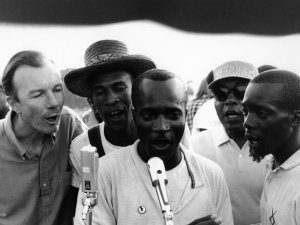
American folk singer and activist Pete Seeger (left) adopted and helped popularize “We Shall Overcome” by teaching the song at rallies and protests. Here he sings with activists in Greenwood, Miss., in 1963. (NPR)
NPR had a wonderful story yesterday about the history of the Civil Rights Movement’s signature song: The Inspiring Force Of ‘We Shall Overcome’.
It is not a marching song. It is not necessarily defiant. It is a promise: “We shall overcome someday. Deep in my heart, I do believe.”
It has been a civil rights song for 50 years now, heard not just in the U.S. but in North Korea, in Beirut, in Tiananmen Square, in South Africa’s Soweto Township. But “We Shall Overcome” began as a folk song, a work song. Slaves in the fields would sing, ‘I’ll be all right someday.’ It became known in the churches. A Methodist minister, Charles Albert Tindley, published a version in 1901: “I’ll Overcome Someday.”
The first political use came in 1945 in Charleston, S.C. There was a strike against the American Tobacco Co. The workers wanted a raise; they were making 45 cents an hour. They marched and sang together on the picket line, “We will overcome, and we will win our rights someday.”
There’s much more about how the song was passed from group to group and changed over time. Please give it a listen–it’s only about 8 minutes long, but really fascinating.
Not a single Republican appeared at yesterday’s commemoration of the March on Washington and Martin Luther King’s “I Have A Dream” speech. George W. Bush and his father George H.W. Bush couldn’t come because of health issues, but John Boehner and Eric Cantor are presumably in good health, but they refused offers to make speeches at the event, according to Roll Call.
That wasn’t a wise choice, said Julian Bond, a renowned civil rights activist, in an interview with MSNBC on Wednesday afternoon.
“What’s really telling, I think, is the podium behind me, just count at the end of the day how many Republicans will be there,” Bond told news anchor Alex Wagner. “They asked senior President Bush to come, he was ill. They asked junior Bush, he said he had to stay with his father.
“They asked a long list of Republicans to come,” Bond continued, “and to a man and woman they said ‘no.’ And that they would turn their backs on this event was telling of them, and the fact that they seem to want to get black votes, they’re not gonna get ‘em this way.” [….]
Cantor’s decision to turn down the invitation to speak is especially striking given his stated commitment to passing a rewrite of the Voting Rights Act in the 113th Congress, and the many opportunities he has taken over the past several weeks to publicly reflect on the experience of traveling with Rep. John Lewis, D-Ga., to Selma, Ala.
Sadly, Dr. King’s dream of peace has not made much progress in the past 50 years. And now the U.S. and its allies are considering another military intervention–in Syria.
Fortunately, the UK is now hesitating. NYT: Britain to Wait on Weapons Report Ahead of Syria Strikes.
Prime Minister David Cameron of Britain, who runs a coalition government, is facing political difficulties from legislators mindful of the experience in Iraq, when assurances from Prime Minister Tony Blair and President George W. Bush that Saddam Hussein had weapons of mass destruction proved inaccurate and a false pretext for war.
Mr. Cameron bowed on Wednesday to pressure from the opposition Labour Party and to some within his own coalition who want to allow United Nations weapons inspectors a chance to report their findings and for the United Nations Security Council to make one more effort to give a more solid legal backing to military action against Damascus.
At BBC News, Nick Robinson explains why Cameron “buckled.”
If you think that NSA domestic spying is invasive, you should take a look at what the NYPD has been up to since 9/11. Matt Apuzzo and Adam Goldman of the AP have a new book out called Enemies Within: Inside the NYPD’s Secret Spying Unit and bin Laden’s Final Plot Against America. There’s an excerpt at New York Magazine: The NYPD Division of Un-American Activities. It’s long, but a very important story. Please give it a read if you can.
Yesterday Apuzzo and Goldman published a related shocking story at AP: NYPD designates mosques as terrorism organizations.
The New York Police Department has secretly labeled entire mosques as terrorist organizations, a designation that allows police to use informants to record sermons and spy on imams, often without specific evidence of criminal wrongdoing.
Designating an entire mosque as a terrorism enterprise means that anyone who attends prayer services there is a potential subject of an investigation and fair game for surveillance.
Since the 9/11 attacks, the NYPD has opened at least a dozen “terrorism enterprise investigations” into mosques, according to interviews and confidential police documents. The TEI, as it is known, is a police tool intended to help investigate terrorist cells and the like.
Many TEIs stretch for years, allowing surveillance to continue even though the NYPD has never criminally charged a mosque or Islamic organization with operating as a terrorism enterprise.
The documents show in detail how, in its hunt for terrorists, the NYPD investigated countless innocent New York Muslims and put information about them in secret police files. As a tactic, opening an enterprise investigation on a mosque is so potentially invasive that while the NYPD conducted at least a dozen, the FBI never did one, according to interviews with federal law enforcement officials.

Boston Magazine has published more photos from “Behind the Scenes of The Hunt for Dzhokhar Tsarnaev.” Above is a photo of Tsarnaev exiting the boat in which he hid for hours as law enforcement searched all over Watertown for him. See more photos at the link.
In more hopeful news, one long-hospitalized survivor of the bombings was given the go-ahead to return home to California yesterday: Boston Marathon bomb survivor John Odom set to return home to Torrance (Daily Breeze News).
Nearly five months after a bomb almost took his life at the Boston Marathon, John Odom of Torrance was cleared by doctors on Wednesday to finally come home.
Odom’s wife, Karen, who has never left her husband’s side, has been chronicling her husband’s long recovery on Facebook, called it a “monumental” day.
“It’s official, John is released to go home!!!” she posted on the John Odom Support Page. “Although his recovery is nowhere near complete, there is no medical or physical reason he can’t fly home and continue his recovery in California. We are hoping to be home the end of next week, a few days shy of 5 months since we left on that now famous 4 day trip.”
“Famous” is one way to put it. The couple could have never imagined the journey they’ve been on since April 15.
Read the rest of this moving story at the link.
On October 8th and 15th, NPR’s Frontline plans to show League of Denial, “a two-part two-part investigation examining whether — as thousands of former players allege — the NFL has covered up the risks of football on the brain.” The documentary has so far been produced in partnership with ESPN, but last week the sports channel backed out of the collaboration presumably because of pressure from the NFL. From The New Republic: ESPN Quit Its Concussions Investigation With ‘Frontline’ Under Curious Circumstances.
“Frontline,” the prestigious, multiple-Emmy-winning investigative news show produced by Boston’s PBS member station, announced late Thursday afternoon that a 15-month-old partnership with ESPN in which they published a series of pieces exploring how the National Football League has (and has not) accounted for the relationship between playing football, head trauma, and brain damage, had come to an end. Dating back to last November, “Frontline” had run articles on its site featuring the work of Steve Fainaru and Mark Fainaru-Wada, ESPN staffers (and brothers) even as these articles appeared at espn.com and as the brothers did segments for ESPN’s award-winning investigative series “Outside the Lines.” The end result—in addition to abook that the brothers are publishing in October—was to be a “Frontline” documentary, League of Denial (also the book’s title).
According to “Frontline,” the documentary will premiere this season on October 8 and 15, but, “from now on, at ESPN’s request, we will no longer use their logos and collaboration credit on these sites and on our upcoming film.” Executive producer David Fanning and deputy executive producer Raney Aronson expressed their “regret” and credited ESPN with “a productive partnership.” They added, “The film is still being edited and has not been seen by ESPN news executives, although we were on schedule to share it with them for their editorial input.”
Aronson told me late Thursday that ESPN contacted “Frontline” last Friday to request that it remove ESPN’s logo from its website, citing the technicality that it was a “trademark issue.” It wasn’t until Monday, after the latest collaboration was published on “Frontline”’s website and aired on “OTL,” that ESPN also requested that language describing collaboration not be used, and that it became clear the collaboration itself was coming to an end.
The circumstances are indeed mysterious. Perhaps it was over-cautiousness on ESPN’s part or perhaps indirect pressure from the League. If you’re interested in this important story, go read Marc Tracy’s piece at TNR.
A couple more useful links on this story:
PBS: Questions Over NFL Doctor Cloud League’s Concussion Case
Bill Littlefield at NPR’s Only a Game: ESPN And Frontline Part Ways Over ‘League Of Denial’
The authors of the book League of Denial will continue their involvement with the Frontline presentation.
I’m running out of space, so I’ll end there, and add a few more links in the comments. Now what stories are you following today? Please share your links in the thread below.
Tuesday Reads
Posted: August 27, 2013 Filed under: Barack Obama, China, Foreign Affairs, Iran, Iraq, morning reads, NSA, National Security Agency, Regulation, Russia, Syria, U.S. Politics | Tags: California wildfire, chemical weapons, cuba, David Miranda, Edward Snowden, GCHQ, Glenn Greenwald, John Kerry, Saddam Hussein, San Francisco water and power, Texas legislature, West Fertilizer Co., Yosemite National Park 30 Comments
Good Morning!!
The big news today is that President Obama appears likely to order “limited” strikes on Syria in the next few days in response to Syria’s use of chemical weapons against opposition fighters. From the WaPo: After Syria chemical allegations, Obama considering limited military strike.
President Obama is weighing a military strike against Syria that would be of limited scope and duration, designed to serve as punishment for Syria’s use of chemical weapons and as a deterrent, while keeping the United States out of deeper involvement in that country’s civil war, according to senior administration officials.
The timing of such an attack, which would probably last no more than two days and involve sea-launched cruise missiles — or, possibly, long-range bombers — striking military targets not directly related to Syria’s chemical weapons arsenal, would be dependent on three factors: completion of an intelligence report assessing Syrian government culpability in last week’s alleged chemical attack; ongoing consultation with allies and Congress; and determination of a justification under international law.
“We’re actively looking at the various legal angles that would inform a decision,” said an official who spoke about the presidential deliberations on the condition of anonymity. Missile-armed U.S. warships are already positioned in the Mediterranean.
I guess “looking at…legal angles” is code for that pesky rule in the Constitution where Congress has to declare wars. When’s the last time that happened–WWII?
Meanwhile, BBC News reports: Russia and China step up warning over strike.
Russian foreign ministry spokesman Alexander Lukashevich has called on the international community to show “prudence” over the crisis and observe international law.
“Attempts to bypass the Security Council, once again to create artificial groundless excuses for a military intervention in the region are fraught with new suffering in Syria and catastrophic consequences for other countries of the Middle East and North Africa,” he said in a statement.
Late on Monday, the US said it was postponing a meeting on Syria with Russian diplomats, citing “ongoing consultations” about alleged use of chemical weapons in Syria.
Hours later, Russia expressed regret about the decision. The two sides had been due to meet in The Hague on Wednesday to discuss setting up an international conference on finding a political solution to the crisis.
The Russian deputy defence minister, Gennady Gatilov said working out the political parameters for a resolution on Syria would be especially useful, with the threat of force hanging over the country.
Read more at the link.
Just as SOS Kerry was giving a speech to justify the upcoming military strikes, providing “Clear Evidence of Chemical Weapon Use in Syria” (NYT), a little birdie told Shane Harris and Matthew Aid of Foreign Policy magazine that the U.S. facilitated Saddam Hussein’s use of chemical weapons against Iran back in 1988.
The U.S. government may be considering military action in response to chemical strikes near Damascus. But a generation ago, America’s military and intelligence communities knew about and did nothing to stop a series of nerve gas attacks far more devastating than anything Syria has seen, Foreign Policy has learned.
In 1988, during the waning days of Iraq’s war with Iran, the United States learned through satellite imagery that Iran was about to gain a major strategic advantage by exploiting a hole in Iraqi defenses. U.S. intelligence officials conveyed the location of the Iranian troops to Iraq, fully aware that Hussein’s military would attack with chemical weapons, including sarin, a lethal nerve agent.
The intelligence included imagery and maps about Iranian troop movements, as well as the locations of Iranian logistics facilities and details about Iranian air defenses. The Iraqis used mustard gas and sarin prior to four major offensives in early 1988 that relied on U.S. satellite imagery, maps, and other intelligence. These attacks helped to tilt the war in Iraq’s favor and bring Iran to the negotiating table, and they ensured that the Reagan administration’s long-standing policy of securing an Iraqi victory would succeed. But they were also the last in a series of chemical strikes stretching back several years that the Reagan administration knew about and didn’t disclose.
U.S. officials have long denied acquiescing to Iraqi chemical attacks, insisting that Hussein’s government never announced he was going to use the weapons. But retired Air Force Col. Rick Francona, who was a military attaché in Baghdad during the 1988 strikes, paints a different picture.
“The Iraqis never told us that they intended to use nerve gas. They didn’t have to. We already knew,” he told Foreign Policy.
Read the rest of this long article at Foreign Policy.
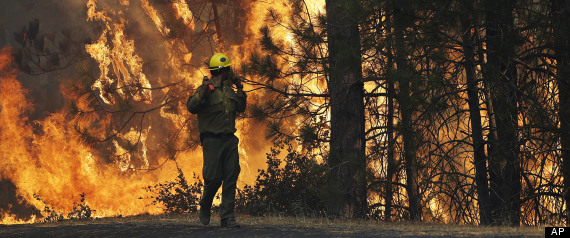
Firefighter A.J. Tevis watches the flames of the Rim Fire near Yosemite National Park, Calif., on Sunday, Aug. 25, 2013. With winds gusting to 50 mph on Sierra mountain ridges and flames jumping from treetop to treetop, hundreds of firefighters have been deployed to protect this and other communities in the path of the Rim Fire raging north of Yosemite National Park. (AP Photo/Jae C. Hong)
The wildfire in Northern California continues to spread into Yosemite National Park and has begun to threaten towns in the area. From the LA Times: Massive Rim fire continues to reshape lives and topography.
…even as firefighters worked furiously to hold a line outside of town, officials warned that this blaze was so hot it could send sparks more than a mile and a half out that could jump lines and start new hot spots. Evacuation advisories remain in effect for Tuolumne City and nearby areas.
On the north edge, the fire — now 134,000 acres — pushed into the Emigrant Wilderness Area and Yosemite National Park. It’s the one side of the fire with a natural last stand: Eventually it will run into granite walls that have snuffed out fires in this region for centuries.
Each day, what the massive blaze does depends on the wind. But officials were particularly attuned to each shift of breeze Sunday because of the weather’s eerie similarities to the day when the fire first exploded out of control.
So far the unpredictable blaze is only about 20% controlled, and it still threatens water and power sources for San Francisco.
The massive fire presents every challenge: steep slopes, dry fuel, rugged terrain and entire communities possibly in harm’s way.
The base camp and incident post, usually a haven outside fire lines, was a prominent example of the fire’s unpredictability: It’s in the middle of the burn zone, charred land with still-smoldering stumps on both sides.
Firefighters call such complete devastation “the black.” Entire ravines and ridges were a dusty gray moonscape. But some of the land was a “dirty burn” — meaning there were small circles of pine and aspen and even grass and wildflowers in the middle of charcoal-black areas where smoke still curled and embers glowed. The specks of beauty made firefighters nervous: To a fire, they are fuel.
My sister and her husband own a house north of San Francisco. It’s probably not in danger, but it still brings the scope of this disaster home to me. I sure hope Firefighers will begin to make progress soon. The burning area is now the size of the city of Chicago, according to CNN.
Yosemite National Park, California (CNN) — A massive northern California wildfire that’s threatening Yosemite National Park and San Francisco’s key water and power sources grew Monday, becoming the 13th largest in state history, state fire authorities said.
The Rim Fire, which has devoured 160,980 acres, has scorched an area about the size of the city of Chicago while more than 3,600 firefighters try to rein it in….
The wildfire, which was 20% contained Monday night, was spreading primarily to the east and threatened to grow amid extremely dry conditions and hot weather.
Part of the fire continued to spread Monday toward a key part of San Francisco’s water supply: the Hetch Hetchy Reservoir, which lies within Yosemite and is just east of the flames.
The fire also could threaten the area’s hydroelectric generators, which provide much of San Francisco’s electricity. Because of the approaching flames, officials shut down the generators, and the city — more than 120 miles to the west — temporarily is getting power from elsewhere.
Speaking of disasters, Charles Pierce reminds us that West, Texas is still recovering from the horrible explosion at the fertilizer plant there and that Texas still isn’t doing that much to prevent similar events in the future.
Read the rest of this entry »
International Community Must Confront Putin and Russia on Anti-Gay Legislation
Posted: August 21, 2013 Filed under: Foreign Affairs, GLBT Rights, homophobia, open thread, Russia | Tags: 2013 Winter Olympics, adoption, Bradley Manning, Edward Snowden, Harvey Fierstein, James Kirchick, Russian anti-gay legislation, same-sex marriage, Vladimir Putin 19 Comments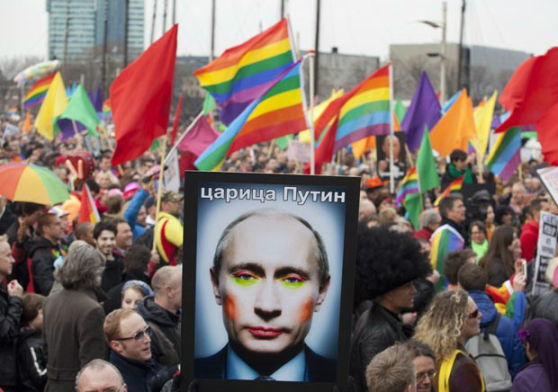
There’s been quite a bit of talk recently about Russia’s anti-gay “propaganda” legislation–signed into law on June 30 by President Vladimir Putin–because of this month’s World Athletics Championships in Moscow and the upcoming Winter Olympics in Sochi as well as Edward Snowden’s decision to defect to Russia. Naturally there is concern about discrimination against gay athletes and coaches at international sporting events; and Snowden has been criticized because his supposed passion for human rights is belied by his embrace of Putin and his disastrous human rights record.
Here’s an explanation of the new law at PolicyMic: Russia’s Anti-Gay Law, Spelled Out in Plain English.
On June 30 this year, Russian President Vladimir Putin signed into law a bill banning the “propaganda of nontraditional sexual relations to minors,” thus opening a new, dark chapter in the history of gay rights in Russia. The law caps a period of ferocious activities by the Russian government aimed at limiting the rights of the country’s lesbian, gay, bisexual, transgender, and intersex people.
The violations of fundamental, constitutionally protected rights of Russia’s gay citizens have included multiple bans on gay pride parades in Moscow and other cities, hefty fines to gay rights groups accused of acting as a “foreign agent,” denial of registration to nongovernmental organizations, and regional laws banning the propaganda of homosexuality to minors, which served as a basis for the federal law enacted by Mr. Putin and unanimously passed by the State Duma. Against this backdrop, violent attacks on gays or “suspect gays” are becoming commonplace.
The federal law is spelled out in Article 6.21 of the Code of the Russian Federation on Administrative Offenses.
Here is what Article 6.21 actually says:
Propaganda is the act of distributing information among minors that 1) is aimed at the creating nontraditional sexual attitudes, 2) makes nontraditional sexual relations attractive, 3) equates the social value of traditional and nontraditional sexual relations, or 4) creates an interest in nontraditional sexual relations.
If you’re Russian. Individuals engaging in such propaganda can be fined 4,000 to 5,000 rubles (120-150 USD), public officials are subject to fines of 40,000 to 50,000 rubles (1,200-1,500 USD), and registered organizations can be either fined (800,000-1,000,000 rubles or 24,000-30,000 USD) or sanctioned to stop operations for 90 days. If you engage in the said propaganda in the media or on the internet, the sliding scale of fines shifts: for individuals, 50,000 to 100,000 rubles; for public officials, 100,000 to 200,000 rubles, and for organizations, from one million rubles or a 90-day suspension.
If you’re an alien. Foreign citizens or stateless persons engaging in propaganda are subject to a fine of 4,000 to 5,000 rubles, or they can be deported from the Russian Federation and/or serve 15 days in jail. If a foreigner uses the media or the internet to engage in propaganda, the fines increase to 50,000-100,000 rubles or a 15-day detention with subsequent deportation from Russia.
As PolicyMic points out, the language of the law is so ambiguous that it is difficult to predict how it will be enforced or how it will be applied to foreigners. According to HuffPo, visitors to Russia should be concerned.
Bad news for lesbian, gay, bisexual and transgender (LGBT) travelers hoping to visit Russia, as foreign tourists will now be subjected to the same “gay propaganda” fines and sentences as residents.
Travel site Skift reports that the new law, signed into law by Russian President Vladimir Putin on June 30, contains a provision that allows the government to arrest and detain gay (or “pro-gay”) foreigners for up to 14 days before they would then be expelled from Russia.
As far as what is considered “pro-gay,” the laws specifics are somewhat vague, butCanadian site Travel and Escape suggests “gay-affirmative” speech, displaying a rainbow flag and same-sex partners holding hands are among the prohibited actions.
A few days later, on July 3, Putin signed another law that bans adoption of Russian children by foreign same-sex couples or by any unmarried couple or single parent in a country that recognizes gay marriage.
Today Harvey Fierstein published an op-ed in The New York Times on Russia’s Anti-Gay Crackdown, in which he reports there are rumors that Putin will soon
sign an edict that would remove children from their own families if the parents are either gay or lesbian or suspected of being gay or lesbian. The police would have the authority to remove children from adoptive homes as well as from their own biological parents.
Fierstein dismisses claims that these recently passed laws are designed to protect children from pedophiles. There is no scientific evidence to show that pedophiles are homosexuals; in fact research shows that the overwhelming majority of pedophiles are heterosexual males. So what is the explanation for the Putin’s war against gays?
Mr. Putin’s true motives lie elsewhere. Historically this kind of scapegoating is used by politicians to solidify their bases and draw attention away from their failing policies, and no doubt this is what’s happening in Russia. Counting on the natural backlash against the success of marriage equality around the world and recruiting support from conservative religious organizations, Mr. Putin has sallied forth into this battle, figuring that the only opposition he will face will come from the left, his favorite boogeyman.
Mr. Putin’s campaign against lesbian, gay and bisexual people is one of distraction, a strategy of demonizing a minority for political gain taken straight from the Nazi playbook. Can we allow this war against human rights to go unanswered? Although Mr. Putin may think he can control his creation, history proves he cannot: his condemnations are permission to commit violence against gays and lesbians. In May a young gay man was murdered in the city of Volgograd. He was beaten, his body violated with beer bottles, his clothing set on fire, his head crushed with a rock. This is most likely just the beginning.
Yet, so far the international community hasn’t done much to push back against Putin’s anti-gay campaign. As Fierstein writes, “this must change,” and the upcoming Winter Olympics provides the perfect opportunity for enlightened government to put pressure on Putin and his regime.
Today, one gay reporter, James Kirchick, did his part to call attention to Russia’s repressive new anti-gay laws when he appeared on Russia Today, the state-owned TV station, ostensibly to discuss the Bradley Manning sentence. It turned into quite a scene.
According to The Washington Free Beacon, Kirchick was taken off the air when he refused to stop talking about Russia’s anti-gay laws and focus on Bradley Manning.
“A quick explanation now for the beginning of our coverage of the Bradley Manning sentences,” one host said later in the program. “We invited a guest on to discuss the fate of the whistleblower, but he used the chance to discuss his views on other unrelated issues and that’s why we had to take him off air. We would like to say sorry for any confusion caused.”
RT also refused to continue Kirchick’s car service, according to the reporter.
“True fact: (RT) just called taxi company that took me to studio to drop me off on the side of the highway on way to Stockholm airport,” Kirchick wrote on Twitter Wednesday morning following his appearance on the network.
This is an open thread, but any comments on the content of this post will be much appreciated.
Tuesday Reads: The Agony of Glenn Greenwald, The Ickiness of Ted Cruz, & Other News
Posted: August 20, 2013 Filed under: 2016 elections, Egypt, Foreign Affairs, Great Britain, morning reads, Pakistan, Republican politics, U.S. Economy, U.S. Politics, US & Canada | Tags: Bob Cesca, David Miranda, Glenn Greenwald, Muslim Brotherhood, Pervez Musharraf, Ted Cruz, the 24-hour rule, The Guardian UK 29 Comments
Good Morning!!
As of yesterday, we’ve reached the point with the NSA leaks story that the entire focus is on Glenn Greenwald and his martyrdom. Even Edward Snowden has now faded into the background.
On Sunday, Greenwald’s domestic partner David Miranda was detained for nine hours by UK authorities as he passed through Heathrow Airport on his way from Berlin to Rio de Janeiro where he and Greenwald live. Miranda was finally released, but his laptop, an external hard drive, a number of memory sticks and other electronic devices were confiscated. Greenwald reacted by threatening the UK government with harmful revelations from the Snowden stash.
As with previous Greenwald stories, this one quickly evolved from a tale of horrendous government repression as reported by the Guardian to a more complex story reported by other news outlets–forcing the Guardian to walk back or provide more details on aspects of its original reporting. Bob Cesca does a good job of summarizing the process.
Like most people, Cesca was at first shocked by the news of Miranda’s detention. Then he began reading the stories under the headlines.
When I read The Guardian‘s article about the incident, however, more questions popped up — as with much of The Guardian‘s reporting on this topic, the publication’s tendency for coy, smoke-and-mirrors reporting invariably raises more questions than it answers. The article was credited to “Guardian staff,” for one, there weren’t any quotes from Miranda himself and the only source for the article appeared to be Greenwald, who, from my experience covering this story, tends to be incendiary and misleading.
The wailing and garment rending was underway — the predictable group freakout we’re forced to endure every time a new article is published. Greenwald himself wrote that the U.K. authorities were actually worse than the Mafia because the Mafia doesn’t target family members. (Clearly, Greenwald knows less about the Mafia than he does about political realities or history.)
An aside: Cesca coined the term “the 24 hour rule” after a the first few Greenwald NSA “bombshells.”
The 24 Hour Rule: 1) A wild claim is made via a news article, most often The Guardian, about the U.S. government or related entities. 2) The article sparks wild fits of outrage. 3) Then, within 24 hours, a mitigating detail is added, undermining or totally debunking one or more of the central claims contained with the article. Related quote: “A lie can travel half-way around the world before the truth gets its pants on.”
Back to Cesca’s take on the Miranda story:
As the hours rolled by, Charlie Savage, reporting for The New York Times, began to revealmore details about the trip — details which The Guardian mysteriously didn’t include in either of its articles….
First, we learned from The New York Times that The Guardian financed Miranda’s trip to Germany and back. This means Miranda was conducting some sort of official business for the publication. Around the same time, Amnesty International referred to Miranda as “a Guardian newspaper employee.” Combined with the Laura Poitras detail, it’s obvious that Miranda was commissioned to do some serious leg-work on the Snowden/NSA reporting, the extent of which was unknown at the time.
And then, late in the evening east coast time, The New York Times revealed the purpose of Miranda’s trip to Berlin:
Mr. Miranda was in Berlin to deliver documents related to Mr. Greenwald’s investigation into government surveillance to Ms. Poitras, Mr. Greenwald said. Ms. Poitras, in turn, gave Mr. Miranda different documents to pass to Mr. Greenwald. Those documents, which were stored on encrypted thumb drives, were confiscated by airport security, Mr. Greenwald said. All of the documents came from the trove of materials provided to the two journalists by Mr. Snowden.
So Miranda, Greenwald’s spouse, served as a paid courier to transfer stolen, top secret national security documents from Greenwald to Poitras, and from Poitras back to Greenwald.
While I’m not defending UK authorities for their ham-handed treatment of Miranda–and neither is Cesca–it’s really not surprising that Miranda was stopped and questioned. It also later came out that Miranda had been offered an attorney, but he refused the offer (Greenwald had originally said his partner was refused access to legal advice). From The Guardian on Monday:
He was offered a lawyer and a cup of water, but he refused both because he did not trust the authorities. The questions, he said, were relentless – about Greenwald, Snowden, Poitras and a host of other apparently random subjects.
“They even asked me about the protests in Brazil, why people were unhappy and who I knew in the government,” said Miranda.
He got his first drink – from a Coke machine in the corridor – after eight hours and was eventually released almost an hour later. Police records show he had been held from 08.05 to 17.00.
The questions about the Brazilian government weren’t actually that outrageous, since Glenn Greenwald had contacted high level officials there and they had tried to intervene.
So the “24-hour rule” still holds. This entire story turned around in 24 hours, but many news outlets are still reporting information that is either wholly or partially untrue. After it became clear that their original reporting on the Miranda detention was problematic, the Guardian released another bombshell article written by Guardian editor-in-chief Alan Rusberger in which he claims that two months ago GCHQ (Britain’s version of NSA) agents forced the Guardian to destroy their hard drives and computers unless they turned over their NSA materials. Again Bob Cesca has a good summary. Please read the whole thing if you can–it’s not long.
We’ll have to wait another day to see if this story also morphs into something different. Cesca has a list of questions for Rusberger. My big question is why wasn’t this reported immediately after it happened, and why didn’t the Guardian go to court over it?
And so Glenn Greenwald and his victimization remain the center of international attention. I have to wonder why Greenwald arranged for his partner to travel through Heathrow in the first place. Was he deliberately inviting something like this? He couldn’t have asked for better free publicity that he and the Guardian are getting right now.
Meanwhile, any discussion of NSA spying is hindered by so much inaccurate information; yet the NSA story is distracting Americans from focusing on equally important and even more pressing issues like jobs, the economy, voting rights, the war on women’s autonomy, the environment, and the upheavals in the Middle East. So now I’ll move on to some other news–I’ll add more links on the Miranda story in the comments.
In other news,
The Atlantic has a good story on economic inequality: Are the Rich Getting Too Much of the Economic Pie?
When one of you asked, “Are the rich getting too much of the economic pie?” the team behindEconomics in Plain English got pretty excited. Because you said “pie.” So we headed toDangerously Delicious Pies in northeast Washington, D.C., with business editor Derek Thompson to explain income inequality over dessert. We ordered three pies — peanut butter, blueberry, and something amazing called the “Baltimore Bomb” — to make three charts that illustrate the income and wealth gap in the U.S. We’re not the first to mix math and pastry, as we discovered recently, but we hope this video offers a tasty perspective on a complex economic question.
Watch the video–and others by the same group–at the link.
In Pakistan, Pervez Musharraf has been indicted in the 2007 murder of Benazir Bhutto
ISLAMABAD, Pakistan — A Pakistani court indicted Pervez Musharraf on Tuesday in connection with the 2007 assassination of former Prime Minister Benazir Bhutto, the first time that a former military leader has faced criminal proceedings in Pakistan.
The court in Rawalpindi, near the capital, Islamabad, filed three charges against Mr. Musharraf, including murder and conspiracy to murder, said a prosecutor, Chaudhry Muhammed Azhar.
Mr. Musharraf, who has maintained that the charges against him are politically motivated, pleaded not guilty, his lawyers said. Reporters were excluded from the hearing. Afterward, police commandos and paramilitary rangers escorted Mr. Musharraf back to his villa on the edge of Islamabad, where he has been under house arrest since April in connection with other cases stemming from his rule from 1999 to 2008.
The sight of a once untouchable general being called to account by a court had a potent symbolism in a country that has been ruled by the military for about half of its 66-year history. While the military remains deeply powerful, the prosecution has sent the message that Pakistan’s top generals are subject to the rule of law — at least after they have retired.
In Egypt, a leader of the Muslim Brotherhood has been arrested. The LA Times reports:
CAIRO — Egyptian authorities early Tuesday arrested the leader of the Muslim Brotherhood, another demoralizing blow to the Islamist organization amid a crackdown by the military to silence dissent and build support for its control of the nation.
Supreme Guide Mohamed Badie was arrested in a Cairo apartment. Dressed in a gray tunic, the 70-year-old spiritual leader looked shaken, sitting next to a bottle of water in police custody. The image distilled the desperation the world’s most influential Islamist organization faces against an army that appears determined to crush it.
Most of the Brotherhood’s top leaders, including Khairat Shater, its chief strategist and financier, and former Egyptian president Mohamed Morsi, who was overthrown in a coup last month, are in detention or have gone underground. Much of the group’s strategy appears to have shifted to the Anti-Coup Alliance, an umbrella group the Brotherhood organized to protest Morsi’s downfall.
The army’s crackdown on the Brotherhood has been ferocious. Police raids on two Brotherhood sit-ins last week and the protests and violence that ensured killed more than 900 Morsi supporters, many of them shot by live ammunition fired by security forces that have shown little restraint.
“When the hand of oppression extends to arrest this important symbol,” the Brotherhood said in a statement regarding Badie, “that means the military coup has used up everything in its pocket and is readying to depart.”
I’ll be honest–I’m really clueless about what’s going on in Egypt right now. I just hope the situation doesn’t descend into a Syria-like civil war.
Texas Tea Party Senator Ted Cruz is back in the news. The Dallas Morning News revealed yesterday that Cruz holds dual citizenship in the US and Canada.
Born in Canada to an American mother, Ted Cruz became an instant U.S. citizen. But under Canadian law, he also became a citizen of that country the moment he was born.
Unless the Texas Republican senator formally renounces that citizenship, he will remain a citizen of both countries, legal experts say.
That means he could assert the right to vote in Canada or even run for Parliament. On a lunch break from the U.S. Senate, he could head to the nearby embassy — the one flying a bright red maple leaf flag — pull out his Calgary, Alberta, birth certificate and obtain a passport.
“He’s a Canadian,” said Toronto lawyer Stephen Green, past chairman of the Canadian Bar Association’s Citizenship and Immigration Section.
The circumstances of Cruz’s birth have fueled a simmering debate over his eligibility to run for president. Knowingly or not, dual citizenship is an apparent if inconvenient truth for the tea party firebrand, who shows every sign he’s angling for the White House.
Cruz has decided to renounce his Canadian citizenship, according to CNN:
“Because I was a U.S. citizen at birth, because I left Calgary when I was 4 and have lived my entire life since then in the U.S., and because I have never taken affirmative steps to claim Canadian citizenship, I assumed that was the end of the matter,” Cruz wrote in his statement.
“Now the Dallas Morning News says that I may technically have dual citizenship. Assuming that is true, then sure, I will renounce any Canadian citizenship,” he continued. “Nothing against Canada, but I’m an American by birth, and as a U.S. Senator, I believe I should be only an American.”
Too bad he didn’t decide to run for office in Canada. I guess we’re stuck with him now.
I’ll end with this Daily Beast story about what Ted Cruz Princeton roommates recall about him. Some excerpts:
When Craig Mazin first met his freshman roommate, Rafael Edward Cruz, he knew the 17-year-old Texan was not like other students at Princeton, or probably anywhere else for that matter.
“I remember very specifically that he had a book in Spanish and the title was Was Karl Marx a Satanist? And I thought, who is this person?” Mazin says of Ted Cruz. “Even in 1988, he was politically extreme in a way that was surprising to me.” [….]
“It was my distinct impression that Ted had nothing to learn from anyone else,” said Erik Leitch, who lived in Butler College with Cruz. Leitch said he remembers Cruz as someone who wanted to argue over anything or nothing, just for the exercise of arguing. “The only point of Ted talking to you was to convince you of the rightness of his views.”
In addition to Mazin and Leitch, several fellow classmates who asked that their names not be used described the young Cruz with words like “abrasive,” “intense,” “strident,” “crank,” and “arrogant.” Four independently offered the word “creepy,” with some pointing to Cruz’s habit of donning a paisley bathrobe and walking to the opposite end of their dorm’s hallway where the female students lived.
“I would end up fielding the [girls’] complaints: ‘Could you please keep your roommate out of our hallway?'” Mazin says.
Eeeeeeeeek!!

 peej
peej Carissa
 bostonboomer
 dakinikat
 ecocatwoman
 mablue2
 Mama Lopez
 peggysue22
 quixote
 skydancingguestblogger
 Mona (aka Wonk the Vote)



 Sky Dancing
Recent Comments