
Tuesday Reads: Rats are Abandoning Trump’s Sinking Ship and Leaking Like Crazy
Posted: October 1, 2019 Filed under: Foreign Affairs, morning reads, U.S. Politics | Tags: australia, Bill Barr, Donald Trump, impeachment, Italy, Mike Pompeo, Rudy Giuliani, Russia, Ukraine 62 Comments Good Morning!!
Yesterday was quite a day. In the afternoon, it became abundantly clear that the rats are jumping off Trump’s sinking ship, competing to see who can be the first to leak dirt on the Dotard and his gang of miscreants. Here’s summary from CBS News: New revelations shed light on Trump-Ukraine call — live updates.
A series of rapid-fire developments brought the House impeachment inquiry into clearer focus Monday afternoon, with Democrats issuing new demands for evidence and new revelations about the circumstances of the president’s call with Ukraine coming to light.
Just before 4 p.m., three House committees announced they had subpoenaed Rudy Giuliani, the president’s personal lawyer, for documents related to his work on behalf of President Trump to persuade Ukraine to open an investigation into former Vice President Joe Biden. The committees also requested material about Giuliani’s work to secure Ukraine’s cooperation into a Justice Department review of the origins of Robert Mueller’s Russia probe.
Shortly after the subpoena was announced, The Wall Street Journal reported Secretary of State Mike Pompeo was on the July 25 call between the president and the Ukrainian leader. CBS News has confirmed Pompeo was on the call.
The New York Times reported Mr. Trump had called the prime minister of Australia to request assistance in the Justice Department review. The call came at the behest of Attorney General William Barr.
A Justice Department official then told CBS News that Barr had asked Mr. Trump to reach out to a number of foreign officials to request their assistance in his review, which is being led by the U.S. attorney in Connecticut. A source familiar with the matter said Barr traveled to Italy as part of his effort, and The Washington Post reported he has also reached out to intelligence officials in the United Kingdom.
In the call with Ukrainian President Volodymyr Zelensky on July 25, Mr. Trump repeatedly asked him to work with Barr to pursue a fringe conspiracy theory about the origins of the 2016 U.S. counterintelligence investigation that would became the Mueller probe.
 But it wasn’t just Australia. At about 8:30 last night, The Washington Post reported: Barr personally asked foreign officials to aid inquiry into CIA, FBI activities in 2016.
Attorney General William P. Barr has held private meetings overseas with foreign intelligence officials seeking their help in a Justice Department inquiry that President Trump hopes will discredit U.S. intelligence agencies’ examination of possible connections between Russia and members of the Trump campaign during the 2016 election, according to people familiar with the matter….
The direct involvement of the nation’s top law enforcement official shows the priority Barr places on the investigation being conducted by John Durham, the U.S. attorney in Connecticut, who has been assigned the sensitive task of reviewing U.S. intelligence work surrounding the 2016 election and its aftermath.
The attorney general’s active role also underscores the degree to which a nearly three-year-old election still consumes significant resources and attention inside the federal government. Current and former intelligence and law enforcement officials expressed frustration and alarm Monday that the head of the Justice Department was taking such a direct role in reexamining what they view as conspiracy theories and baseless allegations of misconduct.
So far, we’ve learned that Barr and Trump sought help to discredit their own intelligence community from Australia, the UK, and Italy. What other countries have been approached? I imagine we’ll learn more soon. Keep in mind that this entire criminal enterprise is designed to help Vladimir Putin by discrediting the Mueller investigation and removing sanctions on Russia.
 Elliot Hannon at Slate: Trump Is Now Enlisting Foreign Leaders to Discredit Russian Election Meddling on His Behalf.
It’s now abundantly clear that President Trump is actively deploying the resources of the U.S. government explicitly to bolster his chances of reelection in 2020. The recent whistleblower complaint revealed one part of the two-pronged strategy: leverage U.S. military aid to Ukraine to compel the Ukrainian government to dredge up old allegations on political rival Joe Biden. The second aspect of the Trump vindication-through-vilification reelection strategy has led Trump and his allies to investigate the investigation by Robert Mueller into Russian interference in the 2016 election to try to muddy the water sufficiently that Trump looks clean by comparison—or by confusion. That effort is also being propelled by the power vested in the highest offices of the U.S. government, including, of course, the presidency. Yet another example, the New York Times reports, is a recent phone call made by President Trump to Australian Prime Minister Scott Morrison asking the foreign leader to assist Attorney General Bill Barr in the investigation of the Mueller investigation.
Will Trump get away with it? He is opening inciting violence against the whistleblower, Adam Schiff, and anyone else who tries to stand up to him. We don’t know yet what will happen, but history shows that politicians who mess with the CIA/FBI are playing with fire. I expect more drip drip drip revelations in the coming days.
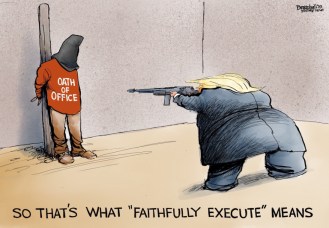 Yesterday David Remnick at The New Yorker highlighted Trump’s unhinged attacks on anyone who tries to stand up to him:
Shortly after eight this morning, the President of the United States, making maximal use of his “executive time,” wielded his smartphone to issue a legal threat against the chairman of the House Intelligence Committee. It is worth reading the missive from @realDonaldTrump in full:
“Rep. Adam Schiff illegally made up a FAKE & terrible statement, pretended it to be mine as the most important part of my call to the Ukrainian President, and read it aloud to Congress and the American people. It bore NO relationship to what I said on the call. Arrest for Treason?”
Were the collective nerve endings of the electorate not so frayed and numbed by now, we might be even more alive to the ugliness of this message from the White House. One of the consequences of the Trump Presidency is the way that it constantly diminishes our expectations of anything other than hideous rhetoric and action. But there are those who are intensely aware of the potential consequences of such a threat. Sources close to Schiff told The New Yorker today that Democrats in Congress are deeply worried about the President using Twitter to incite violence and to direct it at specific members.
The threat to Schiff via Twitter came just a few days after the President, speaking at the United States Mission to the United Nations, said that whoever provided information to the whistle-blower about his July 25th telephone call with the President of Ukraine was “close to a spy.” Trump went on to wax nostalgic about how spies were dealt with “in the old days”—with the death penalty, in other words. “As soon as I heard that, I thought, He has the soul and the mind of an authoritarian,” Nicholas Burns, a former high-ranking diplomat who has served in Republican and Democratic Administrations, told me. “What other President in American history would say that?”
As Remnick points out, Trump’s violent threats against his “enemies” are nothing new and they are likely to get worse as the impeachment investigation continues.
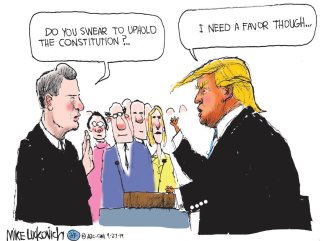 This could be an ominous sign for Trump. The Washington Post: McConnell says if House impeaches Trump, Senate rules would force him to start a trial.
Should the impeachment spotlight turn to the Senate in the coming weeks, McConnell — who faces a reelection fight next year — will confront the dual pressures of minimizing political pain for his Senate majority and ensuring legitimacy and a sense of fairness for what would be only the third impeachment trial of a president in American history.
On Monday, McConnell said he was bound by existing Senate rules governing the impeachment and conviction process, amid speculation that he could simply ignore the specter of putting Trump on trial. Senior Republican aides had worked to try to tamp down that notion over the weekend.
“I would have no choice but to take it up,” McConnell said during a CNBC interview. “How long you’re on it is a whole different matter, but I would have no choice but to take it up, based on a Senate rule on impeachment.”
The Kentucky Republican — who hasn’t hesitated in the past to revise Senate rules to benefit Republicans, specifically the president’s judicial nominees — stressed he would not change them to aid Trump. That move would require the support of 67 senators, almost certainly an insurmountable threshold.
I’m waiting with bated breath to see what breaks today in this massive scandal that has now engulfed Trump, his personal attorney, his White House lawyers, his Secretary of State, and his Attorney General.
 And what about the second whistleblower complaint that House Ways and Means Committee Chairman Richard Neal has been sitting on? Catherine Rampell at The Washington Post: There’s another whistleblower complaint. It’s about Trump’s tax returns.
An unnamed civil servant is alleging serious interference in government business. If the allegations are true, they could be a game-changer. They might set in motion the release of lots of other secret documents showing that President Trump has abused his authority for his personal benefit.
Wait, you thought I meantthe whistleblower from the intelligence community?
Nope. I’m talking about a completely different whistleblower, whose claims have gotten significantly less attention but could prove no less consequential. This whistleblower alleges a whole different category of impropriety: that someone has been secretly meddling with the Internal Revenue Service’s audit of the president.
In defiance of a half-century norm, Trump has kept his tax returns secret.
We don’t know exactly what he might be hiding. His bizarre behavior, though, suggests it’s really bad.
Read the rest at the WaPo.
More interesting reads, links only:
The New York Times Magazine: This Is the Moment Rachel Maddow Has Been Waiting For.
Miami Herald: ‘He conned us from day one’: Giuliani’s Ukraine ally leaves trail of South Florida debts.
David Enrich at The New York Times: Me and My Whistle-Blower.
Alex Pascal at The New York Times: Did the Trump White House Mishandle the Ukraine Call Memo?
Politico: Trump may have lied to Mueller, House Democrats say
The Los Angeles Times: Trump’s ‘favor’ and delay of U.S. aid weakened Ukraine in the fight against Russia.
Politico: Hillary Clinton says staying in her marriage was ‘gutsiest’ thing she’s ever done.
Please post your thoughts and links in the comment thread and have a tremendous Tuesday!!
Lazy Caturday Reads
Posted: September 28, 2019 Filed under: Afternoon Reads, Foreign Affairs, U.S. Politics | Tags: Beatrix Potter, caturday, China, Donald Trump, election interference, impeachment, Russia, Saudi Arabia, Ukraine, Volodymyr Zelensky 18 Comments Good Afternoon!!
I hope you’ll forgive a little childhood nostalgia from me this morning. Yesterday I came down with a cold and sought a little comfort by recalling the Beatrix Potter stories my parents read to me as a child. I googled Potter and came across this wonderful story about her life at The Guardian: The strange life of Beatrix Potter — how rabbits (and mushrooms) set her free, by Matthew Dennison. Dennison wrote a brief biography of Potter, Over the Hills and Far Away: The Life of Beatrix Potter. Here’s the Amazon blurb of the book:
Inspired by the twenty-three “tales,” Matthew Dennison takes a selection of quotations from Potter’s stories and uses them to explore her multi-faceted life and character: repressed Victorian daughter; thwarted lover; artistic genius; formidable countrywoman. They chart her transformation from a young girl with a love of animals and fairy tales into a bestselling author and canny businesswoman, so deeply unusual for the Victorian era in which she grew up. Embellished with photographs of Potter’s life and her own illustrations, this biography will delight anyone who has been touched by Beatrix Potter’s work.
At The Guardian, Dennison writes that at 25, Potter was:
Unmarried, cripplingly shy, plagued by poor health, she passed empty days in the nursery of her childhood home in South Kensington, at the beck and call of her irritable parents. She would remain there until her unexpected marriage at the age of 45.
In place of friends, she had a “noisy cheerful” pet rabbit called Benjamin H Bouncer. On good days, she noted, he was “amiably sentimental to the point of silliness”; on bad days, he ate the insides of her paintbox. Beatrix even dreamt about him: “Bunny came to my bedside in a white cotton nightcap and tickled me with his whiskers.” Inspired by Pepys, she wrote her diary in a complicated code of her own invention, sometimes framing her entries as letters to an imaginary friend called Esther. In these diaries, she vented frustration at her comfortable, pointless existence. As young as 10, she recorded an intention to “do something”.
It took quite awhile, but Potter eventually broke away from her restrictive parents by studying nature and painting. Of course she was best known for her illustrations of rabbits, but she also wrote illustrated stories about cats. I’ve used some of those illustrations in this post.
Now to the latest news.
We’re moving rapidly toward impeachment and maybe we’ll actually be able to rid ourselves of the monster in the White House. The revelations about Trump administration corruption are coming out at warp speed. You’ve probably been following every twist and turn, just as I have.
The latest: Last night we learned that Trump’s meeting with Russian officials in the Oval Office was even worse than previously reported. The Washington Post: Trump told Russian officials in 2017 he wasn’t concerned about Moscow’s interference in U.S. election.
President Trump told two senior Russian officials in a 2017 Oval Office meeting that he was unconcerned about Moscow’s interference in the 2016 U.S. presidential election because the United States did the same in other countries, an assertion that prompted alarmed White House officials to limit access to the remarks to an unusually small number of people, according to three former officials with knowledge of the matter.
The comments, which have not been previously reported, were part of a now-infamous meeting with Russian Foreign Minister Sergei Lavrov and Russian Ambassador Sergey Kislyak, in which Trump revealed highly classified information that exposed a source of intelligence on the Islamic State. He also said during the meeting that firing FBI Director James B. Comey the previous day had relieved “great pressure” on him.
A memorandum summarizing the meeting was limited to a few officials with the highest security clearances in an attempt to keep the president’s comments from being disclosed publicly, according to the former officials, who spoke on the condition of anonymity to discuss sensitive matters.
A bit more:
White House officials were particularly distressed by Trump’s election remarks because it appeared the president was forgiving Russia for an attack that had been designed to help elect him, the three former officials said. Trump also seemed to invite Russia to interfere in other countries’ elections, they said.
The previous day, Trump had fired Comey amid the FBI’s investigation into whether the Trump campaign had coordinated with Russia. White House aides worried about the political ramifications if Trump’s comments to the Russian officials became public.
Trump had publicly ridiculed the Russia investigation as politically motivated and said he doubted Moscow had intervened in the election. By the time he met with Lavrov and Kislyak, Trump had been briefed by the most senior U.S. intelligence officials about the Russian operation, which was directed by Russian President Vladimir Putin and included the theft and publication of Democratic emails and the seeding of propaganda in social media, according to the findings of the U.S. intelligence community.
Apparently, no one told Robert Mueller about these remarks–unless they were redacted by Cover-Up General Bill Barr.
 Another scoop from The New York Times: White House Classified Computer System Is Used to Hold Transcripts of Sensitive Calls.
The White House concealed some reconstructed transcripts of delicate calls between President Trump and foreign officials, including President Vladimir V. Putin and the Saudi royal family, in a highly classified computer system after embarrassing leaks of his conversations, according to current and former officials.
The handling of Mr. Trump’s calls with world leaders has come under scrutiny after questions over whether a transcript of a July 25 call with the Ukrainian president, Volodymyr Zelensky, was improperly placed into this computer system.
The latest revelations show the focus that White House officials put o safeguarding not only classified information but also delicate calls with Mr. Trump, the details of which the administration did not want leaked.
In the case of the calls with the Saudi royal family, the restrictions were set beforehand, and the number of people allowed to listen was sharply restricted. The Saudi calls placed in the restricted system were with King Salman, Crown Prince Mohammed bin Salman and Prince Khalid bin Salman, who at the time was the Saudi ambassador to the United States….
The practice began after details of Mr. Trump’s Oval Office discussion with the Russian foreign minister, Sergey V. Lavrov, leaked to the news media, leading to questions of whether the president had released classified information, according to multiple current and former officials. The White House was particularly upset when the news media reported that Mr. Trump had called James B. Comey, the former F.B.I. director, a “nut job” during that same meeting, according to current and former officials.
The White House had begun restricting access to information after initial leaks of Mr. Trump’s calls with the leaders of Mexico and Australia. But the conversation with Mr. Lavrov and Sergey I. Kislyak, then the Russian ambassador to the United States, prompted tighter restrictions.
From The Guardian this morning: Trump’s Ukraine call sparks new questions over intelligence chief’s firing.
Three days after his now infamous phone conversation with Ukrainian president Volodymyr Zelenskiy, Donald Trump abruptly fired his director of national intelligence in favour of an inexperienced political loyalist.
According to a New York Times report, the White House learned within days that the unorthodox call on 25 July with Zelenskiy had raised red flags among intelligence professionals and was likely to trigger an official complaint.
That timeline has raised new questions over the timing of the Trump’s dismissal by tweet of the director of national intelligence (DNI), Dan Coats, on 28 July and his insistence that the deputy DNI, Sue Gordon, a career intelligence professional, did not step into the role, even in an acting capacity.
Instead, Trump tried to install a Republican congressman, John Ratcliffe, who had minimal national security credentials but had been a fierce defender of the president in Congress. Trump had to drop the nomination after it emerged that Ratcliffe had exaggerated his national security credentials in his biography, wrongly claiming he had conducted prosecutions in terrorist financing cases.
Despite the collapse of the Ratcliffe nomination, Gordon was forced out. She was reported to have been holding a meeting on election security on 8 August when Coats interrupted to convinceher that she would have to resign.
According to The New York Times, Trump knew about the whistleblower complaint “Soon After Trump’s Call” with Ukraine’s President Volodymyr Zelensky, so it appears that Trump fired Coats and Gordon to keep them from getting involved in the situation.
The Washington Post reports that Trump may have been trying to get China to investigate Hunter Biden’s activities there: Trump says he raised Hunter Biden allegations with his China go-between.
President Trump, who has alleged that Hunter Biden got the Chinese to put $1.5 billion into an investment fund, said during private remarks this week that he raised the matter with a U.S. executive who has served as his intermediary on trade talks with Beijing….
In remarks to the U.S. Mission to the United Nations on Thursday morning, Trump said he discussed Biden’s China work with Stephen Schwarzman, the chief executive of the investment company Blackstone.
“I was with the head of Blackstone . . . Steve Schwarzman,” Trump said, according to a video of the remarks obtained by The Washington Post. After alleging that Hunter Biden got $1.5 billion from the Chinese, Trump said he asked Schwarzman, “Steve, is that possible?” Trump said Schwarzman asked, “Who got that?” and Trump responded, “Biden’s son.”
Trump said he asked Schwarzman how that could happen, and the executive responded: “Maybe I shouldn’t get involved, you know it’s very political.”
I wonder how many other countries Trump has tried to solicit for help with the 2020 election?
More stories to check out, links only:
Gary Kasparov at The New York Daily News: The dam is breaking: Trump’s true character is revealed, more fully than ever.
Michael Cohen at The Boston Globe: Forget impeachment. Donald Trump needs to resign.
Jonathan Chait at New York Magazine: The Ukraine Scandal Is a Fitting Symbol of Trump’s Presidency. It May Finally Be His Downfall.
Anne Applebaum at The Washington Post: Americans spent decades discussing rule of law. Why would anyone believe us now?
The Washington Post: Deep Throat’s identity was a mystery for decades because no one believed this woman.
CNN: Democrats say White House stonewalling won’t drag out inquiry and will boost case for impeachment.
HuffPost: Now One Of Trump’s Court Picks Is Tied Up In This Ukraine Scandal.
The Washington Post: Amateur pro-Trump ‘sleuths’ scramble to unmask whistleblower: ‘Your president has asked for your help.’
The Daily Beast: Pompeo Grapples for Ways to Outlast Hurricane Rudy.
Have a great Caturday, Sky Dancers!!
Thursday Reads: DNI Facing Intel Committees and Trump Facing Impeachment
Posted: September 26, 2019 Filed under: Foreign Affairs, morning reads, U.S. Politics | Tags: Donald Trump, House Intelligence Committee, Joseph Maguire, Nancy Pelosi, Russia, Ukraine, whistleblowers, William Barr 30 Comments Good Morning!!
Acting Director of National Intelligence Joseph Maguire is testifying before the House Intelligence Committee this morning. Maguire has given his opening statement and the questioning has begun. At about 8:30, the whistleblower complaint was released to the public. You can read it here.
So far Maguire is working pretty hard to obfuscate Adam Schiff’s questions, but he has admitted that he first took the complaint to the White House counsel’s office for advice. He keeps claiming that he can’t violate executive privilege but he also admits that the “president” has not asserted executive privilege. Next he went to the DOJ even though Bill Barr is specifically mentioned in the whistleblower complaint as likely being involved in Trump’s wrongdoing!
https://twitter.com/waltshaub/status/1177218746919915521
Anyway, if you’re watching, please post your thoughts in the comments to this post.
Here’s the latest:
The Washington Post: Whistleblower claimed Trump abused his office and that White House officials tried to cover it up.
The whistleblower complaint at the heart of the burgeoning controversy over President Trump’s call with the Ukrainian president claims not only that the president misused his office for personal gain and endangered national security but that unidentified White House officials tried to hide that conduct.
“In the course of my official duties, I have received information from multiple U.S. government officials that the President of the United States is using the power of his office to solicit interference from a foreign country in the 2020 U.S. election,” the whistleblower wrote in the complaint dated Aug. 12. The House Intelligence Committee released the document Thursday morning.
“This interference includes, among other things, pressuring a foreign country to investigate one of the President’s main domestic political rivals. The President’s personal lawyer, Mr. Rudolph W. Giuliani, is a central figure in this effort. Attorney General (William P.) Barr appears to be involved as well,” the complaint states.
In that phone call, Trump pressed President Volodymyr Zelensky to investigate Joe Biden, one of his chief political rivals, and Biden’s son Hunter — offering to enlist Barr’s help in that effort while dangling a possible visit to the White House, according to a rough transcript of the call released by the White House on Wednesday.
Read the rest at the WaPo.
The New York Times: Whistle-Blower’s Complaint Says White House Tried to ‘Lock Down’ Ukraine Call Records.
President Trump used the power of his office to try to get Ukraine to interfere in the 2020 election to investigate a political rival “for personal gain,” according to an explosive whistle-blower complaint released on Thursday after days of damning revelations about Mr. Trump’s dealings with Ukraine.
Attorney General William P. Barr and the president’s personal attorney Rudolph W. Giuliani were central to the effort, the complaint said.
In addition, the complaint says that whistle-blower, an unidentified intelligence officer, learned from multiple American officials that “senior White House officials had intervened to ‘lock down’ all records of the phone call, especially the official word-for-word transcript of the call that was produced as is customary by the White House Situation Room.”
“This set of actions underscored to me that White House officials understood the gravity of what had transpired in the call,” the complaint said.
The whistle-blower’s complaint was based on accounts from multiple White House officials who were “deeply disturbed” by what they heard on the call, the complaint said.
Read more at the link above.
The New York Times last night: Phone Call Showed Only a Slice of Trump’s Obsession With Ukraine.
Long before the July 25 call with the new Ukrainian president that helped spur the formal start of impeachment proceedings against him in the House, Mr. Trump fretted and fulminated about the former Soviet state, angry over what he sees as Ukraine’s role in the origins of the investigations into Russian influence on his 2016 campaign.
His fixation was only intensified by his hope that he could employ the Ukrainian government to undermine his most prominent potential Democratic rival in 2020, former Vice President Joseph R. Biden Jr.
His personal lawyer, Rudolph W. Giuliani, has undertaken a nearly yearlong, free-ranging effort to unearth information helpful to Mr. Trump and harmful to Mr. Biden.
And Mr. Trump has put the powers of his office behind his agenda: He has dispatched Vice President Mike Pence and top administration officials with thinly veiled messages about heeding his demands about confronting corruption, which Ukrainian and former American officials say is understood as code for the Bidens and Ukrainians who released damaging information about the Trump campaign in 2016. This summer he froze a package of military assistance to Ukraine even as the country, eager to build closer relations with Washington, continued to be menaced by its aggressive neighbor Russia.
HuffPost: Donald Trump Actually Has 2 Whistleblowers To Worry About.
…there’s another whistleblower ― one with possible evidence that Trump tried to corrupt an Internal Revenue Service audit of his personal tax returns ― who has received relatively little attention.
The tax whistleblower…went straight to Congress ― specifically to the House Ways and Means Committee, which had sued the Trump administration for refusing to provide copies of the president’s tax returns in response to a formal request. Democrats say they need Trump’s returns to make sure the IRS properly enforces tax laws against the president.
But Ways and Means Chair Richard Neal (D-Mass.) is far less outspoken than Schiff, and his approach to the tax case has been cautious. He decided to stay focused on the lawsuit, using the whistleblower’s material to bolster that case.
In a brief last month, the committee told the U.S. District Court for the District of Columbia that a “federal employee” had approached them with “evidence of possible misconduct” and “inappropriate efforts” to influence an IRS audit of the president. The document provided no further detail about the whistleblower, but in a footnote, Democrats offered to tell U.S. District Judge Trevor McFadden all about it in private.
A spokesman for the committee said this week that McFadden, a Trump nominee who donated to the Trump 2016 campaign and volunteered for the Trump presidential transition, has so far not asked to hear more about the whistleblower. He denied a Democratic motion to speed up the case.
Selected analysis:
This one is really interesting. I hope you’ll read the whole thing by Murray Waas at the New York Review of Books: Trump, Giuliani, and Manafort: The Ukraine Scheme.
The effort by President Trump to pressure the government of Ukraine to investigate former Vice President Joe Biden and his son had its origins in an earlier endeavor to obtain information that might provide a pretext and political cover for the president to pardon his former campaign chairman, Paul Manafort, according to previously undisclosed records.
These records indicate that attorneys representing Trump and Manafort respectively had at least nine conversations relating to this effort, beginning in the early days of the Trump administration, and lasting until as recently as May of this year. Through these deliberations carried on by his attorneys, Manafort exhorted the White House to press Ukrainian officials to investigate and discredit individuals, both in the US and in Ukraine, who he believed had published damning information about his political consulting work in the Ukraine. A person who participated in the joint defense agreement between President Trump and others under investigation by Special Counsel Robert Mueller, including Manafort, allowed me to review extensive handwritten notes that memorialized conversations relating to Manafort and Ukraine between Manafort’s and Trump’s legal teams, including Trump’s personal attorney, Rudy Giuliani.
These new disclosures emerge as House Speaker Nancy Pelosi announced on Tuesday that the House would open a formal impeachment inquiry into President Trump’s conduct. What prompted her actions were the new allegations that surfaced last week that Trump had pressured Ukraine’s newly elected president, Volodymyr Zelensky, to investigate Trump’s potential 2020 campaign rival, Biden, and his son Hunter, placing a freeze on a quarter of a billion dollars in military assistance to Ukraine as leverage. The impeachment inquiry will also examine whether President Trump obstructed justice by attempting to curtail investigations by the FBI and the special counsel into Russia’s covert interference in the 2016 presidential election in Trump’s favor.
New information in this story suggests that these two, seemingly unrelated scandals, in which the House will judge whether the president’s conduct in each case constituted extra-legal and extra-constitutional abuses of presidential power, are in fact inextricably linked: the Ukrainian initiative appears to have begun in service of formulating a rationale by which the president could pardon Manafort, as part of an effort to undermine the special counsel’s investigation.
Jonathan Chait at New York Magazine: The Ukraine Scandal Is Not One Phone Call. It’s a Massive Plot.
On July 25, President Trump held a phone call in which he repeatedly leaned on Ukrainian president Volodymyr Zelensky to investigate Joe Biden and Paul Manafort’s prosecutors. The episode is so blatantly inappropriate even Trump’s most fervent apologists are, with a few exceptions, having trouble defending it. What they are trying to do, instead, is define this phone call as the entire scandal. Trump emphasizes that he “didn’t specifically mention the explicit quid pro quo” of military aid in return for the investigation.
That is true, as far as it goes. The quid pro quo in the call, though perfectly apparent, is mostly implicit. But the real trick in Trump’s defense is framing the call as the entire scandal. The scandal is much more than that. The call is a snapshot, a moment in time in a months-long campaign that put American policy toward Ukraine at the disposal of Trump’s personal interests and reelection campaign.
Last spring, Rudy Giuliani was openly pressuring Kiev to investigate Joe Biden. Giuliani told the New York Times, “We’re meddling in an investigation … because that information will be very, very helpful to my client.” The key word there was “we’re.” The first-person plural indicated Giuliani was not carrying out this mission alone. A series of reports have revealed how many other government officials were involved in the scheme.
Read more at the link.
A few more:
Susan Glasser at The New Yorker: “Do Us a Favor”: The Forty-eight Hours That Sealed Trump’s Impeachment.
Lawrence Tribe at USA Today: Donald Trump’s call with Ukrainian president drips with impeachable crimes.
Neal Kaytal at The New York Times: Trump Doesn’t Need to Commit a Crime to Be Kicked Out of Office.
Please post your thoughts and links on any topic in the comment thread below.
Terrifying Tuesday Reads: Impeach the MFer!
Posted: September 24, 2019 Filed under: Foreign Affairs, morning reads, U.S. Politics | Tags: Abigail Spanberger, Chrissy Houlahan, Declan Walsh, Donald Trump, Elaine Luria, Gil Cisneros, impeachment, inherent contempt, Iuliia Mendel, Jason Crow, Mikie Sherrill, Nancy Pelosi, press freedom, reporters in danger, Ukraine, United Nations, Volodymyr Zelensky, Wilbur Ross 43 Comments Good Morning!!
The Dotard is not looking or sounding good this morning. He must be missing his executive time watching Fox News this morning. Trump was at the UN trying out a new excuse for his corrupt bullying of Ukraine. Supposedly he secretly held back the aid because other countries weren’t giving enough.
Then he gave a slow-motion speech full of slurred words. His face was bloated and expressionless, and he appeared to be struggling to read the teleprompter, squinting his eyes and craning his neck forward.
Commerce Secretary Wilbur Ross appeared to be dozing off in his chair.
The Dotard’s kids were in the audience, hoping he could somehow make it through the “speech” before he keeled over.
Here’s a longer excerpt, posted by an expert on authoritarian regimes.
This robotic, senile, yet dangerous “person” is supposedly the president of the United States.
I’ll get to Ukraine and impeachment talk in a minute, but first I want to highlight this op-ed by the publisher of The New York Times A.G. Sulzberger. I hope you’ll go read the whole thing, but here’s the breaking news part: the Trump administration refused to help a NYT reporter who was in danger of being arrested in Egypt.
Two years ago, we got a call from a United States government official warning us of the imminent arrest of a New York Times reporter based in Egypt named Declan Walsh. Though the news was alarming, the call was actually fairly standard. Over the years, we’ve received countless such warnings from American diplomats, military leaders and national security officials.
But this particular call took a surprising and distressing turn. We learned the official was passing along this warning without the knowledge or permission of the Trump administration. Rather than trying to stop the Egyptian government or assist the reporter, the official believed, the Trump administration intended to sit on the information and let the arrest be carried out. The official feared being punished for even alerting us to the danger.
Declan Walsh
Unable to count on our own government to prevent the arrest or help free Declan if he were imprisoned, we turned to his native country, Ireland, for help. Within an hour, Irish diplomats traveled to his house and safely escorted him to the airport before Egyptian forces could detain him.
We hate to imagine what would have happened had that brave official not risked their career to alert us to the threat.

Walsh wasn’t alone.
Eighteen months later, another of our reporters, David Kirkpatrick, arrived in Egypt and was detained and deported in apparent retaliation for exposing information that was embarrassing to the Egyptian government. When we protested the move, a senior official at the United States Embassy in Cairo openly voiced the cynical worldview behind the Trump administration’s tolerance for such crackdowns. “What did you expect would happen to him?” he said. “His reporting made the government look bad.”
You have to wonder why NYT reporters like Ken Vogel and Maggie Haberman are so protective of Trump. Check out this example at The Daily Beast: Author of New York Times’ Controversial Biden-Ukraine Story Becomes New Ukrainian President’s Spokeswoman.
The New York Times last month published a controversial 2,500-word report raising questions about whether Joe Biden used his position as vice president to meddle in Ukrainian politics for the benefit of a company that employed his son.
Iuliia Mendel
Now one of the piece’s authors has announced she has taken a job as the new Ukrainian president’s spokesperson—sparking a new round of criticism of the Times’ story.
“If you want changes—make them. I am glad to join Volodymyr Zelensky’s team. We will do everything possible to be as open to the media and society as we can,” Iuliia Mendel said Monday in a press release.
Her May 1 Times piece detailed how in 2016, then-Vice President Biden successfully pushed Ukraine to oust Viktor Shokin, the country’s top prosecutor who’d been criticized by the U.S. as an impediment to corruption reform. The story suggested the possibility that Biden was motivated to push for Shokin’s removal because the prosecutor investigated the head of Burisma Holdings, a Ukrainian energy company where the veep’s son Hunter Biden was a board member.

The article provided no evidence to support the accusations against Biden, but the NYT pushed Trump and Giuliani’s false claims anyway.
Two important stories broke at The Washington Post last night:
Trump ordered hold on military aid days before calling Ukrainian president, officials say.
President Trump told his acting chief of staff, Mick Mulvaney, to hold back almost $400 million in military aid for Ukraine at least a week before a phone call in which Trump is said to have pressured the Ukrainian president to investigate the son of former vice president Joe Biden, according to three senior administration officials.
Officials at the Office of Management and Budget relayed Trump’s order to the State Department and the Pentagon during an interagency meeting in mid-July, according to officials who spoke on the condition of anonymity to discuss internal deliberations. They explained that the president had “concerns” and wanted to analyze whether the money needed to be spent.
Volodymyr Zelensky
Administration officials were instructed to tell lawmakers that the delays were part of an “interagency process” but to give them no additional information — a pattern that continued for nearly two months, until the White House released the funds on the night of Sept. 11.
Trump’s order to withhold aid to Ukraine a week before his July 25 call with Volodymyr Zelensky is likely to raise questions about the motivation for his decision and fuel suspicions on Capitol Hill that Trump sought to leverage congressionally approved aid to damage a political rival.

Op-Ed by Seven freshman Democrats: Seven freshman Democrats: These allegations are a threat to all we have sworn to protect, by
Our lives have been defined by national service. We are not career politicians. We are veterans of the military and of the nation’s defense and intelligence agencies. Our service is rooted in the defense of our country on the front lines of national security.
We have devoted our lives to the service and security of our country, and throughout our careers, we have sworn oaths to defend the Constitution of the United States many times over. Now, we join as a unified group to uphold that oath as we enter uncharted waters and face unprecedented allegations against President Trump.
Abigail Spanberger
The president of the United States may have used his position to pressure a foreign country into investigating a political opponent, and he sought to use U.S. taxpayer dollars as leverage to do it. He allegedly sought to use the very security assistance dollars appropriated by Congress to create stability in the world, to help root out corruption and to protect our national security interests, for his own personal gain. These allegations are stunning, both in the national security threat they pose and the potential corruption they represent. We also know that on Sept. 9, the inspector general for the intelligence community notified Congress of a “credible” and “urgent” whistleblower complaint related to national security and potentially involving these allegations. Despite federal law requiring the disclosure of this complaint to Congress, the administration has blocked its release to Congress.
This flagrant disregard for the law cannot stand. To uphold and defend our Constitution, Congress must determine whether the president was indeed willing to use his power and withhold security assistance funds to persuade a foreign country to assist him in an upcoming election.

They go on to call for impeachment hearings and even using inherent contempt to force the administration to turn over documents and witnesses.
Speaker Nancy Pelosi has called a meeting of the Democratic caucus for this afternoon. CNN reports:
House Speaker Nancy Pelosi will meet with key committee chairmen who are leading investigations into President Donald Trump, ahead of a full caucus meeting Tuesday afternoon, according to Democratic sources, in what appears to be a crucial day for the party and their strategy on whether to impeach the President.
Amid a new slate of Democratic lawmakers opening the door to impeachment proceedings, Pelosi will consult with the six House Democratic leaders to discuss their presentation to the caucus later in the day, Democratic sources familiar with the issue say. The speaker has been on the phone with her colleagues over the last several days to take the temperature of the whistleblower complaint against Trump as she decides whether to embrace impeachment, Democrats say.
In an interview with CNN Monday night, Pelosi declined to say whether she would fully endorse initiating an impeachment inquiry when she meets with the caucus Tuesday.
But she left little doubt the developments around the whistleblower’s complaint had dramatically escalated the standoff with Trump and a move toward impeachment proceedings was all but certain.
“We will have no choice,” Pelosi said of ultimately getting behind an impeachment inquiry.Some of Pelosi’s closest allies, including House Reps. Rosa DeLauro of Connecticut and Debbie Dingell of Michigan, have signaled their support for impeachment proceedings — a significant indicator that the speaker could be moving closer to backing the divisive political procedure.
The news is full of impeachment talk this morning. Here are some stories to check out:
The Washington Post: Pelosi quietly sounding out House Democrats about whether to impeach Trump, officials say.
Politico: ‘Seismic change’: Democratic hold-outs rush toward impeachment.
Joyce White Vance at Time: Trump Is Leaving Congress No Choice But to Impeach.
Jonathan Chait at New York Magazine: Why Trump Has Finally Forced the House to Impeach Him.
Jonathan Bernstein at Bloomberg: We’re Likely Headed for Impeachment.
The Daily Beast: Trump Impeachment: House Dems Are Discussing a ‘Select Panel’ to Handle the Task.
What stories are you following on this Terrifying Tuesday?
Thunderous Thursday Reads: What Did Trump Promise A Foreign Leader?
Posted: September 19, 2019 Filed under: Foreign Affairs, morning reads, U.S. Politics | Tags: Acting DNI Joseph Maguire, Adam Schiff, Andrew P. Bakaj, Dan Coats, Donald Trump, House Intelligence Committee, Intelligence Community Inspector General Michael Atkinson, Vladimir Putin, whisleblower, William Barr 30 Comments
Gustav Klimt, Large Poplar II (Approaching Thunderstorm)
Good Morning!!
Last night The Washington Post broke a story on the mysterious whistleblower complaint that Trump and Cover-up General Barr are trying to keep secret from Congress: Trump’s communications with foreign leader are part of whistleblower complaint that spurred standoff between spy chief and Congress, former officials say.
Trump’s interaction with the foreign leader included a “promise” that was regarded as so troubling that it prompted an official in the U.S. intelligence community to file a formal whistleblower complaint with the inspector general for the intelligence community, said the former officials, speaking on the condition of anonymity because they were not authorized to discuss the matter publicly.
It was not immediately clear which foreign leader Trump was speaking with or what he pledged to deliver, but his direct involvement in the matter has not been previously disclosed. It raises new questions about the president’s handling of sensitive information and may further strain his relationship with U.S. spy agencies. One former official said the communication was a phone call.
Gustav Klimt, Landscape with Birch Trees
Intelligence Community Inspector General Michael Atkinson determined that the complaint was credible and troubling enough to be considered a matter of “urgent concern,” a legal threshold that requires notification of congressional oversight committees.
But acting director of national intelligence Joseph Maguire has refused to share details about Trump’s alleged transgression with lawmakers, touching off a legal and political dispute that has spilled into public view and prompted speculation that the spy chief is improperly protecting the president.
The dispute is expected to escalate Thursday when Atkinson is scheduled to appear before the House Intelligence Committee in a classified session closed to the public. The hearing is the latest move by committee Chairman Adam B. Schiff (D-Calif.) to compel U.S. intelligence officials to disclose the full details of the whistleblower complaint to Congress. Maguire has agreed to testify before the panel next week, according to a statement by Schiff. He declined to comment for this article.

This seems like a very big deal. Atkinson is meeting right now behind closed doors with the House Intelligence Committee. And the Dotard is up and tweeting about it.
Yes, I’d say quite a few of us believe that the dummy in the WH would do that. Some background from the WaPo story:
The complaint was filed with Atkinson’s office on Aug. 12, a date on which Trump was at his golf resort in New Jersey. White House records indicate that Trump had had conversations or interactions with at least five foreign leaders in the preceding five weeks.
Among them was a call with Russian President Vladimir Putin that the White House initiated on July 31. Trump also received at least two letters from North Korean leader Kim Jong Un during the summer, describing them as “beautiful” messages. In June, Trump said publicly that he was opposed to certain CIA spying operations against North Korea. Referring to a Wall Street Journal report that the agency had recruited Kim’s half brother, Trump said, “I would tell him that would not happen under my auspices.”
Trump met with other foreign leaders at the White House in July, including the prime minister of Pakistan, the prime minister of the Netherlands and the emir of Qatar.

The Swamp, Gustav Klimt
Most likely the call in question is the one with Putin. As you may recall, that was the call in which Trump supposedly offered Russia help with the wildfires in Siberia. The Russian readout of the call was very different. Putin claimed that Trump’s offer demonstrated that normalization of relations between the two countries was possible.
Putin, in response, expressed his “sincere gratitude” to Trump and said that if necessary, he will accept the offer, the Kremlin said on its website.
“The President of Russia regards the US President’s offer as a sign that it is possible that full-scale bilateral relations will be restored in the future,” the statement from the Kremlin read.
“The presidents of Russia and the United States agreed to continue contacts both in a telephone format and in person,” it added.
However, the two countries differed somewhat in their interpretations of the call.
As NPR’s Tamara Keith reports, “Russia announced the call first, saying President Trump offered Putin assistance fighting wildfires in Siberia. … Putin assessed the offer as a sign that relations between the two countries would be fully restored. Russia interfered in the 2016 presidential election, and is still under U.S. sanctions.”
Speculation from Twitter about what happened:
Shugarman has posted a thread with timelines from other twitter users of events that took place during the time in question. Click on the above tweet to read the thread. More timelines:
Response from @swatkins109:
“Also Huntsman (Ambassador to Russia) resigns Aug 6 Sept 3 trump announces military spending for NATO countries canceled.”
Make of all that what you will. I can’t wait till the whole story comes out, and it will.
David Frum writes at The Atlantic: The Question Posed by Trump’s Phone Call: A whistle-blower complaint raises the possibility that President Trump has betrayed the duties of his office.
On the 20th of July 1787, Gouverneur Morris rose inside the stiflingly hot Independence Hall, in Philadelphia, to explain why he had changed his mind and now favored including a power of impeachment in the constitutional text.
Until that point, he and others had feared that an impeachment power would leave the president too dependent on Congress. He had thought that the prospect of reelection defeat would offer a sufficient control on presidential wrongdoing.

A Morning by the Pond, Gustav Klimt
But Morris ultimately changed his mind.
Foreign corruption inducing treason was the core impeachable offense in the eyes of the authors of the Constitution.
Which is why a whistle-blower report filed with the inspector general for the intelligence community, reportedly concerning an improper “promise” by President Donald Trump to a foreign leader, has jolted Congress.
Earlier in the constitutional debates—back when he still opposed an impeachment provision—Morris argued that a corrupt or treasonable president “can do no criminal act without Coadjutors who may be punished.” Trump is surrounded by coadjutors, yet so far all are acting with impunity, joined now by the acting director of national intelligence, Joseph Maguire, who is withholding from Congress the apparently explosive information.
Trump has been engaged in improper contacts with foreign governments for years, and built deep business relationships with foreign nationals. Russian assistance helped elect him. Money from wealthy Russians reportedly helped keep his businesses alive from 2006 to 2016. Since 2016, more and more foreign money has flowed Trump’s way. Trump literally has a hotel open on Pennsylvania Avenue to accept payments—there’s a big carpet in front, his name on the door, nothing even remotely clandestine about the flow of corruption. That corruption seeks returns. Again and again, Trump has acted in ways that align with the interests of foreign states, raising questions about his motives.
Exactly what was promised in this particular conversation, and to whom, America and the world wait to hear.
I certainly hope we learn something from Adam Schiff when he emerges from that private briefing with the Inspector General.

Gustav Klimt, The Marshy Pond
The New York Times just broke a story about the hearing: Watchdog Refuses to Detail Whistle-Blower Complaint About Trump.
The internal watchdog for American spy agencies declined repeatedly in a briefing on Thursday to disclose to lawmakers the content of a potentially explosive whistle-blower complaint that is said to involve a discussion between President Trump and a foreign leader, according to two people familiar with the briefing.
During a private session on Capitol Hill, Michael Atkinson, the inspector general of the intelligence community, told lawmakers he was unable to confirm or deny anything about the substance of the complaint, including whether it involved the president, according to the people, who spoke on condition of anonymity to describe the closed-door conversation. The meeting was still underway.
The complaint, which prompted a standoff between Congress and Mr. Trump’s top intelligence official, involves a commitment that Mr. Trump made in a communication with another world leader, according to a person familiar with the complaint….
Few details of the whistle-blower complaint are known, including the identity of the world leader. And it is not obvious how a communication between Mr. Trump and a foreign leader could meet the legal standards for a whistle-blower complaint that the inspector general would deem an “urgent concern.”
Under the law, the complaint has to concern the existence of an intelligence activity that violates the law, rules or regulations, or otherwise amounts to mismanagement, waste, abuse, or a danger to public safety. But a conversation between two foreign leaders is not itself an intelligence activity.
And while Mr. Trump may have discussed intelligence activities with the foreign leader, he enjoys broad power as president to declassify intelligence secrets, order the intelligence community to act and otherwise direct the conduct of foreign policy as he sees fit, legal experts said.
The NYT has the name of the whistleblower’s lawyer.
Andrew P. Bakaj, a former C.I.A. and Pentagon official whose legal practice specializes in whistle-blower and security clearance issues, confirmed that he is representing the official who filed the complaint. Mr. Bakaj declined to identify his client or to comment.
Obviously this story will be making news all day today. As the Dotard likes to say, “we’ll see what happens. Please post your thoughts on this story or anything else you find interesting in the comment thread below.

 peej
peej Carissa
 bostonboomer
 dakinikat
 ecocatwoman
 mablue2
 Mama Lopez
 peggysue22
 quixote
 skydancingguestblogger
 Mona (aka Wonk the Vote)



 Sky Dancing
Recent Comments