
Thursday Reads
Posted: March 31, 2011 Filed under: Afghanistan, Barack Obama, Central Intelligence Agency, Democratic Politics, Diplomacy Nightmares, executive orders, Foreign Affairs, Iraq, Libya, MENA, morning reads, U.S. Military, U.S. Politics | Tags: CIA, death anxiety, evolution, General Electric, intelligent design, Jeffrey Immelt, Libya uprising, Moammar Gaddafi, progs, Quinnipiac poll, Russ Feingold, the Super-Rich 40 Comments
Good Morning!! Here are the stories that caught my eye this morning.
Reuters: Exclusive: Obama authorizes secret help for Libya rebels
President Barack Obama has signed a secret order authorizing covert U.S. government support for rebel forces seeking to oust Libyan leader Muammar Gaddafi, government officials told Reuters on Wednesday.
Obama signed the order, known as a presidential “finding”, within the last two or three weeks, according to government sources familiar with the matter.
Such findings are a principal form of presidential directive used to authorize secret operations by the Central Intelligence Agency. This is a necessary legal step before such action can take place but does not mean that it will.
Washington Post: In Libya, CIA is gathering intelligence on rebels
The Obama administration has sent teams of CIA operatives into Libya in a rush to gather intelligence on the identities and capabilities of rebel forces opposed to Libyan leader Moammar Gaddafi, according to U.S. officials.
The information has become more crucial as the administration and its coalition partners move closer to providing direct military aid or guidance to the disorganized and beleaguered rebel army.
Although the administration has pledged that no U.S. ground troops will be deployed to Libya, officials said Wednesday that President Obama has issued a secret finding that would authorize the CIA to carry out a clandestine effort to provide arms and other support to Libyan opposition groups.
I can’t imagine why anyone would be surprised that the CIA is involved in Libya (they are everywhere). But the progs are looking down their noses in strong disapproval.
Emptywheel: Where Will Obama Try Himself for Material Support for Terrorism?
After all, according to Holder v. Humanitarian Law Project any help to a terrorist group–even counseling on how to make peace–is material support. And no matter how we try to spin arming rebels as an act of peace, it’s a good deal more help than legal counsel.
And, as the DC Circuit’s decision yesterday in Uthman Abdul Rahim Mohammed Uthman’s habeas suit makes clear, it’s not enough for a person to stop associating with al Qaeda in the 1990s, nor does the government need any real evidence of a tie between someone in al Qaeda’s vicinity to claim that person is a member of al Qaeda.
Glenn Greenwald: The wisdom and legality of arming Libyan rebels
Then there’s the question of the legality of arming Libyan troops. Salon’s Justin Elliott reported on Monday that the administration was actively considering arming the rebels despite an absolute arms embargo imposed by U.N. Resolution 1970 (“imposing an arms embargo on the country”). Today, The Guardian elaborates by citing numerous legal experts insisting that it would be a violation of the U.N. Resolution for the U.S. to arm the rebels. For its part, the U.S. insists that it is legally entitled to do so, with Hillary Clinton announcing that the arms embargo has been “overriden” by the broad mandate of U.N. Resolution 1973, allowing “all necessary measures” to be used to protect Libyan civilians.
On the strictly legal issue, this seems to be a close question. Can the specific arms embargo really be “overriden” by a general clause allowing the protection of civilians? That seems redolent of the Bush arguments that specific prohibitions in the law (such as the ban on warrantless eavesdropping) were “overriden” by the broad war powers assigned by the AUMF. More to the point, can it really be said that arming Libyan rebels is necessary for the protection of civilians? That sounds much more like what one does to help one side win a civil war.
I don’t know, and I admit I don’t like the idea of this action in Libya expanding too far. I remember when Reagan armed the “Contras.” Of course back in those days we were arming right-wing groups and the US was involved in countless human rights violations. In Libya, the opposition forces are trying to depose a genuinely evil dictator who has been involved in terrorist attacks.
But here’s my question: why don’t the progs convince the guy they supported to get us the hell out of Iraq and Afghanistan? They wanted this guy, they forced him on us, and now they’re whining. and what are they doing to find a decent alternative? A big nothing.
I’m not going to be happy if we get involved in a ground war in Libya or anywhere else, but it hasn’t happened yet. We’ve been in Afghanistan for almost ten years!
Raw Story: Most Americans think Obama does not deserve re-election, according to new poll
Obama’s approval rating is also at its lowest point ever, at 42 percent, while his disapproval rating rose from earlier in the month to a new high of 48 percent.
A similar Quinnipiac poll published March 3 found President Obama with 46 percent approval and 46 percent disapproval.
In that earlier poll, voters also split on whether Obama deserves reelection, with 47 percent saying yes and 45 percent saying no.
The latest poll reflects the president’s sliding fortunes in other studies, with a full 50 percent now saying that he does not deserve to stay in office beyond 2012.
The big problem with this is that the Republicans are bound to nominate someone who is to the right of Atilla the Hun and about as crazy and unempathetic as Muammar Gaddafi. I refuse to vote for Obama, but what if we end up with Michelle Bachmann or Mike Huckabee as President?
Anyway, the Tea Party’s polls are in the crapper along with Obama’s.
Just 32 percent of respondents viewed the tea party favorably, while a record-high 47 percent had a negative view of the movement that propelled Republicans to dramatic Congressional victories last November. Fourteen percent had no opinion, and 7 percent said they’ve never heard of the tea party.
I sure hope the Congresspeople find out about that.
Russ Feingold doesn’t think Jeffrey Immelt is a very good jobs czar. No kidding, lol.
Feingold’s new group, Progressives United, is set to launch a new campaign to pressure General Electric CEO Jeffrey Immelt to step down as the head of the President’s Council on Jobs and Competiveness. Feingold’s campaign — which I’m told will be joined by Move On later today — is based on two pieces of news that, Feingold says, render Immelt unfit for the gig of Obama jobs chief: GE paid no American taxes in 2010; and Immelt’s compensation doubled .
In an email to members of his new group, Feingold will argue that if Immelt doesn’t step down, Obama should fire him, arguing that Dems need to stop coddling corporations whose behavior undermines our economy:
I’ve got a couple of semi-humorous stories to get your mind off all the bad news. Get out your tiny violin. Did you know that the super-rich are unhappy and dissatisfied with their lives?
The Atlantic: Secret Fears of the Super-Rich
Does great wealth bring fulfillment? An ambitious study by Boston College suggests not. For the first time, researchers prompted the very rich—people with fortunes in excess of $25 million—to speak candidly about their lives. The result is a surprising litany of anxieties: their sense of isolation, their worries about work and love, and most of all, their fears for their children.
Awwwww. Too bad, so sad. Then give your money away to people who actually need it, why don’t you. And then get a real job.
Raw Story: Death anxiety linked to acceptance of intelligent design: study
Research conducted at the University of British Columbia and Union College found that people’s death anxiety was associated with support of intelligent design and rejection of evolutionary theory.
Death anxiety also influenced those in the study to report an increased liking for Michael Behe, a prominent proponent of intelligent design, and an increased disliking for Richard Dawkins, a well-known evolutionary biologist.
The findings suggest that people are motivated to believe in intelligent design and doubt evolutionary theory because of unconscious psychological motives.
Okay, time out. Because? No. This is a correlational study, and as we all should have learned long ago, Correlation does not equal causation.
The study was lead by UBC Psychology Assistant Professor Jessica Tracy and and UBC psychology PhD student Jason Martens. It was published in the March 30 issue of the open access journal PLoS ONE.
“Our results suggest that when confronted with existential concerns, people respond by searching for a sense of meaning and purpose in life,” Tracy said. “For many, it appears that evolutionary theory doesn’t offer enough of a compelling answer to deal with these big questions.”
There are a lot of variables unaccounted for in this description of the study. Maybe death anxiety is just associated with fundamentalist Christianity. I guess I could look up the study and see what the findings really were… But I probably won’t.
That’s all I’ve got for today. What are you reading and blogging about?
The Changing Face of the MENA Region (Breaking News)
Posted: March 24, 2011 Filed under: Algeria, Bahrain, Egypt, Foreign Affairs, Iran, Iraq, Israel, Jordan, Lebanon, Libya, Syria, Tunisia, Yemen | Tags: arab awakening, MENA 8 Comments The WSJ reports that Yemeni President Saleh is working out a deal that will let him resign. The country’s leading general will also resign. The details will be released on Saturday.
“Both sides have agreed on the main points of departure, and Saturday is expected to be the day that Saleh and General Ahmar both step down,” according to a senior official familiar with the negotiations.
It couldn’t be determined which individuals were being considered as candidates for any transitional authority as talks continued late Thursday between the two leaders.
The support for mainstream opposition party leaders is unclear across the rugged and largely conservative country. Meanwhile, traditional tribal leaders who have great social standing would face problems exerting authority over rival tribes.
The Pentagon is currently holding a presser and has announced that they’re no longer ‘detecting’ Libyan planes in the air. NATO and the UN are expected to make an announcement shortly that NATO will be taking over the No-fly efforts. I just read some interesting analysis at Juan Cole’s Informed Consent on the Top Ten Accomplishments of the UN’s no-fly zone efforts. Cole says the French have also verified that Gadhafi’s air attacks have stopped and that his planes are grounded. There is also this tidbit.
The participation of the Muslim world in the United Nations no-fly zone over Libya has been underlined. The measure was called for by the Arab League, which has not in fact changed its mind about its desirability. Qatar is expected to be flying missions over Libya by this weekend. Other Arab League countries will give logistical support.
It is significant that the Arab League is supporting this action. The GCC (Gulf Cooperation Council)–an organization that is an essential part of my research on trade–is also trying to curb problems in Bahrain. This is significant because it shows that region is actively trying to create situations to jointly improve the conditions in the region.
Meanwhile, the people of Syria may be closer to the goals of their mostly peaceful protests. Syria is one of the most repressed countries in the region and has been under martial law for 50 years. Clashes between protesters and the government have increased recently.
President Bashar al-Assad made a rare public pledge to look into granting Syrians greater freedom on Thursday as anger mounted following attacks by security forces on protesters that left at least 37 dead.
Syrian opposition figures said the promises did not meet the aspirations of the people and were similar to those repeated at regular Baath Party conferences, where committees would be formed to study reforms that do not see the light of day.
“The leadership is trying to absorb the rage of the streets. We want to see reform on the ground,” said a protester in the southern city of Deraa.
A hospital official said at least 37 people had been killed in the southern city of Deraa on Wednesday when security forces opened fire on demonstrators inspired by uprisings across the Arab world that have shaken authoritarian leaders.
While an aide said Assad would study a possible end to 48 years of emergency rule, a human rights group said a leading pro-democracy activist, Mazen Darwish, had been arrested.
It’s exciting to watch the move to democracy and modernity in a region known for strongmen dictators, kings, and harsh political oppression. This will be an interesting situation to watch. I only hope that the people get what they are hoping for and that modernity and better treatment of women are part of the equation. Some of the states–like Qatar and the UAE–are further along in this pursuit than others. Yemen and Syria are perhaps the most dangerous parts of the equation. The Shia-Sunni dynamic is present and that always makes for a delicate situation.
Also, SOS Hillary Clinton will be making a statement shortly. We will try to keep you updated and give you interesting links as these new developments unfold.
Tuesday Reads
Posted: March 22, 2011 Filed under: Baby Boomers, Bahrain, Foreign Affairs, health hazard, Iraq, Japan, Libya, morning reads, psychology, Syria, U.S. Military, U.S. Politics, Water, Yemen | Tags: 1960s, Ali Abdullah Saleh, Bahrain, Fukushim nuclear plant, Hillary Clinton, id, iran, Japan, Libya, LSD, Muammar Gaddafi, Owsley Stanley, personality, Sigmund Freud, Syria, Wisconsin, Yemen 30 Comments
Good Morning!!
I’m teaching a Psychology of Personality course this semester, and yesterday I started lecturing about Freud and psychoanalytic theory. I was explaining Freud’s notion of the three parts of the personality–the id, the ego, and the superego. You’re probably familiar with those terms, but basically the id is there when we are born–it is completely self-centered, doesn’t know the difference between fantasy and reality, all it cares about is pleasure. It wants what it wants when it wants it. Sometime during infancy, we develop an ego that gets the id under some control, and around age 4-6 we develop a superego–basically like a conscience, that tells us which behaviors are right or wrong or socially acceptable.
Anyway, after class I was thinking about Muammar Gaddafi and his bizarre behavior–the way he has insisted for weeks that there is no opposition and that he isn’t attacking Libyan citizens. No, he would never do that. It occurred to me that Gaddafi is pretty much acting from his id all the time. Of course his ego keeps him somewhat connected to reality so he can function in the world, but mostly he just cares about his own needs.
I wonder if that is what happens to all leaders who gain absolute control. Does the quote “power corrupts and absolute power corrupts absolutely,” really mean that power causes people to regress to an earlier stage of development?
It sounds peculiar, but think about how powerful people get so many of their needs met by others. Obama doesn’t have to worry about paying for things, getting food or clothing, even getting information. It is all provided by other people. In many ways, it’s a kind of childlike, dependent state. So if the leader doesn’t have a strong character (ego), he can end up behaving in a narcissistic, childlike way.
OK, well that’s my not-very-deep thought for today.
So what’s happening in the news? As has often been the case in recent weeks, much of the big news is coming from outside the U.S.
On Libya, there has been more criticism of the UN resolution and how it is being carried out. I posted quite a few examples of the criticism in my post last night. Most of the objections are based on the fact that Libya is not at all important to the U.S. strategically.
Today I want to recommend a couple of articles that explain why the intervention in Libya, while troubling in many ways, was probably the right thing to do–even for U.S. interests. The first is by Mark Lynch at the Foreign Policy blog. Lynch uses the name “abuardvark” on twitter. His post is headlined Libya in its Arab Context Although Lynch has misgivings about the intervention and has written about them, he still thinks what the U.S. is doing is the right thing–both for the Arab world and for advancing our interests. Here’s his basic argument:
Libya matters to the United States not for its oil or intrinsic importance, but because it has been a key part of the rapidly evolving transformation of the Arab world. For Arab protestors and regimes alike, Gaddafi’s bloody response to the emerging Libyan protest movement had become a litmus test for the future of the Arab revolution. If Gaddafi succeeded in snuffing out the challenge by force without a meaningful response from the United States, Europe and the international community then that would have been interpreted as a green light for all other leaders to employ similar tactics. The strong international response, first with the tough targeted sanctions package brokered by the United States at the United Nations and now with the military intervention, has the potential to restrain those regimes from unleashing the hounds of war and to encourage the energized citizenry of the region to redouble their efforts to bring about change. This regional context may not be enough to justify the Libya intervention, but I believe it is essential for understanding the logic and stakes of the intervention by the U.S. and its allies.
Libya’s degeneration from protest movement into civil war has been at the center of the Arab public sphere for the last month. It is not an invention of the Obama administration, David Cameron or Nicholas Sarkozy. Al-Jazeera has been covering events in Libya extremely closely, even before it tragically lost one of its veteran cameramen to Qaddafi’s forces, and has placed it at the center of the evolving narrative of Arab uprisings. Over the last month I have heard personally or read comments from an enormous number of Arab activists and protest organizers and intellectuals from across the region that events in Libya would directly affect their own willingness to challenge their regimes. The centrality of Libya to the Arab transformation undermines arguments that Libya is not particularly important to the U.S. (it is, because it affects the entire region) or that Libya doesn’t matter more than, say, Cote D’Ivoire (which is also horrible but lacks the broader regional impact).
Lynch is still worried about what could go wrong:
I continue to have many, many reservations about the military intervention, especially about the risk that it will degenerate into an extended civil war which will require troops regardless of promises made today. But as I noted on Twitter over the weekend, for all those reservations I keep remembering how I felt at the world’s and America’s failure in Bosnia and Rwanda. And I can’t ignore the powerful place which Libya occupies in the emerging Arab transformations, and how the outcome there could shape the region’s future. Failure to act would have damned Obama in the eyes of the emerging empowered Arab public, would have emboldened brutality across the region, and would have left Qaddafi in place to wreak great harm. I would have preferred a non-military response — as, I am quite sure, the Obama administration would have preferred. But Qaddafi’s military advances and the failure of the sanctions to split his regime left Obama and his allies with few choices. The intervention did not come out of nowhere. It came out of an intense international focus on the Arab transformations and a conviction that what happens now could shape the region for decades.
At CNN, Peter Bergen tries to explain Why Libya 2011 is not Iraq 2003 I recommend checking it out.
Another article worth reading is by Robert Fisk at The Independent: Right across the Arab world, freedom is now a prospect
In the Middle East, Yemen may be close to ousting President Ali Abdullah Saleh. From the Guardian:
A military showdown is looming in Yemen after the defence minister announced that the army would defend the president against any “coup against democracy”. His statement came hours after 12 military commanders, including a senior general, defected from the regime and promised to protect anti-government protesters in the capital, Sana’a.
[….]
Yemen’s president, Ali Abdullah Saleh, suffered a significant blow when General Ali Mohsen al-Ahmar, his longtime confidant and head of the Yemeni army in the north-west, announced that he would support “the peaceful revolution” by sending soldiers under his command to protect the thousands gathered in the capital to demand that Saleh step down.
“According to what I’m feeling, and according to the feelings of my partner commanders and soldiers … I announce our support and our peaceful backing to the youth revolution,” Ali Mohsen said.
Minutes after his defection, tanks belonging to the republican guards, an elite force led by Ahmed Ali, the president’s son, rolled into the streets of Sana’a, setting the stage for a confrontation between defectors and loyalists.
At Bloomberg: U.S. Faces Loss of Key Ally Against Al-Qaeda in Yemen
…Yemeni President Ali Abdullah Saleh appears unlikely to weather a popular uprising and defections among his ruling elite, former U.S. officials said.
“It’s clear at this point that Saleh will have to step down,” Barbara Bodine, a former U.S. ambassador to Yemen, said in an interview yesterday. With the “mounting numbers of senior people in his administration resigning, we know it’s over. The terms of his departure, I think, are still being negotiated.”
The March 18 killing of at least 46 protesters allegedly by police and pro-regime gunmen — which drew condemnation from Obama and Secretary of State Hillary Clinton and prompted the defection of key military, tribal and government officials — may well be the tipping point.
Protests are continuing to escalate in Syria as well.
In Deraa, hundreds of black-uniformed security forces wielding AK-47 assault rifles lined the streets but did not confront thousands of mourners who marched at the funeral of 23-year-old Raed al-Kerad, a protester killed in Deraa.
“God, Syria, freedom. The people want the overthrow of corruption,” they chanted. The slogan is a play on the words “the people want the overthrow of the regime,” the rallying cry of revolutions that overthrew the veteran rulers of Tunisia and Egypt.
Security forces opened fire last Friday on civilians taking part in a peaceful protest in Deraa to demand the release of 15 children detained for writing protest graffiti.
Authorities released the children on Monday in a sign they were hoping to defuse tension in the border town, which witnessed more protests after Friday’s crackdown.
And there is a lot happening in Bahrain too. This article is worth a read: Libya burns but Bahrain can shake the world
While the world attention remains glued to the fires in Libya potential stakes in Bahrain are actually a hundred times higher. Safaniya Oil Field, the largest oil field in the world, is less than 200 miles from Manama. The Strait of Hormuz, through which passes 20 percent of world oil shipments and 40 percent of the world’s sea-borne oil shipments, is within a 400-mile radius.
More importantly, United States Fifth Fleet, with a forward deployed Carrier Strike Group, Combat Command force, Anti-Terrorism force, Sea Stallion helicopters, Amphibious Force and Patrol and Reconnaissance Force, is headquartered at Naval Support Activity Bahrain (or NSA Bahrain). In essence, Bahrain is home to America’s military might that reigns over the Persian Gulf, Red Sea and the Arabian Sea-all put together.
On March 14, around 2,000 soldiers of the Saudi-led, US-backed Peninsula Shield Force, in their armored carriers and tanks, invaded Bahrain. The stated purpose of the invasion is: to crush an unarmed civilian uprising.
On March 15, King Hamad ibn Isa Al Khalifa of Mamlakat al Bahrayn declared martial law under which the Bahrain Defence Force (BDF), numbering around 10,000 personnel, was “empowered to take whatever actions it deems appropriate in dealing with the predominately Shiite-driven unrest.”
I recommend clicking on the link and reading the rest to learn how Iran could get involved in the Bahrain conflict. Yikes!
In Japan workers are still trying to get the Fukushima nuclear plant under control. We keep hearing that things are improving, but it’s kind of hard for me to trust what I hear from governments and corporations these days. After Iraq, Katrina, the BP oil spill, and on and on, I honestly believe just about everyone in government and private business lies their asses off. The biggest fear at the moment is the radiation that is turning up in food and water. Of course the authorities claim that’s nothing to worry about, but why should we believe them?
Away from the plant, mounting evidence of radiation in vegetables, water and milk stirred concerns among Japanese and abroad despite assurances from Japanese officials that the levels were not dangerous.
TEPCO said radiation was found in the Pacific ocean nearby , not surprising given rain and the hosing of reactors with seawater. Some experts said it was unclear where the used seawater was ultimately being disposed.
Radioactive iodine in the sea samples was 126.7 times the allowed limit, while cesium was 24.8 times over, Kyodo said. That still posed no immediate danger, TEPCO said.
“It would have to be drunk for a whole year in order to accumulate to one millisievert,” a TEPCO official said, referring to the standard radiation measurement unit. People are generally exposed to about 1 to 10 millisieverts each year from background radiation caused by substances in the air and soil.
Whatever. I wouldn’t want to drink from the tap or swim in the radioactive ocean water.
Back in the USA, Wisconsin Asks Appeals Court to Block Order Halting Union Bargaining Law
Wisconsin’s attorney general asked an appeals court to block a state judge’s order that temporarily halted a law curbing government employee unions’ collective- bargaining power.
State Attorney General J.B. Van Hollen today also asked the Wisconsin Court of Appeals for permission to file an appeal seeking to overturn the ruling by Circuit Court Judge Maryann Sumi.
“Contrary to established case law, the trial court injected itself into the legislative process and enjoined a legislative act,” Van Hollen said in court papers filed today in Madison. “There is absolutely no authority for the broad, overreaching step taken.”
Sumi on March 18 granted a temporary restraining order blocking publication of the measure signed into law by Governor Scott Walker on March 11, after a hearing in Madison, the state’s capital city. Publication gives the law full force and effect.
I’ll end on a lighter note. If you’re as old as I am, you might remember a guy named Owsley “Bear” Stanley: “the Sixties hero who ‘turned on’ a generation.” Stanley died a few days ago in a car crash at the age of 76.
Stanley, who died in a car crash in Australia on Sunday, fuelled the “flower power” counter-culture that took root in California in the mid-1960s, supplying it with acid that he manufactured after stumbling across a recipe in a chemistry journal.
He also worked with the psychedelic rock band Grateful Dead, who wrote their song “Alice D Millionaire” about him after a newspaper described him as an “LSD millionaire”. One batch of his drugs reputedly inspired Jimi Hendrix’s song “Purple Haze”, and he provided LSD for the notorious “Acid Test” parties hosted by the American writer Ken Kesey, which featured in books by Tom Wolfe and Hunter S Thompson.
News of Stanley’s death – his car swerved off a road and slammed into a tree near his home in north Queensland – elicited tributes, but also surprise. Despite a youth so misspent that his name became slang for good acid, Stanley had made it to the age of 76. He was even a great-grandfather. In a statement yesterday, his family mourned him as “our beloved patriarch”.
Supposedly, a batch of Owsley’s acid inspired Jimi Hendrix’s first big hit, Purple Haze. Rest in peace, Owsley. I am one “casualty” of the ’60s who did learn something significant from my experiences with LSD. One thing I eventually learned is that I don’t need drugs to “get high.”
I guess that’s another not-so-deep thought, but hey, I’m OK with that. What are you reading and blogging about today?
Bradley Manning Could Face Death Penalty
Posted: March 2, 2011 Filed under: Action Memo, Afghanistan, Foreign Affairs, Iraq, Psychopaths in charge, U.S. Military, U.S. Politics, Wikileaks | Tags: aiding the enemy, Barack Obama, Bradley Manning, death penalty, injustice, whistle blowers, Wikileaks 20 Comments
Bradley Manning
Remember when the U.S. was a civilized country? Or am I dreaming? Were we ever a civilized country? Are we really supposed to believe that this guy in the White House is a Democrat? This latest outrage is way beyond the pale, as far as I’m concerned:
Sara Sorcher at The National Journal
The U.S. Army today charged Pfc. Bradley Manning with 22 additional offenses related to the release of classified documents to WikiLeaks, including “aiding the enemy,” traditionally a capital offense. But in a release announcing the new charges, the Army said it would not be recommending the death penalty.
The charges, announced after what the Army said was a seven-month investigation, also included wrongfully causing intelligence to be published on the Internet where it could be accessed by “the enemy,” theft of public records, transmitting defense information, and fraud in connection with computers. The new counts included five violations of Army regulations as well, the Army release said. During this time Manning has been held in solitary confinement at the Marine Corps Base brig at Quantico, Va.
They won’t recommend the death penalty? I’m not sure why we should believe anything our government tells us anymore. And just who is this “enemy” that Manning supposedly “aided” by releasing a video of war crimes and supposedly leaking diplomatic cables? That is still a mystery, because the army won’t say.
In its Twitter feed, WikiLeaks said the charge of aiding the enemy was “a vindictive attack on Manning for exercising his right to silence. No evidence of any such thing.” It also said the charge suggested that “WikiLeaks would be defined as ‘the enemy.’ A serious abuse.”
Military officials did not respond to a question on Wednesday about who the “enemy” was. The charge sheet, however, accuses the private of giving intelligence to the enemy “through indirect means,” which could suggest that prosecutors are referring to Afghan and Iraqi insurgents rather than to WikiLeaks.
Does anyone think the Afghan and Iraqi insurgents were surprised to learn that U.S. Soldiers have killed innocent civilians in their countries? I’m not sure what they are supposed to get out of the diplomatic cables. I doubt if any of them would be surprised to learn that the Bush administration lied in order to start a war in Iraq.
The Guardian tries and fails to decipher the “aiding the enemy” charge:
The charge involves “giving intelligence to the enemy”, which is defined as “organised opposing forces in time of war but also other hostile body that our forces may be opposing such as a rebellious mob or a band of renegades”. Such an enemy could be civilian or military in nature.
The charge sheet, like the original set of accusations, contains no mention by name of the enemy to which the US military is referring.
It could be WikiLeaks itself, which the US secretary of state, Hillary Clinton, has accused of launching an “attack on America”. Or it could be a reference to enemy forces in Afghanistan.
A report by NBC News said Pentagon officials emphasised that some WikiLeaks material contained names of informants and others working with US forces whose lives could have been put in danger.
That’s bullsh&t, IMHO. I hope they’re ready to present evidence of harm that actually took place as a result of the release of the diplomatic cables.
At FDL, Jane Hamsher has published a statement from Manning’s friend and supporter David House along with a petition to tell Robert Gates to drop the “aiding the enemy” charges. Here is House’s statement:
Through WikiLeaks we have been given direct evidence that the White House openly lies to congress and the American people in order to achieve political ends. Richard Nixon, in an attempt to stifle government transparency, once called Ellsberg “the most dangerous man in America” and accused him of “providing aid and comfort to the enemy.” Today we see the Obama administration continuing the legacy Nixon started by declaring whistleblowers as enemies of the state. It is a sad and dangerous day for transparency advocates everywhere.
President Obama should be ashamed, but I’m not sure he has the capacity for that–or to feel empathy for this young man who has already spent months in prison under conditions tantamount to torture.
Will 2011 “Rock the World” Like 1968 Did?
Posted: February 19, 2011 Filed under: Algeria, Bahrain, Egypt, Foreign Affairs, Iraq, Middle East, Tunisia, U.S. Economy, U.S. Politics, worker rights, Yemen | Tags: May 1968, Paris, worldwide protests, year that rocked the world 27 Comments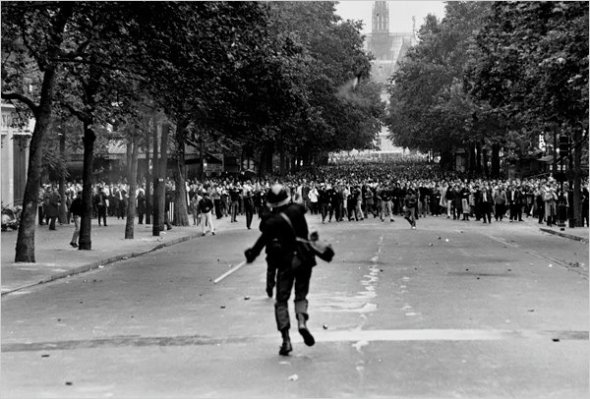
Paris, May 1968
For the past few weeks, as the protests in Tunisia spread to Egypt and then to several other countries, I’ve been reminded of the worldwide political uprisings that took place back in 1968, “the year that rocked the world.” Now that we are even seeing Americans protesting in the streets of Madison, Wisconsin and Columbus, Ohio, I wonder: could it happen again?
In case you weren’t around in 1968 or your memory is fuzzy, the Guardian published a summary of some of the events of that unbelievable year back in 2008. Sean O’Hagen describes how in May 1968, Paris
…was paralysed after weeks of student riots followed by a sudden general strike. France’s journey from ‘serenity’ to near revolution in the first few weeks of May is the defining event of ‘1968’, a year in which mass protest erupted across the globe, from Paris to Prague, Mexico City to Madrid, Chicago to London.
[….]
These rebellions were not planned in advance, nor did the rebels share an ideology or goal. The one cause many had in common was opposition to America’s war in Vietnam but they were driven above all by a youthful desire to rebel against all that was outmoded, rigid and authoritarian. At times, they gained a momentum that took even the protagonists by surprise. Such was the case in Paris, which is still regarded as the most mythic near-revolutionary moment of that tumultuous year, but also in Mexico City, Berlin and Rome.
In these cases, what began as a relatively small and contained protest against a university administration – a protest by the young and impatient against the old and unbending – burgeoned into a mass movement against the government. In other countries – like Spain, where the Fascist General Franco was still in power, and Brazil, where a military dictatorship was in place – the protests were directed from the start against the state. In Warsaw and Prague, the freedom movements rose up briefly against the monolithic communist ideology of the USSR. And in America, capitalism was the ultimate enemy, and Vietnam the prime catalyst.
Those protests, along with revolutions in music, art, fashion, and mores truly changed the world. Could it be happening again? Have we really reached a tipping point?
I thought I’d just put up some links to the important events that have taken place today in the many ongoing protests. You can add your own links in the comments (if anyone else is still awake).
More below the fold….

 peej
peej Carissa
 bostonboomer
 dakinikat
 ecocatwoman
 mablue2
 Mama Lopez
 peggysue22
 quixote
 skydancingguestblogger
 Mona (aka Wonk the Vote)



 Sky Dancing
Recent Comments